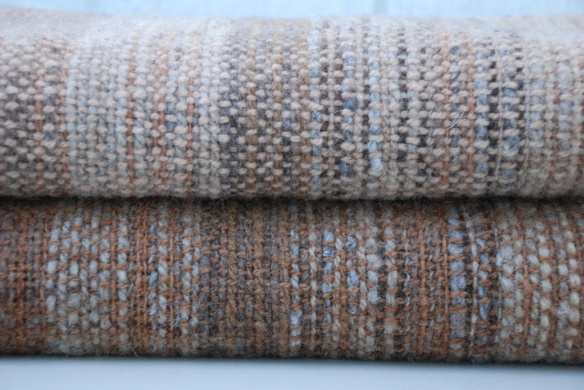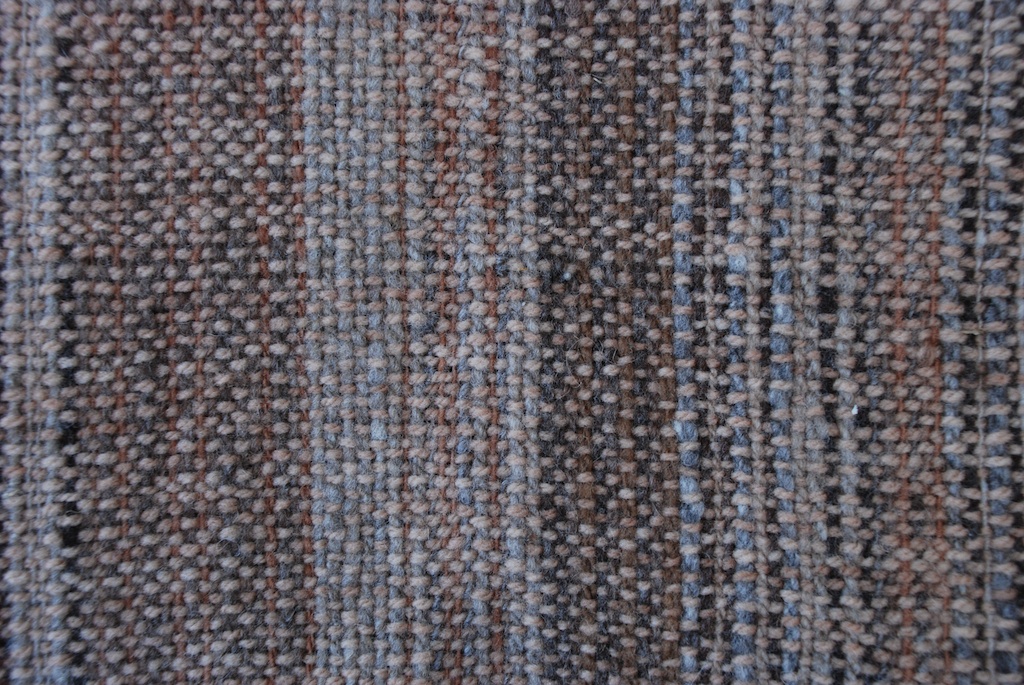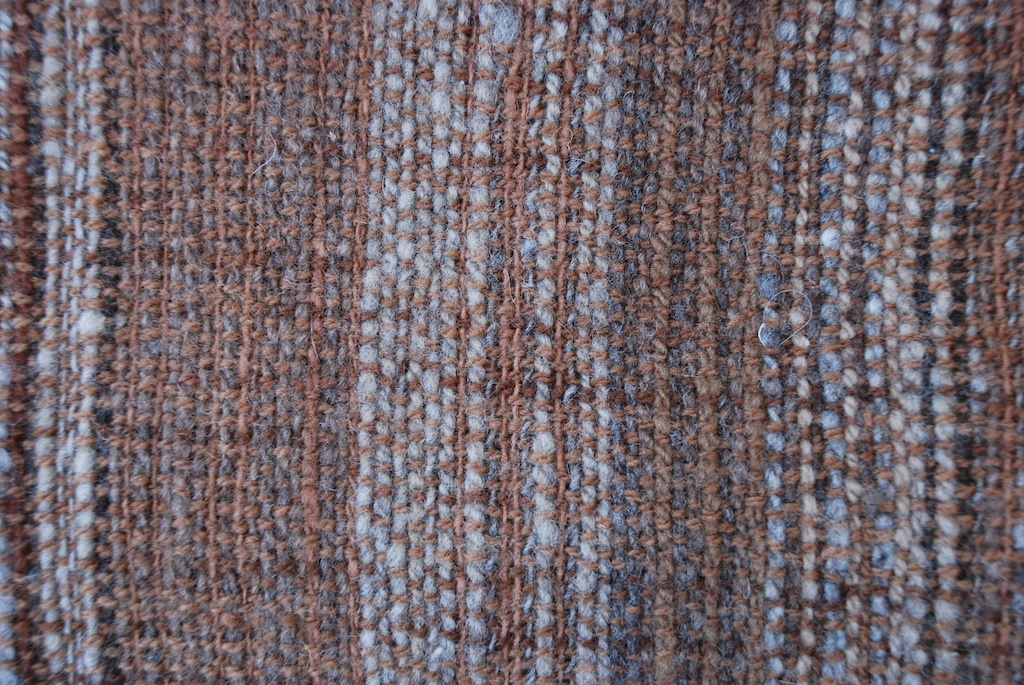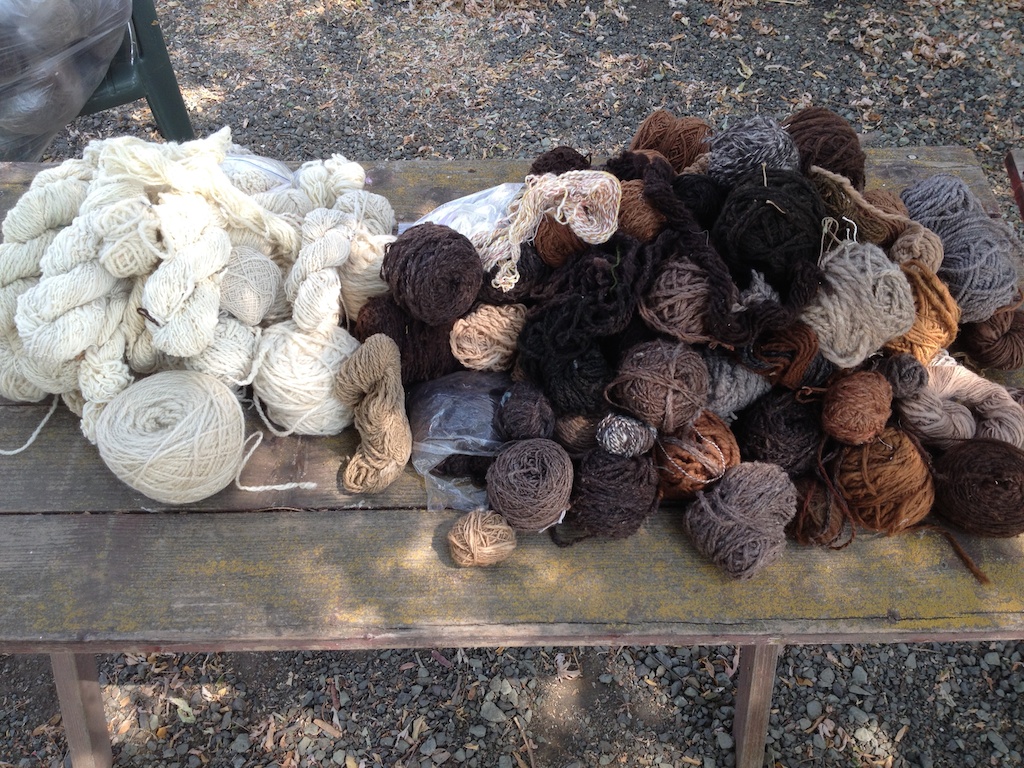
Unknown's avatar

About Robin

Owner of Meridian Jacobs, farm and fiber shop. I raise Jacob sheep, teach fiber arts classes, weave handwovens for sale, and manage the store.

Close to Home…Interrupted by Orange Kitty

I think I’ve written 9 blog posts about my show, Close to Home. There are more to go but I have to interrupt the series briefly.

About five days ago the dogs were barking at something in the yard. Well, Maggie is always barking at the squirrels outside the yard but this time it was an orange cat who had it’s back up and was hissing. I got the dogs in the house but the cat was gone when I went back outside.

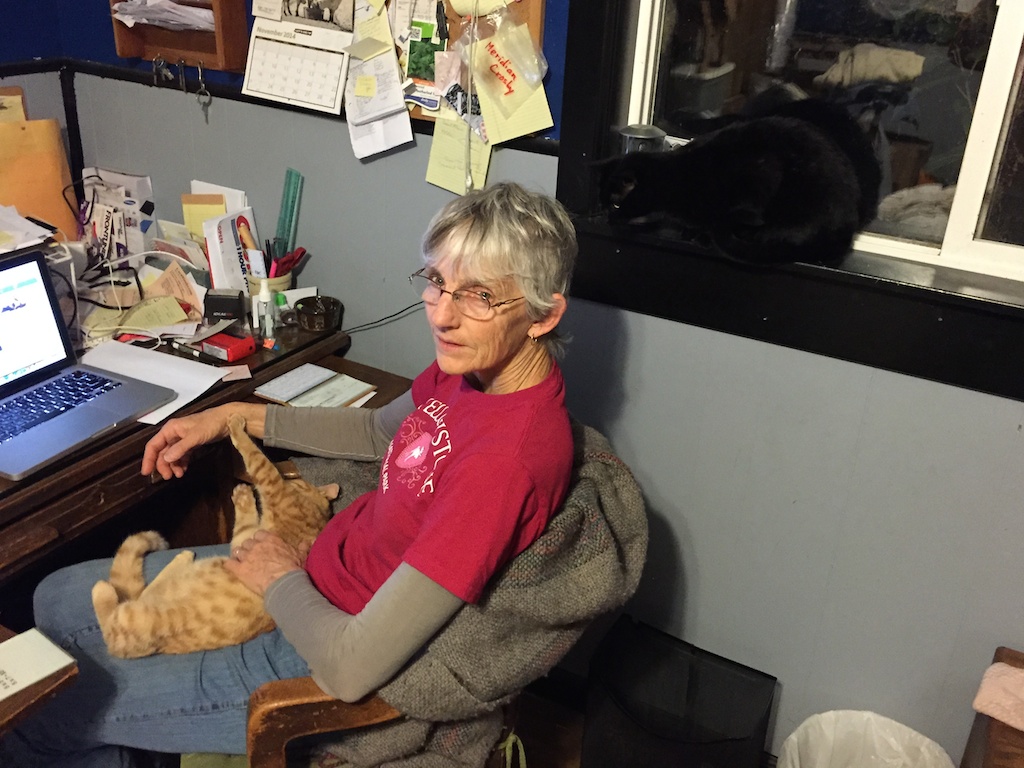
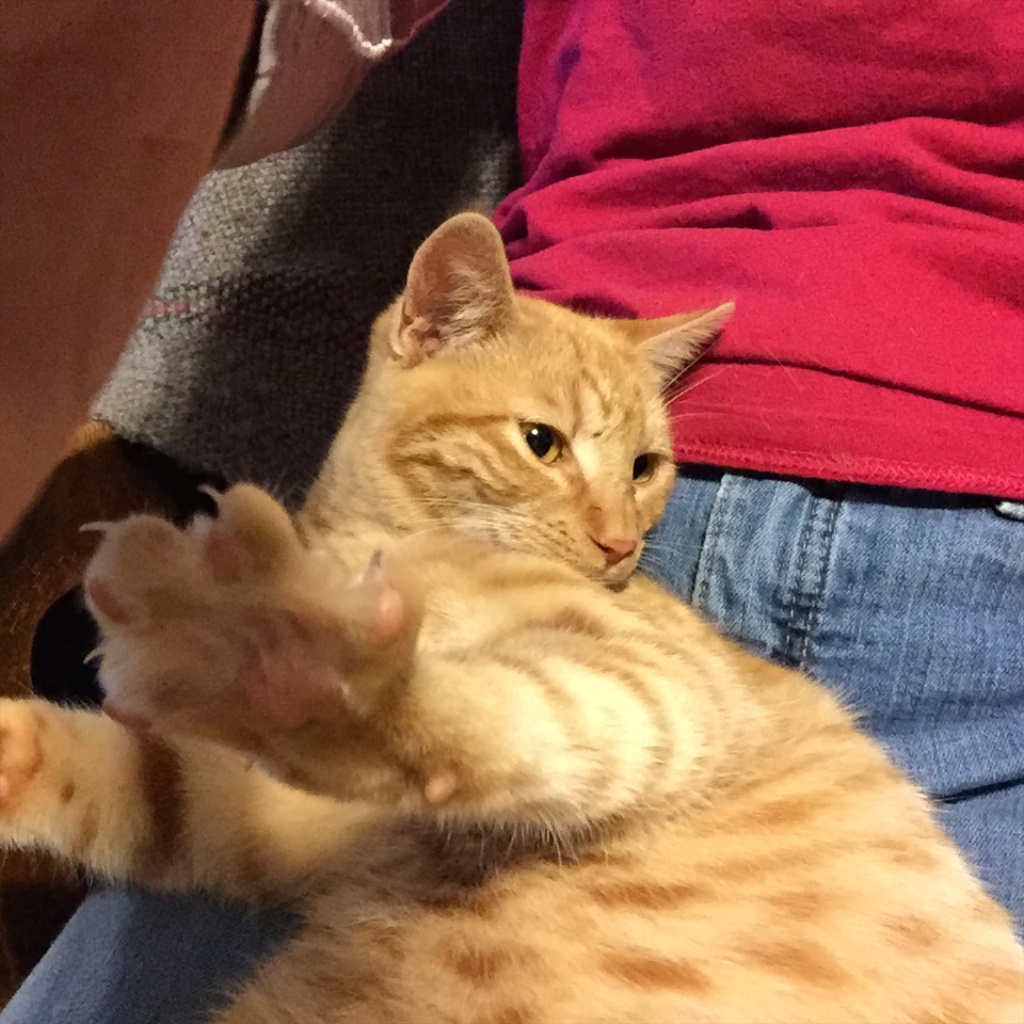
Monday I was teaching a weaving class and Maggie wouldn’t stop with the barking. I brought her in the shop with us but she started to bark when I let her out again. Rusty was no where to be seen which is unusual. I found him in the garden area staring (as only a Border Collie does) under the house. It was evident that the dogs had been digging there and that someone (my guess is Maggie) had been chewing at the wood beam that holds up the house. I blocked off the area so that at least our house would remain intact. Tuesday before the weaving class started up for the day the dogs were at it again but this time in the cellar access. I went down there (with all the cobwebs and other creepy things) and found the orange cat. I donned leather gloves and caught it. The class was going to start so I put it in a crate in the barn for the day. When I went out later I discovered that it was a “he” and he was a young very grateful-to-be-petted kitty.IMG_0127 I didn’t want to leave him in the small crate in the barn all night so I thought I’d put him in a larger crate in my shop.IMG_0135 That didn’t last long. IMG_0140 After I got back from a Board meeting at the Artery I brought the crate in the house and the kitty spent most of the evening in my lap while I sat at the computer. Note Ozzie who blends into the darkness on the windowsill.I
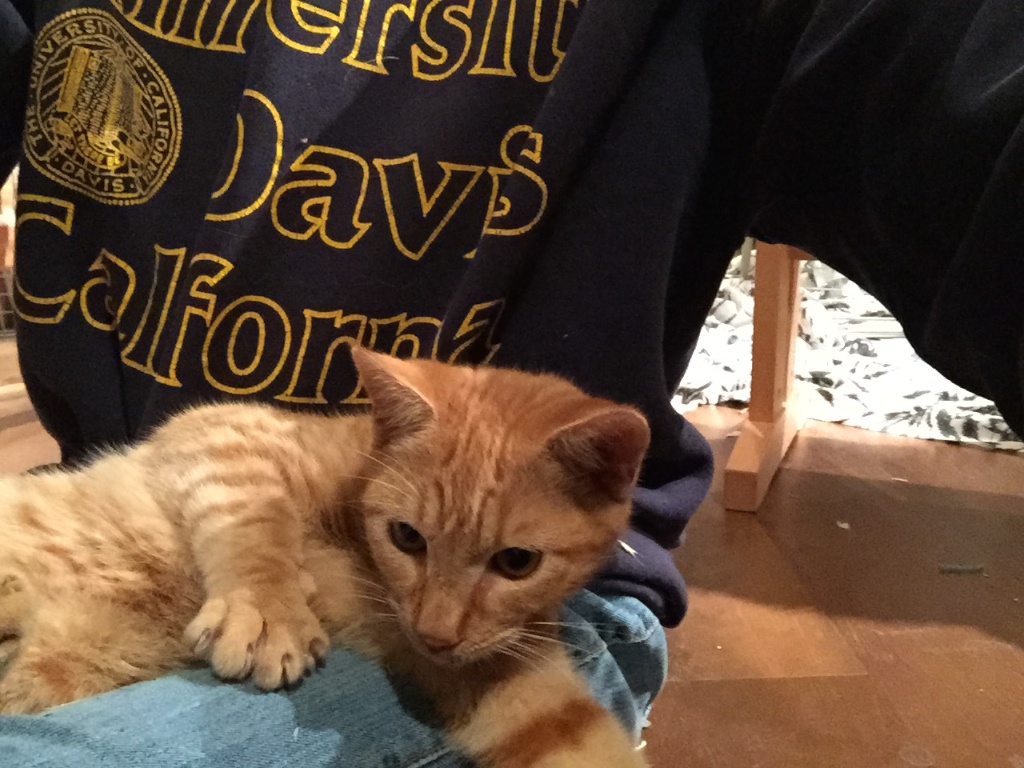
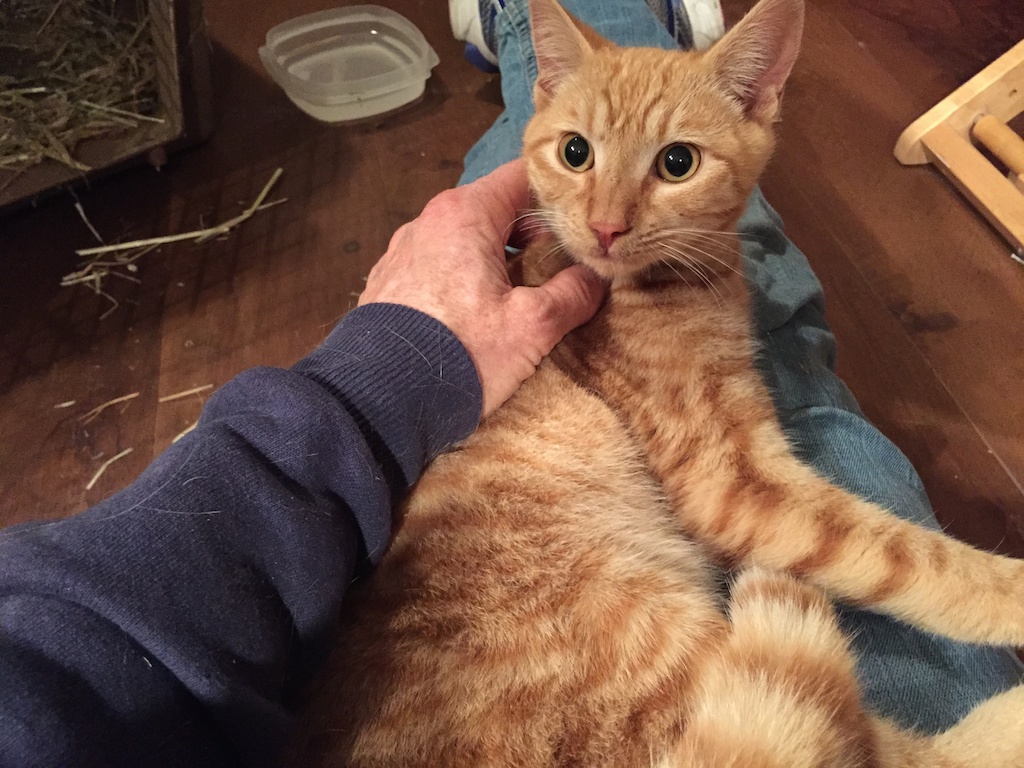
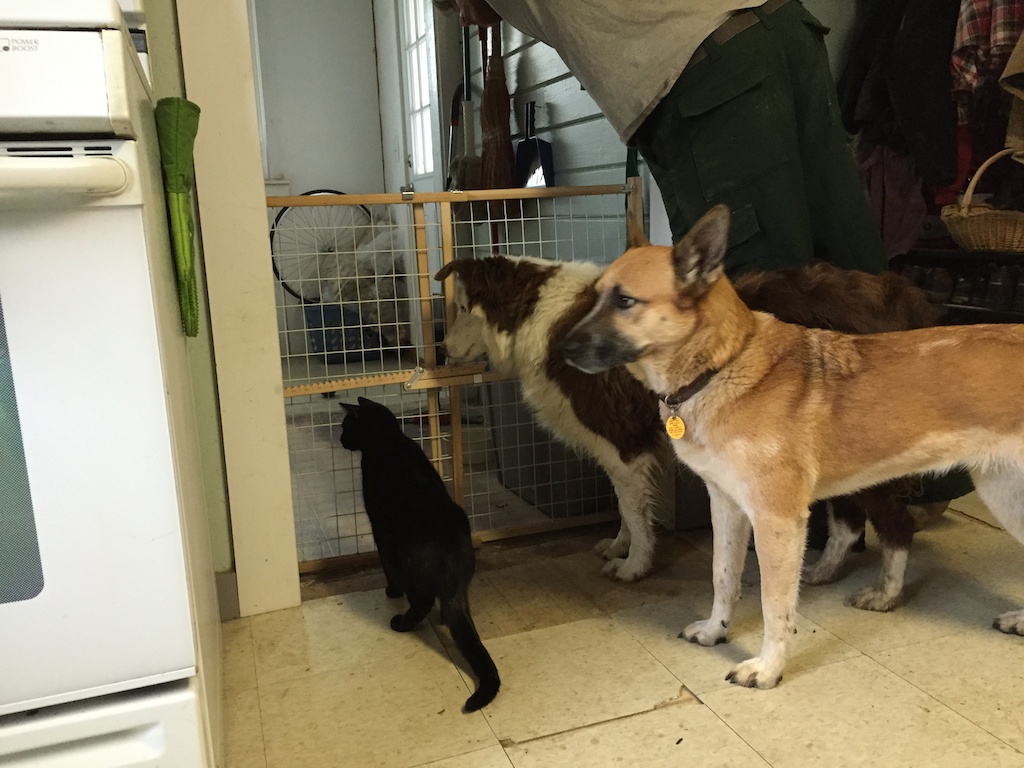
IMG_0142 IMG_0166 This morning I put up a fence and let the kitty on the back porch where there is a litter-box.  (Did you know that WordPress corrects cat box to read hatbox?) Everyone watched.
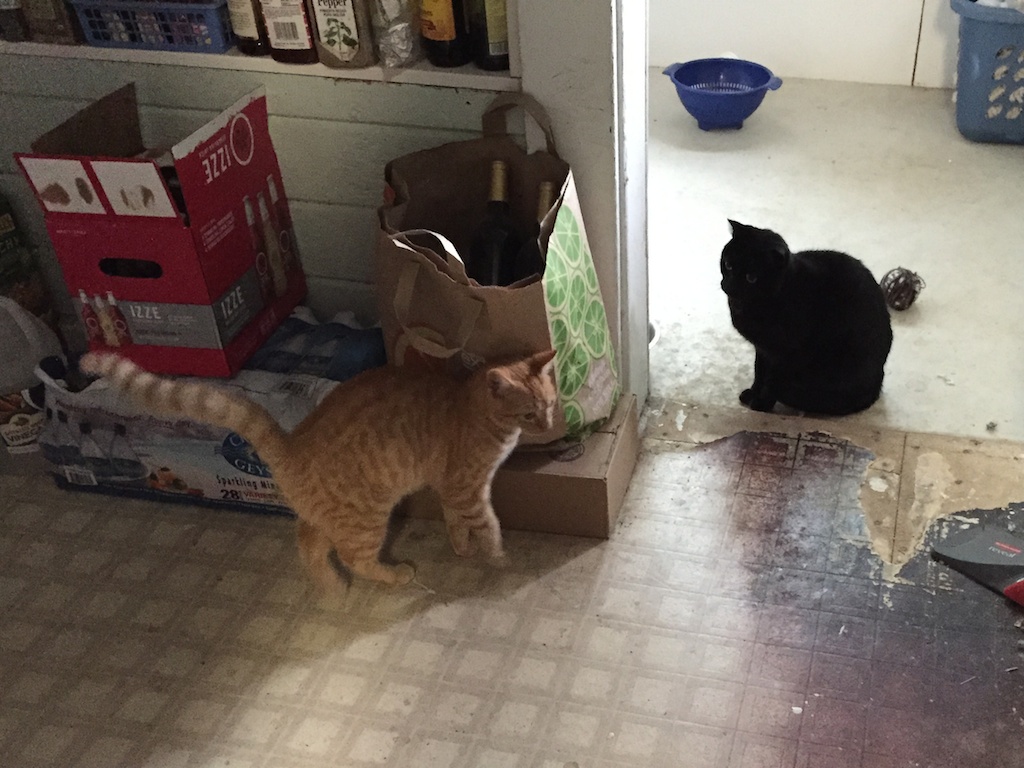
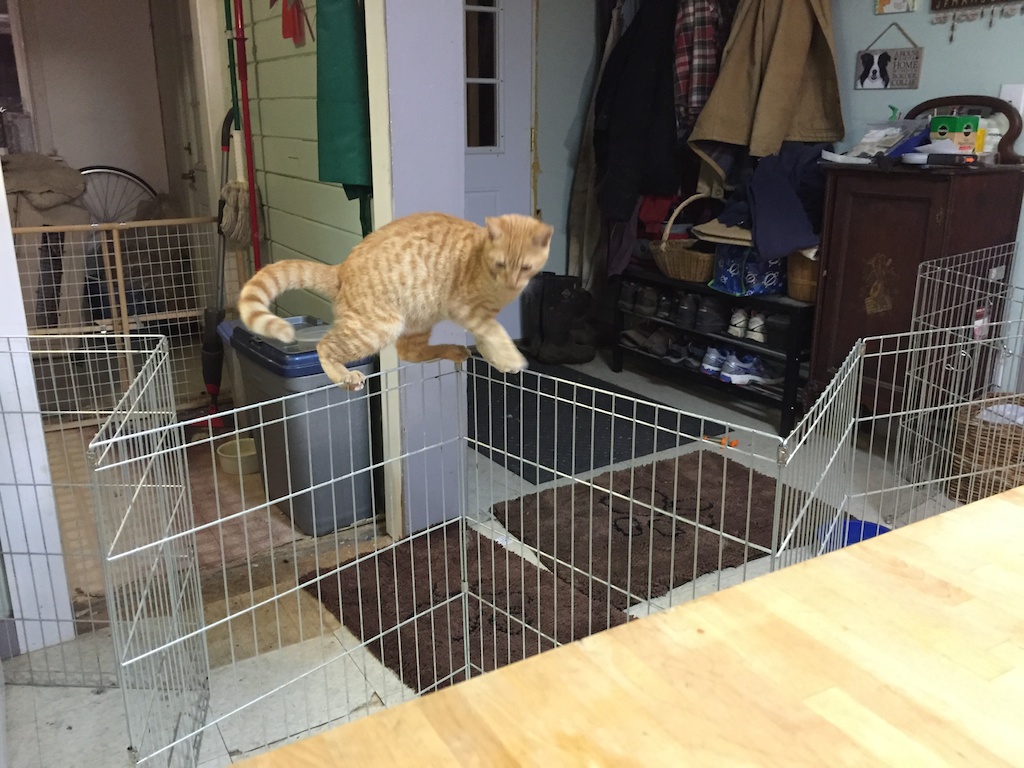
IMG_0168 Ozzie could come and go but remained skeptical. I spent longer than I should have, not watching kitten videos, but taking kitten videos. Later I put the kitten back in the crate while I was outside. Tonight I let him out on the back porch again with the fence to keep him contained.IMG_0180I guess that was a short-lived solution to keeping him in a safe area.
Close to Home…Post #9 – Phillips Farm

The Phillips Farm is about a mile down the road from my place and I used their wool in the show at The Artery.DSC_1956 DSC_1970 Story:  The Phillips family lives down the road from my farm and they raise a small flock of Suffolk sheep for lamb and meat production. For the last few years I have acquired their fleeces and used the wool in woven blankets and for felt projects.

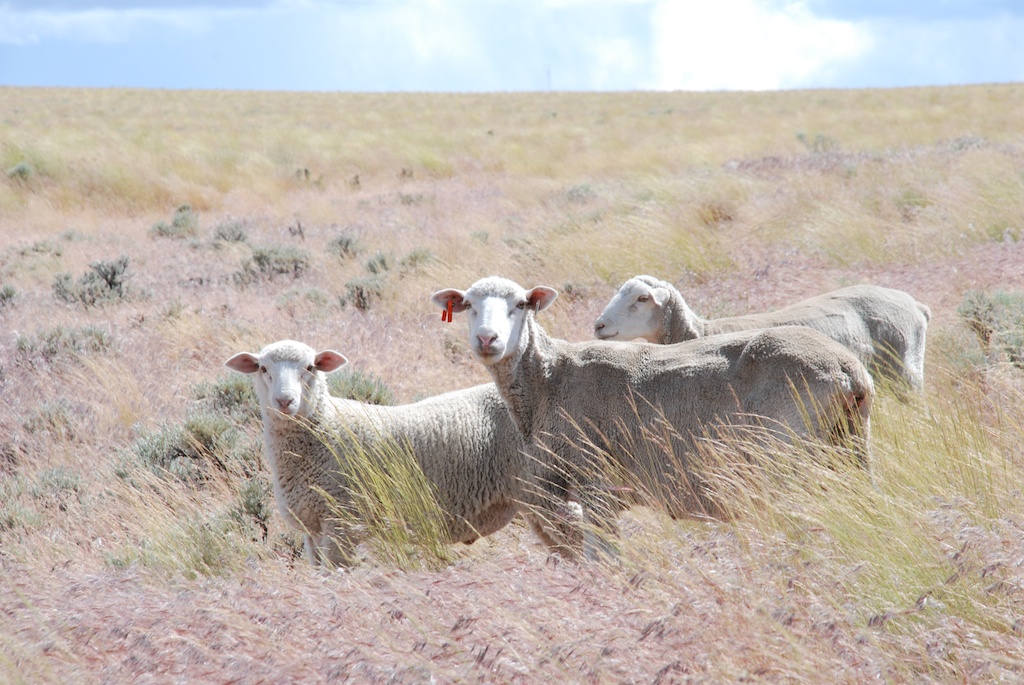
Suffolk sheep are an English breed developed in the early 1800’s and brought to the U.S. in 1888. Suffolks are large black-faced sheep that are often used as a terminal sire for range flocks. They produce a lofty, medium grade fleece measuring 25.5 to 33 microns.

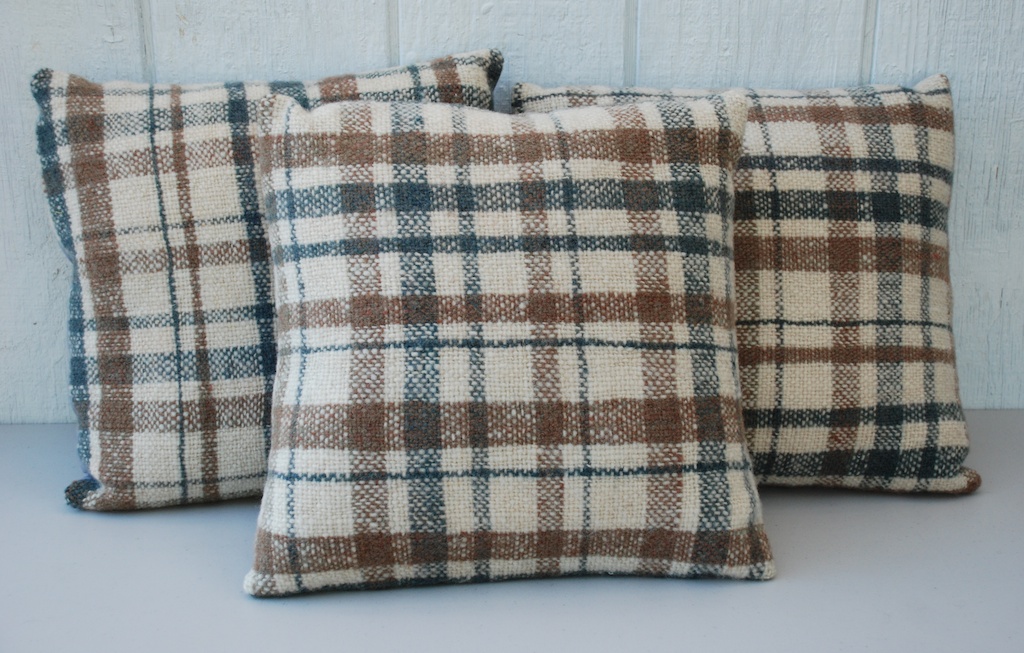
I sort the fleeces and have the softer wool spun into yarn for use in blankets and shawls. The coarser wool is carded into batts at Yolo Wool Mill in Woodland that are used for felt projects and pillows. The natural springiness and loft of Suffolk wool makes it the perfect pillow stuffing. DSC_4171 I sent these fleece samples for testing and the result came back 29.4 microns. In the past I have used this wool for blankets but with access to a friend’s felt loom (machine for needle felting) I decided to use most of it for felt this year. The felt I made is a combination of the Suffolk wool and Jacob britch wool.felt placemats I made three series of placemats (10 to 12 in each).felt placemats felt placematsI also made larger (door) mats and smaller (mug rug) mats.F-46Cutting up all that felt leaves odds and ends of felt. What is better to do than to turn them into weaving projects? So I made these woven felled wall hangings…Dryer balls …and dryer balls. I delivered the prototypes of these to the Artery last year and found a customer who wanted to juggle with them. Here’s a short video of that.

…and dryer balls.

Close to Home…Post #8 – Fiber Confections

I raise black and white sheep and my friend, Colleen, raises brown sheep so between us we have all the natural colors. I used some of her wool in my show at the Artery. If you’re just starting to read these posts go back to this one to read about the concept of this show.

I don’t have the sheep photo I used in the show because I borrowed the print from Colleen…CVM…but this one shows the distinctive color pattern on the face.

The story: Colleen Simon got her first sheep about 15 years ago. Since then her spinning and sheep raising hobby has evolved into a fiber business. She keeps about 20 ewes of varying shades of tan and brown and markets their wool as roving and yarn at the Davis Farmers Market. Colleen is an expert felter and creates felted hats and embellishments from her fiber. She sells her creations at the Farmers Market as well as at local festivals and Grand Hand in Napa. Lambs are sold to Superior Farms in Dixon.

Colleen’s flock is a blend of fine-wooled Romeldale, CVM, and colored Merino sheep. The Romeldale is a rare breed that was developed in California in the early 1900’s. Breeding long-wool Romney and fine-wool Rambouillet sheep resulted in a breed with heavy fleeces of very soft wool. The CVM or California Variegated Mutant is a not-so-appealing name of the colored variant of the Romeldale that has a multi-colored brown fleece and “badger-face” markings. The wool is very soft and measures 20.6 to 25 microns.

Colleen lives about a mile from me and we have shared sheep and fiber adventures for years. We make a good team because my flock grows black and white wool and hers grows brown wool so between us we have all the natural colors.CVM yarn (1)Some of the beautiful shades of wool used in the shawls below.

860-2, 860-3-AWB Shawl detail Artery 2014 Detail of the shawl on the left. 

Shawl detail

Detail of the show on the right. I also wove two plaid shawls that are in the show but I don’t have photos of those. The photos below are of soft CVM scarves.

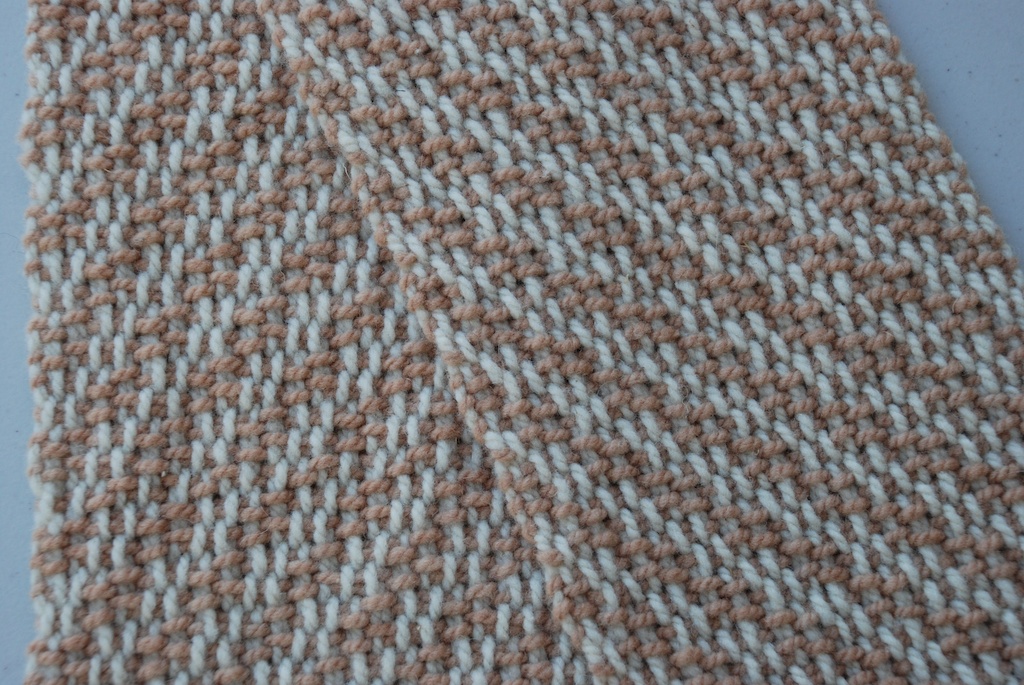
CVM scarf CVM scarf CVM scarf Colleen took this photo of sheep in her field.

FullSizeRender

Close to Home…Post #7 – Jacob Wool

I’ve been writing about sources of wool from Solano and Marin Counties and from Oregon, but of course I used my own wool too for the Artery show. How to choose a representative photo of my sheep? I used more than one. I can do that because it’s my show.Fanny FannyLola Lolarams-frontRams.

Here is the story I wrote for the show:

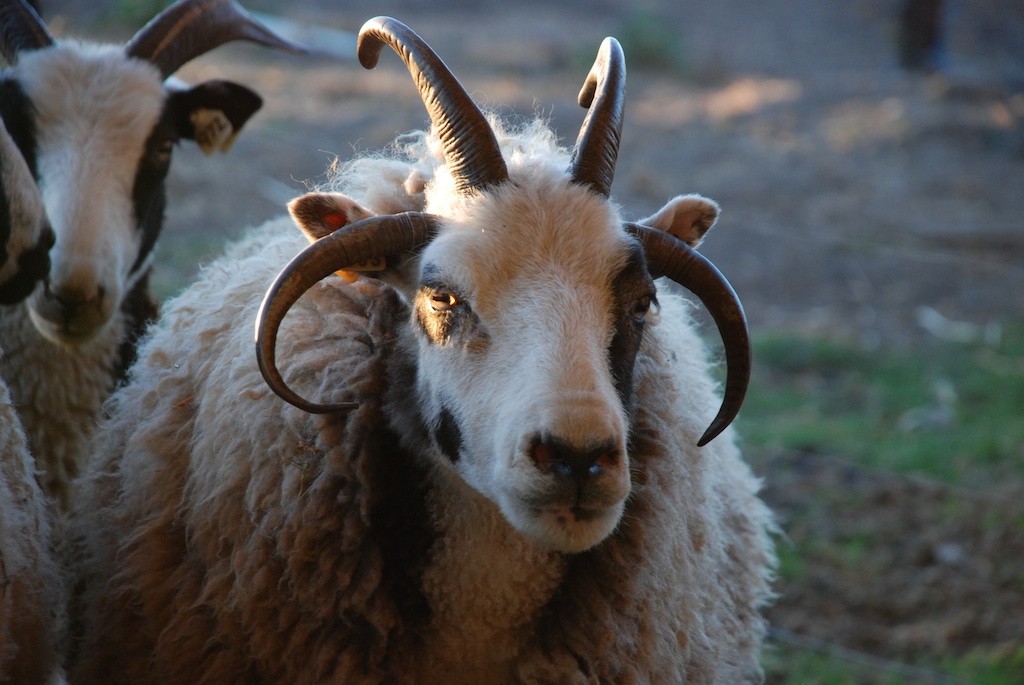
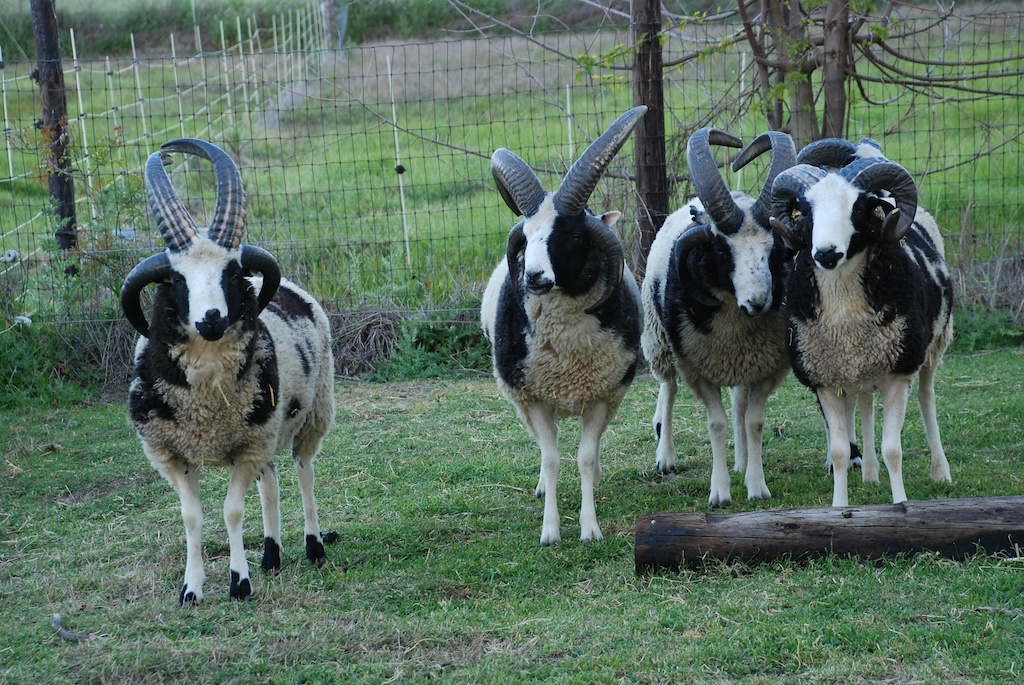
I developed Meridian Jacobs after my family moved to Meridian Road, north of Vacaville, in 1999 and I purchased Jacob sheep. The Jacob sheep is a rare breed that is hardy and well-adapted to low-input, sustainable farming practices. My flock of 65+ sheep grazes irrigated pasture much of the year and is supplemented with locally grown alfalfa during the winter.

The sheep provide me with unique wool and tasty lamb and are the core upon which I have built a multi-faceted business, selling fiber (from my sheep and other yarns featured in this show), teaching classes, and creating the Farm Club. Lambs for meat are sold to individuals and to Superior Farms in Dixon.

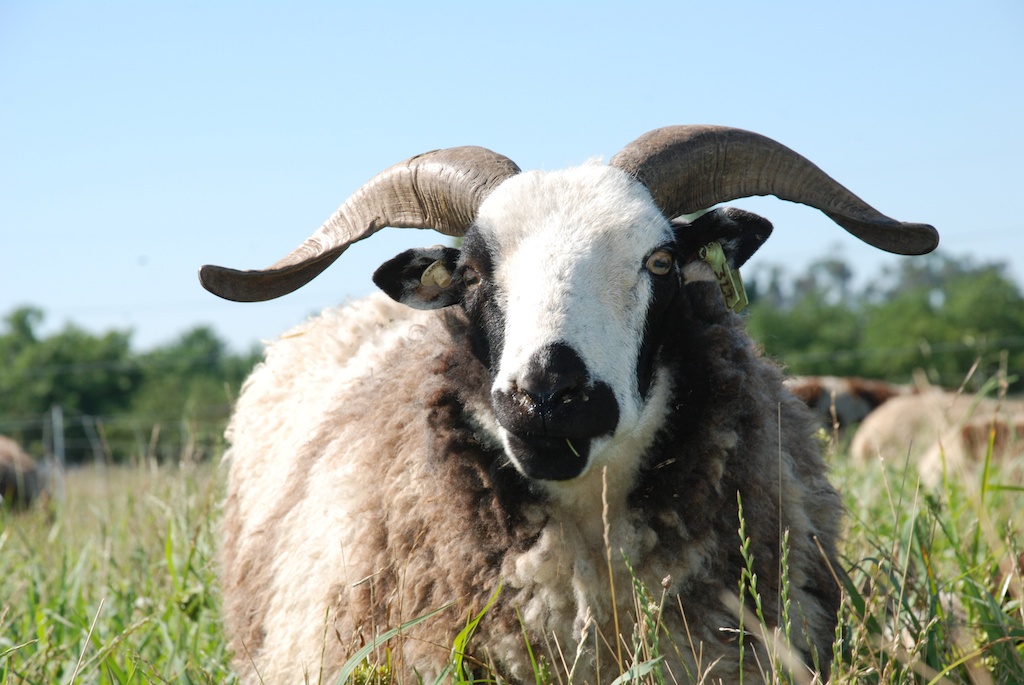
The Jacob sheep is striking in appearance with it’s spotted fleece and multiple horns. The sheep are shorn in the fall and yarn is spun at two California mills. My flock’s wool measures from 27 to 31 microns. By sorting fleeces by color and grade I produce a variety of natural shades and can use the softer fleeces for blankets and garments and coarser wool for felt items.

Meridian Jacobs evolved as I turned my passion for wool into a business.

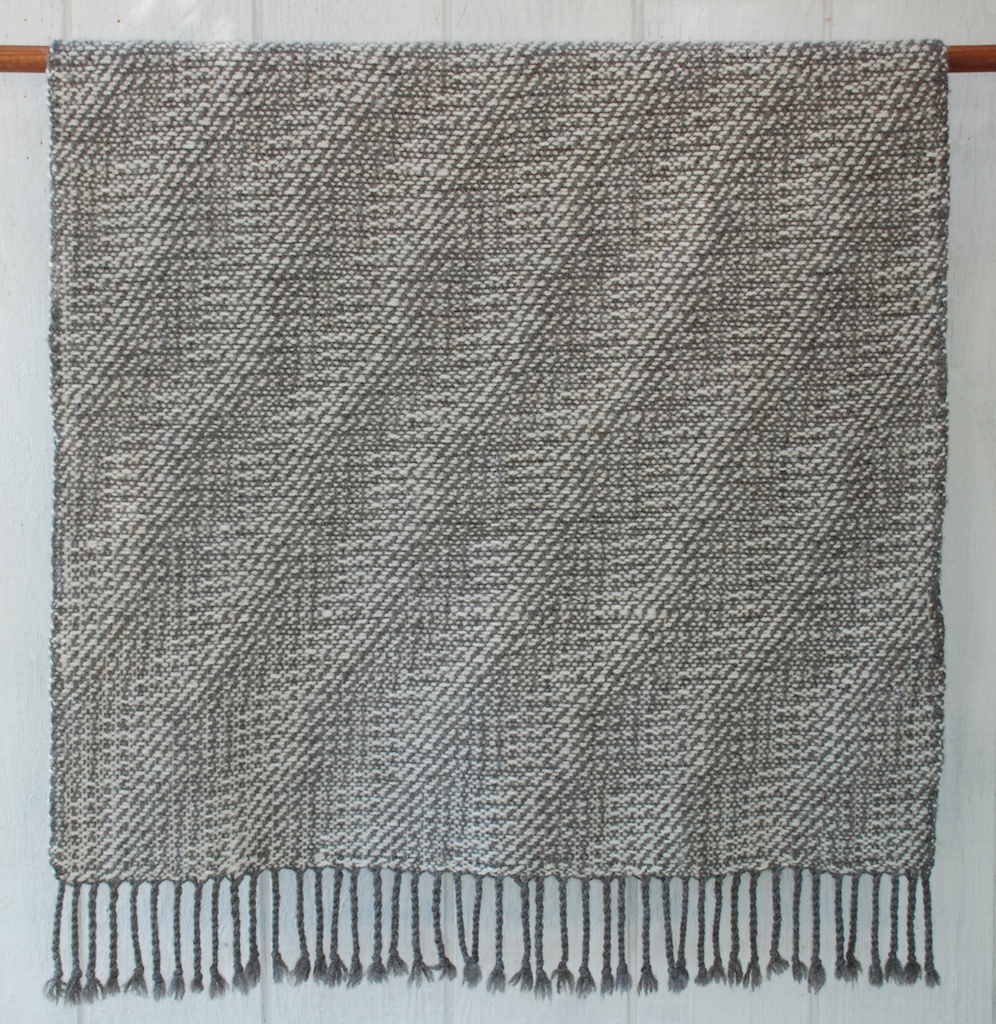
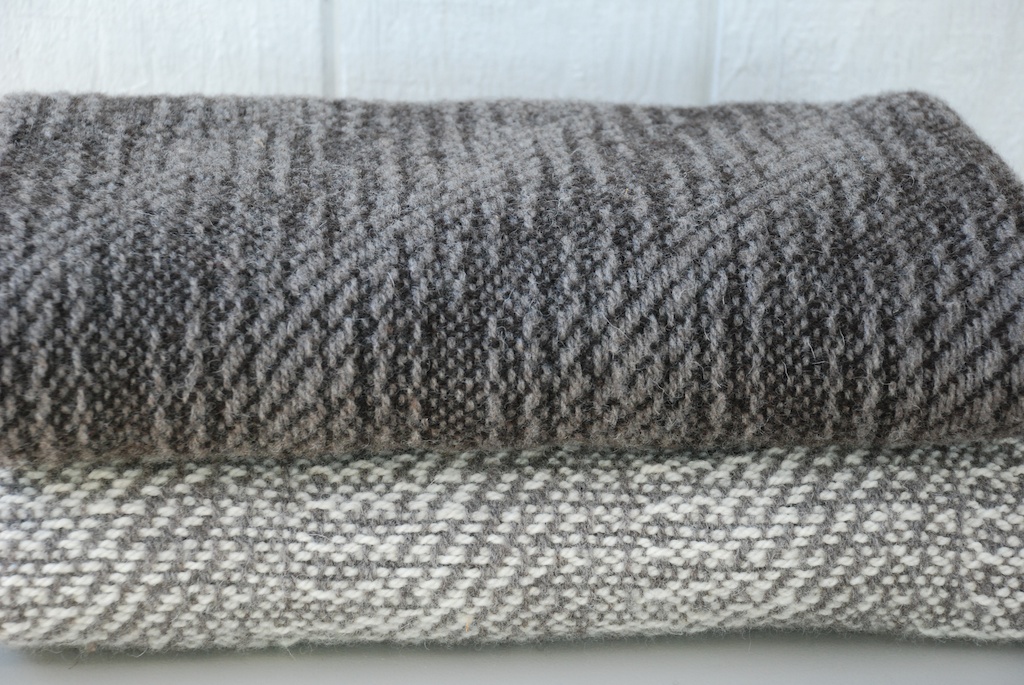
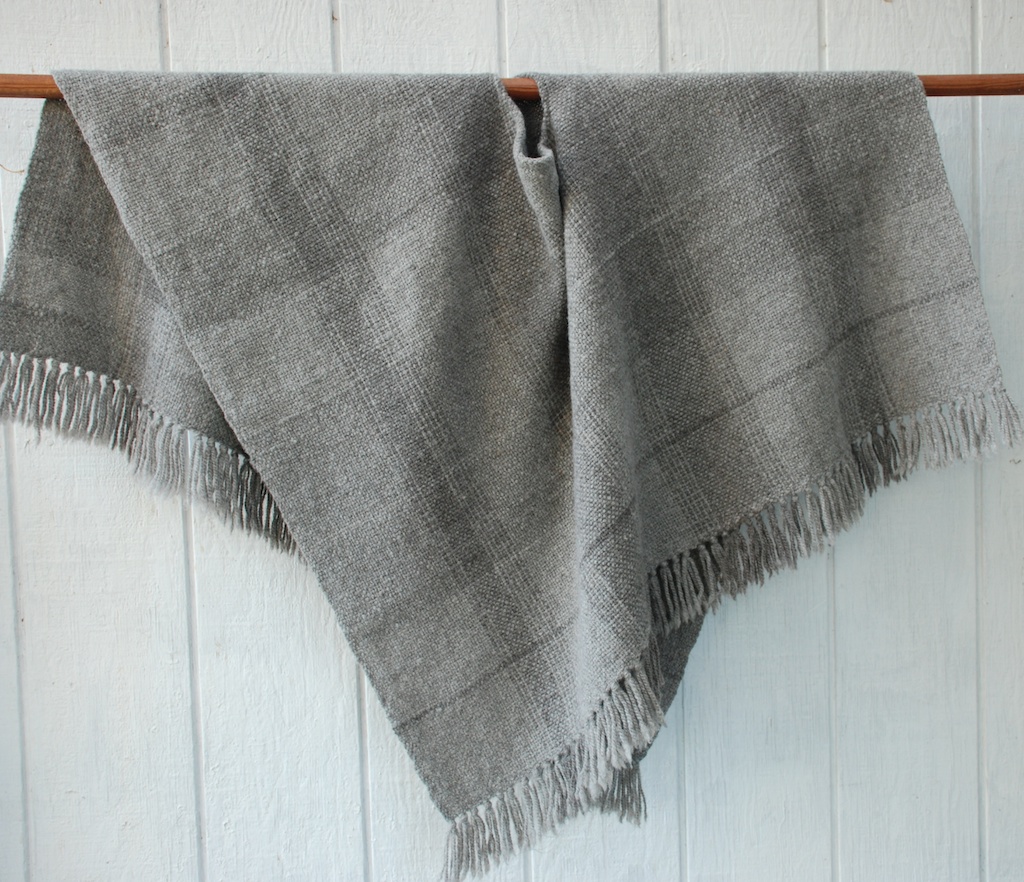
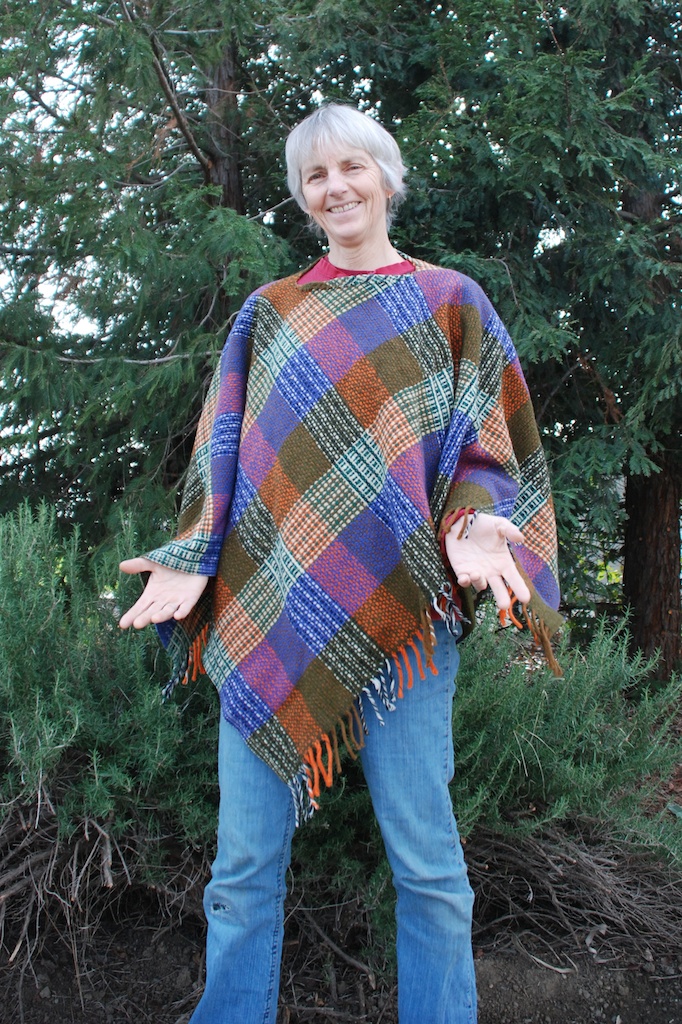
I had a limited amount of yarn from this year because I sold so many fleeces at shearing day. Some went to Farm Club members and I used most of the rest. It is beautiful yarn.Artery 2014 Jacob blanket Artery 2014 Artery 2014 These are all throw-sized blankets.Jacob blanketThe cool thing about Jacob wool is that you get all of these natural colors without dyeing. For this blanket I used odds and ends of the yarns that were left in warp and weft. It was going to be a poncho along with the other blanket on this warp. I have a poncho that I wore in high school:ponchoYes, I still have it because I always planned to use it for a pattern. (When I put it on it makes me look 17, right? Glasses are gone. With camera angle, you don’t see as many wrinkles. You can pretend that I bleached my hair back then.)Jacob wool 2014Anyway, the fabric in the first “poncho” photo was larger than the poncho that I wanted and it looked and felt so nice as a blanket that I didn’t cut a hole in it. (Good thing–it has sold to someone and it will be shipped to Australia.) This fabric was about the right size so I did turn it into a poncho. It can be purchased at the Artery (or from me after the show).887-4This is a scarf from more of the left-over yarn.
Close to Home…Post #6 – Anderson Ranch wool

Last March I watched some of the shearing on a large sheep ranch in southern Solano County and I brought home fleeces. Here is the blog post from that dayRio Vista shearingIn September I got the yarn back from the mill and used it for pieces in my show at the Artery.
Story that is part of the show:  Margaret and Ian Anderson farm land that Ian’s great grandfather settled in the late 19th century. While Ian’s great grandfather raised only sheep and grain the modern ranch is a diversified farming operation growing hay, grain, and cattle as well as sheep. The original sheep on the ranch were mostly Corriedale but today’s 3000 breeding ewes are a blend of Corriedale, Polypay, and Rambouillet breeding. The ewes are bred to Suffolk and Rambouillet rams to produce each year’s lambs. The lambs are raised in adherence to the strict animal handling and environmental sustainability protocols of Niman Ranch, where most of the lambs are marketed. Local sources of Anderson Ranch Lambs are Nature’s Bounty near Vacaville and Chuck’s Custom Slaughter in Dixon.

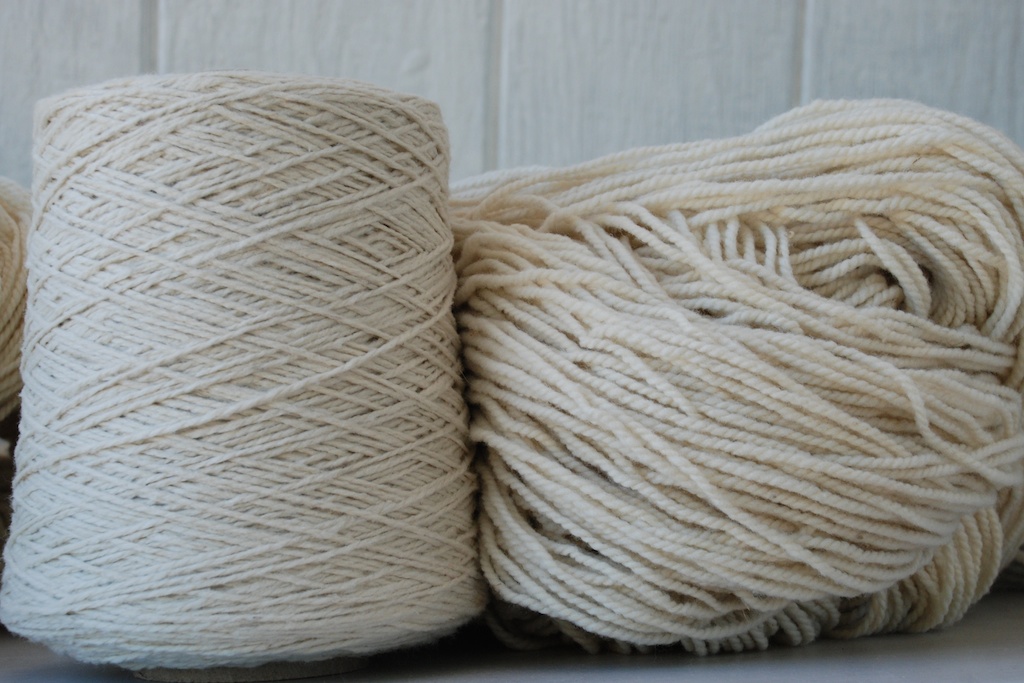
As in many U.S. sheep operations the Anderson Ranch wool is handled as a by-product and is usually baled and sold in bulk. Last spring I watched some of the shearing and brought home about a dozen fleeces. I sorted and pre-washed the wool and shipped 90 pounds to Zeilinger Wool Company in Michigan, one of the few mills in the U.S. that can adequately process fine wools in small quantities. The wool was spun into 54 pounds of 2-ply-sport weight yarn. The fiber averages 20.4 microns. Feel how soft it is for yourself!

Rio Vista yarn

This yarn, like the yarn from the Timm Ranch and processed at Zeilinger’s, changes dramatically from it’s coned form to skeined yarn or finished piece. I will do another blog post about that because it’s so cool to see the changes. This would make a great knitting yarn as well (although I’d skein and wash it first) and it is on my website for sale now.Rio Vista yarn Anderson RV yarn Anderson RV yarn This blanket and the one above it are woven with the same weave structure, but they look different because one has dyed weft. The browns are dyed with black walnut.Anderson RV yarn Anderson RV yarn, osage orange dye This blanket has weft dyed with osage orange that grows across the road.Anderson RV yarnI also wove some scarves.Anderson wool, eucalyptus dye Anderson woolThis is beautiful yarn, very soft and would make great knitted scarves or caps. I look forward to weaving more projects with it. Maybe I’ll even be enticed to get out the knitting needles.

Close to Home…Post #5 – Mom’s Yarn

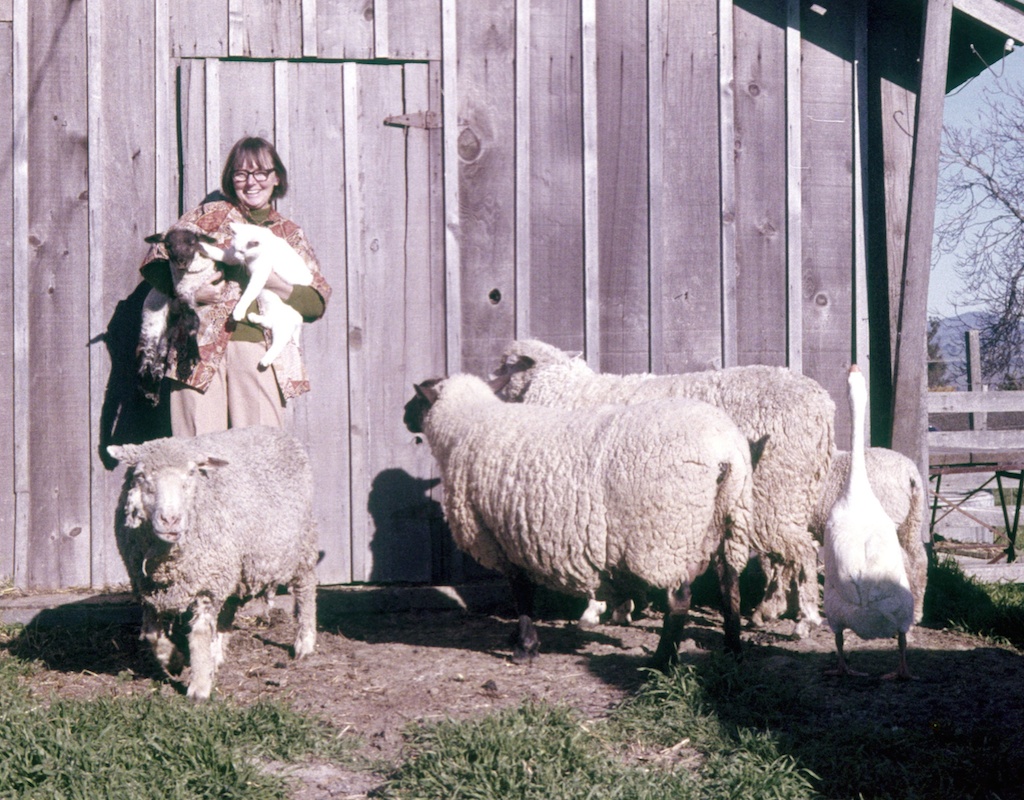
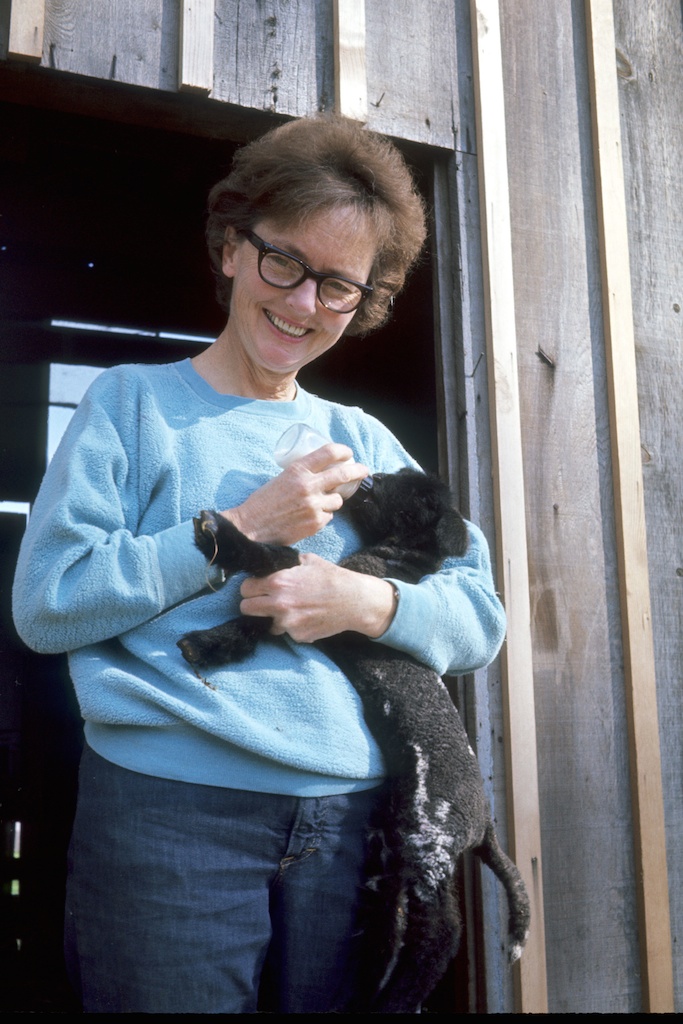
I’ve been writing posts about my show at The Artery in Davis. Here is a link to the first post  that explains the concept.Mom with sheepI used this photo in the show but had a hard time deciding between it and the one below both taken probably in the 1970’s at our place in Cotati, CA where I grew up. Mom and lambHere is the story:

Everyone I know who is a weaver has a yarn stash and I am no exception. My stash includes what I like to think of as “archival” yarns that were spun by my mom years ago. Over the years the odd ball of my own handspun yarn has ended up in the stash that I have accumulated.

Most of the yarn mom spun was from sheep that were the descendants of my brother’s  4-H project (I raised dairy cows and didn’t do anything with sheep back then) and many years later from my flock of sheep. Mom took up the hobby of spinning in the 1970’s as an adjunct to her expert knitting passion. These yarns reflect the lumpy, bumpy style of that era as that was the type of yarn she liked to use in her knitting and later in weaving.

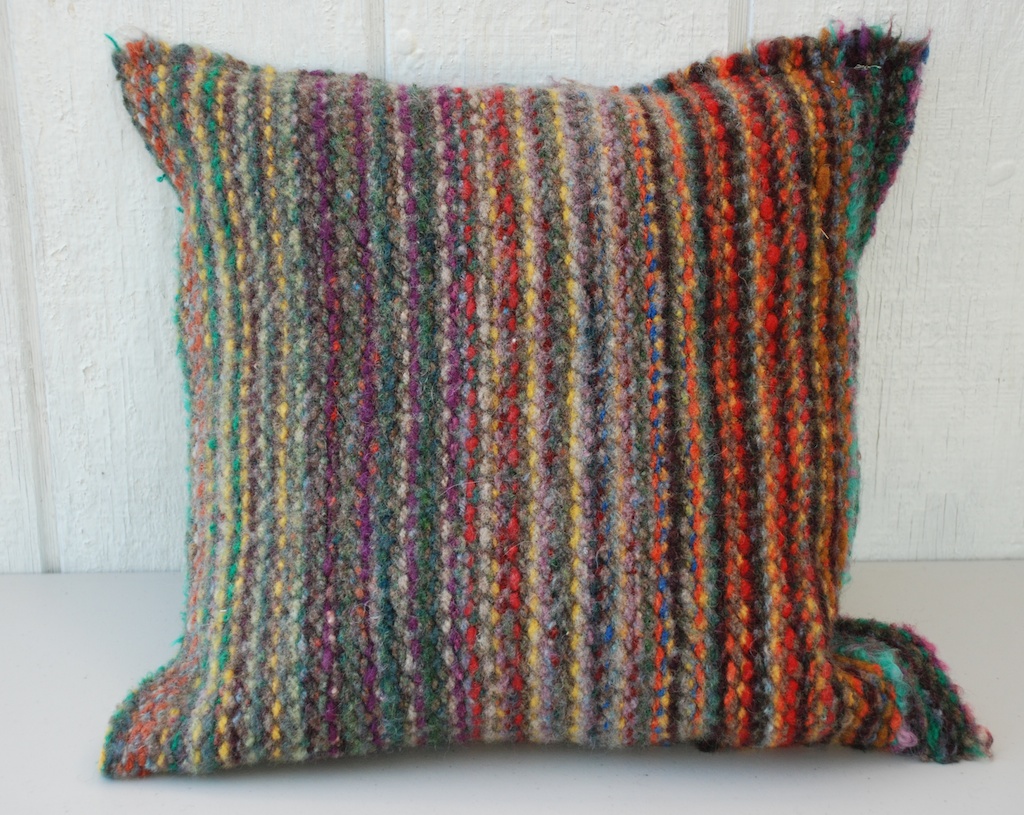
The blankets in this show that are labeled with yarn from “My Mom” are woven by me using these yarns for warp and one of my current yarns for the weft. Pillows and organizers labeled “My Mom” use her handwoven fabric scraps left over from constructing jackets, vests, or blankets.

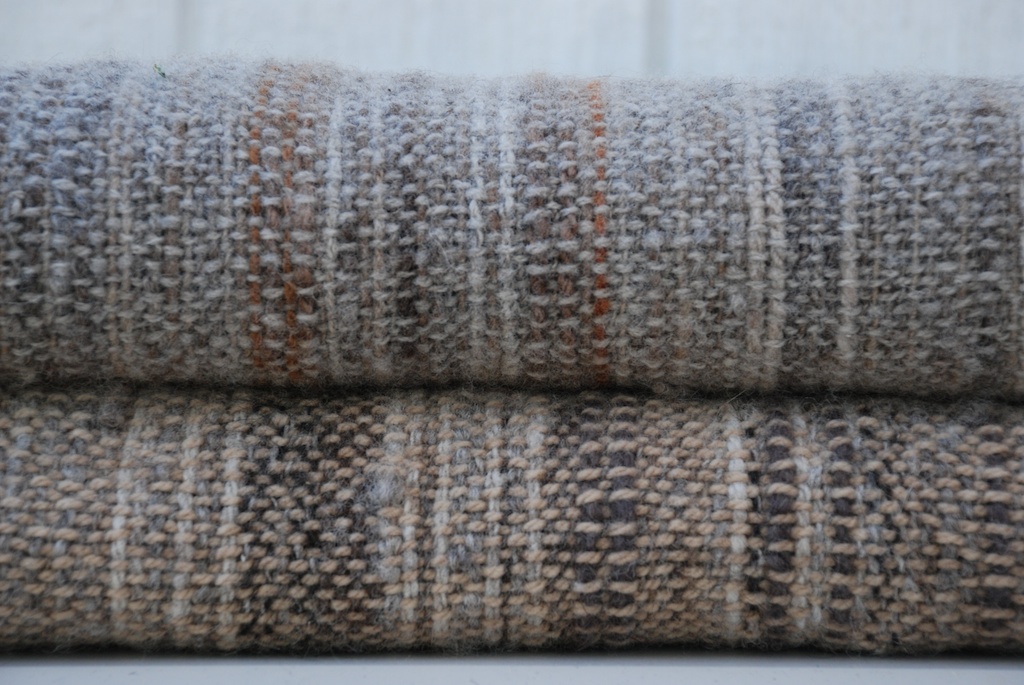
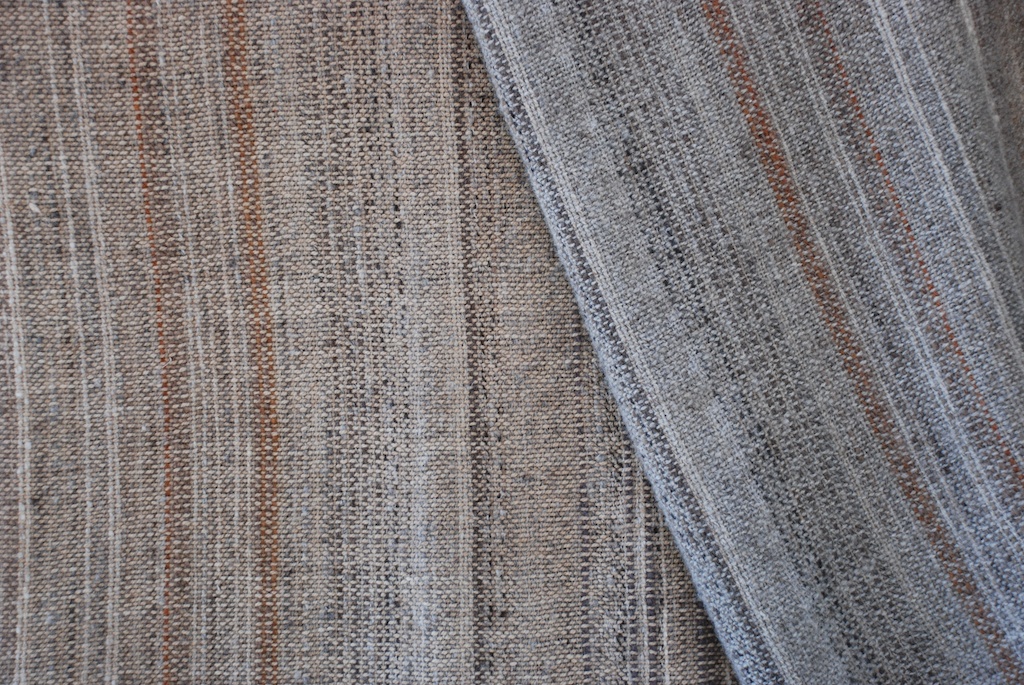
Mom's yarn Two throws, above and below. All of these blankets have Mom’s yarn as the warp. The challenge with weaving something like this is that all the yarns are of different grist, amount of twist, and elasticity. That can cause waviness (or seersucker effect) in the woven piece. By using small amounts in each place instead of big bands I can minimize the effect, but it doesn’t all go away. There wasn’t enough of any one for weft so I used other yarn for the weft yarns–either my Jacob yarn or other yarn featured in the show.Mom's yarn

Mom's yarnThe next two blankets, above and below.Mom's yarn Mom's yarn Mom's yarn for blankets This is the batch of yarns from which I worked. Not that Mom didn’t spin in color, but for most of the pieces of the show I was trying to stick true to the “local” aspect of source of yarn and dye.Uses fabric leftover from weaving mom's yarn blanket This is a pillow in the show with Mom’s yarn in the warp. This fabric was leftover from a blanket I wove for Katie when she lived in VT. See this post for a photo of that blanket.Pillow with mom's handspun fabricMom also did some weaving. This is fabric that Mom wove of her handspun yarn and I think she used some for a vest for my brother or maybe my uncle.

There will be more blankets to come using more of this yarn.

Close to Home…Post #4

Another flock represented in my current show at The Artery is The Timm Ranch north of Vacaville.Timm Ranch eweHere is their story:

The Timm Ranch is north of Vacaville on the east side of the Vaca Mountains. Susan Timm’s grandfather bought the ranch in the early 1900’s and, although much of the ranch is leased to a cattle rancher, Susan runs about 85 ewes there. Lambs are born in the fall and sold to individual customers and to Chuck’s Custom Slaughter of Dixon.

Susan’s father started with Targhee sheep and then added Polypay and Rambouillet rams to the flock. Susan’s sheep are descendants of this blend of breeds and produce a fine, soft wool.

I took home about 65 pounds from last spring’s shearing (average fiber diameter of 23.5 microns). After pre-washing (soaking and draining in cold water) to reduce weight I shipped 39 pounds to Zeilinger’s Wool Mill in Michigan, one of the few mills in the U.S. that can accommodate fine wool in small quantities. They washed, carded and spun the wool into 30 pounds of 2-ply fingering yarn.

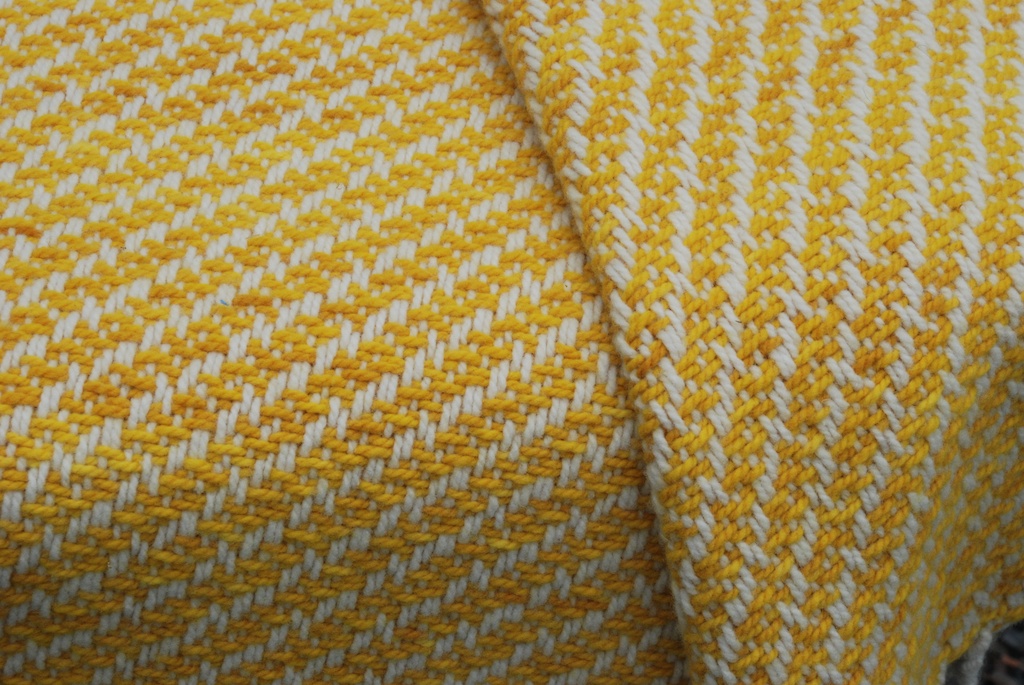
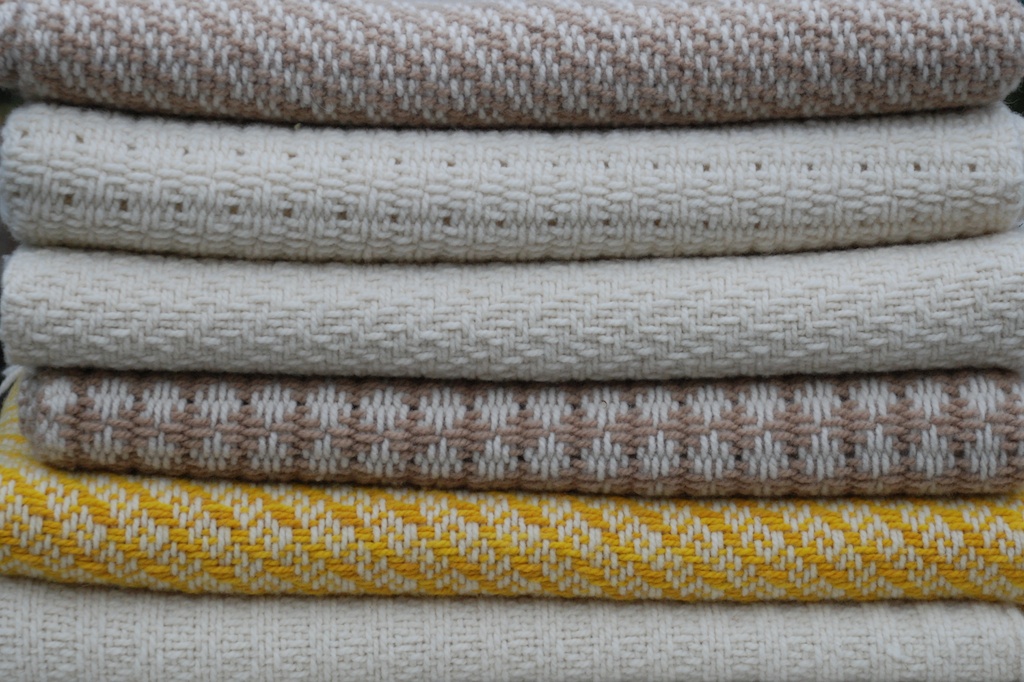
The yarn comes back from Zeilinger’s unfinished (no final washing) on cones. Washing the yarn or the finished weaving results in a seemingly magical transformation from what looks like string into soft, lofty yarn.DSC_2969 The ewes after shearing.DSC_2987 Fleeces that I took home.Timm Ranch wool Samples for micron testing.Timm Ranch woolYarn on cone and skeined. I wove a warp with six throws.Timm Ranch Timm Ranch Timm Ranch Timm Ranch Timm Ranch Timm Ranch Timm RanchThe brown yarns are dyed with black walnut and the yellow is osage orange. Both of those plants grow across the road. I also wove shawls.894-1 & 894-3 Timm RanchThese are a 16-shaft huck.

Close to Home…Post #3…Barinaga Ranch Yarn

The first post in this series explains the concept of this show. Barinaga blanketsBlankets woven of East Friesian wool from Barinaga Ranch.

Story of this yarn: Valentin Barinagarrementeria travelled from the Basque Village of Markina to the U.S. in the early 1900’s to make his life as a sheep-herder and eventually managed 5000 ewes and lambs on a range sheep operation in southern Idaho. His granddaughter, Marcia Barinaga, after a career in science journalism, and with support from her biologist husband, began Barinaga Ranch, a sheep dairy, on the shore of Tomales Bay in 2009. Her Basque cousins generously shared their knowledge of sheep dairying and cheese making and her American cousin helps with lambing in the spring. The 800-acre ranch is grazed by beef cattle as well as by the dairy sheep and is part of the Marin Agricultural Land Trust.

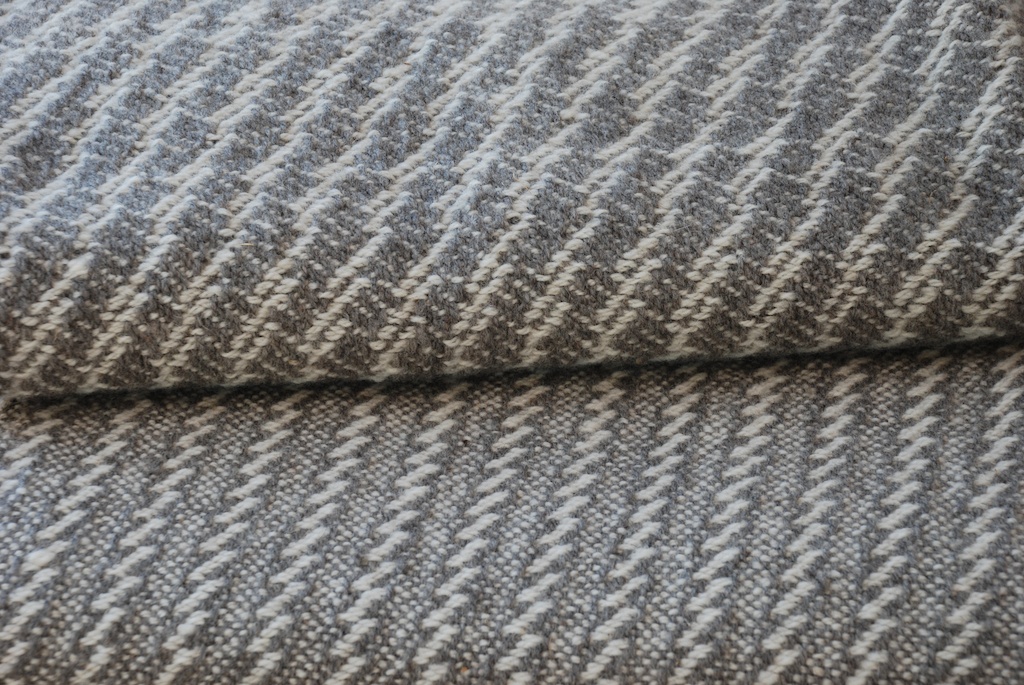
East Friesian dairy sheep originated in northern Europe and produce on the average a half gallon of milk per day during the six to eight month lactation cycle. They are milked two times per day and Marcia uses their raw milk to make Basque-style cheese that is sold all over California. Milk and lamb production (and of course cheesemaking) are the primary enterprises of Barinaga Ranch, but with the help of local Fibershed members, Marcia is developing her wool market.DSC_9395These are East Friesian ewes and their lambs. They graze the hills in Marin County but spend some time in the barn at lambing time and they were in for our Farm Club field trip. 874-5 The wool is not as soft as some of the other wools I used in the show but it is a medium grade and just fine for blankets. They have great loft and dynamic color.Barinaga East Friesian yarnCan you believe that this blanket…Barinaga Sheep Ranch…and this blanket are the same weave structure? The top one uses dark weft and the bottom one uses white.artery 2014 Barinaga East Friesian yarnI have a little of this yarn left and look forward to more blankets.

Close to Home…Post #2

I explained the concept behind my Artery show in the last post. Here are some more photos. I’ll start as you walk in the gallery. I have a photo and a story for each ranch whose yarn I used.DSC_5209Columbia sheep at the Imperial Stock Ranch in Oregon.

The story: The Imperial Stock Ranch is located on 32,000 acres in Oregon’s high desert and is owned and operated by the Carver family, who raise sheep and cattle and produce grain and hay.

In the late 1990’s the U.S. processing and manufacturing industry drastically declined (moving overseas) and the ranch, like thousands of others, was unable to sell their wool through traditional commodity channels. If the Carvers were going to continue to raise the Columbia sheep that had grazed the ranch for a century they needed to find a way to market the wool. Jeanne Carver’s response was to create and sell premium wool yarns and the Imperial Yarn Company was born.

The Carvers were thrilled to find out that their home-grown “Erin” yarn was chosen by Ralph Lauren for the 2014 Olympics Opening Ceremony sweaters. I saw this yarn at a trade show and was awed by the rich colors. I knew I had to use this for a Stars and Stripes series of blankets.

The Columbia sheep was developed by the U.S.D.A. in the early 1900’s to create a true-breeding large ewe that would yield more pounds of lamb and wool than the randomly crossbred range sheep. The Columbia is a result of crossing Lincoln rams and Rambouillet ewes and is a very large breed that produces 10-16 pound fleeces that measure 24-31 microns.

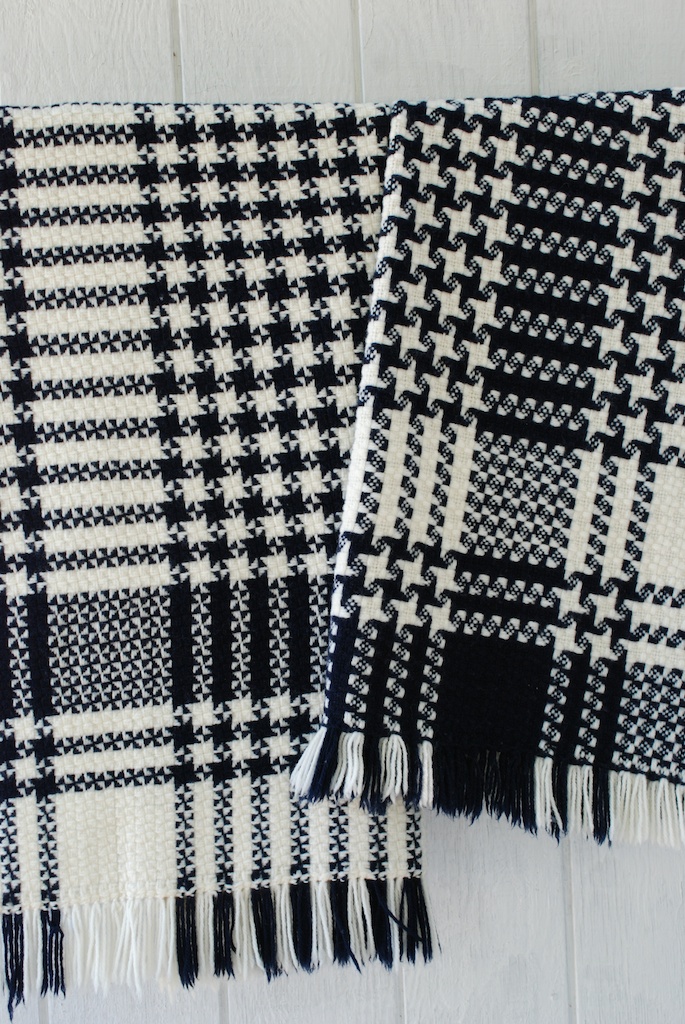
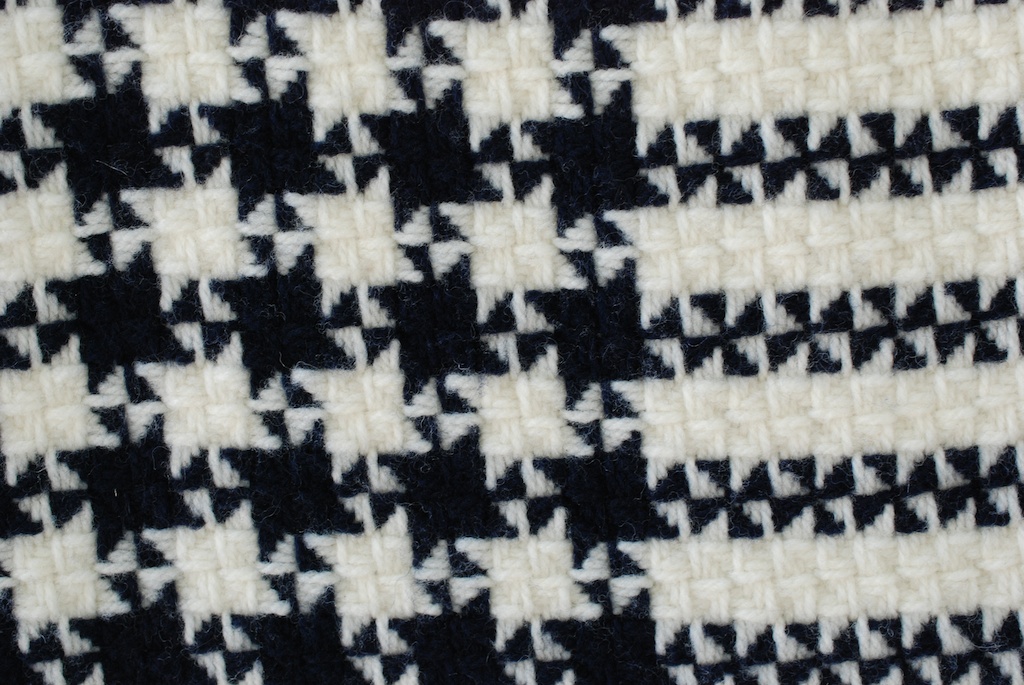
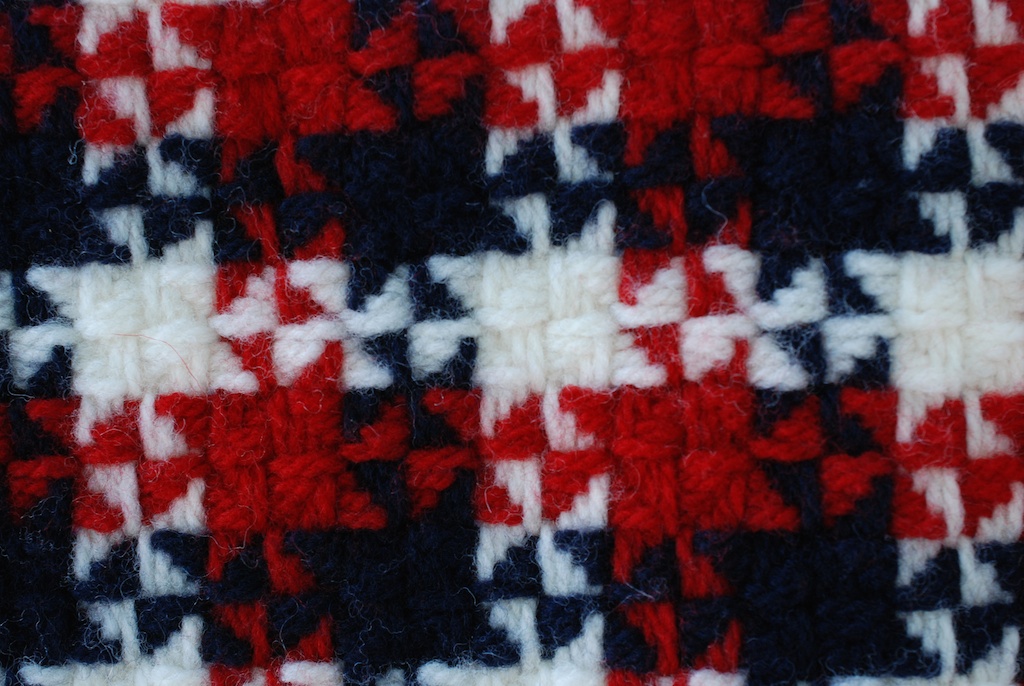
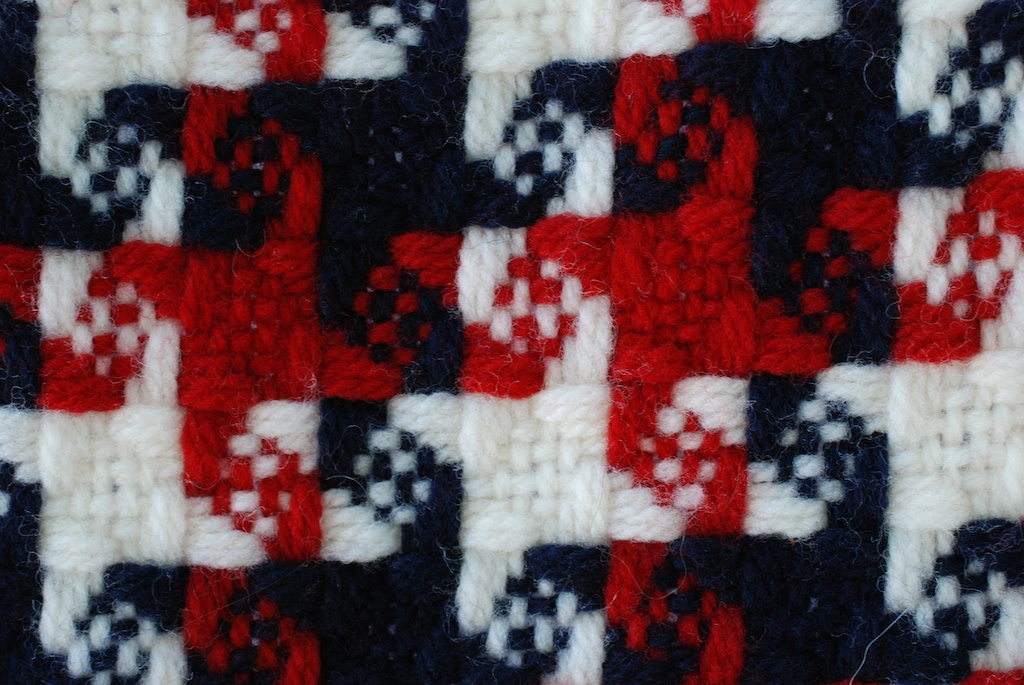
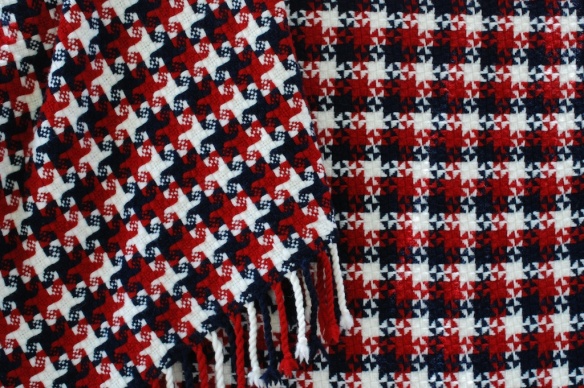
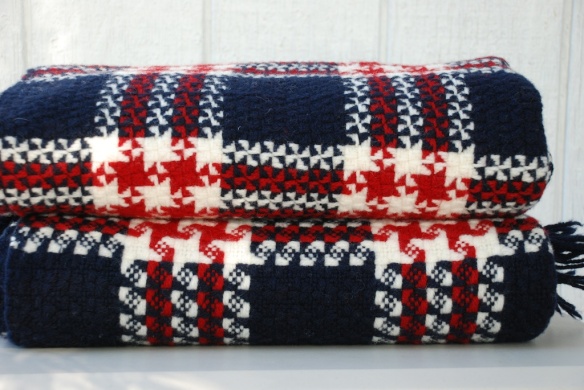
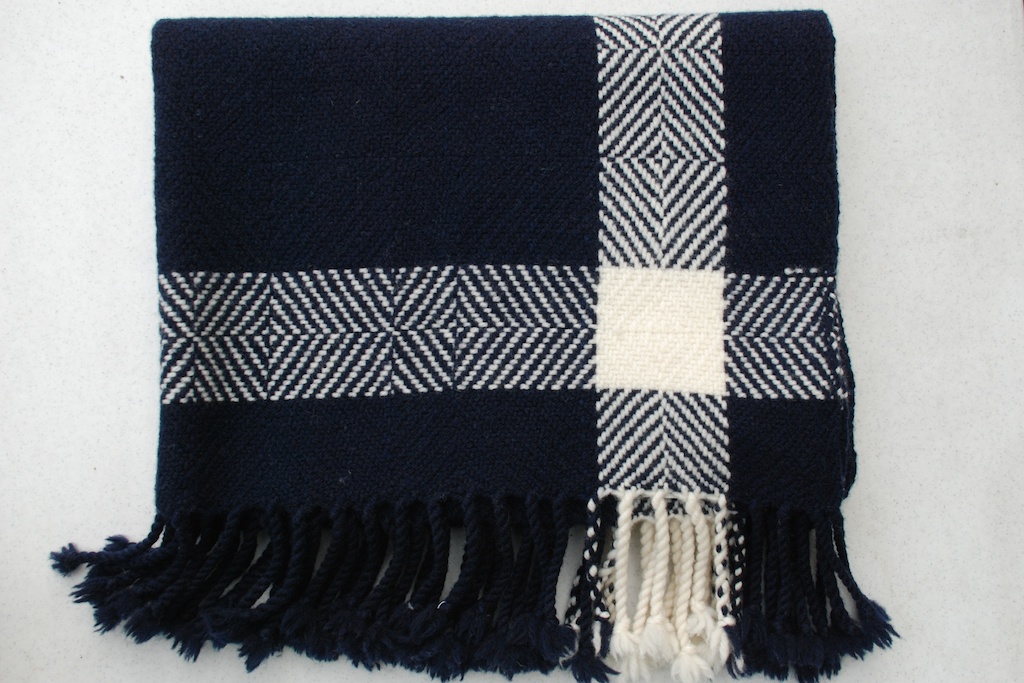
Here are some of the blankets that I wove. In another post I’ll explain the process of weaving these blankets. Also look for a later post of shawls using a fine wool yarn from the Imperial Yarn Company.DSC_5338The first blankets that I wove were in blue and white. All of these blankets except the mostly blue ones at the bottom are woven using “color and weave”. The weave structure is the same throughout the blanket but it is the color order of the threads (8 blue/8 white) in the warp and the weft that allow the pattern to show. Where there are solid areas of white or blue in warp and/or weft you don’t see the star pattern.870-2 For a true Stars and Stripes theme I needed to use some red.Artery 2014 871-2 These are the same weave structures as above but with 8 white/8 red/8 blue threads in the pattern area.Artery 2014In the first two red, white, and blue blankets I repeated the 8-thread sequence throughout.Blanket 885In the next two I designed blocks, sort of plaid like, where the star pattern would show up. Then I decided that there should be something in this collection that was more restful for the eye. IYC blanket  I thought about solid colors but had to throw in a bit of design.IYC blanketIn addition to being colorful this yarn is very soft and wonderful to work with for weaving or for knitting. I sell it at my shop and on the website.DSC_5378 - Version 2 Next up: Yarn from the Barinaga sheep dairy in Marin County.
Close to Home…Yarn with a Story

For many months I have been preparing for a show at The Artery in Davis, CA. The Artery  is an a cooperative gallery with about 70 member artists and I have sold my work there for over ten years. The show runs from November 7 to December 1. I hope that local people will be able to visit.DSC_9944Jacob blankets above and on the rocking chair (my mom’s) on the right. Gray blanket on the left chair uses “Mom’s yarn” (see a future blog post on that). The others are wool from other Solano County farms.

The best way to explain this show is to reprint my “Artist’s Statement” here. My blog is usually mostly photos because that’s the kind of blog that I like to read but I hope that you will take the time to read the following because it explains the concept behind the work in the show.  I’ll throw in a few photos, but will display others in later blog posts.

DSC_9926Blankets woven from yarn grown by Imperial Stock Ranch in Oregon.The story about this yarn will be in a later post.

Artist’s Statement:   In 2010 I became involved in the Fibershed movement by donating yarn produced from my flock of Jacob sheep to Rebecca Burgess whose goal was to wear, for a year, only clothes sourced entirely from an area within 150 miles of where she lived. That means that the fiber (and any dye) was grown, the yarn was spun, the cloth created, and the garment sewn locally! Imagine doing that—it’s not easy!

Why bother? Have you looked at your clothing labels and thought about the impacts of the way in which we clothe ourselves? The true cost of inexpensive clothing is high when you consider the social and environmental impacts on a global scale. (China produces 52% of the world’s textiles.)

Rebecca’s personal challenge led to the creation of the on-line Fibershed Marketplace in 2011, and in 2012 the Fibershed (501c3) with the mission “… to change the way we clothe ourselves by supporting the creation of local textile cultures that enhance ecological balance, and utilize regional agriculture while strengthening local economies and communities.” In other words, by embracing the Fibershed concept, we support the idea of using locally grown and locally made textiles and encouraging the development of Fibersheds all over the world.

Education is an integral part of the Fibershed movement—educating the consumer about the environmental, economic, and social benefits of embracing the Fibershed concept. Imagine the Slow Food movement applied to textiles!

Close to Home… Does that mean down the block, across town, or within the U.S.A? Each yarn used in this show has a story. Some were grown by my own sheep, some by my neighbors, and some in other parts of Solano County. One is grown by a long-established Oregon ranch and another is grown by several ranches in the Pacific Northwest and dyed with plant dyes in Napa County. A few pieces are woven of yarn handspun and dyed by my mom many years ago. It was a challenge to stay true to the Fibershed concept when I needed commercial fabrics for pillows. (One of the many Fibershed goals is to bring mills back to our area that will commercially produce fabrics not locally produced now.) I did the best I could by using fabric and pillow forms made in the U.S.A. and some pillows use my home-grown wool for the pillow itself.

I wove or felted all the wool fabric in the show and each of the fibers have a story. Some were grown close to home and other evoke memories of home. The pieces are simple because my focus is on the fiber and the yarn. Enjoy the photos, read the stories, and think about the stories that your textiles would tell.

DSC_9954