Camera Shy Rams

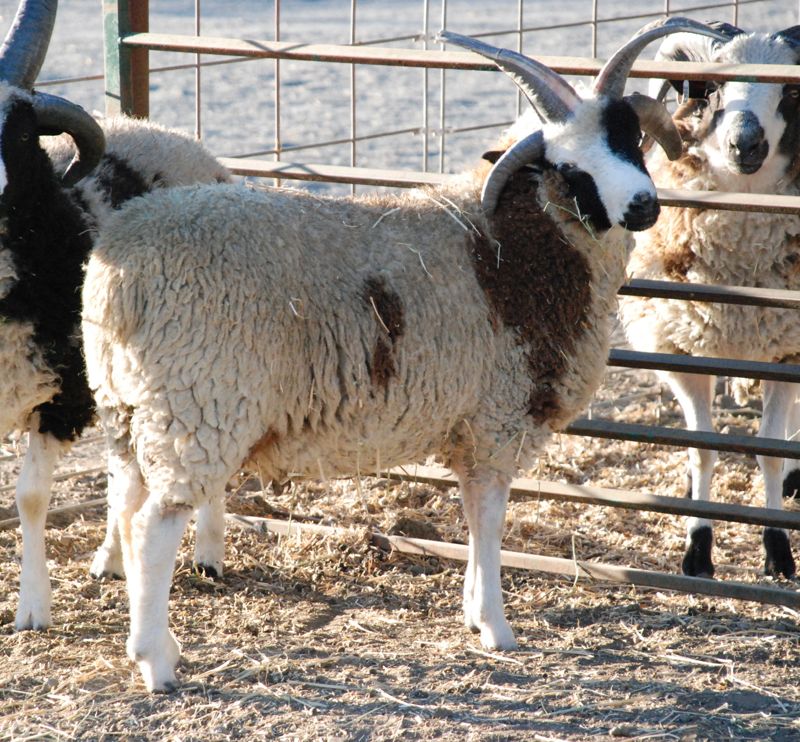
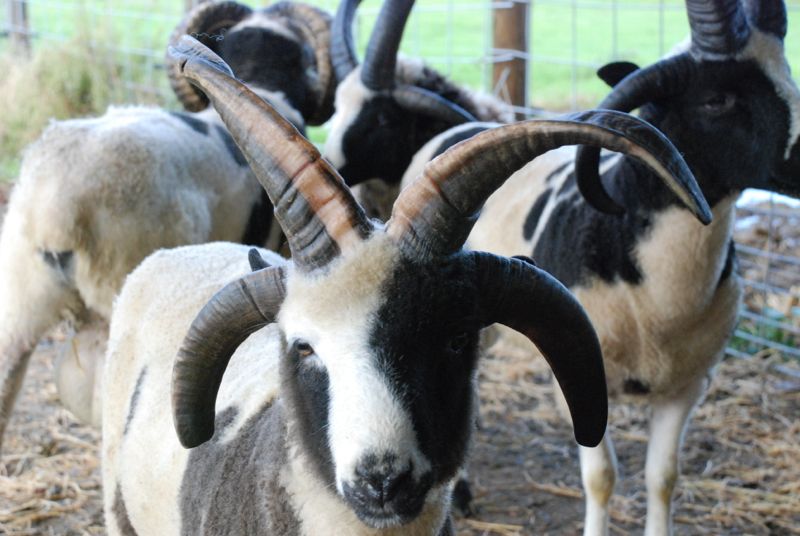
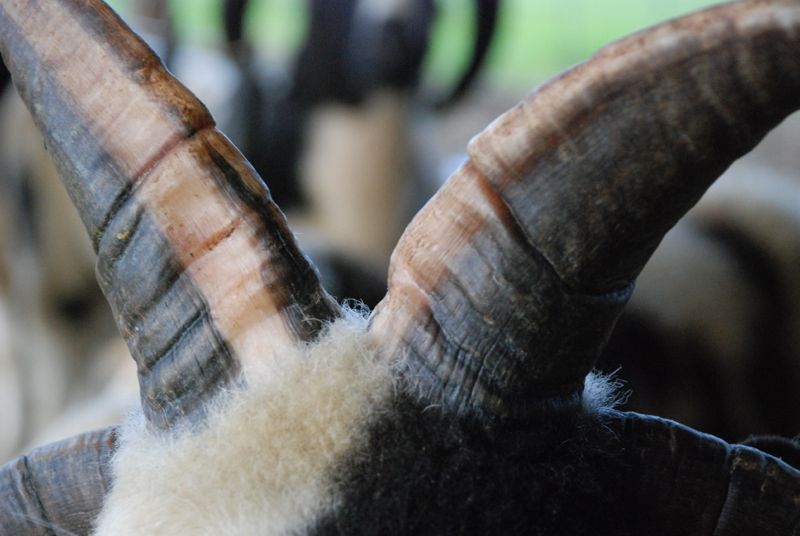
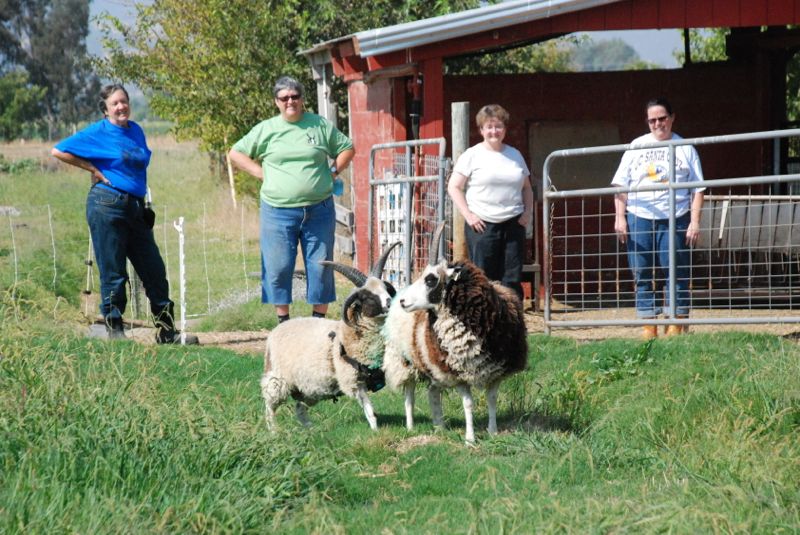
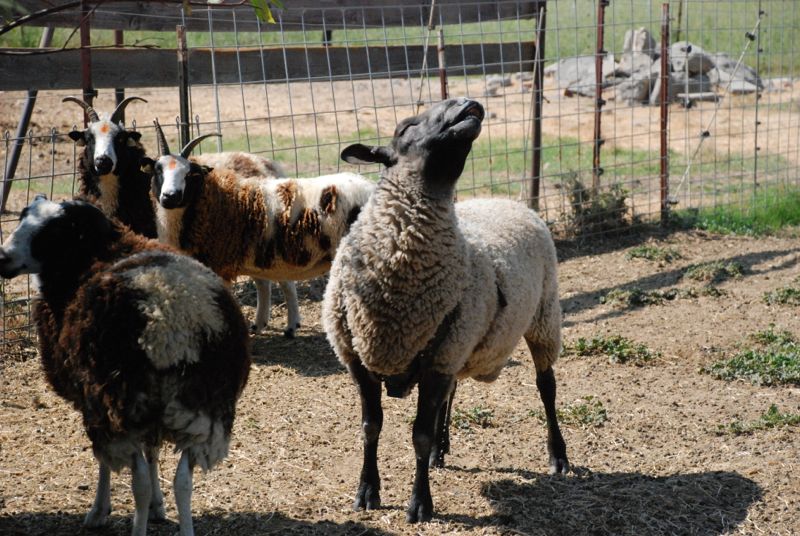
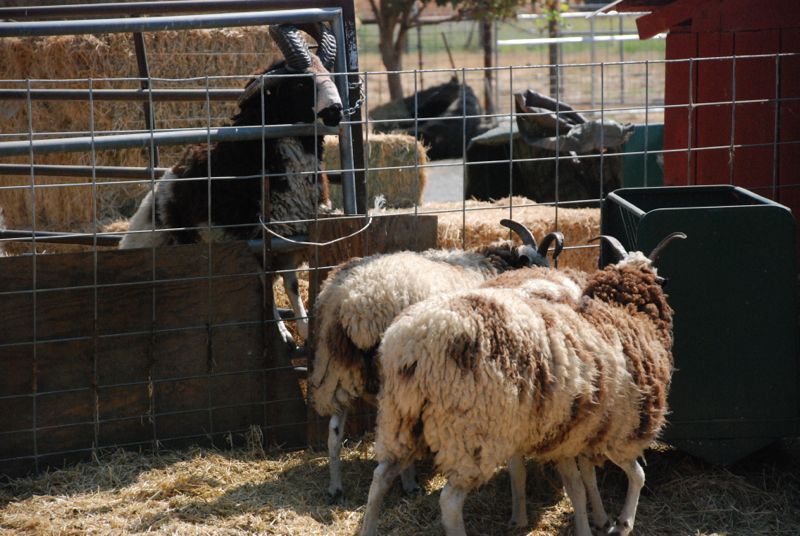
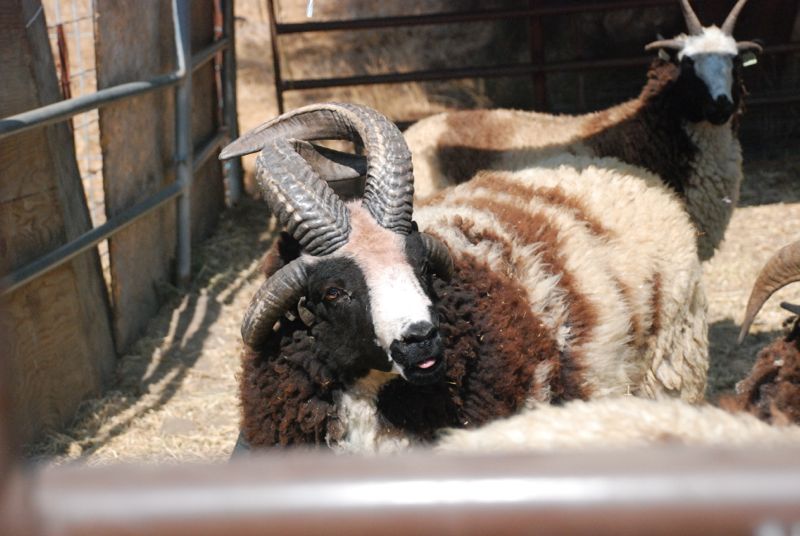
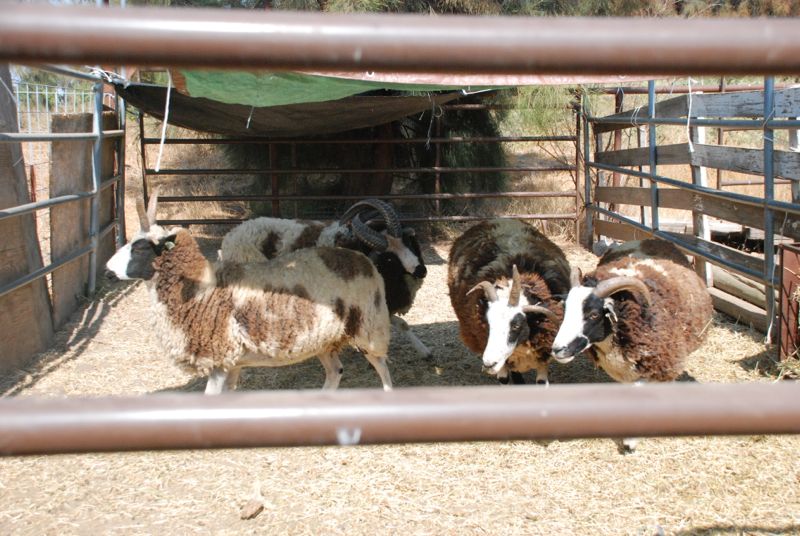
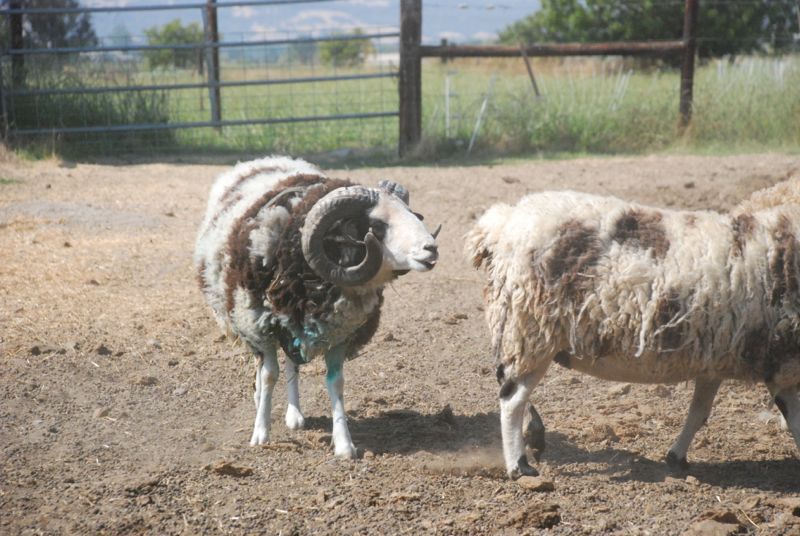
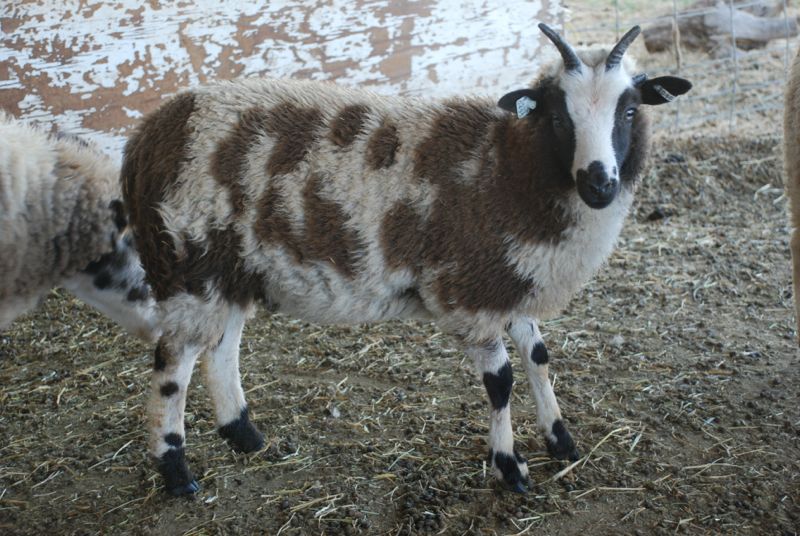
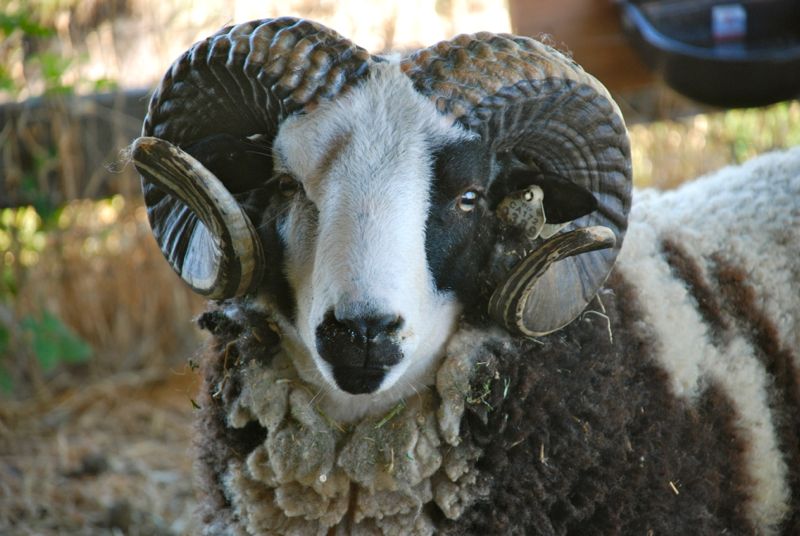
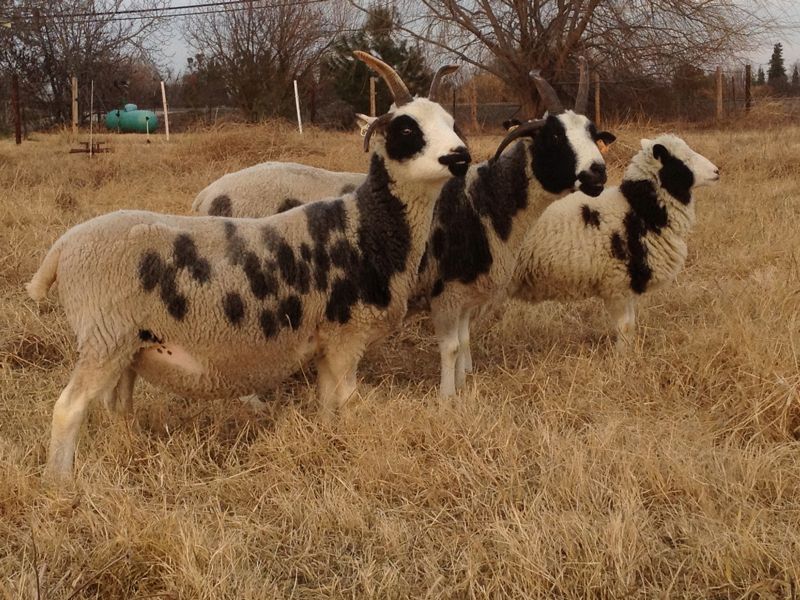
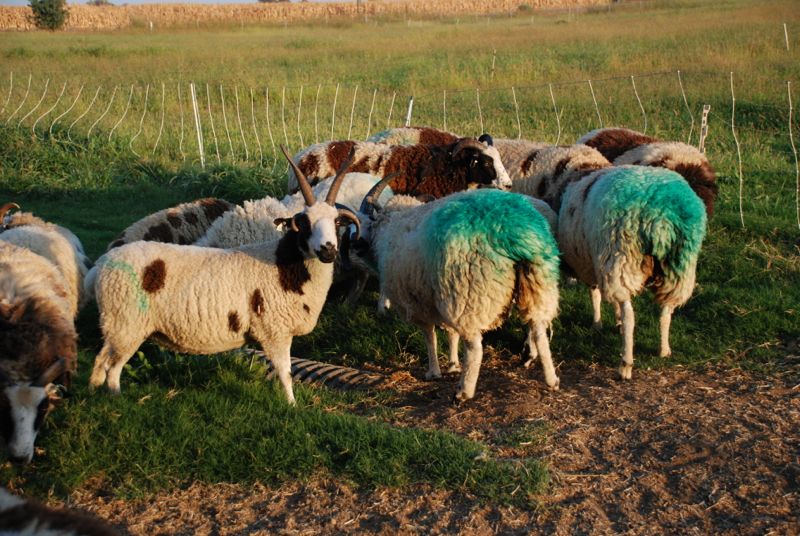
I was trying to take ram photos today. It’s frustrating because they all stay in one cluster. I think part of that is due to the flies that bother the sheep this time of year. They stand together with their heads down.5 rams This isn’t exactly the kind of photo I’m looking for.Larry and PresleyOr this.Rusty and ramsRusty helps move them around.DSC_3901I had the best luck getting photos of this ram with the white horns, but he is not one I’m keeping for a couple of reasons. His lower right horn was already cut to keep it from growing into his cheek. The lower left is almost growing into his jaw and will need to be cut.  He also shows no respect for people and as he gets older I think he could become a danger.  Both rams in this photo are a year old, born at last year’s State Fair in July. I am keeping Hendrix, the one with the black horns, at least for now. He just recently broke his top horns which is unusual for an adult ram.12085This is a photo of the same ram taken in February. Do you see those ridges on all the horns a few inches from his head? There must have been some kind of stress (illness, parasites??) at that point in growth that results in a weak place in the horns. Now, as he fights or…Hendrix and tree…rubs on a tree (even with electric fence there…ACHHH!) those horns have broken off where they were weak. (Also notice how far out they have grown since February.)

While we’re looking closely at ram horns…butcher ram   … take a closer look at the ram with the white horns.

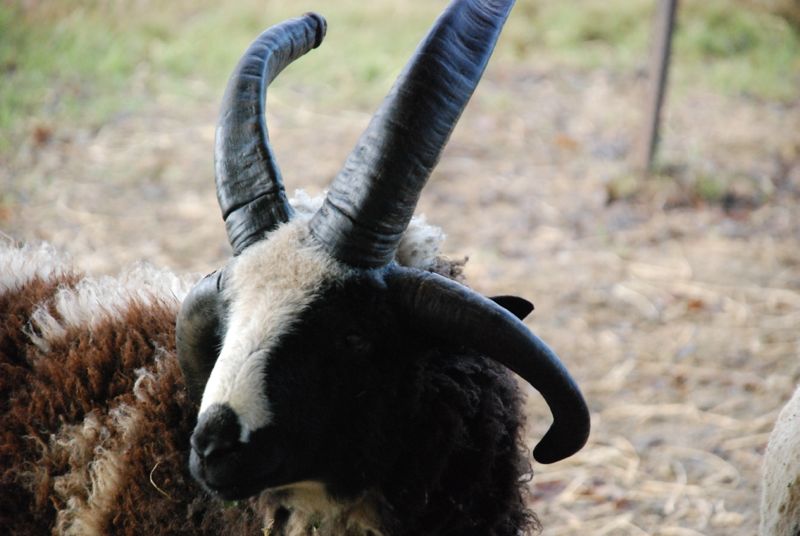
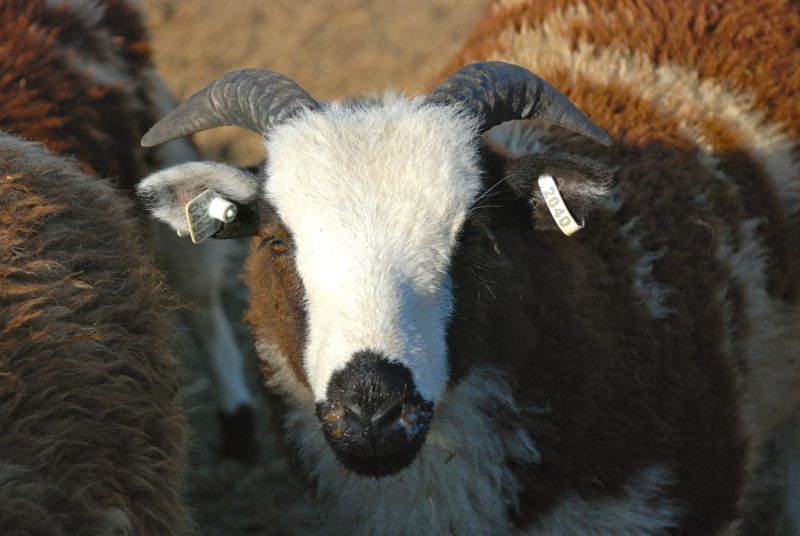
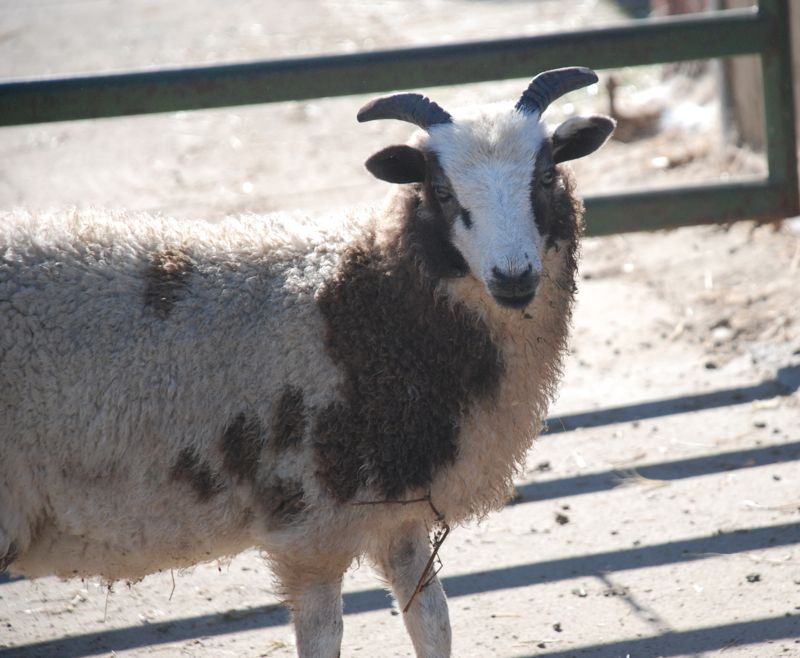
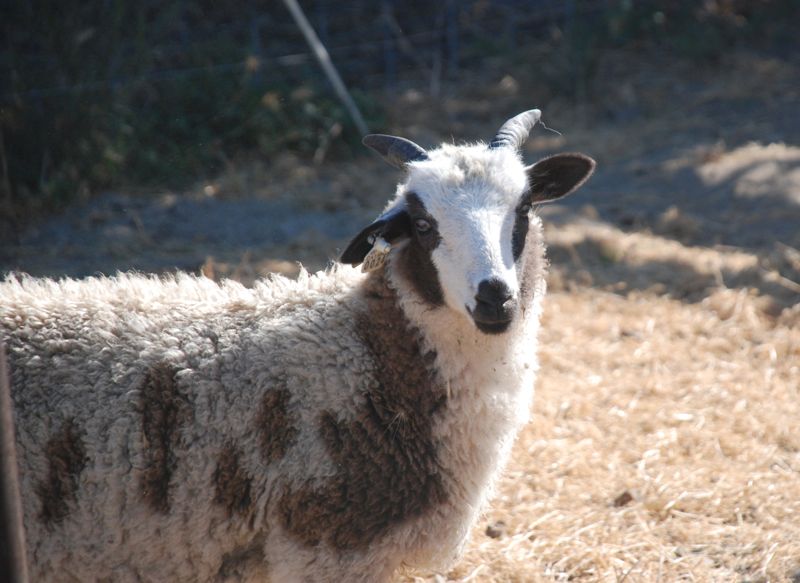
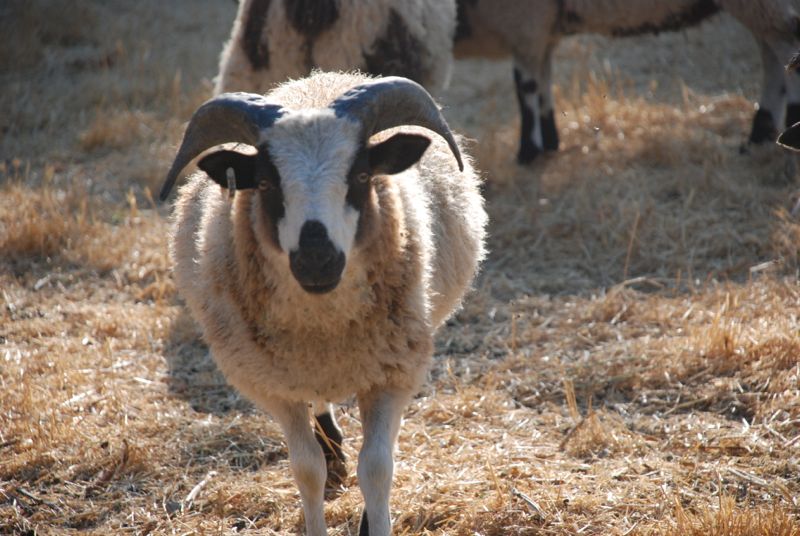
So after dozens of photos this morning I didn’t end up with the full body shots I had hoped for. I have a few head portraits.Hendrix  Hendrix (Mud Ranch’s Hudson x Meridian Shelby)MillerMiller (M. Clapton x M. Mable)PresleyPresley (Sweetgrass Clint x M. Vicki)Larry   Larry (Ruby Peak Linden x M. Spring)
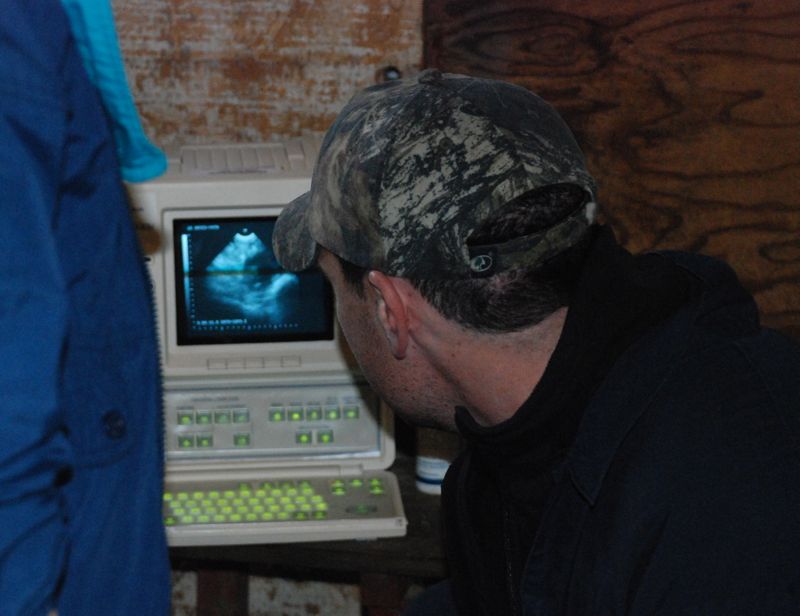


Ultrasounds and other veterinary observations


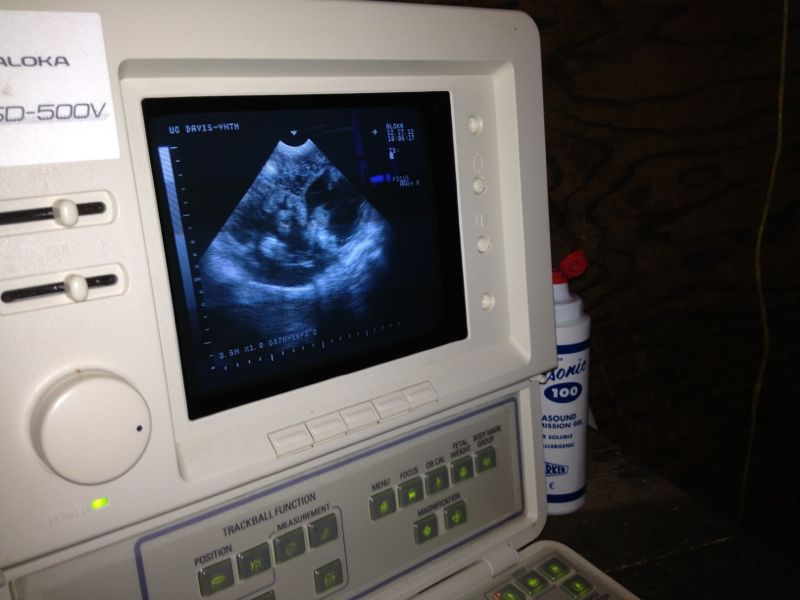
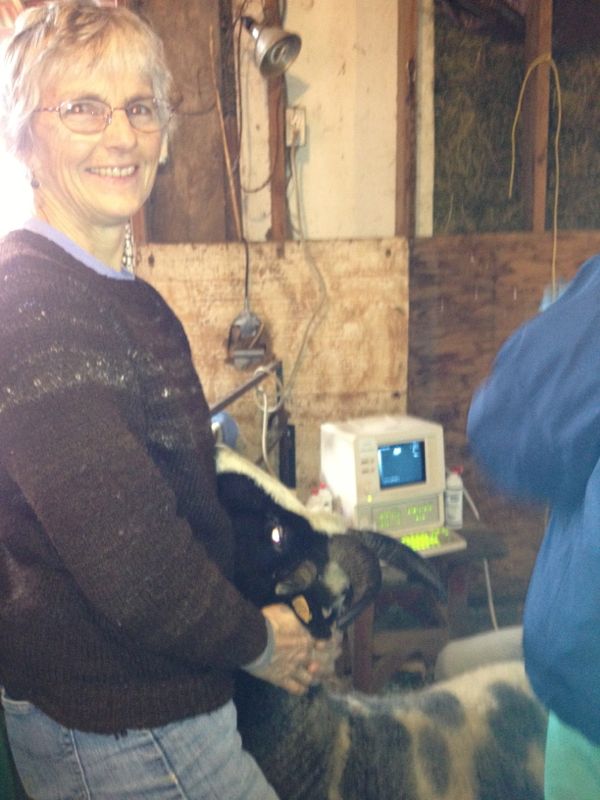
The veterinarians from UC Davis VMTH were here on Monday. The VMTH sponsors the State Fair Nursery so they will come here to ultrasound ewes. I will be breeding 3 or 4  ewes at the same time as all the others are lambing. This fall, while I was breeding ewes to 6 different rams I also had a non-breeding group. Unfortunately, one of the rams got in with that group on the last day of my breeding season. I gave the 2 ewes he bred the sheep equivalent of the morning-after pill, so Monday was the day to see if it had worked.

IMG_5006


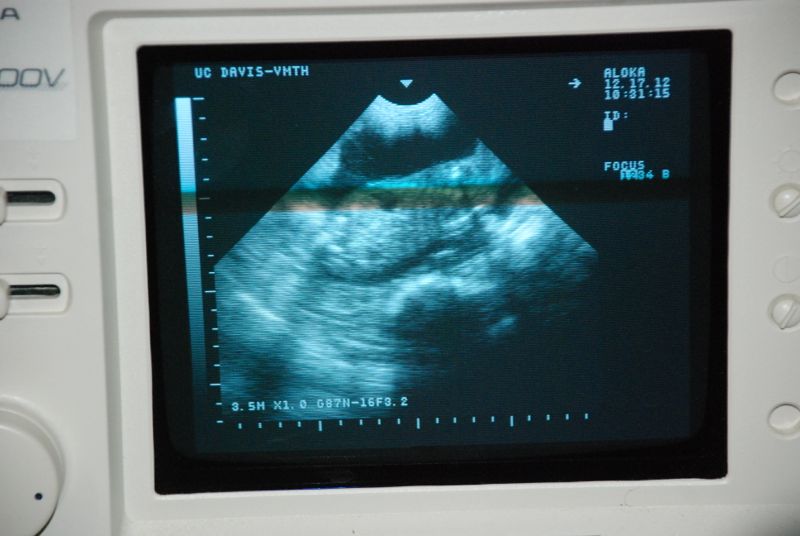
No! Shelby is pregnant with a single and Mary has triplets. I think this is the photo of triplets. (If you must know, I can’t always tell what I’m seeing in these.) By the way, a lamb at 42 days gestation is about the size of a gummy bear. That’s not something that you find in a veterinary text, but vet students have pointed out the relationship to their teachers.
IMG_5009


DSC_7081


DSC_7084

Here is one that I could see. There is a large (relatively) single lamb here in the middle just under that dark line. (It doesn’t show up in this photo as well as it did seeing it on the screen.)

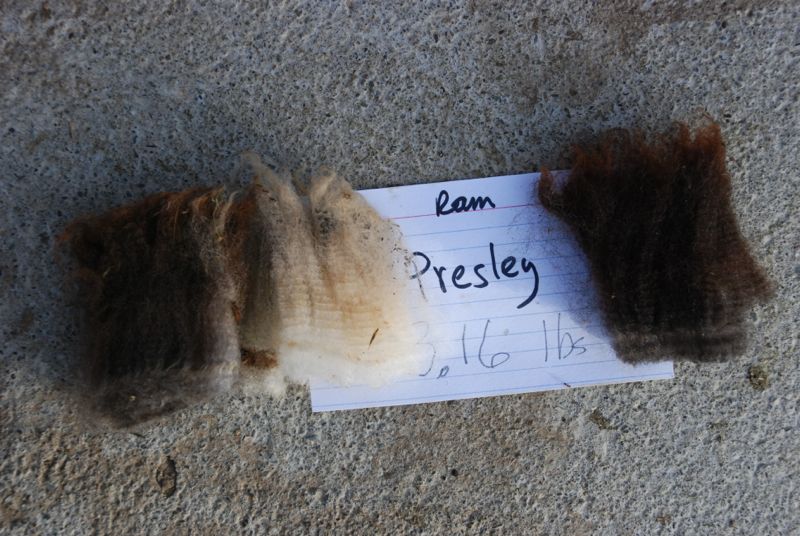
While the vets were here I showed them a wool sample from the fleece of a ram lamb, Presley.

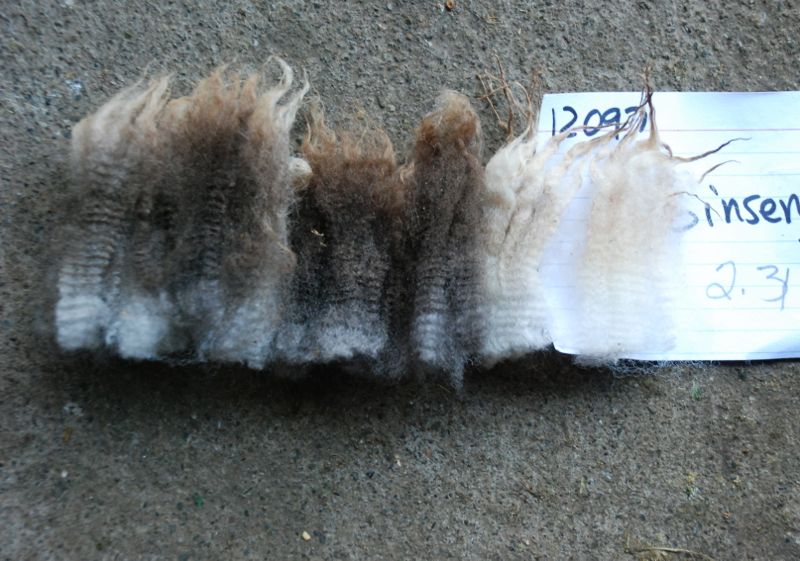
DSC_6733It isn’t all that obvious in this photo, but can you see that distinct change in color and texture at the bottom of the locks? It is not weak at that point, but the fleece definitely changes color. That is the cut end, so the change occurred a couple of months before shearing. I thought that maybe this related to selenium deficiency or some other mineral issue. We looked at the ram.

DSC_5119This is Presley, taken in mid-September. One observation of mine is that he won’t register as a lilac ram, but his fleece is the brown/gray of a lilac and definitely not black and white. (In this photo the dark wool just shows sun-bleaching, but when you look at the fleece sample you can see that is is not black.) However his facial markings look black. I think this is what some people are calling a chocolate lilac.DSC_7089 This is Presley now. Take a look at his horns.

DSC_7091I hadn’t noticed before, but all 4 horns have a ridge in the same place and the vets wondered if this related to the same conditions that caused the change in the fleece sample. When you look back at the first photo of Presley from September 17 you see that his horns are smooth. I posted a video of Presley taken September 24 that shows what I think is one of the many possible symptoms of bluetongue. The last two photos were taken 3 months after that. Did the illness result in the change in horn growth and the fleece observations? It is not any matter of earth-shaking importance, but I find it an interesting idea. My simple question about the fleece has led to a lot of other inquiries.

We looked at the rest of the rams while the vets were here.

DSC_7098 This is Larry, who was breeding a friend’s flock and just came home. The friend told me that she thought Larry had blue tongue also. Note the ridges on his horns.

The reason that I asked the vets about Presley’s fleece is that I had remembered seeing another fleece with the same discoloration. I had taken a photo of it at the time.

DSC_6663 Ginseng is also a lilac lamb and her fleece shows the color change at the same place as does Presley’s.

I have no answers yet (except that Mary and Shelby won’t be going to the fair), but I’m going to examine the rest of the fleeces as I sort through them and I think I’ll pay more attention to horn growth after this. I’ll report back if the vets give me any answers.

A Riot of Rams

You’ve heard of a Flock of Sheep, a Herd of Horses, a Gaggle of Geese. How about a Riot of Rams as a subset of the Flock?

Larry came home yesterday. He is a ram born last February (still called a lamb up to his first birthday) and was with a nearby flock of ewes. Whenever rams that have reached sexual maturity (and that could be 5 to 6 months) are to be reunited there are apt to be fights until they have figured out the pecking order. The shepherd’s job is to prevent injury, death, and property damage. Most of the time that means putting all the rams together in a pen that is small enough that they can’t back up and put their whole body force into the inevitable ramming that occurs.

DSC_7019

This is Larry. He is a nice looking ram lamb. Since I was going to be moving all the rams I took the opportunity to trim all their feet.

12085This is one of the ram lambs born at the State Fair in July.

12085 wool He has nice wool, doesn’t he?

DSC_7009Here is Sullivan, a yearling ram. He was shorn along with the rest of the flock last month. Larry missed shearing so I’ll have to shear him by hand, and I didn’t shear those lambs that are going to be sold. Do you notice a swelling just under and behind the two spots on his shoulders?

DSC_7012 Here is what it is like close-up. I noticed it a few days ago and I think it is a hematoma, probably a result of rams tussling.

How do I put the rams in close quarters? I don’t want them near the ewes because that would be asking for trouble. I particularly don’t want any of these rams trying to get over or through the fence to get in with the ewes. So I use one of the stalls, but a 12′ x 12′ stall is way too big. I use panels to make a pen in the corner of a stall.

DSC_7024There is a feeder just out of this photo at the bottom of this photo. The two shorn rams at the feeder are the February lambs. The two rams with wool at the feeder and the one in the top corner are the July lambs. Sullivan is the 2-horn ram in the center and Larry is the 4-horn ram next to Sullivan. Small enough pen?

DSC_7035Evidently not. I tried to take video so I could share the real impact (pun intended) of this, but it was too dark in here. In this photo Larry goes for Sullivan.

DSC_7036Now it’s Sullivan’s turn. You can’t tell in these photos but there is real power behind these hits.

DSC_7039Larry’s turn again.

DSC_7041

DSC_7042

DSC_7044Another view. They are still fighting.


DSC_7048I collapsed the pen a bit more and they gave it up. Or maybe it took the fun out of the fight when they couldn’t back up to bash each other.

This morning all the rams were behaving so I gave them more space. Tomorrow they will go out to the ram pen and live happily ever after…

Breeding Season is Here

Four Farm Club members came today to help me sort out breeding groups. I told myself that using four rams was plenty but in the end I put ewes with six rams. I don’t have a very big place and by the time I save spaces for non-breeding rams (a few ram lambs left), non-breeding ewes (my State Fair ewes and lambs and a few ewe lambs that I don’t want to breed yet) and try to leave buffer spaces between breeding groups it gets tricky to find space for everyone.

Kenleigh’s Matrix, a ram lamb, was the first to go out with 14 ewes.

Meridian Loretta was obviously in heat, but we wondered if Matrix, smaller than the ewes, was going to manage the job.

Meridian Fogerty, a yearling ram, was next. He has 8 ewes.

Faulkner was happy to be given eight ewes.

Meridian Clapton, the ram who has been behaving badly wanted some of the action.

Clapton is temporarily in a small pen so he has just three ewes.

Puddleduck Sullivan has ten ewes.

When you first put the rams with the ewes they get a little carried away trying to find a ewe in heat and you may see random marks on some of the ewes. One of the Farm Club members asked how you can tell if the marks from the ram harnesses are the “real thing”. I told her that you can tell.

This is in Fogerty’s pen later in the day.

These are two of Matrix’s ewes. One is Loretta, the ewe in the first photo.

It wasn’t until the end of the day that I picked up the marker for the sixth ram harness so Meridian Miller (the ram lamb who was champion at the State Fair) didn’t get his 7 ewes until evening. He is in the pen right behind my shop.

You could say that the ewes were a bit stand-offish, but Miller didn’t let that deter him.

Where will you be February 21? I’ll be in the barn with new lambs.

The Younger Generation

It simple math. If I had 65 sheep last November and  want 65 sheep next November, but  81 lambs were born, that means that  I need to sell 81 sheep before November. So out of all the lambs that were born I need to be very selective about which ones I will keep. Here are the chosen lambs so far.

This is Sonata, daughter of Meridian Moon and Sweetgrass Clint.

Lila, a lilac ewe, daughter of  Meridian Lola and Mud Ranch’s Hudson.

Fandangle, daughter of Meridian Fran and Sweetgrass Clint.

Kenleigh’s Isadora who came from Kenleigh’s Acres in Oregon.

Mud Ranch’s Foxglove and …

…Mud Ranch’s Ginseng, both lilac lambs from Mud Ranch in Lewiston, CA.

There are plenty of other pretty lambs, but most of them will need to find homes elsewhere. I have my eye on one appealing ram lamb:

Axle, son of Meridian Tina and Sweetgrass Clint.

I almost forgot someone:

Onyx, daughter of Sparkle and Faulkner.

This is Fogerty, a ram who was born last spring. He is one of the rams that I will use for breeding this fall. Here is another photo:


You Can’t Always Count on Genetics

This is Ebony, a black and white Jacob ewe.

This is Hudson, a lilac Jacob ram.

Here is one of their lambs at almost 2 months old. He is lilac like Dad.

This is the other lamb at about a month old…

… and here he is at just over 2 months. He has been marked with a cull tag because of a severe split eyelid, but also, do you see how his horns are growing?

Both lambs today, at 3 1/2 months old:

I love the horns, the color, and the fleece on this lilac ram, but (as in the discussion over on Facebook) I sure wish that I could combine these lambs into one and keep just the parts I like. Look at those pretty blue eyes on the black and white ram…

…and he has nicely marked feet also.

Speaking of rams, here are a few more photos:

The photo above is of Meridian Clapton at about 6 months…

and here he is as a yearling.  Look at the photo below for horn detail on his right side.

The first thing that is unusual is how his horns go behind his neck instead of under, but there is also a fifth horn there.

Meet Puddleduck Sullivan, a 2-horn yearling ram. But is he really a 2-horned ram? I see a seam in those horns that could mean that he is a fused 4-horn. And he also has another horn on this side. People talk about 6-horn Jacob sheep, but I haven’t seen any in which the 5th and 6th horns weren’t scurs or some how compromised by the larger horns. After all, where would you put another full set of horns?

This is Meridian Fogerty, a another 2-horn yearling ram. I had so many rams last year that I didn’t use him, but he will be in this fall’s ram line-up. His horns are closer to his face than I’d like, but still OK.

One more ram. Sweetgrass Clint is Clapton’s sire and here he is (above) at 6 months old.

This is Clint last fall as an adult.

Bottom line–you don’t necessarily get the perfect lamb by breeding two “perfect” parents and you can’t predict how the lamb will look as an adult when you buy it at 4 months old.

For more photos of how rams’ horns change see my website photo gallery . By the way, Ebony, who is at the beginning of this post, stars in her own video over on YouTube. Click here  and find her video to see her having those ram lambs.

Running with the Big Boys

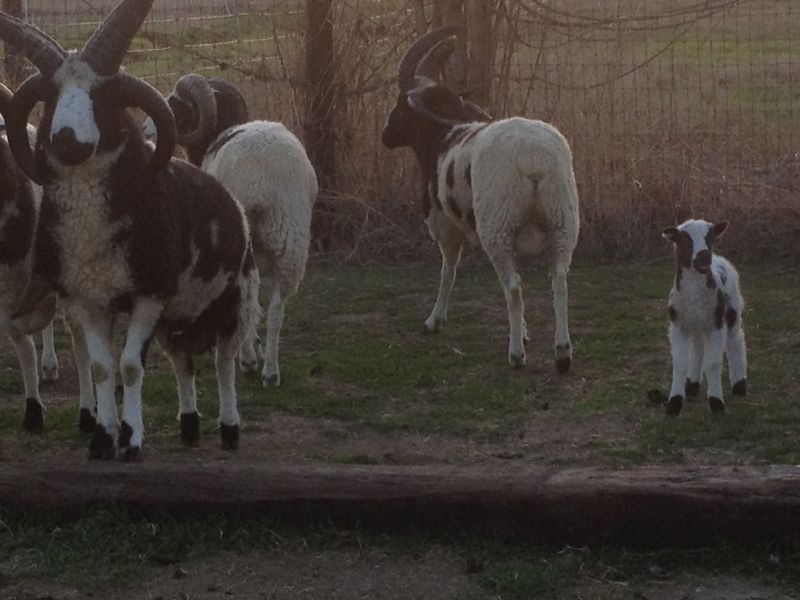
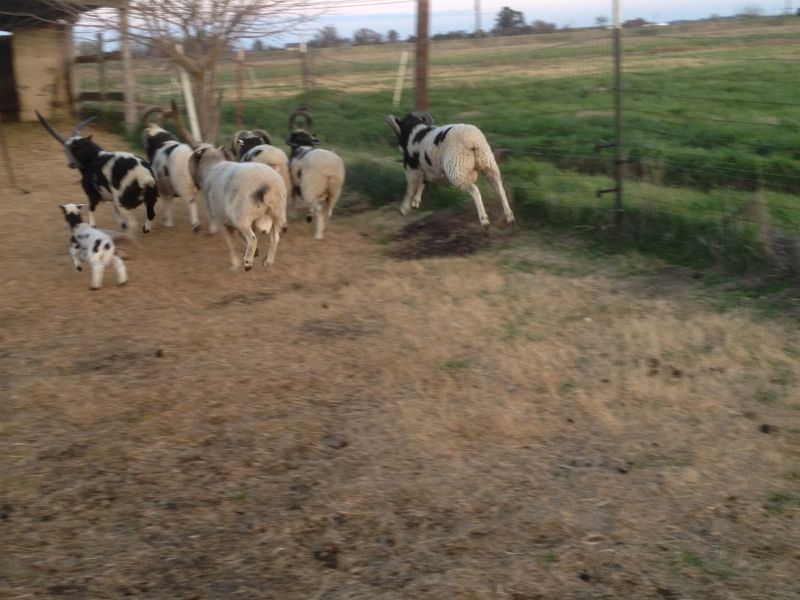
It was getting dark tonight when I took these photos with my i-phone so the quality isn’t great, but they are kind of amusing. Look at where this lamb ended up today.

I don’t think he was too happy about it.

But of course he wouldn’t let me catch him anymore than the big rams will let me catch them. They needed to be chased into a pen.

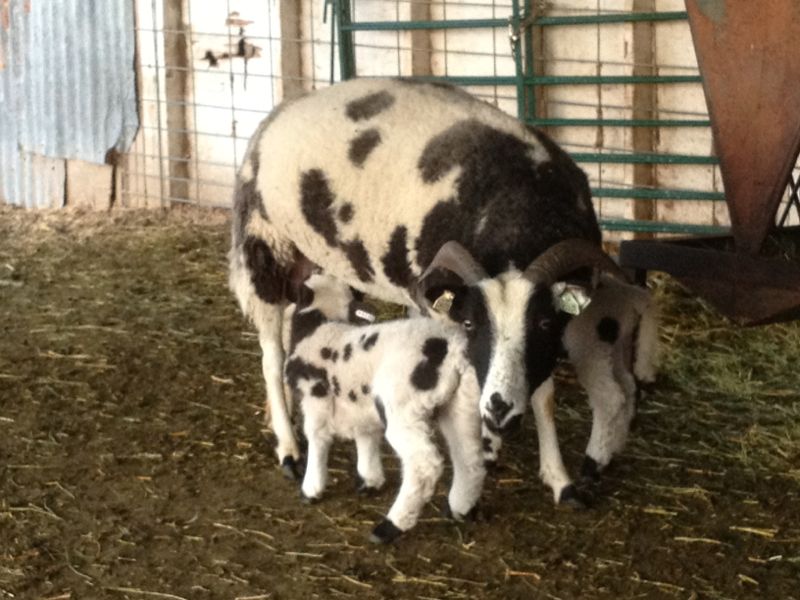
"Maybe it's not so bad being with these guys, especially with Dad here on my right."

"But Mom is still my favorite."

When doing chores this morning I saw these ewes that I assumed would lamb during the day.

Summer didn’t show much interest in breakfast.

Laura looked uncomfortable.

This is Summer again, looking even  bigger. No lambs yet, but I’m going to the barn now for the last check before bed.

The rams are jealous of the ewes that got to go out in the pasture. That is Hudson, Clapton , and  Clint.

Sheep photos

Lambing won’t start for 4 weeks but there are some ewes that look as though they shouldn’t wait that long, especially when you realize that 70% of total fetal growth occurs during the last third of pregnancy.

Sparkle was bred as soon as I put her with the ram. She is due February 18, a month away.

I don’t have a breeding date for Summer, but she is obviously pregnant.

I’ll be surprised if she doesn’t have triplets.

Jimmy is out there with the ewes and he is a very luck sheep. Most males that do not make the cut as breeding rams end up in the freezer. When he was a young lamb, I thought Jimmy had breeding potential. In fact I had a buyer for him. She was very disappointed when, after taking a closer look at him at about 3 1/2 months of age, I would not sell him for breeding. I was knew that his lower horn on the left would be a problem, but what was not obvious until I looked more closely was the freckling.

In this photo you can’t see the freckling, but when I parted the fleece I could see it. Freckling in a young lamb is a disqualifying trait for Jacob sheep registration. It increases with age and it is almost as if a spotted sheep turns into an overall gray sheep. Jimmy has a beautiful fleece (although not appropriate for a breeding ram) so I decided to keep him as a wether. The horn issue was dealt with when he was castrated because, without testosterone, the horn growth slows drastically.

Why keep a wether? When you have to separate a ram for whatever reason, he needs a buddy to keep him company. Sheep do not do well by themselves. The other wether I have right now is Jerry (nice fleece, but too much black for a breeding ram)…

…and he is Faulkner’s permanent buddy.