Early Morning Sheep Portraits

I usually have my i-phone (camera) with me but was glad I took the real camera to the barn this morning.Celeste 873That is Celeste in the doorway.Alison 11057 AlisonSummer 0899SummerRoxi 964RoxiVentura 11007Ventura and SonataLaura 706Laura is the third oldest ewe here. She is not really that old at almost 7 years.Phyllis 514Phyllis is an 8 year old lilac ewe.EarsThis is Ears, the second BFL-cross that I have kept.FaulknerHere is Faulkner, the BFL ram. He gets to be “clean-up” ram and is out with all the breeding flock now.DSC_6112    I used red the first two weeks of breeding (starting October 1) and green the second two weeks. Almost all the sheep are marked with red and maybe a 6 or 8 with green. Faulkner has been with them for about 5 days and there are 3 yellow marks so far. Marilyn 13007 left   Marilyn is my favorite of the lambs I’m keeping this year.AmaryllisAmaryllis


Odds & Ends…or what do I do all day?

I am always behind, but this year I feel more behind than ever in the weaving department. I read the blog of a production weaver I know and she commented that any weaving she does now through the end of the year is “extra”. Everything for this season’s sales is finished. What? I should have woven my scarves and blankets LAST January? I thought about it. I also thought about it in March and July and August and September. I knew that I’d get to it in October. What have I been doing when I should be weaving? Here are a few examples beside the obvious sheep farming, Lambtown, etc.field trip

Last week I hosted a field trip of middle school home-schooled kids and their families. We spent a couple of hours in the barn and at the shop. After lunch I guided them through a needlefelting project.DSC_6006  They all made up their own designs. This is one student’s work. Cute, huh?

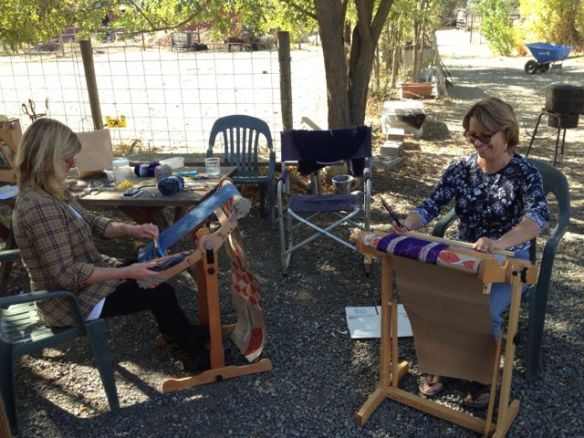
I taught a Learn to Weave class a couple of weeks ago.IMG_8020

Here is the scarf woven by a brand new weaver. She used Zephyr Jaggerspun yarn and doubled it in warp and weft. It turned out great!weaving from classOne of the students couldn’t come back on the second day of the class and she finished her scarf today. This is a close-up. She used Jaggerspun Maine-Line yarn.IMG_8022 I taught three students in a Rigid Heddle Scarf class, which, by the way, I will offer again once in December. No more other classes until January. IMG_8039 This is the blackberry jungle growing (for those of you who know the farm) just north of Faulkner’s pen–in fact part of this IS the fence-line for Faulkner’s pen. There is an engineered septic system under those shorter blackberries that is supposed to be maintained and inspected every year. IMG_8045 This is what I did on Sunday after working another several hours on the final Lambtown reports and finances. There is still a lot of blackberry work to do but at least the septic guys can get to the valve covers.fd Farm Club was here all day on Saturday and helped with the list of chores on the clipboard. We didn’t get to all the barn cleaning, but did a lot of other stuff. Maybe I’ll ask Rusty to write a post about that since he hasn’t done much writing lately.pomIt’s the time of year that the pomegranates need to be picked or they will split (if we ever get any rain that is).

When I take the dogs for a run across the road I see all the black walnuts going to waste. Here is what to do with them.black walnuts Boiling black walnuts.DSC_5782 

Add white yarn.DSC_5931End up with brown yarn.

Maybe I’ll get to the loom tomorrow…after I take my kids to the airport.

Fall Grazing

Hendrix and his group of ewes have been in the back pasture since breeding season started and they have been at the north end of that pasture for a couple of weeks. Since hardly anything is growing (start the rain dance please) I figured that they couldn’t do too much damage leaving them that long. I thought that maybe that could take down the dallisgrass and they actually did a pretty good job of it in most of the pasture. It is still a challenge however along the ditch and the fence-line. (If you search dallis  in the blog search you’ll see several posts about my attempts to conquer it.)IMG_8004

This is the north end of the property. Notice the blackberries on the north fence. I cut these away in the spring to uncover the electric fence wire on the inside of the field fence. The sheep could help in that job except that this time of year the dallis grass growing in and around the ditch keeps them from going over there. It may seem hard to believe that a grass keeps sheep from something, but this stuff is so coarse and strong it’s like hacking your way through a jungle. And it’s very sticky now from a fungus that grows on the seed head. Several years ago I found a ewe whose horns were so tangled in it that she was stuck upside down in this ditch. The only reason that I knew she was there was that she was baaing.  The sheep in the photo above are in the ditch because I trampled some of the grass and put alfalfa there. IMG_7967IMG_7949 This photo shows that they are making progress. Now I can actually see a ditch and the sheep can get through it to the side with the blackberries.IMG_7951 They are finding the hay in the blackberries and it makes it worth their while to work their way through the grass.IMG_7959

IMG_8027After about a week we have worked our way through the ditch and I’m putting the hay near the fence.  IMG_8002   Then I moved beyond the blackberries and had them trample the dallisgrass along the rest of the fenceline.IMG_7960This is the east fence and it looked almost as full of grass before I started this project. It is more overrun with blackberries. The sheep have eaten some of the leaves off. I think I have to get in there with clippers now though. There is an electric fence hiding in there somewhere.

Molly – 19 years

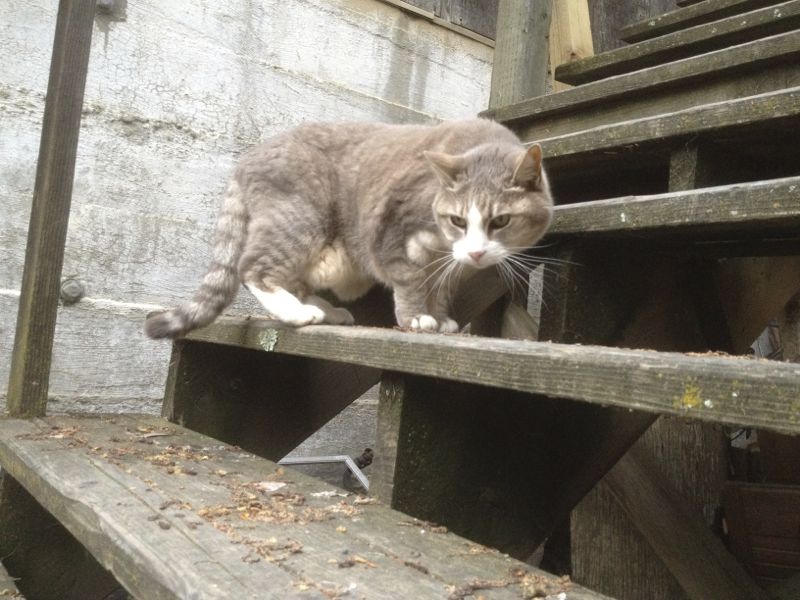
Molly was the garage cat. Many of you who come to work in the barn or to see the sheep never saw her because the dogs are usually with me and Molly avoided the dogs. Molly’s hangout was the garage. She was Dan’s cat.

Dan rescued Molly in 1994 when she was a tiny kitten and we had a dairy. He found Molly trying to lap up milk leaking out of the dairy cows who were waiting to be milked. A baby kitty wasn’t going to last long while standing under the cows so Dan brought her to the house. I’ve been looking for photos of her and this was the only one that I found.1994-12-5 This was an attempt at a family photo for our Christmas card. Molly is the little kitty in the middle. Katie and I are holding Stripes and Myrtle, two cats rescued from the Barn Cat life. The calf was one that lived on the back porch for a couple of months after being born as a premie. I named her Sequoia to give her a name to live up to. We had dogs, but I guess we thought it would be a bit tough to get this photo with dogs too.

Fast forward to 2012 or so when these photos were taken.DSC_2747When we first moved here in 1999 Molly went missing. I was driving the kids to school and saw her up the road running between haystacks. I brought her home and we made sure that she had a safe place in the garage. Dan uses the upstairs of the garage as his office/man-cave and that became Molly’s home base. IMG_1954I probably had the dogs with me when I took this photo because that is how Molly stared at them while holding her ground. DSC_0151  Molly lived a good life for 19 years, but a couple of weeks ago it was time to say that final goodbye.


Red & Green in October

I put the rams in with the ewes on October 1. This is Day 16 so it’s time to change the marker. The ewe’s heat cycle averages 17 days. If one of the previously marked ewes is remarked then I know that she wasn’t bred in the first cycle. If multiple ewes are remarked I may have a  ram fertility problem.  IMG_7986  I changed the markers for all four rams from red to green.IMG_7984 Hendrix was not very happy about being tied up.IMG_7981

IMG_7977IMG_7978 IMG_7989 All he wanted was to get back to the ewe in heat.IMG_7992 The young ram, now named Santana, (second from right) wasn’t put in with the ewes until October 7 but several ewes have been marked. IMG_7996As I was working with the sheep I heard geese honking. It’s that time of year.IMG_7999And here is the gorgeous evening sky.

Breeding Season

It’s time to think ahead five months to lambs. But that won’t happen if I don’t do something about it now. What with events and classes the last few weeks it was hard to get all the rams and ewes sorted into the right places but they are there now.  DSC_5494 Faulkner’s ewes were first to sort because at least I knew where I would put them. They are staying in Faulkner’s pen. He has 7 ewes.DSC_5502    DSC_5542 Hendrix, with 18 ewes, tried to get started right away.DSC_5543 He didn’t choose the right ewe.DSC_5545 DSC_5554 Miller, with 9 ewes, had no problem figuring it out. Each ram wears a marking harness so that I know when each ewe is bred. I will change the markers to another color after two weeks. If the ewes are marked again then there may be a problem with ram fertility. DSC_5559Presley is another adult ram but I don’t plan to use him because he is closely related to the others. (He is for sale.) He was hopeful when I moved him to another pen, but he gave up after finding that there were only ram lambs. DSC_5557   I wanted to use one of this year’s ram lambs for the fourth group of ewes. I had a hard time choosing among the rams I have saved. My first choice was a four-horn ram lamb who I think has promise and also placed well at the summer shows.   Unfortunately, he was very sick with bluetongue (insect transmitted virus common in the fall) a few weeks ago. He pulled through (I lost two others) but with the 106+ temperature I can not be sure that he is fertile. He may have his chance next year, but this year I needed to find another ram.  IMG_7826 I chose a two-horn ram whose wool I like. He wasn’t happy about the whole thing. The ewes were a little rough on him the first day. I could just hear the comments under their breaths “little pipsqueak”, “a lot of gall thinking he can handle us”, “take that” (rib-bashing)DSC_5526There were times when I thought that this ram would do OK, but most of the time I found him lying down away from the ewes. I started to wonder if he also had bluetongue because he acted so depressed and showed no interest in food or the ewes. I finally removed him and chose a second ram. Now I think that he just wasn’t ready to breed and the ewes knew that and beat him up. Most Jacob rams are ready to breed at six months, but not always. DSC_5617This guy seems to be interested and ready to go.13022  He weighs less than all these ewes but that doesn’t seem to bother him (or the ewes).IMG_7906 Hendrix has been with his ewes for a week and seven are marked.IMG_7914Miller has five marked.DSC_5531Poor Amaryllis is exiled for the moment. I don’t want the rams fighting through the fence so they are all in areas with no fence-line contact. Besides the four ram groups there are the non-breeding ewes (spring lambs, summer-lambing ewes, cull lambs) and non-breeding rams.  That doesn’t leave much space for Amaryllis since she has to be on a grass hay diet without pasture (she broke the grazing muzzle) or alfalfa. So she has her own corral for the moment.