
After the first try at eco-printing I wanted to do it again. I also wanted to investigate the technique a little more. As I read blog after blog by people who are eco-printing I got thinking that, as in much of the “fiber arts” there are few rules, some guidelines, and a lot of trial and error. You have to sift the known facts from all the other information that has probably just been passed from person to person. “We do it this way because…that’s just how you do it.” I always think of the story of the housewife (sorry, an old story) who cut the rear end off the turkey before she put it in the oven. Someone asked her why and that was the way her mother did it. It turns out that her mother did it because the only roasting pan wasn’t big enough to hold the turkey. I digress…
Eco-printing, 2nd try:
I had a plan. I wanted to try as many different trees and bushes from our property as I could and print them all on one piece of fabric and use it for a curtain in front of the open closet in my newly painted office. I bought four yards of cotton fabric and cut it in half. I scoured both pieces and then mordanted one in alum. More internet perusal. I read many instructions about mordanting cotton and it seems that the most recommended mordant is aluminum acetate. I had aluminum potassium sulfate so that’s what I used. You’re supposed to follow it up with calcium carbonate or wheat bran. I threw in some CaC03 just in case.
Some friends were here to experiment also. I found that I was running around gathering stuff, trying to figure out how to print on a 45″ wide piece of fabric when the maximum pan size would allow 16″, etc. and I didn’t get any photos of the process.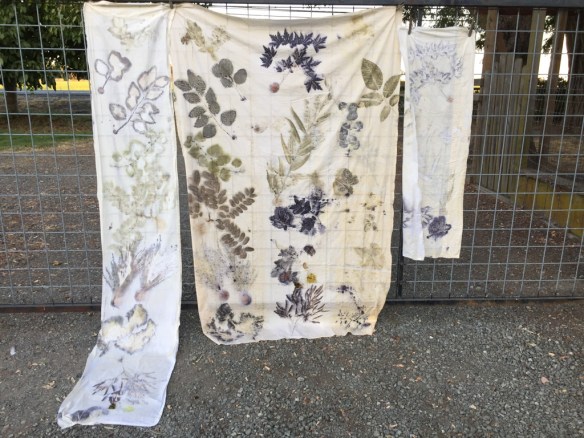 Before you print with plants you soak the mordanted (or not) fabric in iron or tannin (or not). Then you apply the plant material (possibly dipped in iron or not). You cover it with a “blanket” of cotton fabric and then roll the whole thing up with plastic on a dowel or in my case, 2″ PVC pipe and tie it tightly. Then you steam for 90 minutes. Why 90 minutes? That’s just because that is how long everyone else says to do it.
  I started with a map because I wanted my two fabrics to have the same plants in the same positions. I started with the top row of this map and covered it with the blanket material and plastic. Then I placed more blanket material (old cotton sheets), placed the plants on that (upside down from how I wanted them to appear) and folded over the middle third of the fabric. I placed more plastic to separate the middle and outer third layers and applied more plants. At this point I started to think of other plants I wanted to add so some of these were thrown on in between the others or tucked into the middle layer. The photo above the map is the second piece of fabric with part of it’s blanket fabrics, which by this time were any scraps that I could make work. You can see in the blanket fabric on the left the mirror image that was created.
  Here are the two fabrics I printed. Both were dipped in the iron solution before using them. The one on the left was the first one that I did. I think it looks a little less messy because I took more time with it. By the time I got to the second one everyone else was taking theirs out of the steamer and I wanted to hurry…and add more plants that I thought of. Differences: The one on the left was not mordanted and the one on the right was. I don’t know that it made any difference at all in how the plant material reacted with the fabric. Both were dipped in iron. Reasons for the difference? The first project (on the left) took me a lot longer because I was running around finding things like matches and hot pads, cutting PVC pipe, etc. I could see the fabric darkening as it sat out. By the time I got to the second one the iron bath had been mixed longer and I hear that the effectiveness is quickly reduced after it has been mixed. So was it the time the iron bath had been mixed? The time between dipping and steaming? The alum mordant on the right?
 Maple leaves. When you see the spots that look like bulbs–those are the tannins leaking out of the stems in plant material with plenty of tannin. (At least that’s he explanation I’ve heard.)
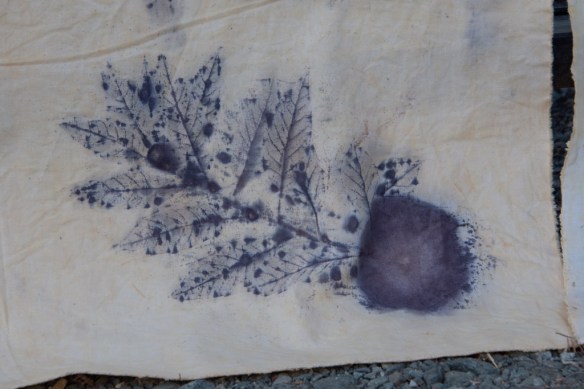 Oak branch.
I decided to do one more. One person had brought silk scarves for people to use.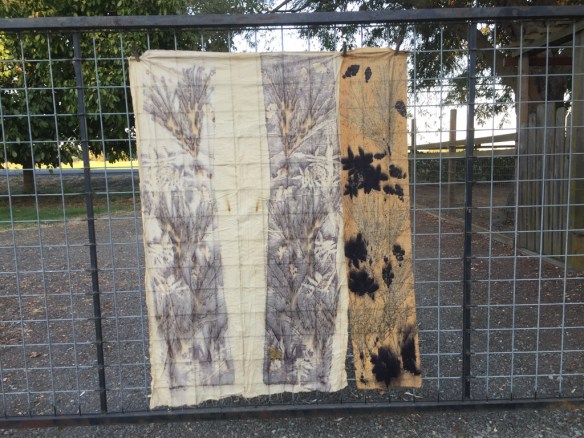 I dipped the silk (right) in tannin and the blanket material (large piece of cotton that I didn’t cut and instead just folded over) in iron. I used three plants on the silk.
 We were loving the effect of the sheoak (Casuarina sp) on some of the other pieces. That’s that wispy one that you see better on the silk. I had added Chinese pistache and oak leaves. Wow. Way too much tannin effect. The outline of the pistache on the blanket fabric is pretty but it doesn’t look so good on the silk. Note to self–use one leaf, not a branch, and maybe even that would be too much. I lost the definition in the oak leaves as well.
 Here are those three plant materials after dyeing.
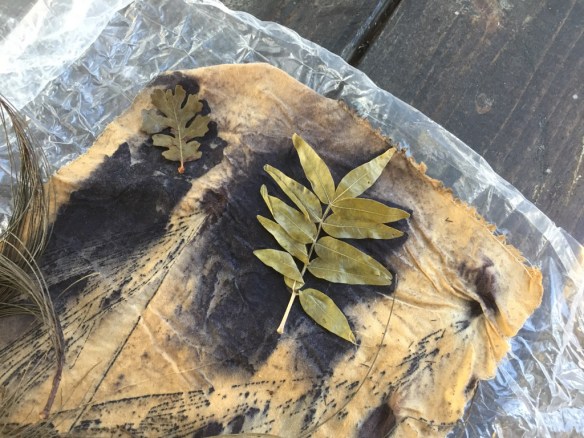 Another view of the oak leaf and the Chinese pistache.
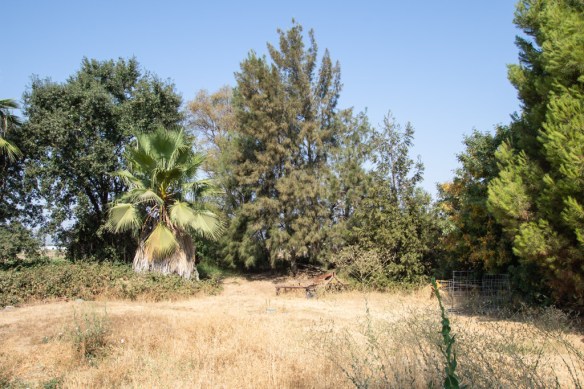 I went out back to photograph the trees. Oak on the left with a palm in front of it. The sheoak is the tall feathery looking one and the smaller tree turning yellow is the pistache.
 I brought some of the oak leaves in to check ID because I wasn’t sure which oak this was (Valley Oak). Look at what a community of other things is on the underside of the leaf. There are two different spiders there as well as…
 …these growths that were described appropriately enough on-line as “miniature chocolate kisses covered with red foil”. These are the response of the tree to the Red cone gall wasp, a tiny (fruit-fly size) wasp that “lays her eggs inside the leaves of the host tree. They hatch and start eating the leaf, which causes the plant to form a hard structure in order to wall off the irritant. This gall is just what the insect needs, though: more plant tissues to eat. The larva pupates and develops into an adult wasp before it emerges.” This oak has plenty of the big round oak galls too. I think that I may have to take some photos and write another post about the dozens of things living in this tree.
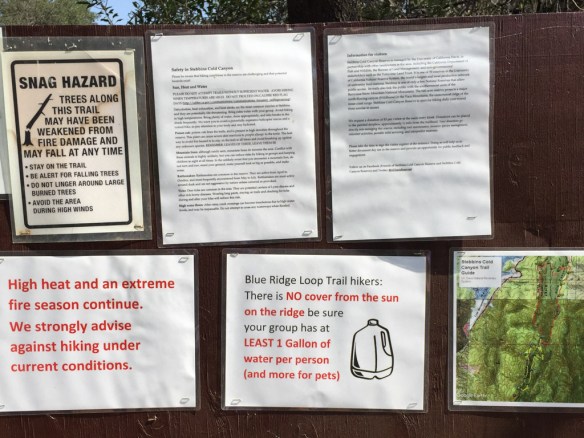 Falling trees, high heat, fires, snakes, poison oak, ticks, mountain lions, high water (that would be a different season). Maybe we should just go back home to the couch.
  After the 2015 fire the area was rebuilt to accommodate needed parking. Now we park below the Reserve instead of on the side of the road and walk under the road through these huge culverts. This is also where storm water will go in the winter. What’s with the graffiti? I am not a fan.
 Leaving the culvert.
 We headed out on the Blue Ridge trail, a five mile round trip. This is three years after the fire. That bush on the right is a CA Bay Laurel growing from the base of the burned tree (it can take on the form of a bush or tree).
 Our first hazard, poison oak.
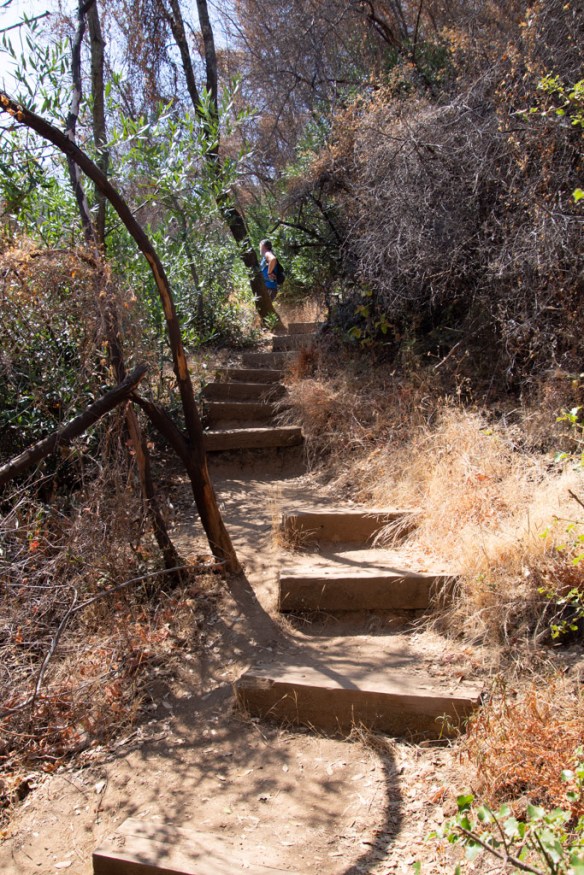 Maybe the next time I go hiking here I’ll count the steps. The trail starts in the canyon and eventually you have to get to the top of the ridge. There may be a million stairs–at least it seems that way when you are half way up.
  Taking scenic photos is a good excuse to stop. This is a panorama looking southeast.
  Our trail continued to the ridgeline. This is the bluest sky that I’ve seen since the fires started in June. We’re up above the smoke and haze here.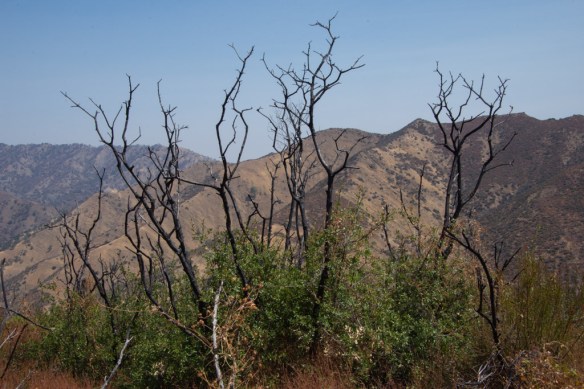
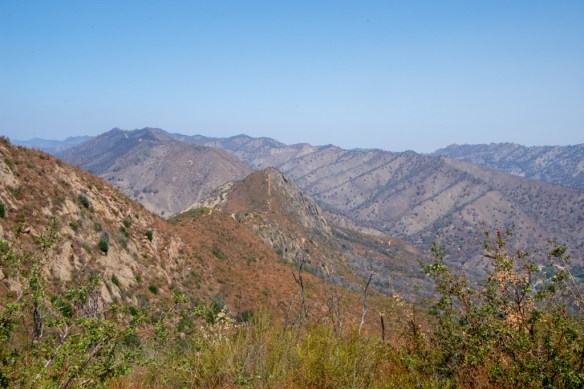 View to the east. That little line on the ridge is our trail.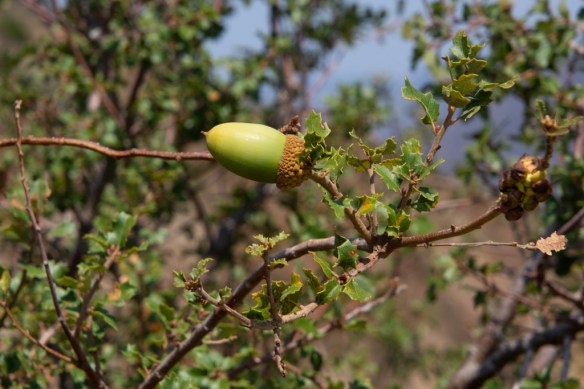

 From the top you can look down to Lake Berryessa. Except for the foreground most of the land was burned this summer.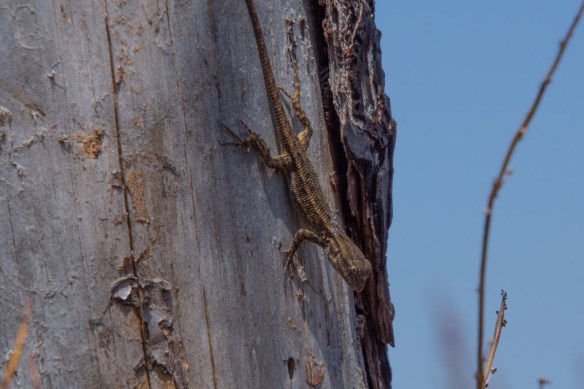
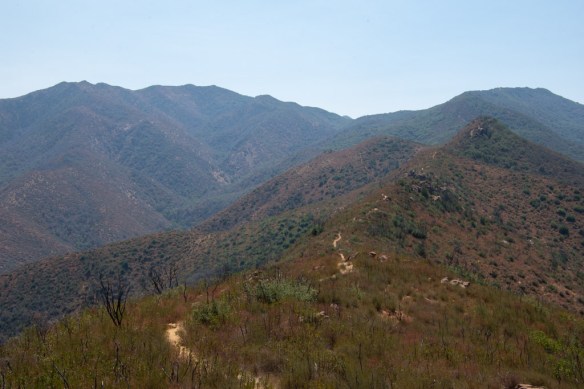 More of the trail. Keep walking.
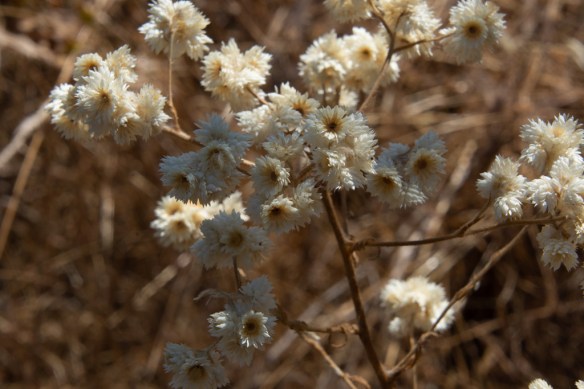 California Cudweed.
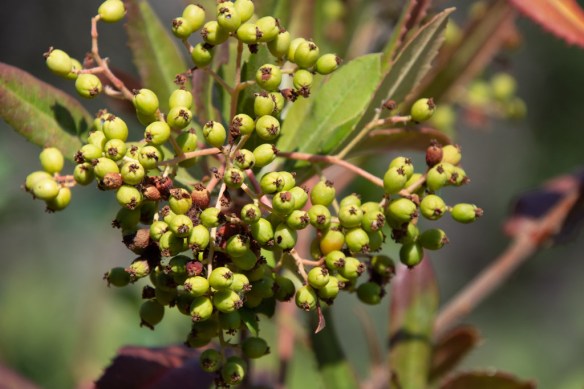 Toyon berries.
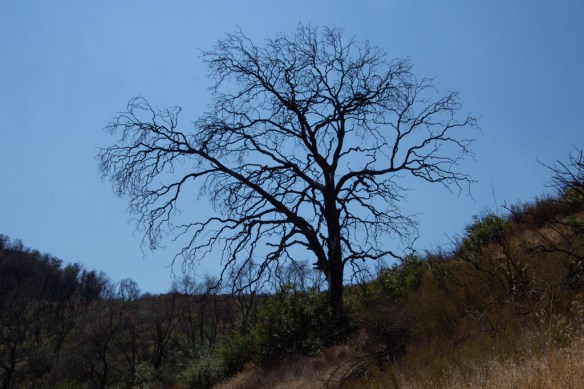 Burned oak.
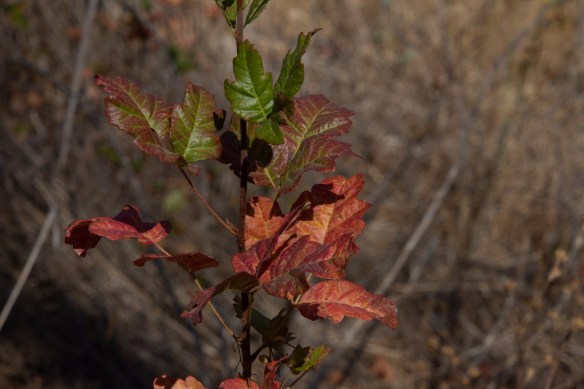 Fall colors (more poison oak).
 Here are some examples from the friend who showed us how to do this.
 We went out to the backyard to get started. There was a supervisor already on duty to make sure that we didn’t mix up the buckets. One says Iron Sulphate and the other says Tannin.
 We dipped our fabric in one or the other depending on if it was silk or cotton and then laid it out on the table.
 I brought weeping willow fronds, oak and eucalyptus leaves, and zinnia and dahlia flowers. I started with silk dipped in tannin solution and then covered this with cotton soaked in the iron solution
 After rolling everything up and tying it snugly the fabric rolls were steamed for an hour and a half.
 While the first batch was steaming we all worked on another project. We were limited by the pot size to a 12″ roll. To print a wider fabric it needed to be folded. So that’s what I did with this one. This piece is 36″ wide. I laid leaves on the center strip and folded one side over. The design would be symmetrical on those two panels. Then I spread plastic on that fabric and placed leaves on the plastic to be printed on the third layer to be folded over.
  Here are the first ones being unveiled.
 The plant material leaves an outline as it resists the iron on the cotton layer that was applied to it. The iron turns the silk varying shades depending on the strength and freshness of the iron solution.
 Interestingly the cotton “blanket” that was rolled up with the silk is sometimes just as appealing as the silk piece.
 This is a cotton pillowcase in which the design is not from a resist but from the plant material itself.
 Here is the project that I did first. I like the printed cotton as much as I do the silk. The willow is the most striking feature. The color spots at the bottom and top are from the flower heads.

 Here is the larger piece that I did.
  You can see the symmetry of the folded cloth on the right. The third layer has a different look. I think those splotchy parts has something to do with the plant material being rolled right onto the plastic. The tannin “leakage” from the oak leaves is also apparent on this piece.
 The pieces on the right were a silk scarf that started out a rusty red and the mirror image is the blanket cloth for that scarf. Both are beautiful.
 I went there planning to make some wool samples. However I had not mordanted my wool so I decided to save most of it. This piece was dipped in iron (left side) and tannin (right side) and the middle was not treated. I laid out black walnut leaves and did the steaming later at home.
 This is the finished sample. Next step will be to wash all of these and see how they hold up. I’m excited to do more of this for sure. … Like I need another thing to distract me right now.
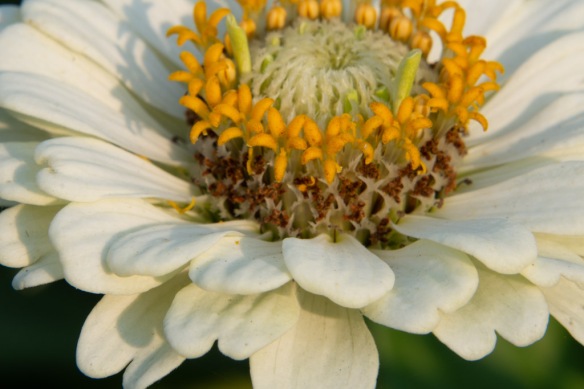
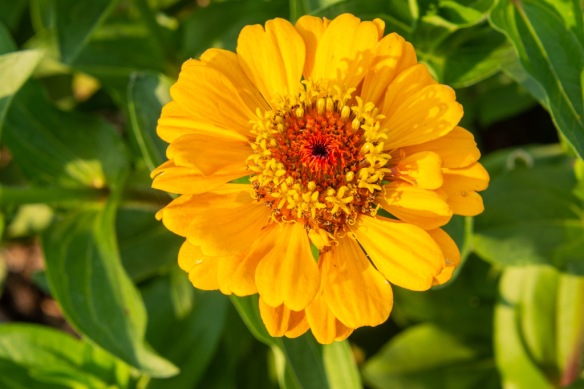
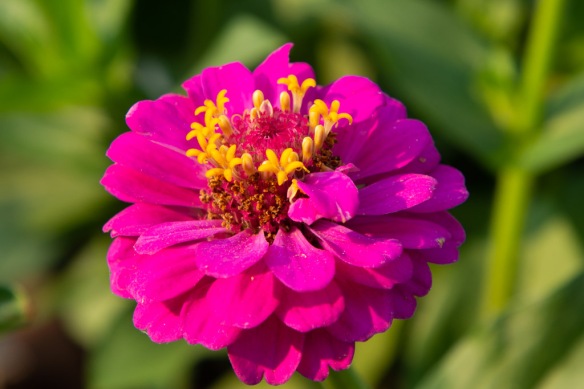
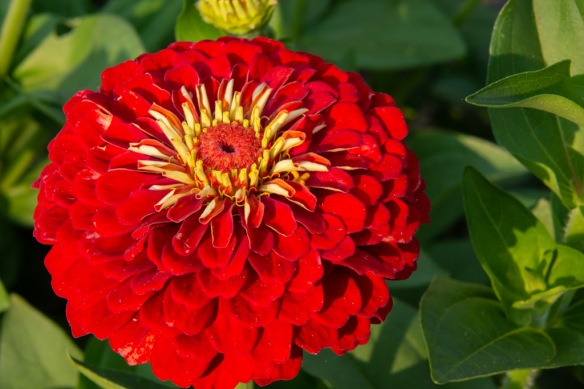
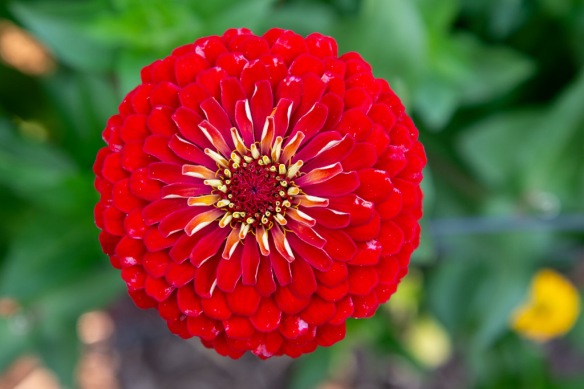 Look at all that detail. Aren’t they amazing?
 The three big rams come to see what’s going on.
 The 2-year old 4-horn is Buster and the yearling 2-horn next to him is Cayenne.
  The lambs aren’t named yet but this one is a full brother to the yearling ram that I took to Maryland this spring and who now lives in Pennsylvania.
 Since the young rams can’t find the older rams they will fight among themselves. That two horn lamb is a full brother to Cayenne in the photos above.
 Buster again and that two horn yearling is Gotham (
 Gotham chasing the lambs.
 This is the other two-horn lamb that I’m keeping for now.
 Gotham in pursuit.
 This young guy has got moves!
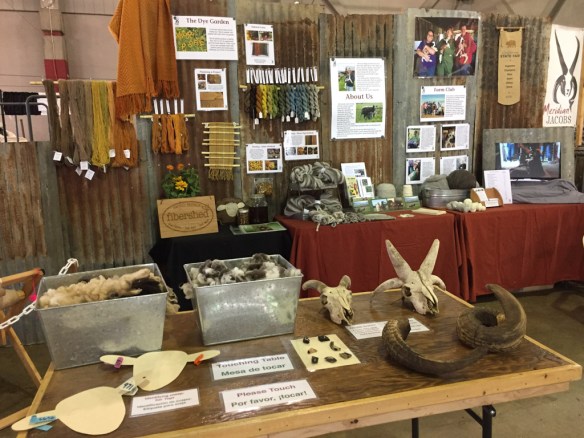 We’ve been using the old tin backdrop for a long time and I still really like the look. It worked especially well with the natural dye display we made this year. There are also signs about Farm Club, examples of yarn and wool on the table, and a continuous loop of about 45 minutes of my farm videos. The Touching Table is popular with fair-goers.
 There are more signs over the sheep pens. My potted plants were dug out of the pasture and include a sign about what is in the bucket.


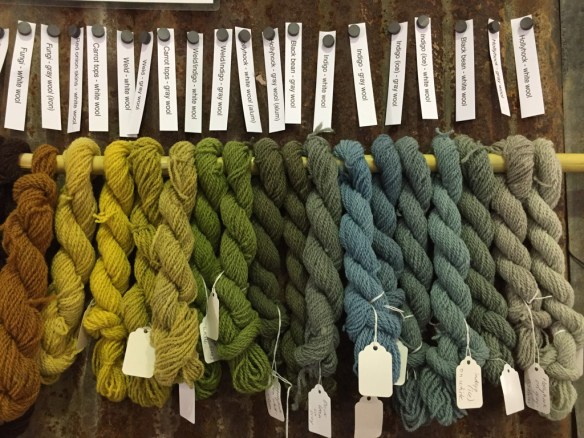 Here is closeup of some of the yarns on display. Farm Club member, Lisa, dyed most of these.
 One of the kids’ activities we provide is this sheet for drawing in details on the sheep. Not everyone takes them home.
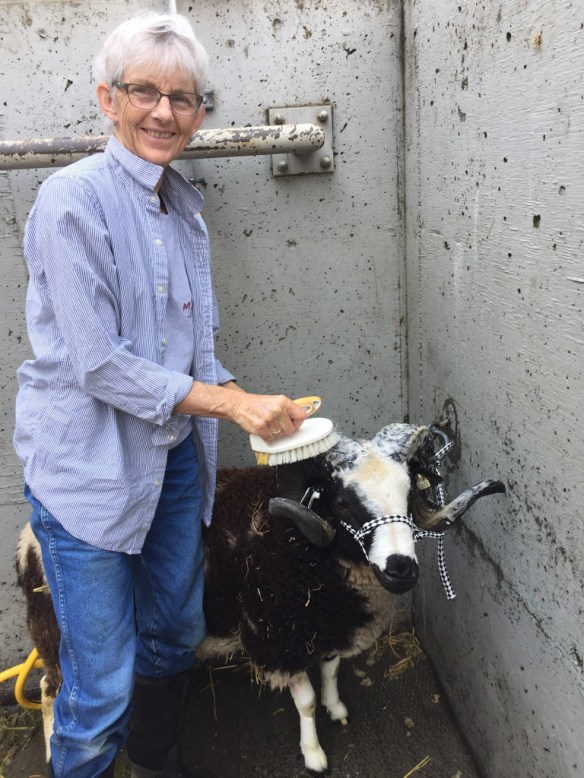 We are also here for the sheep show. Fortunately Jacob sheep don’t require a lot of fitting, but it is nice to get them cleaned up a bit.
 The horns looked pretty good after a scrubbing. This is a ram lamb named Axle.
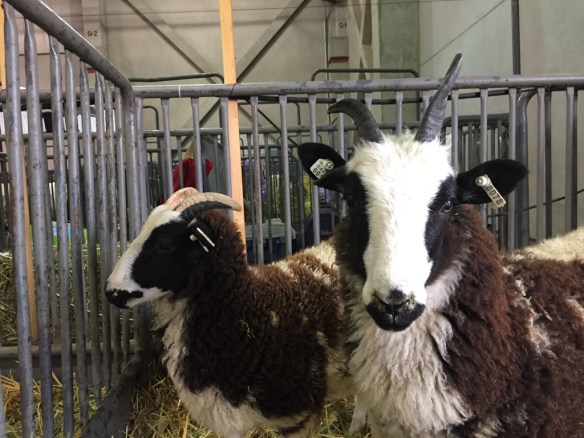 This is Jana on the right and a less-glad-to-be-there Halcyon.
  The Primitive Breeds show was Saturday afternoon. This is a yearling ram, Meridian Gotham. (Look at those shiny horns.)
 Unfortunately there was very little competition this year and I had the only rams. So it’s nice to get a Champion award, but it would have been nice to have other breeders’ sheep there.
  Marina and Betsy helped show. This is the ram lamb class.
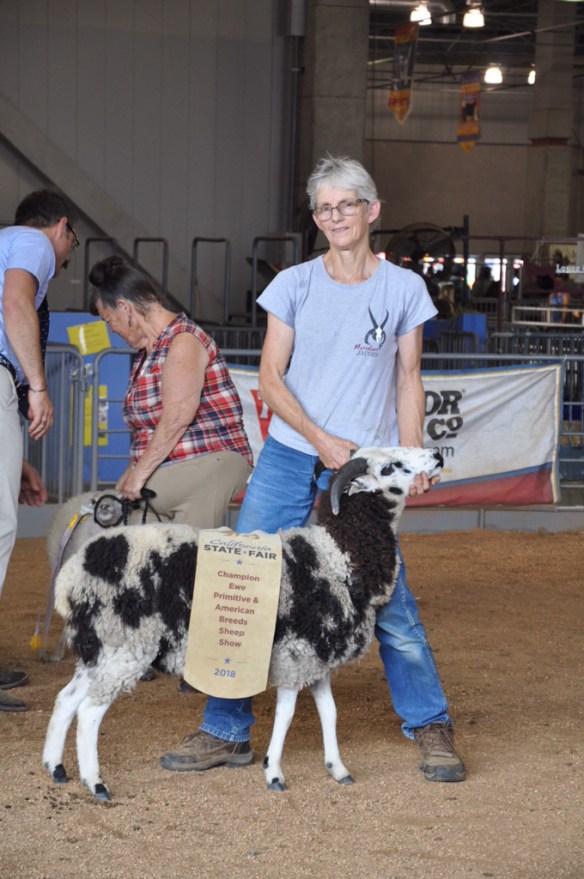 Meridian Maybelline was awarded Champion Ewe.
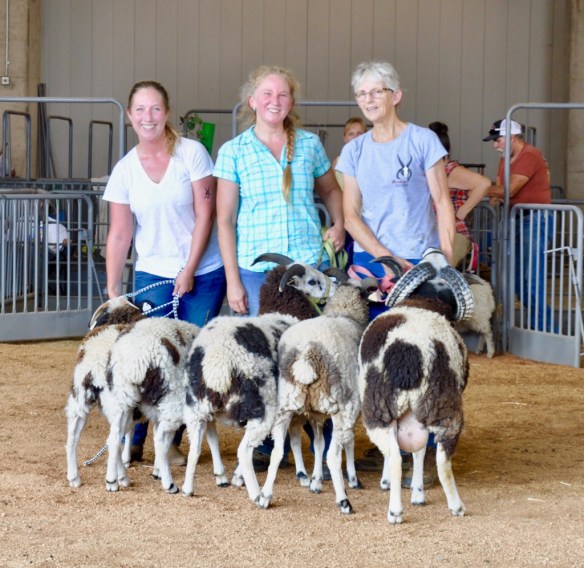 Thanks so much to Betsy and Marina for pitching in and showing sheep. And thanks to Dona for the photos.
 Here we are with a pile of awards, including Premier Breeder and Premier Sire.
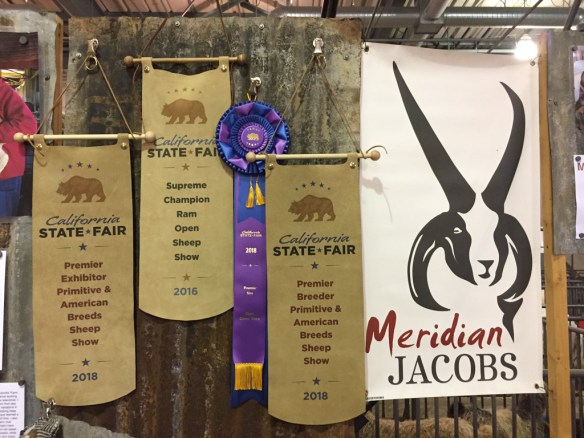
 Winning Champion, even with little competition, means that you take your sheep into the ring on Sunday for the Supreme Champion competition. No, Gotham didn’t shrunk overnight. He was the same size as always. It’s just that those Suffolks are like ponies.
 This is the Supreme Champion Ewe competition.
  In between the Supreme Champion Ram and Supreme Champion Ewe competitions they announce the Marketing Award winners. We did pretty well!
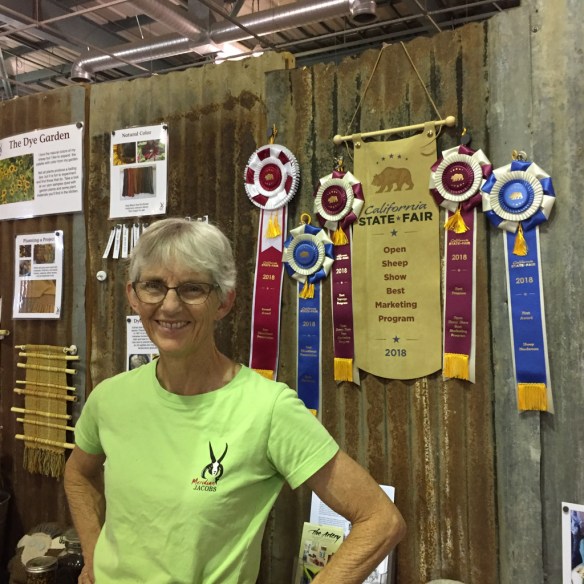 Best Marketing Program. Best Program Directed at the Public. Best Signage. 1st place Herdsman. 1st Place Educational Program. 2nd Place Educational Program over all the livestock species during the three weeks of the fair. Can’t ask for more than that!
 Loading up in my new trailer! Oregon here we come in 2019!
 People arrived for breakfast before the day’s program started.
 First up was “Pass or Fail” a talk presented by Royal and me, the two JSBA inspectors who were present. We started by looking at slides…
 …and then went outside to look at sheep. I hadn’t sold any of my cull rams yet so that we’d have plenty of examples of potential horn problems.
  We also looked at some of the other sheep present.


 Jade is always willing to greet a visitor to the farm.
 Dr. Joan Rowe from UC Davis talked about Lambing and Sheep Obstetrics. Helpful hint: Another use for a feeding tube and syringe is to get lube around a lamb when you need to reach in to rearrange or pull it.
 Afterwards Susan Gandy, one of the Farm Club members, demonstrated preparation and analysis of fecal samples using a method that can be used on the farm to stay on top of parasite levels in our sheep.

 AGM stands for Annual General Meeting and that is a required element of our gathering. So it was meeting time. Gary Anderson from Michigan led the meeting and brought people up to date on JSBA goings-on, recognition of individuals, and announcements. I was given a much appreciated gift card to my favorite local store, Higby’s Country Feed!
 Royal and others presented reports…


 Did I share the things to look at in the tent? Dona put together a display of the unshorn Pope Valley sheep that we recently acquired.
 Having just finished the State Fair the week before we put up part of our Marketing (award winning by the way) display.
 A couple of people had farm displays and sales.
 And there were sheep to buy.
 I find that my photos kind of stopped here at dinner. (But I will still find Dona’s eventually.) After dinner we held the annual raffle and I don’t have photos of that. There were fantastic prizes and we are grateful to everyone who provided them (you can see them
  I enjoyed have Karen and Doug from Oregon here all weekend as Dan got a chance to meet them and spend some evening hours together. This is Karen’s new look!
 It was over all too soon. The tent was taken down, everything put away and we’re back to normal. Or is it ever normal? Two days after this event and the months of getting the place fixed up Dan said something like “maybe we should work on the house now.” That will be another story.
 The handwoven Jacob wool goodie bags were ready, filled with locally made or grown products.
 The friendly parking attendant was ready.
 Sheep were given last minute instructions about behavior. (Karen Lobb from bide a wee Farm in Oregon)
 Guest were arriving.
 Our first gathering was a welcome by me and then a talk/book reading by
  She read passages from her book, Raw Material, Working Wool in the West, to be published in October. This introduced the attendees to the concept of Fibershed and to Farm Club all at once.
 Next it was time for dinner. Farm Club member, Kim, provided background music throughout dinner and we were told how much people enjoyed listening to her.
 Most participants led sheep (some willing and some not so much) down the barn aisle…
 …but Dona led Rick…
 …willingly?


 Doris was the recipient of the People’s Choice award.
 Tables were set up and arranged.
 Trish borrowed sheep panels and we combined those with some I had to make pens.
 The barn was ready for Project Runway.


 Mary and Dona stuffed the goodie bags that were to be given to the registrants. FC member, Kathleen wove 30 bags using Jacob wool and we had gathered locally produced items to put in them.
 The special items included cooling neckties made by Mary using sheep-themed fabric. I can attest to how good these feel when it’s 100 degrees out.
  After another day of work we were ready for Friday when we’d be putting up displays and raffle items and greeting the registrants.


 Mary and Russ organized Project Runway, Jacob Style, our Friday evening entertainment, to be held in the barn.
 There was strategy involved in figuring out how to arrange lighting behind the drape for the desired effect.

 The extra porta-potty arrived.
 Dan scraped behind the barn to create more space for parking.
 Then he mowed the most recently grazed pasture. Note hat that matches tractor. That was a belated Father’s Day gift from Chris. It includes the MJ logo on top.
 He also trimmed branches in the front so people could see our sign.
 Here is the tent all set up. Note to self–when measuring for a tent remember to look up and not just measure the ground.
 Meridian Jacobs' Blog