
I’m going to backtrack chronologically. I thought I had some other photos from lambing but I must be sleep deprived because I forgot that they were still on my phone. As I said in one of the other blog posts, the first lamb was born the day after I got back from Texas.
But here is what greeted me in the morning when I went to the barn. This is Cayenne…
 …and this is Serrano. Yearling rams trying to figure out who is boss. I think most of the blood came from a fifth horn that was behind Serrano’s lower horn–that horn is gone now. I’m not sure who won. Neither of them seemed to be feeling very good for a day or two.


This is Jane’s lamb that was born on February 22, the first day of lambing.
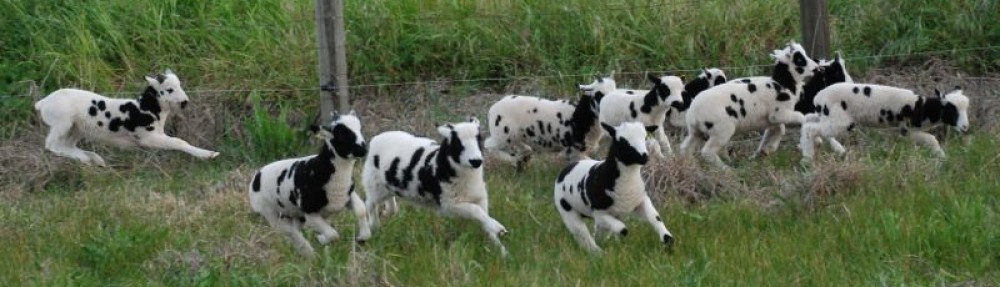
 The last post ended with a storm. But the weather changed to cold but sunny. Time to get the sheep out in the field.
 Estelle and lambs.
 Ht Lips and her triplets plus an extra.
 Back in the barn lambing has continued at quite a clip. This is Fandango and her BFL-cross lamb.
 Vixen’s twins.
 There are plenty of lambs to cuddle.


 Here is the lambing count a week ago.
  My bike set up on a trainer in the house. The only use it is getting right now is as a sock drying rack right.

 This is the first lamb born way back on February 22.
 Wednesday was quite a day with five sets of twins born. There was a Fibershed Ag Coop Board meeting at noon, but the representative photo for that would just be Stephany and me on the phone for two hours. But the main event was not lambing or the meeting. Ben Hostetler of Mountain Meadow Wool came to speak to a gathering of Fibershed producers and other interested people and talk about value-added processing and how to figure out cost effectiveness, etc.
 We also looked at fleeces and discussed skirting and cleanliness of fleeces to be sent to the mill. Oh, and do you see that stack of alfalfa in the background of the first photo of Ben and the group? I had made a call to say DO NOT bring hay on Wednesday because there would be a lot of people and a storm is coming. The hay showed up on Wednesday and Dan got about half of it in the barn before people arrived for Ben’s talk.
  Just before Ben’s talk Trista lambed with a large lamb. I kept watching for a twin during the presentation but nothing happened. I was also watching another ewe and towards the end of his talk decided to check the status of that ewe. She had been in the lambing area all day acting like she was going to lamb. I probably jumped the gun on this one, but it was partly because I wondered if there was a problem and partly because a few of us had planned to go out to dinner with Ben.
 I ended up pulling twins and all was OK although in hindsight I’m sure that this ewe did not need intervention, just more time. In the meantime while I was dealing with that ewe Trista popped out another lamb. This was almost two hours after the first and it was such a tiny thing that I’m not sure she even noticed. She did not want that lamb–that’s the small one in the photo under the heat lamp. By this time it was almost 6:00 and the rain was starting. A few of the people at the talk had stayed around to help. Dan and Ben brought the rest of the hay in under cover. I dealt with the cold, rejected lamb. I ended up tube feeding it colostrum because we could not get it up to suck even when we held Trista still. Ben and Dan helped with chores while Stephany went in to clean up the kitchen and order pizza and pasta to be delivered. That was really the best way to end the day because by then I didn’t want to go out anyway. More about that lamb in a later post.
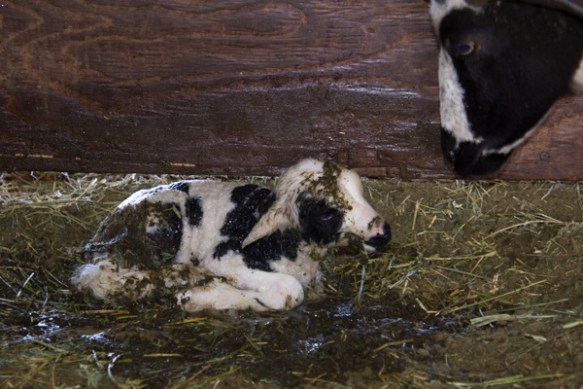 Skipping ahead to the next day. Petra was the only ewe to lamb on Thursday.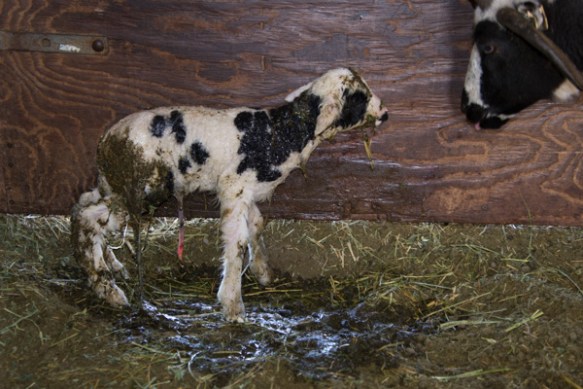
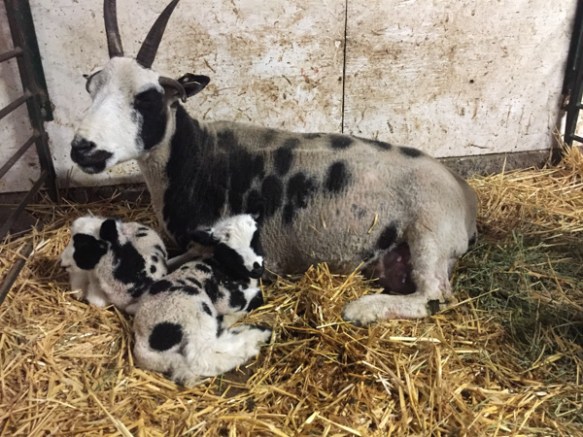 Isadora is one of the ewes who had lambed on Wednesday. By the next day I was worried about mastitis. She has a lumpy uneven udder from previous mastitis and it seemed to get hard again. I spent some time massaging and using warm compresses (easy with hot water in a disposable diaper). She didn’t developed mastitis so I think it was just the normal engorgement coupled with the hard, scarred areas from before that I was feeling.
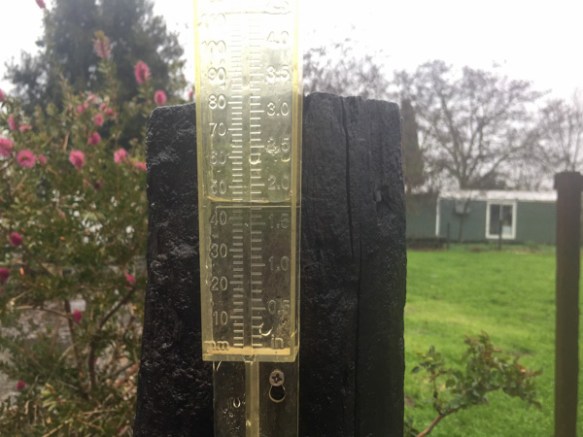 Wednesday night through Thursday we had 1.8″ of rain after almost no rain in all of February.
 That’s all it takes for our place to look like this.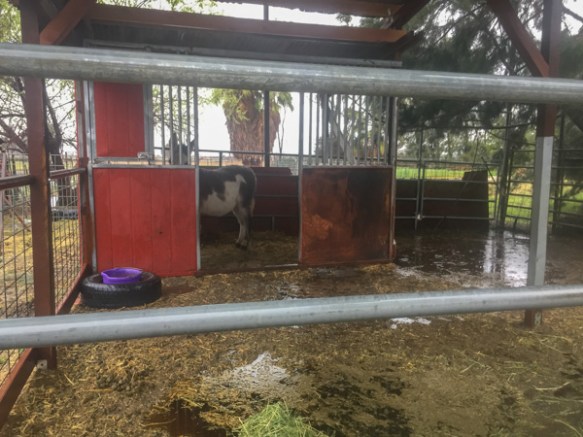

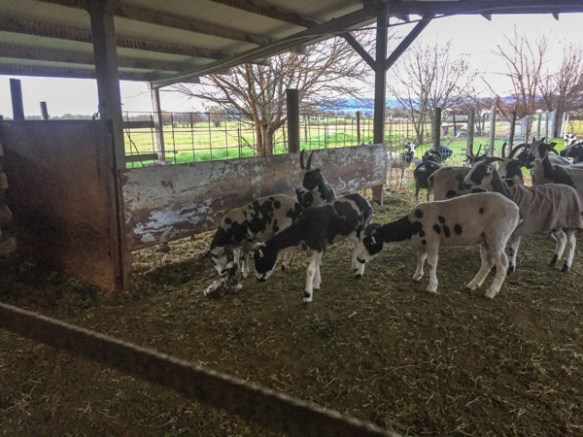 So I looked over the barn wall where I spy on the ewes and saw this. Yearlings aren’t always sure about what to do with a lamb and need a little time to let their instinct kick in. It is important that a young ewe has a chance to figure out that the lamb is hers and that she really does want it. You don’t want to interrupt that bonding time. However she can also be bullied or distracted by other ewes who are curious or close to lambing and will start to mother the lamb themselves.
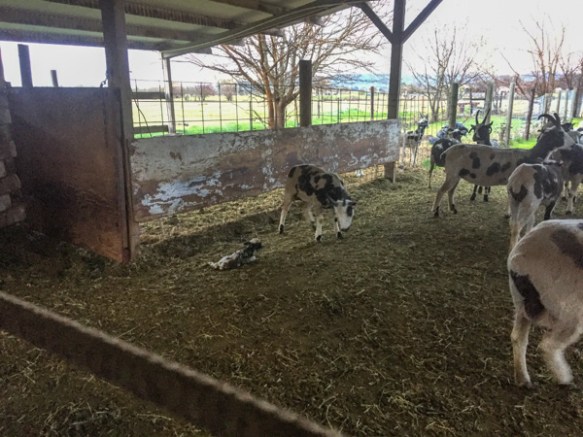 I walked around the gate briefly to push the other ewes away and then backed off so that Dilly would approach her lamb again.
 I gave her some time and then slowly picked up the lamb and got her to follow it into the barn.
 This lamb was only 4.6 pounds. The other Jacob lambs are more often 7 to 8 pounds or even more.
 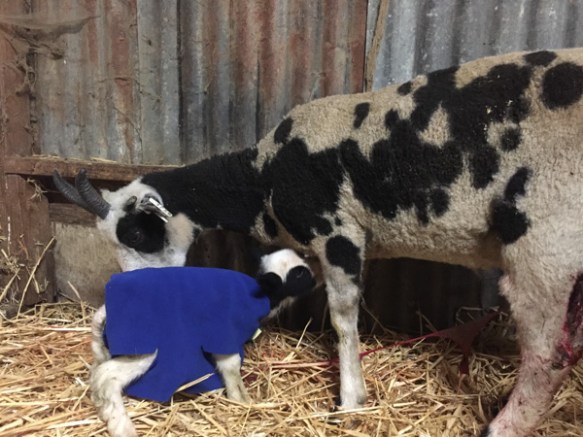 It was stormy and cold so I put this little lamb coat on it for the night. However the coat was too big and got wet. By morning I took it off.
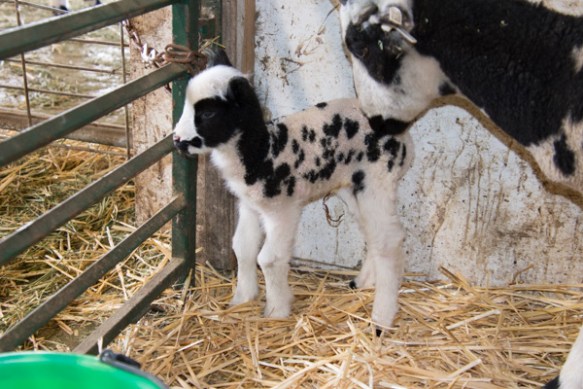 Dilly’s lamb at 2 days old.
 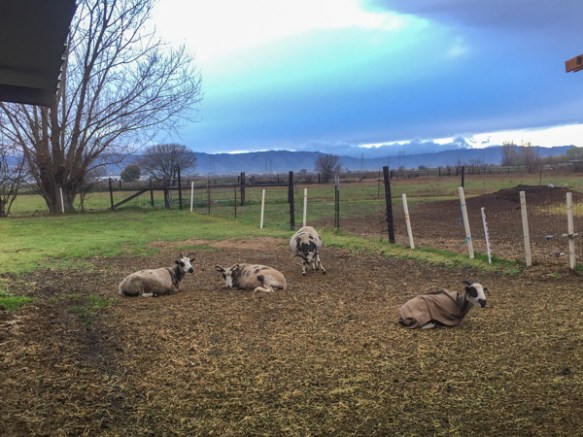 That is her pawing and looking restless during morning chores.
 When she looked more as though she were in active labor I brought her into the barn. That was about 10:15.
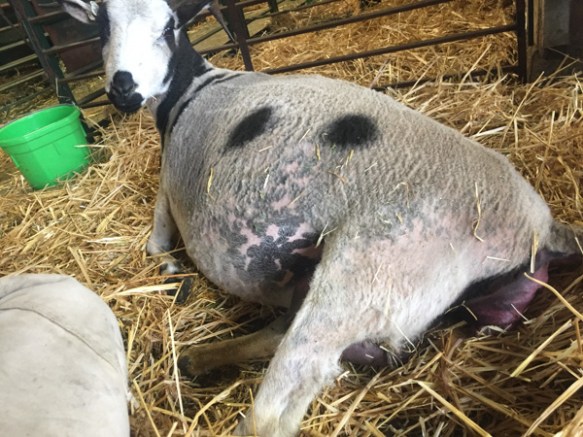 At about noon the sac was visible.
 This view, taken about 2:00 shows how, as labor progresses, the sides are sunken in front of the hips. I had been waiting for Sheena to have her lambs before I went to town, but I finally decided to make a quick trip. When I came back at 3:00 she was lying down and pushing but I saw only the nose, which at that point looked somewhat swollen. When I felt for the lamb position, the feet were at about a 2:00 position instead of below the head and out in front. I pushed the lamb back so that I could make sure that the feet matched up to the right lamb, brought them around to the 6:00 position and then pulled the lamb easily.
 As soon as the lamb was out Sheena went to work.
 The sac for the next lamb showed within a few minutes.
  Lamb #1 was on his feet within 8 minutes.
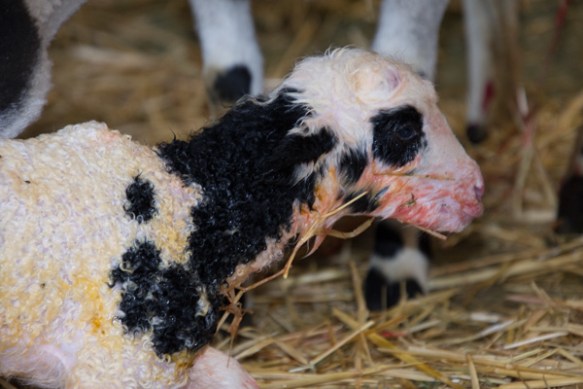 You can see this ram lamb’s horn buds.
 Sheena barely noticed as she pushed out the second lamb about 15 minutes later.
 Lamb #1 is mostly white.
 Lamb #2 has a lot of color and has lilac markings. Catalyst is the sire.
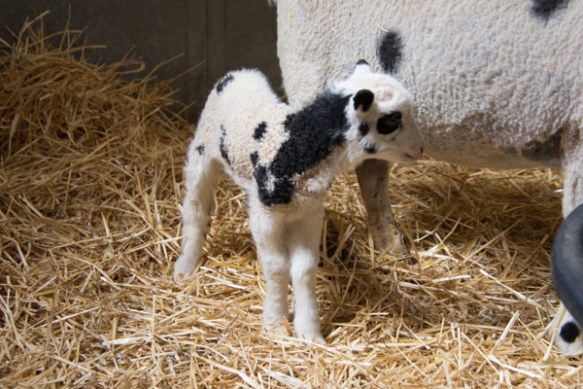 This is the first lamb two days later.
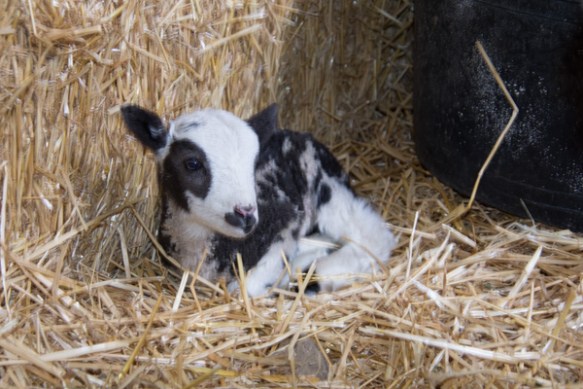 Here is the second lamb.
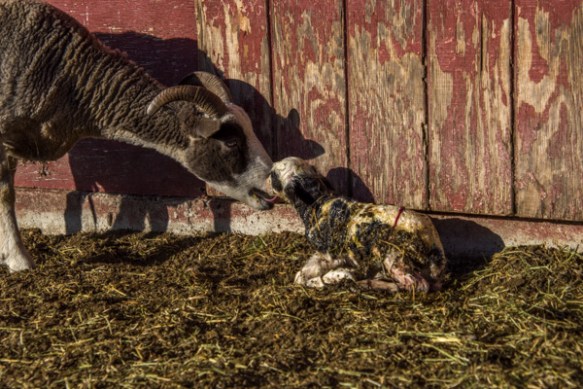 Lamb #1. These aren’t usually a pretty side when just born. Slime, dirt, blood.
 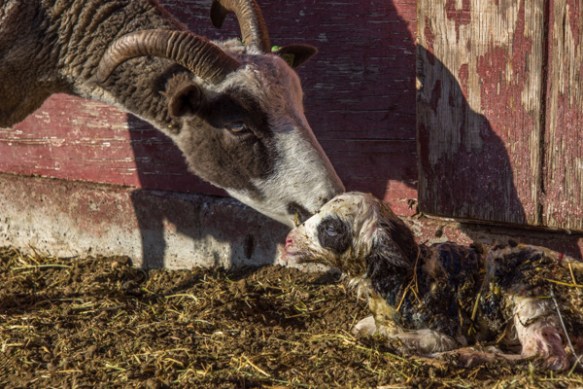 Jacob ewes are usually very good mothers and the lambs are vigorous. Shelby was cleaning up her baby…
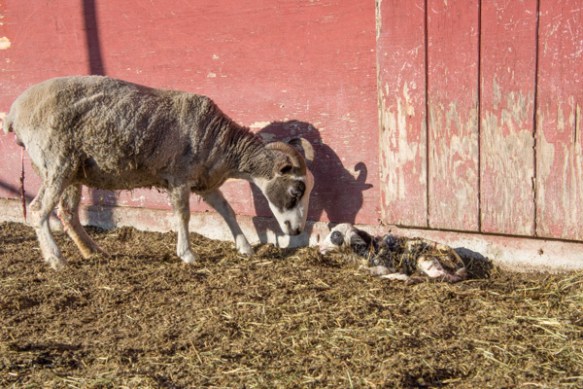 …even while pawing the ground and having contractions for the second.
 I got them inside the barn and the lamb got to its feet and started looking for milk.
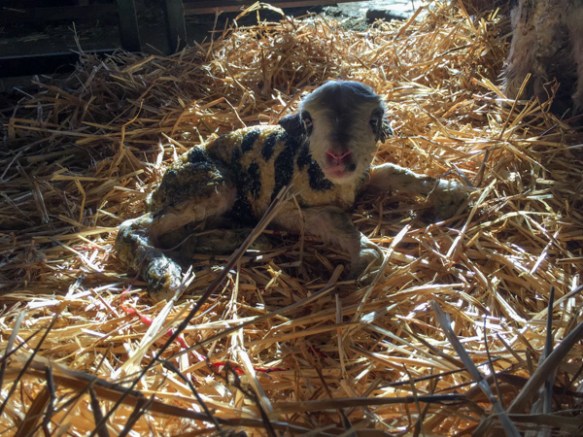 Lamb #2.
 The first lamb is nursing while Shelby cleans the second.
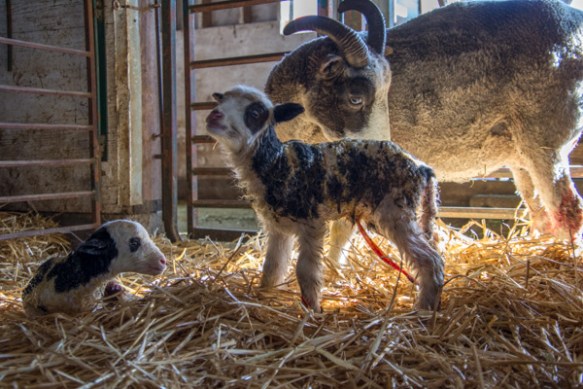 I love the look of this one. These are both lilac ewe lambs sired by Catalyst.
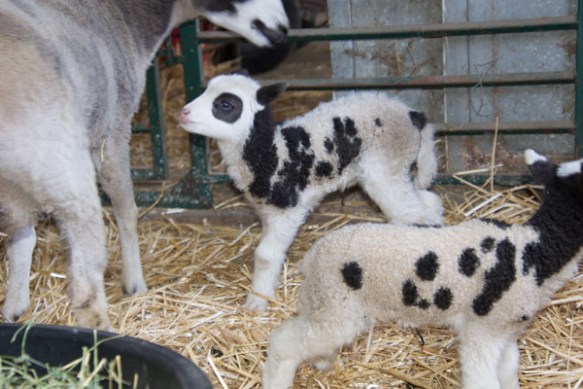 Here they are three days later.
 These lambs are listed on my


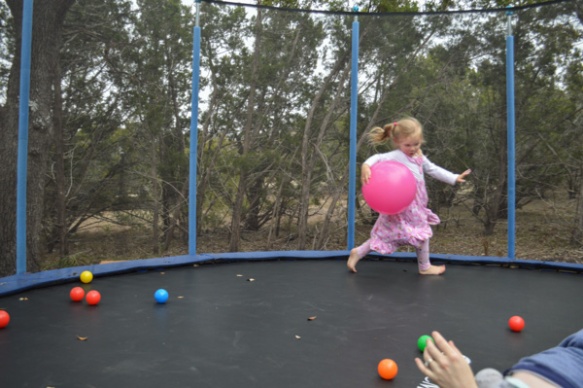 It seems that nightgowns are also good workout attire (see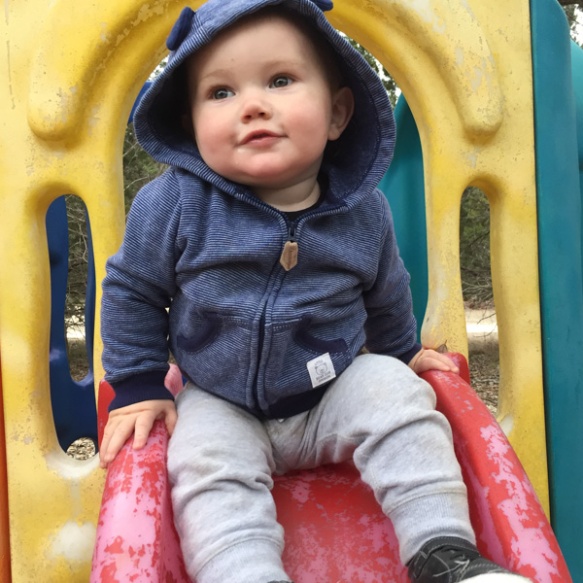
 After a strenuous workout it’s hard to stay awake for lunch.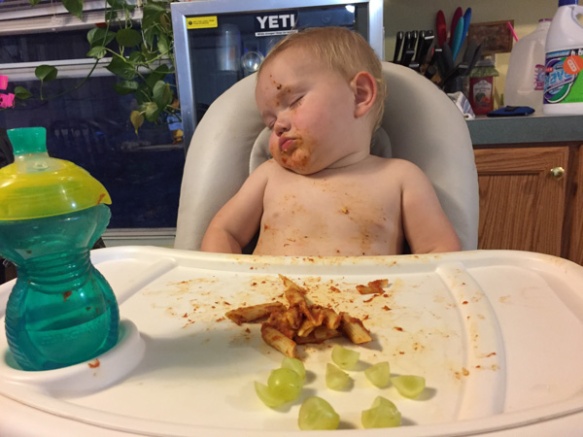
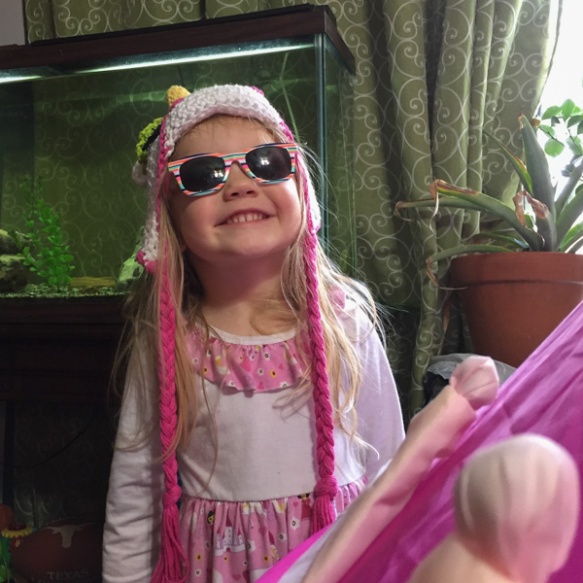 Wearing the unicorn hat she got for Christmas. Yes, there is a unicorn horn and mane on the back of this.


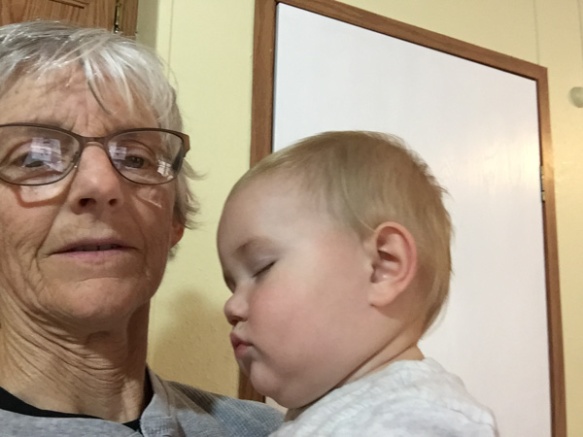 This time Kasen fell asleep before he made it to the high chair.
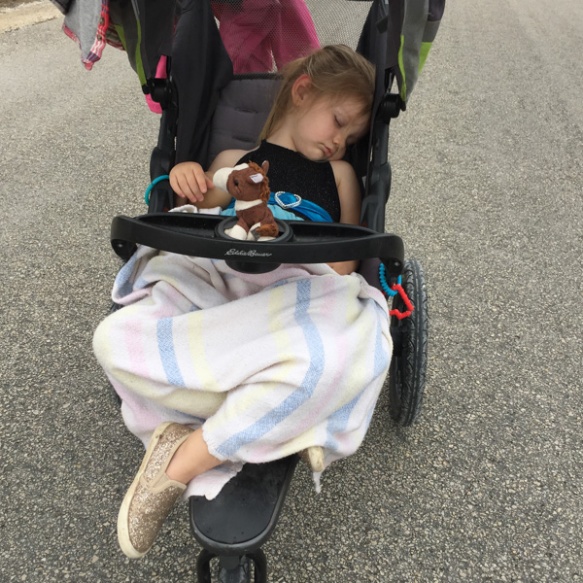 When one goes to sleep sometimes its worth going on a walk so that the other will take a nap without an argument.


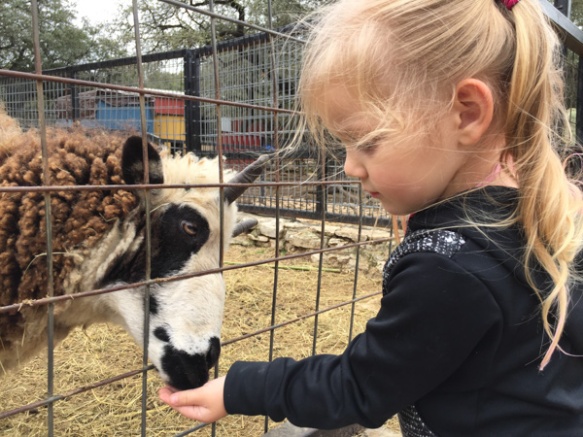 Jacob sheep at the Austin Zoo. This zoo is a rescue/animal sanctuary zoo. All of the animals were seized in animal cruelty cases, retired from other facilities, individual exotic pets that needed rehoming, retired lab research animals, etc.
 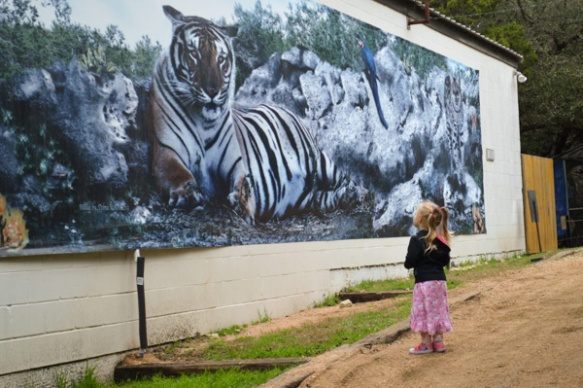 Kirby didn’t want to see the lions or tigers, but I thought that this was a rather intimidating photo (not so much the tiger photo but the little girl in front of the giant tiger).
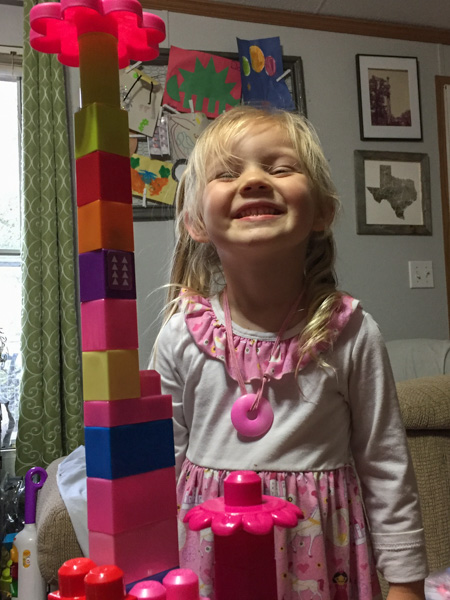 Building a lego tower with flowers on top.


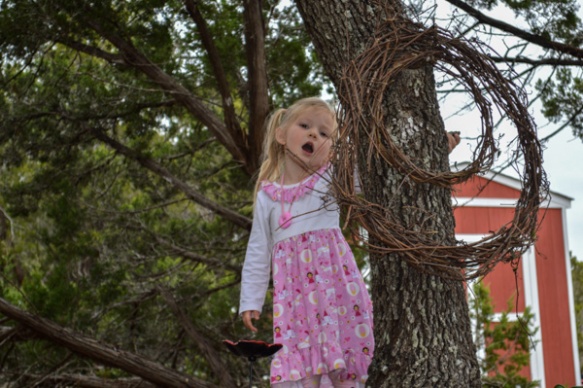 Singing Disney tunes.
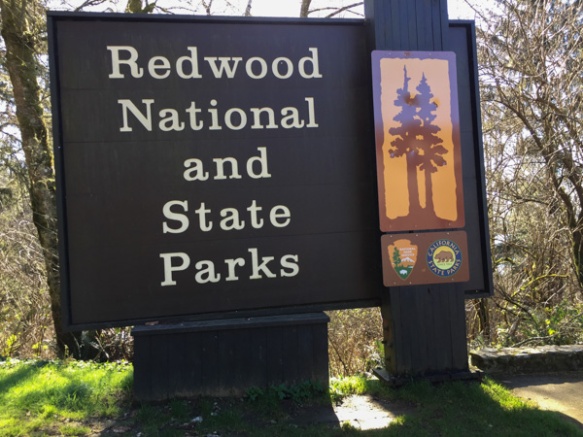 From Wikipedia: “… the four parks, together, protect 45% of all remaining coast redwood (Sequoia sempervirens) old-growth forests, totaling at least 38,982 acres. These trees are the tallest and one of the most massive tree species on Earth.”
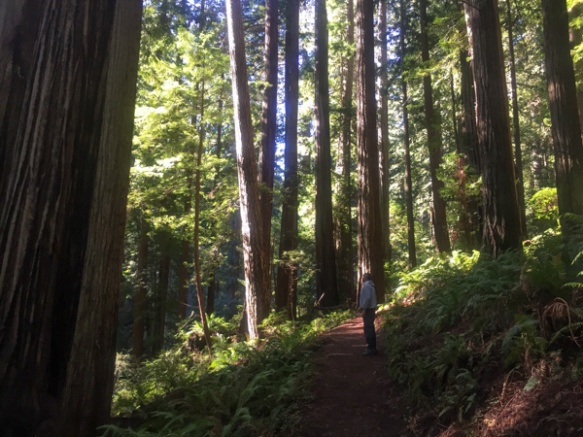 In 1850 there were 2 million acres of redwood forest along the northern California coast. After years of unrestricted logging the Save-the-Redwood League, created in 1918, was successful in establishing three State Parks in the 1920’s.
 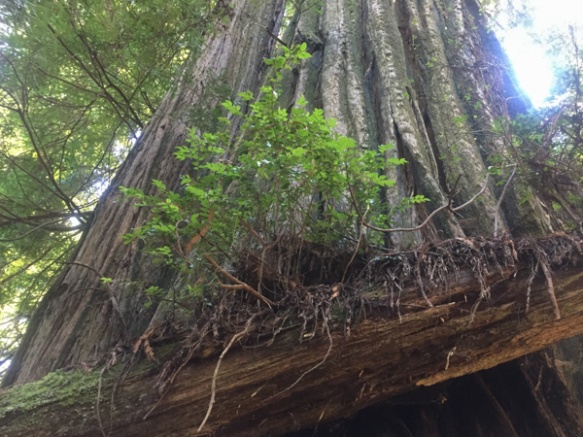 Redwood National Park was created in 1968 after 90% of the original redwood trees were gone. Now the State and Federal agencies cooperatively manage the forests and watersheds as a single unit.
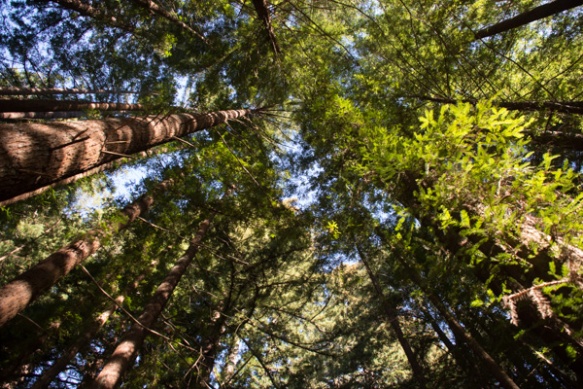 I’ll mention here that all these photos were taken with my iPhone because the previous night I dropped my camera (on the carpet in the motel) and the lens popped off. I couldn’t get it back on and knew that I wouldn’t be able to get it fixed until after I came back from Texas (where I was headed as soon as we returned from this trip).
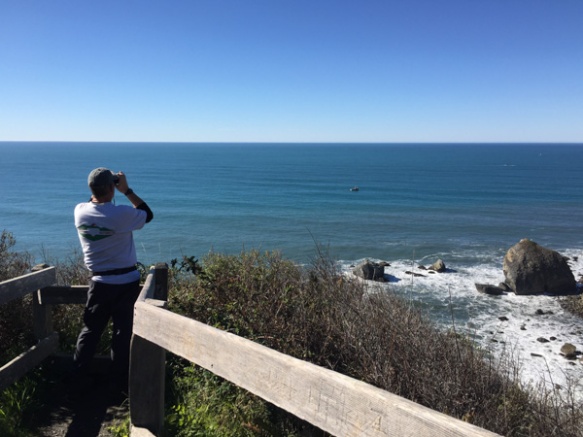 We took a side trip to the spot where the Klamath River flows into the ocean and walked down the steep trail to this overlook. That’s Dan looking across the ocean for Meryl (my DIL who is in Australia right now).
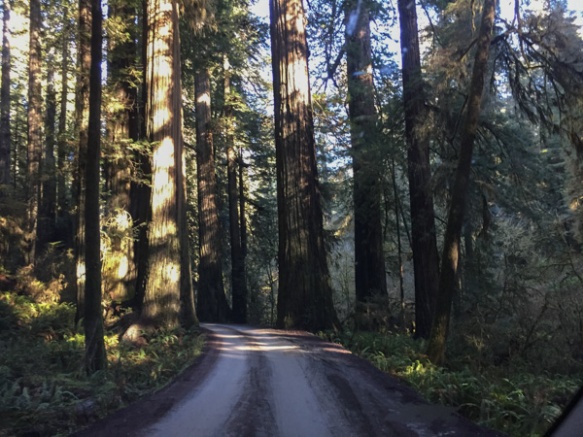 We drove farther north to the Stout Grove in the Jedediah Smith Redwoods State Park.
 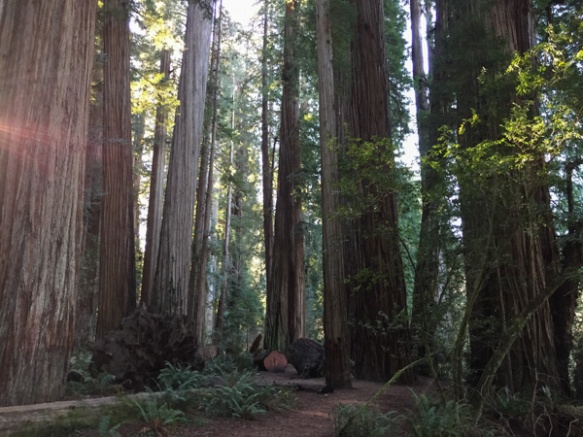 Every time we stopped we continued to be impressed with the grandeur of these trees and the forest.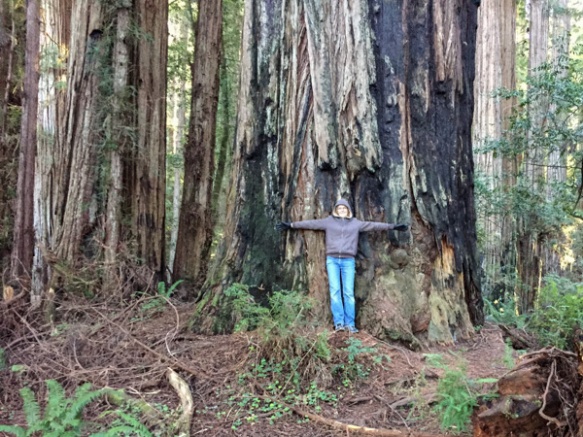
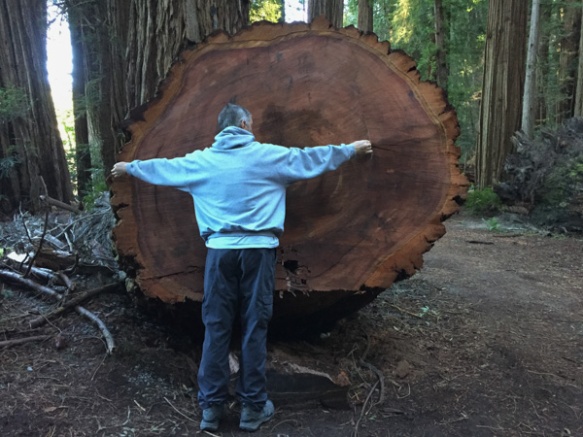 This tree had fallen and then was cut to clear the path.
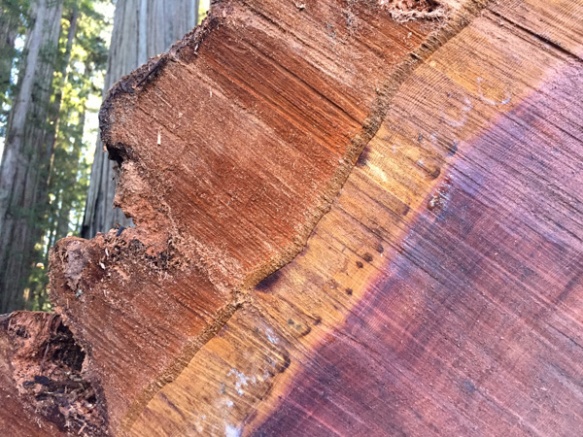 Look at that brilliant color.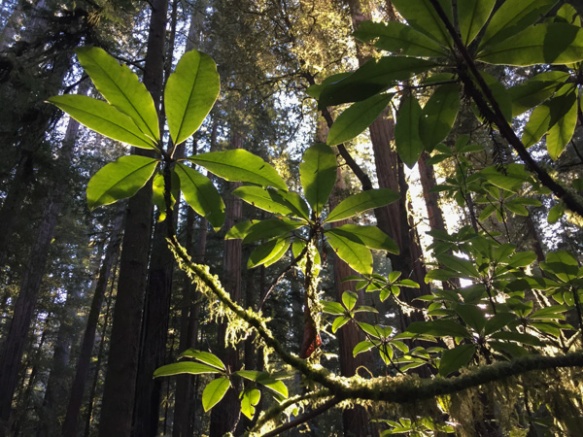
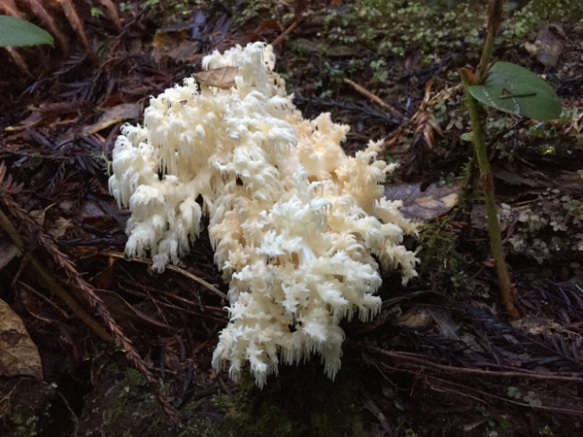 We were surprised that we didn’t see more mushrooms and fungus, but this one did catch my eye. Late in the afternoon we headed toward the coast at Crescent City.
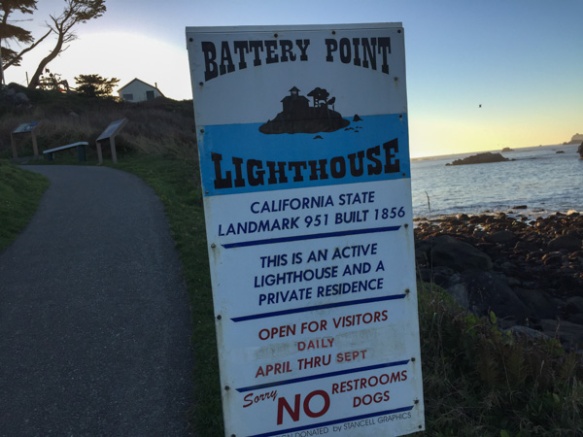 Our map book showed two lighthouses so we started with Point St. George. We found that lighthouse (manned from 1891 to 1975 and abandoned in 1995) but it was 6 miles offshore. The Battery Point Lighthouse is accessible at low tide so we were able to walk to it, but we were too late for a tour.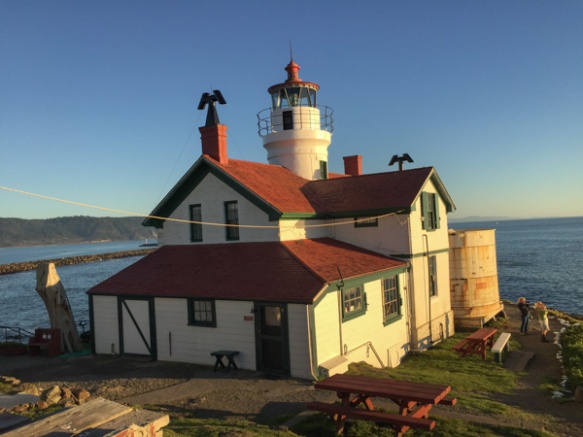
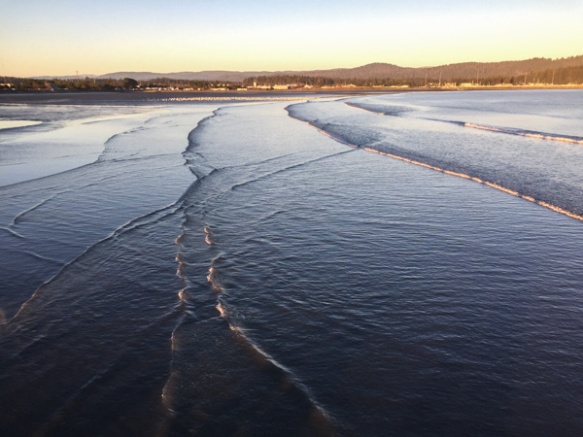 We walked along the breakwater (seen in the lighthouse photo) and then out on a pier. This is a view looking back toward Crescent City.
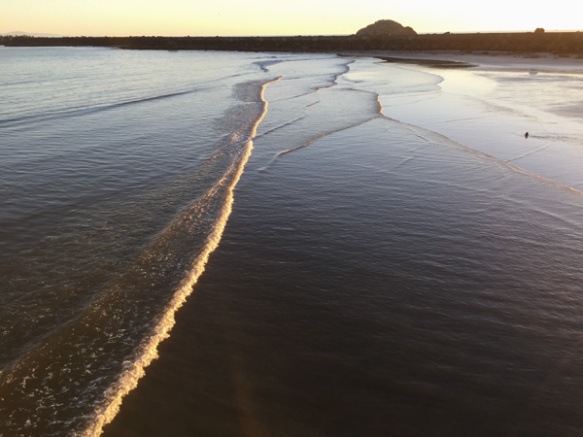 This is the view looking back toward the breakwater and the setting sun.
 Mini Road Trip!
 From the Central Valley you need to drive through the hills to the west. We turned onto Highway 20 at Williams. You can see a slight tinge of green if you look hard but this time of year they should be emerald green. That green is the grass that began to grow after our early January rain. We have had negligible rainfall since and there has been no more growth. This is the time of year that ranchers in the non-irrigated hills count on abundant forage for livestock. Very scary to think of another year of drought to this degree.
 This is a view getting closer to the hills. The almond trees are beautiful this time of year but I am disturbed at how many acres of land all over California have been put into almonds now. That’s a story for another time however. It seems I didn’t take more photos until we got to our first stop.
 From the Humboldt Redwoods State Park website: “In the early 1900s, loggers came to what is now Humboldt Redwoods State Park to cut down lofty ancient redwoods for grape stakes and shingles. The founders of Save the Redwoods League thought that was akin to ‘chopping up a grandfather clock for kindling.’ From the acquisition of a single grove in 1921, the League has raised millions of dollars to build and expand this park. Today Humboldt Redwoods spans 53,000 acres, an area almost twice the size of San Francisco. About one third, or 17,000 acres, of the park is old-growth redwood forest—the largest expanse of ancient redwoods left on the planet.”
 What is special about an old-growth forest?
 The size of the trees.
 The mix of tree sizes. Unlike a reforested clear cut, there are trees of all ages and sizes and this makes for an open forest instead of a monoculture of trees and brush that you can hardly walk through.
 The ecology. When old trees fall they open up space for light to reach the forest floor and opportunity for new growth of other species.
 The grandeur.

 We ended the day at the beach.
 Our fabulous shearer is John Sanchez. We started with the rams. This is Peyton, the new BFL. His fleece sold right away.
 Next was the 2 year old lilac ram, Catalyst.
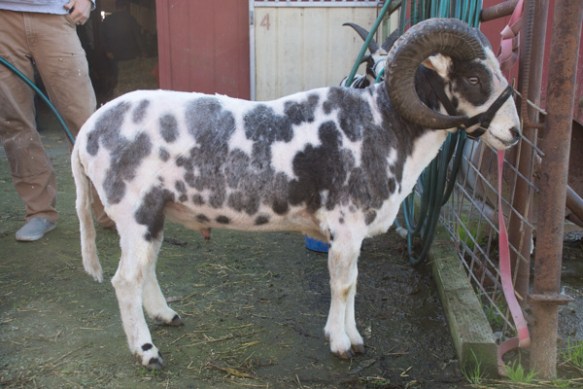 Here he is afterwards and…
 …here is his fleece.
 A staple of Catalyst’s fleece.
 Catalyst’s son, Cayenne, after shearing. You can see what he looked like before shearing near the end of
 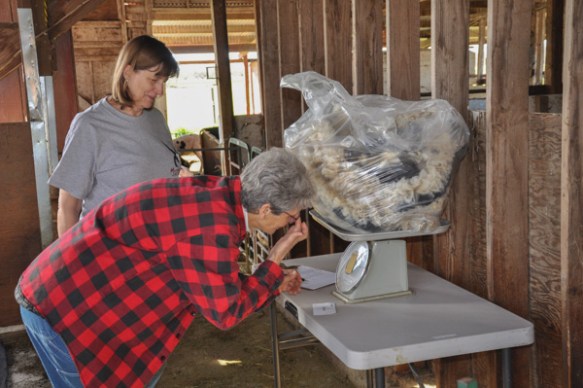 One of the shearing day jobs is weighing and recording fleeces. Kathleen and Lisa did that job.
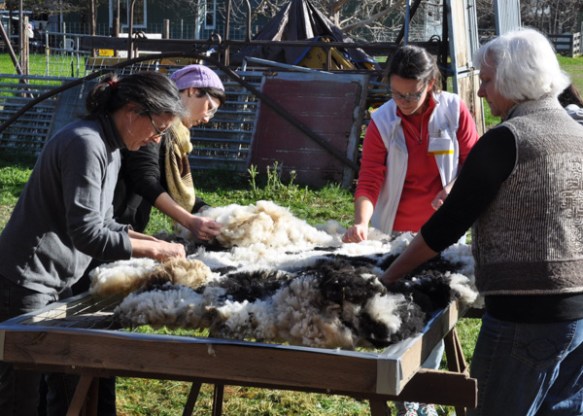 We had two skirting tables set up this year. Farm Club members skirted their fleeces and helped others skirt and sort.
 I set up the GoPro for some shearing video. That will be coming later.
 Roy and Gina worked in the sheep pen.
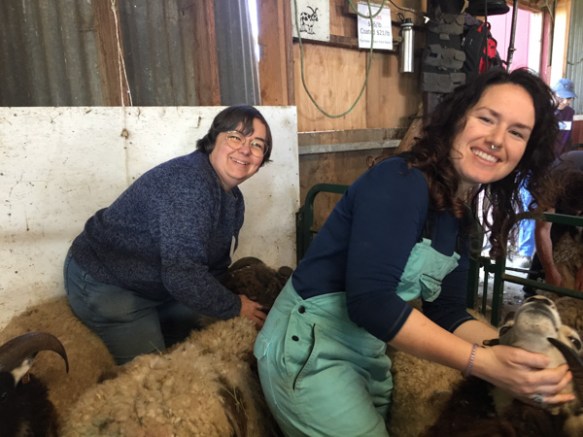 So did Deborah and Shelby. They all made sure that John never ran out of sheep.
 Kathleen, Lisa, and Dona. Dona is our “official” Farm Club photographer because I’m always too busy to take photos on our Farm Days. She took some of the photos here.
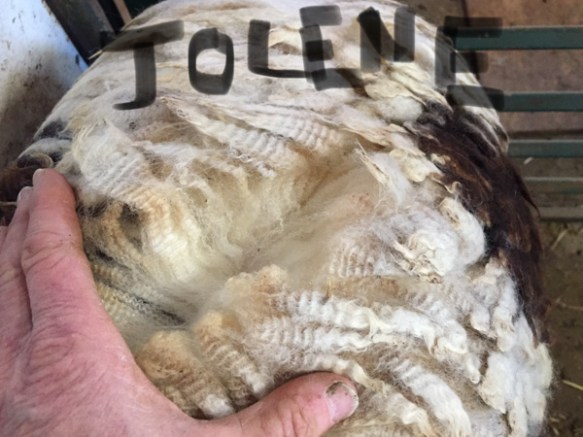 This is what a fleece looks like when you take the coat off the sheep.
 Here is that same fleece after shearing.
 Locks from Jolene’s fleece.
 Another beautiful fleece on the table.
 Doris made Jacob sheep cookies for us.
 Meridian Jacobs' Blog