DISCLAIMER: You wanted it real, right? At least that’s what I hear from some people who say they want to know what it’s like to raise sheep. So this post is real. No pretty pictures; in fact, some down-right yucky ones. A few sad stories. It’s the other part of life on the farm. Skip this post if you don’t want to know.
Over the last couple of months I have had to deal with several relatively minor veterinary issues. If I had to call a vet for each of these I might as well give up raising sheep. There are some things you just have to do on your own. But also note that if I hadn’t dealt with these issues as they arose they would have become much more serious. As it is, they are mostly nuisances, taking time away from other things on the never-ending list of things-to-do.
Problem: Ram horn growing too close to jaw. It doesn’t look too bad here but…
 …here is how it looked after I cut the horn. There was already an open sore on the skin which is the perfect place for infection and fly strike to start. This ram was never registered and destined for butcher because of his horns and his personality. In fact I had counted on using his very cool striped horns for dozens of fabulous buttons. The sad story is that his horns were lost at the butcher facility and no one seems to know what happened to them. Discouraging.
Problem: Ram horn growing into skull. This is Miller. He started life out with nice looking horns, but after one broke it started to grow in the wrong direction. (Those photos will be another post.) This is looking down and you can see the horn going into the top of his skull behind his ear.
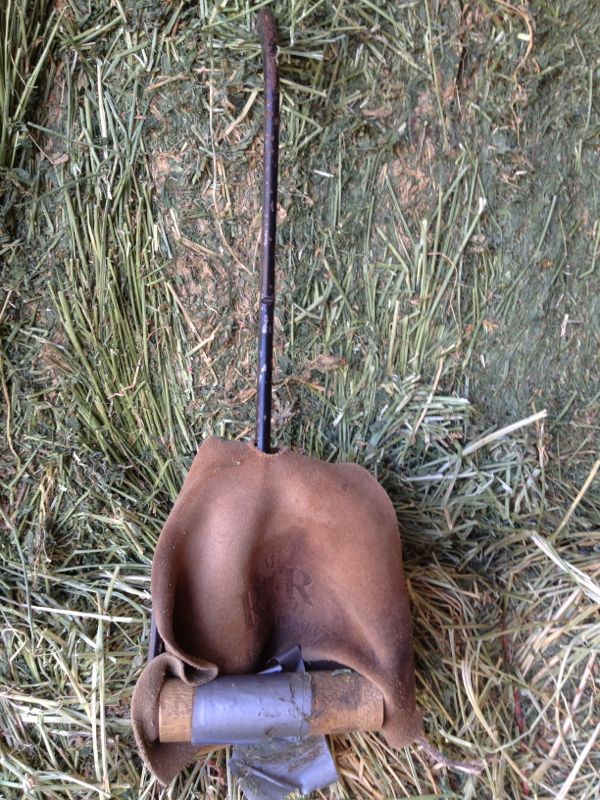
 This is the kind of saw that you use to cut horns. It’s a wire piece with two handles. I can’t find mine so this belongs to a friend (thanks, Jackie).
  Here is a close up after cutting the horn. It’s hard to tell but the horn had already gone into the flesh making an open wound.
 This is the same view covered with Swat, an product that keeps the flies away. It comes in clear or pink. I like pink because I can see that it is still there. Sorry boys. I took these photos in mid-June. It’s early August and this horn needs to be cut again. I just looked up the wire saw on-line because I need to buy one. I read that the wire gets dull with use. No wonder that when I tried to cut this horn again I couldn’t get anywhere. I will buy two of these wire saws (with the wire that can be replaced) and give one to Jackie.
Problem: Ewe depressed (not in the psychiatric way), not eating, getting worse quickly One morning I found Hattie, an otherwise healthy 3 year old ewe who was in a group of ewes I had recently weaned, not wanting to eat and not responding to much I did. I was teaching a class that morning and couldn’t do much other than put her in her own pen and get back to her later.
Do you see Hattie’s posture in the photo above? That is known as star-gazing and sometimes is a result of a thiamine deficiency. I didn’t think Hattie could see–not a problem with the eyes, but a neurologic problem. From Sheep101:
Polioencephalomalacia
(PEM, CCN, polio, cerebrocortical necrosis)
Polioencephalomalacia is a disease of the central nervous system, caused by a vitamin B1 (thiamine) deficiency. Since the rumen manufactures B vitamins, polio is not caused by insufficient thiamine, but rather the inability to utilize it. The most common symptom of polio is blindness and star-gazing.

Polio most commonly occurs in lambs that are consuming high concentrate diets. Polio can also occur in sheep that consume plants that contain a thiamase inhibitor. Polio symptoms mimic other neurological disease conditions, but a differential diagnosis can be made based on the animals' response to injections of vitamin B1.
 I knew that an injection of thiamine would clear this up if that was the problem so I called my vet (Dr. M) to get some. I gave Hattie the injection and saw no response. I talked to Dr. M and she asked if she could come out and bring some students who were helping her. (She said that if nothing else, I would be adding to the students’ experience.) In the long run, we gave Hattie thiamin, calcium, and glucose to no avail. She died within a few hours. I took her to the Food Animal Health and Safety Lab at UC Davis and the necropsy report showed copper toxicity. That could also be the subject of another post someday. There have been a few other deaths associated with Cu toxicity and I don’t know the source of the Cu.
Problem: Ram lamb with broken horn (and lots of blood and flies). That is not the normal position of a horn. The lambs often break horns when they play and fight, but they usually break the outer covering off the horn, leaving a bloody core. It’s messy, but if you do nothing (except use Swat on the head to keep flies away) it will dry up and heal and the horn will continue to grow. But not this one.
 This is looking down on the ram’s head. The lower horn broke at the base of the core which leaves a hole in the head. In this case you can’t just put the horn back and expect it to reattach…and you have to be careful of infection and fly strike. I ended up taking this horn off entirely and then having to cauterize the wound to stop the bleeding.
  Swat again. I kept the ram in a pen for a day with a fan blowing to hopefully keep the flies off. The second day I decided he was better off in the field instead of the barn. He is now a 3-horn ram and is in the butcher line-up.
Problem: Ram with swollen jaw. Remember this guy? This is the one from the first photos. I noticed a swollen jaw. My first thought is bottle jaw (caused by worm overload). On closer examination I saw something else.
 This is a view of the underside of the jaw.
  Here is the solution. Cut the horn, take a photo, then apply Swat.
Problem: Ram with gooey eye. This is Miller again. I noticed eye looking gooey and let this one go for a little while. (It’s more work to catch the rams.)
 After I took a closer look I realized that the gooey eye was a result of a wound (probably from rams fighting) and not due to illness. It was not only gooey, but the lids were swollen.
 Clean up was in order.
 More clean up and then Swat.
Problem: Ram with swollen jaw.  This ram lamb has no horns to speak of so that is not the problem. At first I thought this one was bottle jaw also and I think I treated him with worm medicine. The swelling never subsided and then started to change from an even swelling to something that felt more like an abcess. I just realized that I have no more photos of this one and that’s probably a good thing. This was a big abcess, probably from a foxtail. I treated it and kept the ram away from the others, but I could never get it to clear up well. This ram went with the last batch of rams who were butchered.
Back to pretty pictures next time.

 I have been looking at these paint samples for months and finally chose one.
 But first everything needed to be primed. This is where the new section joins the old.
  This is part of the original building. It’s actually an old mobile home, which hasn’t been mobile in decades. I painted it about a dozen years ago after we first moved here.
  This is at the south end. The window trim on the south end and much of the east side was rotten. The wood beneath was also rotten in some places. It has been very discouraging and overwhelming–trying to figure out how to deal with it. (Don’t look up dry rot on Google unless you want to get depressed.) Some of this still has to be fixed before the whole project is completed, but we moved on with what we could do.
  It was extra nice that a couple of husbands also volunteered to help. The more the merrier!

 I don’t know if Mary overcame her dislike of ladders, but she persevered anyway to paint the eaves.
 We worked all day yesterday with brushes to get that primer into the wood. Today I got out the new paint sprayer.



 One down, more to go.










 I wish that I could draw arrows on the photo but I don’t have the right software. See the sheep on the left? How about the sheep in the back with the white horns. And the sheep in the right center with his head down. Yes, those are rams in the pasture with the ewes. And Amaryllis is in the ram pen. OOPS! Someone didn’t latch the ram pen gate after she cleaned out the feeder.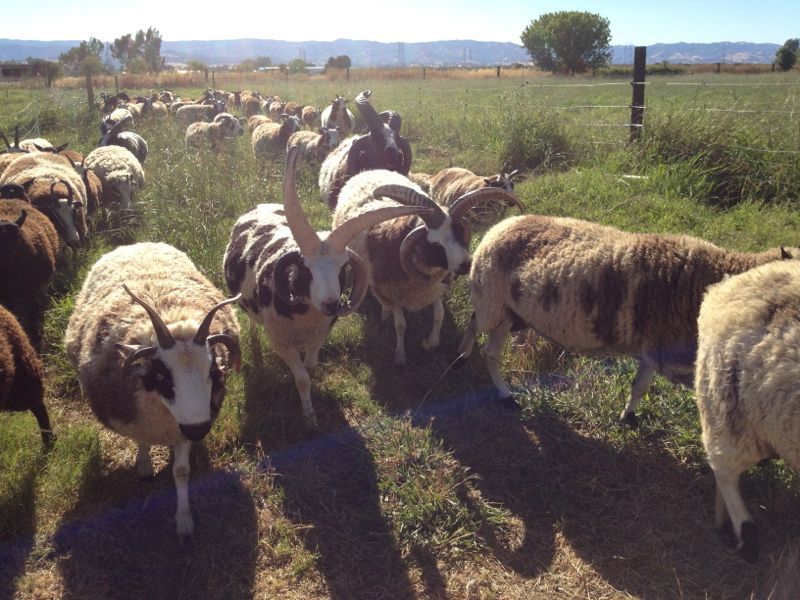
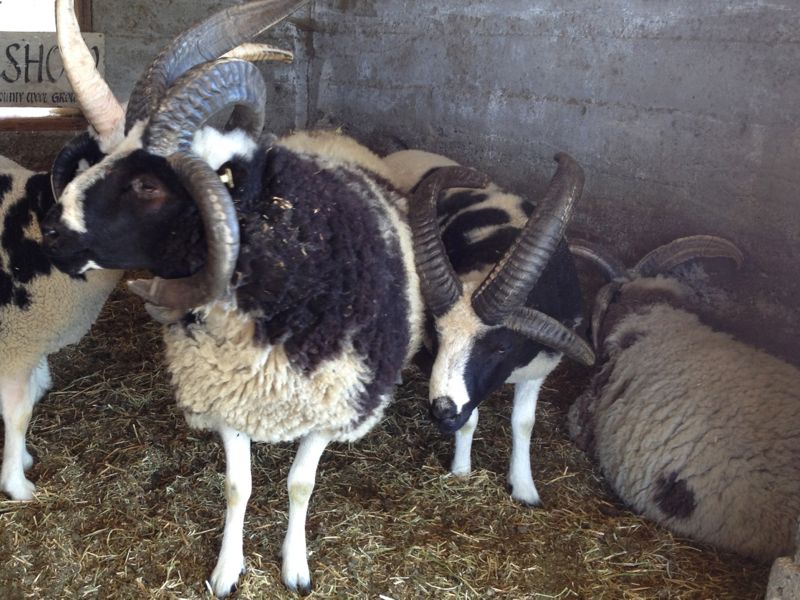


 Rusty helps move them around.


 … take a closer look at the ram with the white horns.


 Larry (Ruby Peak Linden x M. Spring)

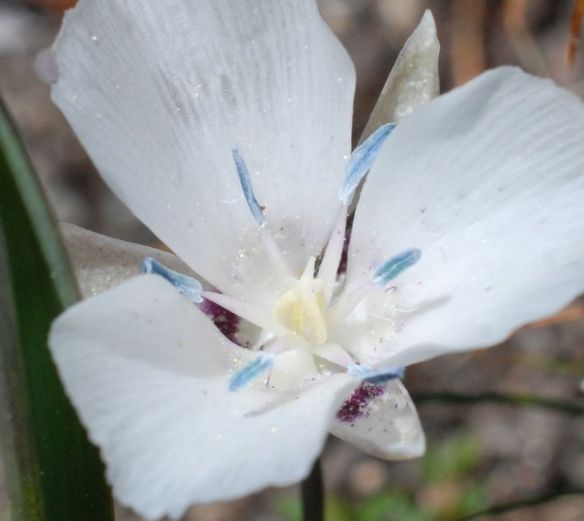 …close.







 My yearling ewe, Fandango, took first place in her class and was awarded Champion Jacob Ewe.


 It has become tradition now to eat dinner at La Oficina.