Regular blog readers may know that in the late summer and fall I start complaining about the unpalatable late summer grasses. I’m sorry, but I’m going to complain now even though it is only spring. I only graze about 7 acres so all of it seems precious. We dealt with some of the issues of the thick dallisgrass a couple of weeks ago by burning it. I hope something starts growing where all that heavy thatch was.
Today’s issue is the condition of the east paddock. Medusahead is a nasty, unpalatable grass that goes to seed in the summer, covering all the soil with thick dry thatch. The medusahead is starting to grow now and the only other thing growing with it is a perennial grass (Elymus–wild rye– I think) that the sheep don’t like either. The rest of the soil is covered with the dry residue from both of these. My goal in this paddock is to graze it hard enough that they will at least trample and break up the dried up grasses from last year and hopefully eat some of the less palatable grass.
As I was uploading these photos I realized that they don’t show what I’ve been talking about.

This is the view looking south. You can’t tell, but it’s the east side (left) of the east paddock that has the problem vegetation. It took them only a day to clear off almost everything in the south part of this paddock (as opposed to 2 days in equal sized paddocks with better vegetation).

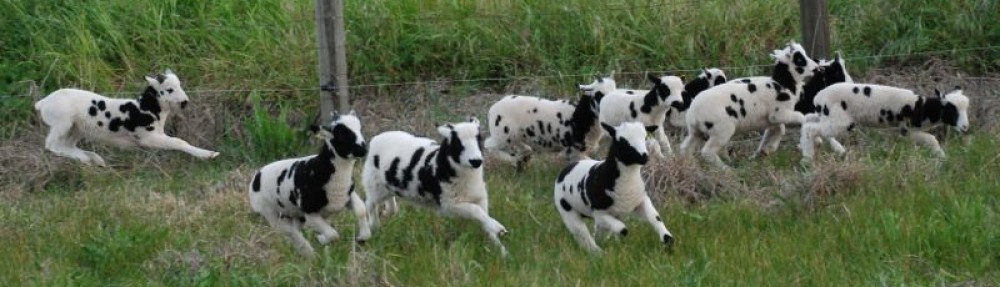
They are hungry and ready to move.

I took this photo as I opened the fence and stepped back so I wouldn’t get trampled.

Arthritic Stephanie follows the running sheep.

Amaryllis brings up the rear. She will follow Stephanie anywhere.

This view is looking north, from the part of the paddock they just left. In this photo you can’t really tell the difference in vegetation between the west (now on the left) and east sides of the paddock. It’s much easier in person, but notice where the sheep are. There is no fence keeping them from the east side–it just doesn’t have what they want to eat.

Compare this photo to the one where they are running into the new pasture. There is a blue cast to these plants–this is very sparse (although it may not look so in a photo from this angle) and it is so tall because the sheep avoided eating it the last time they were here.
Tomorrow I will start irrigating. I hope for some warm weather to follow so that the clover and trefoil will come in faster.