Sheep Across the Road – Shearing

I wrote three blog posts (the latest) about the sheep grazing the alfalfa field across the road. They moved out in December. I had talked to the owner about the possibility of buying his wool so I would have another locally grown yarn here. When I contacted him a couple of weeks ago he said the timing was just right because they were going to shear that week. Unfortunately the sheep he thought would be best for my purpose were grazing a vineyard in Santa Barbara County. Fortunately I have a good friend in Santa Barbara AND I had three days with no commitments. I drove to Santa Barbara on a Thursday, getting there after dark.
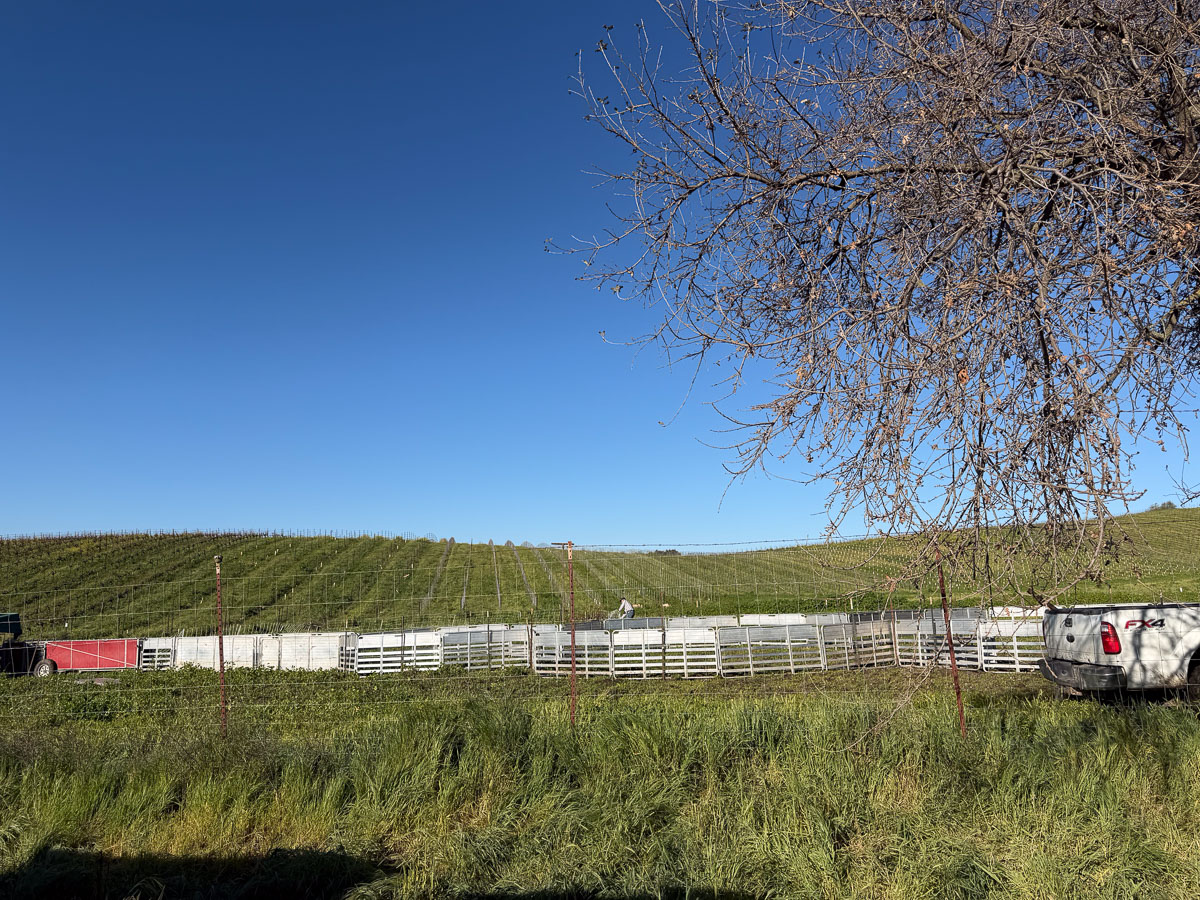
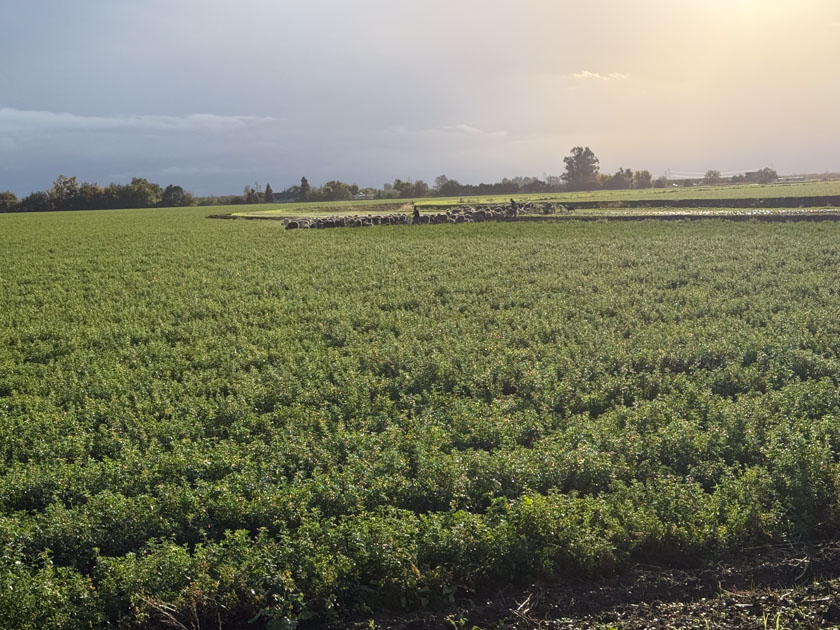
Friday morning we drove about 40 minutes to the vineyard where the sheep were grazing. The corrals and shearing shed (to the left, out of this photo) had been set up the day before. This is a lot of infrastructure to move from place to place, but how they make it work.
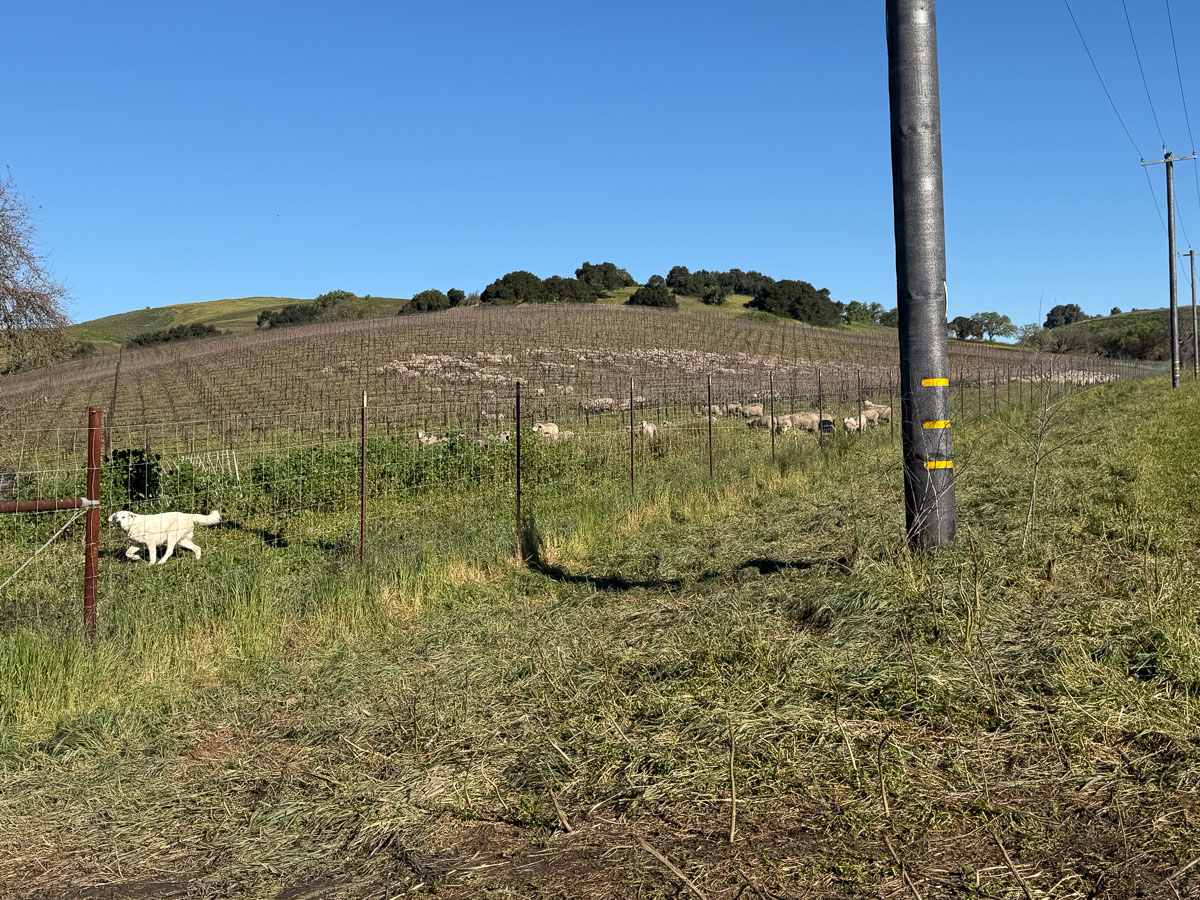
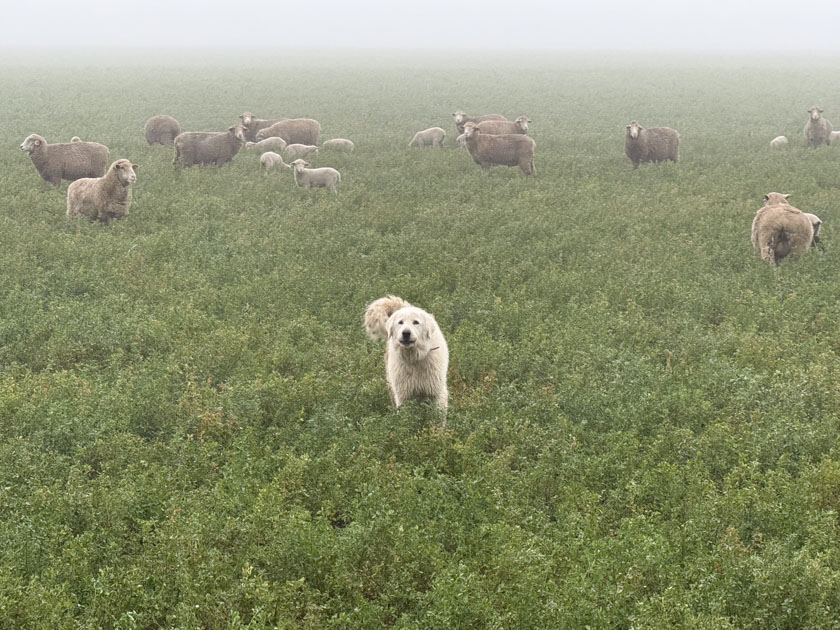
The first group of sheep was brought down from the vineyard. That’s their LGD (livestock guardian dog) leading the way.
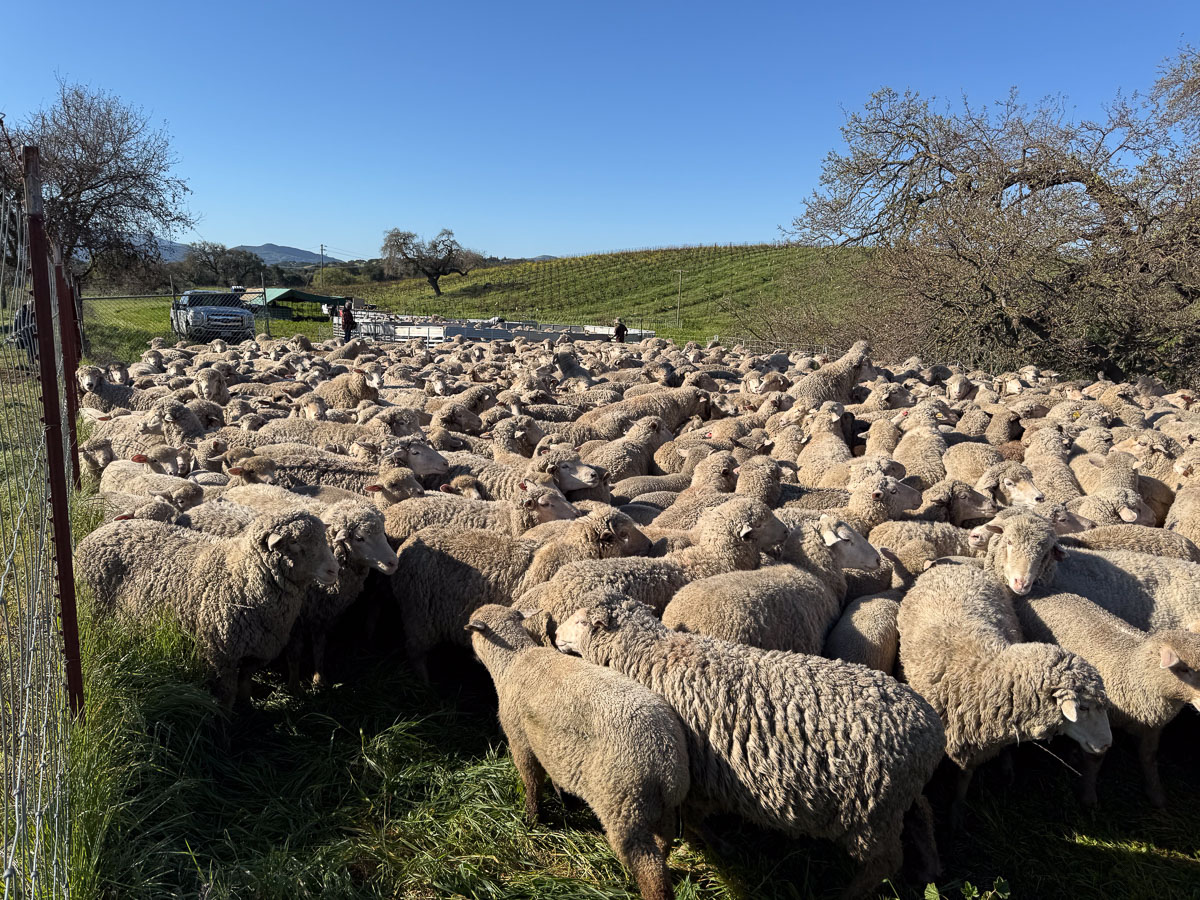
This group includes Merino and Corriedale sheep. The owner, Cole, has separate flocks that he delivers to different jobs. I think that part of the planning is how to make the most of the trucking and deliver a full load. When he grazed the alfalfa in Solano County he had groups of 180 to 200 ewes with lambs and that filled a truck. This group is 400 ewes with single lambs.
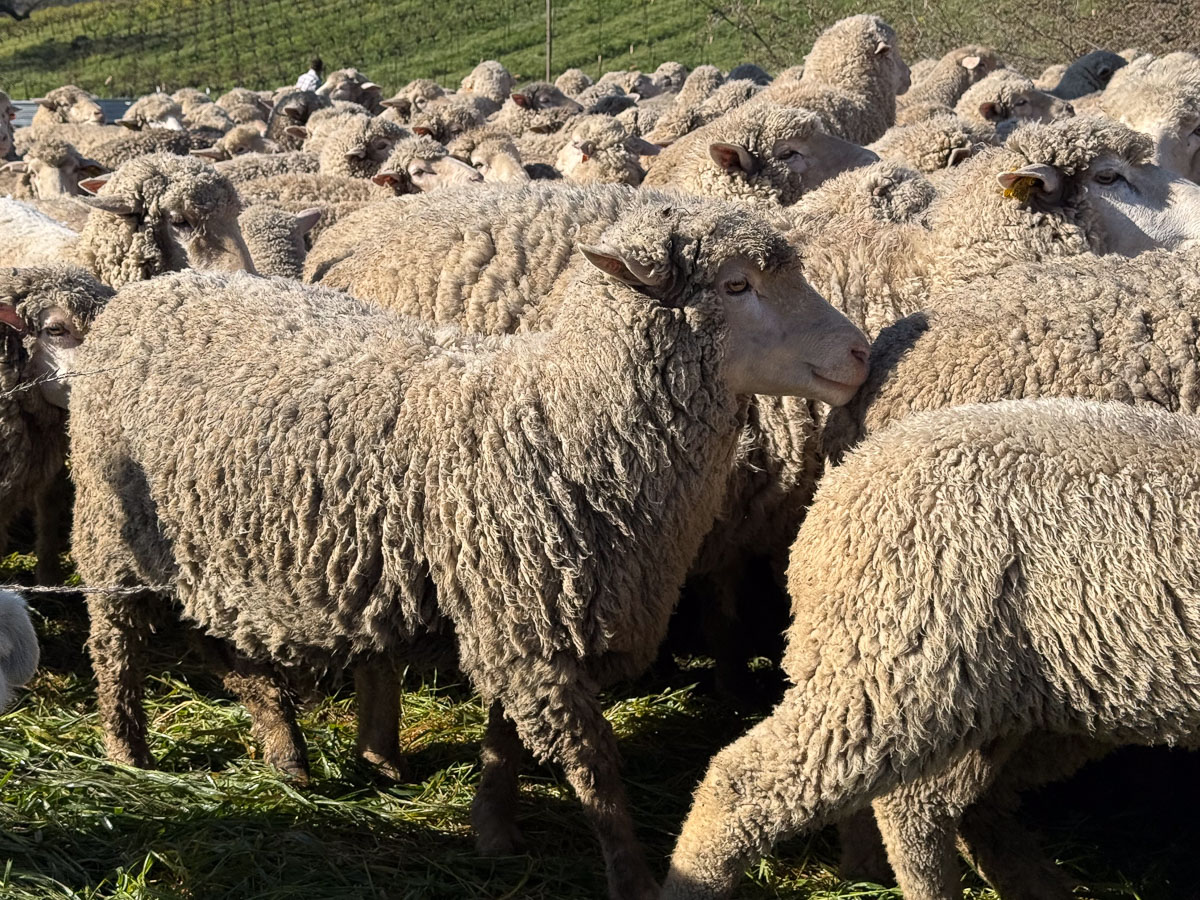
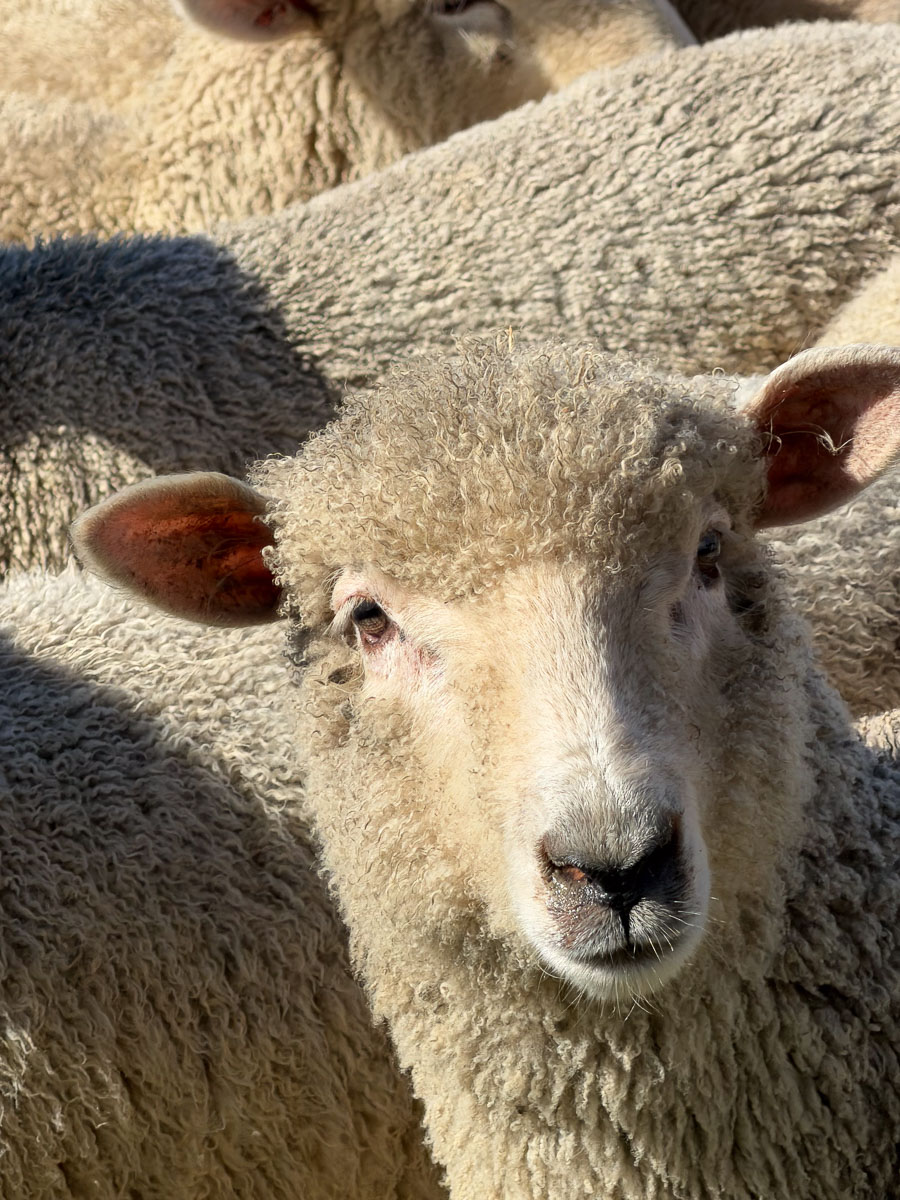
The lambs were born in October which is why they look almost as big as the ewes.
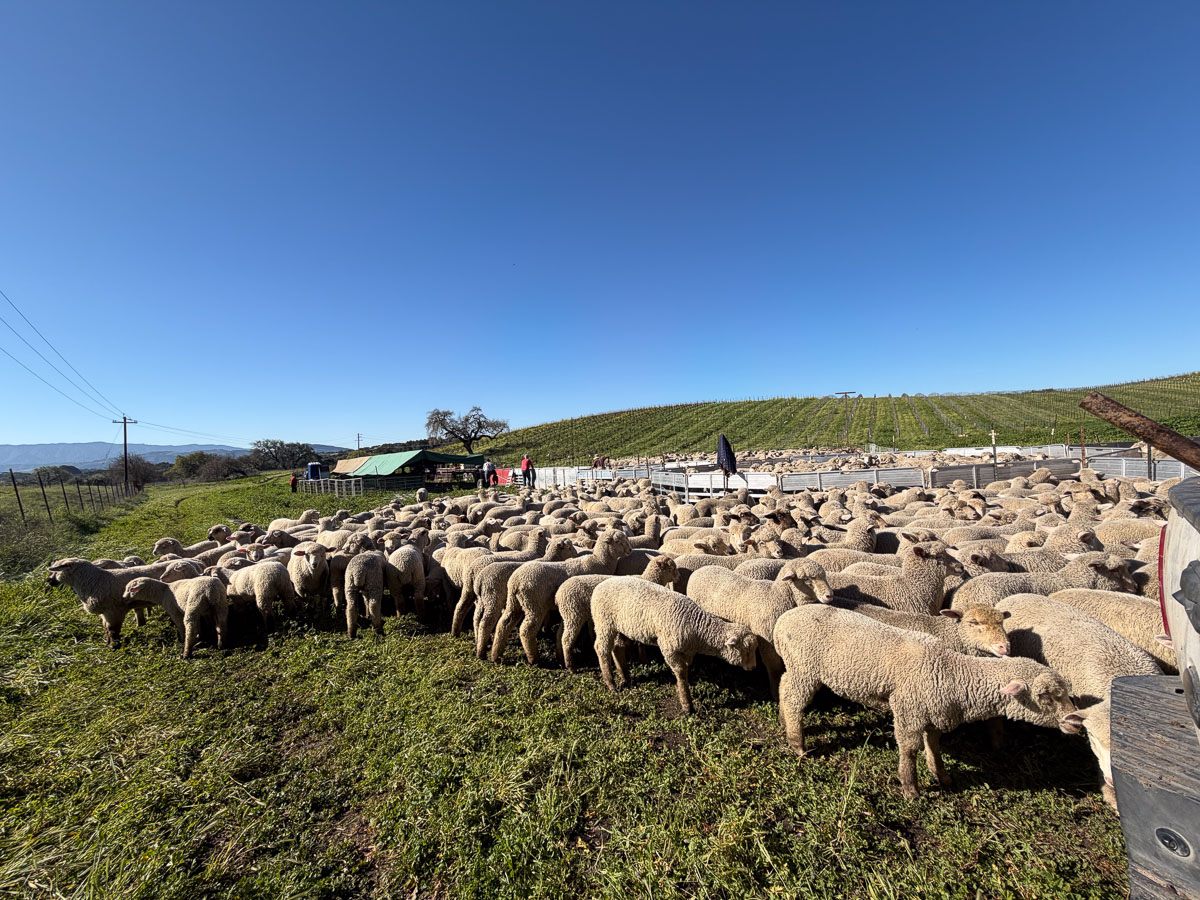
Large group of lambs in green grass.

It took an hour or so to sort the lambs away from the ewes so that didn’t have to happen as the ewes were going into the shearing shed. The shearing shed is temporary panels with the green tarp. The red panel is the chute where lambs were sorted. This view is of the lambs after being separated. The ewes are in the corrals.
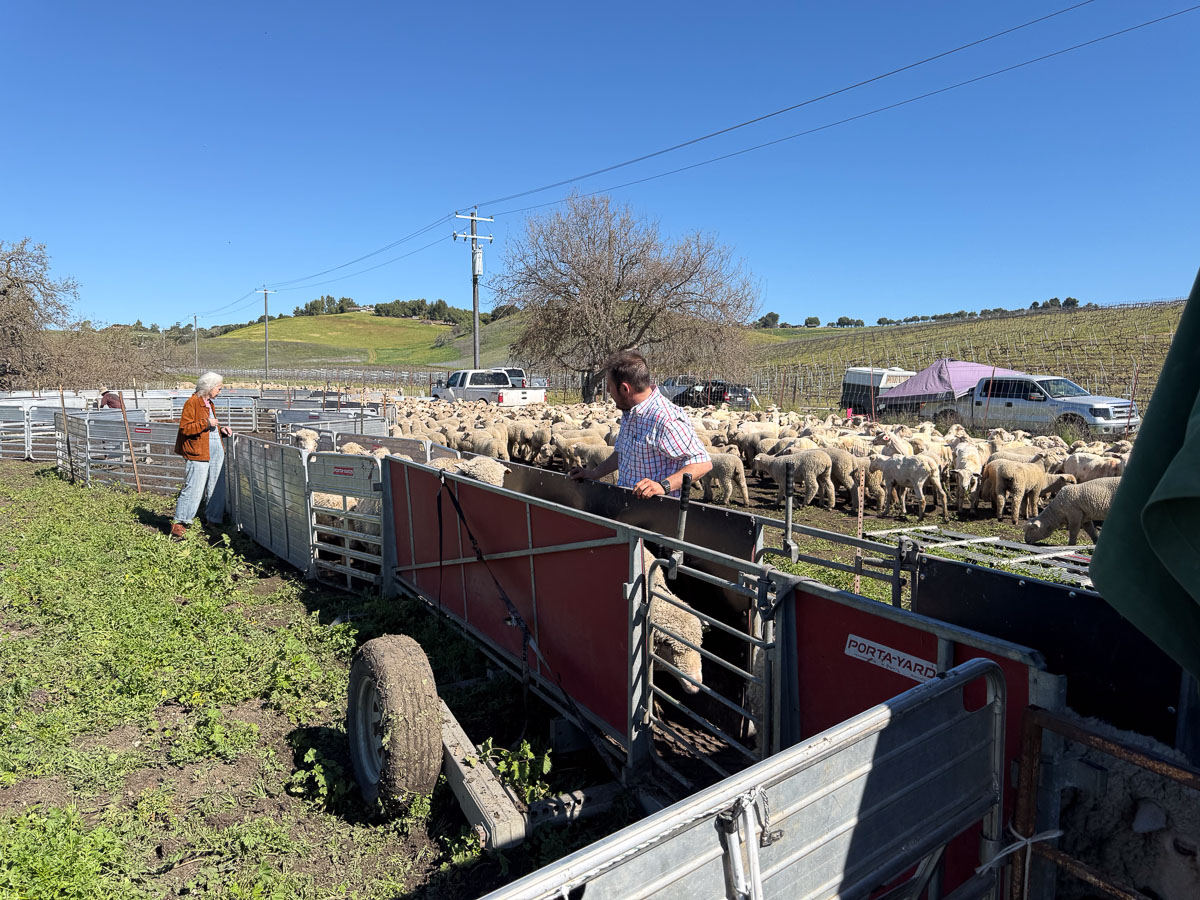
This view is the opposite of the last one. That bumper of the white truck near the tree is seen in the photo above this one. The ewes are now being sent group by group into the shearing shed.
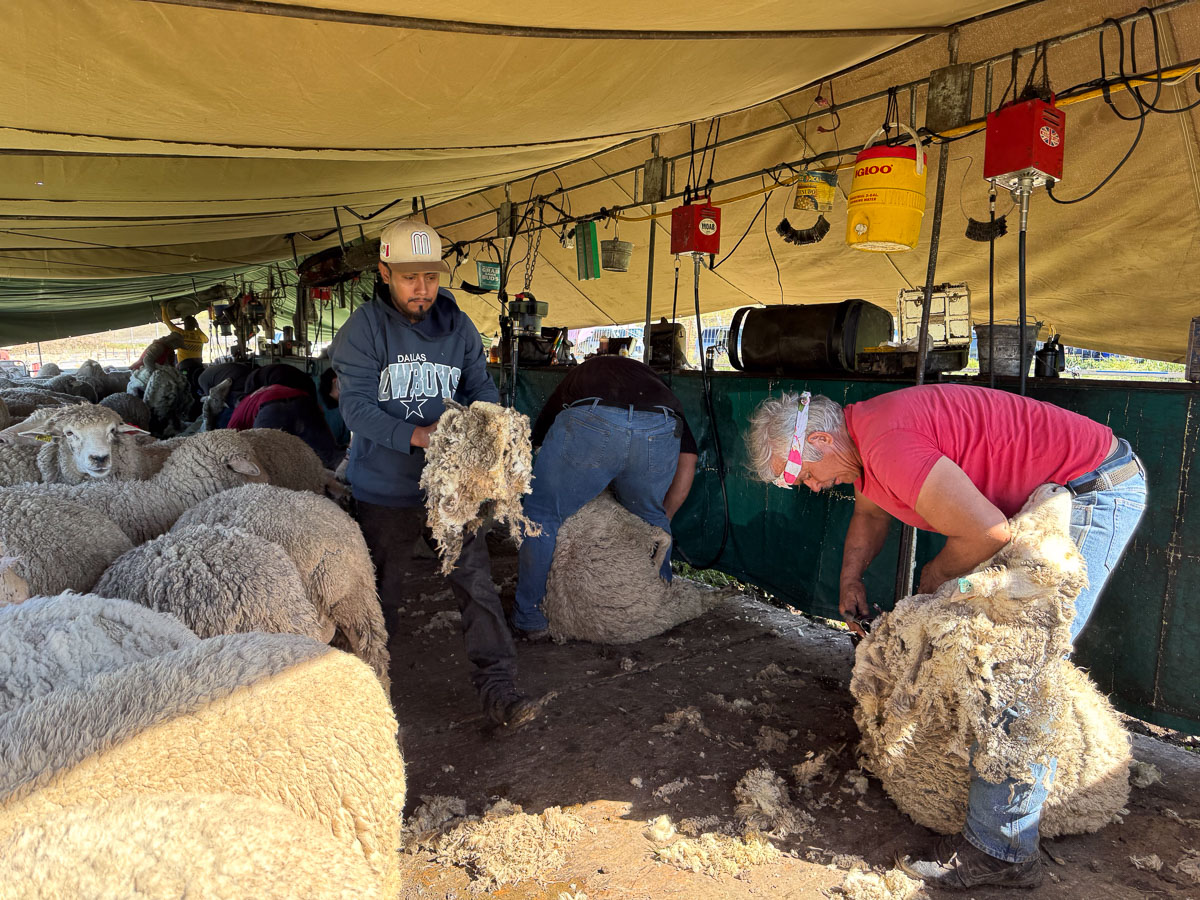
Sheep being shorn with ten shearers working.

There are ten shearers working here. The floor is sheets of plywood. The green panels behind the shearers are tarps hung on metal frames. The tarps can be moved easily after the sheep is shorn and exits to the back. This was quite a noisy operation with all ten shearers working. They brought music with them. I heard Spanish music at one end of the shed and Classic Rock at the other.
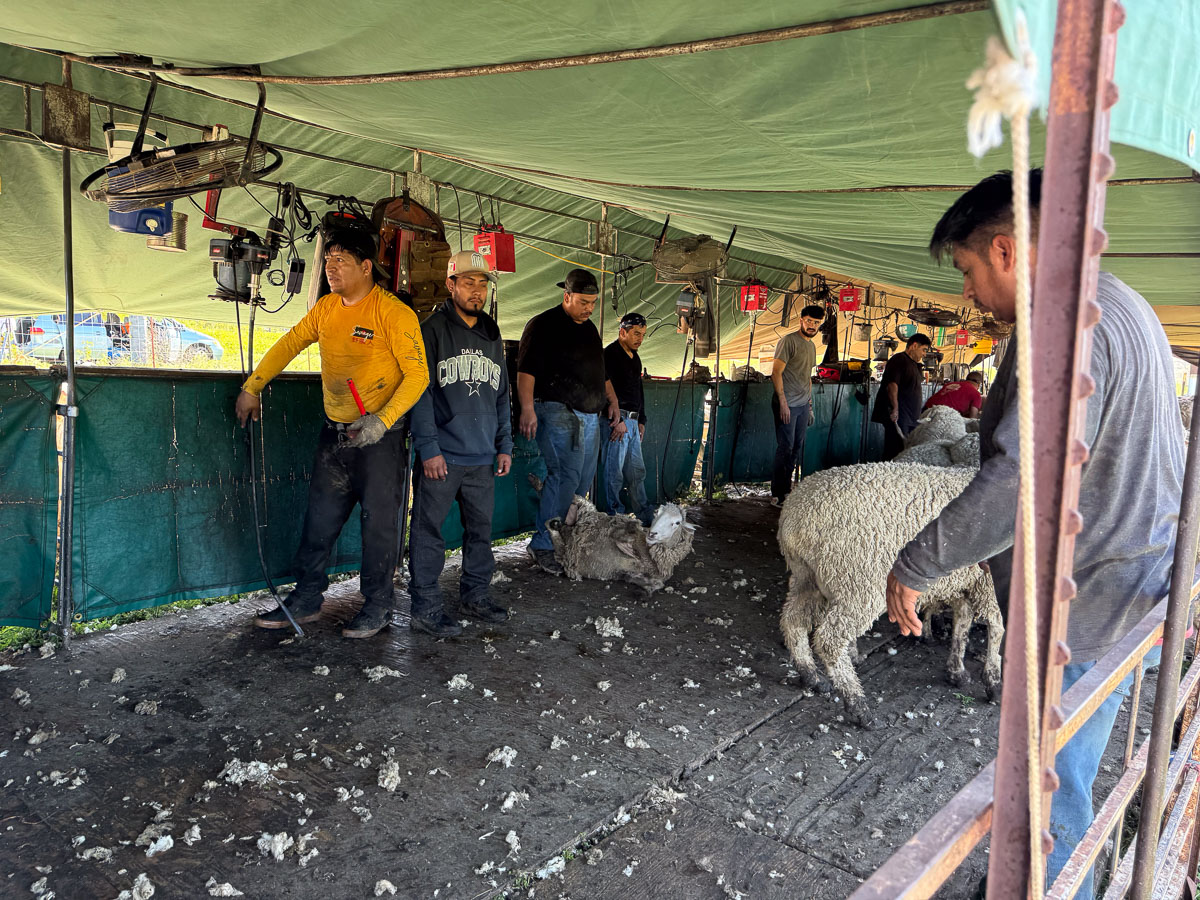
Men waiting for sheep in the shearing shed.

The shearers have a short break as another group of sheep enters the shed. This story will be continued in another post. One more photo below.
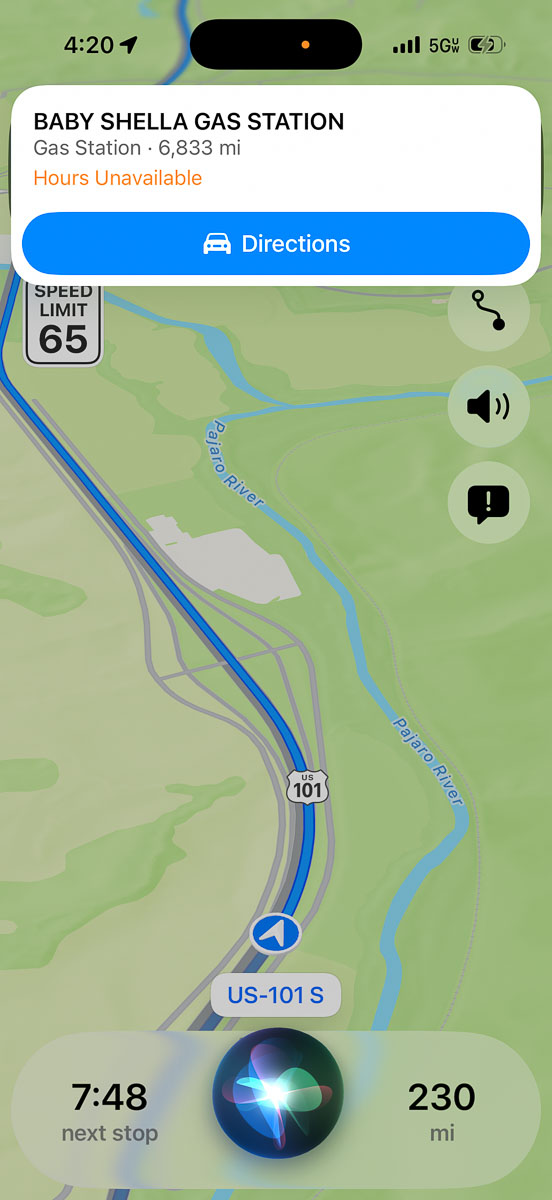
Screenshot of the phone showing the map and location of the next gas station.

I didn’t want to start with this photo because it’s not what the post is about. However, I snapped this screenshot while I was on the road to Santa Barbara. I was getting worried about gas and I asked Siri for the next gas station. Notice the answer: 6833 miles. Fortunately I found one closer than that.

To be continued…
Sheep Across the Road-Part 2

I first shared photos and a sheep story in the November 9 blog post. The sheep were brought in to graze the alfalfa Across the Road November 4 and were there until December 14. Now I have another story to tell about this flock and the grazing operation, but I should at least finish the part of the story that was right across the road two months ago.

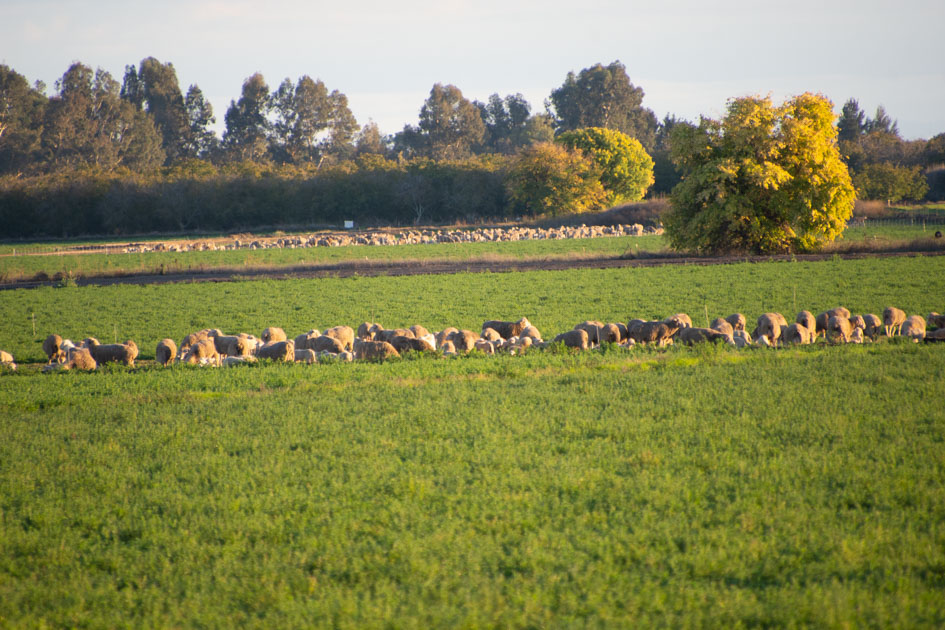
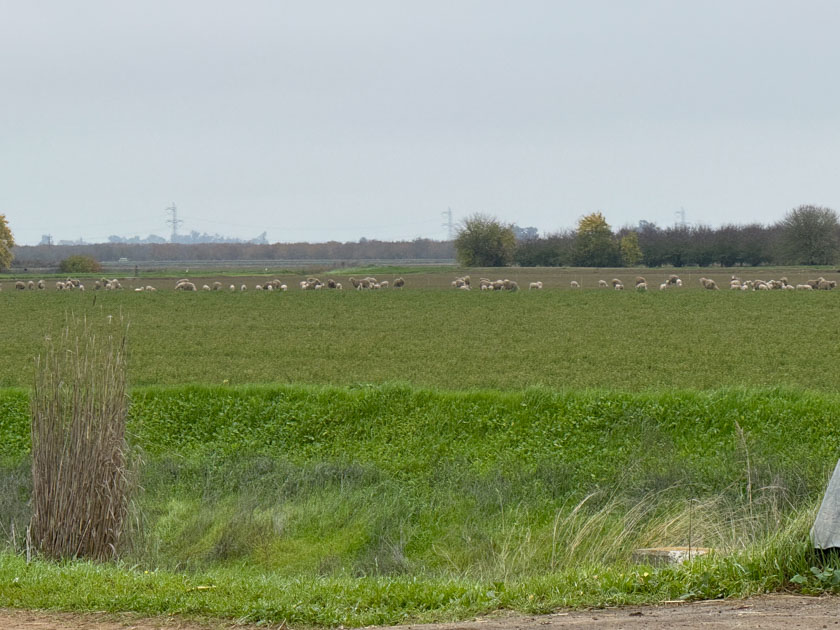
I often walk Across the Road with Ginny, but during this month I didn’t walk there very much. That was mainly because I didn’t want to cause any trouble with the guardian dogs that were on duty, but maybe also because that was the month it was so miserably foggy and dreary. It’s not foggy in this photo but it is a good example of how thoroughly the sheep grazed each paddock before they were moved to the next.

One morning I was checking the fence in our pasture when I saw the sheep being moved away from the main road back to where they had been farther back in the alfalfa. I assumed they had gotten out during the night and wandered out on the road and now they were being herded back. The next day I realized that I interpreted that scene wrong.

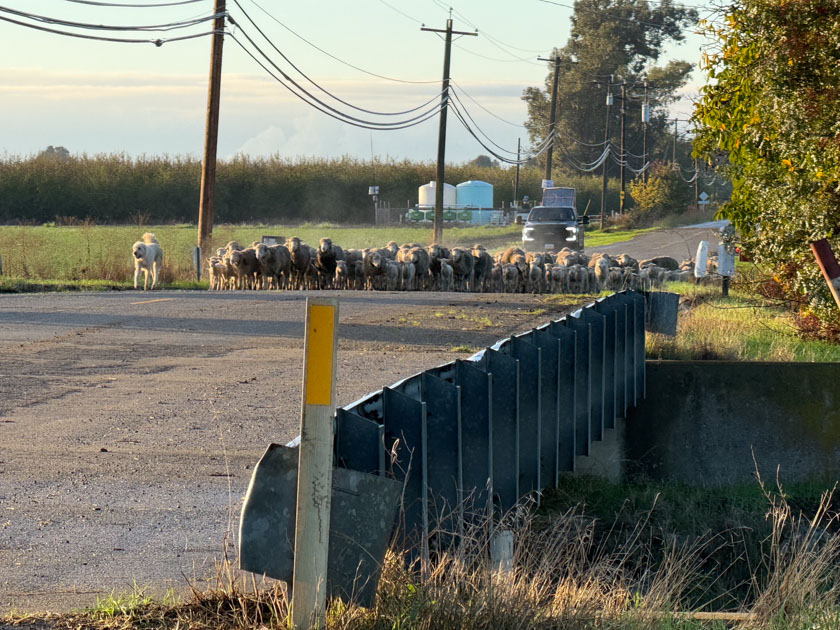
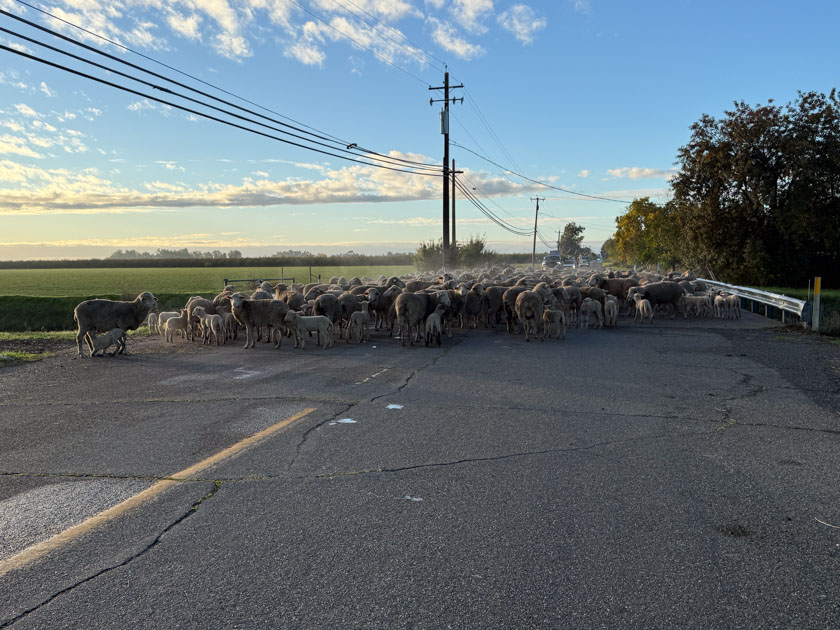
That morning, about two weeks after the sheep had first arrived I saw this scene from the southeast corner of our property. This wasn’t the same flock, but another being trailed up the road.

They had been grazing another property and were being moved to the one near us, as had the sheep the day before.

They turned the corner onto the road along the canal and were herded to a paddock further to the east.

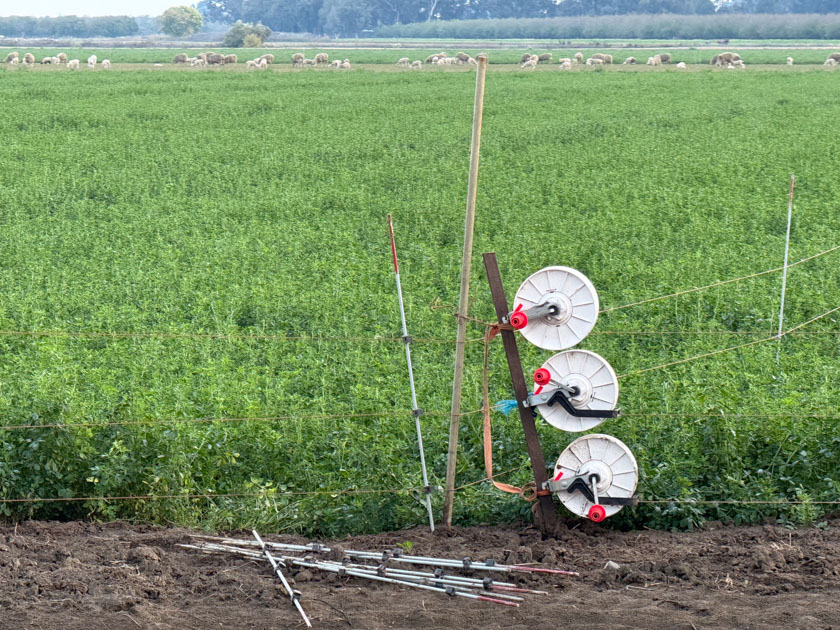
This is the fencing that the herder moved to set up new paddocks when it was time for the sheep to move.

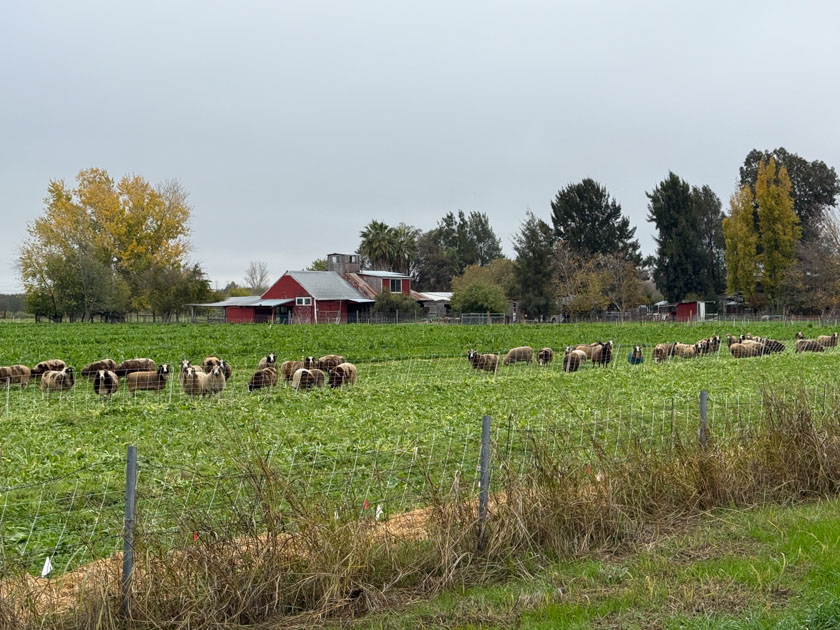
The three flocks were kept separate. I counted from about 180 to 220 ewes in the groups. That’s not counting the lambs.

That was from a distance with binoculars, but I later confirmed with the owner that was about right.

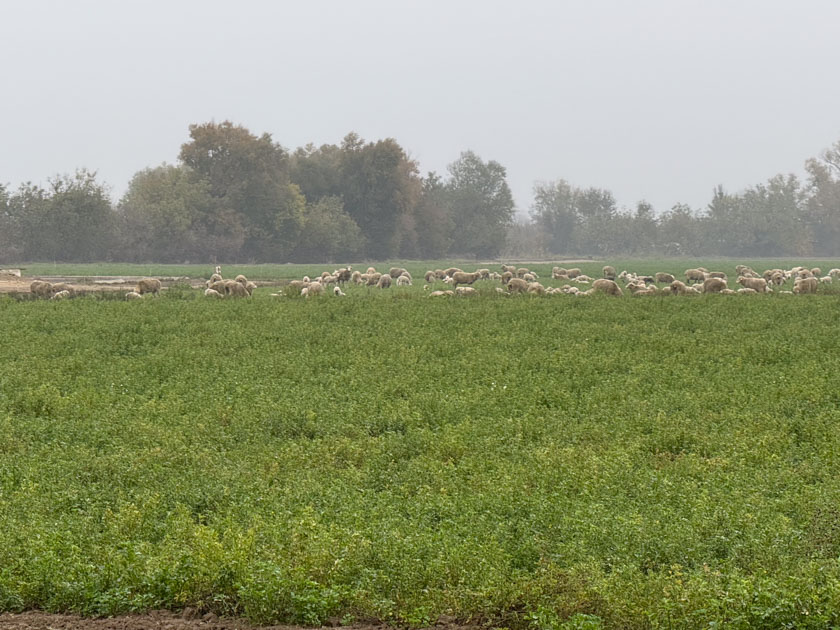
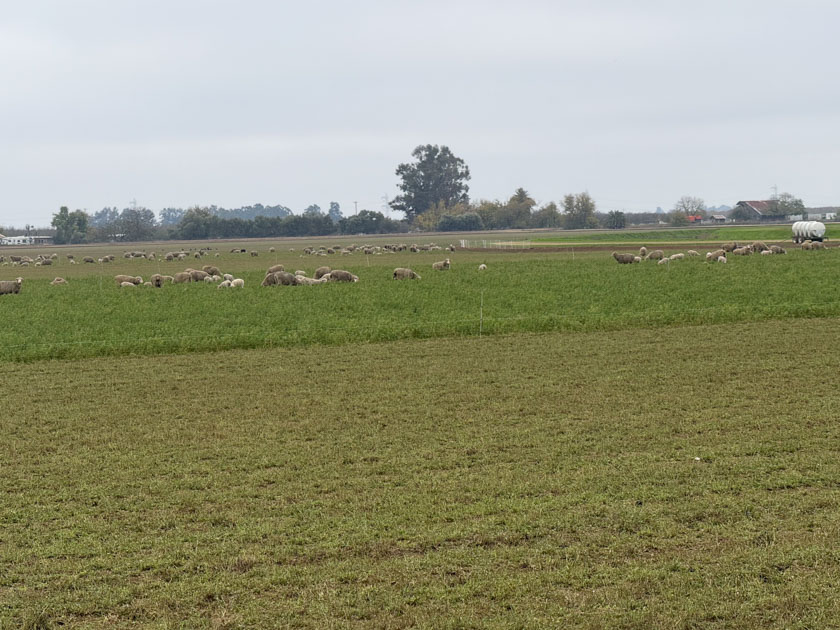
Eventually they moved to the alfalfa right across the road from us.

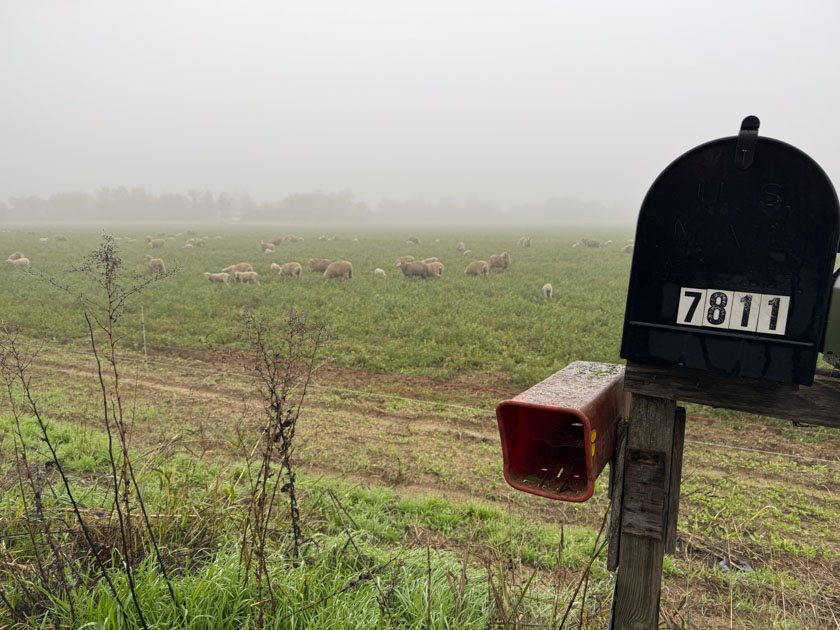
If I went to the mailbox the guardian dog came alert.

One of the flocks moved to south of the canal.

The other two were north.

My flock grazed just across the road. It’s a very different scale of management.

How Many Lambs in 2026?

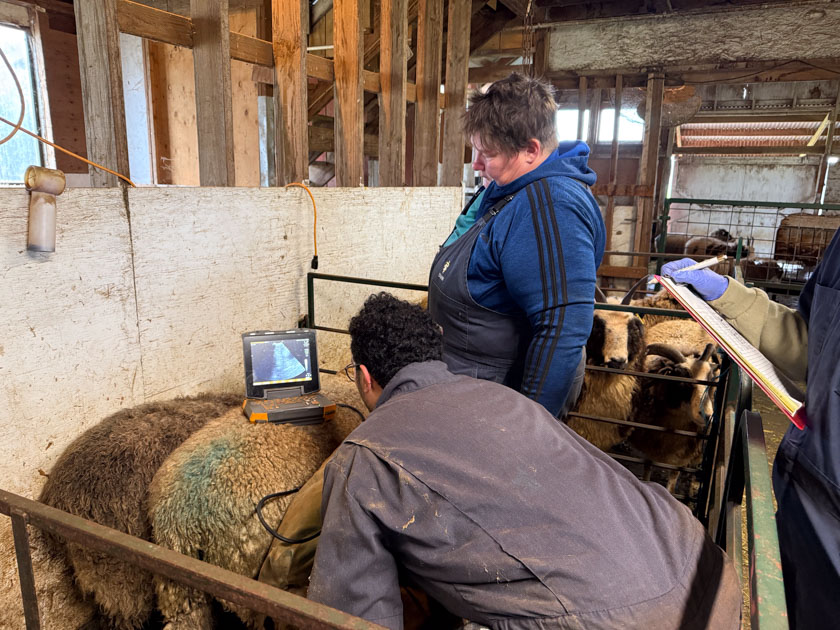
Yesterday was ultrasound day.

The day began and ended very differently as far as weather. This is how I was dressed for morning chores, just has I have been for the last few weeks with the drizzly fog. The vets arrived at 9 and we got to work.

It’s worth it for me to be have confirmation of pregnancy, confirmation of due dates, and idea of how many lambs to expect. It’s not an exact science. I remember a couple of years ago when the prediction was two sets of triplets and there were eight! Some of it is about the timing of the ultrasound. Breeding season this year was from September 27 to November 11. We scheduled ultrasound day so that the timing would be right to confirm pregnancy for the sheep bred the latest. For those bred at the beginning of breeding season, the vets can certainly confirm pregnant or not, but may not be able to get an accurate count of the number of lambs because of the size of them at that point.

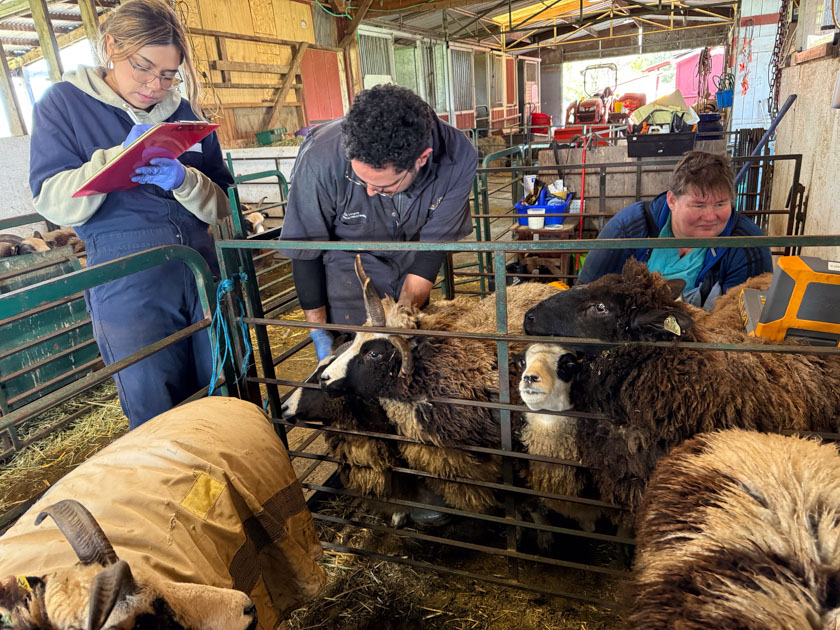
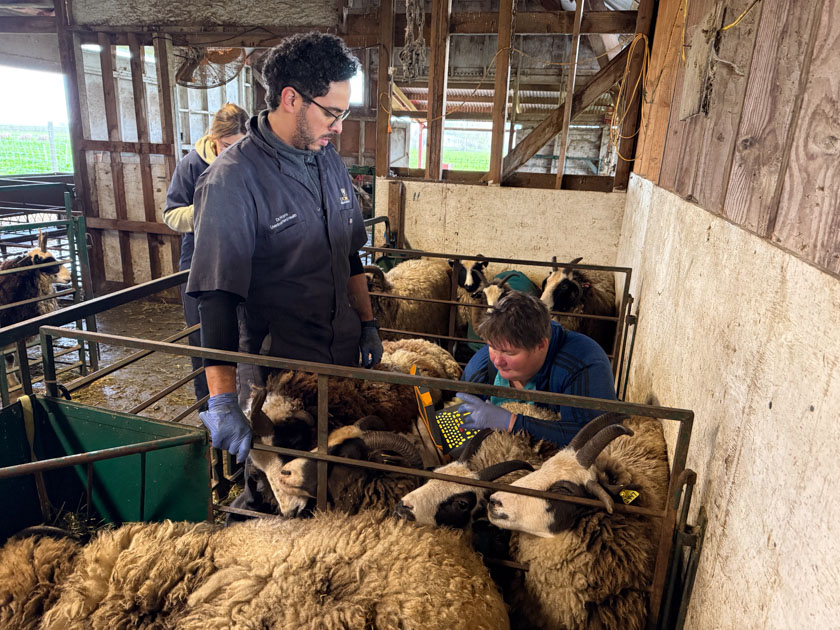
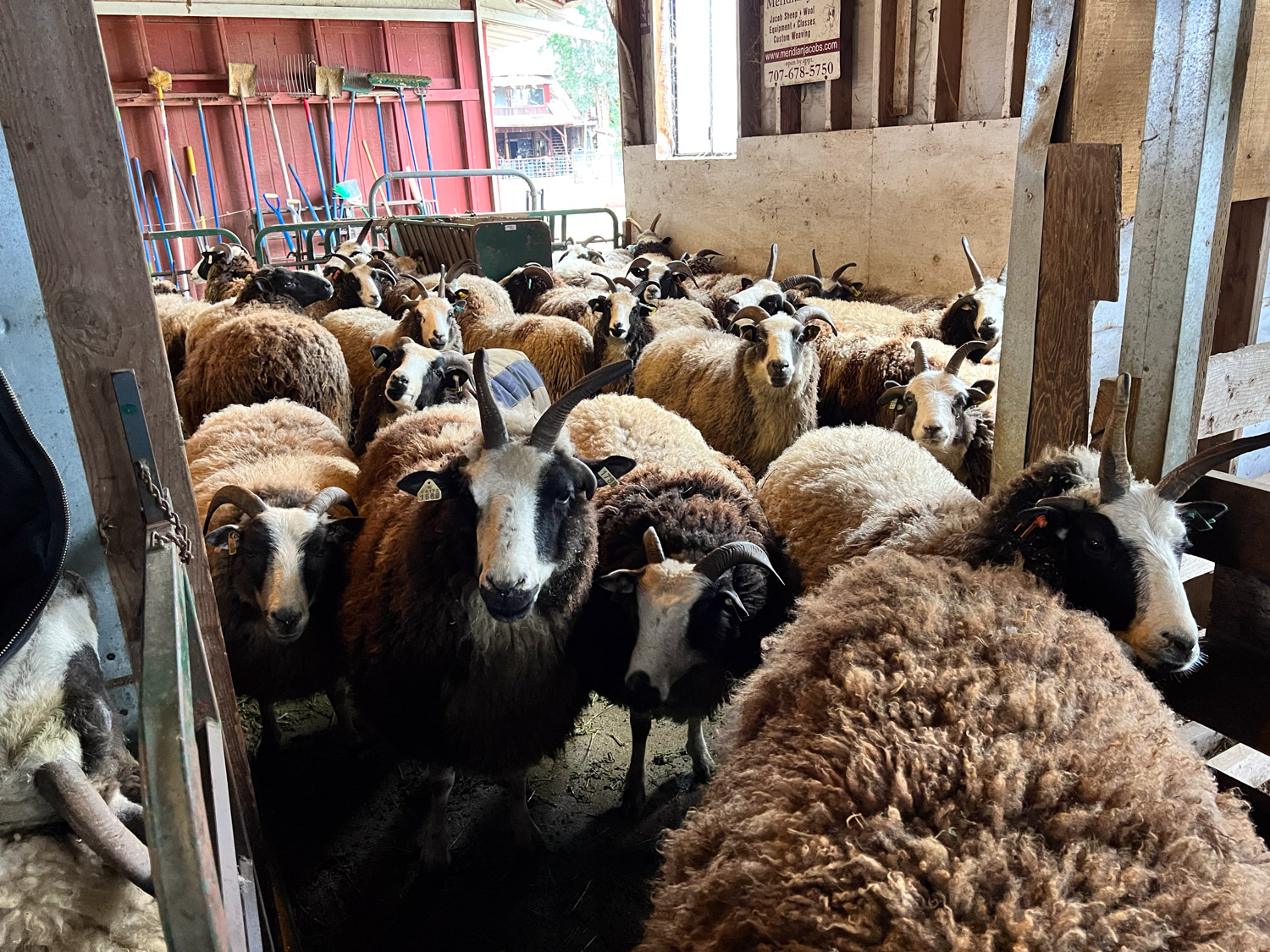
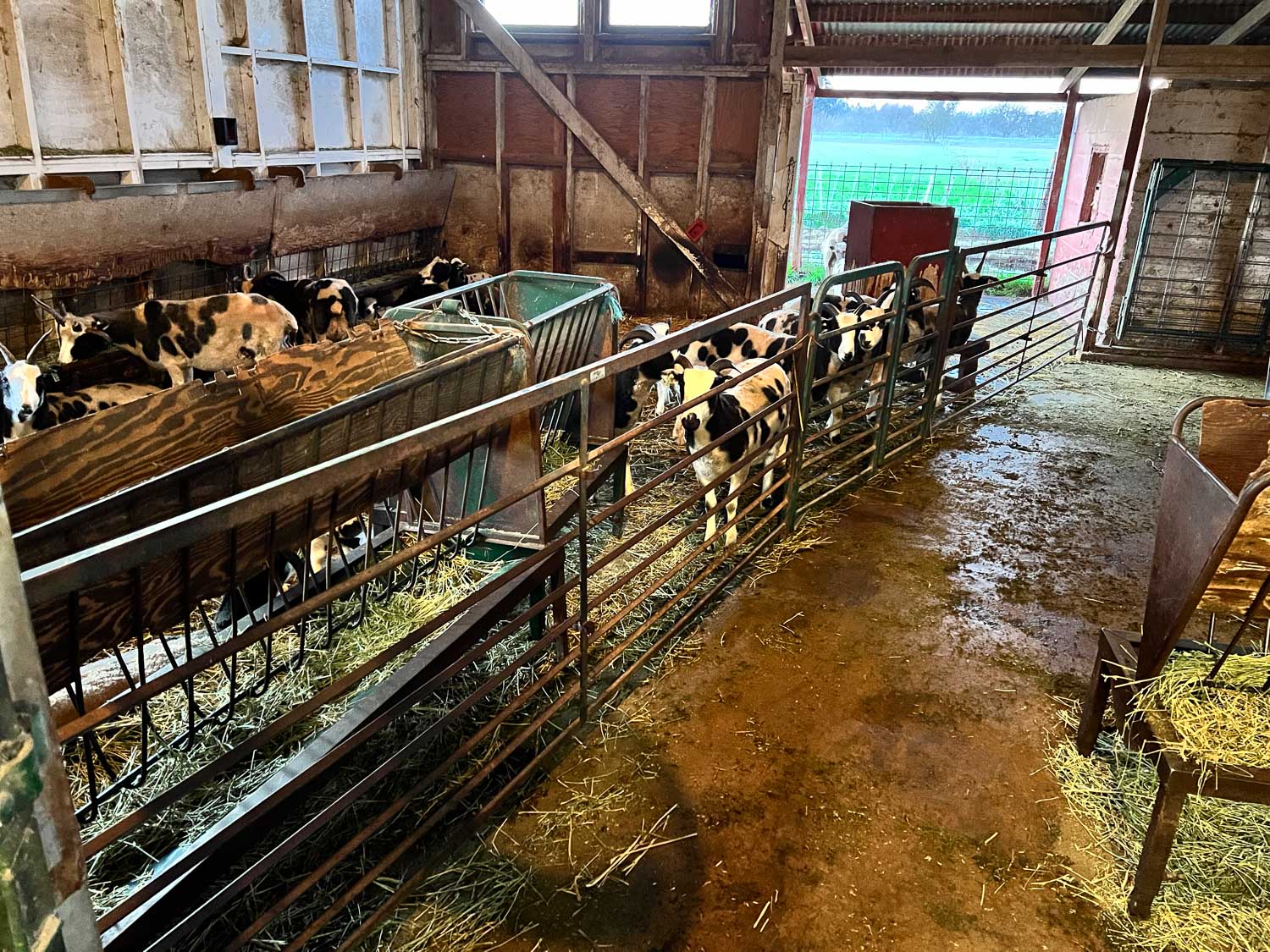
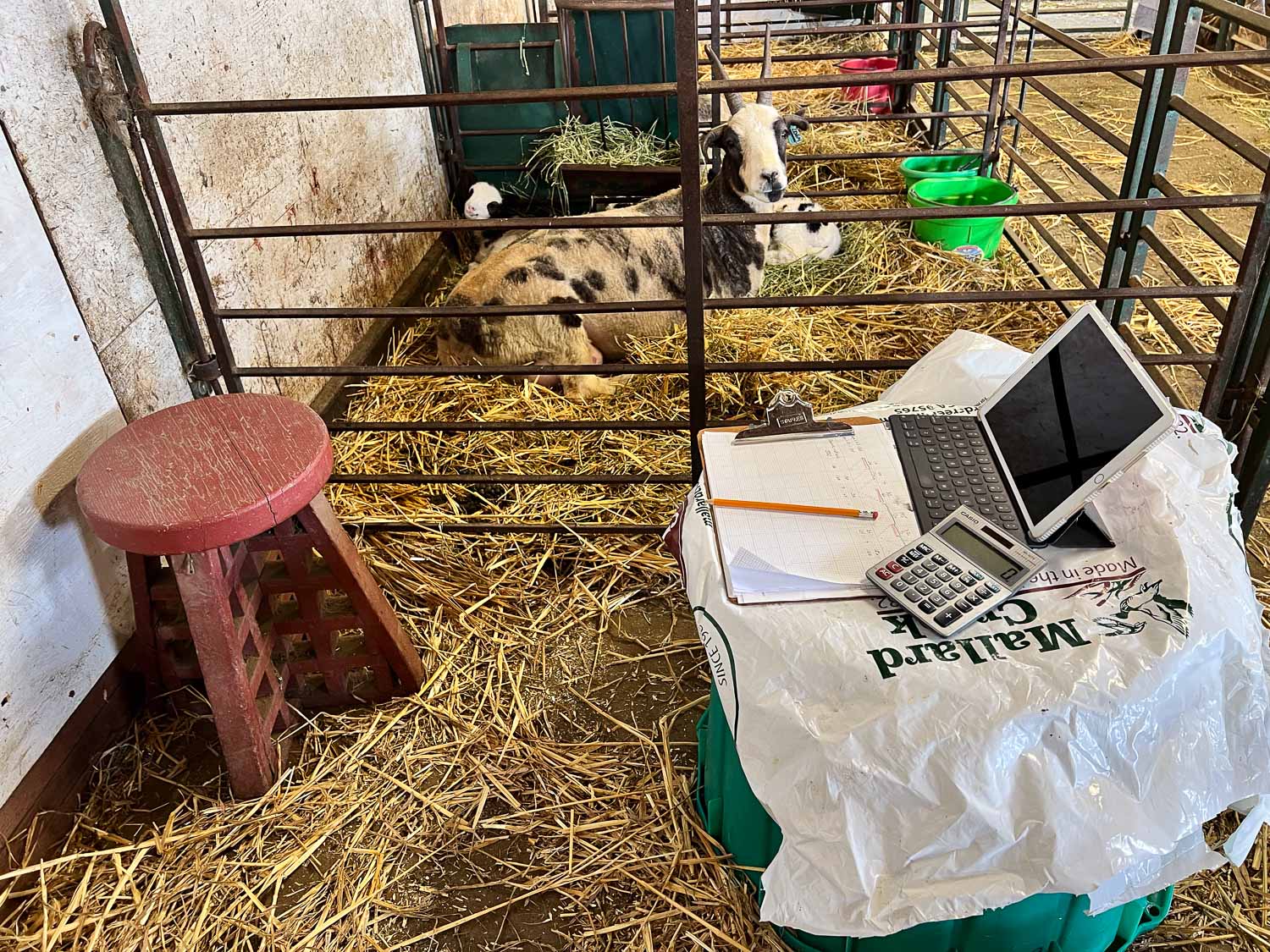
I gathered all the sheep in the barn and we put three or four in each lambing pen. When they are lined up four across it’s easier to keep them in one place, with the added advantage of a place to put the ultrasound unit.

One of the vets is a resident, having earned his DVM, but getting additional experience and training. So the visit probably took longer because he was getting help from Dr. Smith and then she also double checked some of the sheep.

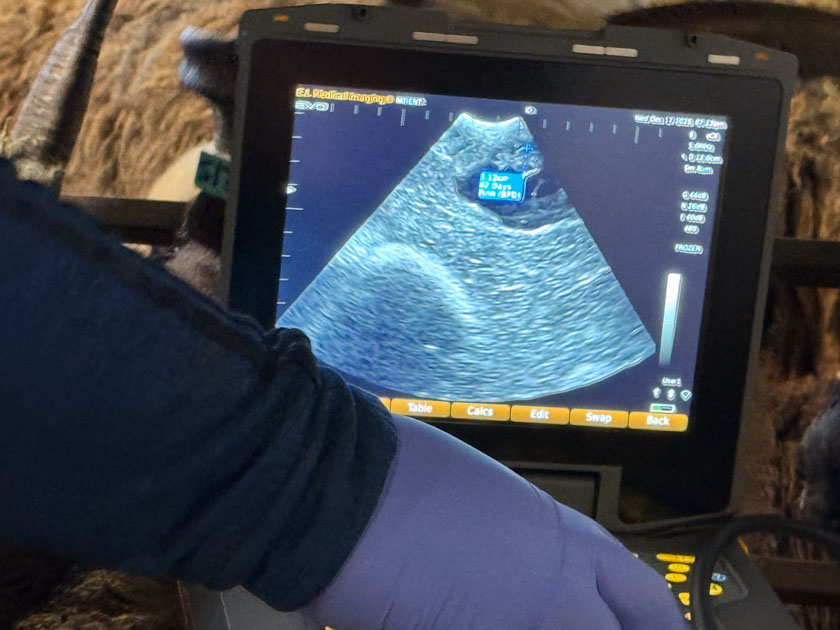
I took a few photos, but I sure can’t make out what is what. Whatever is important in this one is up in that top right part of the image.

It’s what is in the upper part of this image that is significant but I can’t tell you about this either…

…or this one…

…or this one.

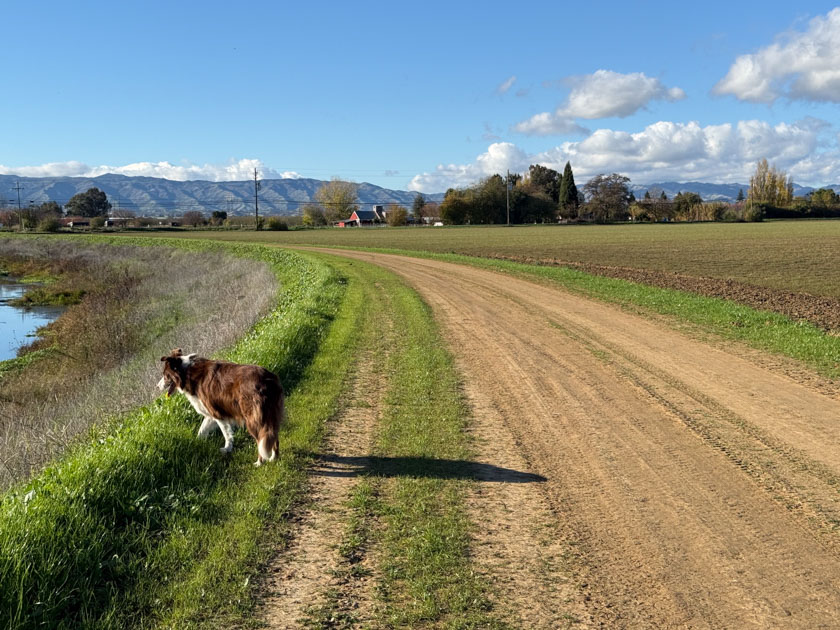
Brown border collie on dirt road with green grass and blue sky in the background.

The sun came out–this was significant since it had been 23 days or so since we’d seen it! After the vets had left and I cleaned the barn I had to get out for a walk. The sheep that were Across the Road were moved a couple of days ago, but that is another story when I can get to it.

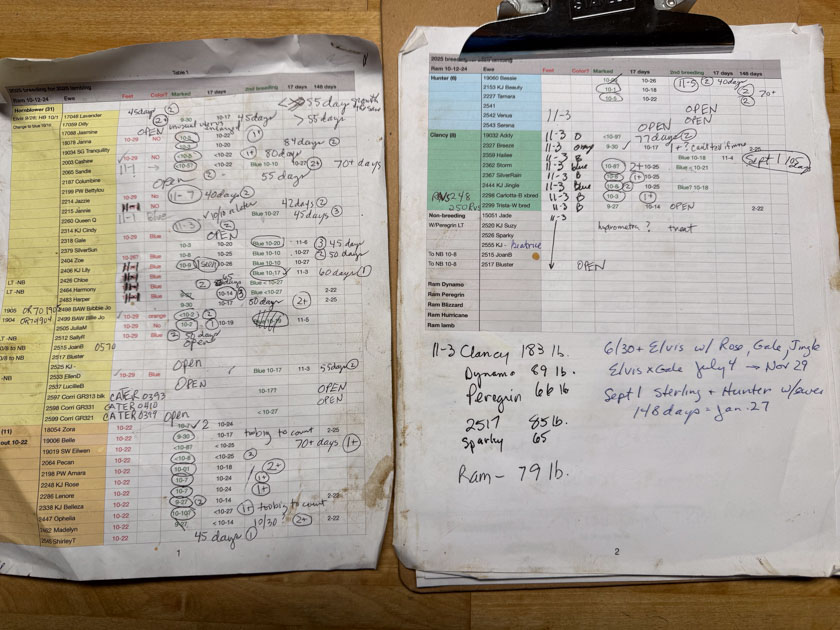
The vet tech wrote notes while they were working but this is how my spreadsheet looked when we were finished. Those people in Farm Club would recognize this as my breeding chart. Breeding groups are color coded on the left and dates are recorded as we go. (In case you’re getting a close-up look the dates on the left are hoof trimming, not breeding.) But all those circles and other notes are how I transcribed what the vets were saying. Fortunately I was able to take the vet tech’s notes and redo this spreadsheet, putting the rows into order of due date. That’s what we’ll refer to when breeding season starts.

One important item–when the rams got in with the ewes on September 1 at least one sheep was bred. The first due date is at the end of January while all the rest are due towards the end of February.

Sheep Across the Road

A few days ago I heard sheep making a lot of noise and saw that they were all going from the pasture to the barn. It seemed like more baaing than usual. Then I realized that I wasn’t hearing my sheep.

Two semi trucks with large livestock trailers parked on the road.

These trucks were parked just down the road but where I couldn’t see them from the house because of the trees.

Close up of the side of a livestock truck with a sheep and a dog poking their noses through the holes.

Notice that the two noses poking through the holes are different!

Ramp at the upper level of a livestock trailer where a sheep is looking out.

These trailers have four levels and all were full of ewes and lambs.

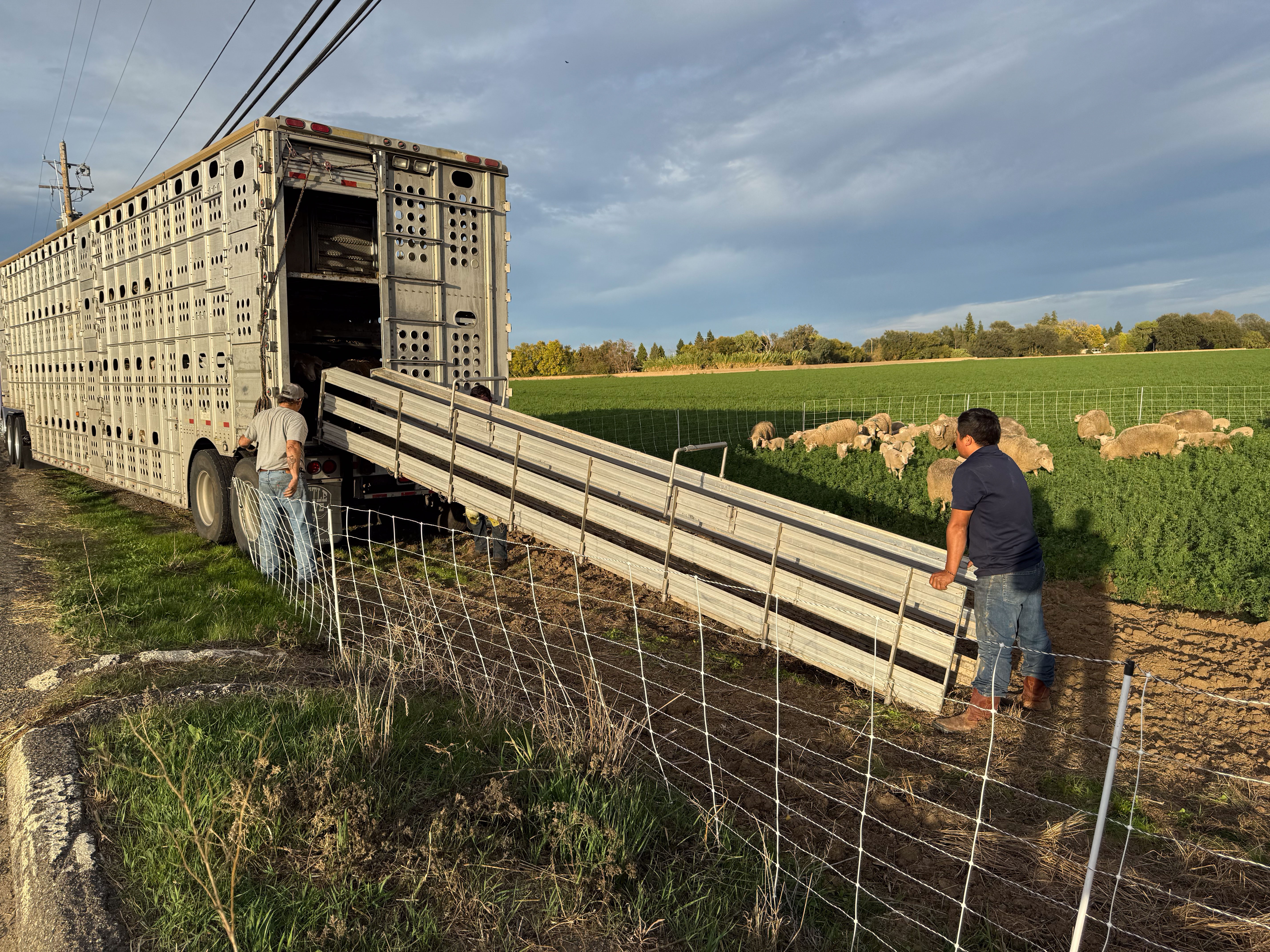
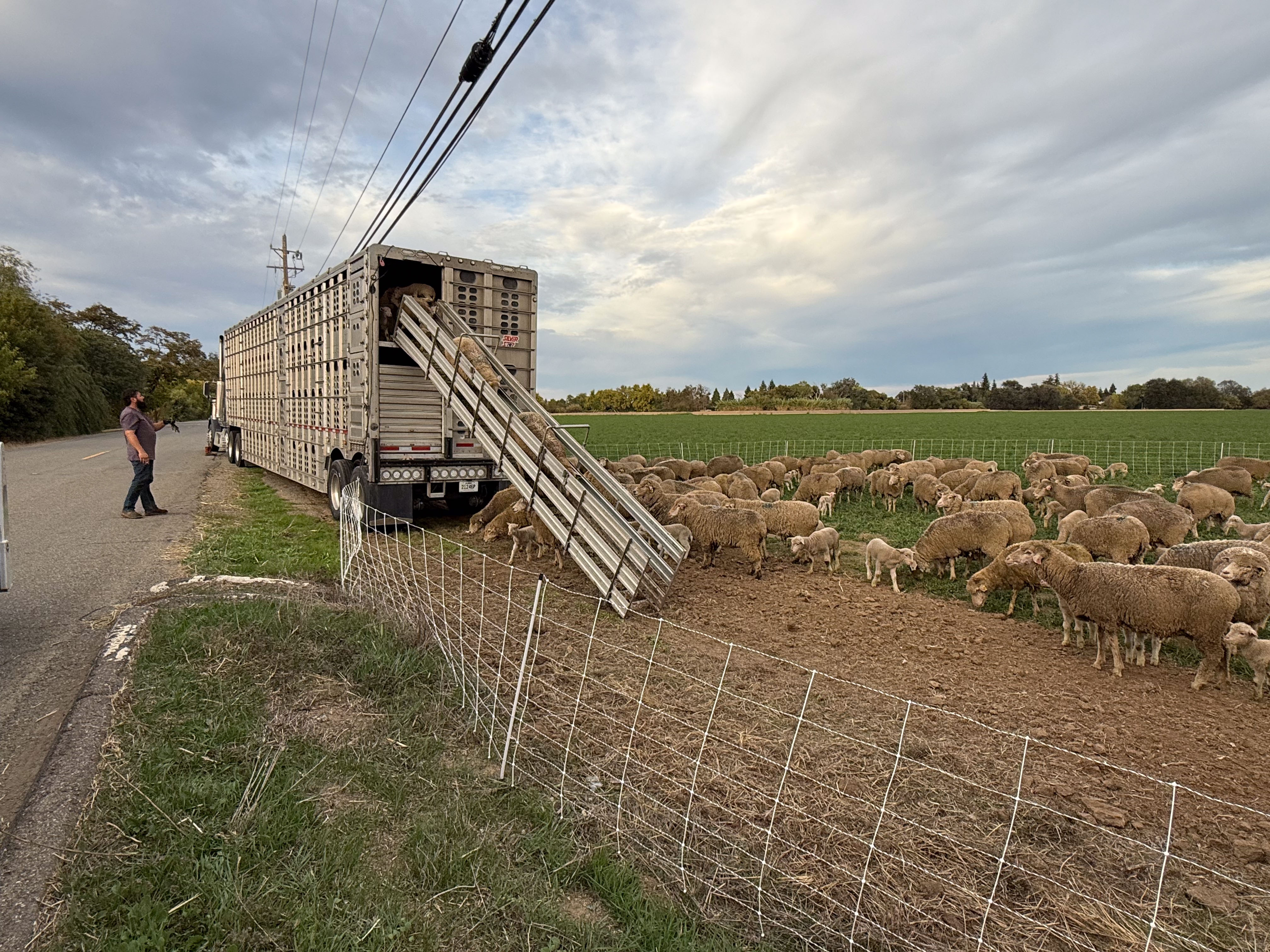
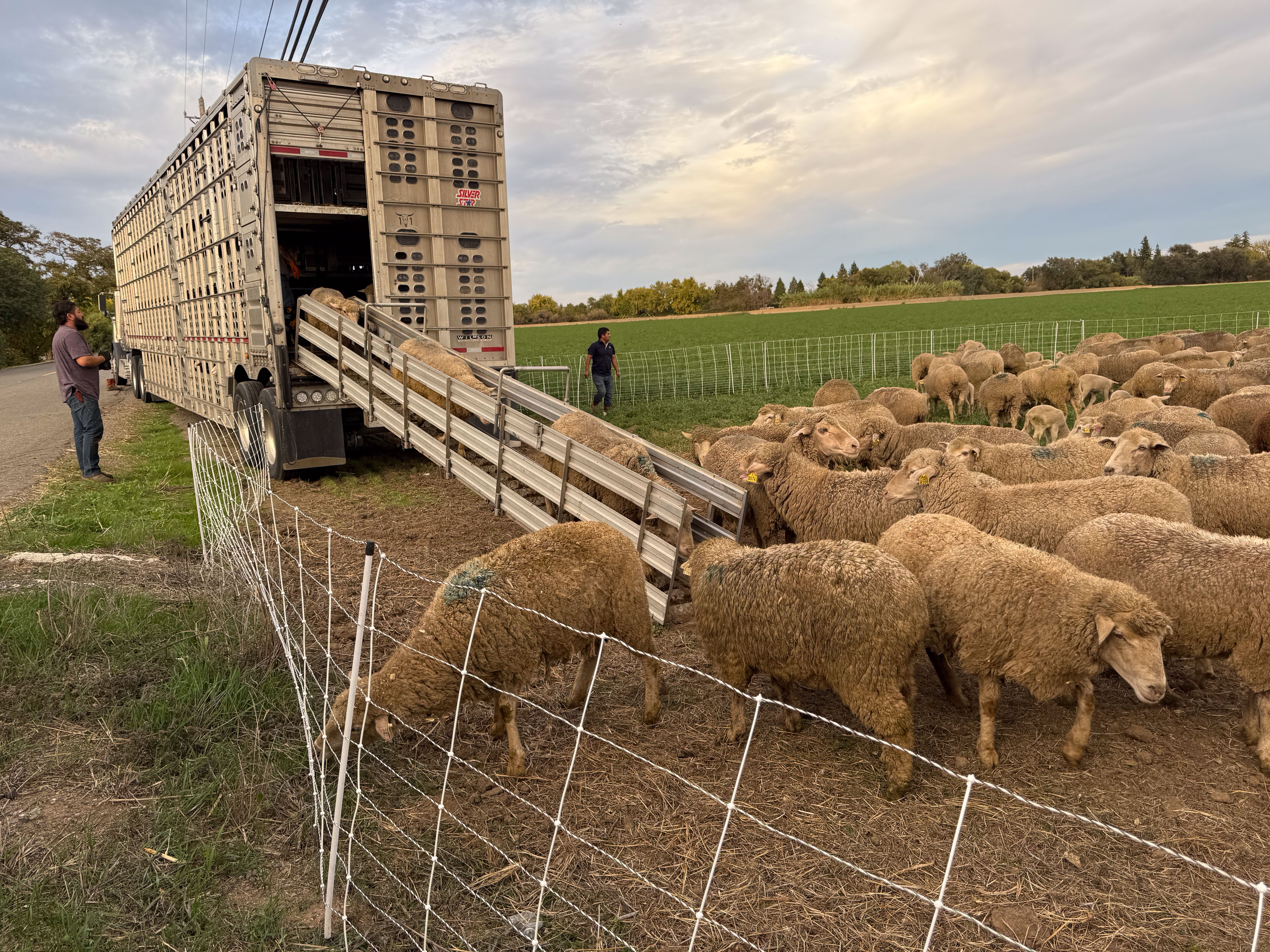
Two men placing a ramp at the back of a truck to unload sheep into an alfalfa field.

They move the ramp once because two levels can unload to one position of the ramp.

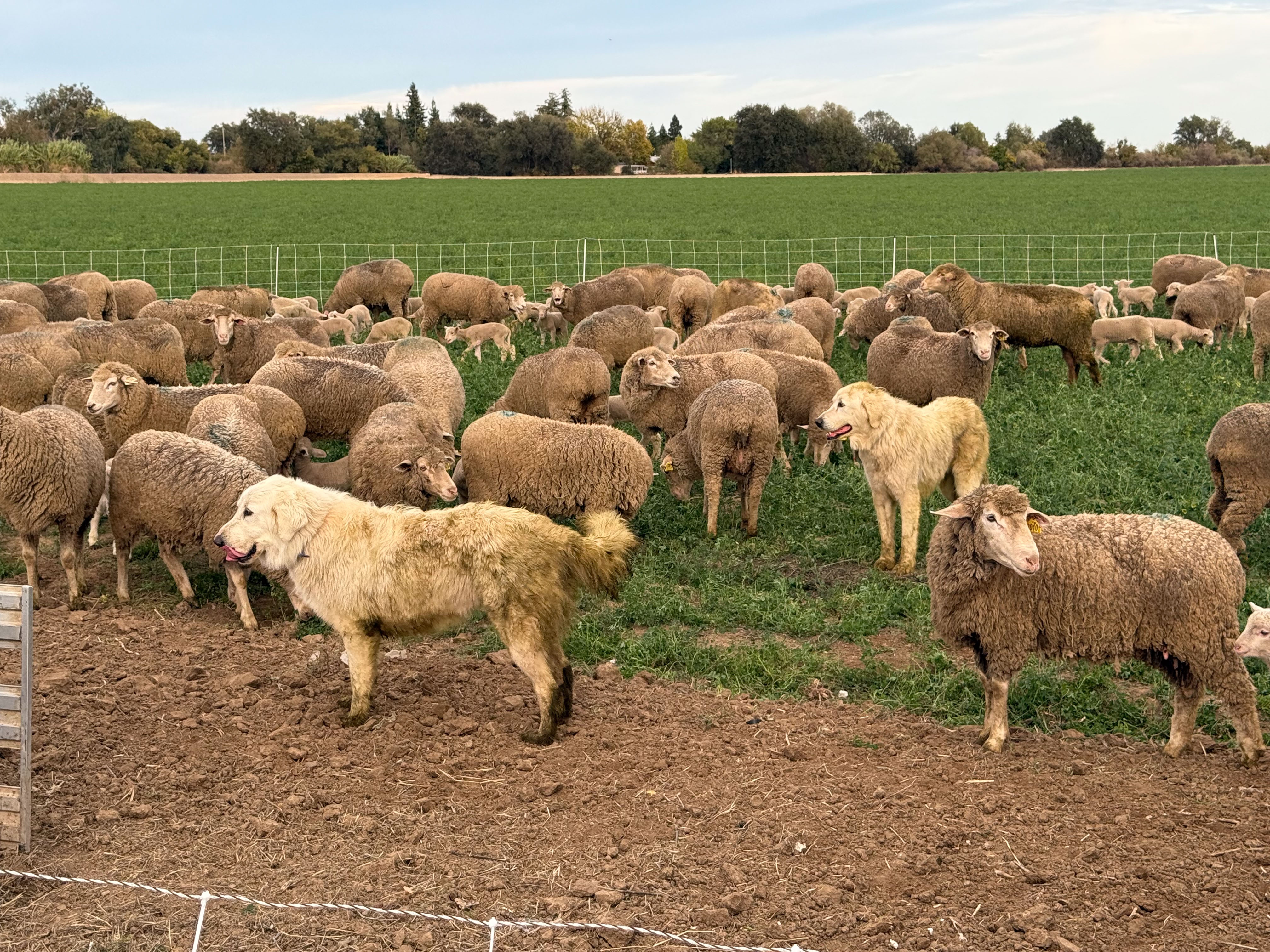
Ewes and lambs and two guardian dogs in an alfalfa field with a net fence holding them in.

Two guardian dogs were with the sheep.

Ewes and lambs with a white guardian dog.

I was surprised at how young some of the lambs were. It shouldn’t have been a surprise. It’s just that I have no experience with this kind of operation. Our sheep have it easy with barn access and personal attention all the time.

Ewes and lambs with a guardian dog inside a net fence set up in an alfalfa field.

It was quite noisy with lambs and ewes looking for each other.

Large truck with sheep walking down a ramp into a fence set up in an alfalfa field.

The second truck pulled up to unload.

Large truck with a ramp where sheep are being unloaded.

Each driver was responsible for unloading his truck. They switched to rubber boots so they could climb in with the sheep if necessary and keep their other footwear clean. I didn’t see any other fences so I wasn’t sure how they were going to deal with this many sheep.

Flock of ewes and lambs held within a net fence.

I have seen other alfalfa fields where they graze sheep but this is a first for “our” field–the one Across the Road that I know well. I talked to the truck drivers a bit. I think they said they had about 450 sheep to unload. I thought they said that was the number of ewes but maybe it included lambs. I wasn’t sure what they were going to do for the night because I didn’t see any other fences.

Flock of sheep being held in a net fence. A four wheeler with a border collie on it is outside the fence.

There were a lot of sheep crowded into this fenced area. It turns out that this was just a holding area while the trucks were being unloaded. This was late in the day and rain was coming in that night.

Green alfalfa field with herd of sheep being moved away from the fence.

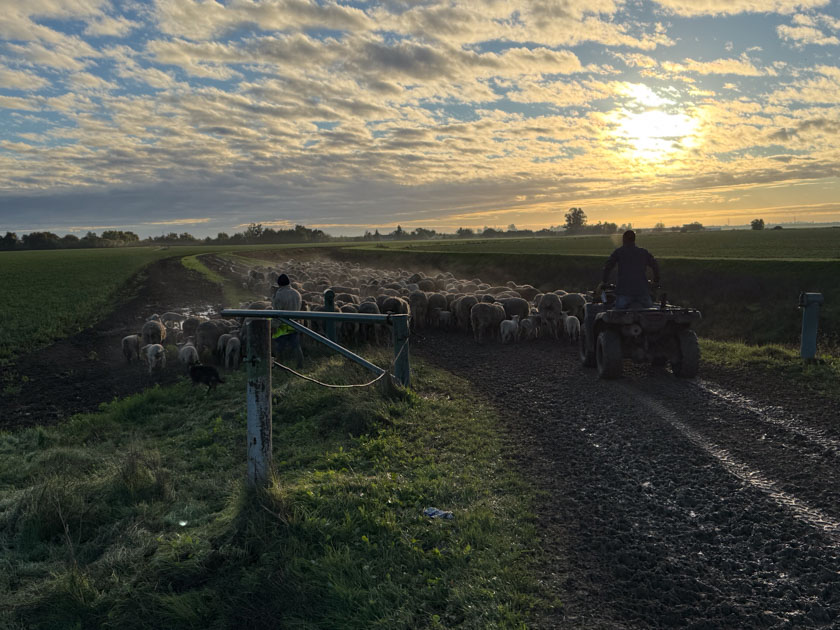
The fence was opened and two men with one 4-wheeler and 3 Border Collies moved the sheep to the east. Fencing was already set up somewhere else and a herder would stay in an RV near the sheep.

Green alfalfa field with an orchard in the distance and sheep in between.

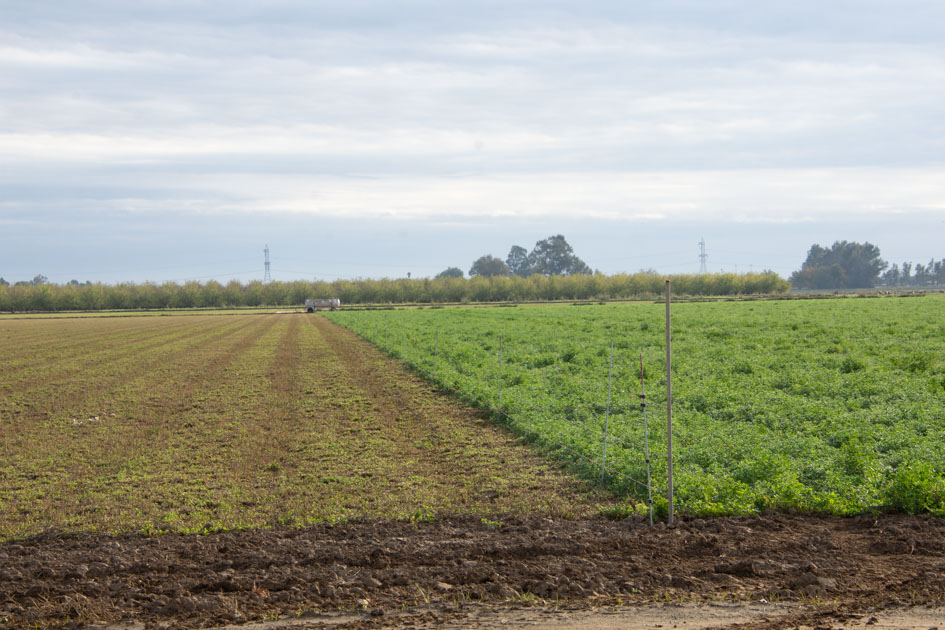
It rained that night and it was too muddy to walk across the road the next day and I was busy all day anyway. The following day I wanted to see where the sheep were. I walked half of my normal route but didn’t want to get close enough to alert the guardian dogs and cause a problem. It’s complicated to bring sheep to graze areas that aren’t set up for it. Fencing is supplied by the grazers–you can’t see the electric net fence in this photo. And they have to have a water source–that’s the white tank.

I’ll probably walk over there today and find out if they are in the same location.

A Totally Random Sheep-Related Post

I was looking for something on my computer. Now I can’t remember what but I was browsing through my folder with the title Sheep. That includes everything from Breeding and Lambing Dates to Body Condition Scoring to Processing Skulls to Vet info and Wool Facts. Now I remember what I was looking for–a list of butcher lamb customers because I have an email from someone who wants a lamb this year–we haven’t even started lambing, so how am I going to remember that person if I don’t add it to a list that I still haven’t found?

Anyway, look at what I found while I was browsing through the files.

I have no idea where I got this photo or who is in it, but the file name is WWII-German . That sure looks like a Jacob lamb!

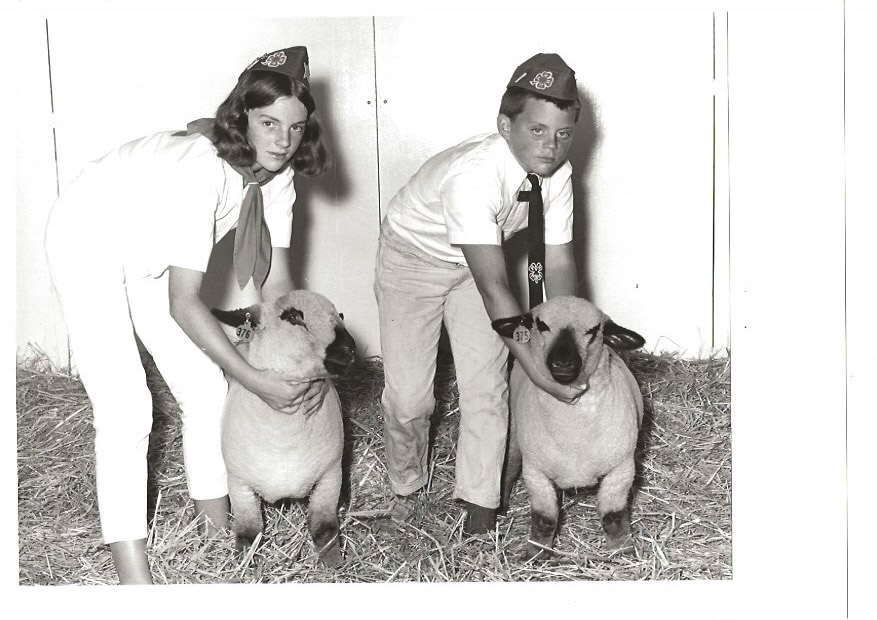
So this prompted a post of random sheep photos. I found this photo that I had scanned not long ago.

This is my brother and me with our 4-H market lambs.This was probably in the late 60’s. I barely remember raising market lambs because I mainly raised dairy heifers in 4-H.

I thought there must be more and I plugged in a hard drive that I’ve had a hard time viewing. Now it seems to be working! I might get carried away with old photos at some point! I’ll stick with sheep tonight.

This is the house we had in Cotati. Mom and my brother are feeding lambs in the kitchen while Joe, our favorite college student renter, looked on. These were Dave’s and Mom’s sheep. I had a horse and dairy cattle at this point.

Mom with sheep

I think I was going to school at UC Davis by now. Mom had a merino sheep and I think the other sheep were probably Dave’s. Mom is holding a lamb and a white cat named Bill. That is Honky, the goose, on the right.

So there’s a trip down Memory Lane. There may be more to come.

Who is Going to Lamb and When? Ultrasounds

For the last few years I’ve asked the UC Davis vets to come here and do ultrasounds. It is certainly useful to know ahead of time the ewes that are not pregnant and, hopefully, the number of lambs to expect from those that are.

I told the Dr. Smith the dates the ewes were with rams and December 20 was chosen as the optimal time for ultrasounds. (Never mind that a few ewes went in with the new ram, Eli, right at Thanksgiving. This ultrasound date was scheduled before Eli came here. It won’t be hard when the time comes to know if those few ewes will lamb.

I purposely did not breed as many ewes this year because of the limited space with our pasture being off limits for most, if not all, of the next grazing season. If you read this blog regularly then you know about the Pasture and Irrigation Renovation going on. Look back over the last few months for those blog posts.

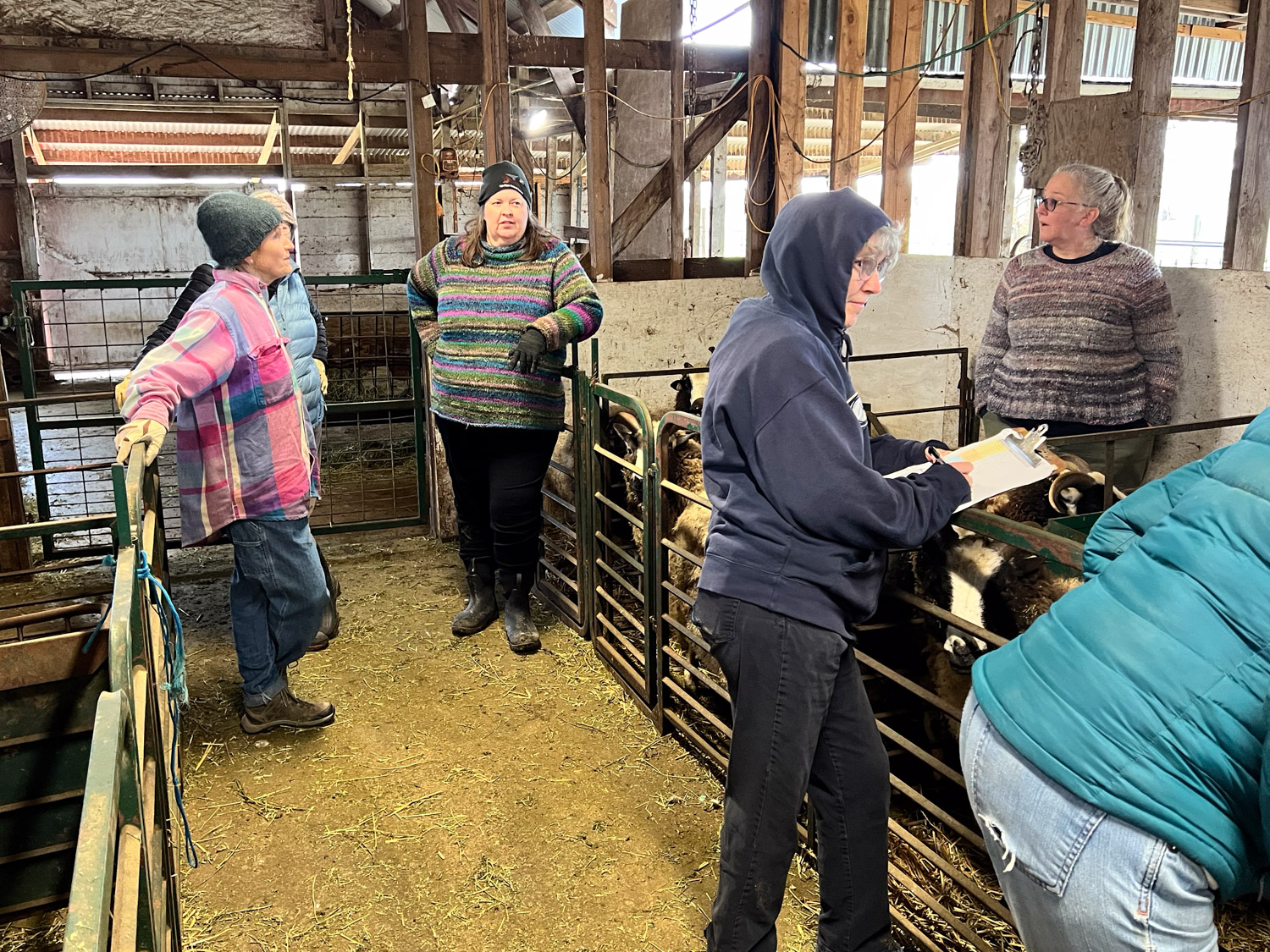
Farm Club members came and, since I was otherwise preoccupied with an overlapping visit by my son and DIL and Matt’s offer to help me with some loom/computer issues, they did all the work of getting the sheep organized and in pens, ready for the vets.

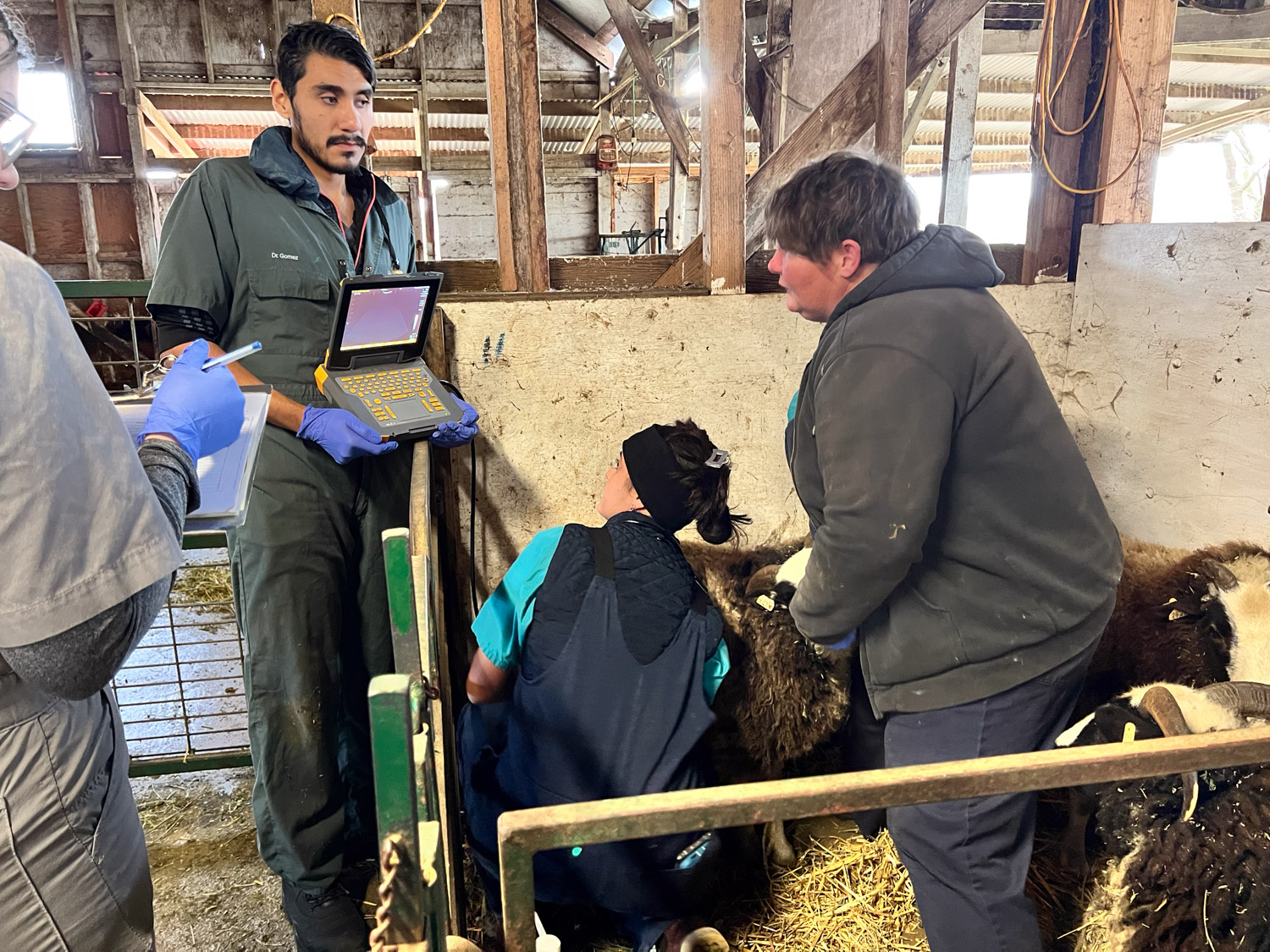
There were four from UC Davis. I lose track of the titles, but I think one person was an intern and/or student and maybe a couple were in residency. They took turns doing the scans and reading the results, with Dr. Smith overseeing it all.

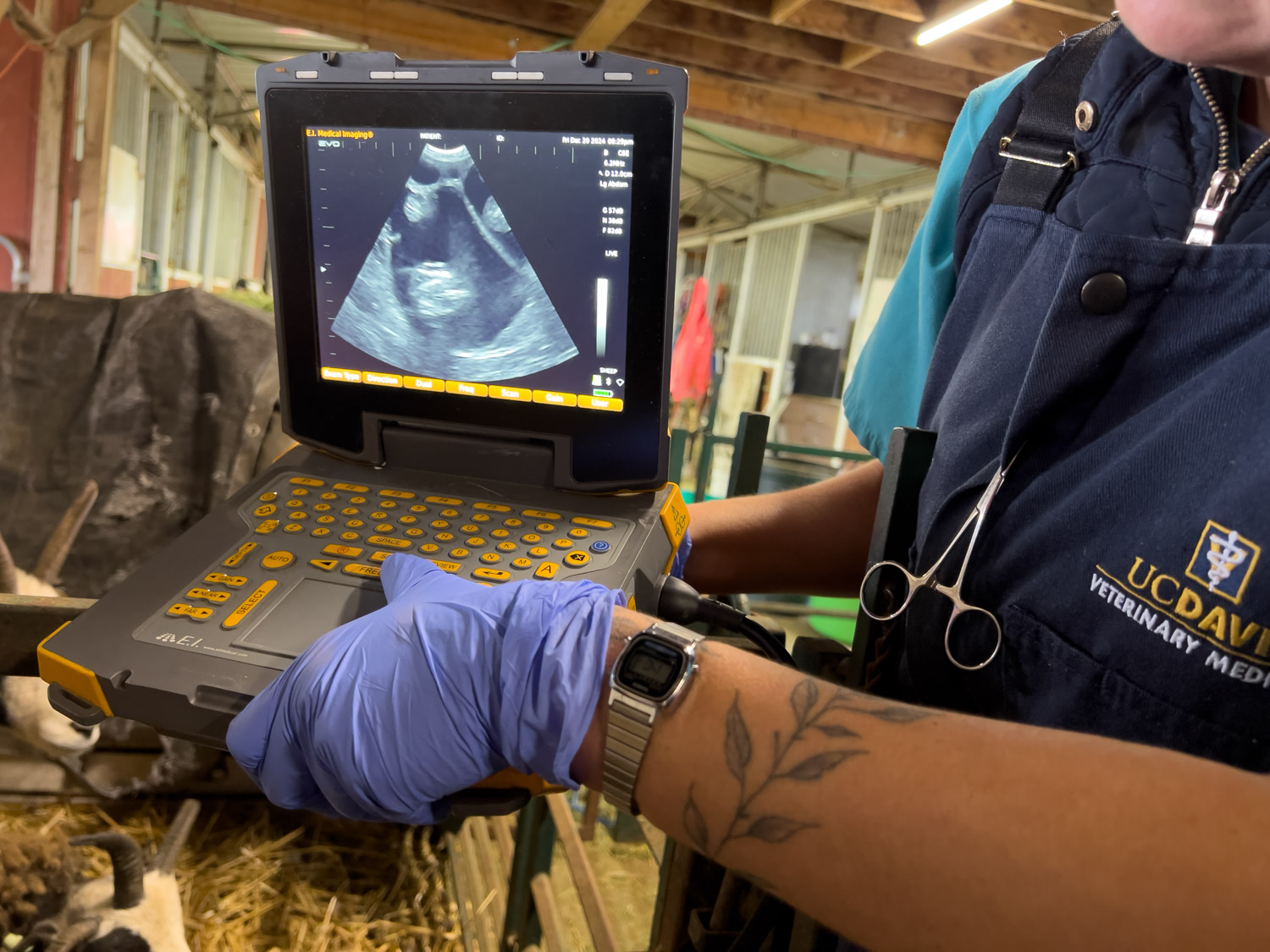
Don’t ask me what we’re seeing. I’m good when I see a ribcage go by as they move the probe around, but I have a hard time with the rest of it unless it’s pointed out. They judge size of the lamb’s head and, therefore, its gestational age. Amount of fluid and relative position of the lambs are other factors they consider.

The next group of ewes waiting.

Trading places in scanning.

Meanwhile, one reason Matt came was to climb the weeping willow and cut a couple of large branches that had broken during the summer. FIY, he is using safety gear to prevent falling in case of slips.

It’s amazing how quickly this tree has grown. Matt cut the problem branches, but then cleaned out a lot more where it overhangs the pasture and the fence.

Back at the barn they are still scanning, but we could used last year’s lambing list on the white board (to be erased at the beginning of the next lambing) to pick out which ewes had triplets last year.

Here are the stats:
Fetuses counted: 51
Sets of triplets: 2
Sets of twins: 17
Singles: 5
Sets of 2+ (twins, but not ruling out a 3rd): 3
Ewes pregnant: 27
Ewes open who were with a ram: 3
Ewes maybe pregnant, bred late by Eli: 4
Ewes not with.a ram: 7
Ewe lambs not bred: 8

Stay tuned for March 9, the first due date based on when I put rams in with ewes.

Today on the Farm – February 21

I know it will make me crazy to go back and do other photos out of order, but I’m ready now for today. So I’ll do it this way and include a couple from yesterday as well. Maybe I’ll get to others later because there are stories.

Yesterday Dan decided to take out part of the tree that we think used to stand straight. Ever since that super strong wind last week this tree has looked like it’s tipping more and we’ve known that part of it looks dead. If it went down it could not only take a person with it but it would lift up the corner of the fence. It’s easier to cut down a tree than to replace the fence.

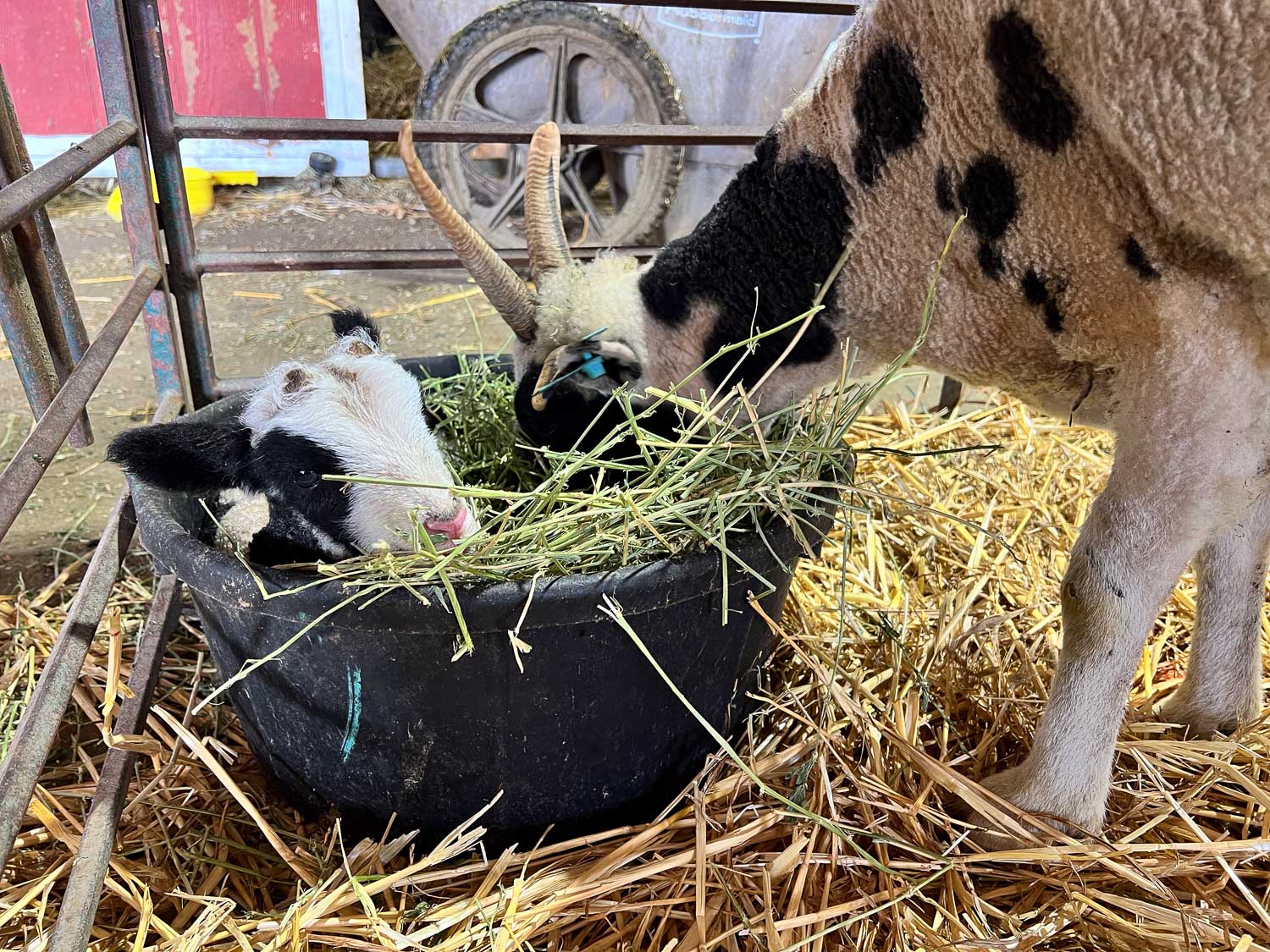
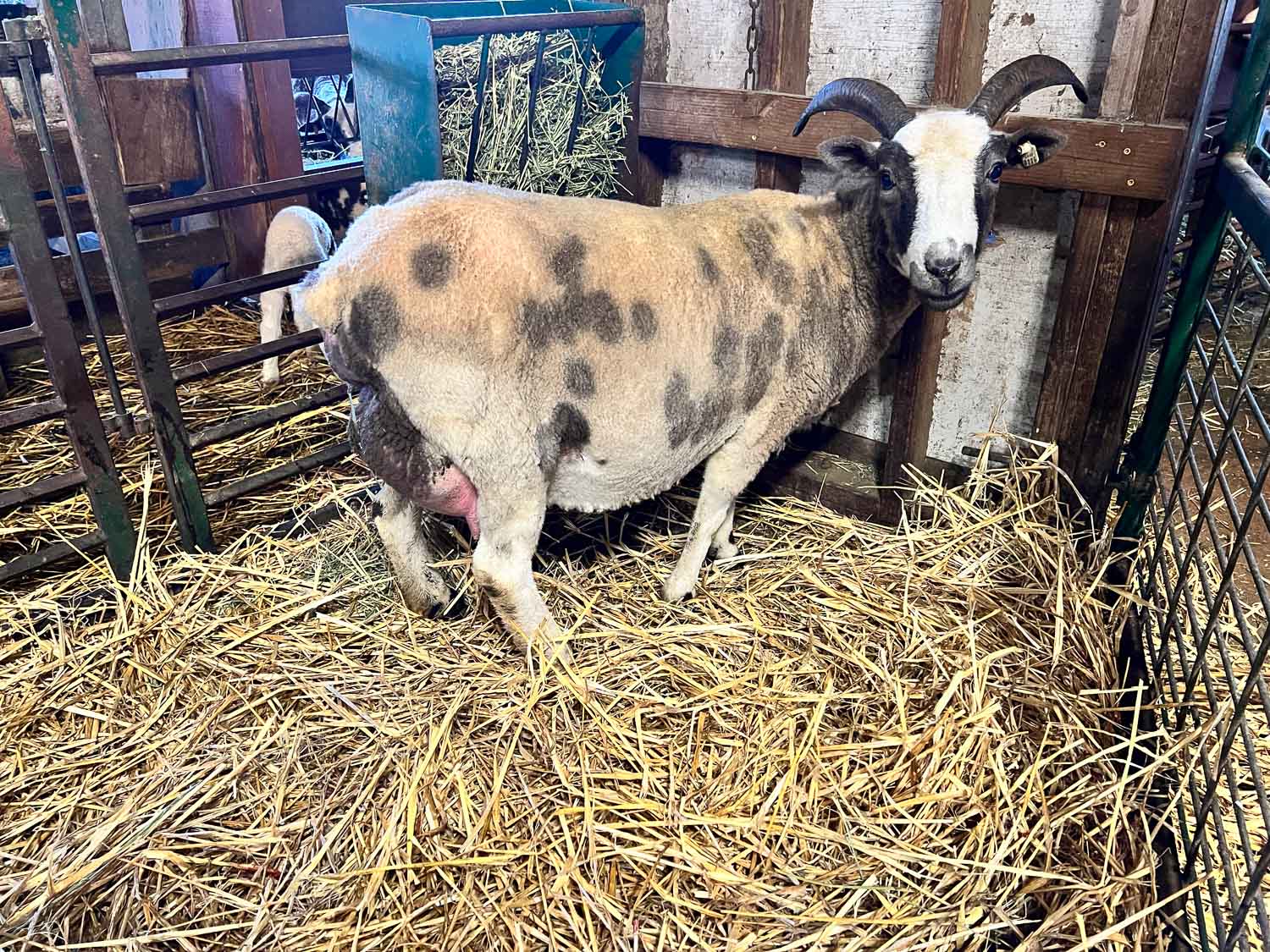
This is one of Trista’s twins born five days ago. The first time he nursed he did it while lying down. Maybe he has decided that is just the way you do things. It works when the sheep has a low hanging udder.

I was in the barn a good part of the day yesterday. I skirted fleeces in between watching ewes lamb. I’ll try to get time to post these.

This morning I knew it was time to rearrange the furniture. As the ewes lamb and I move more ewe/lamb groups out of pens they go on one side. The pregnant ewes stay on the other. It’s the only way I can keep track of who’s next and who may be in labor. There were way too many sheep on one side. It’s mud on the outside of the barn and the pasture has standing water. Until we get some dry days and some more growth they won’t go out there.

Now the ewes and lambs have a much larger space in the barn and outside to the west.

The pregnant ewes (not in this photo) have the space to the left.

In the barn. I ran out of feeders that hang on the panels so Tamara has to share her meal as bedding.

The hens looked like they were dying, but I knew that they were just happy to spread out in the sun.

I moved Amara in last night thinking that she might lamb during the night. Today was the day.

I went to the house for breakfast and to get supplies so that I could work from the barn. I had to prepare for a Zoom meeting for which I didn’t have time last night. This is one of my favorite cups. I bought it at Black Sheep Gathering last year.

My new office set up.

My view from the office.

The result. The second was one of those that may have been just fine if I wasn’t there, but I don’t know. There have been plenty of lambs born with no one around and they are up and nursing when I find them. But so far there have been two that I found dead and had the membranes over the face, one of which was still half in the ewe. This one was born while the ewe was standing and paying attention to the first. It slipped out and landed with the body flopped over the head and fluid all around. I straightened it out and it came to life. I don’t know if it would have before the ewe discovered she had a second.

That’s the day so far. We have 54 lambs and I think I counted 19 ewes to go.

Bright Colors and Lambs

I taught a rigid heddle weaving class this morning and the one participant chose these brilliant colors for her scarf. I think it turned out great!

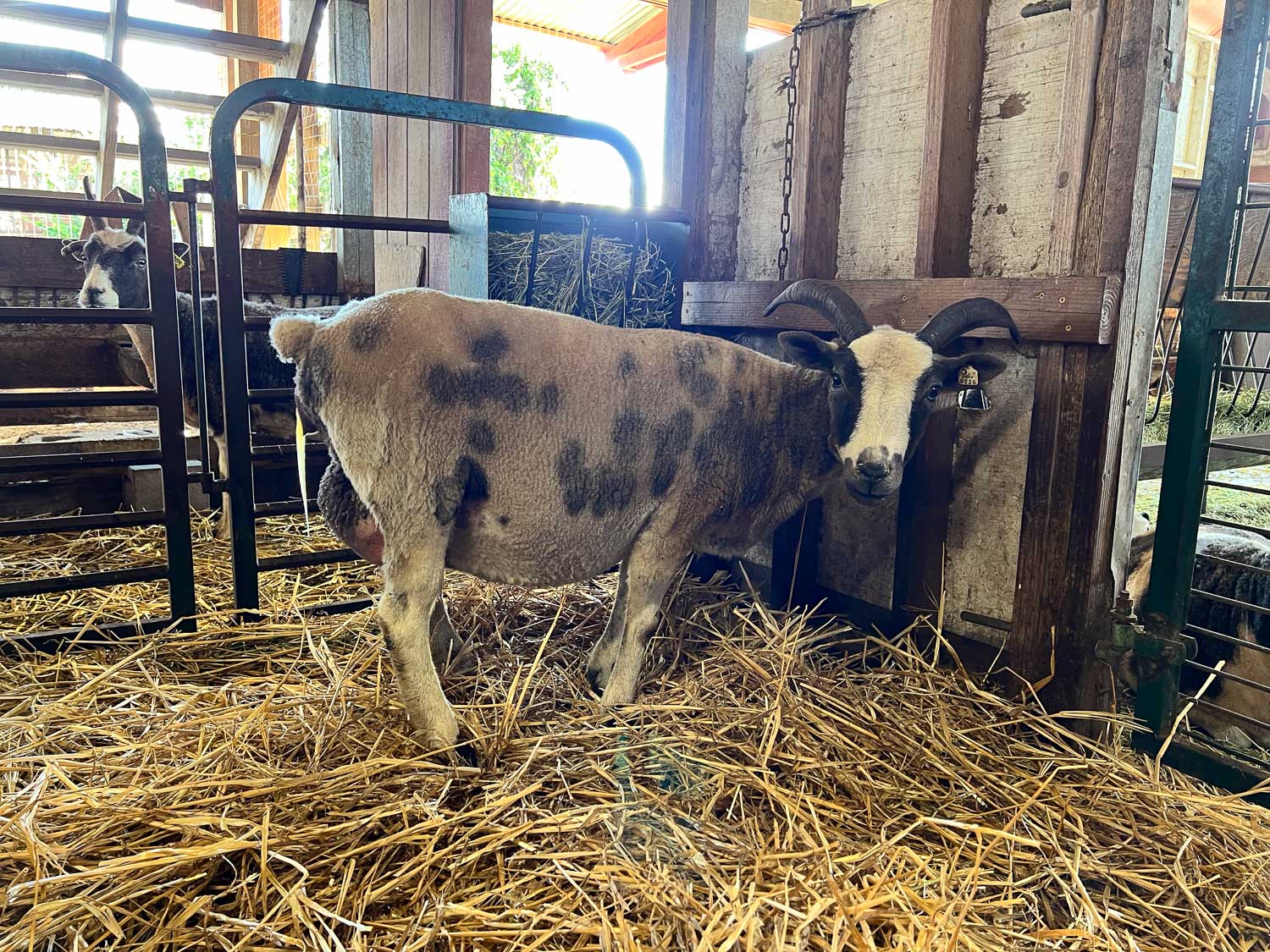
Dan and I went to the barn to put up a new barn camera and saw this out back. I had put these ewe in last night because she didn’t follow the others in to eat. But I put her back out this morning because nothing had happened and she wasn’t due for another five days. This is Rose, Kirby’s ewe. She is in the photo below just before shearing.

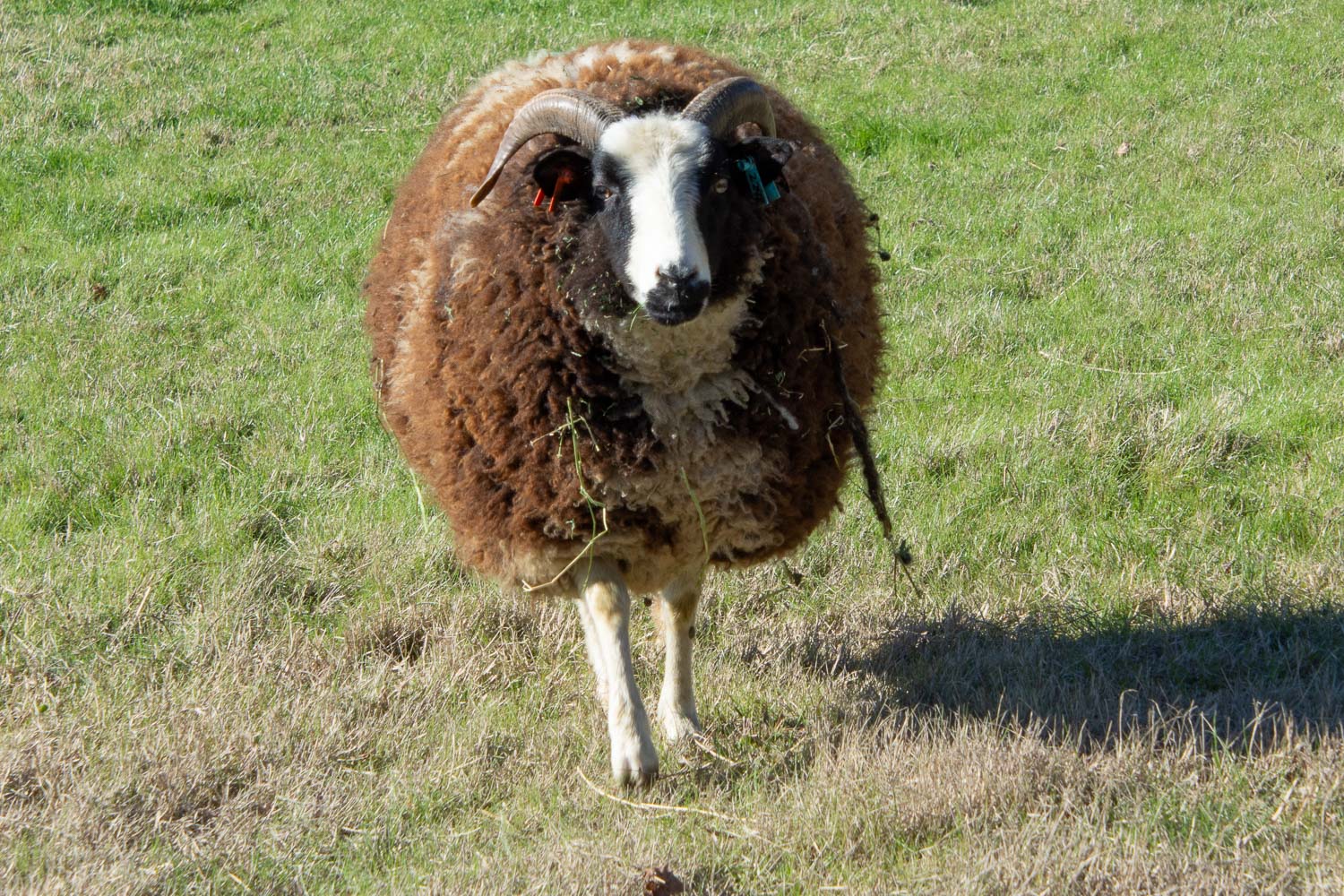
When they are in full fleece, looks are deceiving.

The ultrasound results showed triplets, but there are only twins here. These are dark lilac lambs. Horatio is the sire.

This is Bessie, the ewe that lambed January 29, too early for the “real” breeding season. These lambs are sired by a random ram lamb. They are sure nice looking ewes. One is black and white and one is lilac.

Surprise Lamb!

I was expecting the first lambs in about two weeks so it was a surprise when I saw a ewe who looked as though she was in labor tonight. I put her in a lambing pen and the more I watched the more I knew that she would lamb. I was a bit worried though because lambs can be considered premature and at risk if they are born even ten days before their due date. I put most ewes with rams on September 16 which makes first lambs due February 11. There were two ewes with a ram 6 days earlier which gives us a lambing date of February 5.

All is OK. I went to the house for dinner and pulled up the barn camera feed on my phone.The ewe was definitely in labor. By the time I went back to the barn the lamb was mostly out. The ewe was standing. One more push and the lamb was out.

This is a single ewe lamb out of a 7-year-old ewe, Meridian Dilly.

She was on her feet in about 20 minutes…

…and nursing within a half hour.

So how did we get such a vigorous healthy lamb that much sooner than expected? I sent an email to Farm Club to announce the lamb. One of the members reminded me of an email I had sent in early September in which I said three ram lambs had gone through the fence to where the ewes were. That timing makes sense. One of those is the sire.

Shearing Day 2024 – More Photos

I shared the first batch of photos from Shearing Day last night. Here are more.

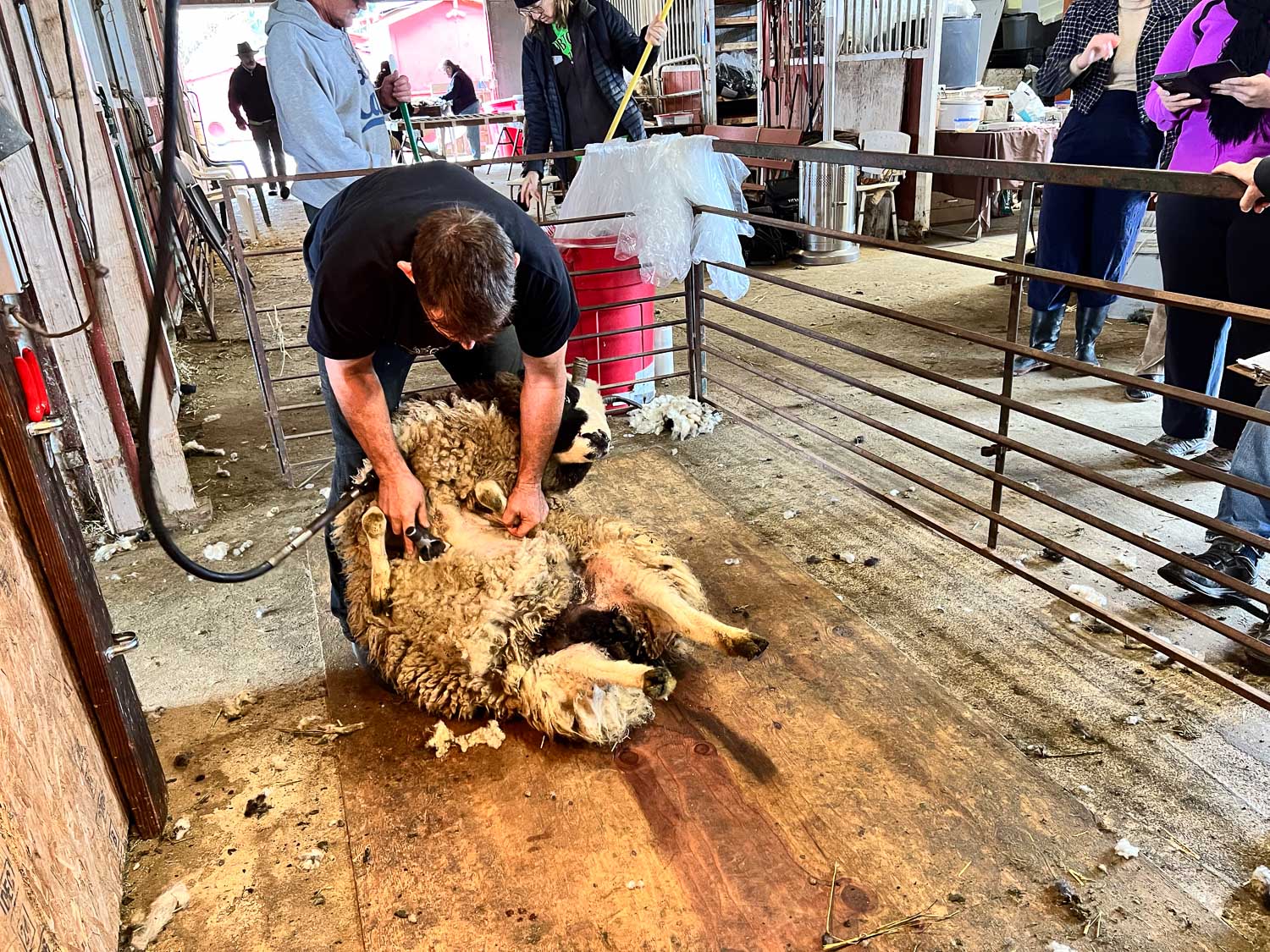
John has been shearing for us for years. He is an excellent shearer and a nice person.

I recorded some of the sheep being shorn which I’ll share when I have time. When I record I can pay attention to time. Some of them are right at 2 minutes or maybe even a little faster.

There is no blood. The sheep are in good shape and the fleeces look great! What more can you ask for?

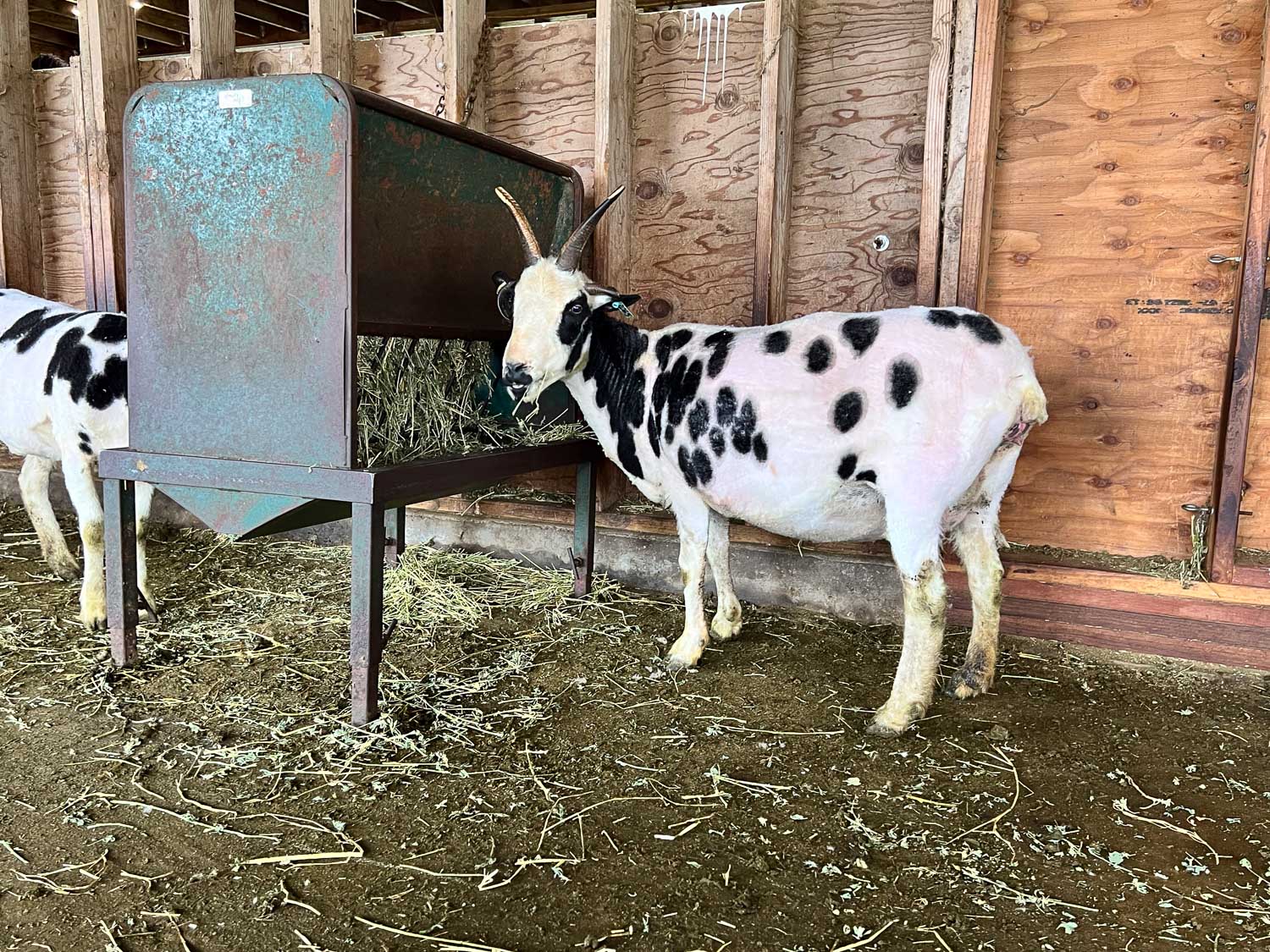
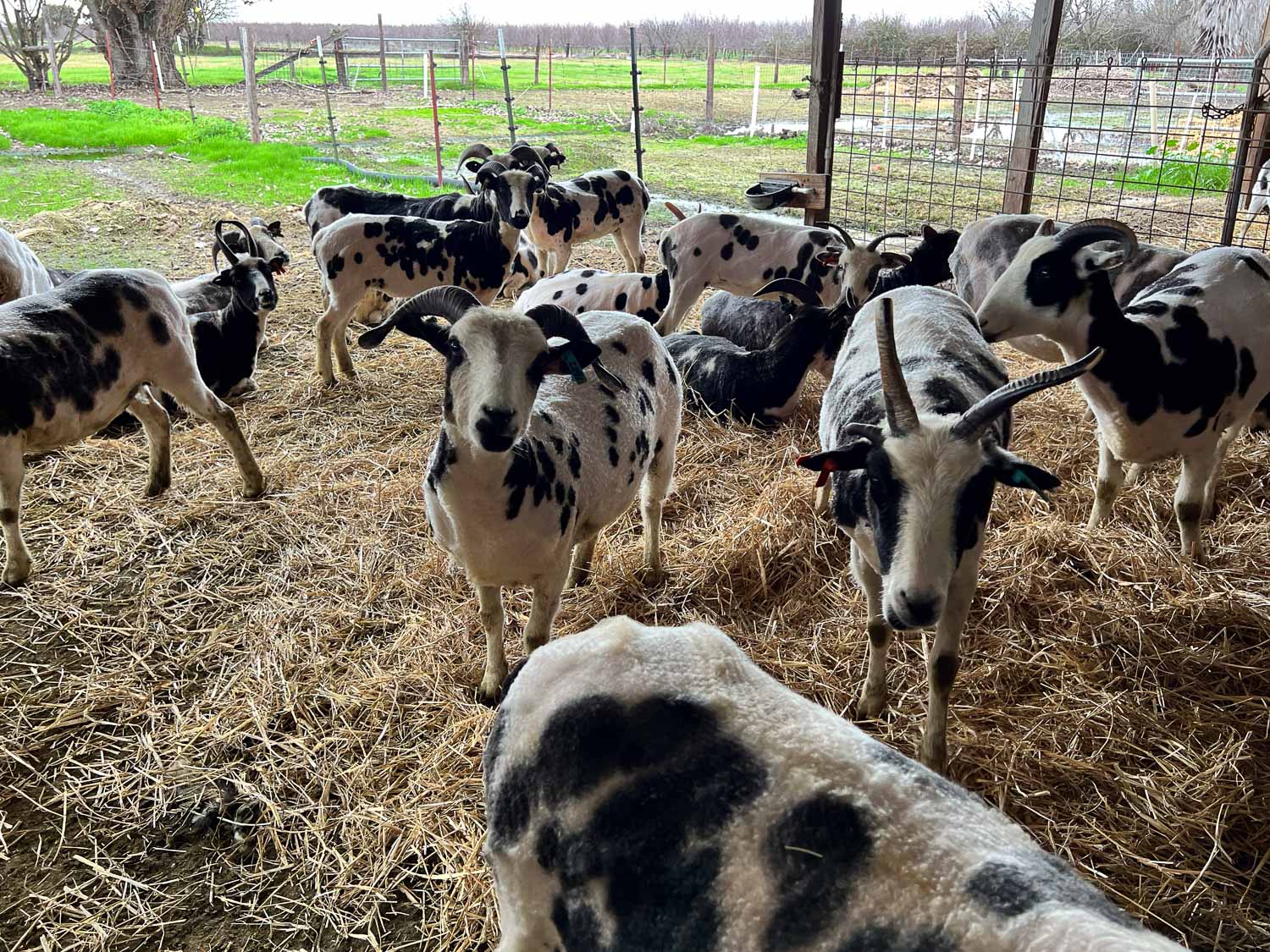
Farm Club members kept up with getting the sheep to John. I got outside and started to take photos of the sheep after shearing. This ewe is Sandie.

They sure look clean now! That won’t last.

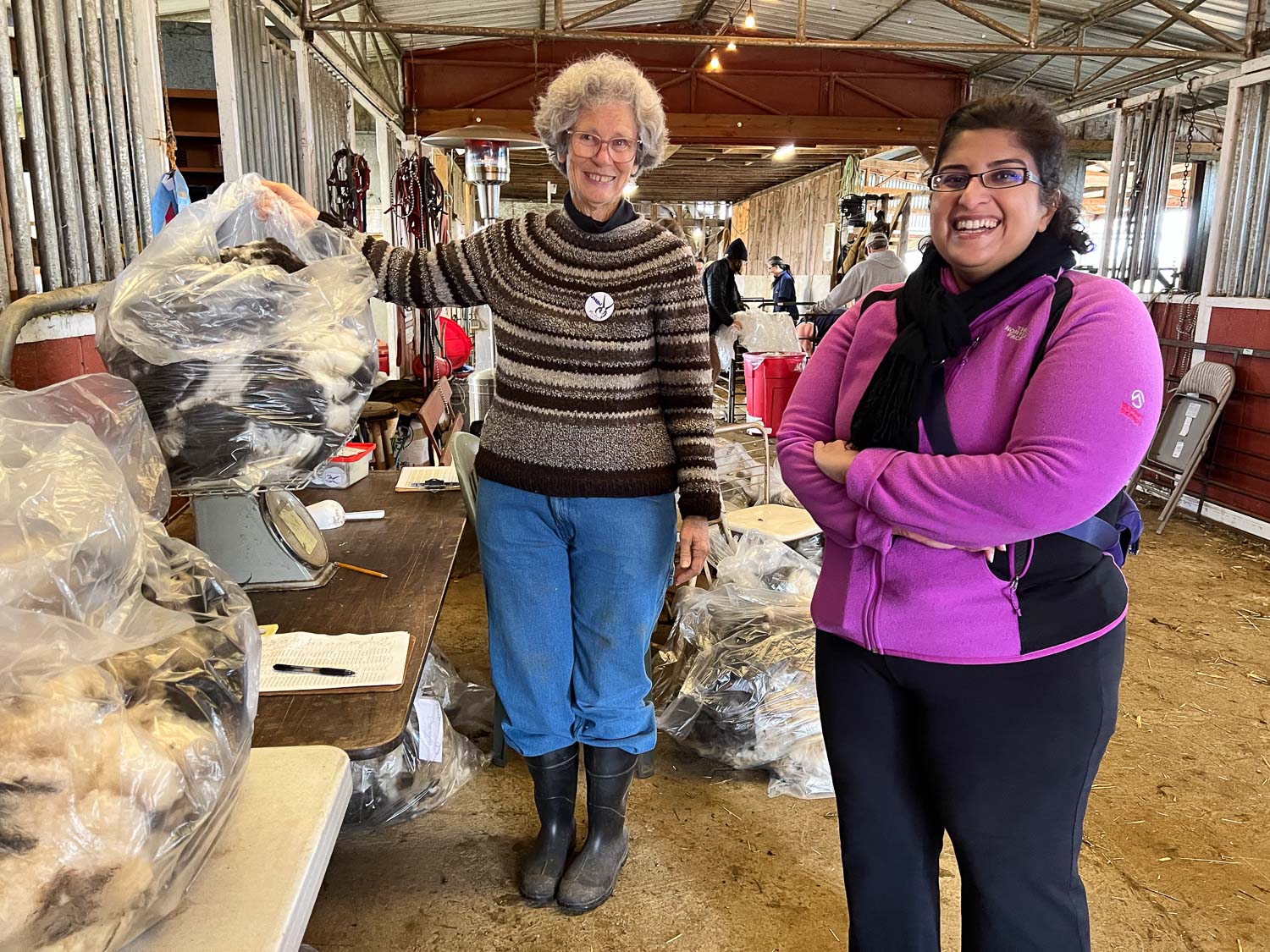
Kathleen weighed all the fleeces.

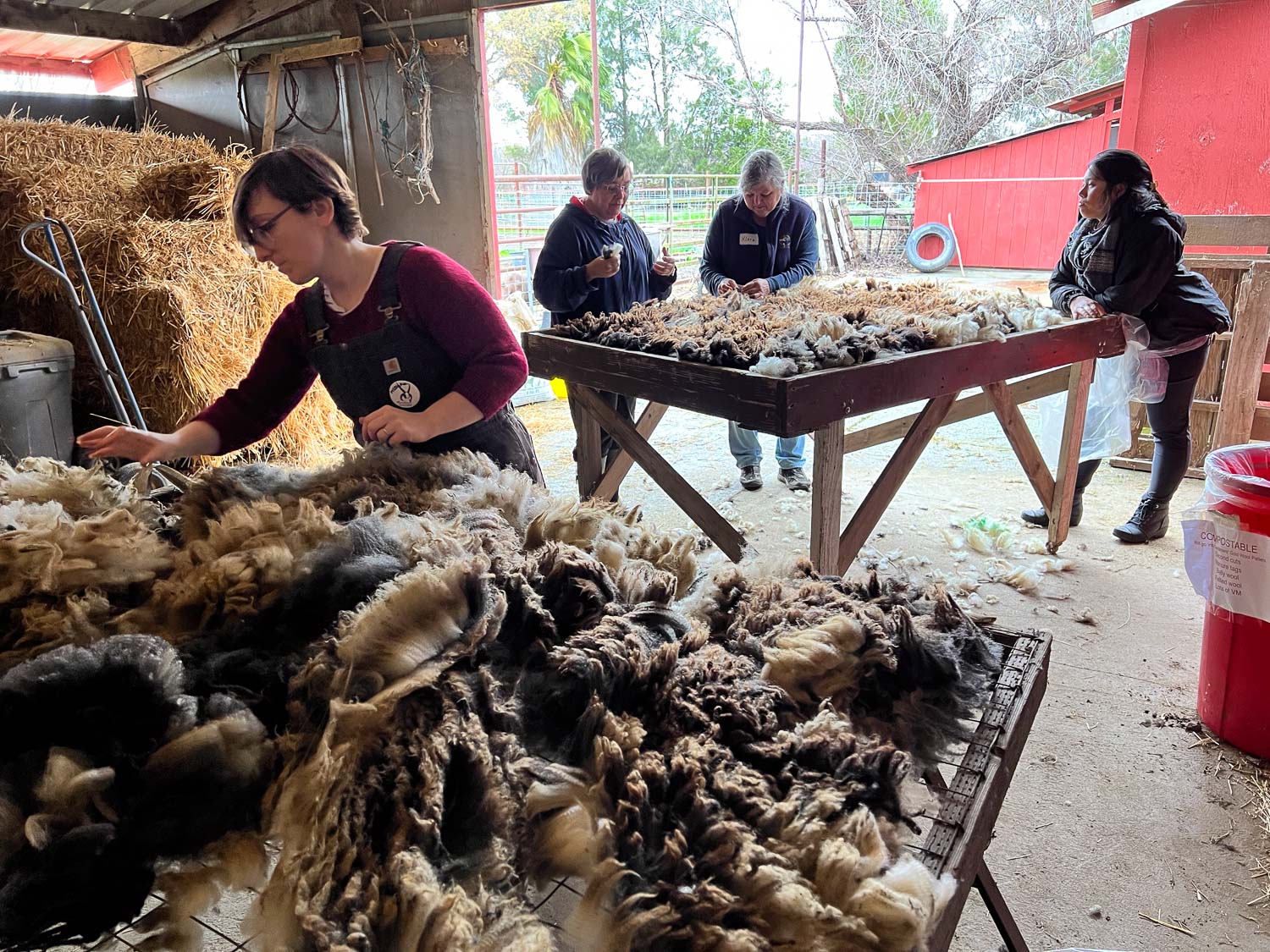
We had two skirting tables available so that fleeces could be skirted before purchase.

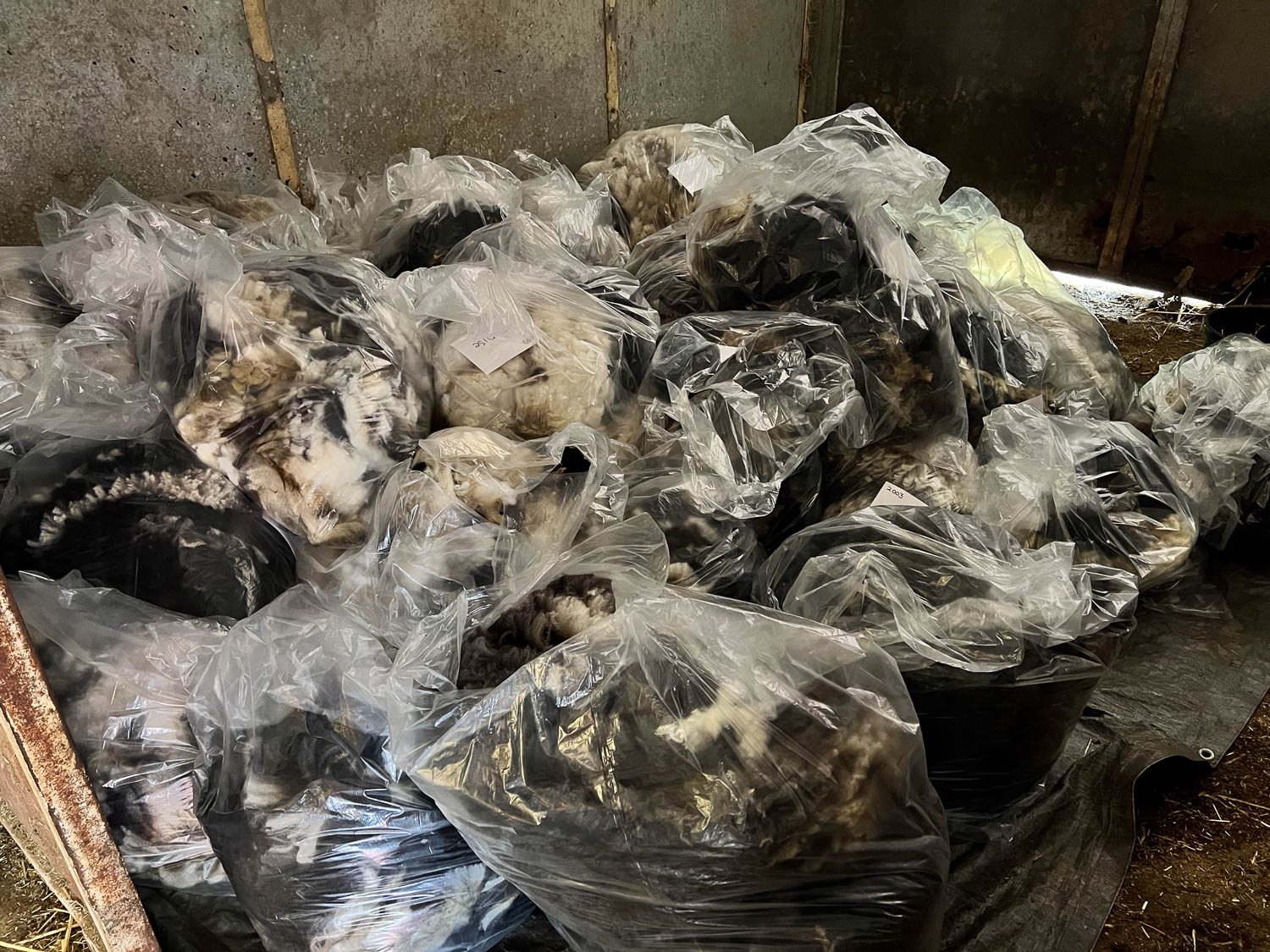
This is just a portion of the fleeces that I need to skirt and put out for sale. Give me a little time to get to that. The sooner the better though.

Distraction…there was a lamb born tonight! Surprise! I guess the next post will be about lambing.