Road Trip to CO – Gunnison to Durango

We left home on Wednesday and planned to get home on the following Wednesday. This was Monday. We had driven the road north of the Gunnison River the day before and camped near the Blue Mesa Dam.

IMG_2788

This campsite was essentially a parking lot for RV’s, but we just needed a place to eat and sleep so it worked.

DSC_1131

The Black Canyon of the Gunnison became a National Monument in 1933 and was made a National Park in 1999, over twenty three years after I spent a summer in the area. It contains 14 miles of the canyon’s total 48 mile length.

IMG_2795

I guess they’ll take anyone as a Park Ranger.

DSC_1132

The canyon is so deep and narrow due to the power of the Gunnison River as it drops an average of 96 feet per mile.  The Gunnison loses more elevation in the 48 miles of the canyon than he Mississippi River loses in 1500 miles.

DSC_1194

It is a sobering thought that the power of this river is forever harnessed due to up-river dams that lessen seasonal flooding. Therefore, build up of sandbars and more vegetation has changed the ecology of the canyon.

DSC_1200

The Painted Wall was created over a billion years ago when molten rock flowed into fissures in the dark wall.

DSC_1177

That molten rock cooled into crystals of mica, quartz, and feldspar. Amazing patterns were revealed as the river cut through the rock, forming the canyon.

DSC_1166

Breakfast with a view.

DSC_1218

I enjoyed the signs along some of the trails to help with plant ID.DSC_1151

I recognized this bush with it’s remarkable fuzzy seed dispersal method, but couldn’t quite find the name in the recesses of my brain. Mountain Mahogany.

DSC_1206

I also recognized this as in the Mariposa Lily family. It’s called Gunnison Sego Lily.

We spent half the day exploring the canyon from the rim. There are no trails to the river in the Park. We saw a couple of trails when we drove along the north rim east of the Park, but they are not for the feint of heart or casual hiker. The rim views are spectacular enough. But we had limited time and needed to get on the road.

In the summer and fall of 1976 I worked  for the BLM in Montrose, Colorado. I had fond memories of renting a bunk house on property between Montrose and Ridgeway and spending weekends exploring the old mines and alpine meadows in the beautiful San Juan Mountains. I had never been back, but wanted to use this opportunity to drive through that country.

IMG_2812

As we were driving down Hwy. 550 I wondered if I would recognize the place. The highway followed the Uncompahgre River but was on the wrong side of the river. Surely I would have remembered living right next to a major river like that. My memory was that the bunkhouse was up against a bluff and just south of the big house. We got to a point where the river shifted course for a brief period to the west side of the highway and there it was. I’m glad to see that they place hasn’t been torn down and, in fact, looks as though it has been fixed up. The bunkhouse is just behind the red truck and, yep, there is a bluff behind it.

DSC_1239

The view heading south from the house. Not a bad place to spend a summer…or a life (if you can deal with snow).

DSC_1245

We drove south into the San Juan Mountains.

IMG_2814

I have memories of driving to Ouray and heading out from there towards Telluride to explore the mountains. I don’t think that these towns had the tourist appeal then that they do now.

IMG_2834

This is one of the most gorgeous places I can imagine. It’s hard to get photos that do it justice.

From dangerousroads.org “In the state of Colorado…there’s a special highway built in the late 1880’s: the Million Dollar Highway, part of the San Juan Skyway. It’s one of the nation’s most spectacular drives…The road’s winding design, providing stunning panoramic views, is very curvy and fun for a leisurely ride, so it pays to take it slow. Offering breathtaking mountain, valley and gorge views, the Million Dollar Highway is one of the most beloved roads in the country. This classic stretch of two-lane blacktop snakes its way through the San Juan Mountains, the wildest and most rugged peaks in the Rockies.”

From another website: “Originally built in 1883 by Otto Mears as a toll way from Ouray to the now abandoned town of Ironton, this two lane highway offers spectacular views of the San Juan Mountain Range, and Uncompaghre Gorge. The road was extended to connect Silverton and Ironton over Red Mountain pass, and operated as a toll road until the early 1920’s when it was rebuilt and became part of the present day US Highway 550.”

IMG_2829

Can you imagine the road when it was first built?

IMG_2828

Here a a panoramic view of the modern day bridge over Bear Creek Falls.

DSC_1249

Originally the road connected Ouray with the Red Mountain Mining District to the south.DSC_0239

There are signs overlooking the site of the Yankee Girl Mine, one of the richest concentrations of silver ore found in the U.S. It started in 1882 and produced ore valued in today’s market at over one hundred million dollars, but lasted only about 16 years.

DSC_1261

Just more pretty scenery.

IMG_2861

This is taken from Molas Pass (10, 910′), the second of three passes on this highway going towards to Durango.

IMG_2858

Loving the mountains.

IMG_2857

Fortunately I don’t have to carry my camera gear the way William Henry Jackson did when he documented the West.

Onward to Mesa Verde where we would spend the night.

Road Trip to CO – Leadville to Gunnison

The main reason that we headed to Colorado on this trip was so that we could be in Leadville when Dan’s brother competed in the Silver Rush 50, a 50-mile endurance run. We spent the previous afternoon walking around town and going on a self-guided mine tour. We had a pre-race meal of pizza and salad and went to bed.

In the morning we split up. Dan got up early to be at the race start with Rob and Renee and I slept in and met up with Sally and John to explore Turquoise Lake.

DSC_0184

Dan took these photos of the first part of the run. Rob is ready to go.

DSC_0188

This run begins at an elevation 10,200′ and goes to over 12,000′. The runners have no difficulty getting their heart rates up right away even if they just walk up the first hill.

DSC_0199

Rob wore neon green (although we discussed repeatedly whether he was wearing green or yellow–it’s sure green in the photos) which was helpful when trying to pick him out on a mountain road.

DSC_0198

Personal support is allowed here, unlike in the Ironman last weekend.

IMG_2761

While Rob was running, my sister-in-law, Sally, and I went for a walk at Turquoise Lake, just a few miles from Leadville.

DSC_1026

DSC_0216

Rob was still on the trail…DSC_0213

…and made a shoe change…

DSC_0204

…while the spectators’ attention was diverted from the runners by a moose who wanted to cross the road.

IMG_2760

Sally and I finished our walk and headed back to town.

IMG_2765

We walked through a few shops to find some t-shirts and postcards. There was a price tag on this sheep, but even marked down to $2700 it was out of my price range.

IMG_2770

We met up with Rob’s support crew at the 25-mile turn around.

IMG_2764

As usual, I entertained myself with my camera while waiting for Rob to run through.

DSC_1034

I don’t know what this plant or the bug is.

DSC_1036

You don’t see a runner in a kilt everyday.

DSC_1041

We finally saw Rob coming in. Although he has run this event before, this wasn’t his day for it. He wasn’t feeling well and had been battling injuries. He had events coming up (including last weekend’s Ironman) and thought it was prudent to stop at the 25 miles mark (as if running almost a marathon isn’t enough for one day). So we ended the day in Leadville early and left town by mid-afternoon, following Rob and Renee to Buena Vista where we would meet for lunch.

DSC_1054

This is Mount Elbert, the highest mountain in Colorado. How do I know that?

DSC_1056

This is why we like these map books. We can follow along and identify points of interest. If we have cell service then I can look up more info, but on this trip cell service definitely wasn’t reliable. We enjoyed a meal with Rob and Renee before they had to head home, we stocked up on groceries, and we continued on our trip.

DSC_1073

Smoke from one of the fires burning in Colorado.

IMG_2781

IMG_3402

We had decided to find a place to camp somewhere near Black Canyon of the Gunnison National Park. The park encompasses the narrow band of land (and cliffs) along the river below where it has been dammed (from center to upper left in this photo). It was late in the day when we got to the dam that creates Blue Mesa Reservoir (right in photo) and we had to decide what we had time to do. We decided that we would drive the road on the north side of the canyon along the narrow Morrow Point Reservoir (which is not in the park) and enter the park the next day by driving in at the southwest entrance.

DSC_1085

The Pinnacles on Blue Mesa Reservoir.

DSC_1099

It was a spectacular drive on the road that follows the canyon. There are plenty of places to get out and take a look into the canyon.

DSC_1101

We stood high above buzzards circling on the wind currents. That is three buzzards roosting in the center of the photo. I took lots of photos of the spectacular scenery as the sun was getting lower but this post is already over-full of photos.

DSC_1108

This photo was taken from the last overlook on this drive–or at least the point where we needed to turn around to go back to the campground we had seen. That is the San Juan Mountains in the distance, which we’d be driving through the next day.

IMG_2786

After our shopping trip in Buena Vista we had a hot meal planned, but the camp-stove wouldn’t work. Tuna sandwiches for dinner again. Dessert was a deliciously gooey melted giant chocolate kiss.

Road Trip to CO – Moab to Leadville

I’m finally back to my photos of our Road Trip. I left off at the blog post about hiking in Arches National Park on our third day out. After a full day of hiking we headed northwest from Moab on Highway 128 that follows the Colorado River. Just after dark we found the Lower Onion Campsite just above the river. We enjoyed the mosquito-less evening while eating a hasty meal of beans and salad and went to bed planning on an early start the next day.

DSC_0967

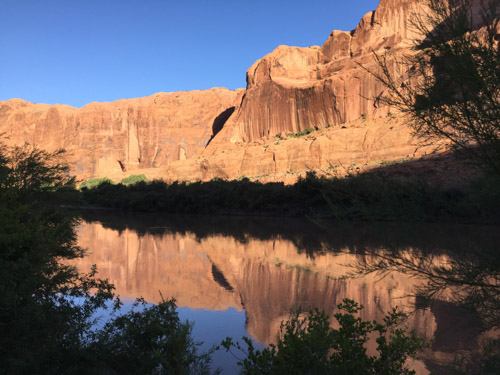
Here is a view of our camping spot in the morning…DSC_0968

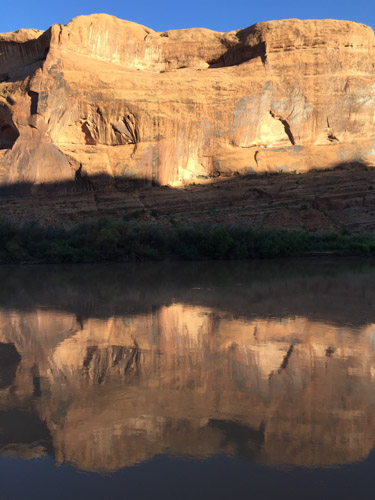
…and the cliffs beyond the river as the sun came up.

DSC_0983

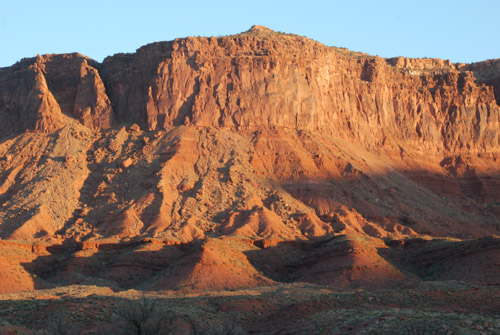
The red rock landscape of Moab changed to more typical desert as we headed north to I-70. We spotted our first prairie dogs along this stretch of road…

DSC_0985

…followed by pronghorn. Not a desolate road at all if you pay attention.

DSC_0996

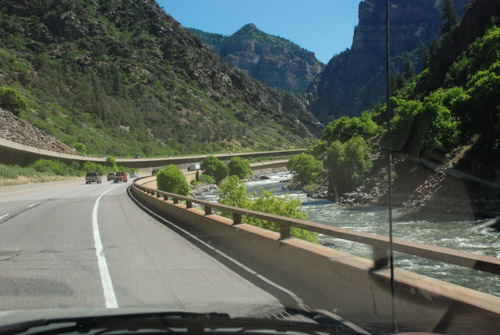
Our goal was to get to Leadville, CO by noon to meet up with Dan’s sister, brother, and their spouses, so we didn’t stop much along the way, but I took photos from the truck. I marveled at the engineering of this stretch of highway between Glenwood Springs and Vail.

IMG_2695

The eastbound lanes are just above the Colorado River and the westbound lanes are elevated to fit within the canyon walls, sometimes overlapping the lower eastbound roadway.  There is also a paved bike/running path right at the river’s edge. IMG_2696

At this point the highway is at about 8000′ elevation. We turned south on Highway 24 that would take us to Leadville at over 10,000′.  As we climbed into the mountains we had to stop at top of one of the switchbacks to take a look.

DSC_1004

Farther up we came to the Camp Hale Memorial. This meadow is the site of a U.S. Army training facility built in the 1942 and decommissioned in 1945. According to Wikipedia “Soldiers were trained in mountain climbing, Alpine and Nordic skiing, cold-weather survival as well as various weapons and ordnance. When it was in full operation, approximately 15,000 soldiers were housed there.”

DSC_1001

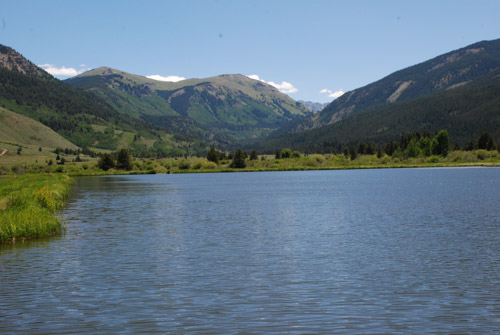
This is a view from that meadow looking east up the canyon to Sheep Mountain.

DSC_1010

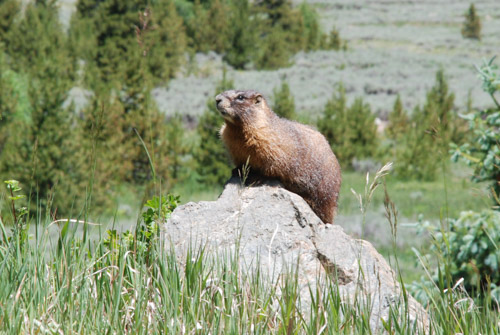
A marmot posed for me while reading the roadside memorial signs…DSC_1013

…and this bee flew into this columbine just as I was taking a photo.

IMG_2723

Entering Leadville.

IMG_2706

We wandered around the downtown for awhile…

IMG_2712

IMG_2704

DSC_1022

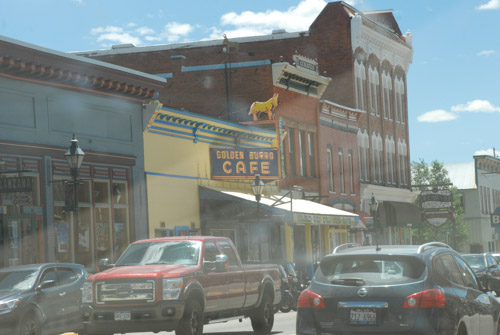
…and then met Sally and John for lunch at the Golden Burro Cafe.

IMG_2716

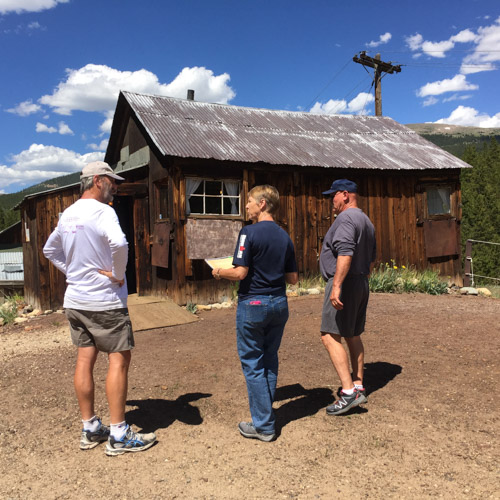
After lunch we took a self-guided tour of the Matchless Mine. “The Mathcless Mine, a historic silver mine purchased in 1879 by H.A.W. Tabor, was estimated to have produced 7.5 million dollars during its peak operating years. Once fabulously wealthy, the silver market crash of 1893 devastated the Matchless Mine and the Tabor Family. Upon Tabor’s death his widow, Elizabeth “Baby Doe” Tabor, returned to the Matchless where she remained in isolation for until her death in March of 1935.” This is the cabin where “Baby Doe” lived until her death.

IMG_2721

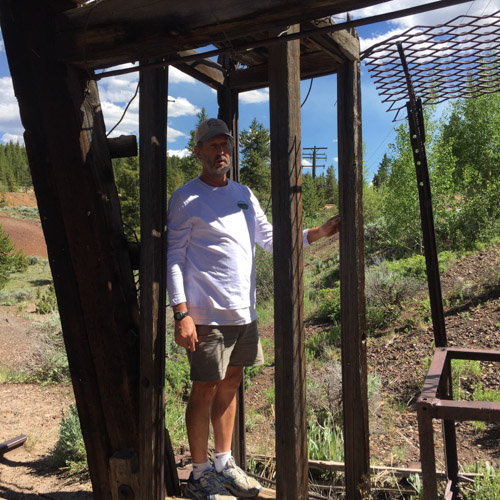
Dan is standing in the phone-booth size structure that would lower miners hundreds of feet below ground. We watched a video that shows a 3-D image all the tunnels and shafts below us. I don’t remember the stats but the distances are staggering to think about.

After the mine tour we met up with Rob (Dan’s brother) and Renee and we all went to the Leadville Cemetery.

IMG_2739

My father-in-law’s grandparents are buried here and following his death just this spring, this was an meaningful stop for the family. We spent some time here before returning to our motel, eating pizza, and making plans for the early morning start of the Leadville 50–an ultra run that Rob was had entered.

DSC_0171

This was our one “civilized night” and I spent a little time trying to catch up with e-mail and thinking that I’d start my blog posts. Nope. We were tired and I wasn’t motivated enough to interrupt the vacation!

Road Trip to CO – Arches #2

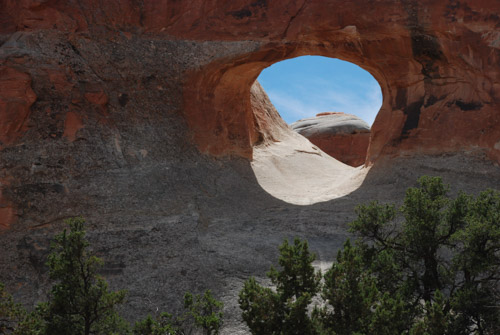
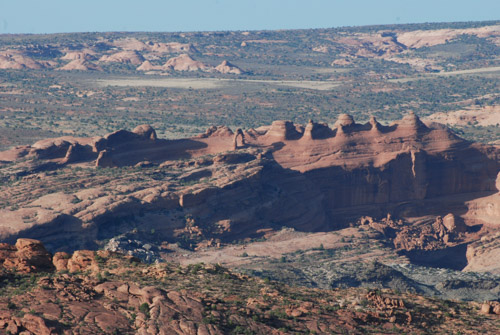
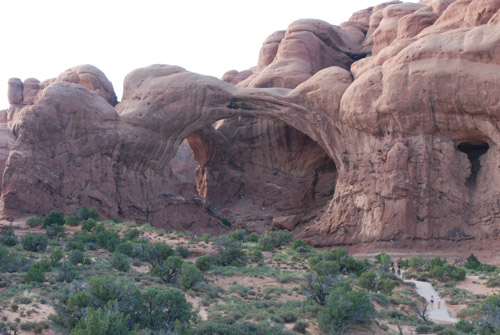
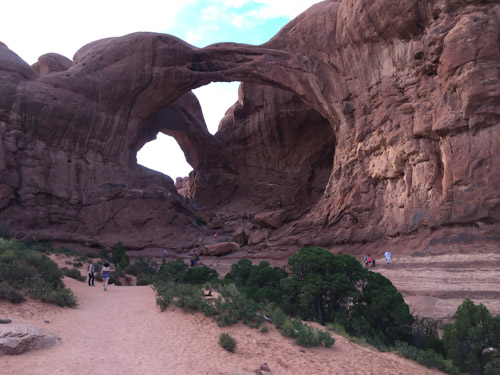
We had only one day to spend in Arches National Park, but we took advantage of it all, hiking/walking/driving. I posted a lot of photos here, but there are more.

DSC_0876

We spent the first half of the day hiking a 7-mile trail. After that we drove to various points of interest or overlooks where there were shorter trails to more arches.

DSC_0879

We ended up hiking about 12 miles that day.DSC_0883

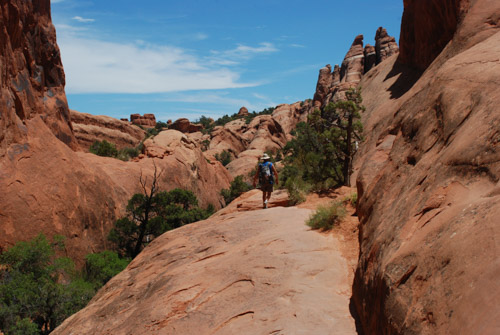
The scenery was all spectacular. DSC_0886

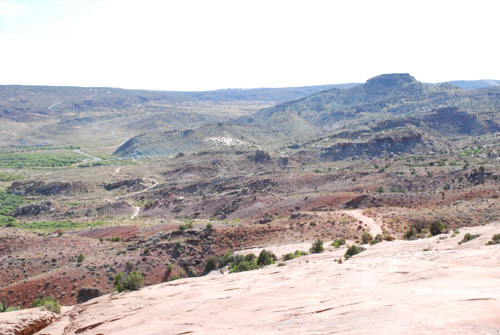
This is looking back at the parking area from the trail to Delicate Arch.

DSC_0888

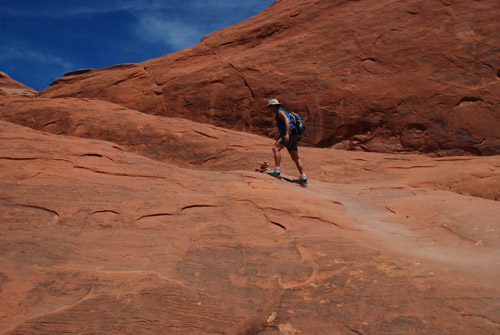
Much of the trail is walking across the slickrock.

IMG_2668

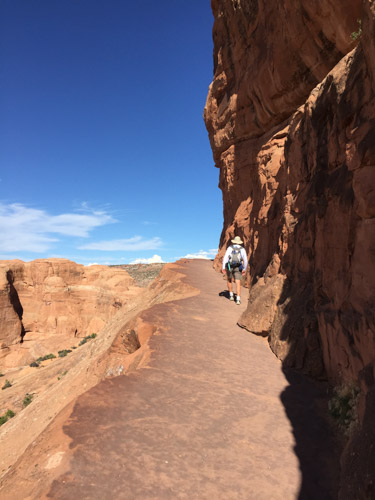
Then the trail becomes almost a shelf that winds around the side of a cliff.

DSC_0904

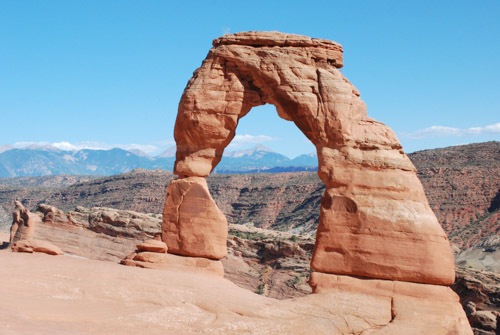
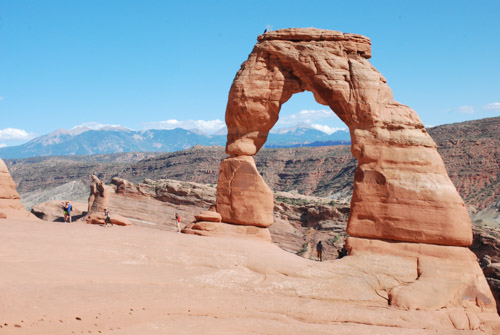
When you get the first view around the corner of that cliff you’re almost blown away (literally as well as figuratively). What a site! It’s absolutely amazing. I mean we saw a lot of arches and cool rocks and cliffs earlier in the day, but there was something about this one that is stunning. Maybe it’s because you see it suddenly as you turn the corner. Maybe because it stand alone with no other features near it.DSC_0898

Maybe it’s because of it’s size. In this photo there are people. Do you see how small they look?

.DSC_0907

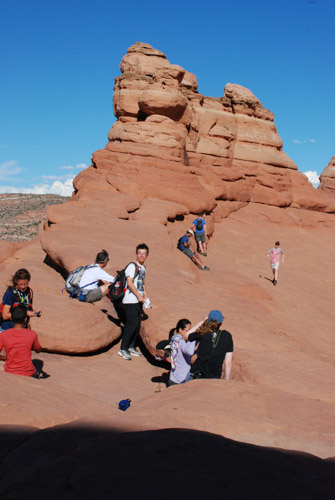
In fact, there were a lot of people. It took some patience to get a photo of the arch with no people. That’s Dan sitting on the rock while others venture towards the arch. At this location the wind was so strong that it felt as though you could be blown backwards off the cliff.

IMG_2670

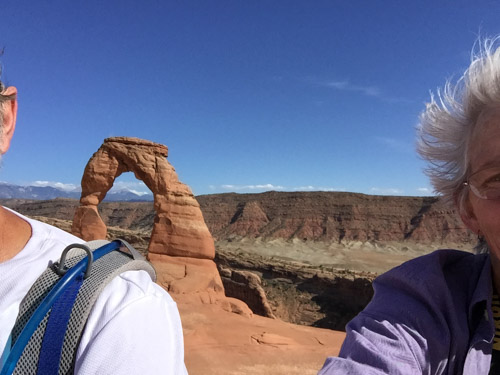
Wind effect in my hair. It’s not standing up just from the sweat and 2 days of camping!

DSC_0919

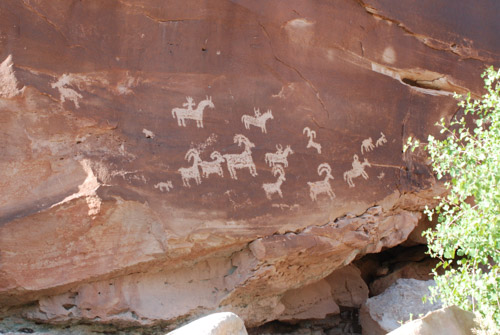
As is the case with most hikes, the trip back to the truck took a lot less time. At the bottom there are petroglyphs. These images of a horse and rider, bighorn sheep, and dogs were carved between 1650 to 1850.

DSC_0922

We continued on the road through the park. This is an overlook across the canyon from Delicate Arch. You can see it right there in the center of the photo. The trail we took came from around the rocky cliffs at the left.

DSC_0929

It was getting dusk when we got to the trails to see the last arches. These were relatively close to the parking lot so there were lots of people there. If you look closely you will see people on the rocks under the arches and on the trail. That gives you a sense of scale.

IMG_2674

DSC_0935

IMG_2667

We followed another trail at this location…IMG_2675

…to get a different perspective…IMG_2680

…as the sun was going down.

IMG_2682

Interesting manmade patterns.

IMG_2690

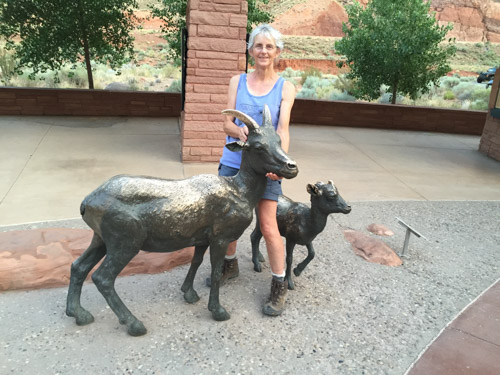
We stopped at the visitor center to clean up and fill water jugs. I got in a bit of sheep showing practice before we left to find our camping spot for the night.

Road Trip to Colorado – Arches N.P.

The mosquitoes that had been relentless the night before (this post) were slightly less so in the morning.

IMG_2631

However the surroundings were beautiful as the sun reached the west side of the canyon.

IMG_2628

But we didn’t linger around camp. We packed up and drove just north of Moab to the entrance of Arches National Park.

DSC_0801

The cliffs on the left side of the photo are part of Arches and that’s the Colorado River flowing our of the canyon in the center of the photo.

IMG_2632

I had been here once or twice before but that was almost forty years ago. (Oh yeah, I was going to find my old slides and see if I have photos from back then.)

I don’t remember the names of all the arches. Besides sometimes I don’t want to know what names other people have used for formations. I like to enjoy them without always having to see or think of something that is not a rock. I’ll make up my own name if something comes to me.

IMG_2636

We had one day to see the park and, knowing that it was going to be a hot day, we decided to start with one of the longer trails. Out and back on the more traveled trail would have been about 5 miles. We ended up taking the “primitive” route to come back and that was 7 miles.

IMG_2648

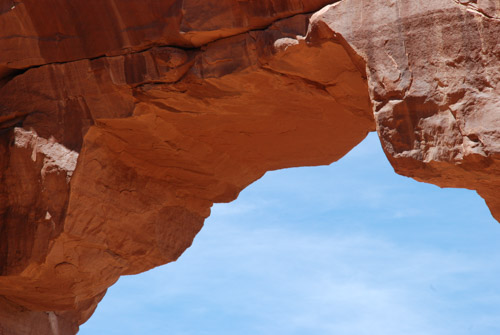
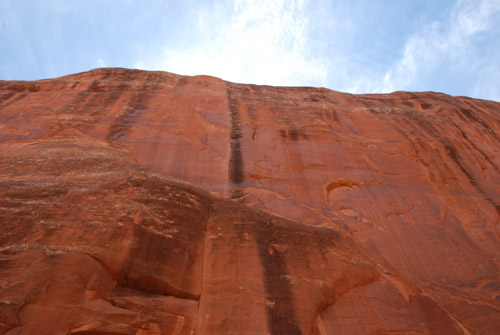
I thought about giving up taking photos because it seem so hard to capture the grandeur, the color, the textures.

IMG_2655

But of course I continued to shoot photos and I am sharing some of my favorites.

DSC_0816DSC_0818

IMG_2663

Distances are so deceptive in this country. We had seen these rock walls in the distance and I had thought, “it’s a good thing we’re not going there”. The “primitive route” took us around those and beyond.

DSC_0852

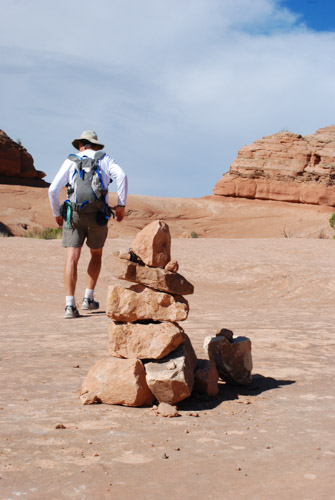
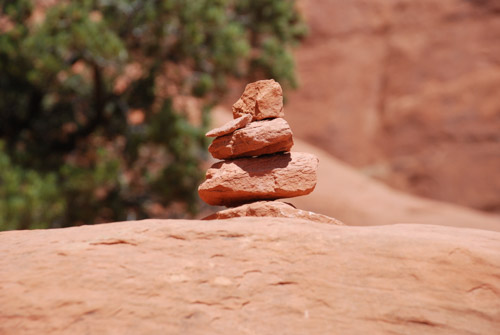
Cairns are important in finding the trails over slickrock and through washes. Seeing those little rock towers kept us on track in places where the trail wasn’t obvious.

DSC_0854

DSC_0857

DSC_0838

More from Arches National Park in the next post.

Road Trip to Colorado–Tonopah to Moab

After the tire problem the night before (this blog post) we knew that before we drove farther we needed to buy new tires.

Tonpah rest stop

We had driven to a rest stop just west of Tonapah, Nevada, where we spent the first night of this trip.

Tonopah NV

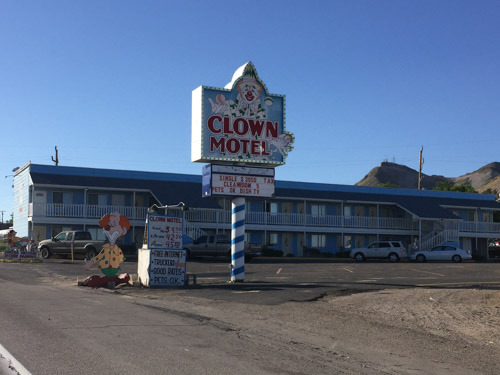
We drove through town looking for a tire store and I remembered this motel from a previous trip through Tonopah when we were looking for a motel late at night. We chose something that did not advertise clowns. Sorry, Clown Motel.

Most of the rest of these photos are DBP (drive-by photography). The goal was to get to Arches National Park or close to it so that we would have all of Friday to spend at the park.

UT-0778 Hwy 50

Dan likes to drive and that’s fine with me. I keep myself amused with following along on the map or with the phone (if there is service…which there wasn’t for a lot of this trip) and by taking photos.

UT-0780 Hwy 50

UT-0780-cosmic ray

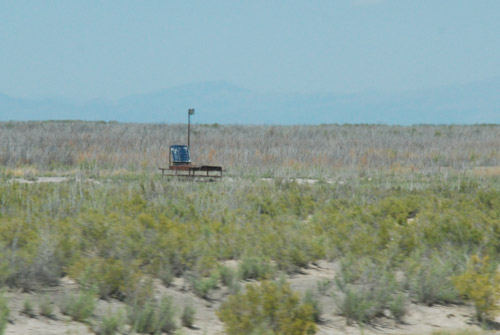
We saw these “things” regularly spaced on both sides of the highway for several miles in Millard County, Utah. All we could make out was what looked like solar panels on a framework and we speculated as to what they were–we decided that they were to monitor or measure something, but what? As we drove into Delta, Utah we just happened to see several of them in what looked like a parking lot beside a building that said Cosmic Ray Center. I googled “cosmic ray delta utah” and found a lot of references to the Telescope Array Project: “The Telescope Array project is a collaboration between universities and institutions in the United States, Japan, Korea, Russia, and Belgium. The experiment is designed to observe air showers induced by cosmic rays with extremely high energy. It does this using a combination of ground array and air-fluorescence techniques. The array of scintillator surface detectors samples the footprint of the air shower when it reaches the Earth’s surface…” OK, you lost me. At first I wondered if this was for real (thinking of driving through Roswell, NM last year with it’s focus on Aliens) but I guess it is. Who knew what we’d learn on the road?

UT-0782-shoe tree-

I also learned from googling, that “Shoe Trees” are a real thing, although of less lofty impact. There will be more about this in a future blog post.

UT-0785-Delta

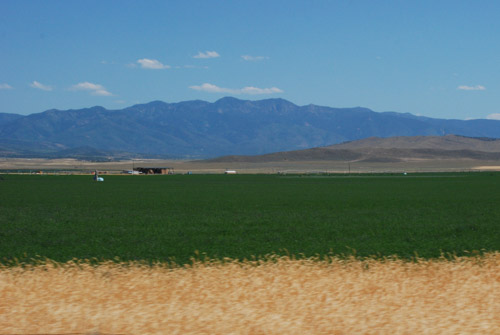
Where there is water the desert is held at bay. There were plenty of alfalfa fields throughout this valley in Utah.

UT-0791

Towards the east the patterns and rock formations were impressive…

IMG_2612

IMG_2620

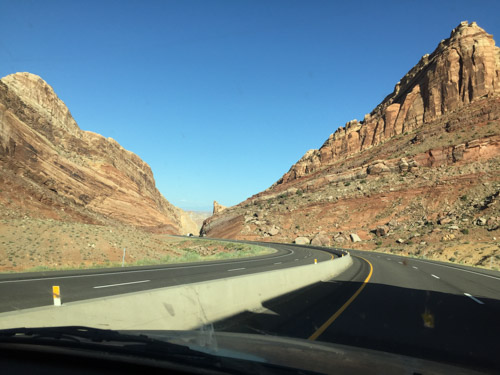
…and we began to see “red rock country”.

IMG_2619

This is U.S. 50 in central Utah, which is known as the “Loneliest Road in America”. I just looked this up and now I understand why there is a sign in Sacramento for Ocean City, Maryland (see my first blog post for this trip). U.S. 50 is also one of the longest highways in America, going between Sacramento and Ocean City. I always thought that it was just because someone in the Sacramento Highway Department has a sense of humor.

We drove U.S. 50 to Highway 191 where we turned south to Moab. Arches National Park is just east of the highway and north of Moab and seeing the spectaular scenery whetted our appetites for the next day’s adventures.

It was late though and we needed to stay somewhere. Arches N.P. has very few campsites, but there are several in the Moab area. We found a BLM campsite on the Colorado River right outside of Moab.

DSC_0792

The sun was going down, giving intensity to the red rock cliffs.IMG_2621

The campsite was right next to the river. River + Dusk = Mosquitoes. They were relentless. IMG_2623

We quickly set up our tent and retreated until after dark when we ventured outside to heat up a couple of cans of chili.


Road Trip to Colorado-Bodie & Beyond

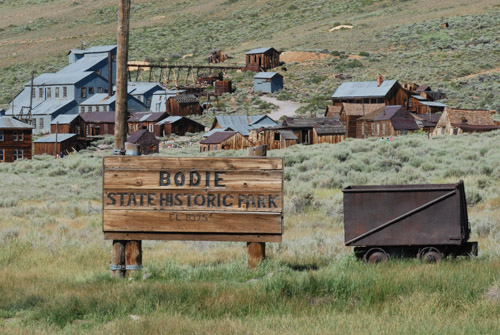
The first post about our trip is here. One the first day we made it to Bodie State Historic Park near the California/Nevada border with about an hour and a half before the park closed.

DSC_0715

W.S. Bodey discovered gold here in 1859 but he died in a blizzard several months later, never seeing the town that was named for him (although spelled differently). A mine collapse in 1875 revealed a rich body of gold and the boom time of the town was during 1877-1881 when there were 30 mines, 9 stamp mills, and 60 saloons. As the boom years ended population declined quickly into the 1900’s. Mining continued until 1942 and the family of the last major landowner continued to protect the town from vandals. In 1962 the CA State Parks purchased the town to protect it. It remains in a “state of arrested decay” without the intent to reconstruct it.  The  non-profit organization, The Bodie Foundation was created with the goal to raise funds to assist with stabilization of structures as well as education.

DSC_0730

View of what is left of the town from above. At it’s height there were probably 8000 people living here. There is an interesting mix of eras remaining–houses built in the 1870’s, gas pumps from the 1920’s, and a school that was used until 1942. DSC_0725

DSC_0737


DSC_0721

DSC_0717

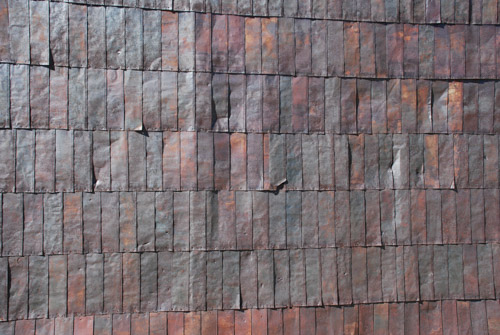
The walls and roofs of many of the buildings are covered with flattened tin cans.DSC_0726

DSC_0736DSC_0157

Dan took this photo because he liked all the different roof lines.DSC_0734

I like the design of the tin here, but I was really trying to take a photo of one of the violet green swallows that were zooming around. I got this one just as it flew into the corner of the roof.

DSC_0734-2

Do you see the wing tips under the roof line?

IMG_2581

IMG_2580

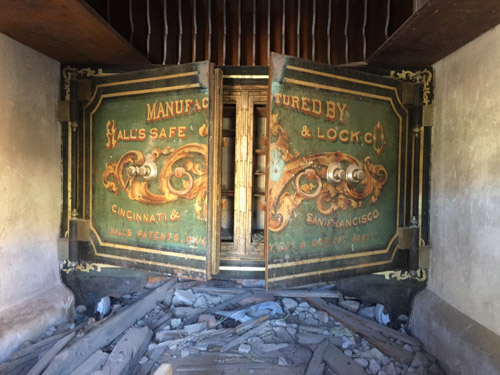
The brick vault is all that is left of the Bodie Bank after a fire in 1932.

IMG_2579

This is the safe inside the vault.

IMG_2577

Due to safety concerns the Standard Consolidated Mining Company’s Stamp Mill and other buildings are not open to the public except by guided tour. It is on the hill above the town and was only one of thirty mining companies in the district.

After our visit to Bodie it was time to get on the road and drive until we found somewhere we wanted to stay for the night.

IMG_2596

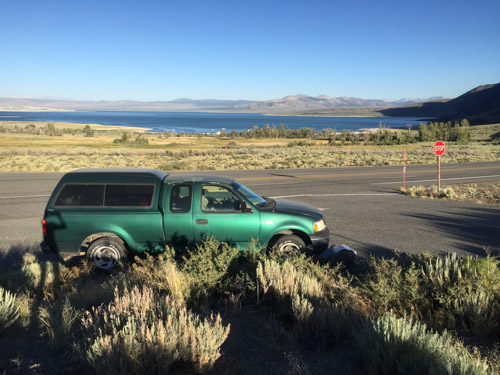
Coming down the mountain towards Mono Lake the truck rattled and shook every time Dan used the brakes. Then we heard a thwump, thwump. One of the front tires was beginning to shred, but fortunately still held air. Dan changed the tire and we knew that we needed new tires. It was too late to find anything near Mono Lake so we decided to continue on. We turned east and spent the night at a rest stop outside Tonopah, NV.

IMG_3063

The lower pink line is the first day of this trip.

Next up: on the road to Arches National Monument.
 

Road Trip to Texas – Day 10 (part 1)

It may seem silly to go back three weeks to finish up my Road Trip blogs, but I don’t want to leave it unfinished. This blog has become my scrapbook that I would never do on paper.  And I have had a lot of feedback that you who read the blog like the Road Trip series. I left off on Day 9, so here is Day 10, split into two parts because that’s how the day seemed. I’ll warn you now; there are a lot of photos.DSC_7386We were packing the truck. I wondered if Kirby would miss us for a little while because we’d been there for four days. Probably not, but I hope that she will remember me next time I see her.DSC_7404Saying goodbye was hard for Dan and me.DSC_7395

KirbyTime to leave. I needed to be home by Friday.

Blanco? Now that it’s been so long until I sorted this batch of photos I forget where some of them were taken. I think this is the town of Blanco, the closest town to where we were visiting.

This is peach season in the Hill Country and wanted to make a stop and maybe pick up a few more gifts for farm-sitters.peach stand

peaches

peach stand (1)Here is where they sort the peaches.peach stand (2)And here is where they bake pies and other delectables. It smelled wonderful inside. I was so tempted to buy a pie, but instead I bought fresh peaches and jam and…peach ice cream…this for the road…trying to ease the sadness of leaving our family behind.DSC_7444I amused myself by taking photos on the road (thinking that I would remember where they were taken).  I have not cropped or edited these photos. They include the squashbugs (as my brother and I used to call them) and glare on the windshield.

Texas is a big place. The country is not all what I had envisioned. DSC_7458There are more mountains than I expected.DSC_7469And more greenery. Even towards West Texas there is agriculture anywhere there is consistent water.DSC_7454

DSC_7463

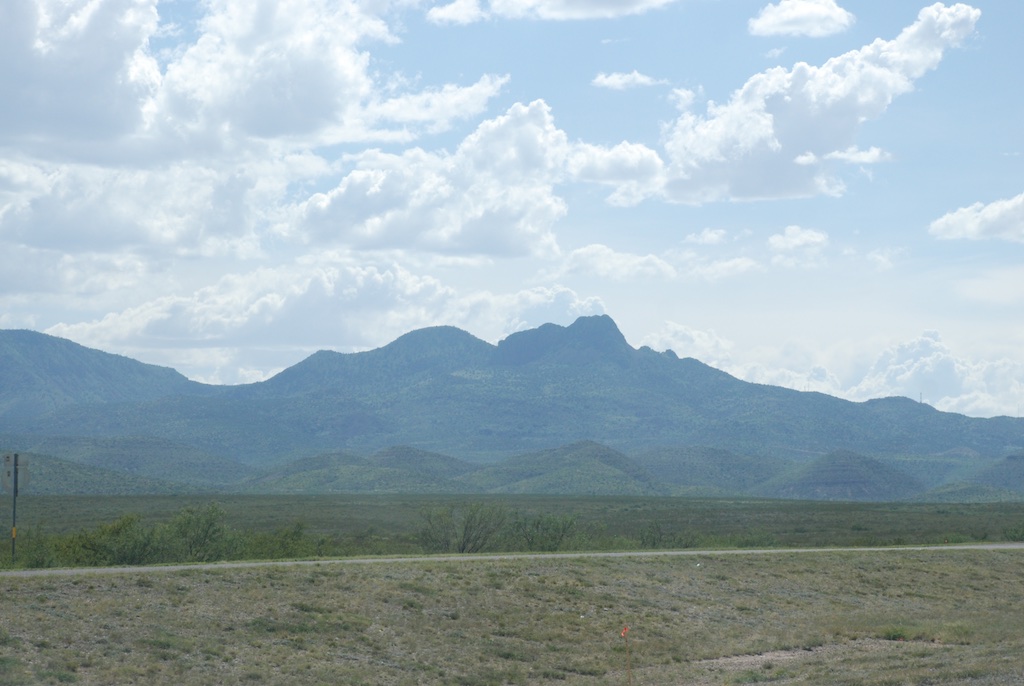
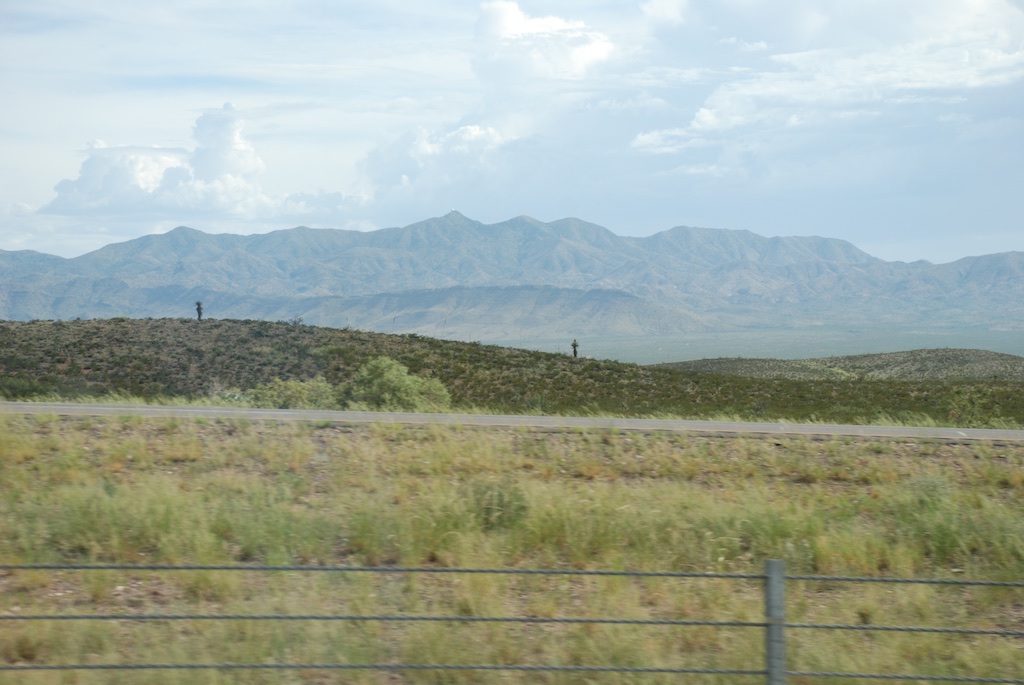
Hwy 10, TXAt this gas stop I walked out back…Davis Mountains, TX…and took photos of the gorgeous Davis Mountains to the south.

DSC_7467 DSC_7471 DSC_7473 DSC_7487 The simple descriptor I kept thinking was Big.

DSC_7488 DSC_7498 DSC_7499

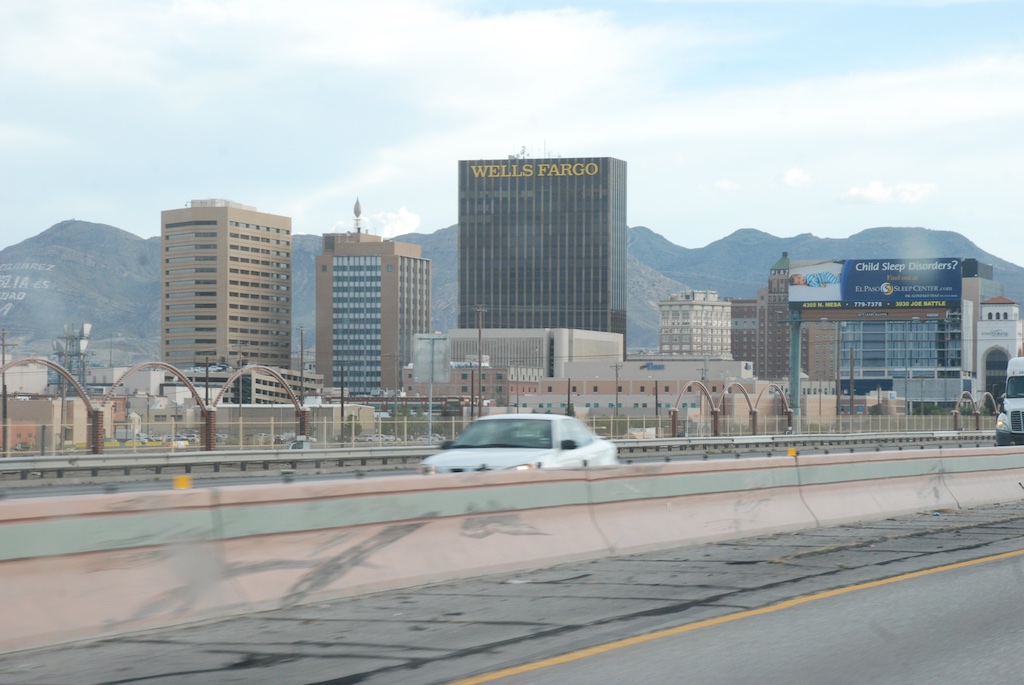
Rio Grande ValleyDropping into the Rio Grande valley.El Paso, TXEl Paso, on the U.S./Mexico border.

DSC_7520 DSC_7521 DSC_7525

US-Mexico fenceThe border fence.

DSC_7530 The end of this blog post but not the day. More in the next post.
Road Trip to Texas – Day 9

We had been in the car for 8 days. We stayed in place for most of this day, our last day to visit Katie, Kurtis, and Kirby.DSC_7380I babysat (grandmothered) most of the day while Dan and Katie worked outside.

DSC_7376 Surprisingly (or maybe not when holding a squirming baby) I didn’t take many photos.

At dinner time we went to “get BBQ”. IMG_5348I hadn’t realized that I’d never had “real BBQ”.

IMG_5347 Kirby had been asleep in the car. She’s wearing one of several outfits given to her by her Aunt Meryl.

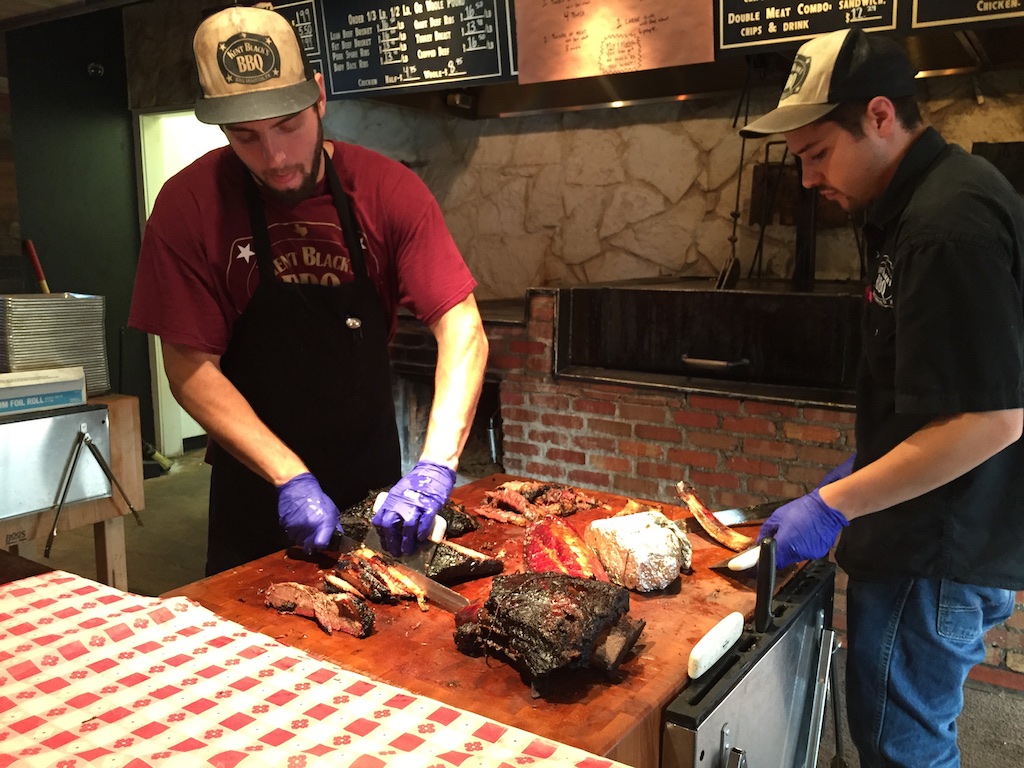
IMG_5349 At a real BBQ place you buy your main course by the pound…IMG_5353…and add “sides” like pecan cobbler, peach cobbler, sweet potatoes (with marshmallows on top) and beans. Katie made sure that we didn’t miss out on pickles, onions, and bread.

IMG_5352   I think you’ll agree that this is one nice looking family.

IMG_5355

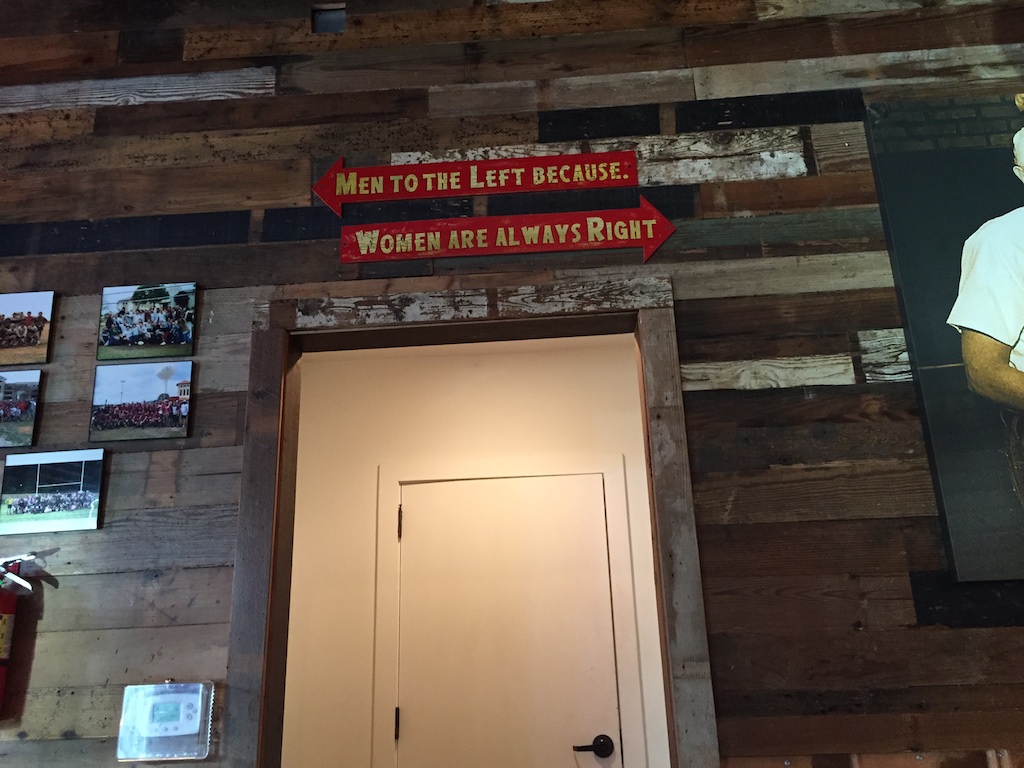
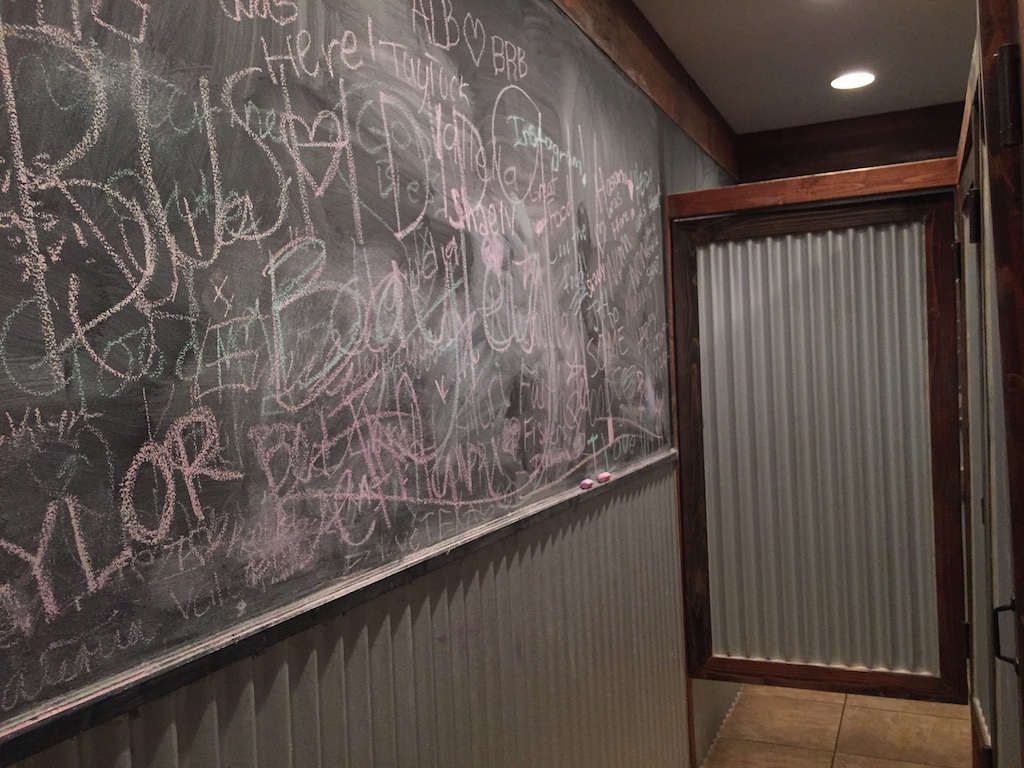
IMG_5356I took this photo inside the bathroom because I liked the idea, maybe because I’m using tin (albeit rusty and full of holes) for my upcoming State Fair display. The chalk boards in the bathroom and in each stall seemed to prevent grafitti on the walls.

Not a lot of excitement for this fourth day in Texas, but we were leaving the next day and an easy day was just fine.

Road Trip to Texas – Day 2

After being pleasantly surprised about our camping spot chosen in the dark I went on an early morning walk in the Mojave National Preserve. Mohave National Preserve

Catclaw acacia, Acacia greggii Catclaw acacia.DSC_6847

jack rabbitAfter stowing our gear we set off north to see what the town of Kelso looked like. Have you ever seen a sign with a flashing light that cautions you to watch for tortoises? I never had and I wish I had stopped for a photo. It was one of those things that I thought I’d do on the way back but we ended up making a loop through the preserve.

DSC_6892First stop was Kelso, a ghost town and defunct railway depot. Most of the building in town are gone but the railway depot was restored and serves as the visitor center.DSC_6891This is a jail cell that was used from the mid-1940s to1985 to “confine drunks or other unruly individuals for a night or two”. The placard said that there was a corrugated shell to protect from rain and sun but that “prisoners rarely spent more than one night in the jail”.

The Preserve contains three major desert ecosystems–Mojave, Great Basin, and Sonoran, as well as the world’s largest and densest Joshua tree forest.We wound our way through the Joshua tree and then pinyon-juniper ecosystems and also saw the affects of the previous night’s rain–flooded gullies and washes. Our next stop was at the “Hole in the Wall”…

IMG_5143 …where we did a one-mile hike that took us through Banshee Canyon.Mohave National Preserve (1)Mohave National Preserve (2)IMG_5147Petroglyphs on the other side of the bluffs.

I was glad to spend some time in the preserve but our goal was to get to Texas and we hadn’t even left California. So we got in the truck and headed for Arizona. DSC_6926We wanted to see as many “points of interest” as possible but since our real goal was to get to Texas we considered this mainly an on-the-road trip, seeing the country along the way, but without a lot of time to spend in any one place.

DSC_6932 About 10 miles southeast of Flagstaff we stopped at Walnut Canyon National Monument, but the trails to the cave dwellings were already closed for the day. However we could view them from short trail along the top of the canyon. Can you spot the dwellings just below that ridge on the right?

DSC_6933 So that was a quick walk on the nature trail and a chance to stretch our legs and we took off again. I told Dan that we had to stop in Winslow. IMG_5151 (1)He was a good sport about standing on the corner. But it turned out to be the wrong corner. The green sign points to the other corner. IMG_5156 IMG_5158It turns out that there were a lot of people also standing on the corner. You almost have to wait in line for your turn at the corner. A quick stop in a souvenir shop and we got on the road again.

All the next photos were taken from the truck.

DSC_6947 Beautiful sky and landscape.

DSC_6949 DSC_6956 We needed to figure out where to spend the night but most of the land on the way to New Mexico is either privately owned or reservation land, so camping wasn’t an option. Seeing the clouds and lightening to the east was the other reason to find a motel for the night and we decided to make it to Gallup, New Mexico. These shots were taken on the way to Gallup, starting about 15 miles away. Incredible rainbow.

DSC_6961 DSC_6966 DSC_6971 DSC_6973   

DSC_6978

More tomorrow.