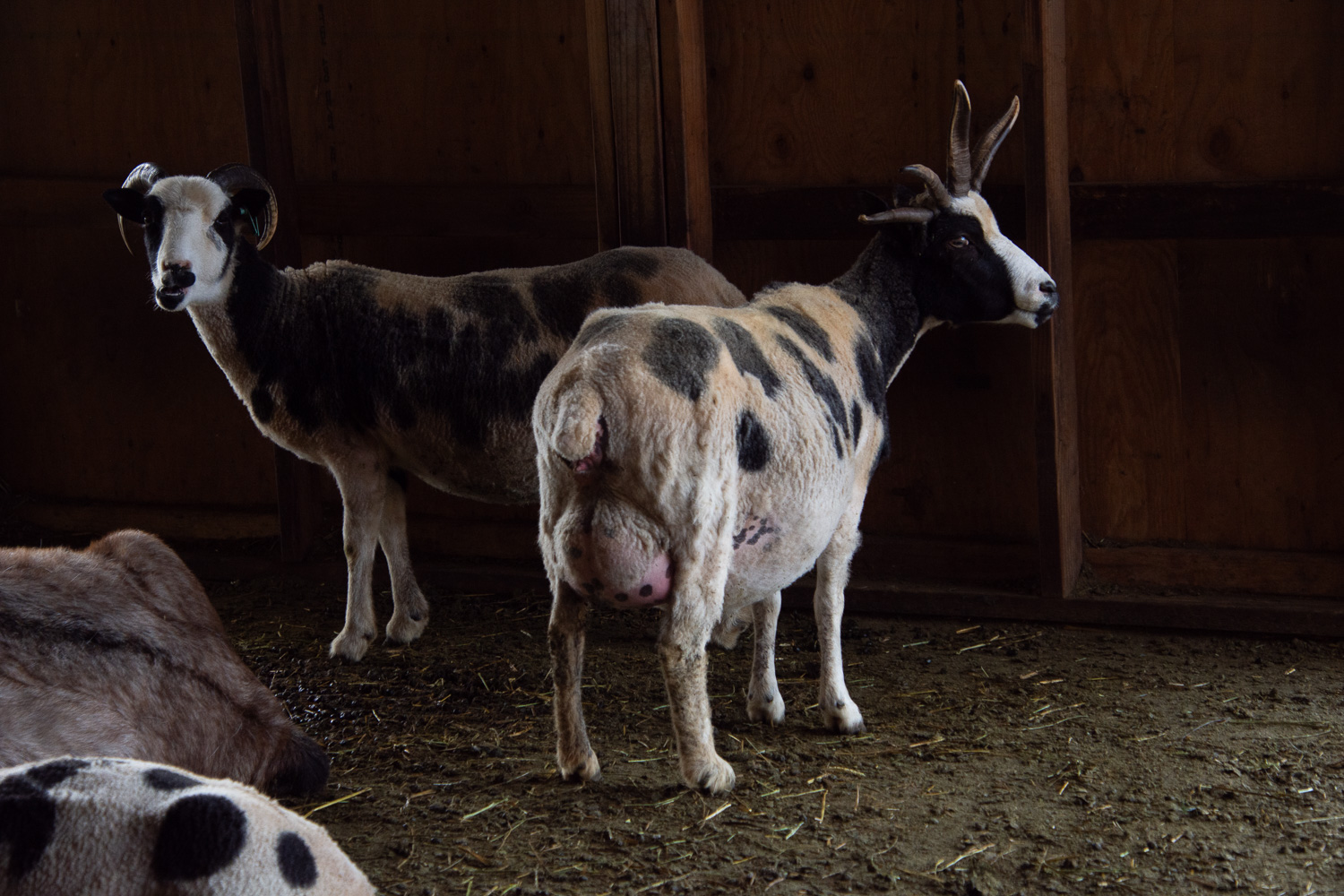
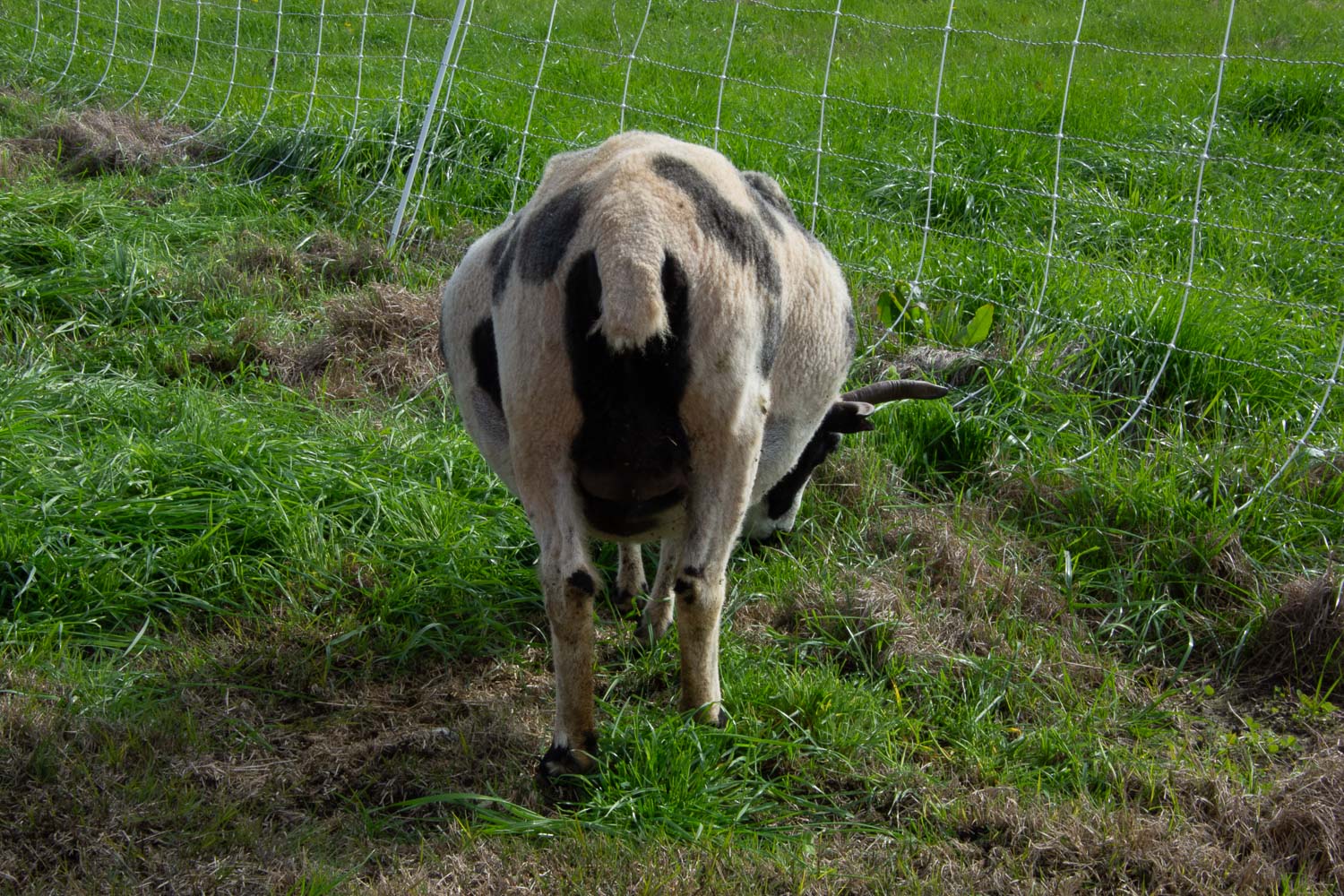
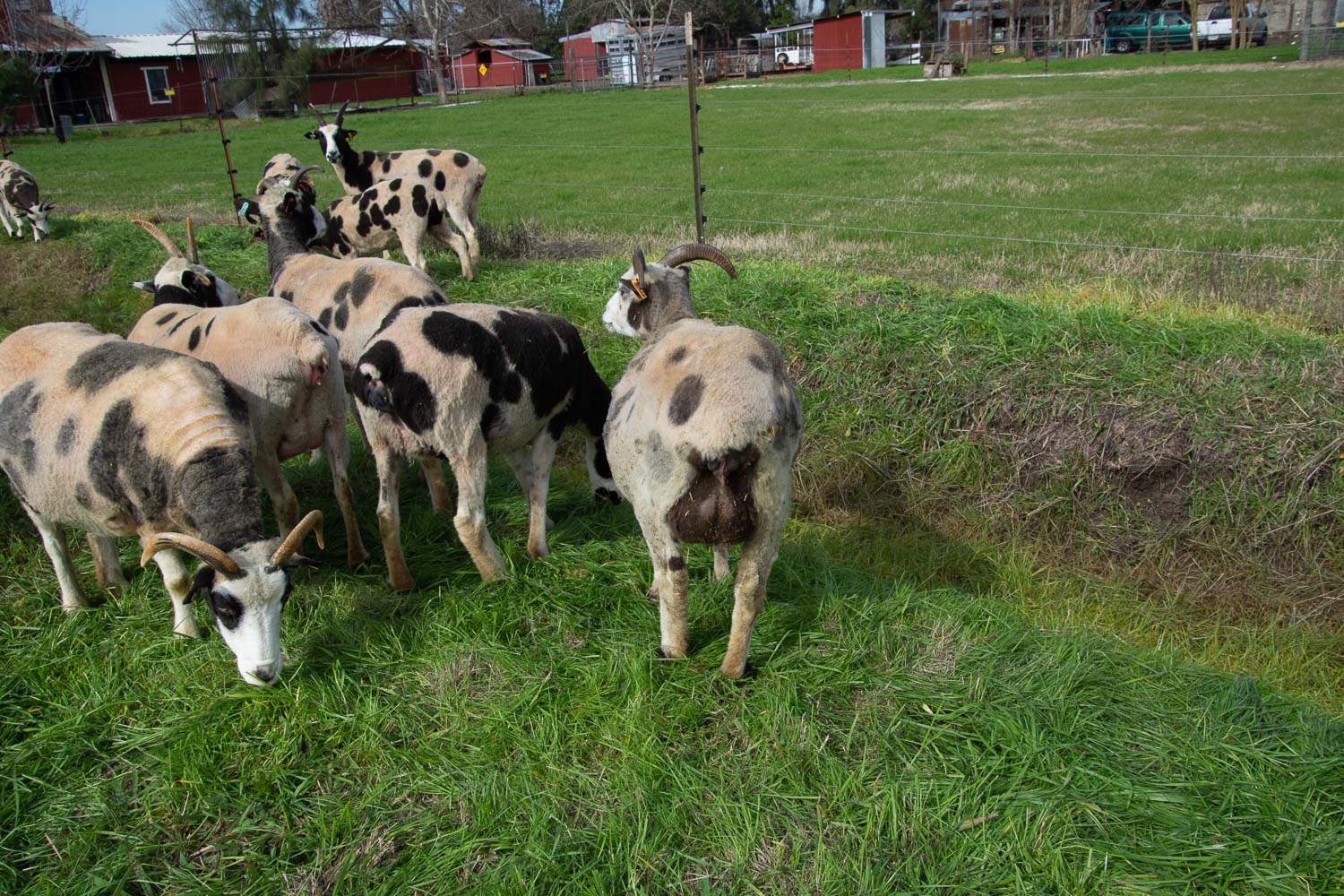
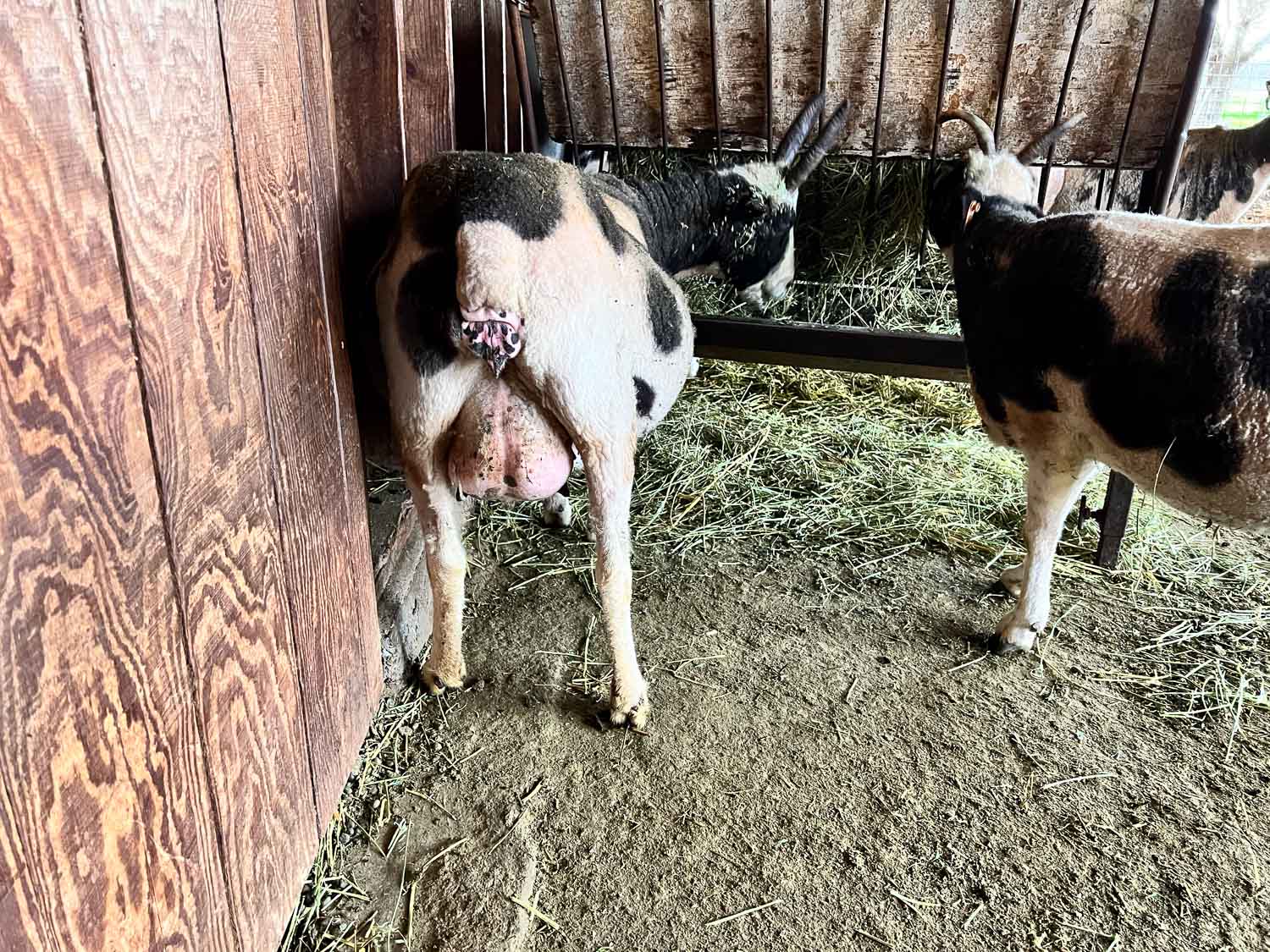
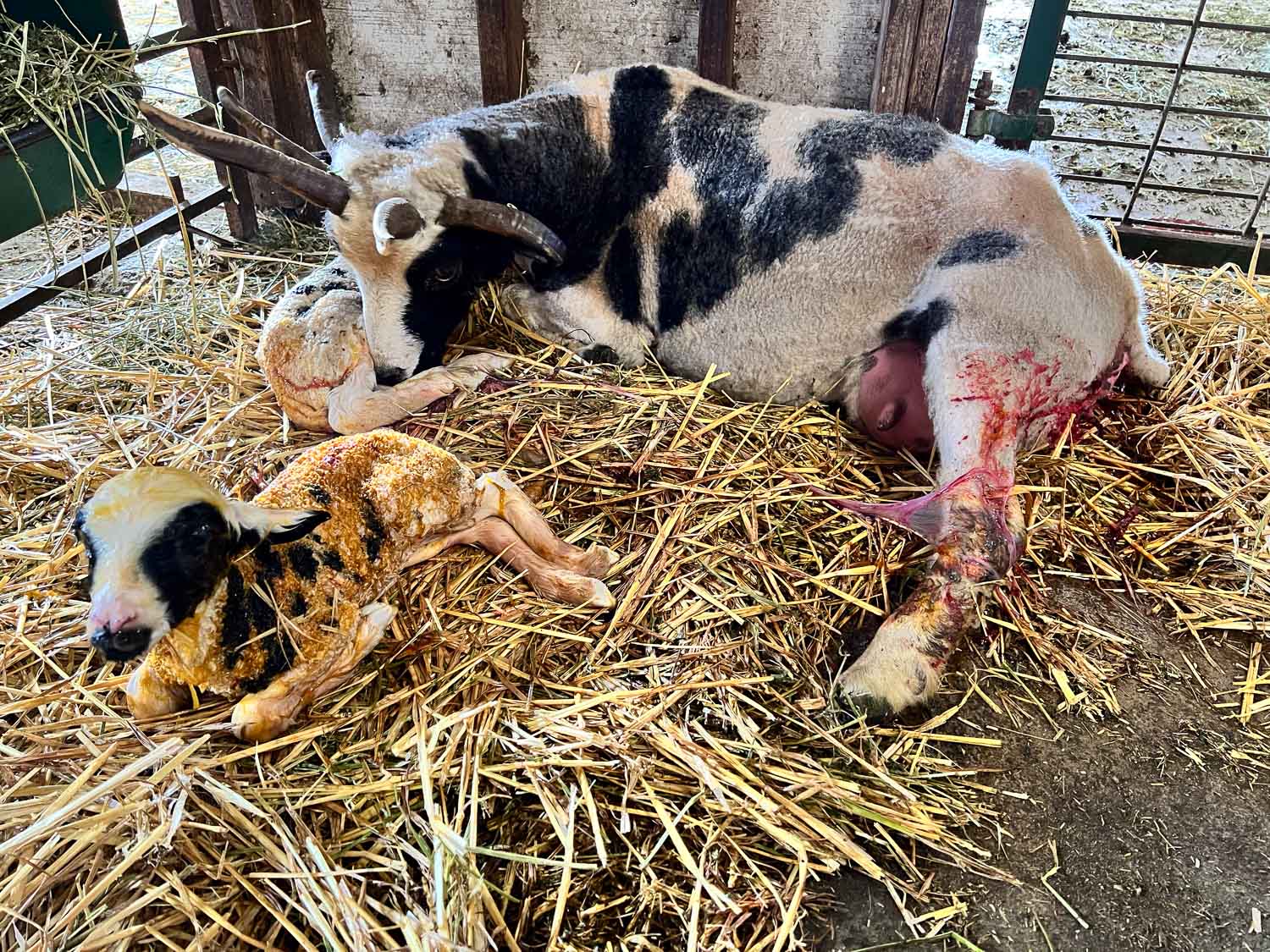
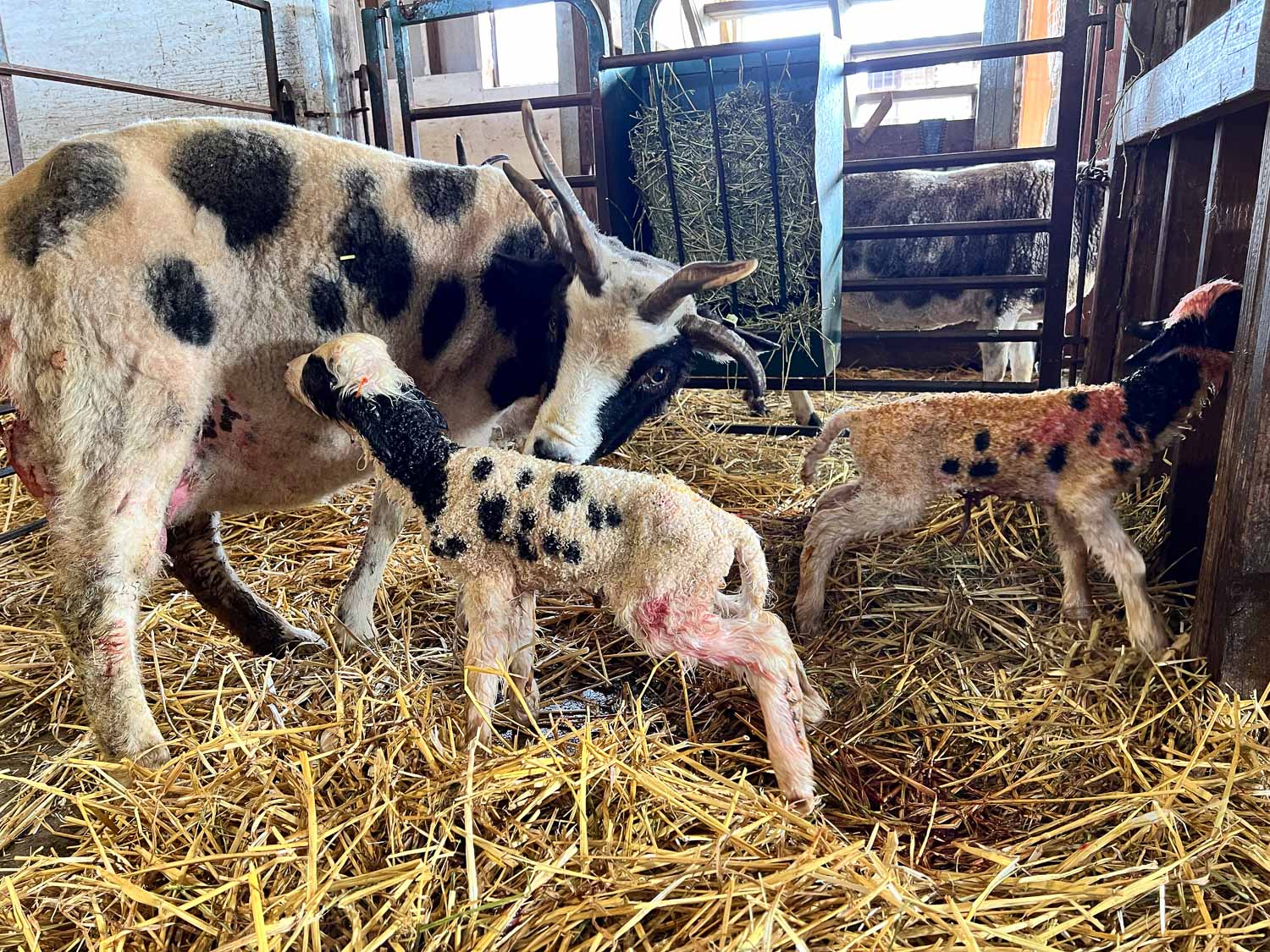
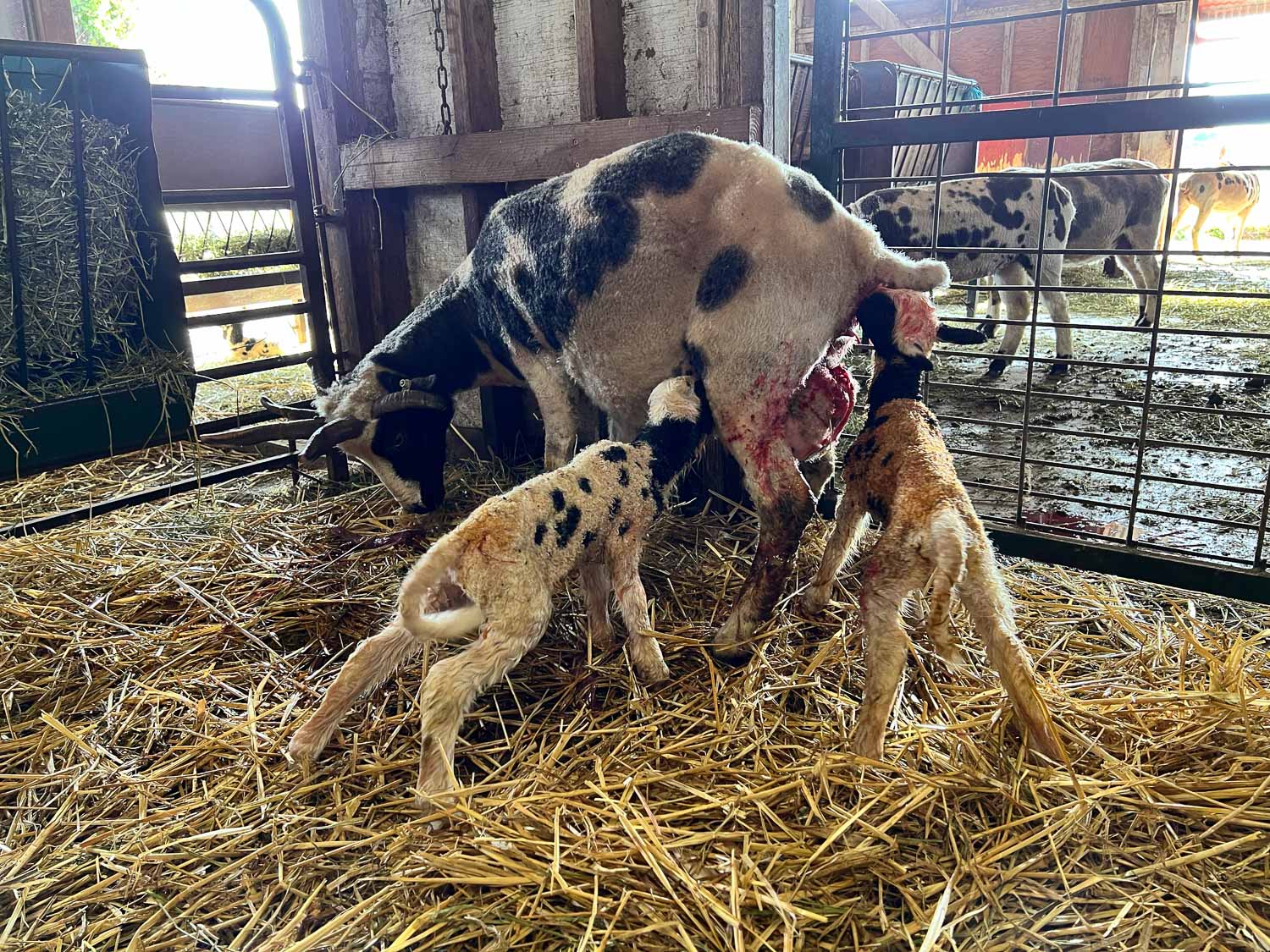
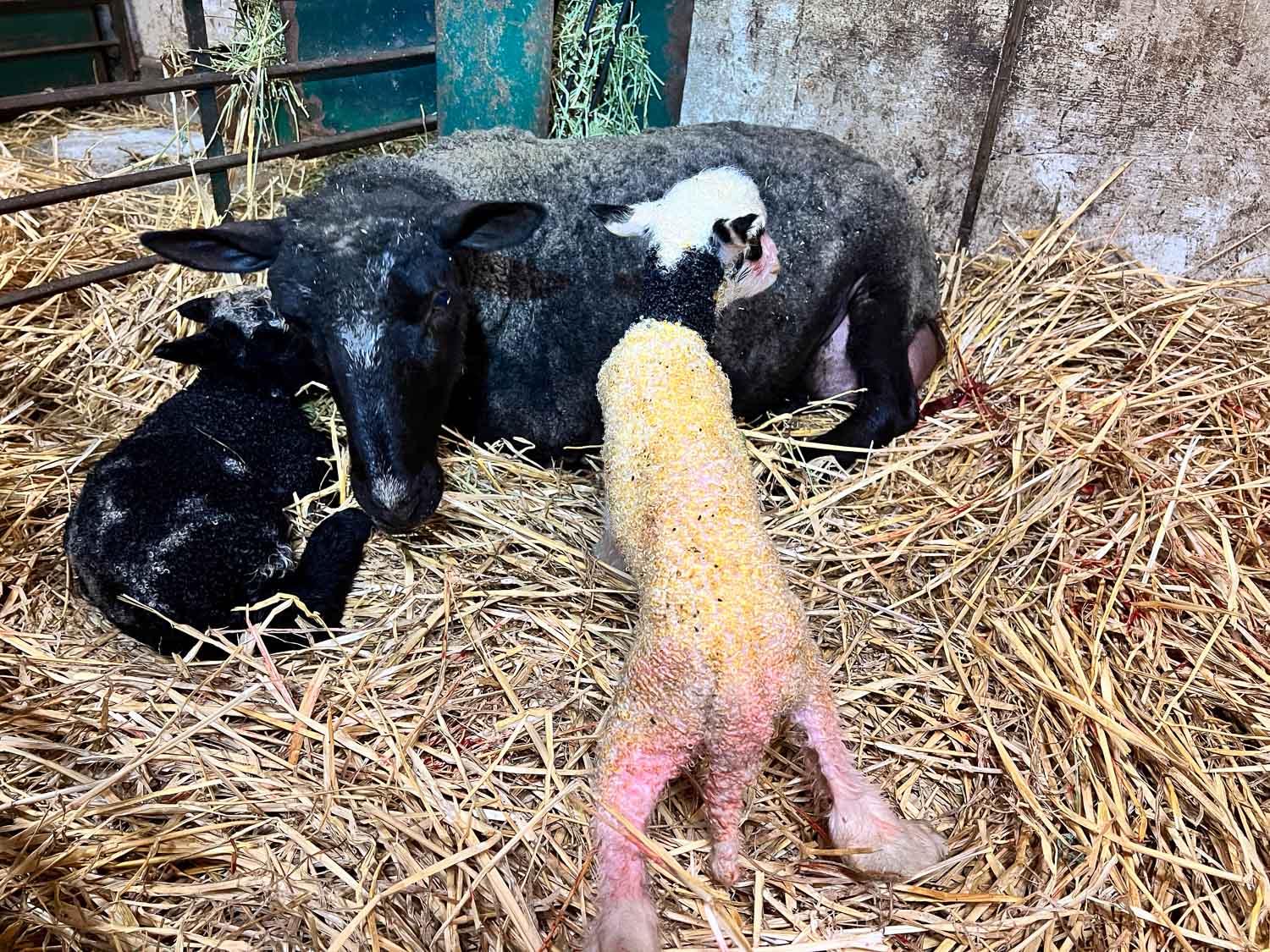
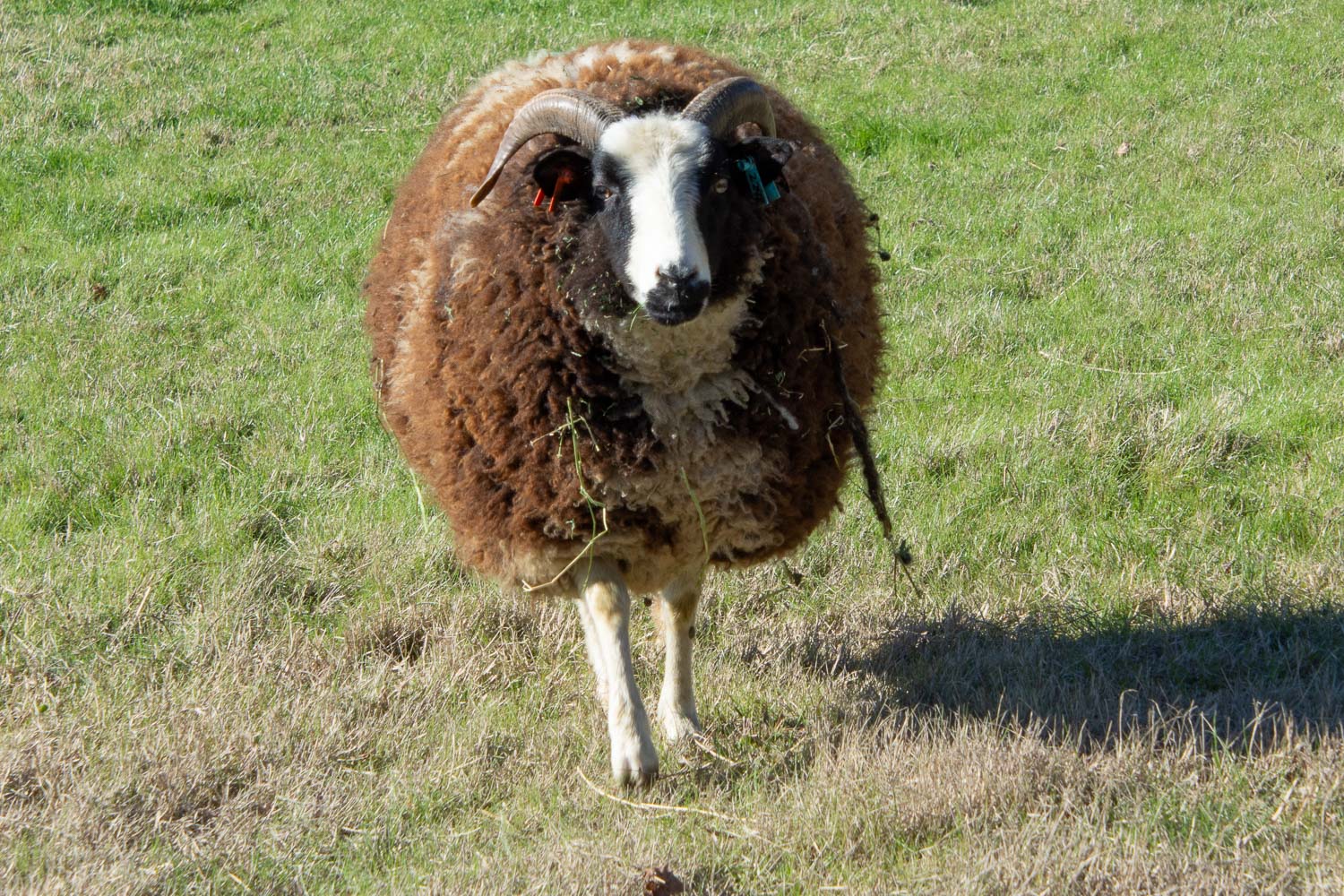
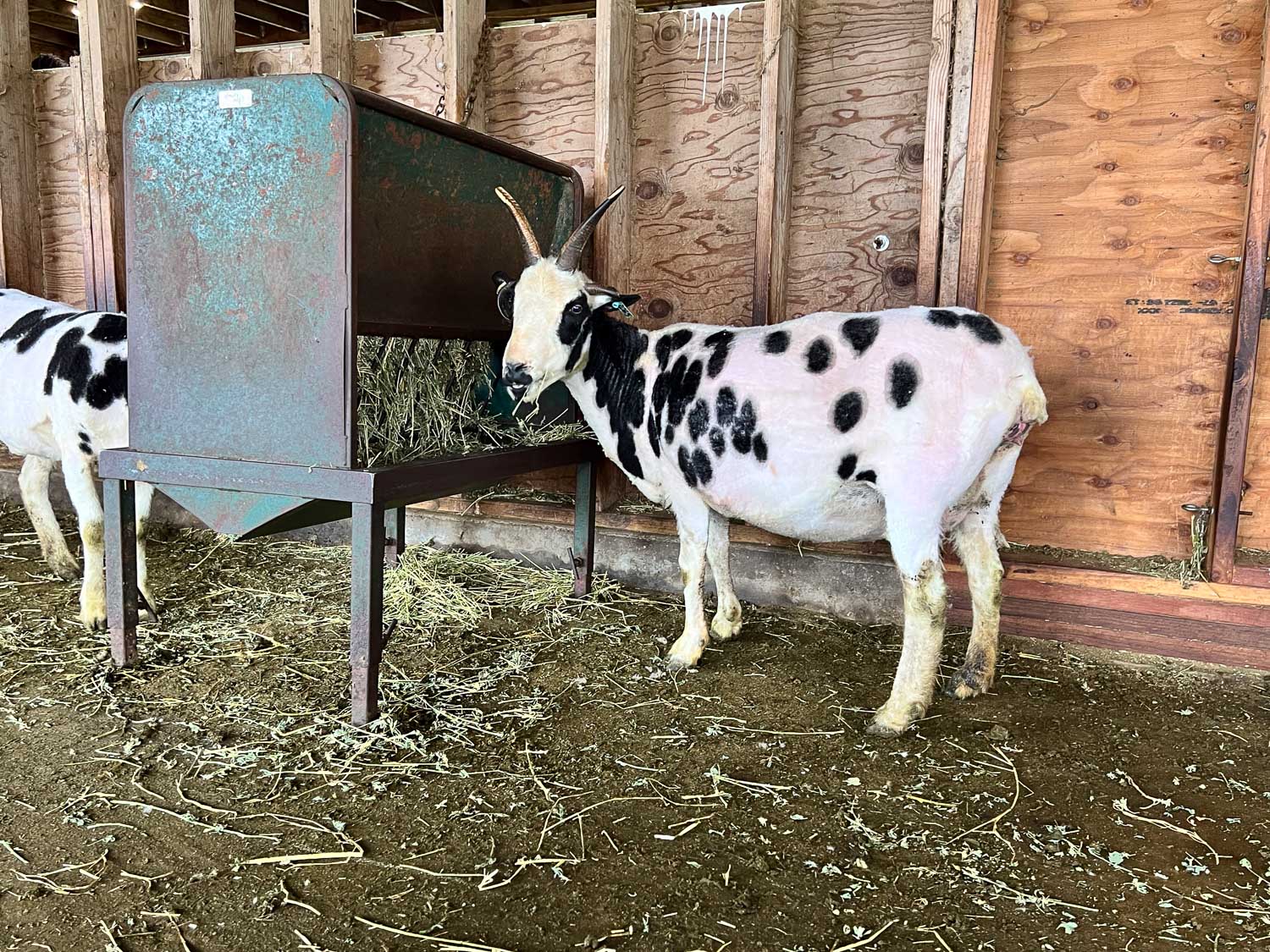
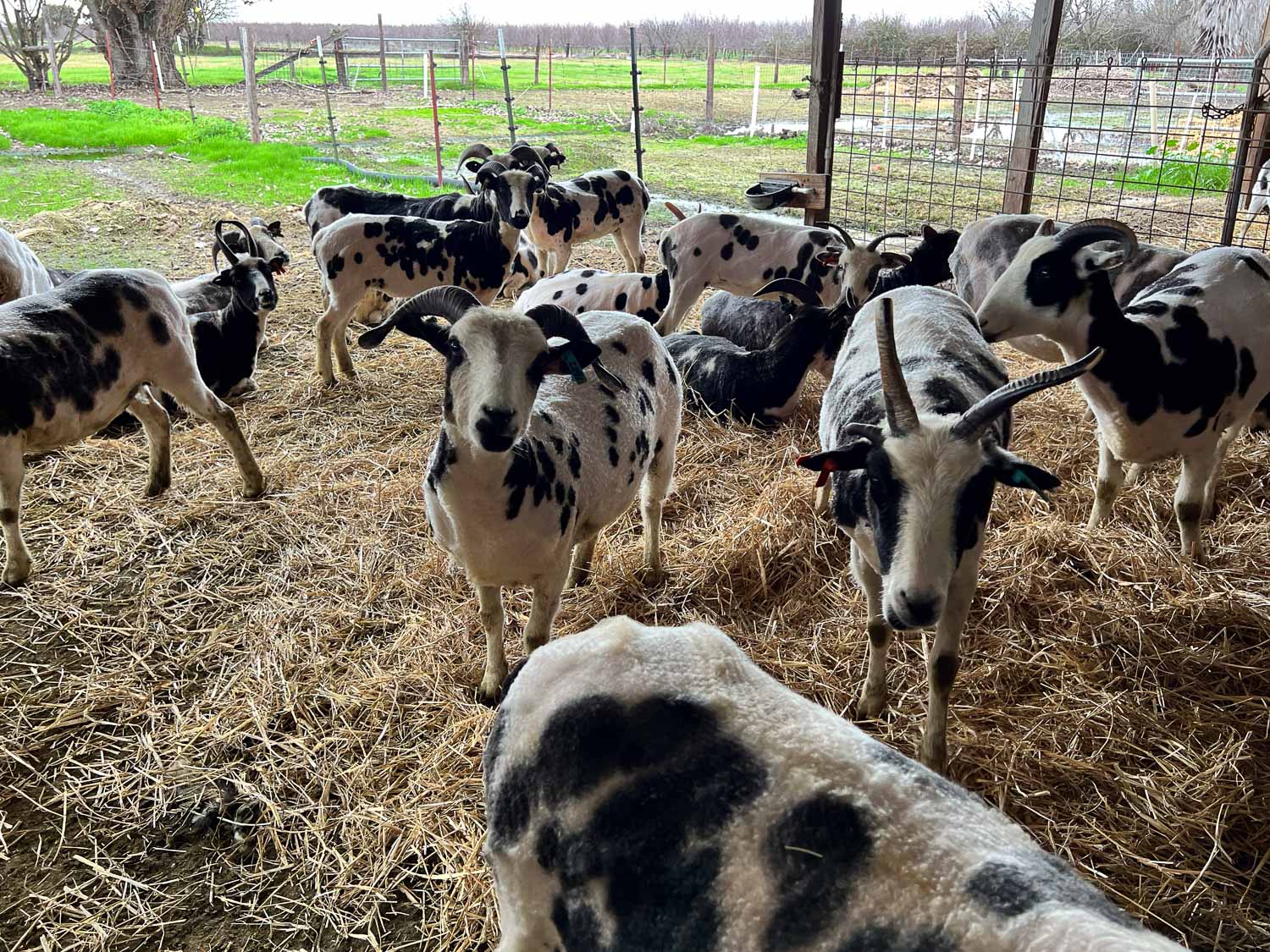
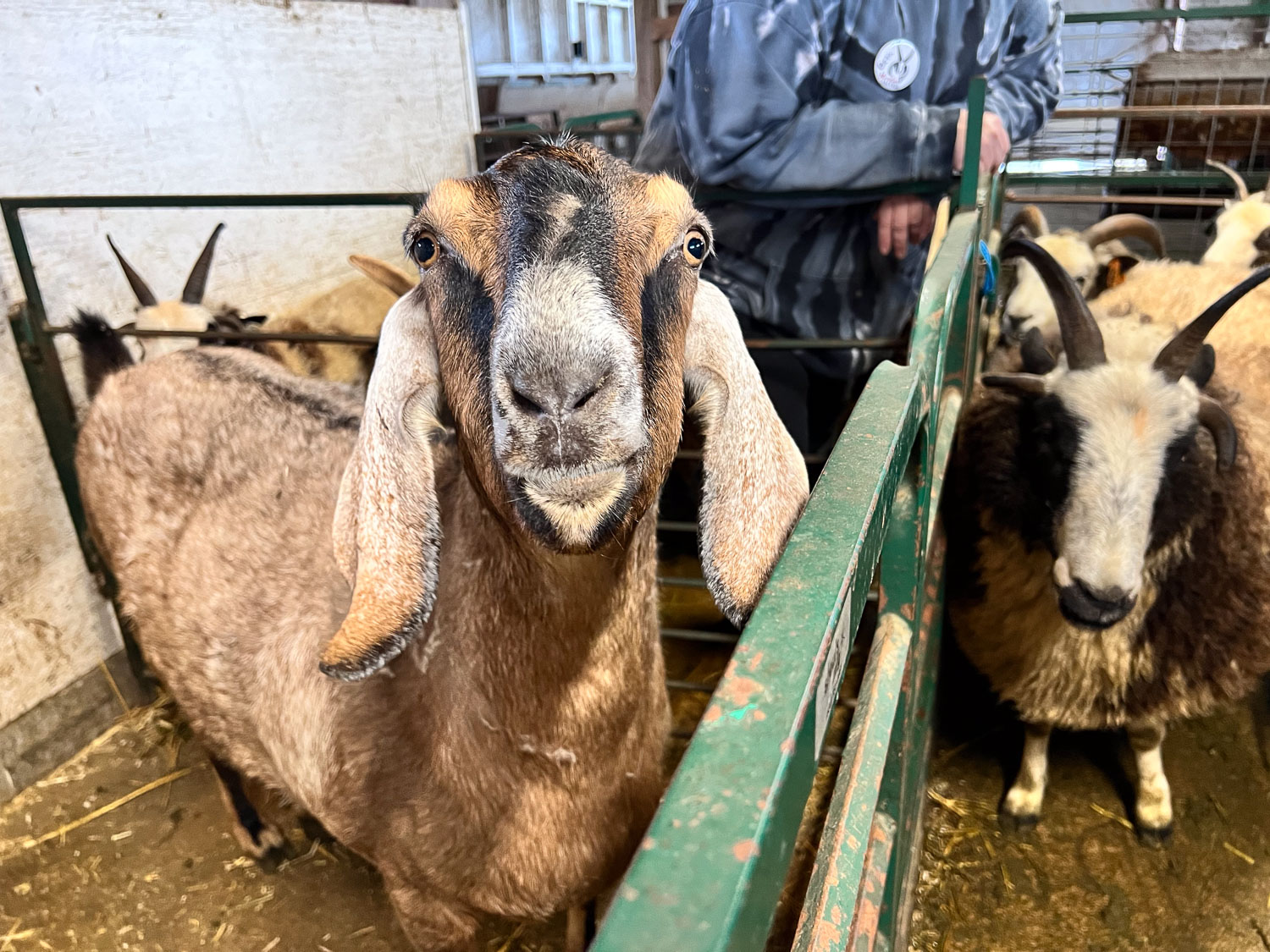
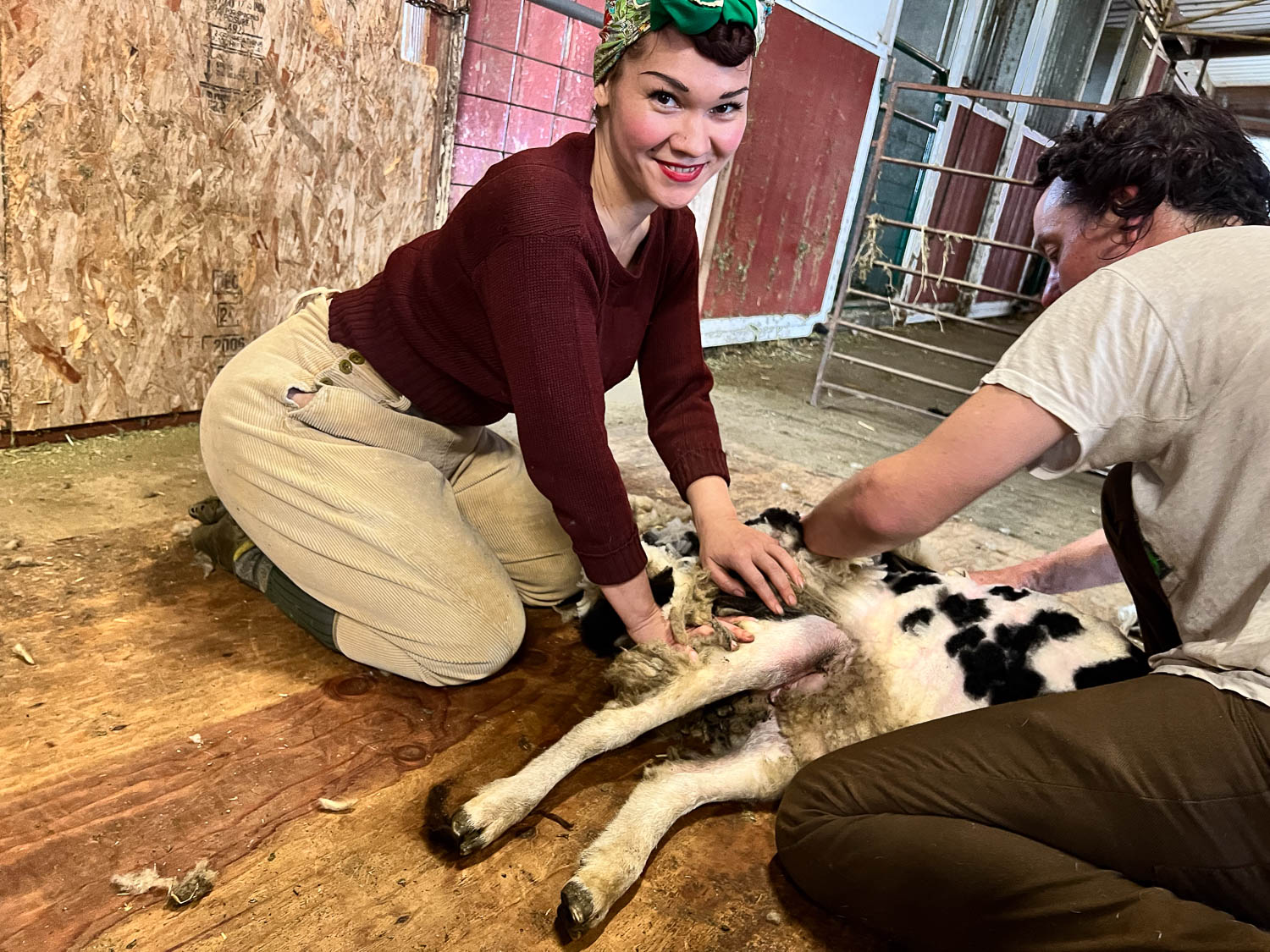
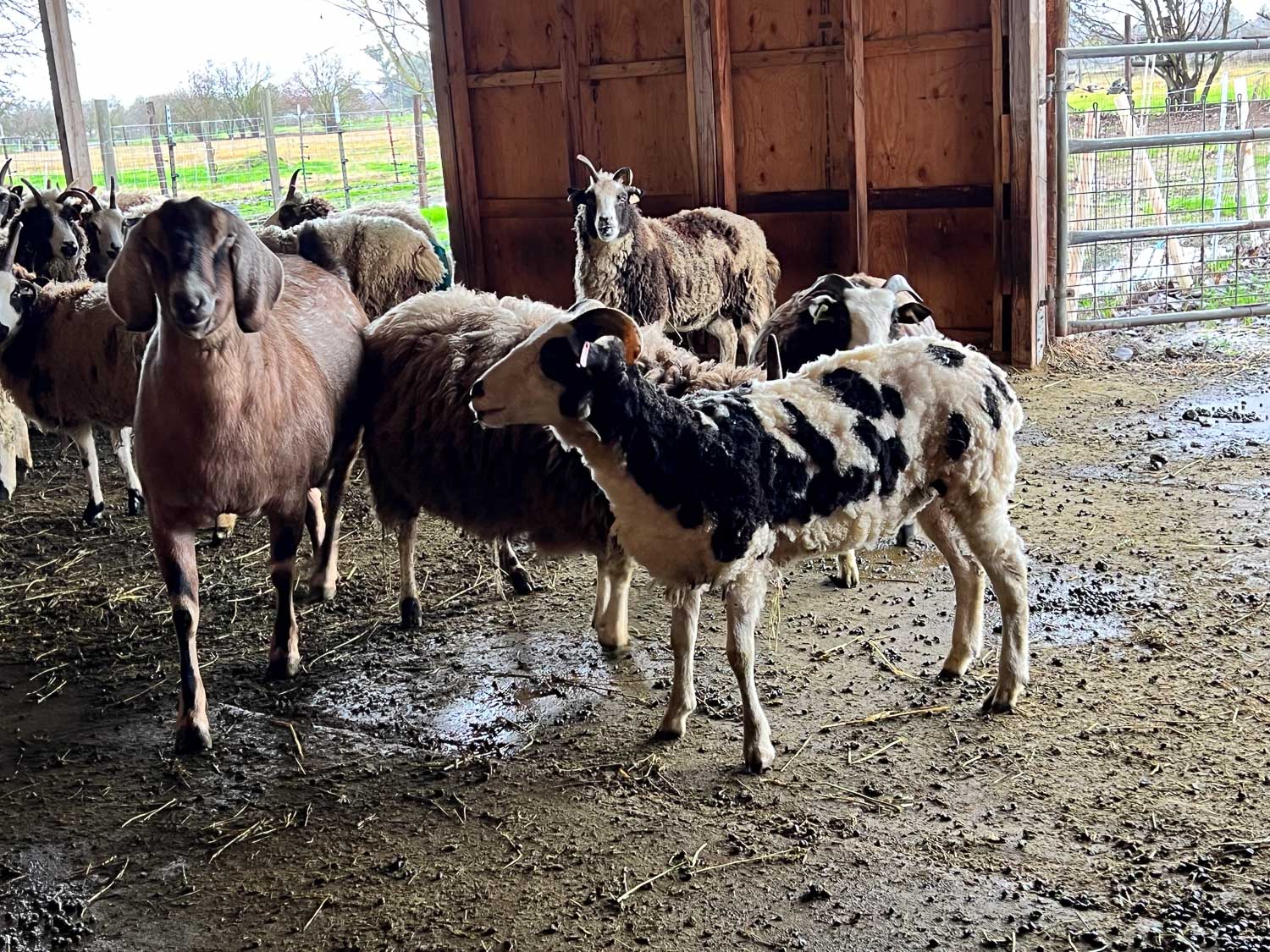
This is probably the kind of photo you expect to see when people are sharing pictures of sheep. But it’s the other end that I’m watching to try and figure out who is next to lamb. The ewe facing me is Sandie due 2/15 (tomorrow). I took lots of photos earlier to bring back the Lambing Game for Farm Club. That’s where I share photos of sheep (mostly rear ends) and Farm Club members can choose the next to lamb. There may be a prize or the prize may just be bragging rights. But I kept taking photos and either not being able to positively identify the sheep from the wrong end, or that sheep lambed before I had a chance to post photos.
Tranquility was one of those I was going to post. She lambed the morning after I took this photo.
Addy was also on the list. She lambed late in the afternoon after I took this photo, the same day as Tranquility.
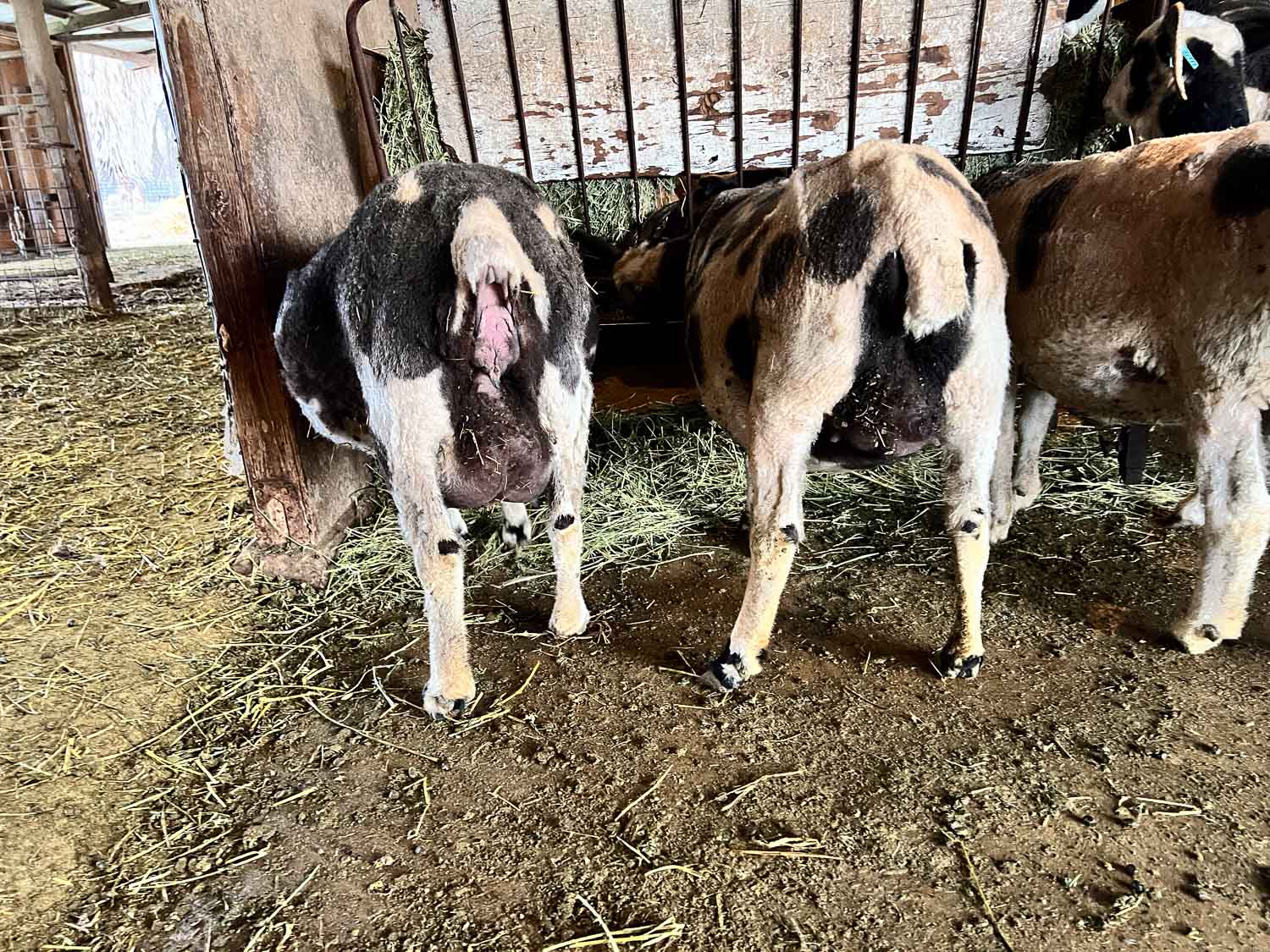
I think this is Eilwen because the spots match the last photo here.
The ewe on the right is Foxy who lambed this morning. The photo was taken three days before.
Jade is in the middle. Everyone who has been here knows Jade. She is due 2/16.
At 12 years, Sonata is the oldest ewe here, due on 2/16.
Trista and Eilwen. Trista is due 2/17. Eilwen is due 2/27.
If I have time I may take a new set of photos tomorrow. They should all be taken at the same time to make this game fair.
I put this ewe, Sweetgrass Tranquility, in the lambing area the last two nights thinking that she was ready to lamb. Notice the sunken sides. She looked like that yesterday too. This was her official due date based on breeding date. There was still no action.
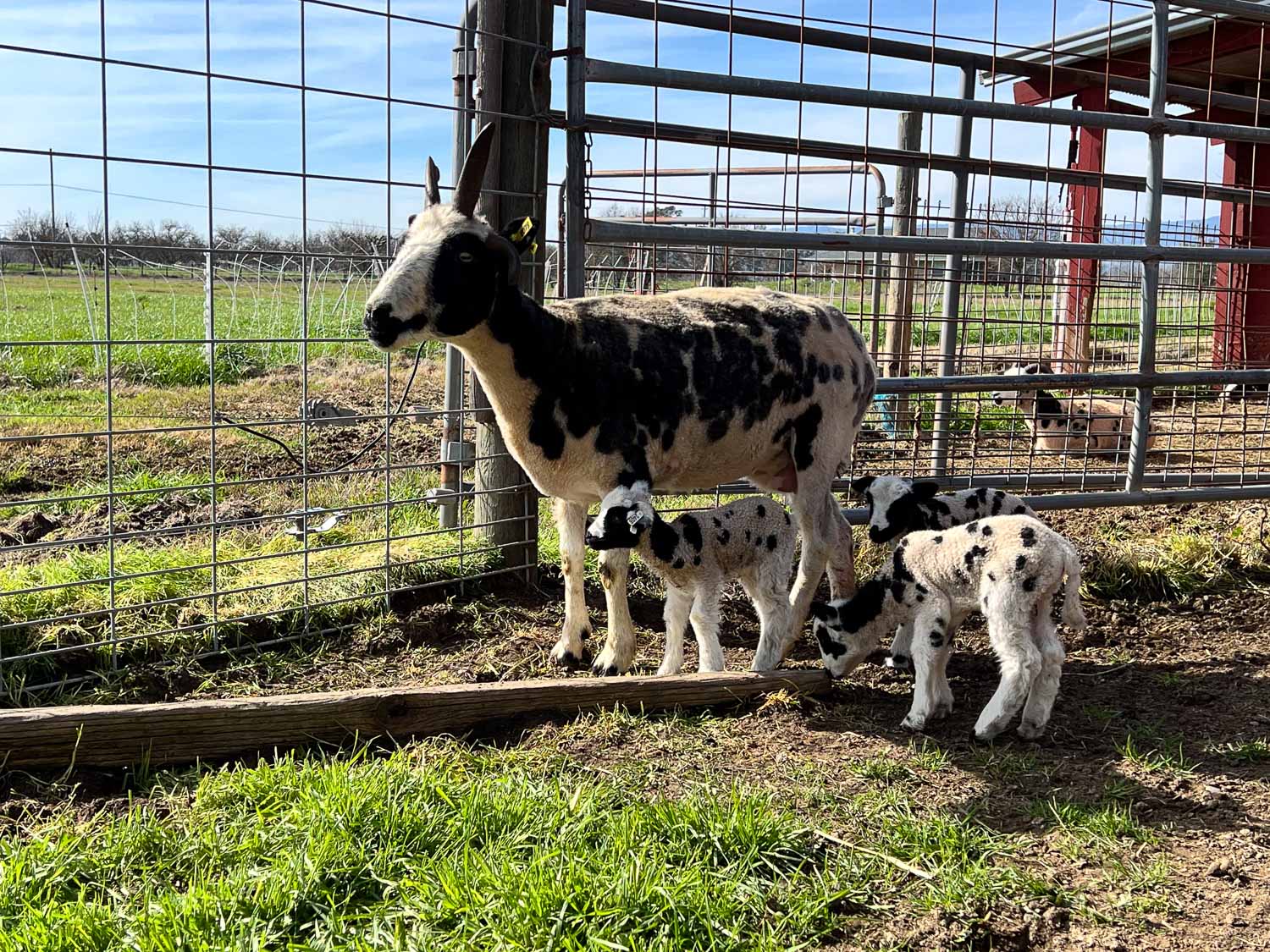
I did chores and moved ewes and lambs around. This is Meridian Janna with triplets. They moved from the stall where they’d been a few days to the big outdoors. I went to the house to do some computer work. When I came back out Tranquility was straining some, but there was still none of the other obvious signs I expect (mucous, drainage). I gloved up and found a lamb close to being born, but stuck. This could be a long story but I’ll just explain that the lamb was dead and was blocking the exit for the other lambs. When a lamb is dead it is floppy and the legs and head don’t stay in the position necessary for easy lambing.
I pushed that lamb back to where I was able to grab its legs and head and pulled it out. Then I was able to find and pull two live lambs. The meconium staining indicates that the lambs were stressed during the process, but all is well. These lambs were normal size (7+ pounds). I think the first one died at least a few days ago. I have a photo but didn’t think this was the place to share it.
Here are those two lambs up and looking for something to eat.
Lambing isn’t always a pretty sight.
I spent a couple of hours still in the barn working on fleeces. I have a lot of fleeces to skirt and photograph for sale. I will get some on the website tomorrow.
I took this photo earlier in the morning, before Tranquility lambed. This is the BFL X Jacob ewe, Addy. Those BFLs put on much more weight than the Jacobs with the same feeding regimen–she is a tad heavy and has looked round for days. Later in the day I went out and thought that the lamb(s) had dropped. Her sides were more sunken and I figured that I would put her in the lambing area tonight.
When I went back to the barn about 5:00 I found her with a lamb that was 12.4 pounds! Maybe the vet that reviewed the ultrasound and gave a 1+ result was right and there was only one. (1+ means they confirmed one but didn’t rule out a second.)
When I went back to the barn two hours later here is what I found. This is a 9.6 pound lamb and had already nursed. I wonder if I’ll be surprised when I go back out as soon as I finish this post.
Here is the lambing list so far. We’re off to a much slower start than previous years, but it’s been easier that way. There are a lot more due before the end of the month.
I don’t think it’s spring yet, but it felt like it today when the sun was out!
If you want to see lambing videos check out my YouTube channel. This is Bessie lambing with twins and here is Cashew with twins. These are about 6 minute videos.
I taught a rigid heddle weaving class this morning and the one participant chose these brilliant colors for her scarf. I think it turned out great!
Dan and I went to the barn to put up a new barn camera and saw this out back. I had put these ewe in last night because she didn’t follow the others in to eat. But I put her back out this morning because nothing had happened and she wasn’t due for another five days. This is Rose, Kirby’s ewe. She is in the photo below just before shearing.
When they are in full fleece, looks are deceiving.
The ultrasound results showed triplets, but there are only twins here. These are dark lilac lambs. Horatio is the sire.
This is Bessie, the ewe that lambed January 29, too early for the “real” breeding season. These lambs are sired by a random ram lamb. They are sure nice looking ewes. One is black and white and one is lilac.
Two ewes have lambed early this year. The dates finally made sense when I realized (thanks to a Farm Club member who keeps track of these things) that some of the ram lambs got in with the ewes September 2. Those lambs would have been 4-1/2 to 6 months old at that time. As another friend said, “where there’s a ram, there’s a way!”
I saw one of the rams breed a ewe, but it wasn’t one of these two who have now lambed. Bessie lambed on Monday and in looking up some info, I thought I would feature her in a blog post.
Bessie was born 3/10/2019. She was a week old when this photo was taken. You can see that she is a lilac–the facial markings are definitely gray, not black and the fleece color follows. I love to see a lamb fleece like this. It’s all tight little curls and, in my experience, a fleece like this will be very nice. Also notice the level of the britch wool. That is the coarser wool on the back leg. It doesn’t spread very far up the leg.
Here she is 10 days later.
This photo was taken at about 7 months old.
Here she is three years later.
In 2023 Bessie lambed with twin rams. I kept this one, now named Blizzard.
This is Bessie, not quite a month ago. She is in full fleece and full of lambs.
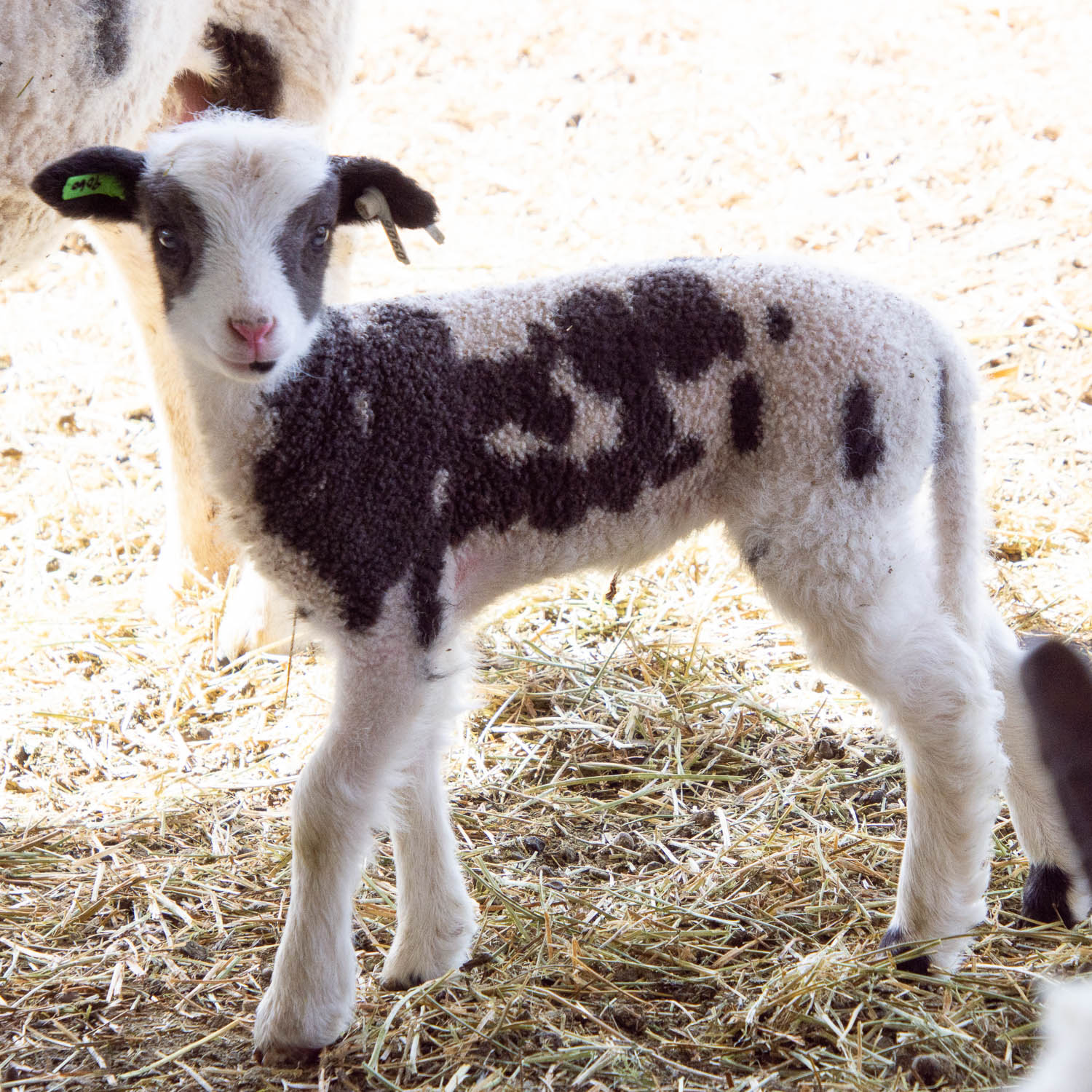
These two ewe lambs were born on Monday, 1/29. The one on the right is lilac like her mom. They have the same curly fleece and low britch wool that Bessie had in her lamb photo.
Here is the Part 1 blog post. I just realized that I got the timeline wrong. That restaurant dinner was on Friday night. The library visit was Saturday. We ordered dinner to be delivered from Kung Food on Saturday and had enough left over that some people had it for lunch the next day as well as taking some home.
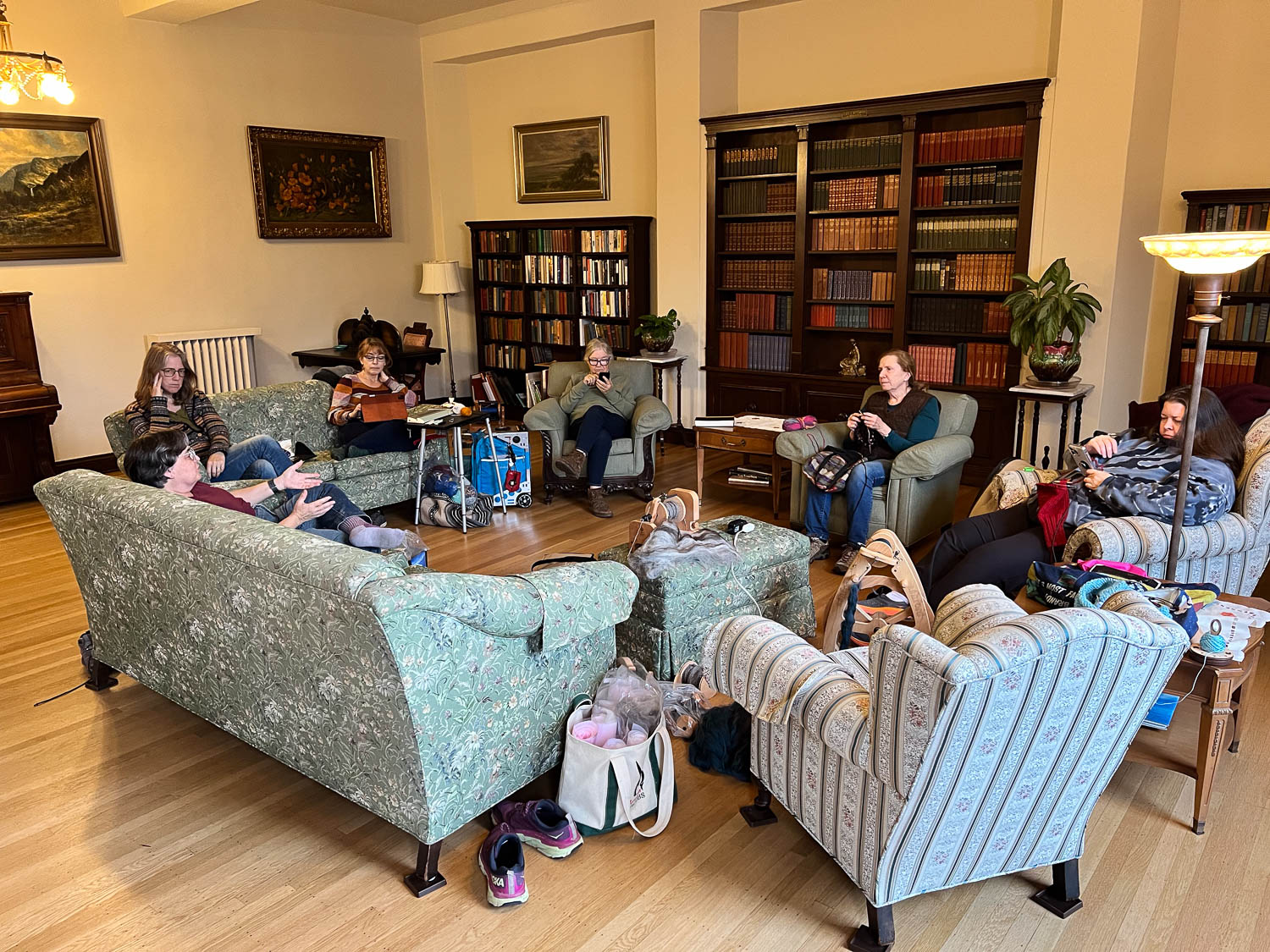
Both evenings and during other parts of the day we arranged ourselves in the parlor and working on projects. The parlor is the room that we were surprised and dismayed last year to find out there had been severe water damage and it was closed for repair. The floors and ceiling had major repair work. The difference this year is that there is no carpet and some of us commented on the different feel to the room. It is still a lovely place to hang out. We were able to leave our “toys” there the whole weekend and come back to them when we felt like it. That empty end of the green couch is where I set up shop. I wove two rigid heddle scarves and spun on the e-spinner.
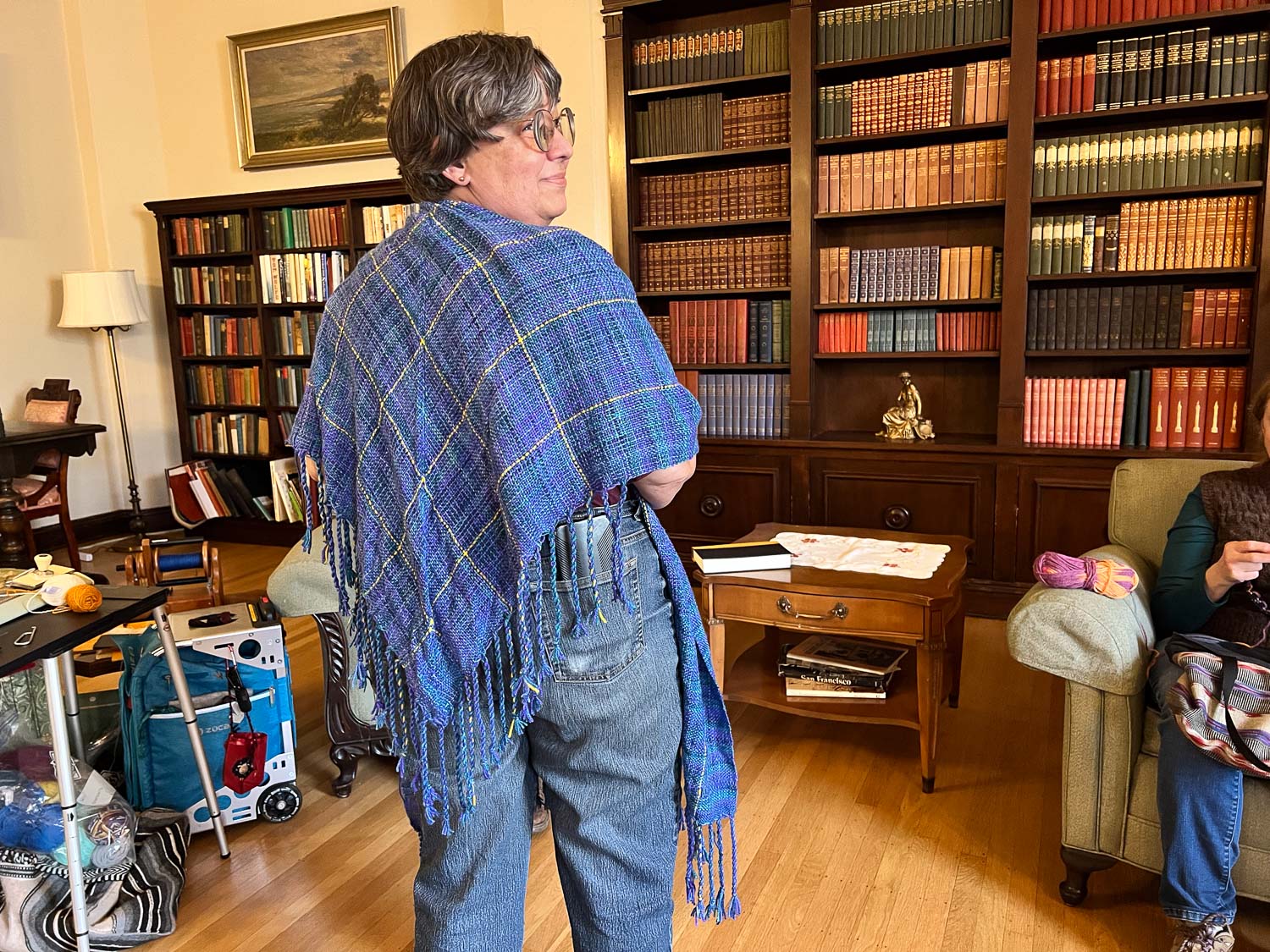
Some people knitted, some spun, and some just relaxed. Deborah used the time to finish the fringe on a v-shawl that she (and I) wove in one of my classes last year.
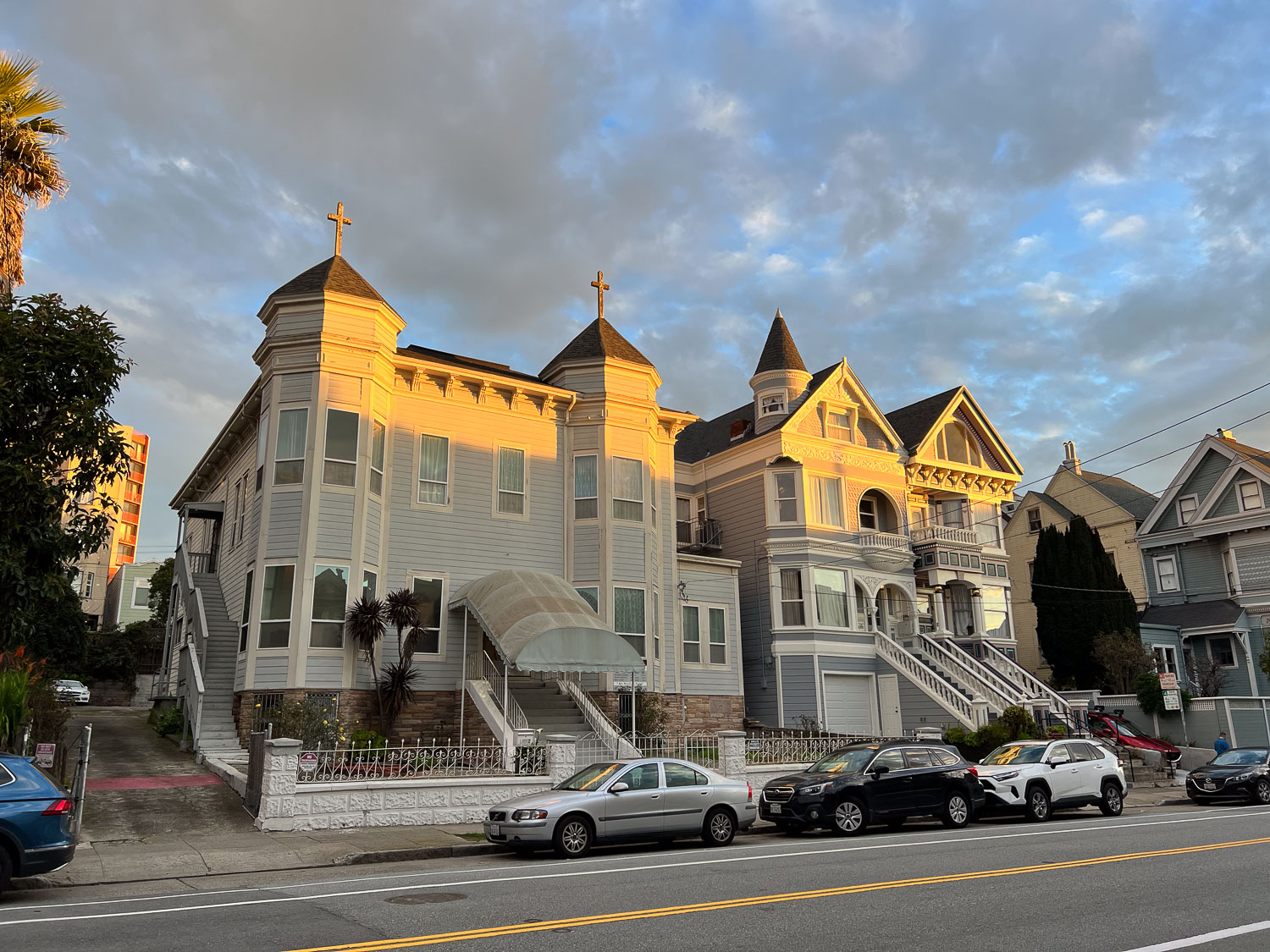
Sunday morning I decided that after all that food and a lot of sitting I’d better go for a walk. I love seeing these old houses. (One here serves as a church.)
Some of the houses are maintained remarkably well, but I noticed some as I got farther from this neighborhood that need work. I can’t imagine how much it costs to keep up the paint job and the window repairs on these houses.
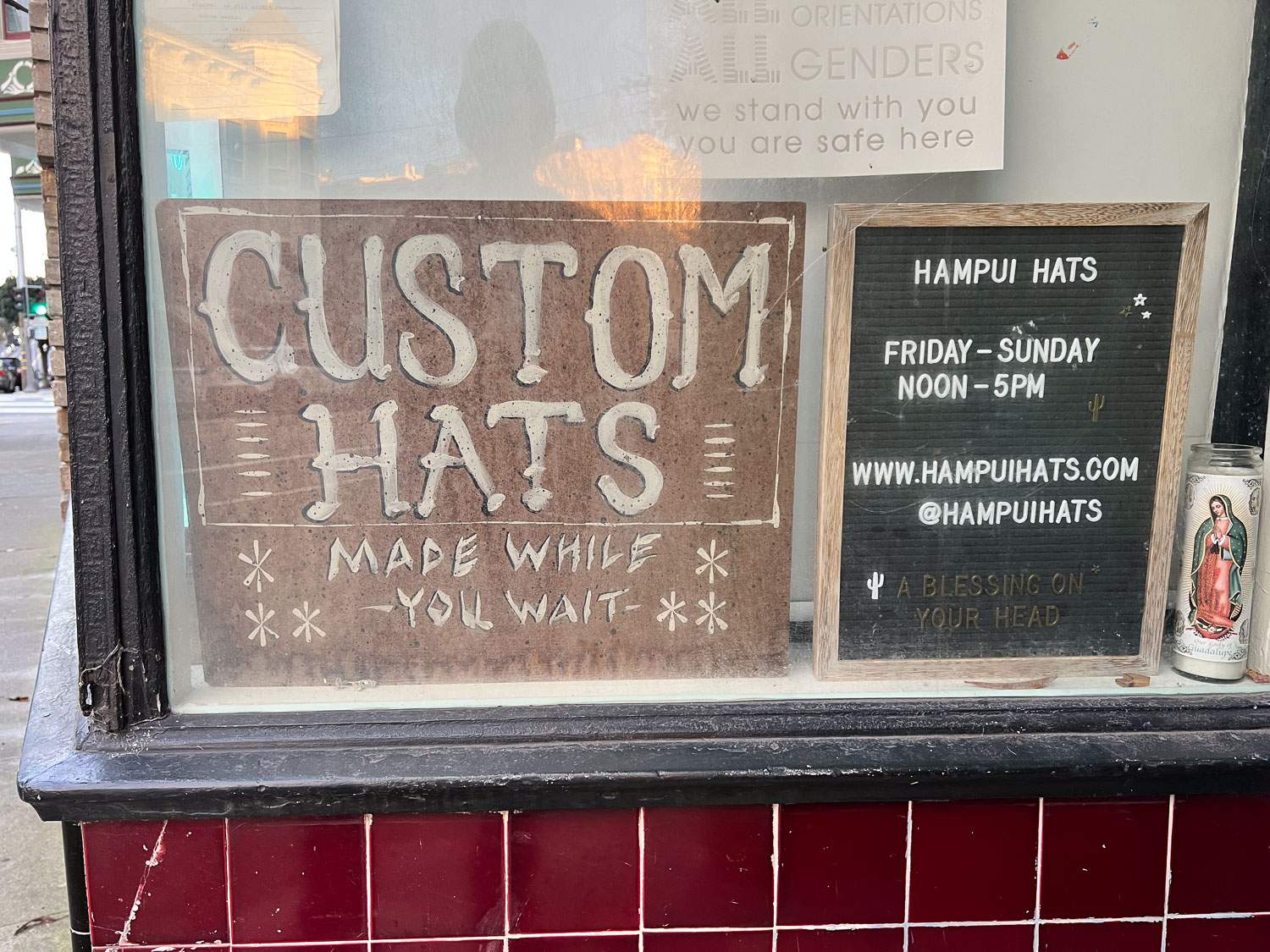
I took this photo a couple of blocks from the Home. Now I wish that I had investigated at the time and we had gone back. I assumed that “made while you wait” would mean that someone has a circular knitting machine and they crank out acrylic beanies. NOPE! I have looked at the website, www.hampuihats.com, and these are felt hats, among others. The website is impressive and the process is interesting. I encourage you to look at it.
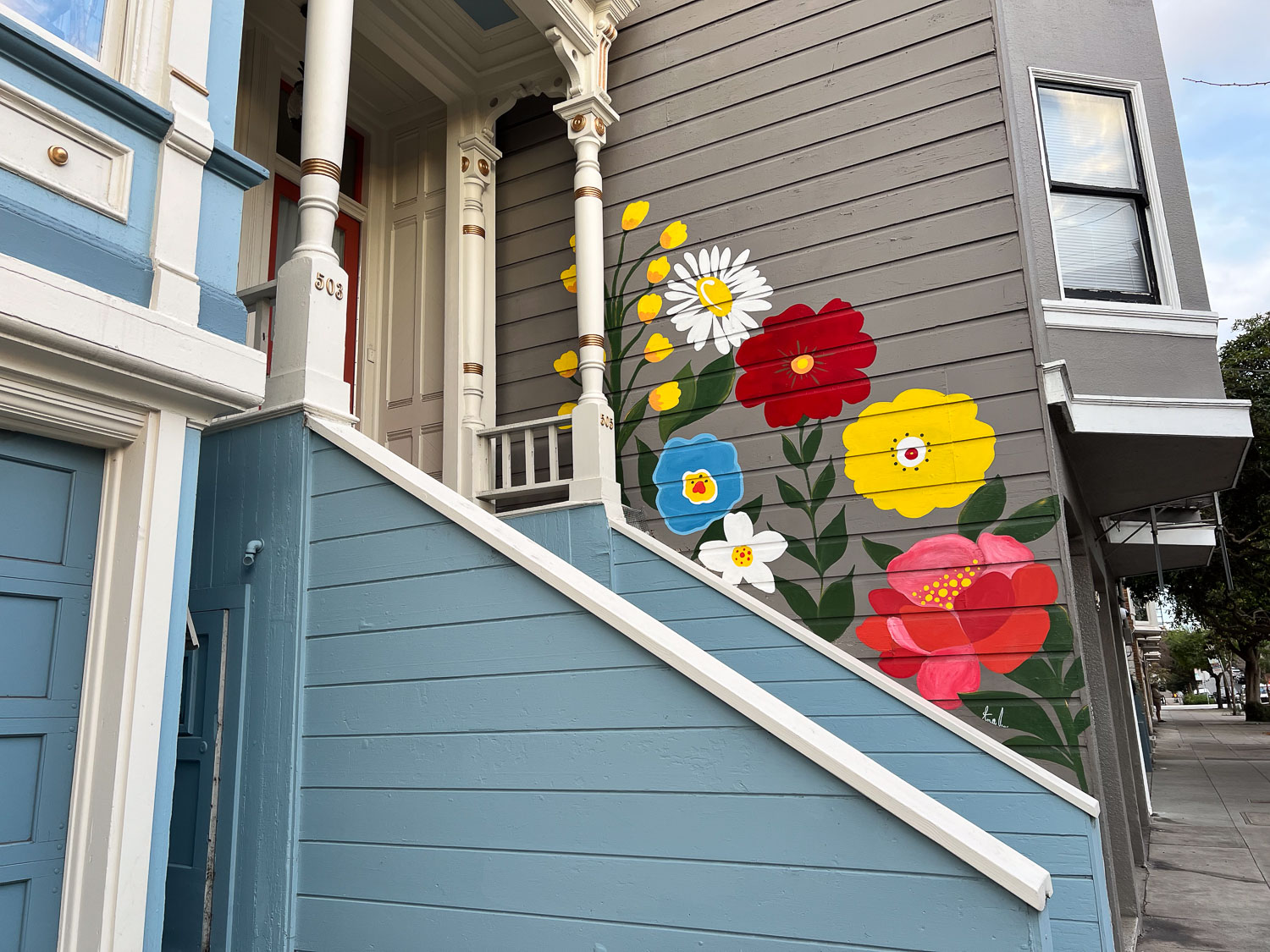
A different kind of home decoration, still beautiful.
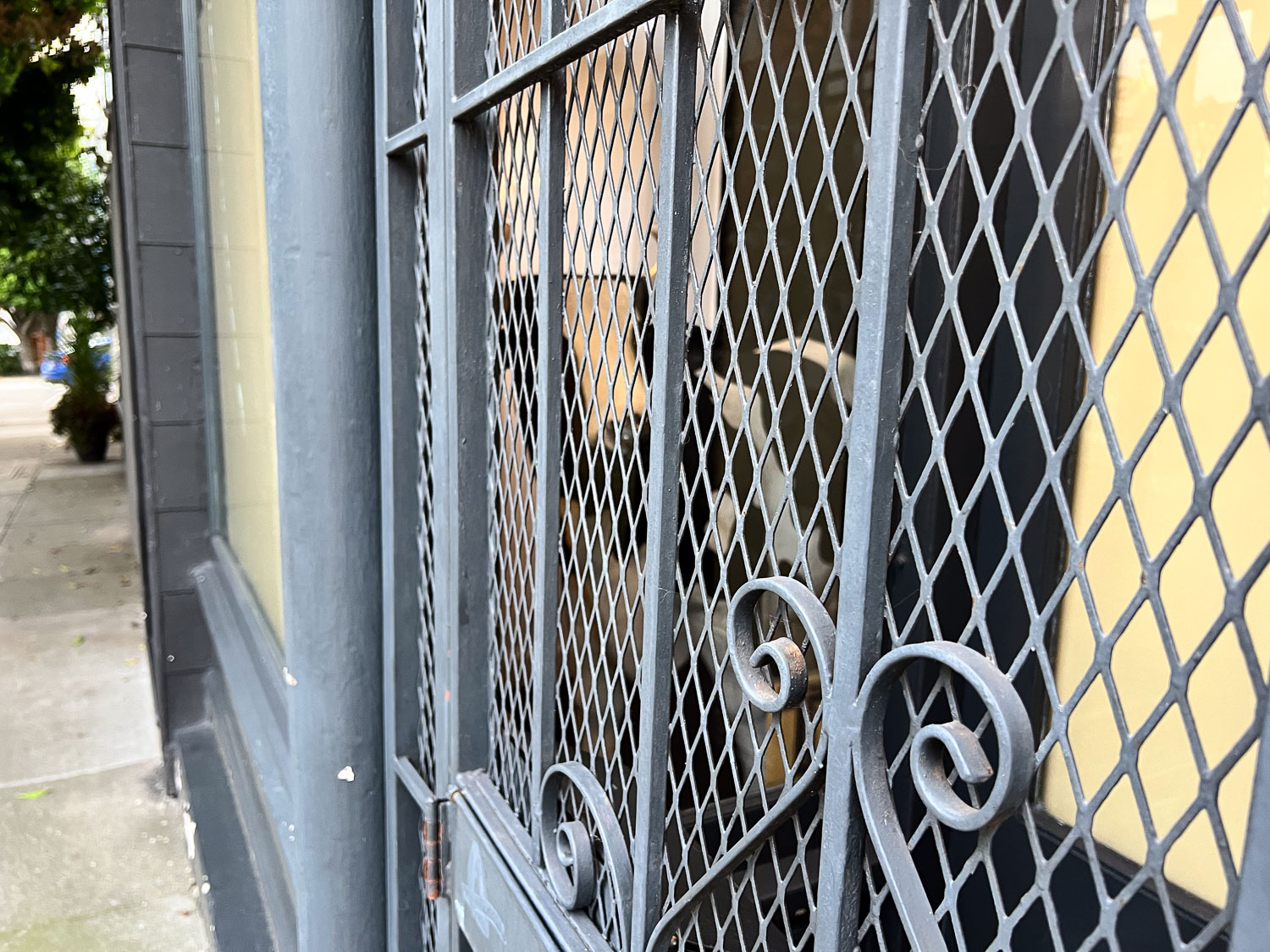
I wasn’t able to get much of a photo here because of the angle. There is a cow in there (not real, but a good size). You can see the face between two of the bars in the cetner and the body between another two.
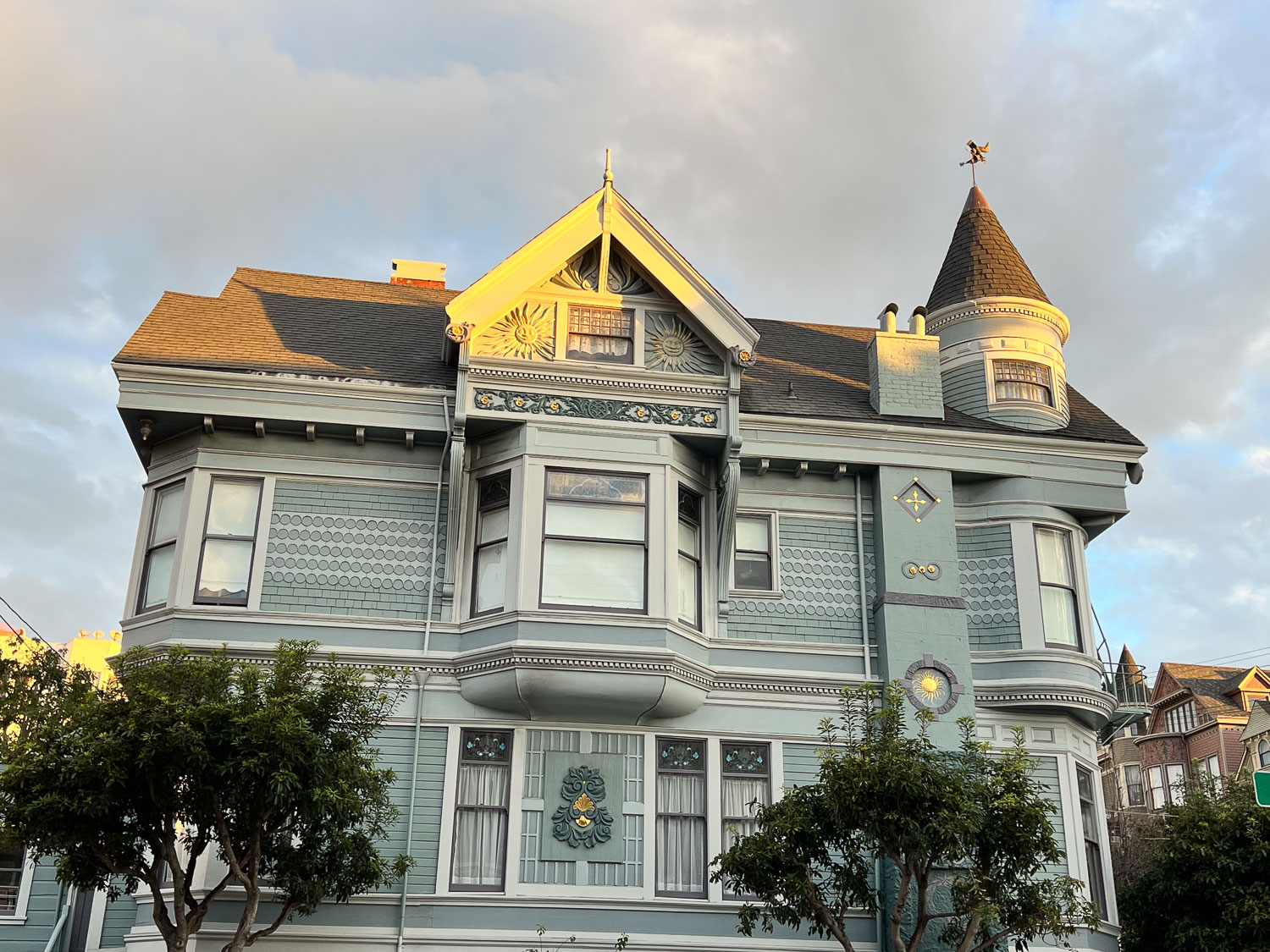
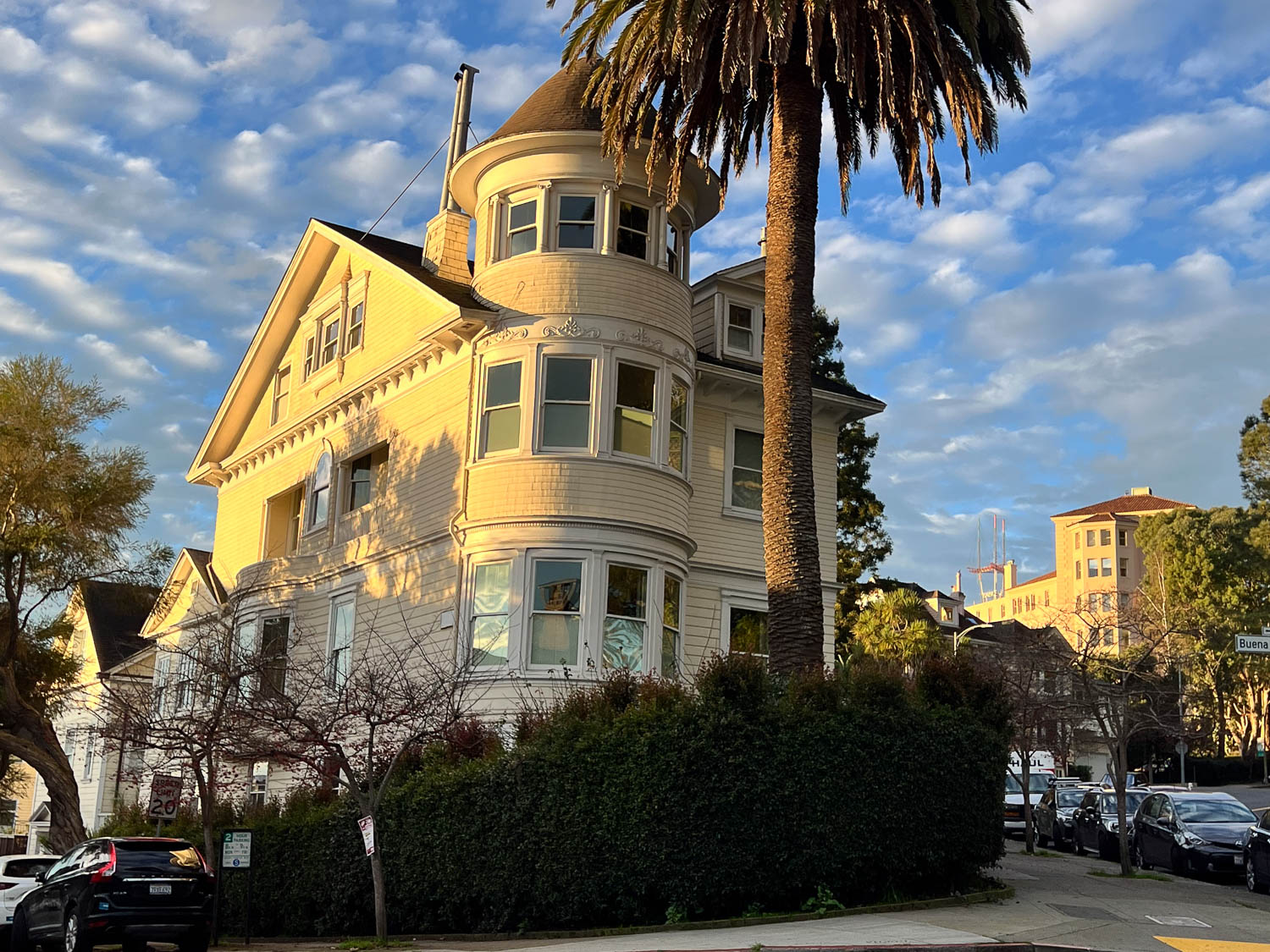
Isn’t this a wonderful house?
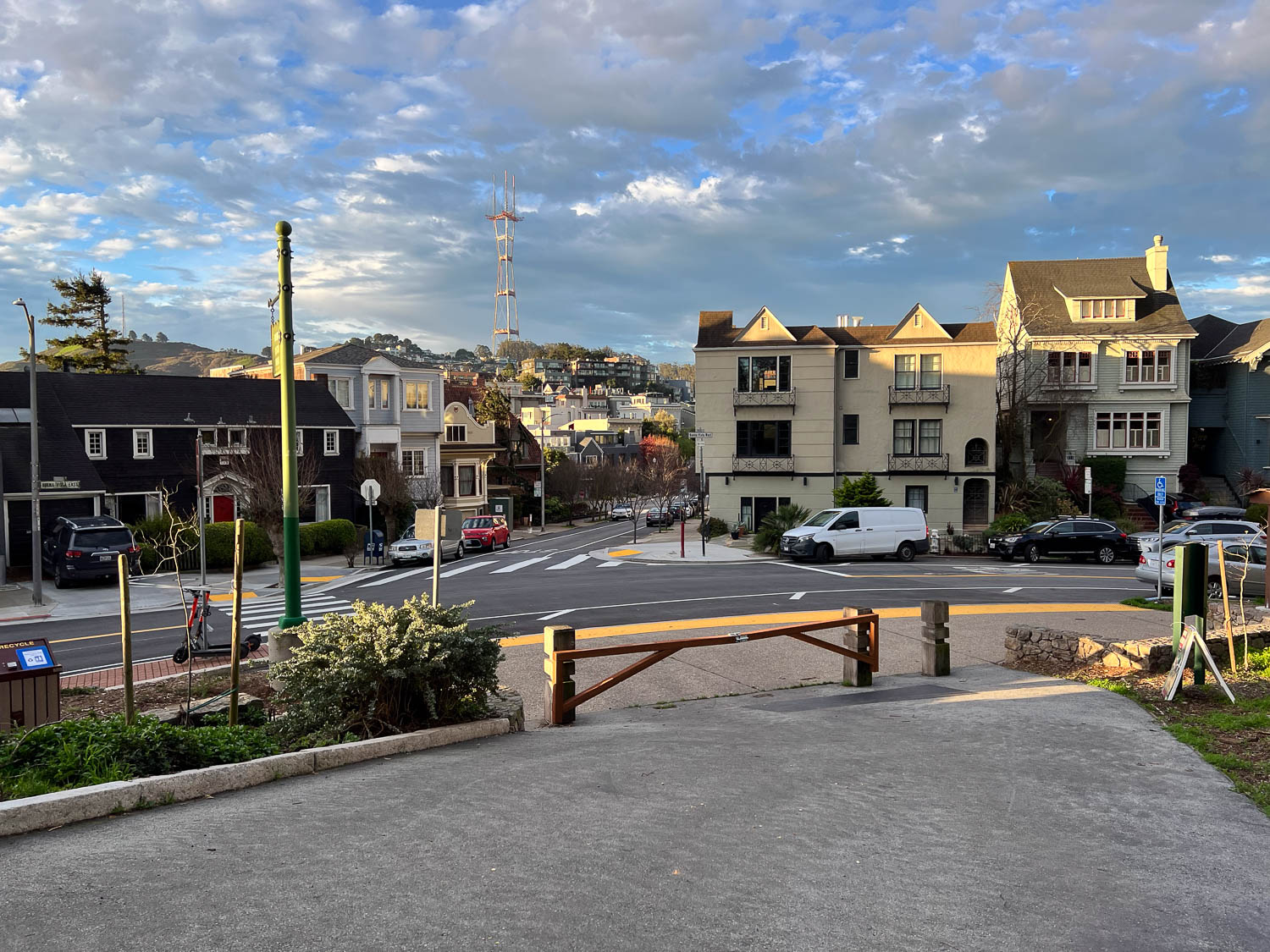
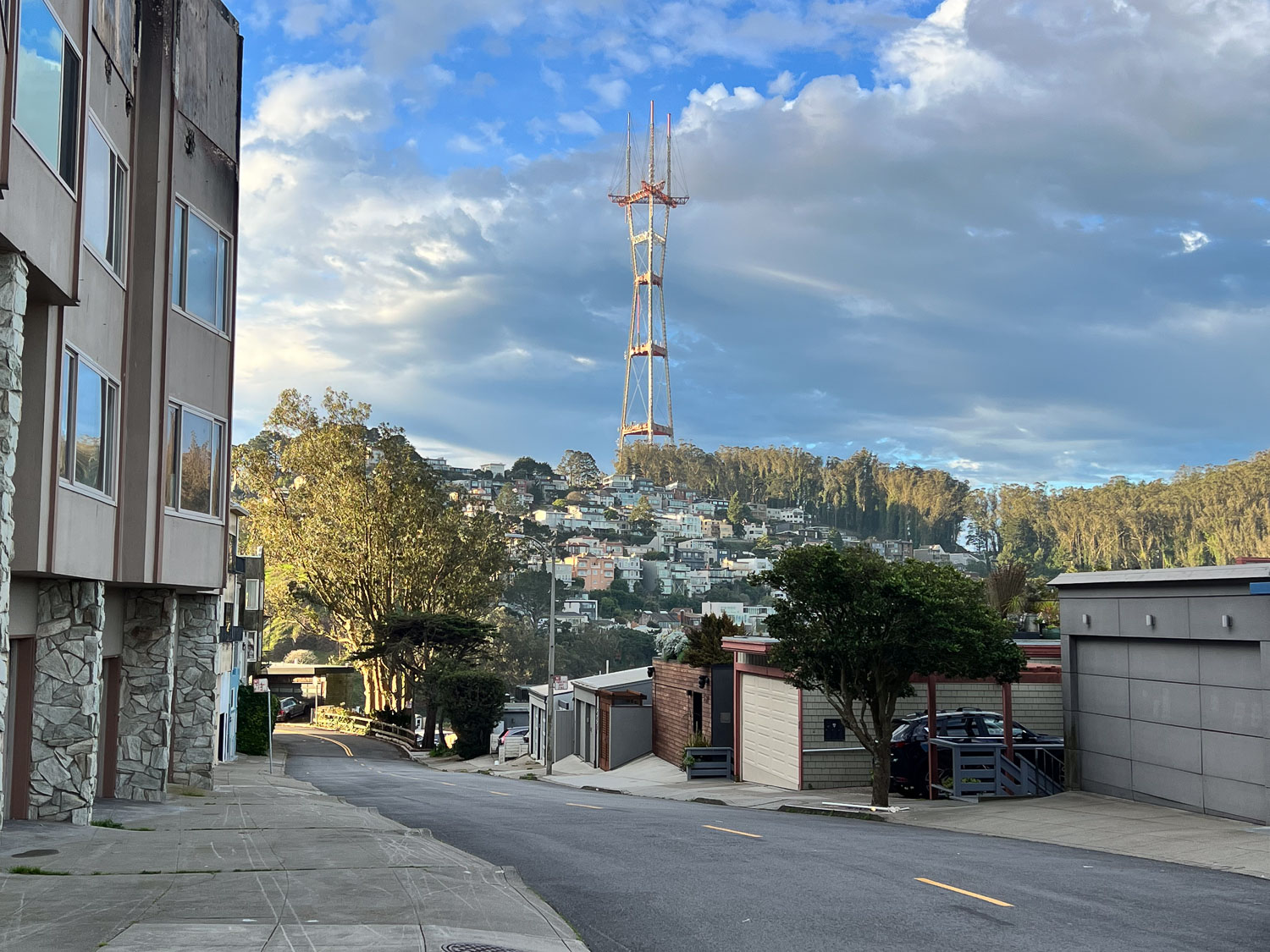
Buena Vista Park is across the street from that last house. I walked into the park and up and down paths through and around it. I came out with this view. Now that I’m looking at a map I see I was at the south side. I saw Sutro Tower and thought that it didn’t seem that far and I may as well head that way.
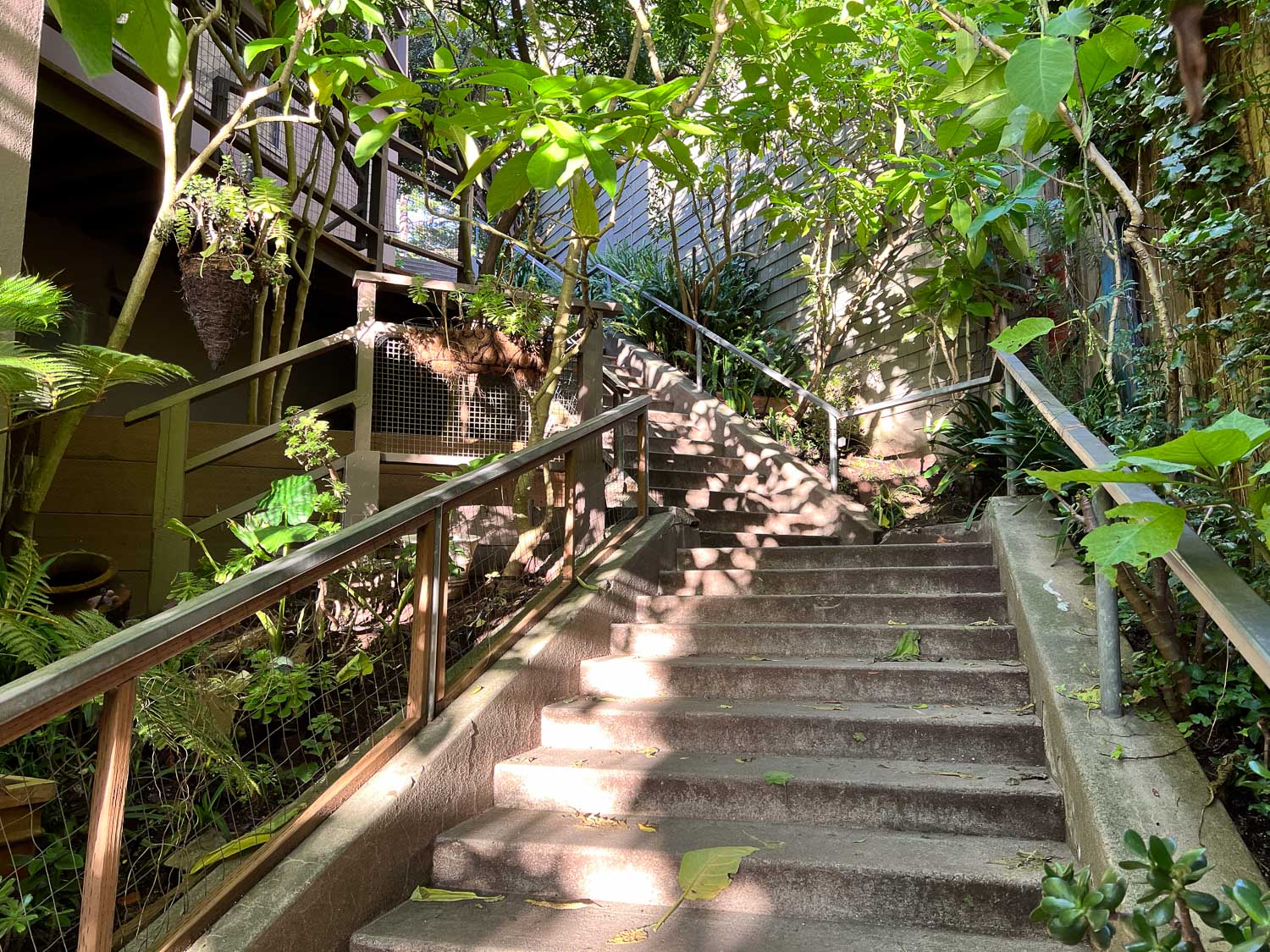
I walked along streets going in the general direction. Every so often you see a stairway that cuts between properties and takes you from one street to another.
I found another small park at the top of one hill and looked beyond it to Sutro Tower. Hmmm. Not as close as I thought. I knew I could still walk there but maybe I shouldn’t spend the time. I turned around and went back taking a different route through Buena Vista Park.
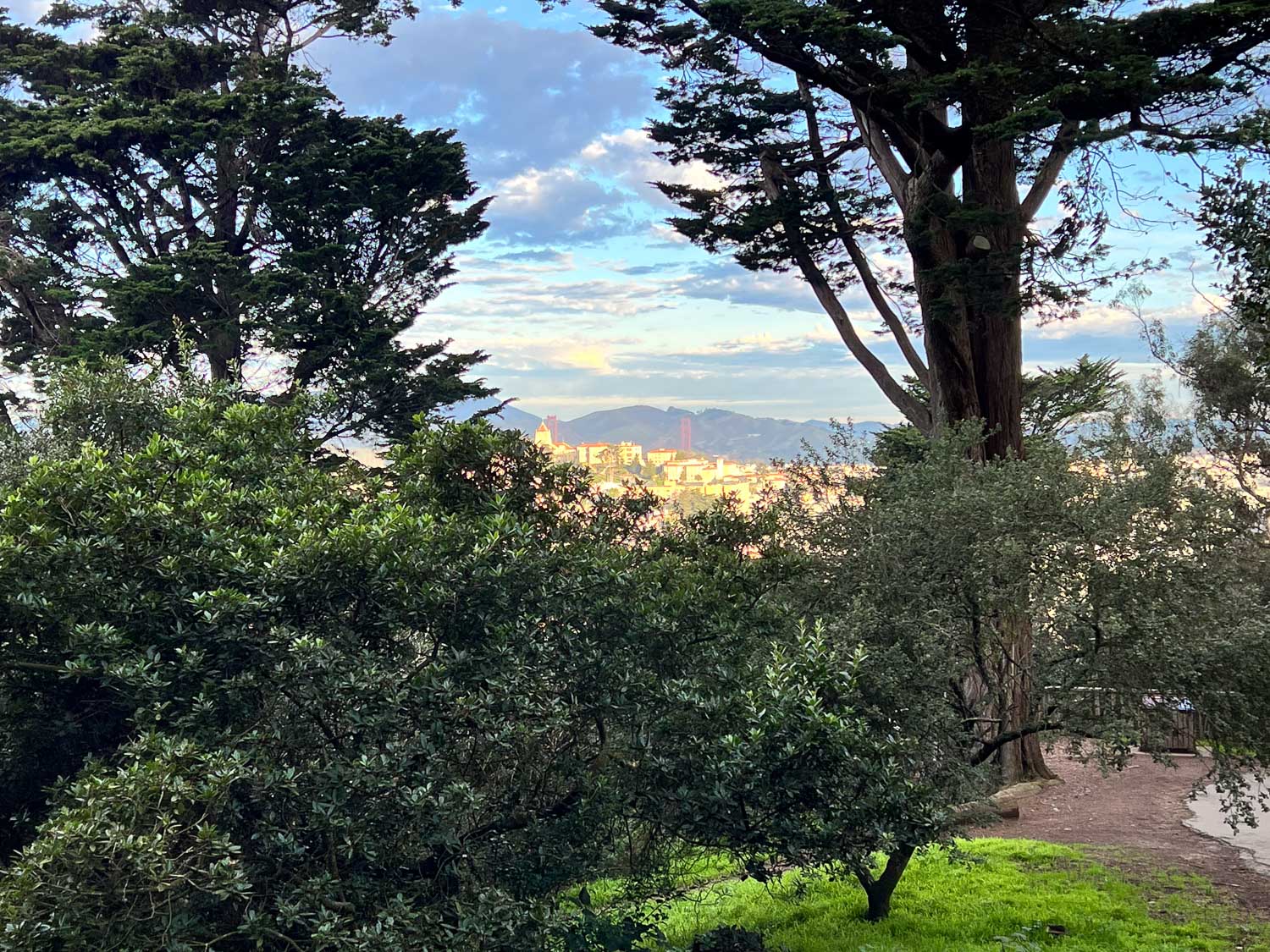
From there I looked to the north and saw the Golden Gate. You can see the towers just below those distant hills.
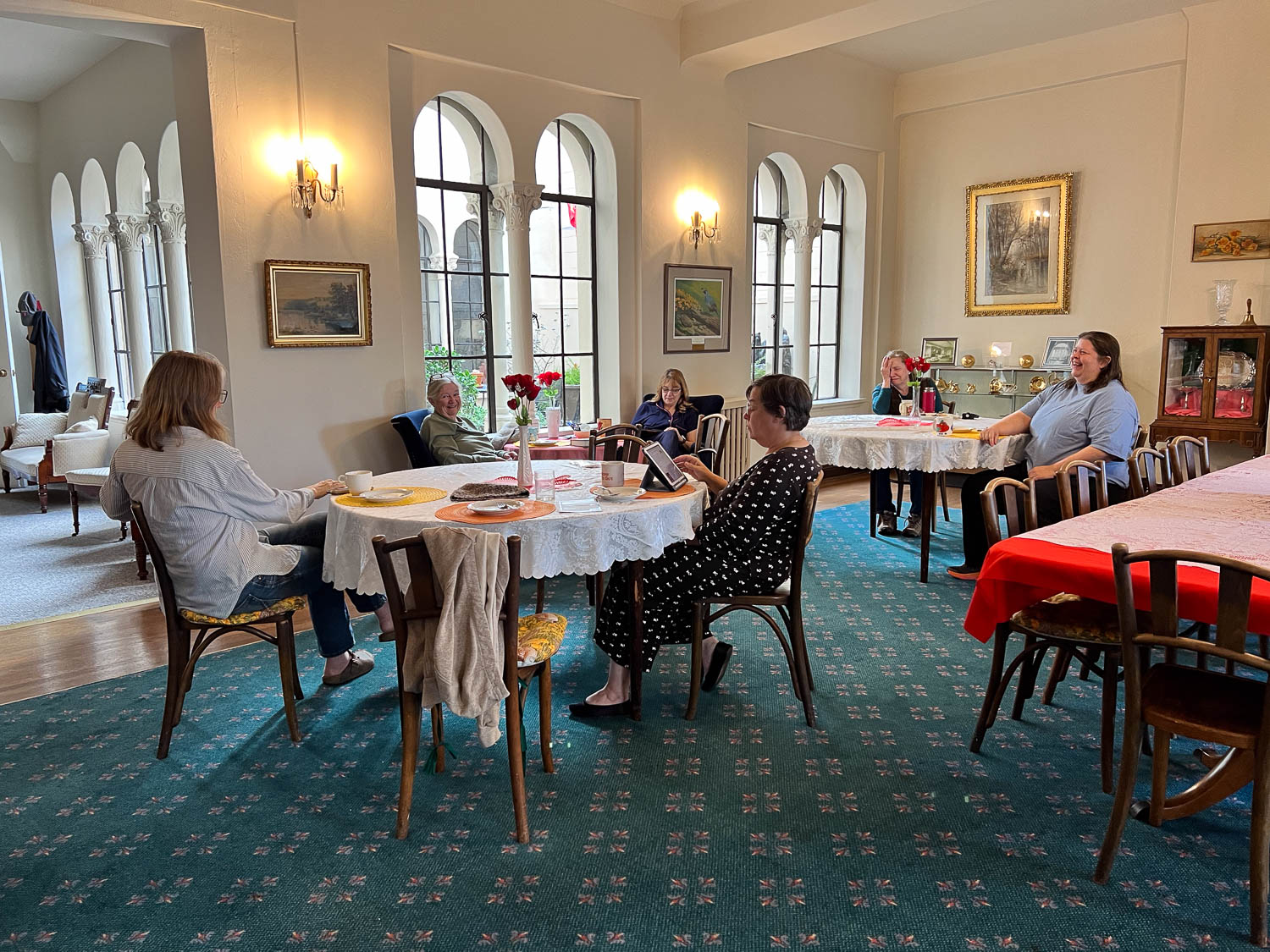
I got back to the Home and many of our group had gathered in the dining room. We finished off yesterday’s pies and spent more time in the parlor visiting and spinning before we headed home about noon.
What will next year bring? If the weather is good I plan to walk to Sutro Tower and maybe through some of the other parks in the city.
From looking back at photos and blog posts I figured out that the first Farm Club Retreat was in 2011. That would make this the 13th retreat, but we had to skip 2020 through 2022. It was fun to look back through that post just now and see the origin of some of our traditions.
Entering San Francisco from the north we drive across the Golden Gate. It was gorgeous weather for this visit.
The Native Daughters of the Golden West Home is on Baker Street. It was designed in 1928 and built for NDGW. Now members and their guests can spend the night in SF in a spacious yet cozy and friendly space. One of the long-time Farm Club members told us all of this in 2010 and that’s when we began the tradition of our Retreat weekend. It used to be just for one night, but we enjoyed it so much that now we make it for two nights.
We were the only guests there for Friday night and we all had our own rooms. Room 401 was a new room for me. Each bedroom is decorated by one of the Parlors (chapters of NDGW) and has it’s own style.
There is a bakery across the street that used to sell pies. We began the tradition of lemon pie for breakfast. Some of us started to bake our own pies and that’s a good thing because the original bakery is no longer there. Saturday morning began with pumpkin pie, lemon pie, apple pie, and plum cake.
I pulled up the live YouTube for Hayes County (TX) Livestock Auction in which my granddaughter was “selling” her Champion bunny.
This is an auction to support all the 4-H and FFA youth who win champion awards in the show. It turns out that the entries go home with the kids but the bids are for real money that go into the bank accounts to help support future projects and college funds.
After watching Kirby we gave our new Farm Club members a tour of the building. This is part of the museum collection in one room. These are gowns worn by some of the Grand Parlor dignitaries. (I can’t remember their designation.) This made me think of watching the movie of the recent Taylor Swift tour with Kirby and DIL Meryl right after Christmas. Taylor had a bit more sparkle but these ladies were very sparkly for their time.
We decided that our destination for the day would be one of the SF Library branches. There are so many fascinating houses.
I’d sure love to see inside some of them. Look at that gorgeous detail.
It was about a mile to the Presidio Branch. Why the library? A California resident can get a SF Library card by showing up in person. That card gives access to all the digital and audio materials from the library and a lot of us make good use of those.
After getting our library cards we split up and two of us walked to Golden Gate Park. This was a unique art structure not far from the park entrance. These are LED cubes that change color I think. If you search for Entwined in Golden Gate Park you can learn more about this art installation that has been in various locations for four years.
Our destination was the Conservatory of Flowers, visible behind the Love alphabet blocks.
The Conservatory originally opened in 1879.
I took photos of some of the extraordinary plants we saw. The variety is fascinating.
The sign here says “The Fanged Pitcher Plant may look sinister, but in the wild colonies of an ant species called diving ants live symbiotically with this plant.” The ants dive into the pitcher part of the plant to consume pests and in turn fertilize the plant with their droppings.
The common name for this plant native to Peru is Lollipop Plant or Golden Shrimp Plant.
Beautiful shades of green on these leaves.
When I saw this I thought that now I know where candy corn is grown!
We walked a few blocks to a restaurant where we enjoyed a great dinner. In this photo we have moved onto dessert. After dinner we went back to the Home to spend the evening working on projects and enjoying the atmosphere.
I was expecting the first lambs in about two weeks so it was a surprise when I saw a ewe who looked as though she was in labor tonight. I put her in a lambing pen and the more I watched the more I knew that she would lamb. I was a bit worried though because lambs can be considered premature and at risk if they are born even ten days before their due date. I put most ewes with rams on September 16 which makes first lambs due February 11. There were two ewes with a ram 6 days earlier which gives us a lambing date of February 5.
All is OK. I went to the house for dinner and pulled up the barn camera feed on my phone.The ewe was definitely in labor. By the time I went back to the barn the lamb was mostly out. The ewe was standing. One more push and the lamb was out.
This is a single ewe lamb out of a 7-year-old ewe, Meridian Dilly.
She was on her feet in about 20 minutes…
…and nursing within a half hour.
So how did we get such a vigorous healthy lamb that much sooner than expected? I sent an email to Farm Club to announce the lamb. One of the members reminded me of an email I had sent in early September in which I said three ram lambs had gone through the fence to where the ewes were. That timing makes sense. One of those is the sire.
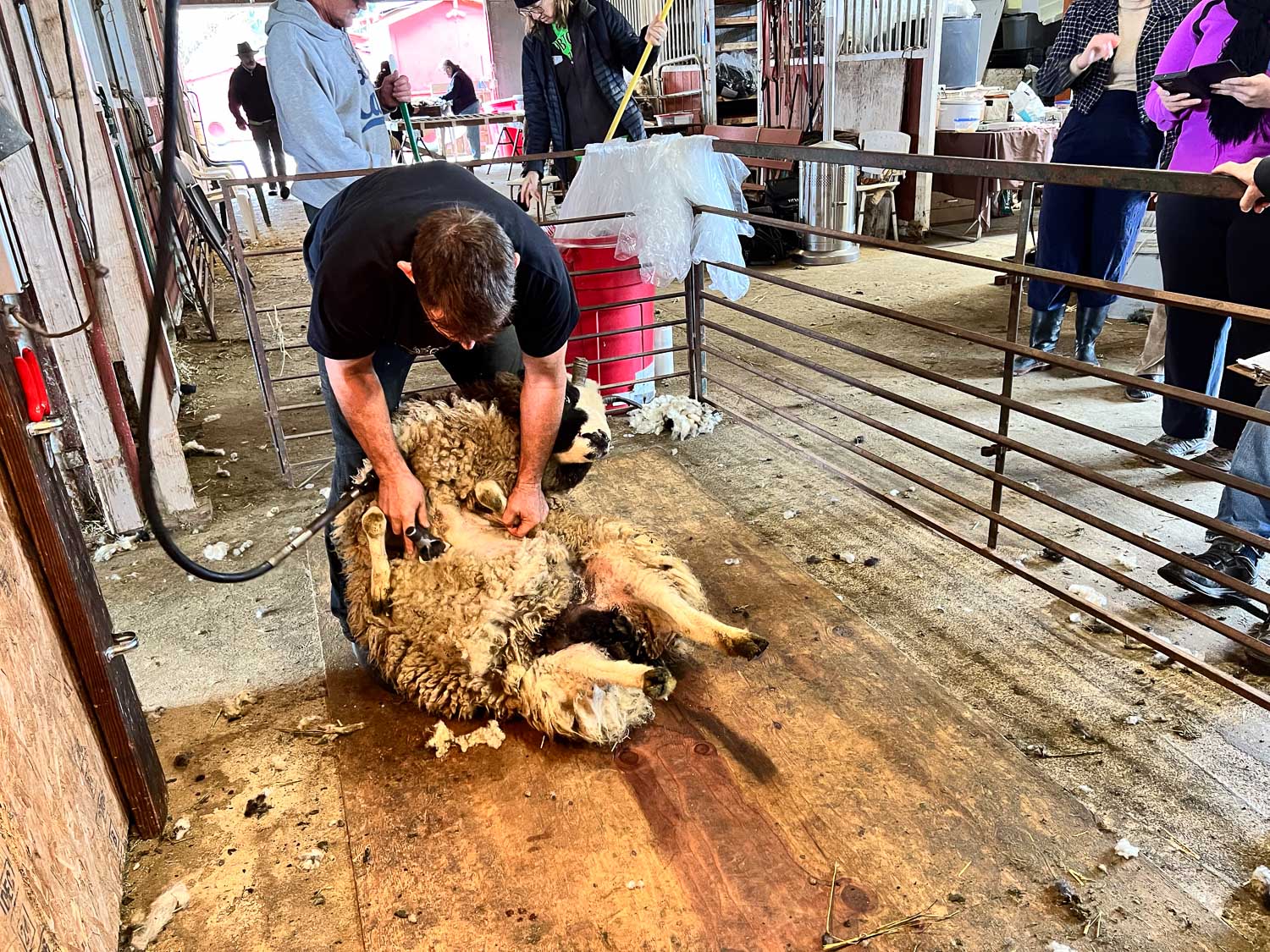
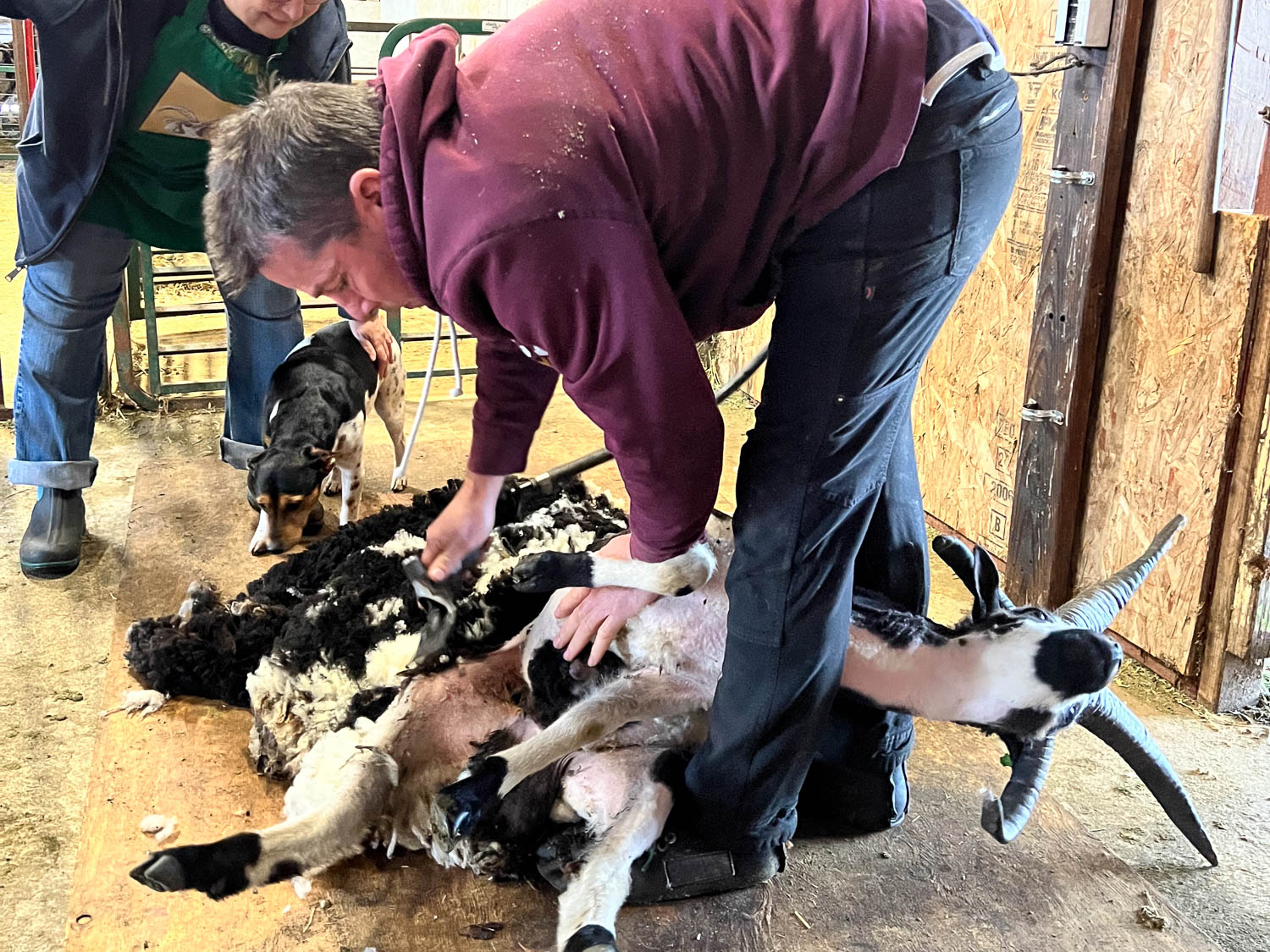
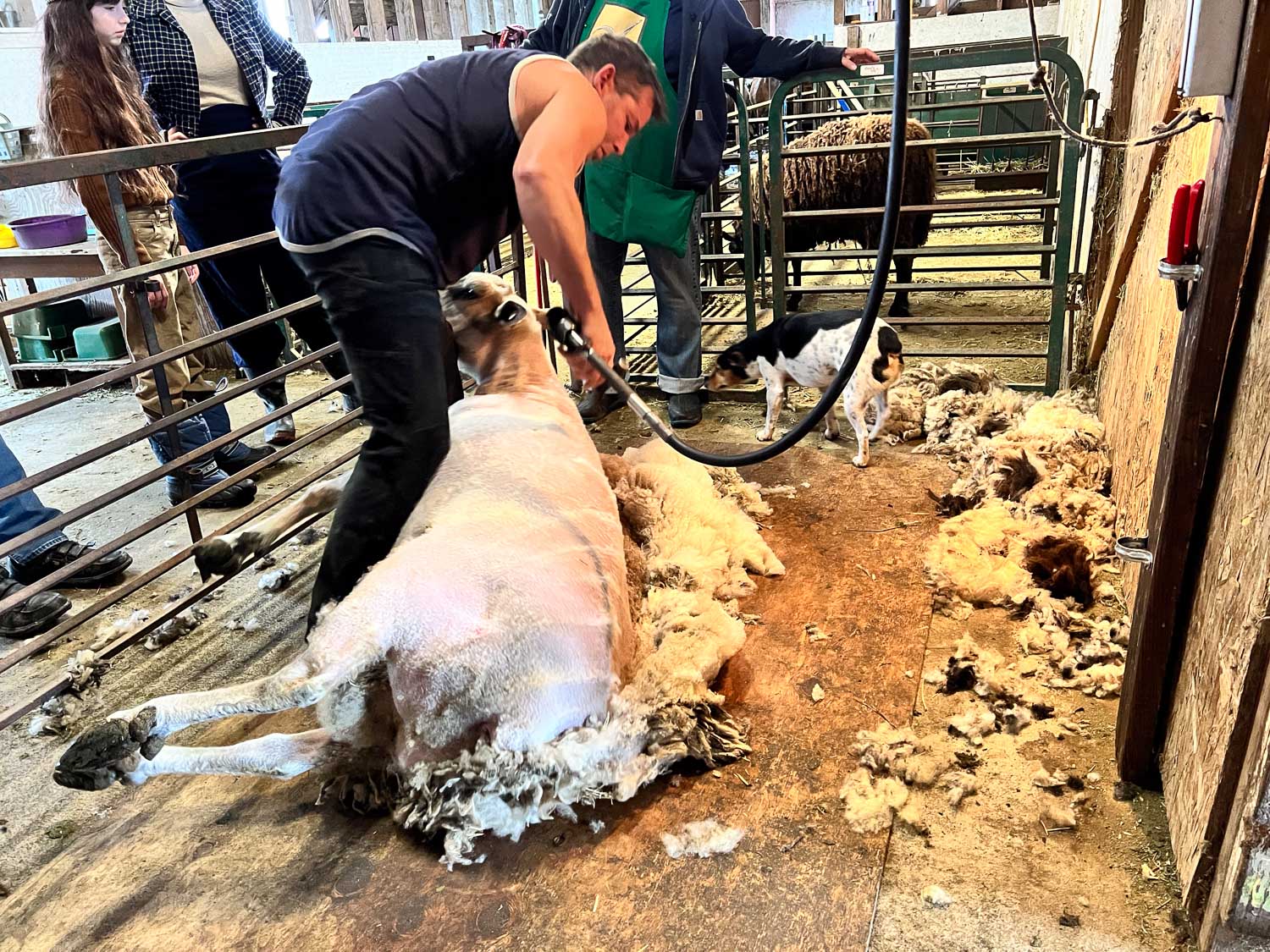
John has been shearing for us for years. He is an excellent shearer and a nice person.
I recorded some of the sheep being shorn which I’ll share when I have time. When I record I can pay attention to time. Some of them are right at 2 minutes or maybe even a little faster.
There is no blood. The sheep are in good shape and the fleeces look great! What more can you ask for?
Farm Club members kept up with getting the sheep to John. I got outside and started to take photos of the sheep after shearing. This ewe is Sandie.
They sure look clean now! That won’t last.
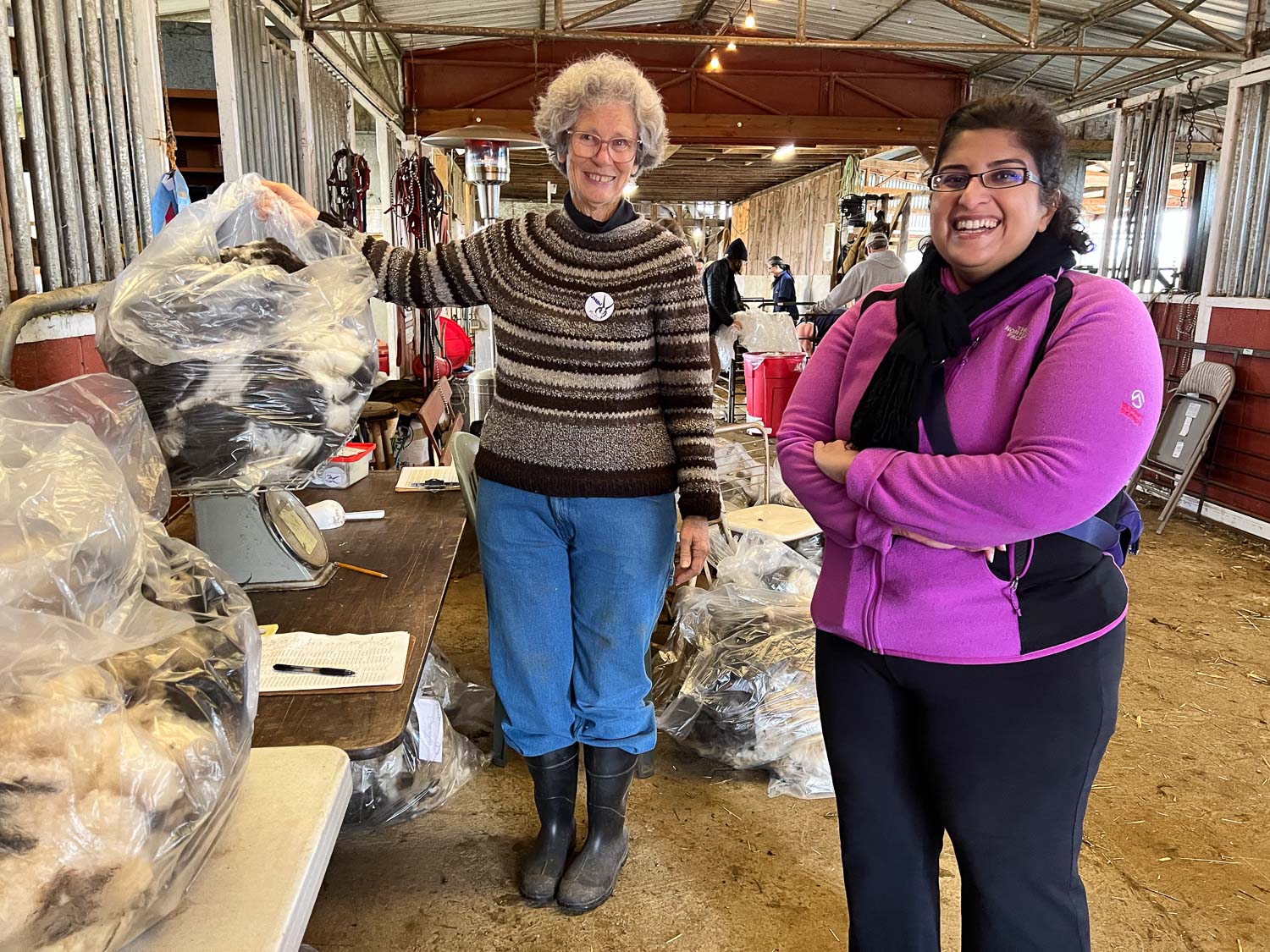
Kathleen weighed all the fleeces.
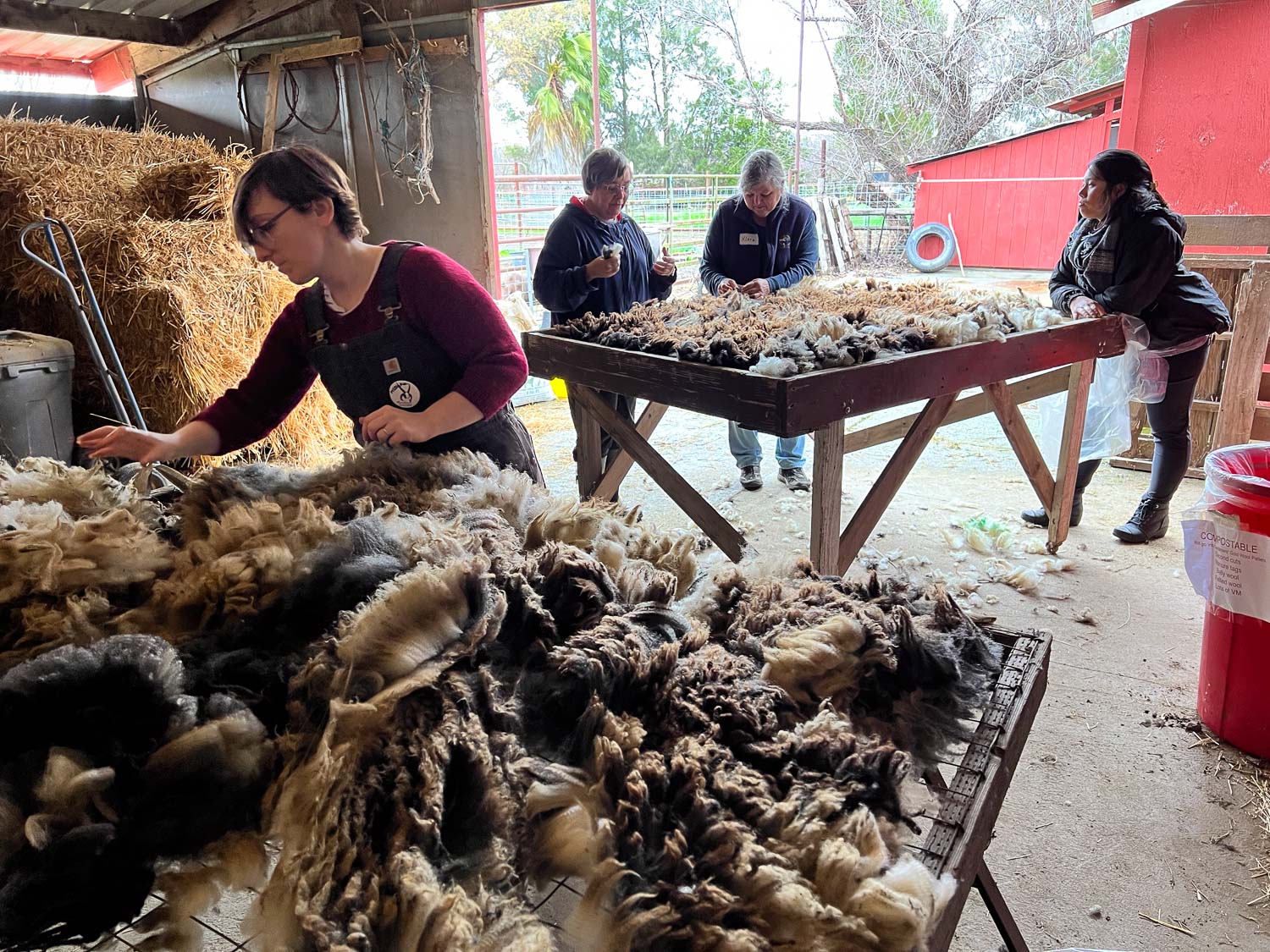
We had two skirting tables available so that fleeces could be skirted before purchase.
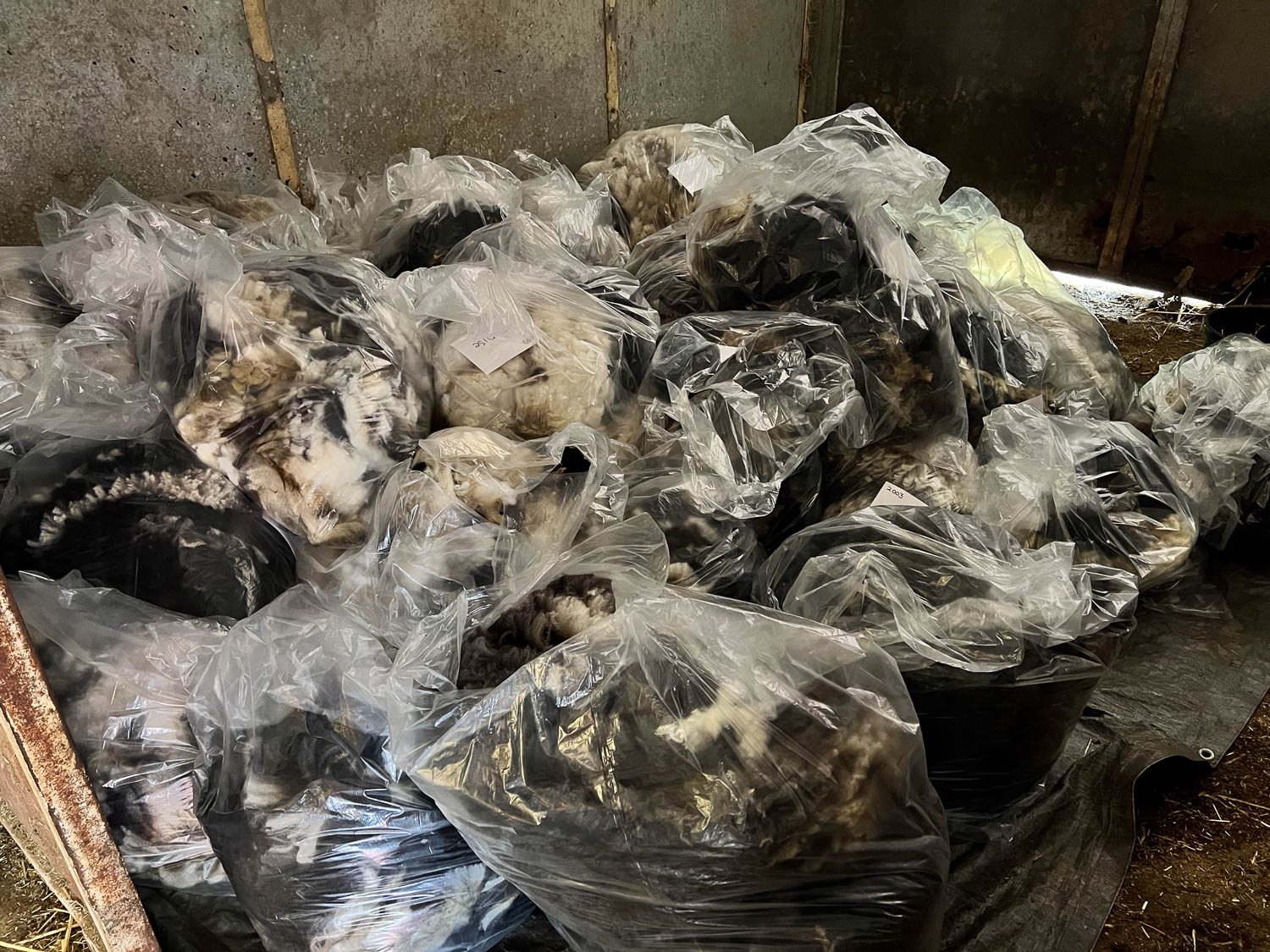
This is just a portion of the fleeces that I need to skirt and put out for sale. Give me a little time to get to that. The sooner the better though.
Distraction…there was a lamb born tonight! Surprise! I guess the next post will be about lambing.
Shearing Day was Sunday, January 21. Rain was predicted all weekend. We need to shear dry sheep. For several years I have used the wool from my friend’s Jacob sheep. It’s easier to shear them here and we can be sure they’ll be dry. So I pay for that shearing and we bring her sheep here the day before.
This year we brought them two days ahead of time due to the weather and because of my Saturday activities. I had two extra stalls there was plenty of room when we split the group.
There were 16 ewes and one ram lamb.
We sheared those sheep first. This is the ram, first sheep of the day to be shorn.
John’s dog, Oakley, found a comfy place to settle down.
As soon as the neighbor’s sheep were shorn we loaded them in the trailer and Dan drove them home. They fit in the trailer much better after shearing than before.
First up for me was Peyton, the BFL ram. The BFL’s seem to gain weight very easily. He and the two crossbred ewes I have are probably a bit too heavy.
The Jacob rams were next. This is the ram lamb (almost yearling) Typhoon.
Here is the lilac ram, Horatio. Look at all that luscious fiber!
Ewes followed. I took recorded lots of video but haven’t had time to do anything with it yet.
Shaggy looking sheep.
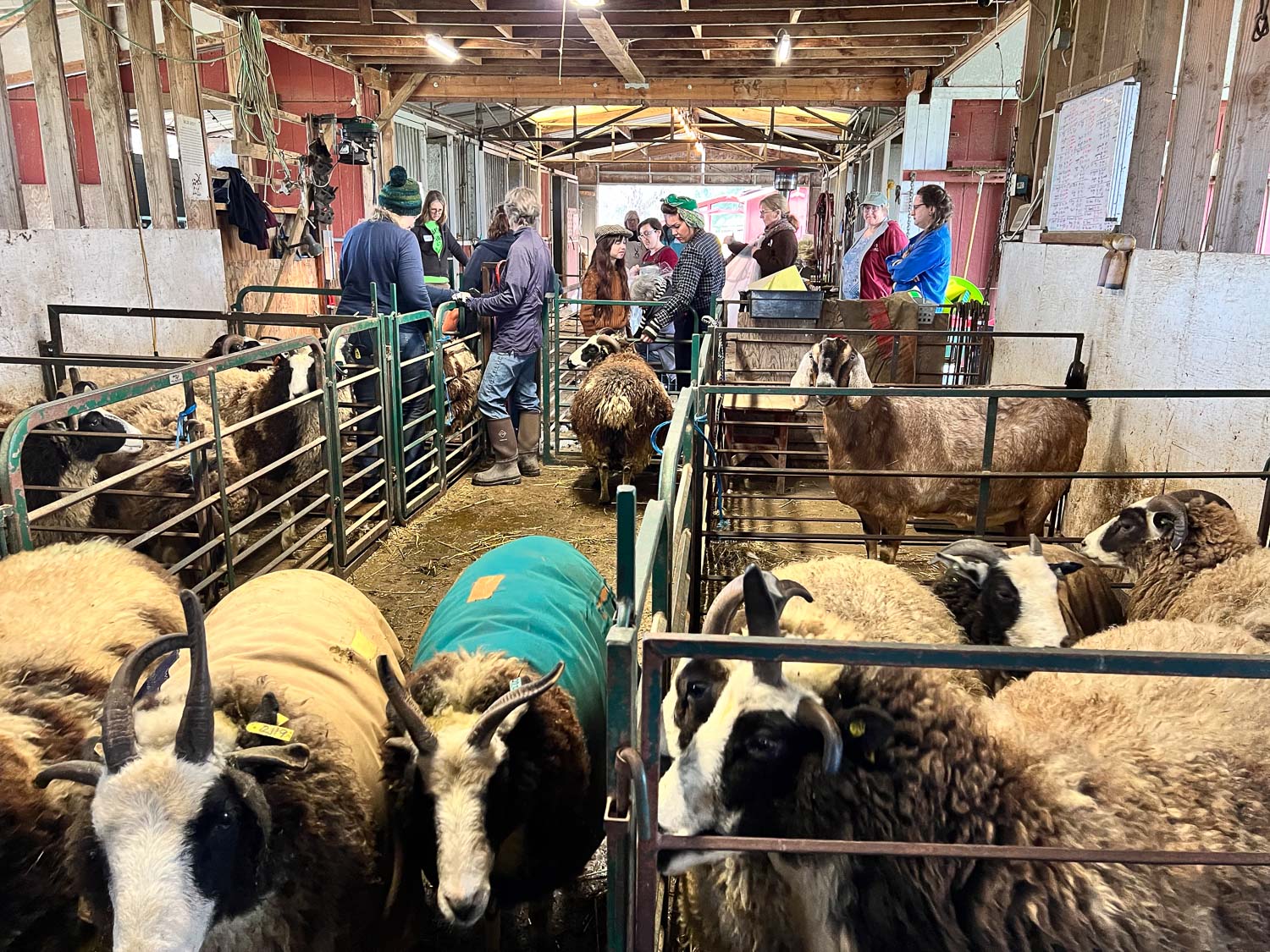
This is the view of the main sheep area looking into the lambing area where there are pens, and beyond to shearing.
Shearing Day wouldn’t go as smoothly without all the Farm Club help. We crowd the sheep into the main barn with panels and move them through to the shearing area.
I’m grateful that so many Farm Club members have been here enough that they can just jump in and take over. There were several new members as well who are well on their way to learning about sheep handling.
Sheep in the lambing area moving to the pen on the top left near the shearer. That’s a goat on the right. The goat has to go in a pen or she gets in the way.
She got plenty of attention there.
Two or three people bring a few sheep at a time into this pen where they are moved through the gate to John.
Kathleen took her regular job of weighing fleeces.
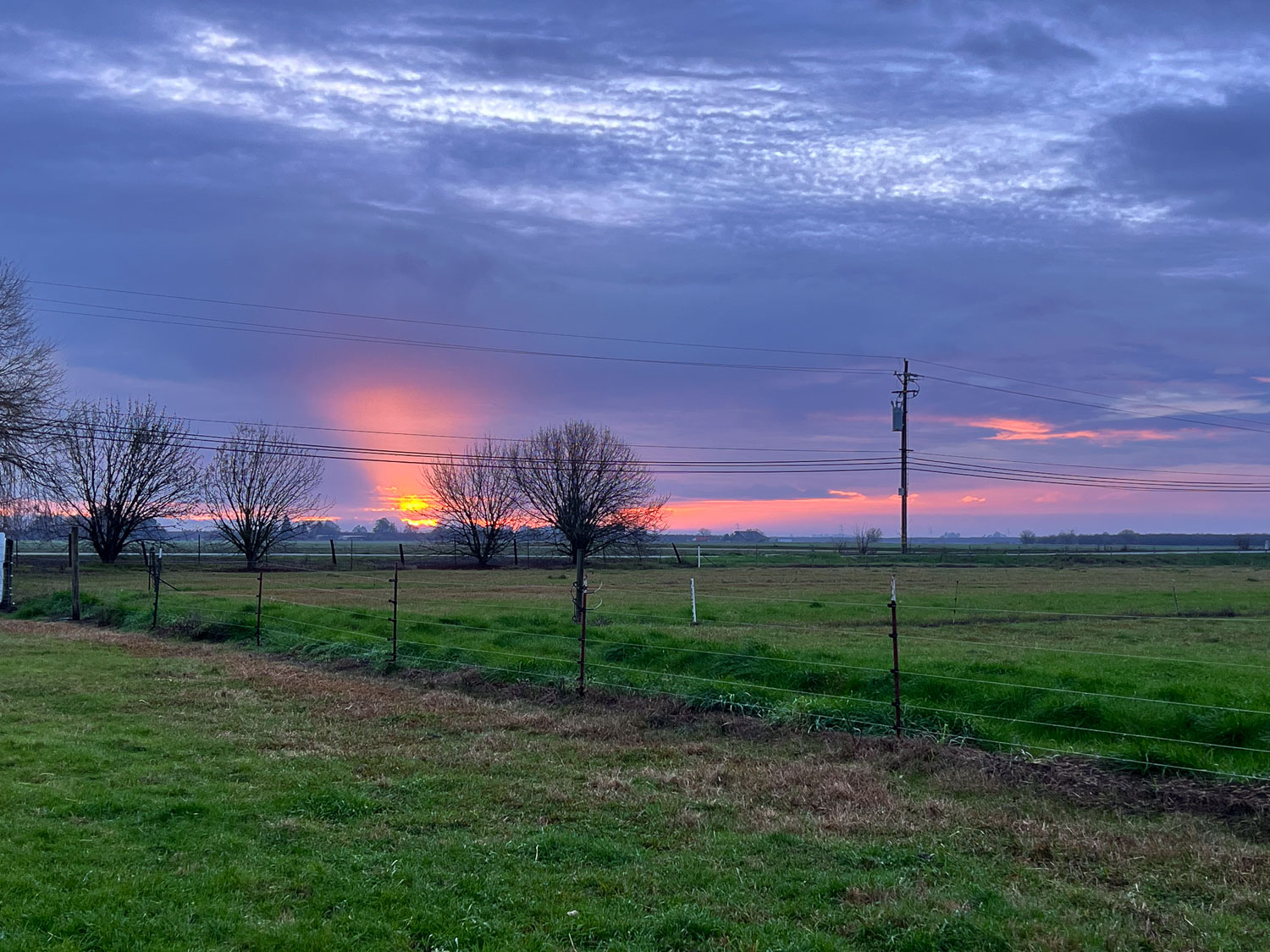
Shearing Day was scheduled for January 21, but this was the day before. I was up before sunrise again (necessary if you want to get enough done in the day in the winter) and it’s nice when there is color to go with it.
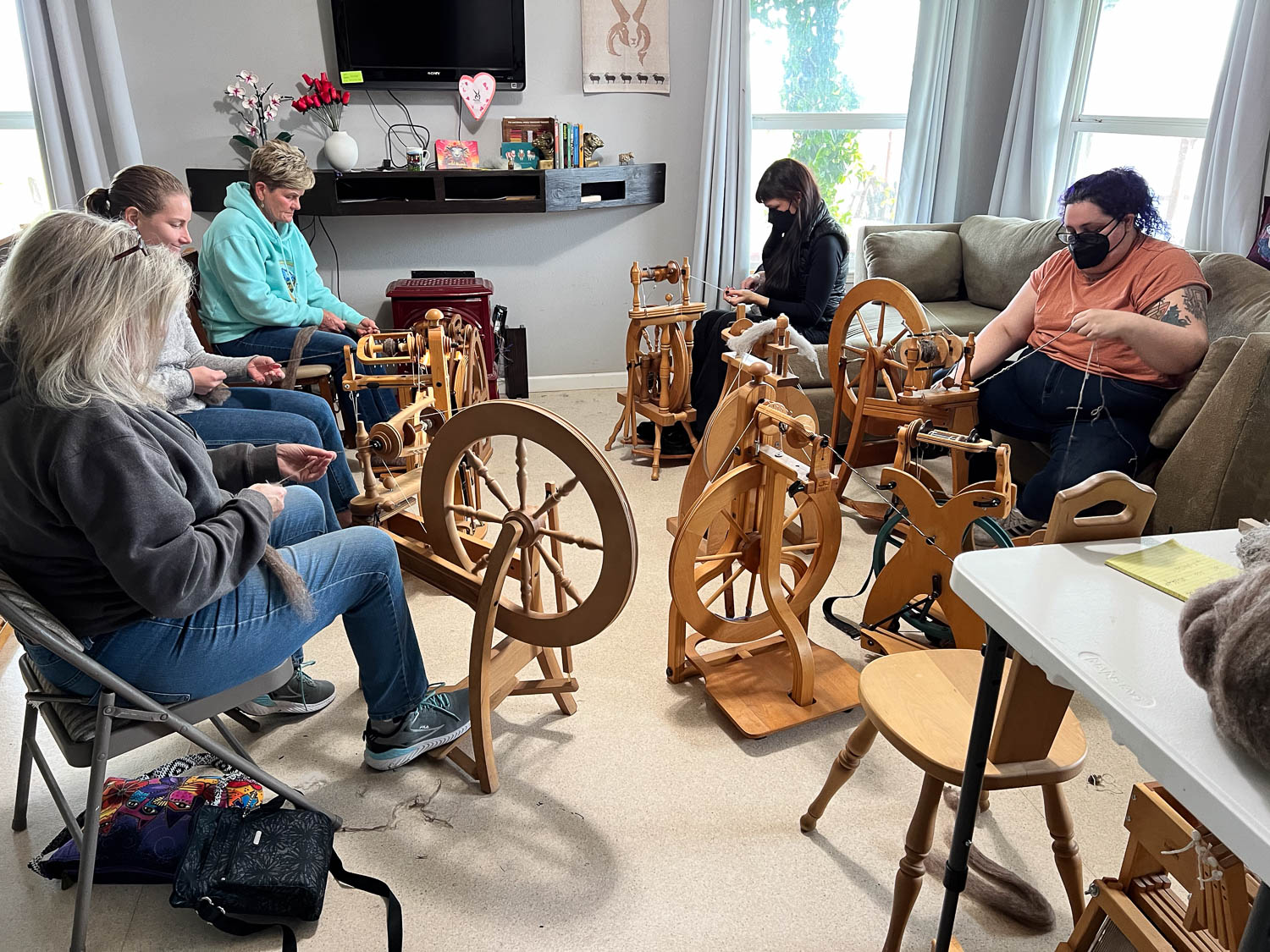
I had a spinning class scheduled for the morning. Five people from five different cities came to learn about spinning. Most had a little bit of experience or at least an introduction to spinning so we started right in after I explained the different wheels and some basic terminology. They all had a chance to ply their yarns by the time we finished a little after noon.
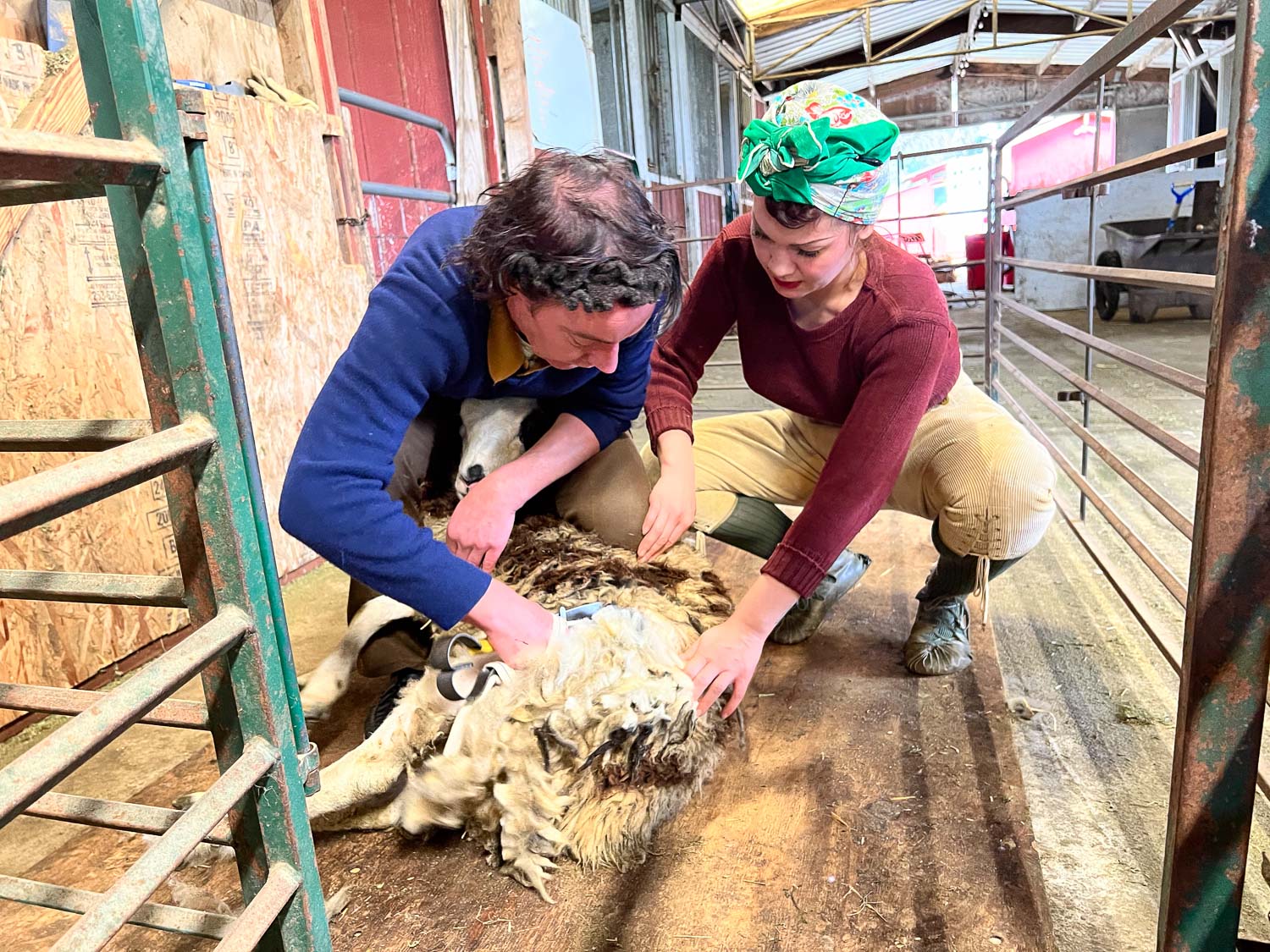
Just as we were finishing Siobhan and Ivar got here. Siobhan is a Farm Club member who has been here often, either teaching a class or to farm sit, besides our regular Farm Days. She and her husband spent a few weeks in England on a belated honeymoon last year. While there they took a lesson on blade shearing and bought hand shears. Siobhan asked if she could shear a sheep for her Farm Club fleece for this year. I said “sure”.
She chose Harry, the offspring of one of our pet sheep, Hazel, who died last year). I had wethered Harry because he had become such a pet to Siobhan and my granddaughter, Kirby. Ivar did the actual shearing while Siobhan helped with sheep control.
I can’t believe that I didn’t get photos between the start and the finish. I was doing some other barn clean up but also helping with a bit of sheep management. In fact I took this photo while Ivar was finishing his last strokes from the front of the sheep where I had one hand (or maybe my knee at this point) on Harry’s head. Siobhan however has a great time-lapse video of the whole process.
I’ll bet it felt like longer to Ivar, but when I looked at the time on my photos I saw that between the first and last photo there was about 55 minutes. I’d say that’s pretty good for your first sheep and doing it with handshears…and the sheep has horns, which only adds to the difficulty.
The fleece looks good too and I can’t wait to see what Siobhan does with it. Great job, Ivar and Siobhan!
The next day we sheared 77 sheep, but John uses electric shears! Stay tuned for another post.