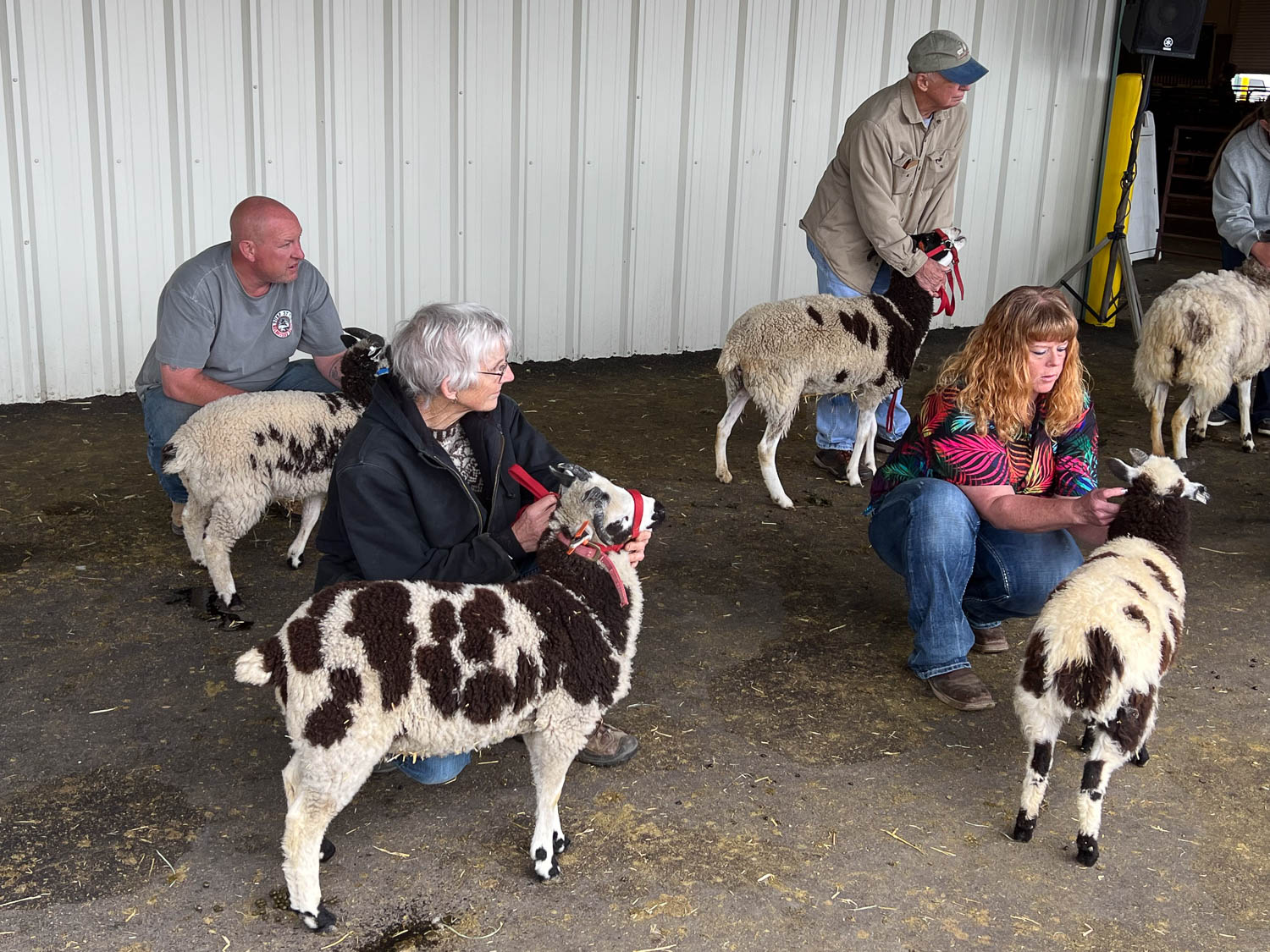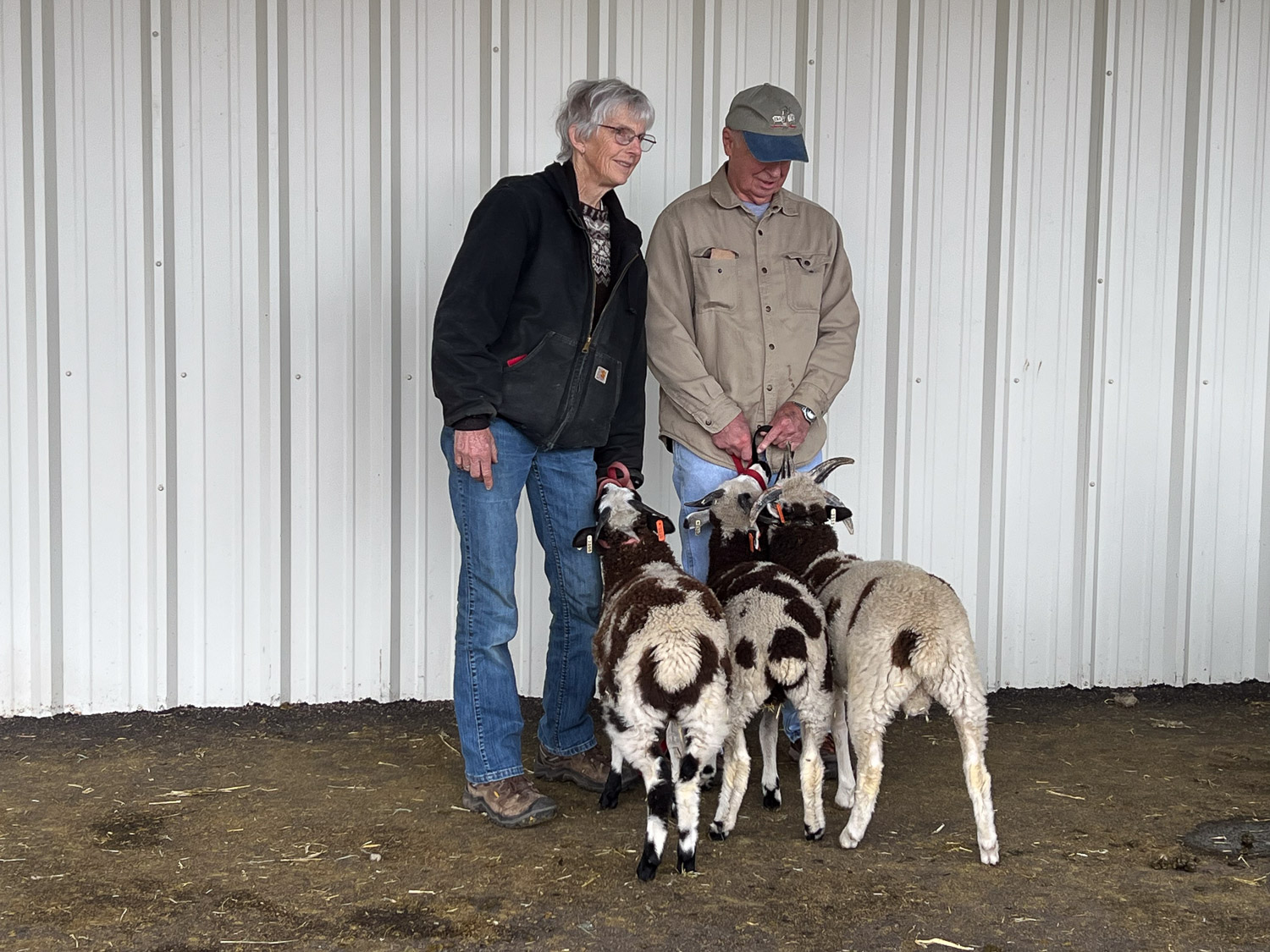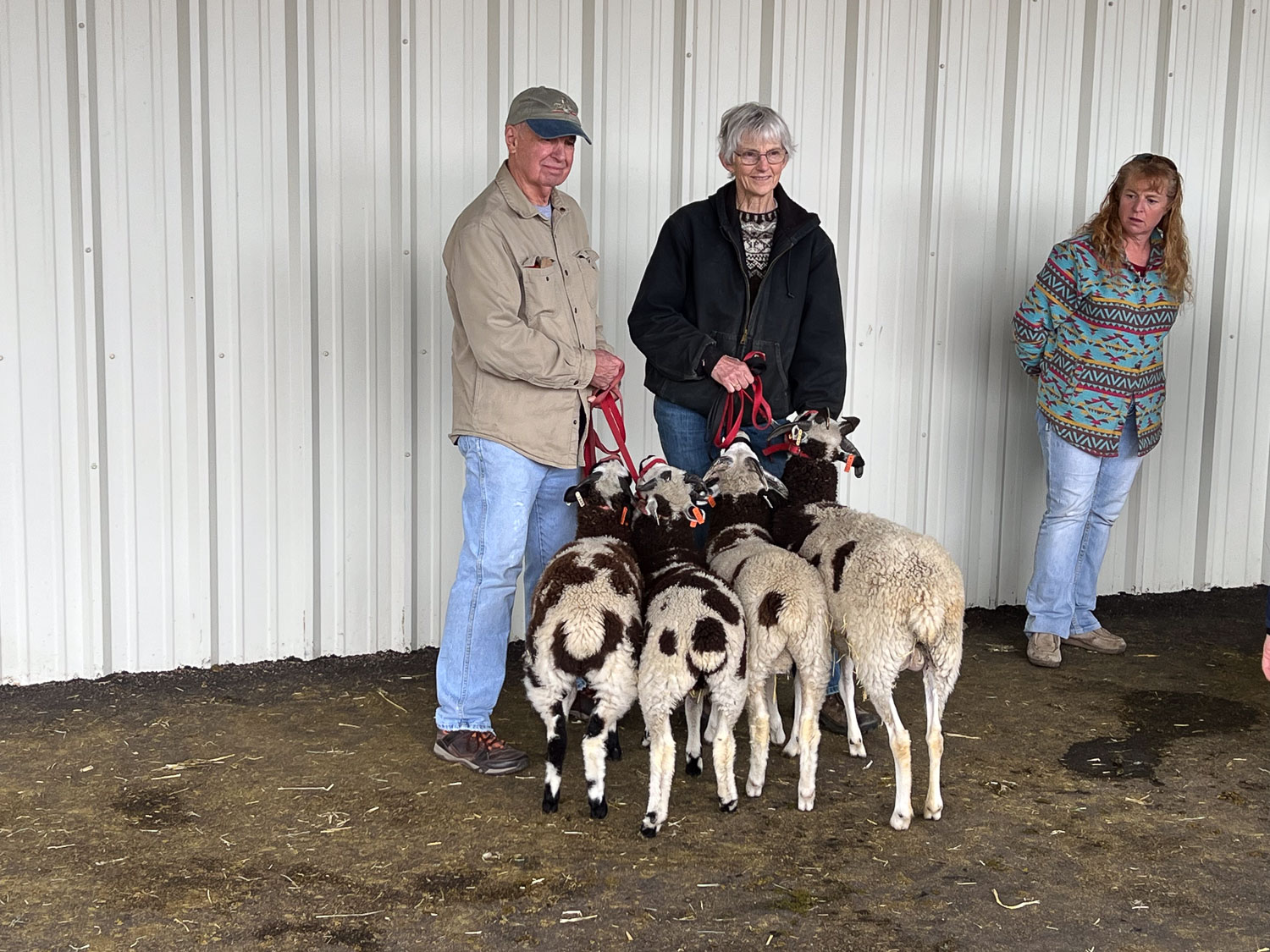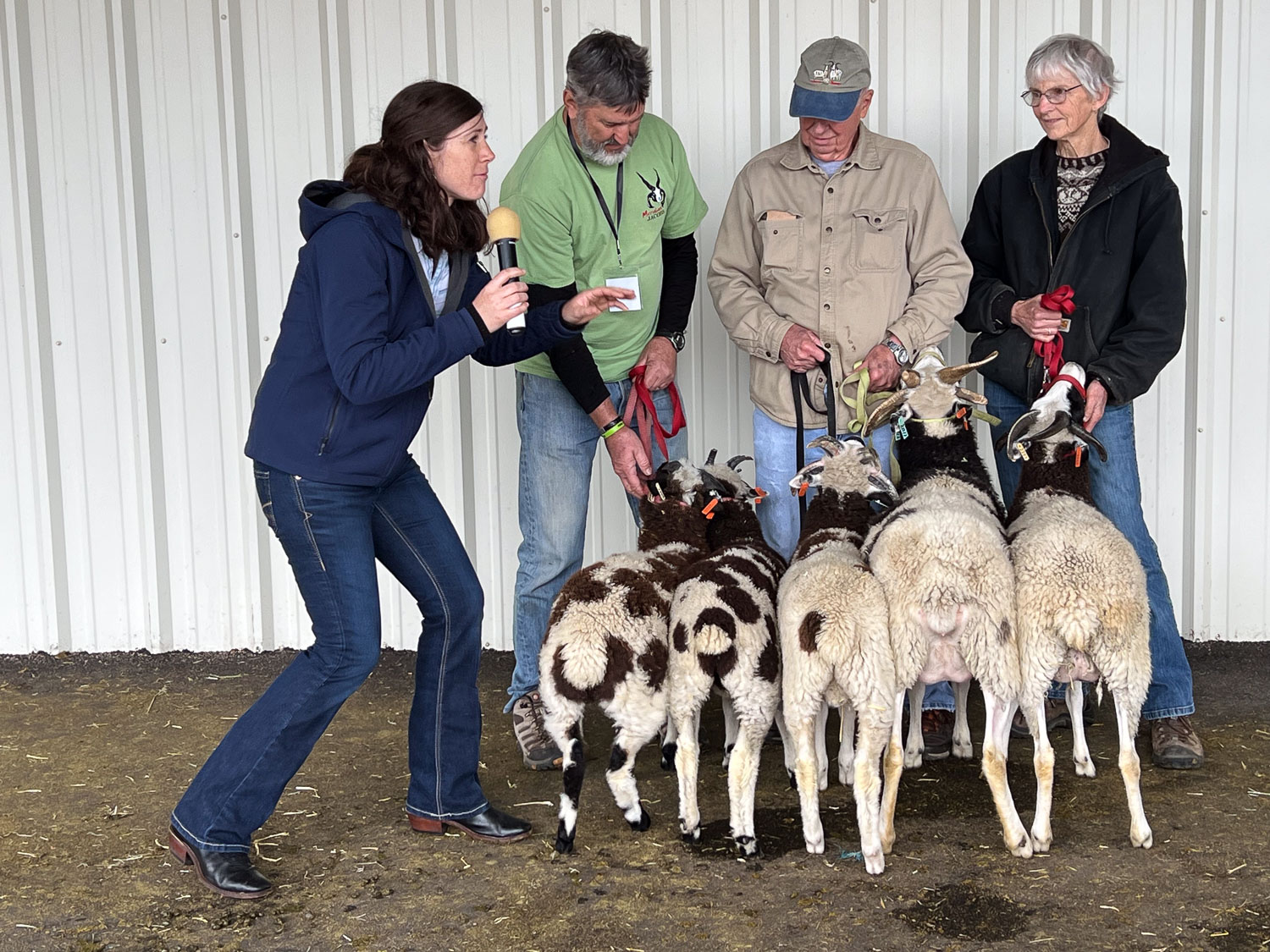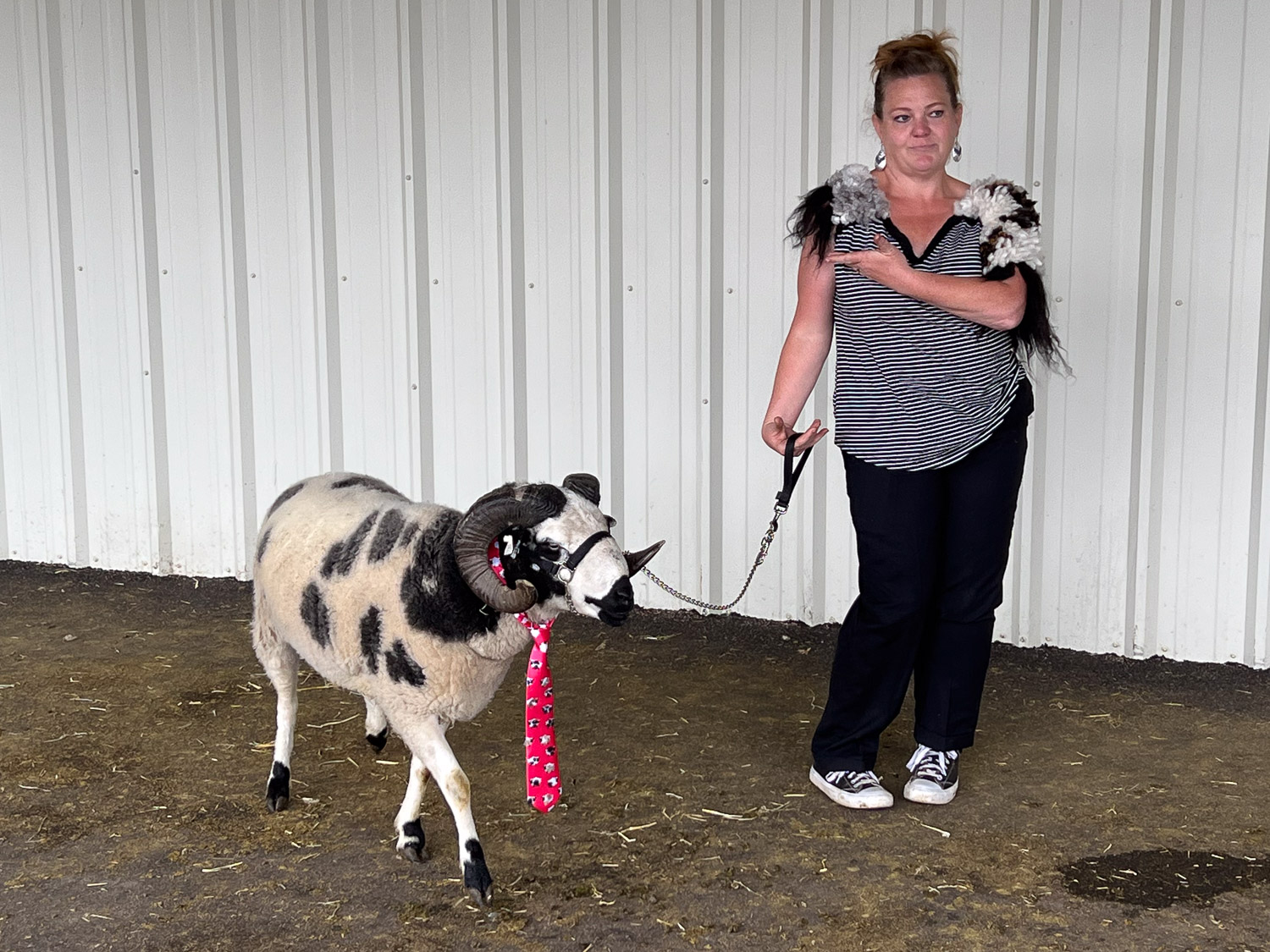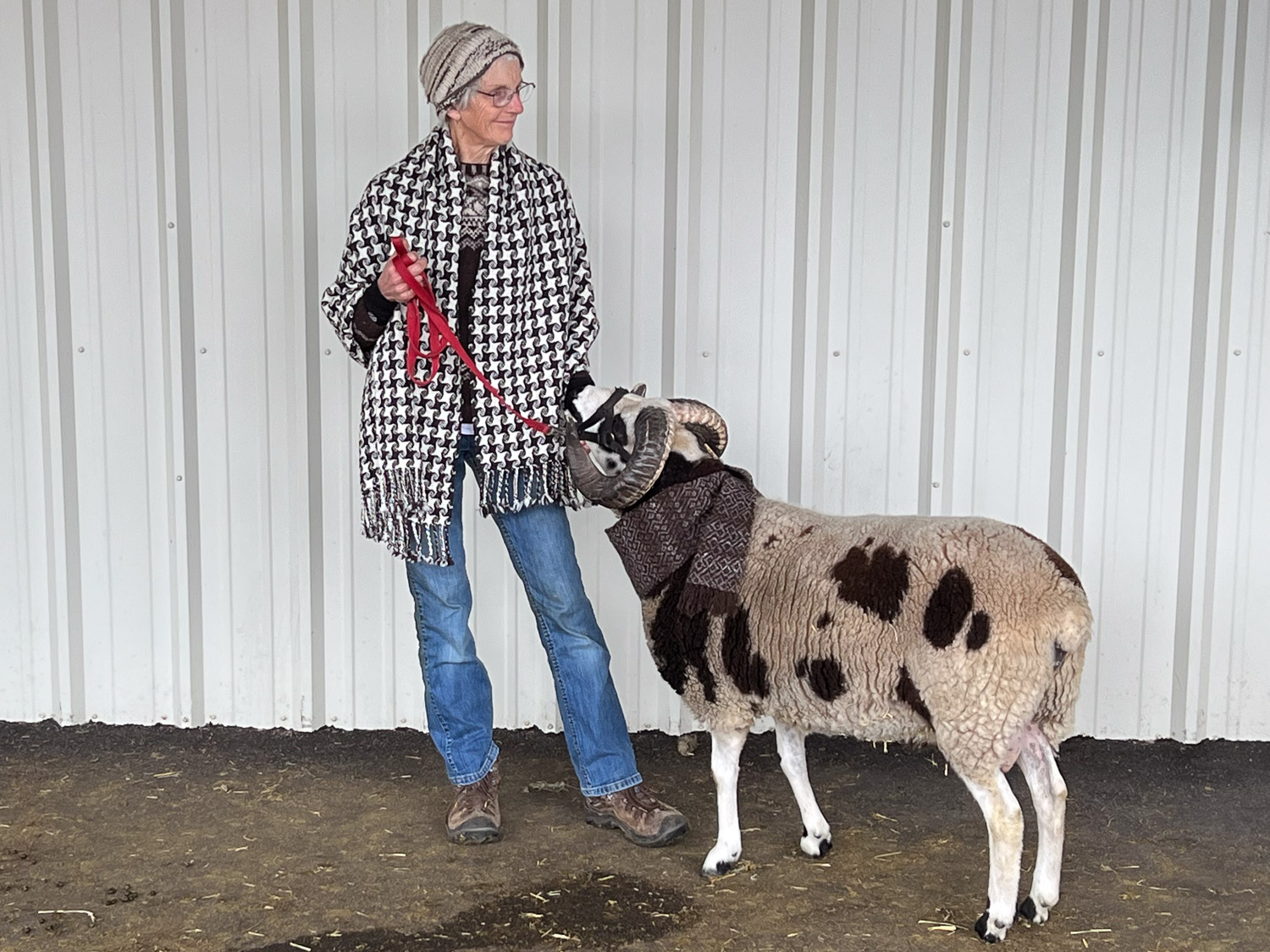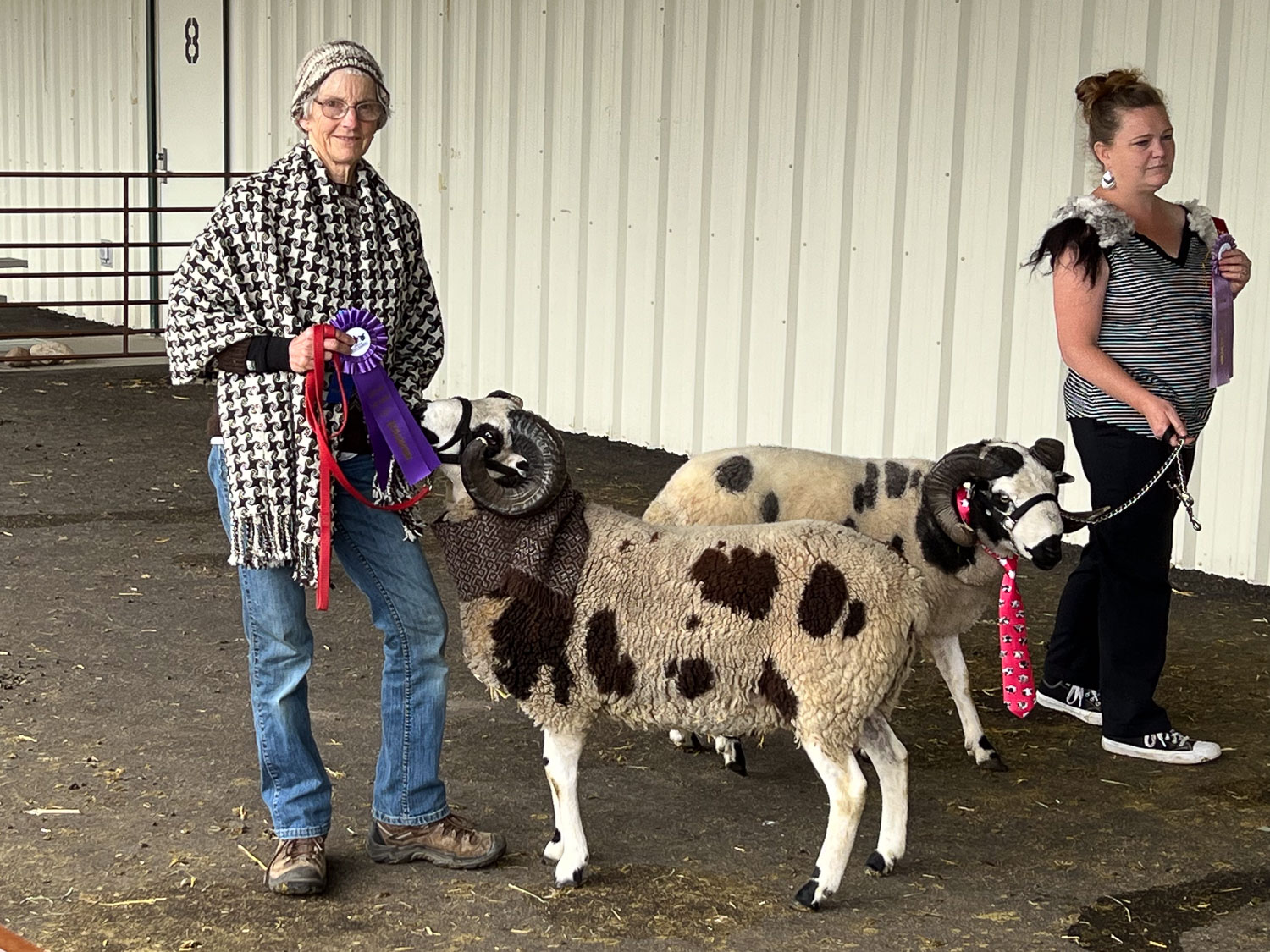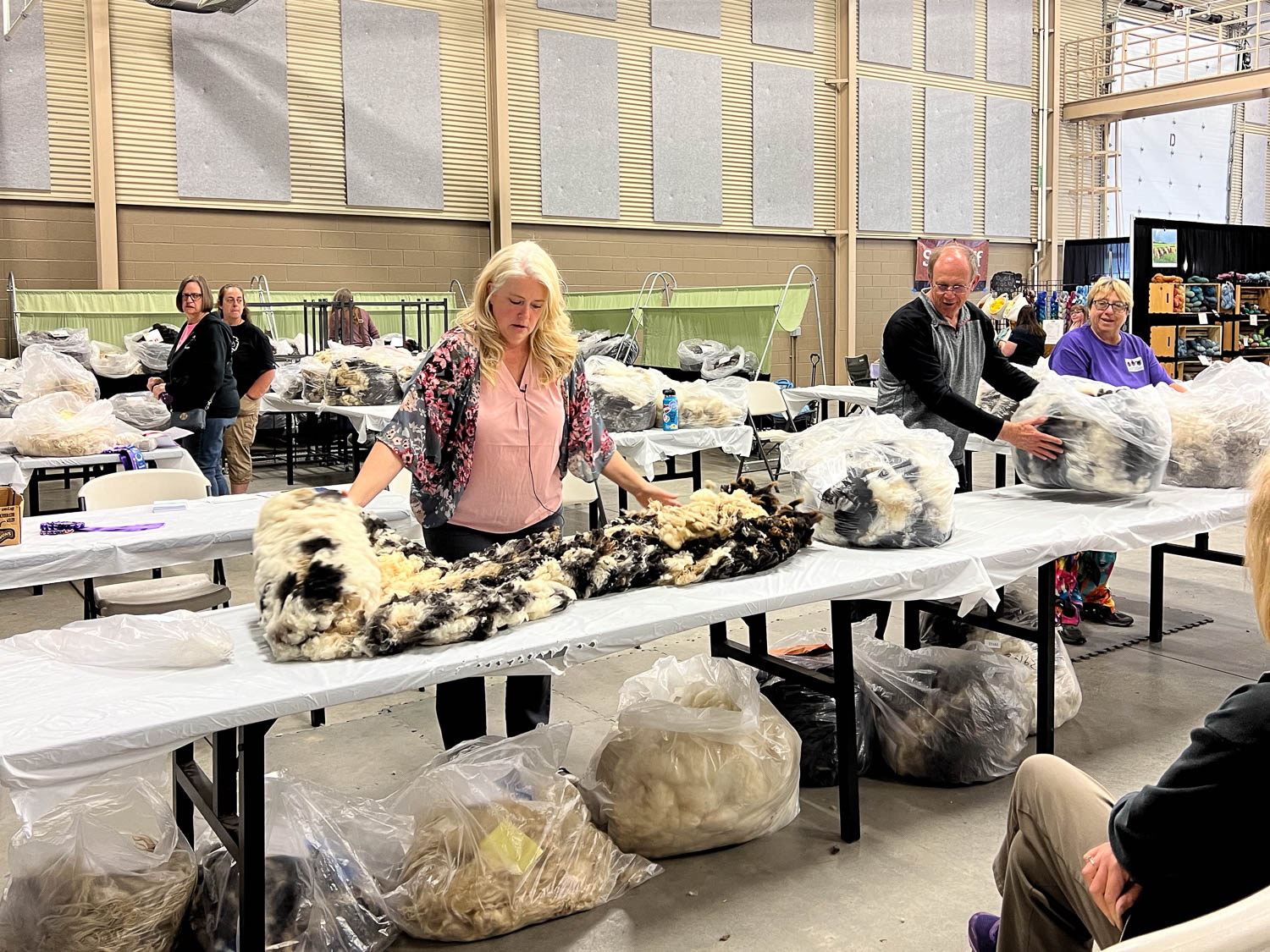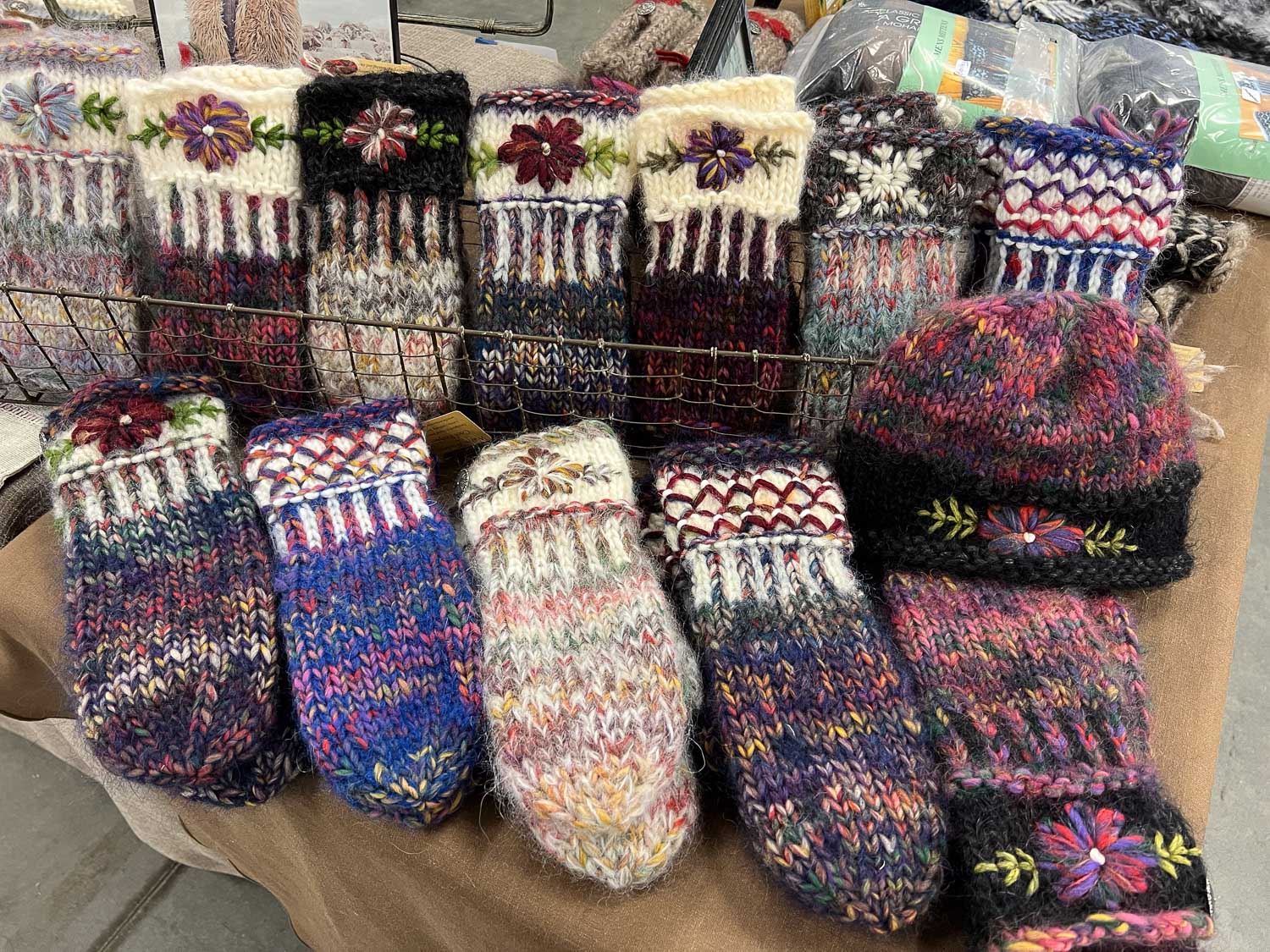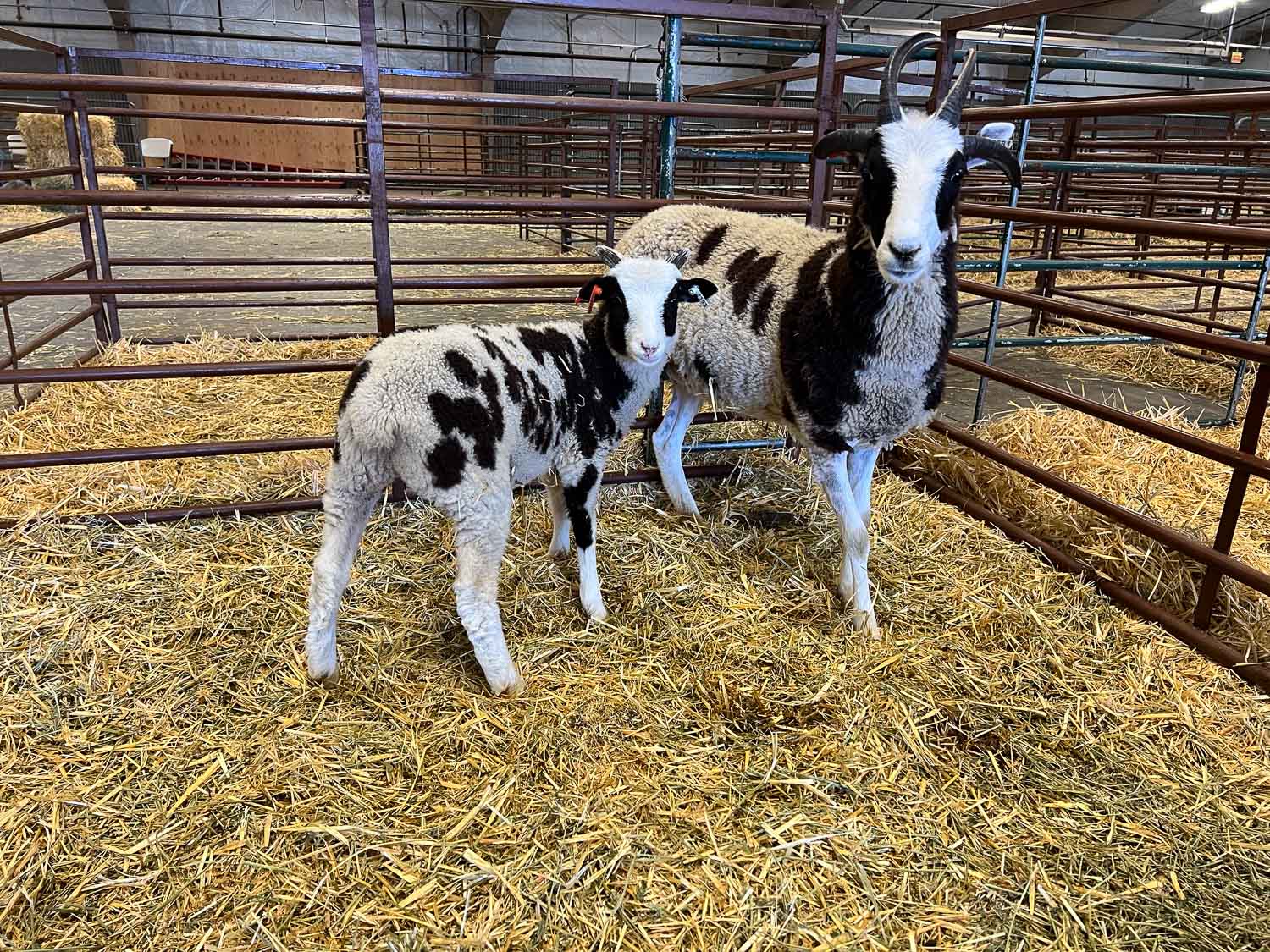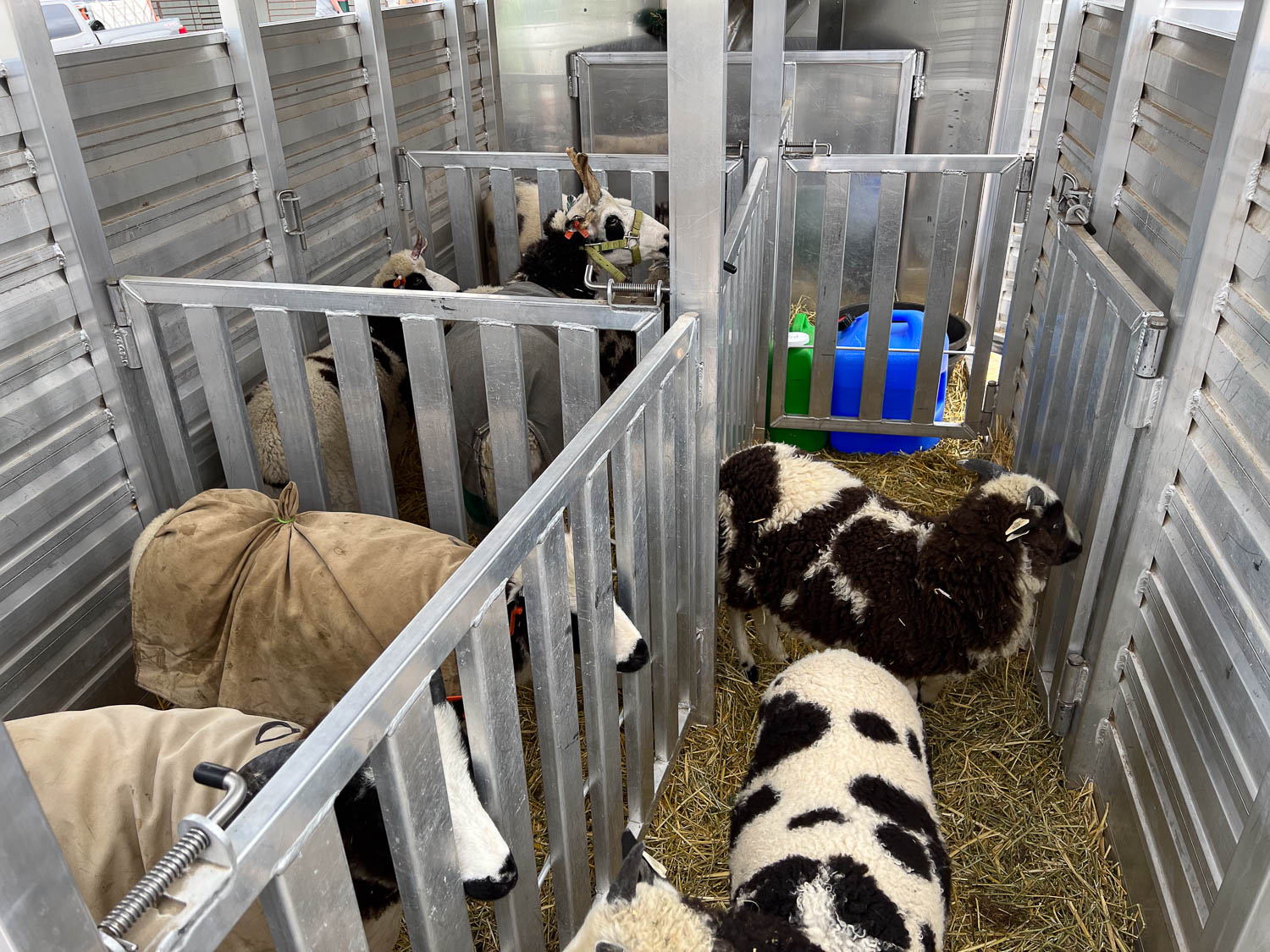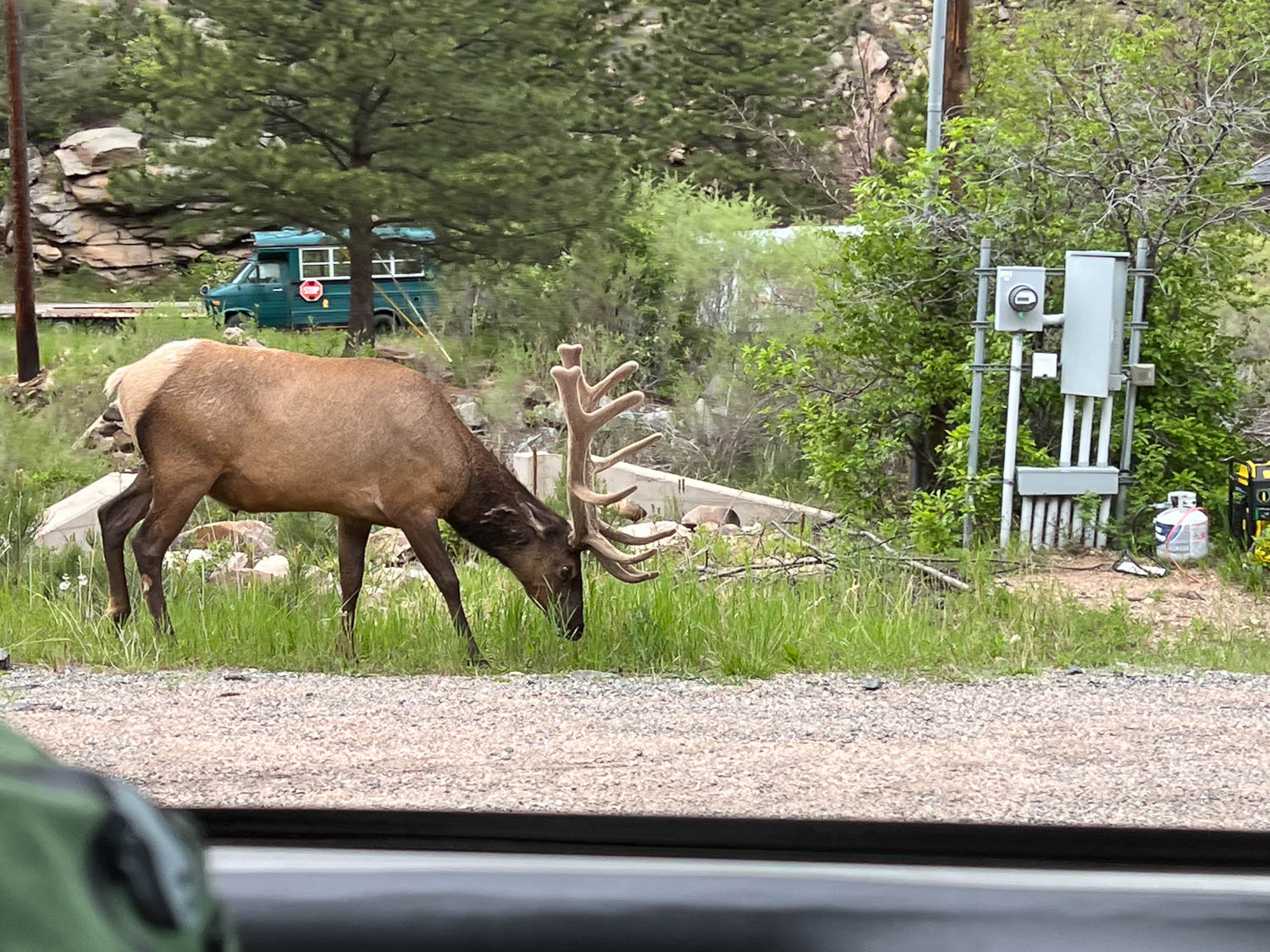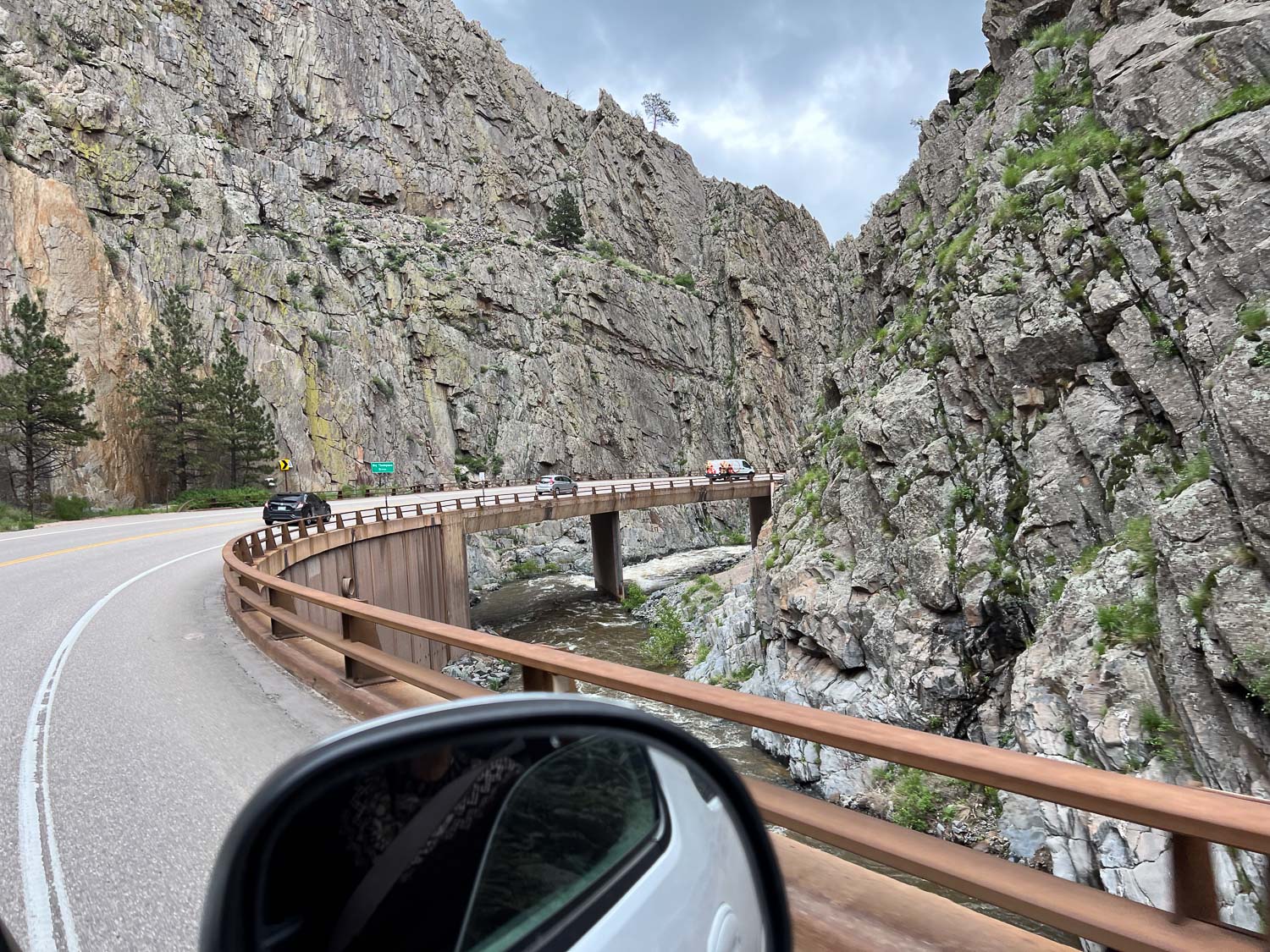
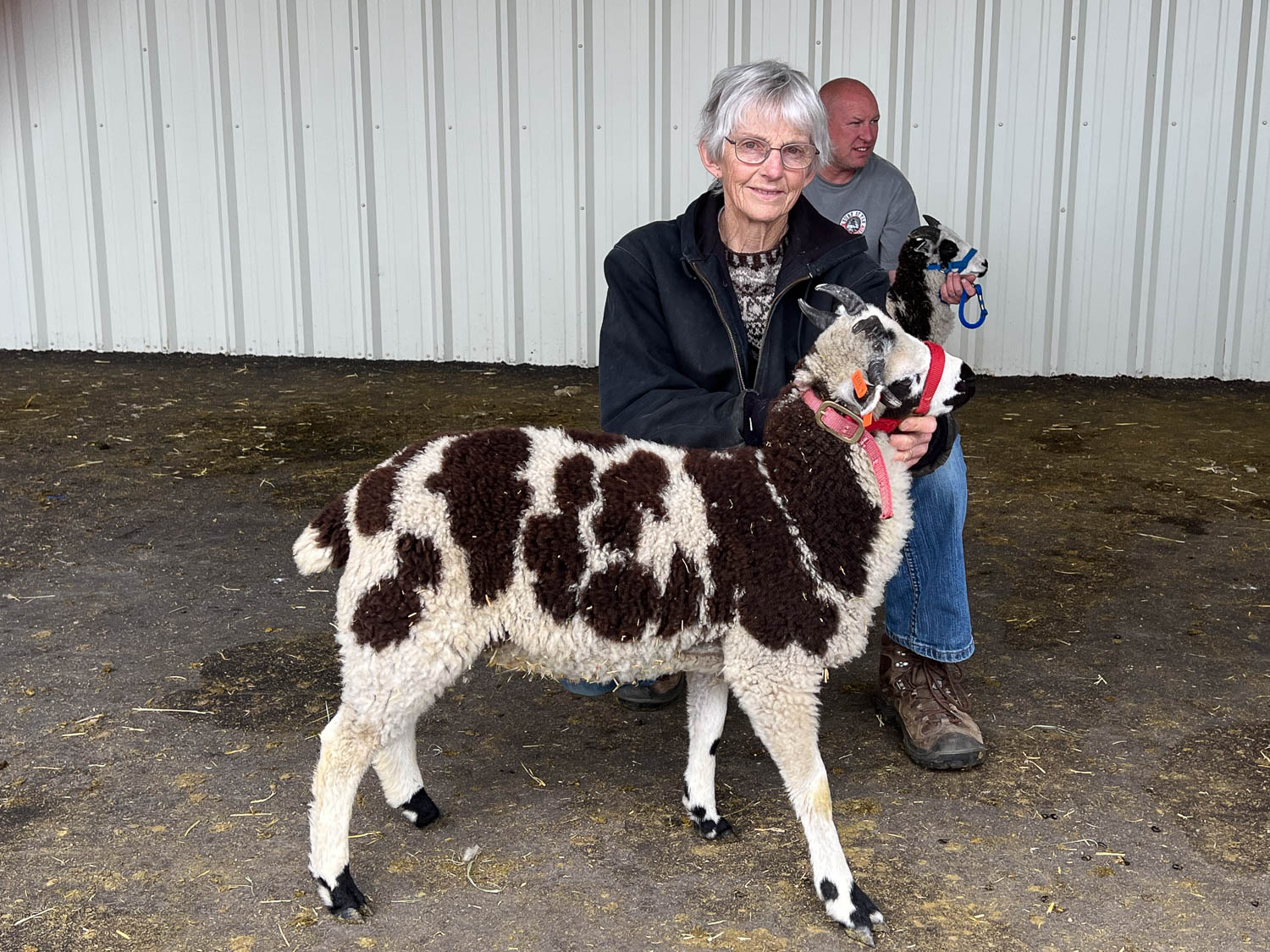
Hug a Sheep Day was last Saturday. We had beautiful weather for it and I did brisk sales in the shop. I was so busy that even though I took my wheel and fiber outside I never had a chance to sit at it. I also didn’t get many photos. We always like to do a group photo but I didn’t even do that until almost everyone had left. This is it for photos!
Jade is our most in-your-face (but in a good way) sheep.
Trista is next.
We had a lot of people earlier in the day but these are the hard-core sheep huggers who was left at the end.
Shortest Breeding Season
The last post was about breeding season that started for us on October 3. A week ago, only 24 days later, I called it quits (almost). I had five breeding groups and one non-breeding group. I get tired of feeding hay to all these different groups especially when there is still green feed in the pasture. But mostly I get tired of the rams tearing up the fences. Also, Hug a Sheep Day was the next day and two groups would cause trouble with that. The young ram, Clark was in the most accessible (to visitors) pen and I don’t trust him if someone stands right at the fence. In addition I thought that we might need to park behind the barn and that’s where Buster’s group was. Time to be done with all these groups.
I decided that Axle would get to remain with the ewes in case someone had not been bred and Peyton could keep his ewes for another few days. But that meant that Buster, Cayenne, Clark, and Spark (who had not been given ewes) would be back together.
I brought the groups in one at a time and separated the rams. That’s Buster in the pen. His nose is already bloody because he was ramming the panel to try to get to Axle, the young 2-horn ram in the middle of the photo.
Most of the ewe flock was back together now and that was Clark’s lucky day! That’s him in the background with his head turned away.
Meanwhile the other four rams went into their “buddy-up” pen. The point of this is that they are confined enough that they can’t do much damage. That doesn’t mean that they don’t hit each other but at least they can’t back up 10 feet and come charging.
After a few days of learning to be buddies again they went back to the ram pen with minimal fuss. They all had figured out the pecking order. Cayenne (above) is #2.
Cayenne. I love a nice two horn head.
This is Spark, Cayenne’s full brother, born this year. There is the difference a year makes. Cayenne was born last year.
Brothers.
Bide a wee Buster is #1 in the ram pen.
Buster is 3 years old and Clark is his son from this year.
Bookends?
Here’s the lucky ram who gets to stay out with the ewes for another few weeks. This is Axle, also a 2018 ram. He is wearing a blue marker…
…and I finally saw some real color. This is ewe lamb, Soprano.
Today I moved most of Peyton’s ewes back to the flock. Three of them were the Pope Valley sheep that came this summer, and they immediately found their two friends. That’s the five or them in the front. Large Triangle, 4-Horn, Small Triangle, White Ear, and Crooked Blaze in the back. (They do have names but I remember them better by what I called them at first.)
Start of Breeding Season
I’m behind on posts. The start of breeding season was October 3, the day after I got back from Texas. I have found that when I wait until October all the ewes are cycling and ready to breed. That tightens up lambing season in March.
Farm Club members came to help move sheep and we split them into four breeding groups and a non-breeding group of lambs.
This is part of Peyton’s group. He got 11 ewes.
Peyton is a BFL and these will be crossbred lambs.
Next was Buster. He was given 16 ewes.
All the rams had yellow markers.
It may be hard to tell here but Buster had his tongue out in all these photos.
Clark is next. He is Buster’s son from this year. It’s hard to pick him out in this photos because the ewes are all bigger than he is.
Clark was given 11 ewes.
Last we have Cayenne with 10 ewes. 

Last, there is the group of ewe lambs that I chose not to breed this year.
There were also two more ram lambs to keep away from the others and, at that time, still a few butcher lambs. This means a lot of juggling of fences and trying to keep free space in between these group.
Stay tuned.
Texas – All About the Grandkids
Less than a week and a half from the end of our road trip to Washington I flew to Texas for a short visit with the grandkids. I had to fit that in before Lambtown and the start of breeding season.
I got there on Thursday. The flight was in time for Katie to meet me in Austin and then pick up Kirby at school (pre-K now) and take her to her dance class.
I had to hide behind another window because Kirby kept looking through the door.
In the middle they changed from tap shoes to ballet shoes. The teachers helped each kid get the shoes on the right feet. They stuffed the bows in the toes of the shoes. Kirby didn’t like that and twice she pulled the ends of the bows out and I saw her twisting them around each other in an attempt to tie them. Eventually the teacher tied them and left them out–I think she tied a double knot. I meant to try and teach Kirby to tie a bow while I was there but actually I think she is too young. Next time…unless she already knows by then.
On Friday Kirby went to school and Mom and Dad were at work. Kasen usually goes to day care but he stayed with me all day.
He is very self-reliant for a toddler and can entertain himself well.
I enjoy taking the kids outside for at least part of the time. The weather this day was very pleasant.
We walked to the end of the smaller road where it meets the main road. Kasen loves trucks and tractors and anything with wheels. So we started watching and listening for trucks.
I moved him to the bank on the road where we could watch both directions (By the way, look at all those flowers–it’s been raining in Hill Country.) I’d hear a vehicle and ask if it was a truck or a car? “Car.” We waved. Some of the trucker’s blew their horns. This entertained Kasen for at last half an hour.
The road home.
Back home with a favorite book, “Brown Bear, Brown Bear, What do you see?”.
Outside again.
Katie and Kurtis have set up a play area for the kids–easier to keep track of them at this age than having them running through the dry grass and having to watch out for snakes and fire ants and scorpions.
They love the trampoline and I love the trampoline because the kids are contained. (I thought I had better photos but now that I see these iphone photos on my computer I realize that none are sharp.)
The sandbox (built by Papa Dan) is also a big attraction.
Back inside with puzzles.
You can hear when someone comes in the driveway. “Mama” or “Dada”!
Time to go see who it is.
It was Mama with Kirby. Time for the trampoline (champerline according to Kirby) before dinner.
Kirby orchestrates the play time. “I’ll be the princess and Kasen is the prince and you be the dragon (or alligator or monster) and you try to get me.” Or “You be the alligator and you are sleeping and I’ll be the princess and I’m going to get you.”
All I really wanted to do was to lie on the trampoline and look up at this amazing oak tree.
Sunset view.
I found this creature on the wall of the mud room. That’s one thing I don’t have to worry about here.
Friday night was movie night. Ice cream and popcorn and getting to sleep in the living room. Kirby chose a Starwars movie but really only wants to see “the princess” and Darth Vader.
Pumpkin Day. We went to a local nursery to find pumpkins.
After pumpkin selection we went to the chicken yard to select a couple of new chickens to replace some that had been killed.
Does someone have an attitude? The look on Kirby’s face reminds me of one of me at that age when I was looking at my little brother.
This was a short trip. I hope to see these kids again in January.
Road Trip to Washington – Day 7
The previous day was the last real day of sightseeing. This was Tuesday and we needed to get home.
Our campsite the previous night was at Beachside State Recreation Site south of Waldport, Oregon. The campsite wasn’t much since we backed up right to Hwy. 101.
However, in the morning we walked along the beach for awhile and were amazed at the mild weather and beautiful beach. Growing up in Sonoma County, CA (me) and Oregon (Dan) we both have the impression of the northern CA coast and Oregon coast as being wild, windy, and cold. This beach on this day was gorgeous and I could imagine sitting in the sun and enjoying a book…no time for that today.
We explored the beach for awhile…
…but had to get on the road.
We drove down the coast to Reedsport where we turned east along the Umpqua River. On the map I saw Elk Viewing Area. Sure enough, there were elk.
Crossing the Umqua River. By the way, all the rest of these photos are “drive-by”.
Dan likes to drive and that is fine with me. I amuse myself with photos, most of which will be deleted as soon as I see them. I wish I had a barn like this.
Or this.
Sign of California. I usually stop at the Mt. Shasta overlook when I’m driving south but this was through the window, the driver’s side window at that. The sky wasn’t actually that blue but I enhanced the photo so you could sort of see the mountain.
We had an amusing time making up stories about what all those Ford vans were doing.
There were about a dozen and all the same.
We passed them. They passed us. Finally they exited the freeway near Yreka.
One of the landmarks when driving on I-5 northbound. I finally got a photo.
Approaching the mountains north of Redding. Remember the fire photos from Day 1?
Crews are still at work removing trees.
It’s a sad sight.
And it was still burning.
Almost home. When driving south on I-5, we take 505, the cut-off towards the Bay Area instead of taking I-5 as it curves east towards Sacramento. I always love these hills.
That’s it! We made it home. The dogs were glad to see us. So was my daughter-in-law who wouldn’t have to do chores again!
One more thing. I was reading a murder mystery the next week (while on my next adventure) that happened to be set in the Olympic Peninsula. I had to photograph this passage to text to Dan.
Road Trip to Washington – Day 6
Cape Disappointment: ‘The first known documentation of the site was in 1775 by Spanish explorer Bruno Heceta, who named it “Bahia de La Asuncion,” or Bay of the Assumption. Then in 1788, British trader John Meares named it “Cape Disappointment” when he mistakenly believed that the mouth of the Columbia River was only a bay. ” (from the Park Service)
Yesterday’s blog left off at Cape Disappointment State Park. Here is the campsite the next morning.
There is a small lake just behind the campsite and in the morning I heard this osprey. I watched quite awhile trying to get a better photo. Eventually he (she) spotted fish and I watched him dive three times, always coming back to watch from this tree. I was surprised at his loud splashdown.
We drove over to the Interpretive Center of the Park. Outside the Lewis & Clark Center is the old Fort Canby, built to defend the entrance to the Columbia River and manned by U.S. Army troops from the mid-19th century through the end of WWII.
We spent a couple of hours here and I highly recommend it. Dan had recently read a book about Lewis & Clark so the details of their story was fresh in his mind. I didn’t take photos inside except for this that reminds me of something that looks like it might belong in a weaving studio:
This is a faking box and the thing behind it is a Lyle gun. The sign says “Propelled by a black powder charge the gun propelled a rescue line (hawser) to troubled vessels…The spiked posts were used to wind a rescue line in a special zig zag pattern to prevent tangling in flight when fired from a Lyle gun.” There were also paddles. “These paddles with detailed instructions in English and French were sent by rescue line to shipwreck victims.”I think it’s interesting that there was a special way of winding the line so that it would not tangle.
After spending a couple of hours at the Interpretive Center we went to see the second lighthouse in the Park. This view is from the trail to that lighthouse. We are now looking south to the breakwater on the north and can see the one on the south as well. The Columbia River entrance is between the breakwaters.
This is North Head Lighthouse, built 42 years after the Cape Disappointment Lighthouse was constructed because there were still too many shipwrecks in this area. It is still in service with an automated beacon. I didn’t realize that each lighthouse has a unique pattern of sound and light to aid in navigation, as well as being distinguished by the color and pattern of paint. (This one is under renovation.)
North Head is said to be one of the windiest locations in the U.S. This is the view of the rocky coastline from the north side of the lighthouse.
If you look closely at the rocky cliff you see cormorants–somehow gripping the steep rocky wall with amazingly little room to maneuver.
The beach stretches for miles just beyond this rocky point.
Sign in the forest on the trail that overlooks the beach. The area gets seven feet of rain per year, falling in the fall, winter, and spring. However, during the summer there is fog. Cape Disappointment is one of the foggiest places in the U.S. having 100 days of fog each year.
The plan for the day was to get to southern Oregon so that we wouldn’t have as long a drive the following day. It was time to get on the road. This is the bridge over the Columbia River.
Now to find the another part of the Lewis and Clark story near Astoria.
We walked around the Fort and along a trail the followed the river, but we didn’t spent a lot of time here, having had such a thorough look at the L&C story that morning.
We read about another historic site in the town of Seaside. Before we found the site we walked to the beach.
Looking north.
Eventually we found the Lewis & Clark NHP Saltworks, a small fenced area right in the middle of a neighborhood. The expedition had run out of salt and needed more before making the journey home. Three men from the expedition spent six weeks here boiling seawater to secure the salt.
Now we got on the road. I read that the Tillamook Cheese Factory was open to the public and I wanted to stop.
This is an amazing place. It must be just swarming with people during the summer.
You enter the factory and go upstairs to follow the hoofprints for a self-guided tour.
There is good signage to explain all the equipment and processes that you see. The tour ends at the cheese tasting area and of course a huge gift store.
After the tour we got back in the truck and drove. We found a beachside (and highway-side) campground just after dark.
Road Trip to Washington – Day 5
I left off in the last post going to sleep in the mostly dry truck listening to the rain.
View from the sleeping bag.
This is where we stayed. We didn’t have a good look at it the night before when it was raining and dark.
More of my slow-moving wildlife subjects.
We had spent the previous day on the east and north sides of Olympic National Park. We wanted to see the rainforest areas which are on the west side. The place we camped was near Lake Quinault and there are several access points to the Park along the road that follows the Quinault River.
We started with the Rain Forest Nature Trail that leads to Willaby Creek Falls, one of the points on the Waterfall Trail we were following.
Everywhere you look there are trees rooted over fallen trees. Every surface seems covered with something growing.
The park protects the largest old-growth forest in the Pacific Northwest. Rainfall varies from 12 feet (!) in the temperate rain forests on the west side to 40″ on the east side.
More of the Devils Club with a good view of he spines on the leaves.
Did I mention that this was a walk through the rain forest? And rain it did. We stood for awhile under the umbrella because is was raining so hard. On our way back this path was filled with water.
The forest was just beautiful.
Lots of fungus in addition to the ferns, shrubs, and trees.


Some of these photos were taken on the trails to Falls Creek and Gatton Creek waterfalls on creeks that flow into the lake. The next stop was at the World’s Largest Spruce Tree.
This Stika spruce is 58′, 11″ in circumference and 1000 years old.
It is 191′ tall and is one of six record breaking trees in the Park.
Sulightn was coming through the clouds as we drove down the road on the north side of the Quinault River.
It gave a special glow to the moss covered trees in the flatland along the river.
A wildlife shot of something other than a banana slug! Can you see the second fawn? I didn’t even see it until I was looking through my photos.
We left the rain forest and the Park and headed for the southwest corner of Washington and Cape Disappointment State Park where we hoped to spend the night.
There were campsites available so we reserved one and then walked took one of the Park trails that follows the coastline to one of two lighthouses in the Park. This is the breakwater constructed on the north of where the Columbia River flows into the Pacific.
Looking south from the Lewis & Clark Interpretive Center you can see the Cape Disappointment Lighthouse and the Oregon coast in the distance, across the mouth of the Columbia River.
The Cape Disappointment Lighthouse was built in the 1850’s. There is a Coast Guard Station nearby. According to Wikipedia: “The lighthouse had several shortcomings. The fog bell was sometimes inaudible due to the roar of ocean waves. It was discontinued in 1881 and moved … Also, the light was not visible to ships approaching from the north. This problem was corrected by building a lighthouse at North Head, two miles from Cape Disappointment. The first-order lens was moved to North Head … The lighthouse was electrified in 1937. In 1956, the Coast Guard intended to close the station, but retained the light when the Columbia River bar pilots protested. The light was automated in 1973. An observation deck has been built for the Coast Guard to monitor traffic and bar conditions.”
This is the view looking back north to the Interpretive Center (which we visited the next day). Also visible is the small cove called Waikiki Beach. The campsites were beyond that. We got back to camp about dark, our usual M.O., and ate an unexciting dinner, and went to bed.
Road Trip to Washington – Day 4
There has been a lot going on since I wrote about Day 3 and now but I really want to finish up our Washington trip before I talk about Texas and the sheep and the farm.
In the last post I ended with a photo of us in the truck at night.
Here is the view from my sleeping bag the next morning.
Later we wondered why we didn’t buy a bigger tarp since then we could have covered the whole camper, although I wouldn’t have liked not seeing out the side window. As it is there is some leakage around where the camper joins the truck bed and we had to make sure that our sleeping bags, clothes, etc didn’t touch the edges or they’d soak up water.
After a quick breakfast (granola and hot chocolate for me and Cheerios and coffee for Dan) we drove further up the road to the Hurricane Ridge Visitor Center.
The name was a clue to the weather on the ridge.
It was a wee bit breezy windy and cold. This view looks south into the Olympic Wilderness with Mount Olympus off to the right. The clouds kept moving but we never had a view of the peaks. We saw photos of this area in the summer–covered with wildflowers. I can imagine how gorgeous it is then.
There is a trail from the Visitor Center to the top of the nearby ridge.
View looking down on the Visitor Center and Mt. Olympus in the clouds.
View to the other direction and the road to the Visitor Center.
Walking along the ridge we tried to get a view of Canada. It’s out there across the Strait of Juan de Fuca, but mostly in the clouds.
More views along the trail.

I admired these flowers blooming so late in the season. They are in the sunflower family: Pearly Everlasting.
Goat’s Beard lichen.
There are no roads that go all the way through the park. From Hurricane Ridge we needed to go out the way we came in before our next stop. The road goes through Port Angeles and we decided to make a stop for gloves. Why I didn’t bring decent gloves I don’t know. I guess, not having worn them all summer, I didn’t know where they were, and it’s hard to imagine cold and rain when it’s 90 degrees and so dry, so I didn’t look very hard.
We both bought gloves. Next stop was Madison Falls at the edge of the Park near another road that follows the Elwha River.
It is a short walk on a paved trail to see the falls.
At this point we were thinking about where we would stay that night. As on all of our trips there is always more to see than we have time for. This was Saturday and we needed to get home on Tuesday. That left Sunday and Monday for more time in the park with a long drive on Tuesday. The bulk of the Park takes up the northern part of the Olympic Peninsula but there is also private and tribal land along the northern coast, the far northwest corner of the state, and the western portion. I wanted to go to that farthest most point of the continental U.S. but we were going to run out of time to do that and spend time in the rainforest. There is a narrow sliver of land all along the Pacific coastline that is also part of the Olympic NP so we decided that we would camp there for the night. That decided, we stopped at the next waterfall on our Waterfall Map.
The trail to Marymere Falls was also within the Park.
This waterfall is on Falls Creek and drops 90 feet. Take a look at the log at the top of the falls.
It made me think about the amount of water that must flow in this creek at times. That is a whole tree that is stuck at the top.
Magnificent trees.
We were walking by this tree and I saw a young woman trying to prop her phone on the ground so that she and her friend could both be in a photo of this huge tree. I offered to take the photo and then she reciprocated.
We got to the coast late in the afternoon.
This was the first beach where we stopped. We drove south to find that the first campground was full. There was plenty of space in the other campgrounds where we stayed so we hadn’t anticipated this. The beach. RV camping. Saturday night. None of the four beach campgrounds had campsites left.
When you’re in the national forest you can camp anywhere, but the rules are different in the national park. And we do follow rules. Our plan was to see the rainforest part of the Park the next day so we didn’t want to leave the area. Between the coast and the access point to the Park there was mostly Quinault Reservation land along the highway and we couldn’t stop there. In studying the map I found some campsites in the Forest land to the north but it was getting late in the day and it was difficult to tell the condition of the roads. There was a sliver of Forest land that was accessible from 101 with Reservation land on one side of a USFS road and National Forest on the other. We took that road as it was getting to be dusk. The road went up…and up. We hit fog…or a cloud. The rain started. We were watching for small signs nailed to the trees that had arrows and indicated USFS or Reservation. You really couldn’t see anything at that point. Just a narrow tunnel of a road in the bushes and trees. It rained harder. Eventually we turned around and went back down to where there was a wide spot on the road. We put the tarp on top of the truck, ate a hasty dinner (more canned beans), and got into sleeping bags.
Saturday night lodging.
Road Trip to Washington – Day 3
We certainly could have spent more time at Mt. St. Helens NVM (Day 2) or gone to see Mt. Rainier, or any number of other interesting places in Washington, but now we were on to our primary destination, Olympic National Park. We were concurrently following the Olympic Peninsula Waterfall Trail that Dan had read about.
Our first waterfall on the trail, and before getting to the park, was Murhut Falls on the Duckabush River.
I first wondered about the name of the river. You have to duck under bushes if you don’t have a ready made trail? No, in a side trip to Google I found that it is an Indian word meaning red face, referring to reddish bluffs in the area.
As we found in all our wanderings in this area, the forest is dense, damp, and spectacular.
A wildlife shot along the way. So far the only wildlife I was photographing was slow moving.
About 3/4 mile up the trail we found the falls.
The waterfall trail guide says that this one is 120 feet with another 35 feet below this point. Photos don’t do any of the forest scenery justice.
Weather continued to be damp and misty but not much real rain.
You can certainly tell that this is a wet climate as opposed to most of the places we find ourselves hiking and camping.
We continued north with the Hood Canal on our right and heading towards the Strait of Juan de Fuca, the body of water that separates the U.S. from Canada. I had thought that we’d have time to visit some of the nearby islands, but that will also have to be another trip.
We stopped at the Visitor Center in Port Angeles to pick up a map, but didn’t spend much time there because we were anxious to get to the Park and figure out where we were going to spend the night. We found that the Heart O’ the Hills Campground had spaces so we parked in one and then went hiking.
The forest was stunning. The trees were massive.
Vegetation is dense.
There were lots of trees down throughout this part of the forest, but it doesn’t take long before ferns and herbaceous plants are growing on the downed trees and the forest covers them over.

This plant with huge (up to 15″) leaves was everywhere in the understory (see the three photos above). It is called Devils Club (Oplopanax horridus) and is endemic to dense, moist, old-growth forests of the Pacific Northwest. It has a long list of uses by Native Americans from medicinals to face paint and is covered with irritating spines.
Dwarf Dogwood, Cornus candensis.
I didn’t even try to identify fungi, but took photos because I like to share these with a friend who dyes with mushrooms.


We walked until we reached the creek and were undecided how far the trail continued. But it was getting to be dusk and we decided that we’d better turn back.
This forest would be pretty dark when the sun was down.
I’ve lost track of our camping meals because they are not exactly gourmet food. On this trip much of the time it was dark by the time we got the camp-stove out and we just dumped a couple of cans of chili in a pan and put hard-boiled eggs and cheese on a salad mix from Safeway. Our sleeping accommodations in the camper shell are just as fancy. We sleep on top of a platform that Dan made so that you can pack all the stuff underneath.
Fortunately it was warm enough with sleeping bag on top of my thick sheepskin. (Maybe it wasn’t that warm, seeing that I’m wearing my wool beanie and a sweatshirt.)
Oh, I have a wool blanket with me too (handspun Jacob by the way). This is the view out from my sleeping bag.
More tomorrow.
Road Trip to Washington – Day 2
The first day of this series of blog posts was rather boring–just driving north to get to where we were going. It will get better, at least for those of you who like scenery of our fabulous country.
We arrived in the dark at Doug and Karen’s place in Newberg, Oregon. They have bide a wee farm and raise Jacob and Navajo-churro sheep. I have known them for years and have some of their sheep but have never been to their farm. The next morning we followed them around as they did chores.
Karen lets the ewes out into the pasture where some of them race to see who will be first to find the pears that may have dropped since the day before.
Some sheep stayed behind but this group checked out the pear snack department and then traipsed back to the barn for the morning hay.
Nearby we met Windy Acres Lightning, who happens to be Buster’s sire.
This is inside the barn. There are a couple of Meridian ewes here but I don’t think this is one because she has a bideawee ear tag. I like these feeders and think that we should try making some.
This is another barn on the property. Those are some of the ewe lambs and their guard llama.
Across the road (the property is split into 4 pieces by the country roads) there are more rams. This is Hunters Glen Roy Rogers and his wether buddy. I sure which that I could get some of these horns like Lightning and Roy Rogers on my sheep.
After breakfast we got on the road to our real destination.
Here is a more welcoming sign along with pretty flowers.
We were headed to Mt. St. Helens National Volcanic Monument for our first stop. We followed State Route 504 along the Toutle River and stopped before entering the NVM at this site where the sign said Sediment Retention Structure. We followed a trail through the beautiful woods.
After a short walk we reached the dam. A sign told us: “As the North Fork Toutle River re-formed and carved new channels in the deposits [after the eruption in 1980], it became one of the world’s most sediment-laden rivers. The U.S. Army Corp of Engineers build the Sediment Retention Structure to trap sediments before they are carried further downstream. Sediment clogs river channels, worsening floods, and degrades water quality and aquatic habitat.” It is hard to tell the scale from my photos but this is a massive structure.
Here is an aerial view on the sign.
This part of the structure is on the aerial photo but is the “little” part at the left end of the horizontal part of the retention structure and to the right of the spillway.
We continued on to the NVM. There are plenty of interpretive sites before you get there, some put out by the state and some by Weyerhaeuser. From their site: “Weyerhaeuser Company began more than 100 years ago with 900,000 acres of timberland, three employees and a small office in Tacoma, Washington. Founded in 1900 by Frederick Weyerhaeuser, we’ve grown to become one of the largest sustainable forest products companies in the world.” I was interested in the divergent viewpoints about the response to the destruction caused by the 1980 eruption. Weyerhaeuser began to reforest as soon as they could, planting millions of seedlings. Their sign shows a contrast between their now almost 40-year-old forests and the vegetation across the boundary where the response was to let nature take its course. Both arguments are convincing and I am not bashing a giant lumber company. After all I live in a wood house. The film that we saw in the Mt. St. Helens NVM Visitor Center, however, describes how quickly the communities begin to recover, starting with gophers, of all things, that survived in their burrows under ash-covered areas and moved soil and seeds to the surface. The film points out that the communities are now at their most diverse and as the natural sequence of forestation continues there will eventually be less diversity as one sees in a mature forest.
I took the photo above because I wanted to share the scene as we traveled through this particular part of the forest. I think these are noble firs and you can sort of tell what I was trying to portray here. It was almost like you couldn’t focus on them. The right angle nature of the branches gives the effect of horizontal lines throughout. It was striking as we drove through.
It isn’t possible to see all of the NVM in one day. No road goes all the way through and it is a lot of driving to get to other entrances. We chose this northwest entrance and realize that we’ll have to come back some day.
I liked this closeup of the USFS sign–see the detail in the tree? Someone had to think of that.
We started at the Visitors’ Center called Johnston Ridge Observatory. Here is a model of the terrain and as the story is told different color lights come on to show lava flows, ash deposition, etc.
View of the mountain. We never got a clear look at it because of the clouds. It is amazing to think that the whole area in this photo was impacted by the blast and that everything in the middle part of the photo is deposits from the volcano.
Coldwater Lake was formed when volcanic debris blocked Coldwater Creek.
A wildlife shot!
We stopped at an overlook before leaving the area and watched as the clouds moved past the mountain. The eruption of Mt. St. Helens was mostly from the side and it created a valley that faces mostly north (the cloud filled part on the left of the photo).
We caught a few views of what is left of the mountain.
This definitely warrants a return trip.
We headed north for our next destination and found a place to camp but it was almost dark and I guess I didn’t get any photos there. Stay tuned!