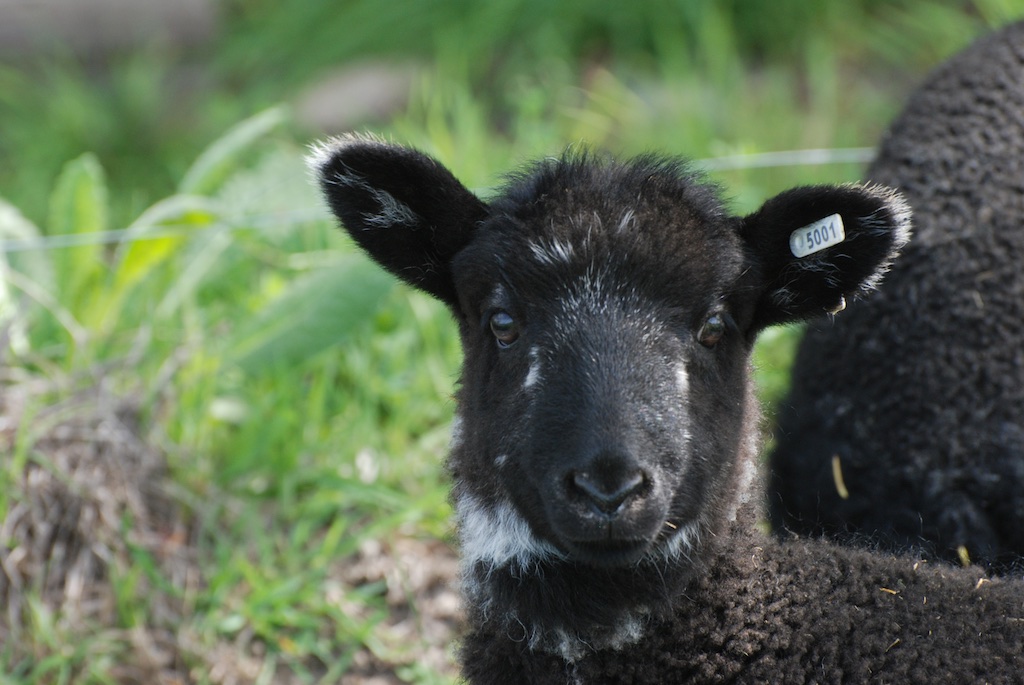
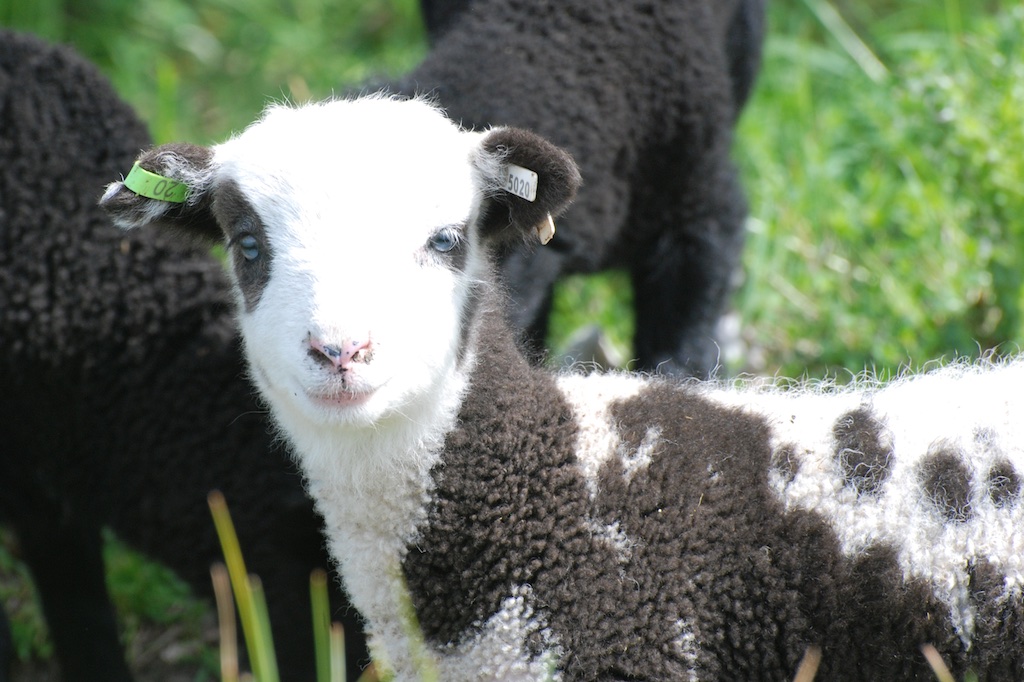


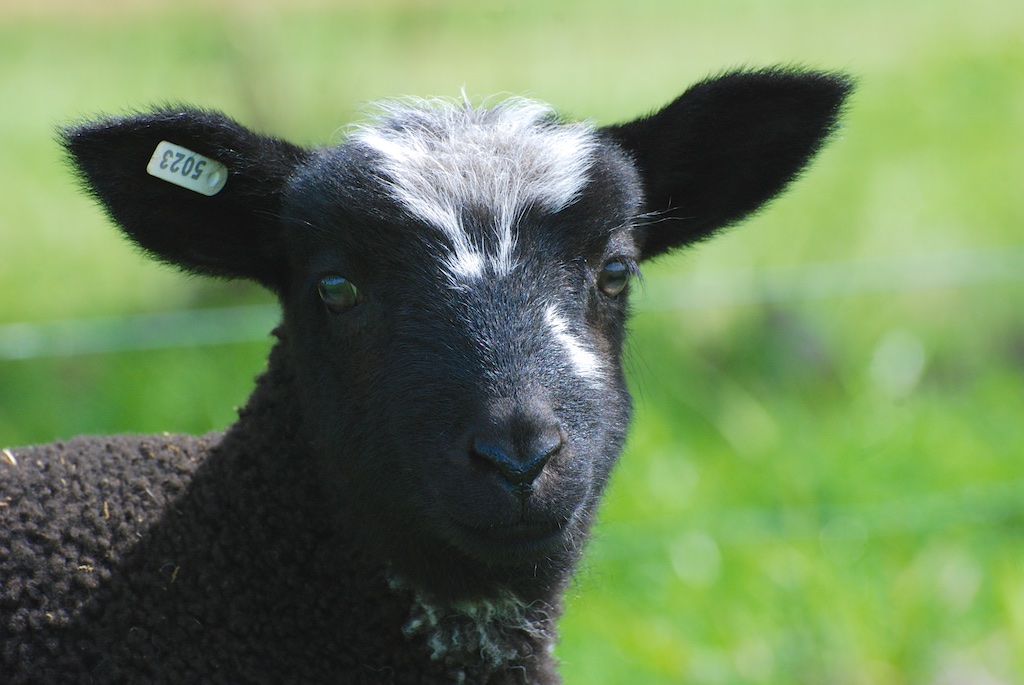
Lamb Portraits
1
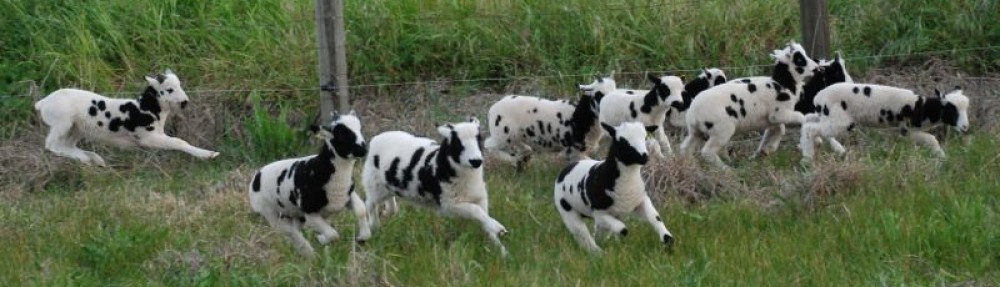
I know, how could there be too many lambs? When there are too many it’s hard to get that perfect jumping lamb photo. There is always another lamb in the wrong place. Here are tonight’s attempts. (Thank goodness for digital cameras.)


This one is today’s favorite:
I finished this project a couple of weeks ago but haven’t had time to share it. My friend, Irene of Cotton Clouds, is involved with The Natural Dye Project sponsored by Mayan Hands. She asked me to create a baby blanket out of the Friendship Towel Kit that she is selling to support the Guatemalan women in this project. The towel kit makes 4 towels using naturally dyed 8/2 cotton.
 I added Monte Cristo cotton boucle to the kit and came up with…
 …two baby blankets, each using Monte Cristo and 8/2 cotton in the weft but using different patterns. It is easy weaving but things don’t always go smoothly.
  I happened to look at the first blanket winding its way onto the cloth beam just before starting the second blanket and saw 7 warp threads that should have been woven into the blanket.Because of the texture of the boucle yarn I hadn’t noticed the error while weaving. Now I can see it but it wasn’t obvious when I wasn’t looking for it.
  Here is the problem. When threading the heddles I inadvertently used 7 heddles from the Shaft #5 when I should have used Shaft #4. This is a 4-shaft structure so #5 didn’t lift at all. It is an easy fix for the second blanket. Just tie Shaft # 5 up to each treadle in which Shaft #4 is engaged.
  That works.
 However, the only way to fix Blanket #1 was to needle weave all 7 threads in after it was off the loom. That should be easy (over-under-over;over-under-under), but it took hours because of the nature of the boucle yarn. Thank goodness it was only 7 threads.
After weaving the blankets aren’t done yet. Wet finishing is an important step of weaving. It allows the yarns to “bloom” and fills in the spaces that are there when the yarns are under tension. It turns a bunch of interlocked threads into cloth. It also results in shrinkage. See the difference in width in the strip that has not been washed and the finished blanket.
 Here is a detail.
The final step is a photo session.  No baby was available so I used one of my kids’ teddy bears.
 My old teddy bear (I won’t tell you how old) featured in some of the shots too.
You can purchase this kit from Cotton Clouds at this link.
I went to the barn a little after 6 a.m. this morning and found what looked like a dead lamb along with two lambs who were up and nursing. The lamb that was flat out on the ground had membranes over his face and was cold and still. I pulled the membranes off of the nose and surprise! That lamb wasn’t quite dead yet. It made a little sound and started to breath raspilly. (Spellcheck says that’s not a word, but it works for me.)
First, get lamb warm. The heat lamp wasn’t fast enough… …so I brought it to the house.
 After it started to revive I substituted a heating pad for the hot water.
 Tube feeding with colostrum was next. Fortunately I had a couple of ounces in the freezer.
  I switched the heating pad from under the lamb to over the lamb while Rusty made sure he didn’t go anywhere.
 I carried the whole bundle back to the barn so I could get on with chores. That’s when I set up the heat lamp. I also milked some colostrum out of the mom and tube fed the lamb another few ounces.
 It got up before long and now sports the most glamorous in lamb-wear. If a ewe lambs with a single lamb in the next few days I will try to graft this one on. That will be another post.
 These are the other two sets of triplets and their moms.
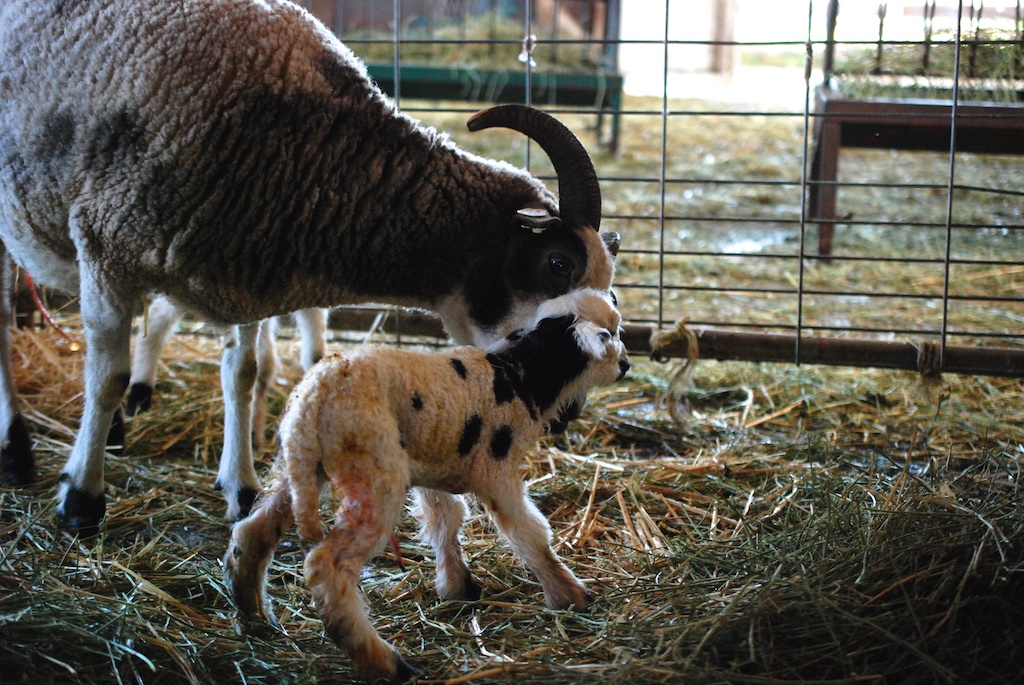
Lambing moved into high gear today. It’s been one ewe a day until now. The morning started with Ginseng and twins.
 Next was Maggie. I pulled twins but one was dead. This one has a long story that I won’t go into now because I still have to go back to the barn. Maggie and the remaining lamb are at the UCD Veterinary Hospital for the night. Maggie was low in potassium and that needs to be dripped in over a 24 hour period.
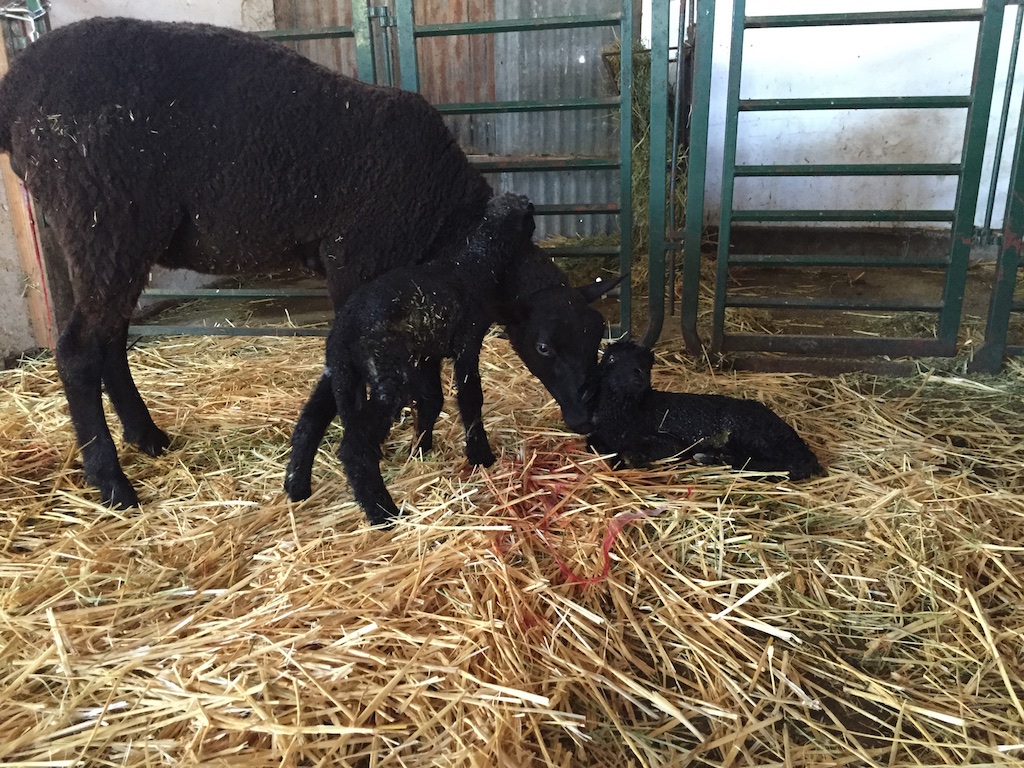 Esmerelda is a Jacob-BFL cross who is just a year old. She delivered 7.8 and 8.8 pound Jacob-cross lambs. That first lamb was on its feet within 5 minutes.
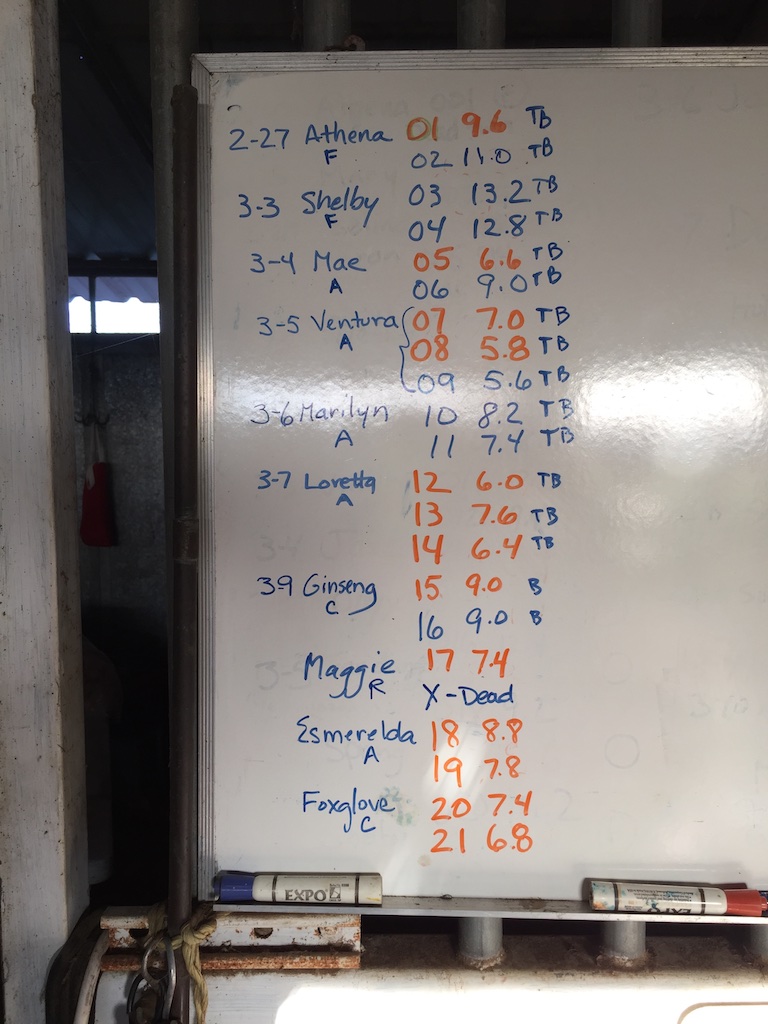 Foxglove is another Lilac ewe with lilac lambs (although it’s hard to tell when they are wet).This is the kind of lambing I like. Put her in the barn. Go to the house. Come back to the barn and there are lambs nursing. Here is the count so far. By the way the TB means that I’ve banded Tails and given BOSE. Rams and ewes are color coded (blue for boy)
Lambing count so far: 4 sets of twins and 2 sets of triplets. I hope this is not indicative of the rest of lambing season.
After checking Ventura every so often for lambing progress I found her with only a tail hanging out. Not a good sign. I don’t know any other way to deliver a lamb in that position other than to push it back in and find some feet to pull. This is lamb #1. With lamb #1 at 5 lb 6 oz and in an abnormal presentation that’s an indication that this is a triplet delivery.Lamb #2.Here are all three.
Ventura with all three lambs the next day. They clean up pretty well.
Here is what I found in the barn this morning:Loretta had one small lamb that had obviously been up for awhile and there were multiple fluid filled membranes. Triplets again? Yes.The second two were trying to come at the same time. Match up a head and two feet and pull that one. The next one comes easily.


 That third lamb took quite awhile to get going. I let her stay in that sunny spot as long as the sun was there.
 Not triplets but three happy Farm Club members and three babies.
I taught a Learn to Weave class this weekend. There were three people who worked diligently all weekend and finished their samplers. I don’t make everyone use the same yarns. Willard used Jaggerspun Green Line, an organic Merino yarn.
 Ruth used Ashford Tekapo yarn. I didn’t get a photo of Marion’s piece until our group photo but she used Imperial Stock Ranch Erin yarn.
 I wish that I had a separate classroom that could remain set up for classes and Spinners Night Out but we just have to move everything aside to turn the shop into a classroom.
And this time we made room for dogs also.
 This is Bear, who came for the weekend. I don’t usually invite dogs to functions here but made an exception for Bear and her owner. Bear is a Leonberger and this is what Wikipedia says in addition to describing a “generous double coat”: “When properly trained and socialized, the Leonberger is vigilant, loyal, and confident in all situations. Robust, adaptable, obedient, intelligent, playful, and kindly, the Leonberger is an appropriate family companion for modern living conditions”. Evidently that goes for weaving classes too although at times I think Bear was a bit bored with us.
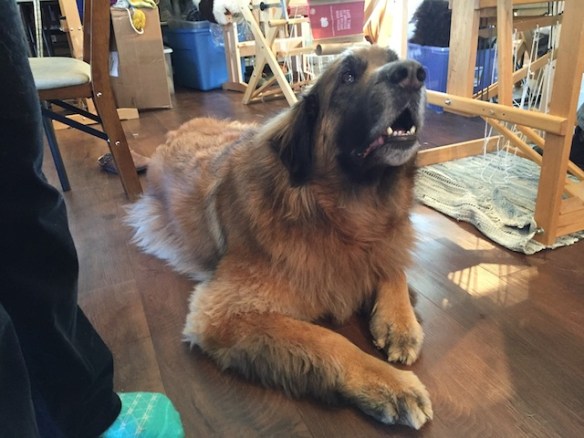 “Mom, can’t we go yet?”
Can you tell from this photos how large bear is? It’s not just the camera perspective.
And then there is Rusty who gets to come in the shop when he hears gunshots and needs to feel safe. At the end of the day.
When weaving the yarns are under tension on the loom so they look thinner than they will at the end of the process. In addition the yarn looks thinner on the cone than if it is wound in a skein. So there is some faith involved in planning a weaving project. It is important to know how the yarn will look once it is relaxed and after the very important step of wet finishing. This is one dramatic example of the same yarn on a cone and wound in a skein and washed.
Here is a project that I just finished:
.This is Jaggerspun Maine Line 3/8 sett at 10 epi (that’s ends per inch, or the number of threads wound in an inch, for you non-weavers). That photo is off the first blanket I wove as it was going around the cloth beam. The two colors alternate in the pattern blocks.
 This is the second blanket on the warp. I didn’t have enough of either of the warp colors so I used a third color and wove the whole blanket in the same color. Notice how much space there is between all the warp and weft threads? It’s harder to weave this way with it so open. And this is where the faith comes in. It sometimes takes awhile for brand new weavers to have that faith that it will all work out in the end.

The photo above shows what the blankets look like off the loom and not under tension and there is a greater difference after washing. (Not the color difference–that is the lighting. I took the photo above in the evening because I wanted to get these washed that night.)
 The photo above and below show these blankets after washing and fulling.
I just posted springtime photos taken near my house. Then I looked at my iPhone photos and found some from Across the Road.  Almonds blooming along the canal.

 Mushrooms.
 Mustard.
 Even thistles are pretty.
 Wild radish.
 The alfalfa field. Rusty has posted in quite awhile. There are a lot of dog photos so I’ll let him use the computer tomorrow.
I hope that winter is not over for California because it barely started. Our water situation is dire. However that doesn’t mean that I won’t admire the fabulous colors of an early spring. I took all of these photos within about 30 feet of my house.  The acacia tree in the front yard.
 The almond tree near the driveway.
 Recent rain (two weeks ago now) and warm weather bring out “the air force”.
 In the pasture.
 Shepherd’s purse in the pasture. In a pot in the backyard.
 Western redbud near my shop.

 This one is not the best photo but I love the colors.
 Meridian Jacobs' Blog