In the 2025 Weaving Recap blog post I included a photo of baby blankets still on the loom and said that warp had been on the loom since October. How about August? That’s what I found when I looked back for photos of warping this loom. Don’t ask me why I decided to wind a warp this way, but it seemed like a good idea at the time.
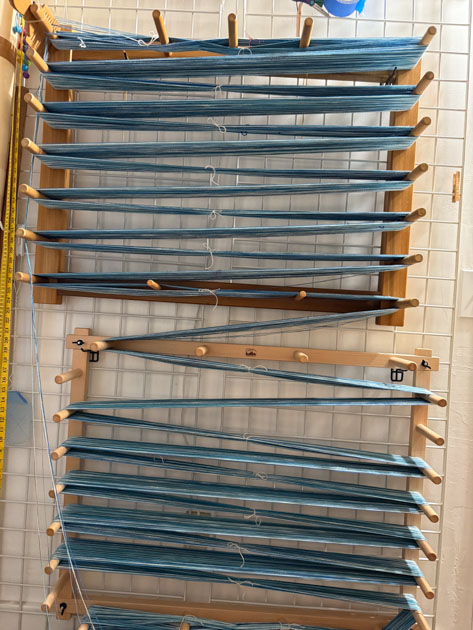
I used a paddle so each pass was four threads and I made a 26 yard warp.
I have wound 20 or 30 yard warps sectionally using the traditional method for sectional warping or using the AVL warping wheel. But I got this idea of using two warping boards and thought, why not?
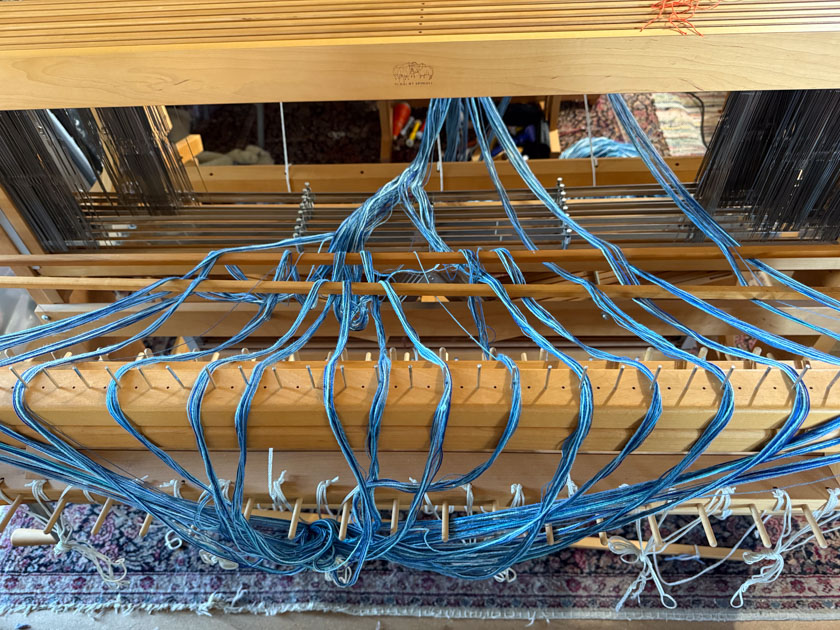
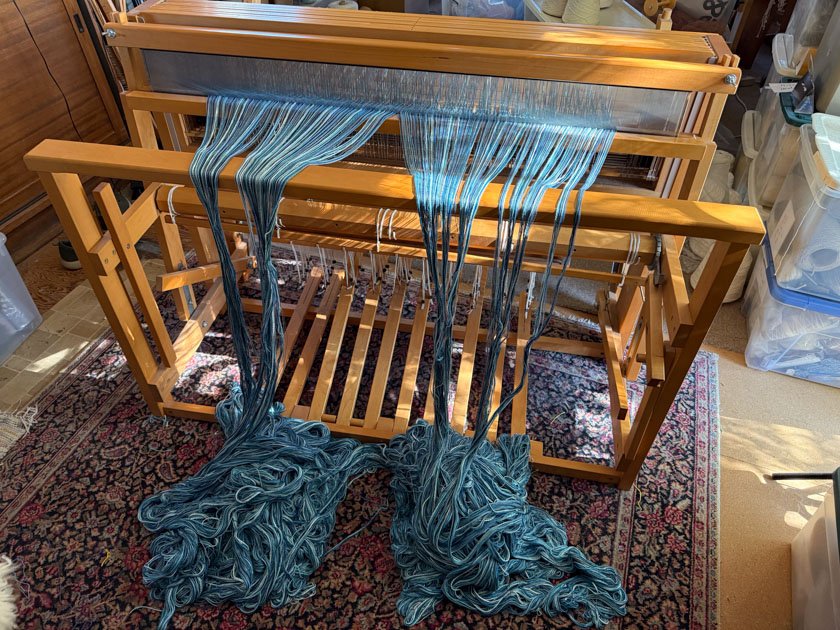
I had to wind two bouts to accommodate all the yarn. My goal was to use up odds and ends of cones of yarn so the second warp. That meant the second warp would be different from the first, but I wanted the colors distributed throughout. I spaced the first one out in the raddle.
Then I added the second warp in the empty spaces.
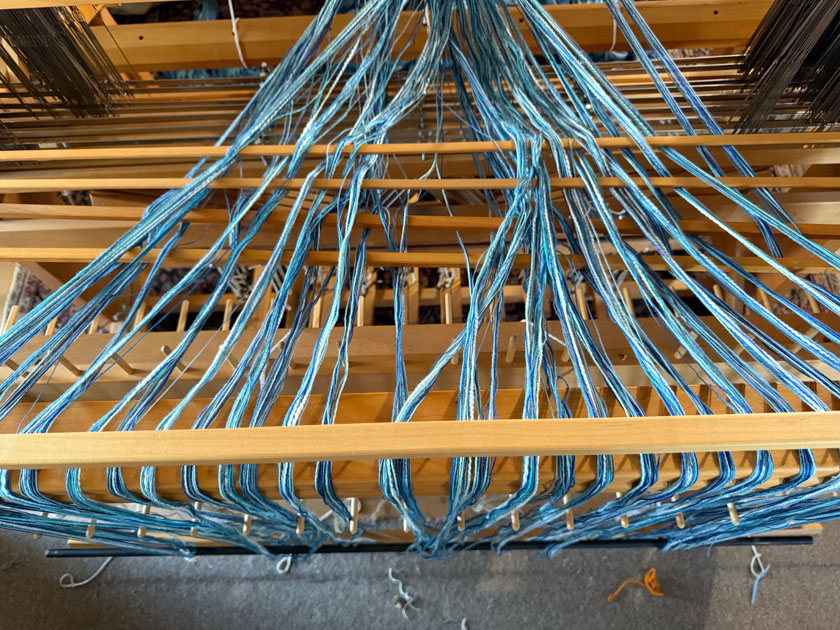
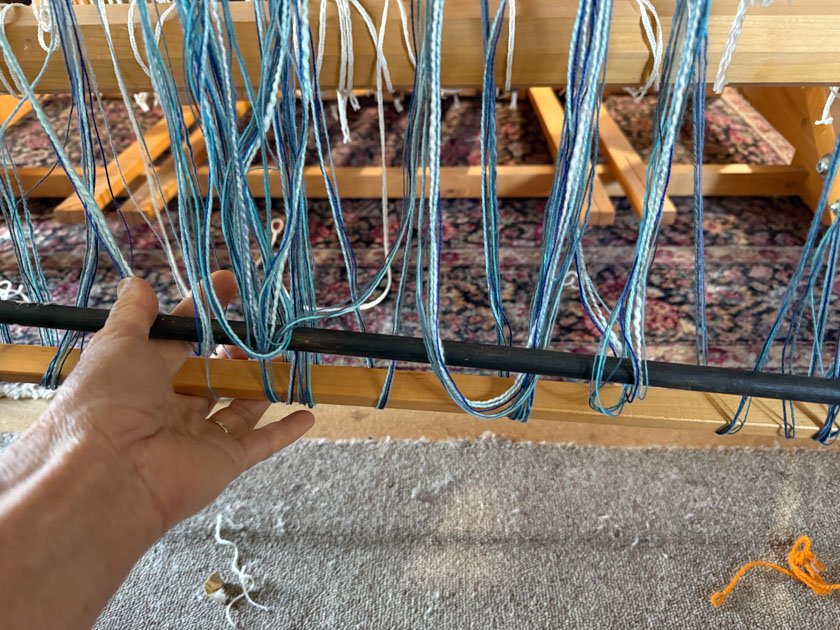
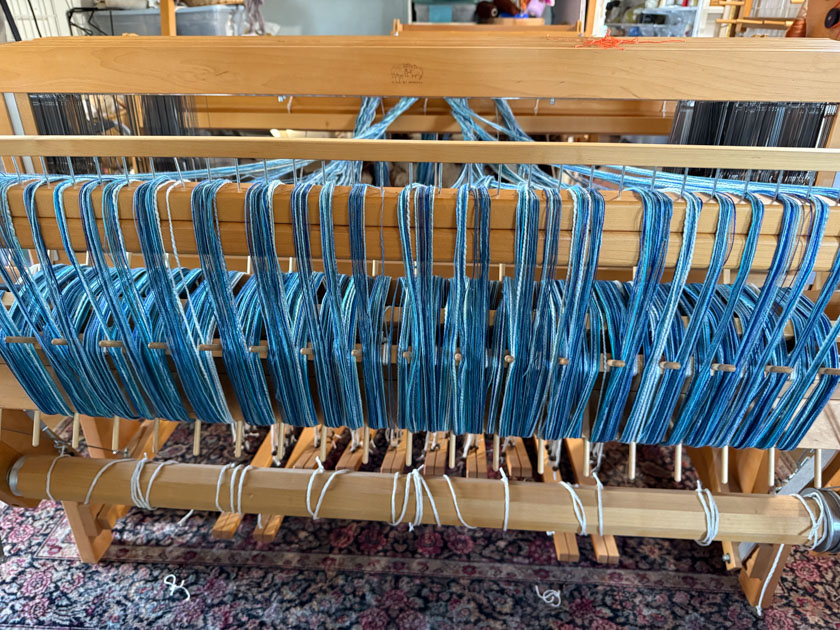
I used two end sticks instead of trying to intersperse the two bouts onto one stick.
This looked good.
This side was a little messier, but it all worked out eventually.
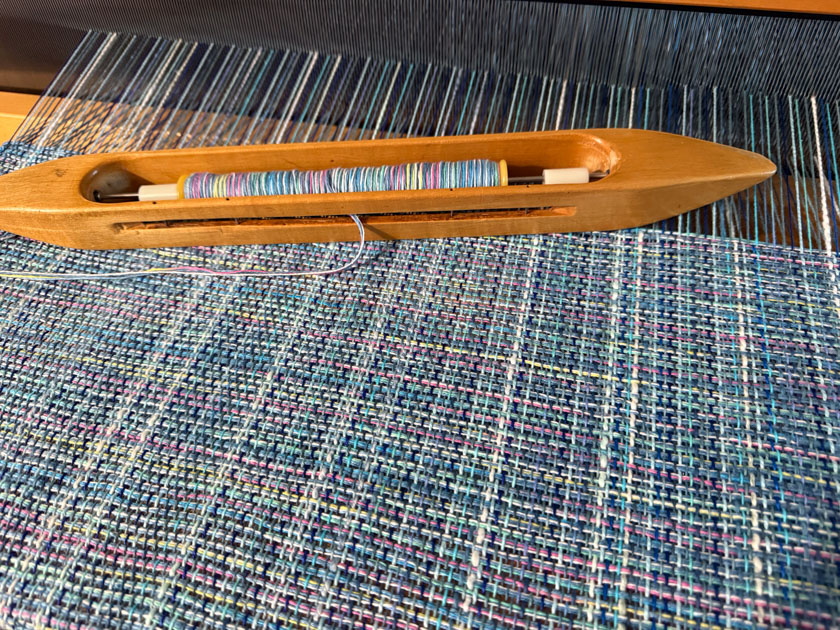
Weaving in progress.
I had an order for blankets so I cut some off the loom early and didn’t get back to that warp until recently.
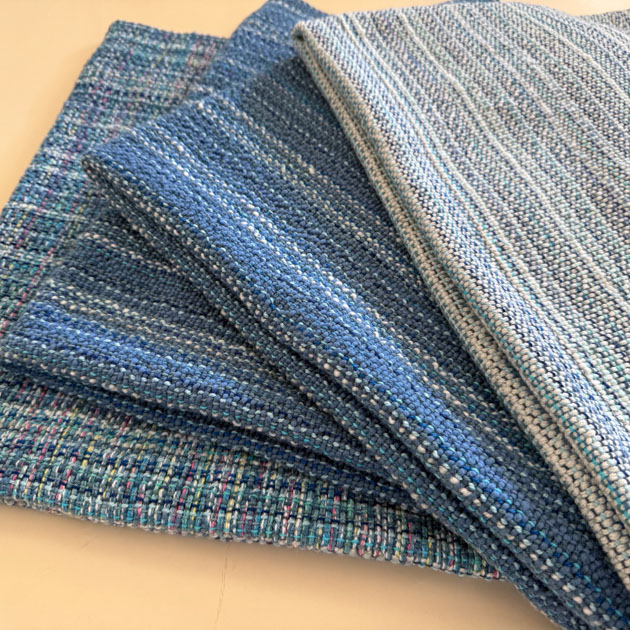
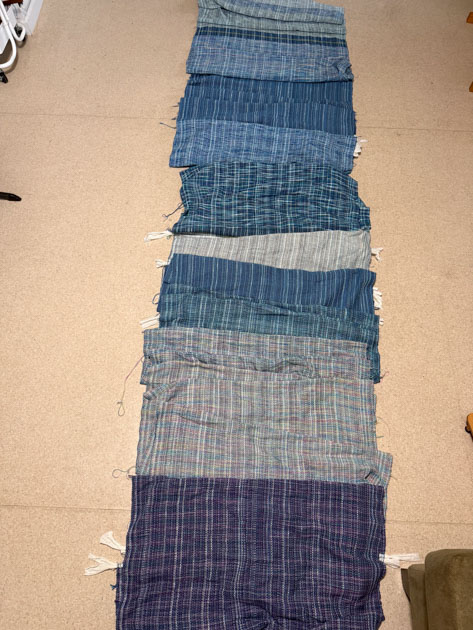
This is the warp I just finished before cutting anything apart. People always ask how long does it take to weave a piece. There are processes other than weaving that go into completing a project. In this case all blankets were machine stitched at each end before cutting them apart. Then some were hemmed. All are washed and then I sew on my label and add the hangtag.
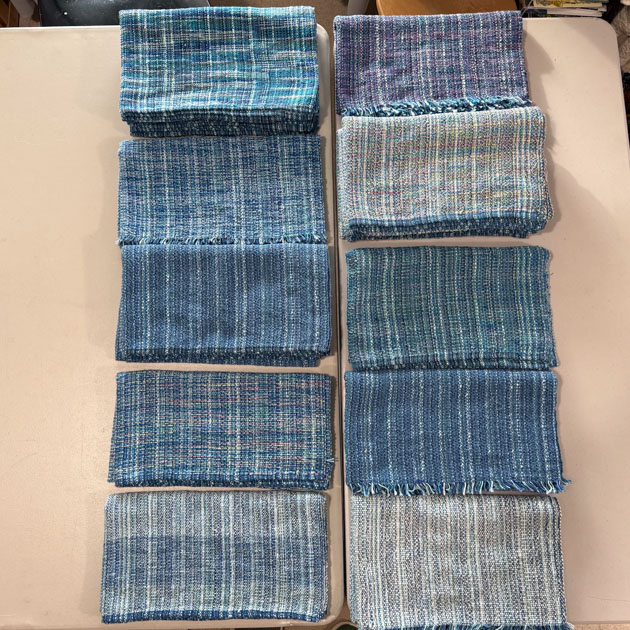
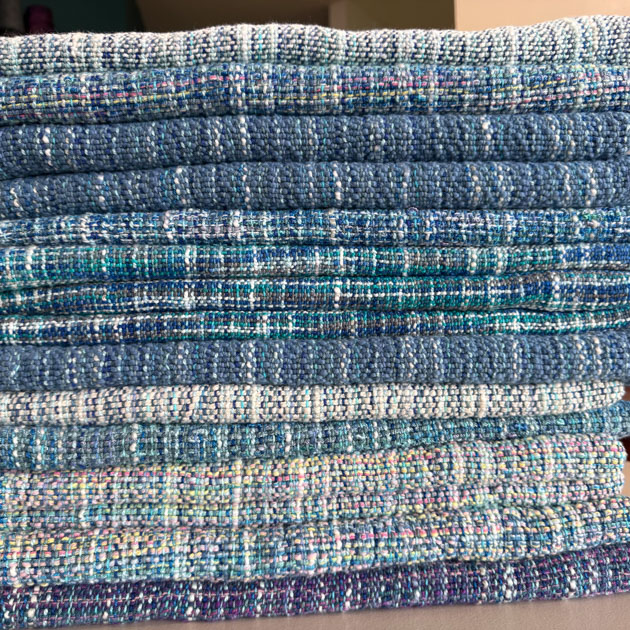
There are multiples of some of these blankets. Those are stacked with two or three.
Another view of all the blankets. You can find some of these blankets on my website and here at the farm store. Others are at The Artery and some are on the Artery’s webstore (local pick-up for those right now). Next up will be a white warp so I can have a variety of colors.
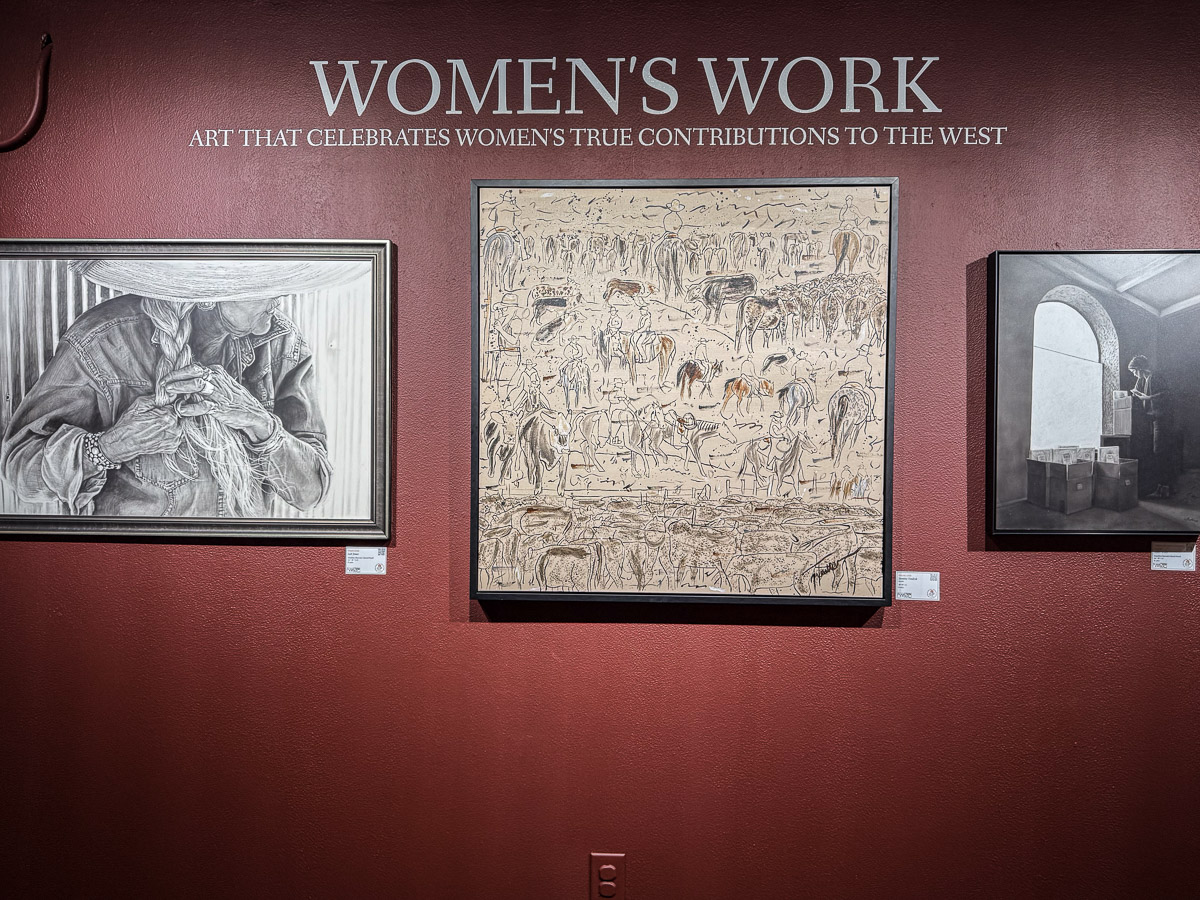
In 2024 we attended the opening of this show because I was a “farm partner”. The explanation and story is in this blog post from 2024. I think I did a better job of photographing last year’s show and sharing artist info in my blog. I took this quote from last year’s blog post, after copying it from the Cowgirl Artists’ website. From the website: “Celebrating the true contributions of Women in the American West…Much Western art is an ode to the work and contributions of men, while often limiting women to a single sphere, or pretty face. “Women’s Work,” a groundbreaking exhibition that teams artists up with women on working ranches, turns that notion on its head. By showcasing Western women as multi-faceted contributors to the Western way of life. Furthermore, Women’s Work aims to provide a platform for Indigenous women to authentically share their own stories, rooted in their intimate connections to culture and heritage. Traditional and fine artists are included, with all work on the theme of “Women’s Work.”
After seeing the show and talking to the organizer I decided to submit an entry for this year. Entries were due in the fall and, if accepted, work was to be completed in the spring 2025. I entered Year to Remember blankets using locally produced wool, and naturally dyed by me with plants grown on the farm. I could serve as my own “ranch partner”. I was accepted! Work was shipped to the show to arrive by mid-July.
The catalog of the show is at this link. There you can see all the pieces and details about work.
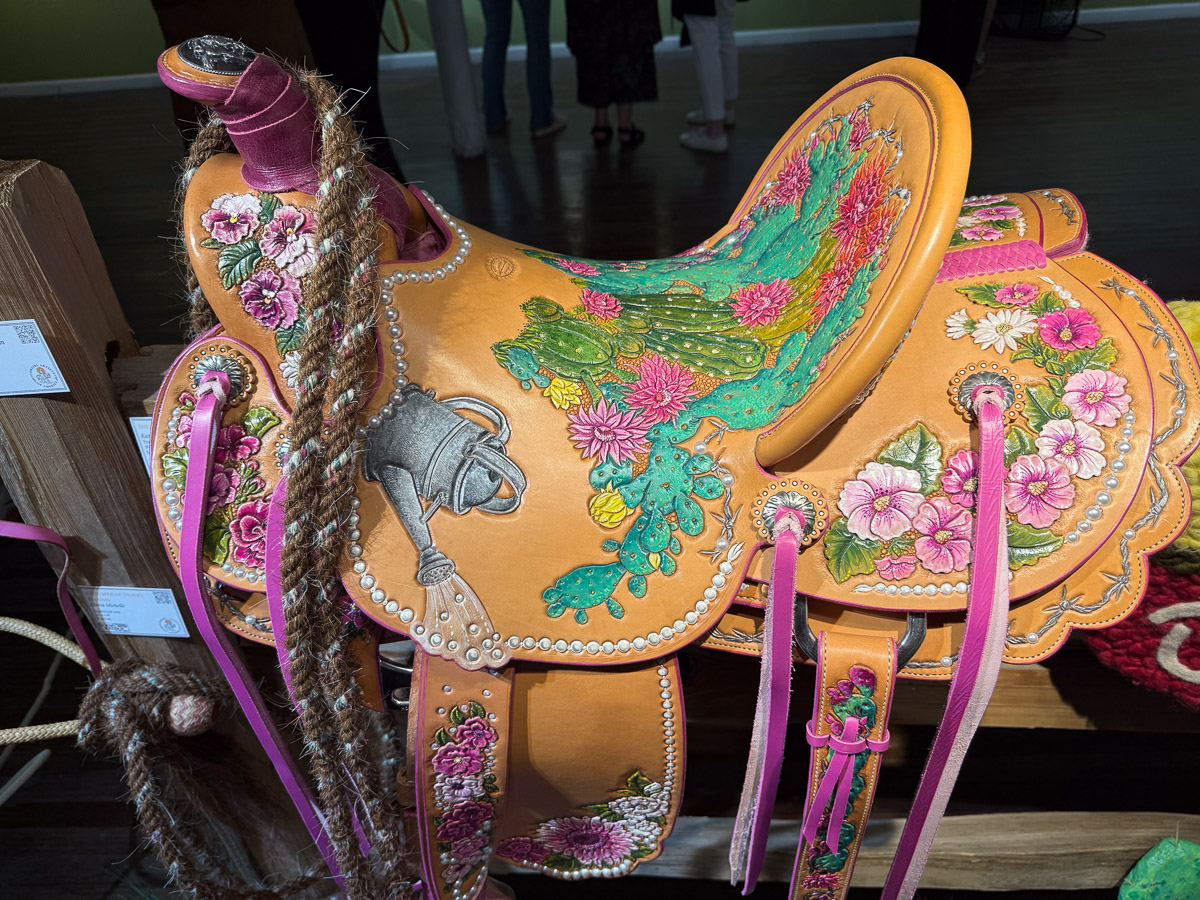
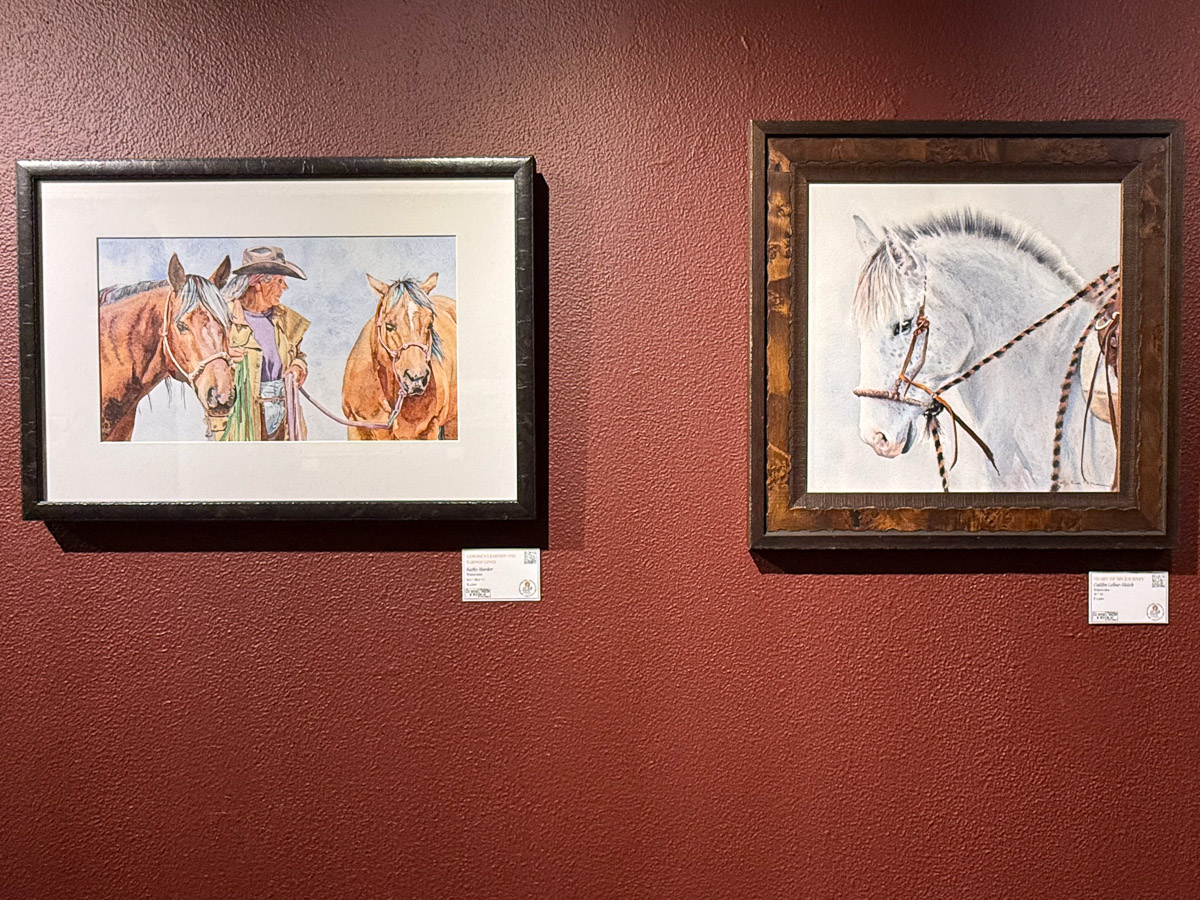
The Women’s Work show is upstairs in this building. The second floor is in a horseshoe shape over the lower floor. When I went upstairs I was immediately drawn to this display. Four artists worked together to put together the display.
There is amazing detail on this saddle called She Who Made Me by Kari McCluey
This painting, CowGirl II – Securing a Win, is by Megan Wimberley, the woman behind Cowgirl Artists of America.
Bluebird Let Me Tag Along by Lisa Sorrell.
There are details about each piece in the catalog at the link above. There was by far more wall art than 3-D work, but it was difficult to get good photos of those. That’s why I recommend looking at the link.
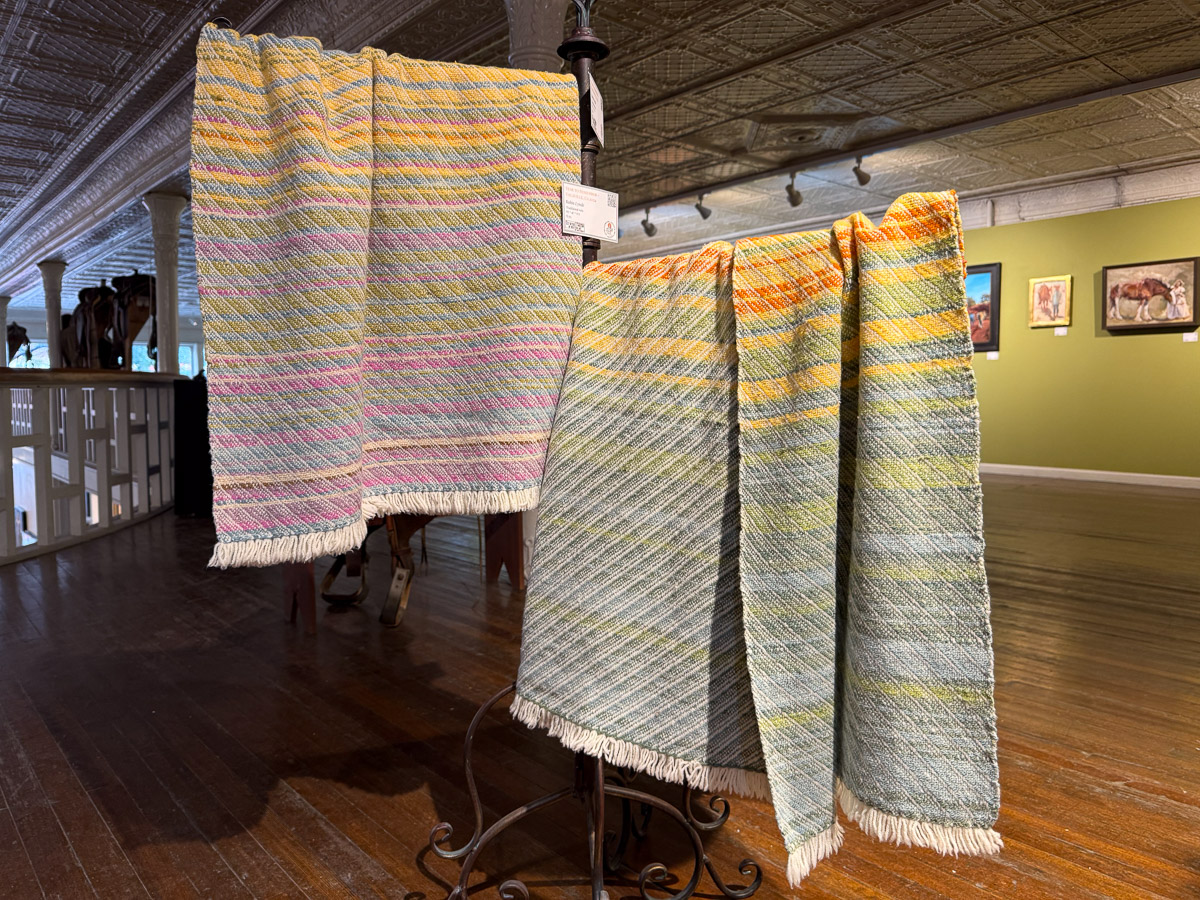
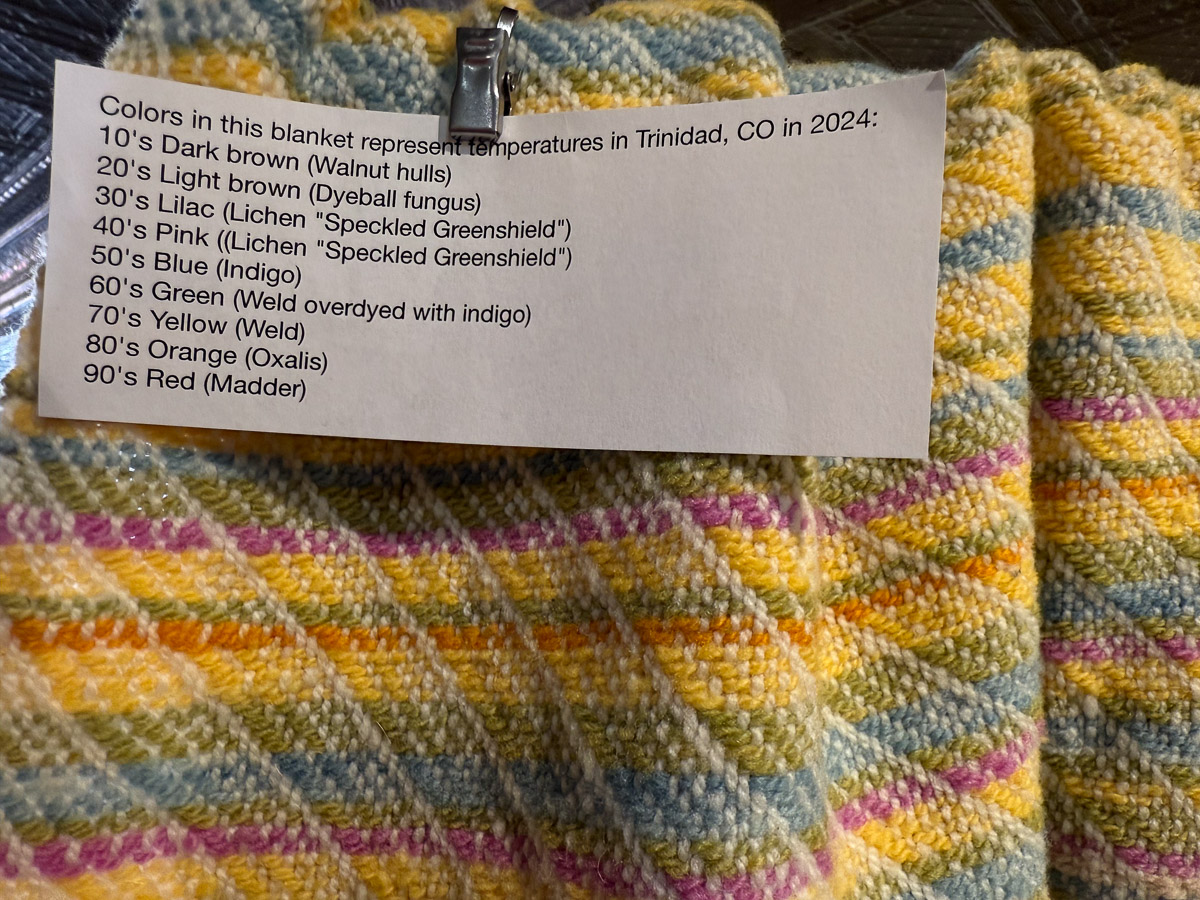
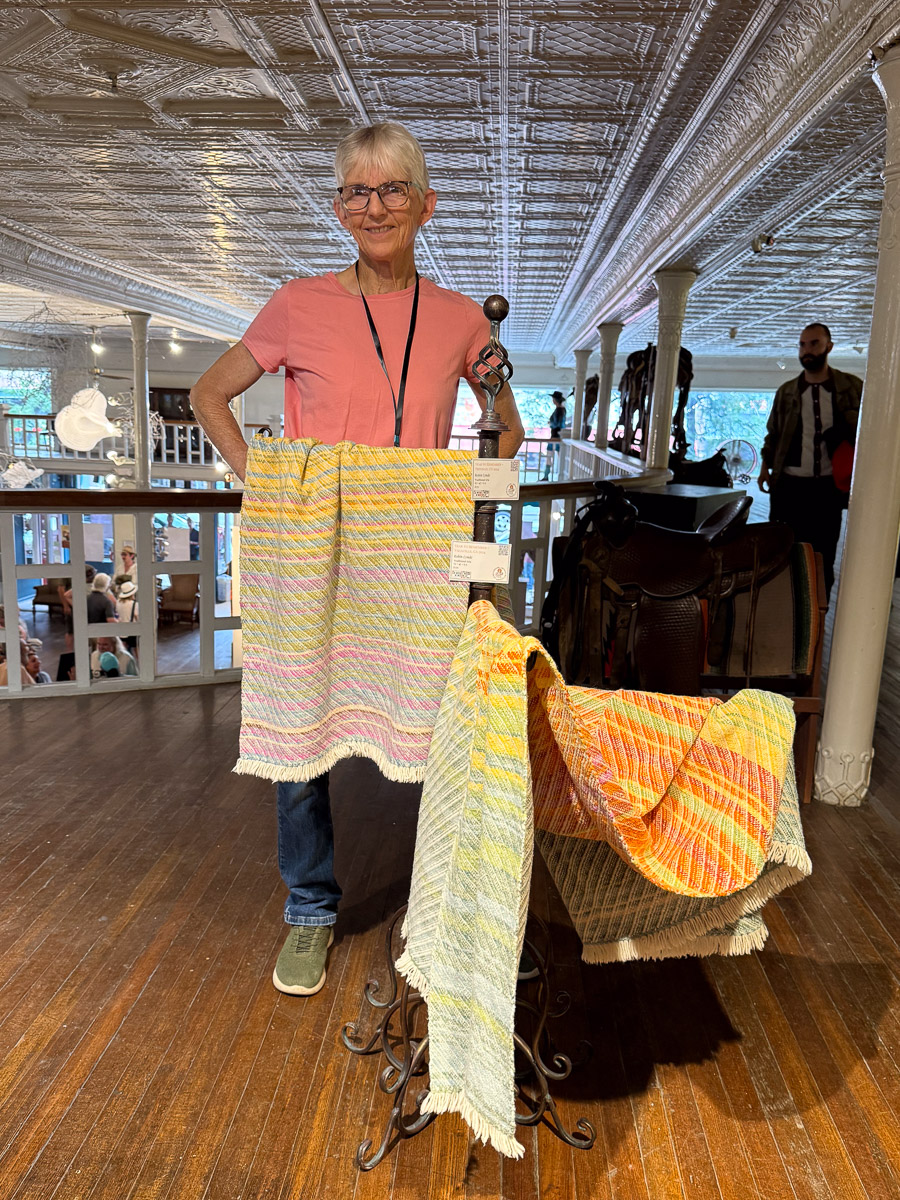
These are my two blankets. Later I rearranged them so that the more colorful side is the one that shows. The blanket on the left indicates high temperatures for Trinidad, Colorado for 2024 and the one on the right is for Vacaville. The full year is portrayed following the stripes from one end to the other.
On Saturday I came prepared to include the info about the Year to Remember idea with color coding. I thought it would make the blankets more interesting (and more saleable). However, this is an art show and the person in charge wanted to keep the signage at a minimum. This info is in the catalog, so I took it off the blankets. I’m including it here as explanation…and because this is a plug for your custom Year to Remember blanket. I have a blanket warp on the loom now and can weave one. If these blankets don’t sell in this show they will be on my website after I get them back.
Dan took this photo.
The A.R. Mitchelll Museum has a large display about Mitchell and his friends as well as contemporary western art for sale. From the Museum website: “During the 1870s and 1880s Trinidad was the headquarters of the largest cattle and sheep operation in the state of Colorado. A booming cow town filled with cowboys, cowhands and ranchers, Trinidad’s streets and neighboring towns were home to the horses, cattle and beloved cowboys and cowgirls that A.R. Mitchell would paint and immortalize throughout his career.”
I am already over my self-imposed limit of 10 photos, but I want to continue the story so I can blog about things at home.
On Saturday there was a luncheon provided by CGA to be followed by an artists’ talk. I had been asked to be one of the panel. Before the luncheon we wandered around this block of Trinidad.
I got a kick out of this design. That’s a real truck, not painted.
We stopped in the Corazon Gallery across the street from the A.R. Mitchell Museum. I was interested in this because it is an artists’ coop as is The Artery where I sell in Davis, California. Here’s a “small world” experience. We wandered through the gallery and I noticed a landscape photograph with the photographer’s name Joe Coca. I knew that name. Having subscribed to Handwoven magazine since the first issue in fall, 1979 I was very familiar with photography by Joe Coca. I wondered if he might be the same person because Handwoven magazine was based in Colorado. We started up a conversation with the person staffing the store on that day. I assume it is like The Artery where all of us artists take turns being shopkeepers when the store is open. I said we were in town for the show across the street and I had entered handwoven pieces. It turns out that I was talked with Joe Coca! We talked awhile longer. He worked with Interweave Press for years and has been all over the world as a photographer. Joe’s website states that he is semi-retired, but it is worth looking at the website to see some stunning photography.
Back to the show!
After the luncheon awards were announced. There was a winner and an honorable mention in the 2-D and 3-D categories. I was so surprised to get the 3-D Honorable Mention!
The people selected for the panel discussion were all artists who were able to fill the role of their own “ranch partner”. Megan, left, had prepared questions for all of us to answer. It was a fun experience and I was very interested to hear the stories of the other women. The other women are all cattle ranchers. Megan asked questions about how we got started, how we integrate artwork with our daily lives as ranchers (I call myself a farmer, but that’s another story– what is the difference between a farmer and a rancher?), do we have issues with gender expectations, recommendations for young people just starting, etc. One difference that I thought about later is that although we all talked about seasonality of ranching/farming, I think I am the only one who direct markets. In other words, I don’t load all my lambs on a truck and send them off to market and I don’t take my fiber, yarn, and handwoven to a retail store and it’s gone. I have interaction with all the customers whether I’m selling lambs for meat or for breeding flocks or selling all the fiber products. I spend time at the computer on social media letting the world know I’m here (including this blog–please share!), time (not enough) working my website, teaching fiber arts, working at The Artery, and attending fiber shows. That doesn’t mean any of us have more or less work than the other. It’s just different. A theme in the discussion was that there is Never enough time for all of it.
Dan had my camera and recorded some of the comments. I haven’t had time to listen yet.
After this discussion we got on the road and headed north to Colorado Springs where Dan’s brother and sister live.
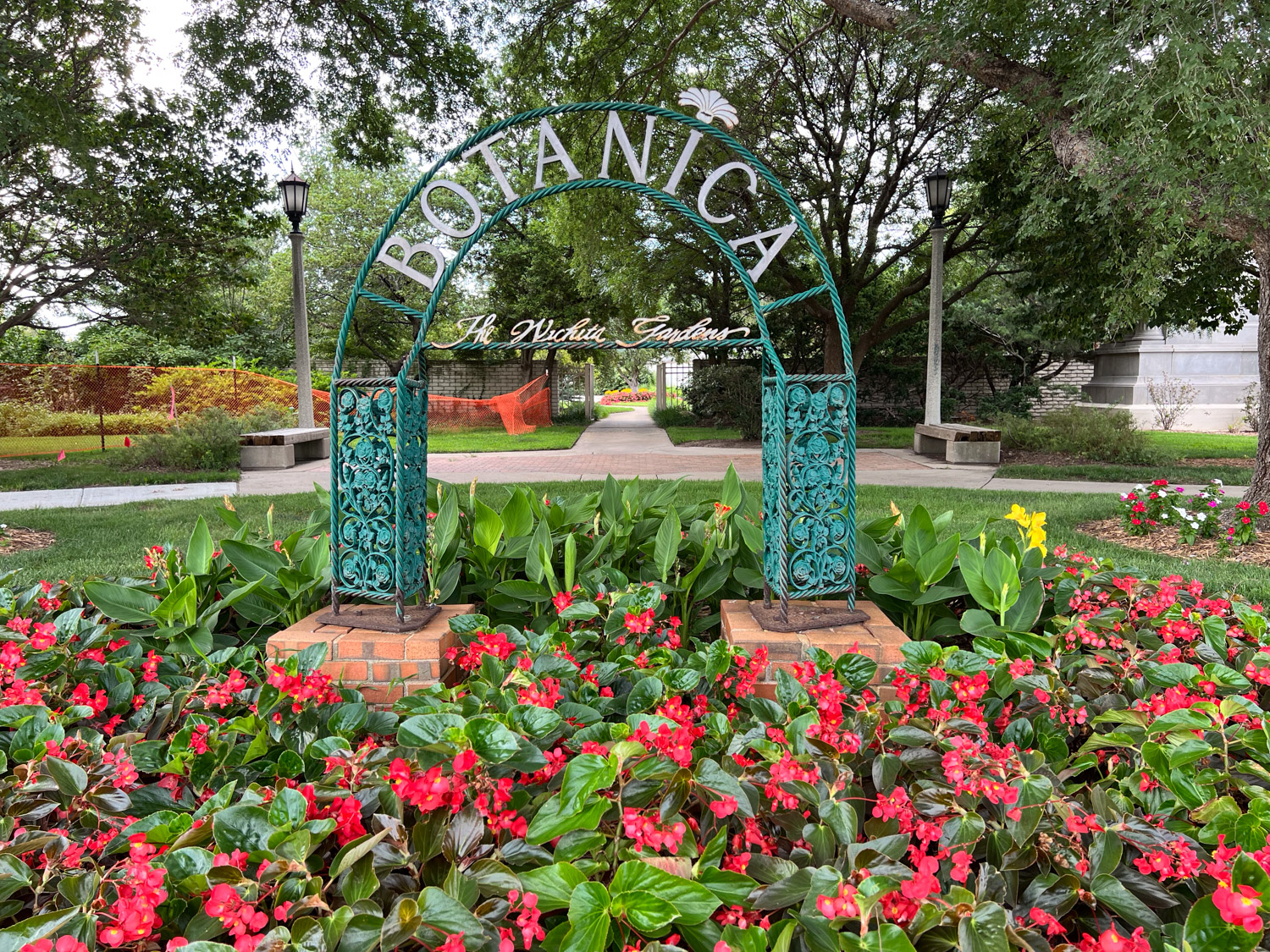
The last post left me looking for the entrance to Botanica Wichita.
I found it.
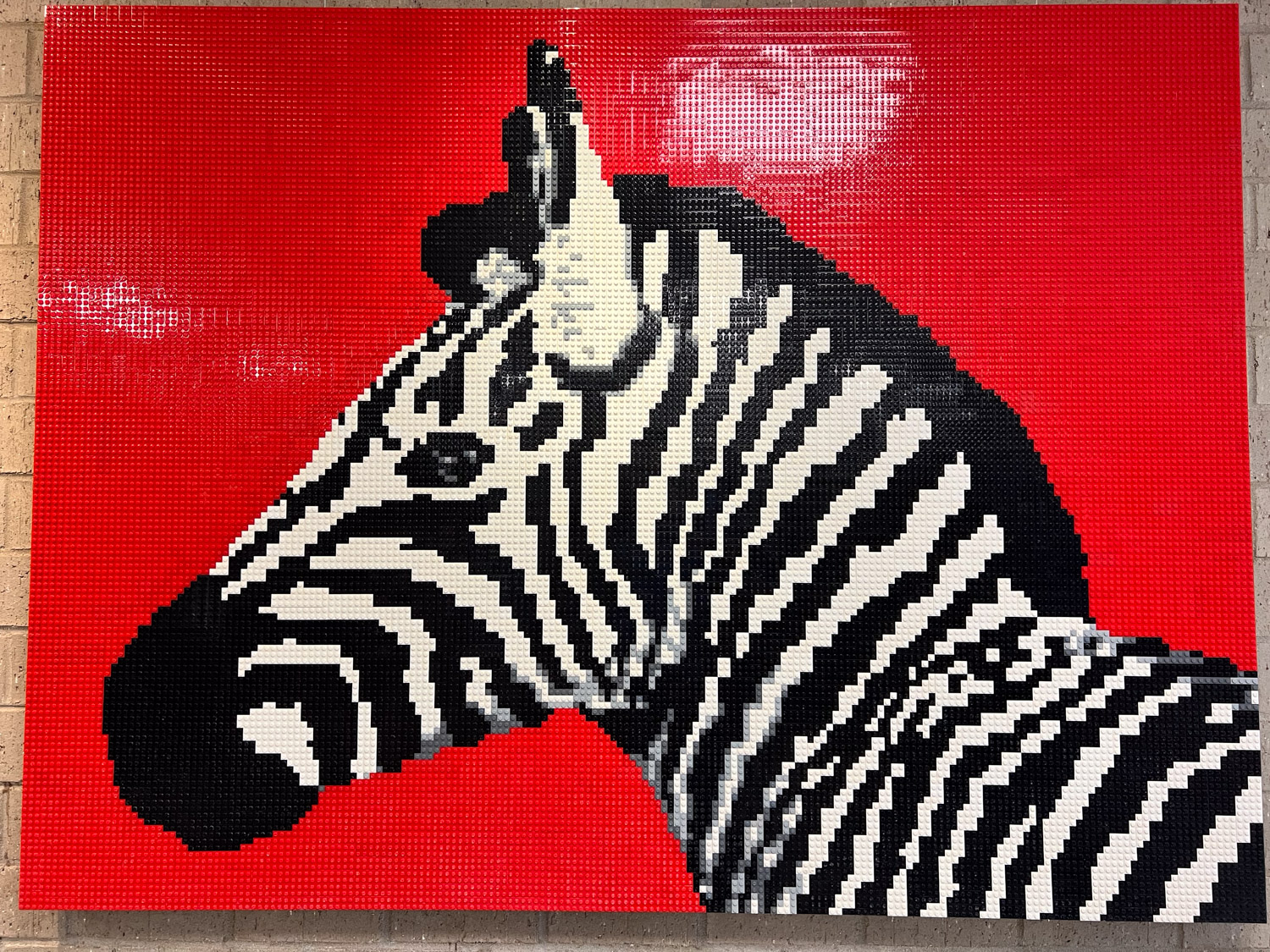
Just inside the entrance I saw Lego images. I may have taken more photos of Lego art than of plants. Lego bricks were (and are?) a big part of a couple of my kids’ lives.
These images were impressive enough, but wait until you see the statues outside.
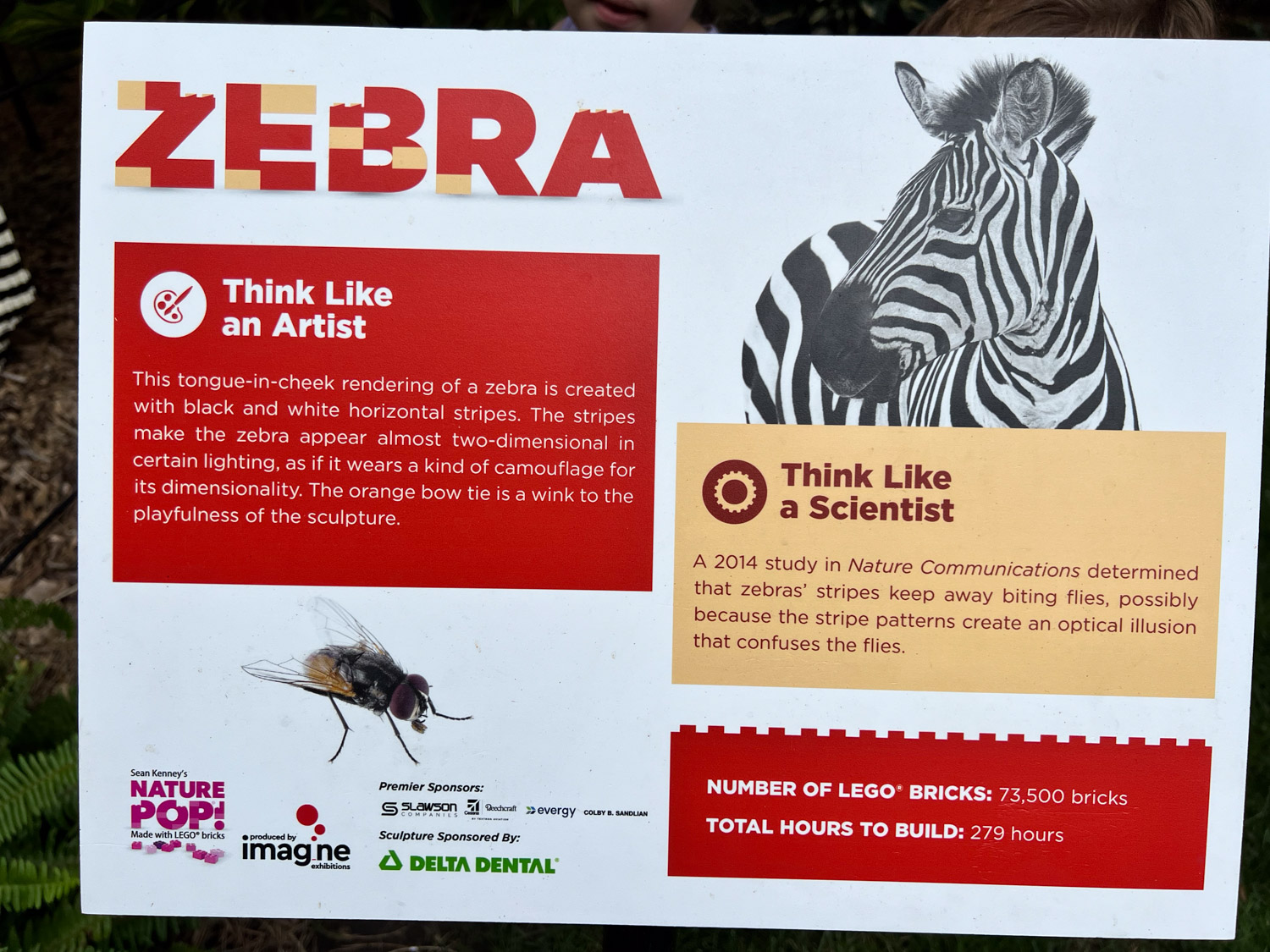
Each Lego artwork is accompanied by a sign that tells a little about the image from the perspective of an artist and of a scientist. The signs include the number of Lego bricks and the time it took to build the piece. The artist is Sean Kenny from New York who has been creating Lego art for 20 years. To see the incredible array of his work check out his website (but come back here). This Nature POP! show is one of his traveling exhibits.
There were also beautiful flowers at Botanica Wichita!
I don’t know if you can read this sign the way I have it formatted here. It tells that this sculpture uses 73,500 bricks and took 279 hours to build.
There was a collection of rabbits and off to the right out of the photo there was a fox.
One of many begonias. I didn’t just look at Lego art.
I walked through the bee garden and found this enclosure at one end. It was difficult to get a photo of this but you can see some recently emerged butterflies at the bottom and on the right side. These are all chrysalis’ along the rods, many with labels.
I walked through a bird sculpture garden.
This dragonfly is near the exit.
Black-eyed Susan.
This little excursion gave me a 7-mile walk. After I returned to the hotel I spent time in the vendor hall and visiting with friends.











 Meridian Jacobs' Blog