Today’s Random Farm Photos

Yesterday I spent time with sheep and weaving and ecoprinting and computer. I did more of the same today but didn’t take any weaving photos.
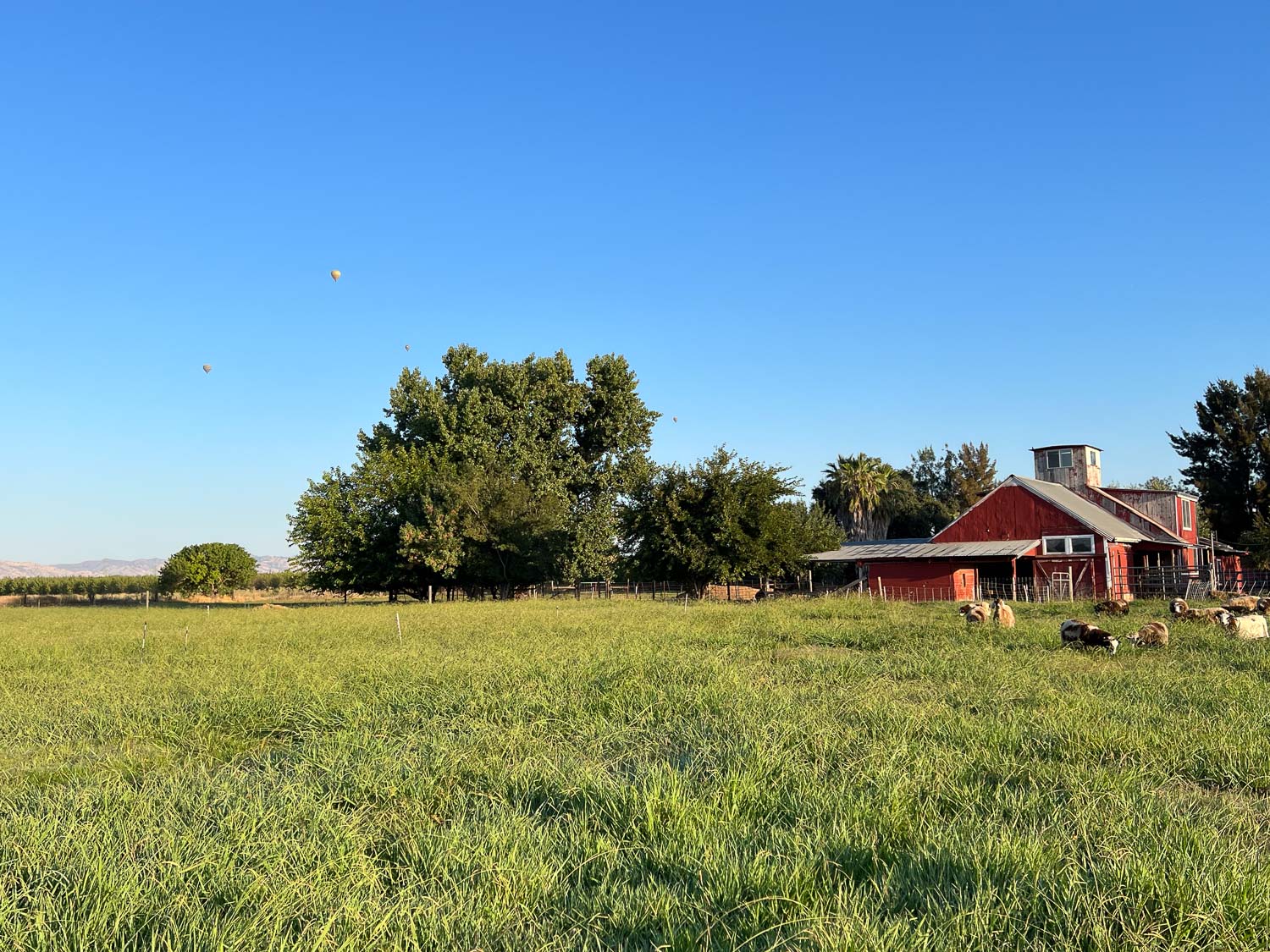
I changed the fence today to move the sheep into a separate paddock. You can’t tell from this photo but there are 8 paddocks that run north-south on this half of the property. There are 3-wire electric fences that keep the sheep in and I change the net fences at the two ends to open or close paddocks. Notice the hot-air balloons. It’s that time of year. There are four in this photo.

This looks like a lot of grass. It is a lot of grass, but it’s not the desirable grass and forbs I’d like. There is a lot of bermuda grass and dallisgrass. Those two take over this time of year. The sheep don’t like them when they get too coarse and head out. Then they go dormant in the winter and choke out the winter/spring annuals that I’d like to see. At least it’s green right now. That’s because we irrigate–there is no summer rain here.
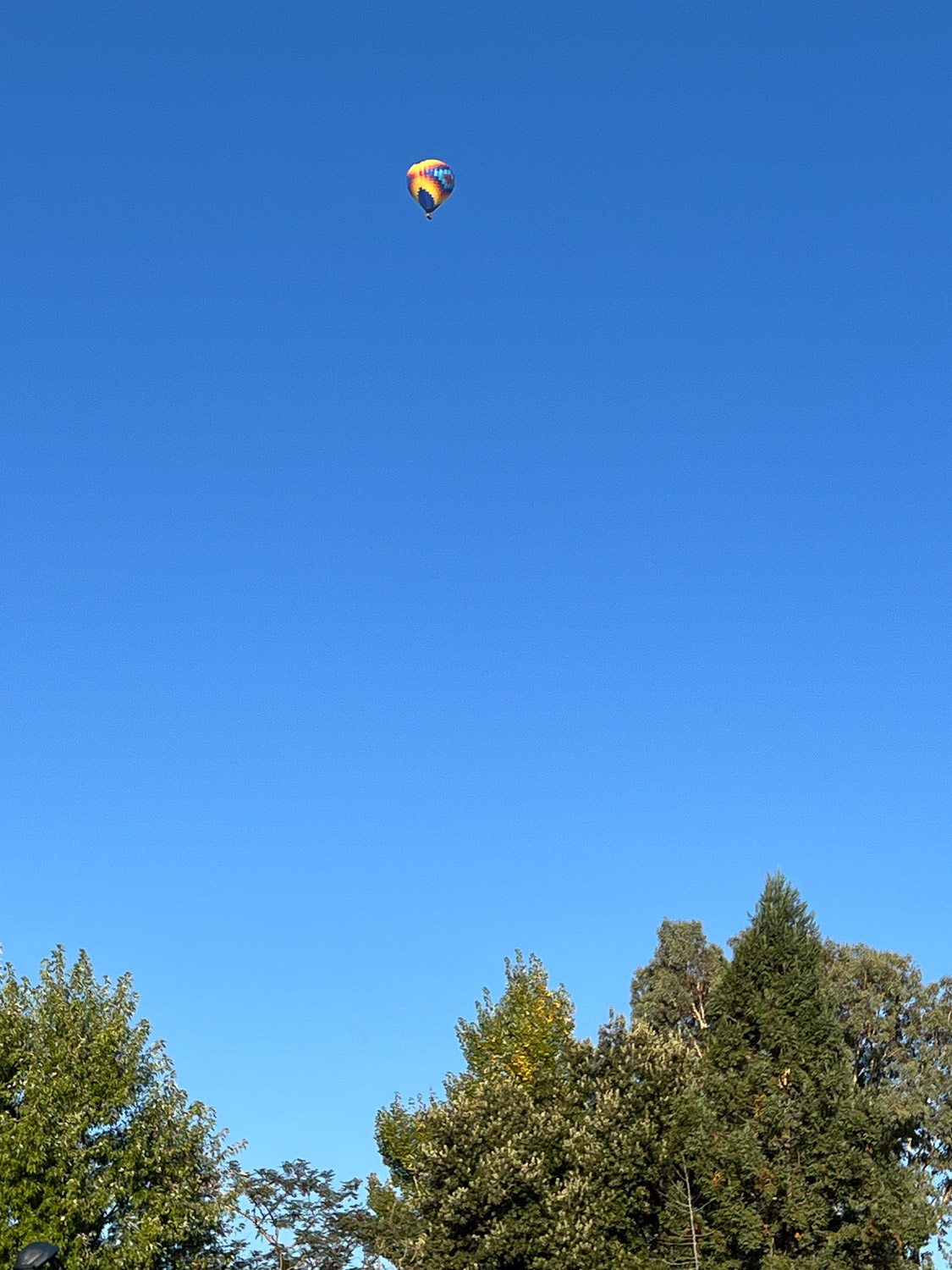
Close up of one of the balloons. Who remembers Rusty? Blog post from 2011. Rusty even had his own blog for several years. I just got distracted and read back through some of it. Rusty was a pretty good writer and I enjoyed reading through his posts just now. I wonder if I could get Ginny to write a blog.

Anyway, about Rusty. He was afraid of these balloons. During “balloon season” he wouldn’t leave the house first thing in the morning. He knew that they’d be gone by mid-morning and then he would go out. Ginny doesn’t mind the balloons, but she is sure gun-shy and that’s a problem with all the recreational shooting around here.
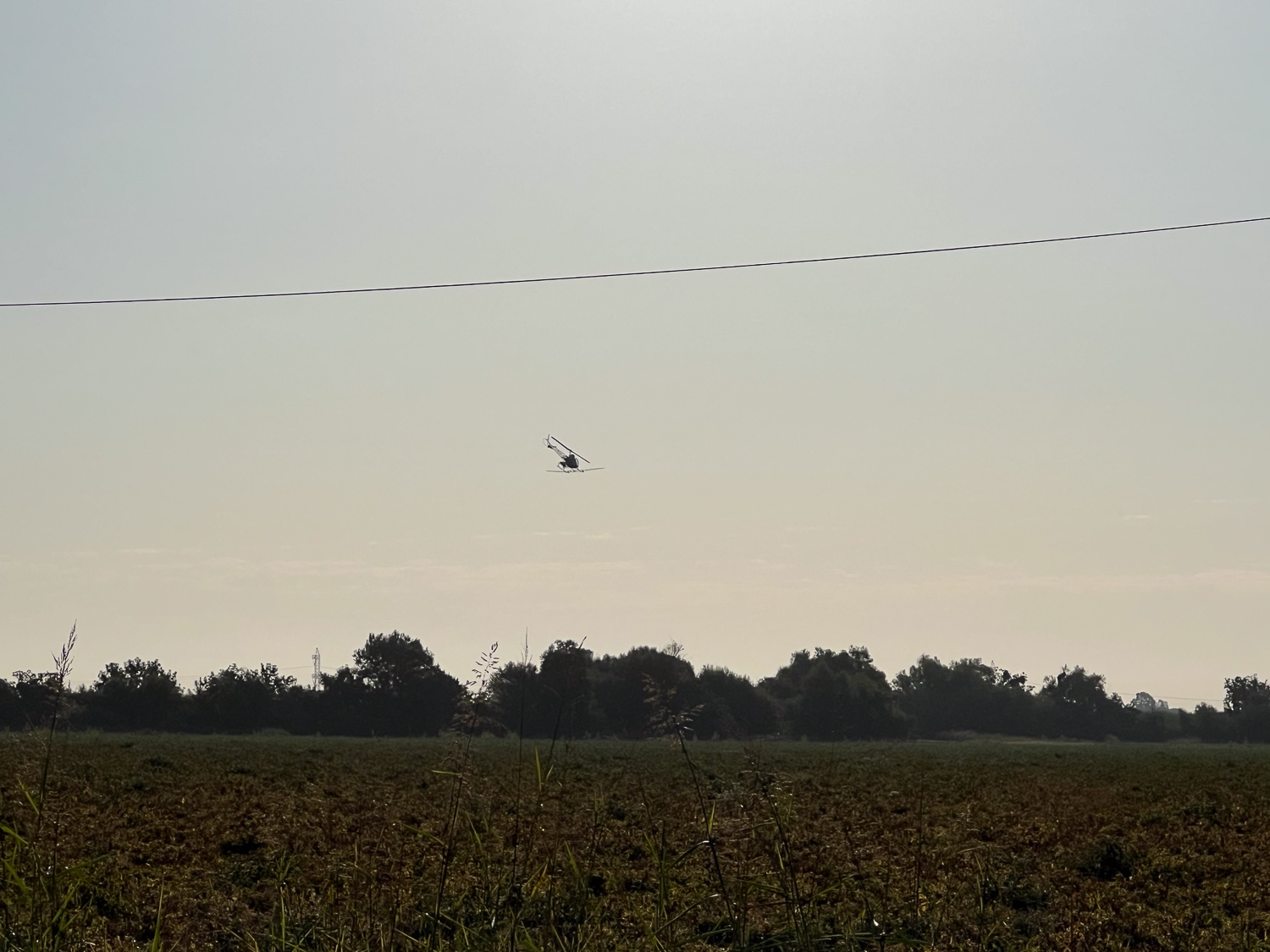
Speaking of things in the sky, this is the third time there has been a helicopter spraying the tomato field across the road.
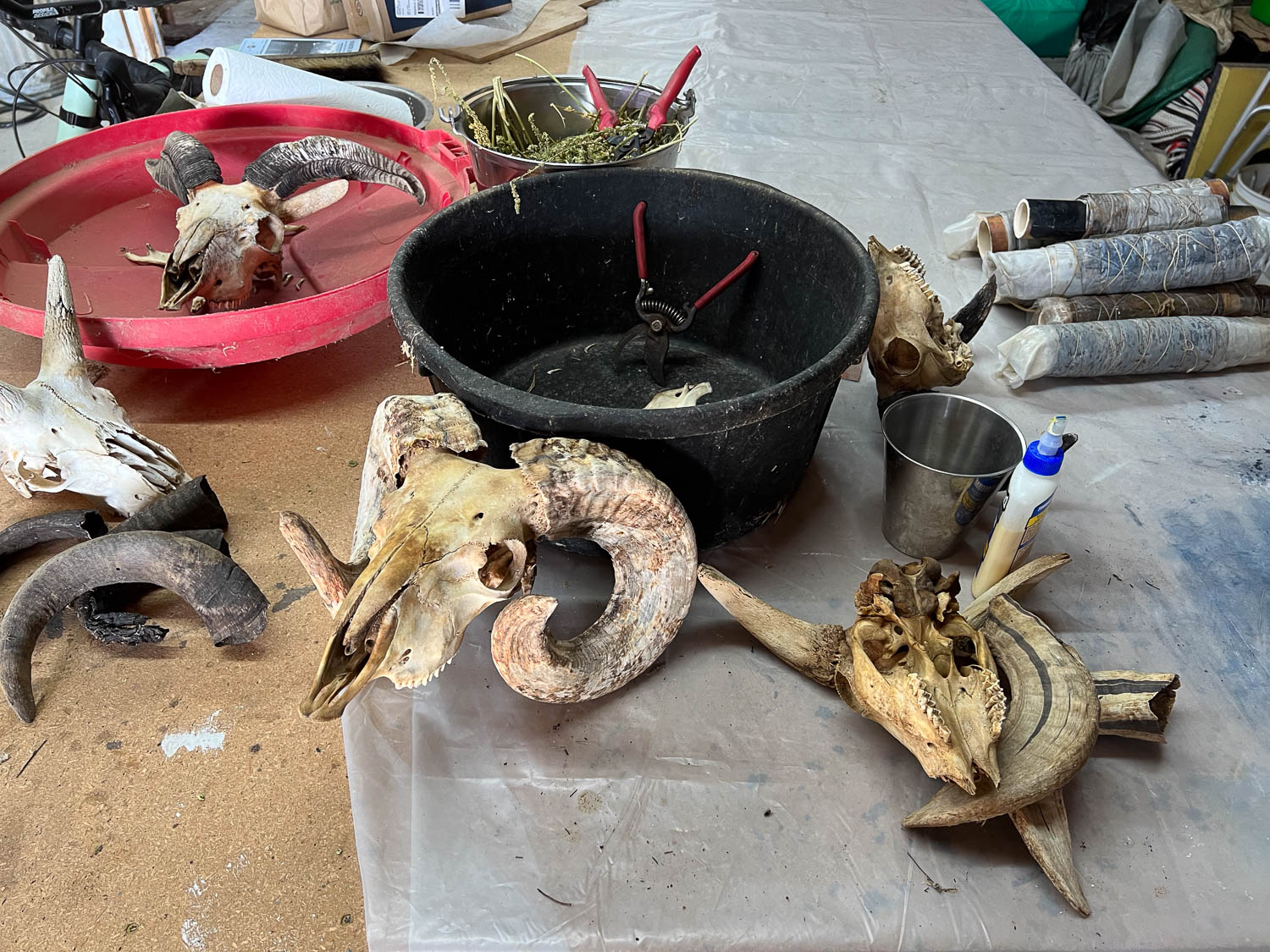
Before I went to the house after this morning’s chores I wanted to unroll the ecoprints from yesterday (see yesterday’s blog post). I have taken over this work table in the garage. The ecoprints are still rolled up on the right of the table. This is a look at the other projects I have going on–getting these skulls in some shape that I can sell them.

While I was working on the ecoprint scarves this morning I had a pot cooking with a couple of skulls to see if I could get them cleaned up better.

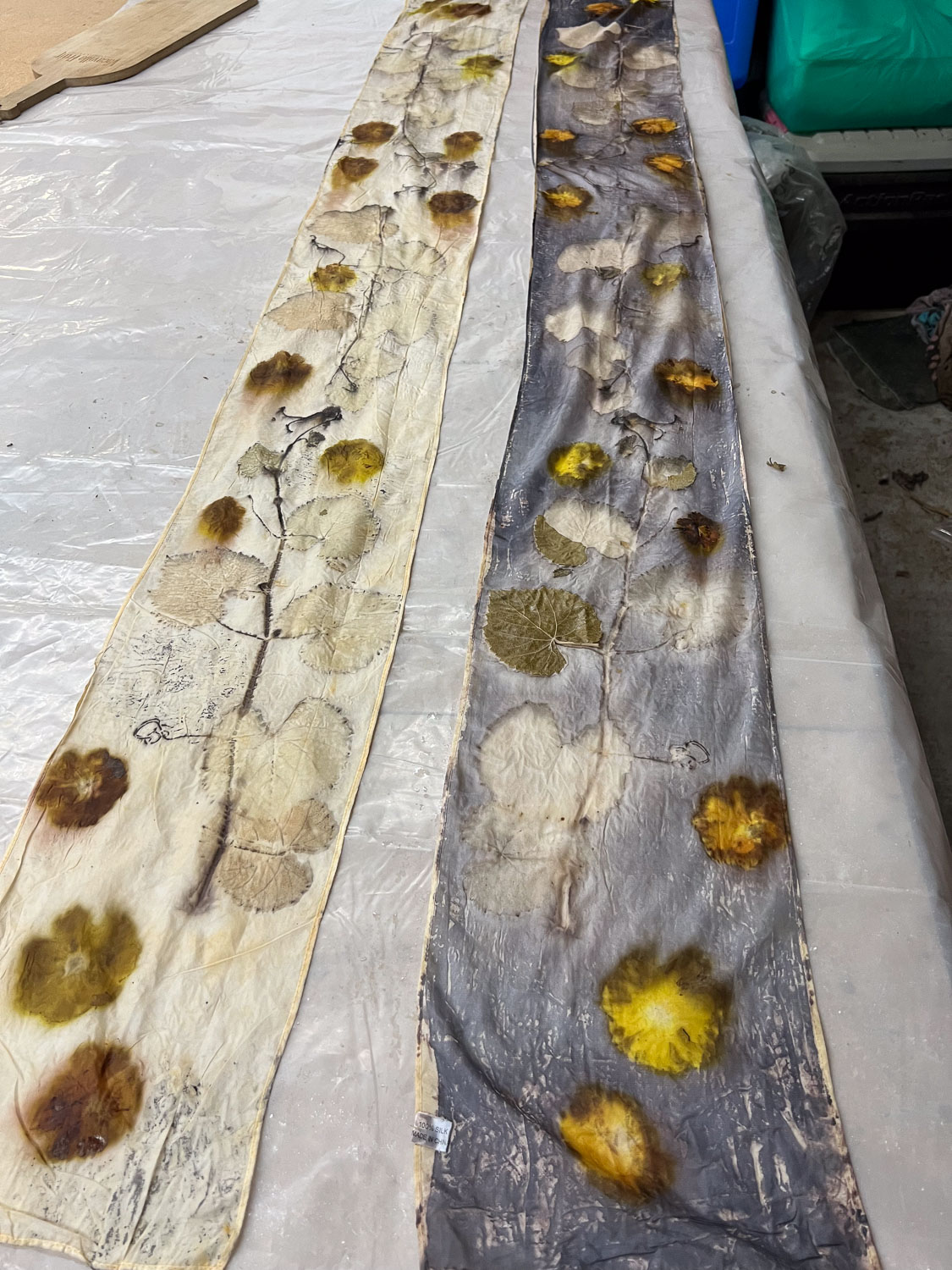
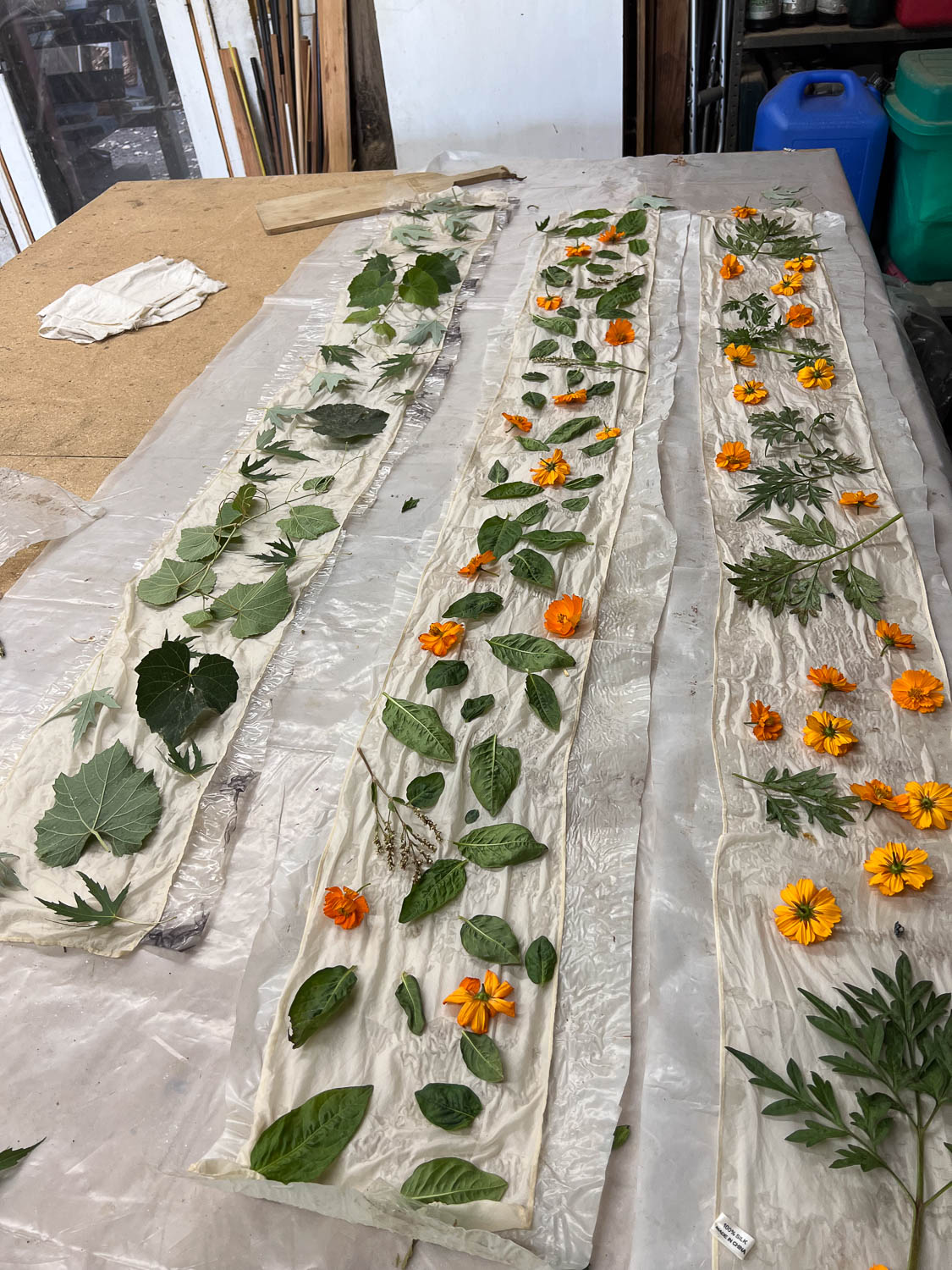
Here is a pair of square scarves. The photos in yesterday’s post show scarves with leaves or flowers in place. I put a second scarf on top of each of those and then roll them around a PVC pipe to steam. These photos show the pairs of scarves after unrolling. This pair has cosmos leaves and flowers. I am always fascinated by the different looks on the two scarves.

This one is all cannabis leaves (supplied by a friend). These don’t have that classic look of the ones below because by the time I got to this, the remaining leaves had started to fold up and at that point it is very tedious to spread them out again, especially with all these small ones.

Cannabis leaves in the more classic look.
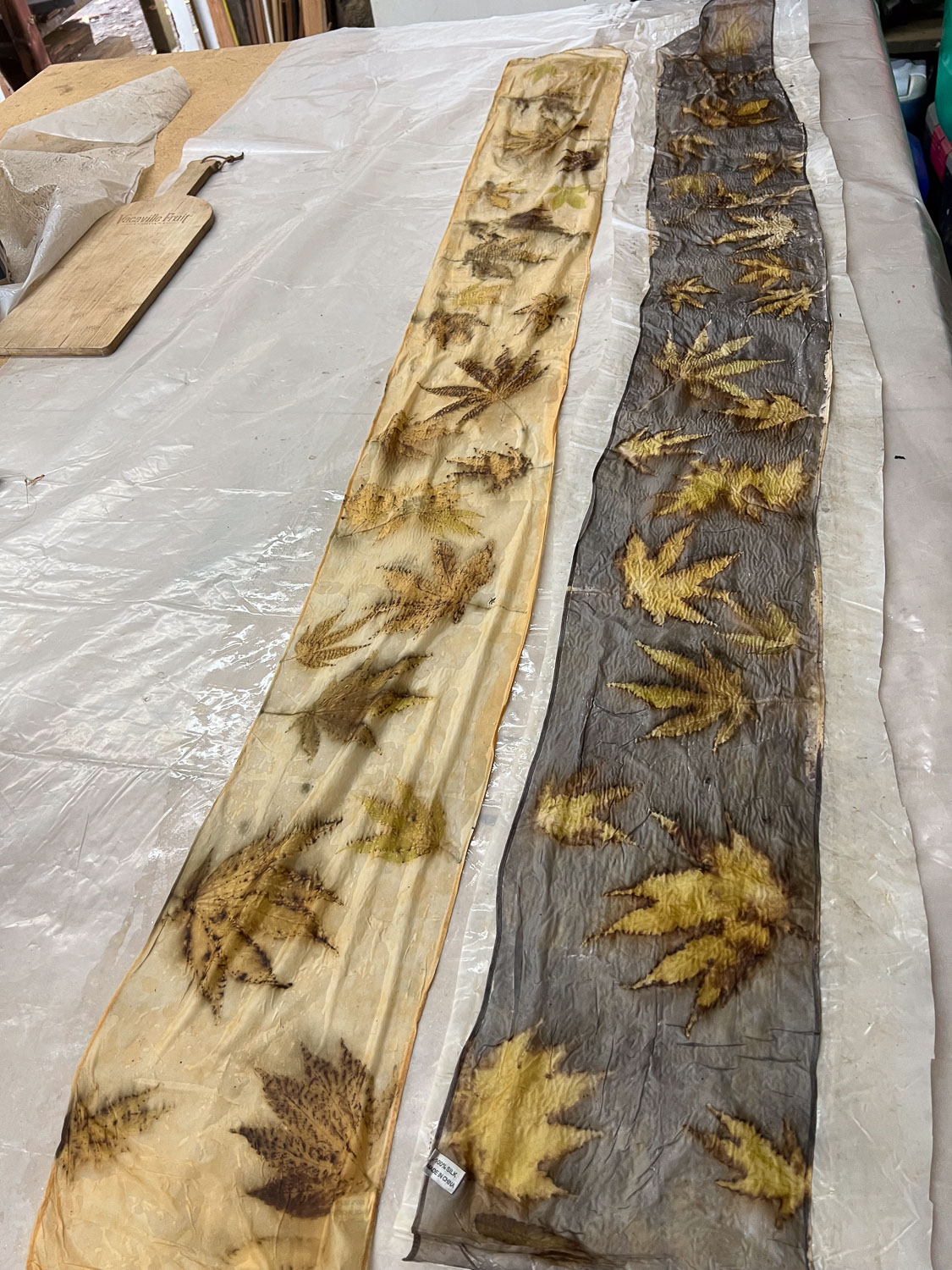
Another set of cannabis leaves with a close-up below.
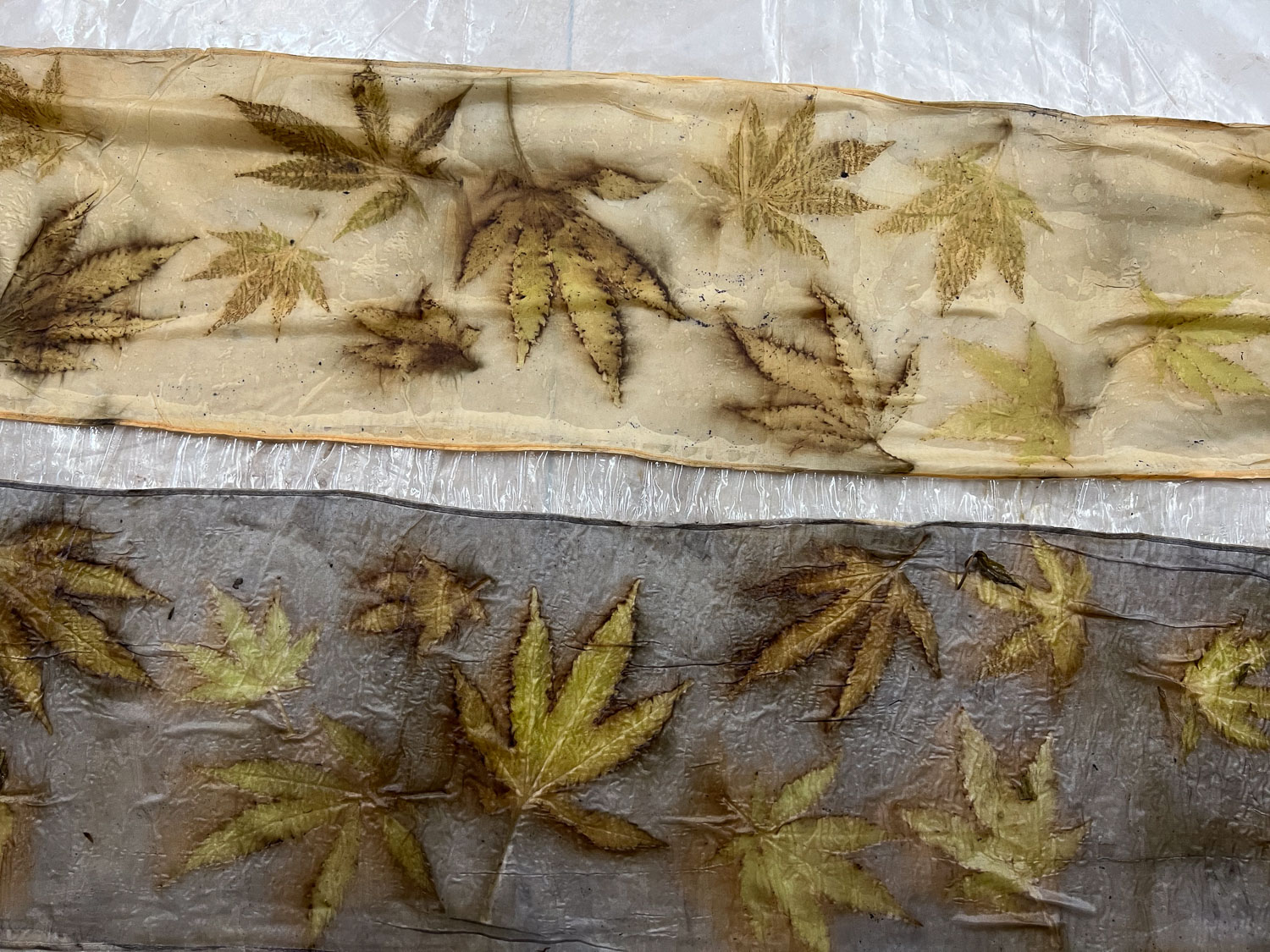
Some plants print on one scarf and create a resist on the other. These are printing on both scarves.

No, I am not selling cannabis. These are purple hollyhocks and cosmos flowers that I have added to my website and will have at Lambtown.

Tomorrow is a Farm Day and we’re setting up breeding groups! I need to look at my list one ore time.

Random Photos–How I Spend My Time

I don’t have photos of everything I do during the day. Standing at the computer for hours doesn’t make for very exciting photos.

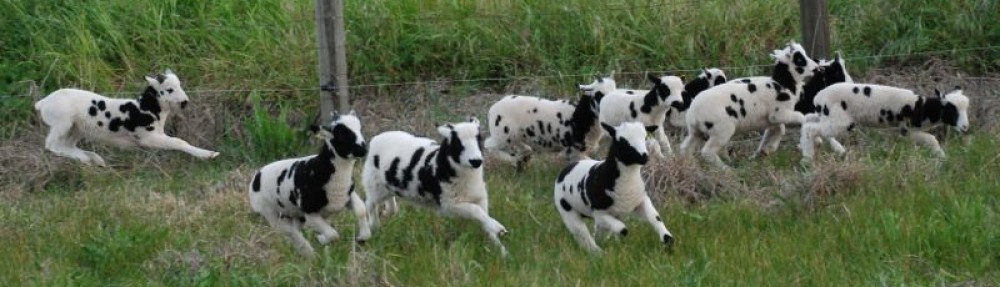
Six 2-horn spotted Jacob lambs tied to the fence with red halters.

Now that the only ewe lambs left are those that I’m keeping, I wanted to halter break them. I don’t expect them to lead like a horse, but I like to be able to tie them to a fence without them panicking. Also, a couple of these will be going to the Lambtown sheep show at the beginning of October. It will make it easier for my Farm Club crew if the lambs are at least somewhat halter broke.

Goat and sheep eating a huge zucchini from a feeder.

There is a bit too much giant zucchini. Too bad zucchini isn’t a dye plant. But at least I can feed the extra to someone.

Gold and maroon yarn being wound onto a loom in the clasped warp method.

I have a couple of articles scheduled for Handwoven Magazine for next spring. The deadlines are approaching and I need to finish some more weaving so that I have photos for one article and the project to send for another. This is Clasped Warp, a technique usually done on a rigid heddle loom. I am adapting it to use on a multi-shaft loom.

Seven colorful balls of yarn arranged in a circle.

I have some custom projects in progress on the AVL loom in the shop. I have woven two Year to Remember blankets on this warp. Now I need to finish the warp with other blankets. The yarn above is all naturally dyed and I want to use that for a blanket that I can post on the new Fibershed Market site (not available yet). The yarn is dyed with mushroom (dark gray), hollyhock (blue-green), indigo (blue), weld, (yellow), cosmos (orange), and madder (rose).

Weaving underway on the loom. Yarns are blue, yellow, and orange.

Here is how it looks on the loom.

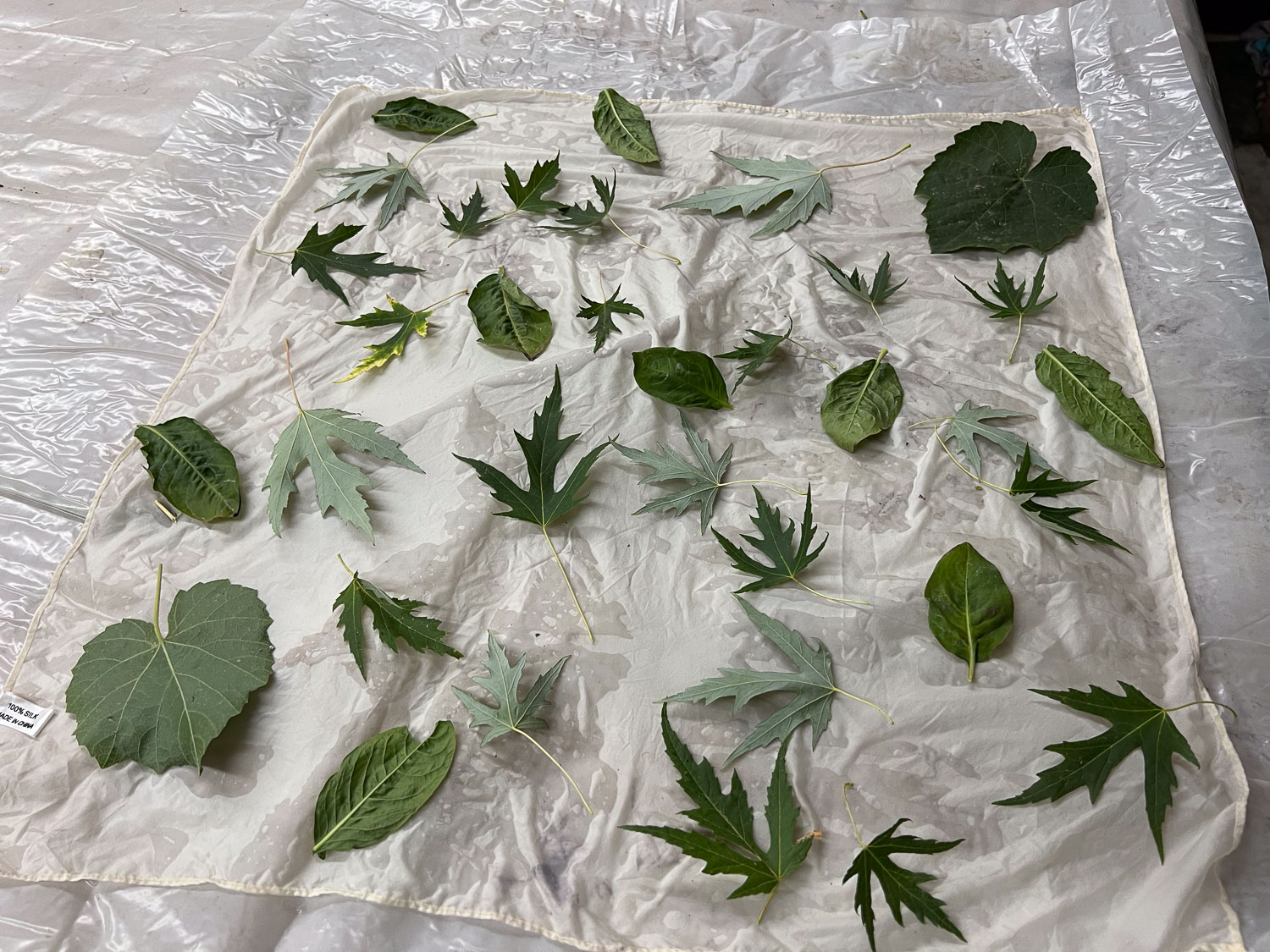
Silk scarves spread out on a work table with cannabis leaves arranged on them.

A friend dropped off more plant material to use for ecoprinting scarves and I wanted to get to it right away while the leaves were fresh. I have learned something about working with cannabis leaves–they start to fold up quickly. It’s tedious to arrange them the way I want them to look. They have a property of differential friction–the little hairs on the leaves allow them to slide one way on the fabric, but not the other. There is a second scarf that goes on top of these and it’s important to have the leaves spread out as the second scarf is spread across the first. Each scarf is wet with different solutions and they begin to react quickly upon contact.

Square silk scarf with cosmos flowers and leaves arranged on top.

I am trying out some square scarves as well. This one is printed with cosmos flowers and leaves.

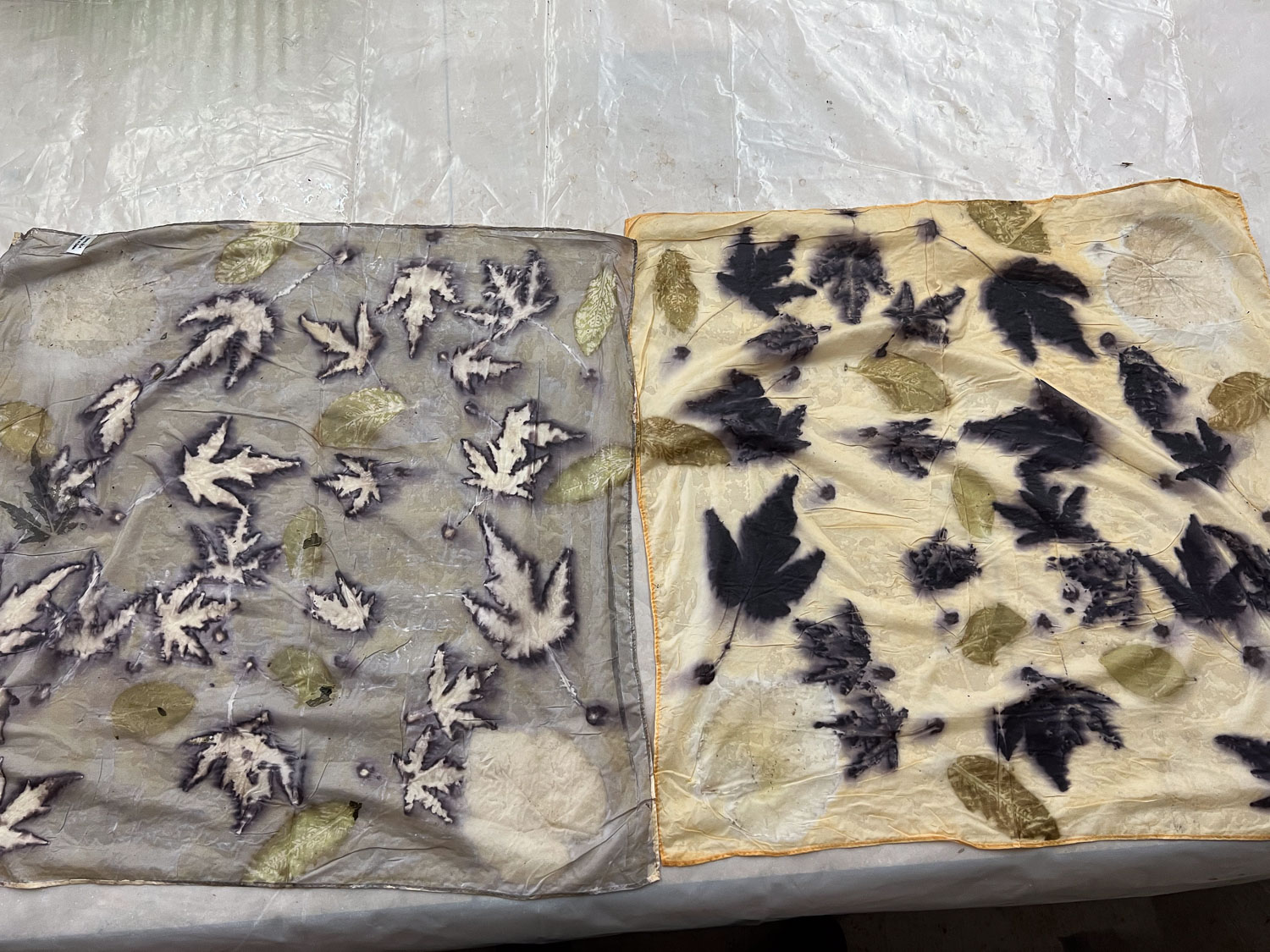
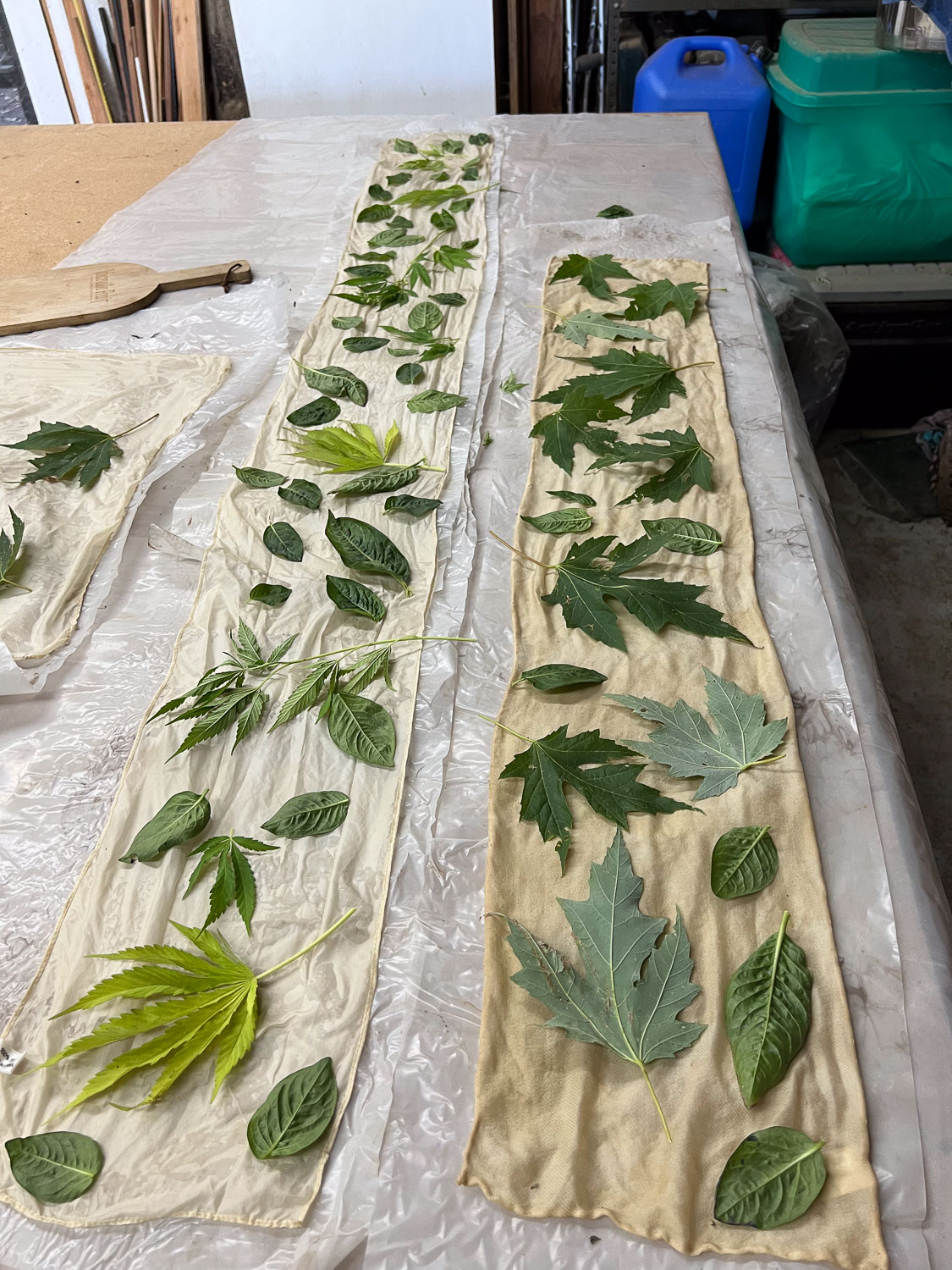
Silk scarves ready to be rolled for ecoprinting. They have cannabis, indigo, and maple leaves arranged on them.

These scarves use maple and madder leaves (left) and cannabis and indigo leaves (right). I rolled all of these up on PVC pipes and they steamed for 90 minutes. They are cooling in the pot and taturhe unveiling will happen tomorrow.

Botanical Printing Explorations

I consider that botanical printing (or ecoprinting as it is better known lately) is always an experiment. There are lots of variables beyond the obvious of the use of tannins and/or iron to bring out color or an imprint. Does the stage of growth of the plant make a difference? Is there a difference if the front or the back of the leave or the flower is against the cloth? How fresh is the plant? How about dried plants?

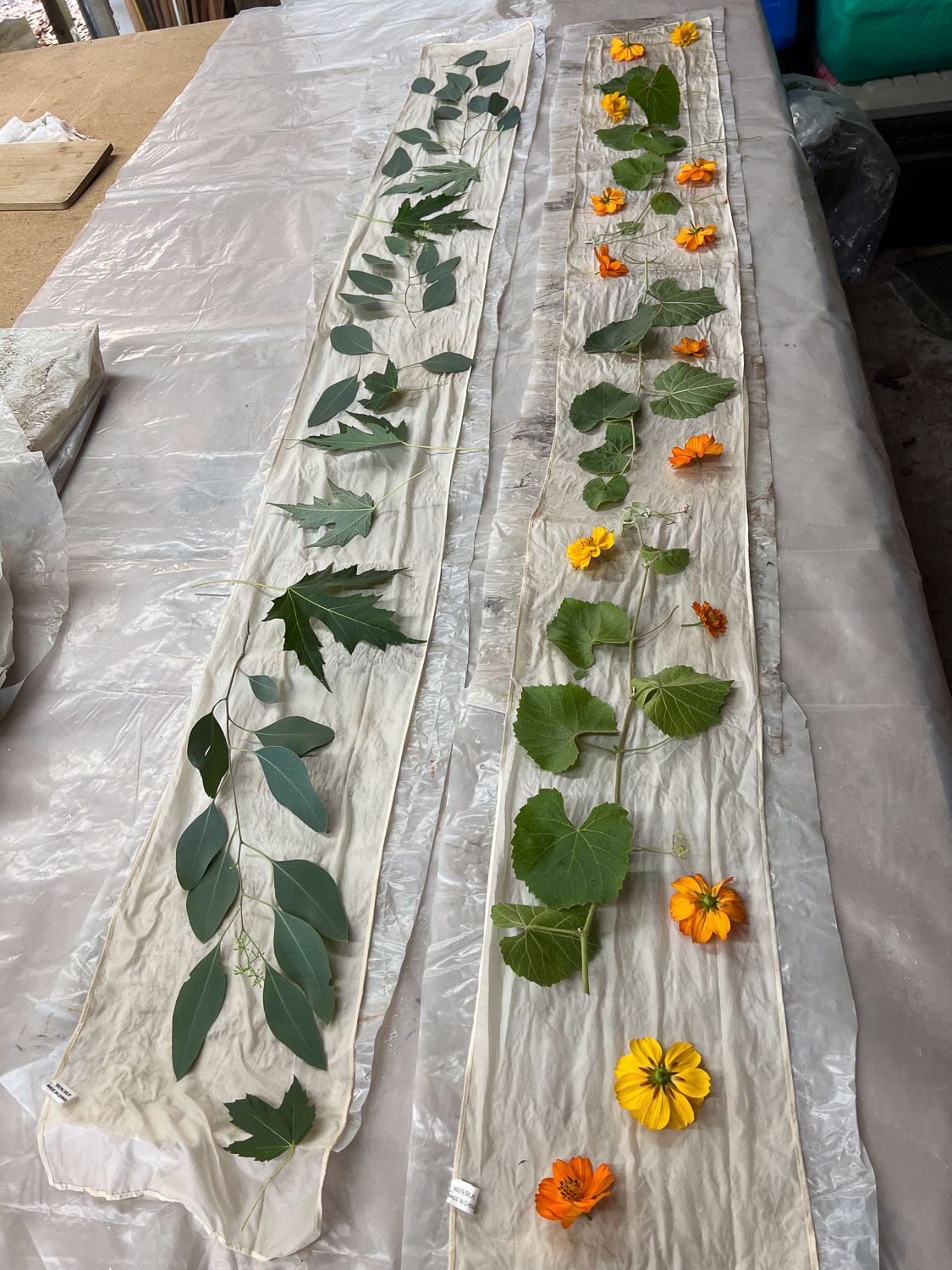
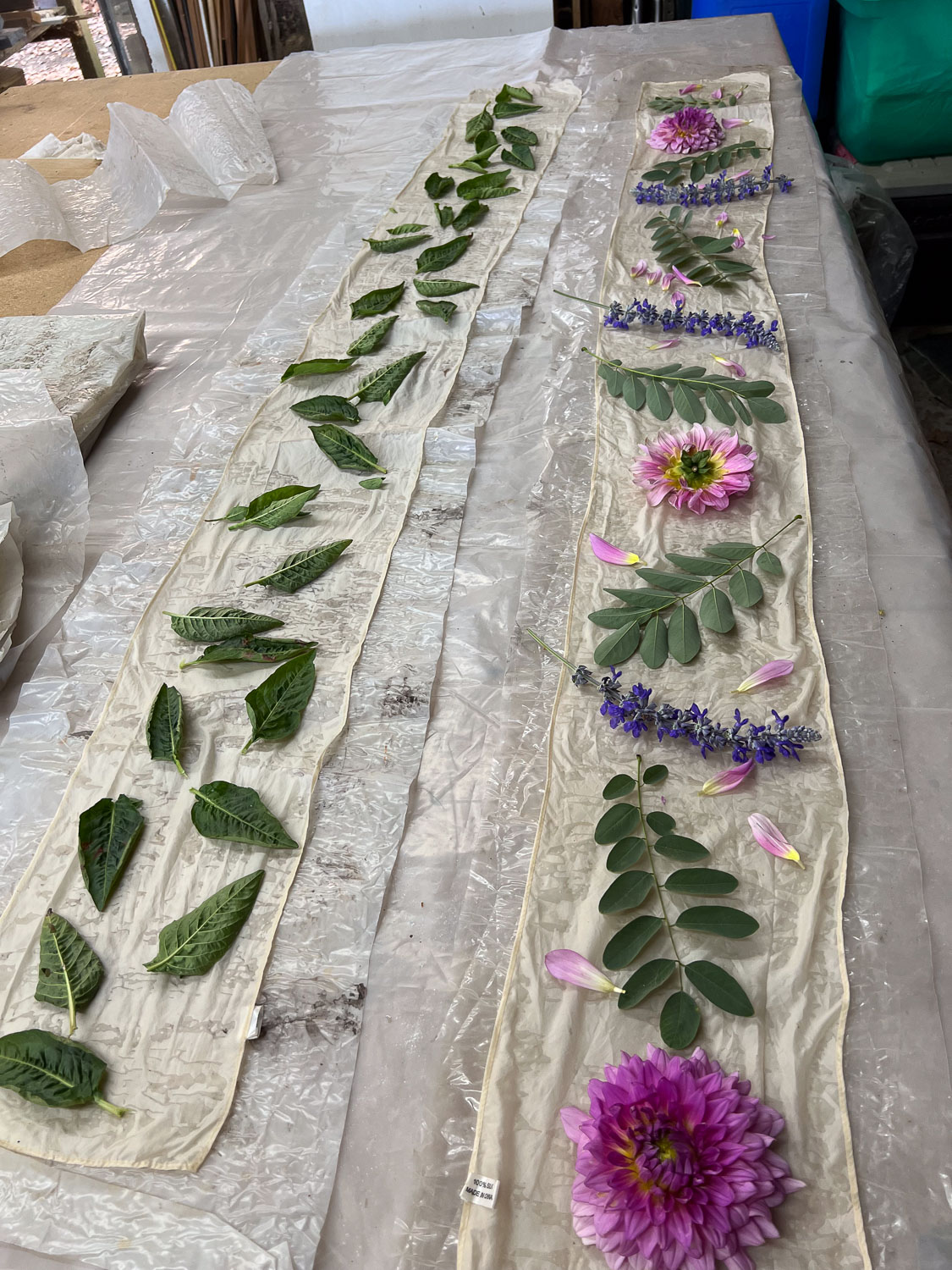
Here is what it looks like while I’m working. These are two different scarves, but I’ll end up with four because I put a second one on top of the first. These were soaked in a tannin solution before adding the plants. The second scarf is soaked in an iron solution. As I put the iron soaked scarf on the tannin soaked scarf a chemical reaction occurs that turns the tannin soaked scarf gray. Wow! Why didn’t we do this in high school chemistry? Maybe some of the rest of chemistry would have stuck.

The pair of scarves sandwiching the leaves and flowers is rolled on a PVC pipe, tied tightly, and then steamed for an hour or more. The rolls cool overnight and then I get to open them. These two scarves are the pair from the left. The one on the left is the iron soaked scarf that was put on top of the flowers and leaves before rolling. Those are cosmos flowers from my dye garden and wild grape leaves from the front fence. I find it interesting that the top scarf has the imprints of veins from the leaves and the leaves act as a resist for the bottom scarf. (That green leaf is the actual leaf I haven’t pulled off yet.) The flowers print on both, but differently.

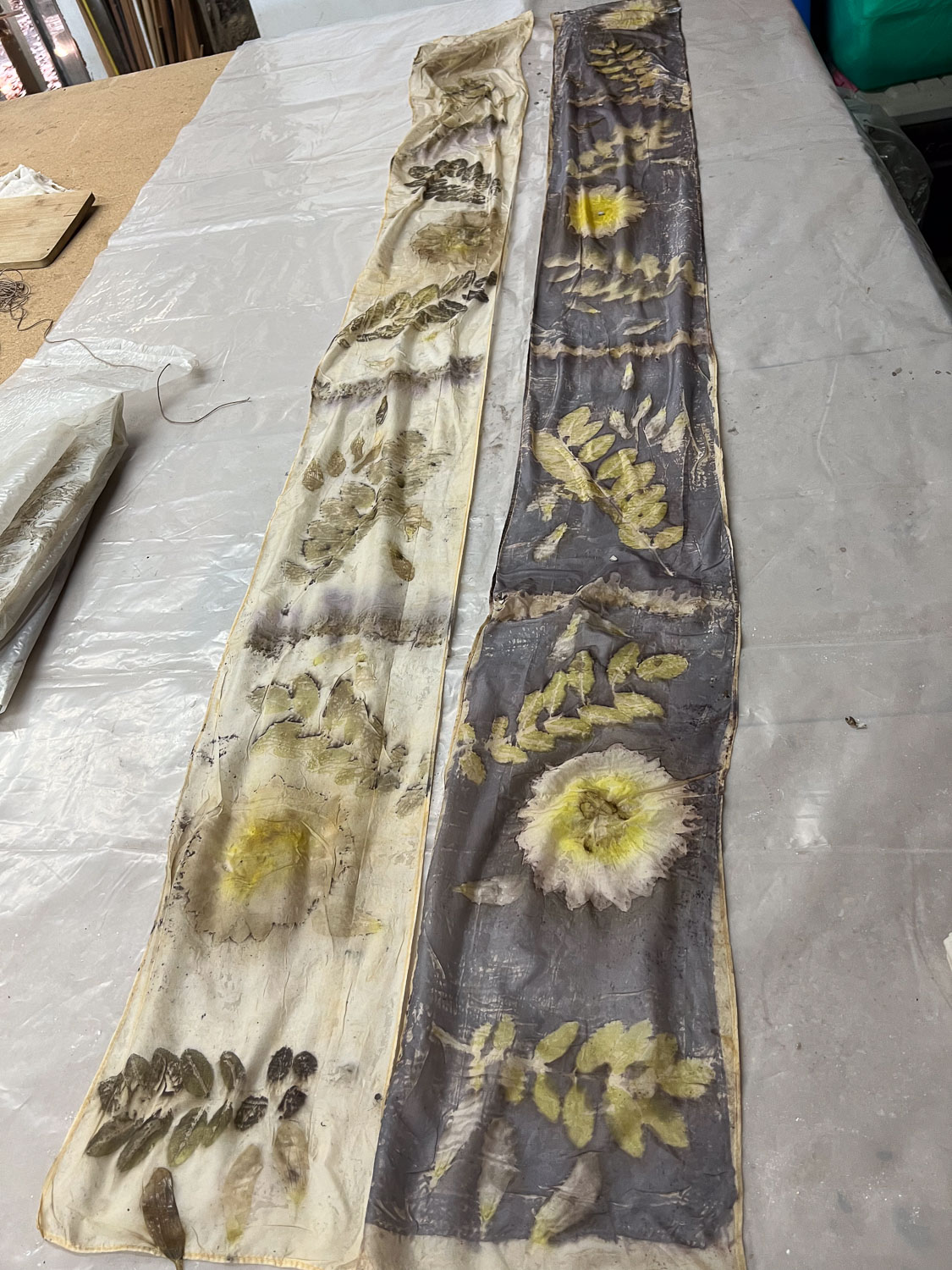
Here is another pair. That’s indigo leaves on the left and dahlia flowers on the right, along with something I can’t remember although I think I wrote it somewhere.

Here is the big reveal of the dahlia scarf.

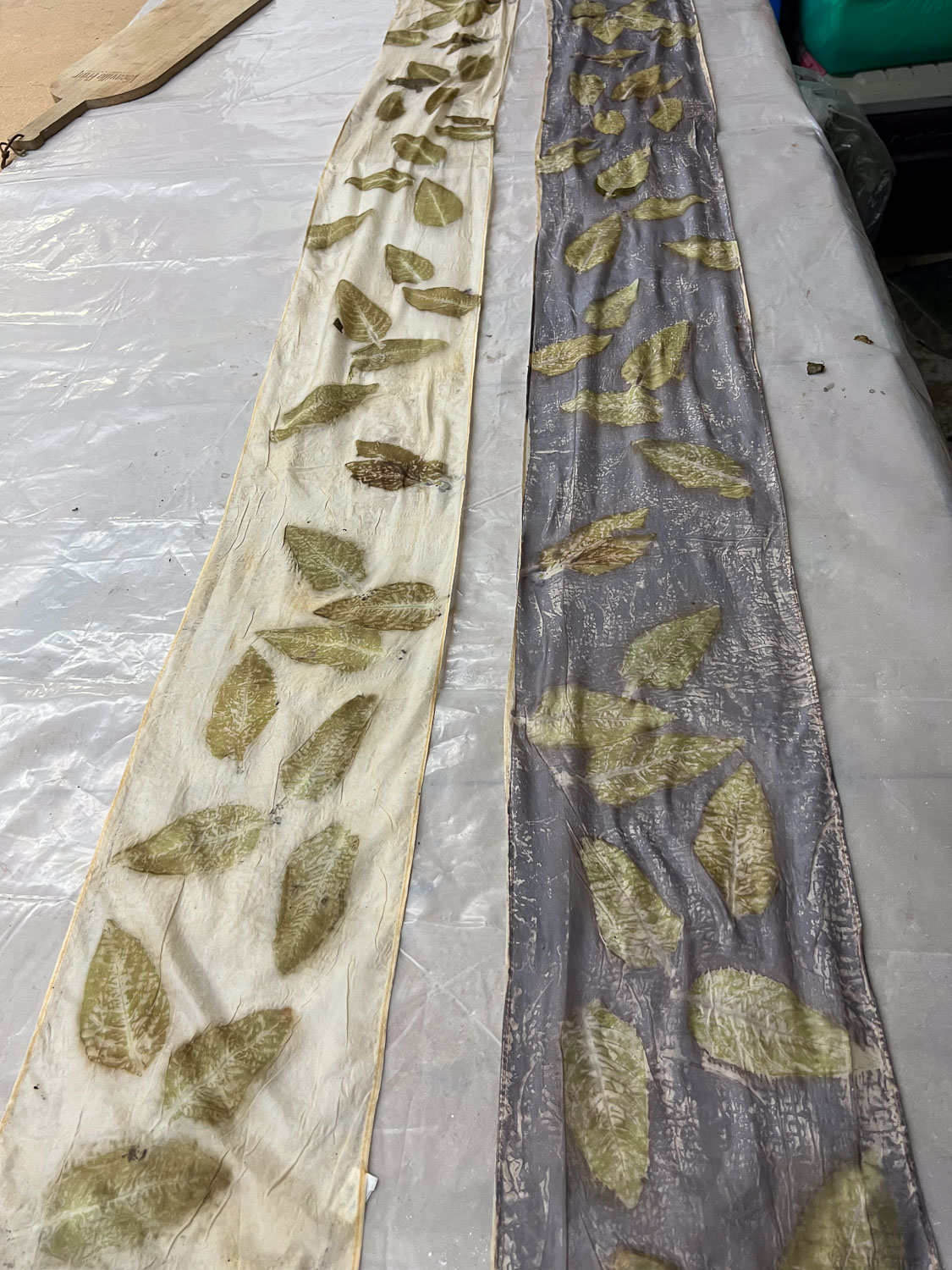
The indigo scarf. In these two pairs, the leaves printed on both scarves instead of acting as a resist.

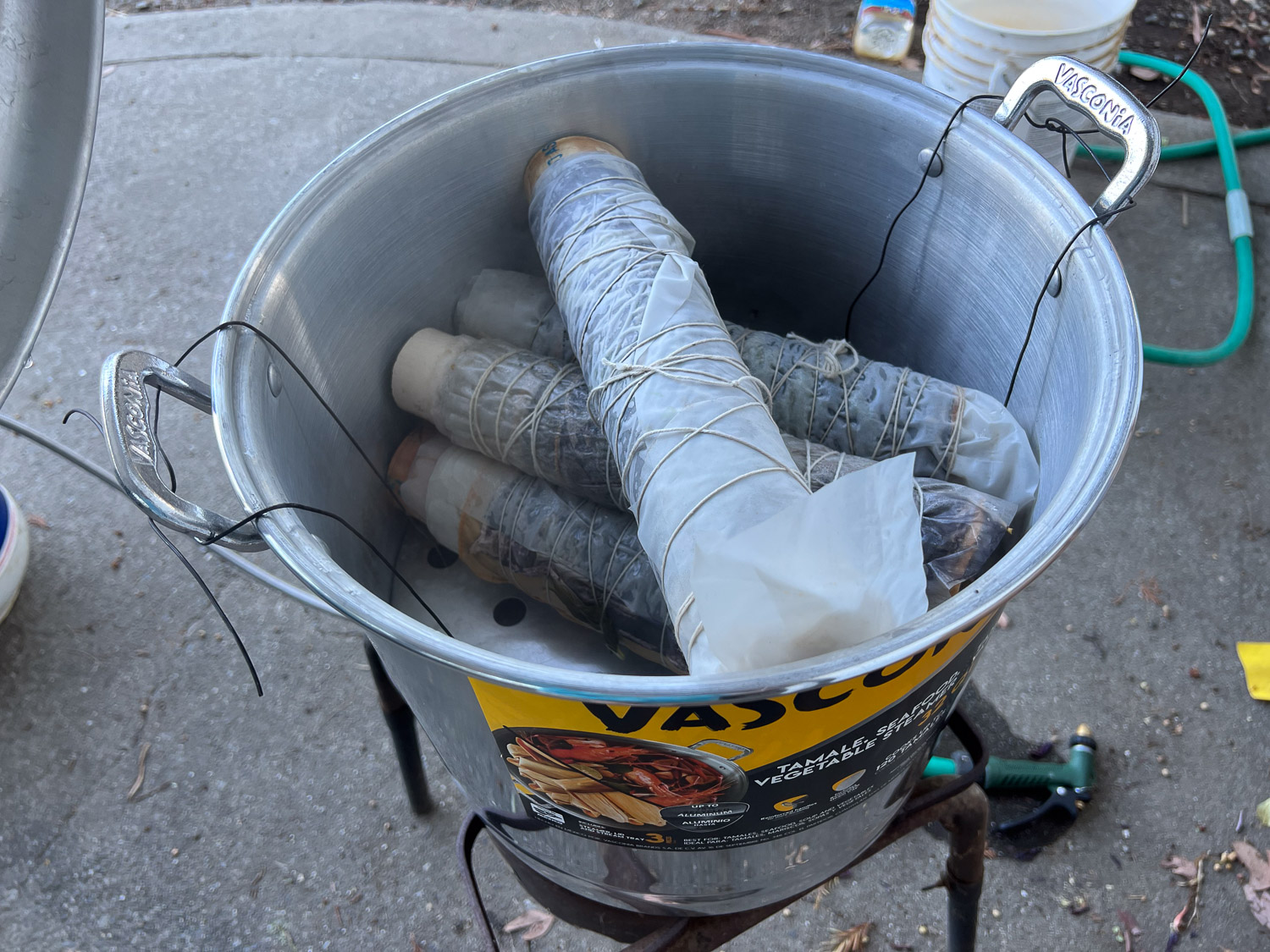
I have used a canning kettle in the past, but I just found this tamale steamer and bought it. The advantage is that a steamer tray comes with it. However I didn’t know if I could put enough water in to last over an hour, and I recently ran my old pot dry which ruined the scarves. So I wired the steamer rack high enough to put plenty of water in the bottom. Now I can fit many more at a time.

I’m experimenting with square scarves. I haven’t figured out the best way to display them at the Artery yet. This is maple, grape, and indigo leaves.

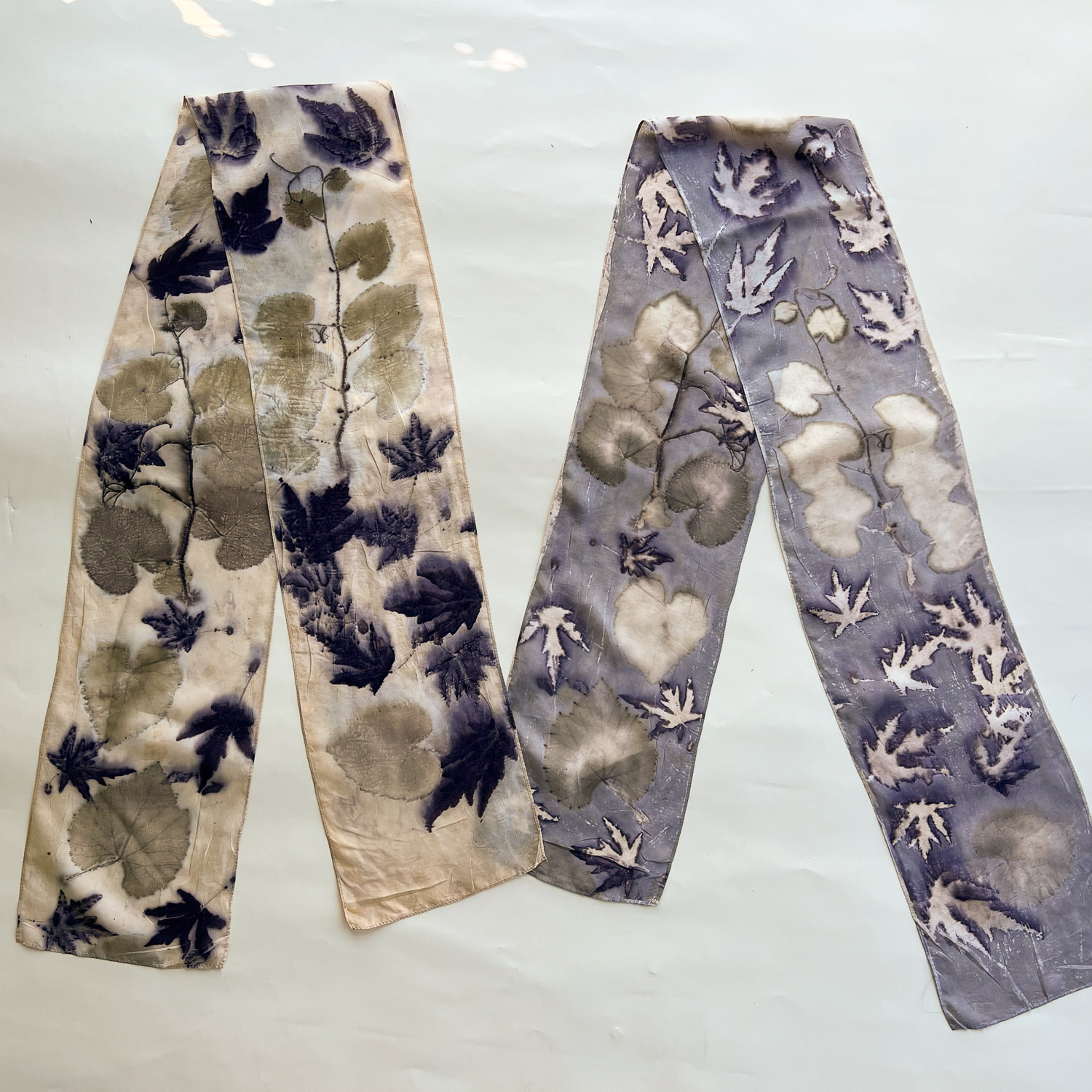
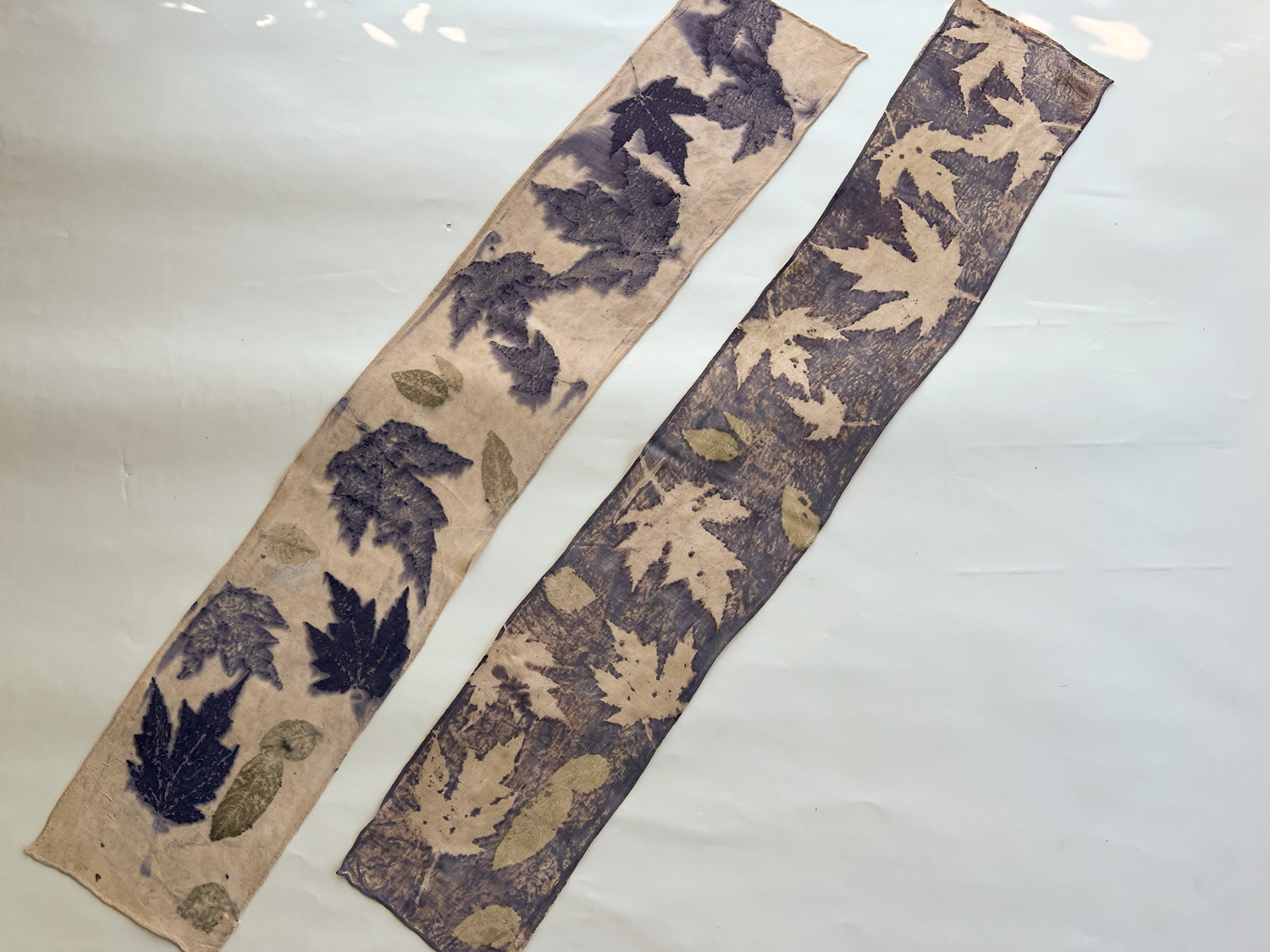
Here is the finished pair. Notice that the indigo dyes green on both scarves but the maple and grape leaves act as a resist on the gray scarf.

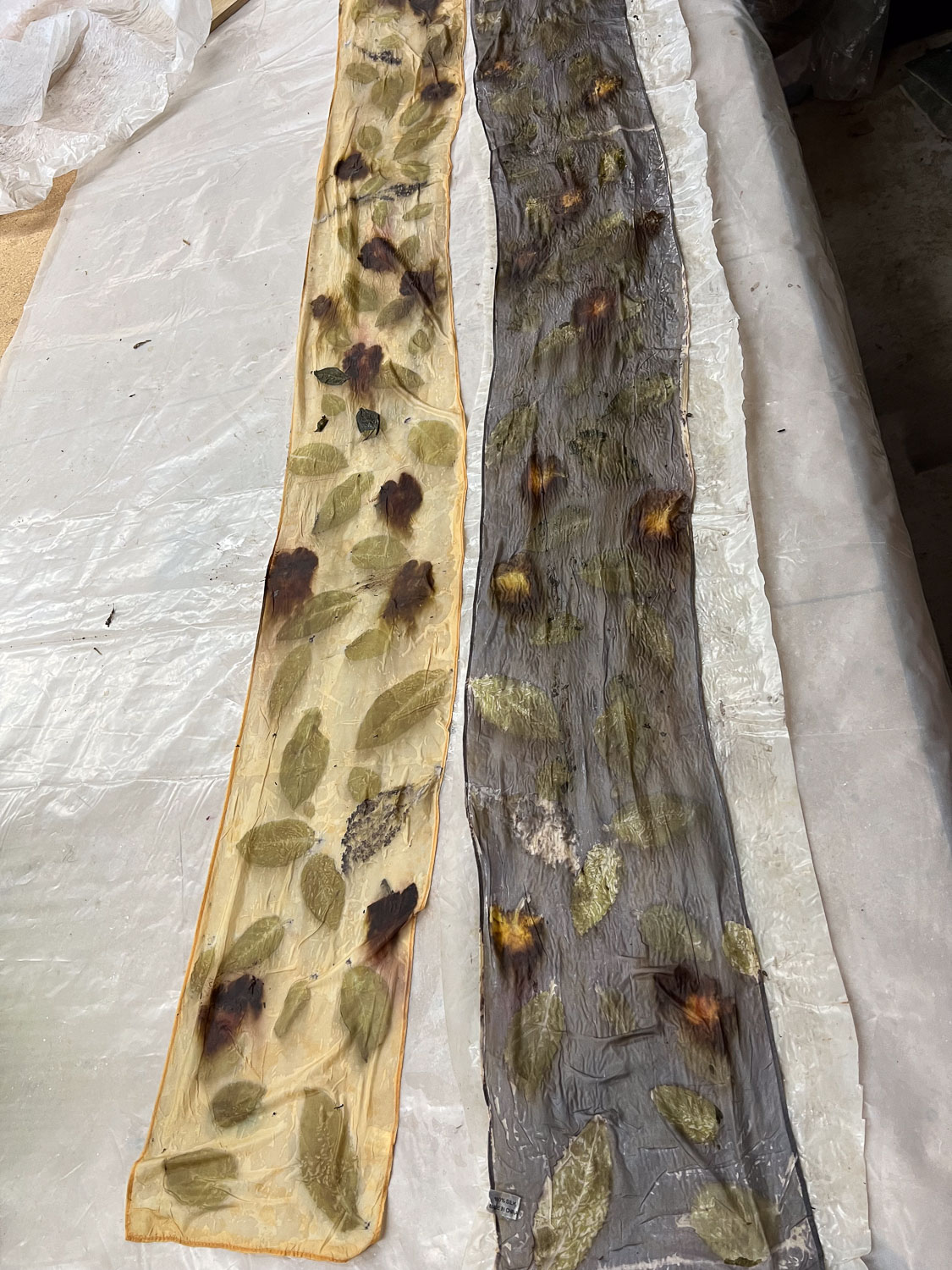
I worked on three at a time here. Maple and grape leaves on the left, indigo leaves and flowers and cosmos flowers in the middle, and cosmos leaves and flowers on the right.

These are the two scarves from the middle after unrolling.

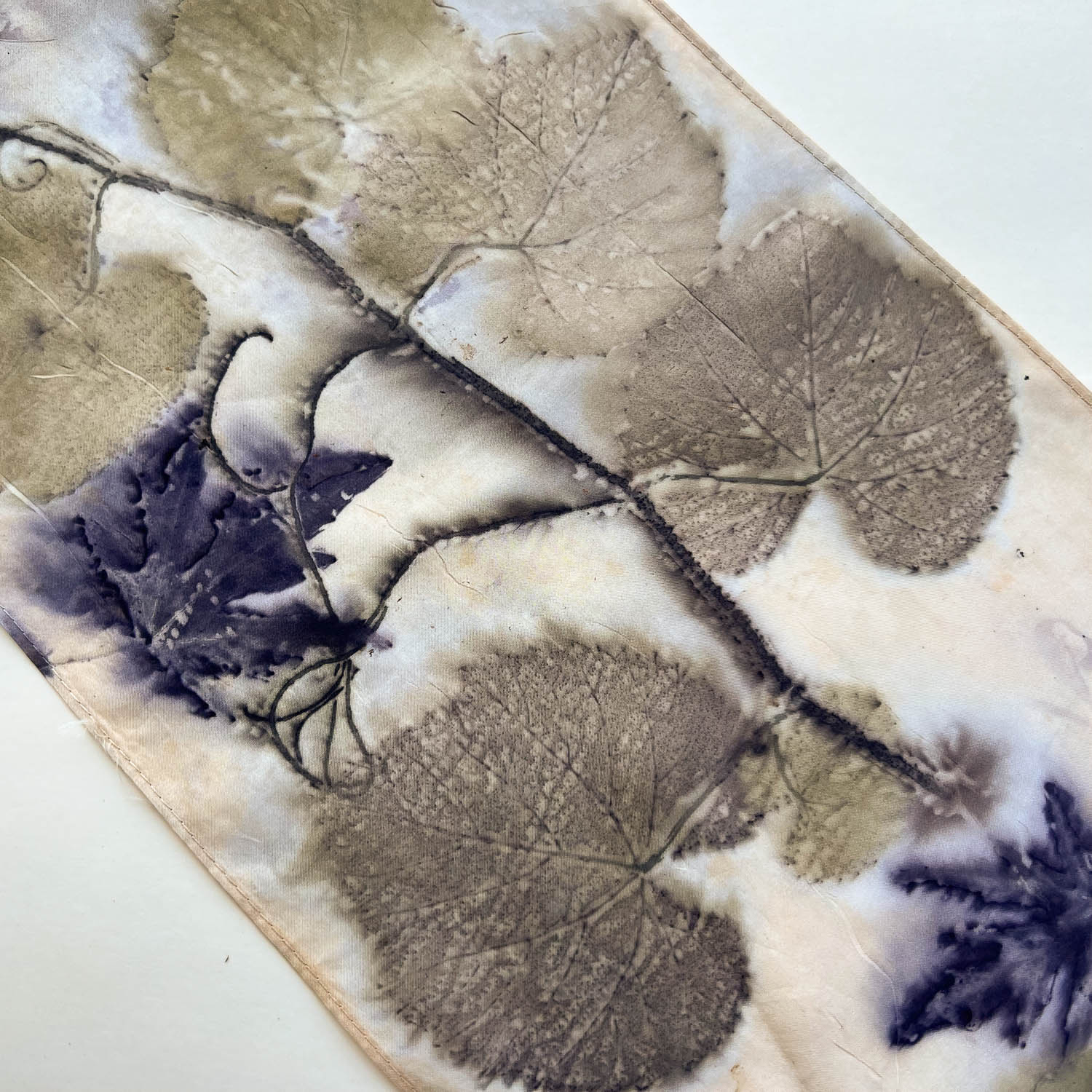
These are the scarves from the left in that photo of three, after washing and ironing. I have four scarves listed on the Artery website right now–working on more listings but need photos. A lot more are in the store in Davis.

Here is a detail.

I printed more scarves the next day. All the scarves have been silk, but I tried a new batch that are 63% silk and 37% silk (right).

Here is that wool/silk scarf after finishing. These are the only ones on my website right now. Hopefully I’ll get more listed soon. I’ll tell you more about that other scarf in another post.

I need to get more photos.