Farm Club helps out again!

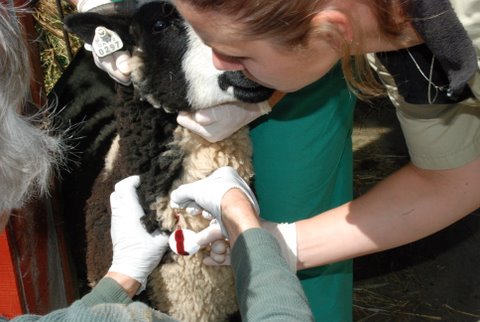
Lambs are due in about a month. That means that the ewes ready for their annual vaccinations. They get Covexin which protects against a variety of diseases caused by Clostridium bacteria including tetenus. They also get MUSE, which supplies selenium and Vitamin E.  By vaccinating at this time in gestation the ewe’s milk will provide a high level of antibody protection to their lambs.

What’s a farmer to do? Call in the Farm Club! We have 3 regular Farm Days a year, but Farm Club members enjoy coming out more often and I am sure grateful for the help and the comraderie.

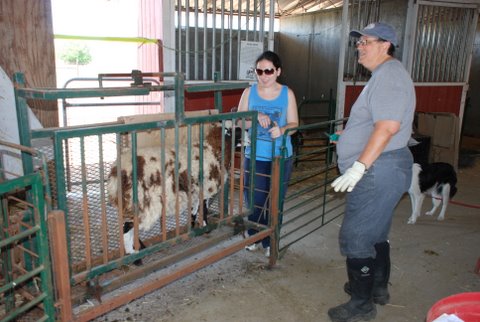
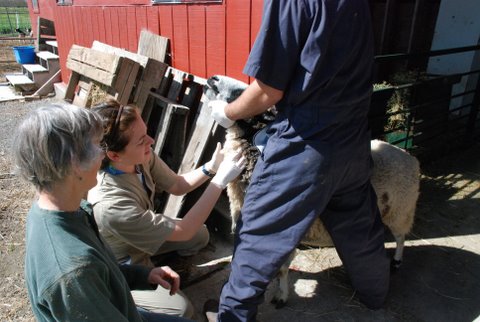
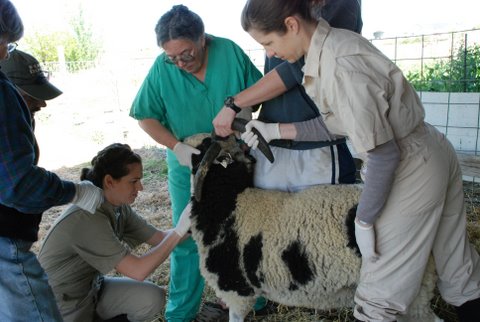
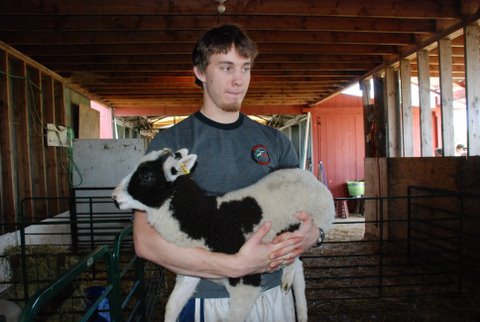
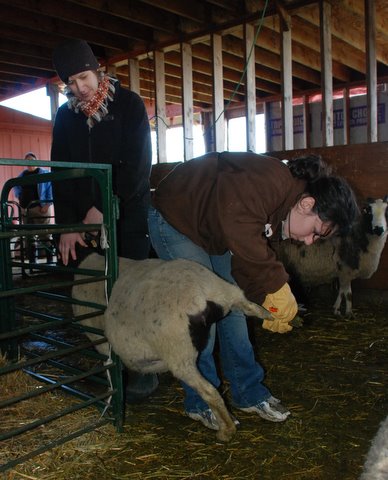
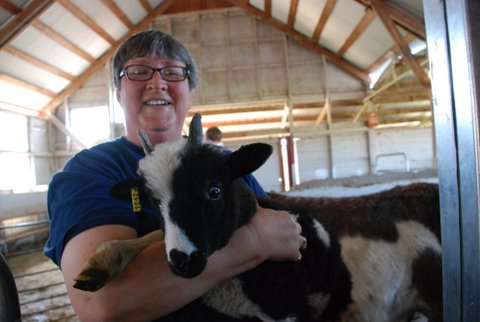
Shelby and Tina teamed up to vaccinate sheep. Shelby, person, is holding Shelby, sheep.

Dona held sheep while I vaccinated.

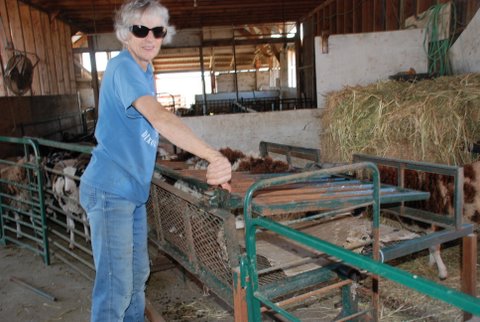
Mary and Kathy kept syringes loaded and ready to go.

Tina spent some time at the manure pile. It’s too wet to get the tractor out to the pile so re-stacking the pile needs to be done by hand (or pitchfork). It’s a good workout!

We spent the afternoon enjoying the sunny day. Notice the milk mustaches on these two. The lambs, that is!


Farm Club Shenanigans

We had an unscheduled Farm Day yesterday.First order of business was chores.

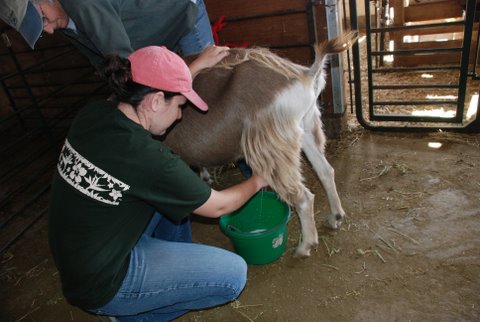
Stephanie greets the Farm Club. She seems to enjoy pestering Kathy. I think she must smell Kathy’s goats. Everyone had a chance to milk a little.

We’re only milking one side because the kid is nursing from the other. This is Tina milking.

Here is Shelby. I haven’t been putting Stephanie on the stand because she is easy to milk and I’m only milking one side once per day.

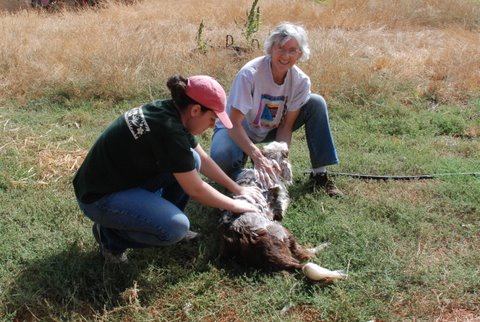
We were going to start trimming feet, but got side-tracked when Rusty decided to roll in the leftovers from yesterday’s butchering. The guys that butcher clean up well, but there is always something smelly left. I think he found the rumen contents.  I had just made Rusty an appointment at the vet to remove a foxtail that he’d picked up that morning. I didn’t think that my husband or the vet would be too crazy about holding a really stinky dog. So dog-washing was in order.

We don’t get too fancy with this. A hose and some soap.

Usually I wear my rubber boots or flip-flops. We were trying to keep our feet dry but get all the soap off of Rusty.

Tina and Kathy are trying to get the dogs to pose. Rusty is back from the vet already (foxtail in right ear) and Mobi (Jackie’s dog) wants to play.

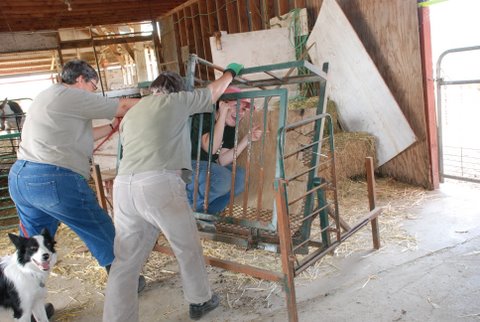
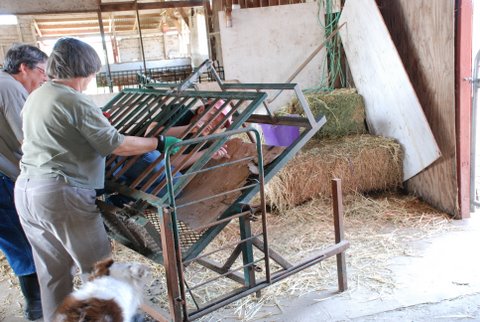
We moved on to trimming feet, putting my squeeze chute/flip table into service again.

To get more work done we also tied some of the sheep to trim feet. This is a lamb that needs to be halter broke anyway because she is one I’ve chosen to keep.

The dogs keep watch. Note the trimmed feet. I have trimmed his feet three times this year to avoid foxtails in the toes.

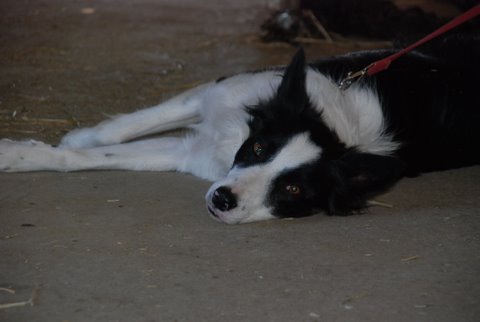
“Well, if you’re not going to let me work, I’ll just lie here.”

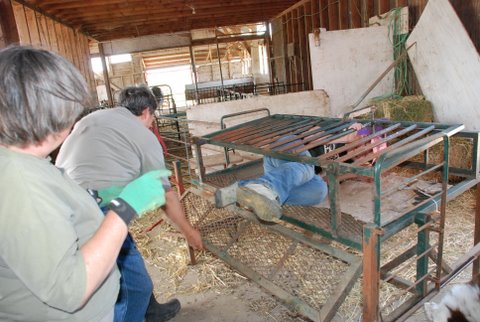
We quit trimming about noon. I forgot to take photos of the chute being used for sheep with varying horn types. I think I need some modifications to use it more effectively. Shelby offered to be a sheep. I’m not sure these are the photos I need to work on the modifications, but laughter is always a good thing.

Somehow the Farm Club is starting to remind me of the YaYa Sisterhood. We’re accepting more members!

Sheep flipping

Several years ago after my second back surgery I bought  a turning sheep squeeze chute. I used it for a few years and then stopped because I felt like I needed a second person to help with it. It seemed to work better if someone held the sheep’s head still. My theory is that sheep with horns struggle when their horns get stuck in the spaces between the expanded metal side (that’s what my husband says that mesh is called). The sheep with 4 horns that have stubby side horns don’t seem to have as much of a problem and I think it’s because they don’t panic as they would if they felt their heads trapped.

I’d been thinking of selling the chute, but then decided that maybe I could modify it. I started by securing cardboard over the side with the mesh. That will not be a long term solution because the cardboard is pretty much destroyed now. But its a start.

Shelby and Jackie were here to help take fleece samples from all the yearlings (19) and trim their feet.

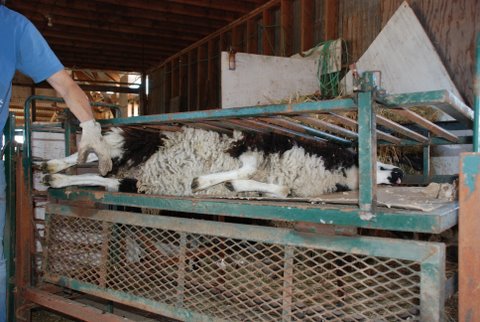
After you squeeze the sides of the chute you can turn the whole thing on its side.

Then you drop the floor so that you can easily get to the feet.

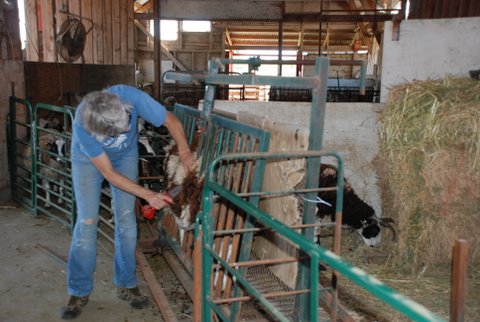
There are a few bars on the side of the chute that you can release so that you can get to the side of the sheep. I take fleece samples of all the yearlings so that I have at least one micron measurement and it’s taken at a consistent age.

There are still some bugs to work out. I think that if I could make a space for the head that would accommodate the horns but that the sheep didn’t think it could climb through the whole thing might work better. We’ll have to work on it.  I think the last time I used the chute it was with a couple of teenagers who were called in to help and argued until one or the other left the scene and then the other sulked. This was much different and vastly more pleasant. I must say that Jackie and Shelby got along just fine–no whining heard. Thanks!

Tay Sachs and Sheep?

Friday was an interesting day. Veterinarians I know had agreed to help with the project of testing my flock for the gene for lysosomal storage disease. I’ll back track and explain briefly.  A gene for lysosomal storage disease has been identified in Jacob sheep. Carriers are unaffected but if two carriers produce an affected lamb it will develop symptoms of the disease and eventually die. There is interest among some breeders in identifying carriers so that they can either avoid the problem (don’t breed carrier to carrier) or remove the problem (cull carrier sheep). But there is more to it than protecting our flocks. Researchers at Texas A&M and New York University Medical Center found that this disease identified in Jacob sheep is the same as the lysosomal storage disease in children, known as Tay Sachs. So there is interest in maintaining a carrier flock of sheep for use in studying human medicine. One of the members of the Tay Sachs Gene Therapy Consortium stated:

“The goal of identi­fying and eliminating Tay-Sachs in Jacob sheep in order to conserve the breed is a noble goal. But we who are working on a human gene therapy cure are very happy that you did not succeed and kept the car­riers for the last decade. These sheep are genetically significant.”

This article it will give more background.

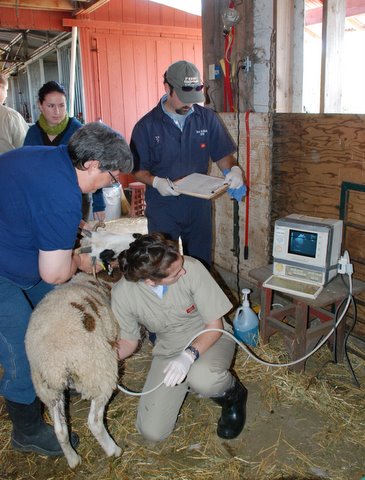
First up was to do ultrasounds on the sheep and one goat that will be part of the UC Davis VMTH Livestock Nursery at the CA State Fair.  I have provided sheep for the nursery for the last couple of years and because we’re breeding out of season we like to check and make sure they are really pregnant.  I’m pleased to announce that Stephanie, the Toggenburg goat, and 3 ewes are pregnant and will be at the fair in July.

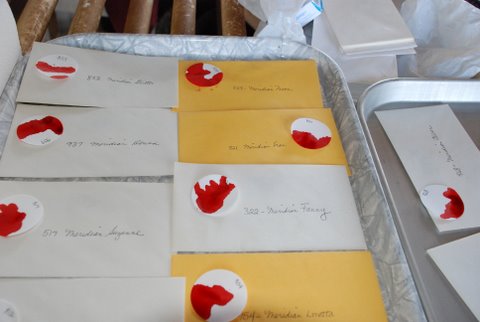
A protocol was developed to enable sheep producers to gather blood samples from their flocks themselves. The DNA test can be done with a few drops of blood on a filter paper. It was recommended to use a special lancet and take the blood from the ear. The Farm Club members and I worked on that a few weeks ago but it turns out that we didn’t have the right supplies and it was a struggle. While I was waiting forthe correct supplies I talked to my veterinarian friend who suggested obtaining the blood from the jugular vein as you would for any other blood test. It’s easier on the sheep (minimal pain) and easier on the person (if you know what you’re doing).   In this photo I’m getting a lesson on how to do this.

I’m pleased to say that after a few missed attempts I was able to get four in a row. Then I figured that I at least knew how to do it and I went back to helping move sheep. We had a “clean” person who labeled and handled the samples, 2 people drawing blood and the rest of us caught and held sheep so we could work through the whole flock quickly. Oh, one of the Farm Club members was the photographer and took all these photos. Thanks,  Shelby.

It was a little more difficult getting blood from the rams. This is Tioga.

My son, Chris,  helped move sheep.

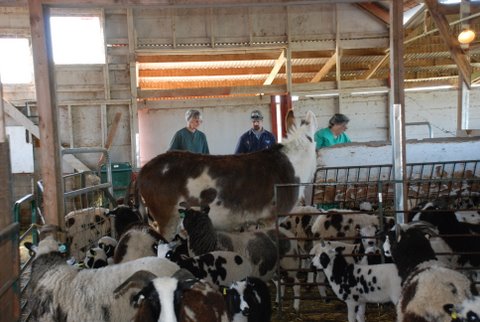
As much as I love my donkey sometimes she makes things more difficult. She is standing right in the gate where the sheep are supposed to go.

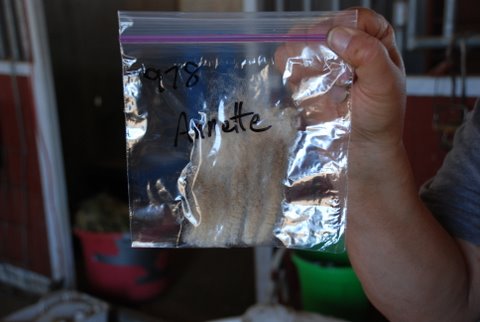
These are some of the samples that will be sent to NY for testing.

This is Sid, a wether who will go home with Jackie when he’s old enough.

Thanks to the veterinarians who helped with this project and to the Jackie, Shelby, and Kathy of the Farm Club.
Spring yet?

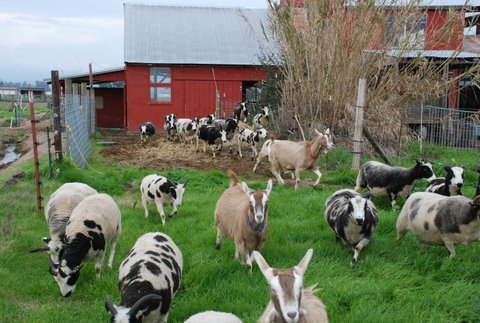
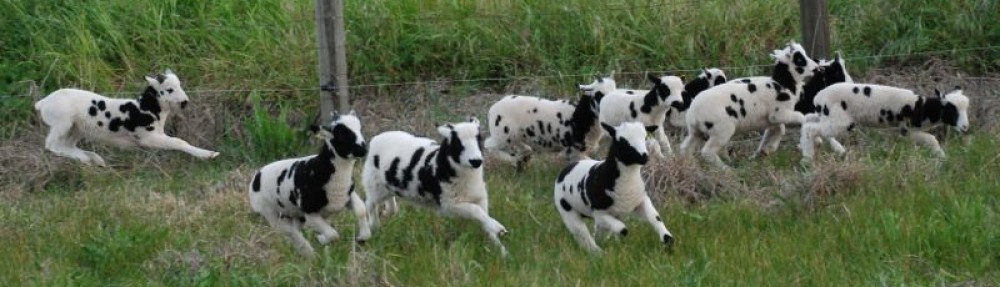
It was sunny this weekend and it felt like spring. The sheep have been cooped up in the barn and corral area for two months now. I let them into this small field today. There is a lot of grass to eat, but it is still wet and if I keep them there too long they’ll turn it into mud.
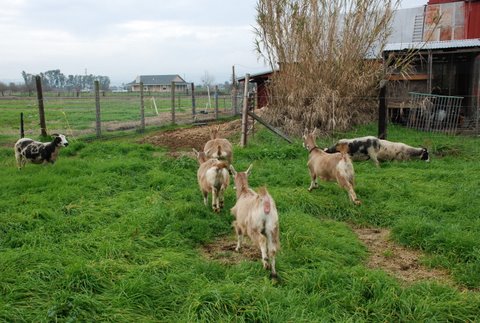
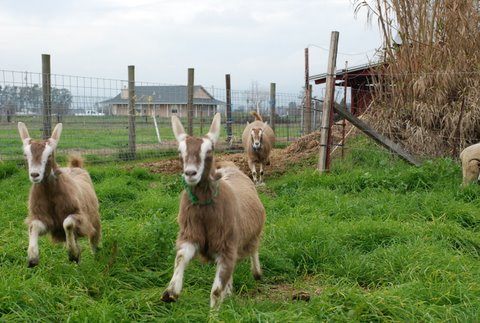
The sheep went right to eating, but the goats continued to race back and forth.

The oldest goat, Stephanie, didn’t participate in the silliness of the younger goats.

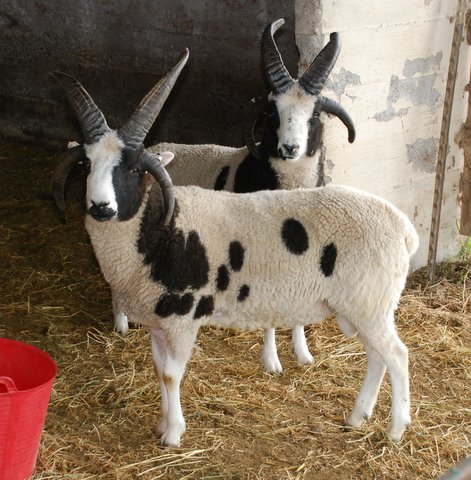
Too bad for the rams. They have to stay in their own area. This is Kenleigh’s Savor in front and Meridian Tioga in back, both born last winter.

This is Lola, a lilac ewe.  That reminds me (because I sold her fleece) that we had Farm Day on Saturday. Three people were here to help with sheep chores. It was great to have the help. We vaccinated all the sheep, wormed the young ewes, and put in scrapie tags.

We even trimmed a few hooves. Shelby is trimming while Jackie keeps the sheep from moving around too much. I don’t flip my sheep anymore to trim feet. I’d rather tie them to trim feet. It has the added advantage of sort of halter-breaking.

Everyone had a hand at trimming feet, but this is Shelby again while Tina holds the sheep.

Fall Farm Day

Today was a perfect day for the Farm Club (see link on the right).   Sunny, but not hot, no wind.  Five people came to spend the day on the farm. We worked in the morning and played in the afternoon.

I had sorted out the spring lambs from the adult ewes. We separated the rams–they’re done for the year. We treated all the ewe lambs, replaced ear tags (remove baby lamb tags and replace with larger, easier-to-read tags), and took photos of the few lambs that I have not yet registered. We also vaccinated the 2-month old lambs. It was great having help with all of this.

We sent Rusty out to get the second group of sheep:

rusty1-w

rusty2-w

3-w

After we finished with sheep chores we moved on to a few others.

jill and jackie-w

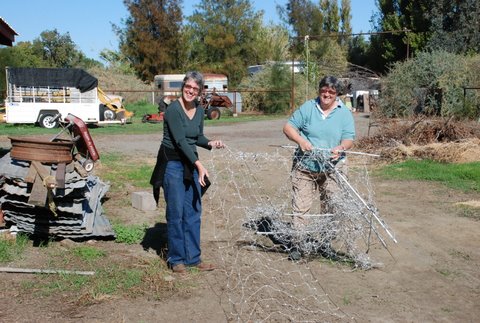
Jill and Jackie sorted out this electro-net fence that had been tangled.

kathy-w

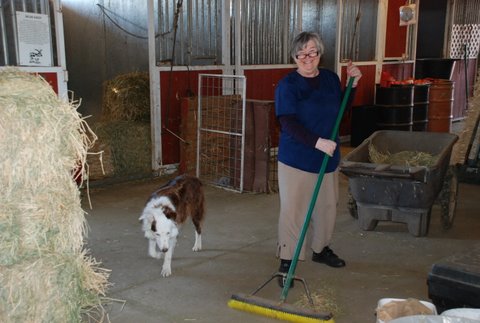
Kathy swept the barn.

jackie,tina,jill-w

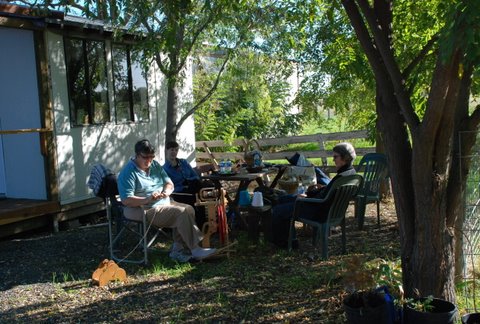
Then it was time for lunch and relaxing. I appreciated the help with farm chores and enjoyed the company. I look forward to Farm Day in the spring.

My New F-word–F…Foxtail

Also could be titled “Yet Another Reason I Don’t Get to the Loom”.

I trimmed border collie, Rusty’s, feet this weekend. I was late in the season and his toes were packed with foxtails. I was able to pull most out, but there was one place that was oozy and I couldn’t find a foxtail with my non-medical equipment (tweezers). I waited until Monday and took him to the vet. While he was on the table the oozy spot squirted out the foxtail and we were going to let it go at that. The vet, as any good vet would, suggested checking Rusty’s ears. He hadn’t shown any signs (shaking head, etc), but he sure wouldn’t let us hold him well enough to look in the left ear.  So I left Rusty to be knocked out for a better look. The little foxtail on the left below therefore cost me $200. Two days later the foxtail on the right cost me $50 (lots of shaking his head, but able to pull it out without the sleeping drugs).

DSC_0367-1

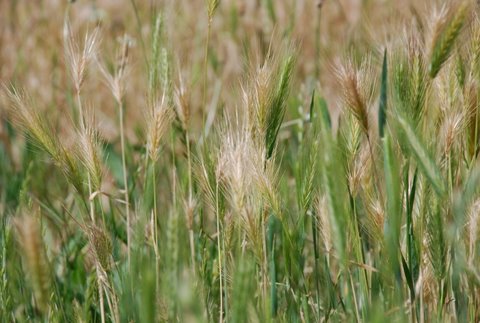
For those of you whose dogs live in utopia and don’t know about foxtails here is what they look like:

DSC_0368-1-w

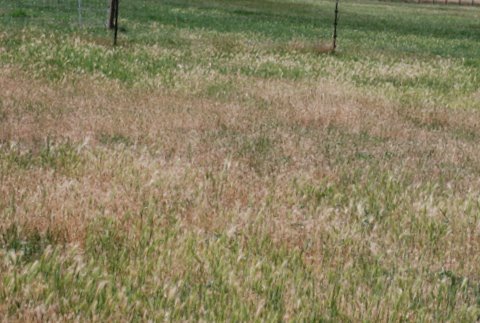
And this is a whole field of them. The vet recommended that we landscape our yard so that we don’t have foxtails. Ummm…that would be another thing that has been on the list–not “landscaping”, but planting some bushes and turning the dog paths into paths with some kind of surface that doesn’t turn to mud in the winter. I did go out with the weed eater and try to zap the foxtails growing in the yard around the house.

DSC_0369-1-w

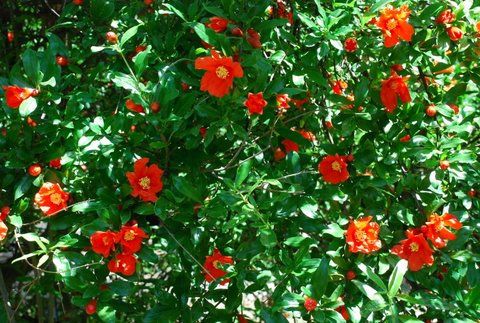
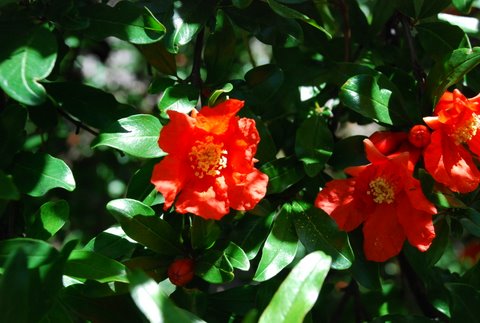
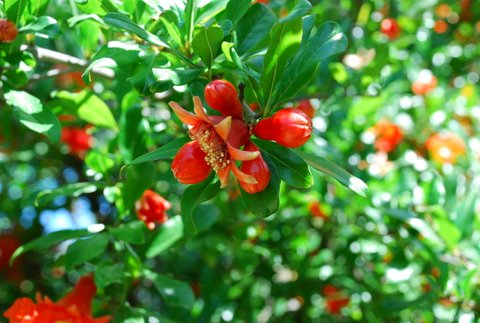
As I was weed-eating  I noticed the pomegranite trees. I love pomegranites–not just to eat, but the whole cycle of the flower.

DSC_0370-1-w

DSC_0371-1-w

Here is a flower that has just lost it’s petals and you can see the part behind the star-like points will become the pomegranite. Those are flower buds that haven’t opened around it.

DSC_0373-1-w

This one still has one petal but is already starting a baby pomegranite.

DSC_0375-1-w

These pomegranites will be included in the fall produce baskets for Gourmet Farm Club members.  See the following link:   http://www.meridianjacobs.com/exec/eFarmClub.asp