Baby Blankets with the Blues

In the 2025 Weaving Recap blog post I included a photo of baby blankets still on the loom and said that warp had been on the loom since October. How about August? That’s what I found when I looked back for photos of warping this loom. Don’t ask me why I decided to wind a warp this way, but it seemed like a good idea at the time.
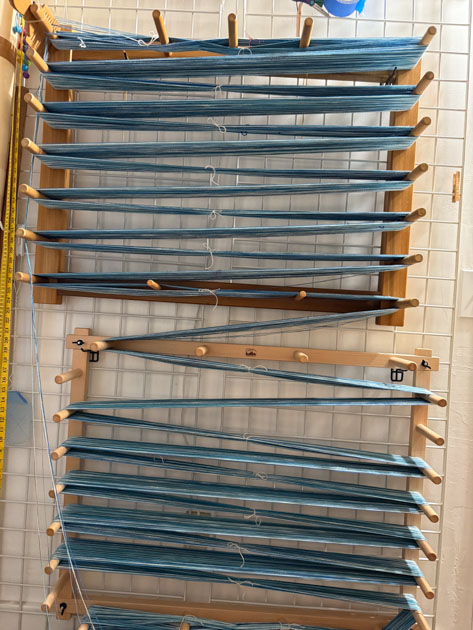
I used a paddle so each pass was four threads and I made a 26 yard warp.

I have wound 20 or 30 yard warps sectionally using the traditional method for sectional warping or using the AVL warping wheel. But I got this idea of using two warping boards and thought, why not?
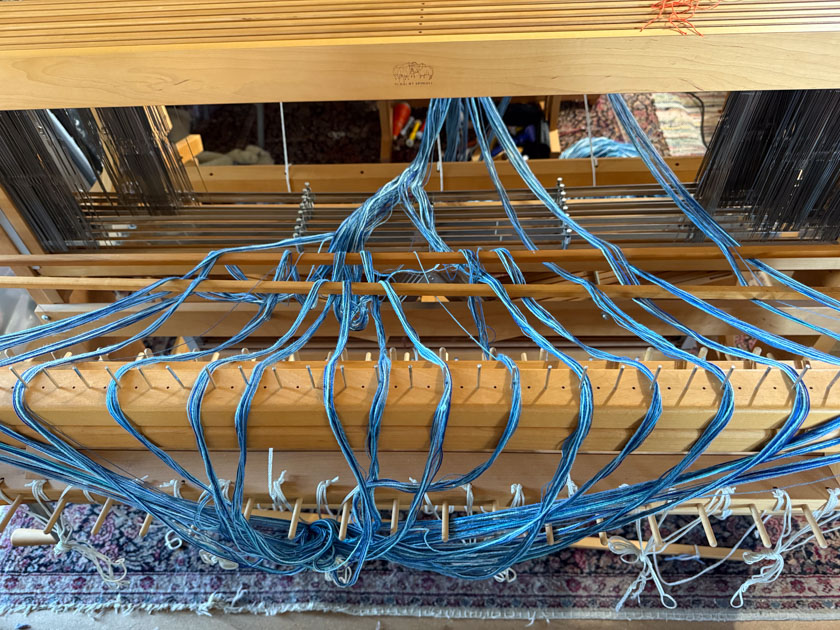
I had to wind two bouts to accommodate all the yarn. My goal was to use up odds and ends of cones of yarn so the second warp. That meant the second warp would be different from the first, but I wanted the colors distributed throughout. I spaced the first one out in the raddle.
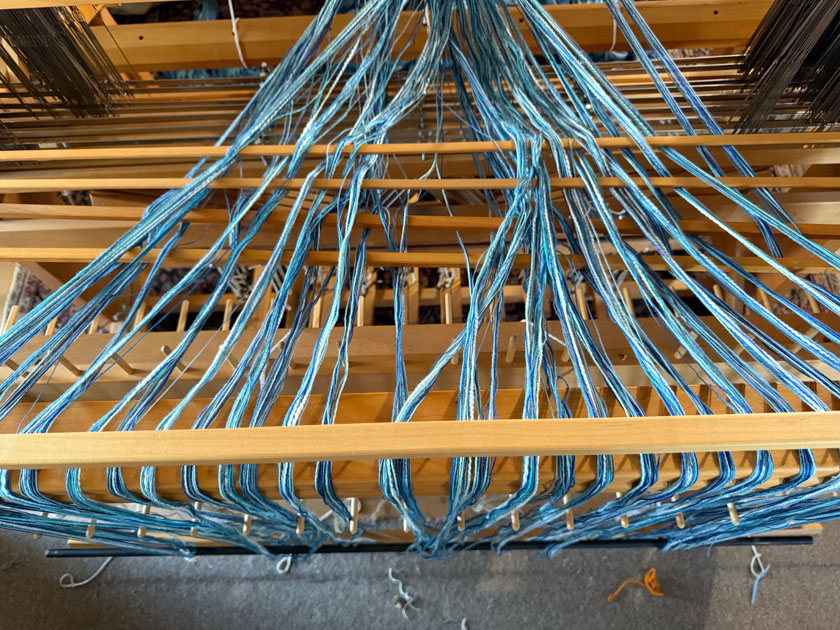
Then I added the second warp in the empty spaces.
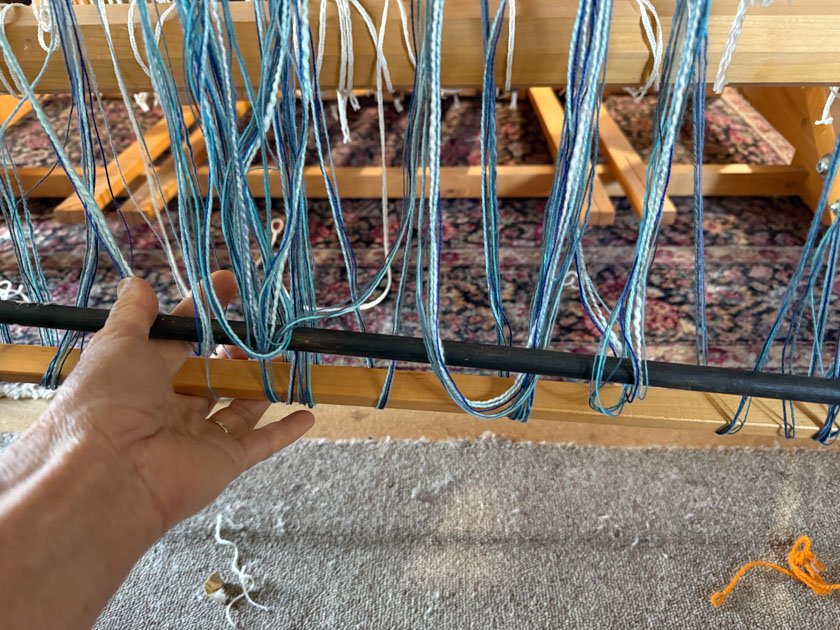
I used two end sticks instead of trying to intersperse the two bouts onto one stick.
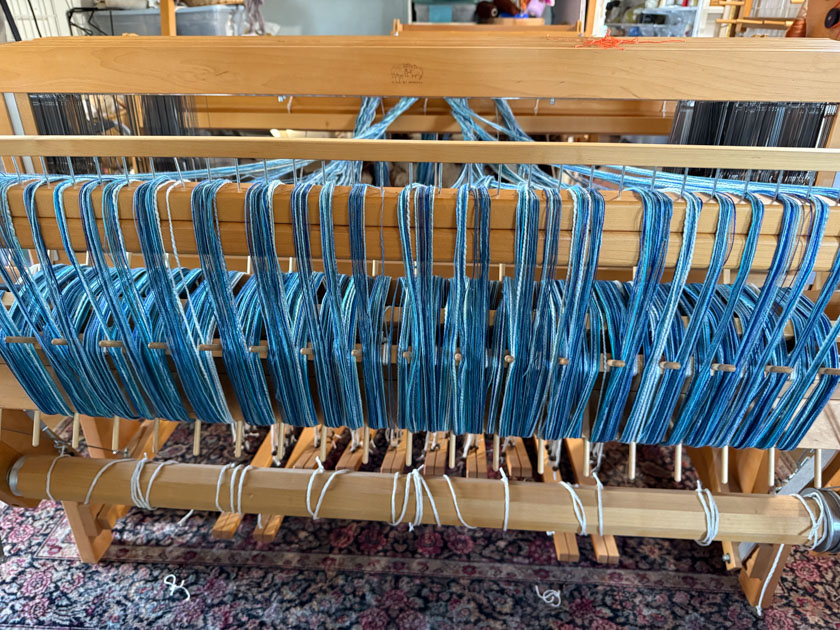
This looked good.
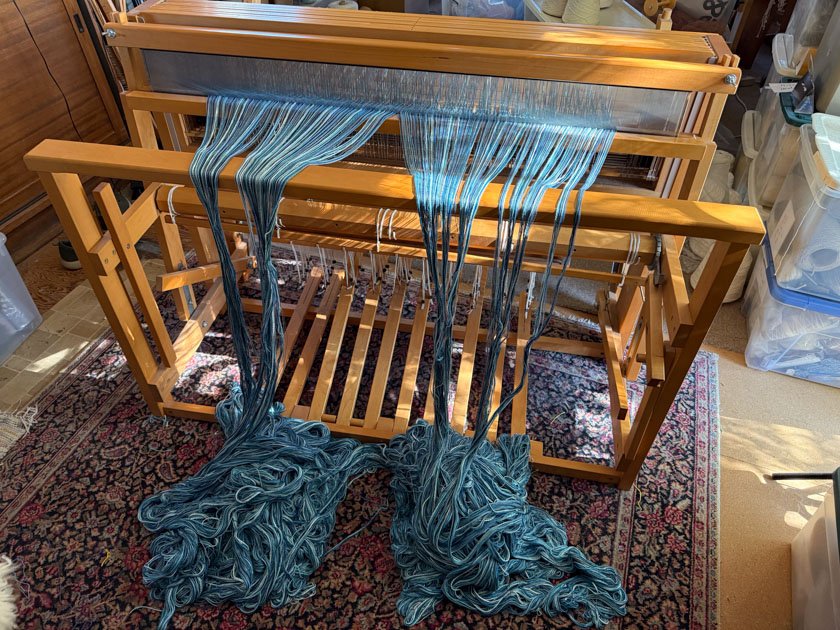
This side was a little messier, but it all worked out eventually.
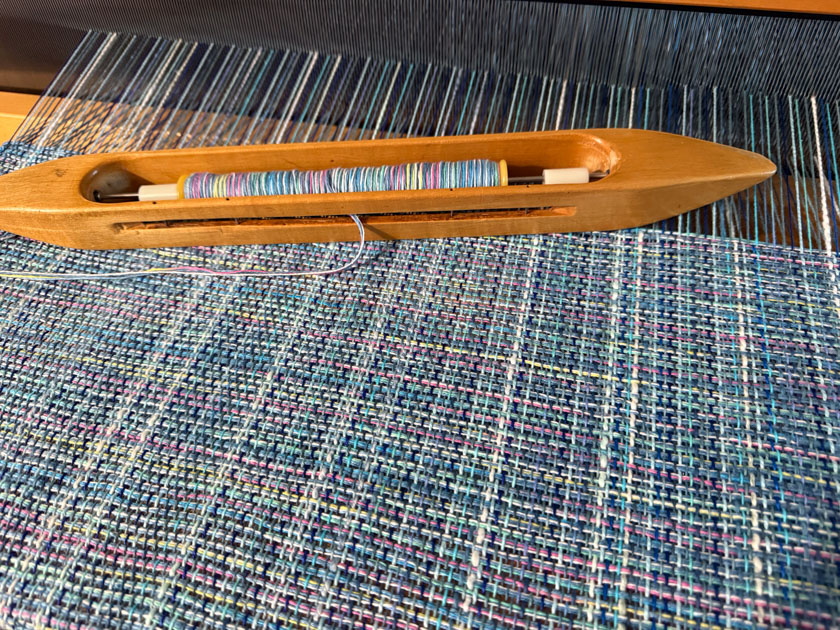
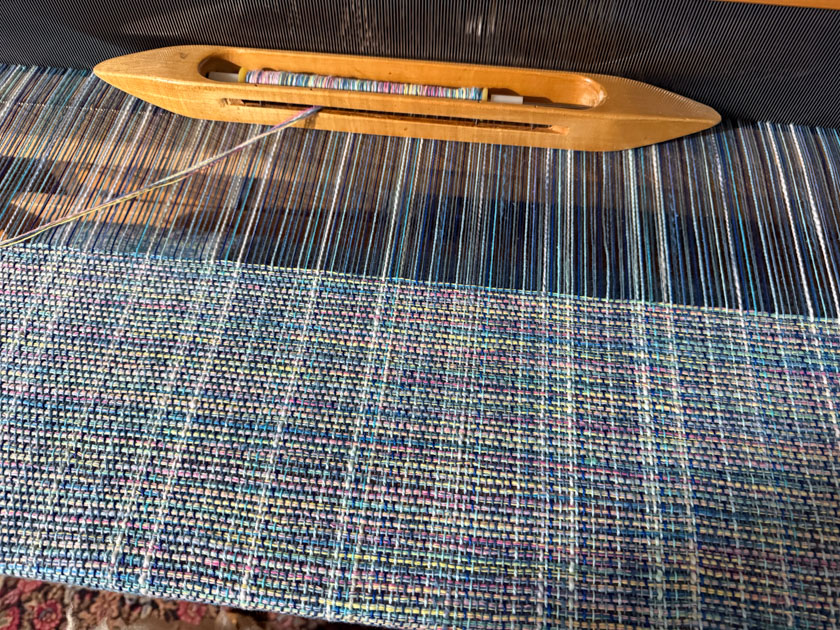
Weaving in progress.
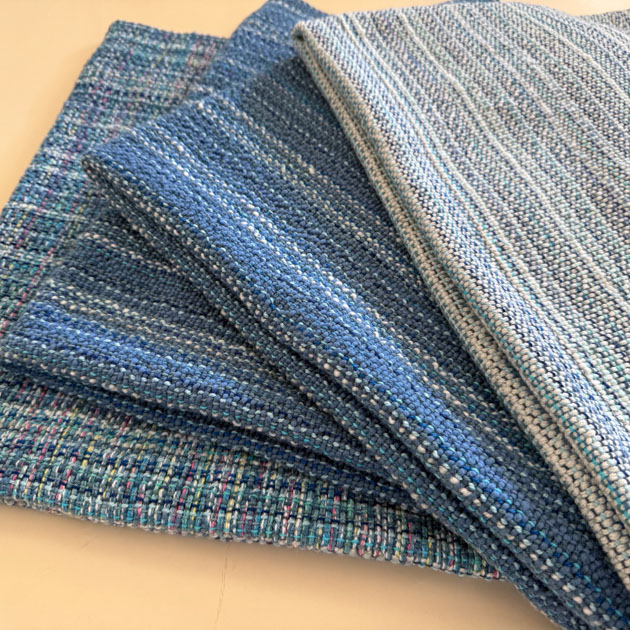
I had an order for blankets so I cut some off the loom early and didn’t get back to that warp until recently.
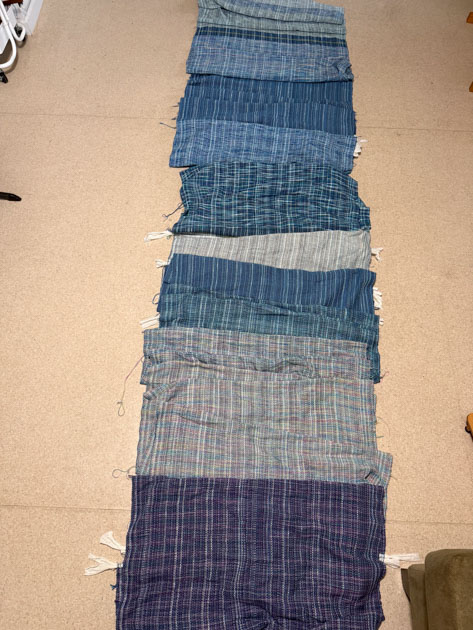
This is the warp I just finished before cutting anything apart. People always ask how long does it take to weave a piece. There are processes other than weaving that go into completing a project. In this case all blankets were machine stitched at each end before cutting them apart. Then some were hemmed. All are washed and then I sew on my label and add the hangtag.
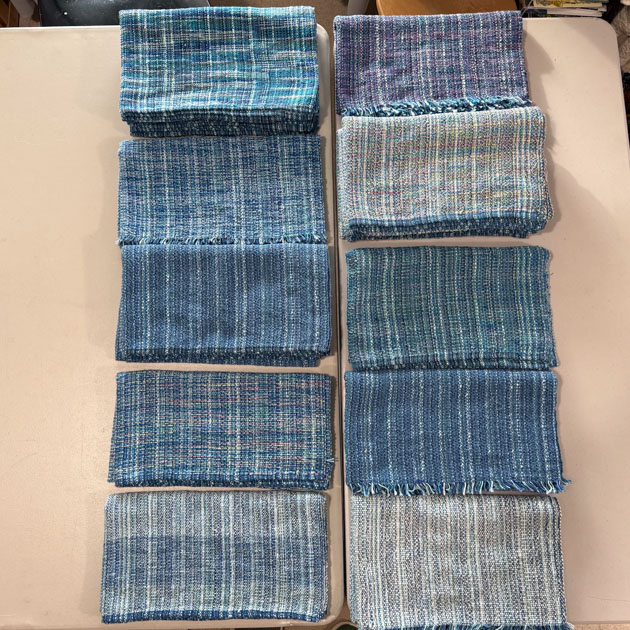
There are multiples of some of these blankets. Those are stacked with two or three.
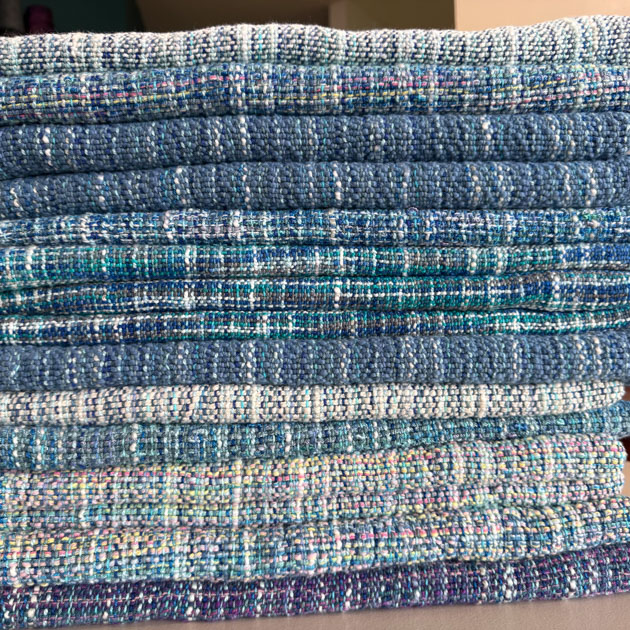
Another view of all the blankets. You can find some of these blankets on my website and here at the farm store. Others are at The Artery and some are on the Artery’s webstore (local pick-up for those right now). Next up will be a white warp so I can have a variety of colors.
Weaving in 2025

I was ready to write another Random Farm Photos blog post but then thought that maybe, since this is the last day of the year, there should be some sort of retrospective. Most of my blog posts this year have been about the sheep and the pasture, but I am also a weaver. I have neglected that.

I keep a notebook with all my weaving info. The warps are numbered. I looked for the first one of 2025 and couldn’t find a photo. I sorted my photos into date order and found 275 photos in the weaving collection. Yikes! That doesn’t mean I wove that many pieces–not even close. But they all are part of various stories, none of which I shared in my blog. Maybe forget the sheep for a while and focus on yarn?

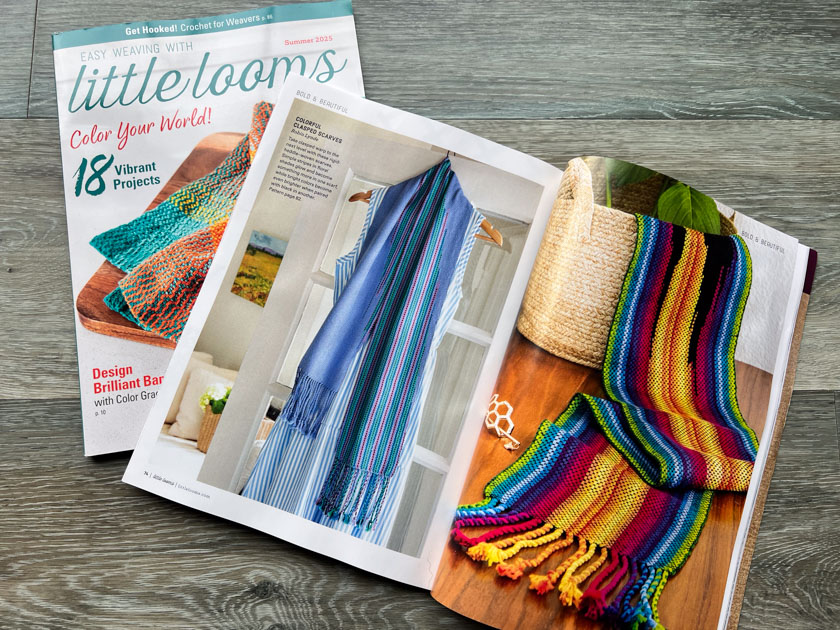
This is the issue of Little Looms, Summer 2025, with my clasped warp scarves in cotton. They were woven the previous year, but the magazine was published this year.

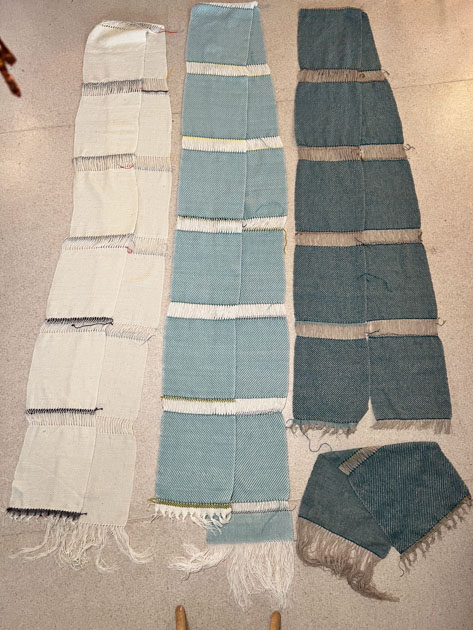
These are samples, all woven the same size in three different wool yarns. This is the photo after I took them off the loom but before any finishing. Wet finishing is the topic of an article in an upcoming issue of WEFT magazine. There were some surprises but you will have to wait for the magazine to be published to find out!

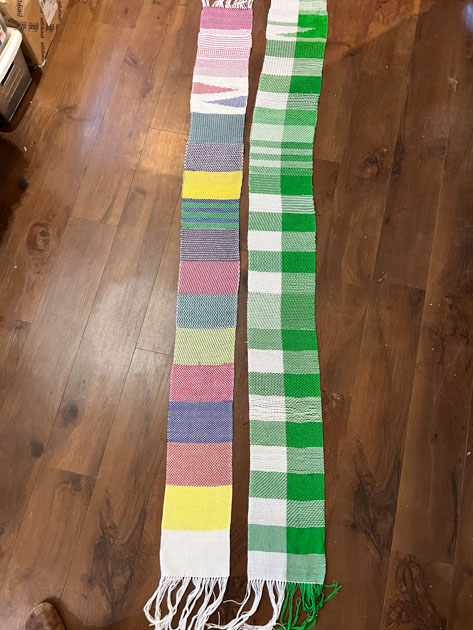
This is a workshop sampler for my Learn to Weave class. I taught this at the Conference of Northern California Handweavers (CNCH) in the spring and wanted new cotton samples. Students have the option of weaving wool or cotton in this class. You can’t tell from this view but every 6″ is a different treadling pattern. The green and white one gives four samples in one for each treadling by showing white on white, green on green, and the green/white blend.

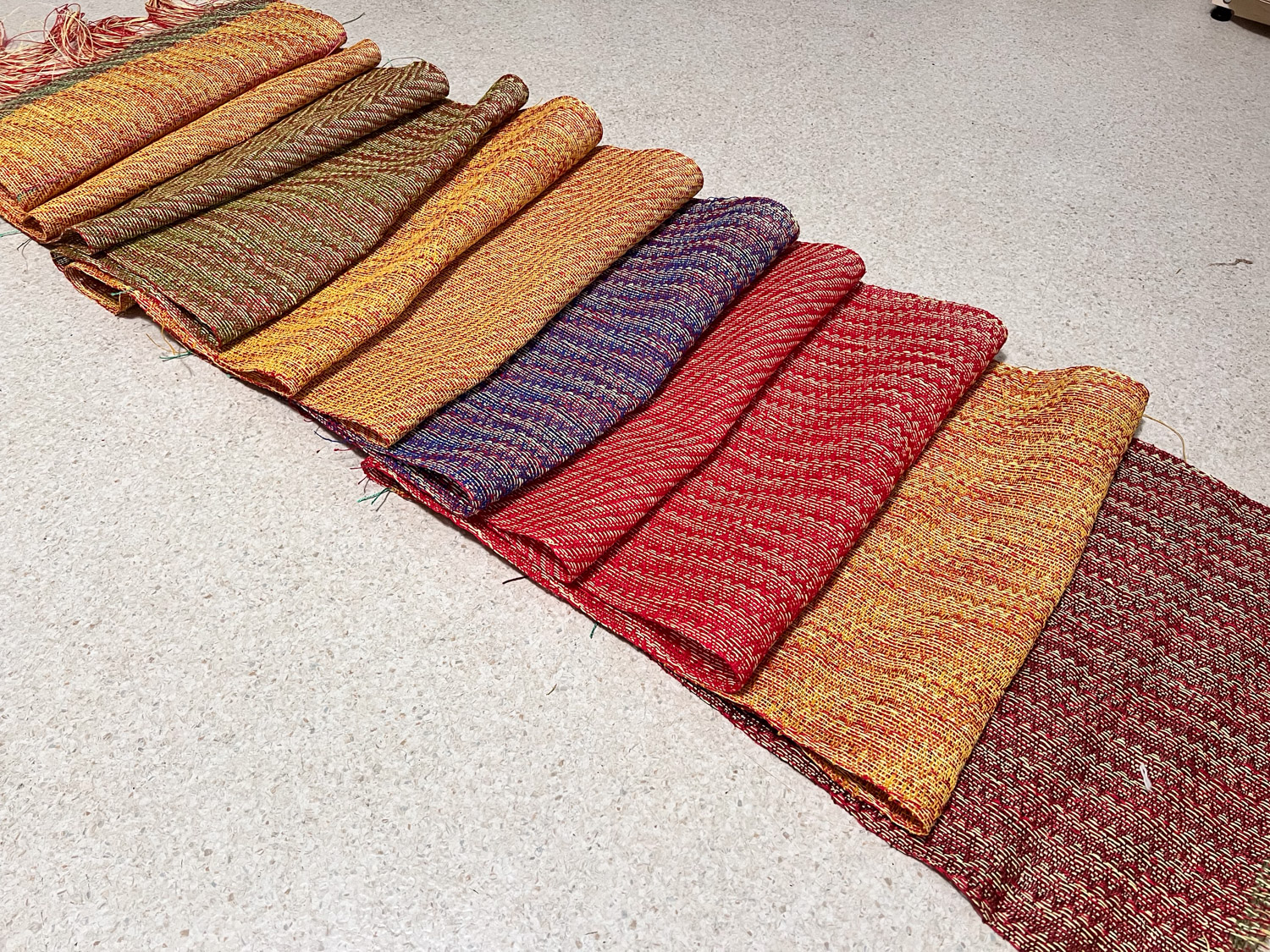
Another sampler. This one is to experiment with color-and-weave using six colors. There will be an article featuring a project based on this in the Summer 2026 Handwoven magazine.

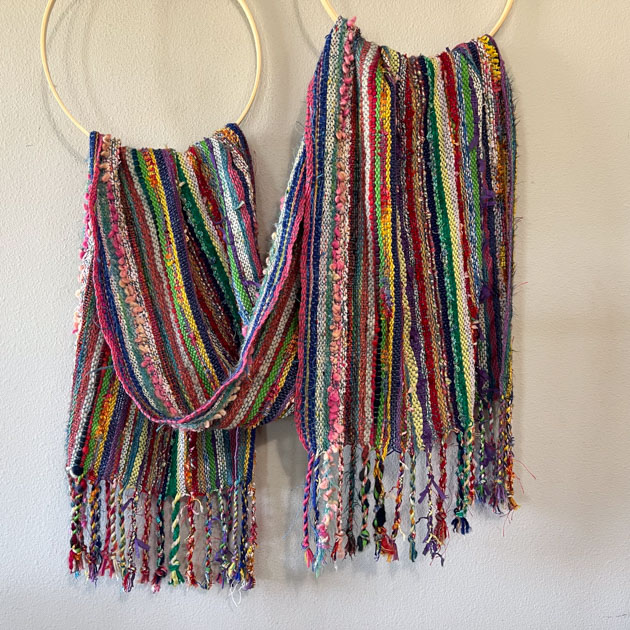
This is another scarf/shawl/wrap (which is it?) using Art Fiber Frenzy yarn. I have been intrigued by this yarn since I first discovered it a couple of years ago. I have also created a class to lead people through weaving a piece with so many fibers and textures.

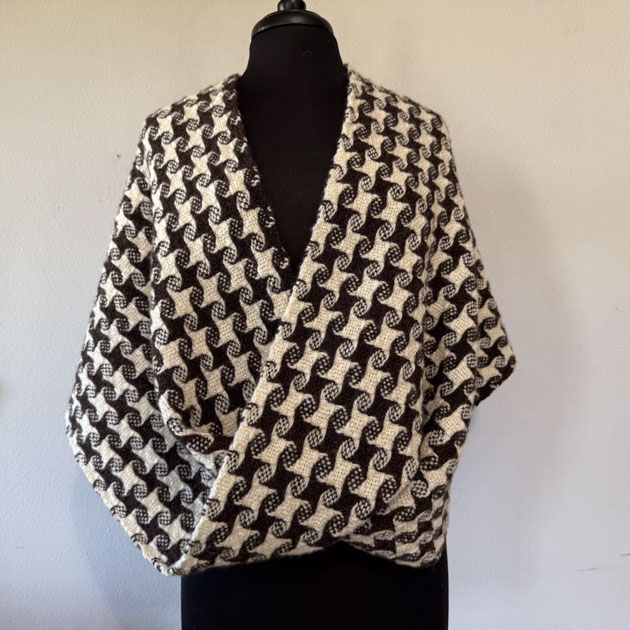
I didn’t neglect my favorite fiber–wool. I wove several blankets and shawls during the year. This is one in a more traditional color-and-weave pattern with only two colors. The yarn is, of course, black and white Jacob wool.

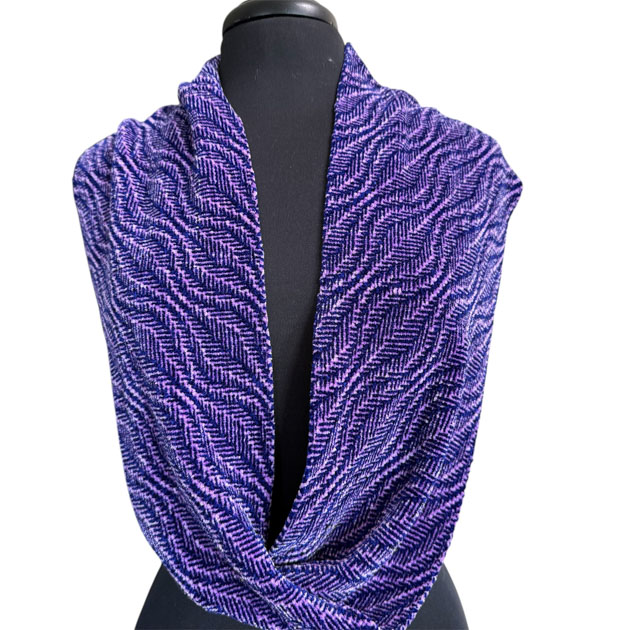
This is a chenille scarf in shadow weave. It has sold but there may be a similar one at the Artery–I’ve lost track.

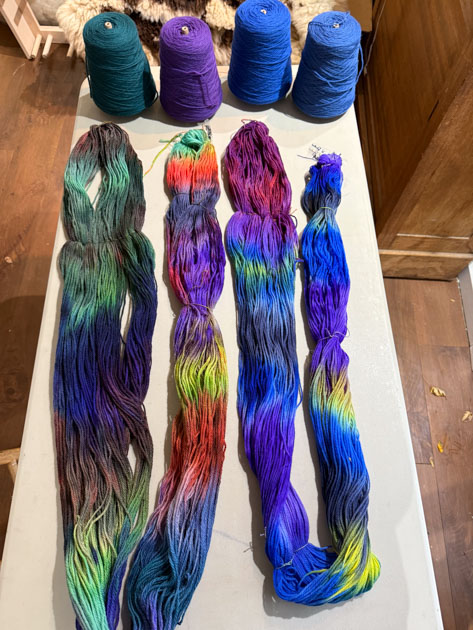
My new favorite wool (other than my Jacob and Timm Ranch yarns) is Brown Sheep Company Nature Spun. I’ll be introducing this for some of my classes this year. I wound some white v-shawl warps and space-dyed them. Then I needed to find weft colors.
Here is how the one on the right turned out.

Oh boy! A crazy thing I got into was triaxial weaving. I wove some pieces 15 years ago and now have resurrected the idea. I spent way more hours on the four pieces I finished than maybe they warranted. But now I’m ready for more. Two will be in a January show at The Artery.

This is a v-shawl using the Nature Spun yarn. This one and the samples below are ideas for other articles I may propose and for pieces that I will sell.

Log cabin on the left is another color-and-weave pattern that looks much more complicated than it is.

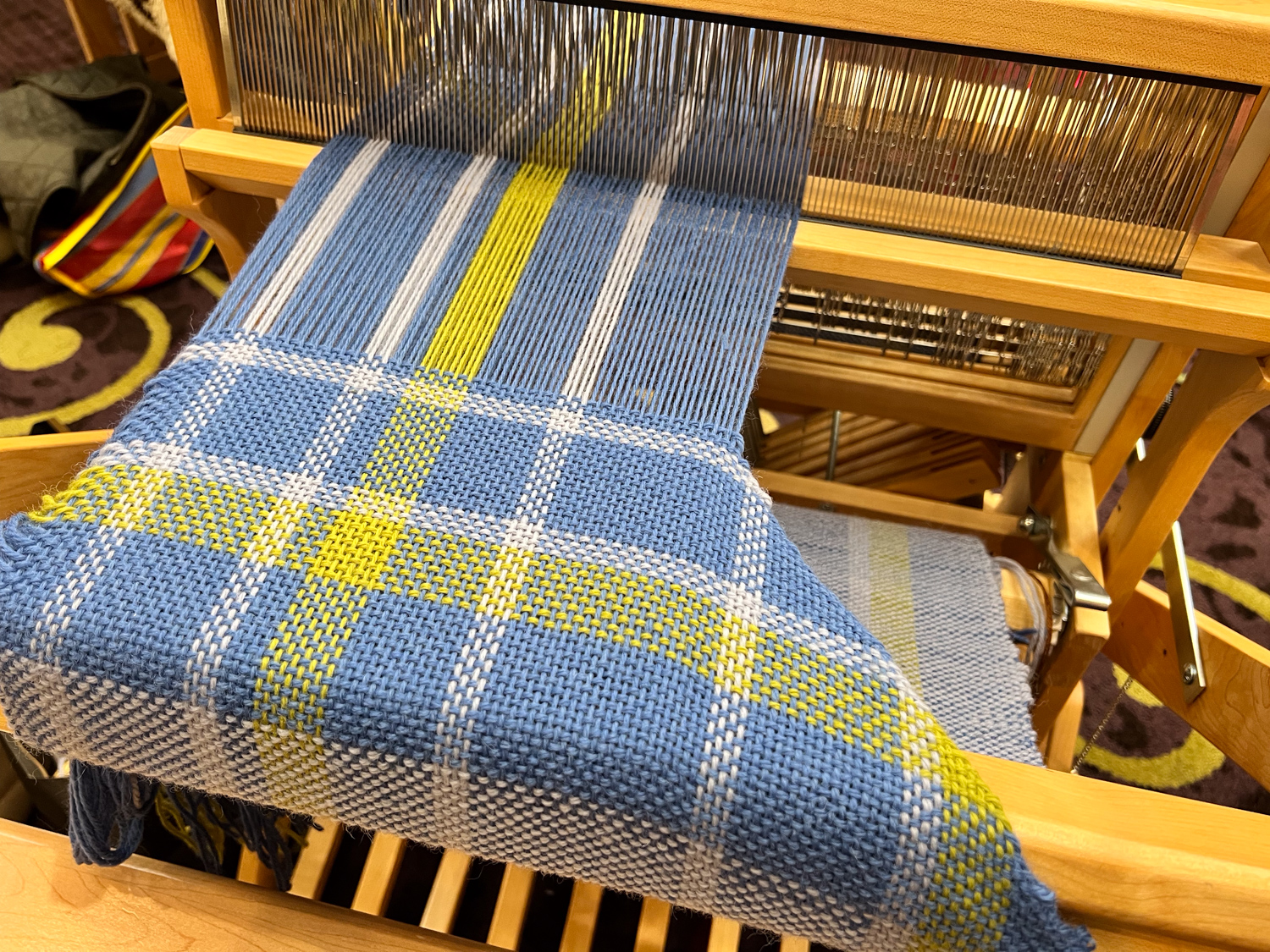
If you read this blog regularly you know that I’ve been complaining about the fog, except for the beautiful sunny day we had two days ago. That didn’t last. It’s foggy again and it’s supposed to rain later. The “shop” where I have my bigger looms is not insulated and I don’t even try to heat it up with space heaters. I will put the heater on right next to me but It won’t have much impact on the surroundings. I am trying to finish the baby blankets that have been on this loom since October. That may be another blog post when I actually finish.

I worked on this loom yesterday and plan to finish today. First I need to put some more layers on.

CNCH 2025 – Asilomar

I spent many days (weeks, months?) working towards going to CNCH (Conference of Northern California Handweavers) as one of the teachers at this retreat-style conference held at Asilomar on the California coast. I have taught Learn to Weave many times and can do it without thinking, but the prep is different when I am not teaching at home and when there will be so many people in the class. This is a class presented to people who may have some weaving experience but not enough to warp a loom themselves, people who may have woven long ago but need a refresher, and those who have never woven anything. Many don’t have looms or at least not looms that are portable.

Fifteen people signed up for this workshop. Five of them were bringing looms, five looms were borrowed from local guild members, and I provided five. That’s not just the looms–five warping boards, benches, and all the equipment that goes along with winding warp and weaving. I also supplied yarn, and not being someone who wants to tell people they have to choose only one or two colors, I brought plenty of choices…and in wool or cotton–their choice. This is where I staged what I was to put in the trailer. It doesn’t include the grid wall that was already in the trailer. You’ll see that in use in some of the photos.

I got the classroom set up by Thursday evening. Many thanks go to the person who organized the conference and made sure that I would have two helpers. My two requests for teaching the class were space (this room was great!) and another person (I had two!). With a beginning level class there are a lot of questions along the way one person can’t provide all the answers in a timely manner. There was also the issues of unfamiliar looms getting them set up to work with the class.

Samplers in wool on the left and cotton in the center. On the right are some of my shawls.

One of the perks of teaching this class was staying at Asilomar. My room was at the end of this building.

We set up grid wall to hold warping frames on this side of the room.

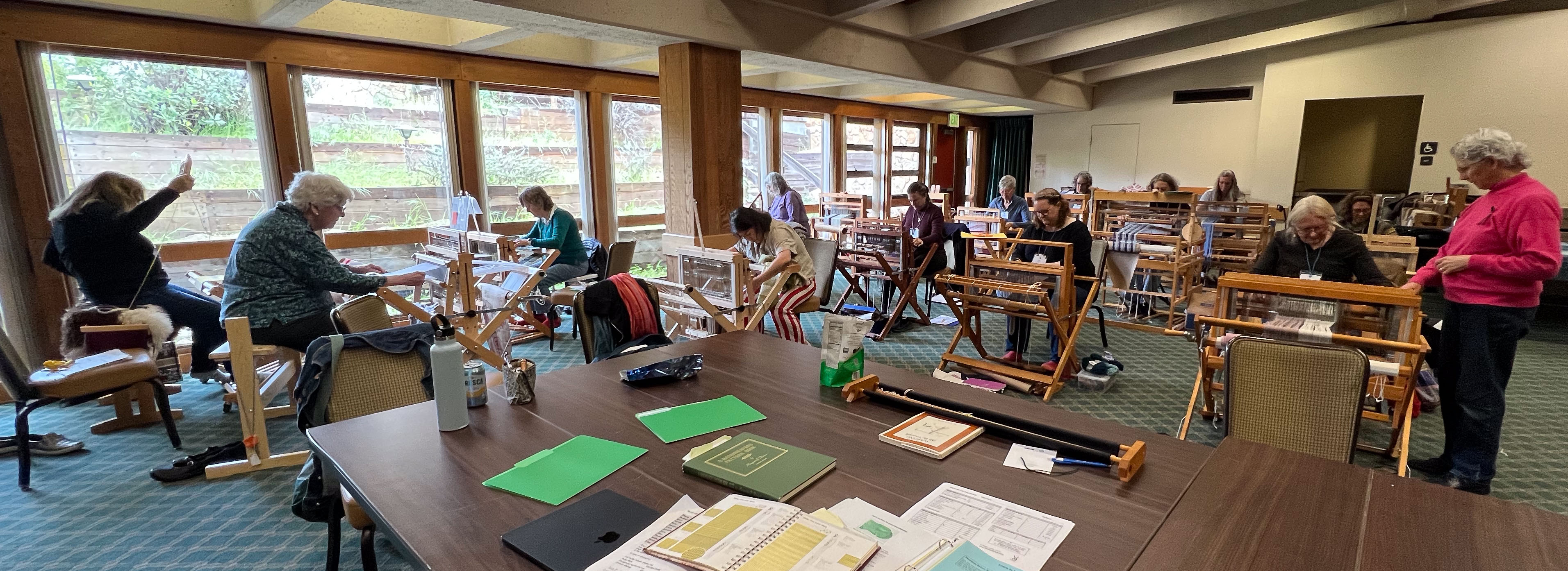
The looms were near windows on the other side.

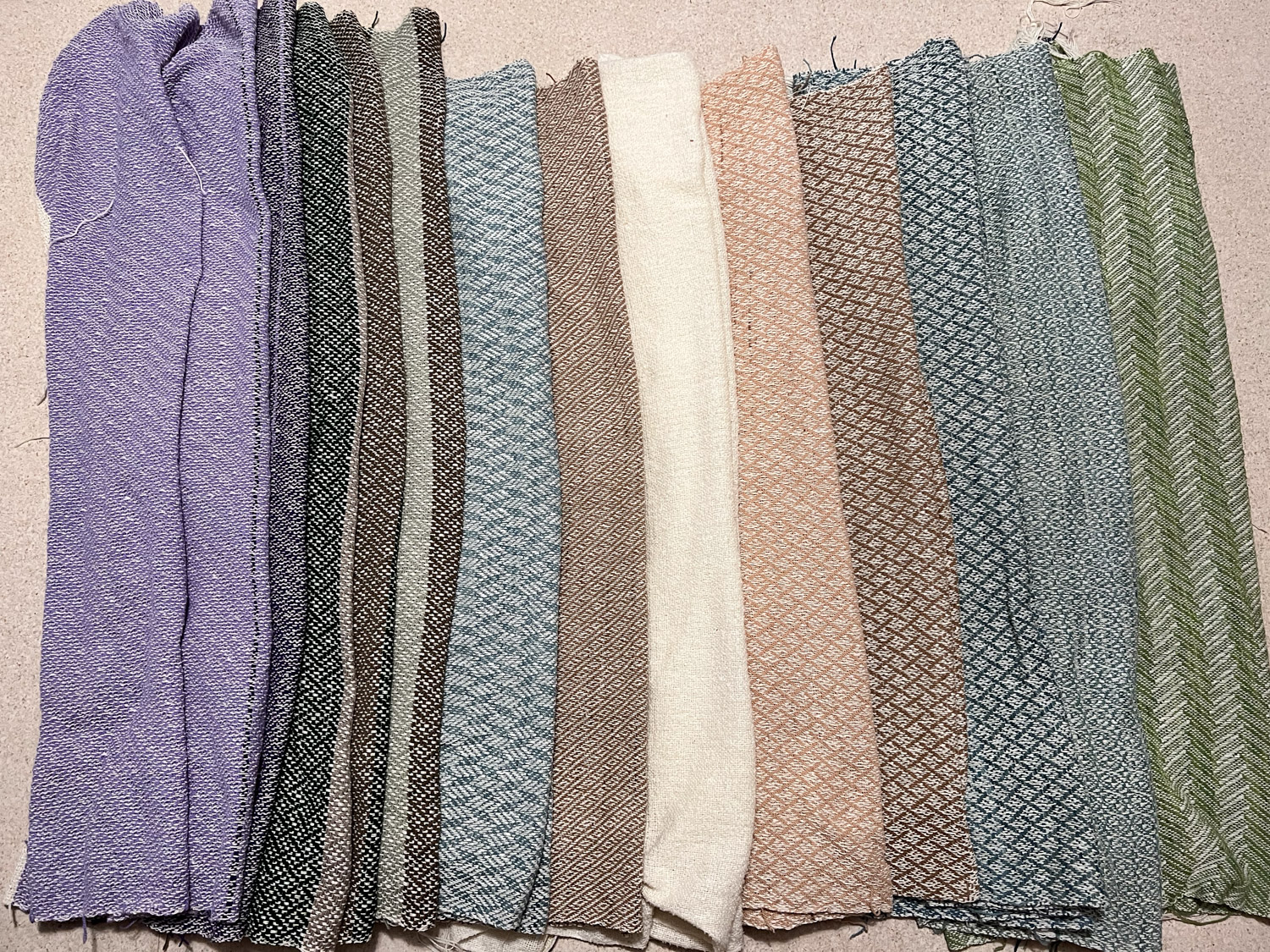
These are only portions of the samplers people could weave.

The workshop was Friday and Saturday with finishing up on Sunday morning.

This is a photo of most of us. Thanks to all of the participants and the helper weavers! I hope to do this again. When I teach this class here at the farm I take three to five people. The class is described here.

Part of the prep for this workshop was planning for farm chores. My husband had a knee replacement only a few weeks before and there were limits to what he was supposed to do. Thanks to a good friend and my brother who handled a lot of that.

When I got home Sunday there was a new lamb which was not a complete surprise, but that’s another story.

Weaving Retrospective 2024

I number all my warps (except for the ones I forget to put in my notebook like some of the rigid heddle projects). Someday I’ll have to look for the notebook with #1, although that wouldn’t be truly #1–it would be the first one I recorded. I think that notebook is here somewhere.

The first one this year was #1351. The notebook page says 12-26-2023, but that would be when I started winding warp. I wove most of the ten blankets in 2024. This photo is two Year to Remember blankets. The one on the left was a custom blanket, commemorating the recipient’s wedding anniversary.

This Year to Remember blanket (Vacaville, 2023) is woven with yarn I dyed using plant material growing here. It is still available on the website.

One of my favorite patterns, also woven on this warp using gray Jacob yarn for weft.

I wove several v-shawls in 2024. The one on the left is still for sale here.

Warp #1387 went on the loom in July, but I didn’t finish the last blanket until December. I get distracted by weaving on other looms and the rest of life going on around me. This photo shows how each weft yarn may behave differently. Some yarns have more elasticity than others, either due to the type of wool or whether or not they have been naturally dyed. The warp and all the naturally dyed yarns are Timm Ranch wool from various years.

Here is that warp off the loom. The blue weft yarn was naturally dyed with my home-grown indigo. The brown yarns are mostly dyed with walnut hulls. Yarns on the left are Ashford DK.

Finished indigo and walnut hull blankets.

The last warp of the year was #1404, a warp for three chenille shawls. This is the first piece off the loom in the process of twisting fringe. This warp is still on the loom with two more shawls to weave. I had wanted to get at least one off to get it to the Artery before the last couple of shopping days before Christmas.

Warp # 1403 went on the loom before the chenille warp, and I finished it just in time for our family Christmas on the 27th. There are ten hemp towels.

There are two colors in the warp and a different weft color in most of the towels.

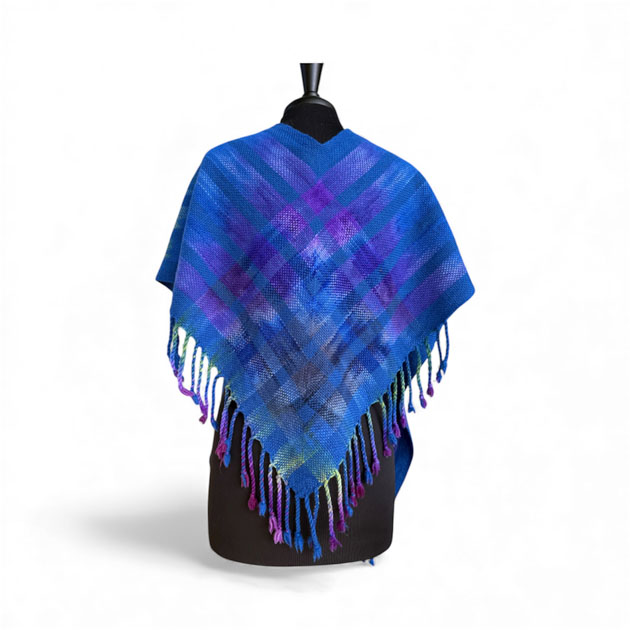
Another favorite this year was a chenille warp. I wove two rectangular shawls and this piece that is sewn to leave a neck hole and be worn over the shoulders sort of like a poncho. I will put this on the website soon.

Weave a V-Shawl (13 of them)

I taught a 2-1/2 day workshop this weekend for CNCH (Conference of Northern California Handweavers). It went very well, mainly because the attendees were all very enthusiastic and patient. That is a lot of people to have in a hands-on workshop when learning a brand new idea. I came home inspired and I hope they did too.

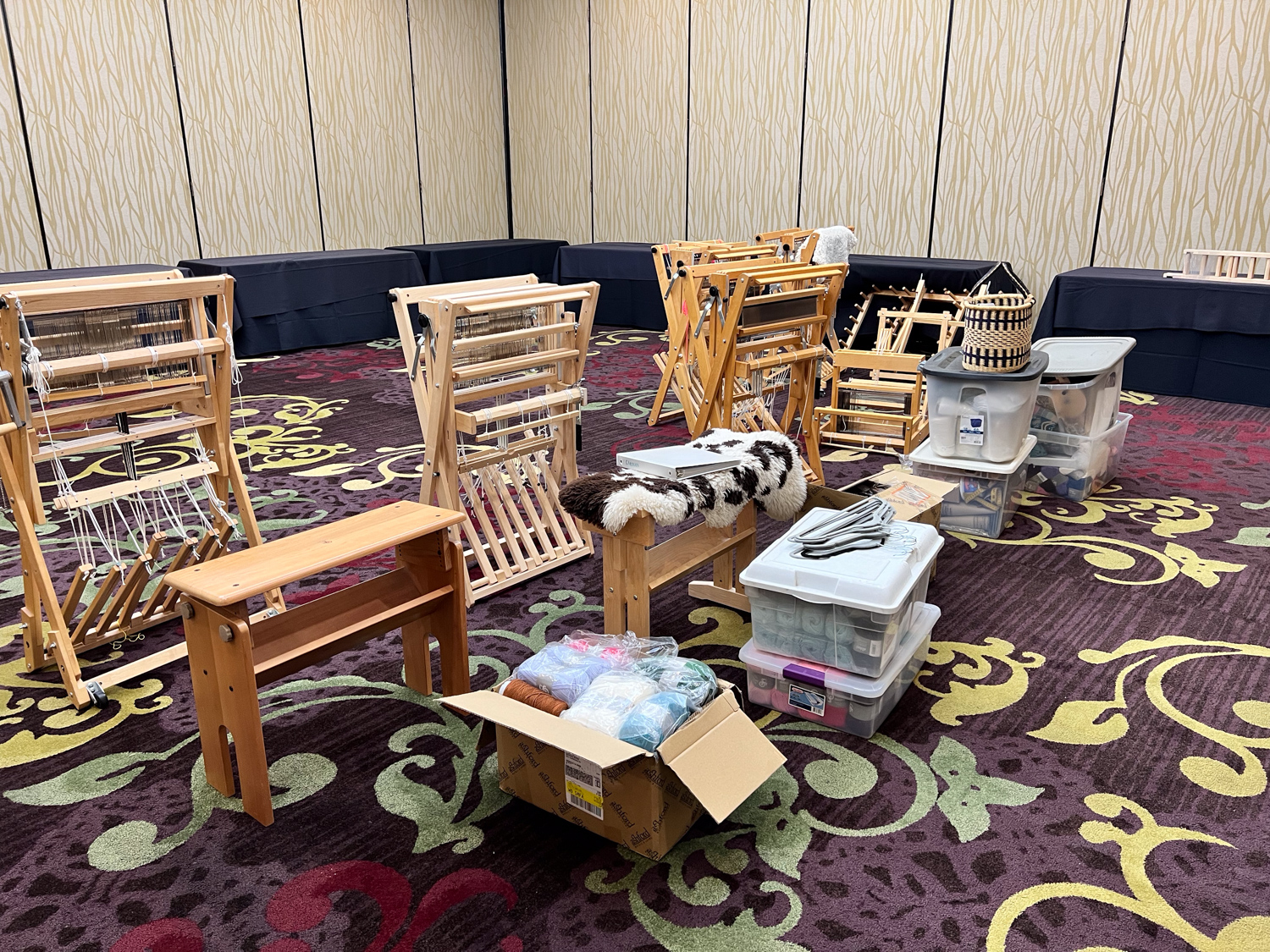
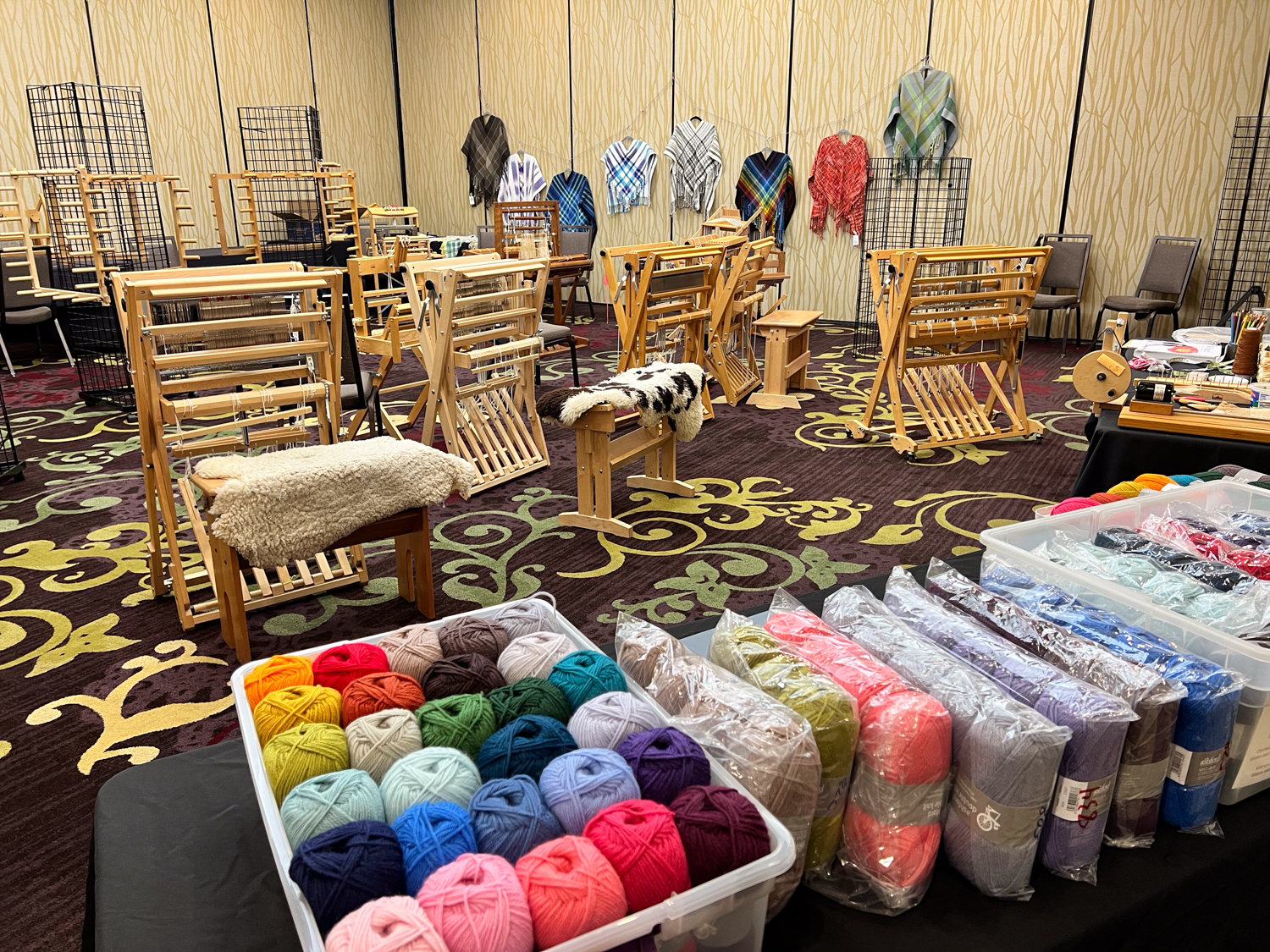
Here is a view of the classroom after I unloaded my trailer. I brought 6 looms for people to use as well as all the gadgets that go with them and the yarn for the projects.

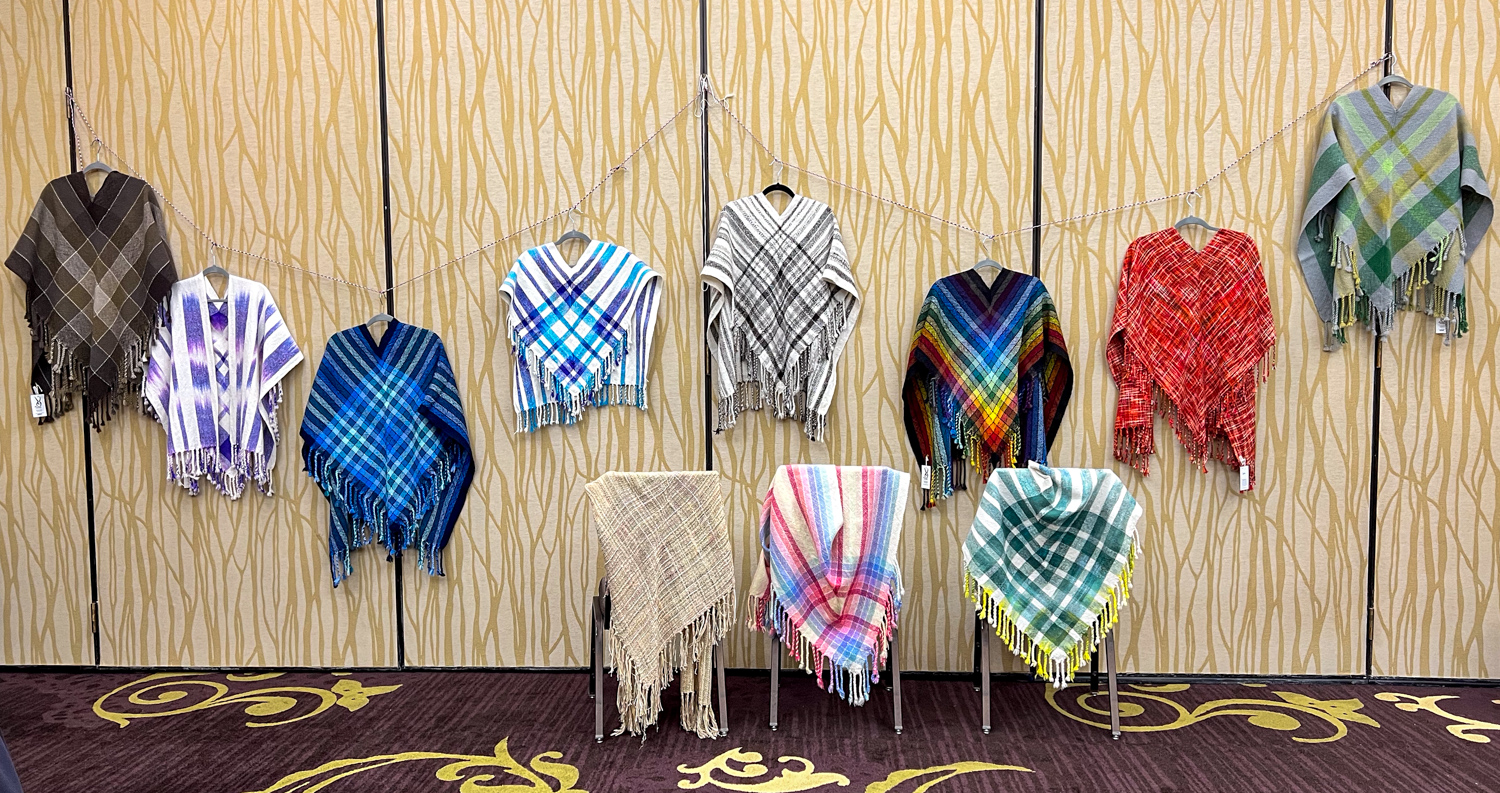
I brought several shawls to as examples and we figured out a way to hang them, clothesline style.

This is how the classroom looked after I had all my things arranged. This was before 7 more looms showed up and we had to find room for warping boards.

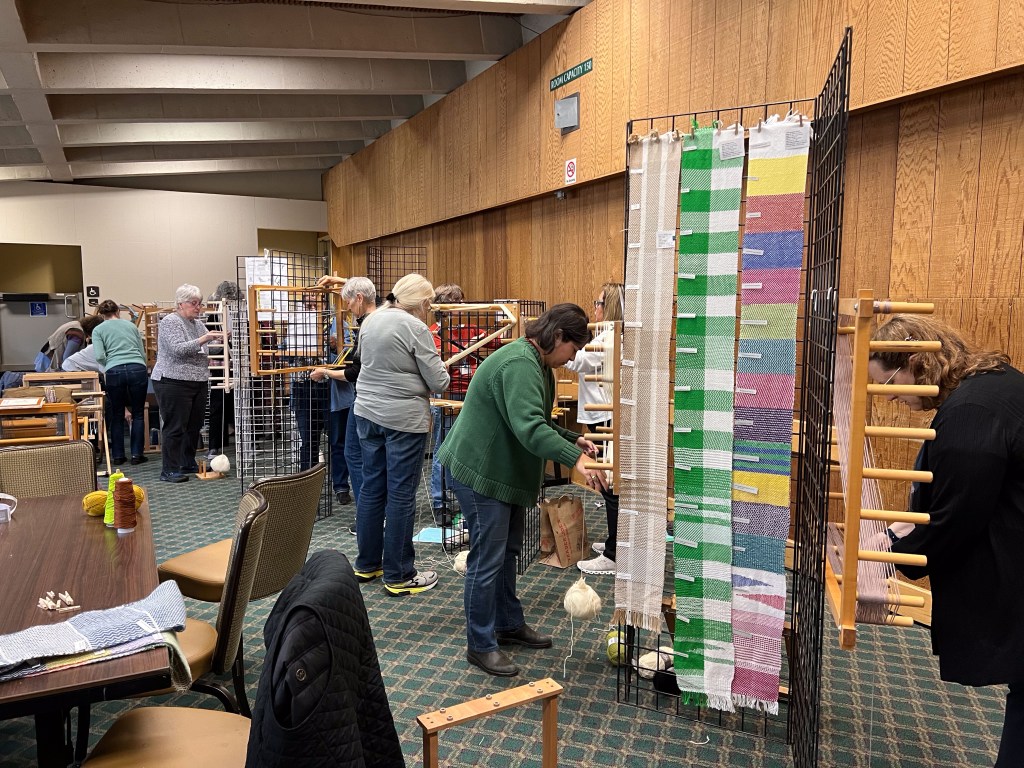
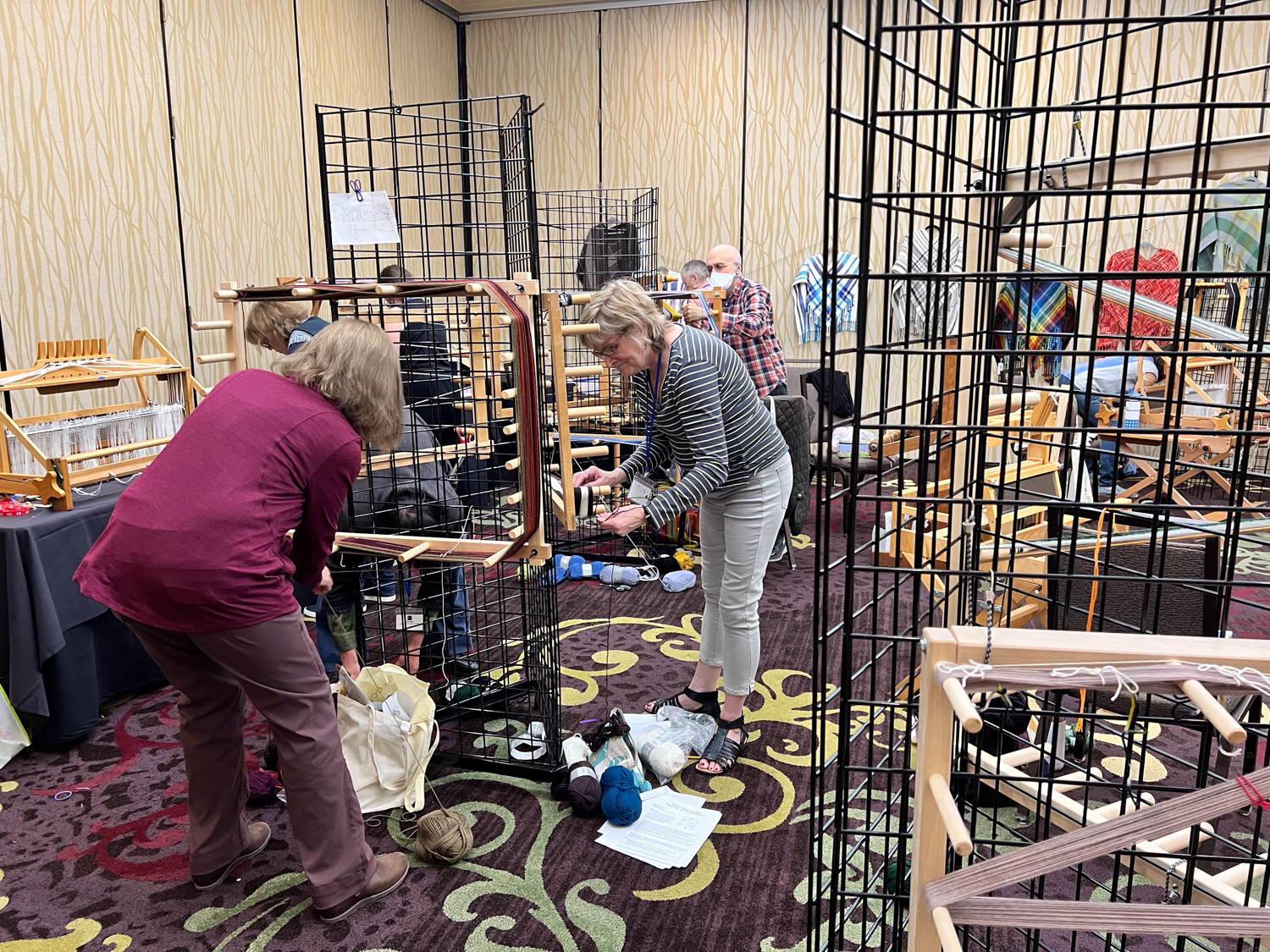
I knew that we wouldn’t be able to hang warping frames on the walls and I suggested using metal grid wall to provide “walls”. The room got more and more cluttered looking as we set up work stations around warping boards and looms. It was already cluttered looking because of the dramatic design of the carpet and the stripy walls.

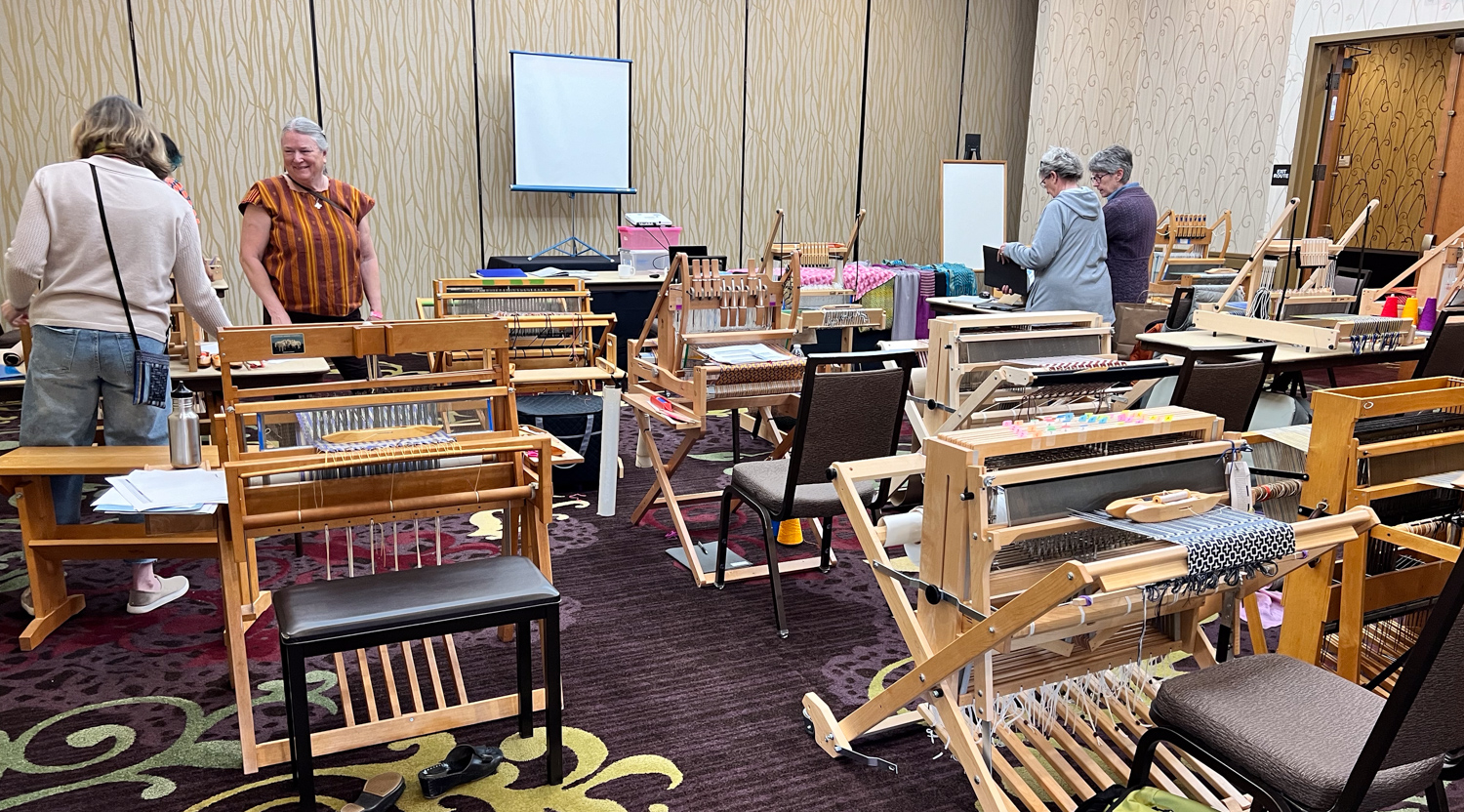
This is the classroom next door. There is still a distracting rug, but overall the classroom looked much more organized with the looms all arranged in rows like a desks in a classroom. These looms were brought to the show already warped, so they didn’t need to start with warping stations like we did.

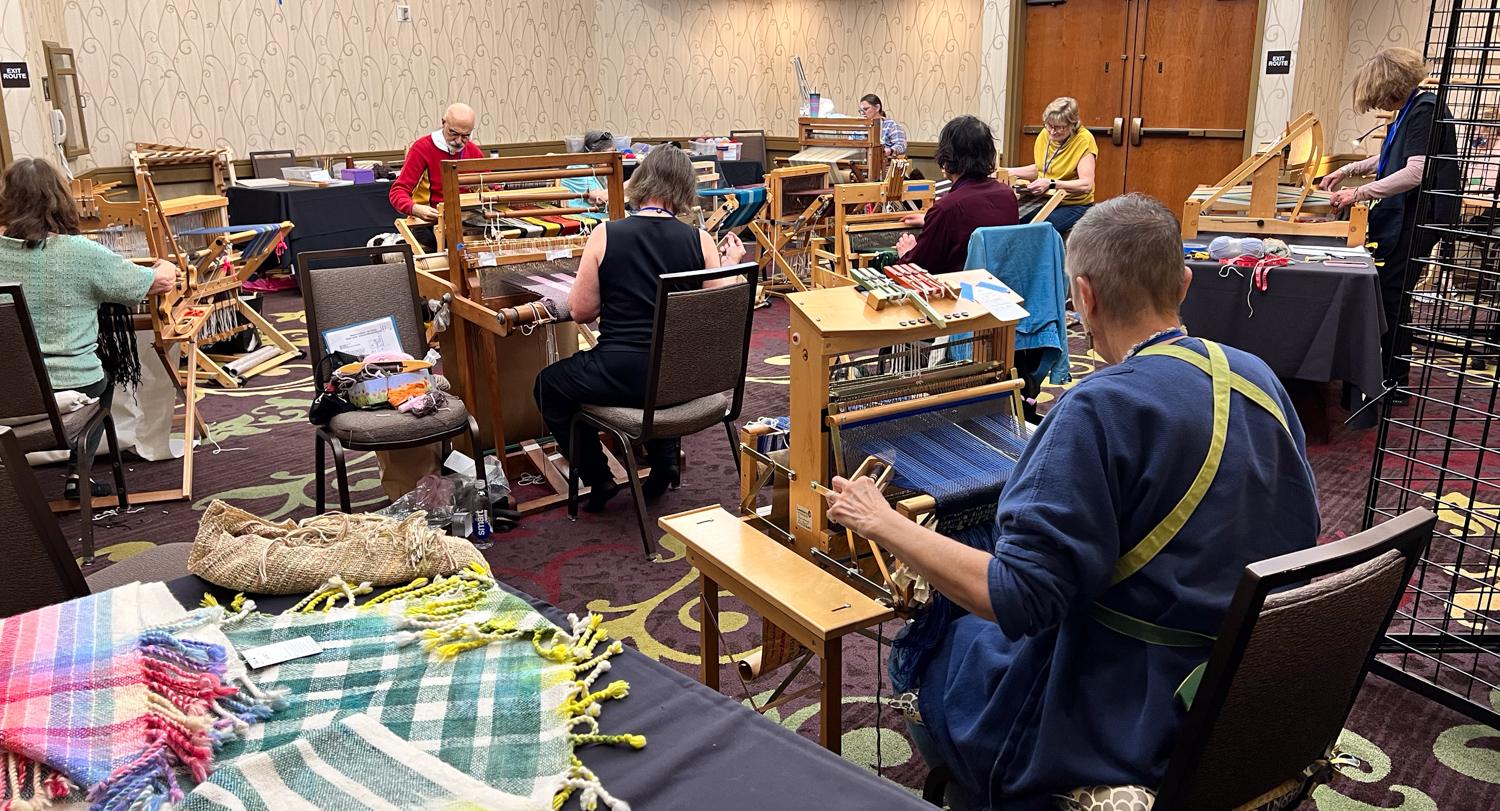
Our classroom looked a little more chaotic, but there was a lot of work going on here. In this photo some people are still warping and others are threading their looms.

At this point everyone was weaving. It is hard to tell that there were 13 weavers in this room (some just out of the photo).

It was fun to see the variety of warp designs.

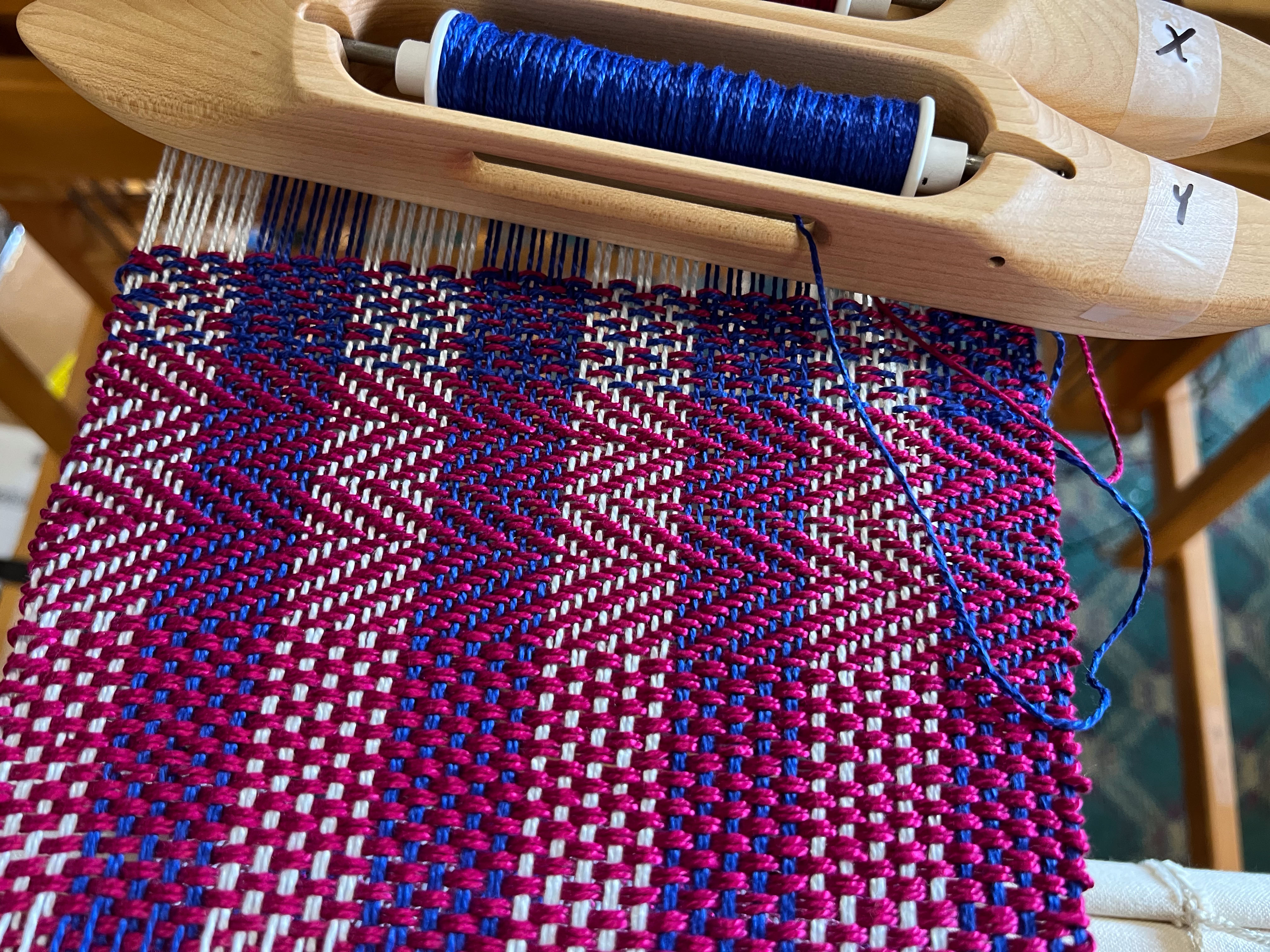
This photo shows one of the shawls partially through the Weave a V part. Warp threads are cut in pairs at the back of the loom and then those warp threads become weft, creating a plaid design.

On Saturday night teachers were asked to stay in their classrooms so that other attendees could wander through and see what was going on in each class. Some of the students stayed as well and were glad to demonstrate the technique (while making progress on their projects).

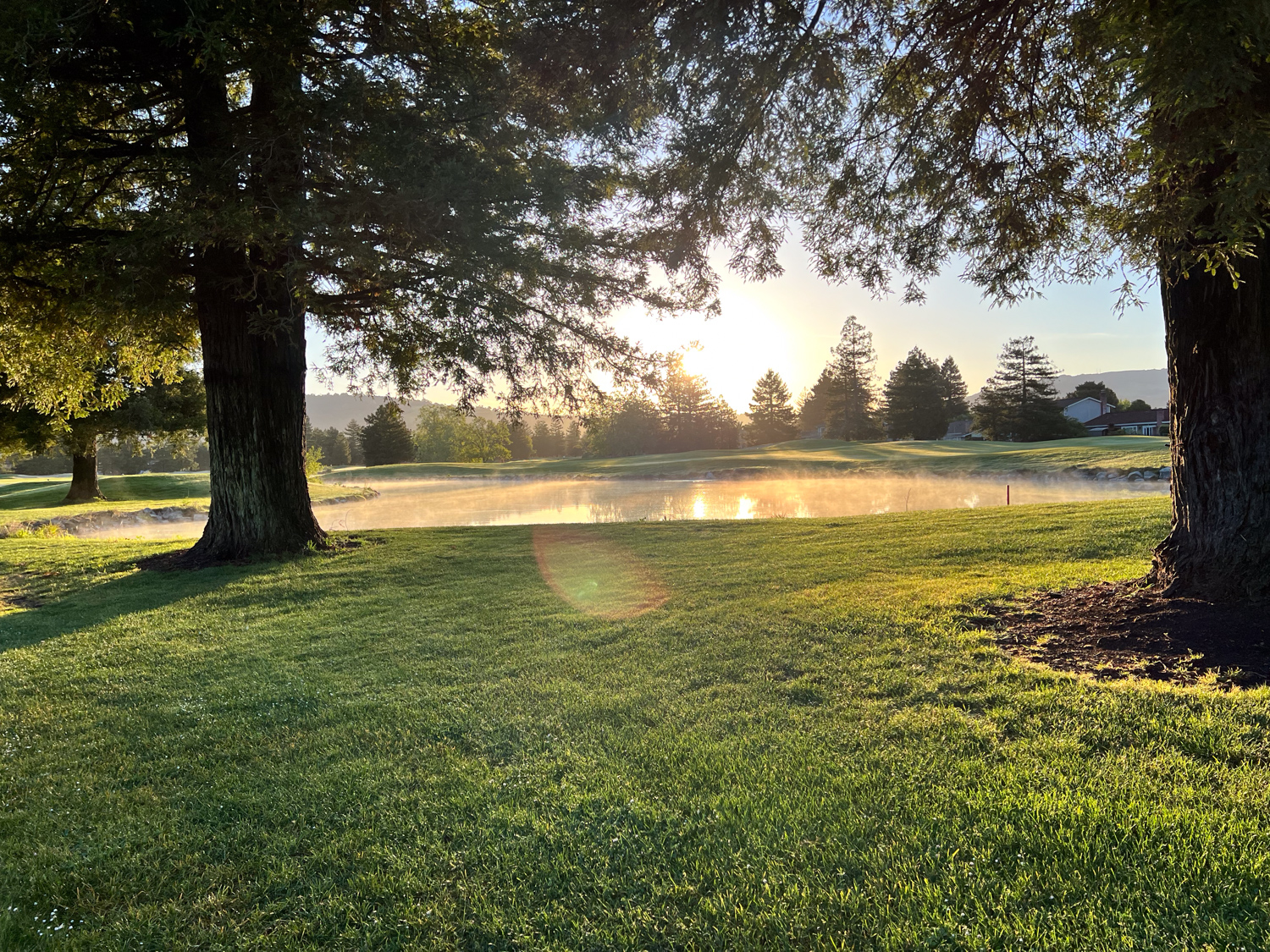
This seems to be a random photo. I left the hotel early on Saturday and Sunday mornings to take a brisk walk around the golf coarse.

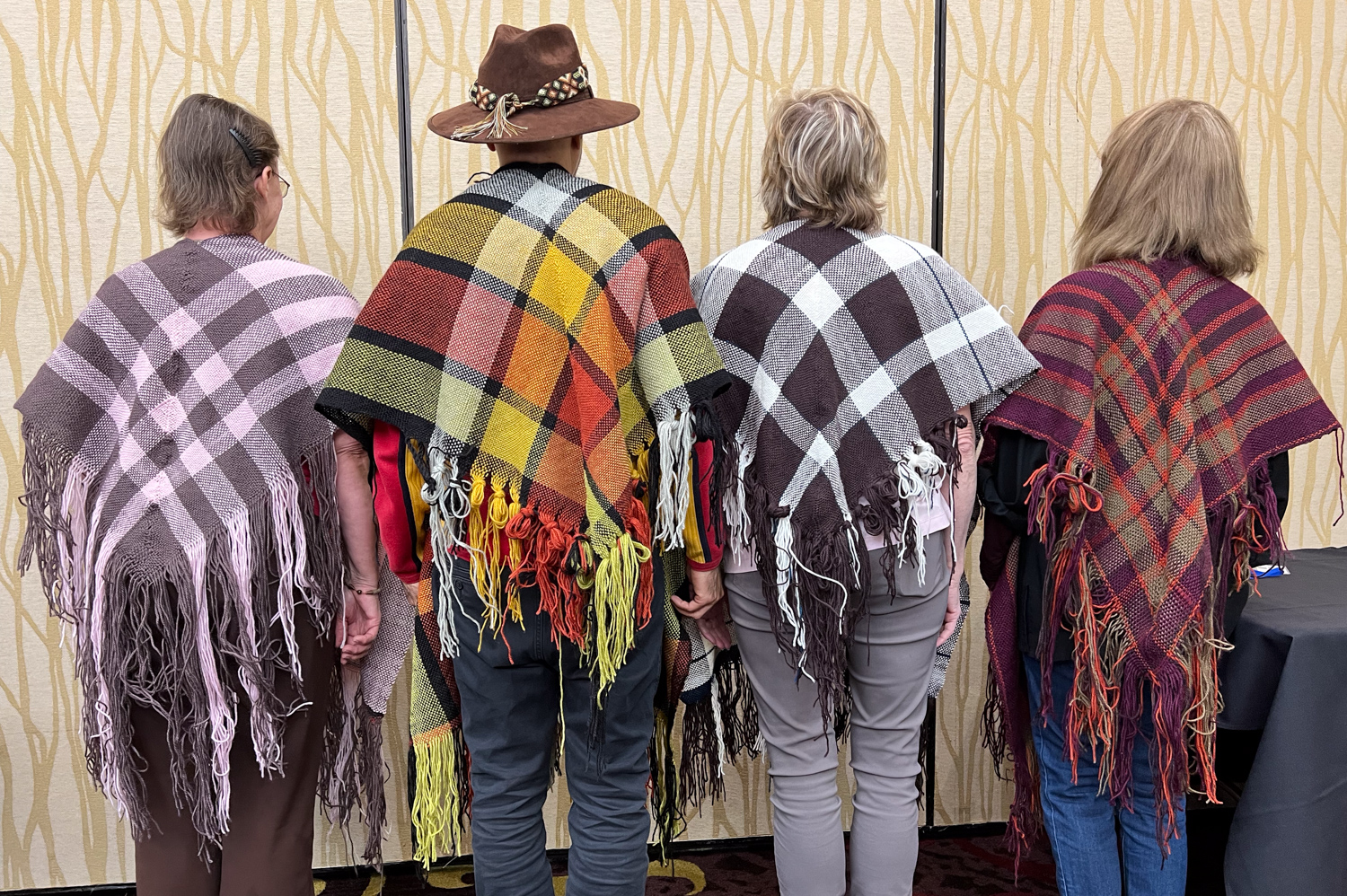
Sunday noon. Some of the students didn’t finish the shawls in class and will finish at home, but some did finish in time to open up the shawls and take photos. These shawls all need finishing touches–tie or twist fringe and wet finish. Then they will have an ore finished look. It is fun to see so many color ideas!

The unique design of the V-Shawl is evident when you see the backs!

Thanks to all these students for making this a great weekend!

Weaving in 2023 – 1

I saw a blog post the other day in which the writer had recorded everything she wove within that year. That gave me this idea. I’m taking photos and keeping notes all the time. I may as well use them. I won’t try to fit the whole year into one post however. Maybe I’ll post weaving, then I’ll post lambs, then weaving, then lambs. How’s that?

My warps are all numbered so I can find the info in my binder. This one is 1299 from January 2023, blankets on the AVL loom. My notebook shows that I wove 11 blankets on this warp, some of which were Year to Remember blankets. These three use temperature data from 2022 so the stripes are all the same, but the colors are very different. I weave custom Year to Remember blankets and use a sparkly yarn to distinguish the special date. I think I have enough warp still on the loom for one more of these this winter, so contact me if you want to know more.

This is 1301 a scarf using all these crazy yarns. I teach a class in weaving a scarf using a mixed warp wound with a paddle, “Mix it Up”. I haven’t taught that class in awhile and I probably need to change it from a 1-day class to maybe 1-1/2 days. I don’t know if people want to pay for an extra day, but I always forget that it takes longer in a class setting than I take if I’m just warping and weaving my own scarf.

Two more mixed warps on the loom. The one on the right is a shawl, now at the Artery I think. I wove 5 or 6 of these in different colors.

In February I demonstrated weaving at the Sacramento Weavers Open House. I missed it this year because lambs were coming earlier than the previous year. I wove a chenille warp on Saturday and a wool warp on Sunday.

This is the warp after I took it off the loom.

Warp 1317 was a handspun Jacob wool scarf. Two Farm Club members spun yarn from wool that was accumulated from years of samples sent in when registering rams. Each ram application requires a few locks of wool. We have been digitizing the papers and that means those baggies of wool are discarded. I decided to do a project like this and then donate the scarf to the Jacob Sheep Breeders raffle. I wove two scarves using wool two different people had spun.
Clasped Warp is a technique that I wrote about for Little Looms a few years ago. It has been used with rigid heddle looms to design warps that change color midway through the length. I decided to do the same thing on a floor loom, adding the woven in pattern to the elements of interest. This is a shawl woven on a 4-shaft loom using handspun yarn. I will have an article coming out in the next Handwoven on this technique.

I wove fabric for 4 bags to use in an article that was published in Little Looms last year. These are hemp and woven on a rigid heddle loom. The bag uses a length of fabric that is 8″ wide and 4 yards long. Folding it strategically gives a shoulder bag with and inside and outside pocket.

This was part of that last blanket warp. It used up odds and ends of the Ashford DK yarn that I use for the Year to Remember blankets. The shape isn’t exactly right because that warp is designed to weave throws that end up about 45-50″ wide. I wove random stripes and sewed two together for a bed-sized blanket. I should have woven them longer and then they’d fit the bed correctly, but I didn’t have a plan at the time.

More to come if I’m going to finish out the year.