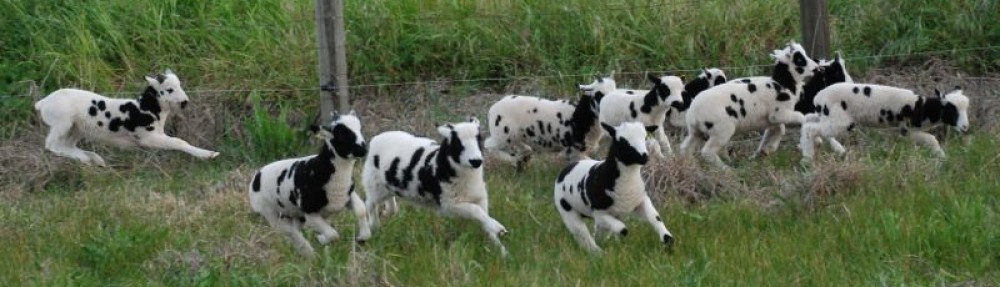
Are we getting tired of lambing posts? It only happens this time of year.
 Do you remember this lamb from a couple of posts back? Trista had a 10+ pound lamb and then almost two hours later a 5 pound lamb. She didn’t want the little one and I struggled to get it to nurse. I ended up milking Trista and tube feeding the lamb colostrum. I left the lamb with Trista but she became increasingly less happy to have it around and more hostile.
The lamb wouldn’t suck on a bottle and I was getting very frustrated. It’s one thing to have to feed a lamb every four hours, but then when it doesn’t suck it’s maddening. You get the nipple in the mouth, the tongue hangs out the side and the precious colostrum goes everywhere. (This brings back frustration of trying to get Brown Swiss calves on a bottle. The Milking Shorthorns were fine, the Brown Swiss were not.)
A solution presented itself the next day.
 I saw this in the barn. This lamb was standing hunched up like a lamb does when it doesn’t feel good. This view from the top down shows how large it’s belly is and it was tight as a drum. From previous experience I suspected intestinal atresia, a malformation of the digestive tract where the intestine is not complete. The lamb eats normally at first and then there is no where for the milk to go and this lamb was already over 24 hours old–it didn’t have long to live and was in great discomfort.
When a lamb dies if you put the fresh skin on an orphan lamb sometimes you can trick the mother into thinking that it is her baby. I went to the house for my new knife (purchased for when I need to necropsy or skin something and the sharpest thing in the house has been a pocket knife). By the time I came back to the barn the lamb was dead. In addition the lamb had stopped nursing so the ewe was at risk of mastitis as her udder filled, even though there was a remaining twin. One side had started to fill more and become uncomfortable. That starts a vicious cycle where the ewe won’t let the lamb nurse and that side of the udder gets worse and worse. This is a photo of milk from Trista, the orphan’s mom. I got over two cups of milk from the ewe with the baby who died.
The trick was going to be to get this lamb who had never nursed on her mom to nurse on this mom.
 I made a little lamb jacket out of the skin by cutting a neck hole and leg holes. It’s kind of hard to tell if you don’t know that’s what you’re looking at.
  The new lamb was smaller than the one that died so this jacket was a little large. The mom wasn’t convinced at first that it was her baby, but she didn’t outright reject it. The lamb had eaten (been tube fed) just two hours before so it wasn’t hungry. But later that night it was hungry. It was on it’s feet and when I held the ewe still it nursed!
  The next day the jacket was beginning to smell. The idea is that at first the mom smells her baby and eventually gets used to the new lamb smell. So our transition was original lamb smell mingled with new lamb smell, new lamb smell mingled with dead smell, all new lamb smell. I had cut a portion of the skin off to get more of the new lamb smell and because I wanted the lamb to be able to adjust to the cold when the second skin came off. But this skin jacket was so big that at that point it got tangled up and I took it off.
I kept the ewe and the lambs in a pen for several days so that I could watch. The ewe slept with her lamb and not the new one. She would stomp when the lamb tried to nurse but if I went in the pen she resigned herself to it (almost rolling her eyes) and stood there.
 We have success. I haven’t had to hold the ewe for a few days while they have been in a group pen. They will go out tomorrow and I’ll keep an eye on them. But I think the baby has a new mama.
 We caught all the lambs to check for number of horns and split eyelids (a trait that is sometimes seen in 4-horn lambs).
  This was also a good time to check the paperwork and make sure that I had recorded the gender and sires correctly.
 My neighbor who recently purchased sheep was here also to get some hands-on experience. He told me that a recently purchased goat had kidded that morning and he wasn’t sure the kid had nursed.
 I went to his place at lunchtime to check on the kid and while he held the doe (very skittish) I got the kid nursing.
 Back at our place, we finished moving sheep around. I moved “Ginny’s flock” of wethers and she was so hot when she was finished that she found the only accessible mud puddle to sit in.
 Last in the afternoon we decided to try grafting a lamb onto a ewe whose lamb had been killed the day before. I had debated it that day and at the time didn’t want to deal with it. But I had some new twins and though it was worth a try. This method of grafting is not as pleasant or as satisfying as “slime” grafting where you just cover the adopted baby in the birth fluids so that the mom will think the lamb is hers. With this method there is a dead lamb and you need to use it’s skin to cover the adoptive lamb to trick the mom into thinking it’s hers. That photo above is the lamb in the skin before I cut it to fit better. Bea, the young ewe, was unsure. The scent of her lamb was there but the sound wasn’t right. The lamb didn’t want to nurse at first and when it did Bea wasn’t happy about it.
 This photo is blurry because I must have smeared my iPhone lens while working with the lamb. When Bea finally lay down while trying to avoid me attaching the lamb to her teat I was able to get the lamb to nurse on the engorged udder. For a day or two I needed to halter her or just stand there.
 At this point Bea has completely claimed the lamb as her own. (The dead lamb’s skin is gone in this photo–I took it off the next morning.)
 We were impatiently waiting for Jazz to lamb. I was sure that she would have triplets because she was so huge. She surprised me with twins the day after Farm Day. They are 9.6 and 12 pounds. At that size it’s good there were only two of them.


 Meridian Jacobs' Blog