It’s the time of year when I need to sell sheep. I want to get numbers down to 50 or so ewes by early October when breeding season begins. I have just separated the March ram lambs from the ewes and am now evaluating them as prospective breeding rams. It’s hard to find that perfect ram. Unfortunately I don’t have the space to keep these rams around for 6-8 more months to see how they look as they get a little older. That’s too bad, because I’d rather be able to choose by seeing them with a little more maturity. (By the way the red in all these photos is marking crayon, not blood.) This ram (15045) has a fabulous horn spread–no chance of those horns growing into his face. He has lilac (gray-brown) markings and a good spotting pattern. But my notes say his fleece is so-so. I think I’ll have to check again because everything else looks great.
  This ram’s horns automatically disqualify him for remaining in my flock. They are fusing at the base and I don’t like the “weepiness” that happens at the join between the horns–it is an area that attracts flies and that can lead to flystrike. Besides if they are already fused at this young age there is a good chance that the upper horns may cut off the blood supply to the lower ones which will weaken and be broken off.
 Here is another one with the same problem. No matter how much I might like his markings and fleece, I don’t like the horns.
 I had my eye on this ram (15054) because I like his wool but his horns are all white which makes him ineligible for registration…
 …and I aso discovered that he is missing something down below. Well, it’s not completely missing, just about half size.
 So here’s a ram (15061) with nice horns and a decent fleece, but to register a ram he needs between 15% and 85% color.
 Looking from this side he doesn’t have that and he doesn’t have much more color on the other side.
 This ram (15062) has plenty of color, but his horns are much too narrow. They will grow right into his neck or face as they grow larger.
 Here is another with good color, but those horns are even more fused than the ones above. See that 5th horn on the right (the ram’s left side)? People like to say that Jacob sheep can have 6 horns, but I have never seen one with 6 good horns. This is more my experience.
  Here is a ram (15030) with decent horn spacing and nice fleece. There is a bit of a problem with the lower horns because at this time they look as though they are going to grow right into his jaw. Sometimes horns with a tight curl like that get broken off when the ram is still young and then they grow out OK. Whether or not his horns would turn out all right, upon closer inspection (hands-on) I discovered that this ram has freckled fleece. That makes a gorgeous handspinning fleece, but it is not appropriate for a breeding ram, and in fact, the JSBA Breed Standard states that “excessive freckling in the white wool of young animals” makes them ineligible for registration.
 How about this ram (15070)? Widespread horns. Not a lot of color but it is over 15% and passable (I think). But I haven’t really considered him because he is so much smaller than the other sheep. Granted, he is younger than many, but I don’t want to choose one of the smaller rams in the lamb crop as my breeding ram. This is where being able to keep them awhile longer might aid in evaluation.
 That 2-horn ram (15022) in the middle is a good sized lilac ram and we all had our eyes on him from the beginning. Unfortunately I think that his horn set is also narrow. This is another one that could benefit from time to find out how the horns actually do grow out.
 Here is a ram (15025) that might make a nice ram to keep.
  The two-horn ram in the middle of this photo is Nash, a lilac ram with nice horns and a beautiful fleece. He was Champion Ram at Black Sheep Gathering in June.
The rest of the ram lambs are shown at this link. However I haven’t updated some of the listings with new photos. I will be removing some of the rams from that page now that I have evaluated them further.
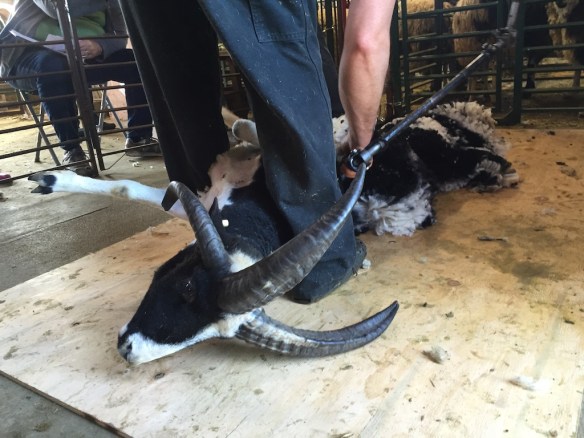 This is the yearling ram, Rotor.
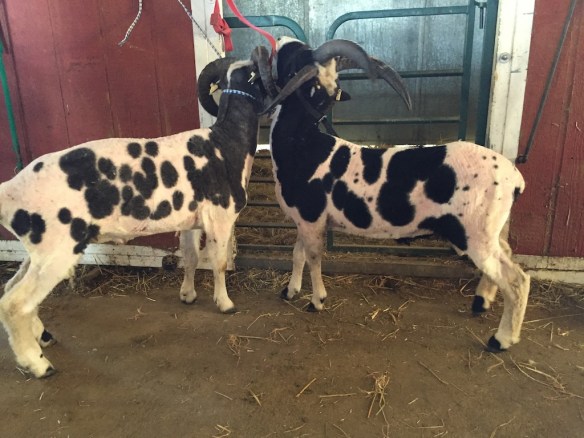 A good comparison of a lilac Jacob (Nash) and black & white (Rotor).
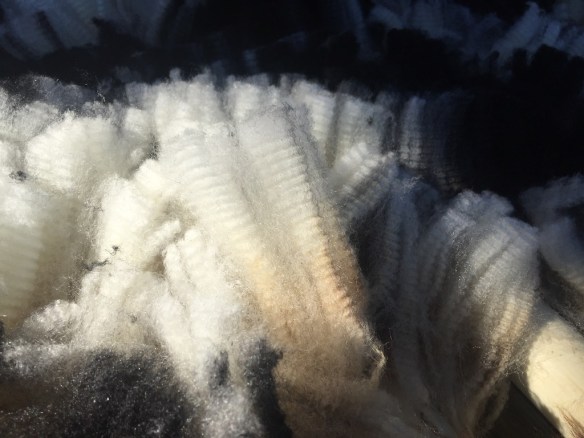 This is Rotor’s fleece.
 They aren’t all spotted. This is one of the BFL-Jacob cross ewes.
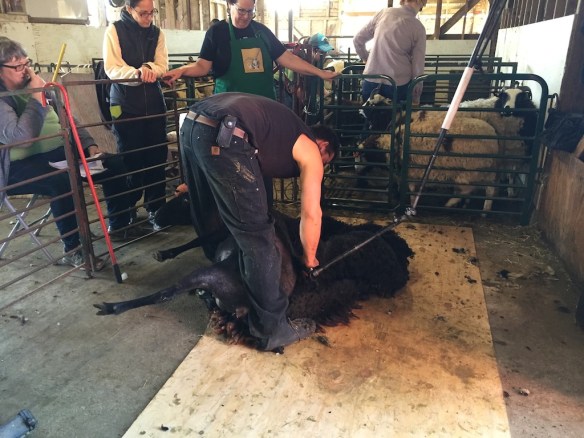
 Lots of people help to make Shearing Day fun and easy for me. Kathleen weighed fleeces.
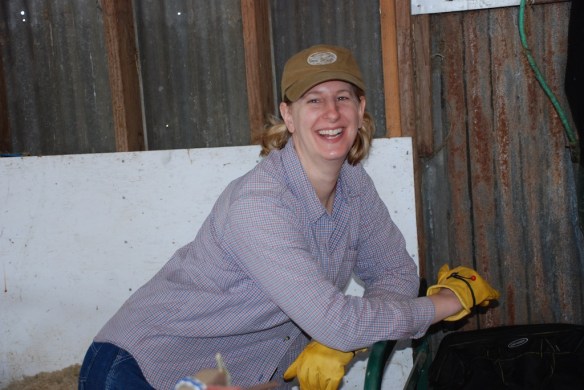 Stephany and Gynna wrangled sheep all morning.
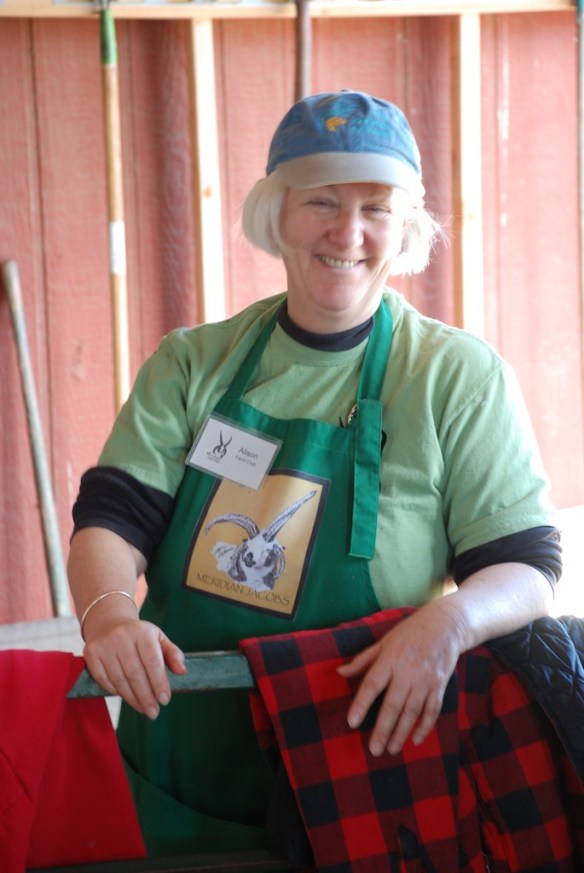 Alison and many others helped at the skirting table.
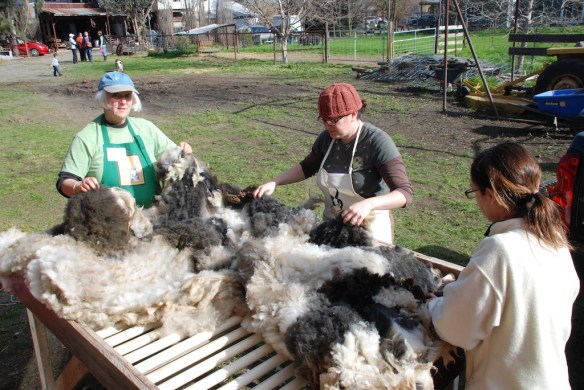 People are welcome to skirt their fleeces before buying or ask for advice about fleeces.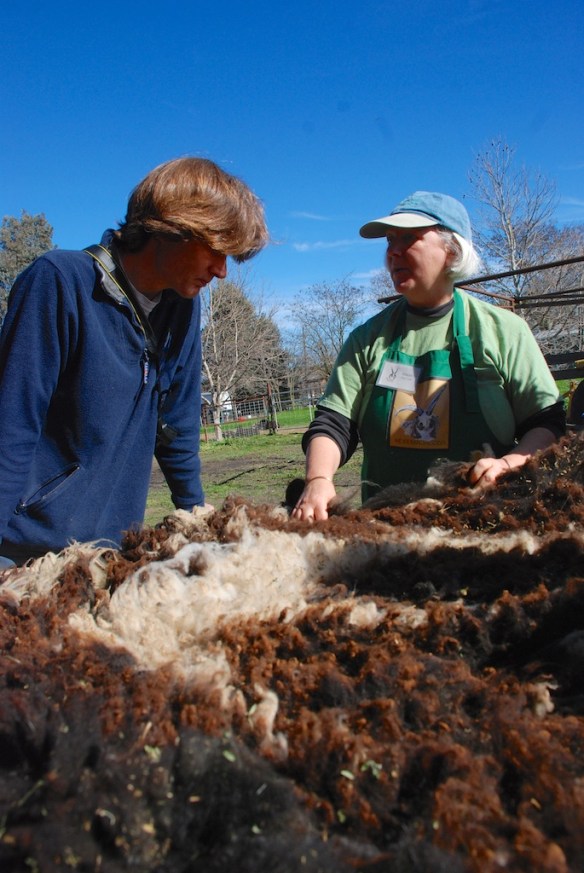
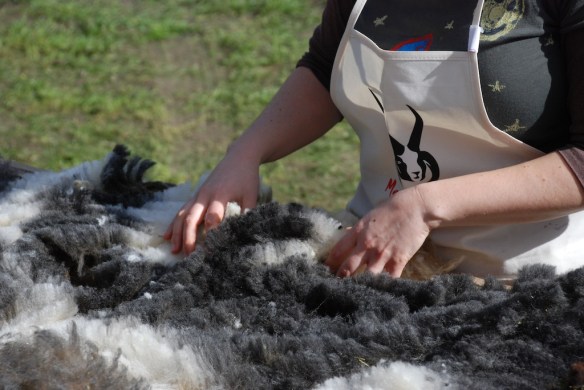 It was a great day to stand in the sun with your hands in freshly shorn wool.
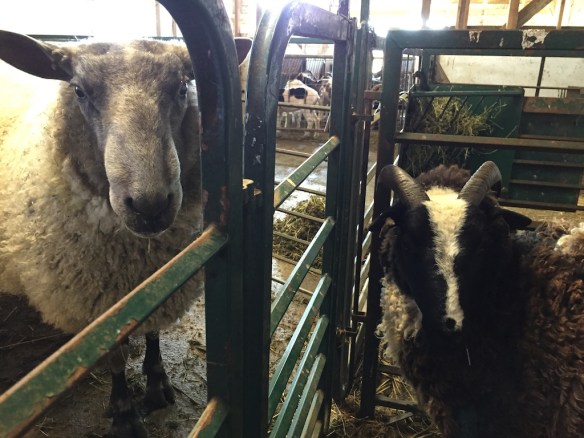 One more ewe to be shorn and then it was Faulkner’s turn.
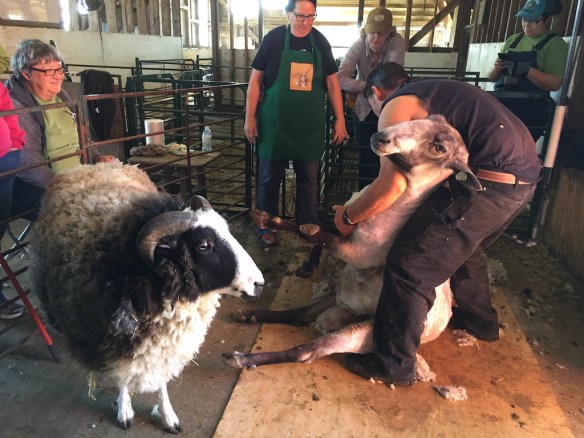 His buddy, Jerry looked on. Faulkner weighed in at 235 lbs (down about 30 pounds from what he sometimes weighs in the summer).
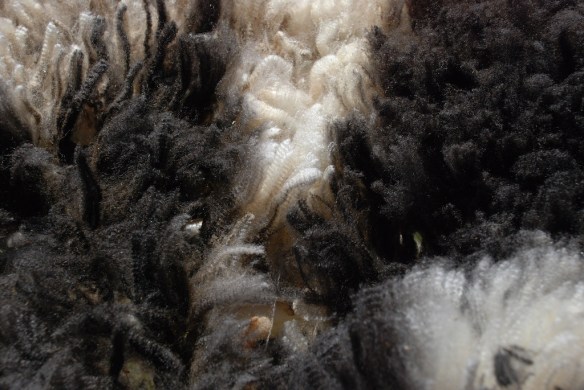 Fresh Jacob fleece.
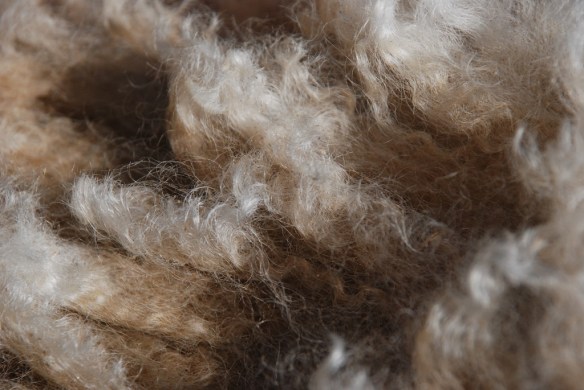 Faulkner’s fleece.
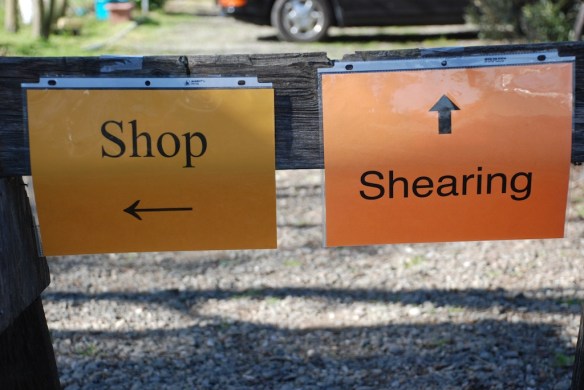 While the shearing and wool sorting was going on, friends were helping buyers in the shop.
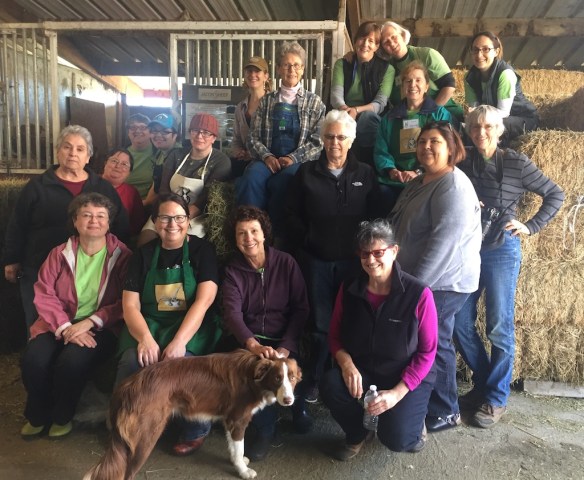 Later we got everyone (almost) to the barn for a group photo. That’s a lot of enthusiastic friends!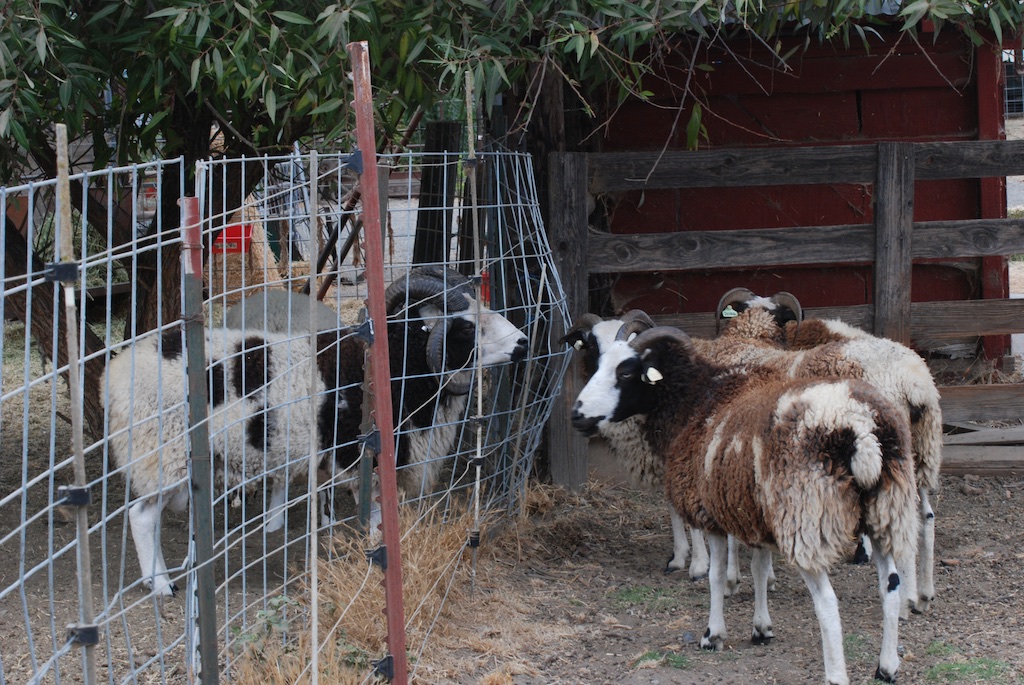
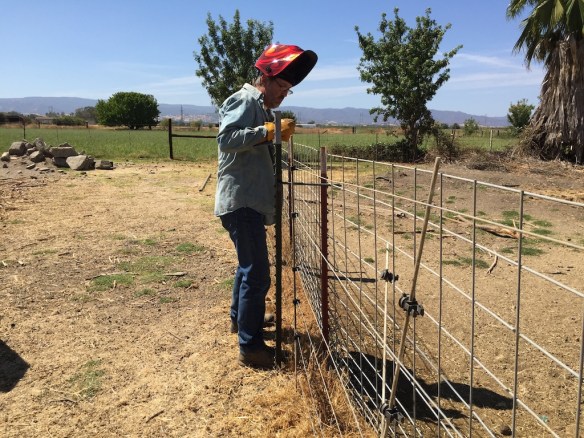 He put in extra posts that we happened to have around and welded rebar between the posts on the two sets of fences to help make things sturdier. We hoped that it would make the whole thing more secure.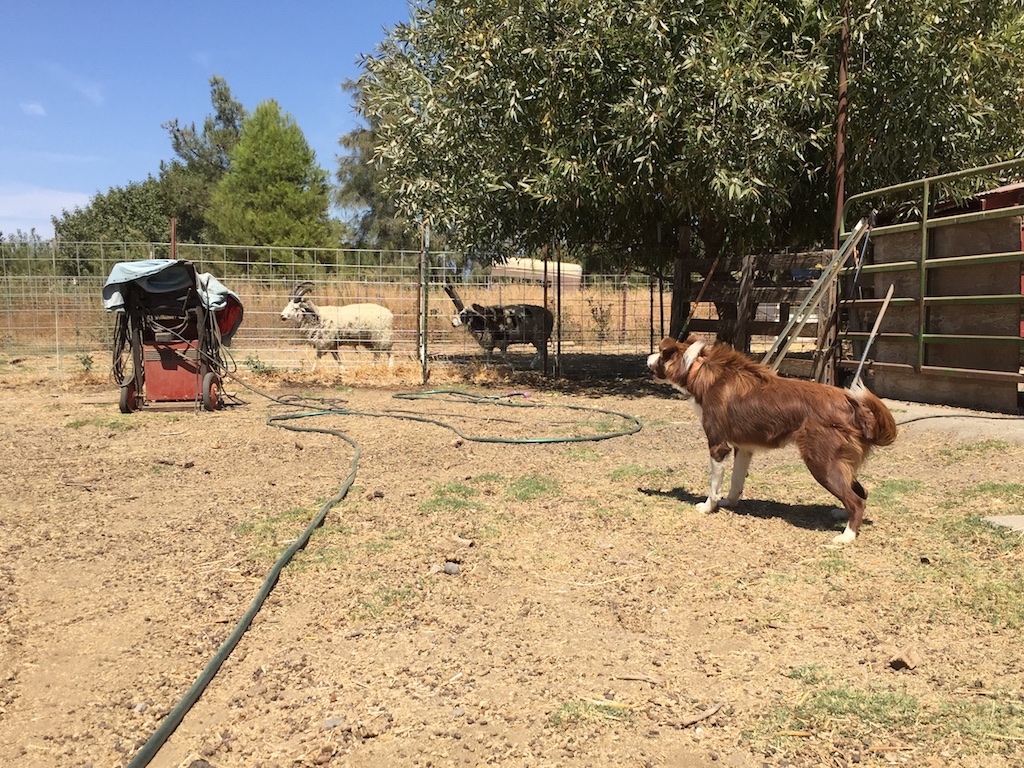
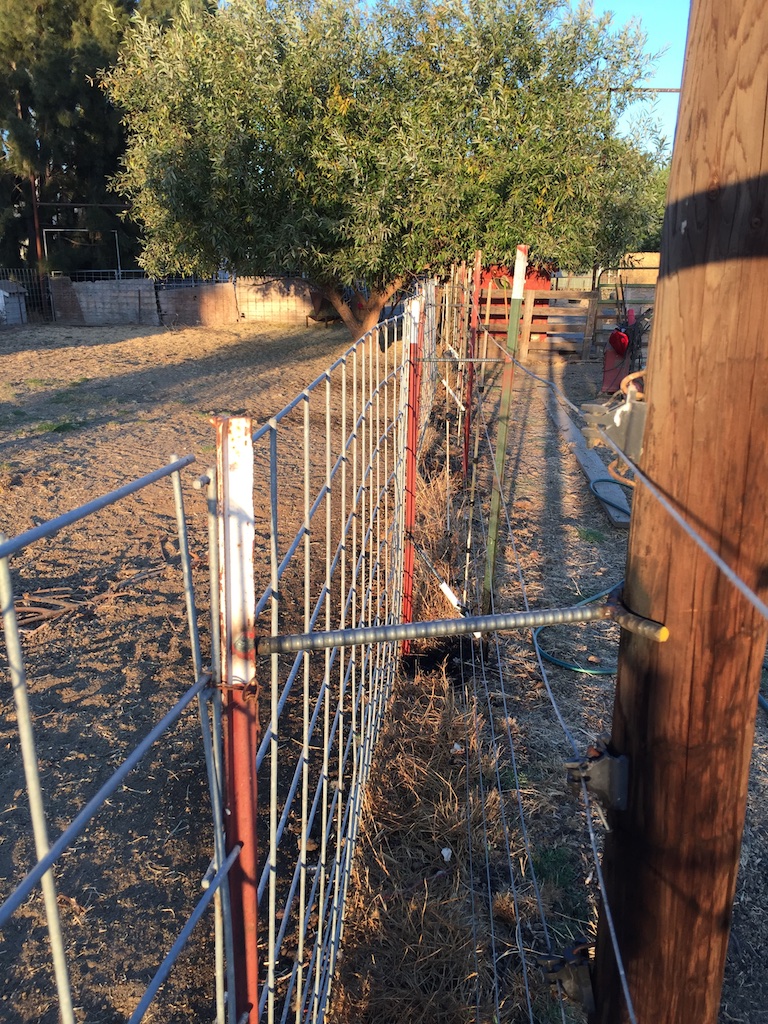
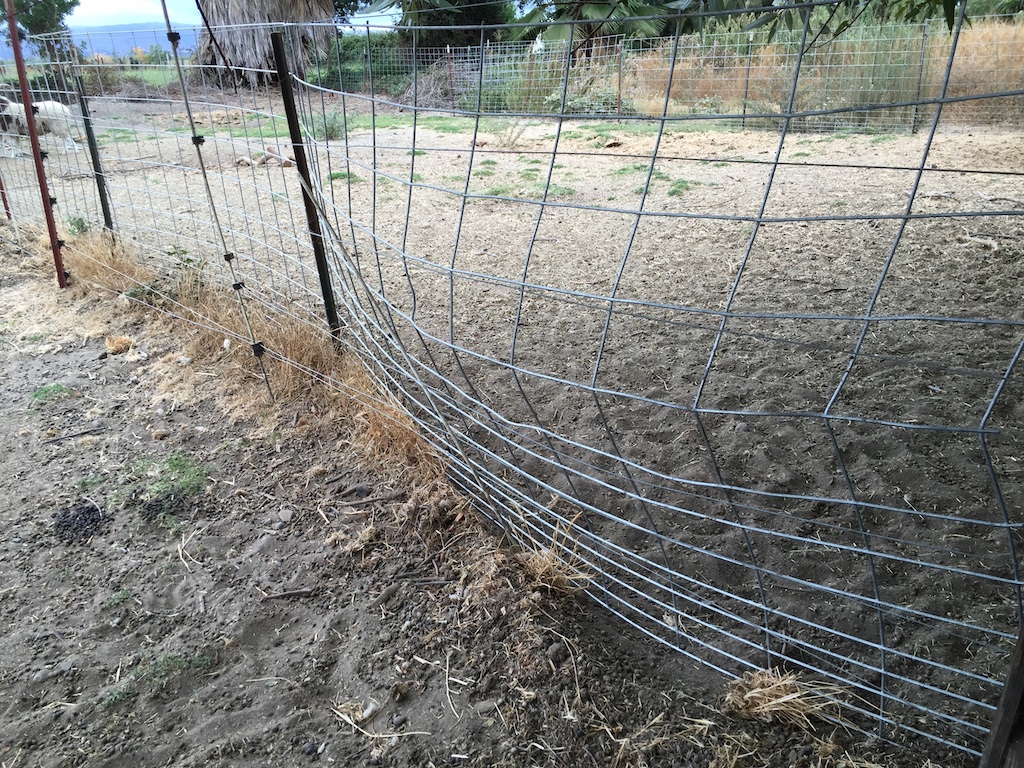
 Fence posts look good.
 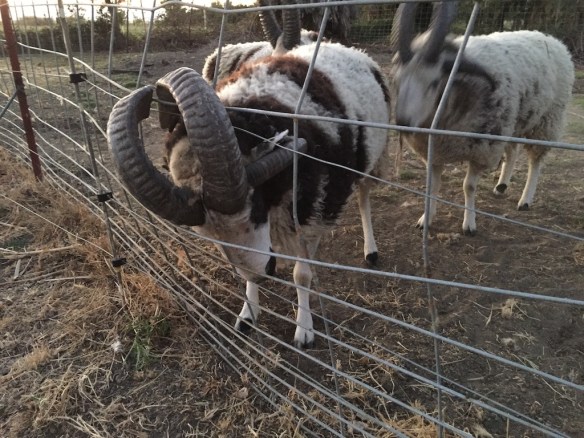 The wire, not so much. He was completely stuck in the welded wire and the high tensile wire. This is Alex, by the way, whose horn I just trimmed in the last post.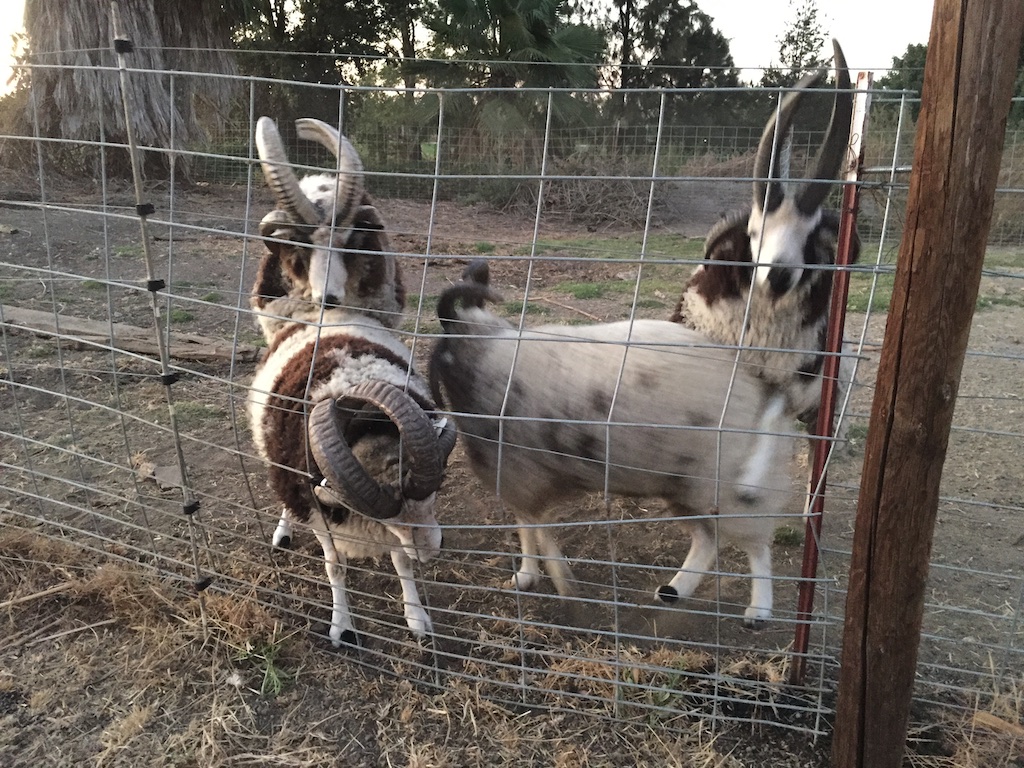


 …it’s hard to look tough when you have fuzz on your horns.


 I wanted to use one of this year’s ram lambs for the fourth group of ewes. I had a hard time choosing among the rams I have saved. My first choice was a four-horn ram lamb who I think has promise and also placed well at the summer shows. Unfortunately, he was very sick with bluetongue (insect transmitted virus common in the fall) a few weeks ago. He pulled through (I lost two others) but with the 106+ temperature I can not be sure that he is fertile. He may have his chance next year, but this year I needed to find another ram.


 He weighs less than all these ewes but that doesn’t seem to bother him (or the ewes).


 Rusty helps move them around.


 … take a closer look at the ram with the white horns.


 Larry (Ruby Peak Linden x M. Spring)


 Meridian Jacobs' Blog