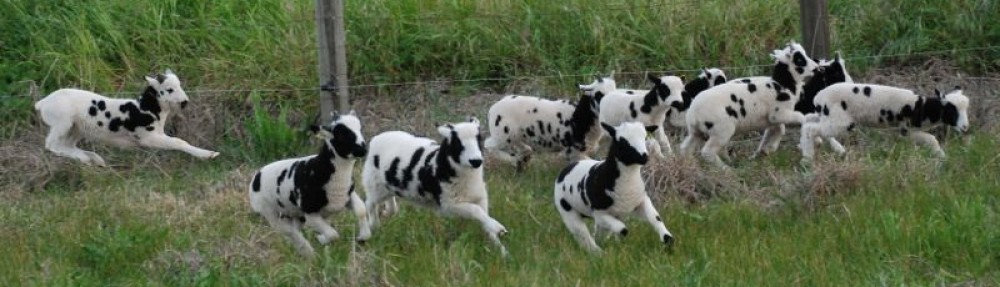
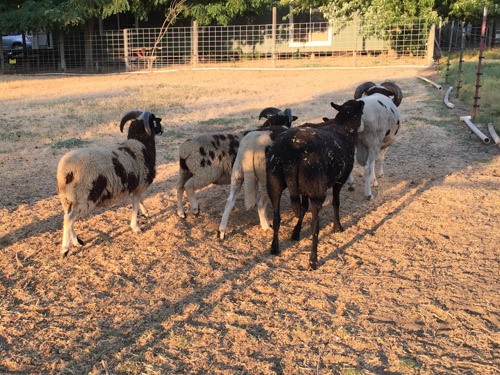
This week it was time to separate sheep into breeding groups. After much debate and deliberation I ended up using five rams this year. I don’t NEED five rams for the number of ewes I have but it’s always fun to find out how each ram will match with the flock…and there is also a bit of “not putting all one’s eggs in one basket”.
There are a lot of criteria in selecting a ram to buy or a ram lamb to keep in the flock.
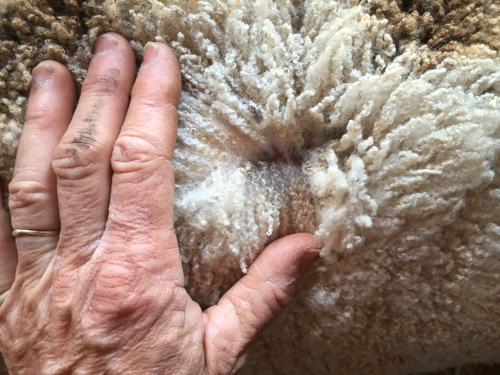
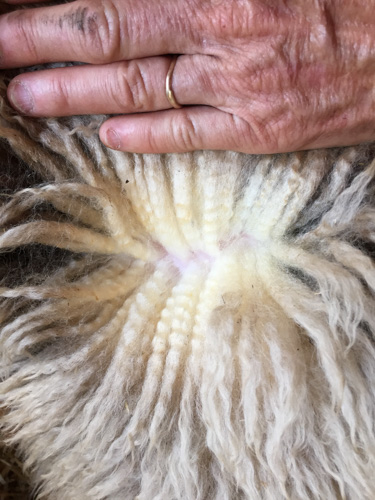
Fleece is the most important characteristic for me. If I don’t like a ram’s fleece then I don’t want to use him no matter how great he looks otherwise. I want to stay within the Jacob breed standards but consider fleece weight, fiber diameter (determines if a fleece is soft or scratchy), crimp, and freckling. One problem with making decisions about young rams is that you’re better off waiting until 18 months to fully evaluate fleeces. That is a long time to hang onto a ram and then decide he stays or goes. With my small acreage I just can’t hang onto several rams to evaluate a year later. I need to make my best guess at about six months old.

Here is an example of a ram lamb from this year who lucked out. I love his fleece but he is freckled. He’s castrated and is the donkey companion for now.
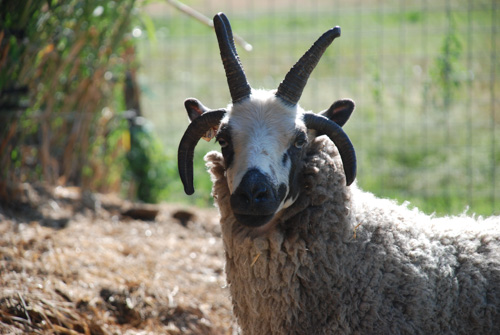
Horns. You can have the best ram from all the other standpoints, but if the horns grow into the face he will have to go. Here is a blog post with examples of two-horn rams.
Color. The Jacob Breed Standard states that registered sheep must have 15-85% color. That’s a broad range, but not all sheep fit that category.
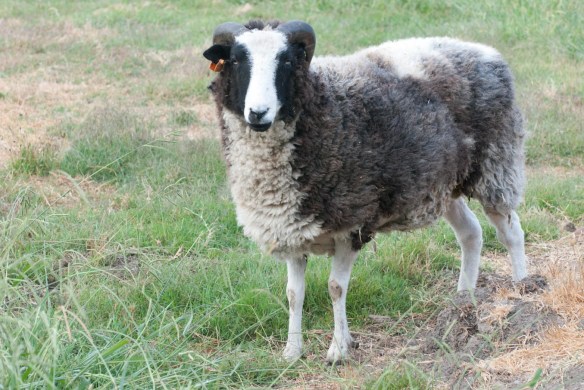
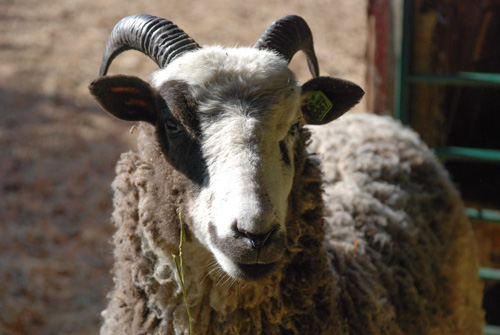
Jerry is a 5-year-old wether who won the sheep-lottery by having a beautiful fleece, but with too much color to be kept as a breeding ram. He was castrated as a lamb and was kept to be a buddy to any sheep who had to be separated from the flock. He lives permanently with Faulkner, the BFL ram. Also note how narrow his horns are. If he had not been castrated those horns would have grown tight onto his neck or face.
There is more, but this was going to be a post about the rams I am using this year, not a how-to-choose-your-flock-sire post. However other traits to consider are personality (yes, really), conformation, size, birth weight, gain, and is he a single/twin/triplet.

I hadn’t planned on keeping Meridian Joker, but as I looked at lamb weights over the last few months he stood out as one of the heavier ones. I sell at least half the lambs for butcher and the sooner they can be sold the better. So rate of gain is important. His horns don’t have a huge spread, but hopefully they will be all right as he grows.
By the way all the rams in these photos are wearing marking harnesses with red crayons. That’s what all the color is.
 Starthist Dragon is on loan from a friend. When I evaluated his lamb fleece a couple of years ago I was impressed and Trish remembered that so offered him for the season.
 Bide a wee Buster came here from Oregon last June. He was so small I had my doubts about him being up for the task this month, but I should have had faith.

Meridian Catalyst is a ram who was born at the 2015 State Fair Nursery. He is a lilac ram with nice fleece and markings. That’s him in the middle of the ewes on the second day of breeding season. Faulker is ram #5. He is a Bluefaced Leicester (BFL) and sires the black (brown) lambs. He is the big guy in the center of the photos. His lambs are larger than the 100% Jacob lambs and are mostly sold for meat although they have very pretty fleeces and also wind up in some spinners’ flocks.
 Faulkner enjoying some time with the ladies.
 Isabelle, marked by Joker.
 Skye is in Catalyst’s group.
 Jillian is with Faulkner.
 Joker looks a little disheveled after a few days.
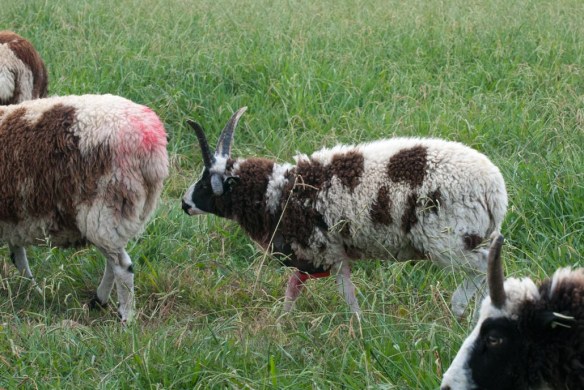 Buster has his work cut out for him to reach those big ewes…
 …and needed a nap after the first morning out.
For any of you who pay attention to this stuff and may be wondering about the other Jacob ram I bought this summer…I discovered a few weeks ago that he must have been injured by another ram and his horn had changed position so that it was growing right up against his jaw. I found that the point of attachment was movable (I don’t know if went all the way to the skull which means that it would have been fractured). I tried to give his face a little more space by using wire and duct tape but that didn’t work. This is not a sustainable situation so he is no longer with us.











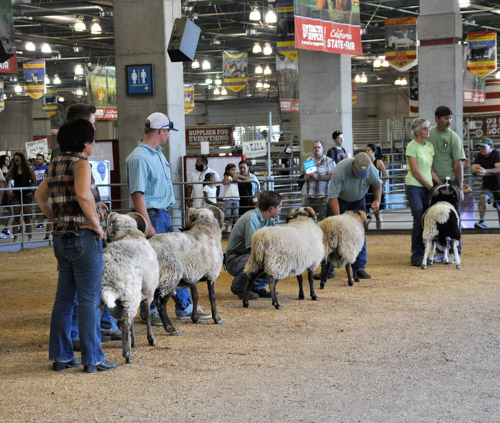
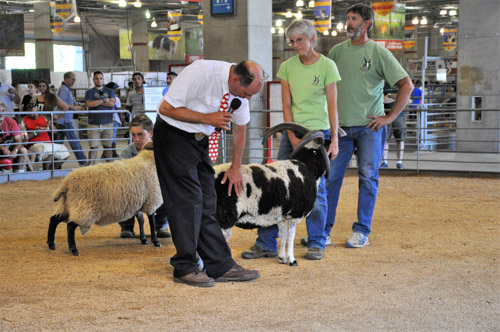

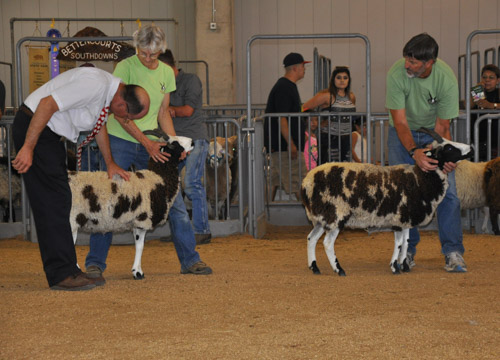

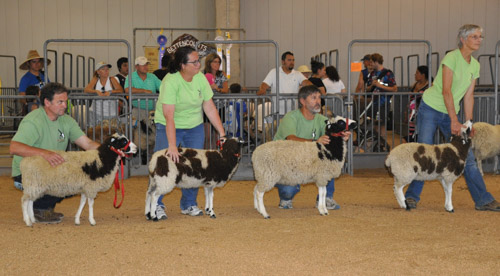





 Shadow Mountain Shelby is a yearling…



 Ginseng and BFL-X lambs.
 Fandango with lambs.
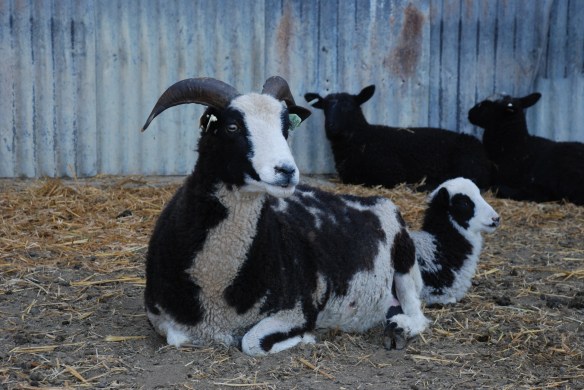 Hot Lips and lamb.
 Alexandria and her lambs.
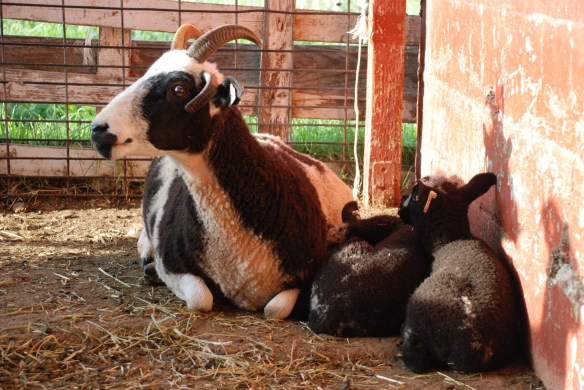 Isabelle with lambs.
 Melinda and lambs.
 These were the last ones born this year.
 Amaryllis.
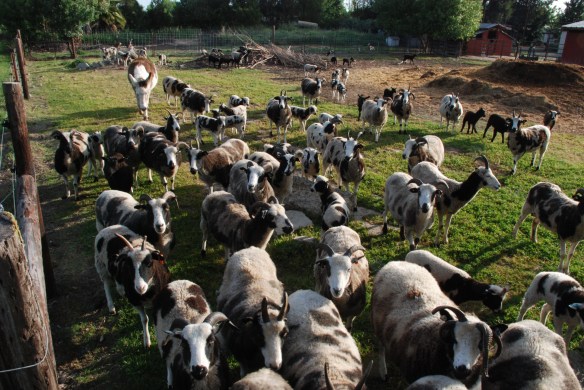 Sheep looking hopeful as I climb back over the gate.

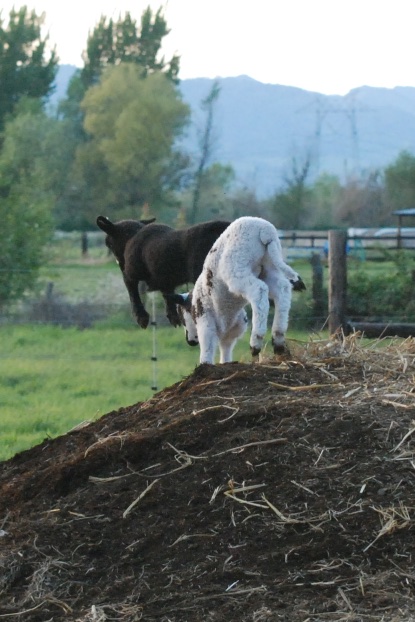


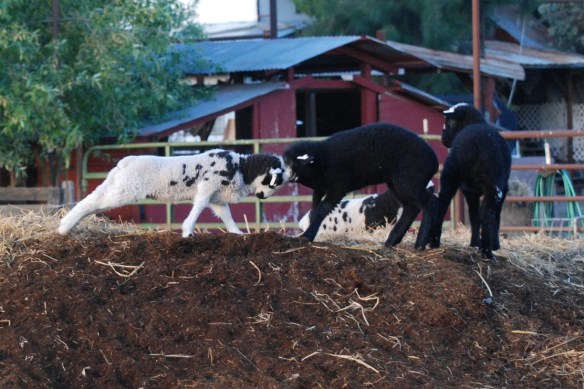


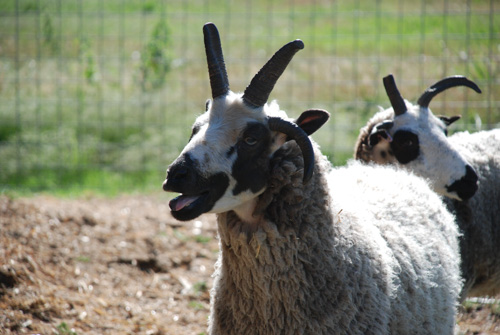
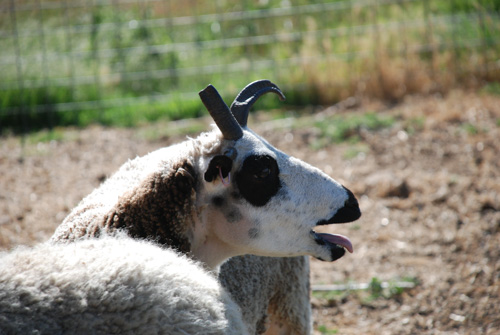
 We caught all the lambs to check for number of horns and split eyelids (a trait that is sometimes seen in 4-horn lambs).
 This was also a good time to check the paperwork and make sure that I had recorded the gender and sires correctly.
 My neighbor who recently purchased sheep was here also to get some hands-on experience. He told me that a recently purchased goat had kidded that morning and he wasn’t sure the kid had nursed.
 I went to his place at lunchtime to check on the kid and while he held the doe (very skittish) I got the kid nursing.
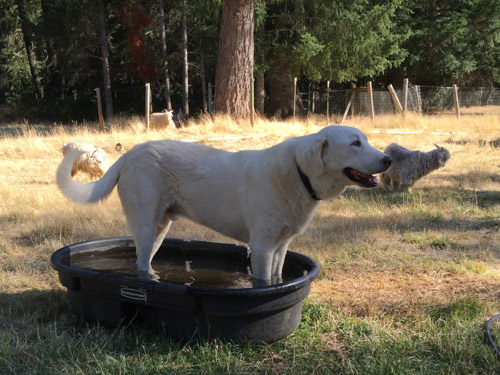
 Back at our place, we finished moving sheep around. I moved “Ginny’s flock” of wethers and she was so hot when she was finished that she found the only accessible mud puddle to sit in.
 Last in the afternoon we decided to try grafting a lamb onto a ewe whose lamb had been killed the day before. I had debated it that day and at the time didn’t want to deal with it. But I had some new twins and though it was worth a try. This method of grafting is not as pleasant or as satisfying as “slime” grafting where you just cover the adopted baby in the birth fluids so that the mom will think the lamb is hers. With this method there is a dead lamb and you need to use it’s skin to cover the adoptive lamb to trick the mom into thinking it’s hers. That photo above is the lamb in the skin before I cut it to fit better. Bea, the young ewe, was unsure. The scent of her lamb was there but the sound wasn’t right. The lamb didn’t want to nurse at first and when it did Bea wasn’t happy about it.
 This photo is blurry because I must have smeared my iPhone lens while working with the lamb. When Bea finally lay down while trying to avoid me attaching the lamb to her teat I was able to get the lamb to nurse on the engorged udder. For a day or two I needed to halter her or just stand there.
 At this point Bea has completely claimed the lamb as her own. (The dead lamb’s skin is gone in this photo–I took it off the next morning.)
 We were impatiently waiting for Jazz to lamb. I was sure that she would have triplets because she was so huge. She surprised me with twins the day after Farm Day. They are 9.6 and 12 pounds. At that size it’s good there were only two of them.
 This event is attended by almost 3000 third graders and their teacher and parent helpers.
 I was amused by this sign.
 Kids are exposed to everything involving agriculture.
 A variety of local volunteer groups, agencies, and 4-H/FFA members bring exhibits and hands-on activities.
 Kids sat in bleachers while learning about dairy products and dairy cows.
 This 4-Her had labeled the parts of her horse.
 There was even a roping demonstration. There were also herding dogs, police dogs and horses, and dozens of other activities over the whole fairgrounds.
 This equipment is what they use to shake nut trees, but it was fun to see the leaves shake in this demo.
 We brought two ewes with month old and week old lambs. The morning started out calm.
 Kids enjoyed petting the lambs.
 But that was when the kids were just starting to get there.
 After awhile the ewes and lambs were stressed with the number of people and the noise level. So we talked to the kids, but didn’t handle the lambs anymore. Fortunately I had brought out tame sheep, Jade.
 I took her out on a halter and she loved the attention. I told the kids who were standing around watching that they could pet…
 …and pet they did…
 …feeling horns…
 …and wool.
 This sheep is amazing.
 When people wandered away she wanted more.
 Eventually her handler (me) got tired and put her away…
 …but she still hadn’t had enough.

