Friday was an interesting day. Veterinarians I know had agreed to help with the project of testing my flock for the gene for lysosomal storage disease. I’ll back track and explain briefly. A gene for lysosomal storage disease has been identified in Jacob sheep. Carriers are unaffected but if two carriers produce an affected lamb it will develop symptoms of the disease and eventually die. There is interest among some breeders in identifying carriers so that they can either avoid the problem (don’t breed carrier to carrier) or remove the problem (cull carrier sheep). But there is more to it than protecting our flocks. Researchers at Texas A&M and New York University Medical Center found that this disease identified in Jacob sheep is the same as the lysosomal storage disease in children, known as Tay Sachs. So there is interest in maintaining a carrier flock of sheep for use in studying human medicine. One of the members of the Tay Sachs Gene Therapy Consortium stated:
“The goal of identifying and eliminating Tay-Sachs in Jacob sheep in order to conserve the breed is a noble goal. But we who are working on a human gene therapy cure are very happy that you did not succeed and kept the carriers for the last decade. These sheep are genetically significant.”
This article it will give more background.
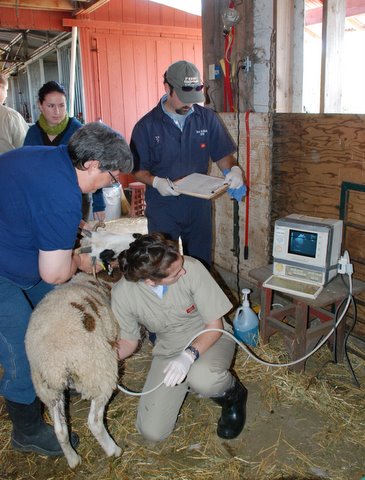
First up was to do ultrasounds on the sheep and one goat that will be part of the UC Davis VMTH Livestock Nursery at the CA State Fair. I have provided sheep for the nursery for the last couple of years and because we’re breeding out of season we like to check and make sure they are really pregnant. I’m pleased to announce that Stephanie, the Toggenburg goat, and 3 ewes are pregnant and will be at the fair in July.


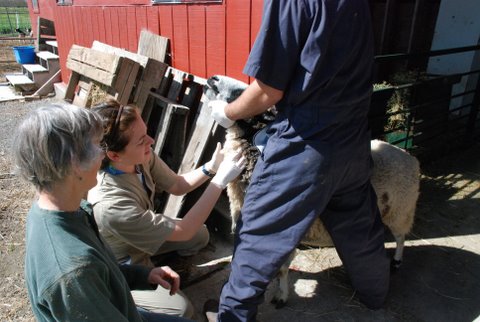
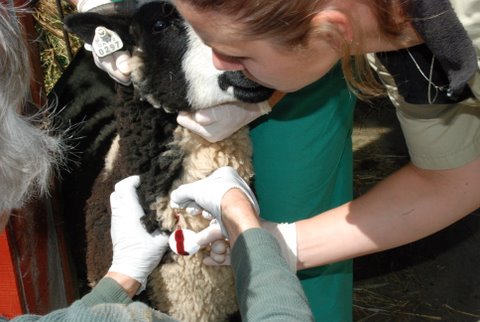
A protocol was developed to enable sheep producers to gather blood samples from their flocks themselves. The DNA test can be done with a few drops of blood on a filter paper. It was recommended to use a special lancet and take the blood from the ear. The Farm Club members and I worked on that a few weeks ago but it turns out that we didn’t have the right supplies and it was a struggle. While I was waiting forthe correct supplies I talked to my veterinarian friend who suggested obtaining the blood from the jugular vein as you would for any other blood test. It’s easier on the sheep (minimal pain) and easier on the person (if you know what you’re doing). In this photo I’m getting a lesson on how to do this.

I’m pleased to say that after a few missed attempts I was able to get four in a row. Then I figured that I at least knew how to do it and I went back to helping move sheep. We had a “clean” person who labeled and handled the samples, 2 people drawing blood and the rest of us caught and held sheep so we could work through the whole flock quickly. Oh, one of the Farm Club members was the photographer and took all these photos. Thanks, Shelby.

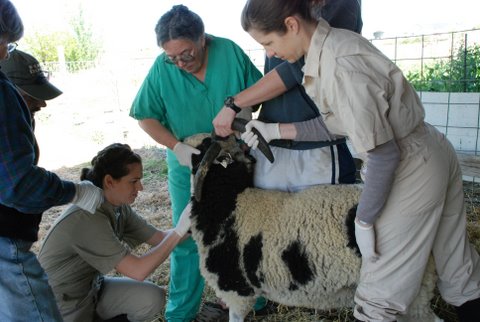
It was a little more difficult getting blood from the rams. This is Tioga.

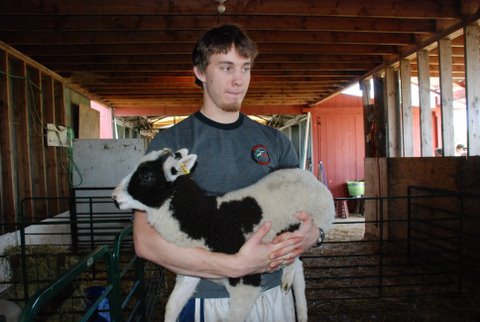
My son, Chris, helped move sheep.

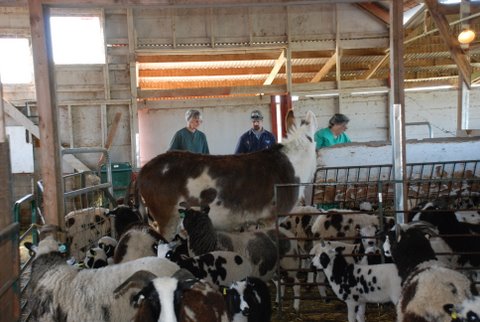
As much as I love my donkey sometimes she makes things more difficult. She is standing right in the gate where the sheep are supposed to go.

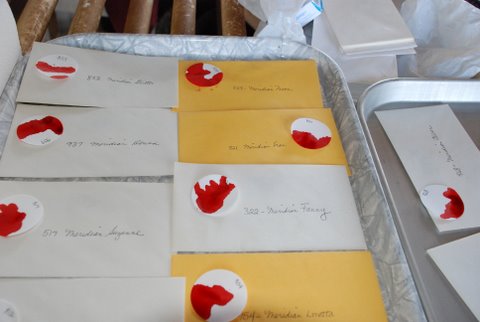
These are some of the samples that will be sent to NY for testing.

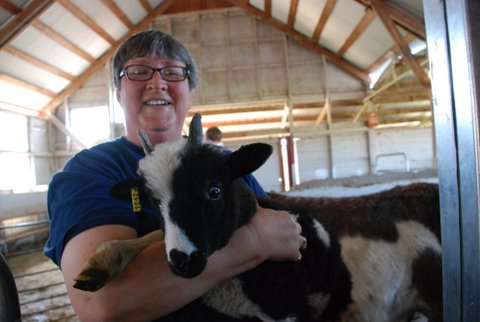
This is Sid, a wether who will go home with Jackie when he’s old enough.
Thanks to the veterinarians who helped with this project and to the Jackie, Shelby, and Kathy of the Farm Club.




















 Meridian Jacobs' Blog