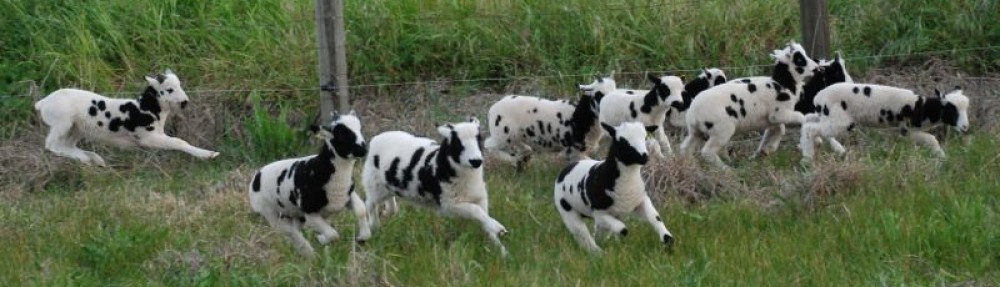
Griffin – Lilac or Black?

In the Jacob world sheep are either black and white or lilac (and white). Lilac refers to a color that is Not Black. That is usually gray maybe with a brown cast. This blog post shows photos of several lilac sheep. Many time people think Jacob sheep have brown spots, but that is because tips of the dark wool become unbleached. The wool is still dark at the skin. When you describe the Jacob sheep’s color you look at the facial markings. If the hair is black or gray(ish) that dictates the label for the color.

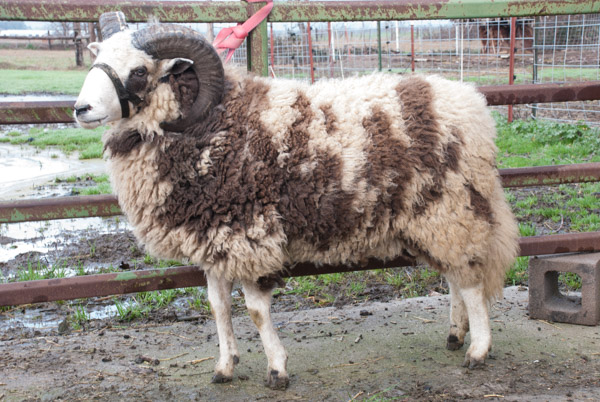
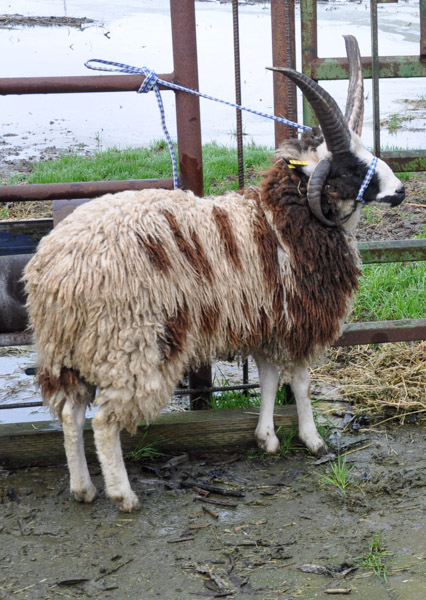
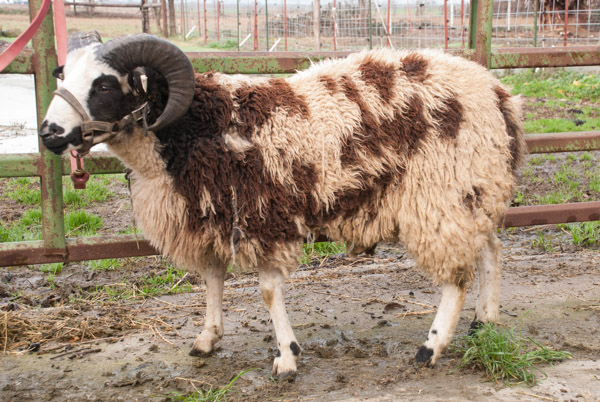
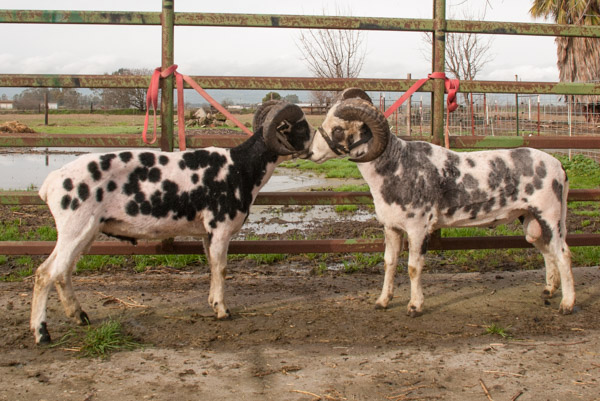
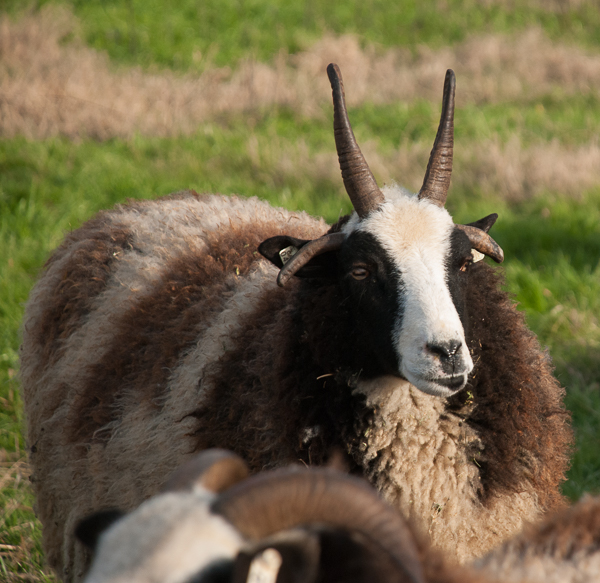
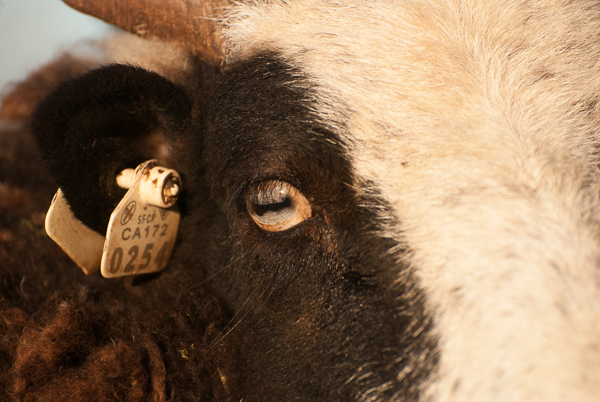
Griffin is a ram that was born in February 2024. Last fall when this photo was taken I wasn’t sure of his color but now I am. In this photo he looks black and white. Remember, it’s based on the facial markings. It may be hard to tell from just a photo as well.

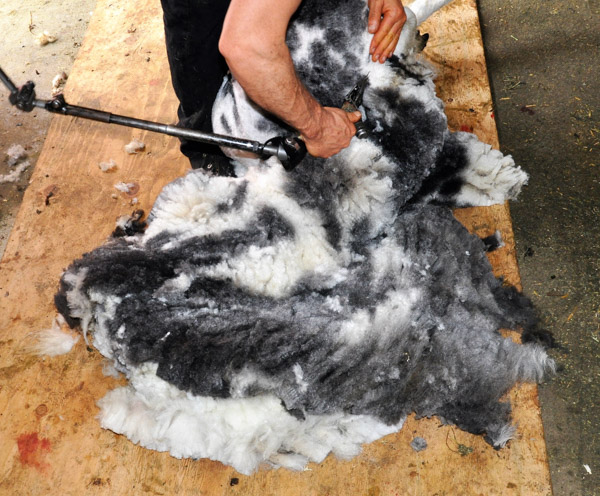
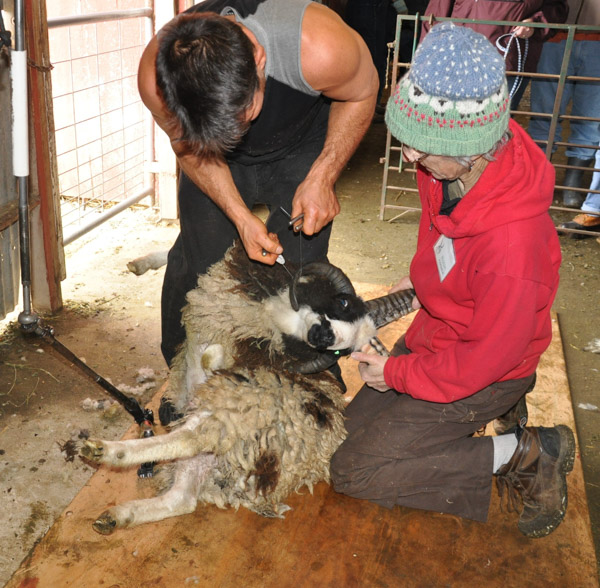
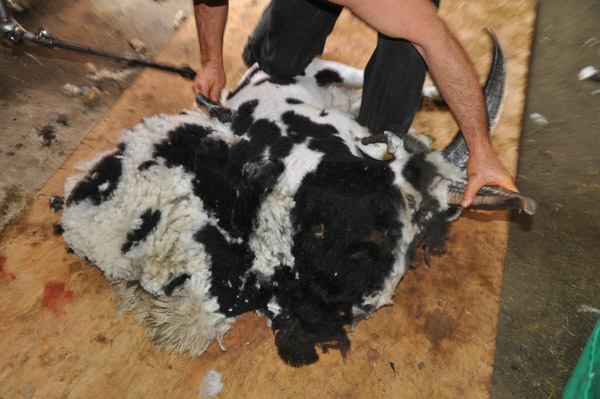
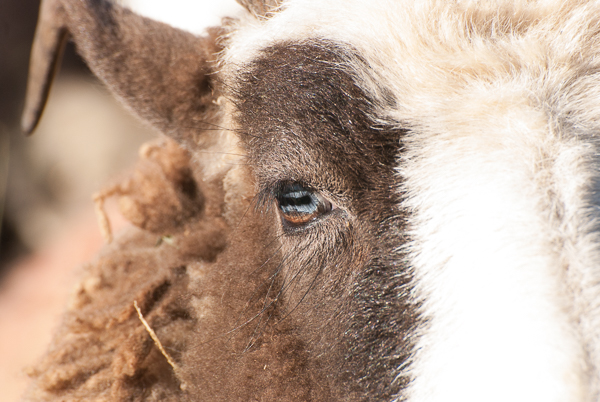
This photo was taken shortly after shearing in January. The eye ring that is often part of the lilac coloring is obvious and the fleece looks gray.
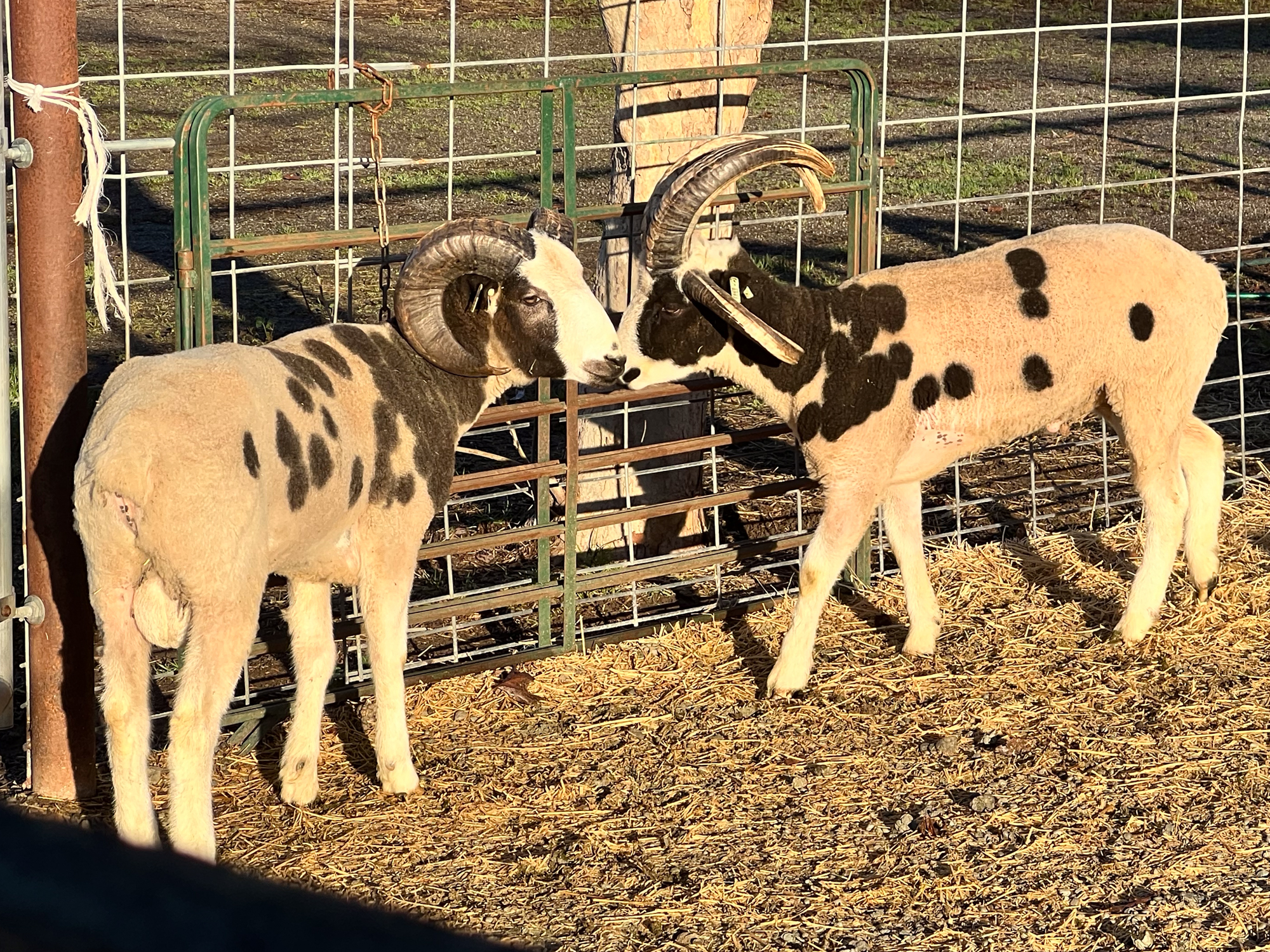
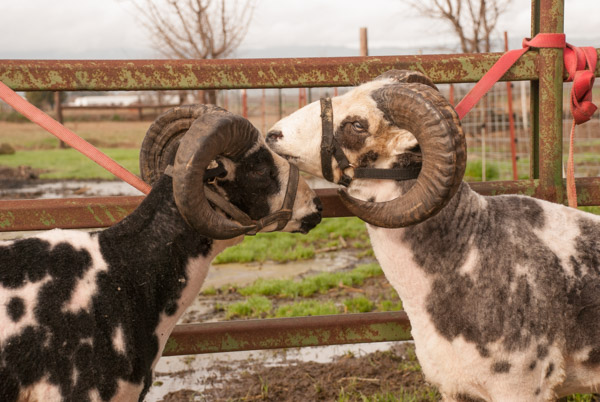
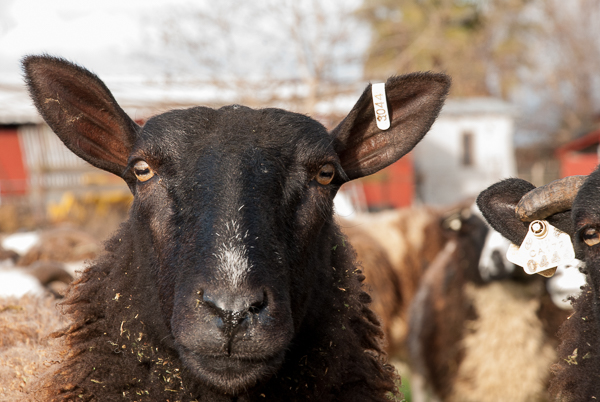
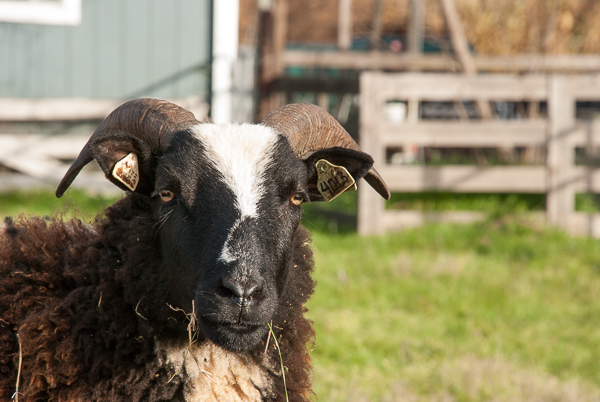
In this photo it is much easier to tell the difference in color between Griffin on the left and Sterling on the right.
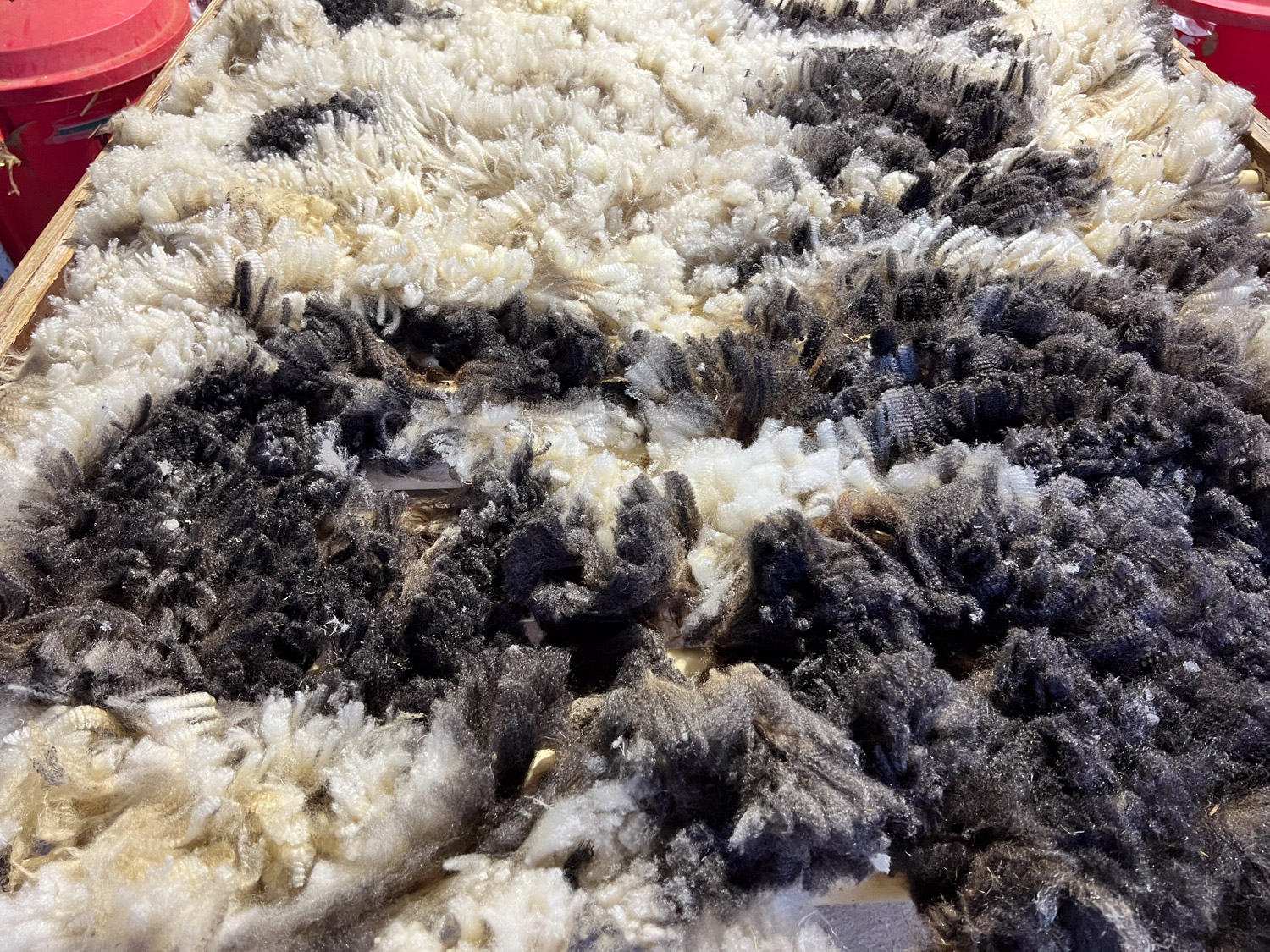
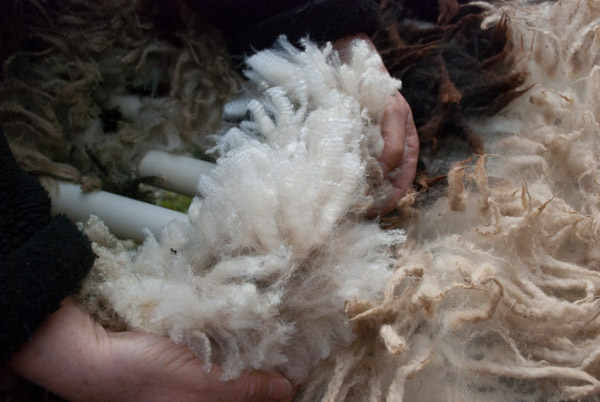
Griffin’s fleece looking at the cut side.

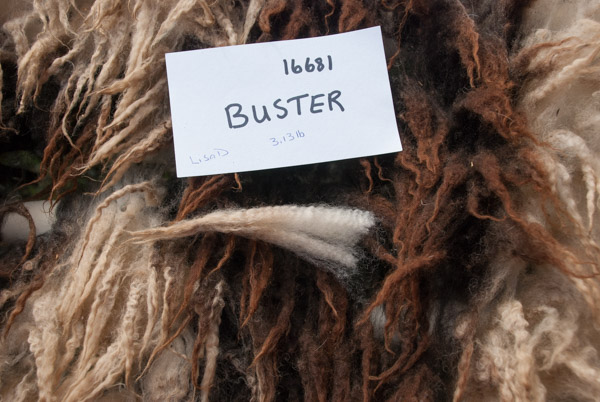
Griffin’s fleece, on the right, with a lock of wool on the left from a definitely black and white sheep.

The lilac trait is recessive so breeding two lilacs should produce lilac lambs. When there is a black and white parent the appearance of lilac lambs means that there is lilac somewhere in the ancestry of the black parent. In Griffin’s case, both parents are black and white. There is a lilac great-great-granddam on his sire’s side and a great-grandsire and on his dam’s side.

Sometimes we wonder if all “not black” Jacob sheep have the same lilac genetics. This is being investigated now.
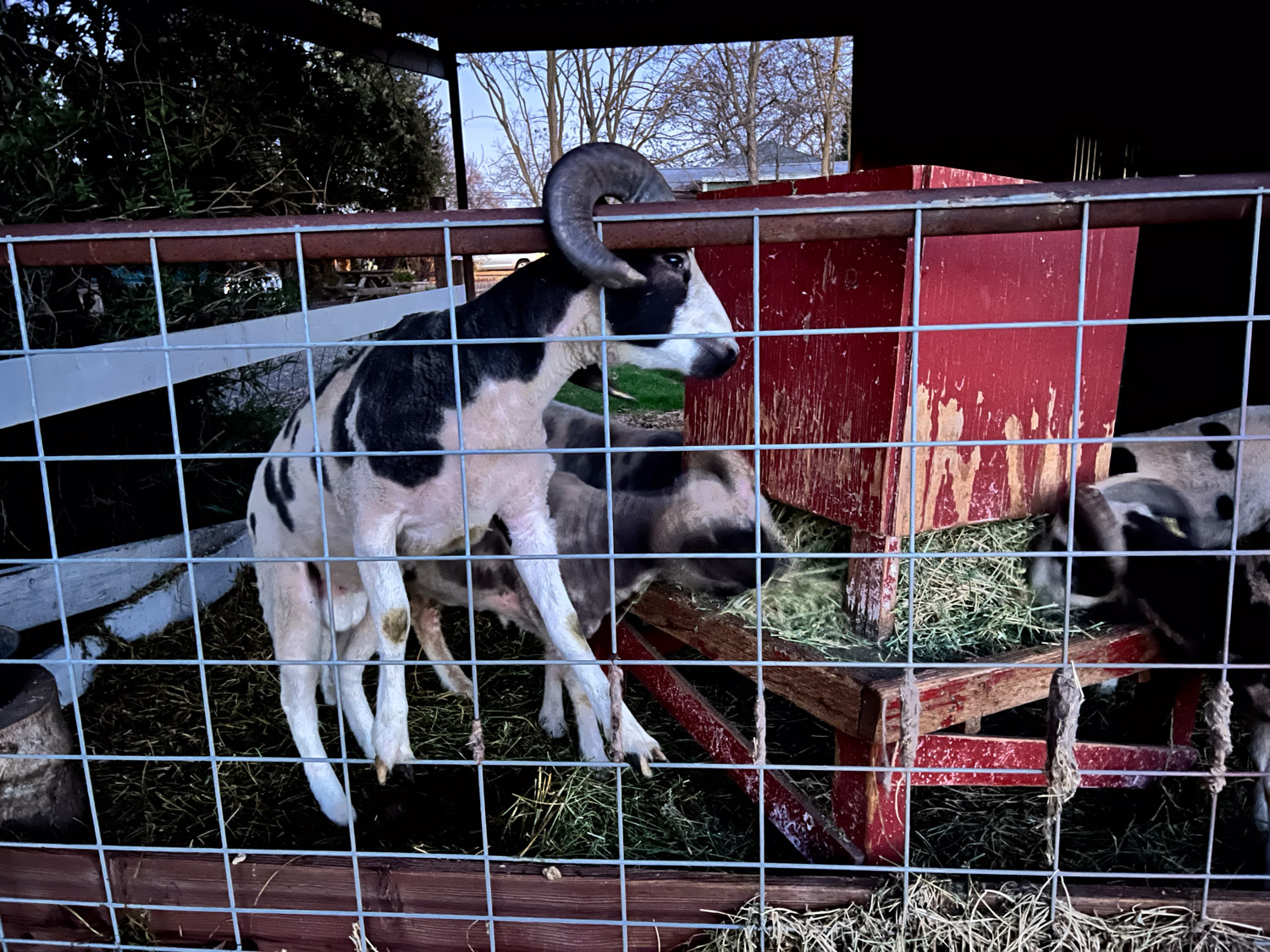
I took this photo a few days ago when Griffin was stuck on the fence. He must have had his front feet on the tray of the feeder and caught his horn over the top pipe along the fence. I couldn’t get him off and had to get Dan to help.
Meridian Bessie

Two ewes have lambed early this year. The dates finally made sense when I realized (thanks to a Farm Club member who keeps track of these things) that some of the ram lambs got in with the ewes September 2. Those lambs would have been 4-1/2 to 6 months old at that time. As another friend said, “where there’s a ram, there’s a way!”

I saw one of the rams breed a ewe, but it wasn’t one of these two who have now lambed. Bessie lambed on Monday and in looking up some info, I thought I would feature her in a blog post.

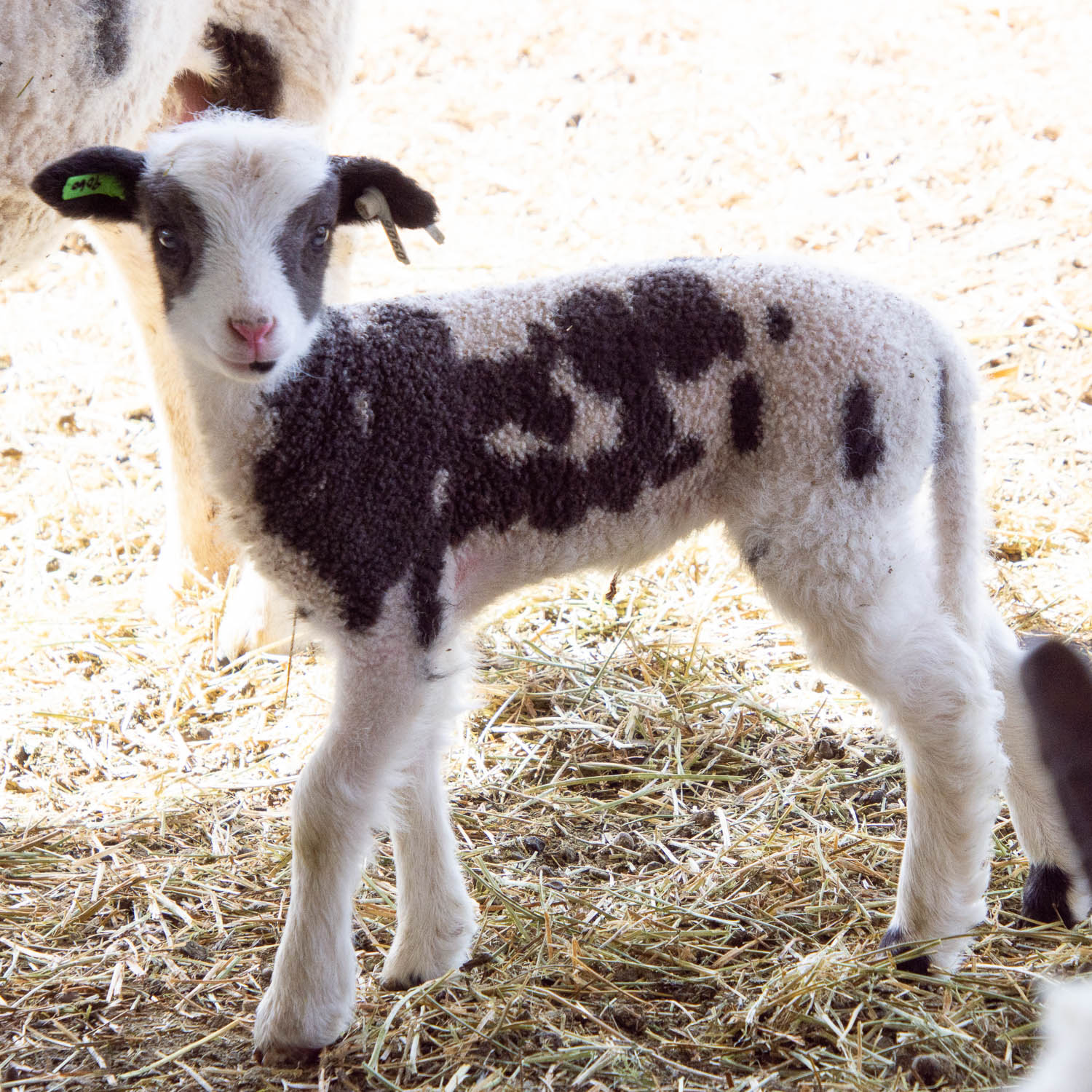
Bessie was born 3/10/2019. She was a week old when this photo was taken. You can see that she is a lilac–the facial markings are definitely gray, not black and the fleece color follows. I love to see a lamb fleece like this. It’s all tight little curls and, in my experience, a fleece like this will be very nice. Also notice the level of the britch wool. That is the coarser wool on the back leg. It doesn’t spread very far up the leg.

Here she is 10 days later.

This photo was taken at about 7 months old.

Here she is three years later.

In 2023 Bessie lambed with twin rams. I kept this one, now named Blizzard.

This is Bessie, not quite a month ago. She is in full fleece and full of lambs.

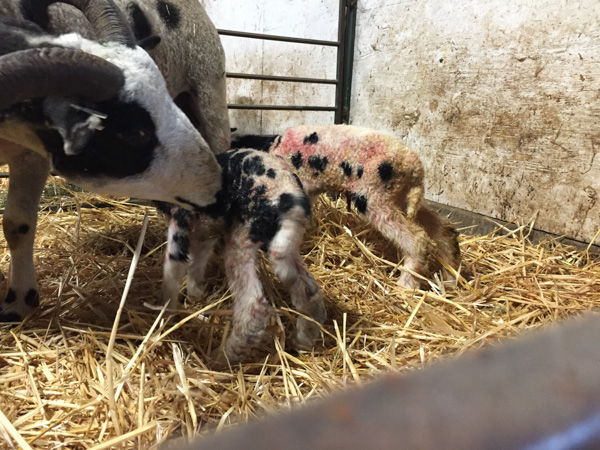
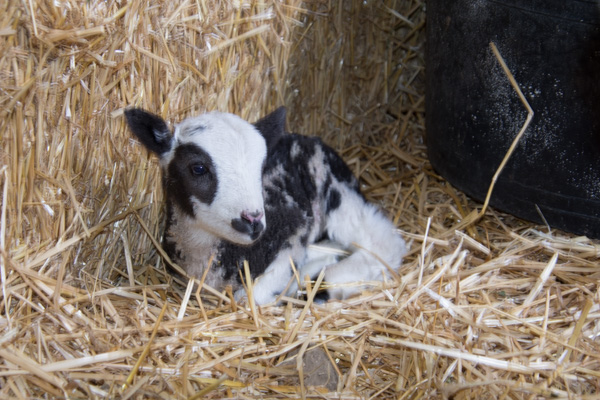
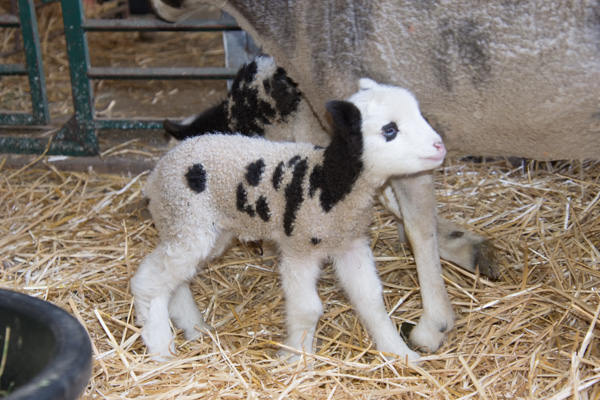
These two ewe lambs were born on Monday, 1/29. The one on the right is lilac like her mom. They have the same curly fleece and low britch wool that Bessie had in her lamb photo.

More Lambs

Sheena was one of four ewes to lamb on February 26.

Sheena            That is her pawing and looking restless during morning chores.Sheena lambing-1                 When she looked more as though she were in active labor I brought her into the barn. That was about 10:15.
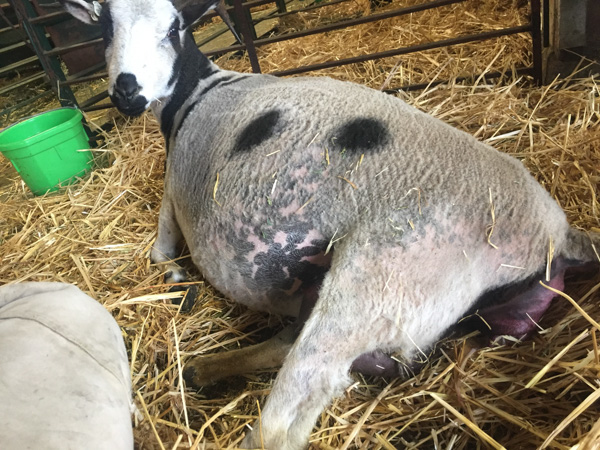
Sheena lambing-4                At about noon the sac was visible.Sheena lambing-3             This view, taken about 2:00 shows how, as labor progresses, the sides are sunken in front of the hips. I had been waiting for Sheena to have her lambs before I went to town, but I finally decided to make a quick trip. When I came back at 3:00 she was lying down and pushing but I saw only the nose, which at that point looked somewhat swollen. When I felt for the lamb position, the feet were at about a 2:00 position instead of below the head and out in front. I pushed the lamb back so that I could make sure that the feet matched up to the right lamb, brought them around to the 6:00 position and then pulled the lamb easily.

Sheena lambing-6                 As soon as the lamb was out Sheena went to work.Sheena lambing-8                      The sac for the next lamb showed within a few minutes.                       Sheena lambing-17           Lamb #1 was on his feet within 8 minutes.
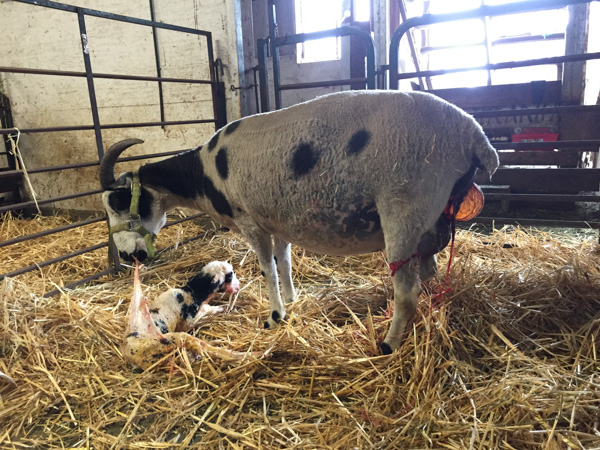
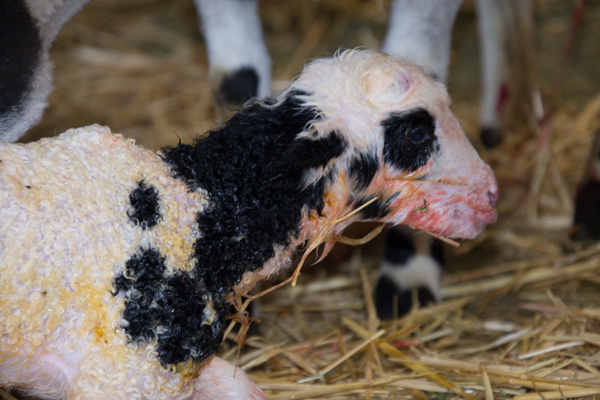
Sheena lambing-12               You can see this ram lamb’s horn buds.

Sheena lambing-18             Sheena barely noticed as she pushed out the second lamb about 15 minutes later.Sheena lambing-22                     Lamb #1 is mostly white.

Sheena lambing-24                    Lamb #2 has a lot of color and has lilac markings. Catalyst is the sire.18010                This is the first lamb two days later.18011                  Here is the second lamb.
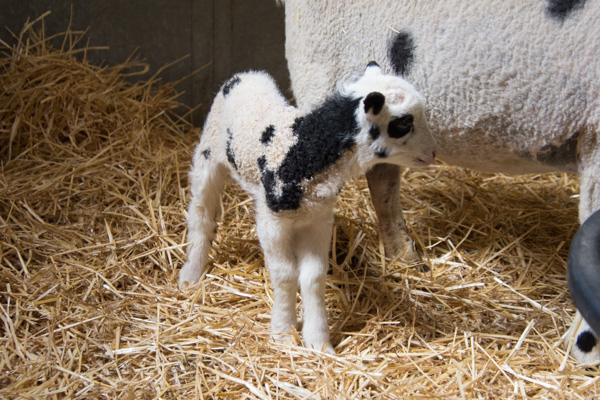
Details are on the website.

LAMBS!

Lambing started the day after I got back from Texas. I’m sure that Dan was grateful I was back. There was one lamb on the 22nd, nothing the next day, and since then they’ve been popping out right and left. I haven’t had time to do anything with photos until now (although I should probably be sleeping).

Shadow Mountain Shelby was the fourth ewe to lamb. She is a lilac (Jacob terminology for markings that are not black but are gray/brown), ewe with beautiful blue eyes. I got to the barn and found her with a lamb.

Shelby lambing-1                    Lamb #1. These aren’t usually a pretty side when just born. Slime, dirt, blood. Shelby lambing-4                Jacob ewes are usually very good mothers and the lambs are vigorous. Shelby was cleaning up her baby…Shelby lambing-7             …even while pawing the ground and having contractions for the second.Shelby lambing-12                    I got them inside the barn and the lamb got to its feet and started looking for milk.Shelby lambing-13                       Lamb #2.
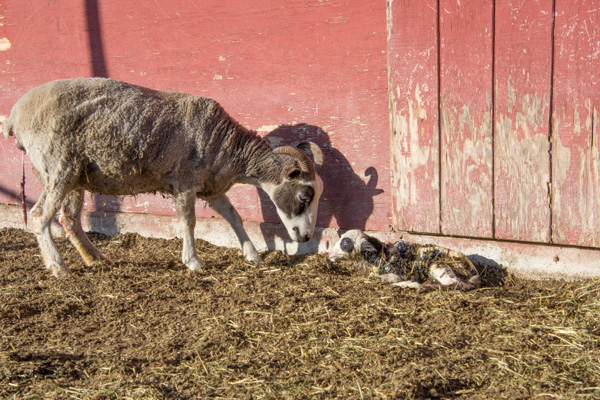
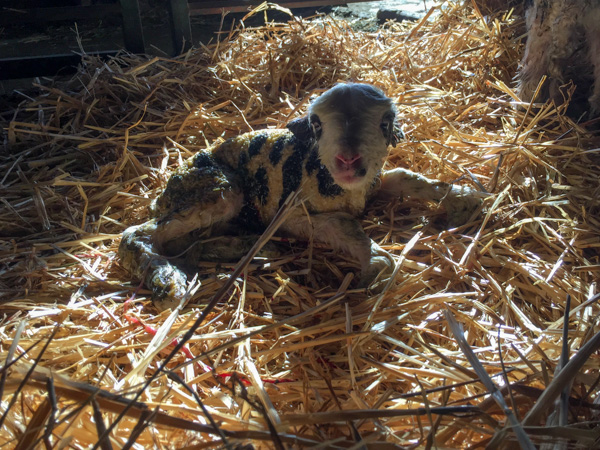
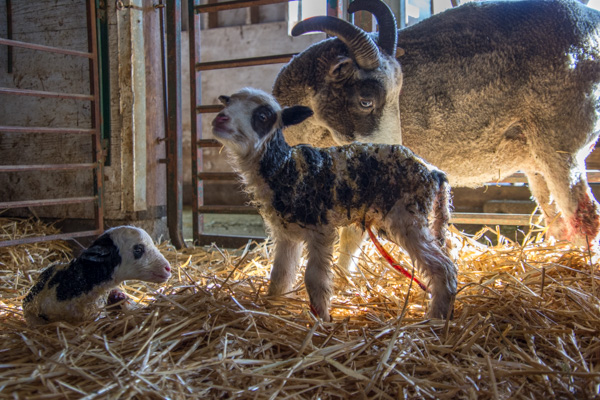
Shelby lambing-15                 The first lamb is nursing while Shelby cleans the second.Shelby lambing-18                   I love the look of this one. These are both lilac ewe lambs sired by Catalyst.18006           Here they are three days later.18007                  These lambs are listed on my website lamb page. I’ll be updating the listings with photos as I get time.
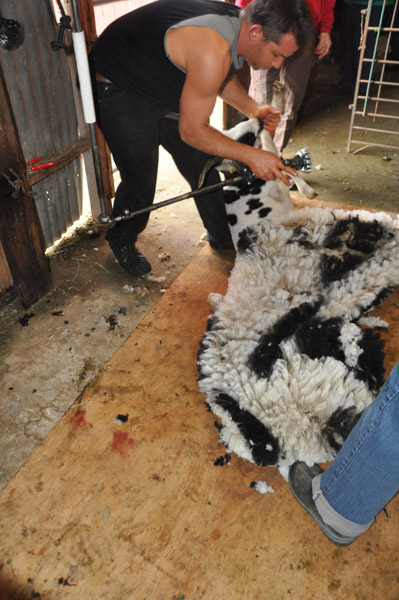
 

Shearing the Rams

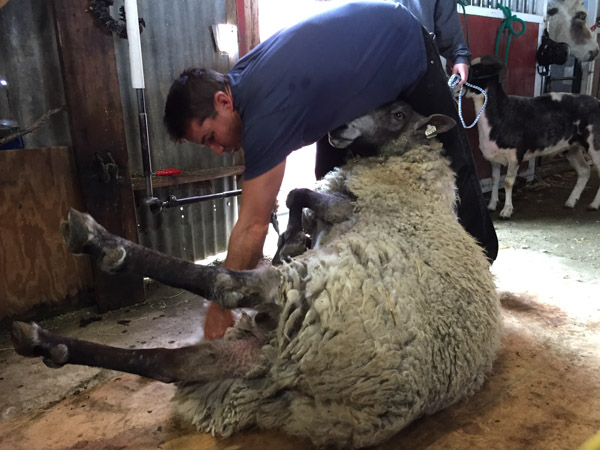
Shearing was a few days ago and it’s an event worthy of a few posts. I started talking about it in here but have been distracted by a major project which will take over my brain for a couple of weeks. I need a break from that so here are photos of shearing the rams. Thanks to Dona and Carole for contributing some of these photos.

img_6616

This isn’t a ram but while I was catching them John started with  Mary’s  seven sheep.

faulkner

Then it was Faulkner’s turn. Faulkner is a Bluefaced Leicester (BFL).

catalyst

Catalyst is a lilac colored Jacob ram. Lilac refers to the gray-brown color of his wool and the facial markings.

dsc_1816

dsc_1819

dsc_1821

What a gorgeous fleece!

dsc_1781

Bide a wee Buster is almost a year old.

dsc_1828

It’s been on my list to trim Buster’s horn, but John did it before shearing.

dsc_1832

dsc_1838

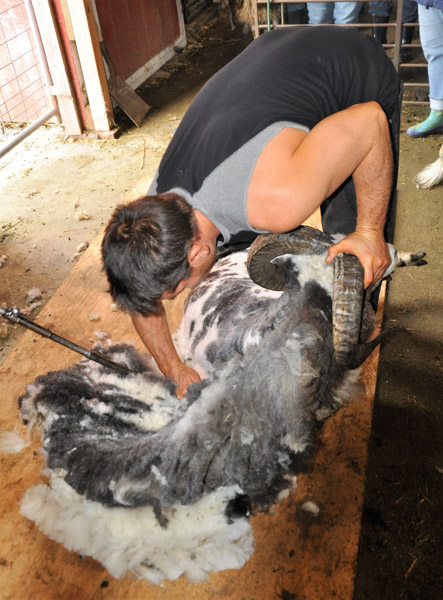
That’s another beautiful fleece coming off.

dsc_1840

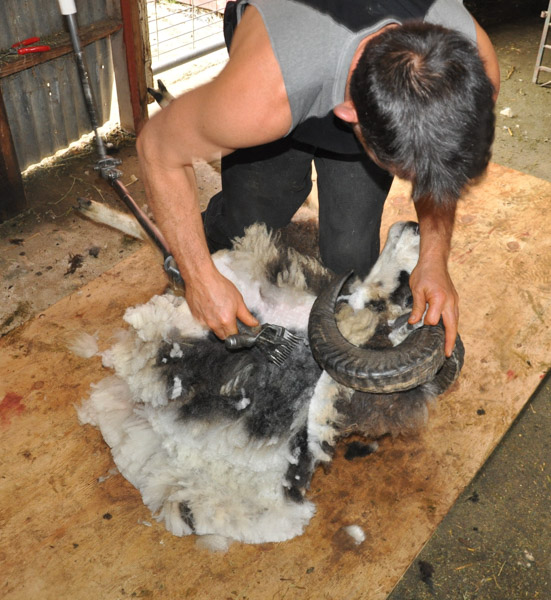
A shearer has to be careful in maneuvering those big horns.

dsc_5929

Here is a close-up of Buster’s fleece. Notice the difference in color of the outside of the fleece and the inside in the photo before this.

dsc_5930

joker

Joker was the last ram to be shorn.

joker-catalyst

This photo clearly shows the difference in the black & white and lilac color pattern in the Jacob sheep.

joker-catalyst-2

img_6686-2

Next up–shearing the ewes.


The Morning After

We sheared yesterday (more about that in future blog posts). Here are some photos from this morning and some before-and-after shots.

img_6882

You can fit more sheep at the feeder after shearing and it’s sure easier to keep an eye on udder development and predict lambing.

img_6889

The aftermath where the skirting table was yesterday. We were so lucky with the weather yesterday–no rain after continual storms. This water is from last night’s rain (almost an inch).

Meridian Zoey. Zoey has freckled skin but not freckled fleece–that’s two different things.

Meridian Fandongo. Notice how the sheep look like they have brown spots in most of the “before” photos. The wool has sunbleached tips. Underneath it is black, or gray if the sheep are fading, or gray-brown if they are “lilac”.

Puddleduck Petra. A good example of a black fleece that looks brown when on the sheep.

Meridian Alice, a two year old ewe.

Meridian Bertha, another two year old. It will be only another day before the sheep look dirty again and you don’t see that bright white against the black.

Shadow Mountain Shelby. Shelby is lilac. Her facial markings are gray, not black. Her spots are a light gray. I used my iPhone for this morning’s photos so some of the sheep look like they have abnormally big heads. Maybe that’s only partly camera perspective but partly that they no longer have huge fleeces around those heads.
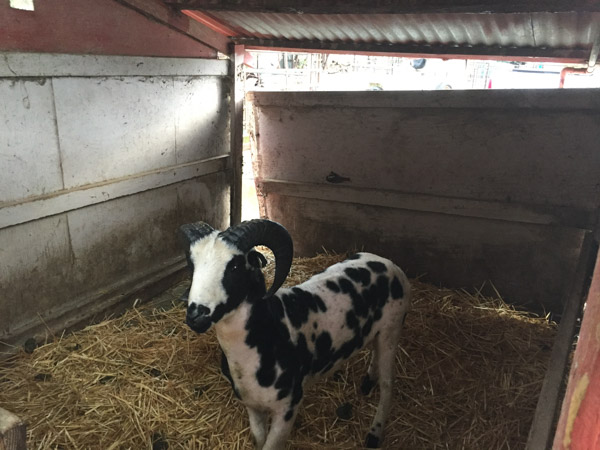
Bide a wee Hallie.

Meridian Cindy, one of last year’s lambs. Oops! It turns out that she is freckled. Those smaller spots are in the wool. You can’t tell about freckling when the lambs are born. After a couple of months it will appear. I think it shows up in the secondary follicles instead of the primary ones and that’s why you don’t see it at birth. (I’d like to hear someone who knows explain if that theory is correct.) I also noticed it in her twin brother, although you can’t really see it in the photo below.

img_6898

Meridian Joker, Meridian Catalyst, and bide a wee Buster.

And here is what I saw when I first checked on the rams this morning:

img_6891

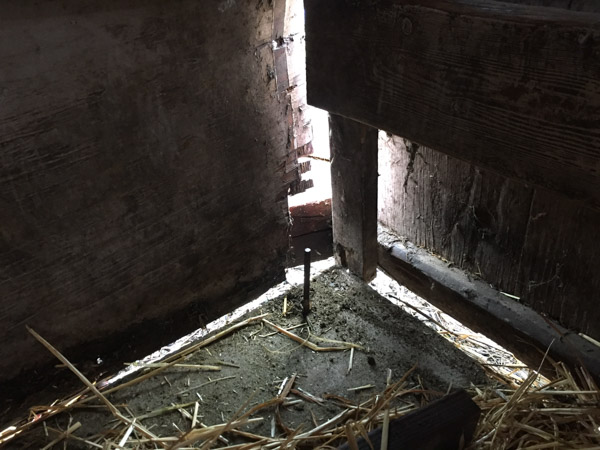
That wall behind Joker is supposed to be attached to the 2 x 4. I found the drill and some screws and put it all back up and it was only then that I looked at the other corner:

img_6910

Oh, that’s a bigger problem.  This wasn’t originally a ram barn. It started out two calf hutches that I made. Eventually they were put on this slab facing each other with a space in between and another roof overhead and the kids show pigs lived there for a few months a year. Then it was Faulkner’s pen and he was pretty easy on it. Now that the Jacob rams live there it needs reinforcement. Dan got the jack out to jack it up back on the cement and then reinforced everything inside with heavier 2 x 10’s at about head-bashing level. It could still use interior solid plywood walls but hopefully this will get us by for a few more months.

Stupid rams. You should be grateful that you have a shelter to get into after shearing and you’re not expected to stay out in the wind and rain.


The Flock

Every year I put together a Flock List for the Farm Club members. This includes photos and a little information about each sheep (and dog and other characters) on the farm. I like to get current photos of each sheep and I’ll share a few here. Shearing Day is in just a month so they are in almost full fleece. I’ll have to get before and after shots of them as well. 11047-zoey-3

Zoey.

11086-alexandria-2

Alexandria.

12018-sonata

Sonata.

13044-ears

Ears.

13068-cascade

Cascade.

14013-jean-2

Jean.

15031-15053

Two almost 2-year-olds, Honey and Zinnia.

16015-marilla-13007

Marilla, a 2016 lamb, and her mother, Marilyn.

sheenashelby

This photo was taking during the summer of two of the sheep I bought from flocks in Oregon. That is Kenleigh’s Sheena on the left and Shadow Mountain Shelby on the right. I found this photo while I was looking for another. It is a good example showing a lilac ewe (right) and a black and white ewe.

dsc_4747

Most sheep eyes.

blue-eyes

Some of the lilac sheep have striking blue eyes

Is she or isn’t she?

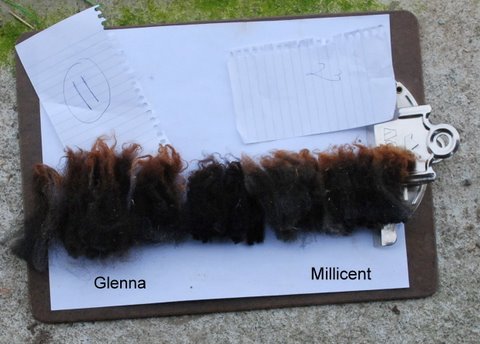
I’ve been sorting fleeces. Here are samples of Glenna and Millicent, 2009 March lambs that I got just before Christmas.

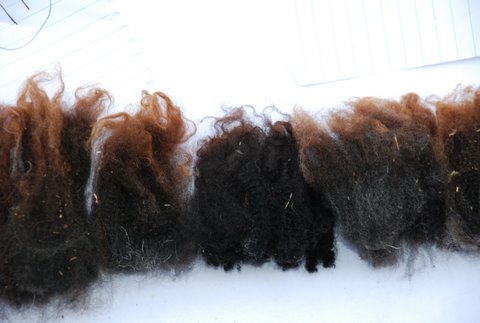
That is black wool from another sheep in the middle and here is a close-up:

When I got these sheep there was one definite lilac among them. (For those of you non-Jacob sheep people, lilac is a color other than the more common black and white, usually a shade of grayish-brown.) I wondered about the others because they are out of lilac ewes and sired by Kenleigh’s Nitro, who is registered as a lilac. Shannon, Nitro’s breeder says that he was very dark and one of the JSBA inspectors said he was “chocolate” lilac.

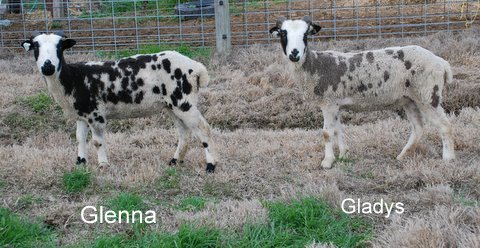
Gladys is the obvious lilac, but what about her sister?

This is Millicent,  out of Nitro and  Meridian Millie, a lilac ewe who I sold a few years ago.

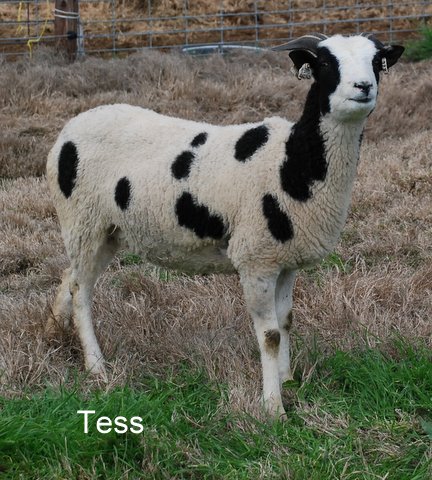
Here is Meridian Tess, who was born here, definitely not a lilac, but I thought she would be a good comparison.

So is there a difference between the black and white Tess and Millicent? Telilah is Millicent’s half sister/cousin (sired by Nitro and her dam is M. Tillie, a lilac ewe and the identical twin of Millie, but that’s another story.) Of course it’s hard to know what color you’re seeing on the computer, and I had decided that these sheep were regular black and white. But after opening up their fleeces today I think I’ve changed my mind.
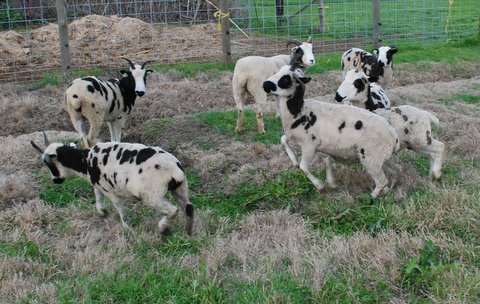
Here is the group of these new sheep playing in the early evening. They stay together most of the time–I think they’er happy to be on the pasture.

While we’re looking at sheep, here are a few that look ready to explode. The first lambs are due in about three weeks.

This is bide a wee Haylee…

and this is Hillside Paula.