Who is Going to Lamb and When? Ultrasounds

For the last few years I’ve asked the UC Davis vets to come here and do ultrasounds. It is certainly useful to know ahead of time the ewes that are not pregnant and, hopefully, the number of lambs to expect from those that are.

I told the Dr. Smith the dates the ewes were with rams and December 20 was chosen as the optimal time for ultrasounds. (Never mind that a few ewes went in with the new ram, Eli, right at Thanksgiving. This ultrasound date was scheduled before Eli came here. It won’t be hard when the time comes to know if those few ewes will lamb.

I purposely did not breed as many ewes this year because of the limited space with our pasture being off limits for most, if not all, of the next grazing season. If you read this blog regularly then you know about the Pasture and Irrigation Renovation going on. Look back over the last few months for those blog posts.
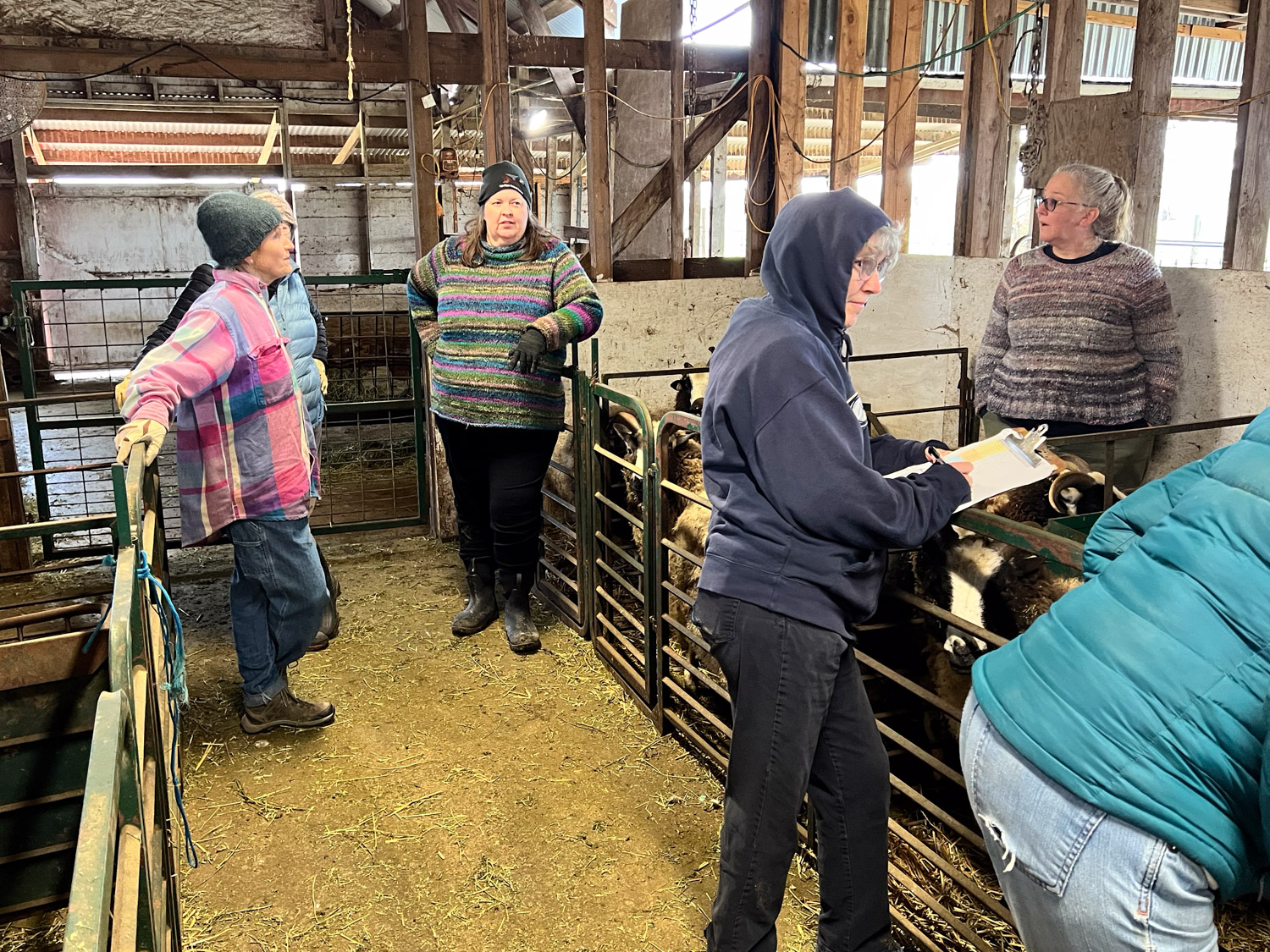
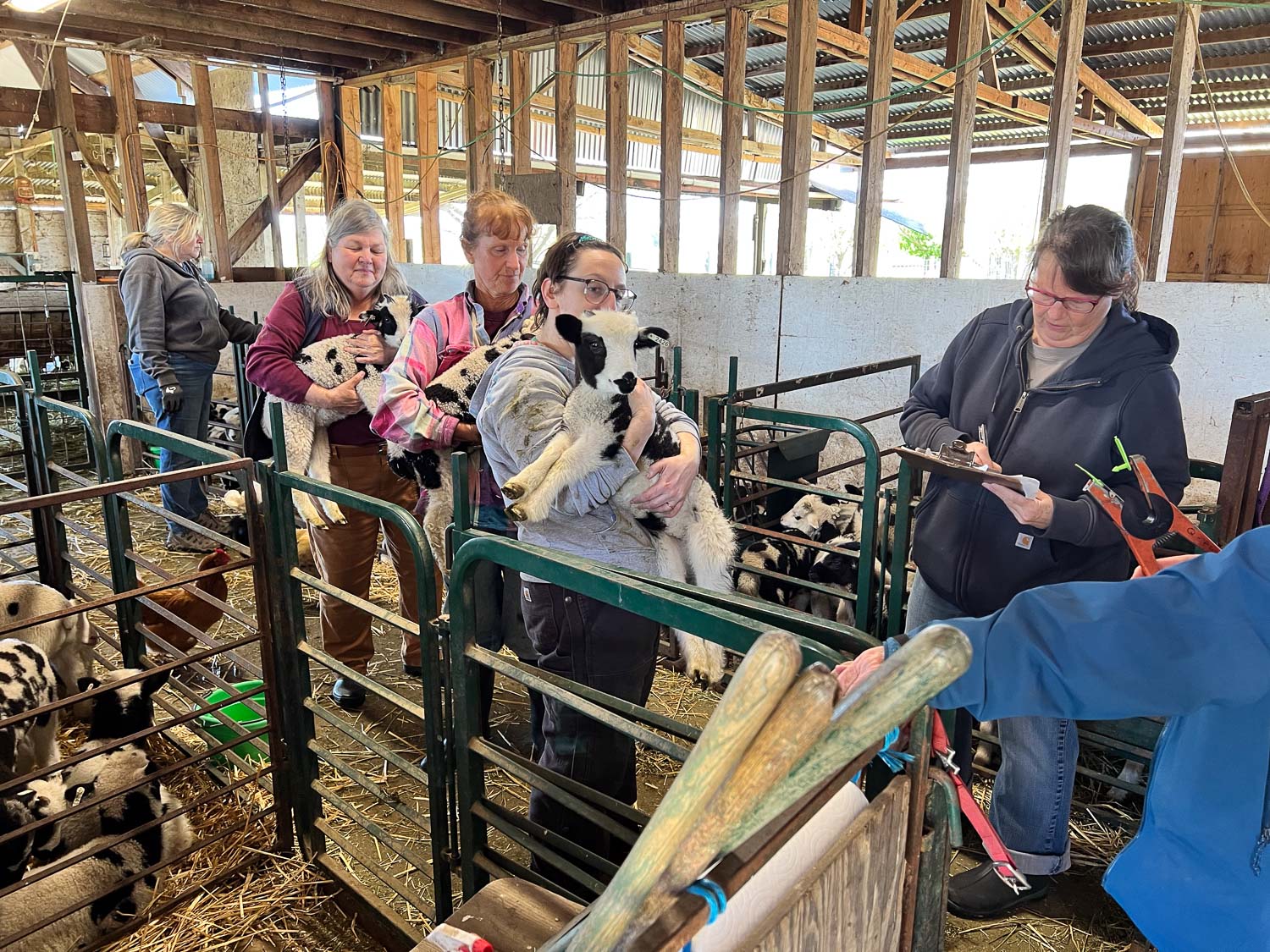
Farm Club members came and, since I was otherwise preoccupied with an overlapping visit by my son and DIL and Matt’s offer to help me with some loom/computer issues, they did all the work of getting the sheep organized and in pens, ready for the vets.

There were four from UC Davis. I lose track of the titles, but I think one person was an intern and/or student and maybe a couple were in residency. They took turns doing the scans and reading the results, with Dr. Smith overseeing it all.
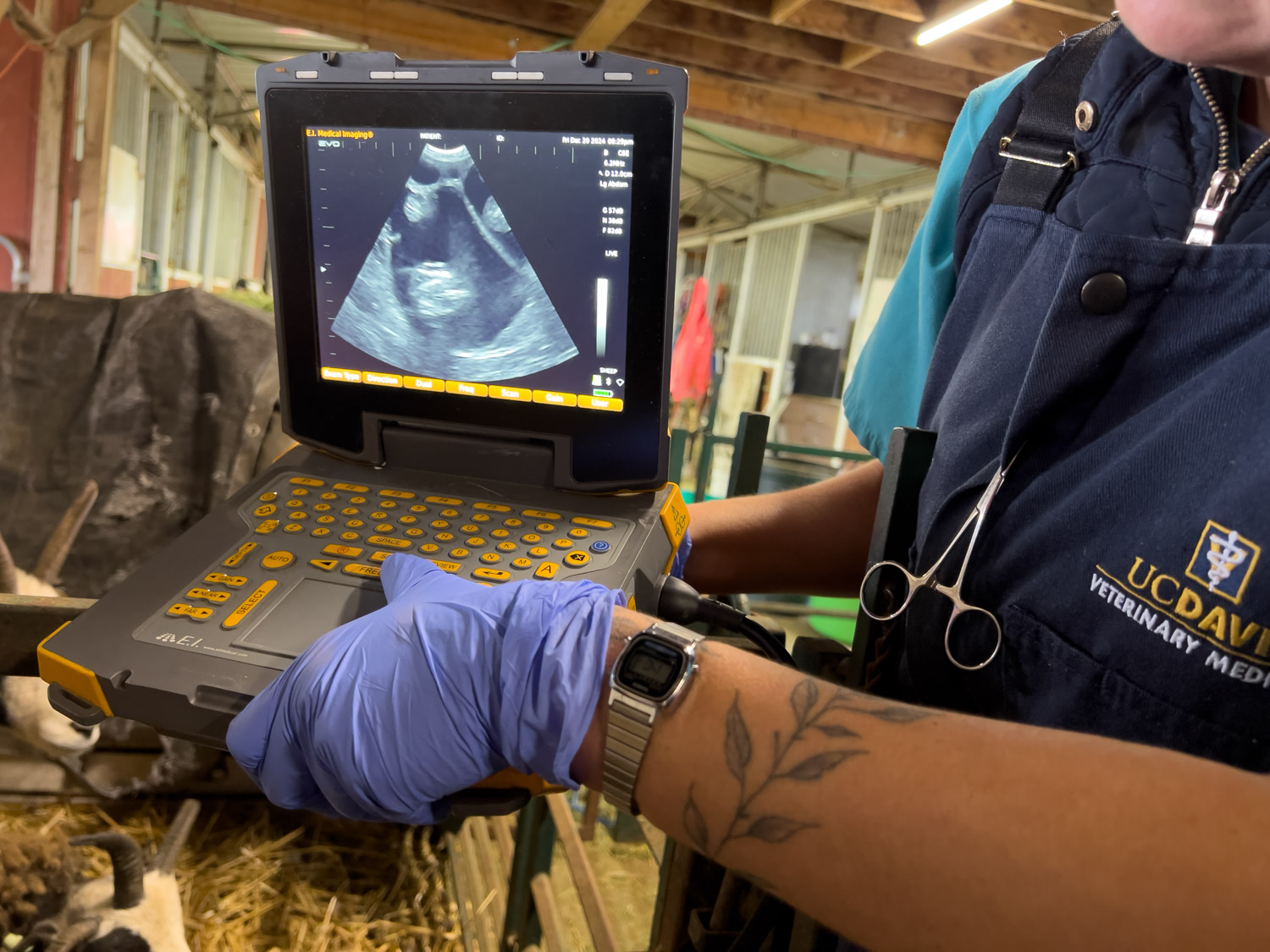
Don’t ask me what we’re seeing. I’m good when I see a ribcage go by as they move the probe around, but I have a hard time with the rest of it unless it’s pointed out. They judge size of the lamb’s head and, therefore, its gestational age. Amount of fluid and relative position of the lambs are other factors they consider.
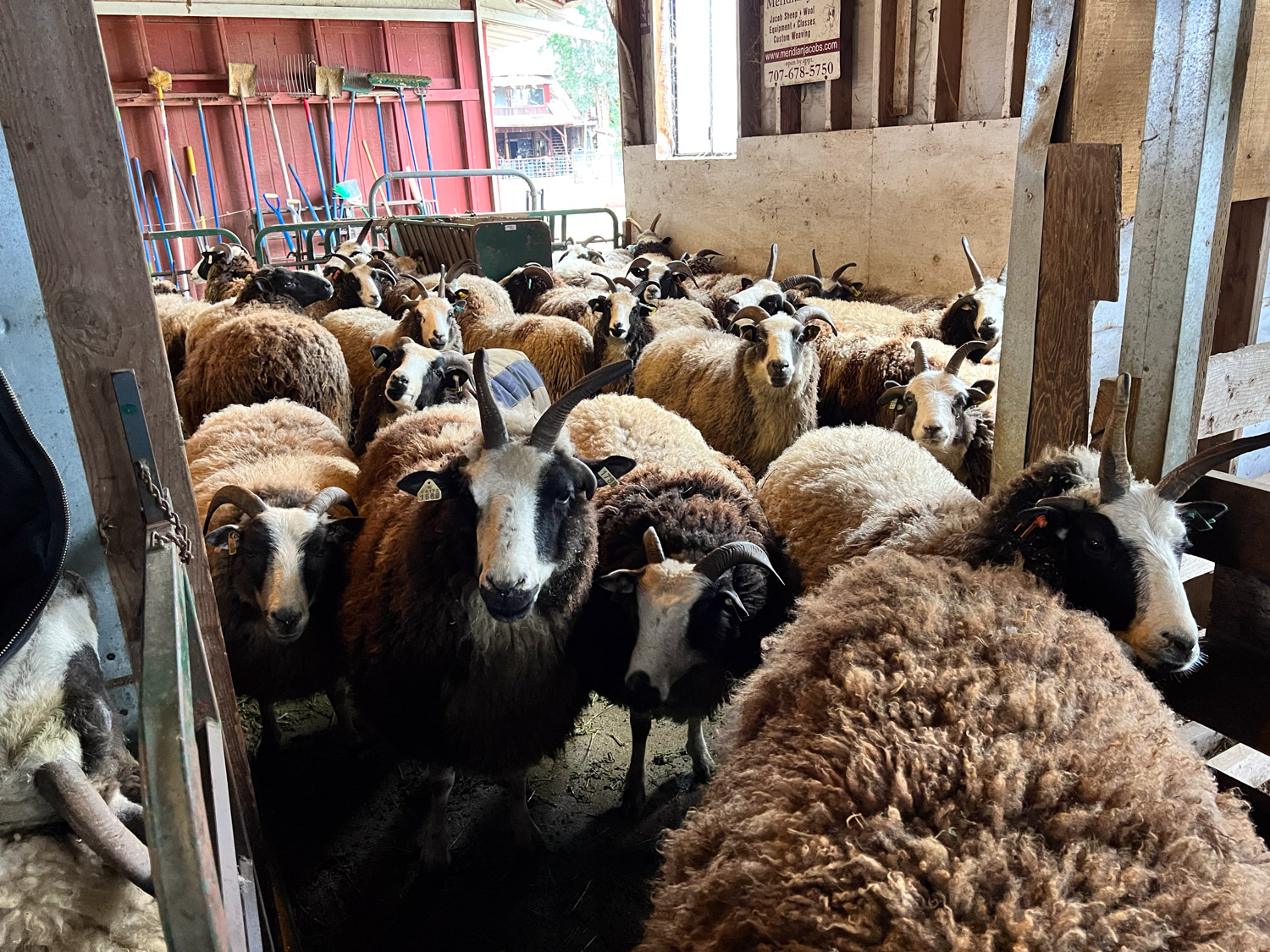
The next group of ewes waiting.
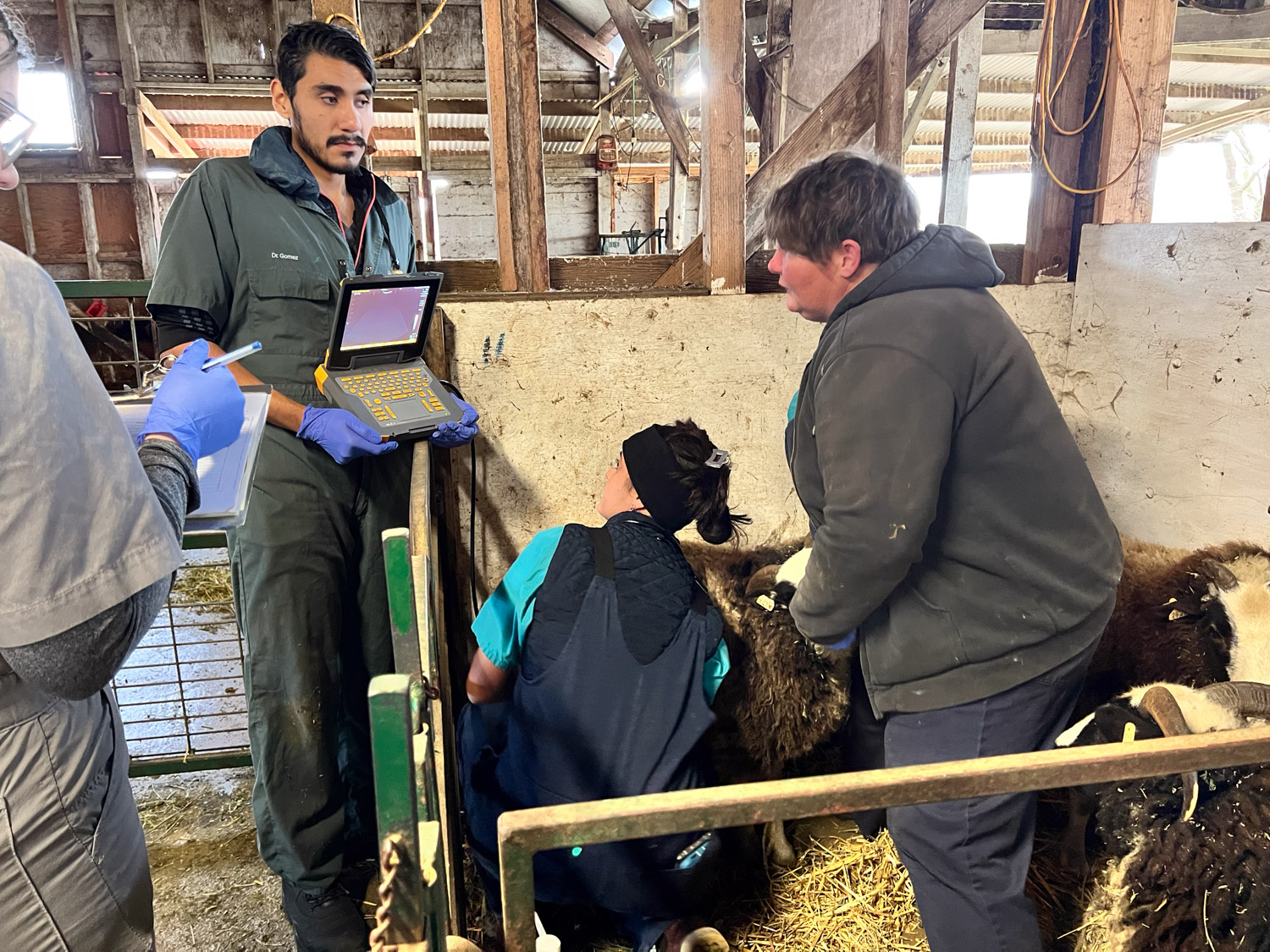
Trading places in scanning.

Meanwhile, one reason Matt came was to climb the weeping willow and cut a couple of large branches that had broken during the summer. FIY, he is using safety gear to prevent falling in case of slips.

It’s amazing how quickly this tree has grown. Matt cut the problem branches, but then cleaned out a lot more where it overhangs the pasture and the fence.

Back at the barn they are still scanning, but we could used last year’s lambing list on the white board (to be erased at the beginning of the next lambing) to pick out which ewes had triplets last year.

Here are the stats:
Fetuses counted: 51
Sets of triplets: 2
Sets of twins: 17
Singles: 5
Sets of 2+ (twins, but not ruling out a 3rd): 3
Ewes pregnant: 27
Ewes open who were with a ram: 3
Ewes maybe pregnant, bred late by Eli: 4
Ewes not with.a ram: 7
Ewe lambs not bred: 8

Stay tuned for March 9, the first due date based on when I put rams in with ewes.

Using the Whole Sheep – Sheepskins

I started raising sheep because I wanted to produce wool. For me lamb meat (Gourmet Lamb on my website) is a by-product of my wool and fiber business, although for most sheep raisers wool may be the by-product. I make a point to use as much of the sheep as possible. Sheepskins are a major by-product of the lamb business. I thought I’d show what goes into producing a beautiful sheepskin.

I don’t have photos of the process of getting the sheepskin from the sheep. That is not something I should put here, but I will say that the person who harvests the sheep is very fast and does an excellent job of getting the skin off the carcass in good shape. My job is to cut off extra skin that came from the legs and salt the pelts as soon as possible to prevent them from decaying.

I ran into trouble this year getting the right salt. You need to use fine salt to cover the most surface area. The one on the left is what I usually use, but it was out of stock for part of the summer. You’d think that the one on the right would be OK since it’s labeled “fine”, however it is not nearly as fine as the “solar mixing salt”.

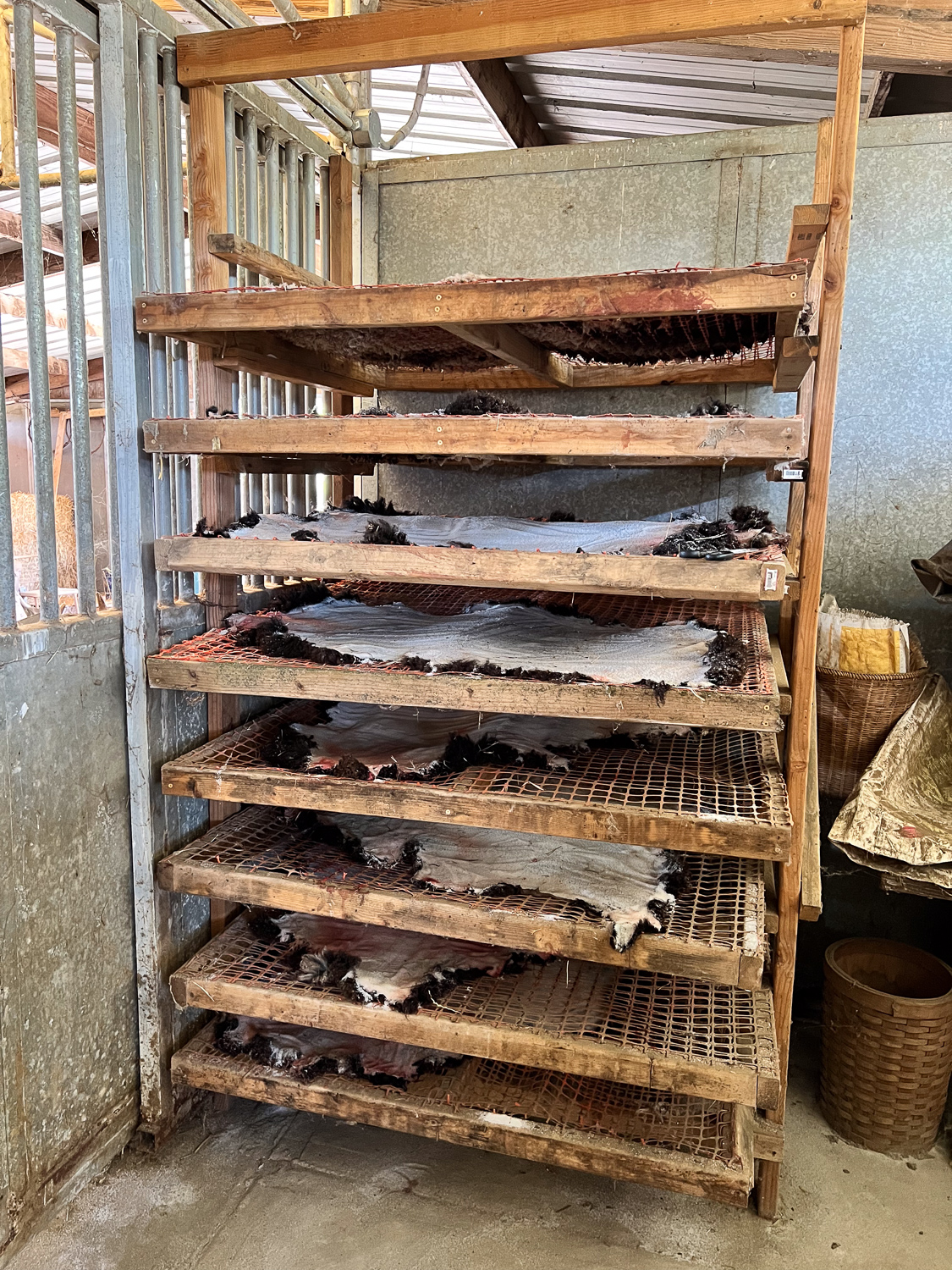
Dan built this rack a couple of years ago so the hides won’t take up as much room as if they were spread out. I have covered hide with a layer of salt, making sure that all parts of the hide are covered.

Even though I had the rack I had to spread some hides on pallets when there were too many to fit. It the middle of the summer they dry enough within a week to move to a stack. If the weather changes and there is moisture in the air sometimes the pelts still feel damp.

You’re not supposed to dry the pelts in the sun, but I after the initial drying and before shipping I may spread them out for a few hours. After the salt has done its job of drawing the moisture out of the skin it sometimes draws moisture from the air and I don’t want there to be extra moisture when I ship them to the tannery.

I flipped them over and dried both sides.

A stack of pelts. The next job is to find an adequate box. I sold a couple of looms this year and still had the boxes. I’m trying to remember now if I was able to fit ten pelts in a loom box.

I take photos of the hides before boxing them. With the two tanneries I am using now I don’t think I have to worry about this step. Over the last few years I have tried three other tanneries. One is now out of business. One is all the way across the country and takes a longer time. The other (in California) sent hides back that were definitely not mine. That’s what prompted me to start taking photos before shipping.

I am satisfied now with the two tanneries I will continue to use. Driftless Tannery is in Wisconsin. Living Sky is in Idaho and last year I was able to deliver hides when I visited my son and DIL in Boise. This year I shipped them all. Both tanneries use mimosa bark for their tanning process. This is a more environmentally friendly alternative than methods that some tanneries use. I also like the resulting leather–it is flexible, yet sturdy.

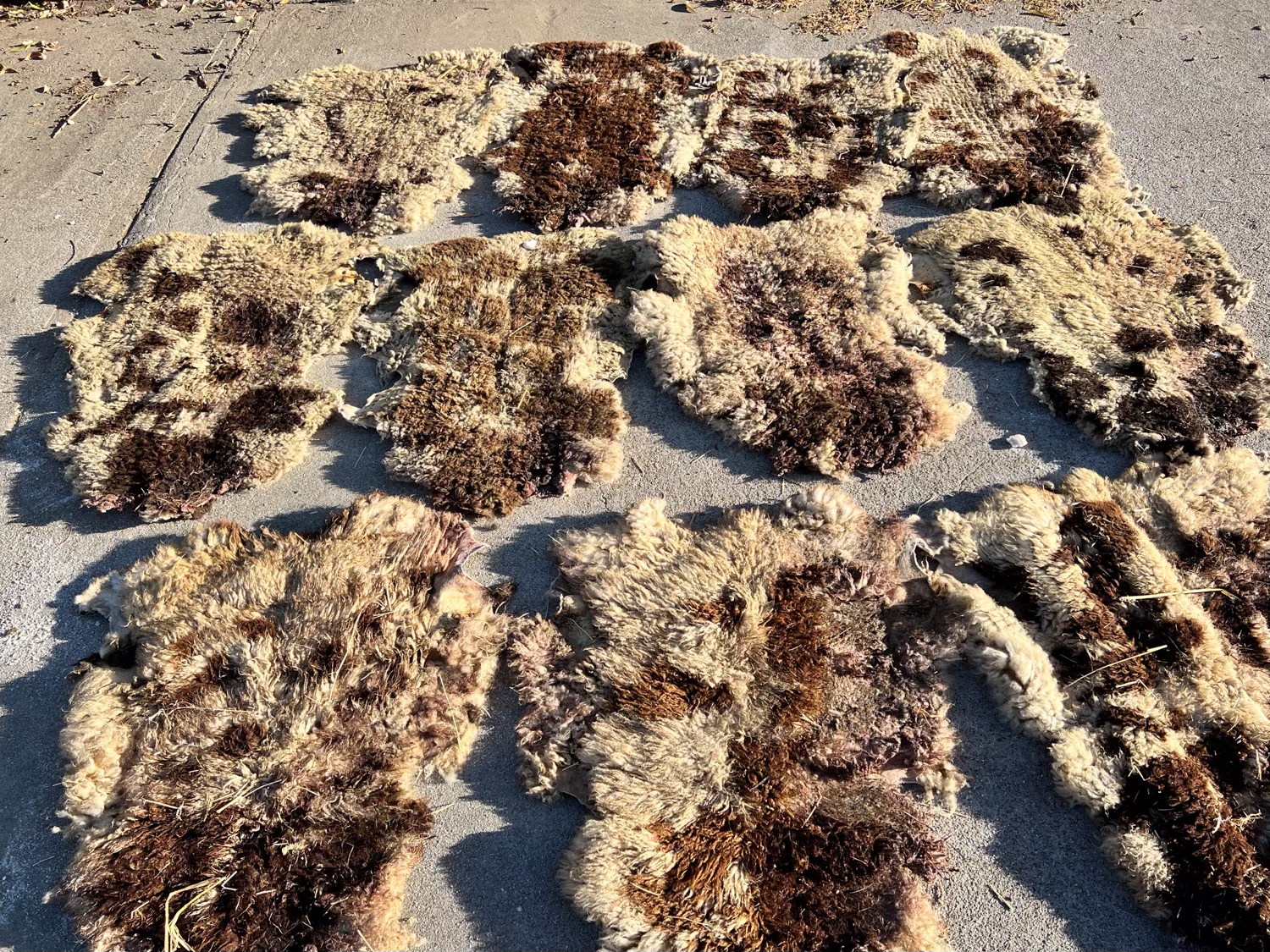
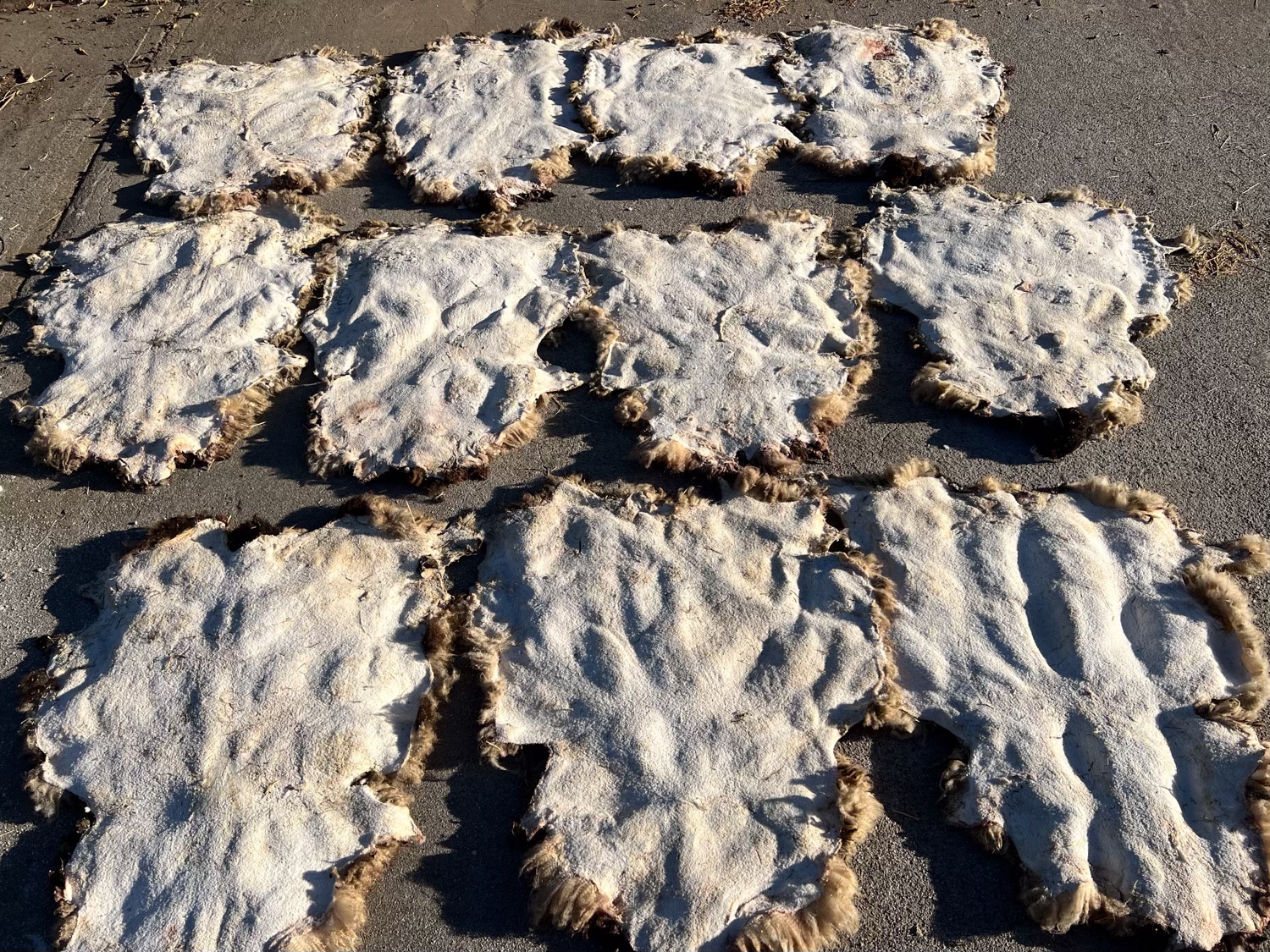
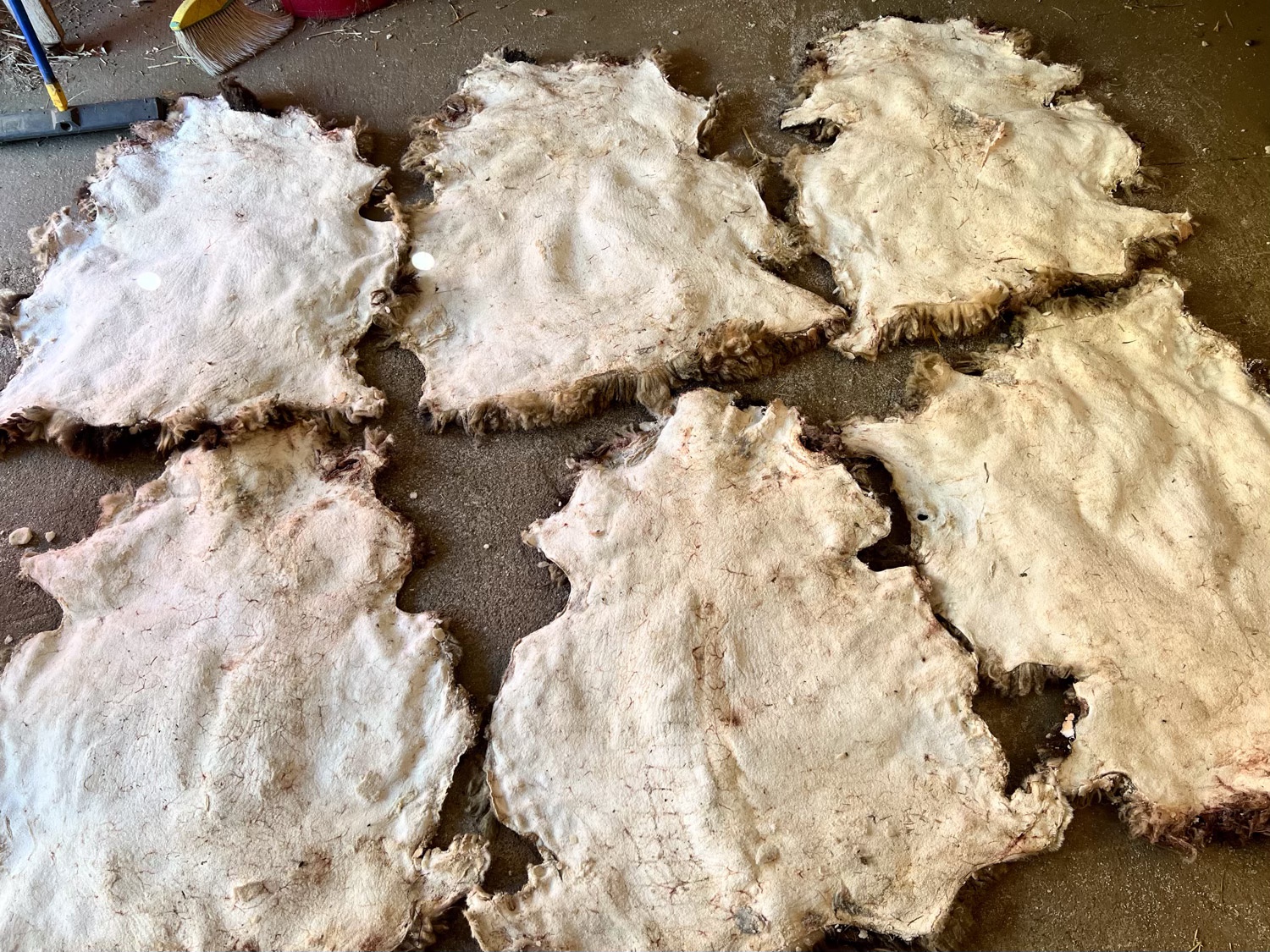
I have photos of the front and back of each hide. People ask me how the hides are tanned. My answer is that it is magic. The photos don’t show how bad these hides look when I ship them. They are stiff and the wool is dirty, including hay, grass, and blood. The tanneries work magic and the hides are returned clean and fluffy.

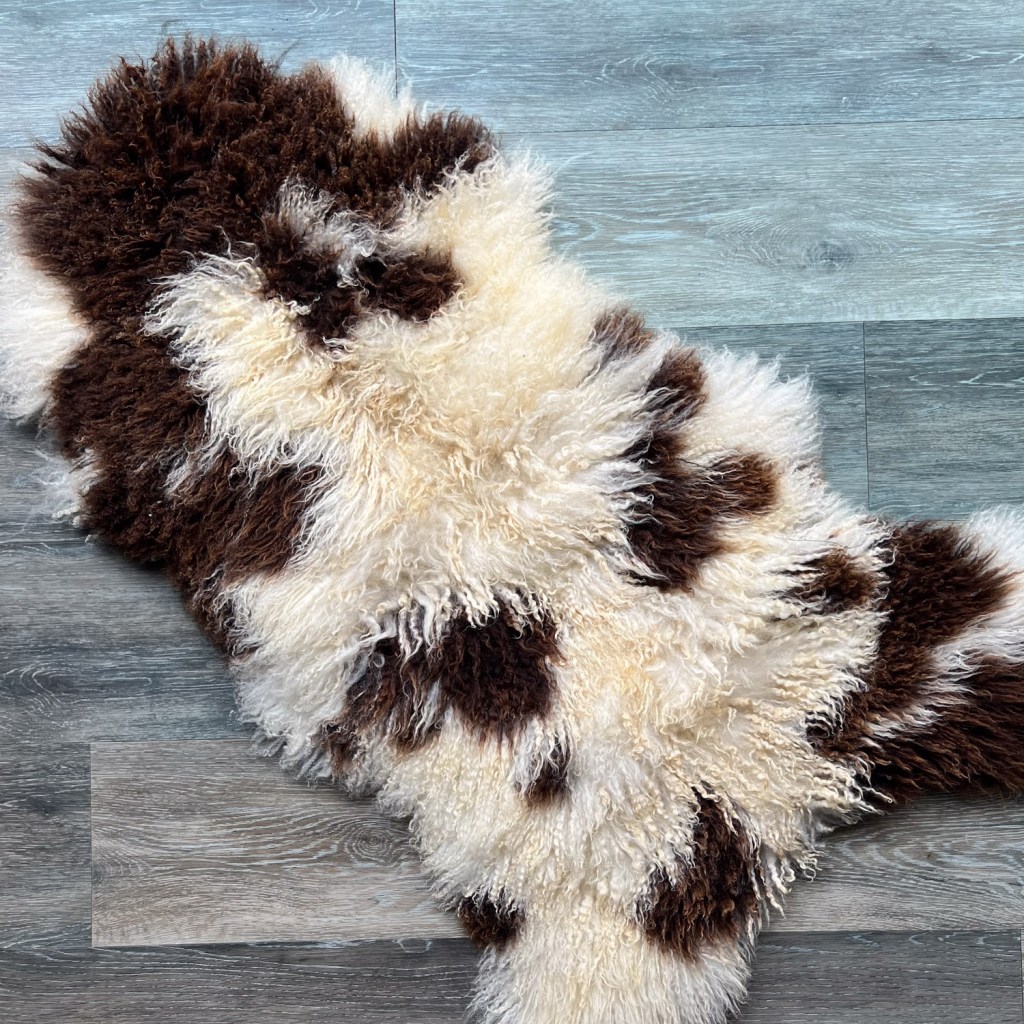
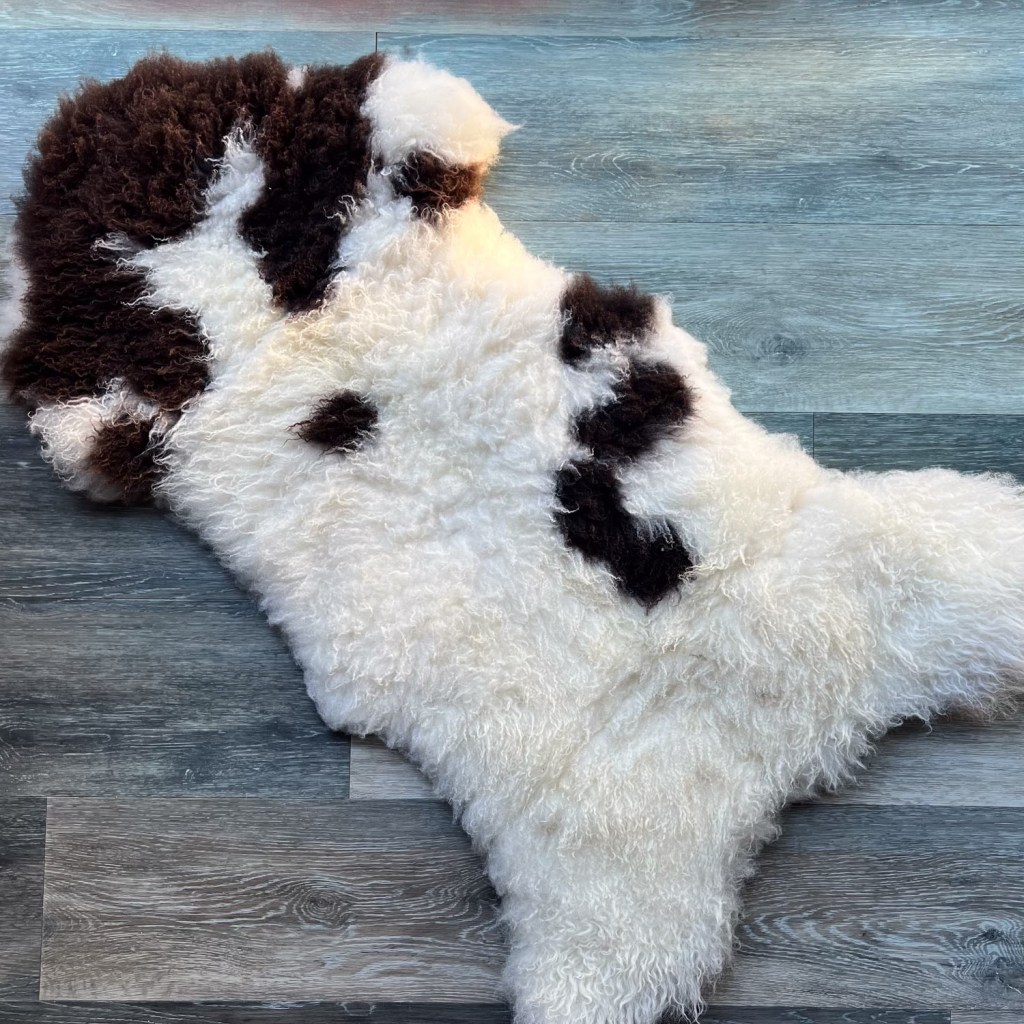
I went through my photos and found some that I could match up with the finished sheepskins.

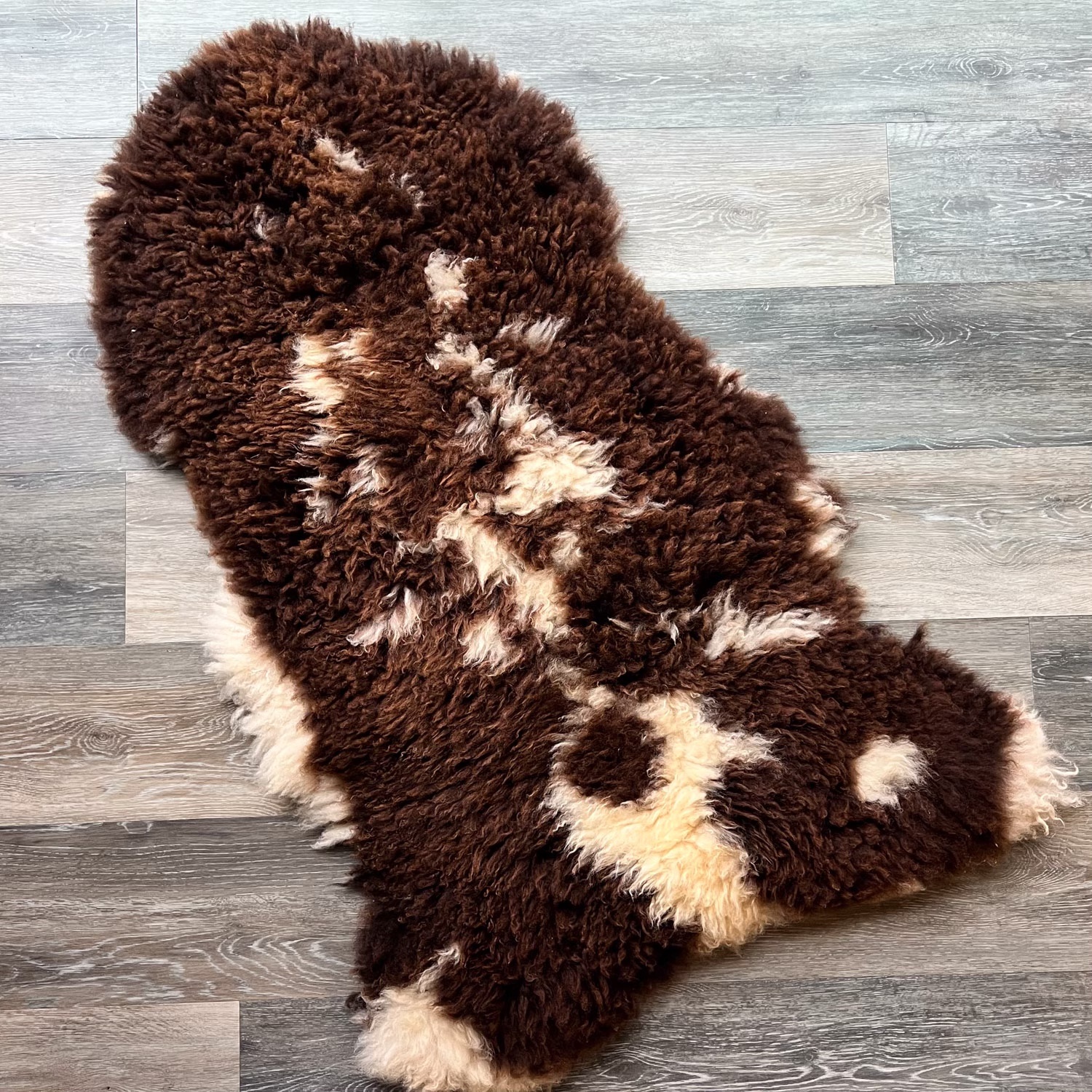
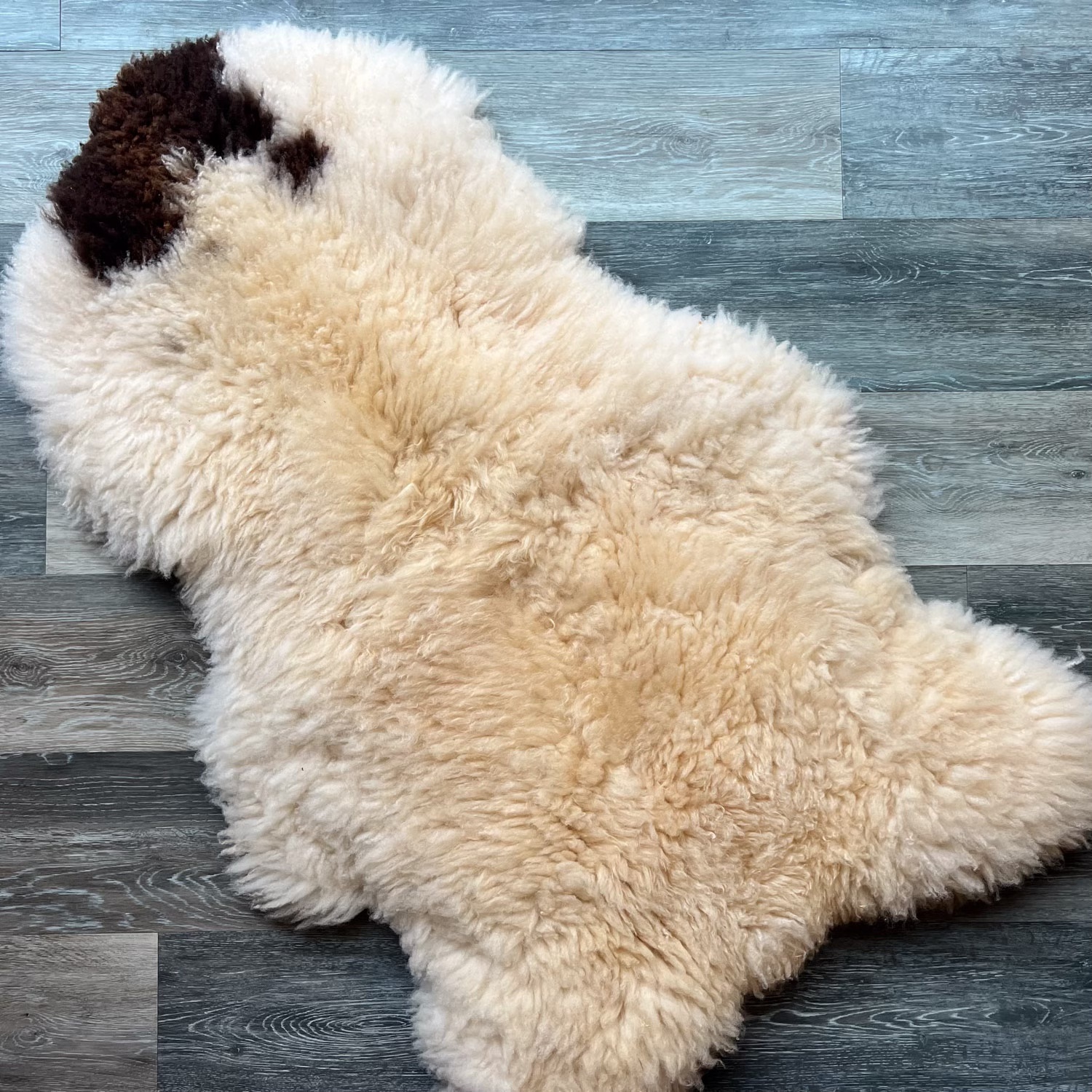
These are three of the hides that came back from Idaho. Can you match the first two up to the photo above? The middle sheepskin is the one on the top right in the photo above. I think the sheepskin on the left is the one in the lower left of the photo with six. Magic!

This is from the batch I sent to Wisconsin.

The sheepskin on the left is the middle one on the bottom row in the photo above. The middle sheepskin is middle, top row above. The one on the right is in the lower left corner above. More magic!

When I get the sheepskins back I need to measure and photograph each one so I can put them on the website. See this page for all that I have listed.

Lambtown 2024 – Part 2

The entrance to Lambtown.

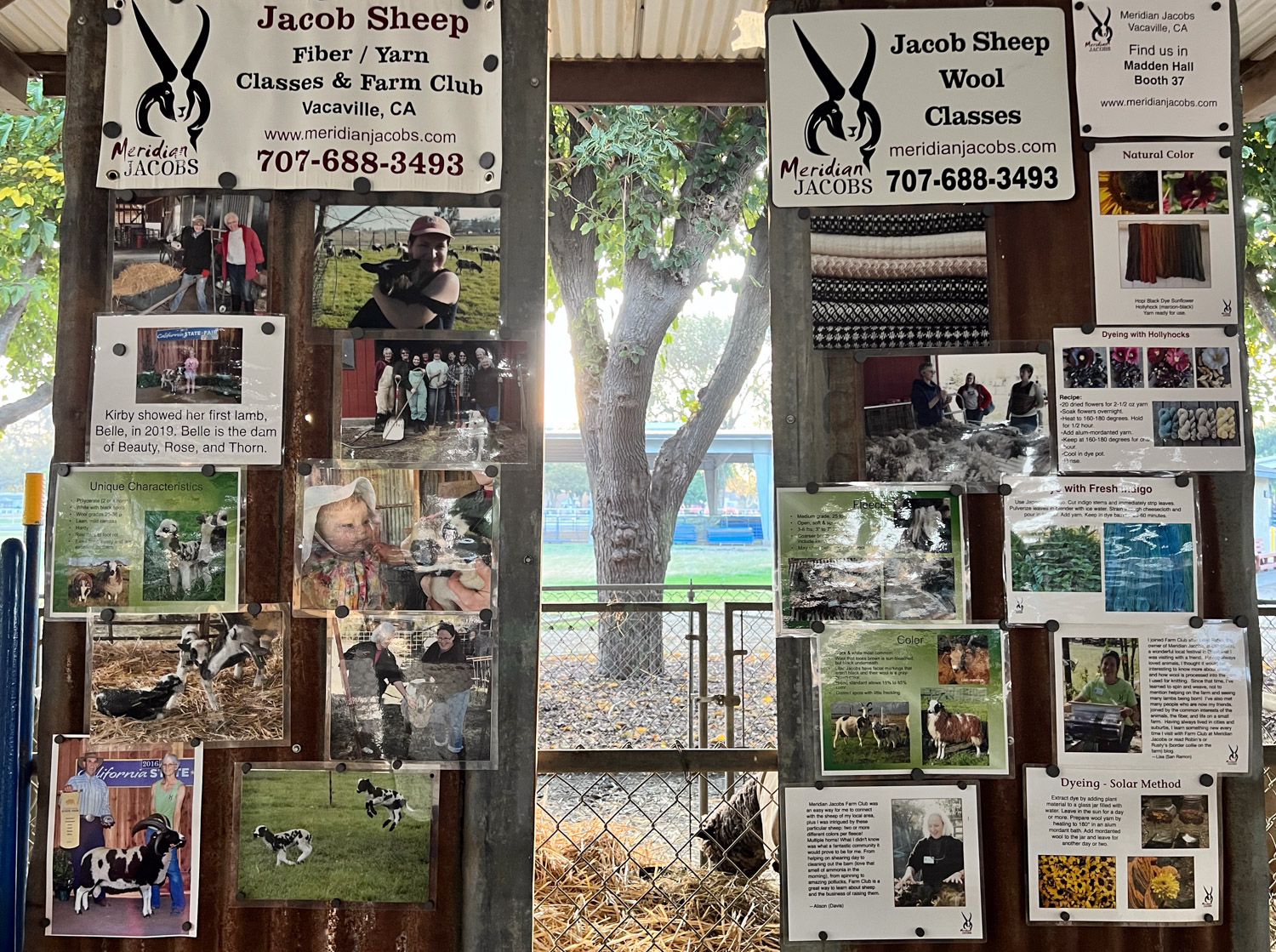
I went early on Saturday and Sunday to feed sheep. This is the display that Farm Club members put together for the barn.

The ram, Blizzard, started out in a different pen but he and the ram lambs were fighting through the fence during the night. Dan and Farm Club members switched pens for him and a couple of ewes so there wasn’t direct contact with the other rams.

Walking back to the vendor building I stopped at Woolly Adventures. This is quite an undertaking, but Gynna does a fabulous job.

There are over a dozen different activities for kids here. ..

…and she thinks up more each year.

I labeled more naturally dyed yarn Saturday night and had it at the booth on Sunday..

The sheep show was on Sunday. I had to be in the vendor hall so Farm Club members handled all the show details. Marina, Beth, Reba, and Nicki showed most of the sheep.

Dan helped out with the yearling ram.

Sheep show--sheep in the show ring.

Thanks to Deborah and Nicki for the photos of the sheep show.

Thanks to Doris for recording the show and the judge’s comments so I could watch it later at home! The sheep show didn’t end until after 4 when the vendor hall closed. Friends and I took the booth down quickly. Dan loaded sheep and drove them home. Then he came back with the other trailer for the booth.

He walked in with this new dolly with a note that said Happy Birthday (early for my November birthday)

All these years I have carried these grids in and out of buildings two at a time. Now it will be easier.

Lambtown 2024 – Part 1

Lambtown is our local fiber festival–only 15 minutes from my farm. After a very different beginning many years ago (but that would be another story) it is now a full-fledged fiber show complete with sheep, sheepdogs, contests, classes, vendors, demonstrations, and other activities. It is the first weekend of October, but starts on Thursday with classes. If I am going to teach it has to be on Thursday because I set up a vendor booth on Friday and am in the booth both Saturday and Sunday. This makes for a busy week. I knew I had to have the trailer packed up on Wednesday.

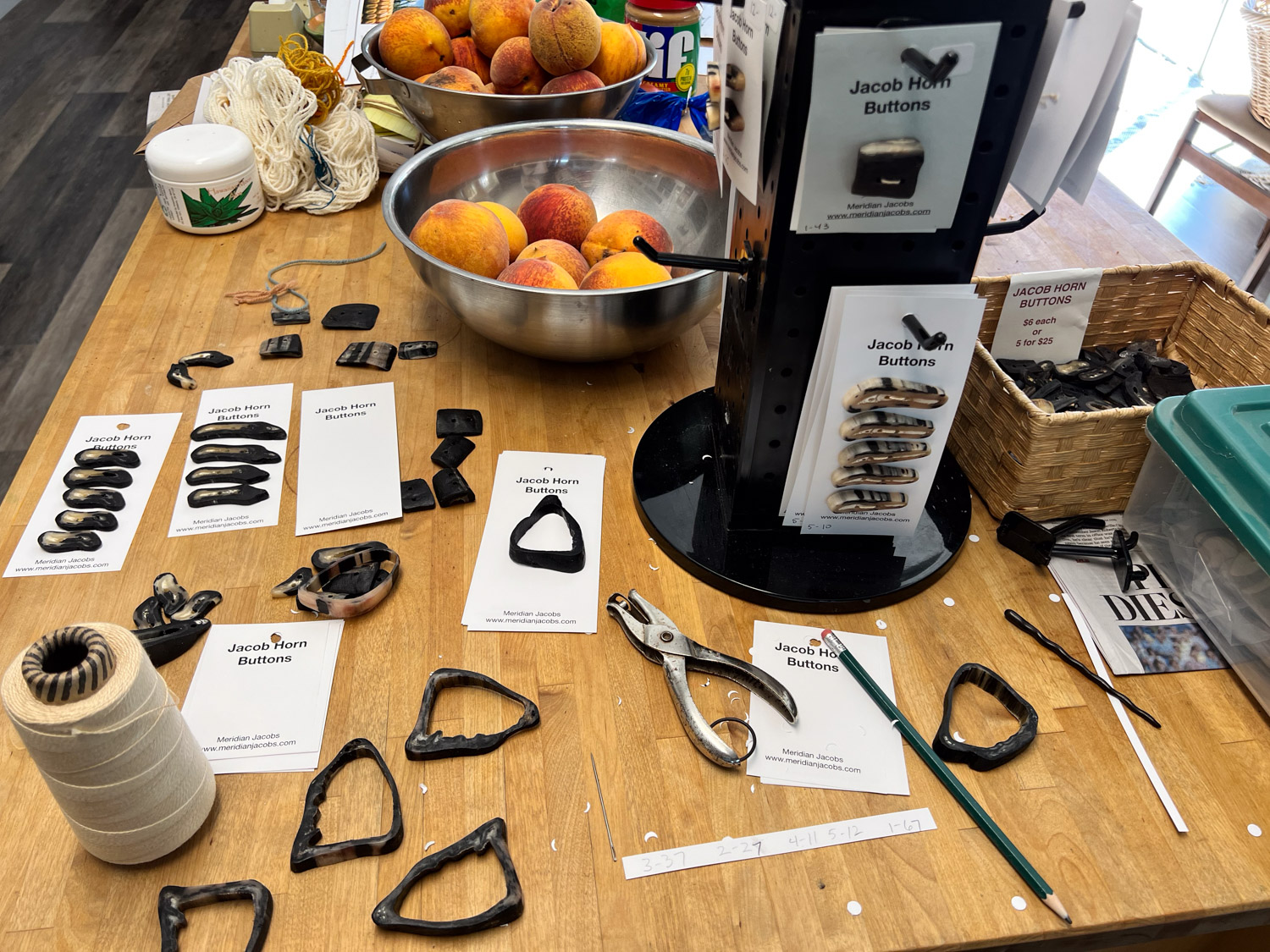
The kitchen island one of the evenings that week. I described making these buttons here. After making them I still have to put them on cards, especially for selling online later.

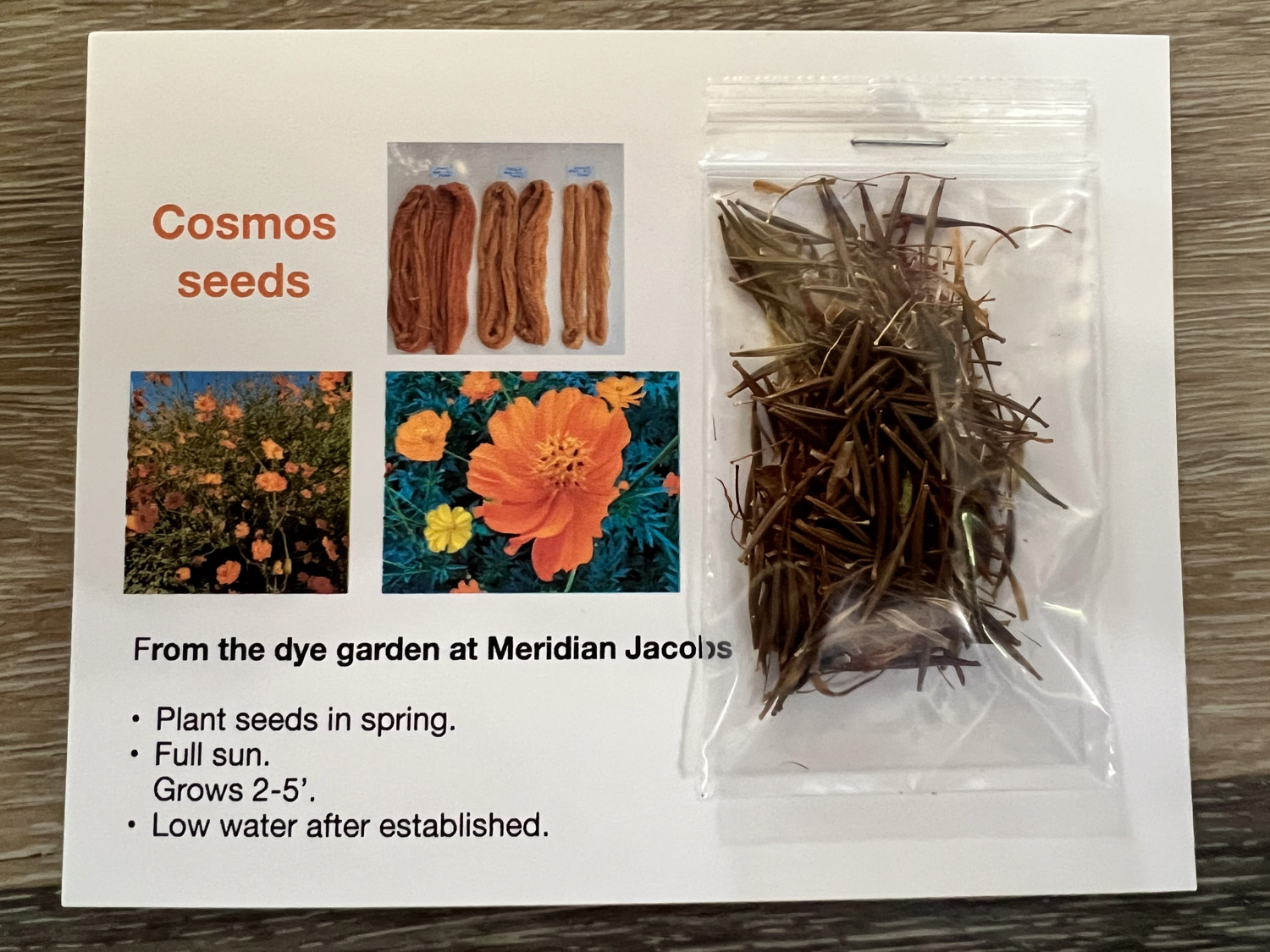
A friend thought that I should sell cosmos seeds to grow flowers for dyeing and printing, so I worked on that too.

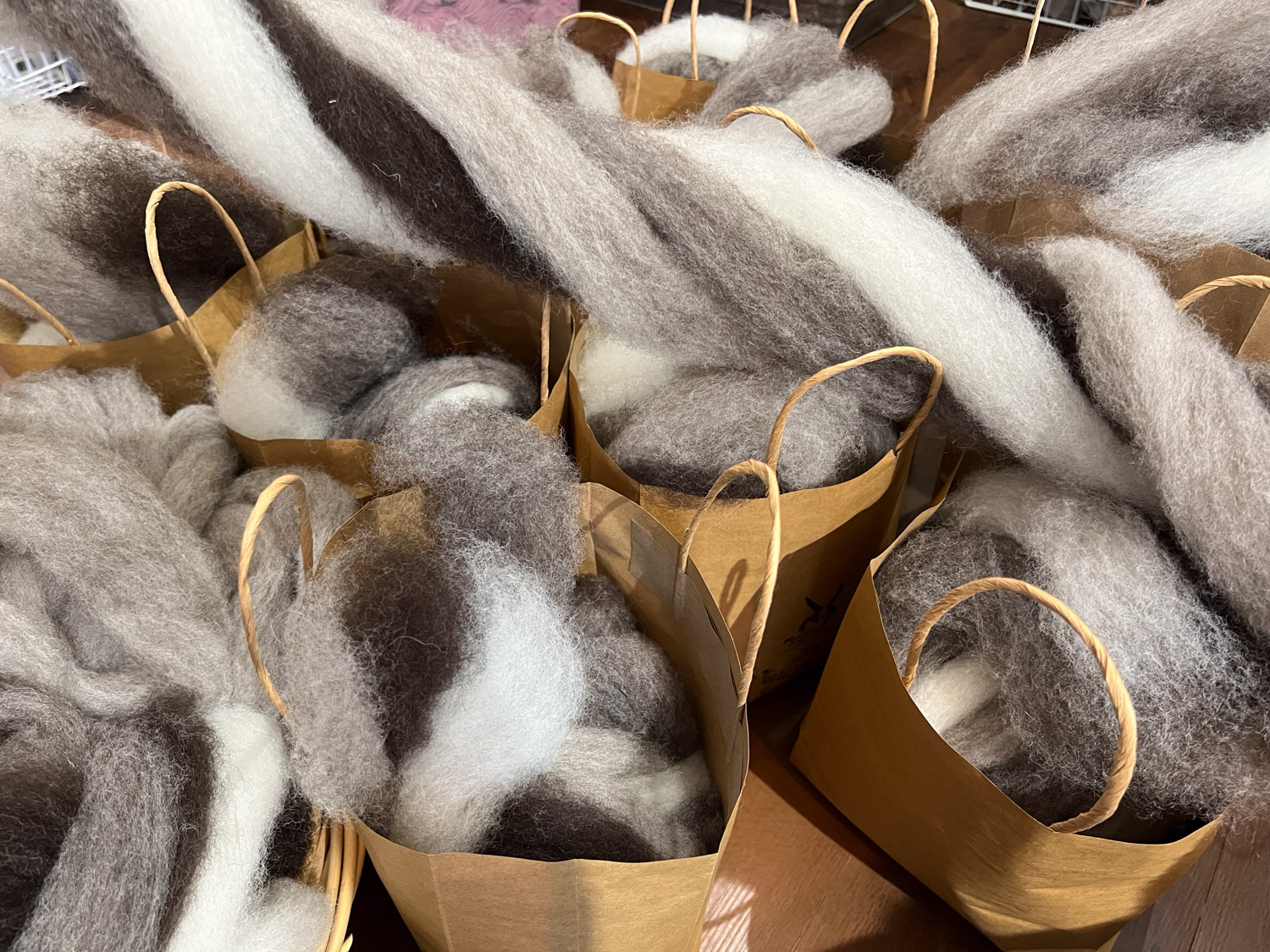
I picked up the 2024 Jacob fiber from the mill on Tuesday and needed to weigh it. Some were single color bags and others are a mix of all four colors.

A few of the shop while I was still trying to decide what to pack up for the show.

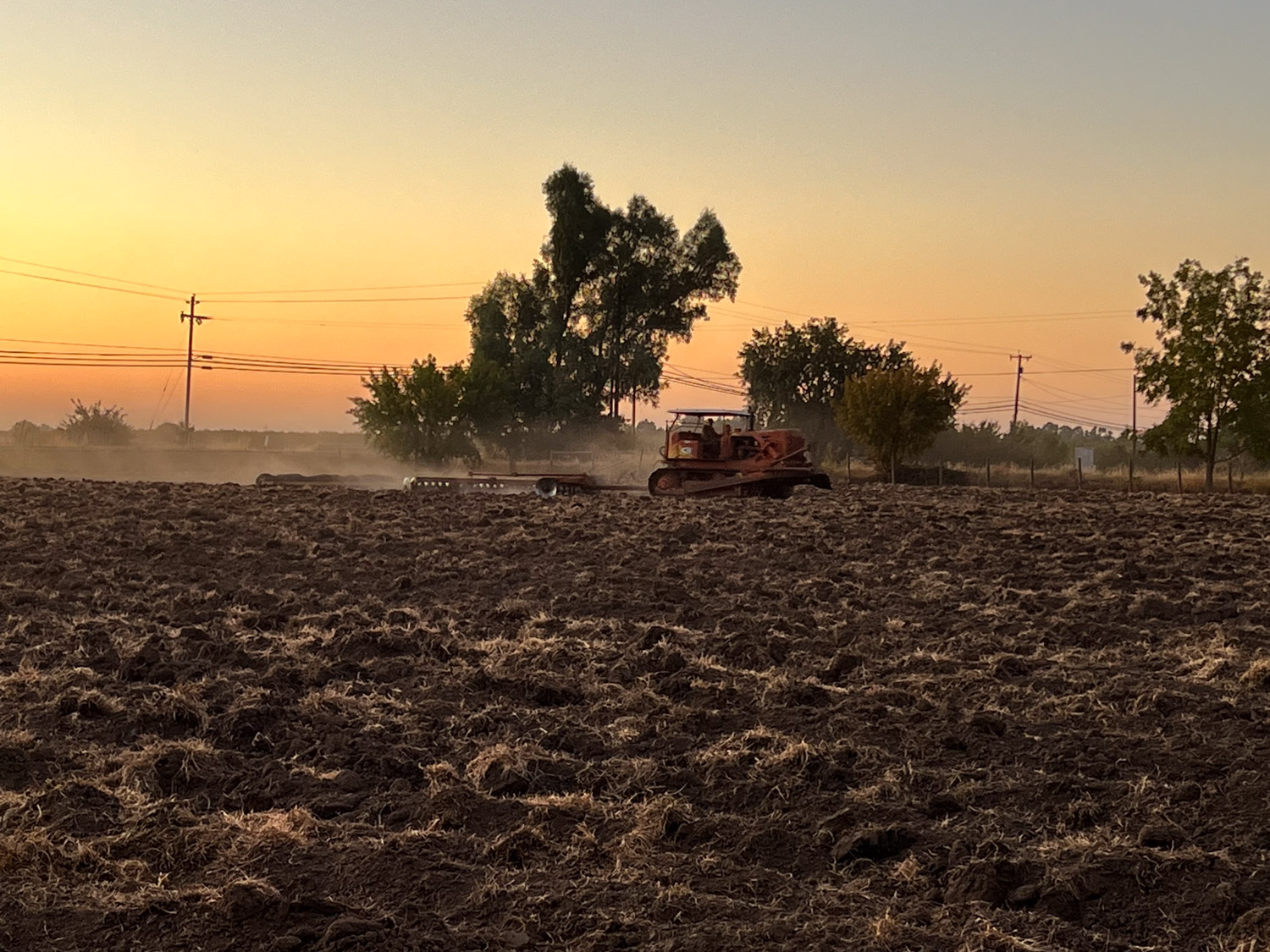
Thursday morning, Brett was at work discing the pasture. That project was described here. We haven’t moved beyond the last discing. Hopefully leveling will happen soon.

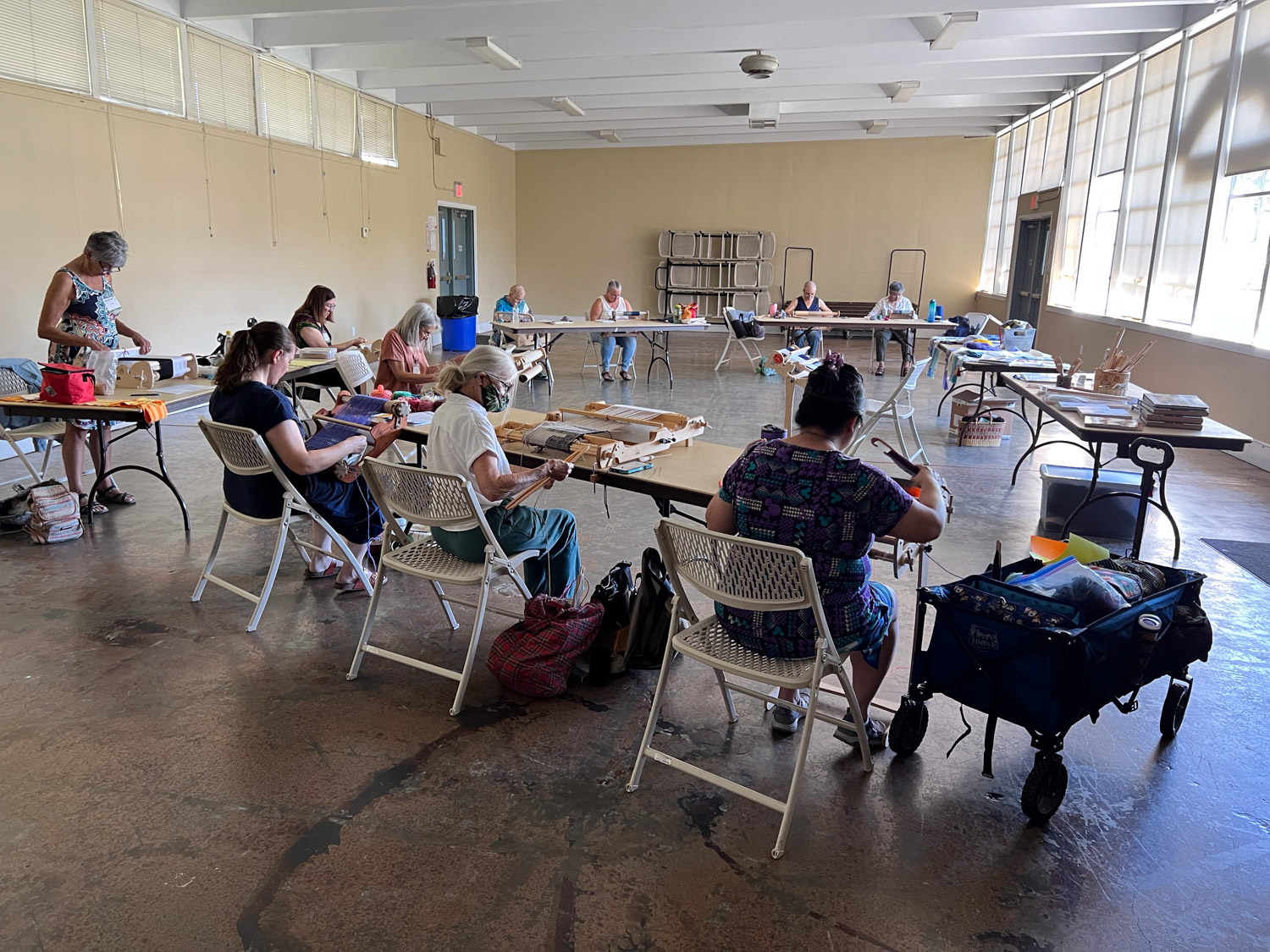
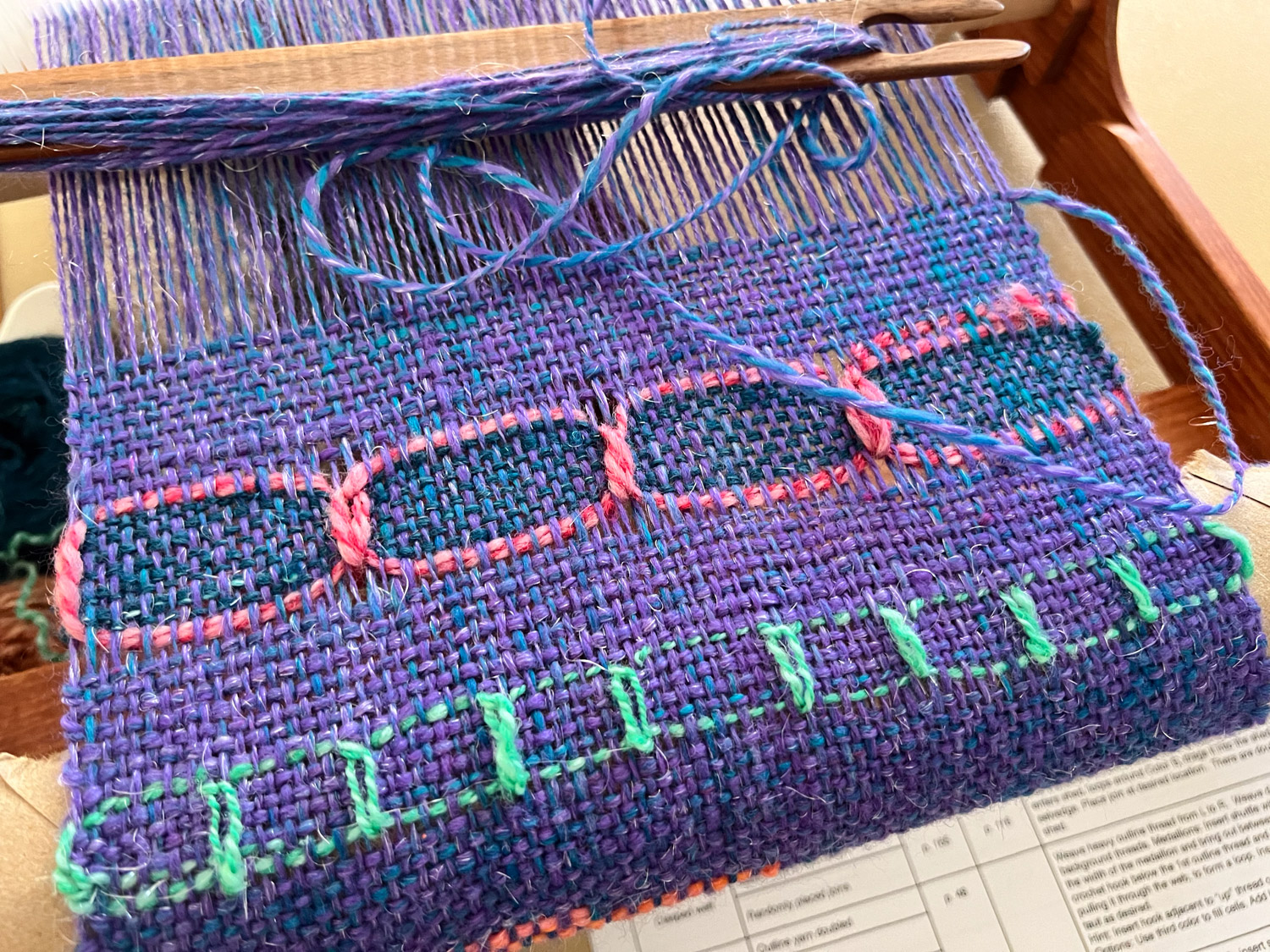
Thursday there were ten students in my “Let’s Get Fancy” class where I showed hand-manipulated techniques for design in weaving.

Danish Medallions.

Brook’s Bouquet, Leno, and Loops.

Friday was a full day as we harvested lambs first. A friend brought her lambs here for one of my customers and I salted the hides. We finished around 11 and went to the fairgrounds by noon.

Here is what the booth looked like by the time I went home.

The other half of the booth. It still needed tweaking, but it was mostly done, thanks to a couple of friends who spent the afternoon helping. We still needed to get the sheep here for the sheep exhibit so I went home to load sheep.

Dan and I drove back with sheep and Farm Club members met to figure out how to best set up a display.

Stay tuned for Part 2.

Using the Whole Sheep – Buttons

Each year many of the lambs produced here end up in someone’s freezer. I wouldn’t be able o breed sheep if there wasn’t a market for these lambs. There were 88 lambs born this year. I selected some to keep, but most are sold to other breeders or for meat. I want to use the WHOLE sheep and buttons are one of the products that I can make.

These are just some of the horns from the latest lambs. I did not photograph the first step because I can’t take a photo while using a Sawzall (just looked that up–a reciprocating saw) and my blog would probably get black-listed if I had a photo of cutting horns off a dead sheep head. The second step is to put the horns in a bucket of water in the sun for a few days. There is a bony core and the living tissue between the bone and the outer horn needs to degrade enough that I can get those horns off.

From Wikipedia: horn is a permanent pointed projection on the head of various animals that consists of a covering of keratin and other proteins surrounding a core of live bone. Horns are distinct from antlers, which are not permanent. 

Look at what you can learn about by reading my blog. I read about horns or horn-like features on a variety of animals from giraffes to triceratops.

I took photos of the button making stages with three horns, but I think that’s too many photos to put in one post. I’ll start with this one which is unusual because it is mostly white.

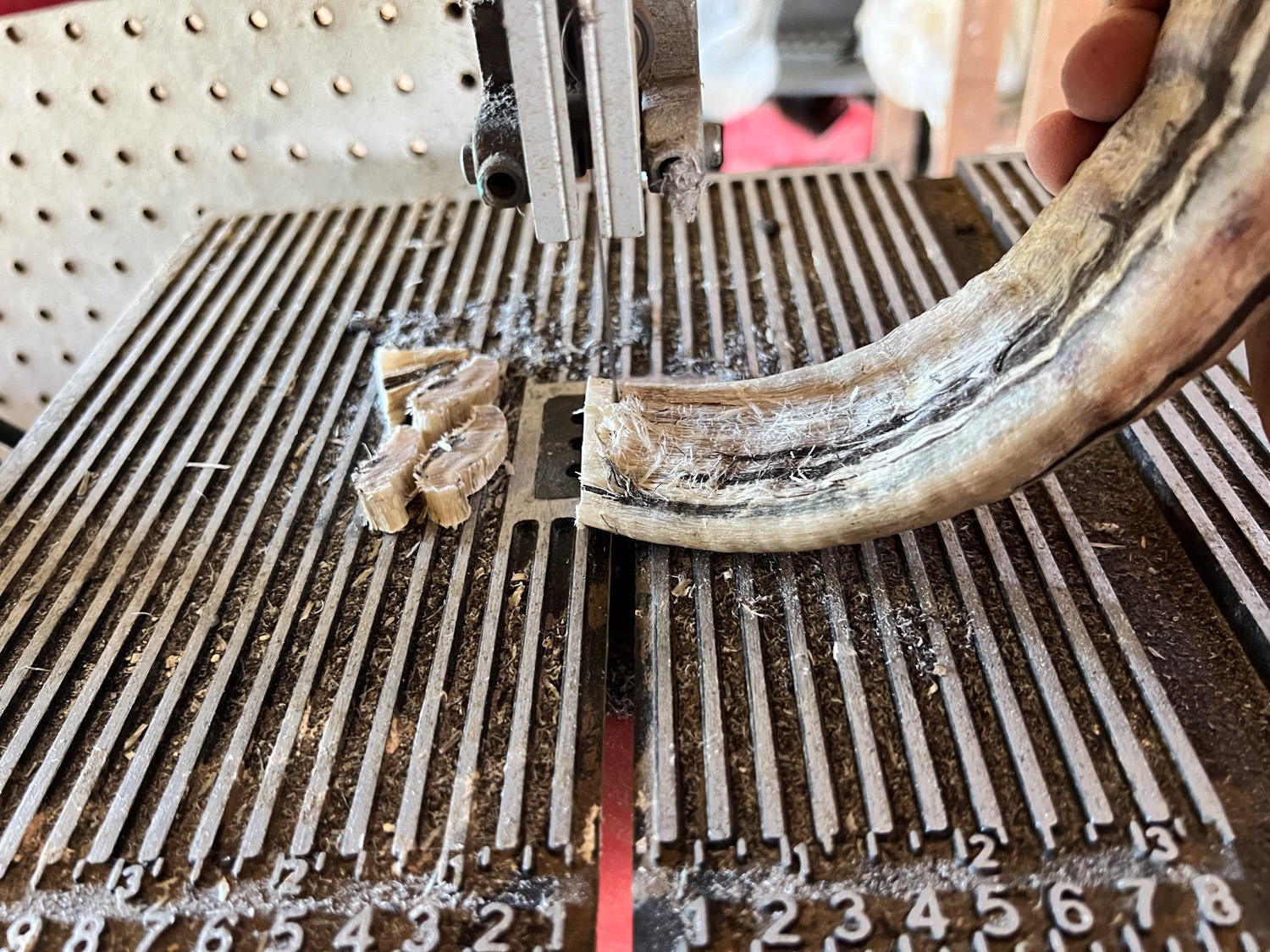
The first step (beyond what I described above) is to cut the horn into button shapes. I use a band saw.

The solid core makes buttons of interesting shapes. most people think of horns as round but you can see that the shape of these horns are anything but round.

Here are all the pieces I cut from that horn. The squarish shapes come from the hollow part of the horn that surrounded the core. I often try to make a few pieces that can be used with a shawl pin. I was told that I could call it an annular although that usually refers to a medieval brooch with a pin attached.

The next step is drilling holes, another step that is difficult to photograph while in progress.

All pieces after drilling the holes.

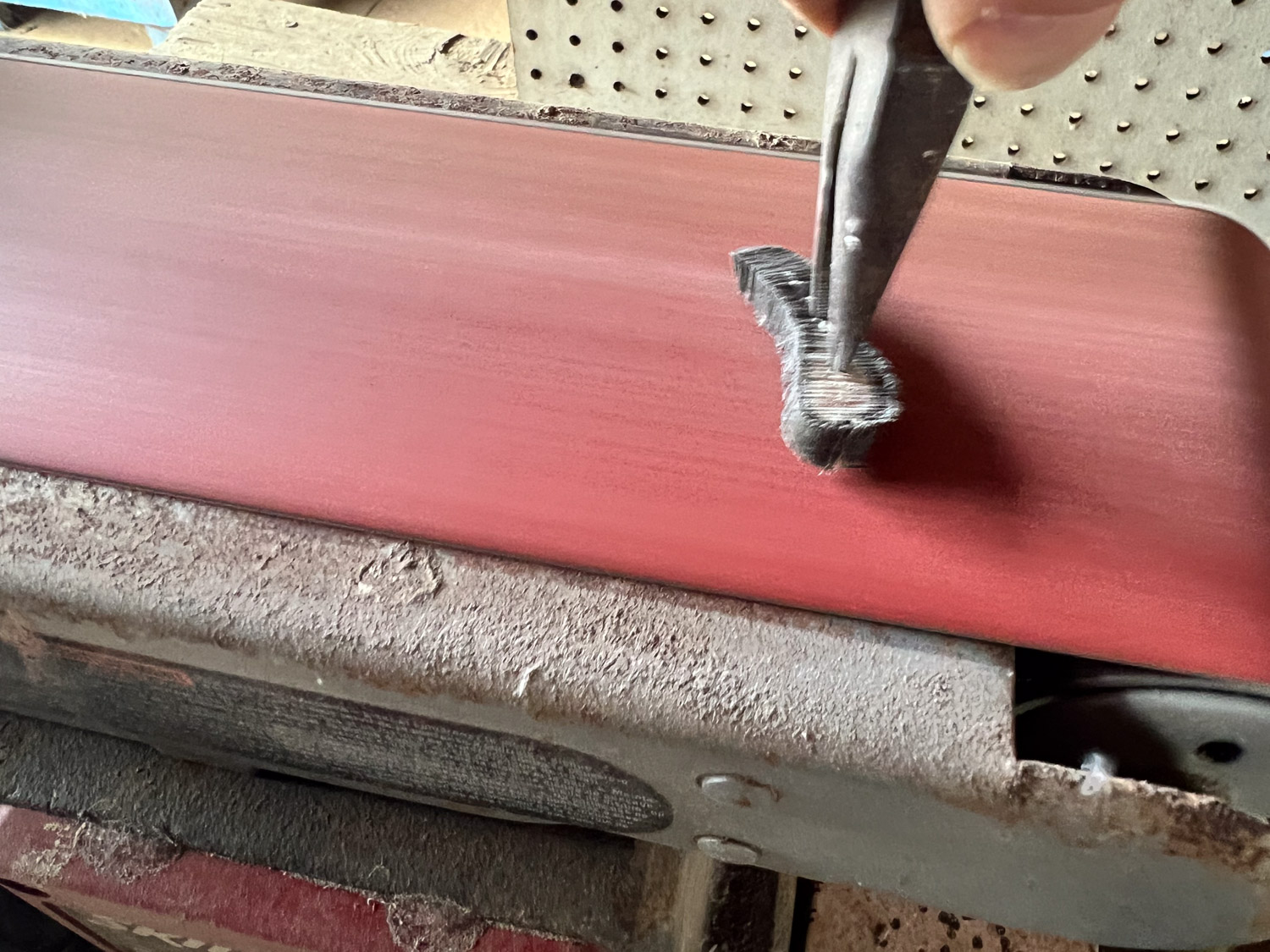
Then I move on to sanding using a belt sander. This is the step that takes me the longest. It’s difficult to get to all the edges.

I can’t use the pliers for all of it and I have been known to come away with nicely (completely) sanded fingernails.

Here are all the buttons from that one horn after sanding.

I have figured out the best way for me to apply a lacquer finish. I can put the buttons on wires that I dip in the lacquer and then I put poke the wires into styrofoam packing material saved from purchased items. These are the buttons made from three horns.

Throughout the process II keep track of the buttons that are from the solid part of the horns so I can match the up for sale. If I plan to sell buttons online I need to be able to identify individual buttons and sets. So the last step is to attach them to cards I have printed.

These buttons are not on the website yet because I’m going to wait until after Lambtown and post those that haven’t sold.

Black Sheep Gathering 2024

I’m already on my next adventure, but need to catch up with the last one. After the quick trip to Idaho I decided against going to Black Sheep Gathering in Oregon the following weekend. I had not planned to take sheep this year and had not entered wool, fiber arts, etc. But half way through the week I changed my mind. Without entering any shows I didn’t have to be gone as many days, so I left Friday morning. I will admit that two hours into the drive I thought about turning around and coming home because I had so much to do at home before the next event (where I am now). However I had told a friend in Oregon that I’d visit along the way, so I kept going.

Here is where I stayed the three nights I was there. As I set up my tent I realized that I think I’ve had this tent and my sleeping bag since my college days or shortly after.

I took very few photos in the barn, but here is one–a Valais Blacknose. There was a new Jacob breeder there and I helped her show. Because she was the only person with Jacob sheep she had to show in the All Other Breeds class, as I did last year. Maybe I’ll enter again next year and we’ll have a Jacob show.

I took a few photos in the exhibit and vendor hall. These are the main award winners in the Fiber Arts Show.

I spent a lot of time with a few vendors and tried to make time to see the rest.

I met this vendor last year at this event. She lives in Sacramento and I encouraged her to sell at Lambtown last fall. Her booth was next to mine. Even though I specialize in locally grown wool, including my own, I was intrigued by her yarns, many of which are not natural fibers and are certainly not local. But they sure are fun! The larger skeins are all lengths of yarns that are tied together. I had bought a few of these crazy mixed fiber skeins and brought the scarf I had just finished to show how I had used the yarns. I plan to create a class using this idea.

I spent time with one other vendor, business name of Shuttle Creek. Annie is a weaver and was working on a loom in her booth, She sells her mostly cotton garments at local shows I think. I just looked at the website and there are some gorgeous items there but blog and Facebook activity seem to stop in 2021 and I was thinking that she said she doesn’t do much online. Anyway, after talking to her a long time she pulled this piece off a hangar and put on me. I bought it and that’s what wore all day at the weaving event where I’m teaching (next post). I need a button that “no, I didn’t weave it”.

I spent part of the day at the vendor hall, helped the other Jacob breeder show sheep, visited with friends (most of whom are from California), and watched Spinners’ Lead. I packed up fairly early on Sunday and started home.

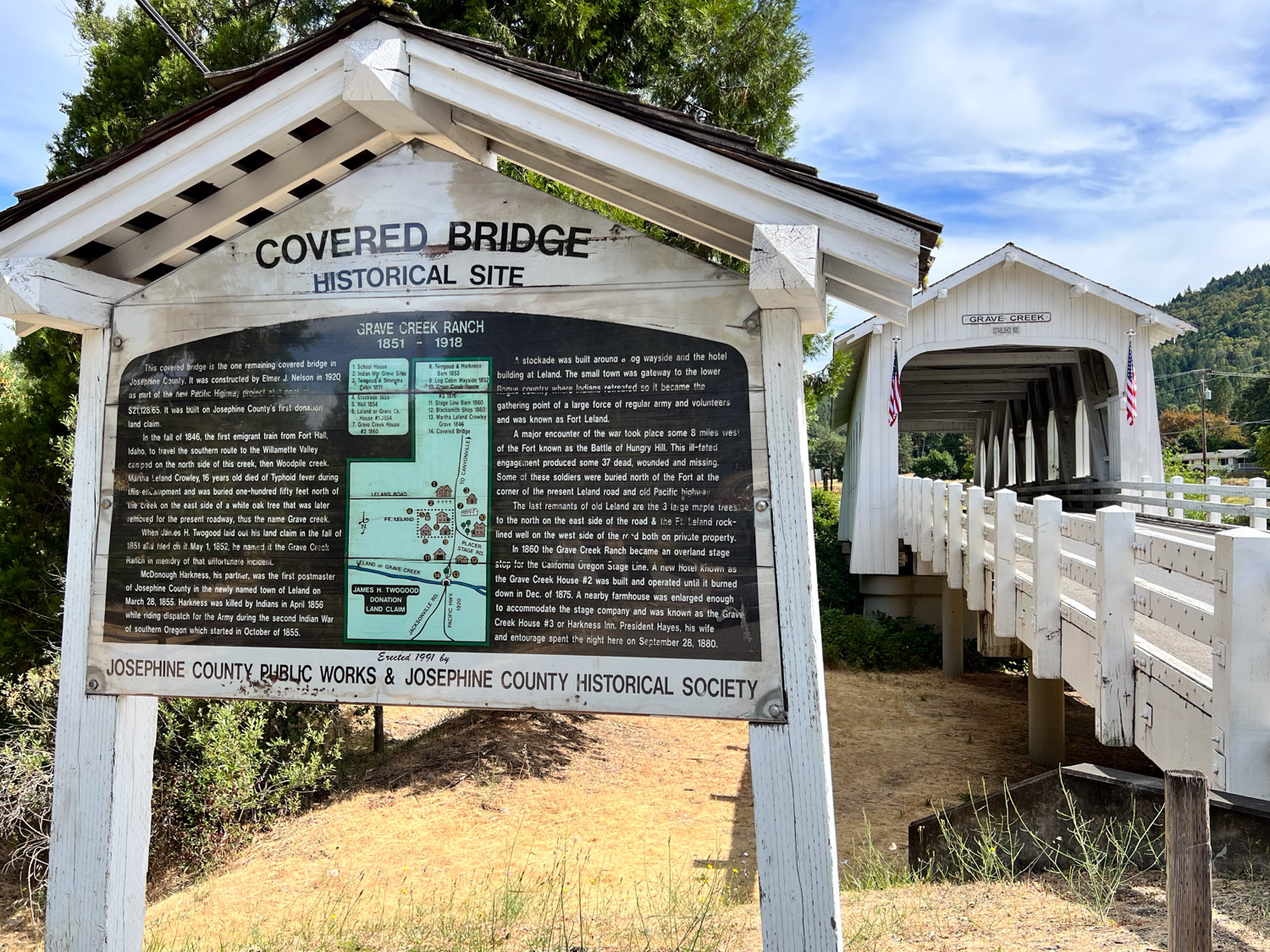
I’ve seen the sign for the covered bridge every time I’ve driven to Oregon but I’ve never stopped. It’s not far from the highway and an interesting site. There is a museum nearby but it wasn’t open on Sunday morning. The bridge was built in 1920 and the sign talks about the history of the area when white settlers came there in the 1840’s and 50’s.

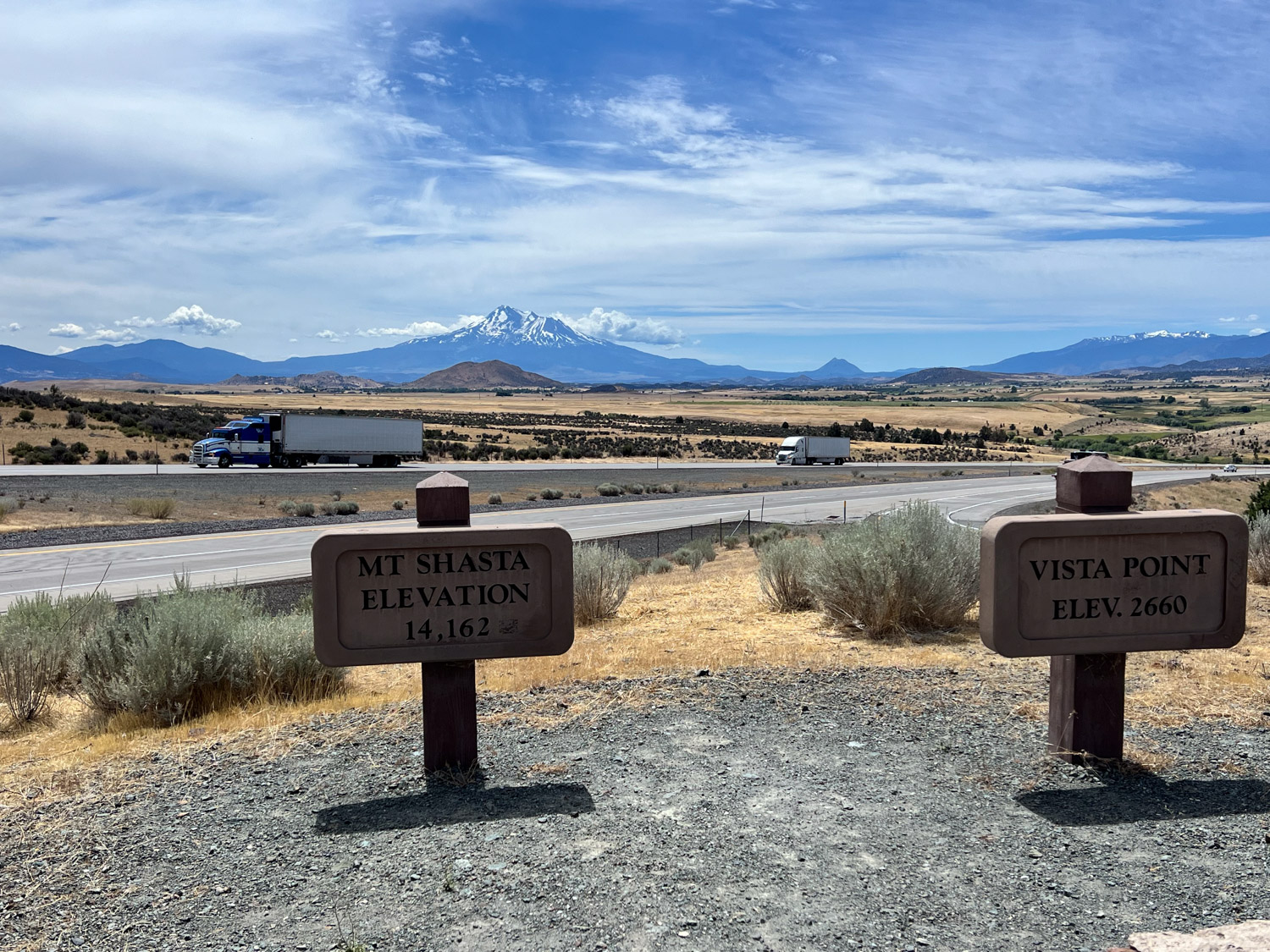
I always at this site in California.

This means I’m almost home. (Sort of.)

Another Busy Day at the Farm

Yesterday was the first harvest day of the season. Some lambs are 4 months old now. The BFL cross lambs are bigger than the 100% Jacob lambs and some are ready for customers who like lighter lambs. I have a customer who likes the black lambs. I asked if he wanted both of these because they are twins. If they were 50:50 crosses they would both be black, but these are 3/4 Jacob. There are two 50:50 ewes here and when bred back to a Jacob you never know what you’ll get. One is black with very short horns and one is white with some Jacob markings and large horns.

While I was sorting and weighing sheep I heard Ginny barking at something at the other end of the barn. This is a fancy trap that I bought several years ago and sort of forgot about. It is a live trap where the animal drops in from the top. It was in the back of the barn on a woodpile. We caught a young opossum! The opossums aren’t a problem here. I took this one out to a brush pile and let it go out there.

After sorting all the sheep I let the rest out to the pasture. This is a view of the property from the south.

This yearling is KJ Royalty Cindy. KJ Royalty is the flock name of my granddaughter and her sheep are the progeny of the ewe lamb I gave her in 2019. Kirby will be here next month to work with the new lambs and show at State Fair. I’m glad that Cindy is getting more friendly.

The person who harvests lambs is very fast and does a good job with the skins. I try to use all the parts of the sheep I can. I salted these hides and will ship them to a tannery when they are dry enough. The beautiful lambskins will be for sale when I get them back from the tannery–hopefully by early fall (but no guarantees). This page gives you an idea of what I will have for sale then, but these are all gone. I recently got back a dozen lambskins that were the first I sent off last year–a whole year ago. I haven’t had time to photograph and list them yet. Next week.

Harvest was over within two hours, but the rest of the day was busy with customers and computer stuff. Never ending computer deadlines. Late in the day we had a new kind of visitor.

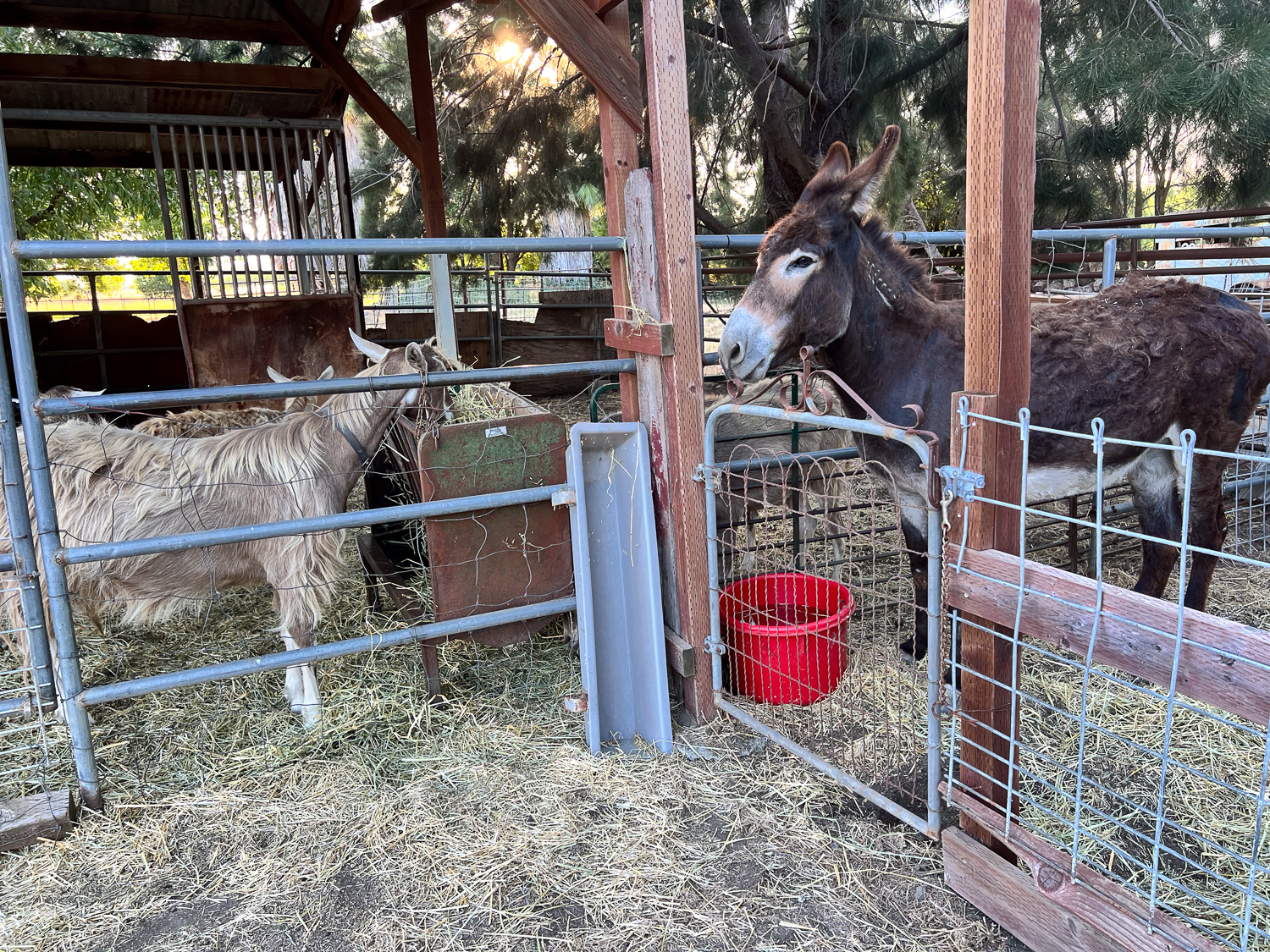
I am caring for these goats for a couple of weeks until their new property is ready for them. There are seven pet goats here and most of them originated from goats that my son Chris raised in his FFA project.

The goats came with a donkey! This makes me want a donkey again, but my irrigated pasture is not a good fit for a donkey. I can hear her braying right now even from the house!

Shearing at Timm Ranch 2024

If you do a search in either of the blog locations (WordPress that you’re reading now, or the one on my website that I don’t use much now) you can find Timm Ranch shearing posts from other years. I could probably substitute photos because the sheep look the same, the shearing location looks the same, our skirting set up looks the same, and some of the Farm Club members are the same–but not all of them. I just searched the WordPress blog and see 2015, 2016, 2017, and 2018. After that I think I started with my website blog. So here is a view of 2024.

The sheep are a blend of Rambouillet, Polypay, and Targhee. Once in awhile a new ram is brought in, but the Timm family mostly raises their own replacements so the blend of breeds has stayed the same.

This year they sheared about 120 ewes.
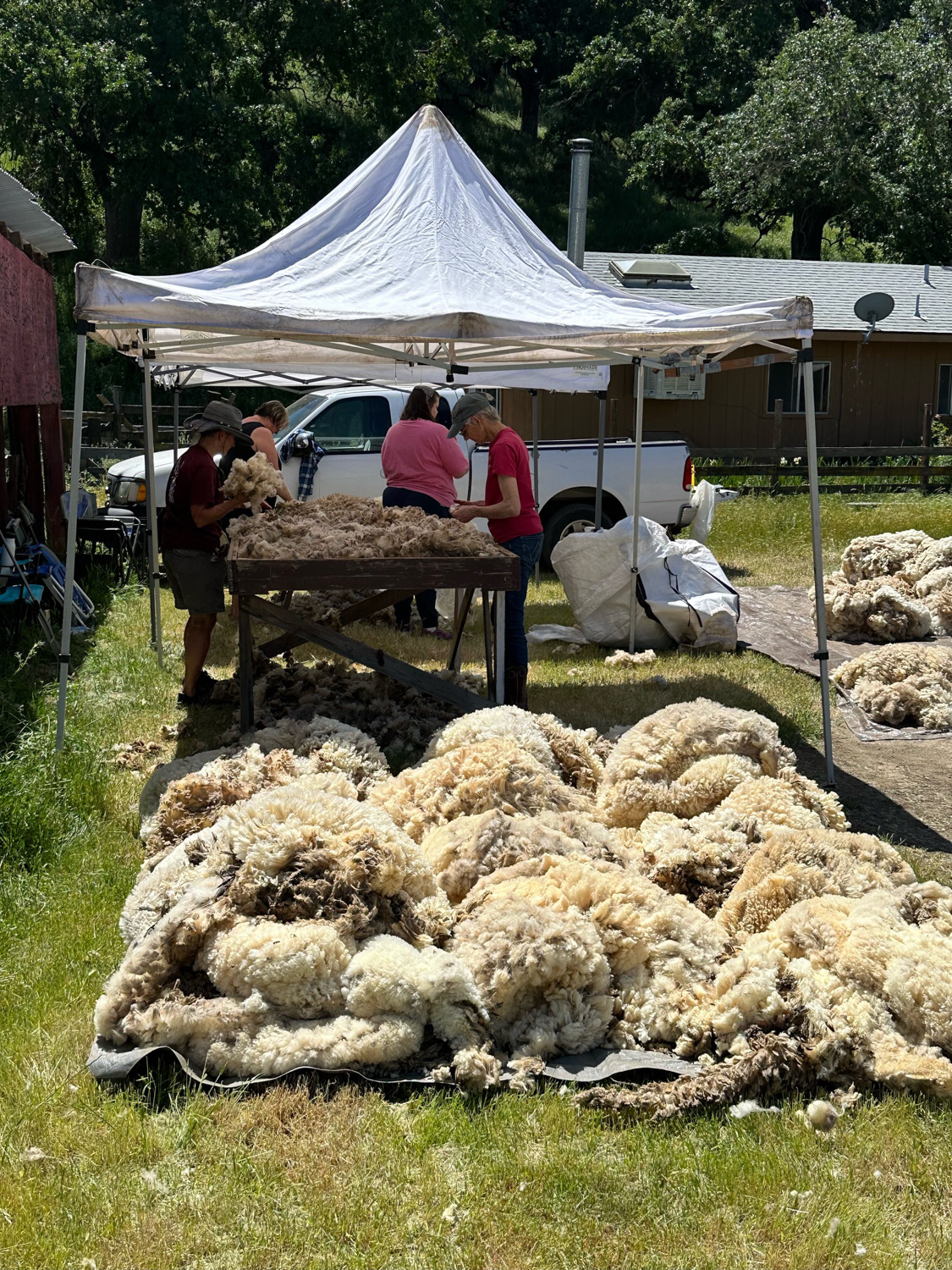
We set up two canopies and two skirting tables.

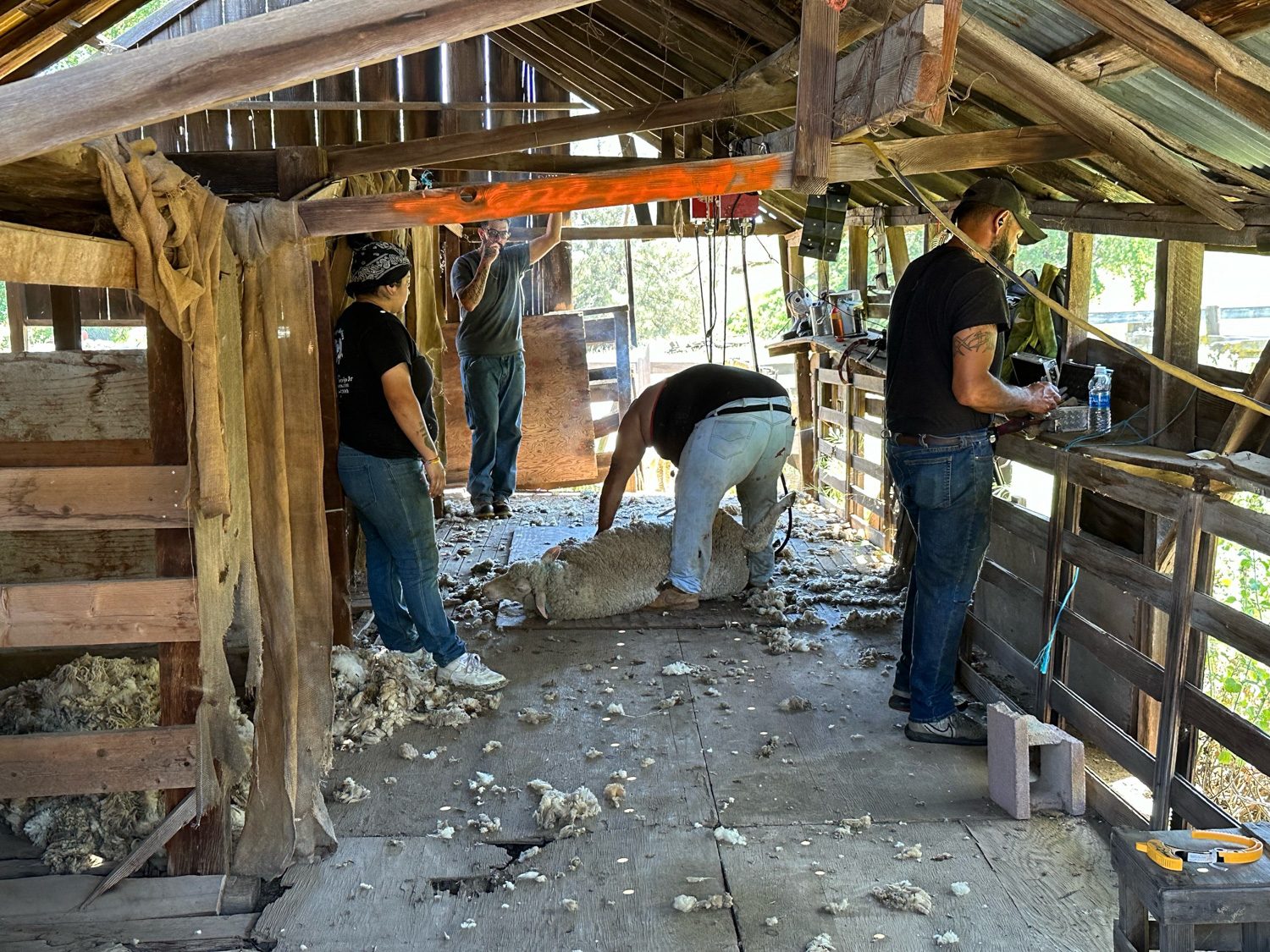
The shearing team started with one shearer but eventually there were two working.

As the fleeces came off the sheep we piled some of them nearby. We were slower than a professional crew would be, but that is because I want to be careful about what I send to one of our small local mills. I knew there would be plenty of wool so I can be picky with what I take. What we don’t take goes into the bale that the Timm Ranch will sell or to my neighbor, Charlene, to be made into Integrity’s Wool Pellets (formerly Gardener’s Gold).

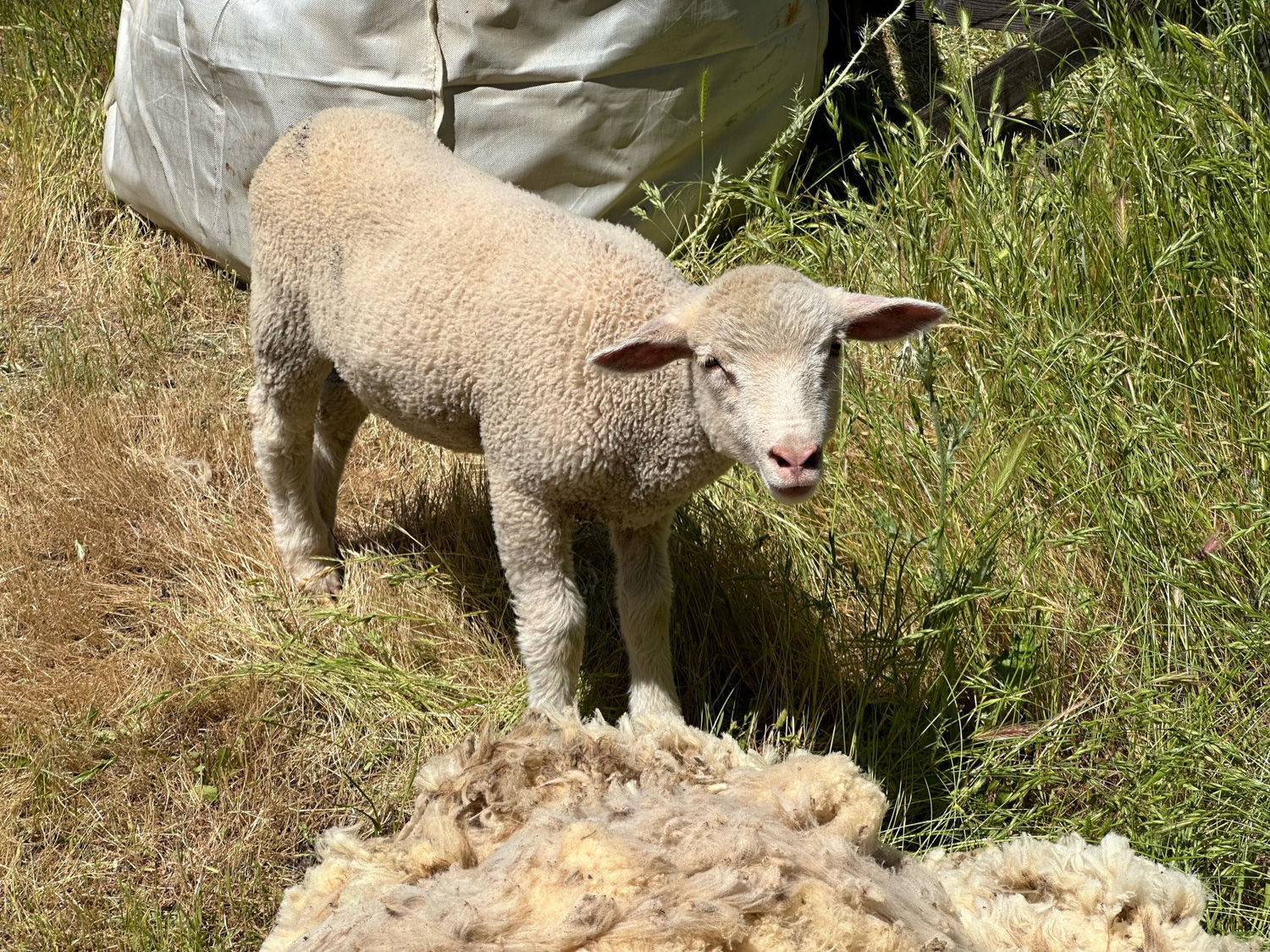
Three lambs got through the fence and wandered around while we were working. (Thanks to Sue G for the previous three photos.)

Another view of shearing.

Ewes after shearing.

We checked staple strength and length and skirted away manure and felted areas.

This is the 130 pounds that I kept. It will go to Mendocino Wool and Fiber for spinning. Yarn from 2022 is here and some of the TR yarn that I have dyed is here. Most of the blankets I weave use TR yarn for warp and sometimes for weft. The painted warp V-Shawls are all TR. You can see a variety of those pieces on this page.

It was a beautiful day at Timm Ranch. Blue sky and green hills just starting to turn gold. Thanks to Farm Club for all their help!

Lambing update

I just checked back to see when I wrote last. Wow! I’m so behind. It’s probably impossible to catch up with all the ideas I was going to share. Here’s an update about sheep and lambing season.

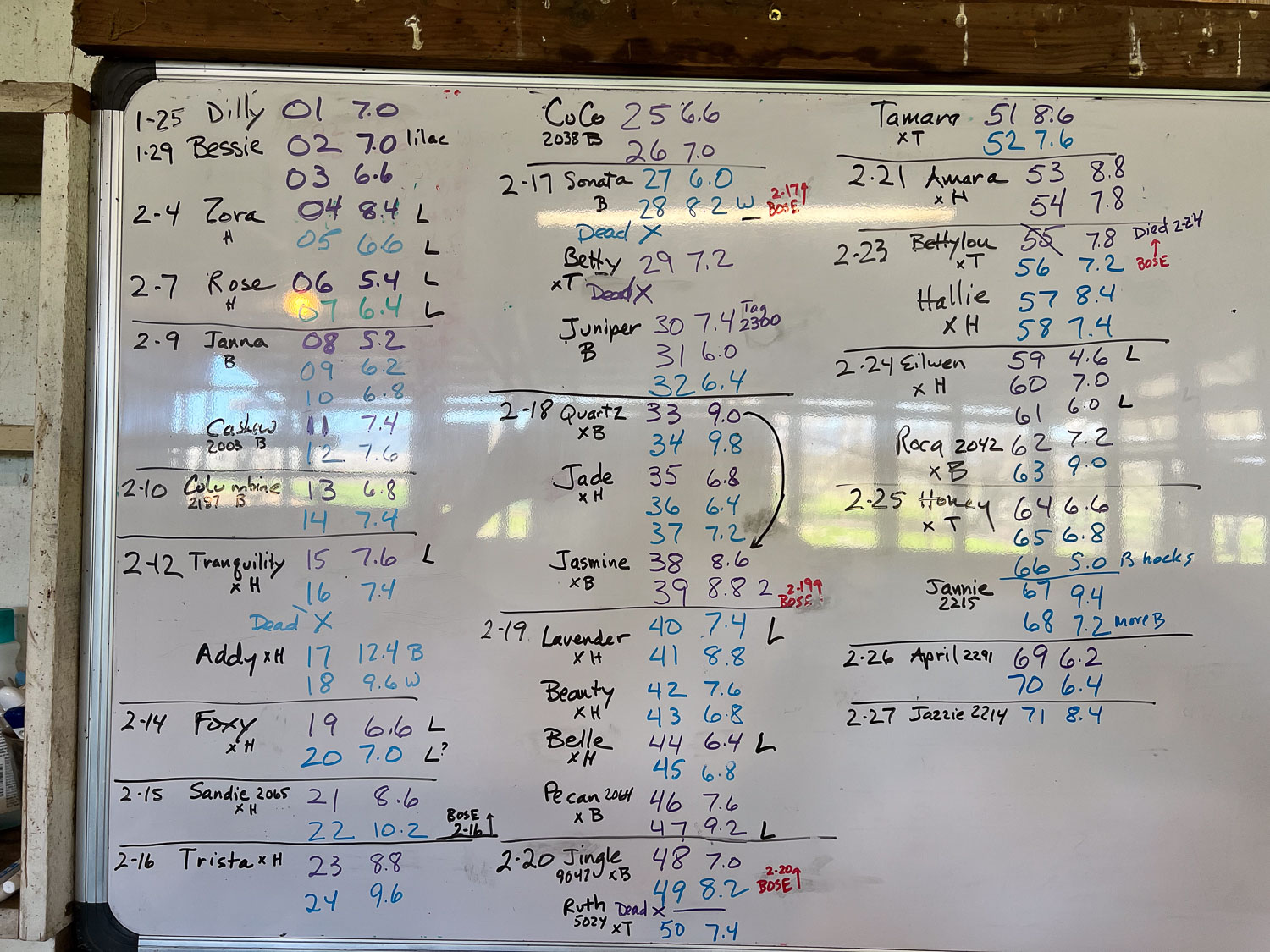
This is the lambing board where I record all the info as lambing progresses. This will stay up until the first lambs show up next year. The info shows date, ewe, lamb # (purple for ewes, blue for rams), and birth weight. The blue brackets are triplets.

Here is a summary:
Lambs born between January 25 and March 7, 2024
Single births: 3 = 3 live lambs
Twin births: 33 = 63 live lambs (3 died at birth)
Triplet births: 8 = 22 live lambs (2 died at birth)
Total live lambs = 88 ear tagged; 1 died at 1 day and 2 dead fetuses not counted.
44 ewe lambs / 42 ram lambs
Sires:
Horatio 36 lambs
Barrett 27 lambs
Typhoon 12 lambs
Blizzard 5 lambs
Peyton 5 lambs
Unknown 3 lambs
The Unknown are the first 3 lambs born, earlier than I expected, and due to the ram lambs getting into the pasture prior to breeding season. OOPS!

I also question if Blizzard is the sire of the five lambs born later than expected based on original breeding dates.

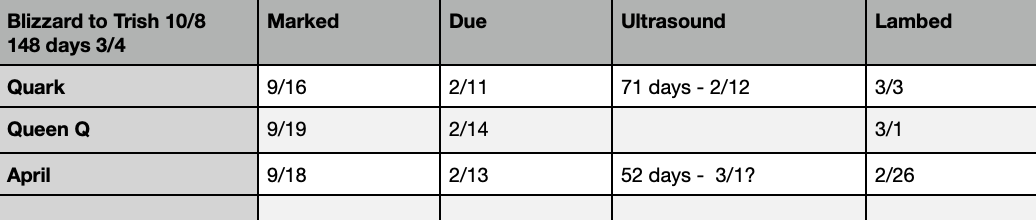
I made this chart to help work it out. If the lambs were born based on the original dates they would have ben born in mid-February. They are about 2 to 3 weeks later. A sheep heat cycle is 17 days and gestation is between 142-152 days (average 147 days or 21 weeks). Blizzard was with 3 ewes until Lambtown, October 6-8. If he bred them October 5 the due date would range from February 24 to March 5. I just looked back at last year’s Lambtown blog post and see that Queen Q and Quark were both at Lambtown also. They came back on October 8. IF they were bred October 8, 147 days would be March 3 (range February 27 to March 9). I’m pretty sure that April’s lambs are sired by Blizzard, but I’m still not sure about the others. I think they probably went in with Horatio when they came back here but I don’t remember. It would have been smart to leave them away from rams for another week or so. The lesson here: TAKE BETTER NOTES.

Thanks for “listening” while I try to work this out. Now, on to photos.

Lambs are getting big. This is Hailee, one of the few 2023 ewe lambs that I put with a ram. Her twins were born March 4, so they are only 3 weeks old. Really? It seems like that was so long ago now.

Here is a view of Hailee without lambs under her. I really like her horns!

We had a Farm Day on Sunday and several members showed up to help take notes about lambs. I hadn’t taken time to record number of horns, color, etc and needed to be able to update the website. We caught all the lambs and then inspected each one. It’s easy to tell the number of horns on the rams when they are young, but not always on the ewes. This photo makes mer think of a line at the grocery store. Farm Club members caught lambs and waited while we all checked them out and then I ear tagged with a colored tag.

They all get white ear tags for ID shortly after they are born. The colored tags are useful as back up if the original ones are pulled out and to help find a particular lamb. When I’m looking for a specific number I have to look at all 80+ lambs and it’s much easier to narrow it down by color. It also helps when I’m taking photos that usually I’ll be able to identify the lamb later by at least one ear tag. We color code them by sire.

Barrett’s lambs got green tags.
Ewe lambs are tagged with the white ID tag in the left ear and the colored tag in the right ear. Ram lambs are the opposite, so that’s another way to help find a lamb.

Horatio’s lambs have a purple sire tag.

We tagged Typhoon’s lambs with yellow. I did not assign colors to lambs that are potentially Blizzard’s or the ones with an unknown sire. Now you can find most of these lambs on the website. Ewe lambs. Ram lambs. I’m not finished taking photos. Most are for sale.

Pecan and ewe lambs born February 19.

Triple Trouble

I wrote last time about Seeing Triple and all the triplets that have been born. Eilwen was the last one in that post, but early the next morning Honey had her lambs–more triplets.

When I went to the barn I saw the moon setting in the west…

…and the sun rising in the east.

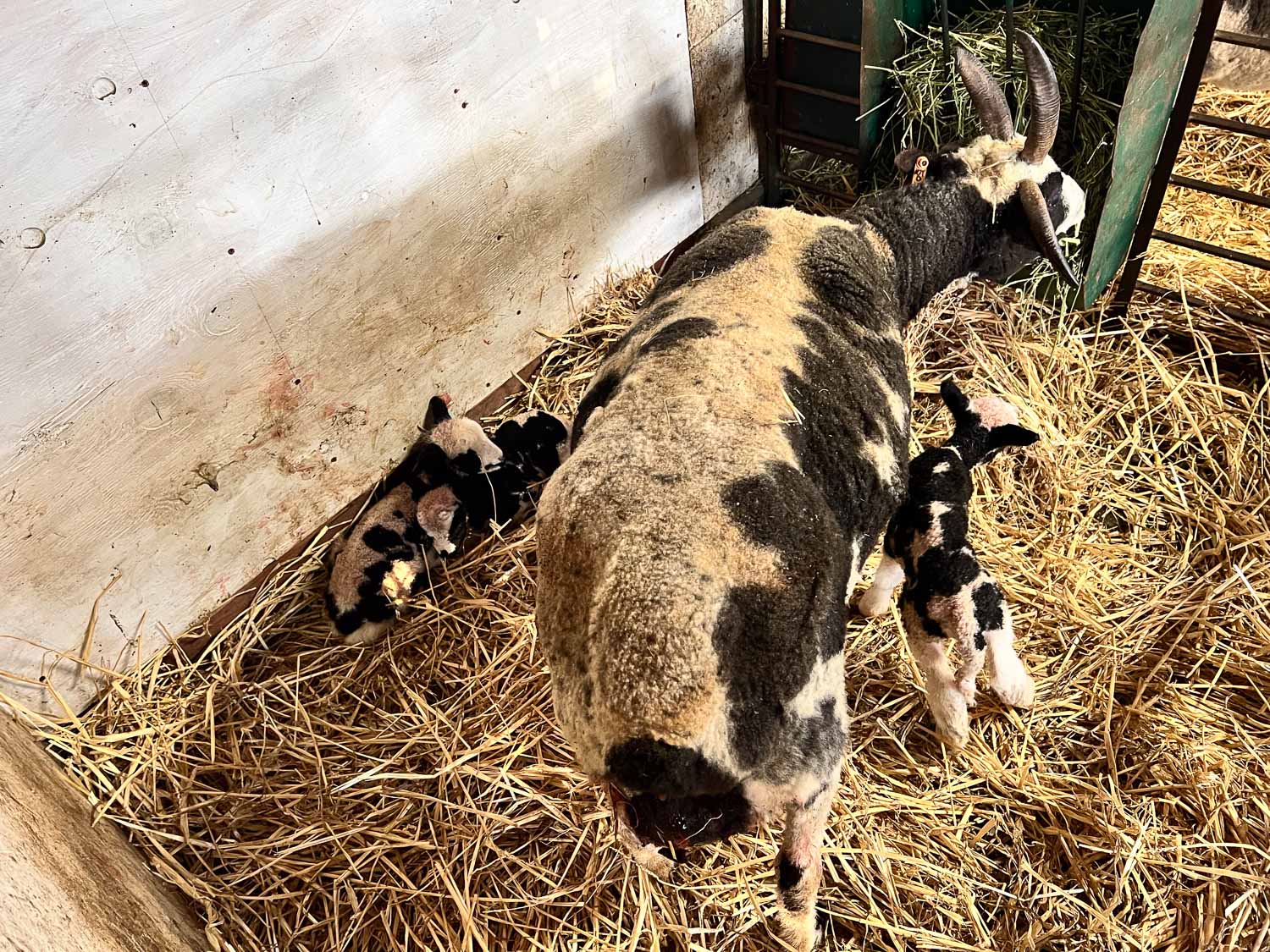
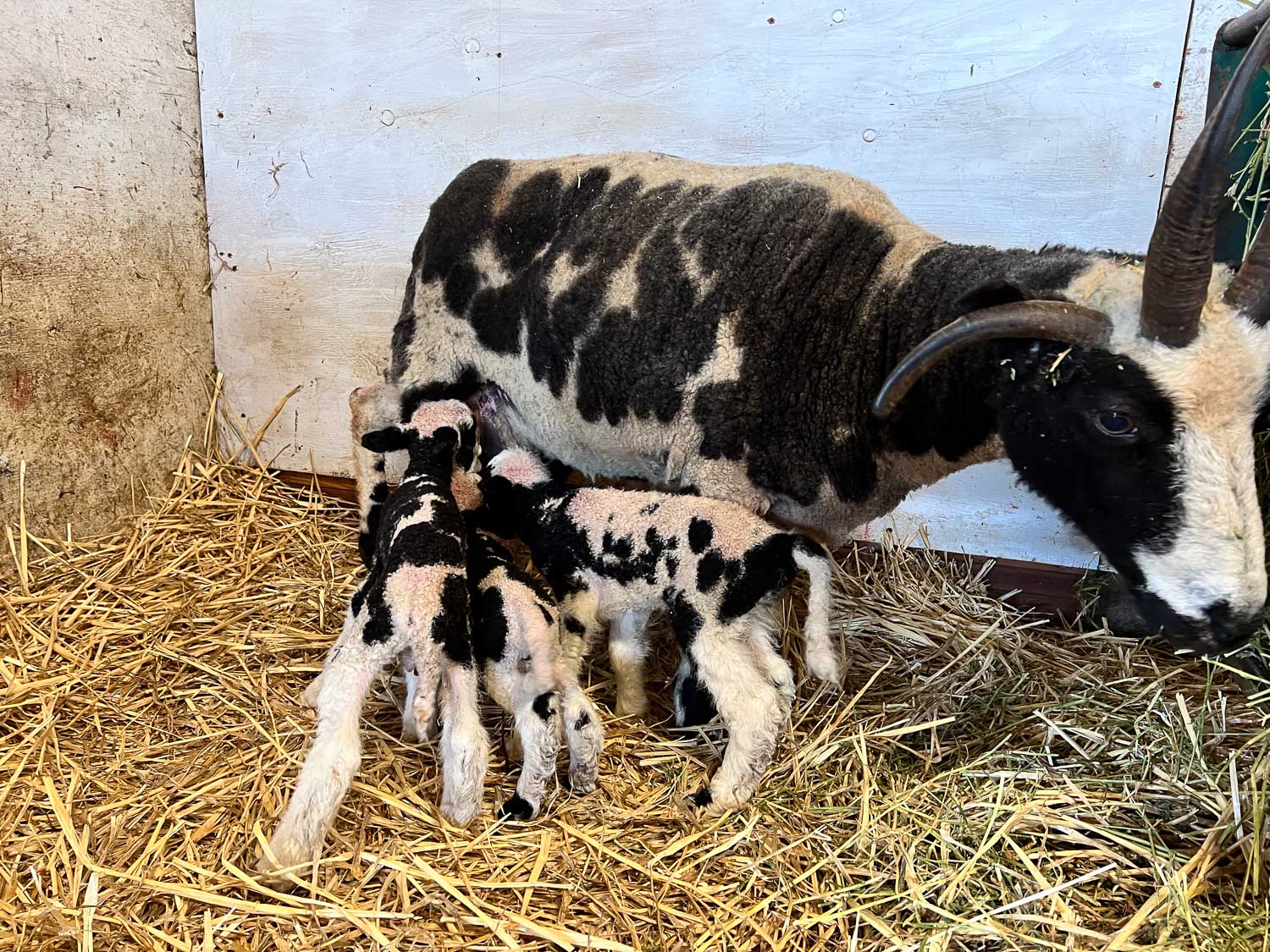
Here is what I saw in the barn. I had put Honey in the night before because she was desperately trying to claim the lambs of the ewe that had just lambed when I was at the barn around midnight. Now she had her own brood. This is the sixth set of triplets. That’s too many, especially for this ewe who had mastitis last year. I thought it had been resolved enough for her to have lambs again. I was wrong.

The lambs had figured out that they were getting milk from only one side. A ewe can nurse a single lamb one one side, and maybe twins, but it’s asking way too much to raise triplets that way. Its important for the lambs to get colostrum during the first day, so I made sure that they all took turns nursing through the day, but I started to supplement that night.

Jannie lambed later that day with twins.

This is Coco with 10-day old twins. Yesterday I found Coco less responsive than normal. She is not one of the tame sheep and she wouldn’t get up when I wanted her to move. The lambs were trying to nurse while she was lying down. I discussed symptoms with one of the vets at the VMTH (UCDavis Vet Hospital).

No fever and, in fact, lower than normal body temperature, her behavior, and the yellow cast to the sclera led her to think copper toxicity. I have dealt with copper toxicity in the past but not for several years.

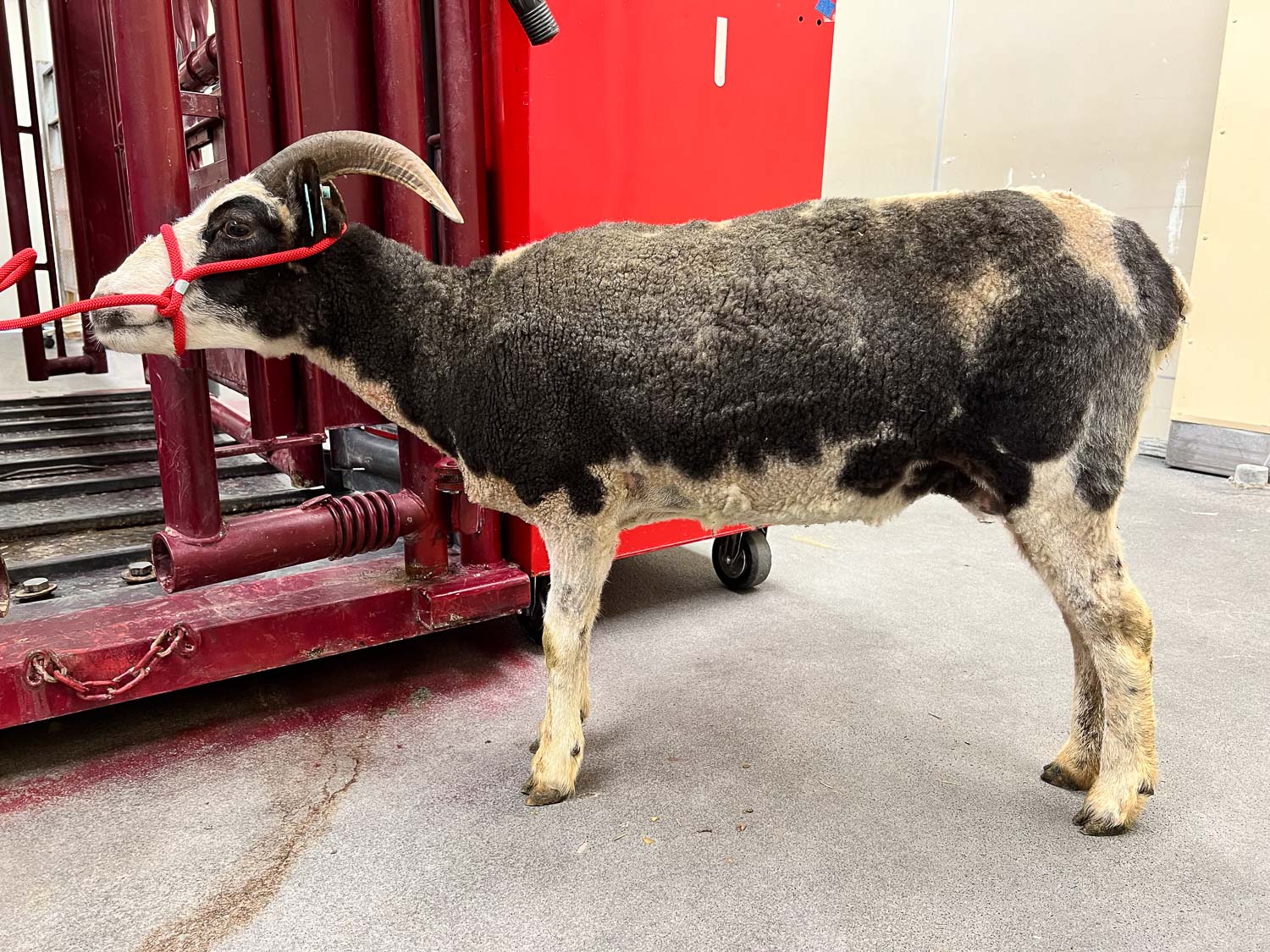
I took Coco to the VMTH as soon as I could. This story does not have a happy ending, but this is real life. Coco was euthanized. I know she looks like a normal sheep in this photo, but believe me, her body was shutting down. There is a lot more I could tell you about this — details about copper toxicity in sheep, decisions one has to make about animals whether they are considered livestock or pets, and more. That is what Farm Club is all about. Farm Club members get the behind-the-scenes stories in much more detail than works (or is appropriate for) a blog post. They have had daily updates from the beginning of lambing and have been invited out here to participate as well.

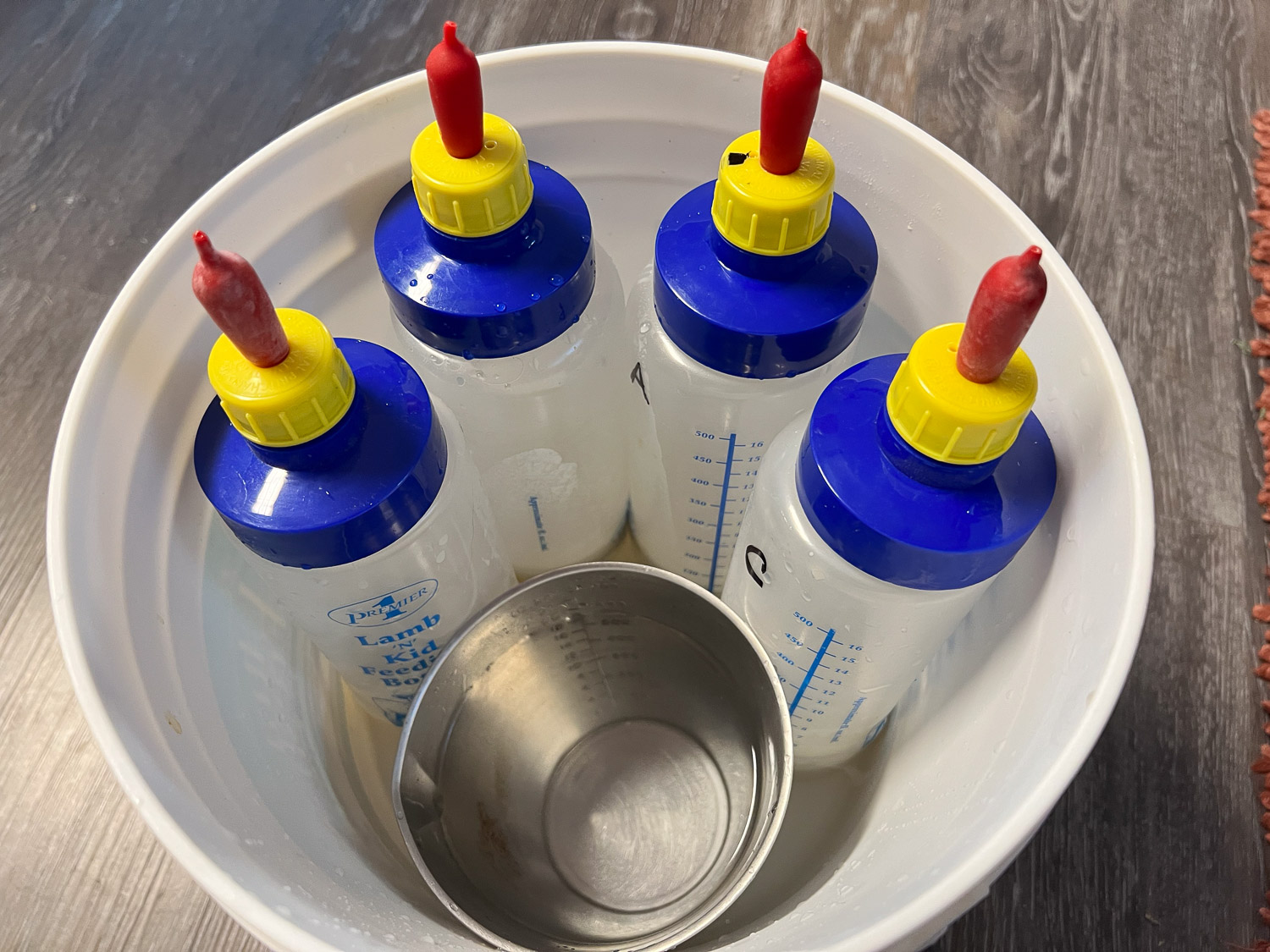
This was the bucket I took to the barn this morning. Two bottles for Coco’s lambs and two bottles for Honey’s lambs. As of the noon feeding I added a fifth bottle. I’ll be feeding four times/day for a couple of weeks I think.

Those are Coco’s lambs on the right. I took two of Honey’s lambs out of her pen this morning. The fact that she didn’t care means she doesn’t feel well. I left one with her but will supplement him.

On the positive side, Jazzie lambed this morning.

The lambing board so far.