Life and Death on a Milkweed Plant

While mowing the pasture the other day I saw a fluttering monarch butterfly.

IMG_3453

I thought, “Cool, I’m watching this butterfly emerge from the chrysalis.” However, as I watched I realized that for some reason the butterfly had been stuck in this position and now was hopelessly damaged. I helped it out of the chrysalis but its wings were damaged and all it could do was flutter, but not fly.IMG_3460

I continued mowing.

IMG_3468There were plenty more milkweed plants that were teeming with life. That’s the Common Buckeye Butterfly and the Alfalfa Butterfly (see my last post).

IMG_3462

Here is what the seed pods have inside when they are ripe. (Spinning, anyone?)

IMG_3476I identified this one in Bug Guide.net  as the Small Milkweed Bug (also the Common Milkweed Bug, Lygaeus kalmii). It’s surprising how many similar looking bugs you find when you google “red and black bug in CA”.

Small milkweed bug or Common milkweed bug, Lygaeus kalmii

I had to look closely to see the identifying markings. The Guide says: “Adults suck nectar from flowers of various herbaceous plants, and also feed on milkweed seeds(?). Also reported to be scavengers and predators, especially in spring when milkweed seeds are scarce. They have been reported feeding on honey bees, monarch caterpillars and pupae, and dogbane beetles, among others.”

IMG_3479

Here is more life, but I’m not going to try and specifically ID this one.

And the circle continues…

Monarch caterpillar on milkweed

The other photos were from a couple of weeks ago and I just saw this monarch caterpillar a few days ago on another milkweed.

Birds and Butterflies

Last week it was impossible to go to town or walk Across the Road without running into butterflies. The orange sulphur butterfly (Colias eurytheme also known as the alfalfa butterfly and in its larval stages as the alfalfa caterpillar), I found out by googling, is widespread in North America and can be a significant alfalfa pest in high densities.

The alfalfa field just south of where I walk had been cut, the sunflowers harvested, and butterflies were doubling and tripling up on field bindweed flowers and any other weedy flowers they could find.

DSC_2177

DSC_2158

DSC_2160

DSC_2176

I thought that I’d be able to get photos of butterflies in flight. Do you know how hard that is? Not possible, at least by me.

DSC_2167

But speaking of things that fly, I did get some bird photos. I don’t usually see great blue herons in the trees.

DSC_2227

The snowy egret is dwared by two great egrets.

DSC_2222

Great egret in flight.

DSC_2233

On my way home I spotted these cattle egrets which I photographed from the road.


A Sheep Adventure – Part 2

I forgot to put a couple of photos in the last post. Besides the BearFest that was going on through the summer in Grants Pass, there was also a Fifties celebration the week we were there. There was a car show that evening and here are some cars that we saw in the motel parking lot.

IMG_3258

I have no idea what they are but I took these photos to show my husband.

IMG_3260

IMG_3261

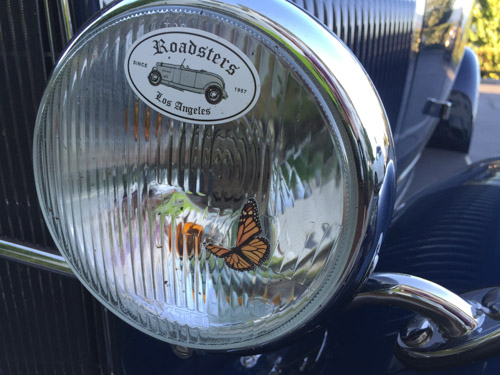
This is not how butterflies normally look on my headlights.

We got on the road about 7:30 and drove to Selma, Oregon where Jackie’s sheep had been delivered the day before. She was picking up two English Leicesters that came from Michigan.

IMG_3266

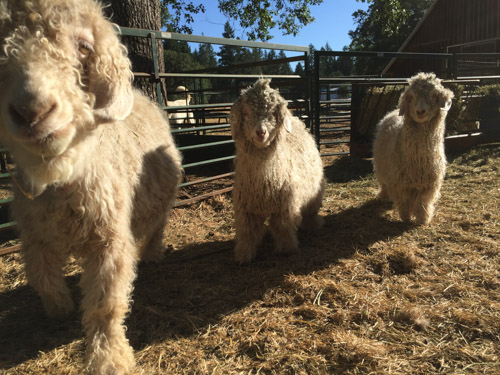
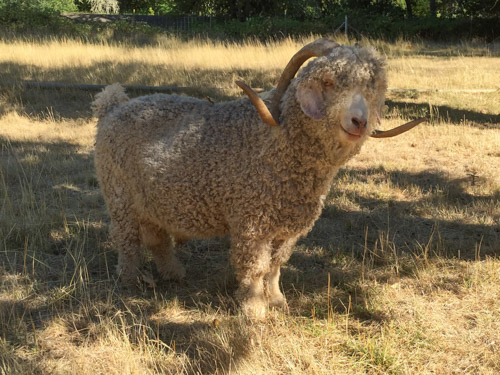
Carol Ronan graciously took time to give us a tour of her beautiful farm. She raises Angora goats (above) and Gotland sheep (below). Information about her sheep and goats (and the beautiful farm which is for sale) is at this link.

IMG_3276

IMG_3278

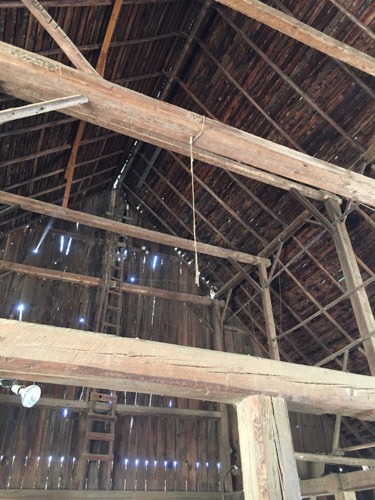
The animals have access to this 100+ year old barn that has been reinforced and given a new roof (which will probably give it another 100 years).

IMG_3281

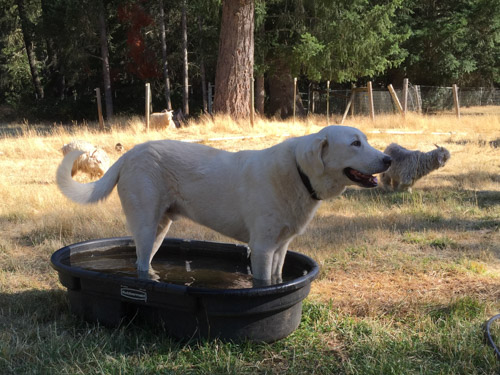
I don’t remember the dogs names but this was an older one who put up with the nosy sheep.

IMG_3284

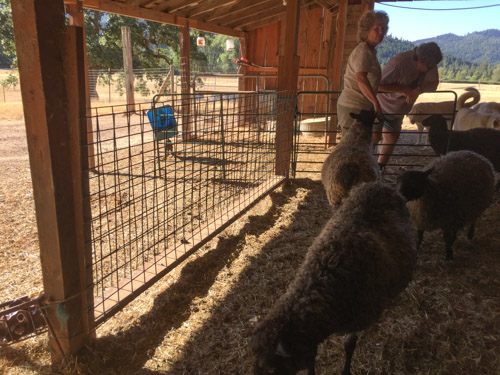
I took this photo because I wanted to remember this oh-so-simple feeder idea. That welded wire panel is not a fence. There are two panels attached to a 2×6 at the bottom and to posts with slightly tapered pieces of wood on the sides. Perfect for dropping in a flake of hay and feeding on both sides.

IMG_3290

We walked to the field with the bucks…IMG_3292

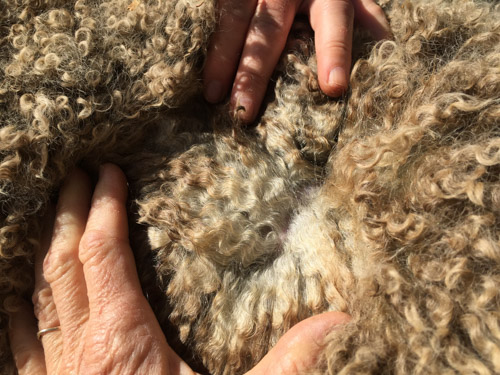
…and examined fleeces.

IMG_3295

IMG_3297

IMG_3298

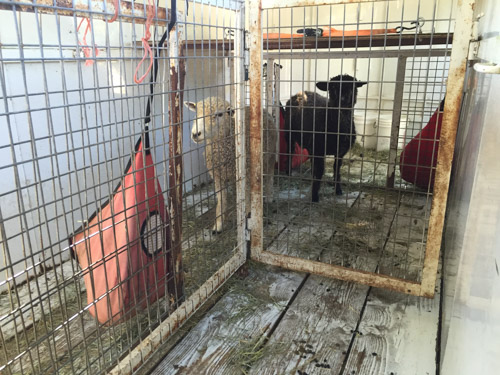
Here are Jackie’s new sheep who had been housed in the trailer overnight.IMG_3299

They were easily switched to my truck and we got on the road. There are not too many photos of the part of the trip that became more of an adventure. I didn’t want to backtrack to Grant’s Pass and I-5. BORING. If you take Hwy. 199 south from Selma you can turn off onto a road that winds its way through the rugged Siskiyou Mountains to Happy Camp. It wasn’t a good idea for me to be taking photos while driving on this road that was full of switchbacks and Jackie probably would have thrown my camera out the window. We didn’t stop because we had spent a lot of time at Carol’s and had planned to make the next stop by mid-morning (weren’t going to make that) and get home in the afternoon, trying to avoid being on I-5 through Redding at the hottest part of the day.

IMG_3307

At Happy Camp we turned east onto Highway 96 and watched for landmarks until we got to this sign and across the road…

IMG_3306

…this bridge where we crossed Horse Creek and drove north along hillside edging a green valley . We were supposed to go 2 miles and find the correct street address for the farm where my ram would be. We saw a few numbers on mailboxes, passed what should have been the right place, found a place to turn around and chose a driveway that seemed to be in the right place. We drove in past barns and farm equipment but didn’t see a house, sheep, or any signs of someone looking for sheep buyers who were late. We drove out of the driveway, down the road and chose another driveway with the number that would be the neighbors to the place we were looking for.

As I drove down the steep driveway, several large dogs ran out barking. However I saw someone looking through a window and waited for him to come out. He wasn’t happy about seeing us and told us to go back up the road and take the driveway with “the lifetime gate”. “Can I drive forward and turn around down there?”, I asked. “No” was the answer. OK then. I’ll back up the steep rocky driveway that has a sharp turn onto the road and a steep drop-off to the side, while trying to see the end of my truck through the plywood sheep crate on my truck. I did that with several back and forths and only one minor mishap.

IMG_3302

Finally backing into the road in the wrong direction we drove down it again, passing this sing, turned around and came back. (Note: When my sons have fought fires in these mountains they have been turned away from entering access roads to the forest by surly land-owners. The firefighters are warned by their supervisors to be careful in or avoid areas where they have spotted marijuana or equipment for growing or harvesting.)

So we took the same driveway we had before with the barns and cattle equipment. Steep-Driveway-And-Big-Dogs-Guy was there to meet us, having gone from his house, across the creek, through the barns, to this upper driveway. He pointed and said “no, go back to the lifetime gate”. Lifetime gate? When we looked more closely there was a closed gate down a dirt road that branched off to the right of this main driveway. Jackie opened the gate and we drove into what looked like a little used driveway that stopped before you got to a house where I could hear children. So at least someone was home.

IMG_3303

I found the sheep owner who strapped her baby on her back and we walked out to the barn with other kids running beside us. We arranged bales of hay to create a step up into the truck and loaded the ram. She pointed us out a dirt road that  ends up on a different paved road which seems to be their main access and is “easier”.

IMG_3305

This is the field (sheep in the distance) that Kenleigh’s Legolas left behind.

IMG_3308

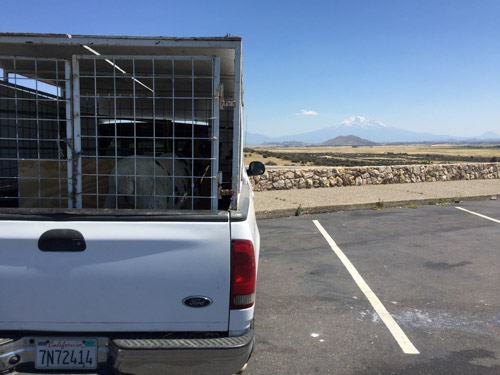
We drove east through Yreka to I-5 and headed for home. I always stop for a photo at this overview of Mt. Shasta. We stopped several times to check on the sheep. There was really nothing we could do about the heat but the truck thermometer was showing 108 (or was it 109?) through Redding. It was in the 100’s for most of the trip, but the sheep survived. I didn’t dawdle, wanting to get them out of the truck as quickly as we could.

IMG_3311

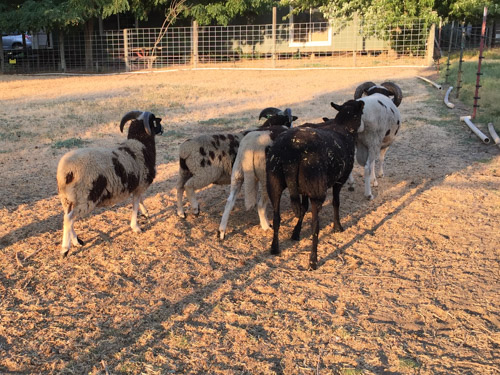
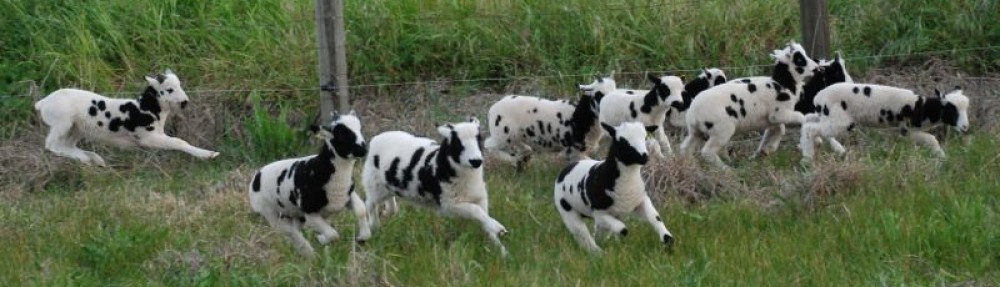
I put Legolas in with the young rams and a wether. They followed him around for awhile.

DSC_1605

There was fighting among themselves, but not with Legolas, because it was obvious that he would be the dominant ram of the bunch.

DSC_1606

This will be the first year that I will breed the bulk of the flock to 2-horned rams. There is Kenleigh’s Legolas (Lego for short), Meridian Catalyst, a 2-horned lilac ram, and bide a wee Buster, the younger ram with 4 horns.

A Sheep Adventure – Part 1

It took me almost a month to finish the blog posts about our road trip partly because I interspersed other stories into those posts. I’m still catching up on the things I wanted to share. One of those is  another adventure on the road, this time involving sheep.

Just after I came home from Black Sheep Gathering I found out about a ram for sale in northern California. I had just purchased a ram lamb at BSG but, after selling rams this summer, I would still have only two rams here for breeding in October  (except for whatever of my own ram lambs I might keep). The new one was small and I wasn’t sure that he’d be up for the job on October 1. The one for sale was an adult so he would definitely be ready for breeding.

I planned a day trip to the Klamath River area west of Yreka, but in the meantime my friend, Jackie, had purchased a couple of sheep that were to be delivered to Selma, Oregon that same week. We decided to combine the two sheep pick-ups, but that turned the trip into a two-day Sheep Adventure.

The drive north on I-5 gets more interesting once you leave the valley and get into the mountains.

IMG_3226

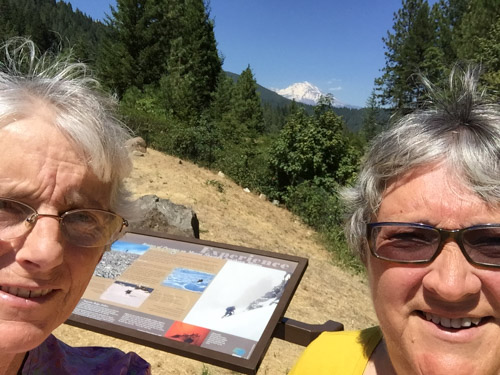
Mt. Shasta, at 14,179′, is in view for many miles. I had never stopped at this vista point. I made Jackie take a photo with me.

IMG_3225

I love this mountain and, although I have never climbed it, I spent a couple of summers working in the Klamath National Forest where it was always a presence. My husband has been at the top, but that is another story.

IMG_3227

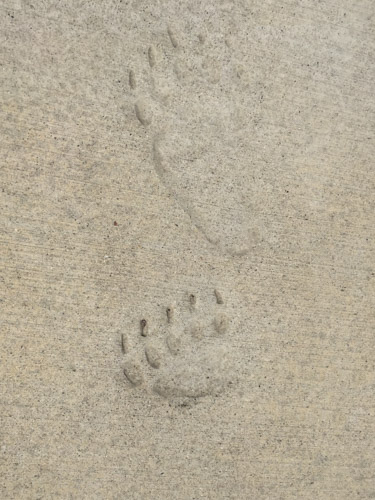
There were bear tracks in the cement walkways.

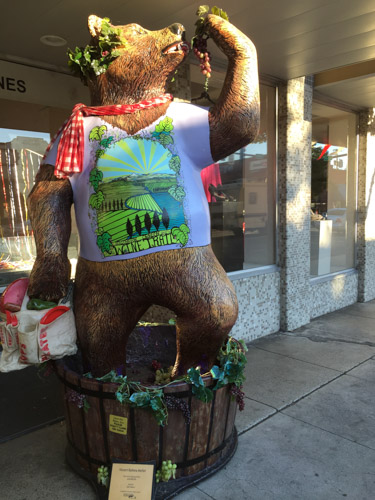
It turns out that bears became the theme for the day. We planned to spent the night in Grants Pass, Oregon and pick up the sheep the next day. It just happened that Grants Pass was celebrating Bear Fest, “a hands-on touchable art event, proving that art doesn’t have to be “serious” to be great. Local artists decorated, embellished, bejeweled and painted larger than life size bears” which were on display through the summer.

IMG_3228

Our motel had bear themed furniture…

IMG_3229

…and bear art over the fireplace in the lobby.

IMG_3232

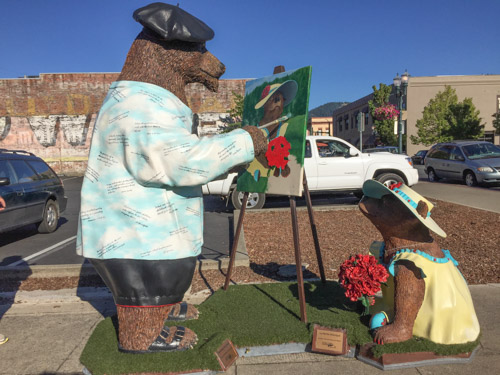
This bear was outside the motel. We drove downtown and parked. We took our Bearfest Map and found some of the fifty bears that were displayed around town.

IMG_3234

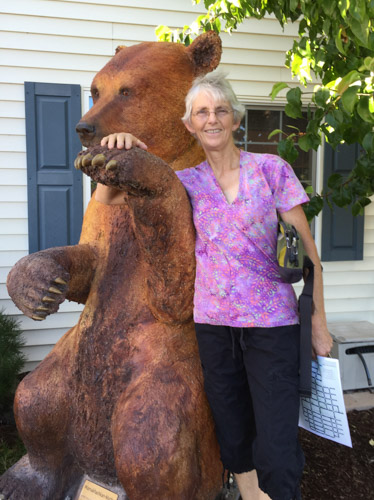
Marge and Rockabilly Bear (with Jackie photographing from another view).

IMG_3242

Pierre Bear the Arteest and La Petite Monique.

IMG_3243

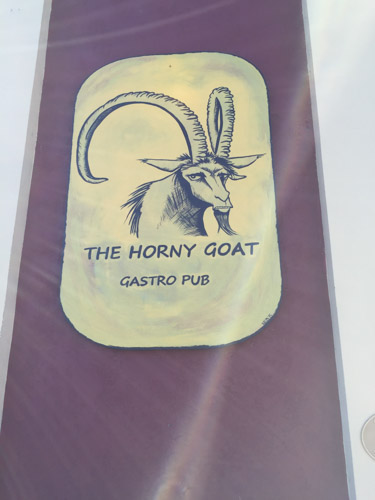
Not a bear, but keeping (loosely) in the theme of our trip, it seemed that we should eat at this restaurant.

IMG_3244

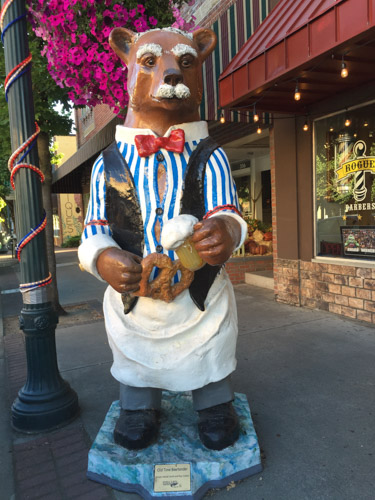
Old Time Beartender.

IMG_3246

Boss Henry the Logger Bear.

IMG_3247

Vincent Barbera Merlot

IMG_3248

Carmen Bearanda

IMG_3250

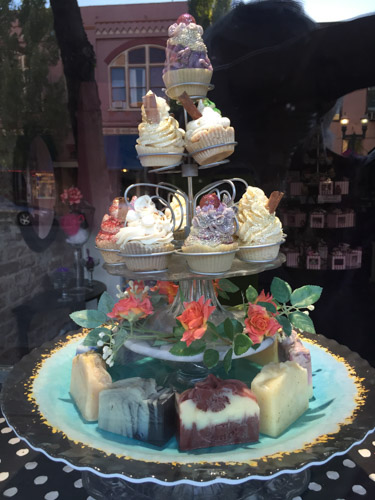
Also seen on the streets of Grants Pass. We had skipped dessert at the restaurant…

IMG_3251

…but didn’t stop here…

IMG_3252-2

…because these wern’t edible!

More in the next post…

Road Trip to CO – Nevada to Home

In the last post I wrote that we drove until dark and then kept going. We didn’t have a plan about where we’d stop and Dan just kept driving. (By the way, when I say that “we” drove I mean that Dan drove and I rode. I used to offer to drive but I don’t bother anymore on our trips. Dan likes to do the driving and that’s fine with me, since I’d rather be watching the scenery and napping when I get tired.)

Eventually, somewhere in eastern Nevada, Dan got too sleepy and pulled over. We didn’t try to stretch out in the back of the truck but slept in the front. After an hour or two I got too cold and uncomfortable (and bothered by someone snoring) and switched places with Dan so I could drive. When I got too tired and pulled over we both slept awhile until he recovered enough to go on.

DSC_1540

The view when I woke up next.

DSC_1541

Have you noticed that the Open Range signs in many places have cattle that look like dairy cows? The Open Range signs in Nevada show what looks like bulls.

DSC_1544

Even along Highway 50 in Nevada there are Points of Interest.

DSC_1547

It’s hard to see in this photo but there are remnants of a stone building surrounded by cyclone fence. One of the signs at Cold Springs (between Austin and Fallon) described The Overland Stage Station: “Constructed using the volcanic lava rock found throughout the area, the Cold Springs Stage Station was built in 1861. The original Pony Express Station was built 1-1/2 miles to the east of here in 1860. When the stage station was erected the Pony Express moved its operation to this building…Life at Cold Springs was not for the timid. The 2 to 3 man station crew endured the barest, leanest forms of living. They ate, lived, and slept in this crude structure for months at a time. Floors, when dry, were dirt and when wet, they were mud. Sanitary facilities were primitive. The handmade furniture was crude and utilitarian at best. There were no luxuries, only the necessities of life: food, water, and a firearm for protection.”

IMG_2952

IMG_2956

IMG_2951

Additional signs explained the quick progression of communication and transportation milestones that occurred here between 1860 and 1927–the Pony Express in 1860, then the Overland Stage in 1861, telegraph in 1861, (dooming the Pony Express), and eventually the creation of Highway 50.

DSC_1549

Here is one more sign. This one is provided by Trails West whose “primary activity is installing, and maintaining, distinctive steel-rail “T” markers along the many emigrant trails leading to California and publishing guide books to enable anyone to follow these trails from beginning to end.” They have placed over 600 markers along 2000 miles of trails.

IMG_2948

Putting my iPhone in my pocket it took this photo.


DSC_1564

Way back in this post I mentioned a Shoe Tree. Here is another west of Cold Springs. This one is even marked in our map book and described in this internet article.

DSC_1566

Not to be a spoil-sport, but I’m not a big fan.  Sure, it is a curiosity and, in this case, a landmark, but I think I’d rather just admire a nice tree growing in the desert. To me it brings to mind the question is graffiti artwork or vandalism?

DSC_1574

Sand Mountain is a 2-mile long, 6oo’ high sand dune that is 20 miles east of Fallon and is the site of another Pony Express Station.

DSC_1577

DSC_1568

DSC_1579

Impressive house in Fallon…

DSC_1582

..and an auto repair shop featuring a NAVY jet out front (representing Fallon Naval Air Station).

DSC_1586

Seen on the highway and reminiscent of a twill pattern in weaving.

DSC_1588

Just past Fallon, we left Highway 50, as it headed southwest, to get on I-80 toward Reno…

DSC_1591

…and, eventually, home.

DSC_1593

California! Only about 2-1/2 hours to home.

IMG_2992

We drove about 2800 miles on this trip. It’s marked in pink. Our 2015 trip to Texas is in blue. Orange is to Grand Tetons and Yellowstone in 2014 and Green was to Grand Canyon and beyond in 2013. Where to next year?

Road Trip to CO – Four Corners to Dark

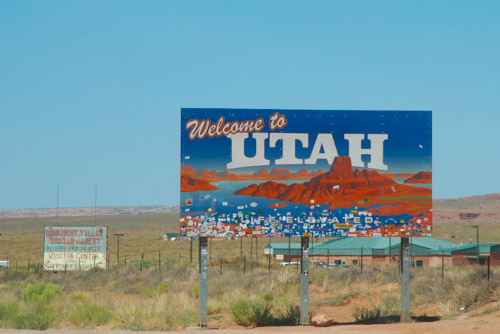
Our 8 day road trip was almost over. We spent Monday night and Tuesday morning in Mesa Verde National Park but needed to be home on Wednesday. We decided to drive through Four Corners and Monument Valley–it wasn’t much out of the way and Dan had never seen the area (and I had been there just once).

DSC_1391

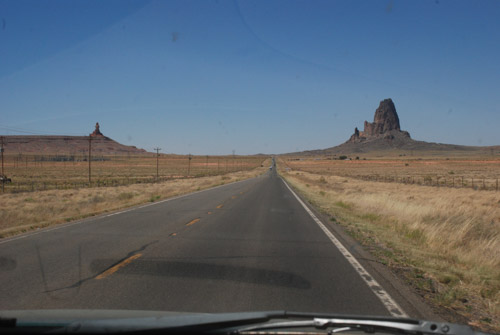
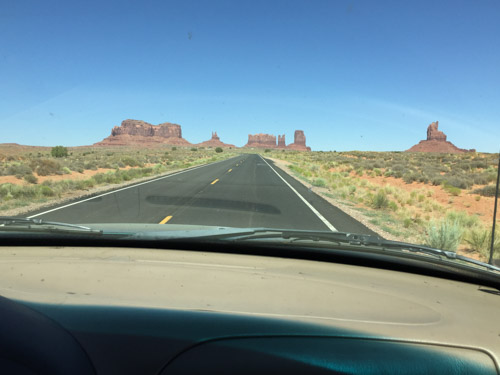
Most of the photos in this post were taken from the truck window at 70 mph. I found that I could sometimes roll the window down (yes, roll, there are no push buttons in this truck), sometimes remove the lens cap, and sometimes turn the camera on, but not always all three of those things.

DSC_1395

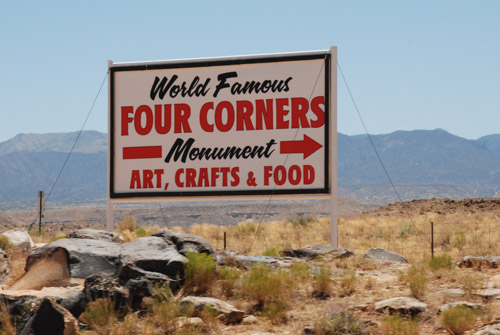
Four Corners is notable for being the only place in the United States where four states meet. It is also marks a boundary between the Navajo Nation and the Ute Mountain Ute Tribe Reservation. The Navajo Nation runs the Four Corners Monument as a tourist attraction.

IMG_2938

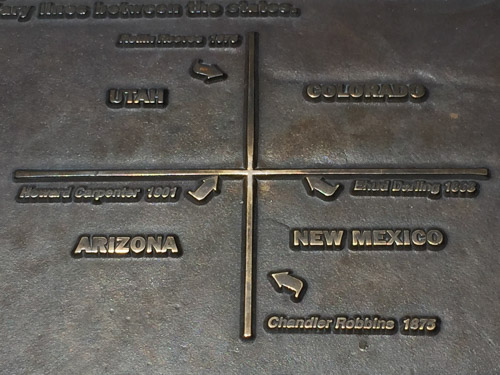
This is not the actual monument, but part of a sign about the surveying that began in the 1860’s. Wikipedia says, “the origins of the state boundaries marked by the monument occurred just prior to, and during, the American Civil War, when the United States Congress acted to form governments in the area to combat the spread of slavery to the region.”

IMG_2940

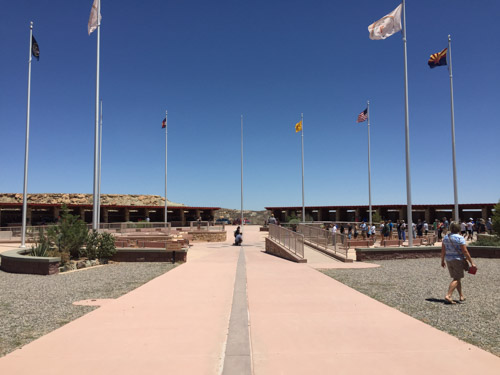
The marker itself is in the center of this courtyard. Notice the line of people to the right. They are all waiting to take their photos over the marker. We didn’t join them, but walked around the outside where there are stalls in which Navajo and Ute members sell souvenirs. Then we got back on the road.

DSC_1414

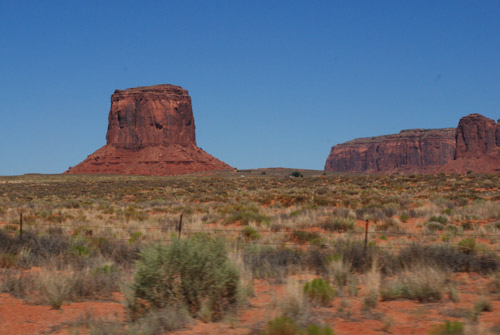
We took Highway 160 southwest to Kayenta where we turned north on Highway 163 to head back to Moab, but drive through part of Monument Valley. Wikipedia: “Monument Valley is a region of the Colorado Plateau characterized by a cluster of vast sandstone buttes, the largest reaching 1,000 ft above the valley floor…Director John Ford used the location for a number of his best-known films, and thus, in the words of critic Keith Phipps, ‘its five square miles have defined what decades of moviegoers think of when they imagine the American West.’ “DSC_1416

DSC_1419

DSC_1424

DSC_1435

DSC_1439

DSC_1446

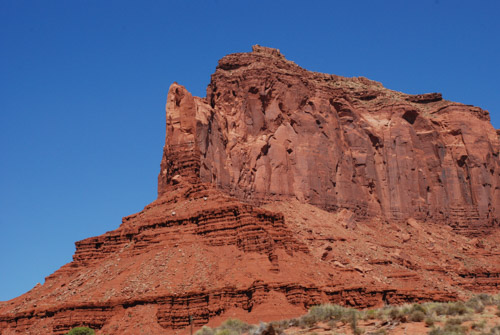
Spectacular country for it’s rock formations. A tough place to live on the land.

DSC_1459

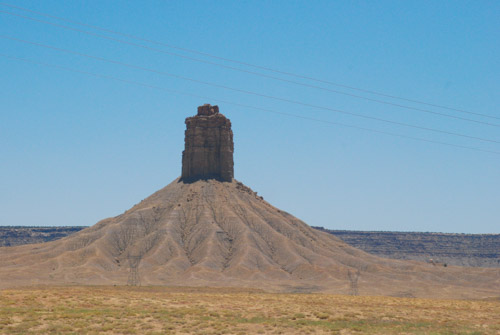
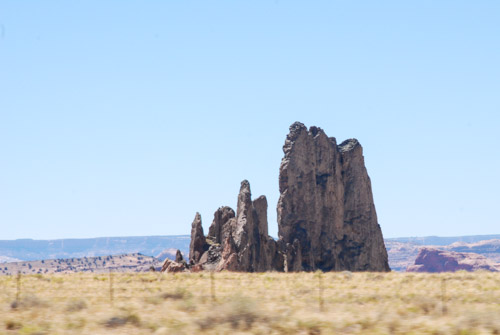
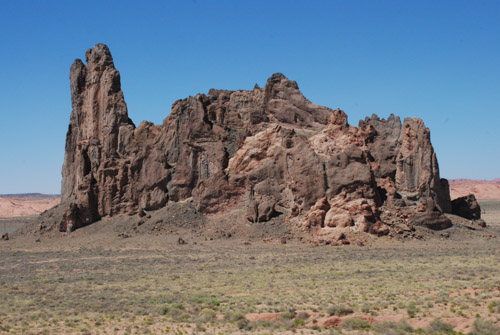
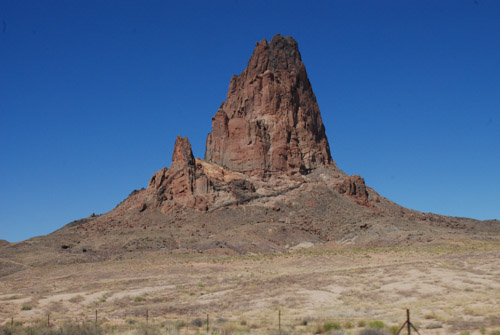
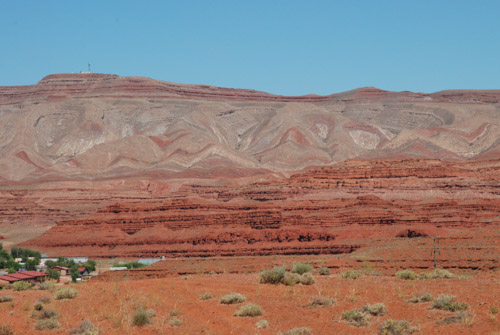
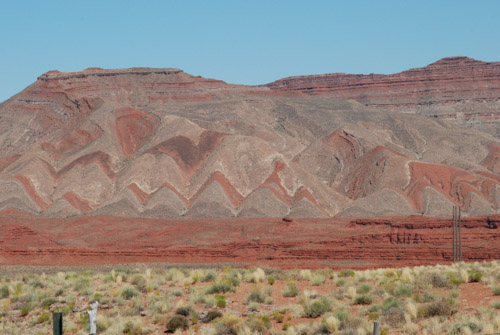
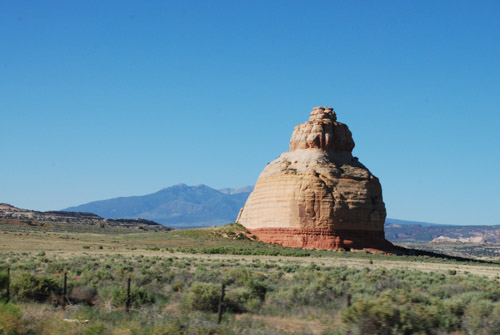
This rock formation kept us entertained for many miles as we drove closer and closer to it. I think it is just north of Bluff, Utah. I have googled a variety of words to describe this near both Bluff and Mexican Hat, Utah, but I don’t see any photos like this.

DSC_1473

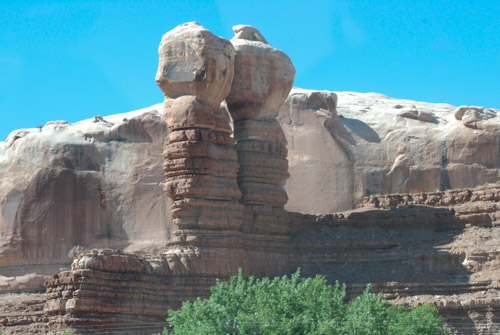
I do know the highway roughly followed the course of the San Juan River between those two towns. The rock formations that show up on-line are the Mexican Hat for which the small town is named and…

DSC_1474

…Navajo Twin Rocks near the town of Bluff.

IMG_2943

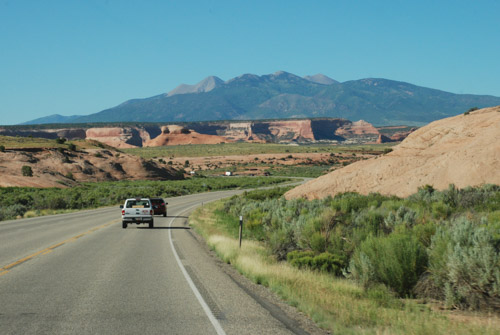
We continued to see red rock formations as we drove north toward Moab.DSC_1477

DSC_1486

DSC_1488

DSC_1499

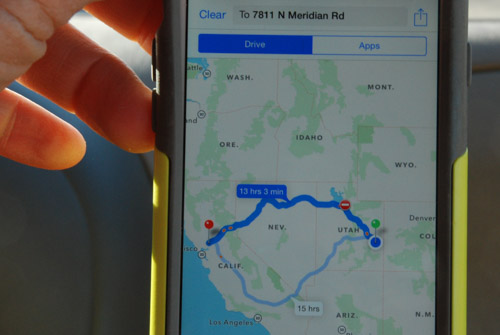
We hadn’t started the trip in Moab, but we’d been there just four or five days ago. I checked to see how long it would take to get home. I couldn’t get the phone to show me the route that we planned to take. We were headed to Highway 50 to cut straight across Nevada.

DSC_1494

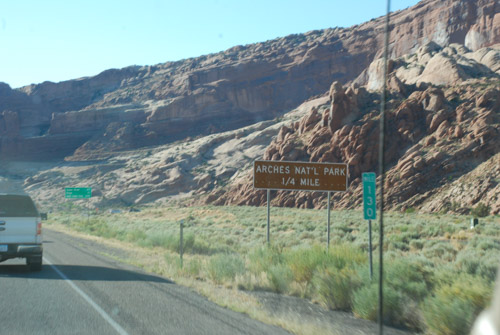
We passed Arches National Monument where we’d spent a day hiking

DSC_1507

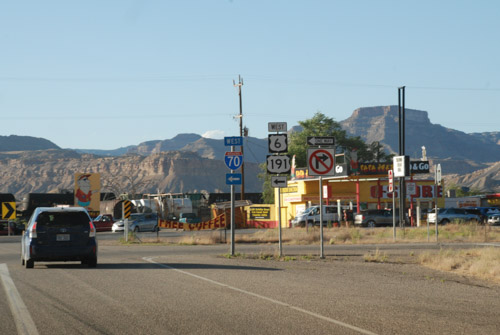
…and picked up Highway 50 at Crescent Junction.

DSC_1521

The plan was to drive west until we needed to stop.

DSC_1530

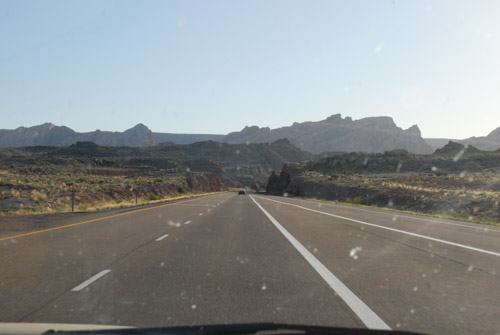
We’d seen some of this spectacular country but it looks different going the other direction.

DSC_1532

DSC_1533

We drove until it was took dark to take photos and then we kept driving.

To be continued…


Road Trip to CO – Mesa Verde

It has been a few weeks since we finished our road trip and there have been plenty of distractions since I’ve been back that have kept me from sharing the story. Now that the Olympics are on  TV I am trying to multi-task. But it’s hard to pull my eyes away from the TV at times.*  However I’m close to finishing–we are still in Colorado but once we headed for home we didn’t stop for much.

After we left Black Canyon of the Gunnison  National Park we looked at our trusty Benchmark map book for Colorado and saw that we could probably get to Mesa Verde National Park in time to spend the night there. So after driving through the marvelous San Juan Mountains it was a relatively short drive from Durango to Mesa Verde. We got there about 6 p.m. and found that there were plenty of open campsites.

DSC_1323

We looked at the Park maps and saw a couple of 2-mile trails that we would have time for before dark. First we hiked up to Point Lookout at 8427′ elevation. This view is to the northwest with the San Juan Mountains in the background and the town of Mancos in the center.

DSC_1295

Squirreltail…

DSC_1313

…and Indian rice grass along the trail.

DSC_1311

DSC_1321

DSC_1326

After getting hiking this trail we drove to the the Knife Edge Trail which follows a section of the precarious road built in 1914 which was part of the original main access into the park.

IMG_2869

IMG_0407

Dan took this photo of me with the booklet that described the plants and other features along this trail.

IMG_2866

IMG_2874IMG_2875

This is a popular place for park visitors to watch the sunset. We walked back to the car at dusk and it was dark when we found a campsite. With the dark it got cold and we didn’t have a working stove. We ate tuna sandwiches and went to bed. DSC_1358

This is what camp looked like in the morning.

DSC_1354-2.jpg

There were deer around the camp in the night and at dawn when I got up.

DSC_1366

Seen on my early morning walk.

IMG_2876

We had learned when we paid for our campsite that the way to see the features for which the park is best known (the cliff dwellings)  is to sign up for one of the tours. We showed up the next morning for the Balcony House tour.

IMG_2877

We were directed to follow the trail to the end where we would find a ladder and to wait there.

IMG_2881

This tour is listed as the “most adventurous cliff dwelling tour” and we were warned that we would “climb a 32′ ladder, crawl through an 18″ wide by 12′ long tunnel, and climb up a 60′ open cliff face with stone steps and two 10′ ladders”. Not quite an Indiana Jones adventure but it did seem challenging for some of the tour participants.

IMG_2882

Can you imagine what this was like when people really lived here?

IMG_2902

I can see the challenge of being a mother of a toddler.

The Ancestral Pueblo people lived in the Mesa Verde area for about 700 years from about AD 550 to the 1200’s, first living in pit houses, then above-ground pole and adobe structures. The people built the cliff dwellings from the 1190’s to 1270’s and lived there for less than 100 years. It is unknown why, in the span of a generation or two, the people left the area.

IMG_2910

Ranger Spenser was glad to answer questions and discuss his passion for the earlier residents of these dwellings.

IMG_2908

Each village or homesite has a kiva built below ground or in the case of the cliff dwellings, into the rock floor.

DSC_1386

This is the view across the canyon from Balcony House.

DSC_1384

This is the same view with a longer lens. It was remarkable that when you really started to look (or got out the binoculars) that you could see dwellings in many of the cliff walls.

DSC_1376

Here is another that we saw later in the day…

DSC_1378

…and here’s the close up. This is known as Square Tower House, a 4-story building.

IMG_2920

Remember the part about the 18″ x 12′ passage. Here it is…

IMG_2923

…followed by the ladders…

IMG_2924

…and steps up the cliff wall.

We drove through more of Mesa Verde, looking at some of the other sites, but knew that we needed to get on the road if we were to get home some time the next day.

Next post: Four Corners and Monument Valley.

*I still didn’t get this finished and now its the next day.

Road Trip to CO – Gunnison to Durango

We left home on Wednesday and planned to get home on the following Wednesday. This was Monday. We had driven the road north of the Gunnison River the day before and camped near the Blue Mesa Dam.

IMG_2788

This campsite was essentially a parking lot for RV’s, but we just needed a place to eat and sleep so it worked.

DSC_1131

The Black Canyon of the Gunnison became a National Monument in 1933 and was made a National Park in 1999, over twenty three years after I spent a summer in the area. It contains 14 miles of the canyon’s total 48 mile length.

IMG_2795

I guess they’ll take anyone as a Park Ranger.

DSC_1132

The canyon is so deep and narrow due to the power of the Gunnison River as it drops an average of 96 feet per mile.  The Gunnison loses more elevation in the 48 miles of the canyon than he Mississippi River loses in 1500 miles.

DSC_1194

It is a sobering thought that the power of this river is forever harnessed due to up-river dams that lessen seasonal flooding. Therefore, build up of sandbars and more vegetation has changed the ecology of the canyon.

DSC_1200

The Painted Wall was created over a billion years ago when molten rock flowed into fissures in the dark wall.

DSC_1177

That molten rock cooled into crystals of mica, quartz, and feldspar. Amazing patterns were revealed as the river cut through the rock, forming the canyon.

DSC_1166

Breakfast with a view.

DSC_1218

I enjoyed the signs along some of the trails to help with plant ID.DSC_1151

I recognized this bush with it’s remarkable fuzzy seed dispersal method, but couldn’t quite find the name in the recesses of my brain. Mountain Mahogany.

DSC_1206

I also recognized this as in the Mariposa Lily family. It’s called Gunnison Sego Lily.

We spent half the day exploring the canyon from the rim. There are no trails to the river in the Park. We saw a couple of trails when we drove along the north rim east of the Park, but they are not for the feint of heart or casual hiker. The rim views are spectacular enough. But we had limited time and needed to get on the road.

In the summer and fall of 1976 I worked  for the BLM in Montrose, Colorado. I had fond memories of renting a bunk house on property between Montrose and Ridgeway and spending weekends exploring the old mines and alpine meadows in the beautiful San Juan Mountains. I had never been back, but wanted to use this opportunity to drive through that country.

IMG_2812

As we were driving down Hwy. 550 I wondered if I would recognize the place. The highway followed the Uncompahgre River but was on the wrong side of the river. Surely I would have remembered living right next to a major river like that. My memory was that the bunkhouse was up against a bluff and just south of the big house. We got to a point where the river shifted course for a brief period to the west side of the highway and there it was. I’m glad to see that they place hasn’t been torn down and, in fact, looks as though it has been fixed up. The bunkhouse is just behind the red truck and, yep, there is a bluff behind it.

DSC_1239

The view heading south from the house. Not a bad place to spend a summer…or a life (if you can deal with snow).

DSC_1245

We drove south into the San Juan Mountains.

IMG_2814

I have memories of driving to Ouray and heading out from there towards Telluride to explore the mountains. I don’t think that these towns had the tourist appeal then that they do now.

IMG_2834

This is one of the most gorgeous places I can imagine. It’s hard to get photos that do it justice.

From dangerousroads.org “In the state of Colorado…there’s a special highway built in the late 1880’s: the Million Dollar Highway, part of the San Juan Skyway. It’s one of the nation’s most spectacular drives…The road’s winding design, providing stunning panoramic views, is very curvy and fun for a leisurely ride, so it pays to take it slow. Offering breathtaking mountain, valley and gorge views, the Million Dollar Highway is one of the most beloved roads in the country. This classic stretch of two-lane blacktop snakes its way through the San Juan Mountains, the wildest and most rugged peaks in the Rockies.”

From another website: “Originally built in 1883 by Otto Mears as a toll way from Ouray to the now abandoned town of Ironton, this two lane highway offers spectacular views of the San Juan Mountain Range, and Uncompaghre Gorge. The road was extended to connect Silverton and Ironton over Red Mountain pass, and operated as a toll road until the early 1920’s when it was rebuilt and became part of the present day US Highway 550.”

IMG_2829

Can you imagine the road when it was first built?

IMG_2828

Here a a panoramic view of the modern day bridge over Bear Creek Falls.

DSC_1249

Originally the road connected Ouray with the Red Mountain Mining District to the south.DSC_0239

There are signs overlooking the site of the Yankee Girl Mine, one of the richest concentrations of silver ore found in the U.S. It started in 1882 and produced ore valued in today’s market at over one hundred million dollars, but lasted only about 16 years.

DSC_1261

Just more pretty scenery.

IMG_2861

This is taken from Molas Pass (10, 910′), the second of three passes on this highway going towards to Durango.

IMG_2858

Loving the mountains.

IMG_2857

Fortunately I don’t have to carry my camera gear the way William Henry Jackson did when he documented the West.

Onward to Mesa Verde where we would spend the night.
Road Trip to CO – Leadville to Gunnison

The main reason that we headed to Colorado on this trip was so that we could be in Leadville when Dan’s brother competed in the Silver Rush 50, a 50-mile endurance run. We spent the previous afternoon walking around town and going on a self-guided mine tour. We had a pre-race meal of pizza and salad and went to bed.
In the morning we split up. Dan got up early to be at the race start with Rob and Renee and I slept in and met up with Sally and John to explore Turquoise Lake.

DSC_0184

Dan took these photos of the first part of the run. Rob is ready to go.

DSC_0188

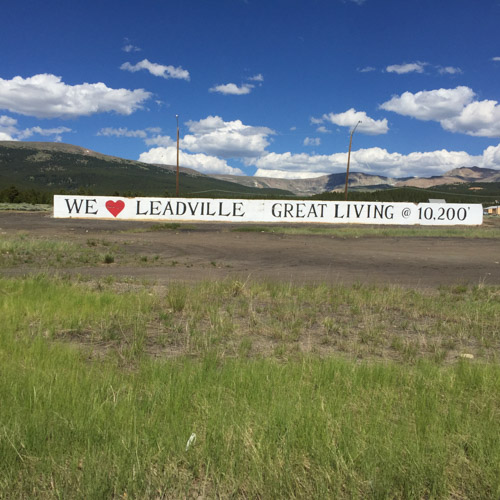
This run begins at an elevation 10,200′ and goes to over 12,000′. The runners have no difficulty getting their heart rates up right away even if they just walk up the first hill.

DSC_0199

Rob wore neon green (although we discussed repeatedly whether he was wearing green or yellow–it’s sure green in the photos) which was helpful when trying to pick him out on a mountain road.

DSC_0198

Personal support is allowed here, unlike in the Ironman last weekend.

IMG_2761

While Rob was running, my sister-in-law, Sally, and I went for a walk at Turquoise Lake, just a few miles from Leadville.

DSC_1026

DSC_0216

Rob was still on the trail…DSC_0213

…and made a shoe change…

DSC_0204

…while the spectators’ attention was diverted from the runners by a moose who wanted to cross the road.

IMG_2760

Sally and I finished our walk and headed back to town.

IMG_2765

We walked through a few shops to find some t-shirts and postcards. There was a price tag on this sheep, but even marked down to $2700 it was out of my price range.

IMG_2770

We met up with Rob’s support crew at the 25-mile turn around.

IMG_2764

As usual, I entertained myself with my camera while waiting for Rob to run through.

DSC_1034

I don’t know what this plant or the bug is.

DSC_1036

You don’t see a runner in a kilt everyday.

DSC_1041

We finally saw Rob coming in. Although he has run this event before, this wasn’t his day for it. He wasn’t feeling well and had been battling injuries. He had events coming up (including last weekend’s Ironman) and thought it was prudent to stop at the 25 miles mark (as if running almost a marathon isn’t enough for one day). So we ended the day in Leadville early and left town by mid-afternoon, following Rob and Renee to Buena Vista where we would meet for lunch.

DSC_1054

This is Mount Elbert, the highest mountain in Colorado. How do I know that?

DSC_1056

This is why we like these map books. We can follow along and identify points of interest. If we have cell service then I can look up more info, but on this trip cell service definitely wasn’t reliable. We enjoyed a meal with Rob and Renee before they had to head home, we stocked up on groceries, and we continued on our trip.

DSC_1073

Smoke from one of the fires burning in Colorado.

IMG_2781

IMG_3402

We had decided to find a place to camp somewhere near Black Canyon of the Gunnison National Park. The park encompasses the narrow band of land (and cliffs) along the river below where it has been dammed (from center to upper left in this photo). It was late in the day when we got to the dam that creates Blue Mesa Reservoir (right in photo) and we had to decide what we had time to do. We decided that we would drive the road on the north side of the canyon along the narrow Morrow Point Reservoir (which is not in the park) and enter the park the next day by driving in at the southwest entrance.

DSC_1085

The Pinnacles on Blue Mesa Reservoir.

DSC_1099

It was a spectacular drive on the road that follows the canyon. There are plenty of places to get out and take a look into the canyon.

DSC_1101

We stood high above buzzards circling on the wind currents. That is three buzzards roosting in the center of the photo. I took lots of photos of the spectacular scenery as the sun was getting lower but this post is already over-full of photos.

DSC_1108

This photo was taken from the last overlook on this drive–or at least the point where we needed to turn around to go back to the campground we had seen. That is the San Juan Mountains in the distance, which we’d be driving through the next day.

IMG_2786

After our shopping trip in Buena Vista we had a hot meal planned, but the camp-stove wouldn’t work. Tuna sandwiches for dinner again. Dessert was a deliciously gooey melted giant chocolate kiss.

Road Trip to CO – Moab to Leadville

I’m finally back to my photos of our Road Trip. I left off at the blog post about hiking in Arches National Park on our third day out. After a full day of hiking we headed northwest from Moab on Highway 128 that follows the Colorado River. Just after dark we found the Lower Onion Campsite just above the river. We enjoyed the mosquito-less evening while eating a hasty meal of beans and salad and went to bed planning on an early start the next day.

DSC_0967

Here is a view of our camping spot in the morning…DSC_0968

…and the cliffs beyond the river as the sun came up.

DSC_0983

The red rock landscape of Moab changed to more typical desert as we headed north to I-70. We spotted our first prairie dogs along this stretch of road…

DSC_0985

…followed by pronghorn. Not a desolate road at all if you pay attention.

DSC_0996

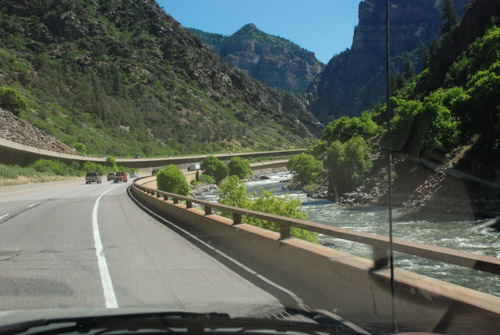
Our goal was to get to Leadville, CO by noon to meet up with Dan’s sister, brother, and their spouses, so we didn’t stop much along the way, but I took photos from the truck. I marveled at the engineering of this stretch of highway between Glenwood Springs and Vail.

IMG_2695

The eastbound lanes are just above the Colorado River and the westbound lanes are elevated to fit within the canyon walls, sometimes overlapping the lower eastbound roadway.  There is also a paved bike/running path right at the river’s edge. IMG_2696

At this point the highway is at about 8000′ elevation. We turned south on Highway 24 that would take us to Leadville at over 10,000′.  As we climbed into the mountains we had to stop at top of one of the switchbacks to take a look.

DSC_1004

Farther up we came to the Camp Hale Memorial. This meadow is the site of a U.S. Army training facility built in the 1942 and decommissioned in 1945. According to Wikipedia “Soldiers were trained in mountain climbing, Alpine and Nordic skiing, cold-weather survival as well as various weapons and ordnance. When it was in full operation, approximately 15,000 soldiers were housed there.”

DSC_1001

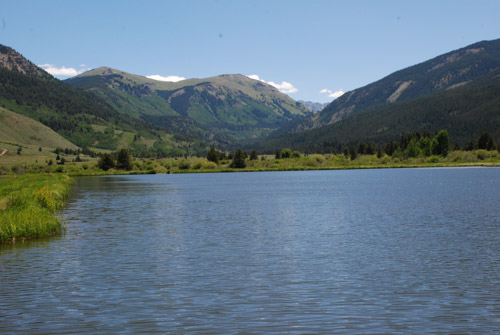
This is a view from that meadow looking east up the canyon to Sheep Mountain.

DSC_1010

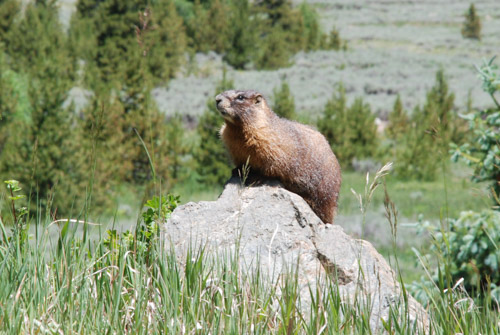
A marmot posed for me while reading the roadside memorial signs…DSC_1013

…and this bee flew into this columbine just as I was taking a photo.

IMG_2723

Entering Leadville.

IMG_2706

We wandered around the downtown for awhile…

IMG_2712

IMG_2704

DSC_1022

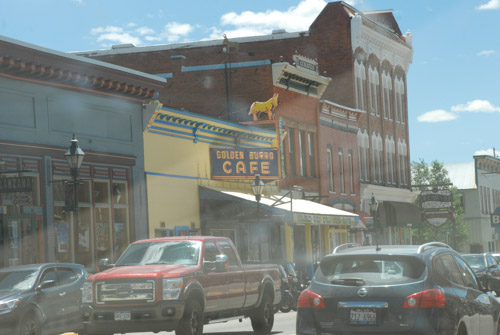
…and then met Sally and John for lunch at the Golden Burro Cafe.

IMG_2716

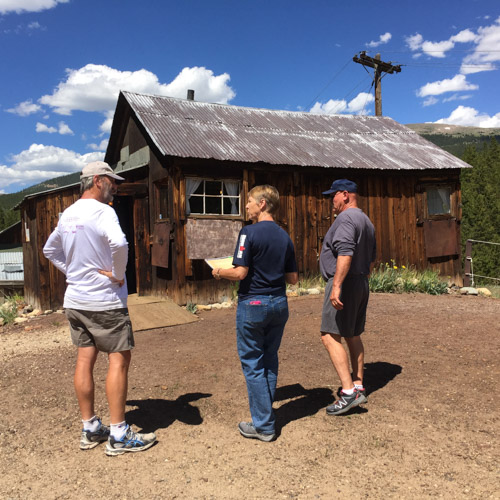
After lunch we took a self-guided tour of the Matchless Mine. “The Mathcless Mine, a historic silver mine purchased in 1879 by H.A.W. Tabor, was estimated to have produced 7.5 million dollars during its peak operating years. Once fabulously wealthy, the silver market crash of 1893 devastated the Matchless Mine and the Tabor Family. Upon Tabor’s death his widow, Elizabeth “Baby Doe” Tabor, returned to the Matchless where she remained in isolation for until her death in March of 1935.” This is the cabin where “Baby Doe” lived until her death.

IMG_2721

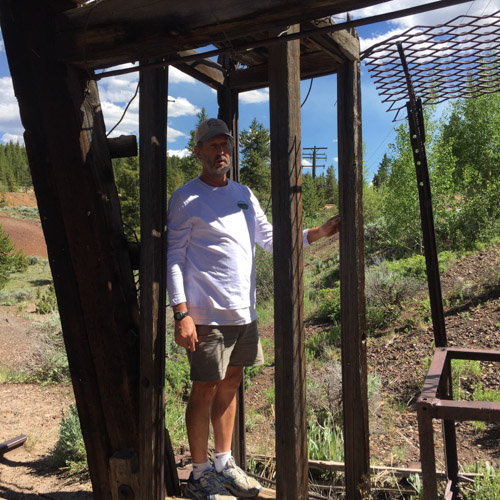
Dan is standing in the phone-booth size structure that would lower miners hundreds of feet below ground. We watched a video that shows a 3-D image all the tunnels and shafts below us. I don’t remember the stats but the distances are staggering to think about.

After the mine tour we met up with Rob (Dan’s brother) and Renee and we all went to the Leadville Cemetery.

IMG_2739

My father-in-law’s grandparents are buried here and following his death just this spring, this was an meaningful stop for the family. We spent some time here before returning to our motel, eating pizza, and making plans for the early morning start of the Leadville 50–an ultra run that Rob was had entered.

DSC_0171

This was our one “civilized night” and I spent a little time trying to catch up with e-mail and thinking that I’d start my blog posts. Nope. We were tired and I wasn’t motivated enough to interrupt the vacation!