Unknown's avatar

About Robin

Owner of Meridian Jacobs, farm and fiber shop. I raise Jacob sheep, teach fiber arts classes, weave handwovens for sale, and manage the store.

Granddaughter Visit – State Fair Show Day

I realize as I’m writing this post that is more about the sheep show than about Kirby, but she starred in the last post, and the sheep show is why we were there. The Heritage Breeds show was on Sunday, the last day of the sheep show. I am the person who, several years ago, asked State Fair to include a Heritage Breeds show so that those of us with Jacob, Icelandic, Navajo-churro, Shetland, to name a few of the breeds that have shown there, could enter. The entries slacked off towards 2019 and then there was the pandemic. Since the fair has been back, Kirby’s sheep and mine have been the only entries in this division.

This year a Karakul breeder from Southern California entered. so we had competition.

This has nothing to do with the sheep show, but it is another animal with impressive horns. The longhorn cattle are in the other part of the barn during the sheep week. Their show was also Sunday afternoon.
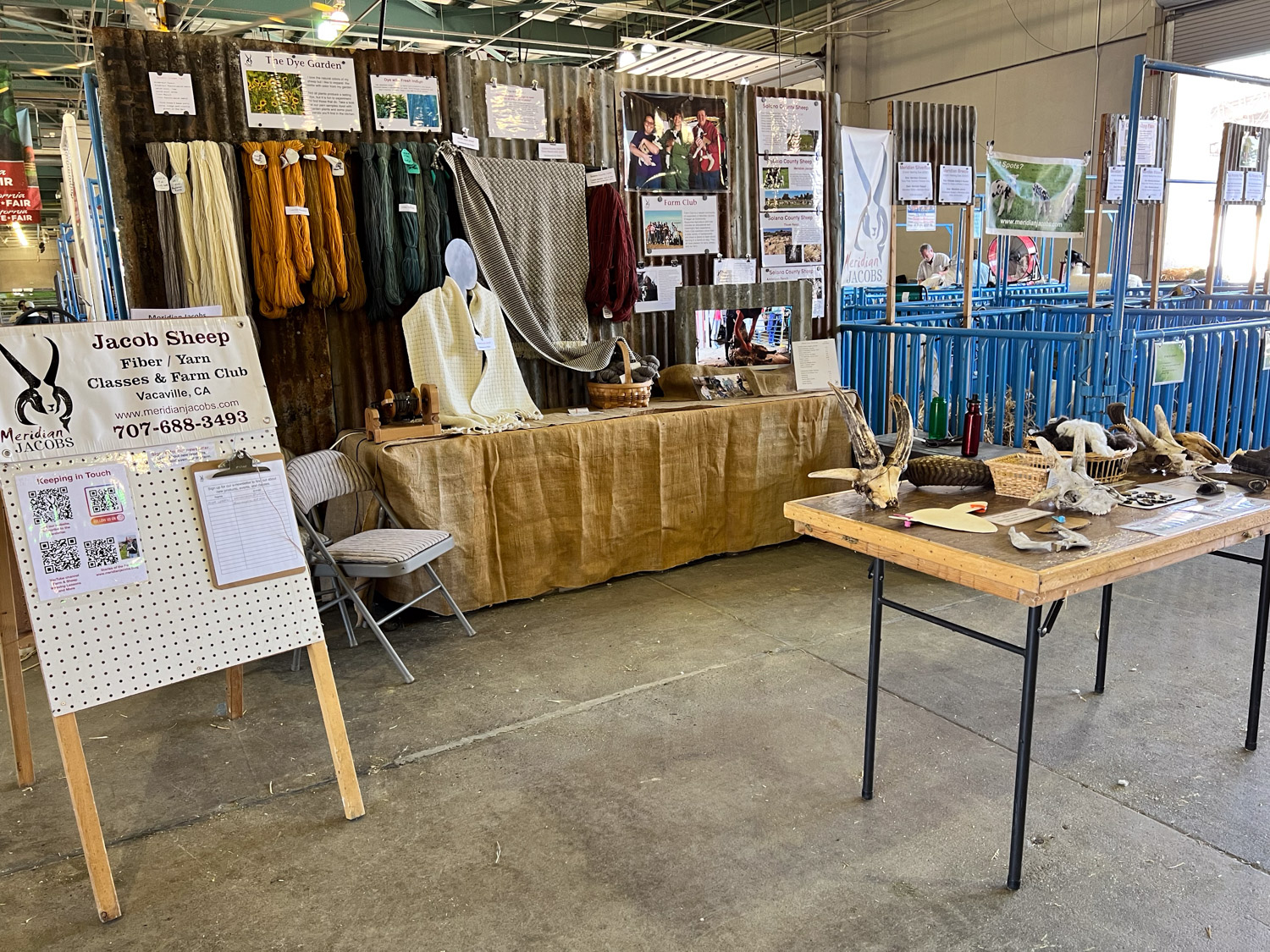
One of the reasons that I originally wanted to show sheep here is that I thought I could be competitive for the Marketing Award. I spend a lot of time in preparing the different components of this display. It is probably more educational than marketing, but I am marketing more than sheep–for me it’s about the other parts of the business, all related to the sheep and wool.
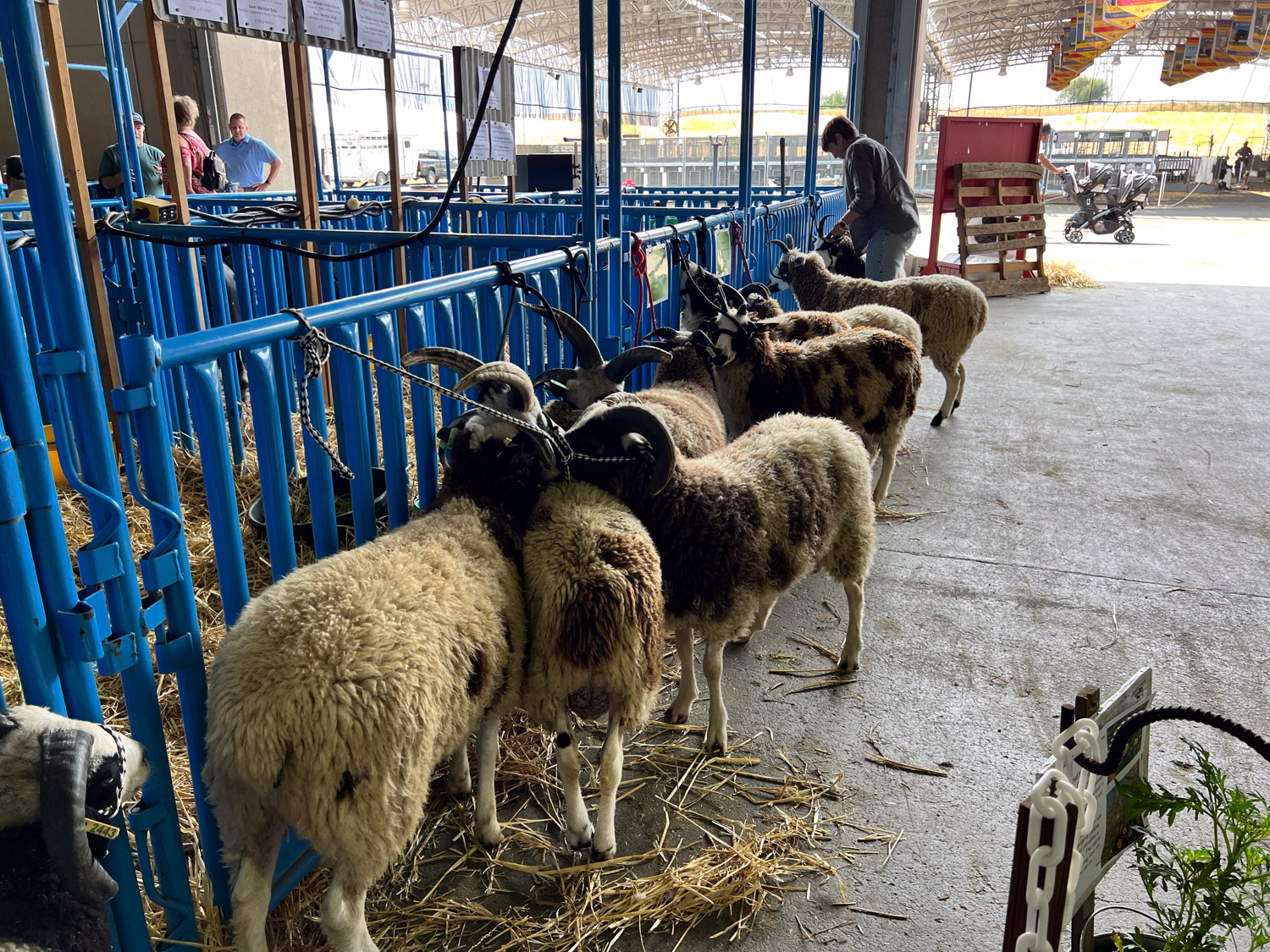
Before the show we got all the sheep on halters and brought them outside the pens to get the straw off the bellies. In the morning Kirby and I spent a few hours with sheep at the wash stalls trying to scrub feet and legs and clean horns. Jacob sheep are shown in a natural state at the fiber shows where I have seen them, and I would not show at all if they were expected to be fitted. I do feel as though they look out of place compared to all the other sheep at this show.
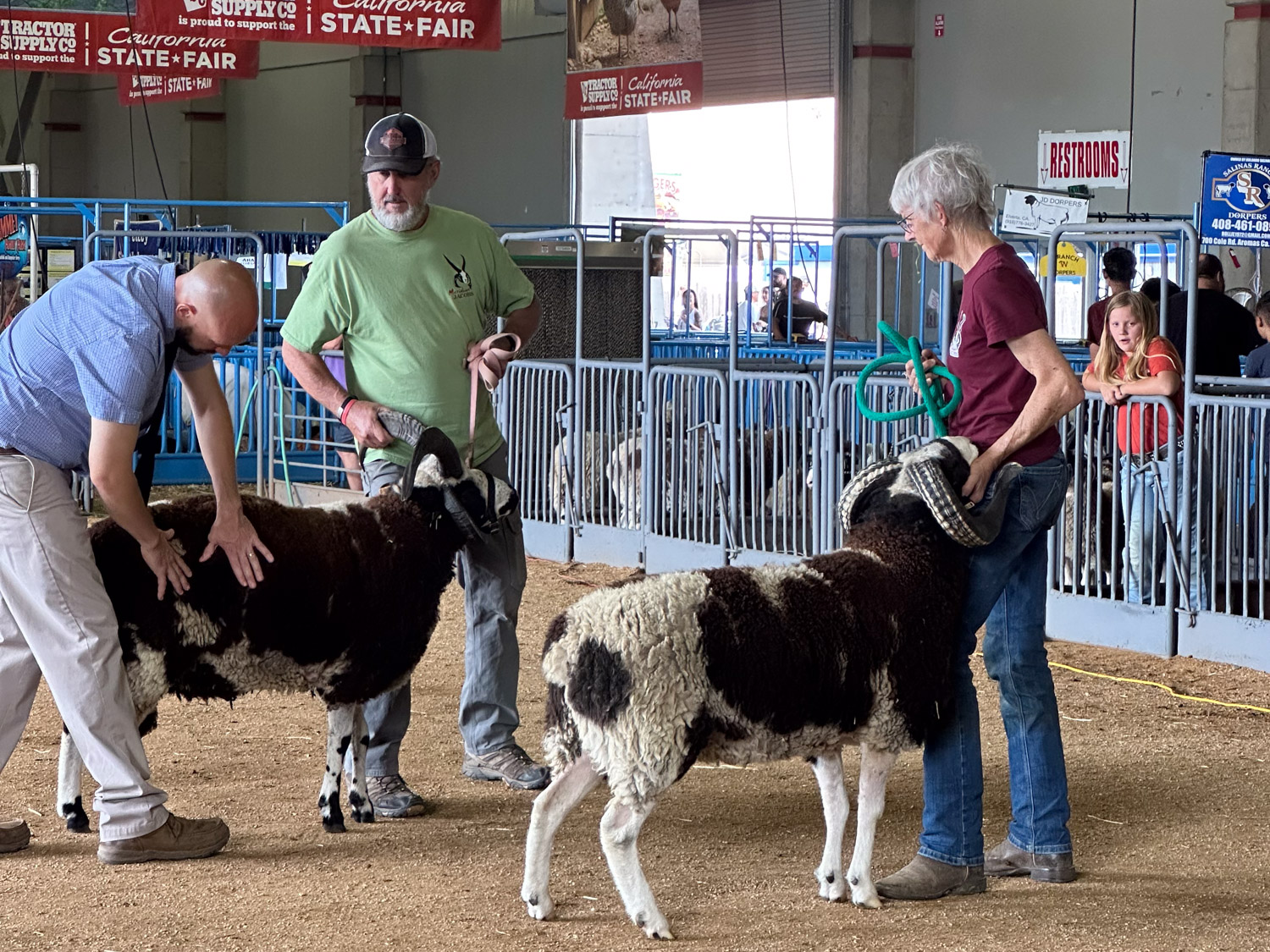
The first class was Yearling Rams. We took first and second place because mine were the only two in the class. There was competition in all the other classes and the Karakuls mostly placed over the Jacobs. That’s OK–it’s a good lesson that you don’t win just because you show up.
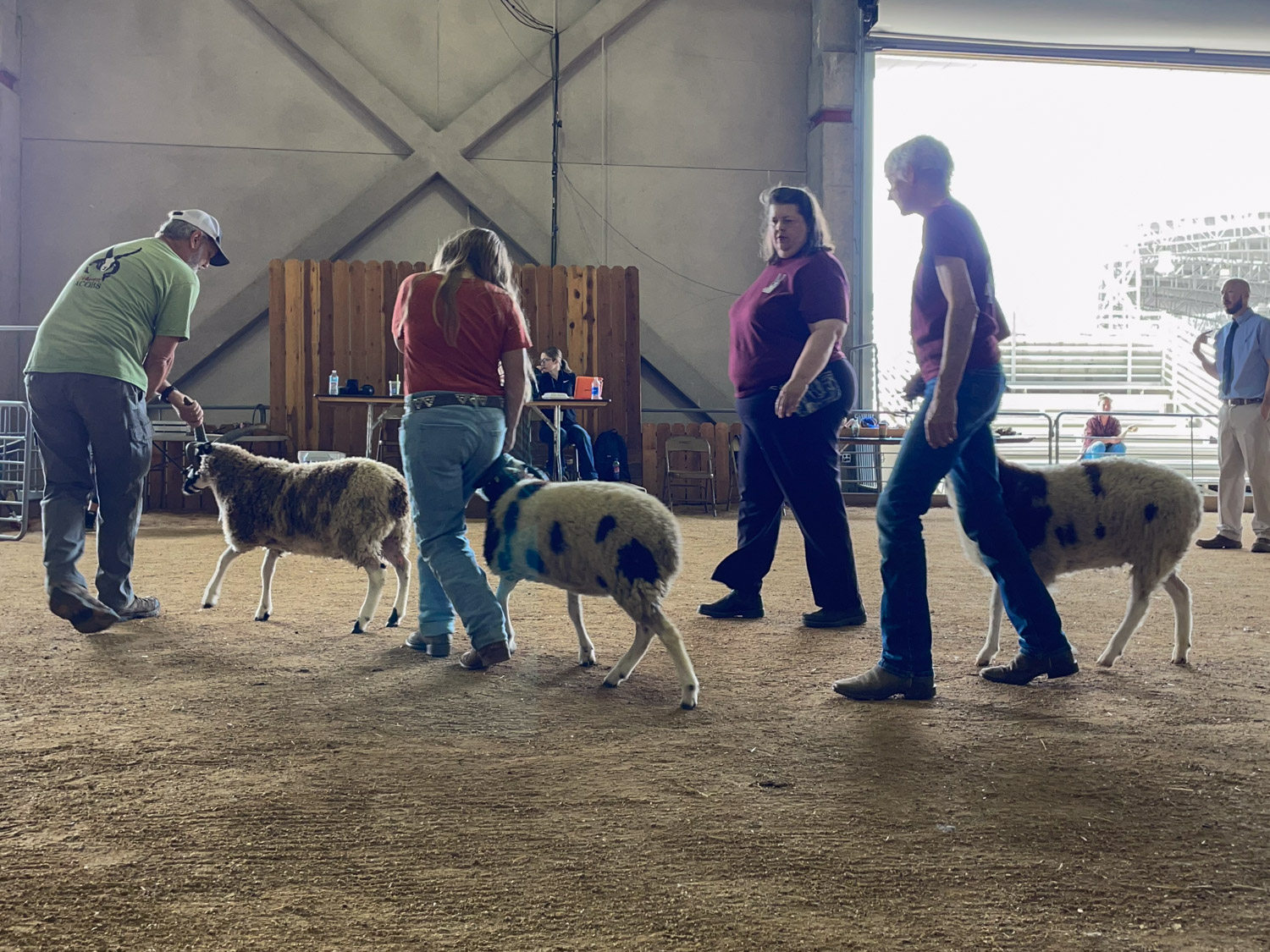
Both Kirby and I had 2 sheep in each of the other classes (yearling ewes, ram lambs, ewe lambs). That meant that we needed four of us to show sheep and I wanted one person to be available in case Kirby had trouble with her sheep. I don’t have any good photos of Kirby in the show ring, but she was able to show her own sheep. She is in the middle of this photo and the one below.
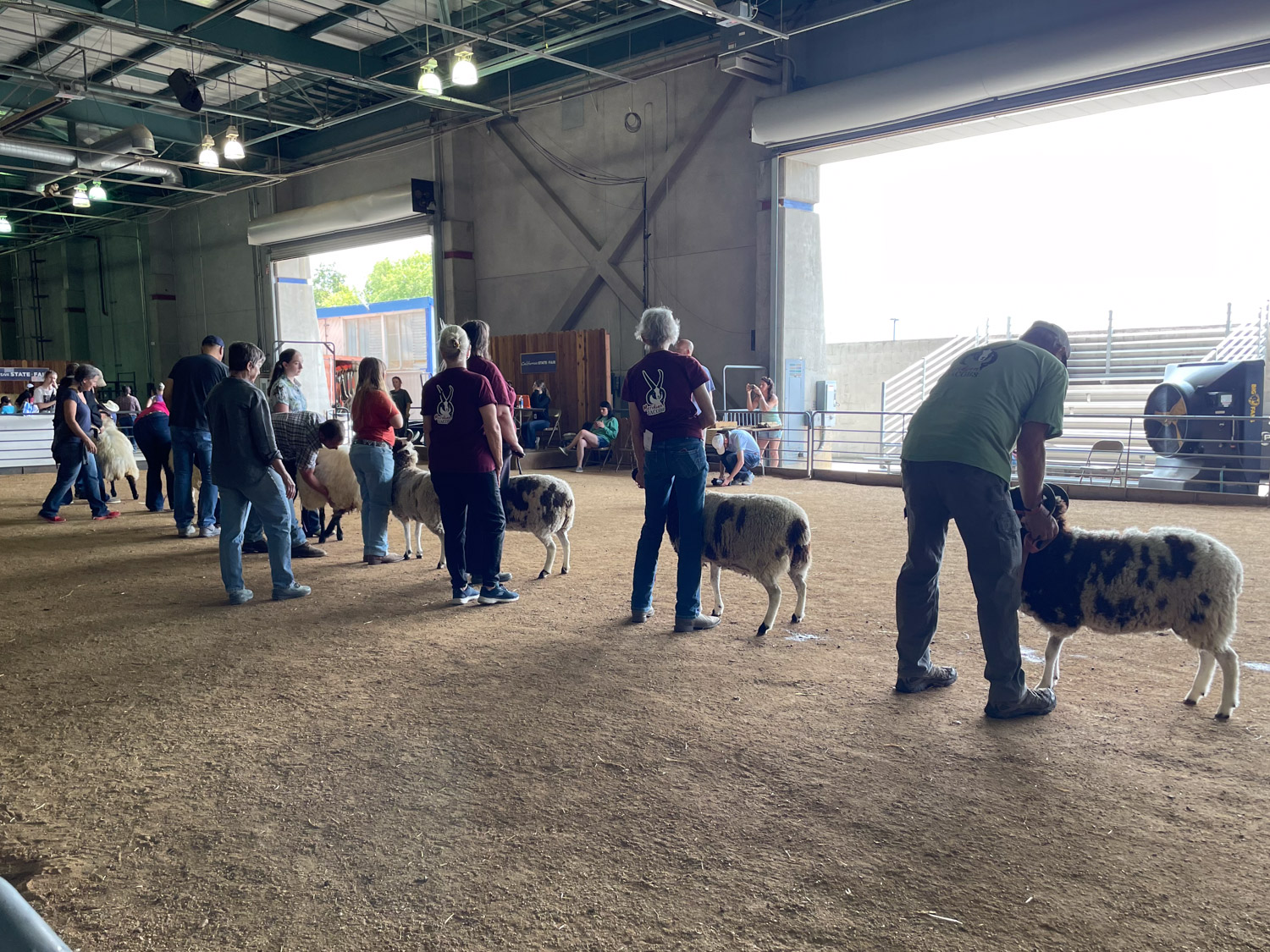
There were just enough Farm Club members here on show day to help with this.

The last few years we have had a ram and/or a ewe in the Supreme Champion classes, the last event of the sheep show. Not this year.
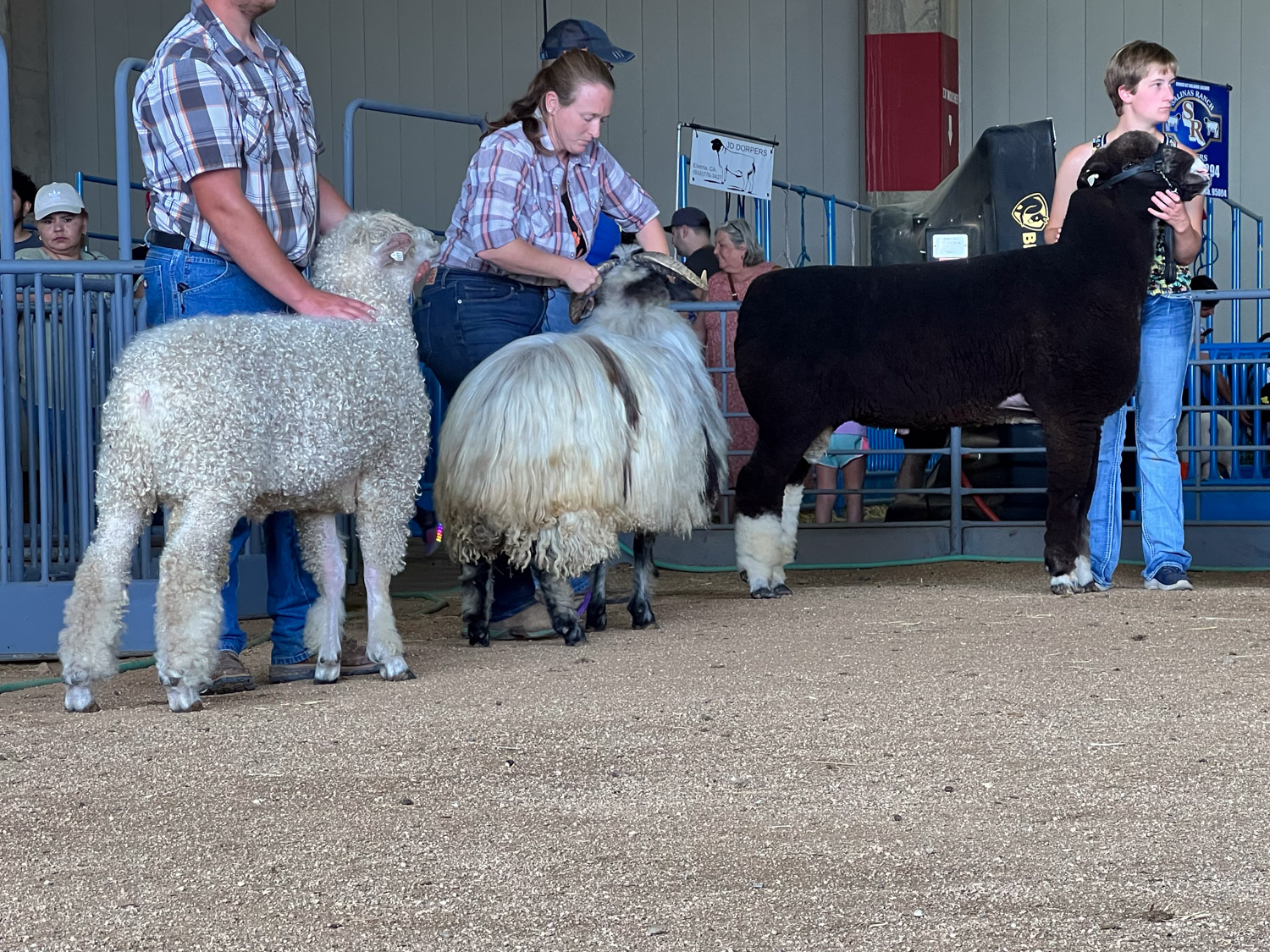
These are the winners of the last three divisions in the show. There is the Natural Colored ram, bigger than any of the other breeds in the ring, the Karakul representing the Heritage division and the winner of the All Other Breeds Wool division, a Cotswold I think.
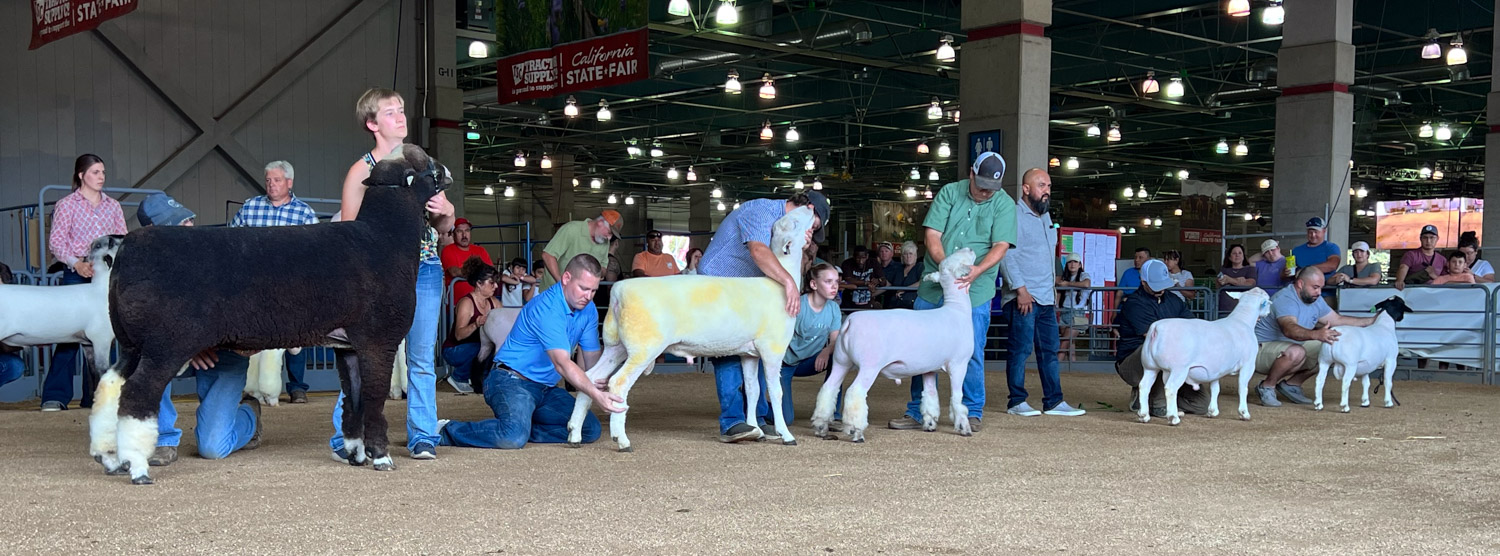
The judge pulled his five favorites out of the line. From right to left, Dorper, White Dorper, Southdown (I think), Dorset (I think), and Natural Colored. One of the Dorpers was the winner.

After the Supreme Champion show they announce winners of the Marketing Award and Herdsman, both awards that are not for the sheep but for the appearance and presentation of your space. Many of the exhibitors don’t include any signage or have any interaction with fair visitors. These awards are meant to be encouragement for exhibitors to provide information for the public.
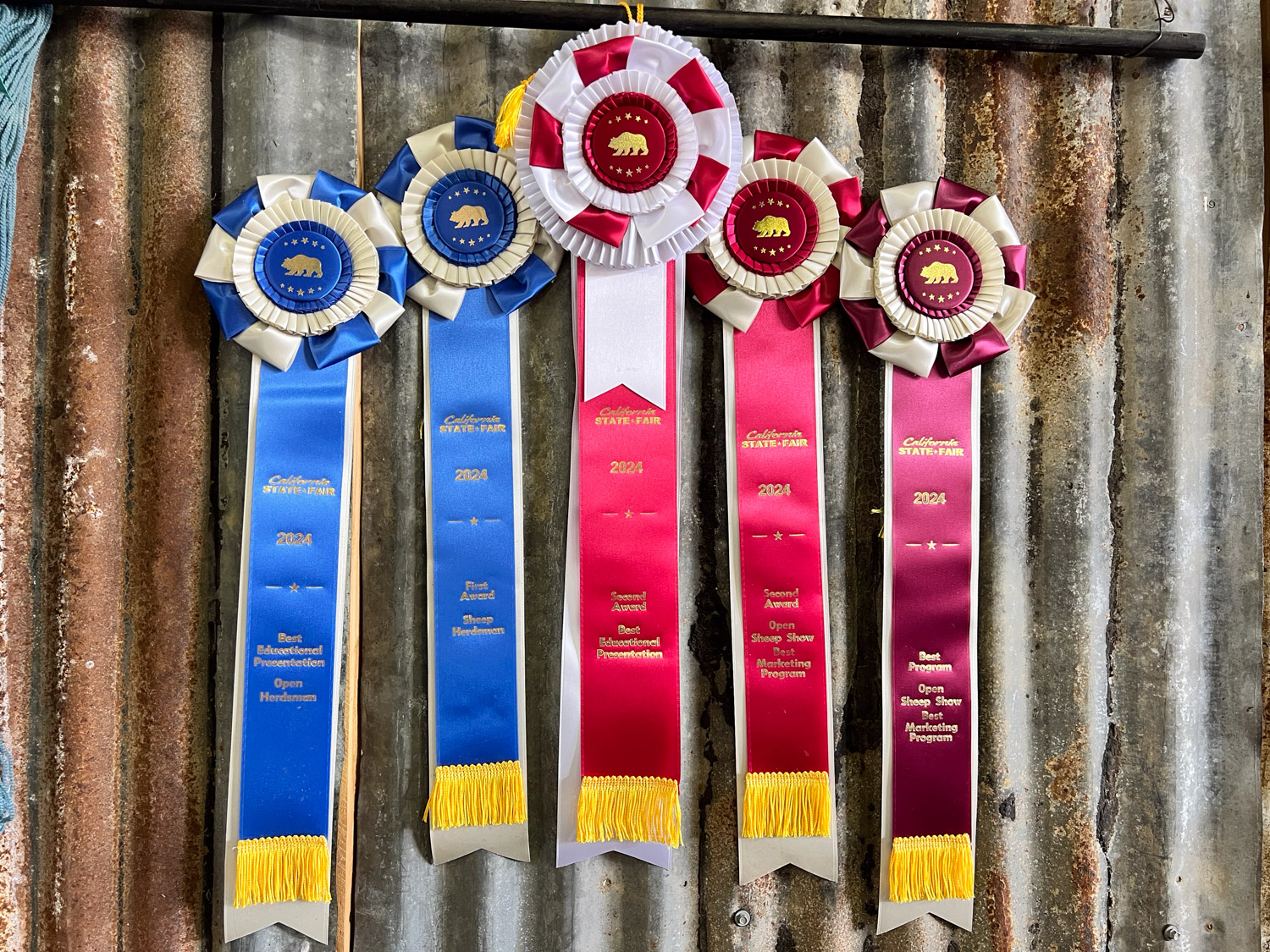
For the sheep and goat show I got 2nd in Marketing overall, Best Program in Marketing, 1st in Herdsman and Best Educational Presentation in Herdsman. I also got 2nd for Best Educational Presentation over all the livestock shows during the run of the fair.

Last year Kirby’s birthday was at the fair. This year her birthday was the following day. She chose the activity and that will be the last post about her visit.
Granddaughter Visit – State Fair 1

A couple days after our Airbase Tour it was time for State Fair. We had worked with the lambs every day since Kirby got here nine days prior to the fair, but I didn’t get any photos then.–too busy. For the last couple of years Kirby has had a long enough visit to California to spend time working with the sheep and then going to the fair.

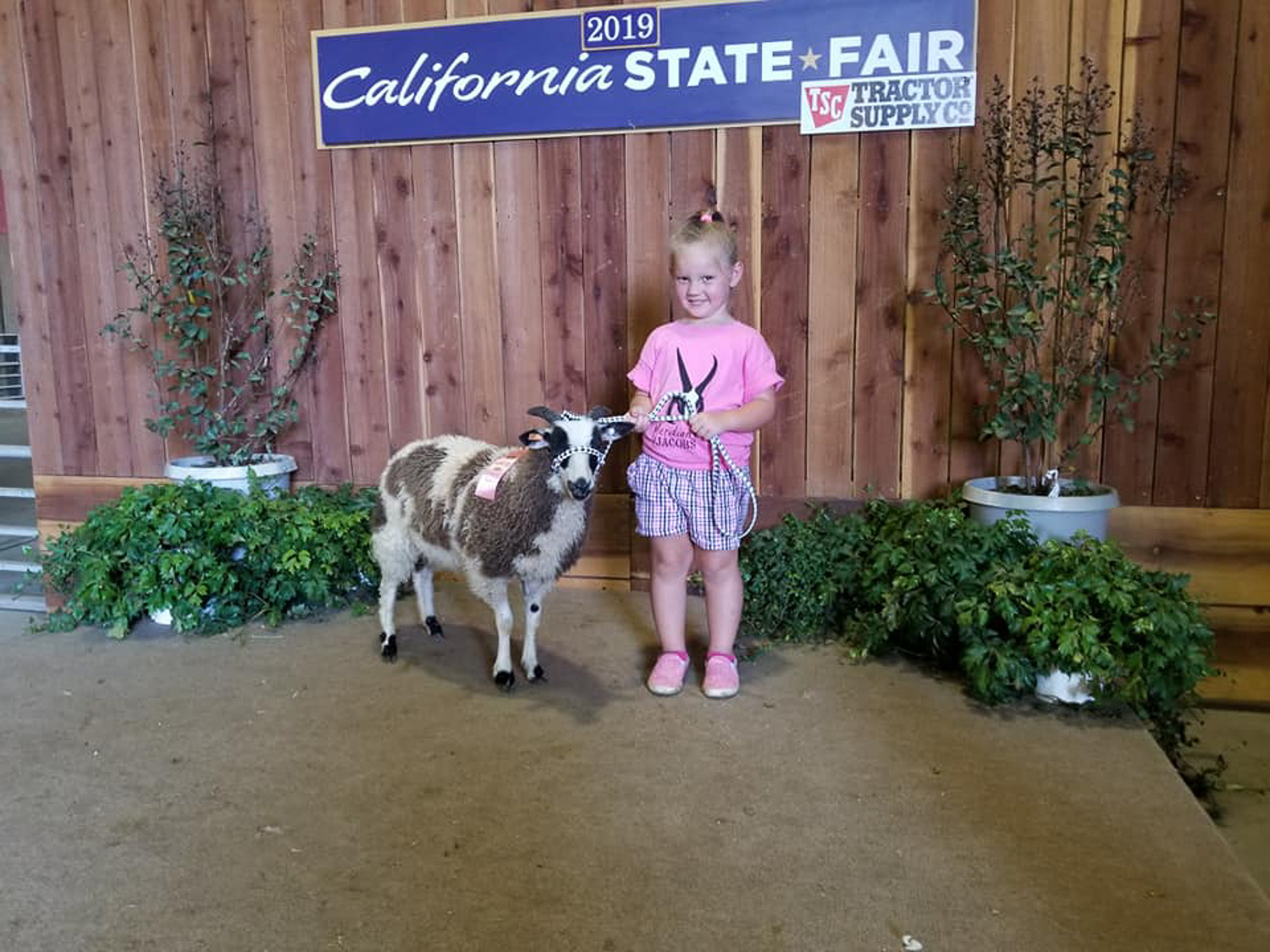
I gave Kirby her first lamb in 2019 and she showed at State Fair that year. There are photos in that blog post on my website, but the one below is one of my favorites.

This is Meridian Belle as a lamb in 2019. Kirby’s flock has grown to include Belle’s daughters, Beauty (2021), Rose (2022), Cindy (2023), and Jingle (2024) and their offspring. Beauty’s daughter is Belleza (2023) and Rose’s daughter is Lily (2024). There have been male offspring as well but I haven’t kept them. We may keep one of the rams this year. Kirby’s flock prefix is KJ Royalty.

The sheep arrive at the fair on Thursday of the third week.

I forgot to take a photo of the space before we unloaded sheep. First thing is getting sheep out of the trailer, vet check and then putting them in pens. We have a lot of other stuff to unload because of the display that I do. That will be another post.

Kirby enjoyed taking her sheep out to share with the public and so that they get calmer when being handled. This is KJ Royalty Jingle, Belle’s daughter.

We used to show dairy cattle at the State Fair and Katie (Kirby’s mom) was a little younger than Kirby is now. At that time people from the Livestock Office took visitors on barn tours. Katie would spend time at the end of the line-up of cattle and talk to people. I remember hearing one woman telling another “that little girl knows more than the tour guide”.

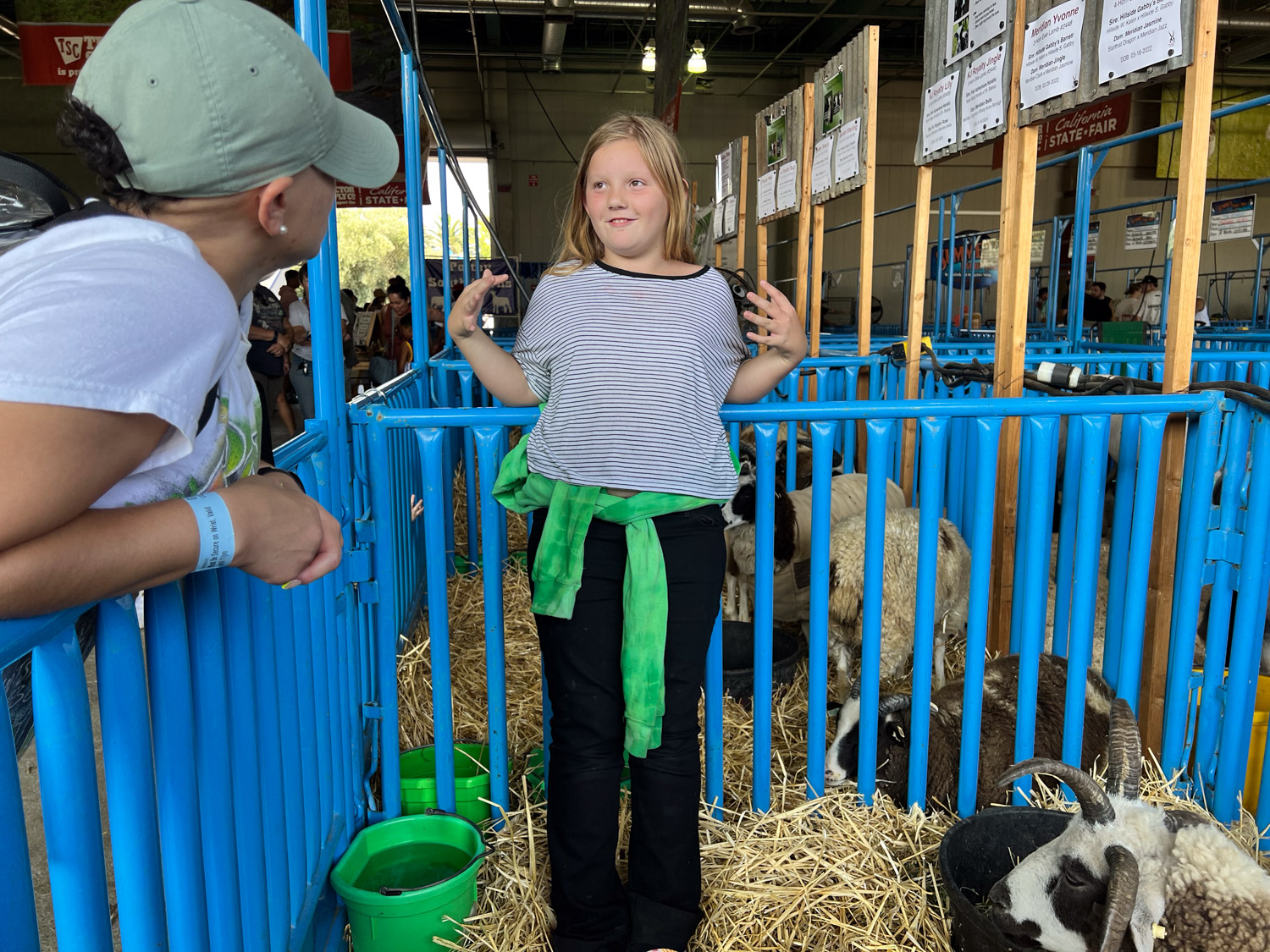
Kirby is also good at engaging visitors and answering questions.

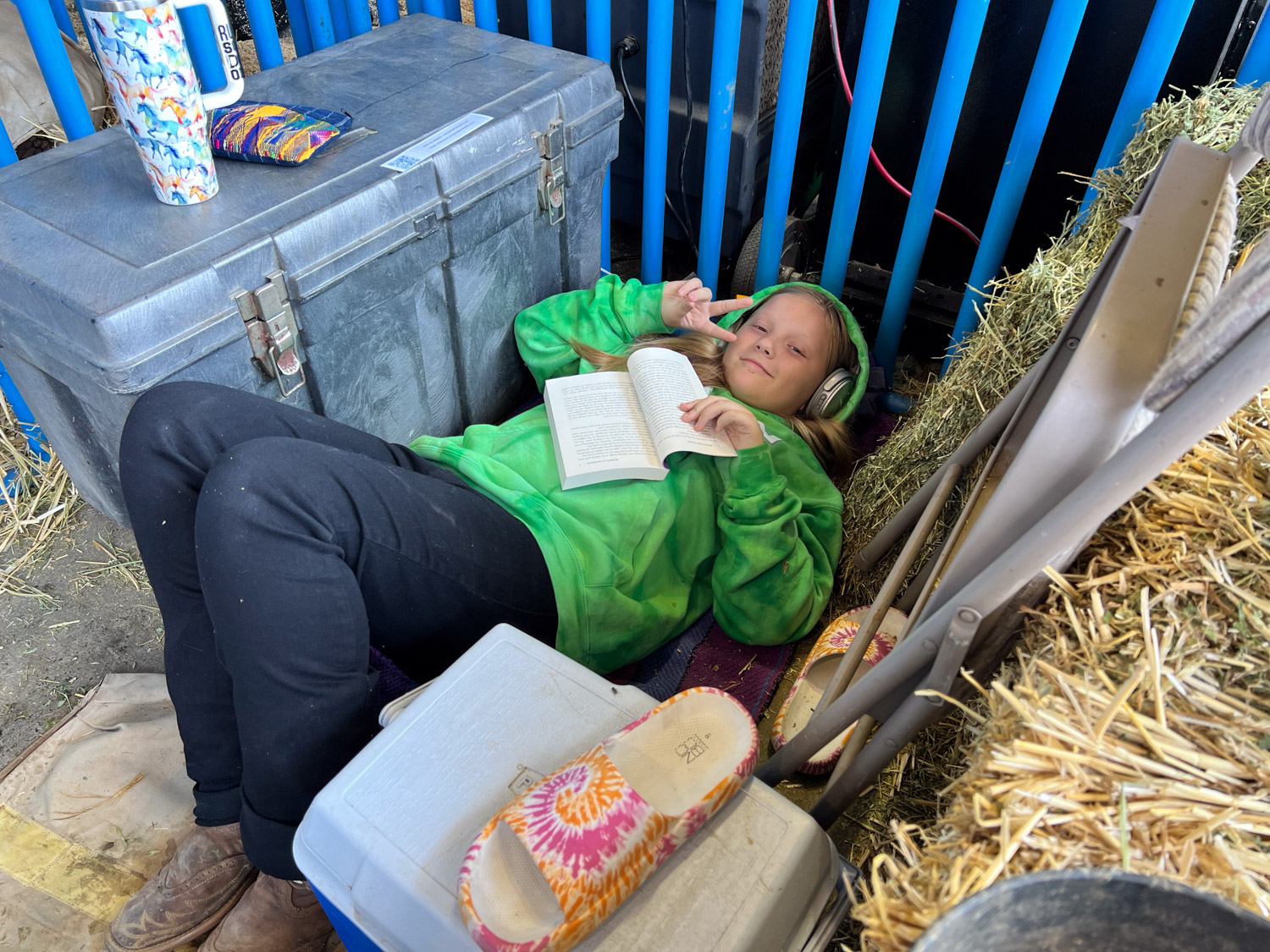
Sometimes you need a break from it all…

…and then maybe a nap.

After a break it’s time to go back to engaging the public.

KJ Royalty Lily, Rose’s lamb.

The signs over Kirby’s yearling pen.

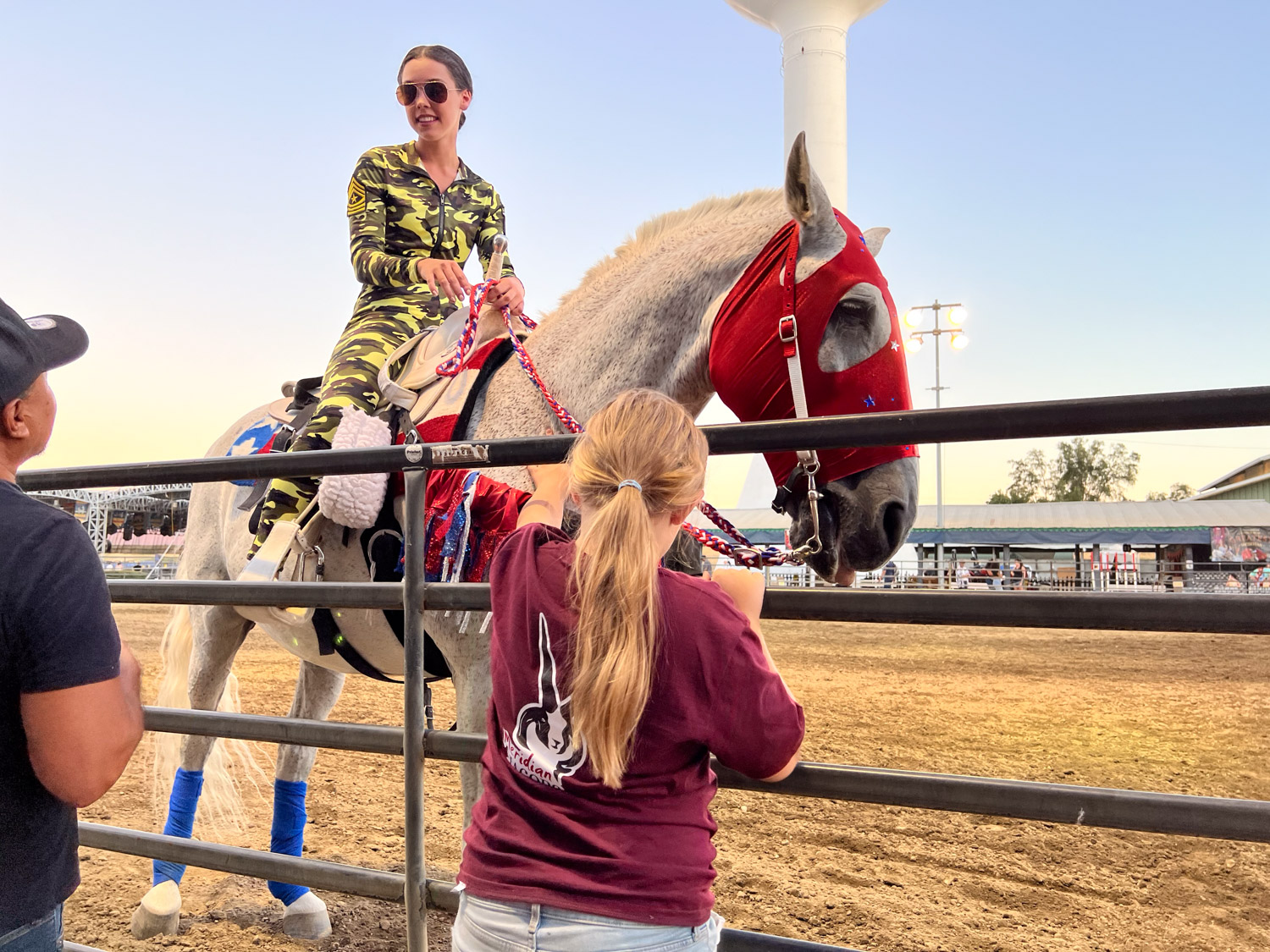
When friends were at the fair I was able to walk around with Kirby a bit. We spent a lot of time at the Cavalcade of Horses, where different horse performances happen every hour.
A display presented by the California pear industry.

Granddaughter Visit – Airbase Tour

The previous two blog posts were about Kirby’s two-week visit in July. On Tuesday of the second week we drove to McClellan Air Force Base, no longer a military base, for a private tour by Matt. Dan’s sister and my brother joined us.
We started at the building used by the USFS for operations and training. I have a general idea of what Matt does at work, but it is sure different to see the details. He is a Helicopter Operations Specialist for the Pacific Southwest Region and spends time in the air managing helicopter operations and coordinating the air traffic over fires (water drops, retardant drops, keeping planes and helicopters from flying into each other). He has an office in this building as well.

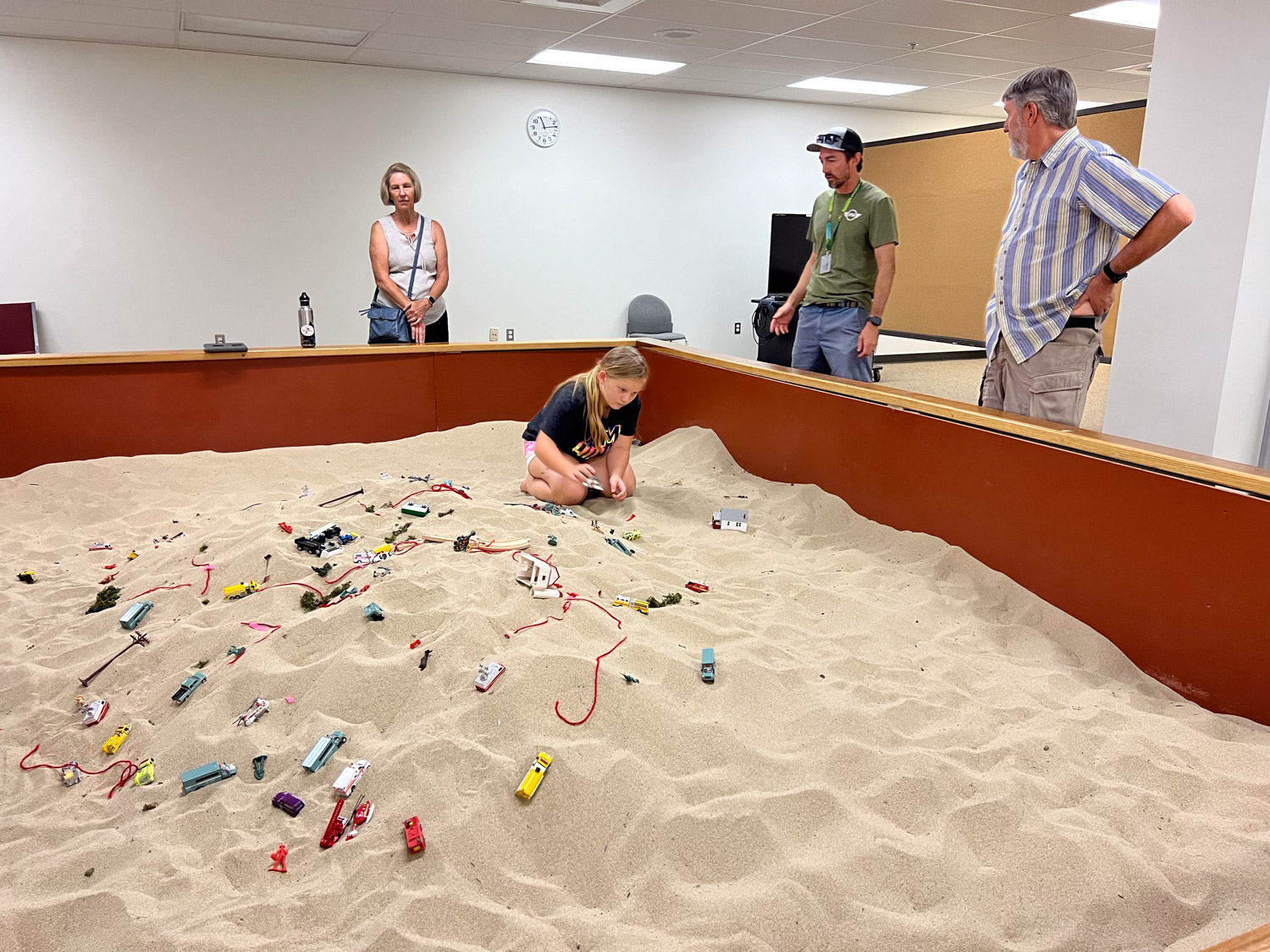
Since this tour I have heard reference to fire strategy training with the sandbox, but I would have had no idea what that meant before seeing this. There are at least two rooms with sandboxes of various sizes. They use red and black yarn to designate active fire and burned areas.

There are toy vehicles, buildings, trees, animals and more. When in use the sand can be moved to create geographic features so that firefighters can discuss fire behavior and fire fighting strategies.

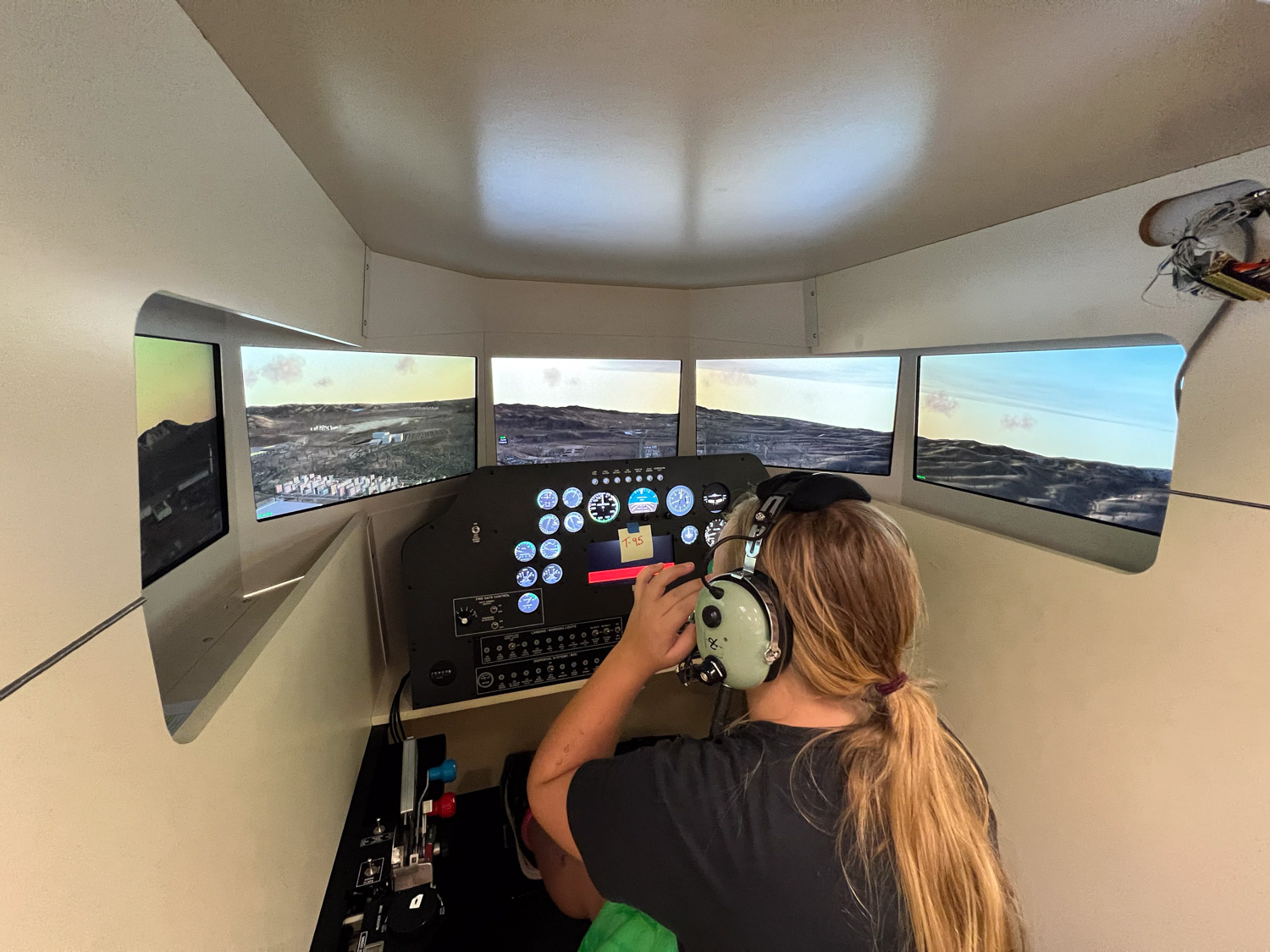
After looking at the sandbox rooms we went to the simulator room. There are probably a dozen simulators for airplanes and helicopters.

We all had a chance to try the simulator. It’s not easy.

Dan and Kirby were both in the airplane simulator here and my brother tried the helicopter. Most of us crashed numerous times and dropped retardant on unintended locations.

Interesting photos line the hallways of this building. After the tour of Matt’s building we went to the airfield and met up with a friend of Matt’s who is his counterpart working for CalFire.

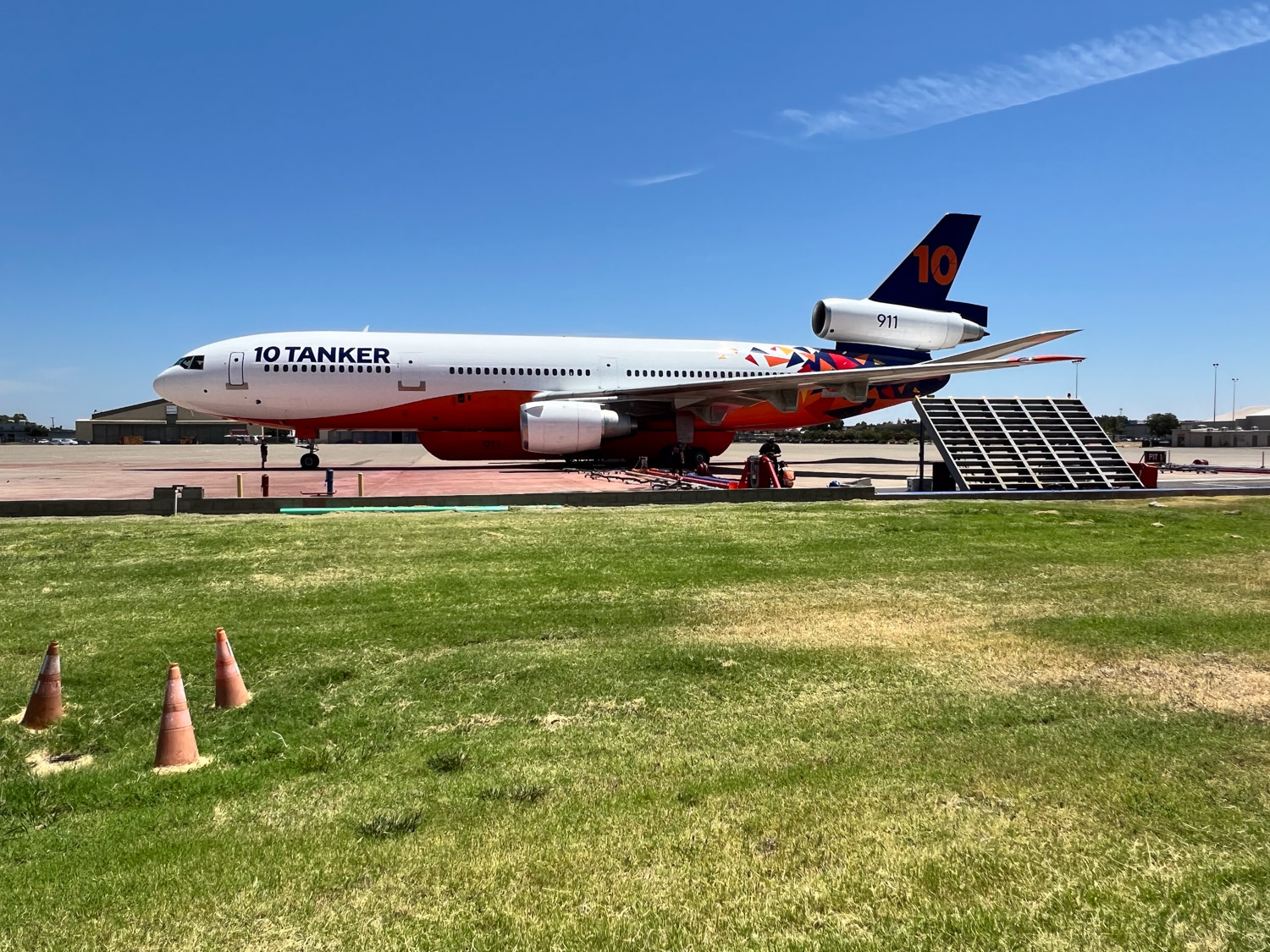
We watched this DC-10 land and taxi to where it would be filled with retardant.

It carries 9000 gallons but can be filled quickly.

The turn-around time was just under 30 minutes. This was a few days before the Park Fire began (arson) near Chico, CA. That fire is now over 400,000 acres and is still burning. On this day this plane was working the fires in northeastern California, where my daughter-in-law was also headed that afternoon. She is now on the Park Fire as a Public Information Officer.

Cal Fire’s C-130 also landed to refill. This plane doesn’t carry as much retardant but is more maneuverable for many situations. It can also land at many more airports than the DC-10s, which need longer runways.

Retardant (mostly fertilizer) in large bags is mixed into a slurry (85% water) and then piped to where the planes are loaded. This article describes the components of fire retardant and how it is used.

OV-10 – Spotter plane

This OV-10 is the favorite plane of Matt’s friend who was showing us around. These were originally military planes used in Vietnam with some being used more recently. This is used as a spotter plane and for directing air traffic as Matt does in the helicopter. This plane is fast enough to also be a lead plane for the retardant drops.

This is a narrow plane and reminded me of the Cobra helicopter Matt was in until they were retired a few years ago. The pilot is up front and the fire personnel sits in back.

We saw the hangars where CalFire houses and repairs aircraft. These are just a couple of the Bell helicopters. There were several hangars but I already have too many photos in this post.

This helicopter was called a Blackhawk when used by the military but is now set up for civilian use and CalFire calls it a Firehawik.

Our last stop was an old air traffic control tower, shown in the photos of the DC-10 taxiing and taking off, that Matt’s friend uses as his office. Here is his view.

This was an extraordinary tour and I appreciate the time spent by Matt and his CalFire friend in showing us around.

Granddaughter Visit – Around the Farm

The weeks between Convergence and State Fair were super busy, but I tried to do as many things with Kirby as we could fit it. She learned to spin. As with most beginners the biggest challenge is understanding the relationship between amount of twist necessary to create a stable yarn and the diameter of the yarn. It helps to use fiber that is easy to spin. Carded Jacob fiber fits that criteria.

Of course we spent time with sheep. Jade is always the favorite. We spent every morning that Kirby was here working with the lambs that would be going to the fair. Maybe I didn’t get photos of that.

I wanted to do some dye projects for my fair display. Kirby learned something about preparing indigo for the dye pot.

I do the cold fresh leaf method.

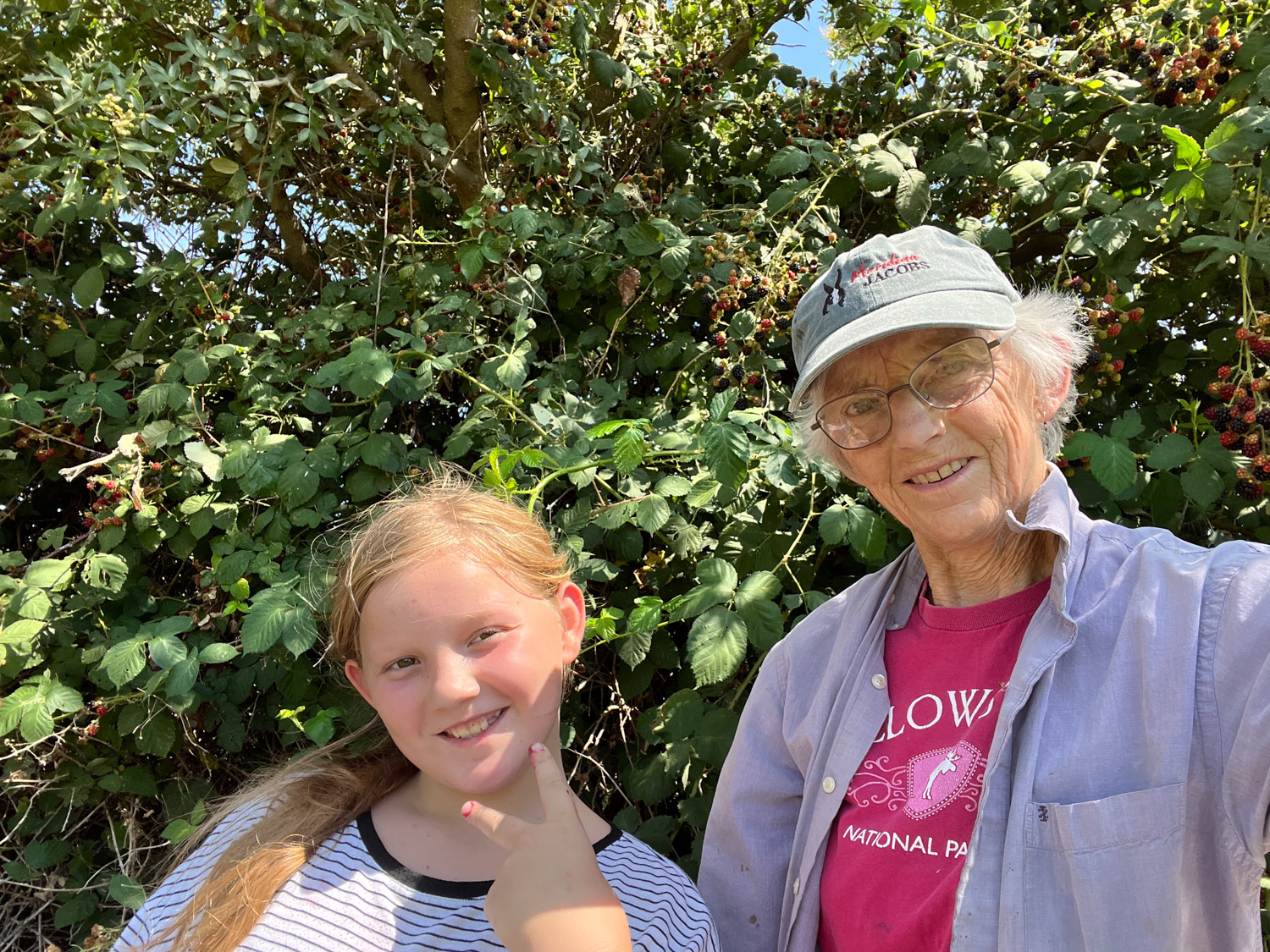
State Fair time is when the blackberries are ripe.

We picked blackberries together.

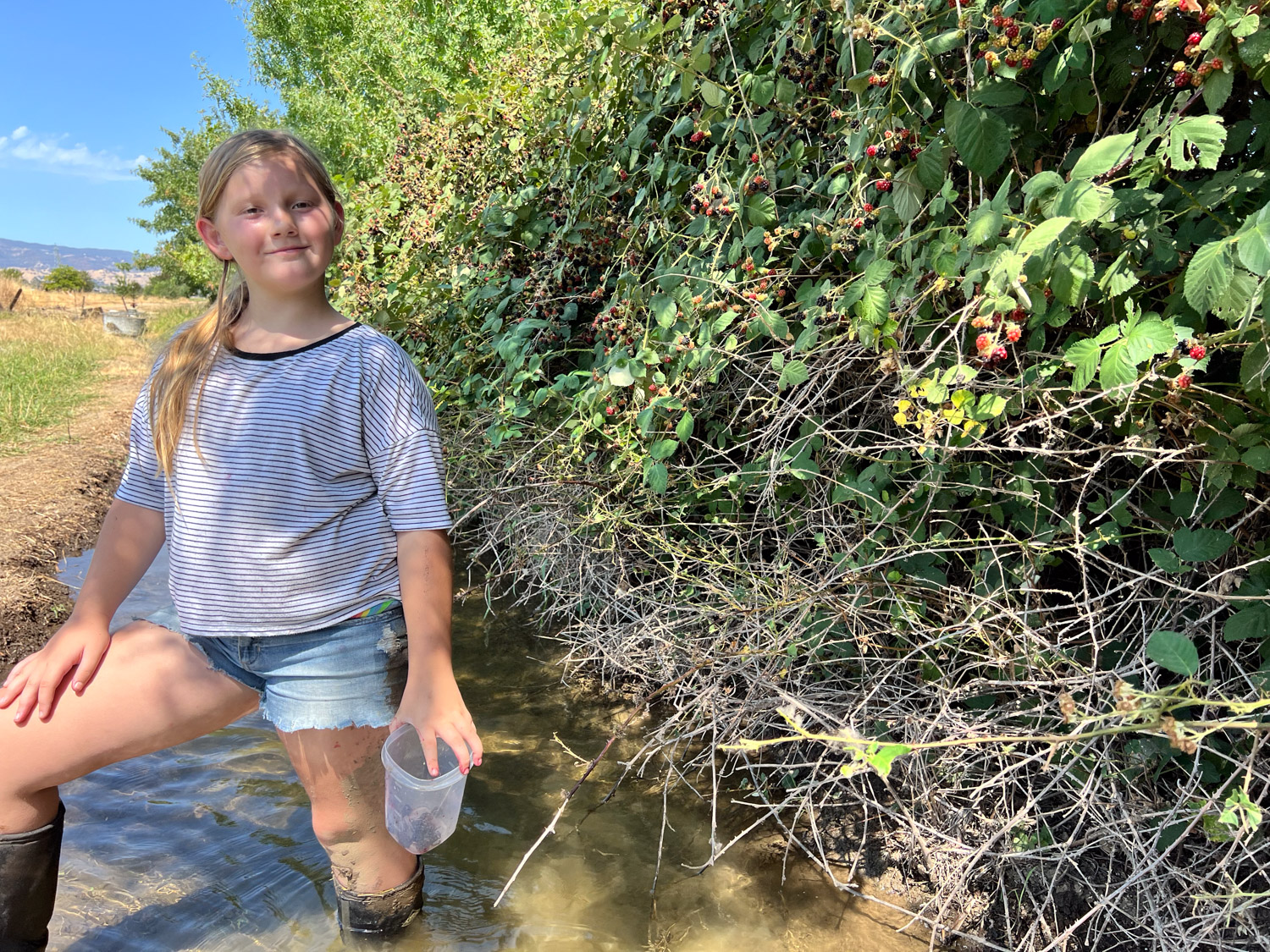
It is a challenge when we have irrigated because the blackberries are on the other side of the ditch. Its a good thing that I had an extra pair of rubber boots to share.

Kirby and I spent time in the barn sorting and cleaning the horns and skulls to use for our touching table at the fair.

Kirby likes to catch chickens as well as sheep.

Granddaughter Visit – Raptors

The day after I got back from Kansas (see Convergence posts) granddaughter, Kirby, flew in from Texas. We had a two week visit planned that would end with the State Fair and then her tenth birthday.

One of the days Kirby was here, the local library hosted a raptor presentation by the UC Davis Raptor Center. We followed that with a trip to the Raptor Center to see the raptors that are permanent residents there due to injuries or other reasons that prevent them from being released.

We first watched as the handlers worked with two turkey vultures in their enclosure. They are learning to enter dog crates so that they can be taken off site when necessary.

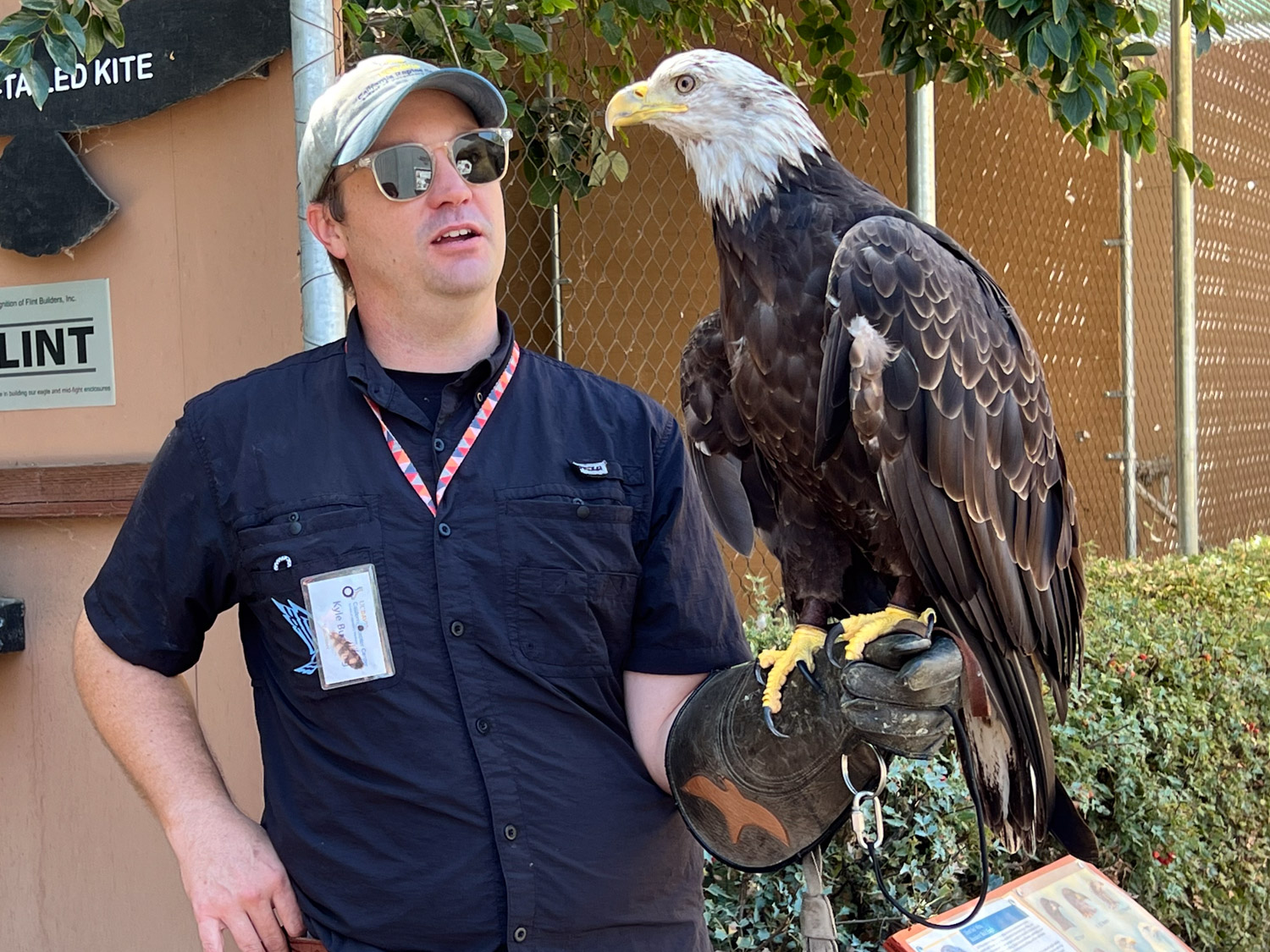
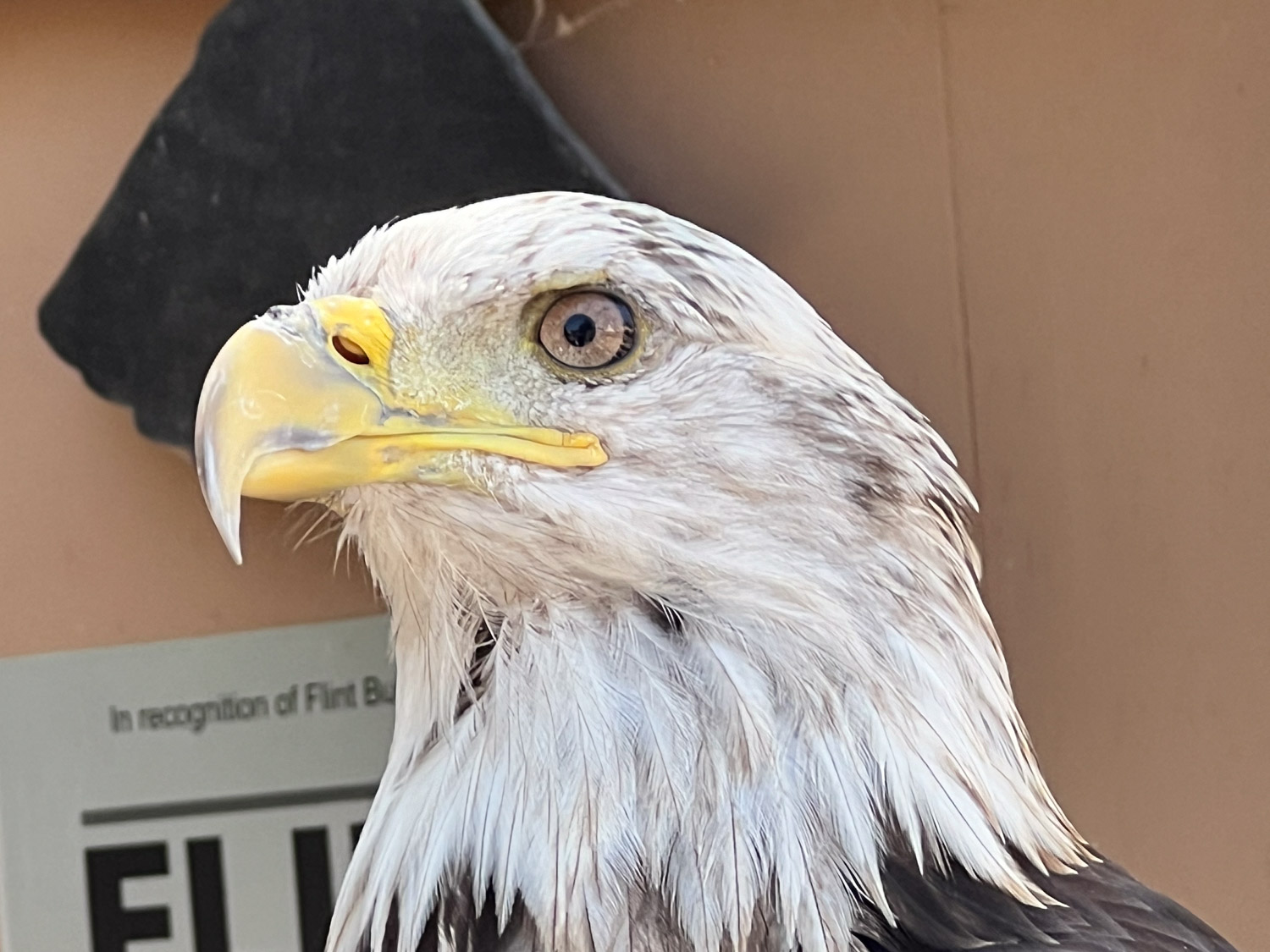
This handler had come to the library presentation but was back at the center to show off a 4-year old bald eagle.

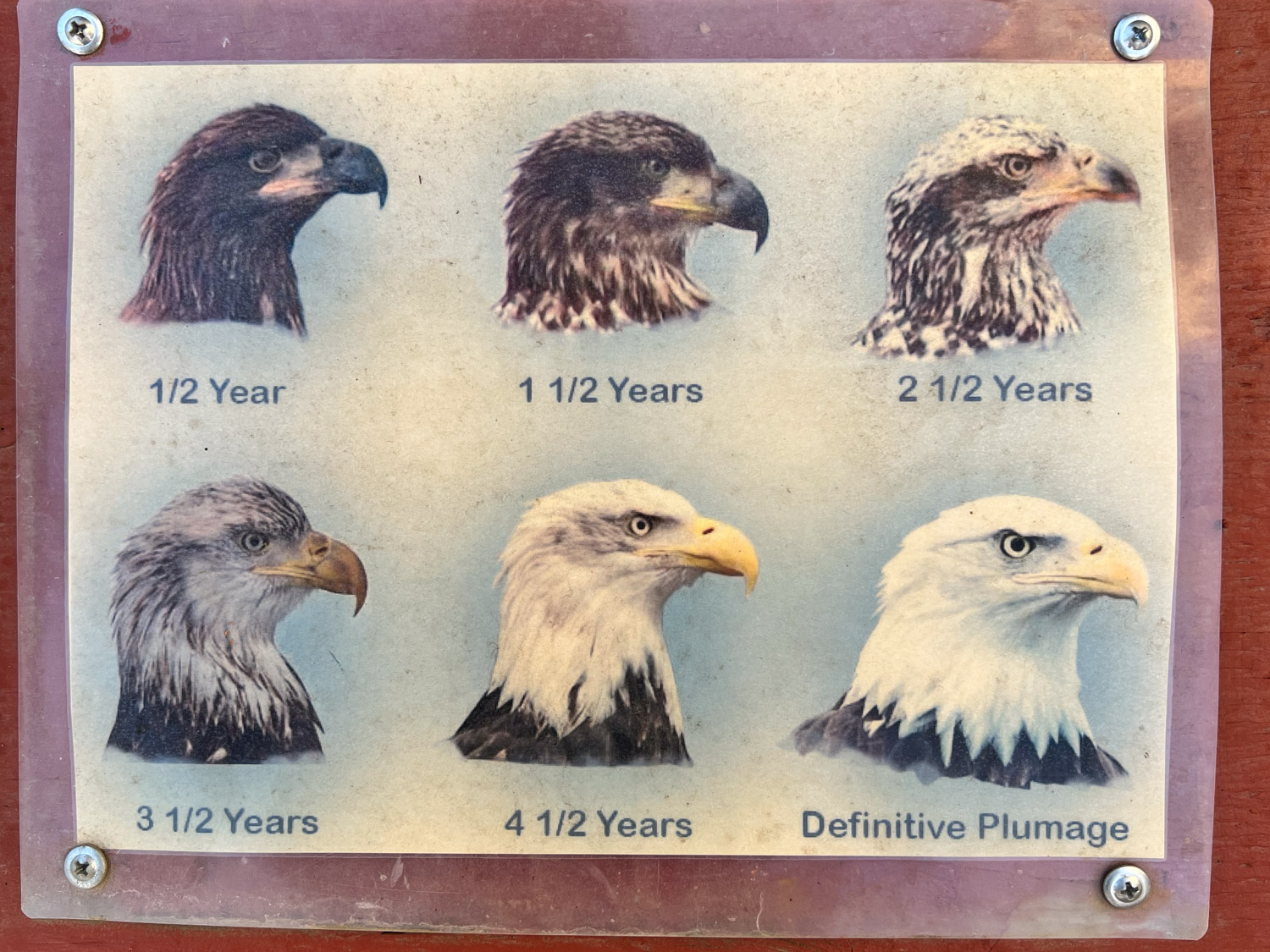
At age 5 his head feathers will be completely white, as in the chart below.

The handlers explained the situation with each bird. Most were brought to the raptor center with injuries. Sometimes injuries are treated successfully, and the bird can be released, but not all of the birds would be able to live on their own in the wild. They are exhibited for educational purposes at the Raptor Center and at presentations like the one we saw at the library.

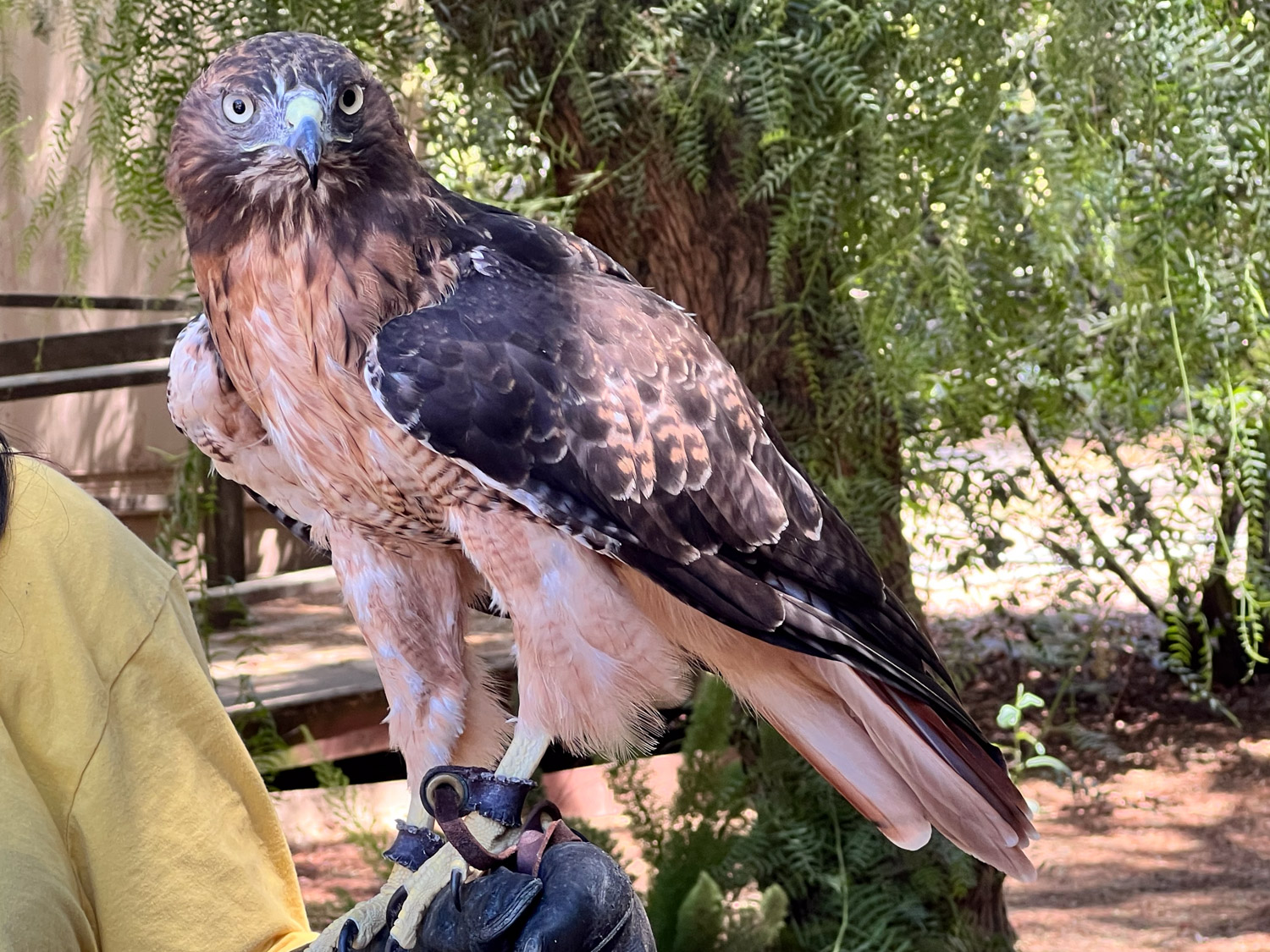
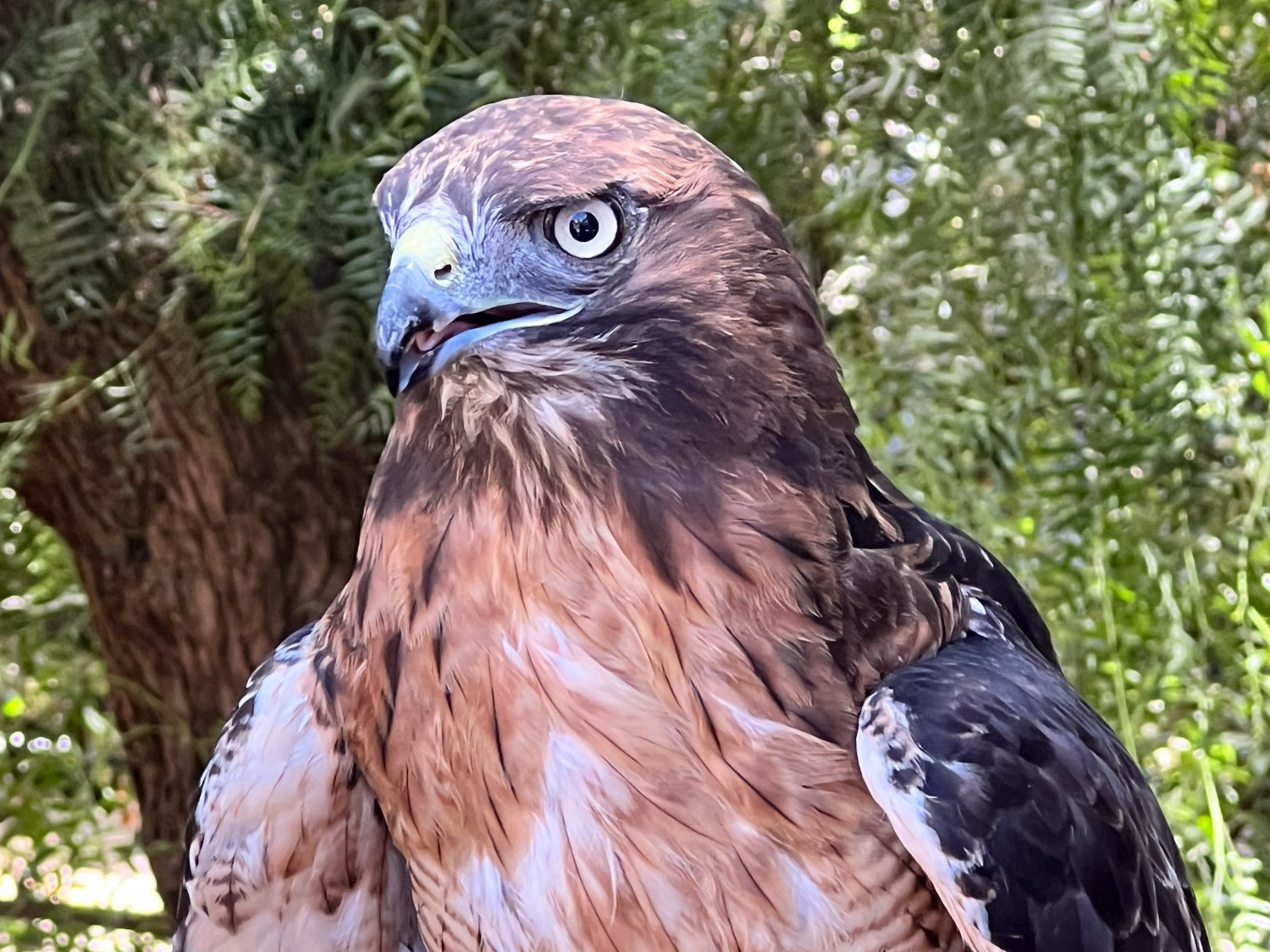
Some birds are also used for research purposes. This is Jack, a redtail hawk that is a resident. Jack had just completed a flight study, being filmed while flying and wearing sensors, before coming to the library.

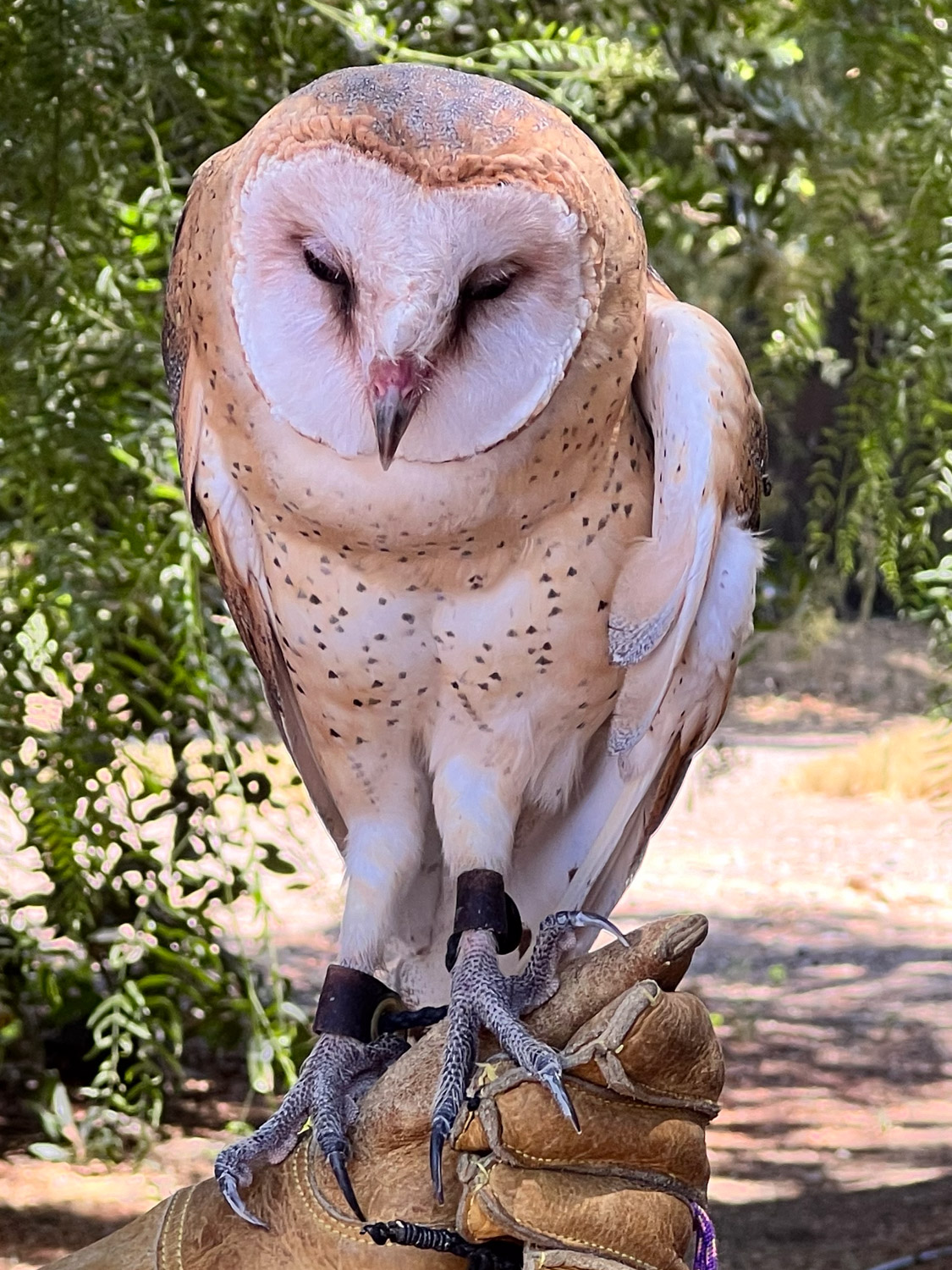
This barn owl was injured at a very young age when the palm tree in which she lived was cut and she broke her wing. She is a permanent resident.

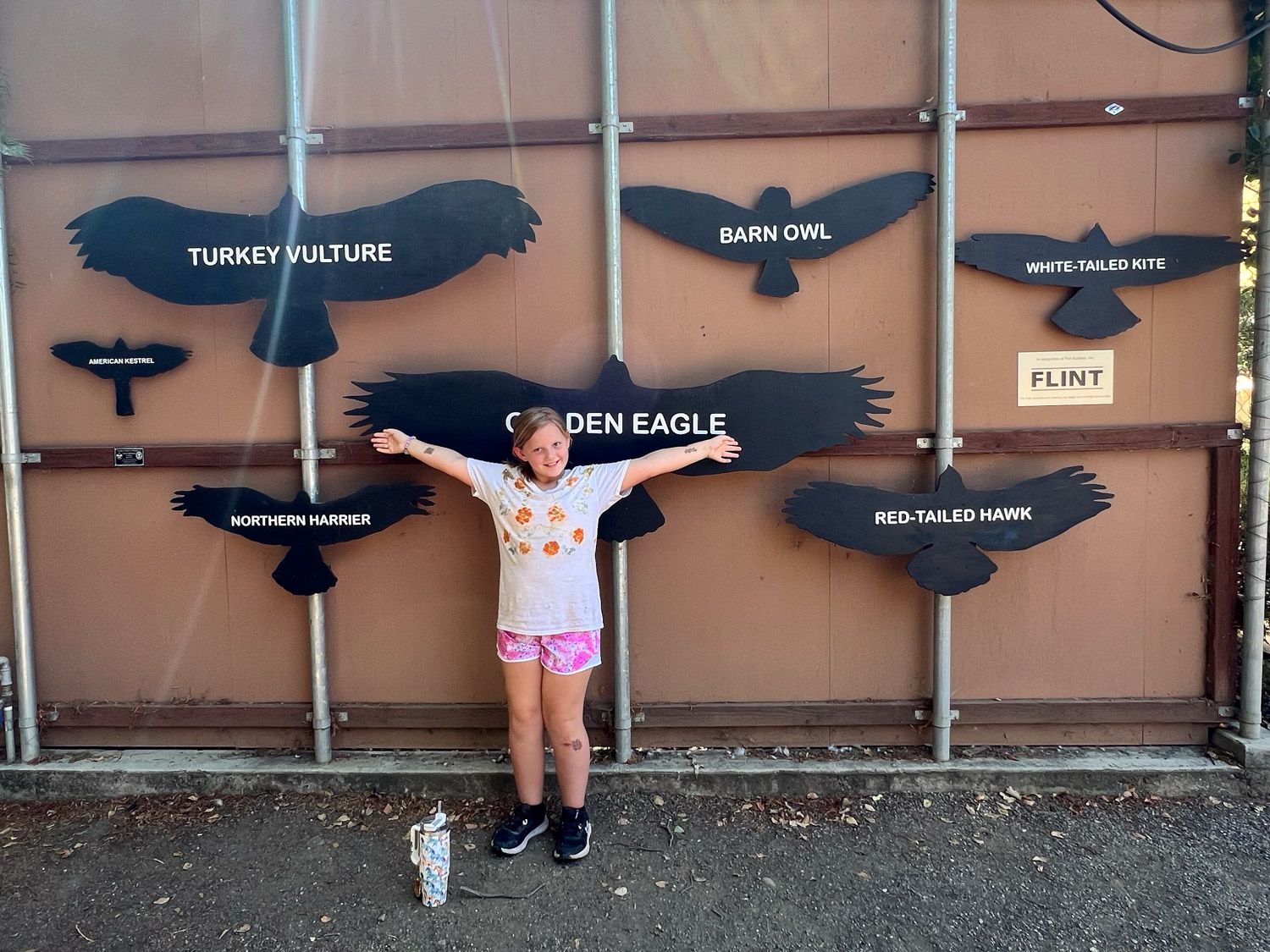
Kirby comparing her wingspan with these raptors.

We were lucky to have so many volunteers on-site to talk about the birds and let us see them up close.

Convergence 2024 in Kansas – Day 5

I left off with the second post for Day 4. I am so far beyond Convergence now that it’s hard to go back and finish but I like these best if they are in order. One more day and it’s a short one.

A fried asked if I had seen the troll yet. I thought she meant one at the Botanica Wichita but it turns out that there is another in town. You can find out about it in Atlas Obscura, something that I didn’t know about until now. The troll seems hidden but is in plain sight if you know where to look. It also pops up on Google maps when you enlarge that area.

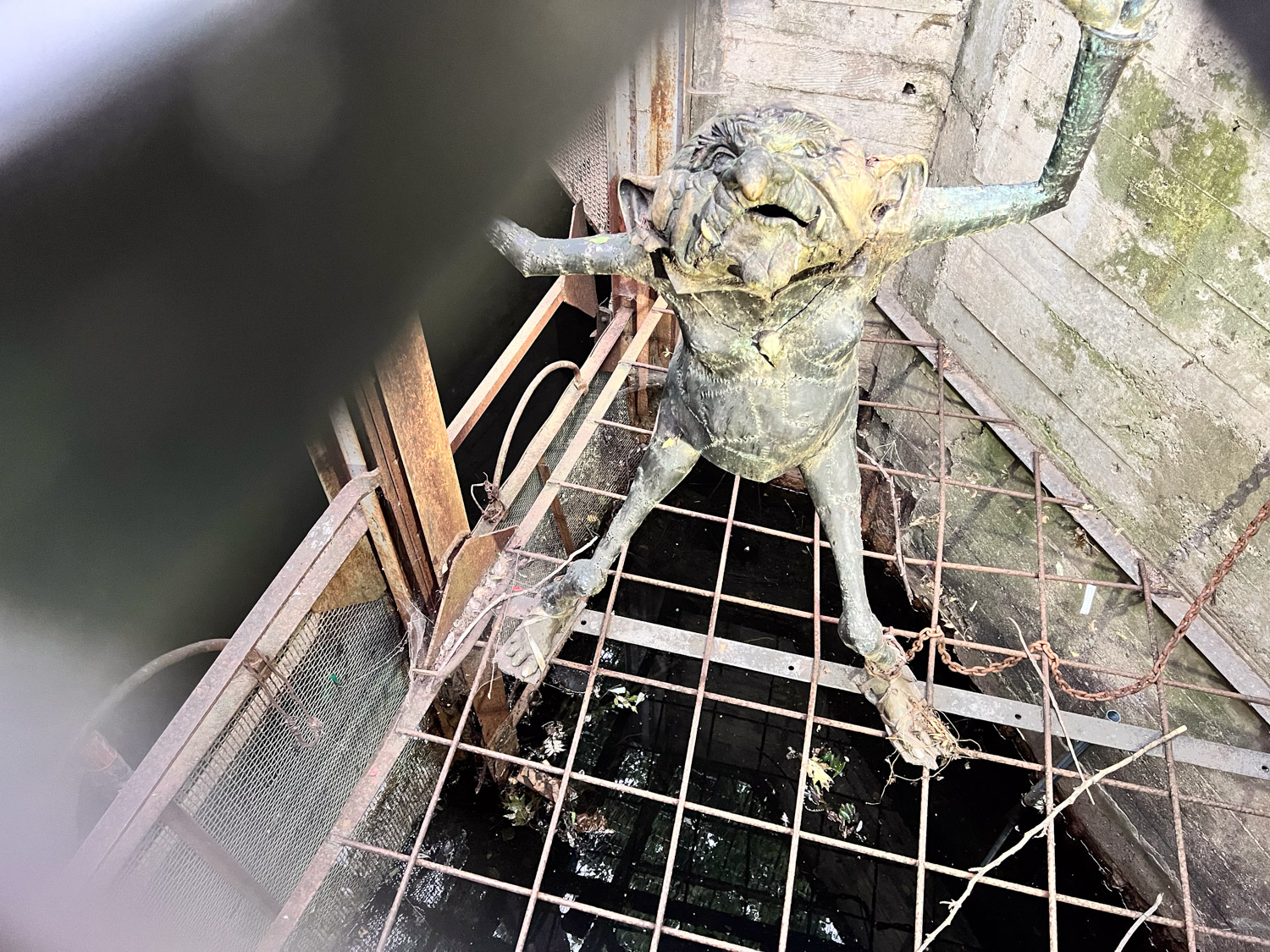
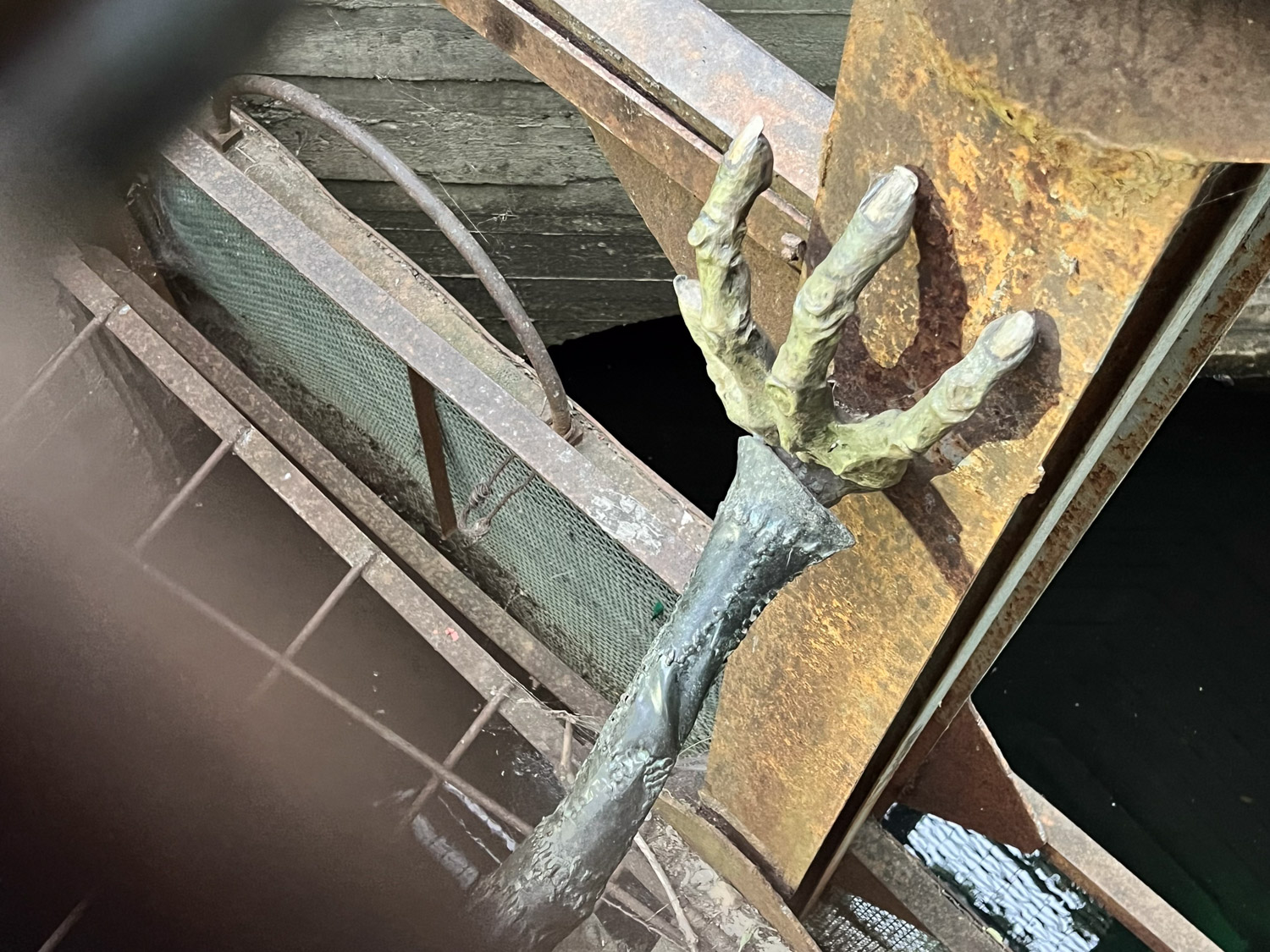
The troll is a 7 foot tall structure chained under a grate of a storm drain. It is easy to miss if you’re just walking over the grate.

I angled my iPhone in a position where I could get a better image.

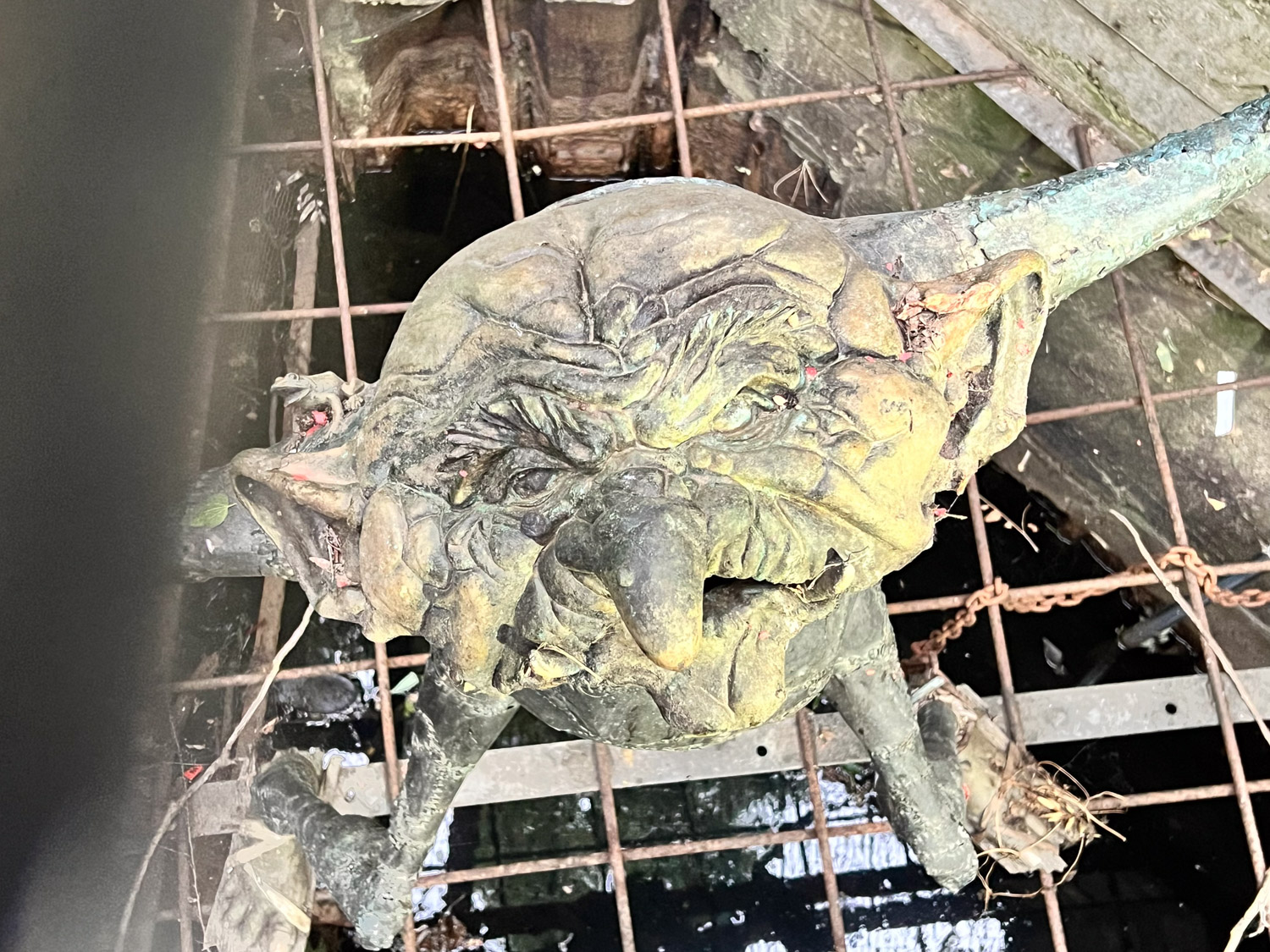
It is truly grotesque…

…down to the details of the fingers.

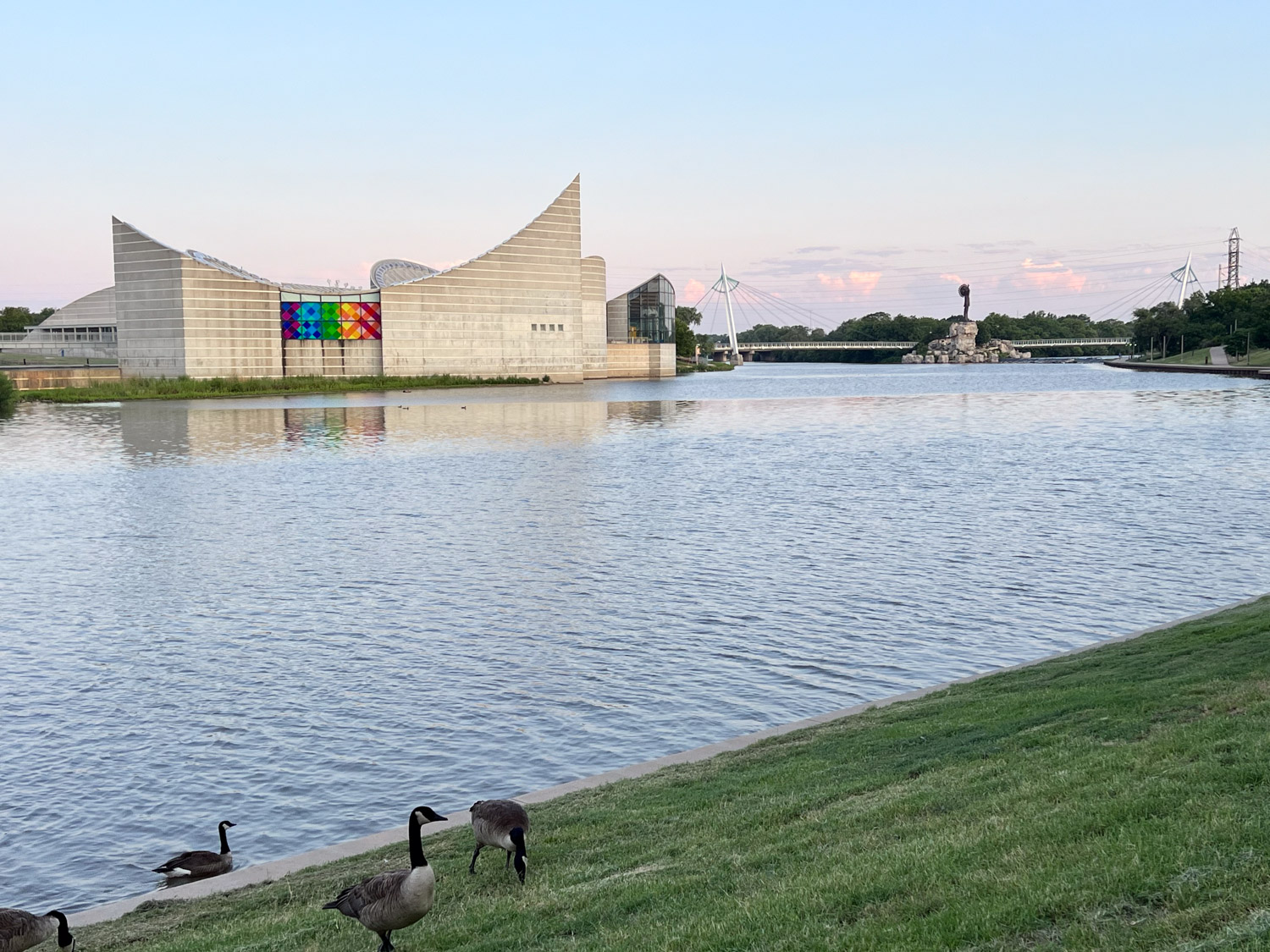
Another view of the Exploration Place on the Arkansas River.

I had signed up for two sessions on Sunday.

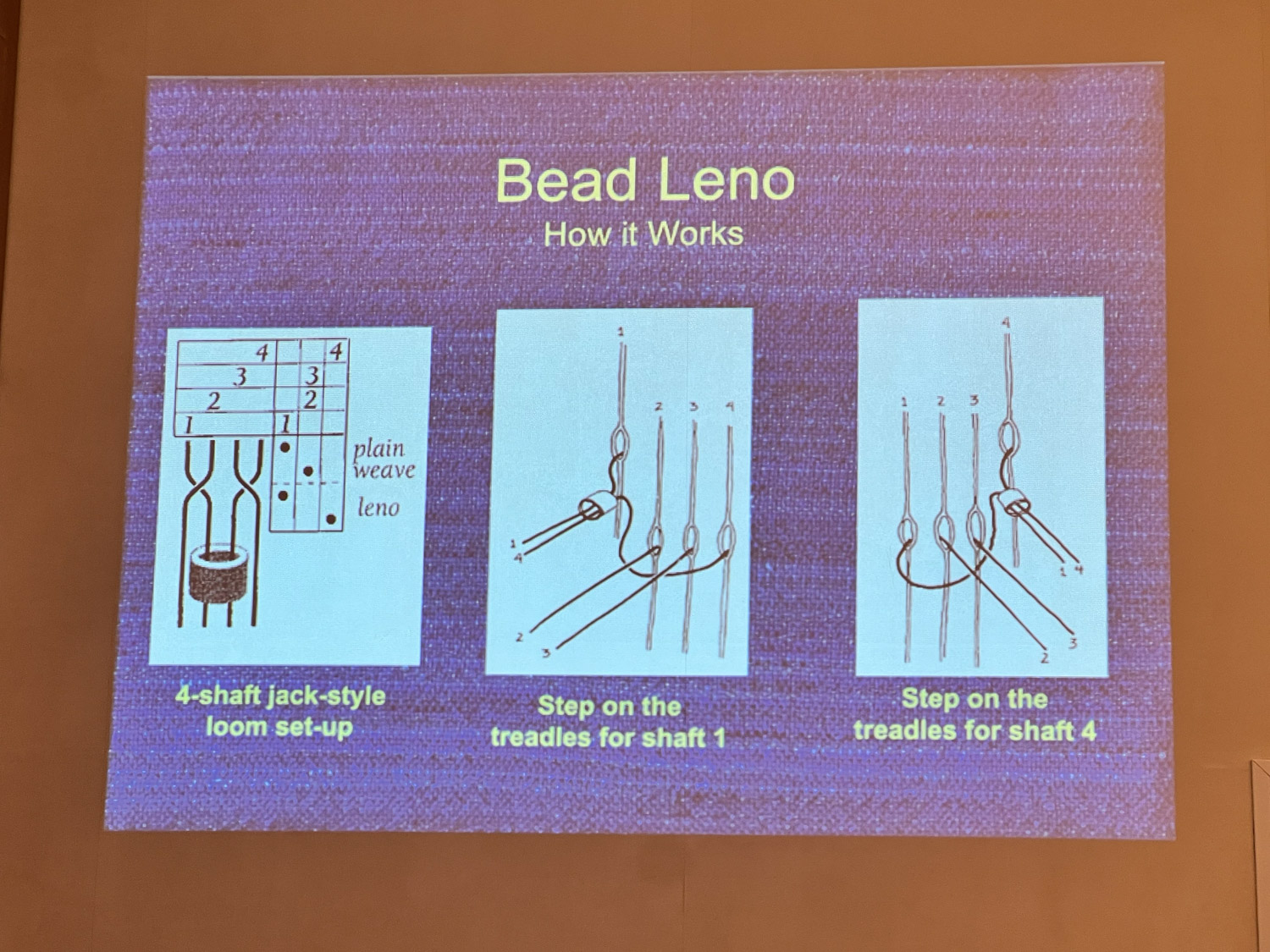
The first was another by Robin Spady. This is a technique that I have never tried and it intrigues me. She includes a booklet of most of the info she shares in class, and I look forward to finding time to try this technique.

I took a class in the afternoon about designing your own color and weave drafts.

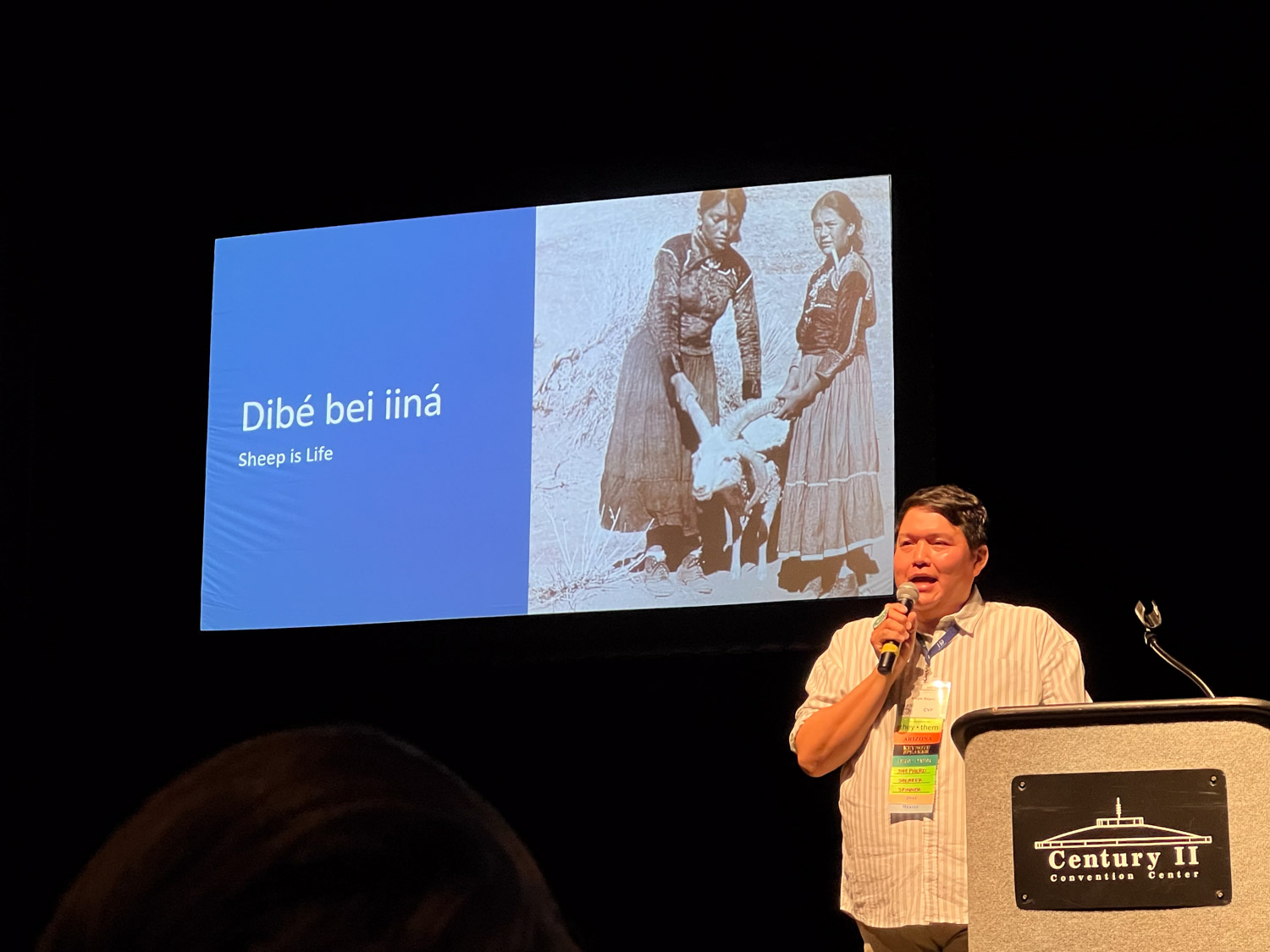
The keynote speech was presented Sunday evening by Nikyle Begay who gave an emotional talk about the Navajo (Diné) experience with sheep from the early days of government intervention to the present.

The view from my room. I flew home early Monday morning.

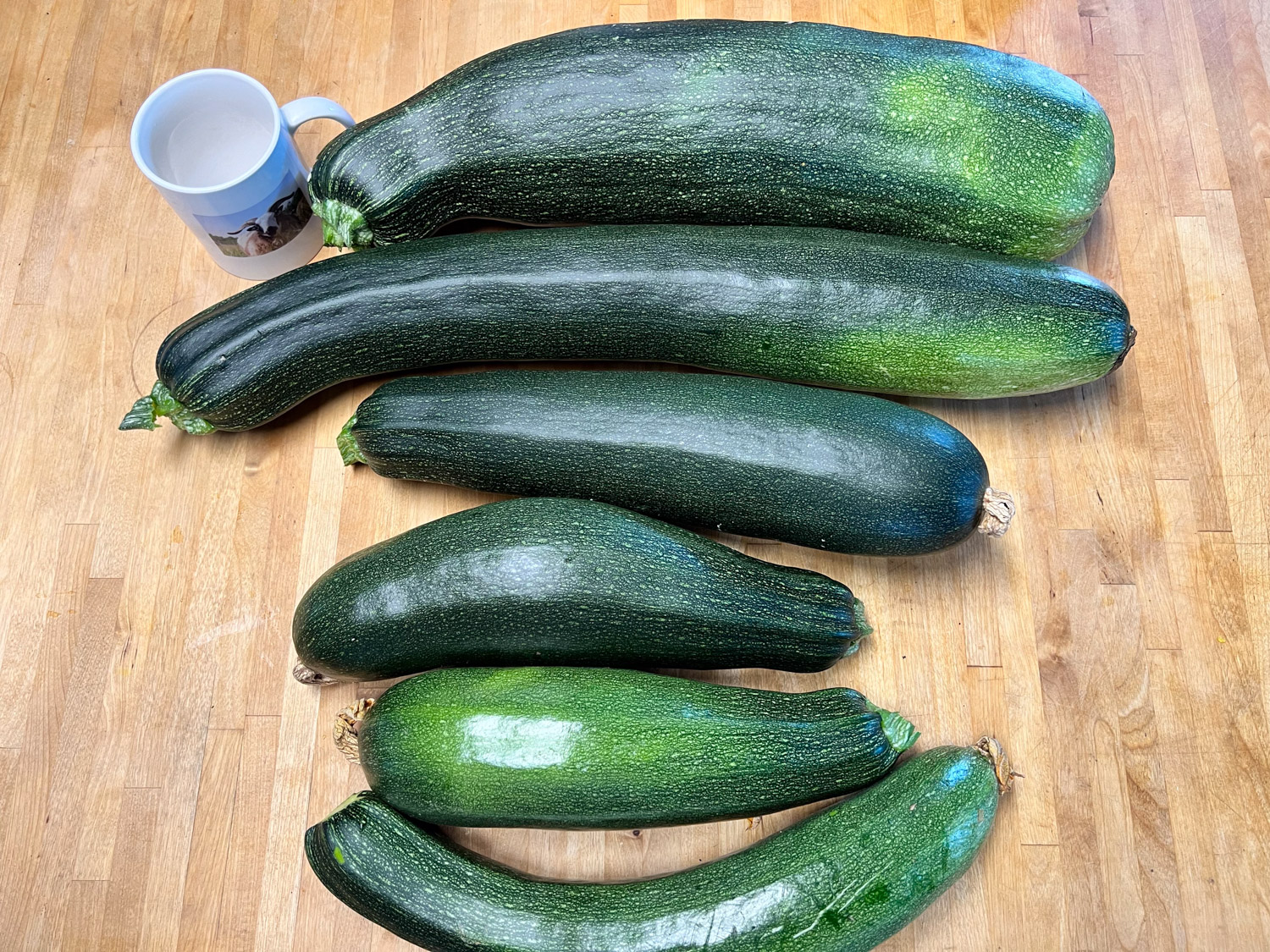
Besides being greeted by Dan and Ginny and the sheep, look what I found on my one zucchini plant. (See mug for scale.)

Convergence 2024 in Kansas – Day 4 (more)

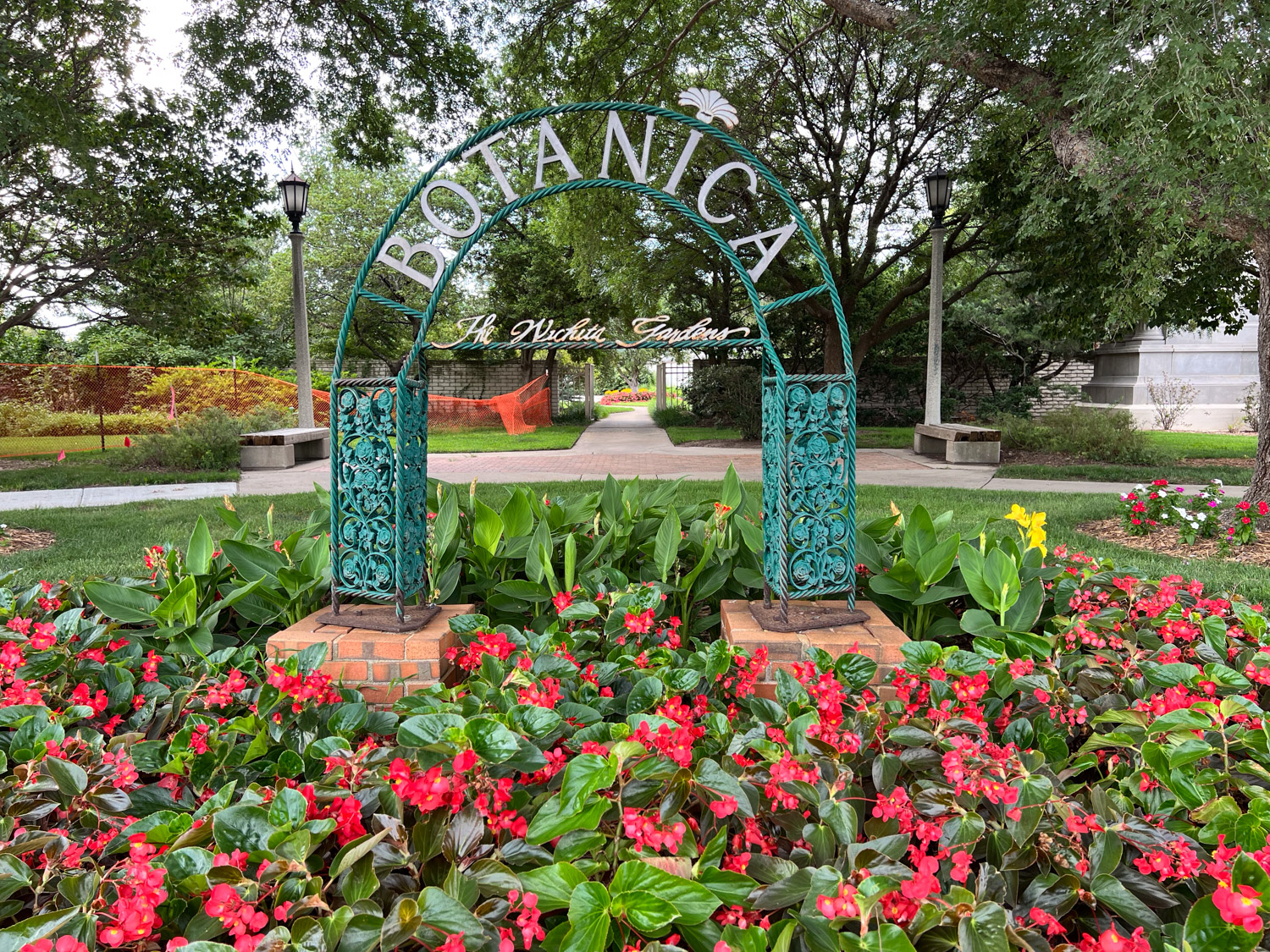
The last post left me looking for the entrance to Botanica Wichita.

I found it.

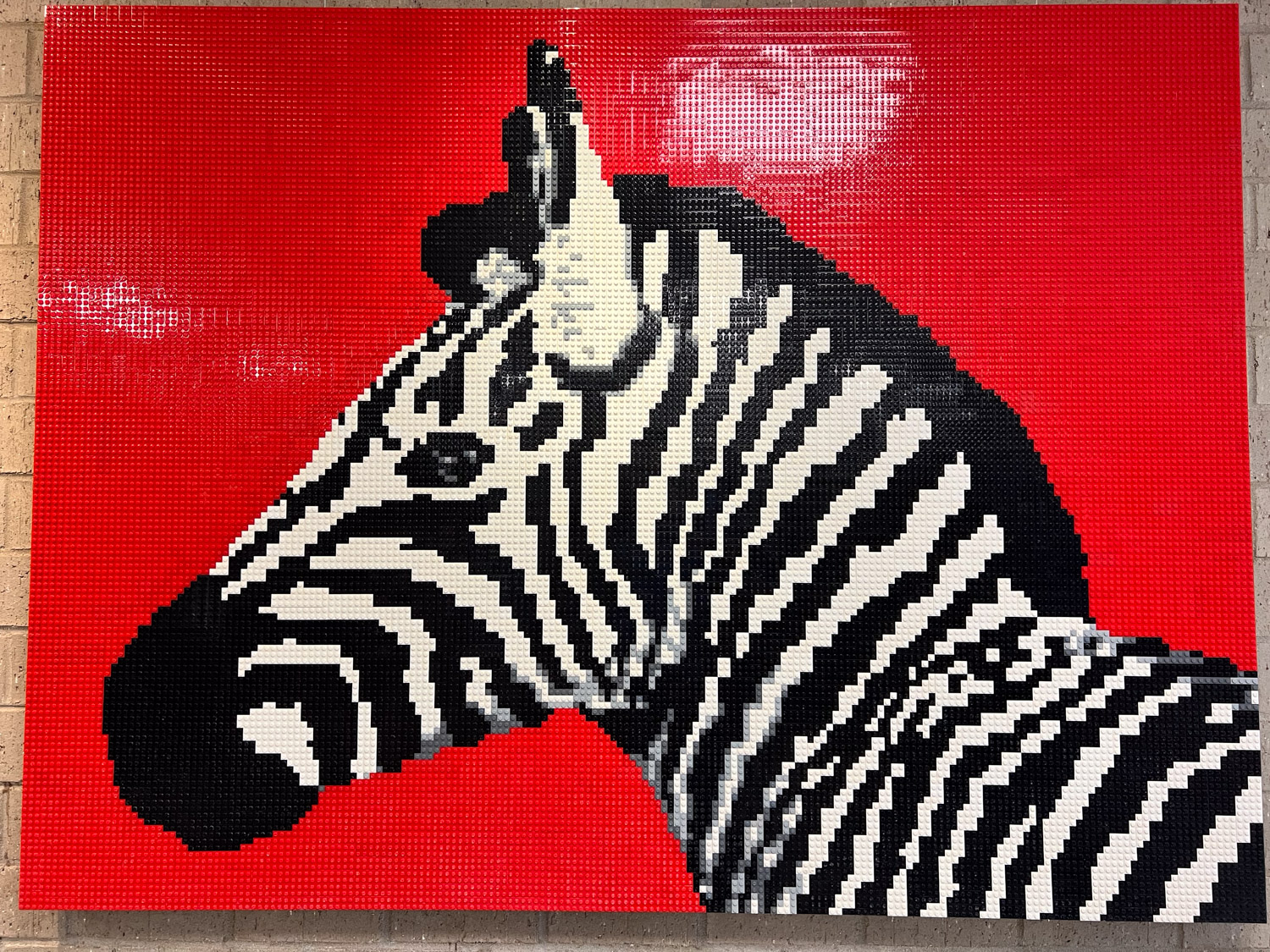
Just inside the entrance I saw Lego images. I may have taken more photos of Lego art than of plants. Lego bricks were (and are?) a big part of a couple of my kids’ lives.

These images were impressive enough, but wait until you see the statues outside.

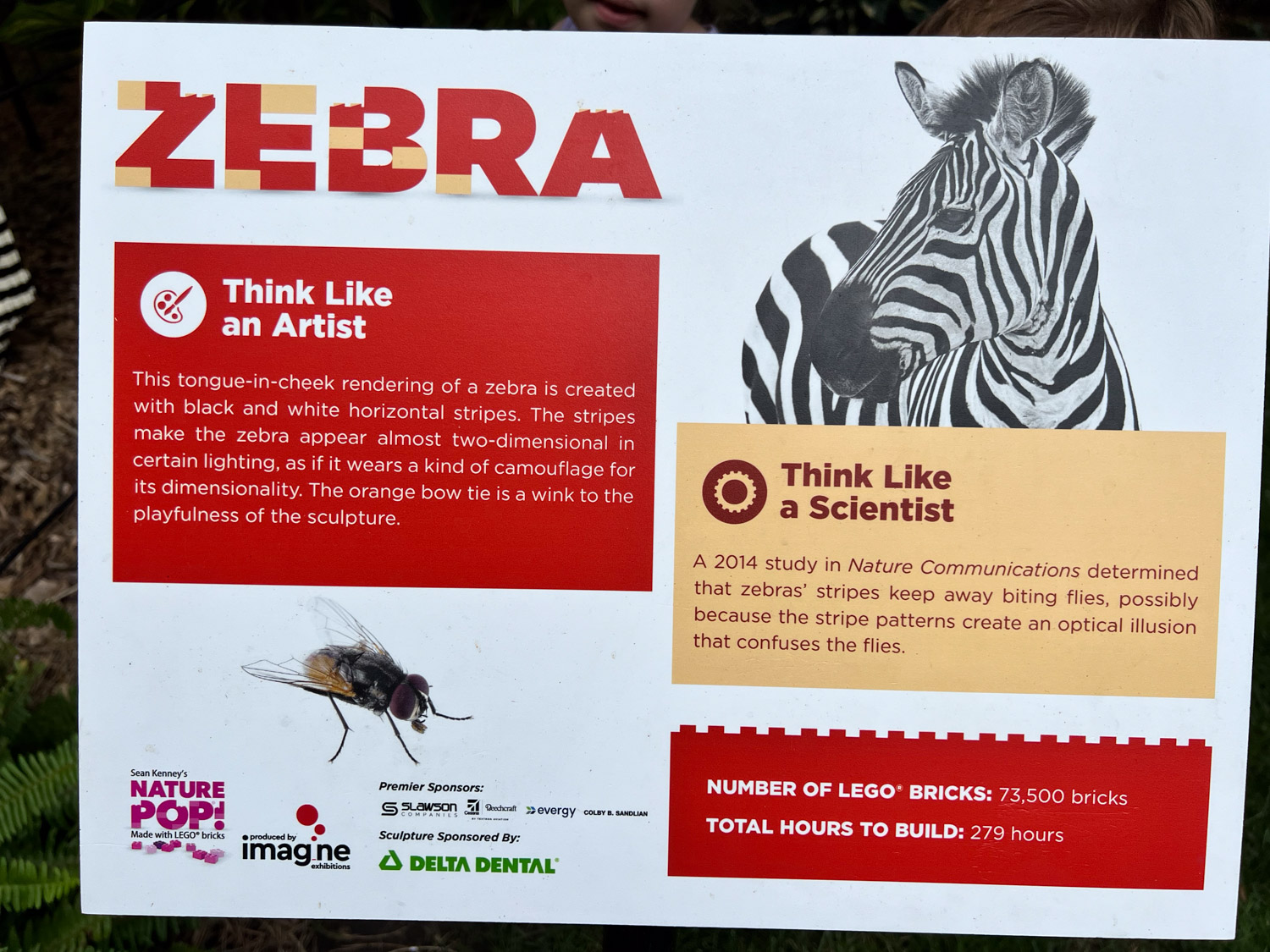
Each Lego artwork is accompanied by a sign that tells a little about the image from the perspective of an artist and of a scientist. The signs include the number of Lego bricks and the time it took to build the piece. The artist is Sean Kenny from New York who has been creating Lego art for 20 years. To see the incredible array of his work check out his website (but come back here). This Nature POP! show is one of his traveling exhibits.

There were also beautiful flowers at Botanica Wichita!

I don’t know if you can read this sign the way I have it formatted here. It tells that this sculpture uses 73,500 bricks and took 279 hours to build.

There was a collection of rabbits and off to the right out of the photo there was a fox.

One of many begonias. I didn’t just look at Lego art.

I walked through the bee garden and found this enclosure at one end. It was difficult to get a photo of this but you can see some recently emerged butterflies at the bottom and on the right side. These are all chrysalis’ along the rods, many with labels.

I walked through a bird sculpture garden.

This dragonfly is near the exit.

Black-eyed Susan.

This little excursion gave me a 7-mile walk. After I returned to the hotel I spent time in the vendor hall and visiting with friends.

One more day…

Convergence 2024 in Kansas – Day 4

Look here for Day 3 of Convergence. I had not scheduled anything at Convergence for Saturday and looked forward to a day to choose to do anything or nothing. I decided to go to Botanica Wichita, a collection of botanical gardens on 18 acres, not too far from the hotel.

I started with the same route along the river I’d walked the first three days. I got side-tracked by flags along the way. The Wichita Flag Pavilion starts with a plaque about the first “flag”, probably a staff with eagle feathers carried by the Native Americans as a way for tribe members to follow their leader.

There are plaques for each of these later flags starting with the flag that flew over Christopher Columbus’ Santa Maria. There are photos of those plaques at this link.

The Flag Pavilion is at the edge of the Wichita Veterans Memorial Park where there are 21 memorials. I wandered through and found the Vietnam Memorial. I am just young enough that none of my friends were drafted, but I was in high school during the last years of the Vietnam war. I think that the Vietnam era is responsible for the culture in which I grew up. It was notable that the word “war” is not on any of these memorials.

From Britannica.com: “Congress authorized troop deployment in Vietnam, but, because it did not issue a declaration of war on North Vietnam or the Viet Cong, the Vietnam War is, technically speaking, not considered a war in the United States.” Maybe that is why there was such an impact on us. We sent our young men half way across the world to experience atrocities and die for what reason? We were not at risk, and this “conflict” had no bearing on our safety at home…but I digress.

After I left the Veteran’s Memorial Park I continued along the river path following the map in my phone until I saw the marker for the Wichita Gardens,

This marker was deceiving. It is at the edge of the gardens but as I walked along the path that bordered the gardens I found gates closed. The trail looked as though it was going farther away from the garden. I think eventually I would have found a street that brought me to the main entrance, but since I was on foot I wasn’t sure how far afield I should go. I stopped and called the number listed for Botanica. Amazingly, a person answered the phone. She told me I had walked too far, and I went back the way I had come, turning at the Art Museum and worked my way through a neighborhood to get to the main entrance.

To be continued…

Convergence 2024 in Kansas – Day 3

This is Day 2, when I taught the Clasped Warp class. I signed up for some sessions on Friday and Sunday.

I went out early on Friday morning to walk along the Arkansas River. There are paths on both sides.

This is the Exploration Place. From a quilt on this side to a helicopter inside on the opposite wall it looks as though there is something for everyone here. The bridge that you see is a pedestrian bridge that crosses the Arkansas and Little Arkansas Rivers at the confluence.

This is another view of the statue you see in the distance in the first photo. It is known as the “Keeper of the Plains” and was donated to Wichita in 1974 by the Kiowa-Comanche artist, Blackbear Bosin.

There is a small pavilion behind the statue and where the rivers meet.There are several displays about Plains Indian culture and beliefs.

Back at the hotel, I took a morning class from Robyn Spady about cool things you can do weaving with four shafts.

In the afternoon I had a short session about ice dyeing with indigo. I did a lot of that last summer but never had all these colors. Since I’ve been home I tried to get purple and failed. I’ll try again.

After this session I wondered through the fiber arts exhibits and the vendor hall. I have a lot of photos but will include only a few here. As usual, I am frustrated that I will never have time to weave all the things I already have in my head and now there are more!

Great boots!

Beautiful wedge weave rug.

The following pieces are just a few that were in the previous day’s fashion show.

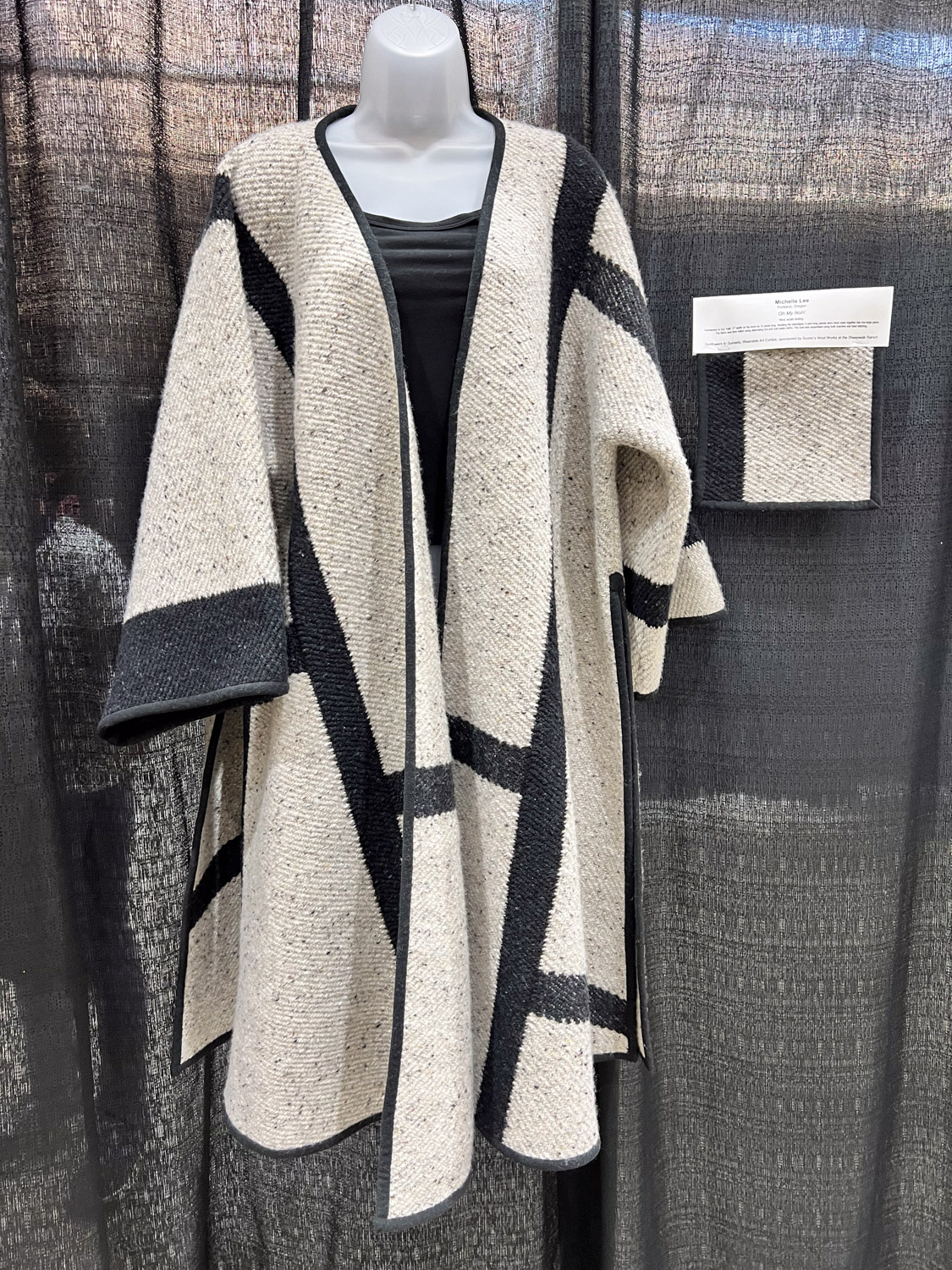
The Noh coat. This refers to a style of coat that I remember reading about a few years ago. It would be interesting to weave fabric for this. I’ll add it to my list.

Woven in tencel.

Cotton top with the gradients of color different for warp and weft.

Remaking a jeans jacket.

I spent some time in the vendor hall. Lunatic Fringe took the Kansas location to heart with the yellow brick table drape and the legs hanging from their banner. They also wore witch’s hats the first couple of days.

In the evening I walked with a friend back to the Keeper of the Plains where fire is lit for 15 minutes every evening at sunset.

Blogging Experiment

Now that I’m back to blogging before I get any more behind, the interface seems different and I’m not sure that my post will go in the right place. I don’t want to spend a lot of time doing this if it’s not going to work so this will be a brief interlude.

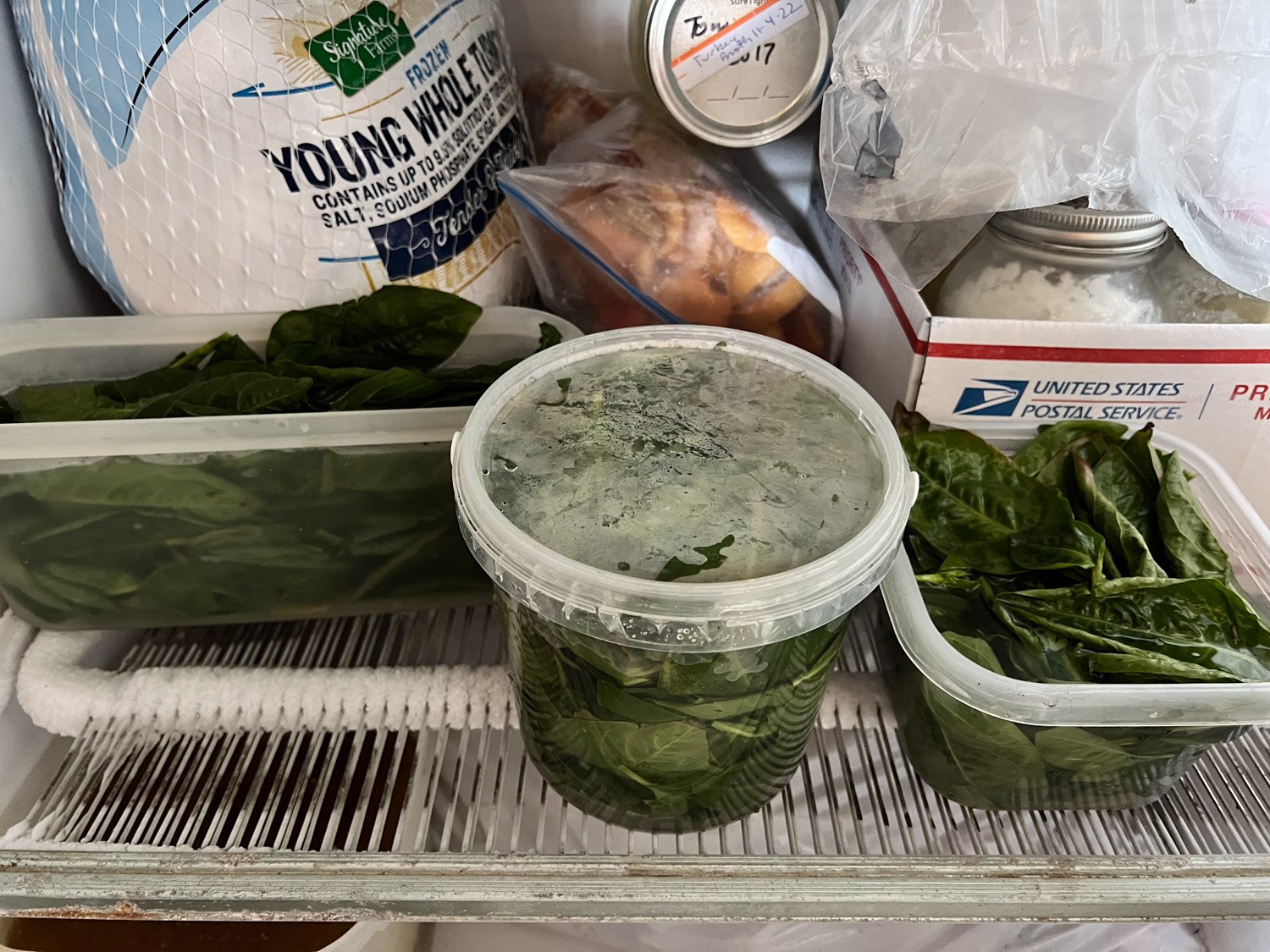
This is the indigo before I left for Convergence. It has been so hot and dry here that I wasn’t sure how it would look when I got back. There was no time to use it but I thought I’d experiment with freezing some. After all when I use it for the fresh leaf method I’m using ice water.

I froze a few containers of indigo leaves in water.

I have done some indigo dying since I got back but it’s been in a rush to have it ready for the fair this week. No time to experiment with this.

Now we’ll see how this experiment of my blog post went. It’s supposed to be at meridianjacobs.blog, but I can’t tell that it will post there.