Unknown's avatar

About Robin

Owner of Meridian Jacobs, farm and fiber shop. I raise Jacob sheep, teach fiber arts classes, weave handwovens for sale, and manage the store.

Convergence 2024 in Kansas – Day 2

While I’m writing this it’s actually my 4th day in Kansas but I feel good that I’m not leaving all of these blog posts until I get home. It’s going to be hectic then. So here is the post for the first day when I explored the surroundings. On Thursday I taught a workshop on Clasped Warp using a rigid heddle loom. This is the description of that class on my website. I plan to change that a bit now that my article about clasped warp on a multi-shaft loom is published in Handwoven.
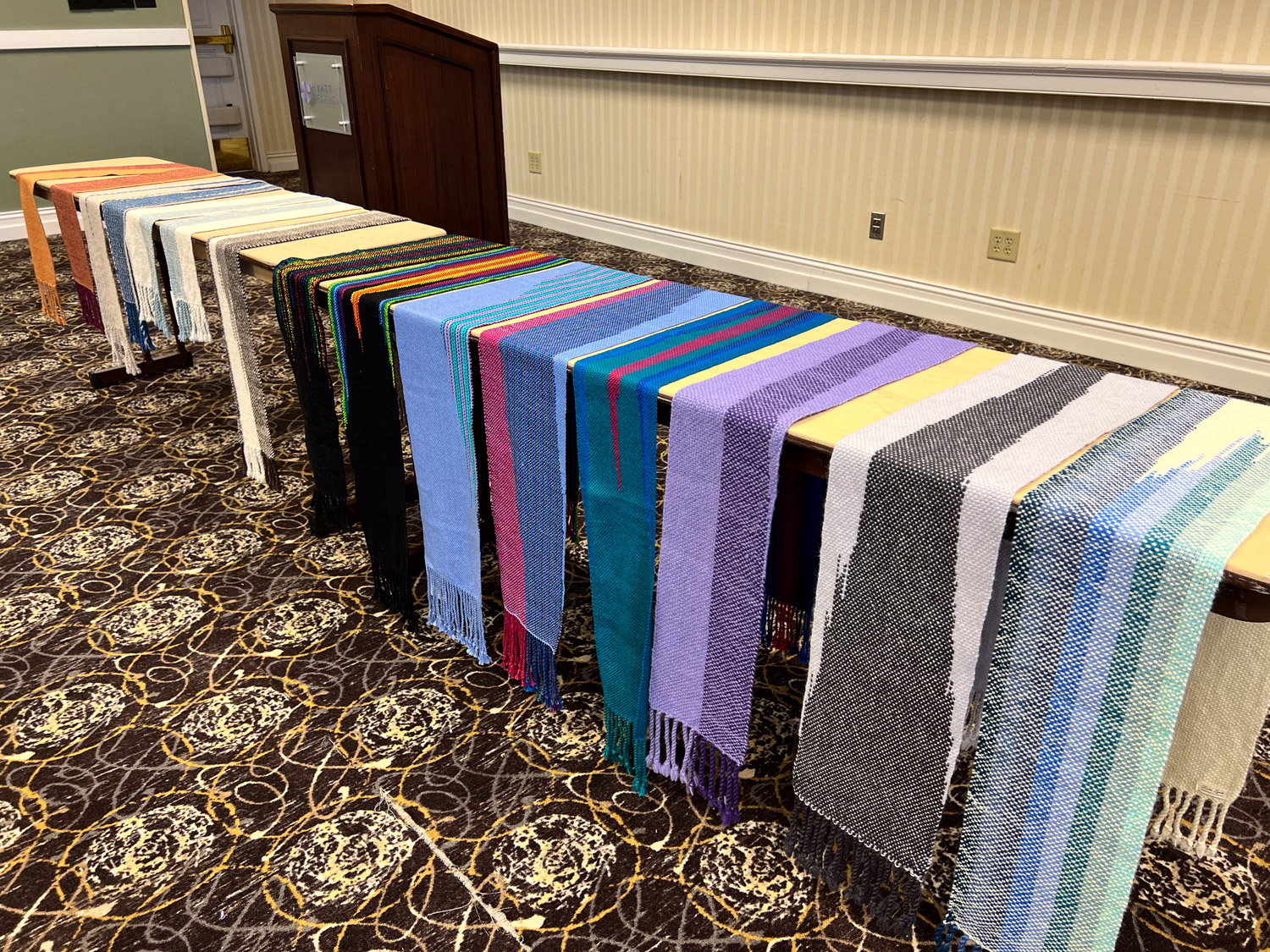
Handwoven scarves draped over a table as examples of the clapsed warp project.

These are the scarves I brought with me as examples of the final project. With clasped warp the loom is direct warped with two different colors at a time. One yarn is attached to the peg and one to the loom. They join or clasp in the middle and you can create many different designs.

These are three going on the looms. I did not get photos of all. It difficult to get decent photos of this process.

Warp yarns in yellow, red, and gray threaded through the heddle of a rigid heddle loom.

Here is one more.

Room with several tables and weavers at their looms.

A view from the back of the classroom. Fortunately we had plenty of space for everyone to spread out. There were 9 people in the class (and a service dog!)

A handwoven scarf just off the loom is spread on a table.

This is the first scarf off a loom. It was the only piece finished during class. There was no rush for most of the others because they were all taking their looms with them. Two people needed to finish the project that night and warp the looms for the next day’s class, but the weaving goes fairly quickly on this project.

People in a weaving class holding their looms with projects in progress.

At the end of the day. This was a great class! I hope to see future projects from all these participants.

The fashion show was Thursday evening. It was a professionally presented show and I was lucky enough to have a front row seat, thanks to friends at Lunatic Fringe Yarns!

Convergence 2024 in Kansas – Day 1

When I Google “convergence” I find “an annual convention for fans of Science Fiction and Fantasy”, “a global network for blended finance”, and more, If you’re a weaver you probably know of Convergence as a gathering held every other year by the Handweavers Guild of America. This year it’s in Wichita, Kansas. It was a year ago that I applied to teach here and two of my proposed classes were accepted. I ended up teaching only one because too few people signed up for the other.

I flew to Wichita on Wednesday.

The conference is at the Hyatt Regency and the adjoining Convention Center. I spent the afternoon setting up my classroom for the next day’s workshop. Then I explored the nearby area.

Screenshot

I took a screenshot of the app I have on the phone to record workouts–although I don’t call this a workout. It’s a walk. There are paved paths along each side of the Arkansas River with plenty to see on both sides.

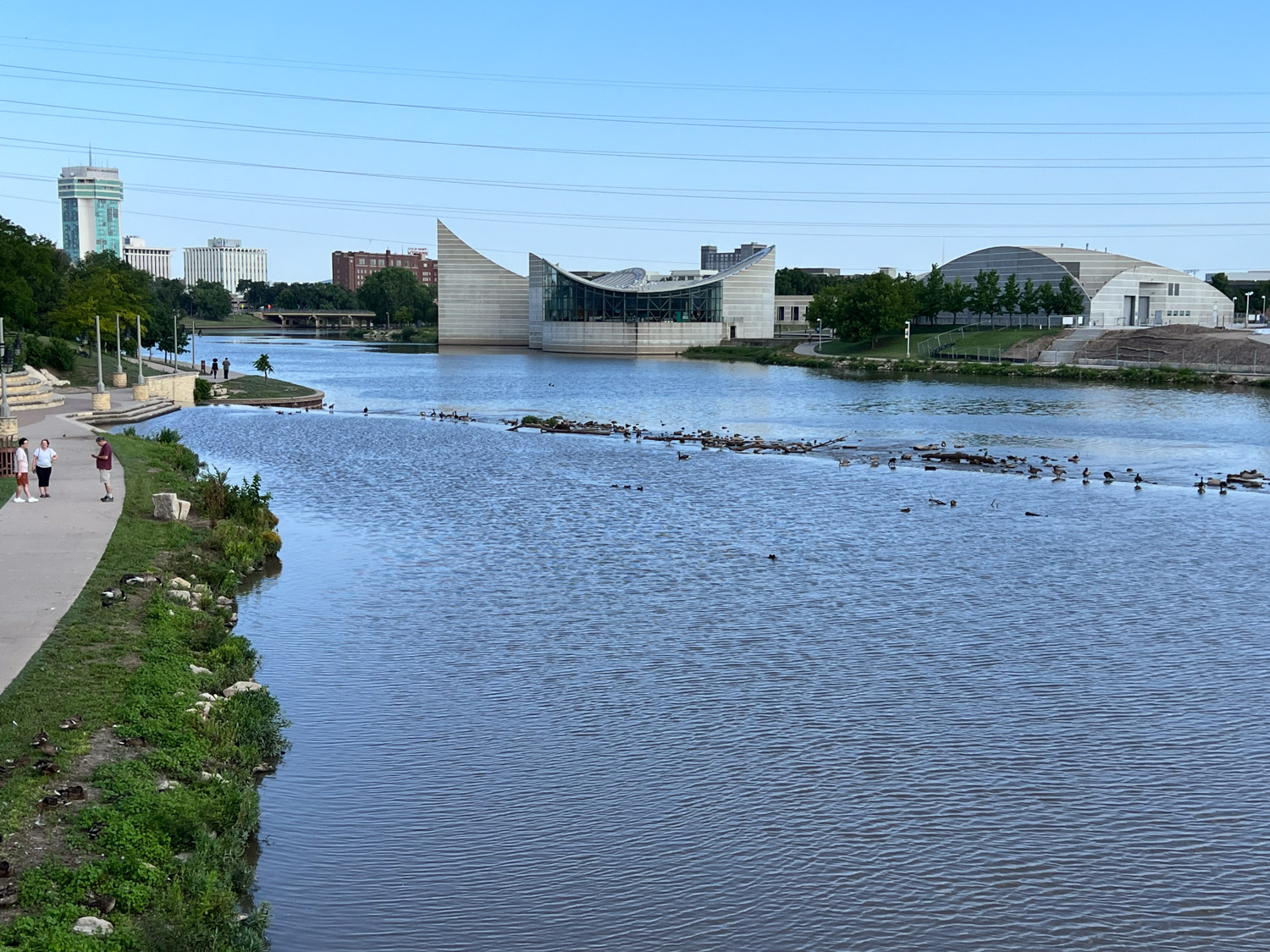
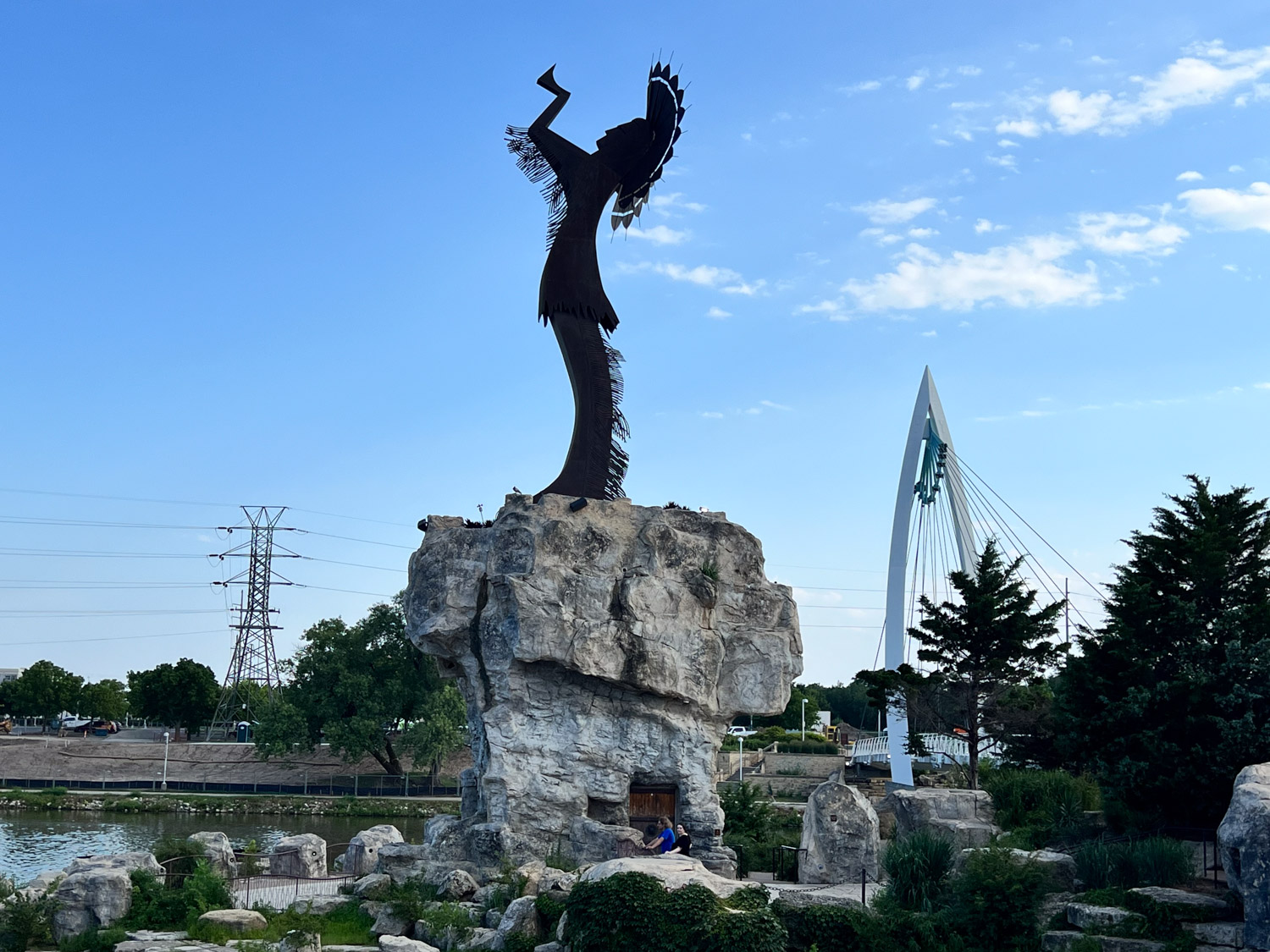
This unusual building is the Exploration Place. In the distance you can see a pedestrian bridge and the 44-foot tall Keeper of the Plains statue that rises on a rock promontory. It is at the confluence of the Arkansas and the Little Arkansas Rivers, as seen on the map above.

This monument is just off the path and is one of many in the adjoining Veterans Memorial Park

Exploration Place seen from the north.

Keeper of the Plains. The statue was erected in 1974 and was raised on a 30-foot promontory in 2006 so that it could be seen from farther away. In the adjoining plaza there are displays that describe the local tribes that used to inhabit the area. There is also a ring of fire pits that are lit nightly for 15 minutes.

As I walked back on the other side of the river I had another view of the Exploration Place. Right now the website advertises two nights of Superhero Sleepover (“Bam, Pow, Snooze”). This looks like a great place to visit with kids…probably adults too. I took this photo partly for my own kids who I think would be interested in or amused by the helicopter, the giant open mouth and the green object on the left. You probably can’t tell in the photo here but I could see from where I stood that it says Fart Chair. The building is large and I’m sure holds a full day’s worth of interesting activities.

This is a view of the Hyatt from the bridge where I crossed back over the river. Home for the next four days.

Black Sheep Gathering 2024

I’m already on my next adventure, but need to catch up with the last one. After the quick trip to Idaho I decided against going to Black Sheep Gathering in Oregon the following weekend. I had not planned to take sheep this year and had not entered wool, fiber arts, etc. But half way through the week I changed my mind. Without entering any shows I didn’t have to be gone as many days, so I left Friday morning. I will admit that two hours into the drive I thought about turning around and coming home because I had so much to do at home before the next event (where I am now). However I had told a friend in Oregon that I’d visit along the way, so I kept going.

Here is where I stayed the three nights I was there. As I set up my tent I realized that I think I’ve had this tent and my sleeping bag since my college days or shortly after.

I took very few photos in the barn, but here is one–a Valais Blacknose. There was a new Jacob breeder there and I helped her show. Because she was the only person with Jacob sheep she had to show in the All Other Breeds class, as I did last year. Maybe I’ll enter again next year and we’ll have a Jacob show.

I took a few photos in the exhibit and vendor hall. These are the main award winners in the Fiber Arts Show.

I spent a lot of time with a few vendors and tried to make time to see the rest.

I met this vendor last year at this event. She lives in Sacramento and I encouraged her to sell at Lambtown last fall. Her booth was next to mine. Even though I specialize in locally grown wool, including my own, I was intrigued by her yarns, many of which are not natural fibers and are certainly not local. But they sure are fun! The larger skeins are all lengths of yarns that are tied together. I had bought a few of these crazy mixed fiber skeins and brought the scarf I had just finished to show how I had used the yarns. I plan to create a class using this idea.

I spent time with one other vendor, business name of Shuttle Creek. Annie is a weaver and was working on a loom in her booth, She sells her mostly cotton garments at local shows I think. I just looked at the website and there are some gorgeous items there but blog and Facebook activity seem to stop in 2021 and I was thinking that she said she doesn’t do much online. Anyway, after talking to her a long time she pulled this piece off a hangar and put on me. I bought it and that’s what wore all day at the weaving event where I’m teaching (next post). I need a button that “no, I didn’t weave it”.

I spent part of the day at the vendor hall, helped the other Jacob breeder show sheep, visited with friends (most of whom are from California), and watched Spinners’ Lead. I packed up fairly early on Sunday and started home.

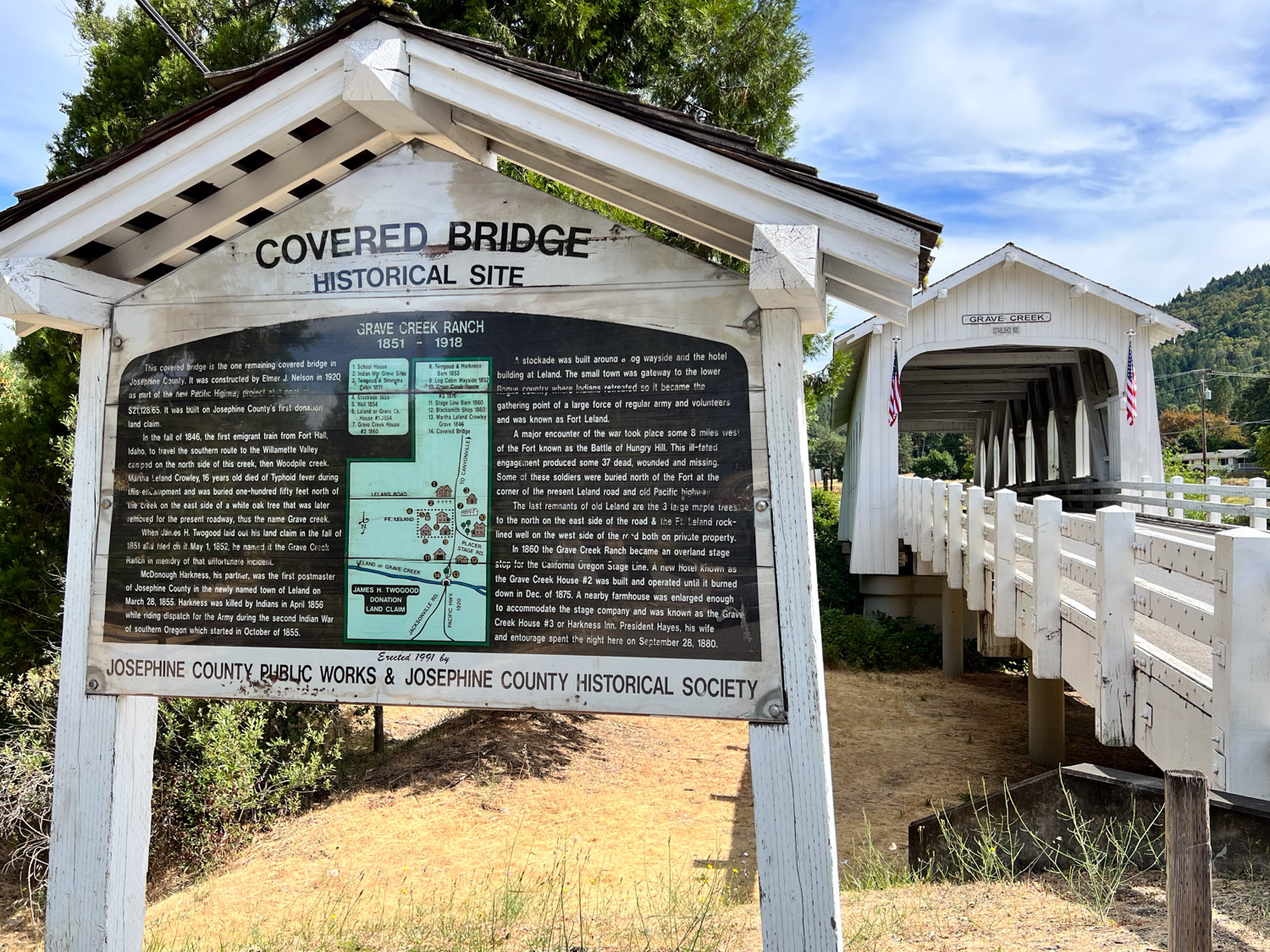
I’ve seen the sign for the covered bridge every time I’ve driven to Oregon but I’ve never stopped. It’s not far from the highway and an interesting site. There is a museum nearby but it wasn’t open on Sunday morning. The bridge was built in 1920 and the sign talks about the history of the area when white settlers came there in the 1840’s and 50’s.

I always at this site in California.

This means I’m almost home. (Sort of.)

Harvest

I thought I wrote about my mulberry harvest but I can’t find that post so I’ll include it here. I was going to tell the story about harvesting mulberries and dropping the bowl after touching the electric fence and then trying again only to have a sheep tip the bowl over. I’m sure I wrote this post–maybe its the one that as I as writing I ran out of room in my 15 year old free WordPress account and had to figure out what to do. Here’s that story.

The mulberry tree.

I have learned that mulberries ripen over time and you can continue to harvest for quite awhile. The berries fall off very easily when ripe, but that also means that a lot fall simply because it’s windy. Also, this tree is very tall. If I wanted to be serious about the harvest I’d need to put down a clean sheet or tarp and then try hitting the branches with a long tool of some kind. This is not in a convenient spot for that since the branches hang over either side of a fence and the irrigation ditch is under part of it. And don’t forget the electric fence.

I did end up with a couple of pies after two different harvest times.

The idea for this post started because of thinking ahead to the blackberry harvest. I know that the blackberries are usually ripe during State Fair. It looks like we’re right on track for that because they aren’t ready yet. State Fair is at the end of the month.

Look at the harvest that we’ll have–although I can’t reach a lot of those. There happens to be an irrigation ditch in front of this too. It’s dry most of the time, but it still makes it more difficult to reach the top half of these. We’ll be gone for up to a week after the fair so my farm sitters may benefit most from this harvest.

Here’s an unusual harvest. I list puncture vine seedpods on the website for use in craft projects.

There was an order today so I had to go find some more outside the pasture fence.

Dye plant harvest is beginning. I don’t have time to do any trying right now so I’m weighing the fresh flowers and drying them. This is Cosmos. Some of this is for sale here on the website. That is from last fall, but the dried flowers dye just as well as the fresh ones.

Dahlia flowers are also ready to harvest. They will continue to bloom if I can keep up with watering during this heat wave.

Ironman 70.3 at Coeur d’Alene Idaho – Day 3

I’ve been distracted, but now I’m ready to finish this story. At the end of Day 2 I said that we got to the Ironman start at 5 a.m.

The race was supposed to start at 6 a.m. At the last minute the organizers changed the start time to 6:20 because they also shortened the swim course. The normal 70.3 Ironman has a swim of 1.2 miles. This was shortened to 500 yards because of the high winds. The water was very choppy and maybe they were worried about not having enough people to monitor the whole course under those conditions.

After leaving the transition bag with the bike we had to wait until athletes started to line up for the swim start.

To space them out the swimmers were allowed in the water two at a time every five seconds. It took over an hour to get all the athletes in the water. Each athlete wears an ankle band with a chip so times are recorded individually at the start and finish and at checkpoints along the course. We were able to pick Chris out of the crowd since he placed himself, based on expected time, near the front. There were a lot of black wetsuits and green caps, but his goggle straps were under the outer green cap and that was an identifying feature, at least at this point.

He is the on the left entering the water.

The original course would have taken swimmers out to that last yellow buoy, then left to the buoy at the far left and then back to shore. The shortened course had swimmers turning at the red buoy in the center of the photo, to another buoy out of the photo and back. There were at probably a couple dozen people in kayaks, rafts, boats, and even scuba divers to watch for problems.

Swim/bike transition. The wetsuit and goggles are left behind near the bike rack.

This is the only place we saw Chris on the 56 mile bike course.

Bike/run transition. Leave the helmet and switch shoes. The run is half a marathon–13.1 miles.

Chris’ support crew. We don’t provide actual support (food, etc) but can cheer him on.

This is the first loop through town.

This is right at the end.

The finish line.

These times are all different because they are measuring total time based on when the athlete entered the water. The stats on the Ironman app where we followed him throughout the course. show 34th out of 135 in his age group. That’s in the top 25% and that was also true over all.

It was a quick trip for all of us, but we’re glad that we were able to be there to support Chris and to hang out with Meryl while Chris was on the course. We didn’t linger after the race because they both had to be at work on Monday and we needed to get back here. Chris was finished before noon we all left by about 1:30. We made it home at 3:15 a.m. Monday.

Ironman 70.3 at Coeur d’Alene Idaho – Day 2

Day 1 was the travel day. Day 2, Saturday was when the bike was to be checked in and we would drive the bike and run courses. We weren’t due to meet up with Chris and Meryl until mid-morning.

Five classic cars on a street in Idaho.

I decided to go on a walk since I’ve been doing it regularly at home and I sure needed to get some exercise after that 13-hour drive the day before. I took this photo for Dan because I thought he’d get a kick out of those cars.

The staging for the Ironman gets complicated. After the athletes get out of the water on race day they move to where the bikes are staged. The clock is already ticking so they want transition time to be as quick as possible. The bike needs to be ready to go and some people leave their gear bags there the day before or may plan to bring them back on race-day morning. Transition from swim-to-run requires a towel, whatever clothes you are going to put on over swimwear (after of course removing the wetsuit at the end of the swim–there are usually volunteers to help pull it off), and cycling shoes and helmet. The bike-to-run transition is usually just switching shoes and leaving the helmet behind with the bike.

After Chris checked in he was given all the numbered stickers for his helmet and the bike. He takes great care to make sure that sticker is on perfectly straight and even.

This is NOT the gear he will wear on race day, but after putting wheels back on the bike he needed to take it for a short test ride.

There are racks set up for all the bikes. Gear bags are left with the bikes or brought the next morning. We drove the course, checking out the long uphills on the bike course. After we had seen the course and spent some time exploring the lake shore roads we went back to the hotel for awhile. Dan was out of reading material and saw that there was a book store on the same street as the hotel. This place was called EntertainmentMart and it calls itself an entertainment superstore. It was a pretty amazing store but we didn’t explore it all–just the books, used and new. Here’s an abrupt change of photos.

There was a table set up just inside and an author was there with her first book, a fantasy adventure. I talked to her and her husband for awhile and they said asked if I wanted to put on the gloves and helmet that were for their display. I chose the gloves. And I bought the book.

The store also had music and a section of vinyl records. This was an interesting use for some of the none-collectable LPs.

Back to the main event.

On Sunday we set the alarm for 4-something so we could meet up with Chris and Meryl by 4:30 and drive to the event. You never know what traffic will be like when almost 2000 people try to get to the same spot at the same time.

Walking to the start at about 5 a.m.

To be continued.

Ironman 70.3 at Coeur d’Alene Idaho – Day 1

I think we’ve made it to all the Ironman events for Chris and Matt. When I search the blog I used from 2019 through early 2023 I found 11 posts about our Ironman experiences. The earlier WordPress blog (which is what I’m using now) had Chris’ first Ironman in 2013 and the second one in 2016. Do you see the purpose of these blog posts? Like I’ve said before, they replace the old scrapbooks. And now, to have the best of both worlds, Matt has made real books out of many of them (see this post).

Chris had to fit this Ironman in before fire season. Chris and Meryl live in Boise and Chris works out of McCall, so it seemed that Coeur d’Alene was doable. For us it was a 13 hour drive. This post is all about the drive on the first day.

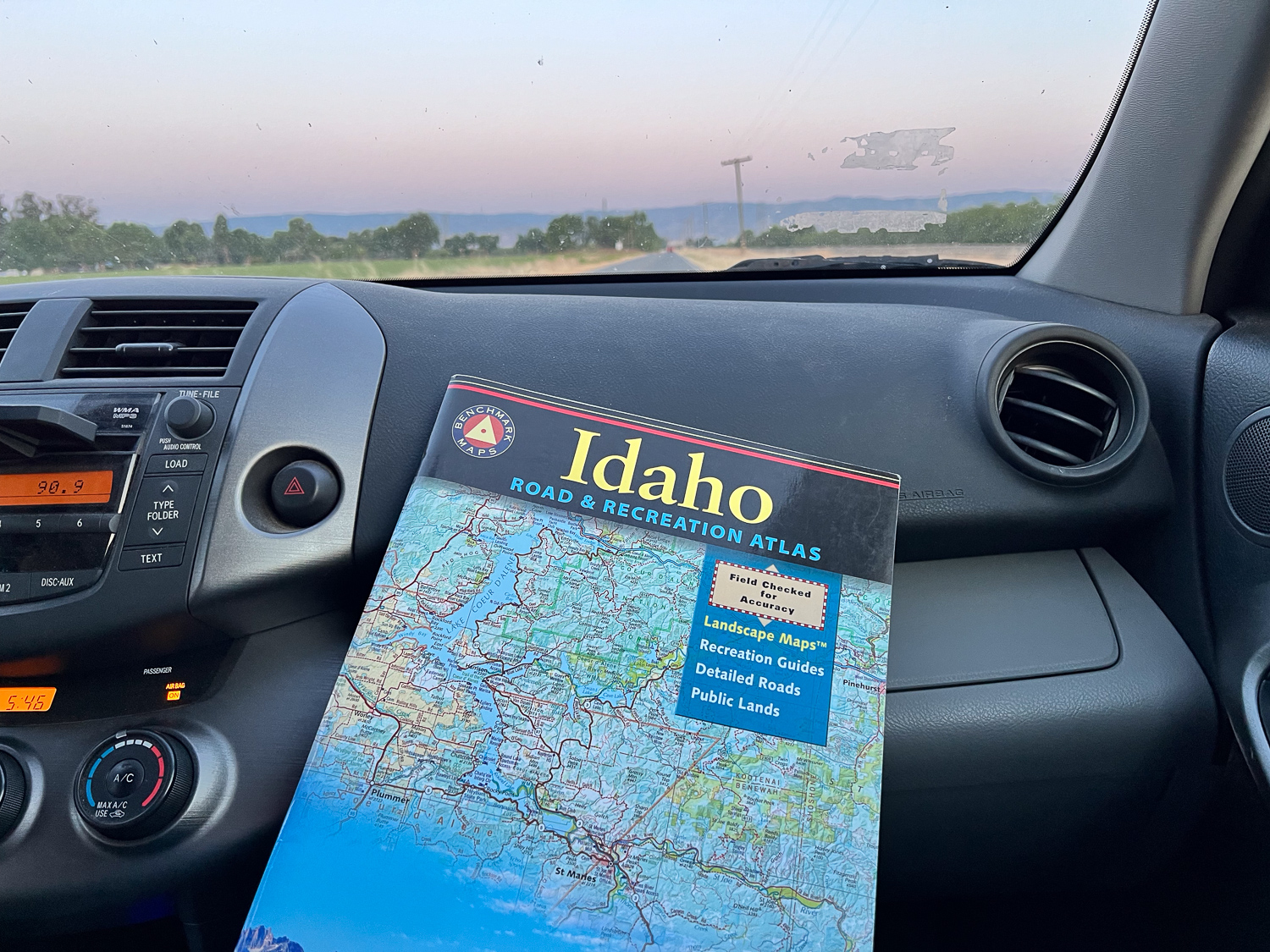
Idaho map book on dashboard of card.

We left at 5:45 a.m. on Friday, only 45 minutes behind schedule. The event was on Sunday so this would give us a day to check out the course, check in the bike, and visit with Chris and Meryl.

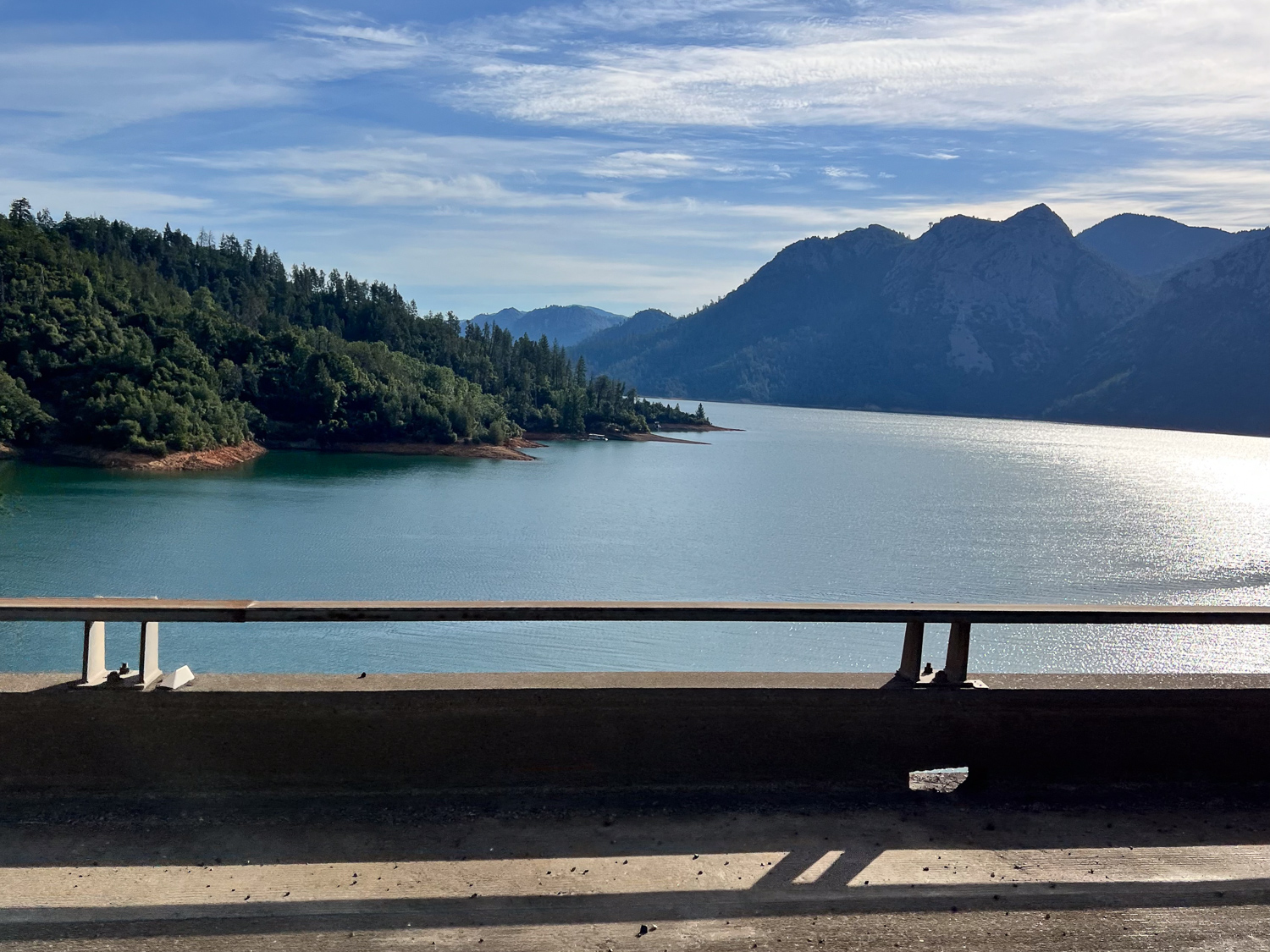
It was good to see that Shasta Lake is full.

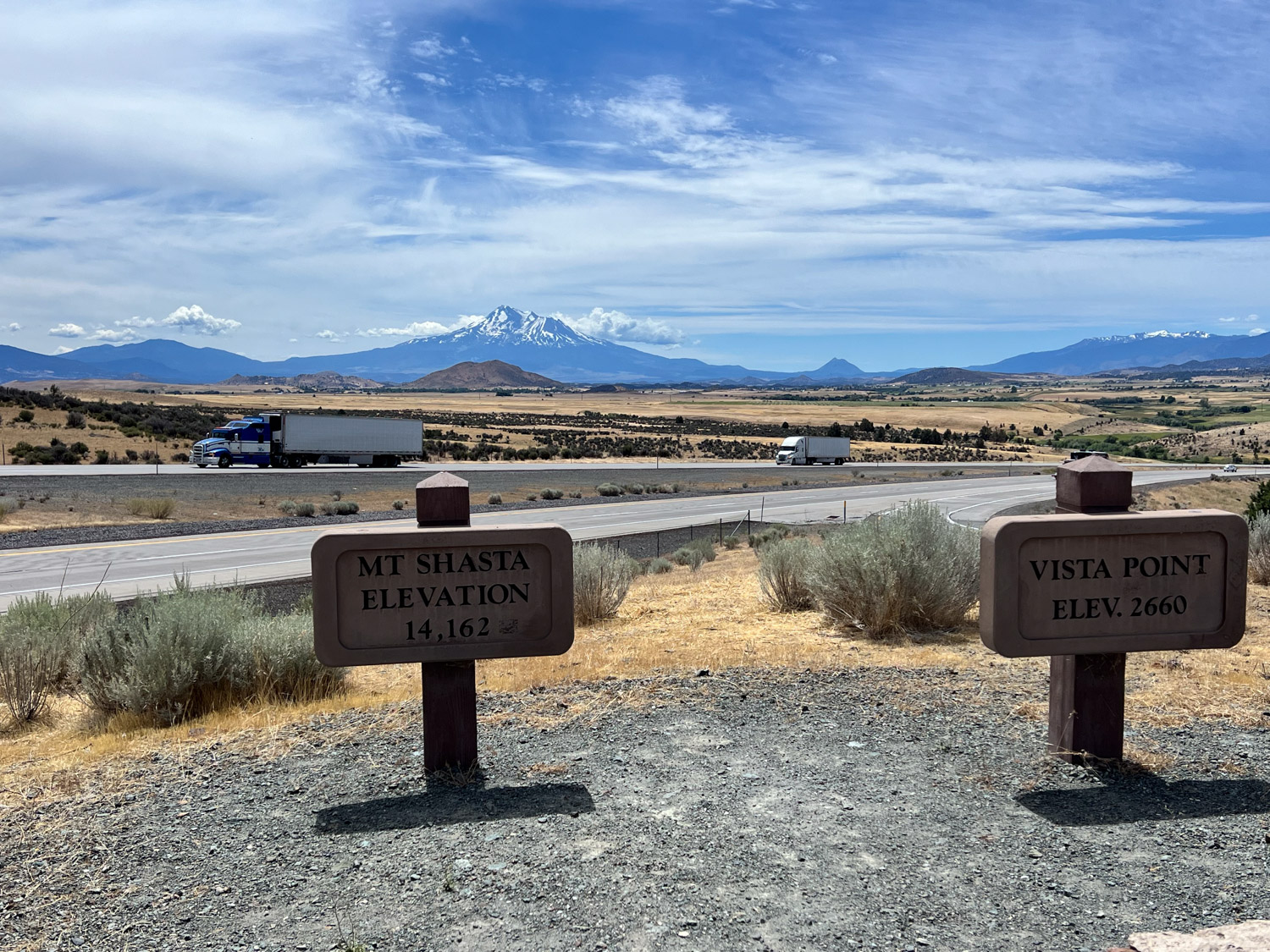
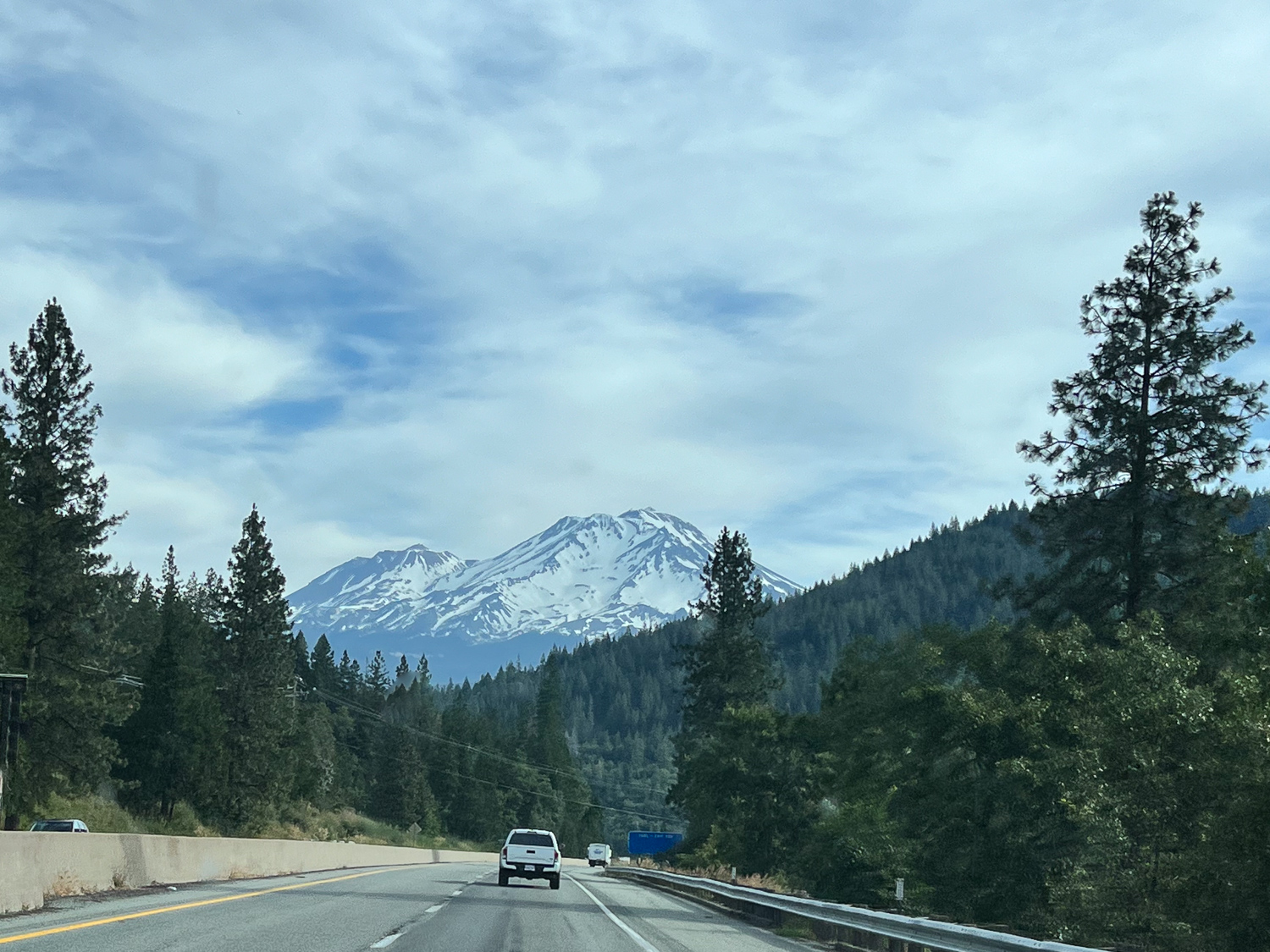
I always look forward to seeing Mt. Shasta.

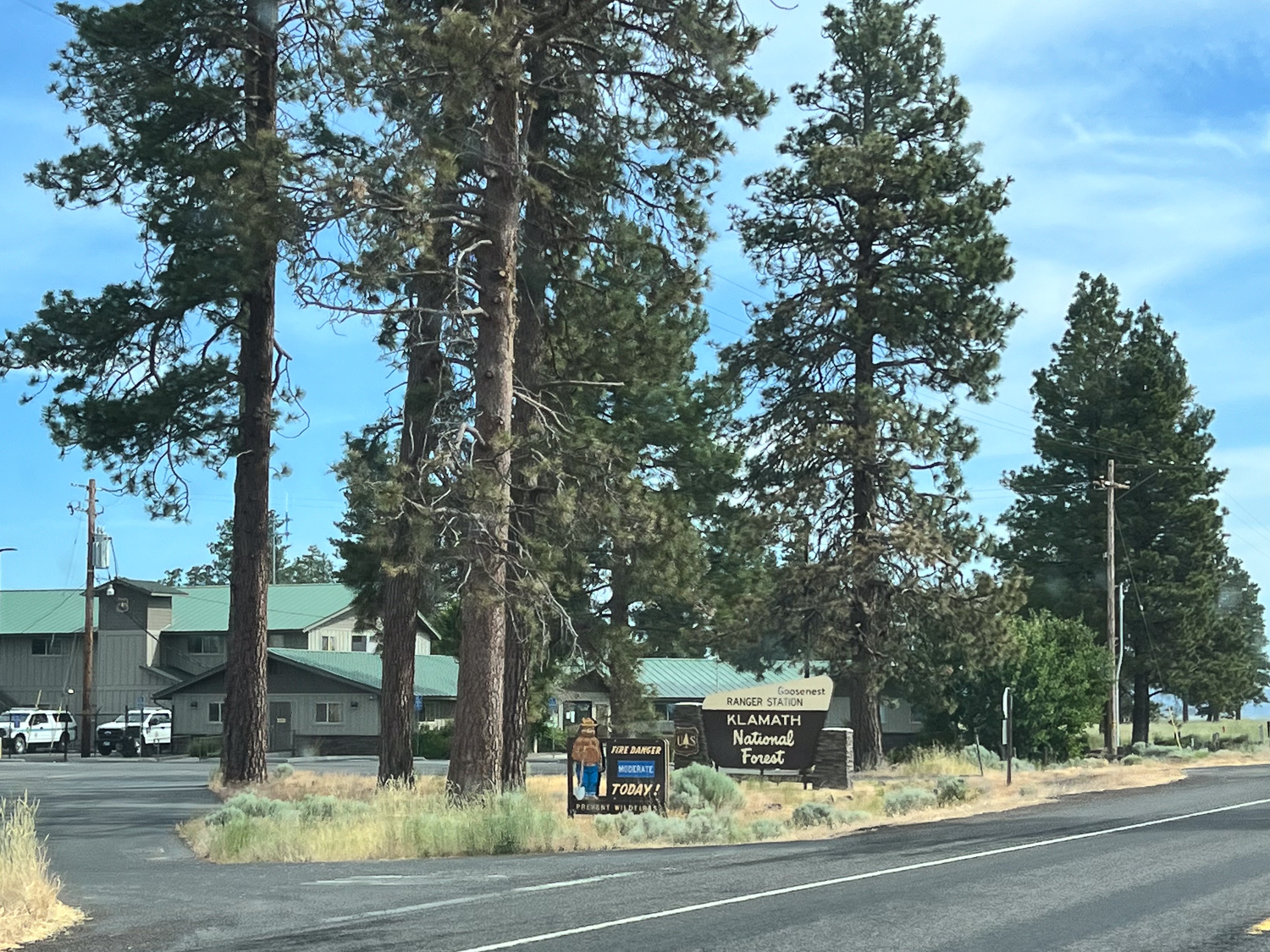
We veered off I-5 at Weed to take Hwy. 97 into Oregon. I interned for a summer in the mid 1970’s (or was it two?) in Siskiyou County for the USFS. This is the station where I reported and I lived in a tent at a campground about 10 (?) miles away. I have forgotten a lot of details. I wouldn’t mind going back there to see it, but this wasn’t the trip for getting side-tracked. There were lots of memories driving through this area though.

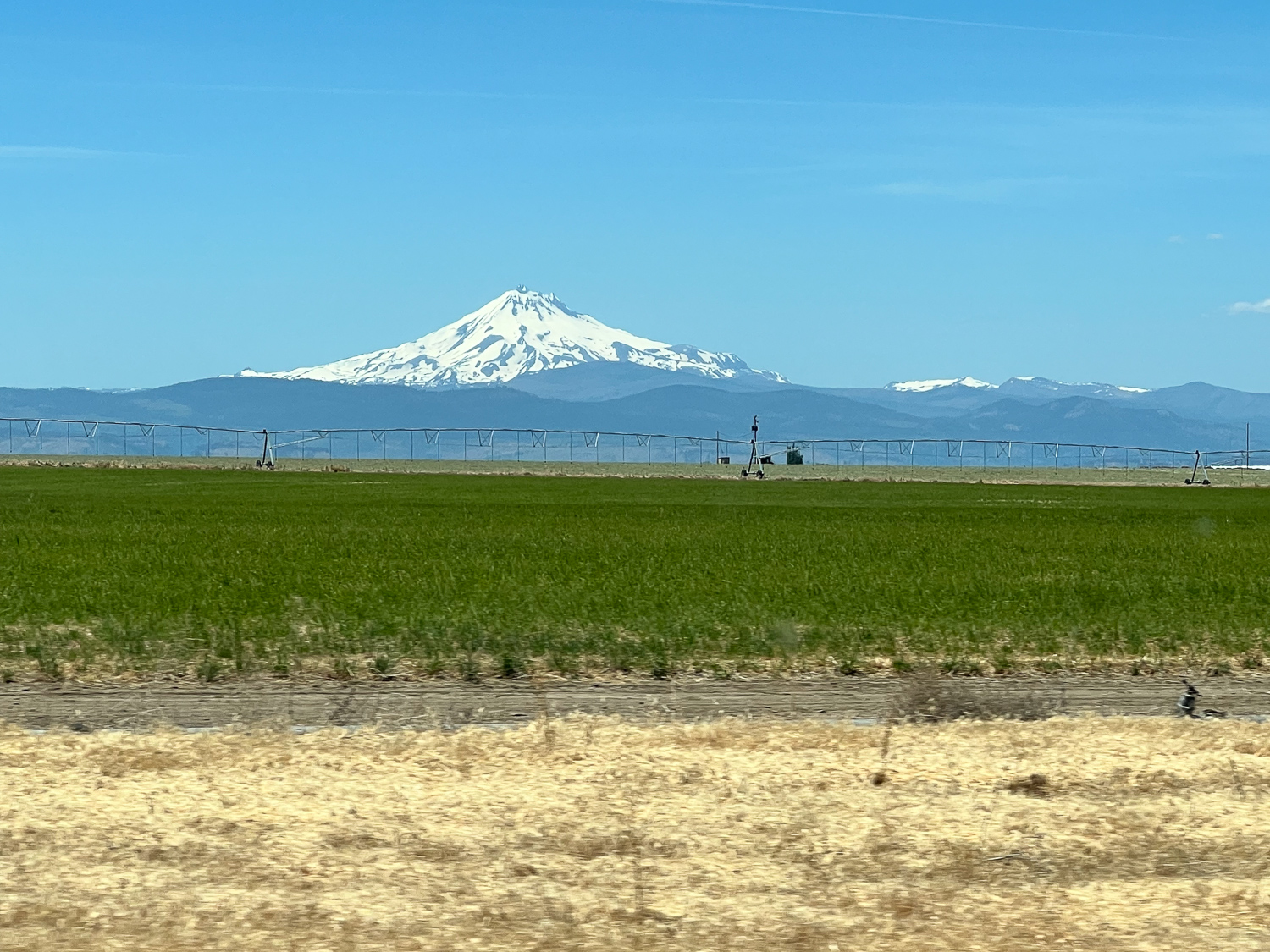
Once in Oregon we were struck by the mountain peaks rising so far above everything else. I’m used to our area where you see a whole range of mountains when the sky is clear enough. Here it’s interesting to see individual mountains that rise above all the rest. This one is Mt. Jefferson (I think), 10,502′ at the peak.

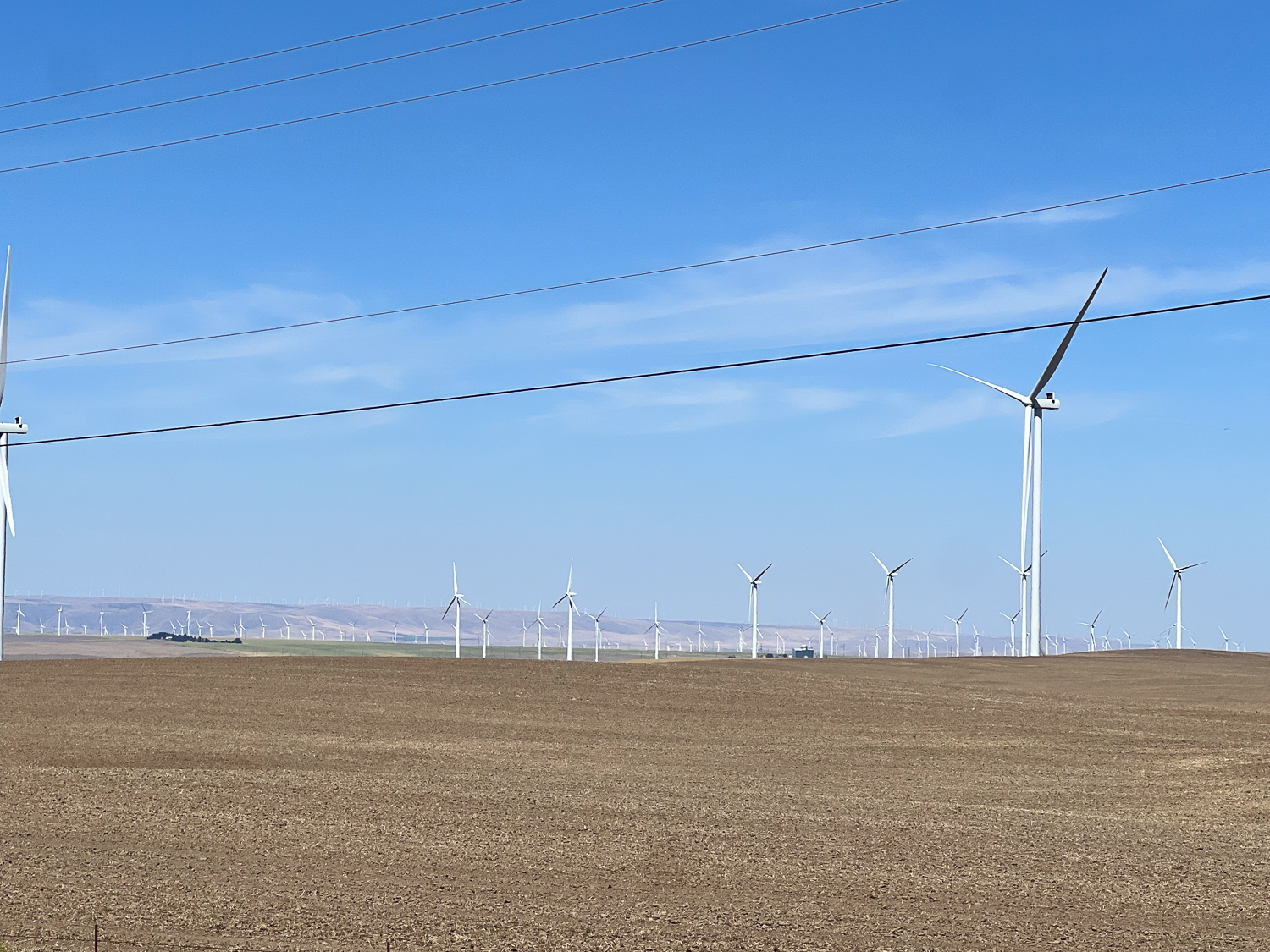
I have lots of landscape photos but I can’t put them all here. I don’t know if I’ve driven this stretch through Oregon. The main feature along this part of the route was the grassland. In fact over 173,000 acres are designated Crooked River National Grassland

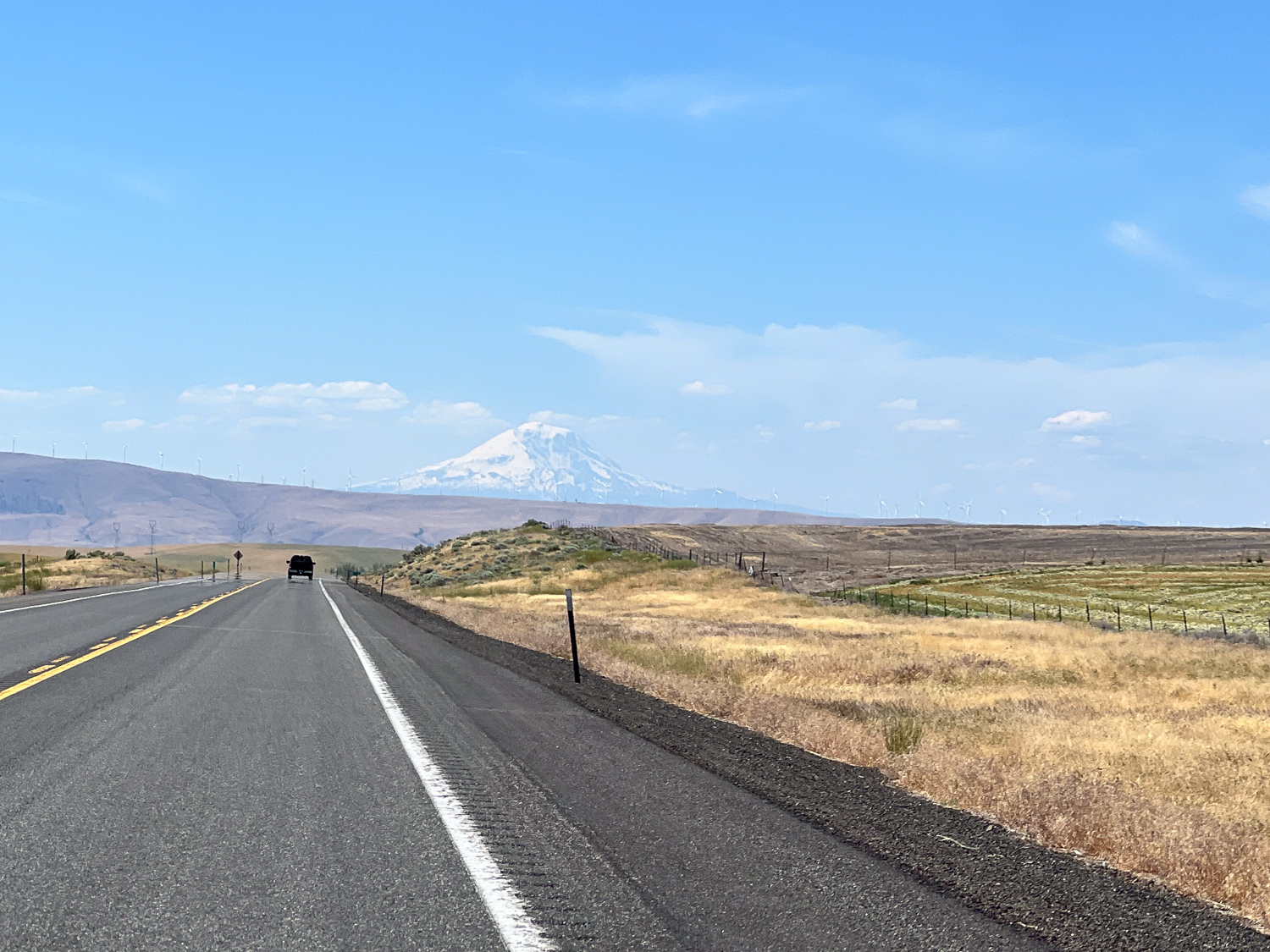
I’m skipping ahead. We’re still in Oregon but with a view of Mt. Adams in Washington.

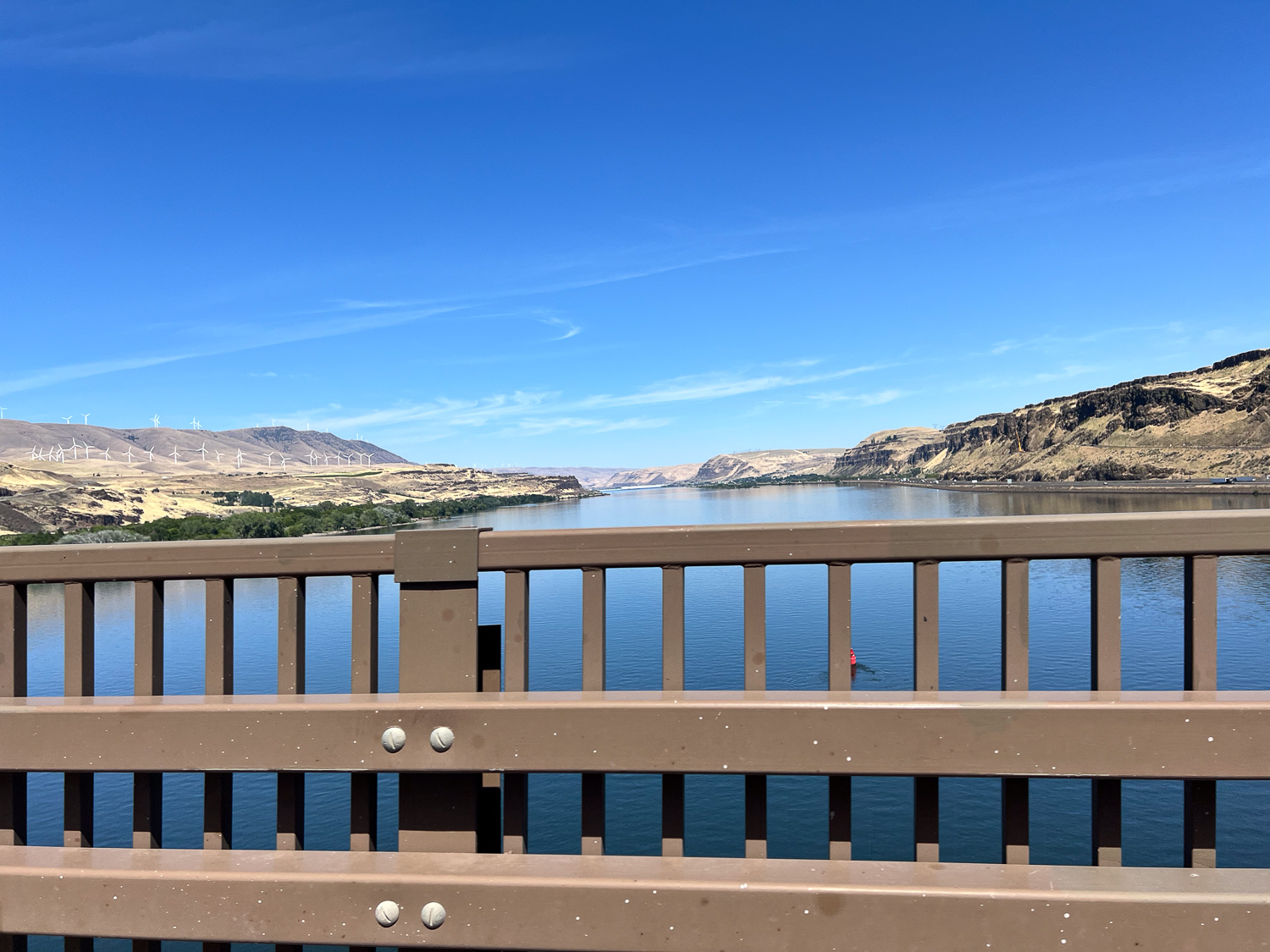
This is crossing the Columbia River at Biggs Junction, entering Washington.

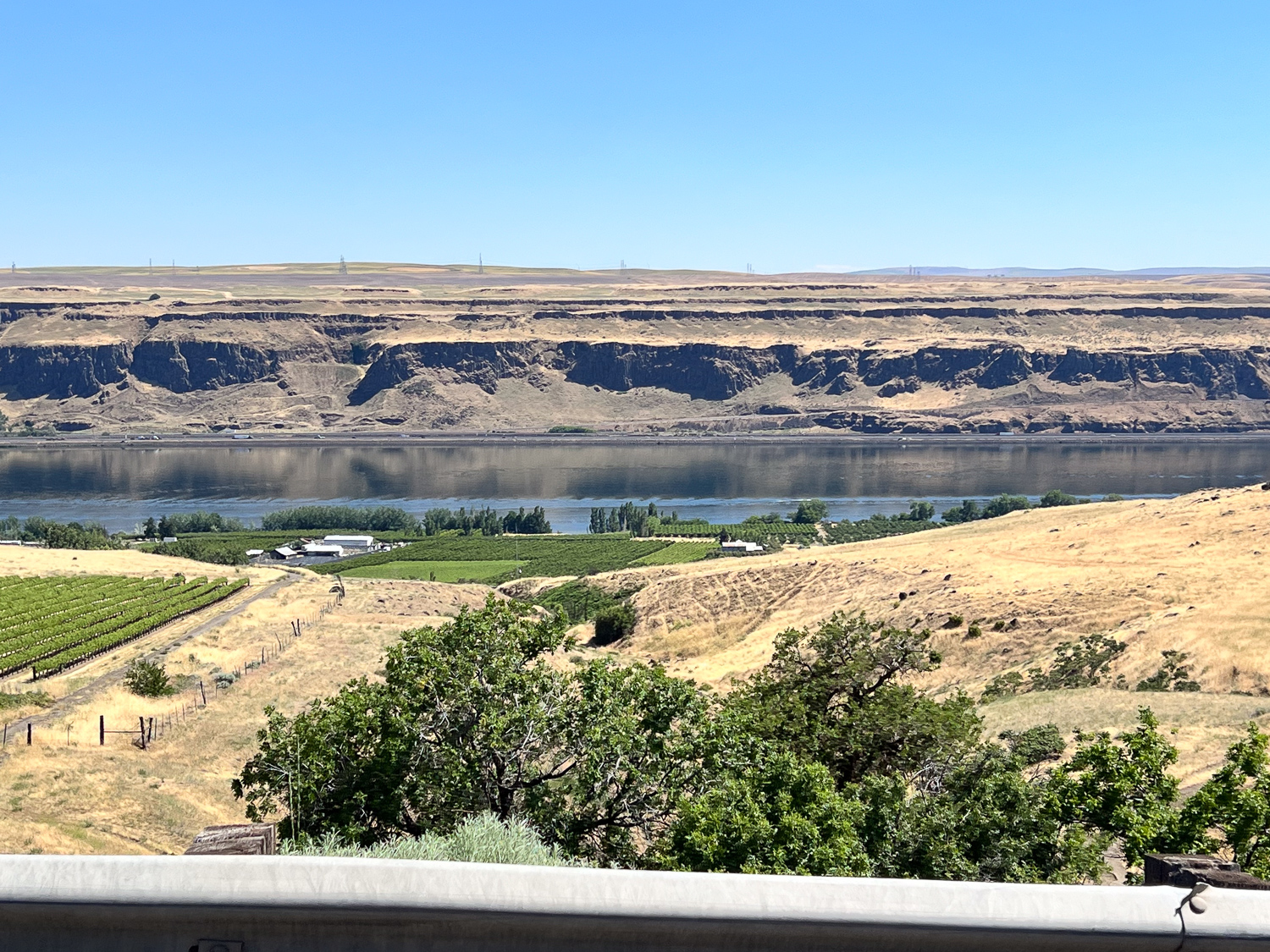
This is the view from the north side of the Columbia River.

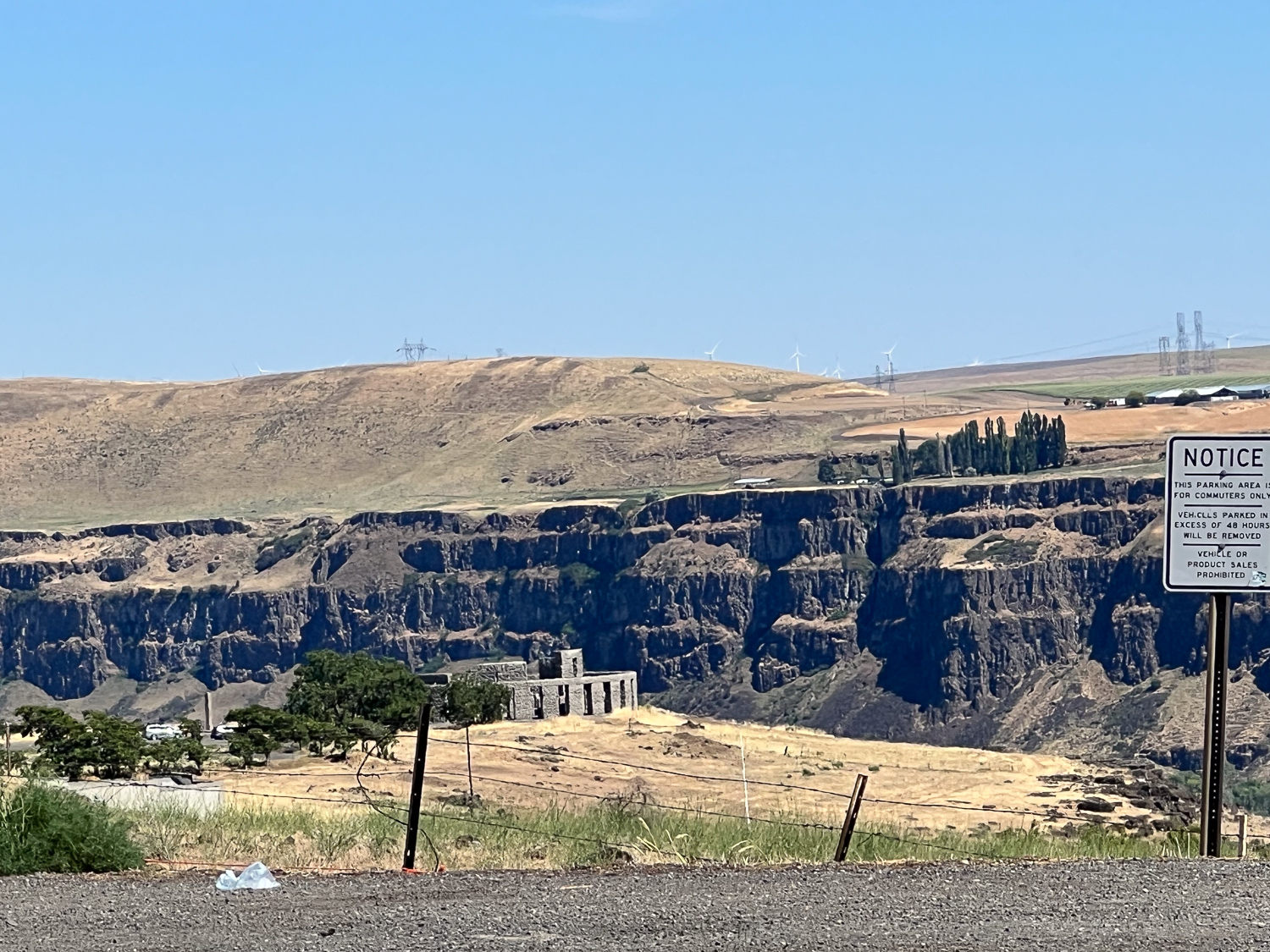
There is an interesting structure on the north bank of the river. This is known as Stonehenge and it was constructed in 1918 to memorialize the men who fought in WWI. See the whole story here.

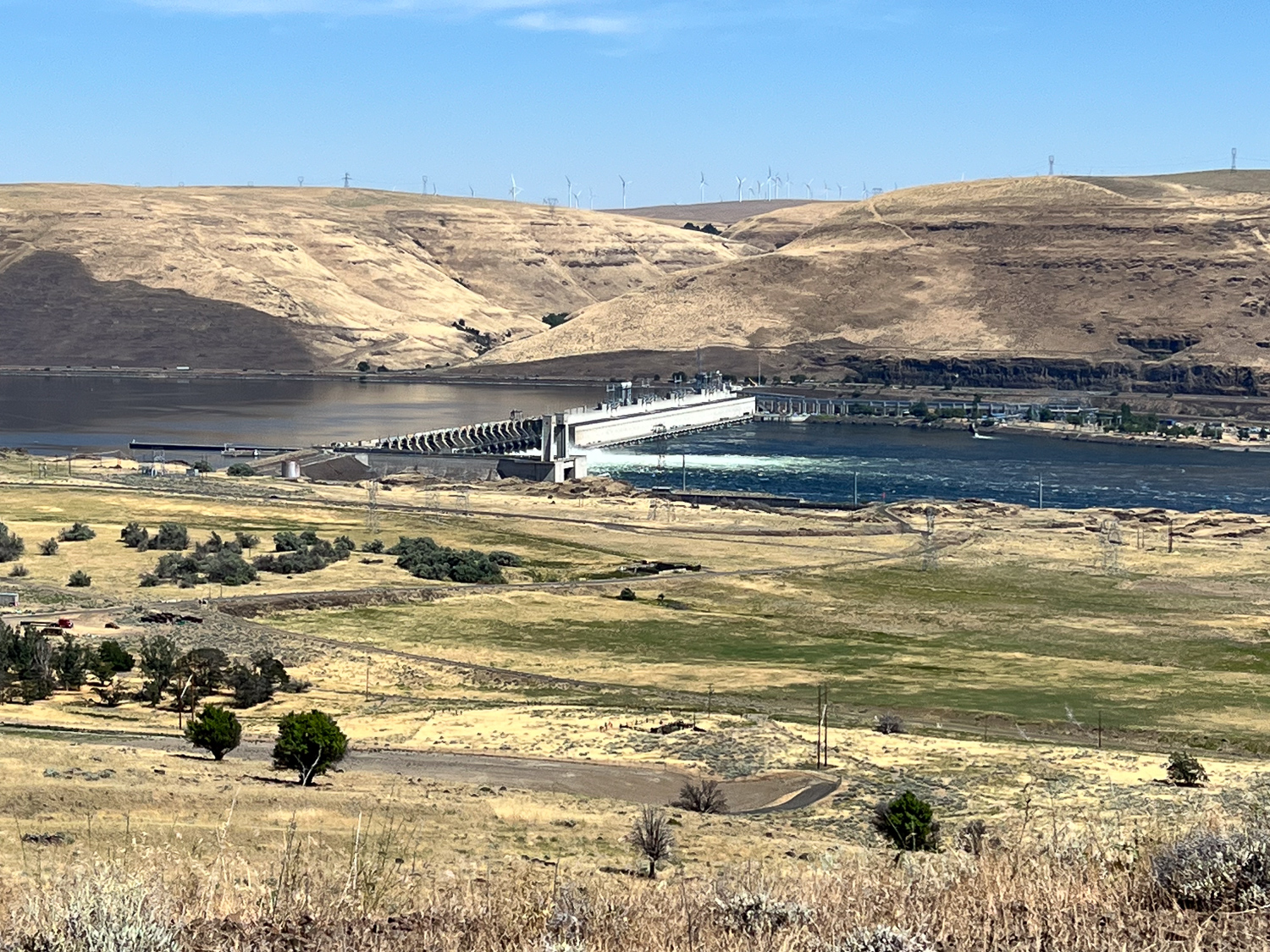
John Day Dam is not far from where we crossed the river. Construction started in 1958 and it was first used in 1971. I am fascinated by the lock structure that lifts a maximum of 113 feet, seen on the left in this photo.

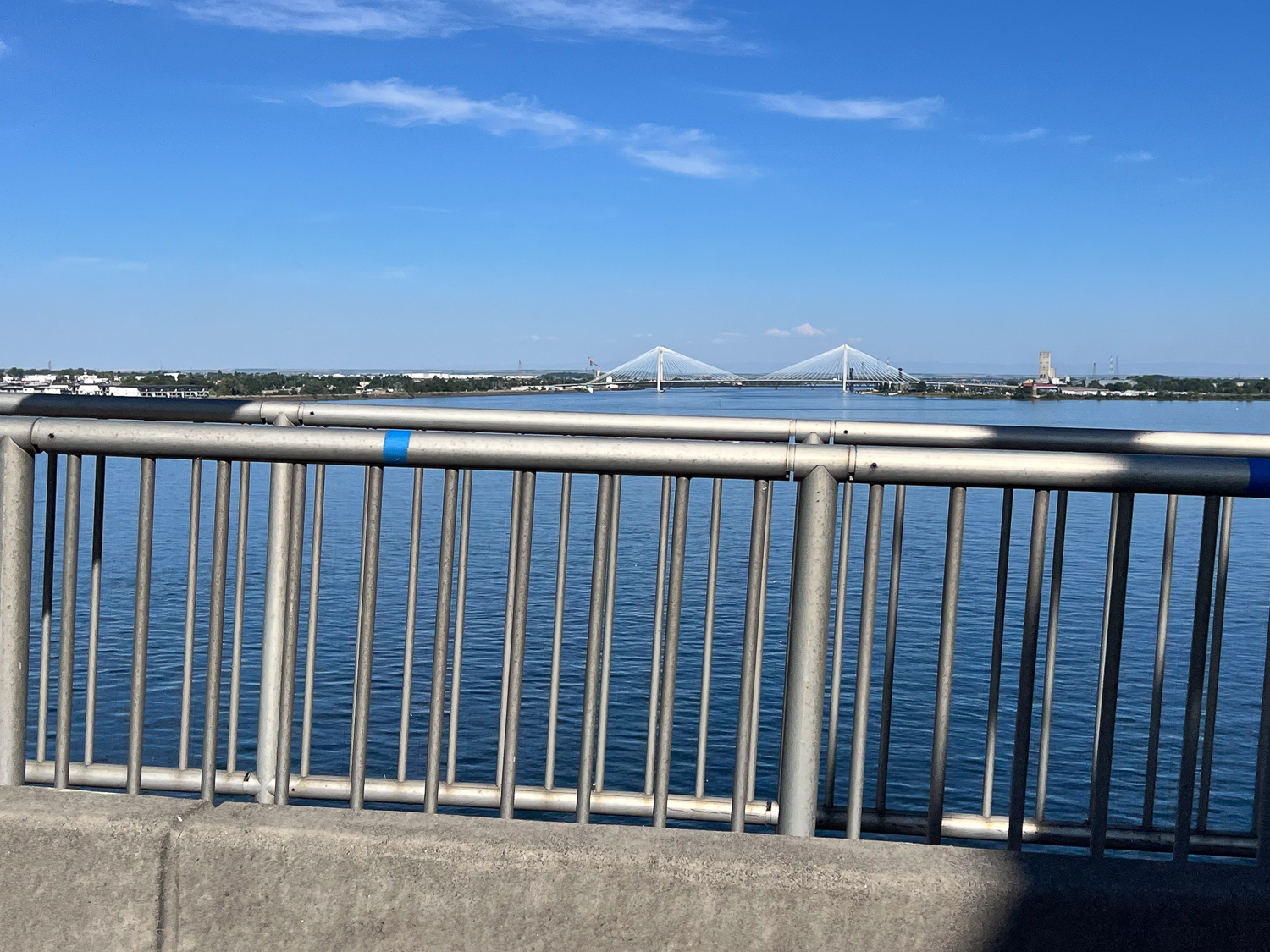
View crossing the river at Kennewick.

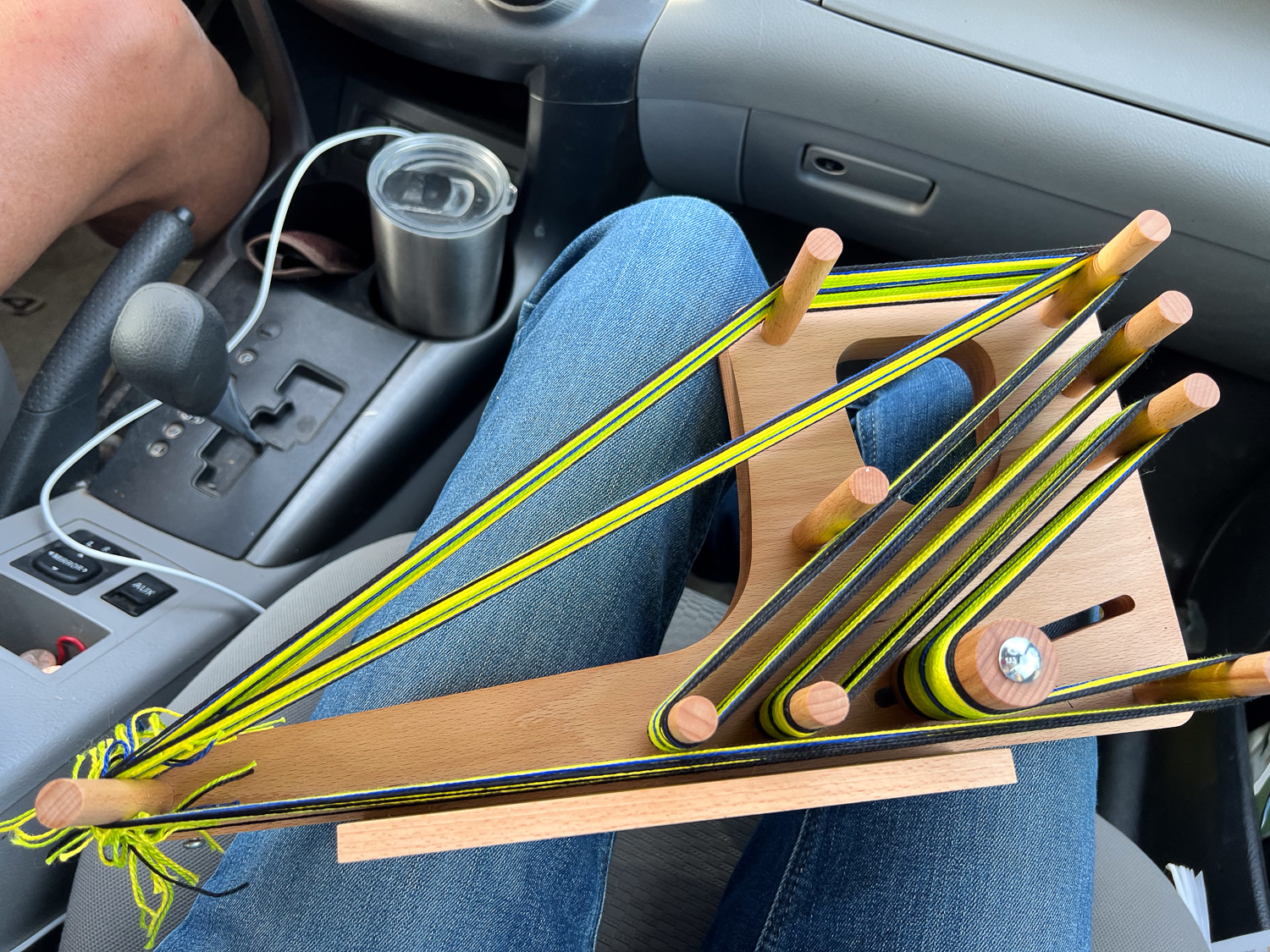
Knowing that Dan would want to do most of the driving, I brought a ridiculous amount of projects and unread magazines with me. I spent the first few hours working on the article I’m writing for Handwoven that was due soon. Once we got into the Northern California mountains and then through Oregon and Washington I wanted to see the scenery. I didn’t get anything out until the last bit when I pulled out this inkle loom to thread it.

It was still daylight when we got to our motel. We met up with Chris and Meryl briefly but everyone needed to get some sleep. To be continued.

Another Busy Day at the Farm

Yesterday was the first harvest day of the season. Some lambs are 4 months old now. The BFL cross lambs are bigger than the 100% Jacob lambs and some are ready for customers who like lighter lambs. I have a customer who likes the black lambs. I asked if he wanted both of these because they are twins. If they were 50:50 crosses they would both be black, but these are 3/4 Jacob. There are two 50:50 ewes here and when bred back to a Jacob you never know what you’ll get. One is black with very short horns and one is white with some Jacob markings and large horns.

While I was sorting and weighing sheep I heard Ginny barking at something at the other end of the barn. This is a fancy trap that I bought several years ago and sort of forgot about. It is a live trap where the animal drops in from the top. It was in the back of the barn on a woodpile. We caught a young opossum! The opossums aren’t a problem here. I took this one out to a brush pile and let it go out there.

After sorting all the sheep I let the rest out to the pasture. This is a view of the property from the south.

This yearling is KJ Royalty Cindy. KJ Royalty is the flock name of my granddaughter and her sheep are the progeny of the ewe lamb I gave her in 2019. Kirby will be here next month to work with the new lambs and show at State Fair. I’m glad that Cindy is getting more friendly.

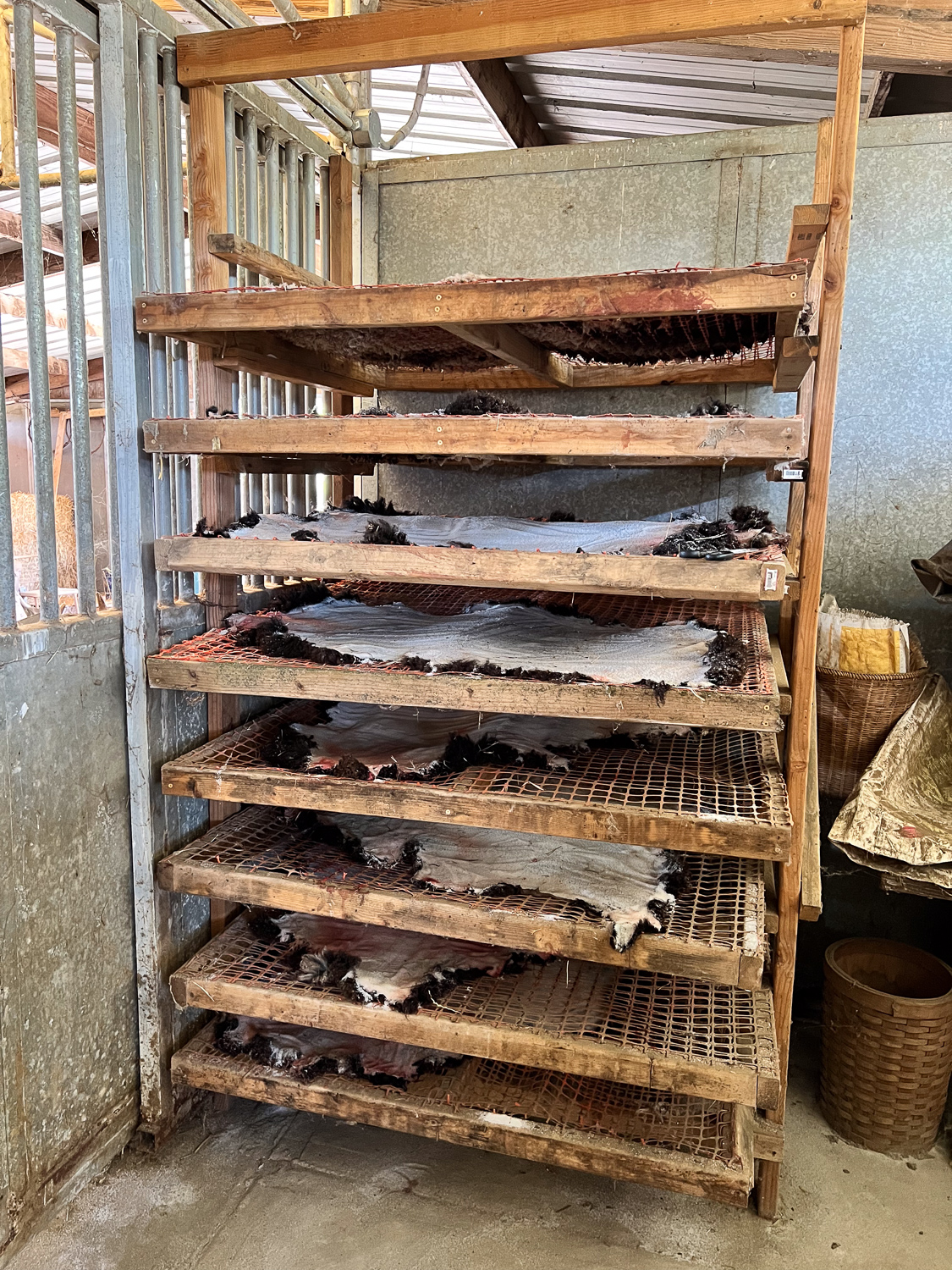
The person who harvests lambs is very fast and does a good job with the skins. I try to use all the parts of the sheep I can. I salted these hides and will ship them to a tannery when they are dry enough. The beautiful lambskins will be for sale when I get them back from the tannery–hopefully by early fall (but no guarantees). This page gives you an idea of what I will have for sale then, but these are all gone. I recently got back a dozen lambskins that were the first I sent off last year–a whole year ago. I haven’t had time to photograph and list them yet. Next week.

Harvest was over within two hours, but the rest of the day was busy with customers and computer stuff. Never ending computer deadlines. Late in the day we had a new kind of visitor.

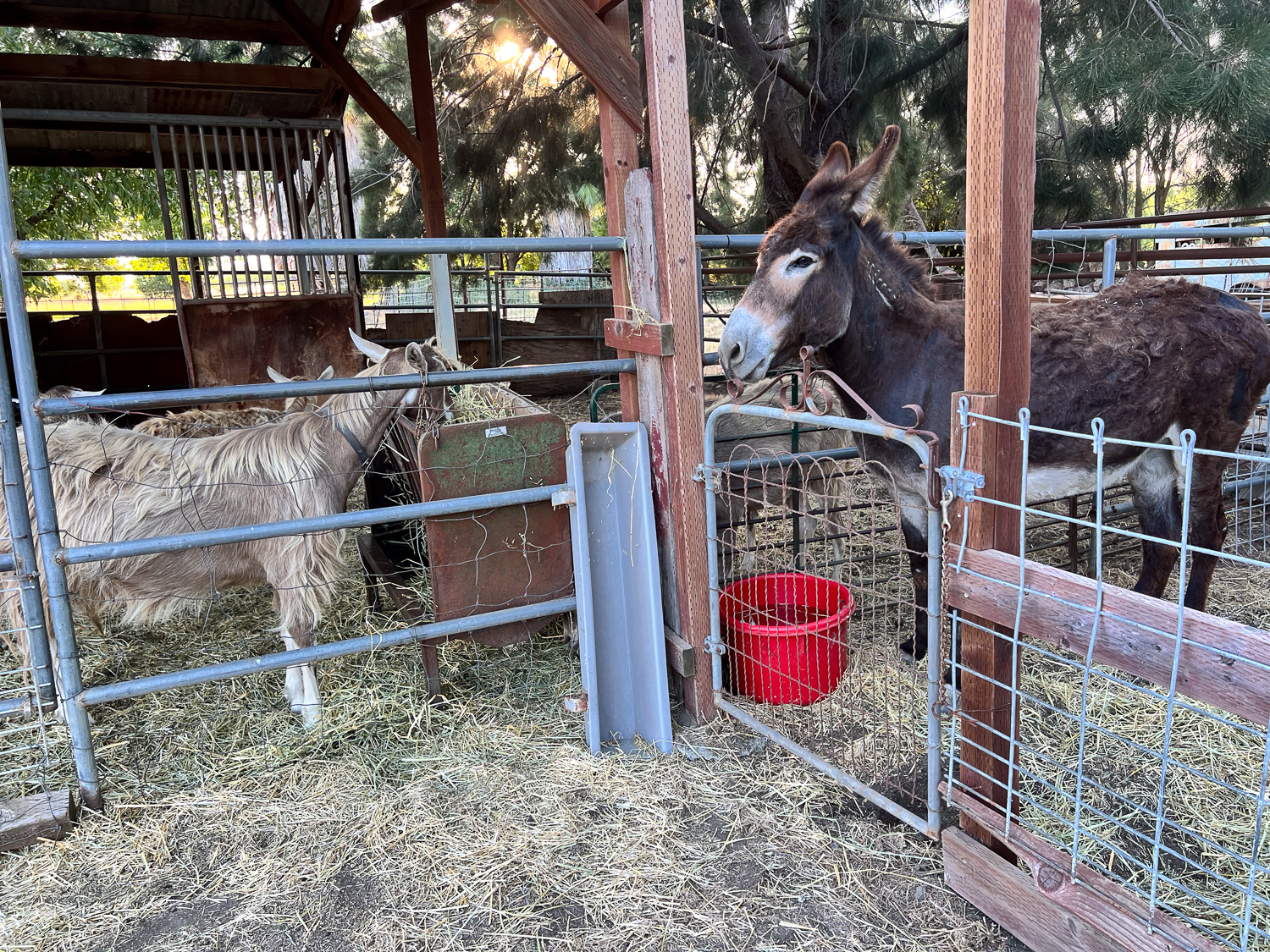
I am caring for these goats for a couple of weeks until their new property is ready for them. There are seven pet goats here and most of them originated from goats that my son Chris raised in his FFA project.

The goats came with a donkey! This makes me want a donkey again, but my irrigated pasture is not a good fit for a donkey. I can hear her braying right now even from the house!

Wheelbarrow or Chariot?

I wrote this post about wheelbarrows a couple of weeks ago. I ended by saying that the last photo would deserve it’s own post.

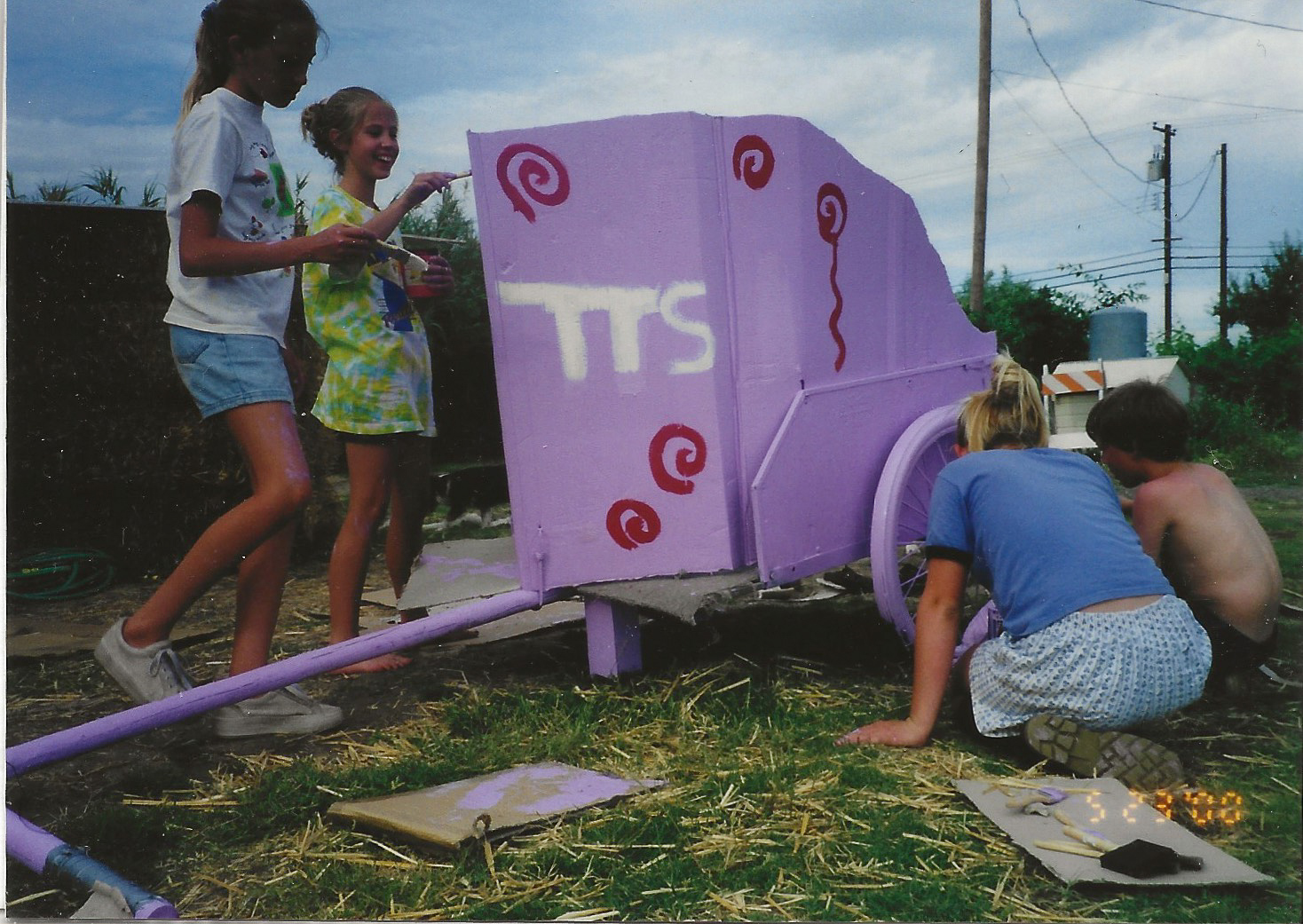
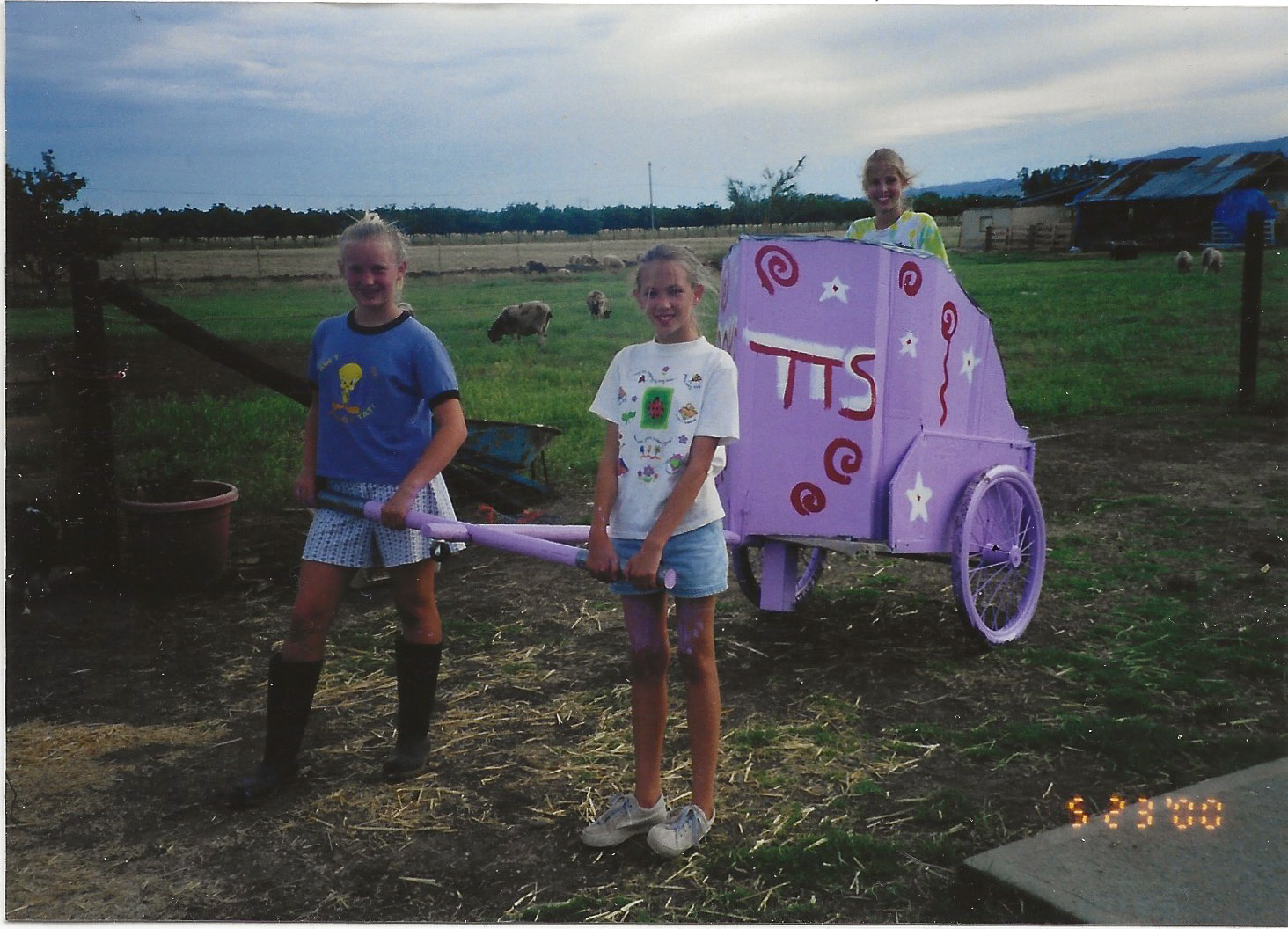
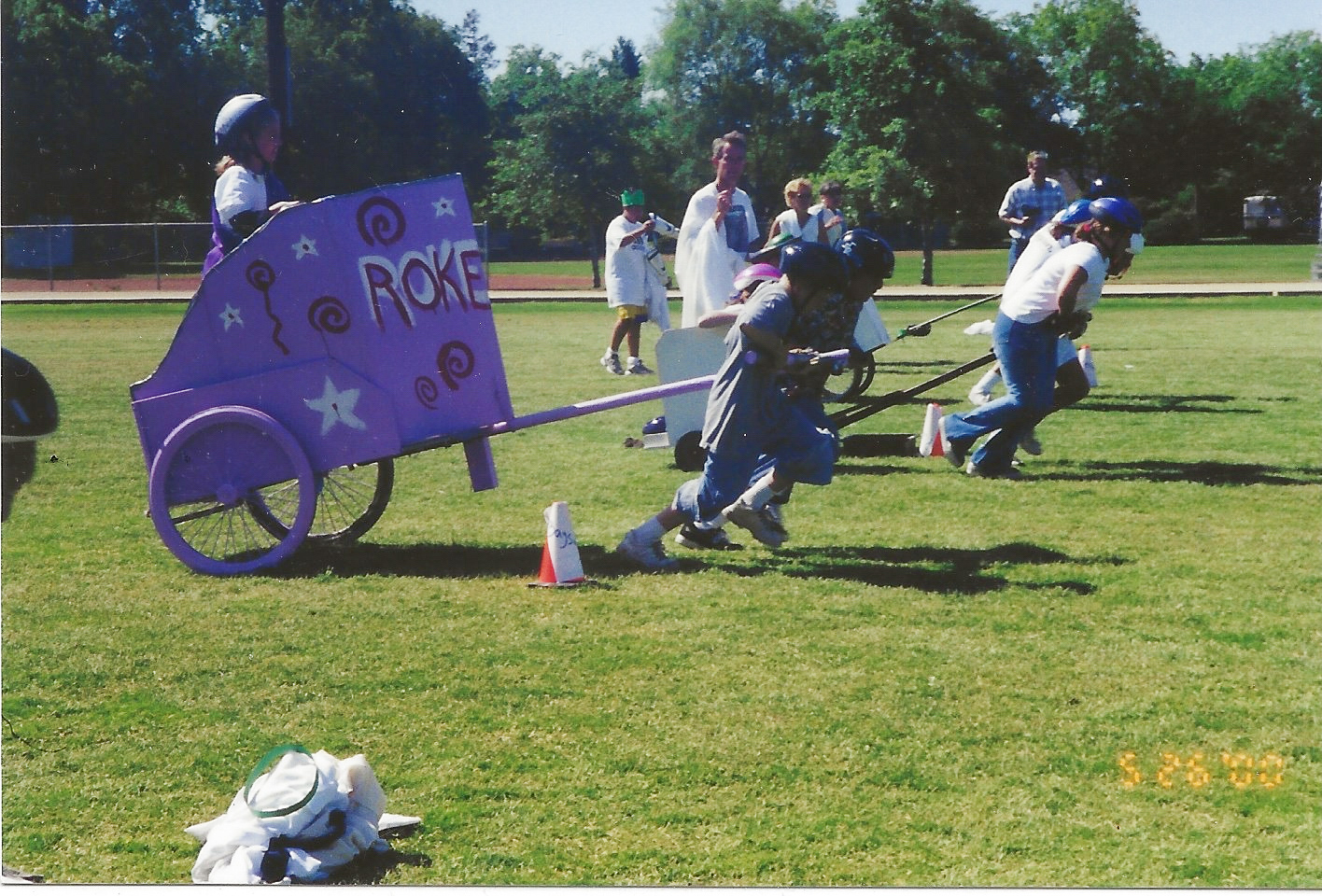
We moved to our farm in the summer of1999 and these photos were taken in the spring of 2000, That is Katie and her friends painting the cart that was to become The Chariot in preparation for the 6th grade Roman Days.

That’s Katie in front and good friends, Camilla and Morgan, with younger brother Chris in the background.

This will be interesting for any of you who know the farm. That barn in the background is the old barn that is where the lambing area is now–between the current big red barn and the stall barn. The yellow building to the left of the old barn is the concrete part of the ram pen that is now behind the big red barn and covered by the shade.

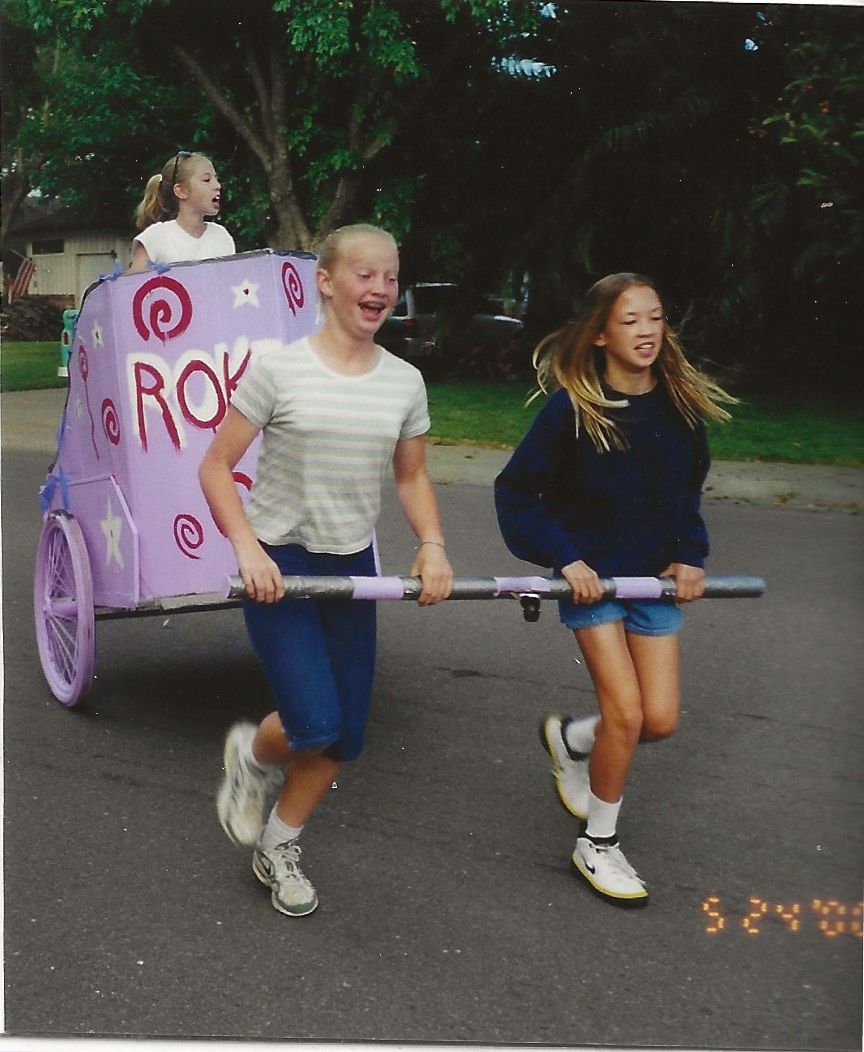
The girls practiced their chariot race in front of my mom’s house which was across the street from the high school where the activities would be held.

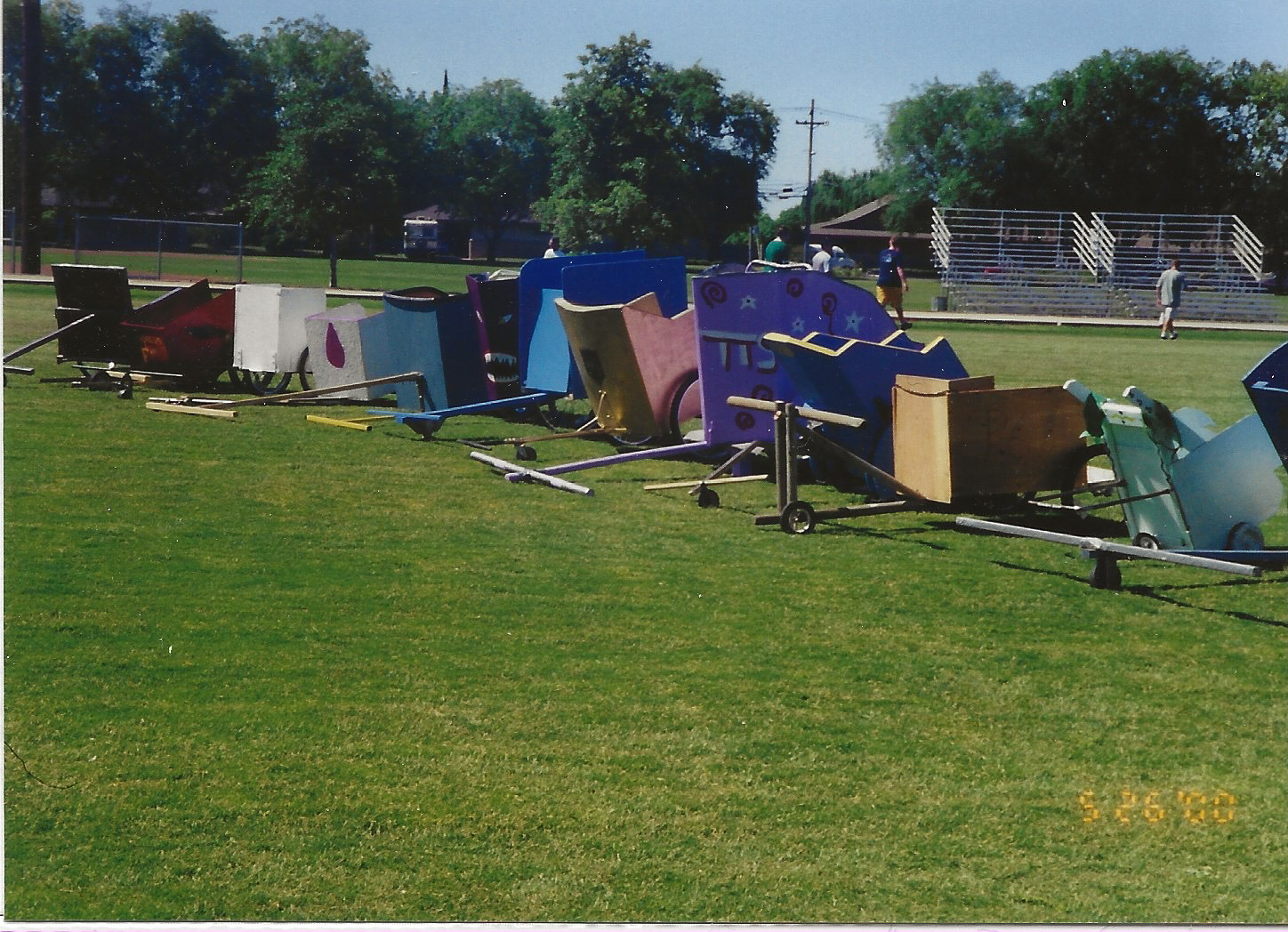
Chariots lined up and ready to go.

Camilla was to ride in the chariot and is dressed in her finery. I don’t know who the boys in front are, but they show up in some of the next photos.

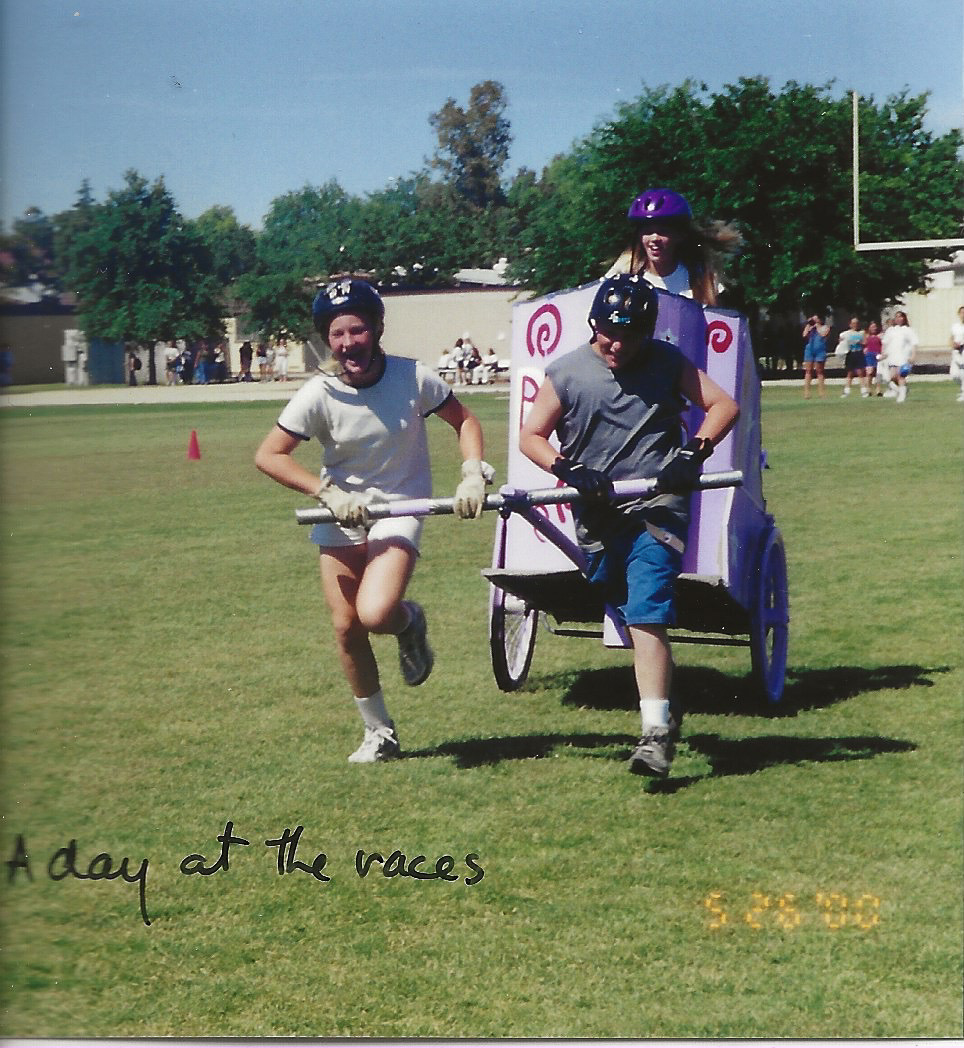
It looks like Katie and one of the boys took the role of the horses for at least one run.

This photo shows two of the boys pulling the chariot. I suppose there weren’t enough chariots to go around and they shared.

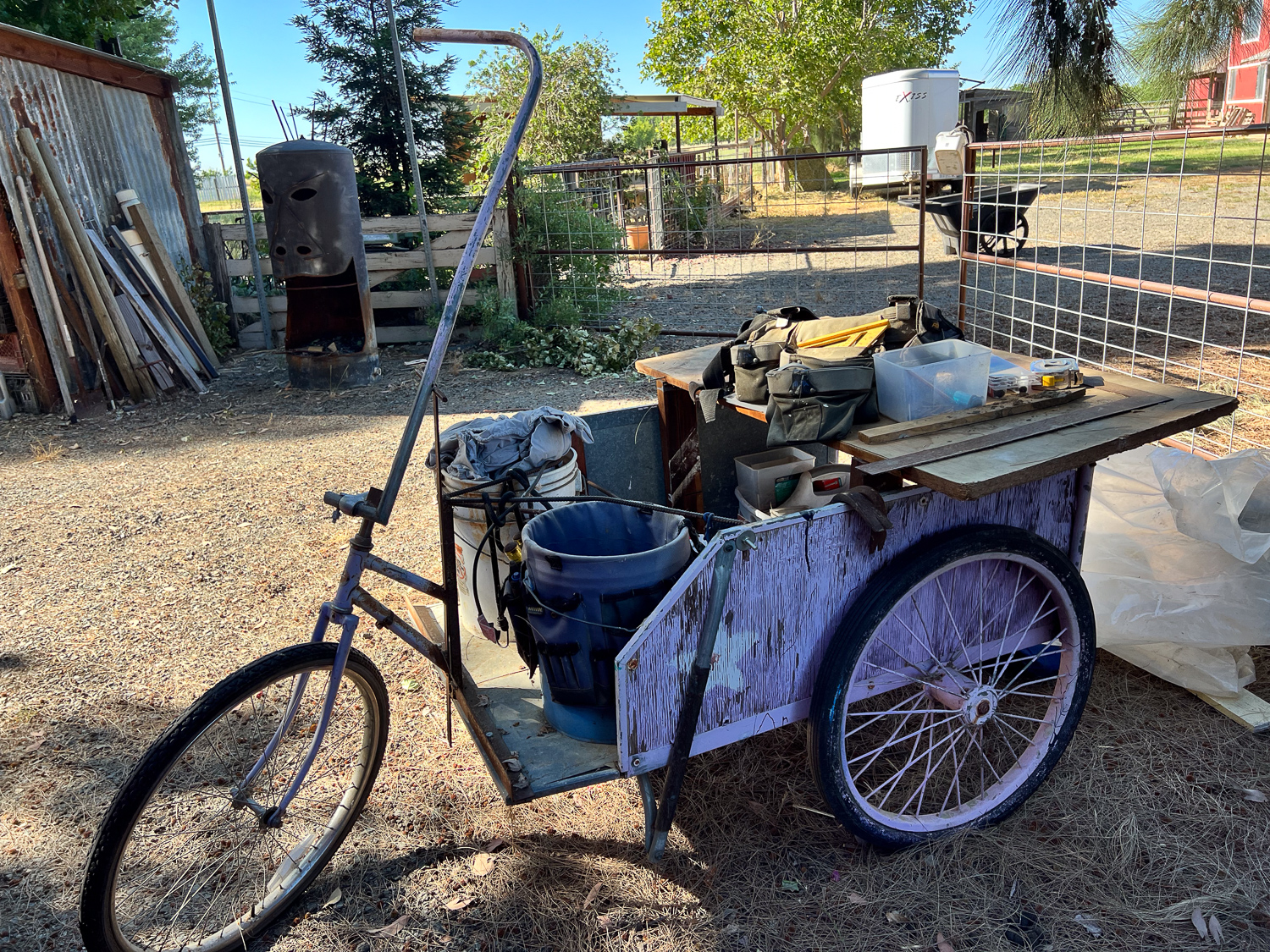
Fast forward 24 years. Here is the chariot in its current state. Dan uses it to hold tools when he needs to take them from the garage to somewhere else. We have plenty of old bicycles around from which to steal parts. Too bad that he removed one of the best additions to the chariot before I took this photo. For a couple of years there was a pink flamingo mounted somewhere on it, but I it got wobbly and Dan took it off. If it reappears I’ll take another photo.

Dyeing with Oxalis and Weld

Back to my regular blog posts. It’s time to pay attention to the dye garden.

The weld appeared on its own where I grew weld last year. No work on my part except to clear out the old and dried out plants from last year. I didn’t pay any attention to the weld bed until the plants started to dry out. That happens after it flowers and produces seeds. I’ve never paid much attention to the specifics of growing weld (it is so easy!) and was thinking that it was all annual growth. I just looked up “growing weld” and read that it is a biennial. How did I not know that? I think I’ve had first and second year plants in the same bed and wasn’t paying attention. All I know is that it makes a great dye.

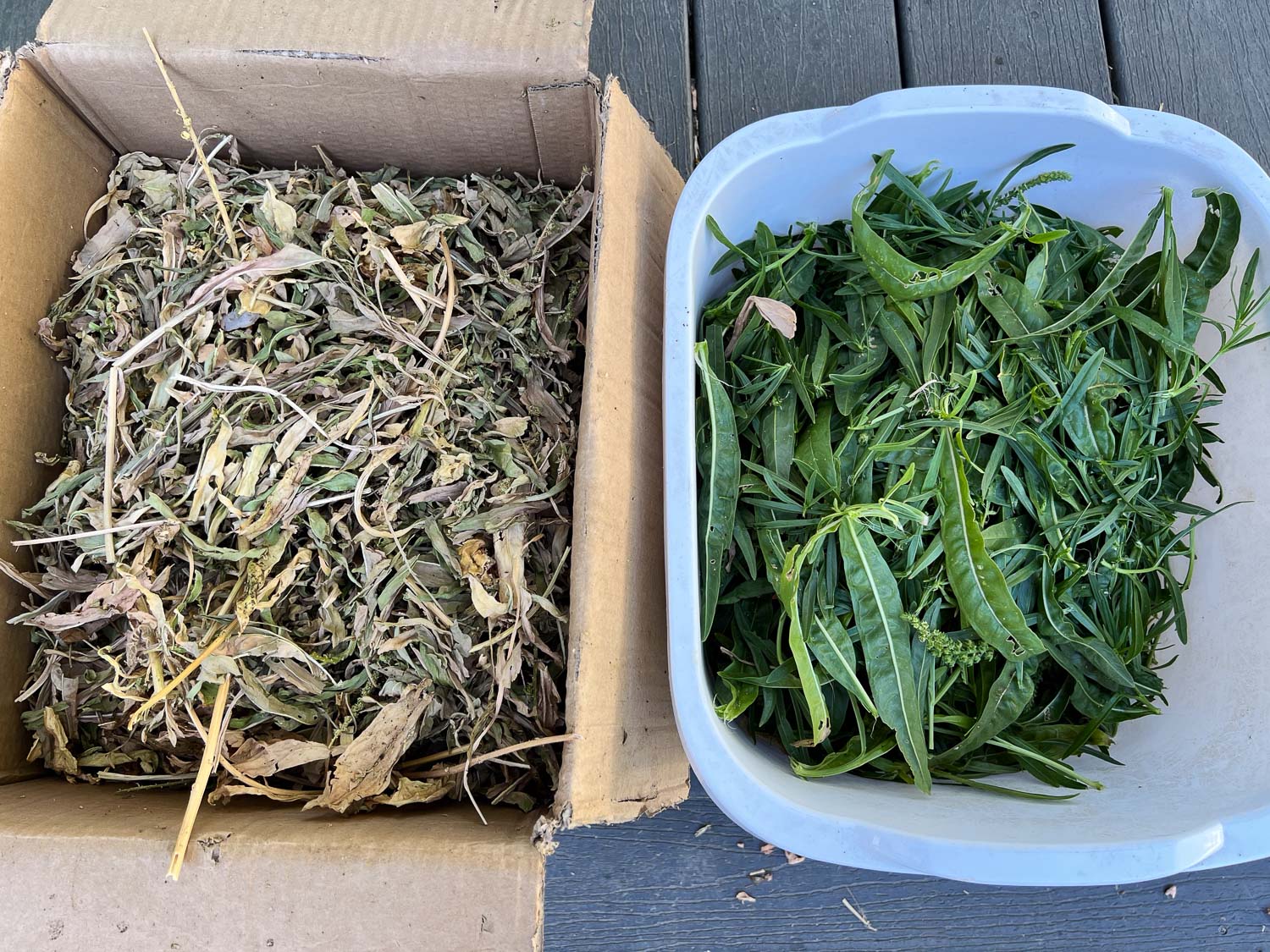
As the plants dry out the leaves fall off the stems. I pulled out some of the dead plants and then scooped up what leaves I could. I also harvested fresh leaves from stems I cut off green plants. I was thinking that the leaves make the best dye, but looking up weld again I realize that people use the stalks and flowers too. This experiment used just leaves.

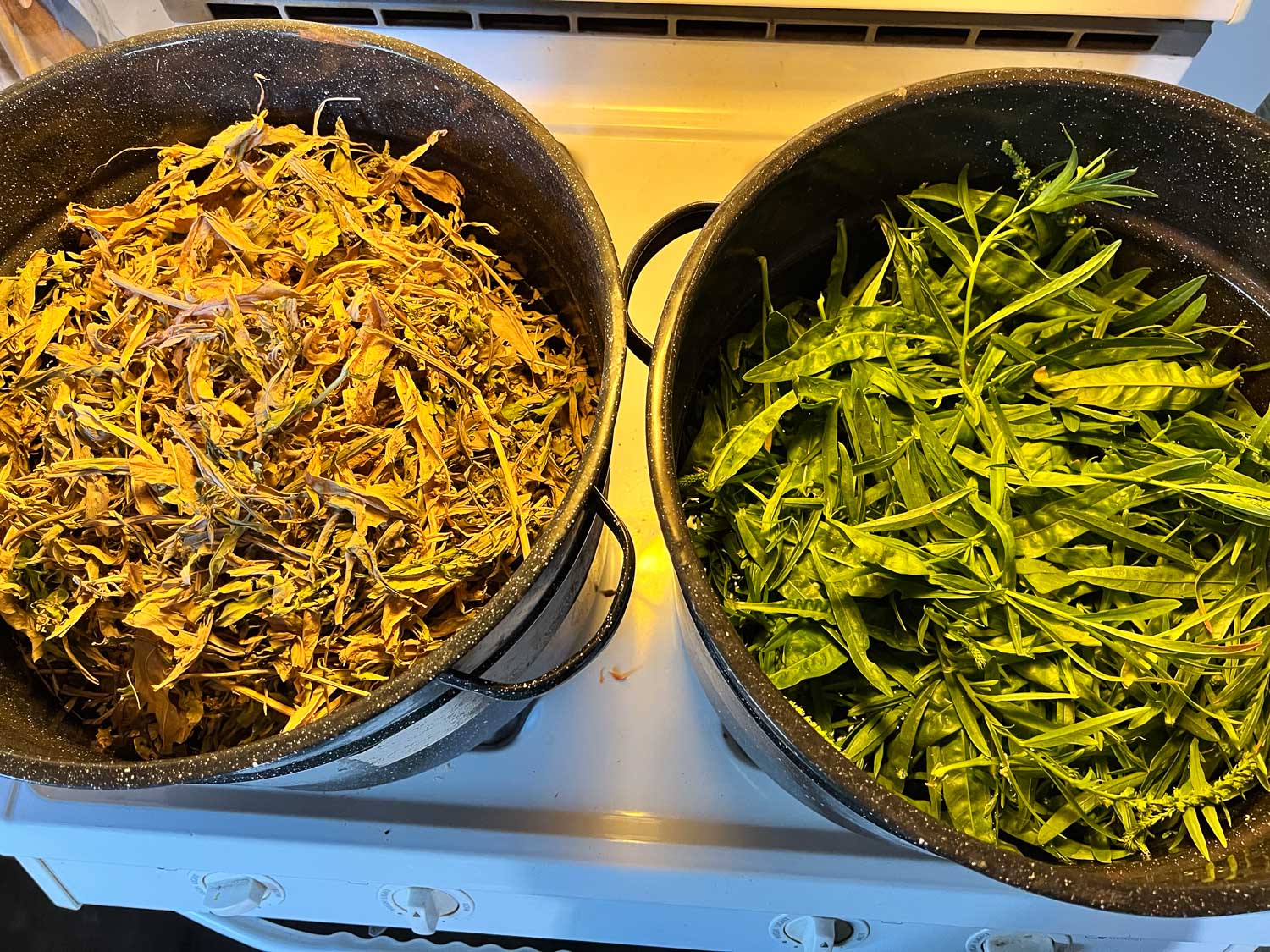
Two dye pots ready to go. I had two batches of yarn, each 12 ounces So I weighed 12 ounces of fresh leaves and guessed at using 4 ounces of dry leaves. The yarn I usually dye is my Timm Ranch yarn since I have more of it than the Jacob yarn.

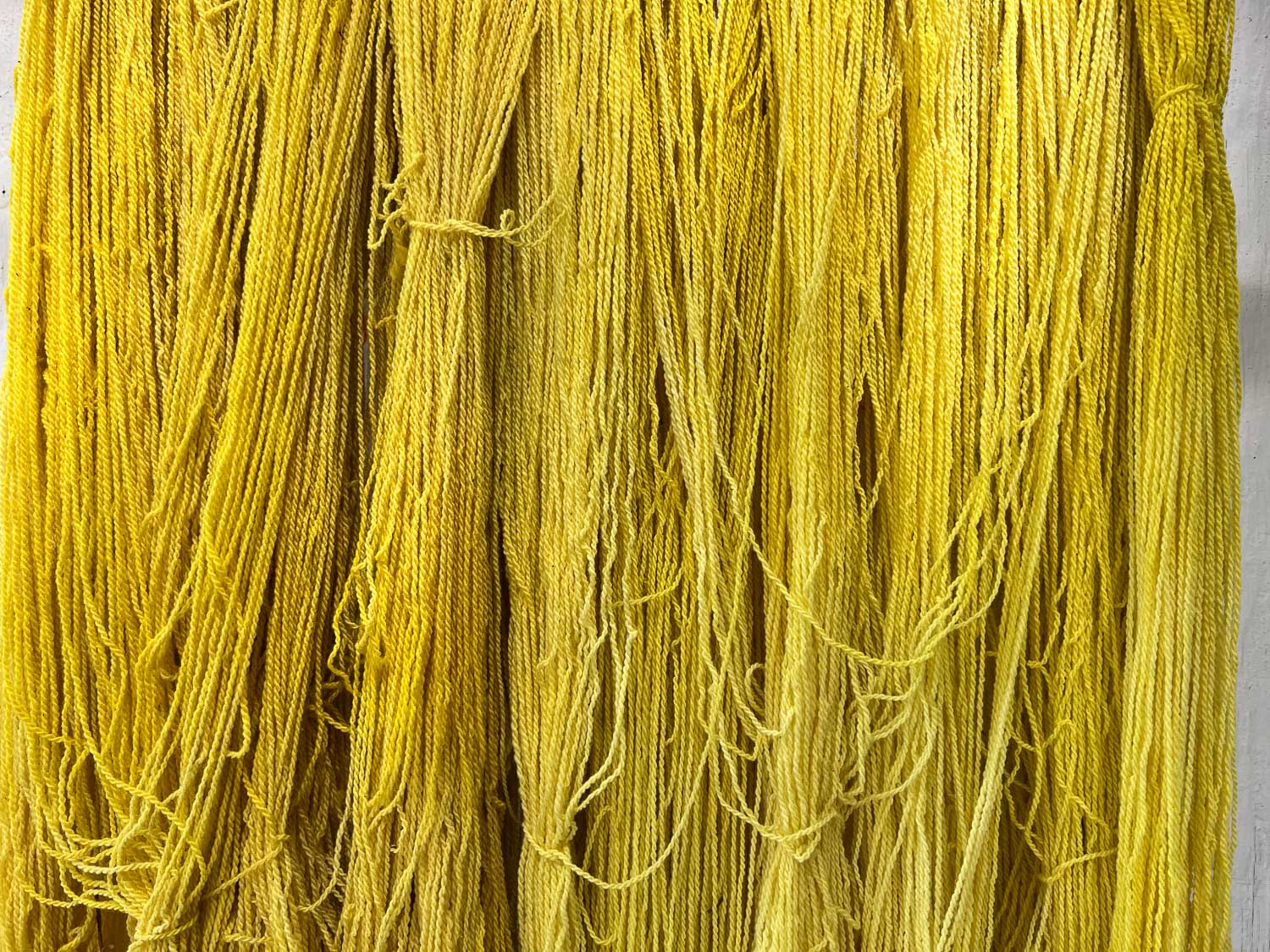
Here is the result. I can’t tell the difference between using dry and fresh leaves. That’s good to know. I need to get out there tomorrow and cut a lot of the stalks so I can put them in a safe place to finish drying before all the leaves fall off.

Putting these photos together reminded me that I had done some dyeing earlier in the year. I gathered what was left of the oxalis flowers just before I left for my Texas trip in early April and did a quick dyepot.

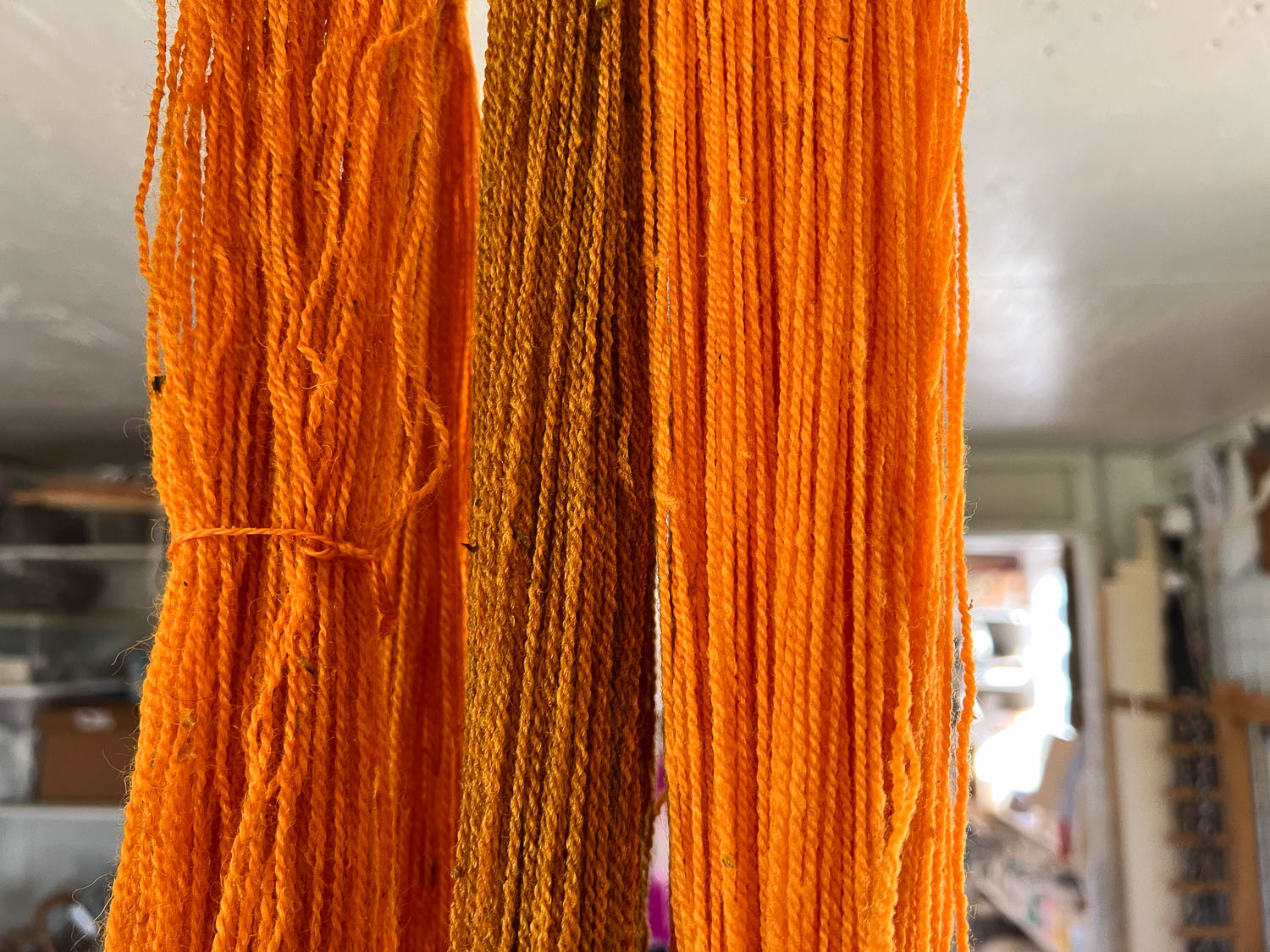
Here is the brilliant result, on white and gray yarn.

Next up may be madder. because I finally hacked away most of the tops of plants that have been growing for two or three years. That’s when the roots are ready for dying. I just have to dig them up and then chop them.