We all have to make difficult decisions at times. I was in that position last month about a ram I had bought only a couple of months previously. Today I had confirmation that I made the right call. WARNING: There are some yucky photos part way through this post.
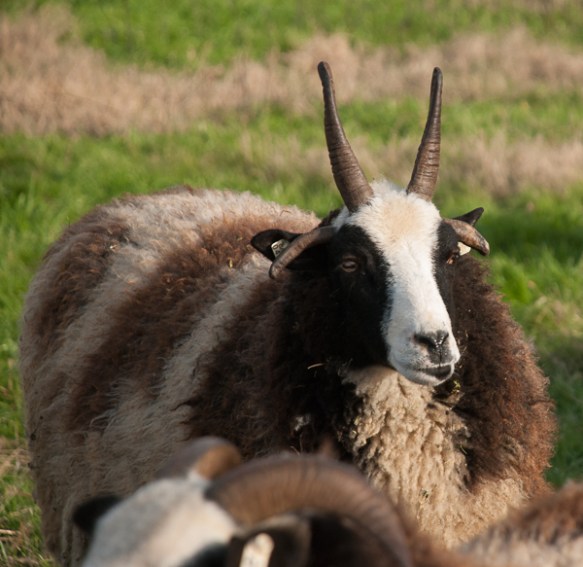
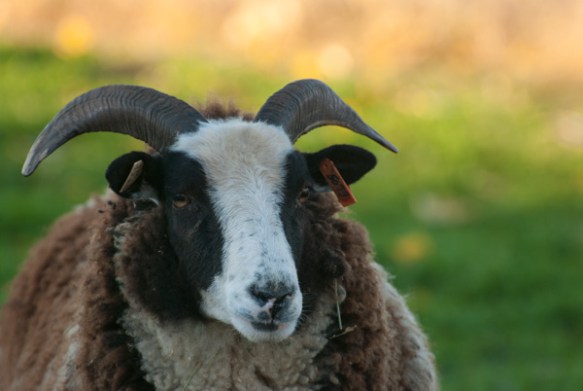
I wrote this blog post about the trip to pick up a new ram in early August. I have looked through my photos and can’t find a “before” photo of the left side of Legolas. This is the one that was posted on Facebook by the seller:

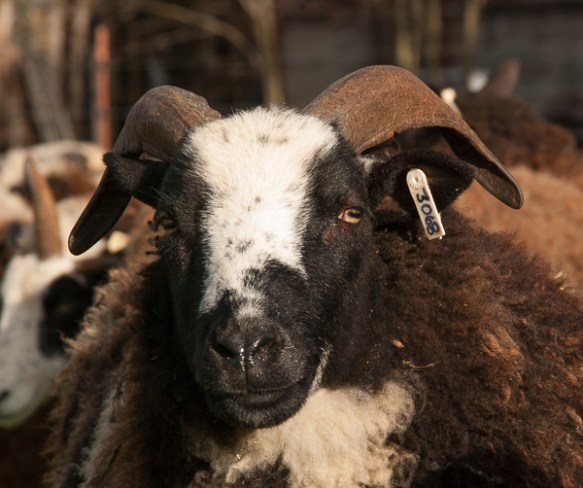
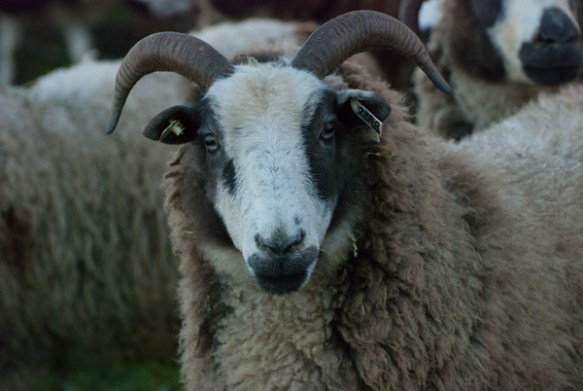
In early September I noticed that his horn looked like this on the left:

That left horn is touching his face. I knew that the horn wasn’t like that when I bought the ram and I was amazed that it could grow so fast that in a month. There was no obvious sign of damage. I had noticed flies around his horns, but again, no sign of blood or a wound. With the horn that close to his face it would be a problem if it continued to grow that direction, putting pressure on the jaw. Even if it didn’t grow more there would be continued skin irritation at the point of contact.
A few days later I caught Legolas to figure out what to do about that horn. I couldn’t even get my finger between the horn and the jaw. Here is what surprised me. When I held the horn not only did it move, but I could see movement in part of the skull where the horn was attached. Yikes!

Behind the horns I found a small opening, which got a little bigger as I scrubbed with hydrogen peroxide. This had been covered with hair and really wasn’t visible until I started cleaning up around it. I could squeeze out a little bit of pus but not very much. There was minimal blood or drainage and the edges of that wound looked already healed over, just not healed together to close up the pocket.

I could move the horn (and skull) so that there was a little space between the horn and the jaw, so I tried to anchor the horn in place with duct tape and wire attached to the other horn. (This was the most mild-mannered ram I’ve ever worked with.)

This is all the progress that was made by that–not much but better than touching the jaw.

That pink stuff is Swat to keep flies away. As I was working on this I was thinking that I didn’t remember these rams fighting, but that would be the only way to account for this injury. At the time I think I just had Catalyst and Marv in the ram pen. When I first brought this ram home I used the “buddy-up” pen, a very VERY small pen where the rams can tussle with each other but not move backwards and run at each other. They usually fight in this small pen where they can barely turn around and when they move to the big pen after a couple of days they mostly behave themselves. They may still posture and fight but hopefully they quickly figure out the hierarchy and the hitting isn’t as violent.
I looked back through my videos and found one of Catalyst (another two-horn ram) and Legolas making some pretty hard hits. Then I remembered that a few days after I moved them all out to the ram pen I was worried about Legolas. He seemed “off”, shaking his head and not eating much. Nasal bots will make sheep very uncomfortable.
Legolas also had bloody lips and gums. I remembered talking to my vet to find out if that was a another symptom of bluetongue because bluetongue causes edema, ulceration, and soreness of the mouth, in addition to listlessness and not eating (because of the sore mouth). At that time I treated him for nasal bots and with antibiotics to prevent secondary infection due to bluetongue. Eventually he got better.
But now, a month later, I realized that he had probably been injured the month prior but the damage to his skull was not obvious.
The wire and duct tape didn’t work. I didn’t take long for Legolas to start scratching and rubbing on the tree and fence and put the horn right back where it had been. I thought about using rebar or something stouter but I knew that I wouldn’t be able to rig up something stable enough to keep the horn in place and besides I wasn’t able to move it enough to be a long term fix. This was not a sustainable situation.
I made the decision to put the ram in the freezer. I am in the sheep business, not the sheep rehab and geriatrics business. Butchering the ram would provide meat and I would have his hide and skull to sell.
Before I can sell the skull it needs to be cleaned. I take the easy way out and put it out in the back and let nature take its course. Today some Farm Club members were here and some of them wanted to see the skull. I was amazed that we could clearly see the damage done to the skull by the fighting. This photo shows the skull fracture clearly:
I have had two other rams die from fighting. Once, early on in my Jacob-raising days, one ram killed another (a 6-month old ram lamb owned by my friend but here for breeding) through the electric fence. The ram lamb was standing when I went into the barn and lying dead at the fence when I came out. (I tried butchering that one myself but that wasn’t so easy. Now that I’m thinking of that I remember that my daughter and I finally dug a hole to bury him, thinking that eventually we’d be able to dig up a skeleton–she was taking a taxidermy class at the time.) Now I do all I can to separate breeding groups without fence-line contact. Another time I was watching when two rams (that had been buddies just a moment ago) started fighting and one staggered away and finally dropped. I took a wheelbarrow in to the pen to get him out and found that he was still breathing. I guess he was in a coma because it’s not normal to be able to load a living adult ram into a wheelbarrow, but I did. I was able to have that one butchered to salvage meat and hide.
The other memorable fighting ram story is about Ranger, a ram that had a beautiful fleece and personality. He wasn’t killed fighting but suffered a skull fracture. With that one I discovered how serious it was when I saw his eye bulging from it’s socket. The swelling in his head was so bad that it pushed the eye forward and the lid couldn’t close over it. I don’t remember if the vet came out or we just talked on the phone, but remember treating and covering the eye and I kept the ram in a small pen until the swelling went down and there was no movement of the horn and skull.
At the time I asked the vet how to tell if there was brain damage. I still remember her answer: “It’s not like he has to drive heavy machinery.”


Pomegranate rinds.


This one is Sylvia and the photo below was taken last week. (Rotor x Sonata)
Here is Marilla (named in a contest for her mother, Marilyn, and because she was our Spinzilla ravatar) in March and below in September. This is a good pair of photos that show that even when a sheep is black and white, the wool may look brown due to sun bleaching. The markings on the face and legs will indicate the true color, at least in Jacob sheep.
This is Marilla’s brother, Marv. He is one of only two ram lambs that I kept this year. He was champion Jacob ram at Black Sheep Gathering and his dad, Rotor, was 
This is Stacy as a newborn lamb and below at 7 months. (Crosby x Estelle)
More newborn photos. This is Jean with twins. I kept both of these lambs. The ewe lamb, trying to stand, is Cindy, below. The lamb nursing is the ram, Joker, in the photo below Cindy. (Nash x Jean)

This is Vanessa with her lambs. Vanna , on the right, was 5.2 pounds when she was born, but you wouldn’t know that now. (Rotor x Vanessa)


Ginny and her lamb.
Ginny and her moose.
Ginny at 7 months with the favorite Toy.

Ginny not so happy after her little operation so that I wouldn’t have to worry about what might happen while I was going to be gone for two weeks.
At 10 months Ginny discovered that she wasn’t a big fan of drones.
First herding lesson at Sheepdog Debbie’s place (Herding-4-Ewe) just down the road.
Ginny’s first birthday.


Starthist Dragon is on loan from a friend. When I evaluated his lamb fleece a couple of years ago I was impressed and Trish remembered that so offered him for the season.
Bide a wee Buster came here from Oregon last June. He was so small I had my doubts about him being up for the task this month, but I should have had faith.
Faulker is ram #5. He is a Bluefaced Leicester (BFL) and sires the black (brown) lambs. He is the big guy in the center of the photos. His lambs are larger than the 100% Jacob lambs and are mostly sold for meat although they have very pretty fleeces and also wind up in some spinners’ flocks.
Faulkner enjoying some time with the ladies.
Isabelle, marked by Joker.
Skye is in Catalyst’s group.
Jillian is with Faulkner.
Joker looks a little disheveled after a few days.
Buster has his work cut out for him to reach those big ewes…
…and needed a nap after the first morning out.