
It’s been over a week since I was at The National Needlearts Association Convention in San Diego but I haven’t been working with my photos. (And in my mind, what’s a blog without photos?) This show is where yarn shop owners go to purchase items to bring into their shops. I have to remind myself that my shop is small, I’m not open 7 (or even 4 or 5) days/week so don’t go crazy. As always I found a few things that I’ll be very excited to bring into the shop over the next couple of months.
Part of the fun though is hanging out with my friend, Irene, who owns Cotton Clouds. She made our hotel reservations. What fun place!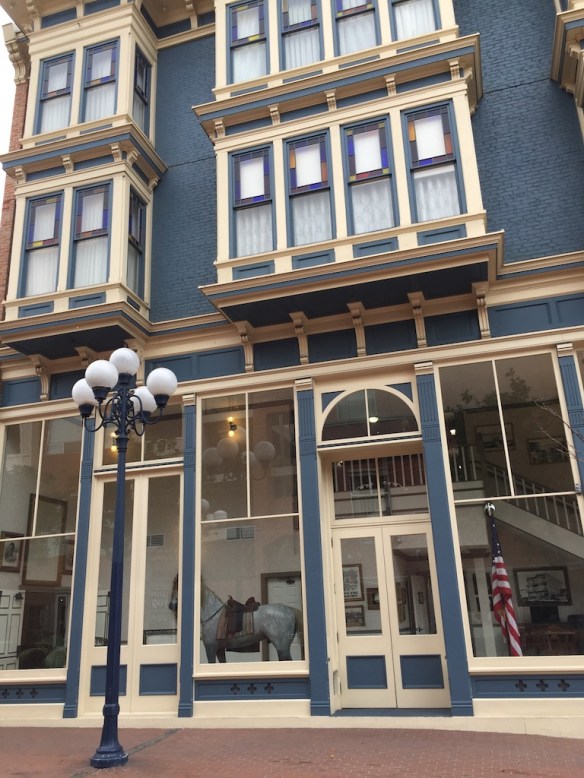 This is the beautiful Horton Grand Hotel…
 …and this is Sunshine, a paper-mache horse who stands in the lobby. He came from the saddle shop that was on the ground floor of the neighboring less formal hotel. The hotels were built in the mid 1800’s but the saddle shop originated in 1912. Wickipedia says: “Both hotels were scheduled for demolition in the 1970s when the City of San Diego purchased them to build the Horton Plaza shopping center on the site. The hotels were dismantled brick by brick, with each brick numbered, catalogued, and stored. In 1986 the hotels were rebuilt into an entirely new hotel at the present location at Fourth Street and Island Avenue.”
 Our room was lovely.
 What fun to decorate a hotel like this. The furniture was all old so I assume it was found at estate sales and flea markets. We even had a fireplace (gas so no wool hauling).
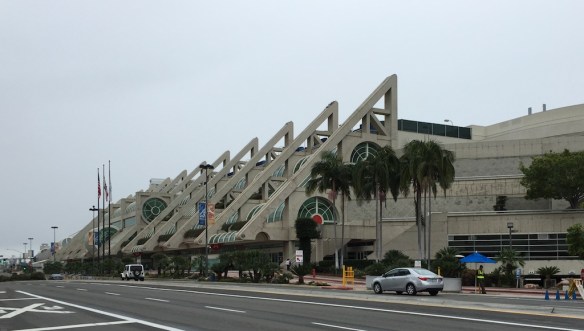 We spent a lot of our time at the San Diego Convention Center.
 Here is a message to be read on the way there. This quote in context of time and author if quite serious. In my world the last sentence has particular meaning and is serious enough in my life, if not with as profound a meaning.
  Fun view while going up the escalator in the Convention Center.
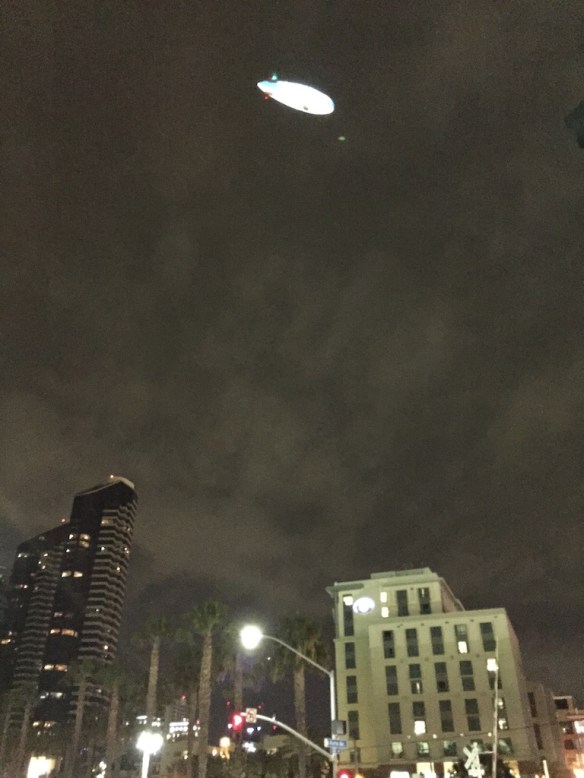 Leaving the hotel at night. This is the Gas Lamp District, kind of like Old Sac is for Sacramento.
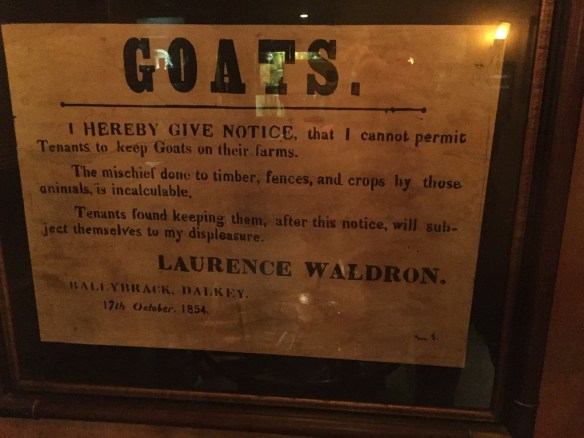 We ate one night at The Field, an Irish pub, while listening to Irish music and dancers. This sign caught my notice.
So what did I buy? My customers sent me on a quest for “sock yarn” so that is what I focused on. But first I found some new equipment. These are prototypes of cool little sample looms designed by author and teacher, Liz Gipson. The unique thing about these looms is that they will be produced in 8, 10, and 12 epi versions, enabling quick sampling of yarns at those setts (and at 4, 5, and 6 epi). There are a few other gadgets I am purchasing here as well.
 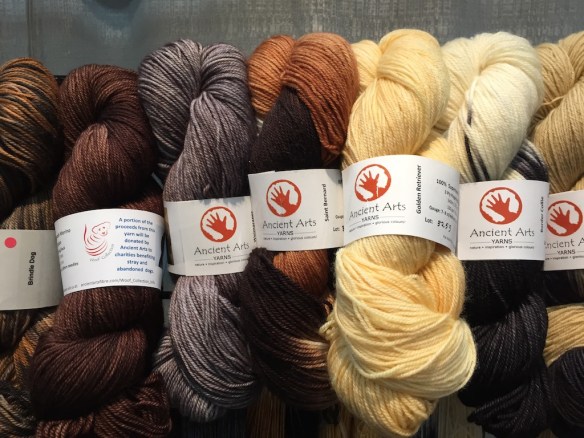 This is the Meow and Woof collection from Ancient Arts Yarns. Each yarn has a photo of the cat or dog that inspired the color. I strayed from my “buy American” plan because I was so enamored with these. They were spun in Italy and are sold by a Canadian company and a percentage of sales goes to dog and cat rescue groups. I have wove a scarf out of the calico cat yarn–that is another post.
 I already carry yarn from Imperial Yarn Company and these are some inexpensive and simple kits some of which use the yarns that I already have. I want to have a knit-along with some of these.
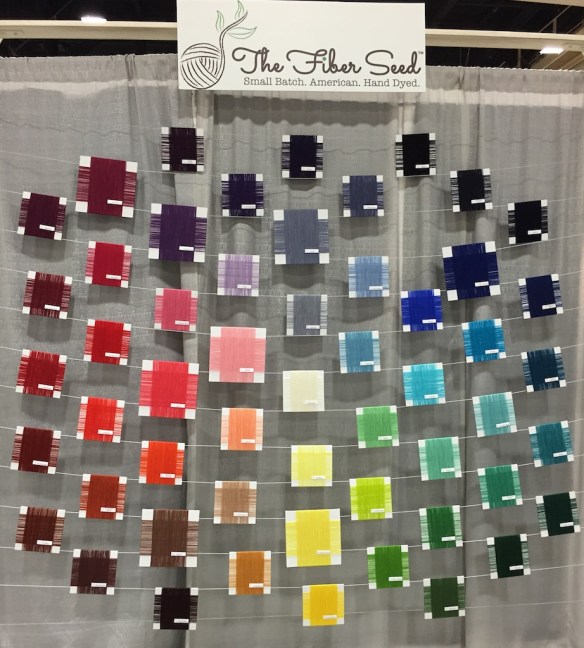 The Fiber Seed will be a new yarn for me. They have some wonderful gradient yarns put together in kits. I’ll get those as well as some of the solids and variegated yarns.
Mountain Meadows is a company who has their own mill. I’m getting a sock-weight Merino yarn that is grown in Wyoming. How to choose from all those colors? I’m getting yarn in about a dozen colors.
What will be first in the shop? I can’t wait for the UPS truck to show up.
 For this month’s show we invited our family members to join us in sharing their art work.
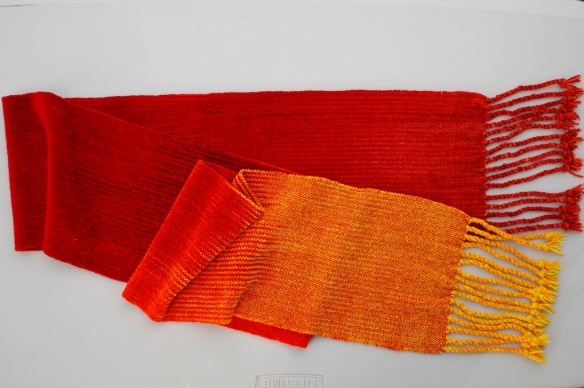
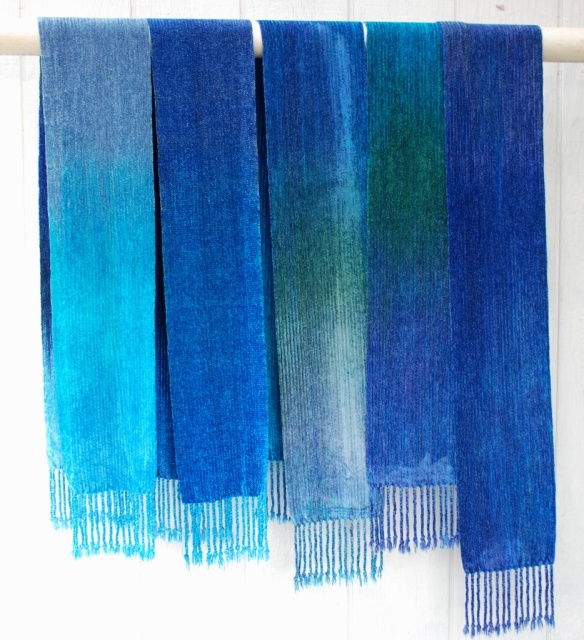
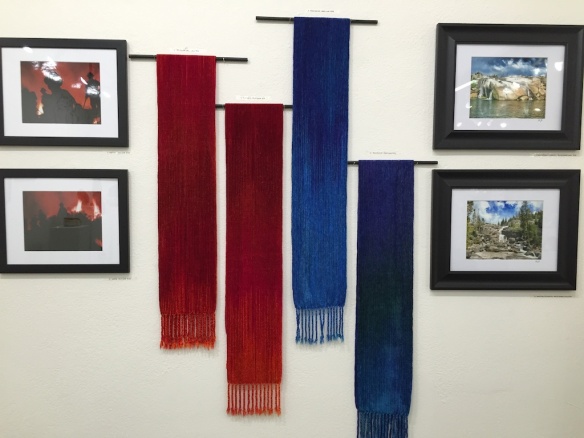 My sons and daughter-in-law entered their photos. Sorry that my photos don’t show theirs very well. Chris took photos while on the fire line last summer. Matt and Kaleena’s photos are taken in their “backyard” of the El Dorado National Forest. I wove 7 Fire scarves and 5 Sky scarves so that I could choose the ones I wanted to display with the photos. You can’t tell from this but the Fire scarves have sparkles (and have a lot more color variation than shows up here).
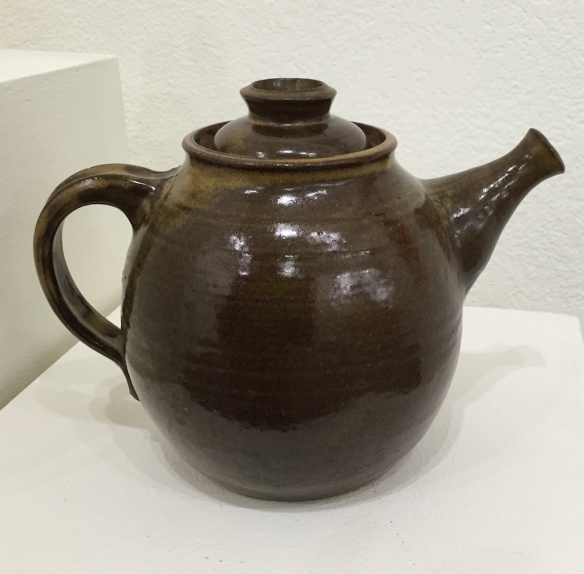 I also included two of my mom’s pieces. She was always proud of her teapots because she could create a dripless spout.
 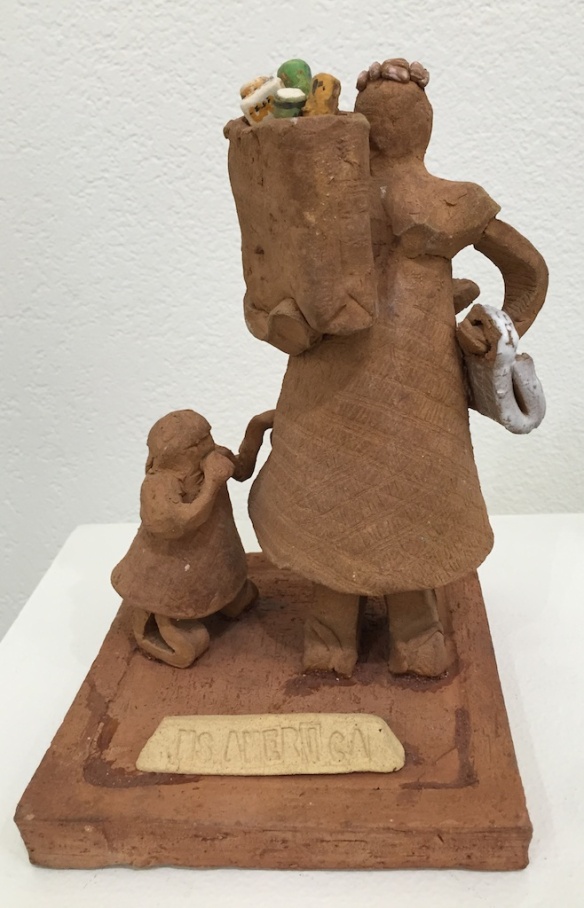 Mom mostly made functional pieces like plates, bowls, and mugs, but also made tiles for the kitchen, a bathroom sink (the actual sink !), lanterns, birdbaths, and a sundial. This is a rare statement on society…
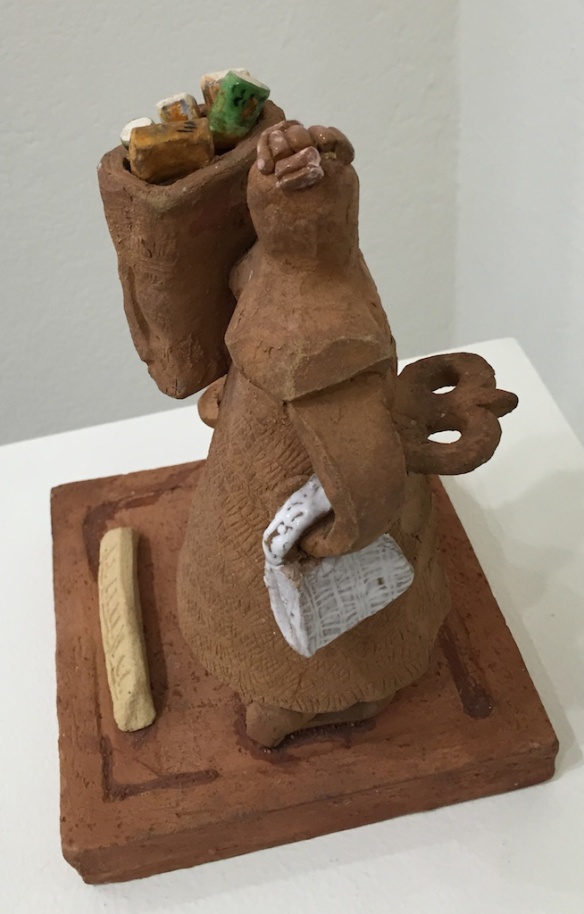 …but I’m not really sure what she meant.
 I took only a few more photos in the gallery because I ran out of time. Artery member Marjan made the 3-D flowers and her mom did the silk paintings.
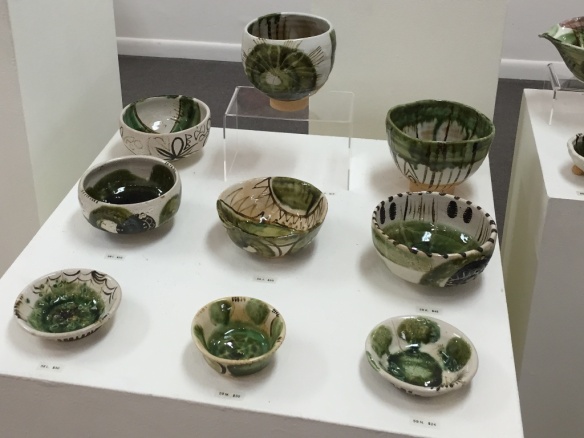 Heidi’s husband and dad collaborated with her making bowls.
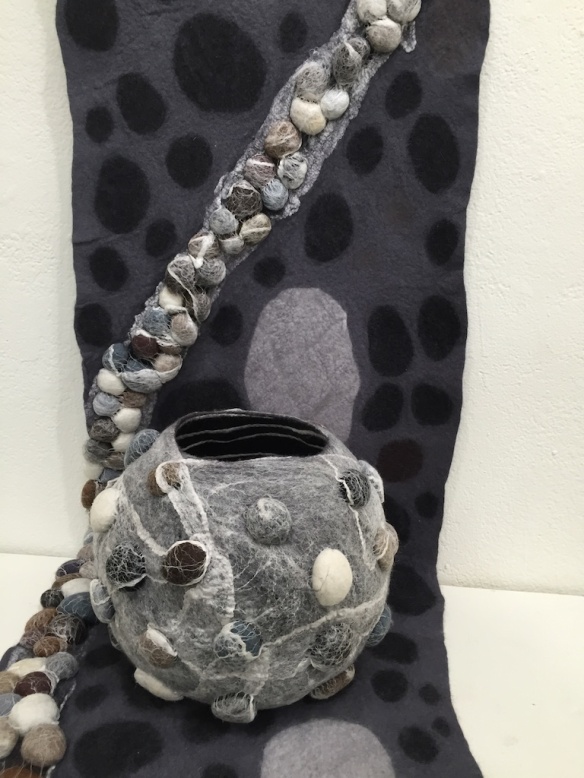 Sorry, but I don’t remember whose work this is but it is all felt, including the rocks.
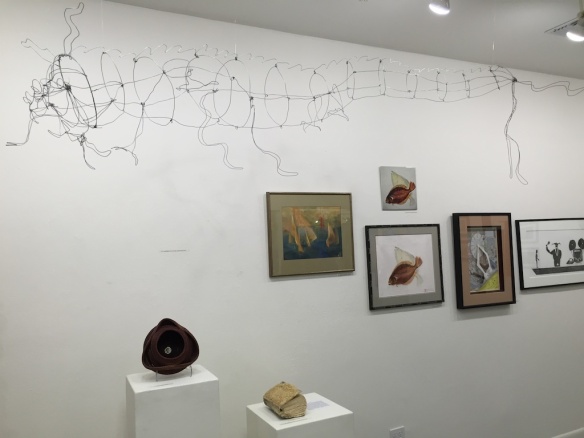 Here is a wild “Dragon Drawn in Space” above member Chris’ family’s art.
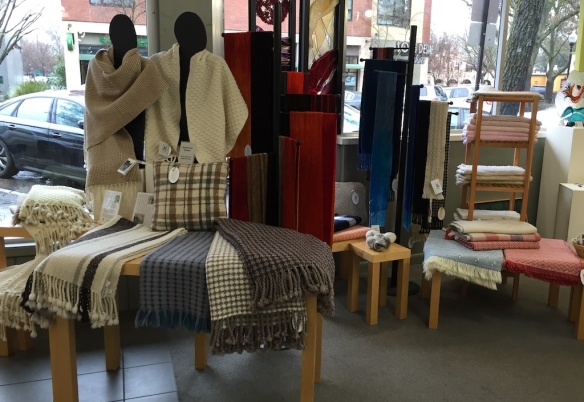 My regular work moved out of the gallery and is in the front of the Artery for the next month or two.
 I was OK for Fire. I had wound the two white/off-white warps but wanted to start with something else to try out the colors.
 I still have some warps leftover from my
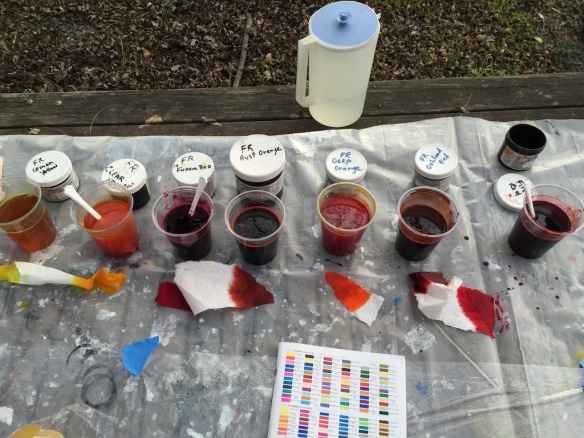
 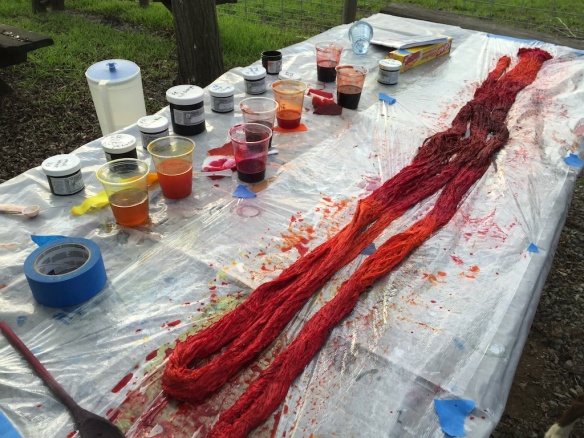 Now was the time. I started with yellow but it didn’t cover the colors very well so this warp went to oranges and reds.
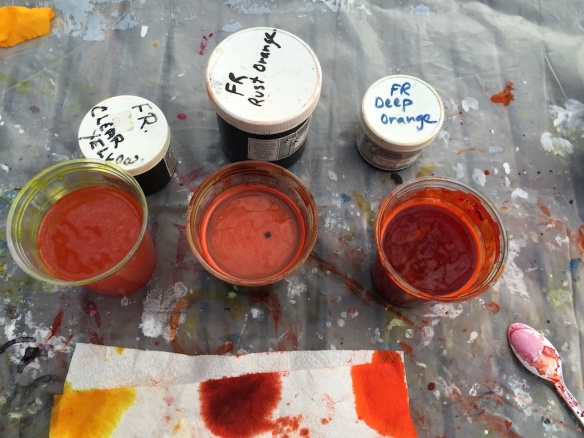 That was the “practice” warp. Now it was time for the “real” one and I decided to use just these colors.
 You can see the yarns that I used weren’t all the same because I didn’t have enough of any one shade. Here is where my photo documentary of the process has holes. This was a cold, damp day. I was bundled up in overalls and Carhart jacket and wool layers. I had footwarmers in my boots but I had to keep switching from warm gloves to rubber gloves, neither of which lent themselves to taking lots of photos. And it was getting late in the day and I was starting to lose the light. So no more photos of these warps after dyeing.
 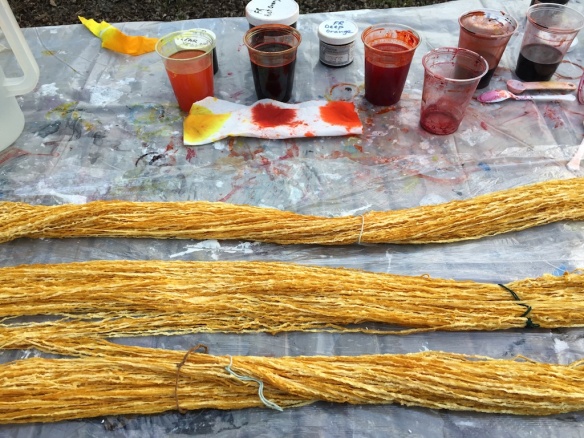 I wasn’t satisfied with the dye job on the white warp so I wound another but this time used yellow yarns because I didn’t have anymore white. I dyed this in those same colors.
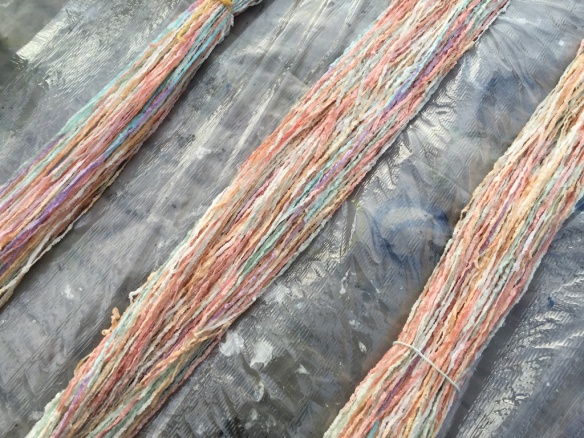
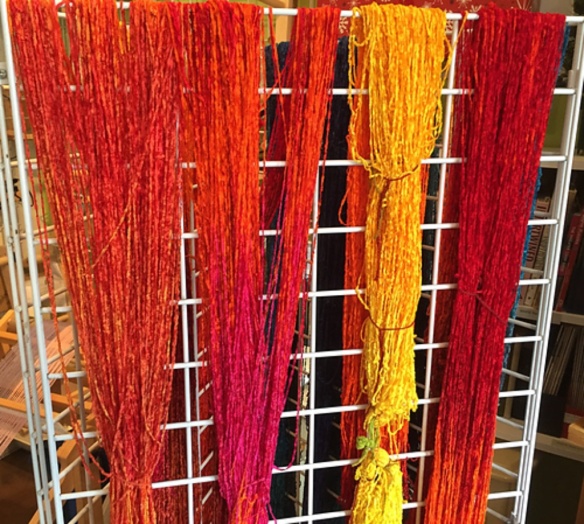 Dona was at the shop the day I was trying to get these warps to dry. She took this photo of them hanging near the heater.
 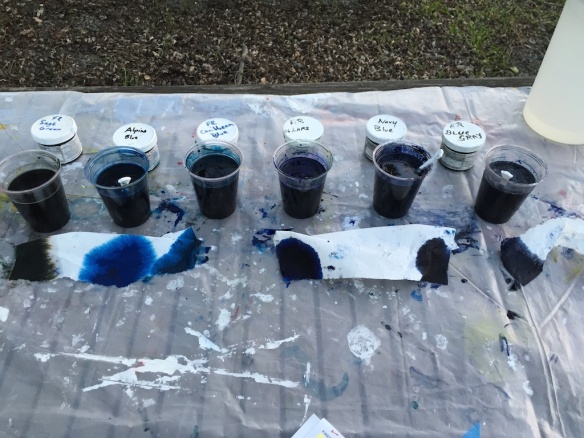 Back to the dye day. These were the blues. It was getting late so not many more photos.
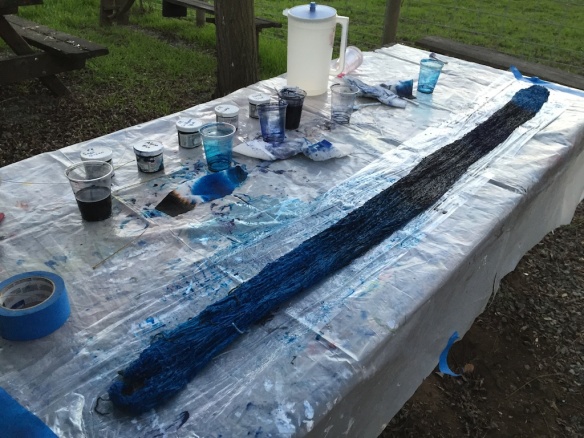 Here is one of the Mountain Sky warps.
 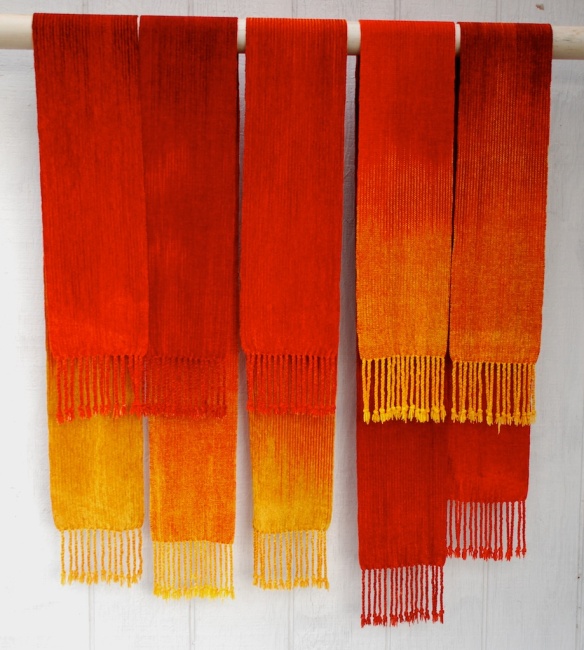 I wove seven Fire scarves (two were finished the night before the show so aren’t photographed here) and five Mountain Sky scarves.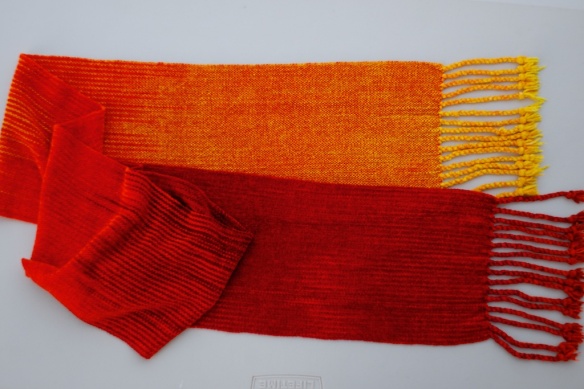
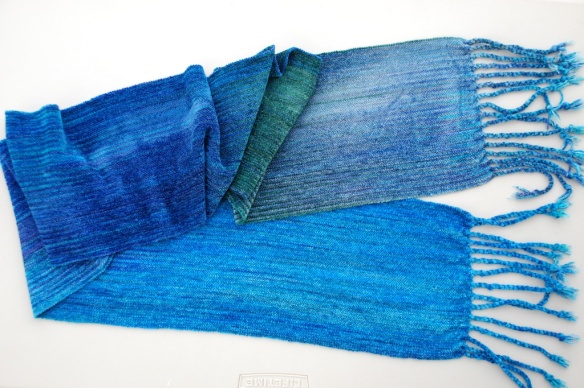
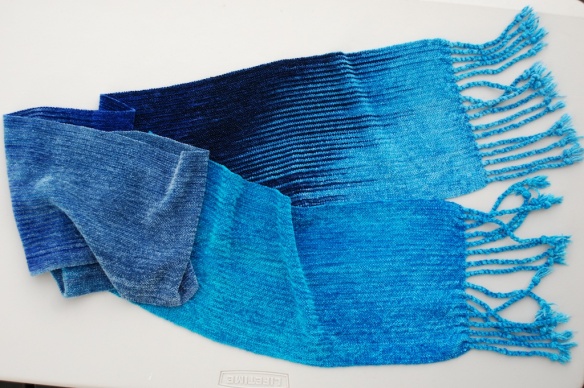 I will do another post of how the Artery show looks.
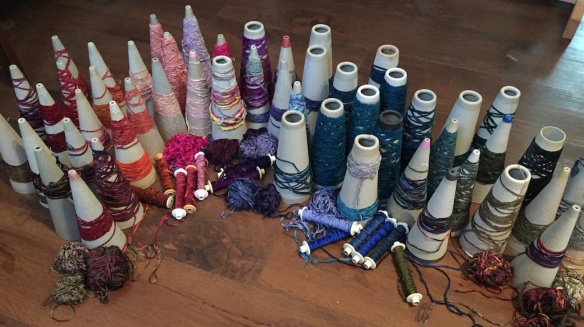 Three yards (or a little less) is the length I need to make a scarf. I dumped out a couple of bags of leftover chenille and organized it by color. This made two warps.
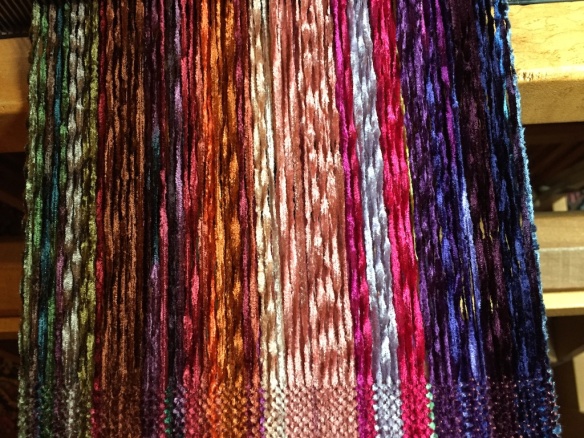 The first uses the yarns on the left side of the upper photo, going into the purple range.
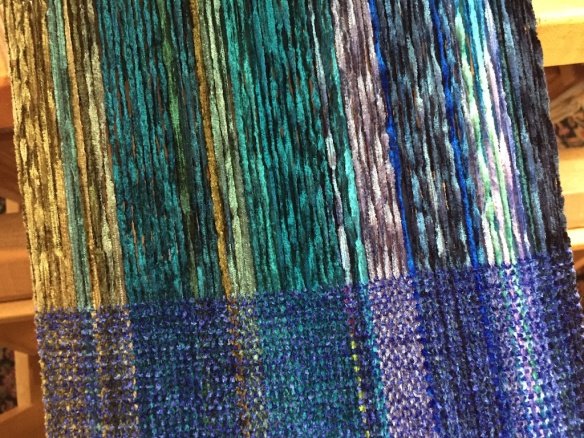 The color isn’t very good on this photo but this was mostly yarns from the right side. Here are the finished pieces:
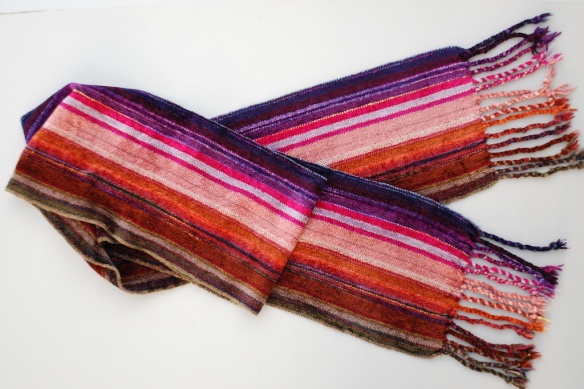 I used a fine cotton weft for this scarf mainly because I couldn’t figure out which color of chenille would work across all of these stripes. By using a fine weft the color of that disappears and the eye sees just the warp color.
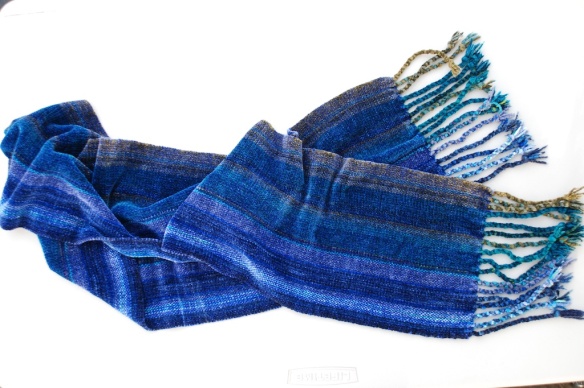 This scarf was different. I used a blue chenille weft. The blue dominates but pulls all the other colors together.
 January 22, 2015.
  February 5.
 February. Almonds are blooming.
 April 26, 2015. The field has been bedded, ready for tomatoes.
 May 3, 2015
 June 9, 2015
 July 22, 2015
 August 9, 2015
 August 30, 2015
 This is a photo taken across the road, from Across the Road. (That is my pasture looking west.)
 The alfalfa field that is the green triangle in the upper right in the aerial photo.
 Beans that were planted after the wheat harvest in the are shown in the triangle that is the upper center of the aerial photo.
 September 5, 2015.
 September 9, 2015. It took 4 days, working 24 hours/day to finish harvesting this field.
 September 23, 2015. Back to the beans. The dry plants have been put into windrows waiting for harvest.
 September 27, 2015.
 October 6, 2015. Field disked and bedded waiting for the next planting. I’m told that it will be planted to sunflowers this spring.
 November 29, 2015. If we have regular rain I can’t walk across here because it gets too muddy. There have been very few days that we haven’t been able to walk.
  December 1, 2015. View of our place, looking west across the field. We need to see more green on those hills.

 What time I have spent in the snow has been well after the storms have come through. There is something very different and beautiful about being there immediately after the snowfall…
 …while the branches are still heavy with snow.

 I loved seeing the snow clear to the tops of the trees. As the sun started warming the trees, snow cascaded from the highest branches.
 I spent the night at M & K’s (Dan came home for chores and dog duty) and the next day Dan came back and brought Chris and Meryl with him. Then we celebrated our private family Christmas.
 The younger generation helping the older one with digital issues.
 Chris plays a mini-flute sporting his new Storm Trooper oven mitt.
 Here are my sheep/barn related Christmas gifts. My wheelbarrows constantly need their tires pumped up so Dan got the fittings to go on an extra air compressor in the barn. There are tubes and tires for my handtruck. Dog treats from Hawaii. Sheep and dog magnets. All the attachments for my new GoPro (birthday present). Footrot Flats is a comic strip series that I think only a sheep farmer would enjoy. Hand and foot warmers packets that I’ll share with Farm Club in the barn.
  We took another hike that afternoon. This was a great two-day Christmas celebration with family. And it’s not quite over. The kids are taking us to see StarWars in a couple of days. The only thing missing was my granddaughter and her family but at least we spent a week with them not long ago.
 View to the southeast with early morning sun.
 View to the northwest.
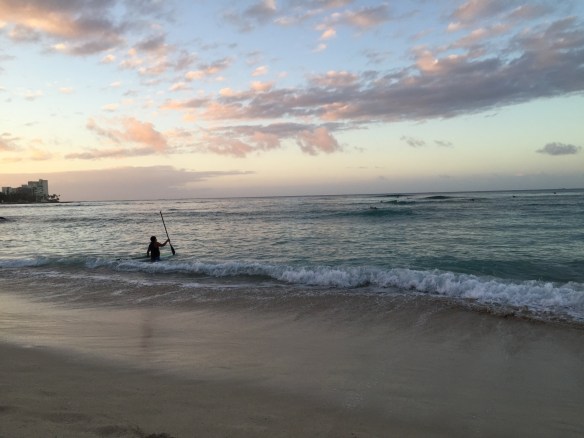 Not too many people in the water yet…
 …but there were people on the beach…
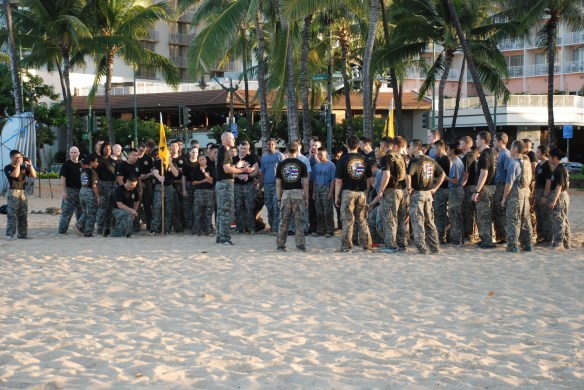 …working out…
 …and getting ready for business.
 The beaches are protected (created?) by rock walls built out into the ocean. When walking along one I realized that it was like looking down into an aquarium tank. There were fish everywhere. I took lots of photos but in most the wave action obscures the fish. There are a few that aren’t bad for my first time trying to photograph fish. The only ones that I later identified are these needlefish.
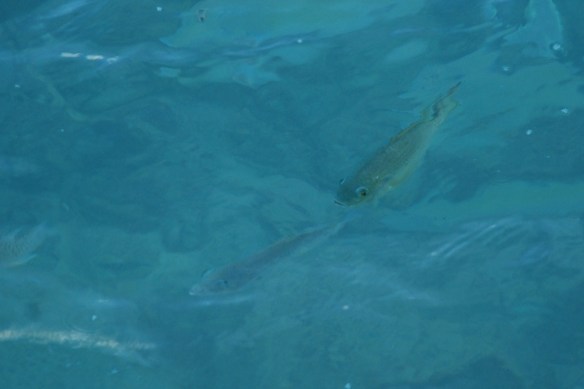 I wish that I’d had my new GoPro with me and a long stick to reach into the water.
 I sort of like this photo because the ships looks pixelated, but it’s just the containers.
 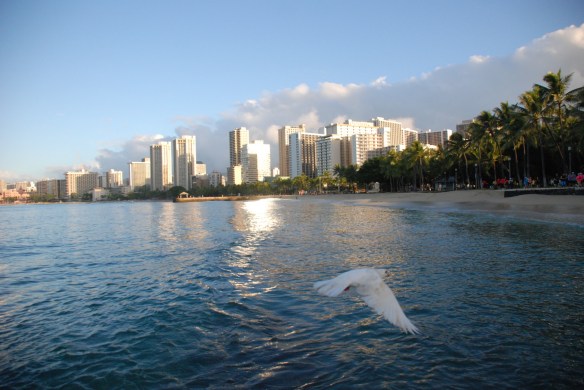 Still on the wall, the sun was getting higher.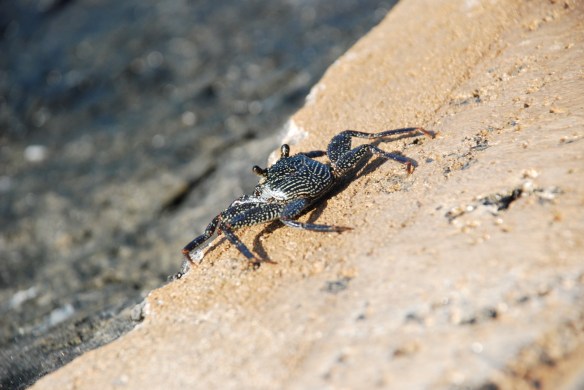

 Here is an activity of which I was unaware–feeding bread to fish –these tourists brought an entire loaf and threw crumbs into the water.
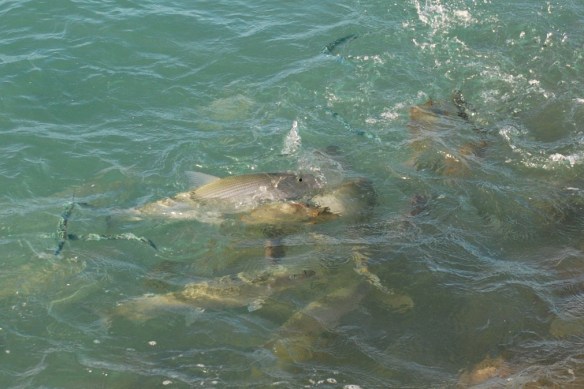 It’s a great way to bring fish (and pigeons) to you, but I can’t imagine that it is an approved method of watching wildlife. I was seeing plenty of fish without bribing them.
 As the sunlight hit the water the fish were easier to photograph…
 …especially these almost luminescent needlefish.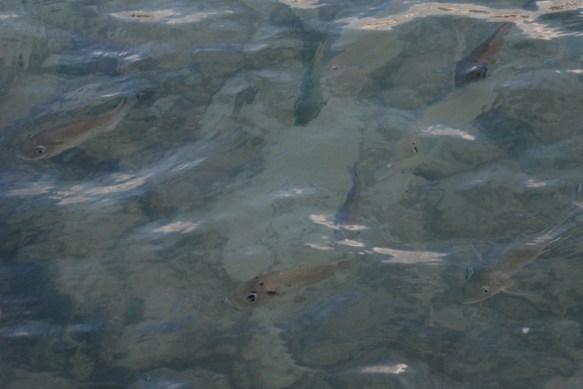
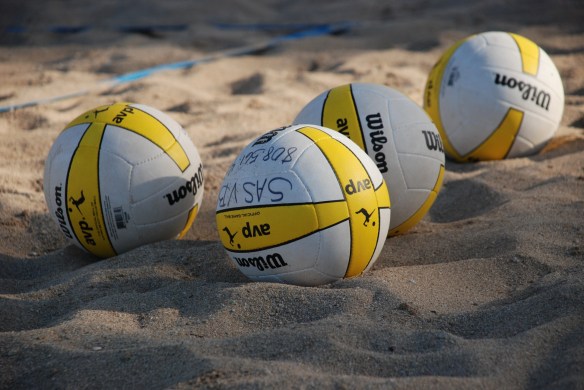 As I walked back to the hotel, the beach was waking up.
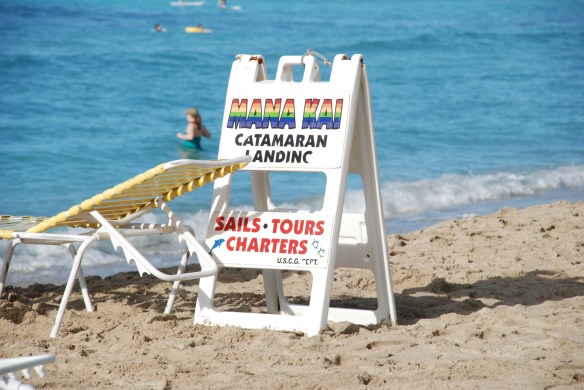
 Many more people out and about.
 By the way, this was not my hotel. Mine was a few block off the beach in the low(er) rent district.
 Unfortunately this is a blurry photo but I like the image. I sat in the row in front of Kirby on this short flight. We picked up a rental car (had to upgrade to carry all of Kirby’s luggage) and drove to Pearl Harbor.
 The monument includes several memorials and museums and it would be easy to spend a full day immersed in this history …but not with a toddler on board. We chose to tour the U.S.S. Missouri while waiting for our assigned time to see the U.S.S. Arizona Memorial. (Unfortunately all boat rides to the Arizona were cancelled due to windy conditions.)
 The USS Missouri was the last battleship built by the U.S. and was the site of the Japanese surrender, ending WWII. The ship also served in the Korean War and, after being modernized in 1984, in Desert Storm.
 The Missouri is now a permanent museum in Pearl Harbor.
 There were a couple of photo opps before entering the ship.
 A lot of the ship is accessible and there is a wealth of information covering the three eras when the ship was in use. It would be easy to spend several hours taking time to absorb everything. I have included just a few photos here.
 There is a display about the Japanese pilots who died in kamikaze attacks near the end of WWII. It is a moving exhibit but I don’t understand what can drive a young man to this end during that era any better than today’s suicide attackers (although I thing there is probably a world of difference in their reasoning).
  So sad…as are all parts of war.

 The living spaces for 1600 enlisted men were spread throughout the ship.
 Part of the modernization in the 1980’s.
 Back on the main deck we looked up and saw…
 Katie, Kurtis, and Kirby.
 A disappointment was not being able to go to the U.S.S. Arizona Memorial. This memorial is directly above the Arizona that still holds many of the 1177 men who were killed during the bombing that sunk the ship.
  During the day my thoughts kept going back to the National Museum of the Pacific War, the moving exhibit in Fredericksburg, Texas (birthplace of Admiral Nimitz) that we saw in July (
 Toddlers don’t care about this stuff. Chasing birds and picking up flowers from the lawn are more their style. (If I chose to make this blog more commentary and opinion this would be the point to discuss innocence and when/how does it change.)
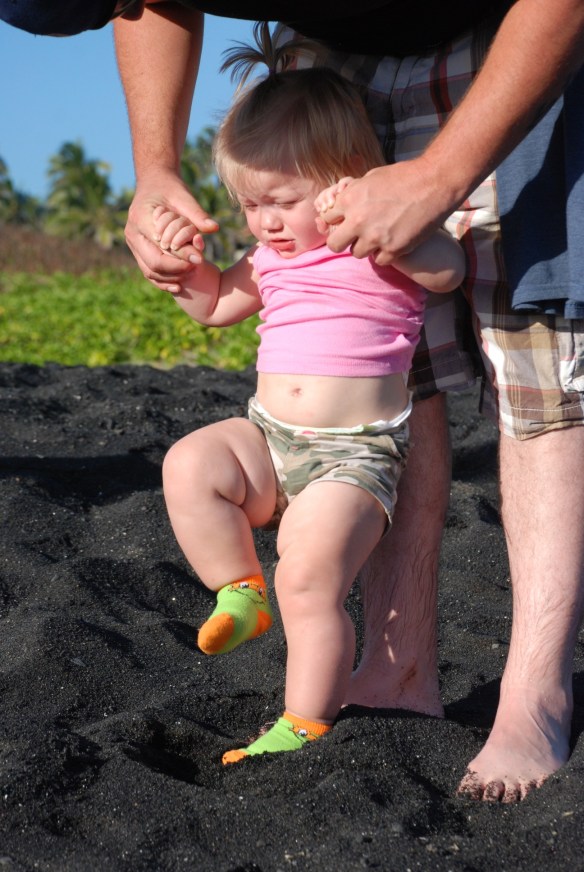 However, that didn’t help Kirby want to step down into beach sand today anymore than the last three days.
  The Punalulu’u Black Sand Beach is well-known to host the endangered Hawaiian Green Sea Turtle.
 We weren’t disappointed.
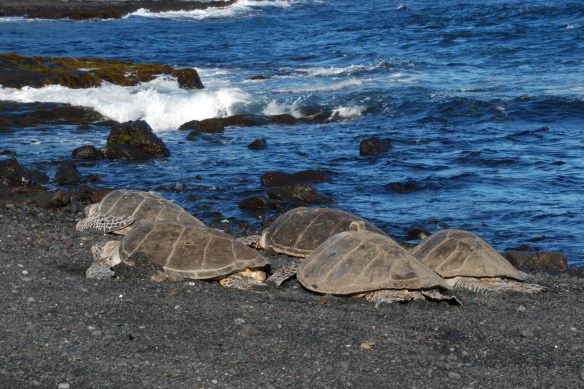 We found several turtles basking in the sand while onlookers watched from outside the stone “corral” that prevented them from coming too close.
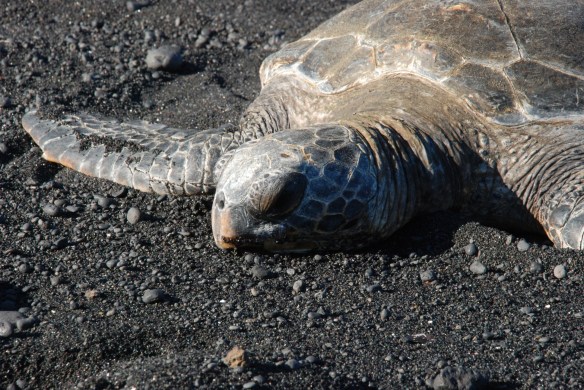 The population of these turtles was in steep decline during the 1970’s due to harvesting of turtles and eggs, but numbers have increased since protection by the Endangered Species Act. The adults weigh 200-500 pounds and they are thought to live 60-70 years.
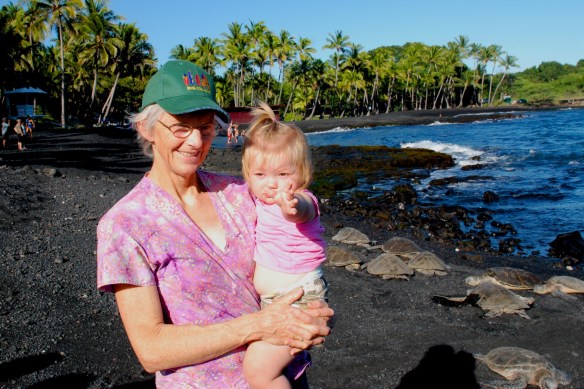 The turtles weren’t moving so I don’t think that Kirby really noticed them.
 Matt found a little more action.
 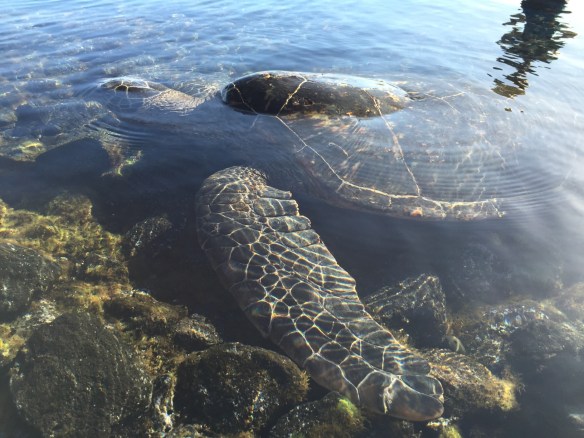 There were a few turtles swimming and eating in this pool.
 I took a video of this one as he (she?) approached me, blowing bubbles.
 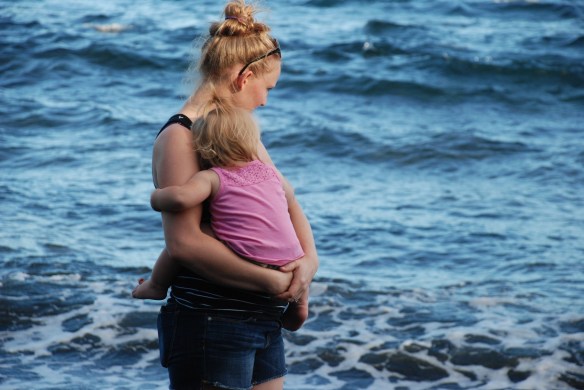 Even if Kirby had been a fan of the beach, she would have probably been too tired to enjoy it here.
  It’s better to be in Mama’s arms…
 …or better yet, sitting on a towel next to Daddy.
 Beautiful water, whether it’s in blue…
 …or shades of gray.


 We spent a little time in the visitor center and museum but mostly drove through the park, getting out to look at points of interest…
 …and take photos…
 …a lot of which, unlike most of my exploring/hiking trips were of family.
  I’m not sure that even amazing, steaming volcanoes can compete with beautiful family pictures…that is, pictures of beautiful family.
 However there were plenty of other arms to hold Kirby on this adventure so I did try to get some photos of our surroundings, especially of the area of rain-forest where we walked.
  While much of the Park is more desert like this part of the trail is through lush rainforest.


 This had already been a long day for Kirby but she did well in her backpack.
 This is on the wall to the entrance to the lava tube.
 Lava tubes are formed as slow moving lava cools to form walls, but the inner hot lava continues to flow.
 Leaving the lava tube.
 Seen in the parking lot. Should I decide to move to Hawaii, do I have a job waiting for me?
 Catching a nap before Part 2 of the Blog.
