We had a couple of impromptu Farm Days–these are days when I have a list of things to be done and I e-mail Farm Club to find out who can come on which days. They come. We work. We talk. Everyone gets dirty and enjoys themselves. Win-Win. This time we set up two days.
On Tuesday Mary and Dona came. Thanks to Dona for most of the Tuesday photos. I usually forget to take photos when we’re all working together. First we cleaned the barn. Three shovels are faster than one! Next I wanted to sort out all the ewe lambs so I could make a decision about which lambs to enter in the Lambtown Sheep Show in October and make notes about which lambs to keep in the flock.
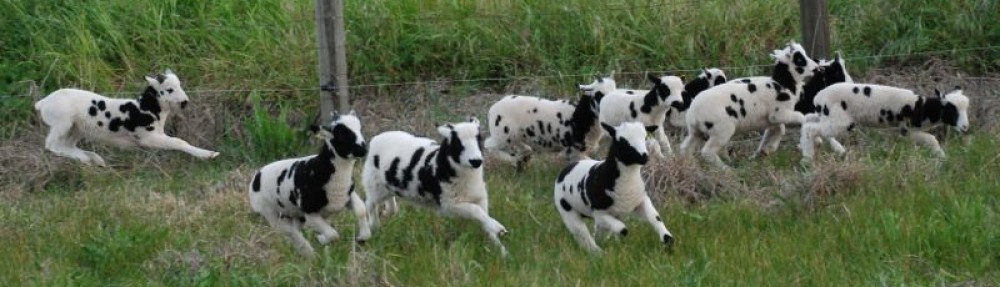
I called the sheep in while Dona took photos.  An enthusiastic response.
 There was only a little bit of coercion by shaking a bucket of grain.
 We took a little time out for Lamb Cuddling…
 …and selfies.
 After selecting our two show lambs and an alternate…
… we started halter breaking. It is amazing the difference a few days of 10 minutes sessions makes.
We had been having a discussion of show prep. One reason that I show Jacob sheep is that most often there is no show prep. You do your best to keep them free of VM (vegetable matter) but they are shown in their natural state without the primping that goes on with other breeds. However, having a show in October pushes the limits of being able to present clean sheep. Not only are the sheep in almost full fleece with a whole summer’s worth of dust, but there is the problem of the late summer grasses that go to seed. I coated the two yearlings and the three lambs that were chosen for the show, but I thought we could try a couple of other things too. This is Mae, a yearling ewe letting me know that she really didn’t want to be the guinea pig for this experiment. Jackie loaned me a blower.
 I have seen some people use blowers, particularly on Shetland sheep. There may be potential to remove the superficial VM, but it is not going to remove stickery things like foxtails that are deeper in the fleece. And if it’s used too close to the sheep it changes the character of the fleece. It may be worth experimenting with a little more. I don’t think it was a favorite of the sheep.

 However, it is fun to make cool designs in the wool!
 Next we tried washing half each of two sheep to compare the two sides later on. I have been told that cheap hair conditioner used 30 days before the show works well. We chose two non-show sheep for the experiment.
  Again, the sheep were not impressed and I wasn’t either. I think I didn’t use enough conditioner and should have used a spray nozzle.
On Sunday, several Farm Club members were able to come. Amy, Stephany, Alison, and Joy were here. There are not too many photos of this day. We started by catching all the ewe lambs again and weighing them. We gave more halter lessons to the show lambs and a few of the others that I am going to keep. After that Rusty brought in the ram lambs. We had only a slight mishap because as we put them in one gate of the barn I realized that the other was still open. They mingled with all the ewes and we had to sort them again. It’s not hard at this age because the horns make it obvious which are the ram lambs. We selected two rams for the Lambtown show and discussed which ram lambs to keep for next year’s breeding. More on that in another blog post. Those rams had halter lessons and then went back to Ram Lamb Land…away from the ewes.
 We caught the big rams, looked at their fleeces and discussed the breeding line-up. Then we took many wheelbarrow loads out of the ram pen.
Thanks to all of you who were able to come and help.

 Probably not the best place for photos where you can really see the sheep.
 But I found other things to amuse me.
 …and other creatures.


 I get a new perspective on everything.









 Meridian Jacobs' Blog