Unknown's avatar

About Robin

Owner of Meridian Jacobs, farm and fiber shop. I raise Jacob sheep, teach fiber arts classes, weave handwovens for sale, and manage the store.

Farm Field Trip

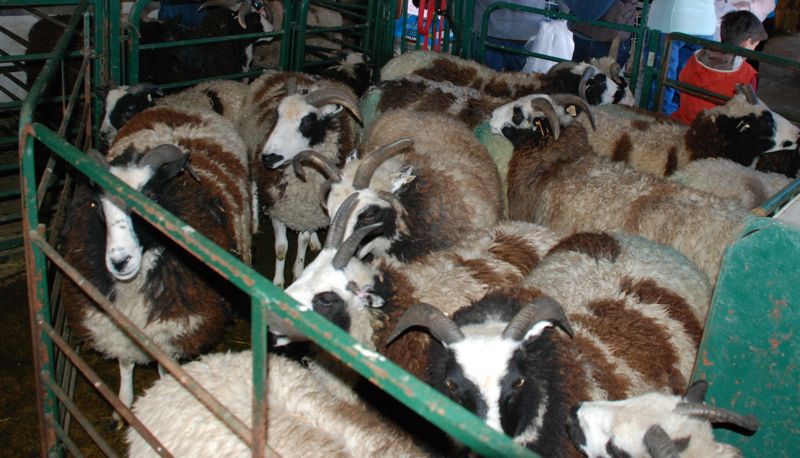
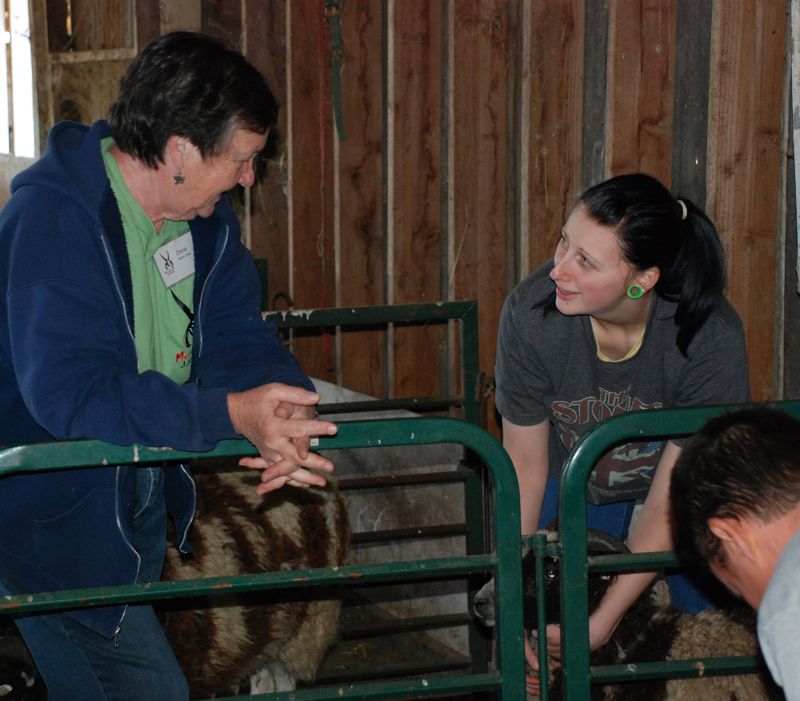
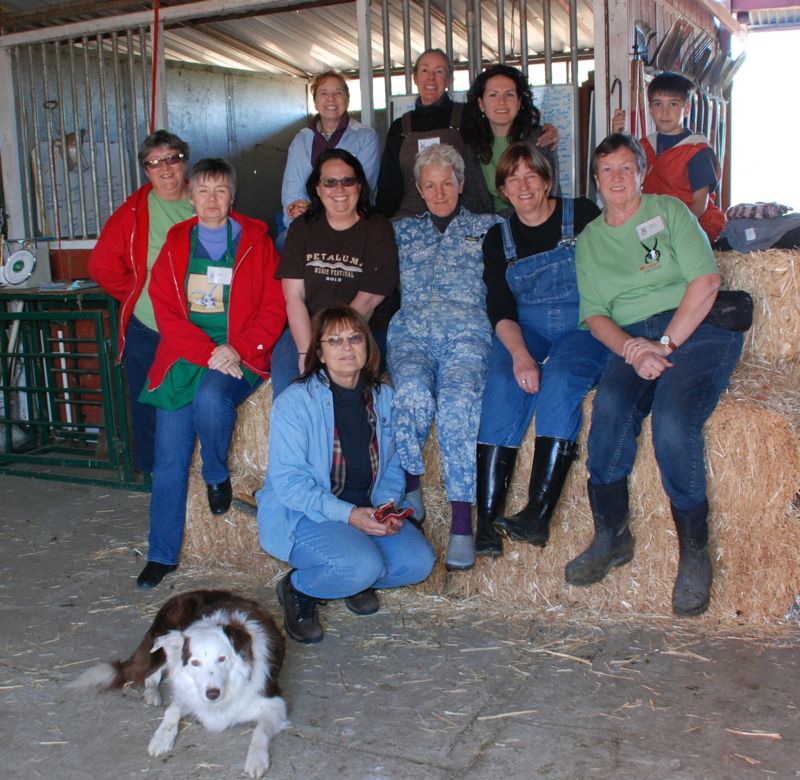
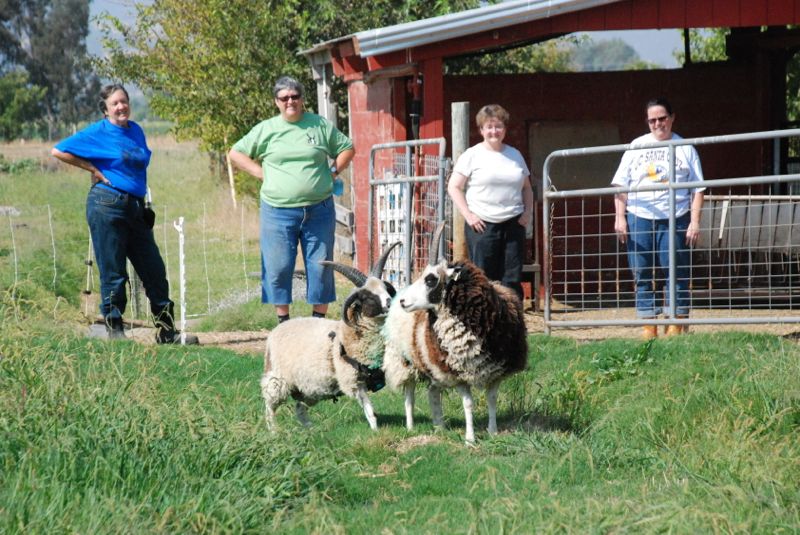
Today I hosted a field trip for 24 six and seven-year-olds and their accompanying adults. Thanks to the Farm Club for helping me out yet again. Kathy, Dona, Mary, and Maggie (Mary’s daughter) all helped with the kids. We split into two groups for petting animals, learning the differences between hay and straw, sorting “sheep” in the chute (with shoe-laces, without shoe laces), etc.  I don’t have many photos because we were busy with the kids but I caught a few.

I always ask the kids if they think I have crayons in the barn. They say “no” and then I show them my crayons. 

Image

Kathy demonstrated how we use crayons.


Image


Image


The demo turned into the farm version of face-painting.


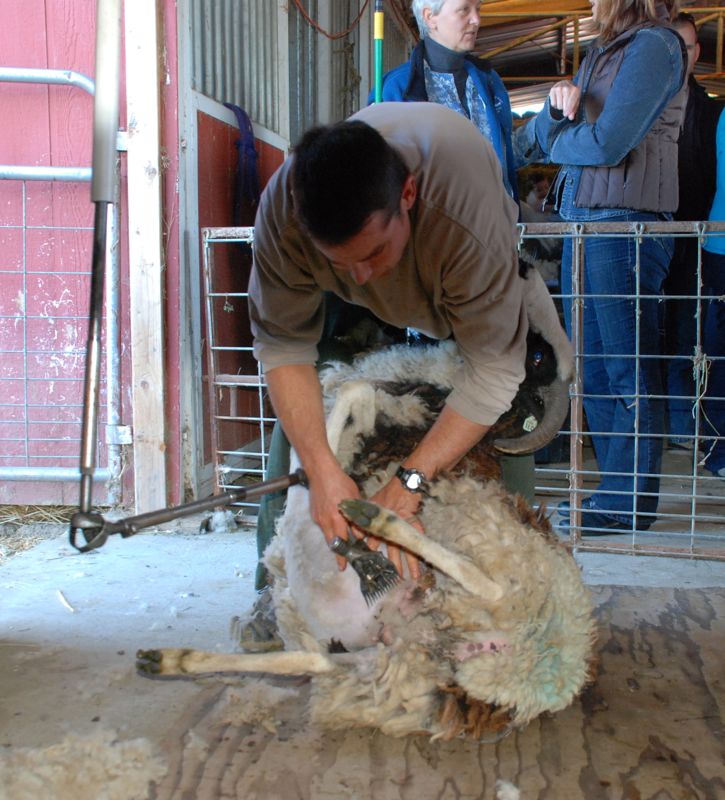
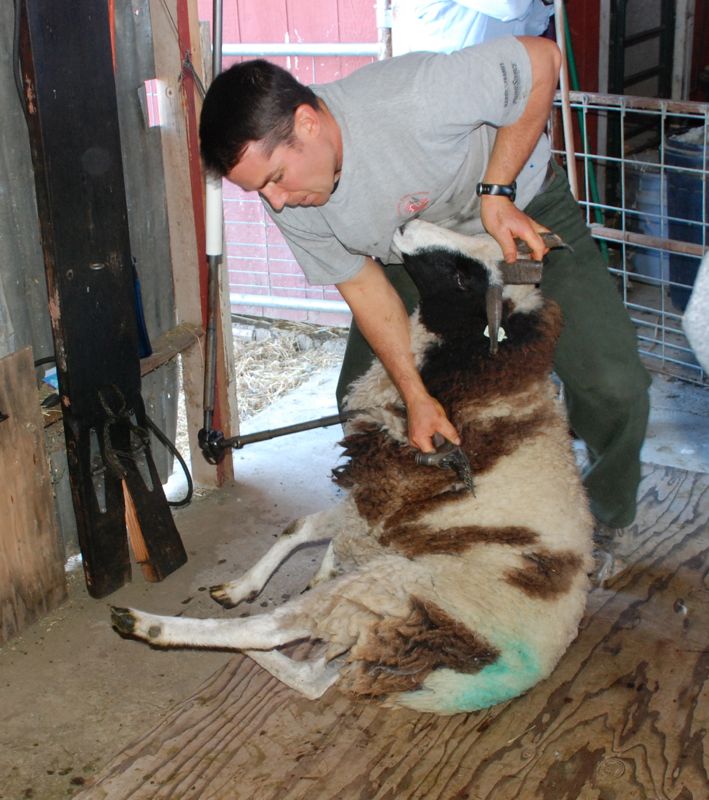
After the groups got back together, Rusty showed how he works sheep. 

ImageThen the kids watched us demonstrate carding, spinning, and dyeing. We read a story, gave them all a postcard with Rusty’s photo and they got back on their bus. Us adults retreated to the shop for de-briefing and visiting with the A/C going. Thanks Farm Club!


CA State Fair

The sheep show is during the last 4 days of the CA State Fair although my ewes with lambs were there for the whole three weeks.

Mary is a 5-time veteran of the Livestock Nursery.

My main focus of the sheep week is the award given for the Marketing Program. This is a stiff competition that is awarded for the display in the sheep barn. I didn’t change last year’s display very much but I tightened up some things that I wasn’t happy with last year. I also learned to make a DVD with several of the videos that I’ve been working on (some of which are on YouTube) so I had a 45 minute loop that included lambing, lambs playing, and Farm Club.


I wasn’t sure how people would react to the lambing video but it certainly caught their attention and most people were in awe.


My friends and I demonstrated spinning and drum carding and that meant that we had a crowd around the exhibit most of the time. In fact this year we were given an area where we could expand into the wide alley.

The real reason to be at the fair is the sheep show. I gave Fogerty to my husband to show because that ram is so strong and I didn’t want to risk him getting away from me. However, Sullivan didn’t cooperate too well. We switched places and Sullivan followed Fogerty without trouble. Fogerty placed 3rd in this class that included Shetlands and St. Croix sheep.

The best placing of the day was my young ram who placed first in his class…

…and then Champion Ram of the Primitive Breeds show.

The most exciting awards for me were presented at the end of the four days.


I finally won the 1st place Marketing Award (that’s one of the leather banners) and Best Educational Presentatation in the Sheep Show and overall for all the livestock divisions at the fair! Should I retire while I’m ahead?

But that’s not all there is to the fair. Here are some other photos I like:

Farm Club members, Mary and Dona, cutting up temporary tattoos for give away.


Here is how the tattoos look in use.


There were other animals with horns in the barn.


And other animals with nice fiber.


Animals that combined horns and fiber.


But look at the Supreme Champion Merino ram owned by Terry Mendanhall…


…and see his fantastic fleece.


The Younger Generation

It simple math. If I had 65 sheep last November and  want 65 sheep next November, but  81 lambs were born, that means that  I need to sell 81 sheep before November. So out of all the lambs that were born I need to be very selective about which ones I will keep. Here are the chosen lambs so far.

This is Sonata, daughter of Meridian Moon and Sweetgrass Clint.

Lila, a lilac ewe, daughter of  Meridian Lola and Mud Ranch’s Hudson.

Fandangle, daughter of Meridian Fran and Sweetgrass Clint.

Kenleigh’s Isadora who came from Kenleigh’s Acres in Oregon.

Mud Ranch’s Foxglove and …

…Mud Ranch’s Ginseng, both lilac lambs from Mud Ranch in Lewiston, CA.

There are plenty of other pretty lambs, but most of them will need to find homes elsewhere. I have my eye on one appealing ram lamb:

Axle, son of Meridian Tina and Sweetgrass Clint.

I almost forgot someone:

Onyx, daughter of Sparkle and Faulkner.

This is Fogerty, a ram who was born last spring. He is one of the rams that I will use for breeding this fall. Here is another photo:


Ladies in Waiting

It’s that time of year again.

We’re off to the CA State Fair Livestock Nursery.

Mary is a veteran of the fair. This will be her fifth time lambing here. Don’t worry Mary. It’s just the camera angle that makes your rear look so big.

Mary brought novices with her. That’s a yearling ewe, Toffee, lying down and a three year old ewe, Shelby, standing. Shelby is one of the ewes that we “rescued” from a foreclosure last year. (Yes, it’s still camera angle, Shelby.)

The State Fair opens tomorrow and runs through the last weekend of July. That’s when I’ll have more sheep there for the sheep show. In the meantime these three ewes will be well taken care of by the staff and students of the UC Davis VMTH (Veterinary Medical Teaching Hospital). We look forward to lambs in the next couple of weeks.

Green Pasture

You have all seen photos of my green pasture.

This does not happen naturally here in California’s Central Valley . We have what is known as a Mediterranean climate. I thought I’d give you a definition but what I found when I did a google search is more interesting:

There are not many places in the world that have our hot, dry summers and cool, wet winters. So how do we grow all that clover and grass in a hot, dry summer? Irrigation, of course. But irrigation water has to come from somewhere if it’s not coming out of the sky this time of year.

Our irrigation water is provided (sold) by Solano Irrigation District and comes from Lake Berryessa which fills from winter rainfall. Here is how our irrigation water is delivered.

Do you see that low spot in the mountains on the right side of the photo? Lake Berryessa is behind there. The water is carried down Putah Creek. Eventually it works it’s way into a system of canals. When I call for water the SID person opens a gate at the end of this ditch that is normally dry. The water flows to another gate at the northwest corner of my property (that cement box on the other side of the fence). When that gate is open the water flows under the fence into the standpipe in the foreground.

That black circle is the pipe carrying the water into the standpipe. It flows out the hole on the south side of the standpipe (at the top of the photo).

This is a close-up of that rushing cool water. It’s not a rushing mountain stream but it sure looked appealing this afternoon when I was outside working.

Here is where the water flows out of the standpipe into the pasture.

There is a ditch at the north end of each pasture. The water is just starting to fill the ditch.

I have to dig cut-outs in the ditch to get the water to flow where I want it. It’s not a perfect system because our ditches are worn out and trampled by sheep and the pastures aren’t level, but I can usually make it work. I have the water on for 24 to 36 hours to irrigate everything.

This is the last pasture the sheep were on yesterday and I finished mowing it (a story for another day)  just before irrigating.

This is what we’d have in the summer if we didn’t irrigate. (This is a small pen behind the barn.)

Here is what irrigation gives us.

Weaving blankets

Here is a blanket that has become one of my favorites to weave.

In the book where I saw this draft it is called Breaks & Recesses. I think I need to come up with a different name.

I have mentioned before how much a woven piece changes after it is has been properly finished. In the case of wool that means wet-finishing or some degree of fulling. When a piece is fulled the individual threads  become less distinct as the wool fibers catch on each other and the piece becomes cloth instead of  a bunch of separate threads. (Fulling is an irreversible process that needs to be controlled–picture a wool sweater that goes through the washing machine and dryer.)

This is a dramatic example. The blanket on the right is the same draft and using the same yarn, but it has not been finished yet. This yarn is one that was mill-spun of wool from sheep at the place where I used to go for sheepdog training. The yarn feels harsh and oily, but it softens beautifully when fulled.

A custom blanket customer saw a similar blanket and wanted me to weave her a queen size blanket using this pattern. “Sure”, I said. “No problem.”

I use double weave to weave a queen (84 x 90) blanket on a 60″ wide loom. That means that I weave two layers at a time with a fold on one side.  I have to allow for take-up and shrinkage (part of that is the fulling I described) so this blanket measured 54″ wide on the loom (double–opened up that would be 108″) and I planned to weave 100″ in length. A lot of this is educated guessing based on previous similar projects.

This pattern is woven on 8 shafts. To weave a double width blanket I used 16 shafts, 8 for each layer. First I had to figure out that part. None of this will make sense if you are not a weaver and I didn’t intend for this post to be an explanation of all the steps. One of these days maybe I’ll do that, but not now.

This looks nothing like the pattern in the finished blanket. That’s because in this draft every other horizontal and vertical line is the opposite layer (odd numbers are the top and even numbers are the bottom). When I buy new software it will be something that will show me the top and bottom layers.

When I finally started weaving the blanket I knew that something wasn’t right, but I had a hard time figuring out exactly what it was. I used a mirror to see the lower layer but I had to go back to the book and the computer to see that I had reversed some of the squares in the draft.

Here is a close-up of the top layer as I was weaving.

This is what the computer looks like as I am weaving. I have what is called a compu-dobby and the computer drives which shafts lift, although I do all the work.

See the shuttle at the other side of the loom?

As I step on the treadle certain shafts lift so that the shuttle can carry the yarn in between the threads.

This is after the shuttle has gone from left to right and is now on the other side.

This is a view of the left side where I can separate the layers. The fold is on the right.

I finished weaving this blanket today and am working on correcting a few errors. Then I will have to crochet the edges before I full it. I should take photos of these processes and report back.


No Sheep in Paradise

We just came back from my first visit to Hawaii. We went to visit with my father-in-law who moved there with his wife last year. They don’t plan to come back here, so if we’re going to see them we need to get to Hawaii–not a bad place to “have” to go, but it’s not that easy to make the trip when you have animals to take care of.  Here are some photos of our visit.

This is the little 10 (or 12?) seat plane that took us from Maui to the Big Island. We were skeptical, especially when we saw one of the pilots for another commuter plane who looked like he was about 12, but it actually gave us great views of the islands and the coastline.

Isn’t that water beautiful?

We were met by our relatives, leis in hand.

The first evening in Hawaii we got to the beach just as the sun was setting.

This photo was taken at Hawaii Volcanoes National Park. This is an incredible place to visit but you need a couple of days to be able to hike the trails and see it all. We drove down to where the road was blocked by a lava flow 10+ years ago. This is right on the coast and it would sure be something to watch the lava flow into the ocean.

That’s all lava as far as you can see.

There are beautiful textures…

…all around…

…and color when you look more closely.

The landscape is immense.

We especially liked the message on this cap. Can you read it? (See next photo)

We did some touristy things:

One day was spent in Kona shopping and eating. One thing it’s hard to get used to is that many of the buildings don’t have walls. As long as you can get under a roof you will be out of the rain, but it’s never cold enough to need the walls. I wonder what the CA Health Department would do if they saw birds walking around on the tables in a restaurant.

We spent one morning zip-lining through the trees. That is Dan and, yes, I did it too. I’ll have to get photos from Dan’s camera. The scariest part was the drive to and from the zip-line course.

It took 6-wheel-drive to get up there and we were still slipping and sliding on the road.

Food is an important part of any vacation and we tried a few of my in-laws favorite places. This is a meatloaf sandwich on homemade sourdough bread.

There wasn’t much beach time but we were there for a couple of hours before it started to rain.

Next time I’d definitely like to explore more beaches.

We feasted at a lu’au…

…and as the sun went down…

…we were entertained by the show. Since our goal was mainly to visit with family we spent a lot of time at the house–which is not on the beach or in the rainforest, but at Waikoloa, in the dry area of the Big Island.

I loved the bananas–a different taste from the ones at Safeway.

I was amused by the geckos…

…although it still seems strange to see them roaming around inside the house.

We were gone for 8 days and needed a day to recover when we got home. It’s fun to visit but good to be back home to sheep and yarn and chores…and, of course, Rusty. I was going to write a blog post about what it took for us to be gone this long, but I think I’ll ask Rusty to write that one. He has been waiting to use the computer because I had it with me. Check out Rusty’s blog a little later.

Hot Day and Other Random Thoughts

Higby’s Country Feed is my favorite store. There is always something there I want to buy. I told them that if they started carrying underwear, then between Higby’s and Ace Hardware, I wouldn’t have to shop anywhere else. Today Higby’s had an anniversary celebration of opening the new expanded store five years ago.

With the weather forecast of 104 degrees and north wind today I scoped out the most protected spot for the canopy and sheep pen. The winds didn’t materialize, but it was breezy enough to help with the heat. Thanks to Jackie who met me there and stuck it out for most of the day. We were well fed as Higby’s provided home-made scones and cinnamon rolls for breakfast, enchiladas for lunch and snacks and cold drinks all day.

I was impressed with the raised beds for the vegetable garden. (Since our tractor tires just shredded maybe I’ll be able to use this idea too.)

This morning I caught a couple of lambs that I think I’ll be keeping.I figured that I may as well bring sheep that I want to halter break. At the time I wasn’t thinking of a blog post so I didn’t take many photos. But here is one lamb that I brought:

She is the biggest lamb I have and she has a beautiful fleece. Does she look familiar?

Here is Dad:

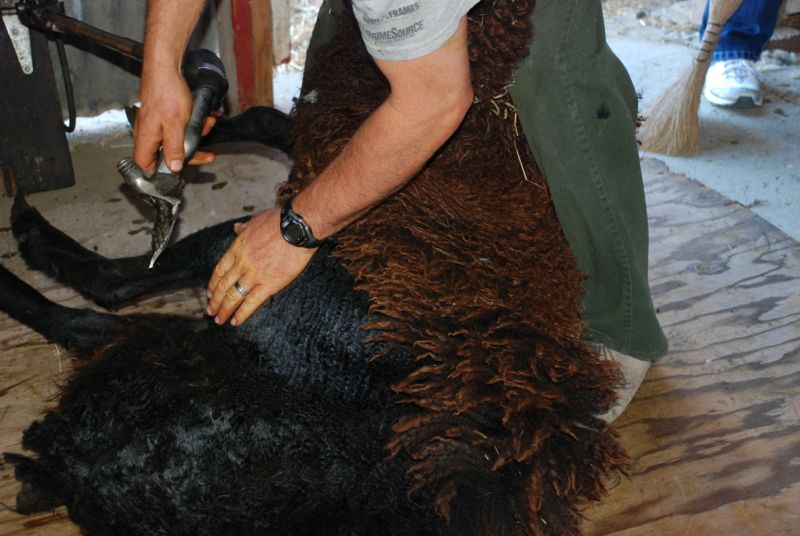
By the way, he was sheared last week. The flock is shorn in November but some of the long-wool breeds can benefit from twice/year shearing. Faulkner’s fleece looked so lovely that I decided to have him shorn since a sheep shearer was in the area to buy lambs anyway.

Penny, the shearer, chose to shear Faulkner standing up. He was a perfect gentleman about the whole thing.

Penny’s son helped catch the locks as they came off. Ummm…don’t look too closely at Faulkner. Maybe he could benefit from wearing a sheep size grazing muzzle.

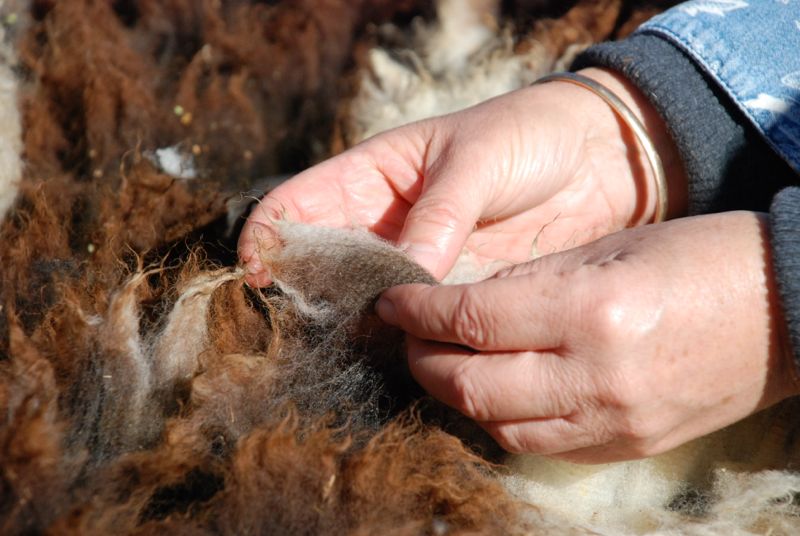
Here is a photo that I took after washing half of Faulkner’s fleece.

This is the site that greeted me inside the door of the shop this morning.

It’s 7:30 p.m. and I think it’s probably still in the 90’s. I’m sitting under the ceiling fan I hope that in another hour it will be cooler outside than inside so we can turn on the whole-house fan. How many people go to Hawaii to find cooler temps? (For those of you who think, “wow, that’s a random thought”, stay tuned. Or maybe it’s just heat stroke.)

Benny 1999 – 2012

Benny was found cowering in a rain storm under the shopping carts at Safeway by the daughter of my friend, Colleen. Colleen rescued him and got him healthy. We had just moved to our current location a few months before and decided that we could handle another dog since we had only Flash at the time. Colleen had said that Benny was probably a Border Collie mix. What I didn’t expect when I saw him was that his legs were only about half the length they should have been to match his body. Colleen raised Corgis–maybe Benny looked normal to her!

We’ll never know what trauma Benny had experienced before he was adopted. He was always loving to our kids and their friends, but was not trustworthy with adult strangers.

Katie took Benny in the obedience classes at the 4-H Dog Shows, but he was never given the Canine Good Citizen award because of his tendency to growl at a stranger who approached with a hand out (unless the hand was throwing treats).

Flash (right) was also found in a parking lot as a puppy and I got him from my vet at the time. He was probably about 6 when we got Benny. Doc (left) was a wonderful dog who came to us later when the neighbors moved and they didn’t want to take him. Benny looks as though he fits in, except for those short legs. Flash and Doc are both long gone.

The next dogs were Rusty and Bonnie. Bonnie has since found a good home in Modoc County where she is a lot happier than she was here.

Benny greets Ozzie when he moved in two years ago. What is it with animals with no homes?

Investigating this spring’s temporary house-lamb.

Benny had congestive heart failure and kidney failure and is now buried under the trees here at his home.


Flash