I have ended up with a third post to finish out this day (and the Maryland trip). After visiting the beautiful old houses in Cumberland (this post) I went in search of more of the C & O Canal and planned to do some hiking before getting back to the motel in Frederick.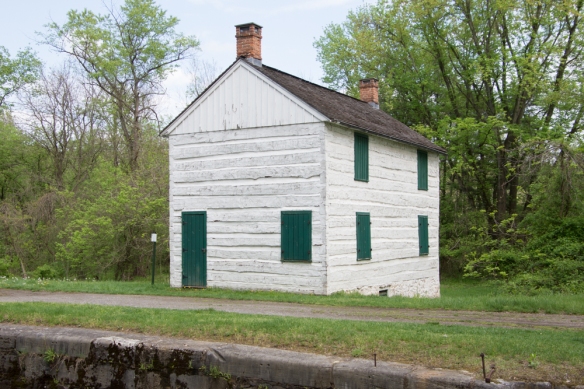 I shared photos of other parts of the canal in this post and the first post about this Maryland trip. This is the lockhouse at Lock 75, the westernmost lock on the C & O Canal.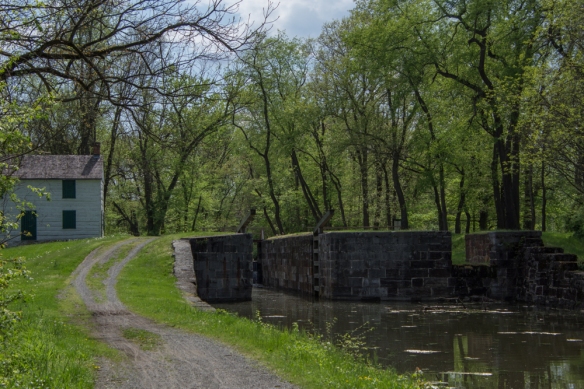
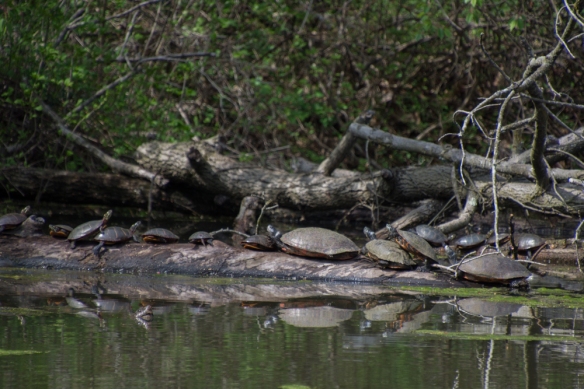 Turtles sunning themselves in the canal near Lock 75.
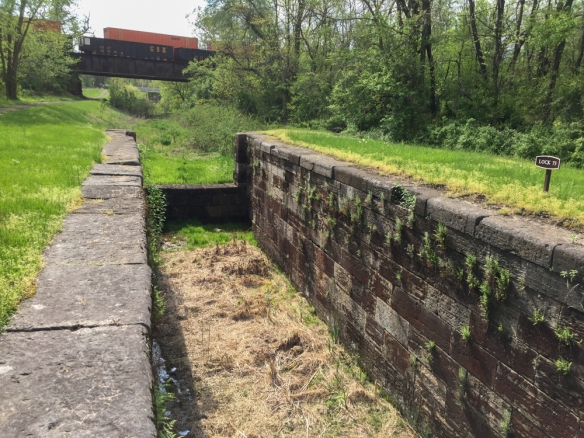 I drove along some of the roads in this area looking for more places to explore and found Locks 73 and 74.
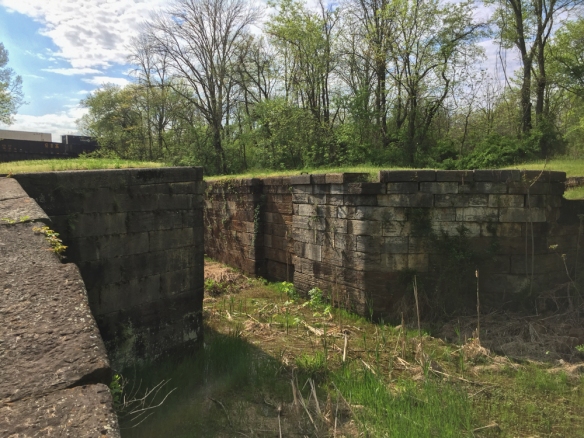 Notice the railroad over the canal in the previous two photos. The railroad and the canal were competitors for business during the era of the canal. Repeated flooding and competition from the railroad were the reasons for the demise of the canal system in 1924.
 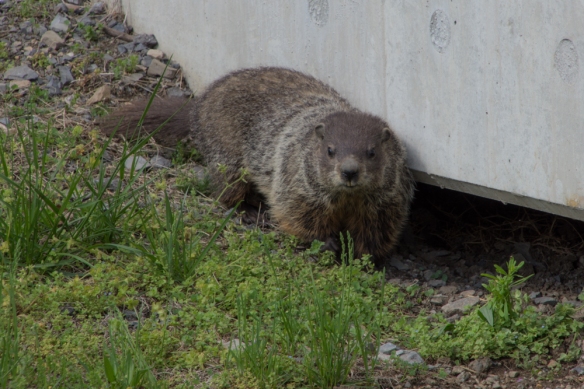 I saw a flash of this animal as he ran under the bridge. This is the first groundhog that I’ve seen.
I drove on and came to a sign for the Pawpaw Tunnel. From Wikipedia: “The Paw Paw Tunnel is a 3,118-foot-long canal tunnel on the Chesapeake and Ohio Canal in Allegany County, Maryland. Located near Paw Paw, West Virginia, it was built to bypass the Paw Paw Bends, a six-mile stretch of the Potomac Rier containing five horseshoe-shaped bends. The town, the bends, and the tunnel take their name from the pawpaw trees that grow prolifically along nearby ridges…Built using more than sixteen million bricks, the tunnel has been described as the greatest engineering marvel along he C & O Canal national Historical Park.” 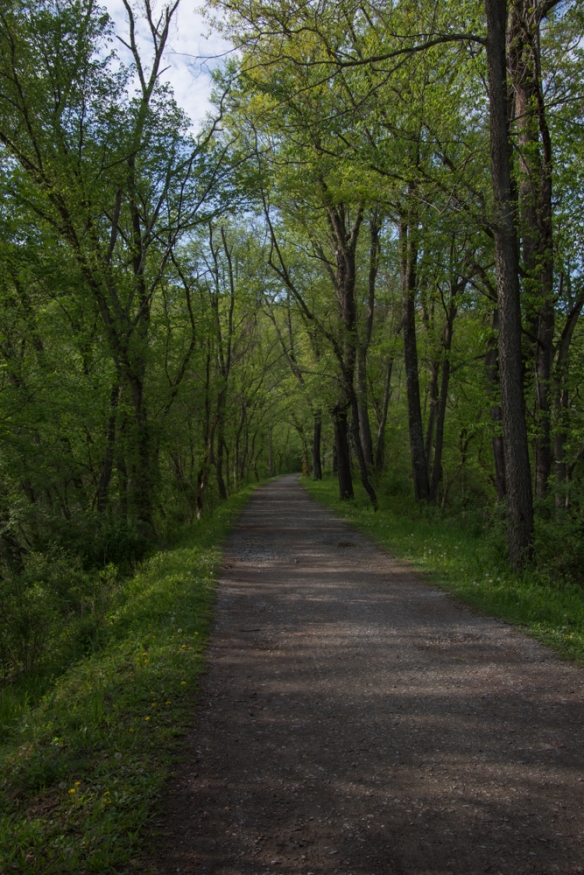 I had read on line that the tunnel was closed but thought that I’d be able to see the canal and walk along the towpath. This photo seems typical of much of the length of the towpath–a beautiful hardwood forest and a broad path to walk. One thing that I noticed everywhere was the number of birds. I didn’t see all of them–but there was quite a chorus in the woods.
 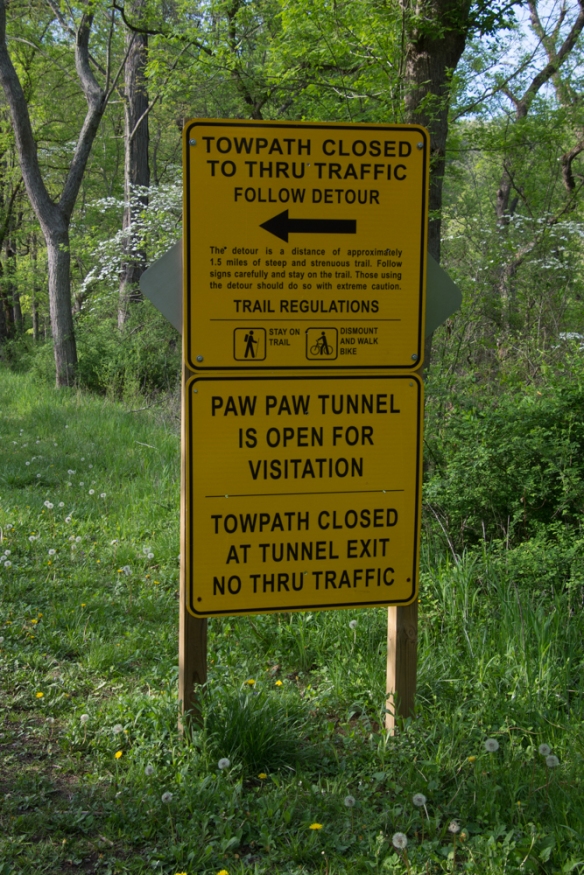 So I got to this sign and decided to take the detour.
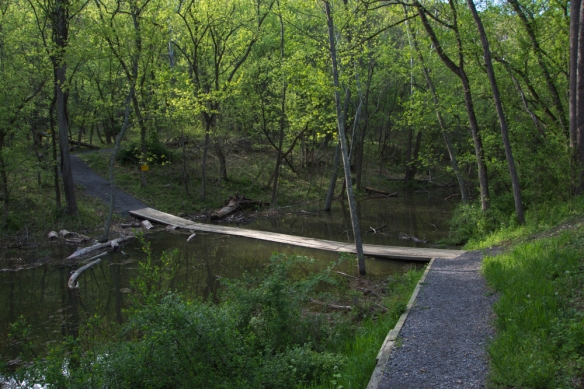 Wooden planks crossed the canal.
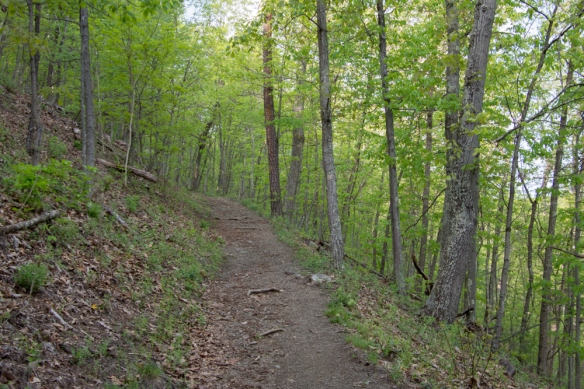 The trail wound up into the woods.
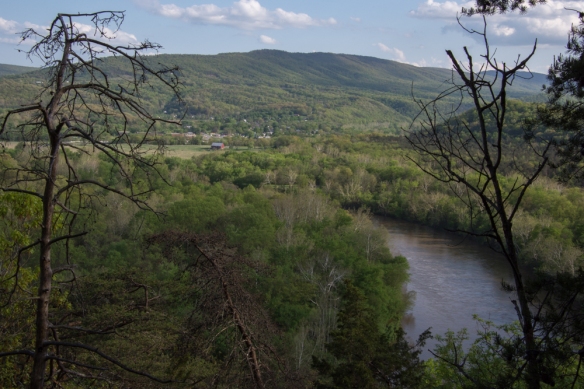 This overlooks the town of Paw Paw, West Virginia.
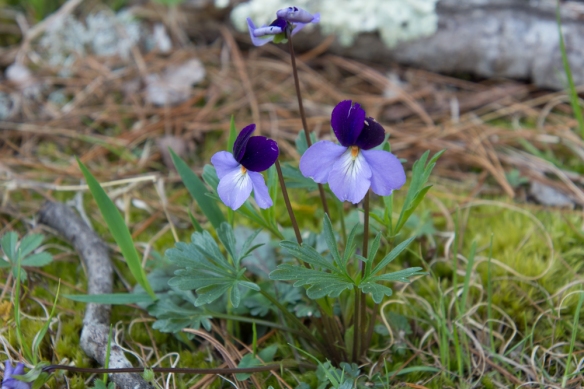 Viola pedata, Birdsfoot Violet.
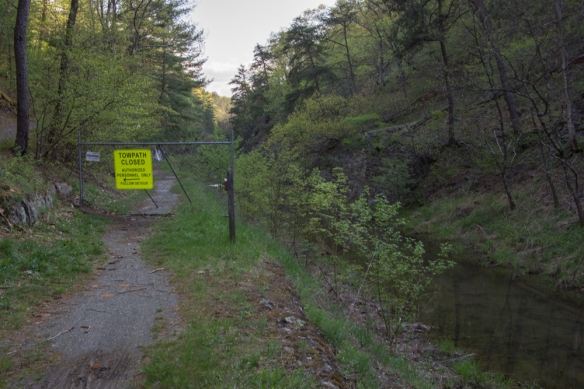 After hiking what seemed quite far into the woods I came back down to the canal and the towpath and saw this sign. From the looks of the terrain I assumed that is where the tunnel is even though the first sign had said it was open.
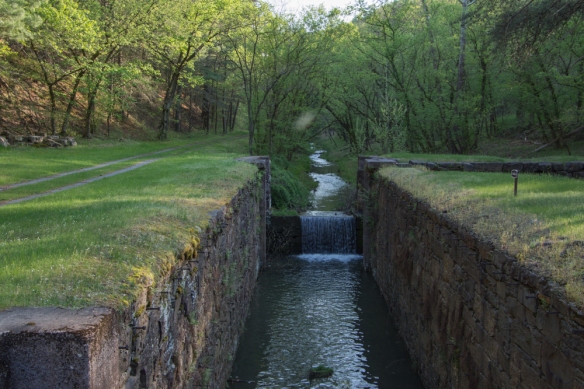 I walked the other direction, and saw this lock. The path continued around a bend.
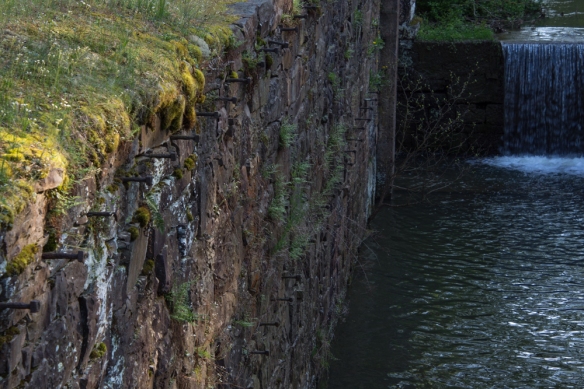 This was confusing. I assumed that there was a reason to make a detour and wasn’t sure if I continued to walk along here (towards where the detour sign had been) that I wouldn’t come to an impassable spot. Why else would there have been that sign? Or was I completely turned around? It was getting late in the day and my mind started to play tricks. Are there bears in these woods? I’m all by myself and no one knows where I am or will know if I don’t return. My phone battery is almost dead. There was no cell service, but I wouldn’t even have a flashlight.
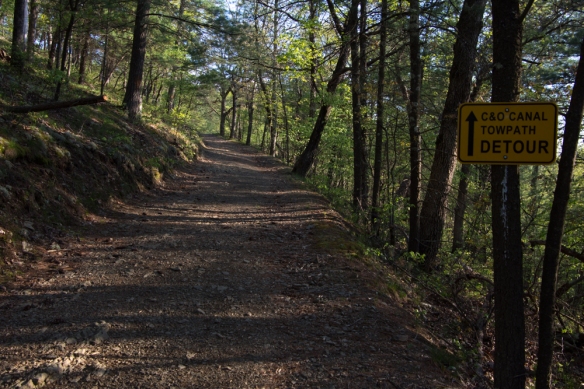 So I decided to turn around and go back the way I had come.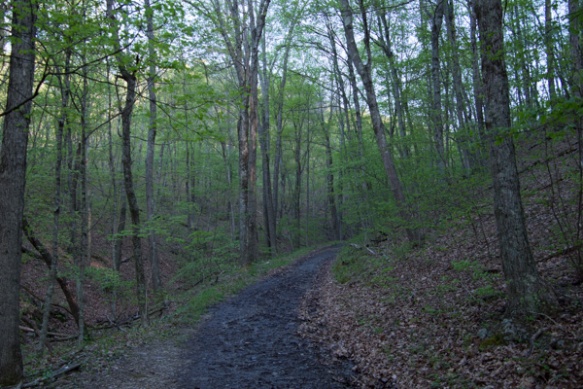
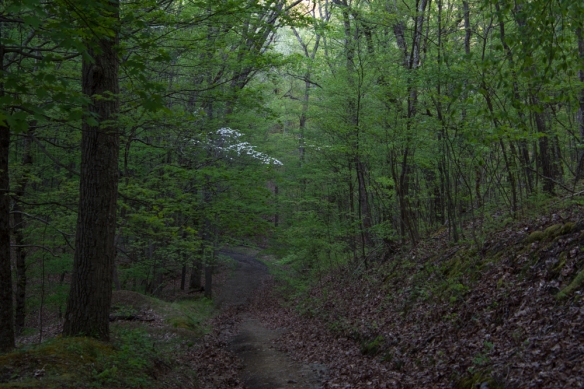
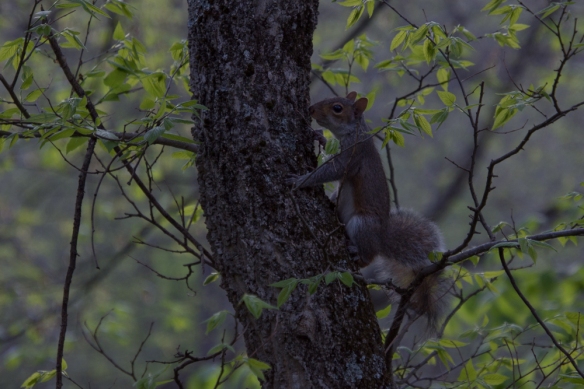 No bears, but there were a lot of squirrels.
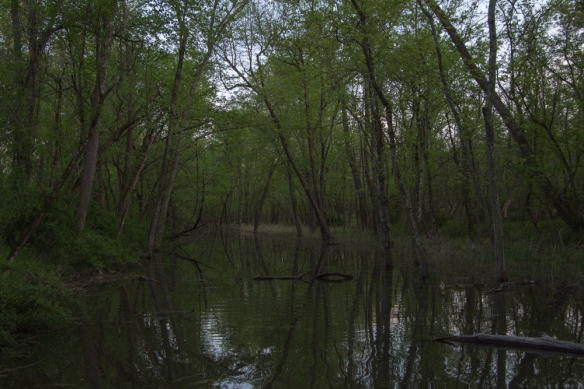 Crossing the canal.
I was disappointed to not find the tunnel, but this was a beautiful place to hike and a good end to the day. I drove the beautiful Country Roads of West Virginia (I want to break into song here) back to the freeway. 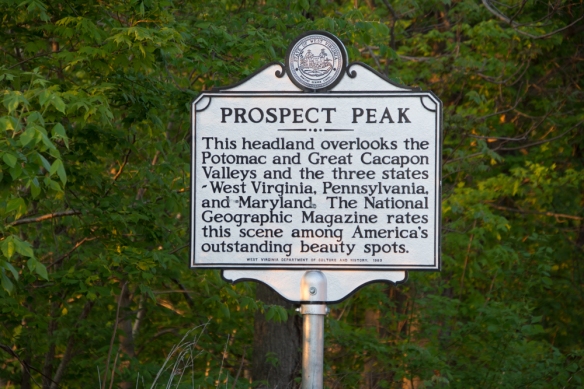 I hit this point at dusk.
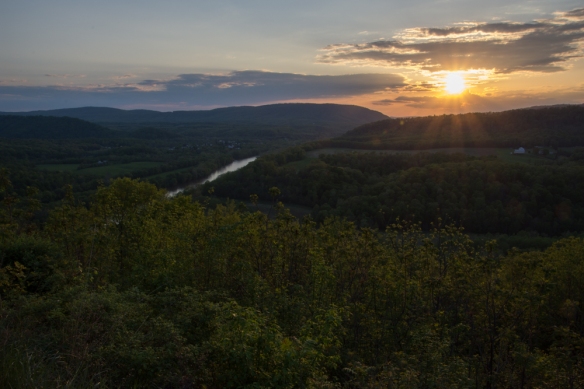 It was dark by the time I got to the freeway and I got back to Frederick at about 9:30 after a long day. That was it. I flew home the next day.
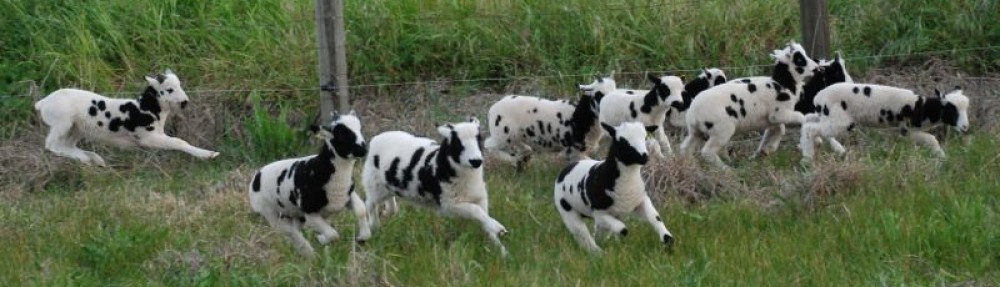
 There was plenty of room to run.
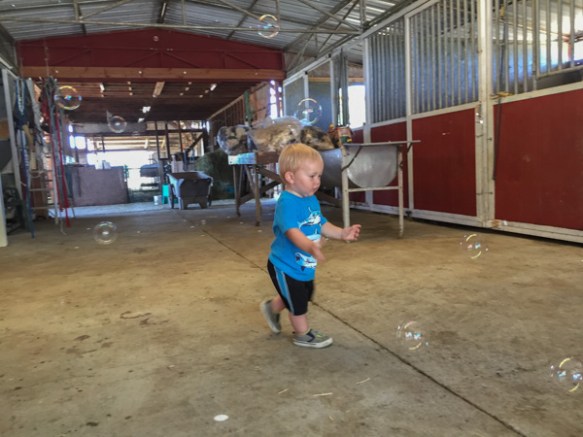 Plenty of room to chase bubbles.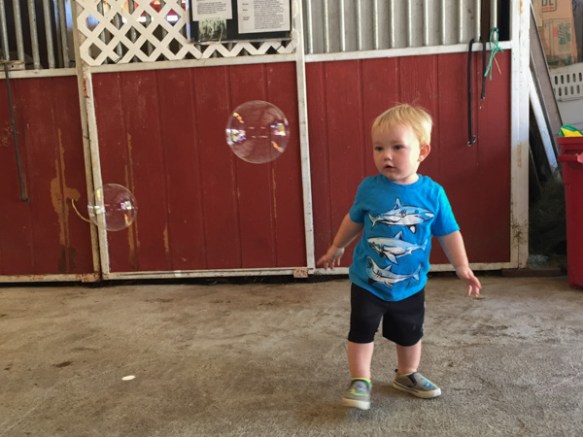
 Plenty of room for drawing with chalk. Notice who is just outside the barn door painting. The kids didn’t know that and I kept them distracted inside.
 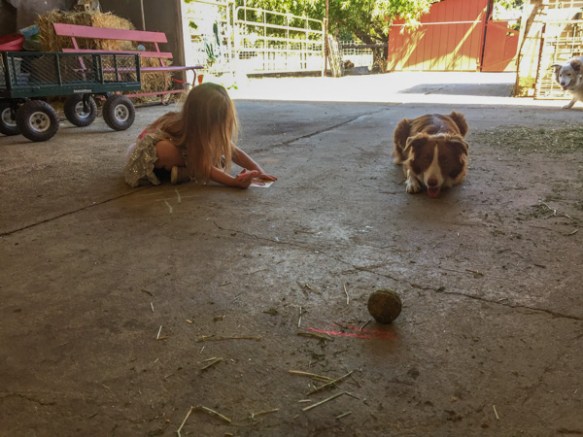 Someone else needed entertaining too.
 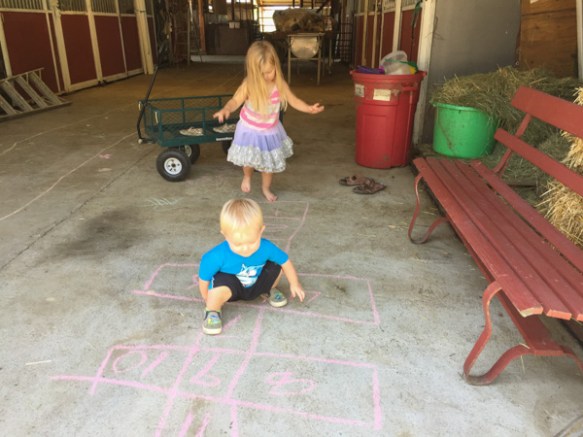 I taught Kirby about hopscotch.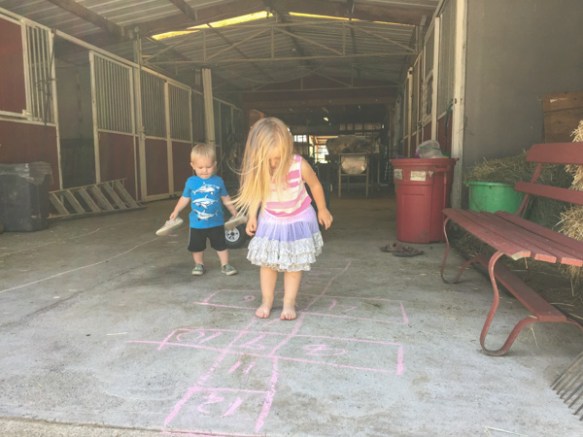
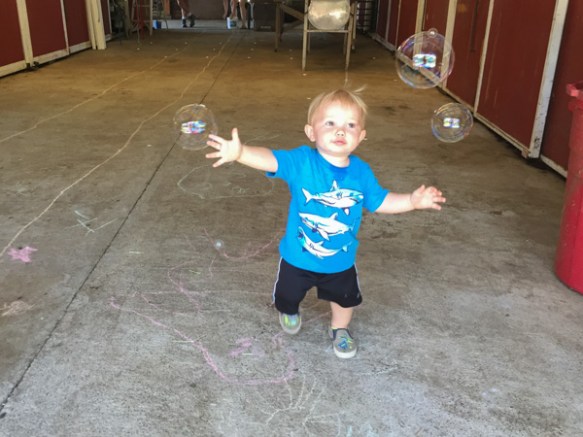
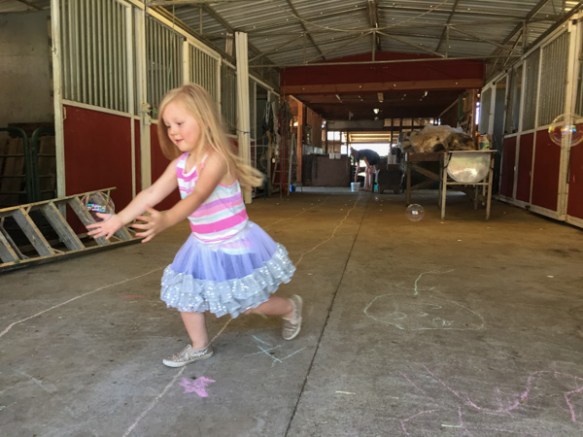
 Aunt Meryl came to the barn to play. While all the names of all the other aunts are are pronounced “aunt” like the 6-legged ant, Kirby says Aunt Meryl with the “au” part as in Australia. We have no idea why because no one else says it that way.
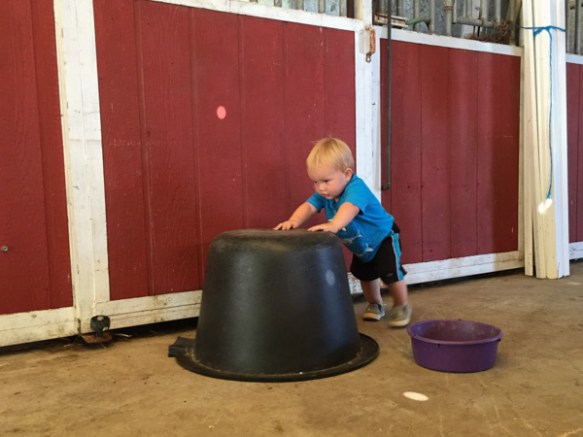 I hid balls under the rubber tubs and then Kasen just started pushing them around the barn.
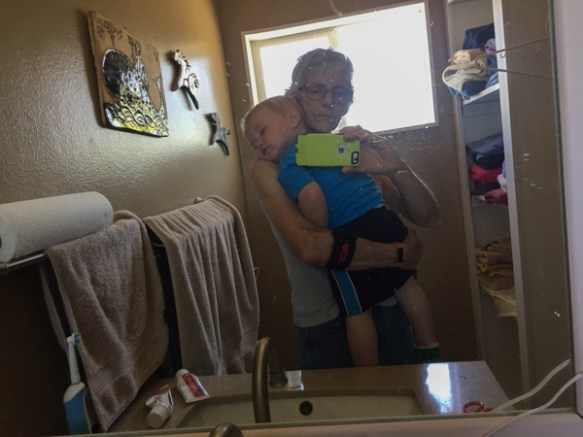 Naptime.
 I had planned to have the prep work done ahead of time, but I didn’t to that so Katie spent the first day power-washing.
 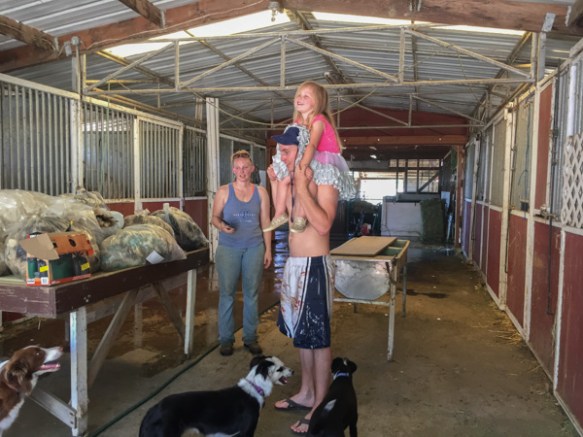 Uncle Chris gives the best shoulder rides.
  The kids got plenty of exercise outside and definitely needed naps each day.
 Before I got into the routine of putting Kasen down for his nap the carseat seemed to be an easy way to get him to sleep. One lap with the carseat in the wagon and he was out.
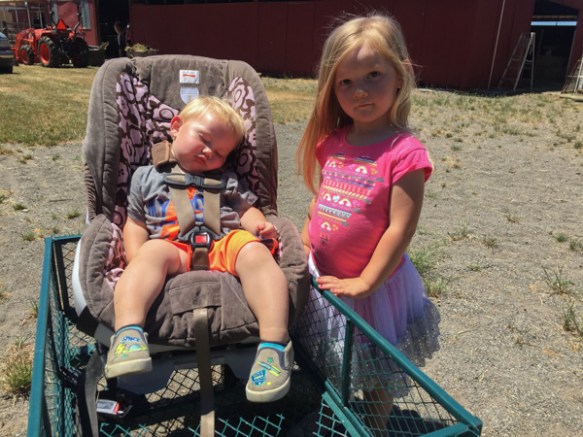 Then it was time to go to the house with Kirby to work on a project.
  She helped to warp the rigid heddle loom with a project in her favorite color.
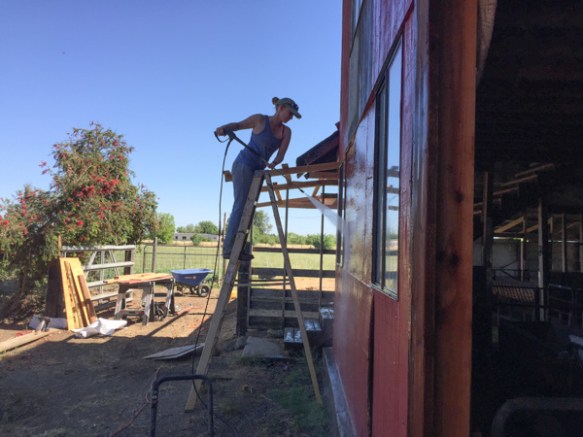 Back to the barn after nap time.
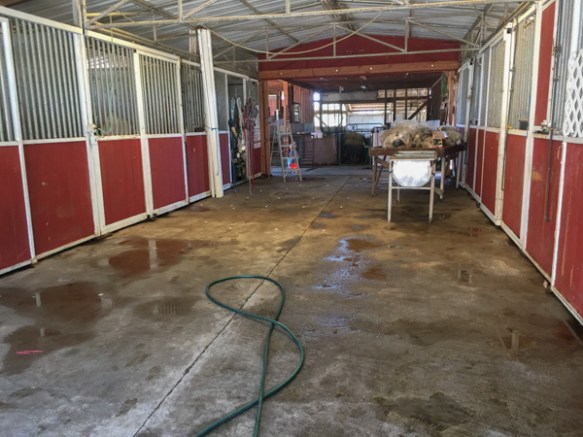 Katie admitted that she got carried away with the power washer on the inside of the barn. It looked great because she and Meryl (DIL) moved all the clutter out of the alleyway. (I still have to figure out where to put all that stuff that was moved.)
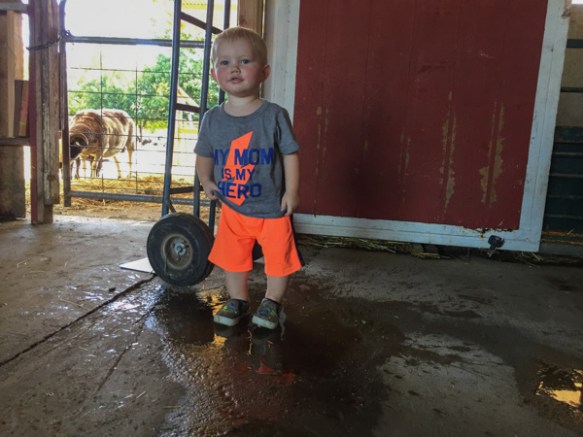 The puddles were irresistible for Kasen.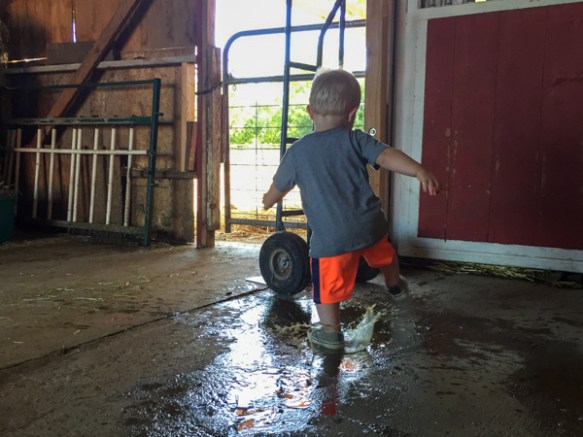
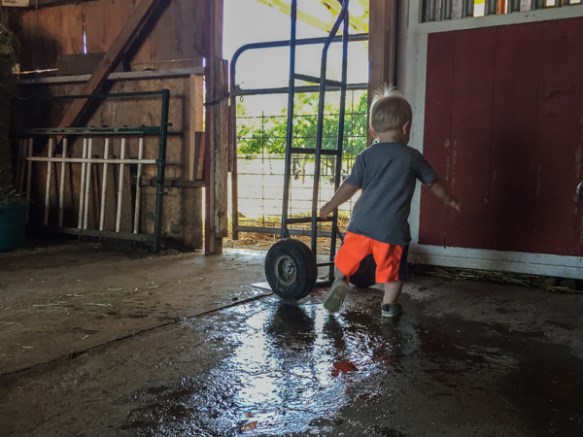
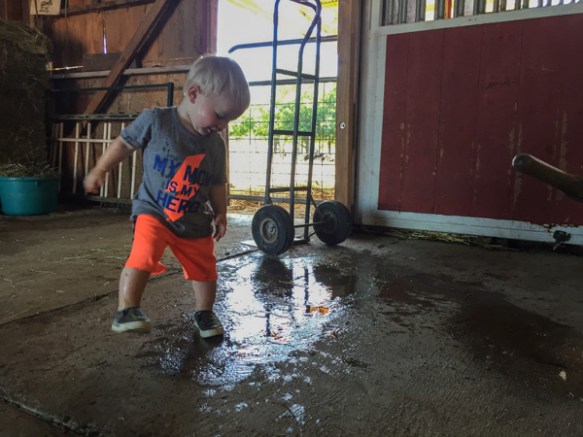
 I asked for this green wagon for Christmas because I knew that I could use it during lambing season. It sure came in handy during this time with the kids here. I found that I could even drag the wheelbarrow and the wagon at the same time.

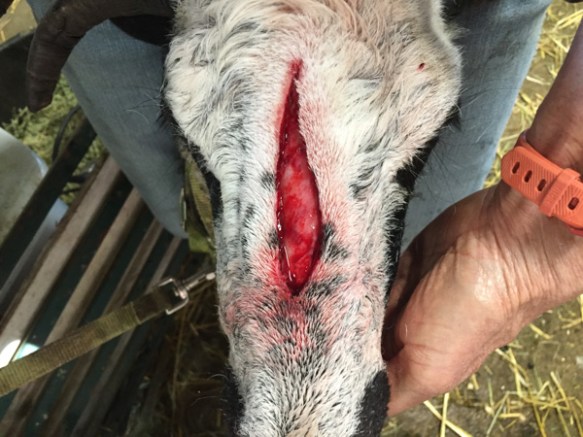 ..with this sheep ?
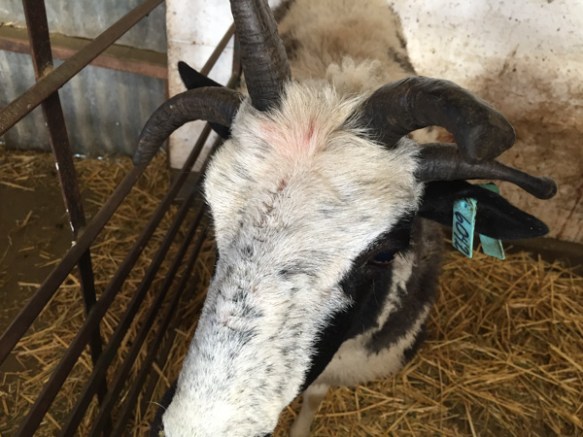 Here she is not too long ago. Staples were still in but ready to come out.
 The end result.


 I love the expressions on this kid’s face.


 The hay feeders are a little high for Kirby to reach without the hay falling all over her.
 Kirby told me she was making a nest for the other chickens.


 First I sort and start narrowing down choices. This is two-horn rams.
 More two-horn rams.
  Four-horn rams (except for the one I liked best who broke his horn this morning and I put him out so he would hopefully not keep knocking it on others). I bred to two two-horn rams and one four-horn ram last year. There are more two horn lambs than four. Some ram lambs are missing from these groups because I had already castrated those that I knew right away would not be candidates for registration (too much or too little color or horns that were too close). Time to narrow these into groups.
 These are rams who will be on the cull list. It doesn’t take much for a ram to be moved to that list. In this case two of these lambs (on the right) have wide spacing between the upper and lower horns. That seems like it would be a good thing, but usually those upper horns tip forward and sometimes there are other issues with them. I’ll report back with more photos as they keep growing. The lamb facing the photo on the left doesn’t have enough spacing between horns. His right side horns are already touching at the base leaving no room for growth. The other two both have a lot of freckling, although it’s hard to see without parting the fleece and one is scrawny.
 Three of the potential 4-horn breeding rams. Nice horn spacing and shape so far. No sign of freckling. Color % OK. Nice looking fleeces. Britch wool not too high on back leg.
  Out of two pens of ram lambs I pulled these four out as potential at this point. That is mostly due to the wide horn growth. There may be others in the pens but I won’t guarantee the horn spread yet. Of course, they all have to meet the other criteria mentioned above as well.
 Here they are from the rear.
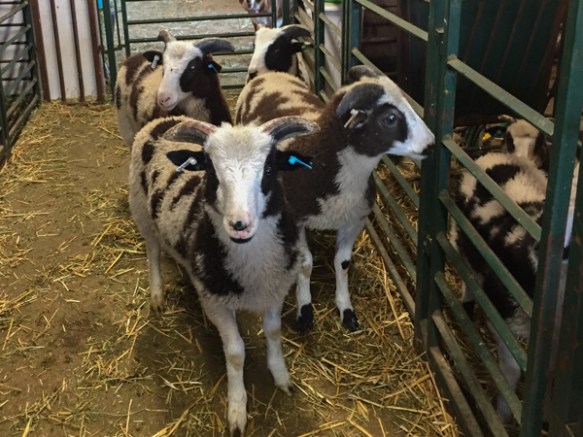 Another from the front showing the ram with the best horn spread so far.
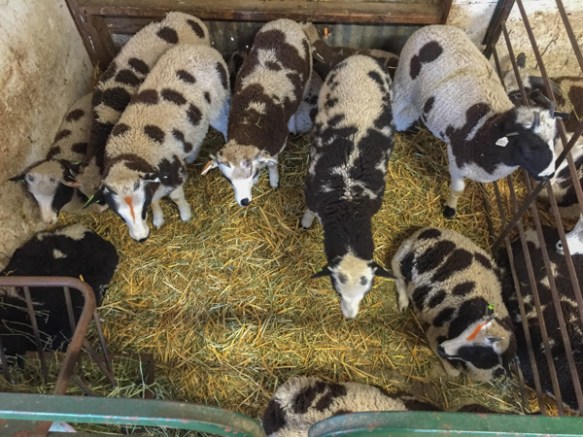 These are the 4-horn ewes. I will be less picky about the ewe lambs than the rams. The breed standard isn’t so stringent and each ewe doesn’t play as large a part in the flock as the ram. Keeping a variety of ewe lambs is a good way to maintain some genetic diversity (although that is a good reason to buy some lambs from other people in August).
 The 2-horn ewe lambs.
 Another view of the pen on the right. Notice the two lambs (sisters) in the upper left corner. Compare their horn growth to the others. All these lambs are about the same age. Those two are showing minimal horn growth compared to the rest. I don’t know if that is temporary and their horns will be just fine when they are mature or if those are scurs. This is another reason to look at the lambs in a group. All of the rest of these lambs look fine to me so it will be hard to narrow this down to only a few to keep.
 These are some of my 4-horn choices. Preliminary selection is based on wool and lack of freckling in the lamb and the dam.
 The same group from the rear. I don’t fault the sheep for their rear leg position, but from this photo it would be the lamb on the left that I’d take to a show.
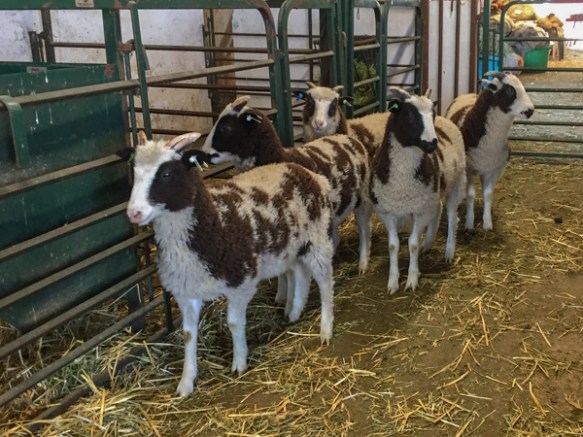 Two horn lambs that I like.
 From the rear.


 The kids will be in California for about 2-1/2 weeks.
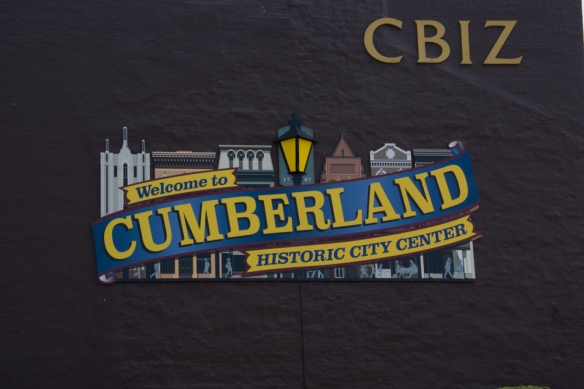 …to Cumberland where I finally found parking away from the touristy city center and I walked …
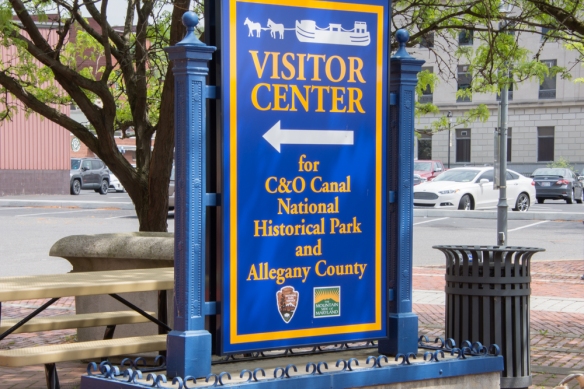 …to the Visitor Center. At the Visitor Center I asked about walking on the towpath. The person there told me that I would find more attractive areas away from town but while I was in town I might want to walk do a self-guided tour of the Victorian Historic District on Washington Street. So I headed out of the Center and started my walk, first seeing a few more of points of interest near the river.
 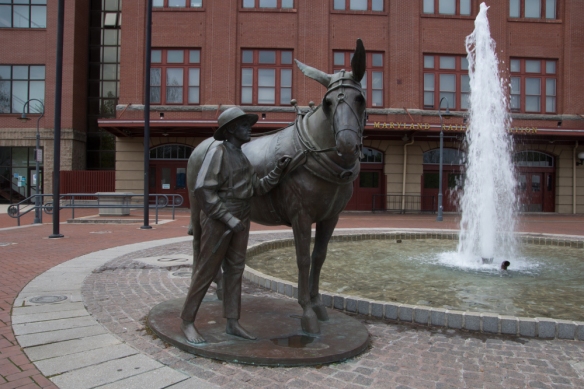 Mules played a big role in the history of the canal. In the last post I mentioned 3000 mules on the canal. Each boat had a small stable for the mules at one end and the living quarters for the boat operator and his family at the other. The rest was cargo (lots of coal). Two mules worked on the towpath while the other two were in the stable.
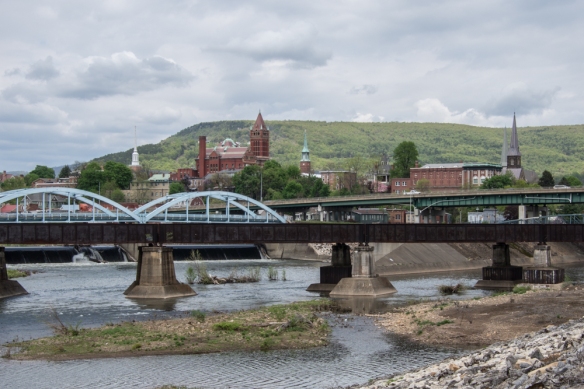 The beginning of the canal system contrasts with modern transportation routes and the old buildings of the city.
 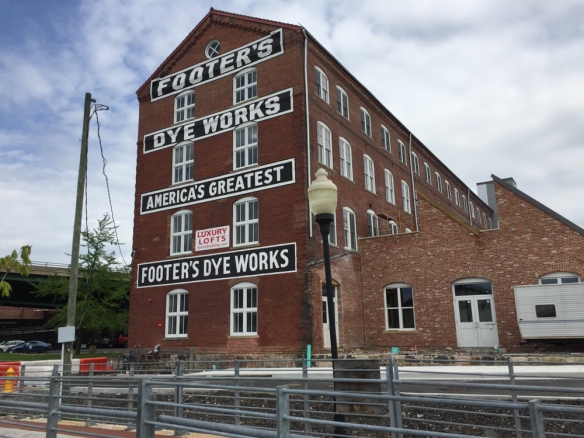 This is the last remaining structure of what was once the largest cleaning and dyeing establishment in the U.S. and a major employer in Cumberland. I think that it is now apartments.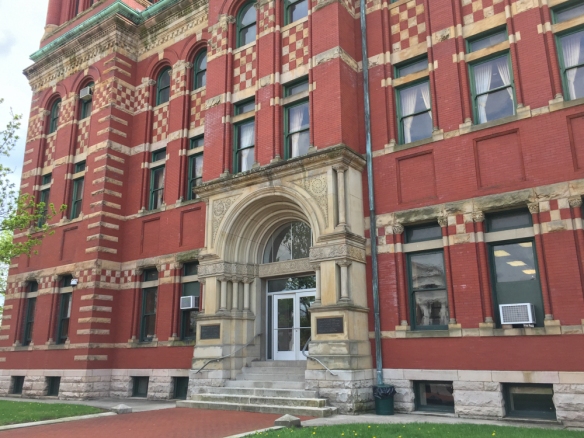
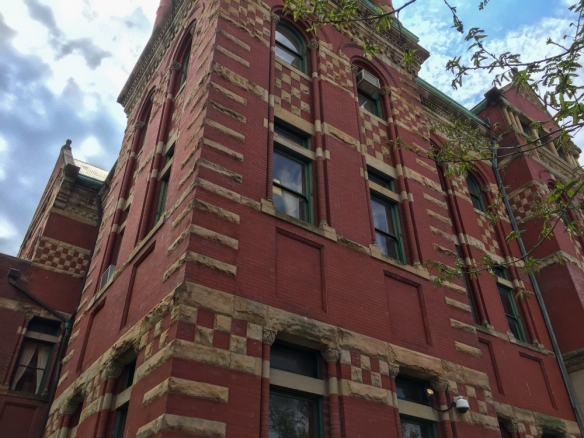 This is the Allegany County Court House build in 1893-94.
 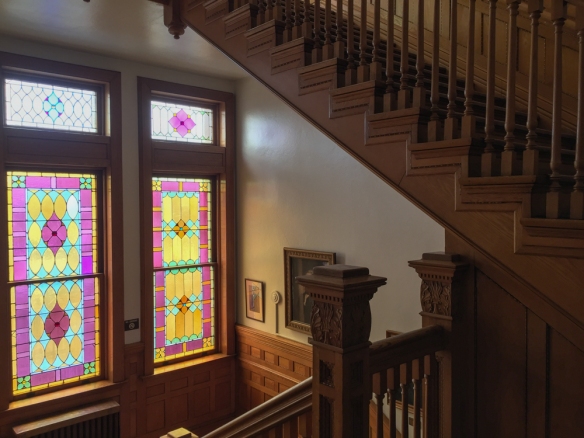 Here is a view inside the Courthouse.
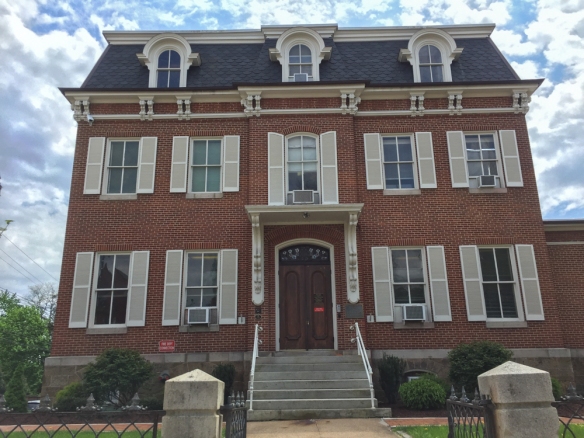 This building has housed the Board of Education since 1936 but was built in the 1860’s for William Walsh who served two terms in the House of Representatives.
 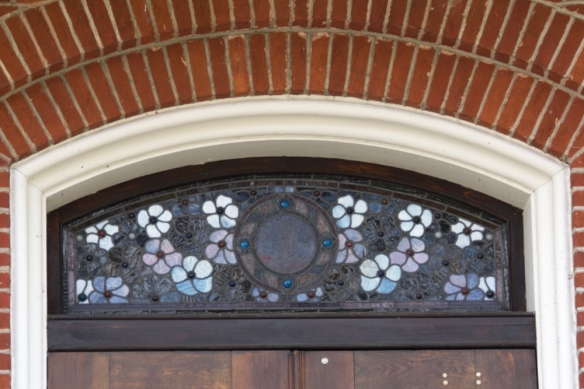 This is the stained glass above the door.
 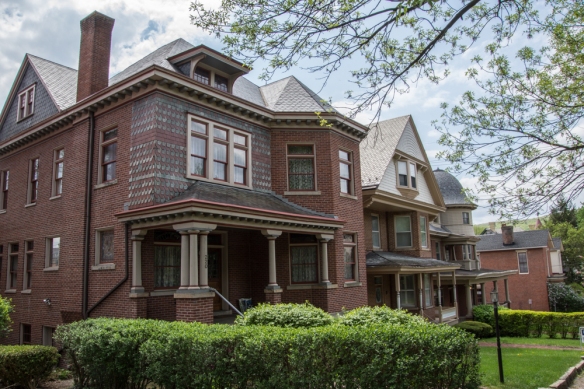 The rest of these photos are in no particular order, but I walked several blocks and over forty of the houses are listed in the Self-Guided Walk Into History. The house above was built for an attorney in the late 1890’s.
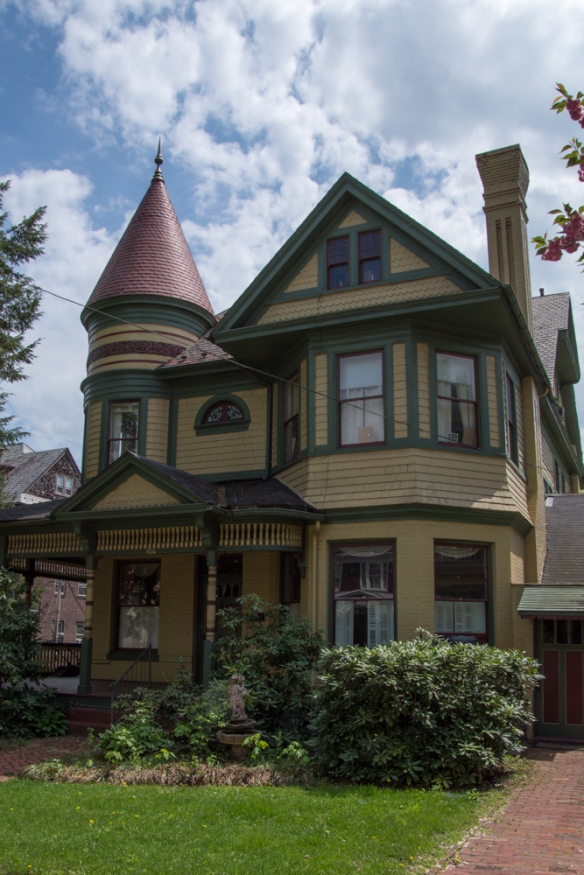 Built around 1890.
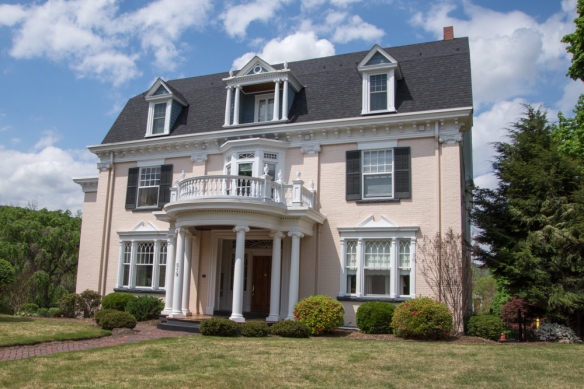 This one was built in 1890.
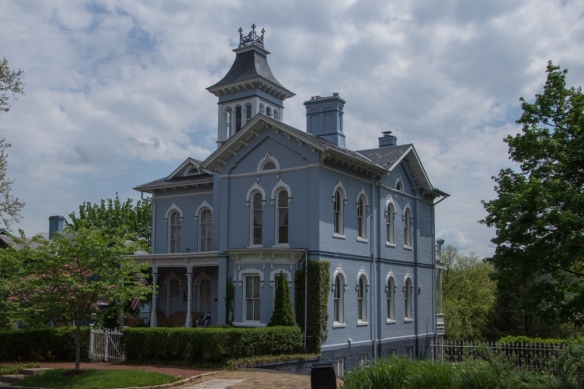 Some of these houses weren’t listed on the Tour Guide or I just don’t remember which they are.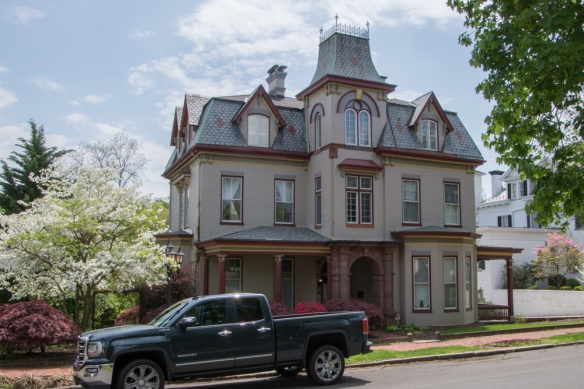
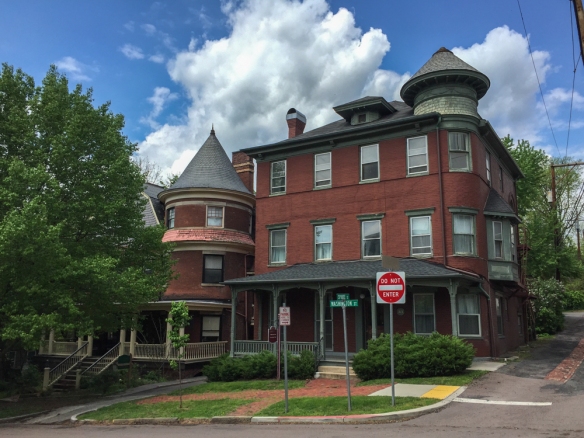
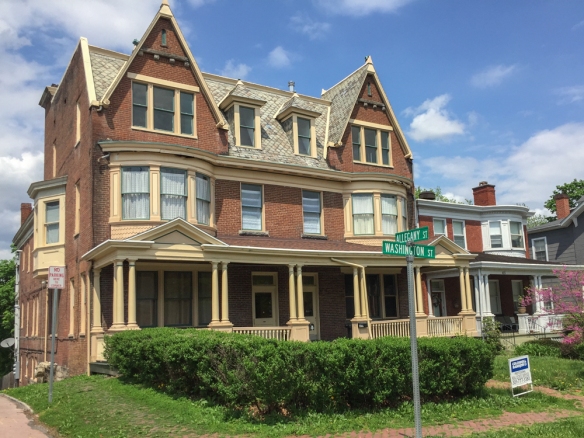 1880.
1880.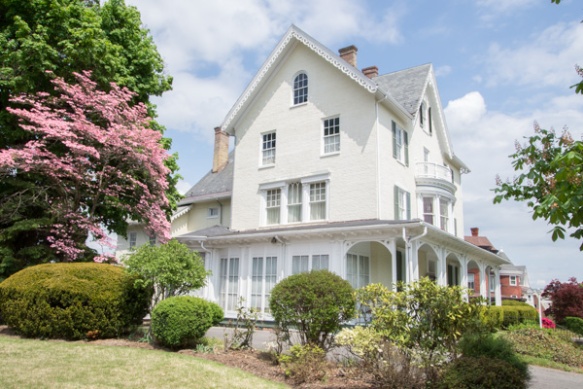 Built in 1855, now the Woman’s Civic Club House.
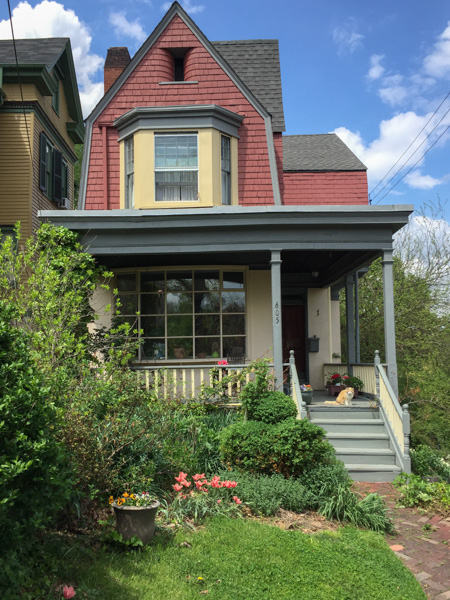 This house was built in the early 1880’s and known as “The Little House because is is the smallest house on Washington Street. The brochure says that this house “features a beautifully curved staircase and a Colonial Revival fireplace with a bullrush design in cast iron”.
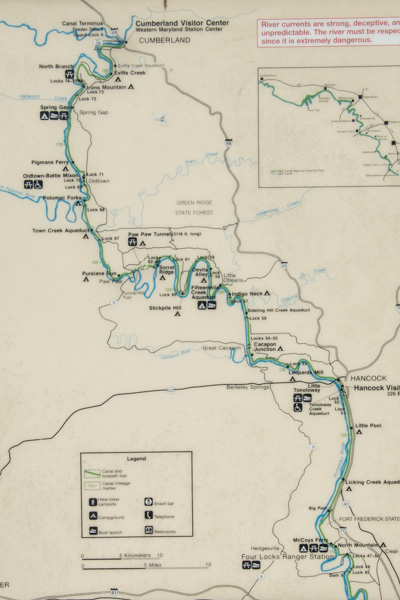 This map shows just the western half of the canal and it really should be turned 90 degrees because the canal runs east-west. I was staying in Frederick which is about a half hour from the Potomac River and the canal. I headed for the canal at a place called Four Locks.
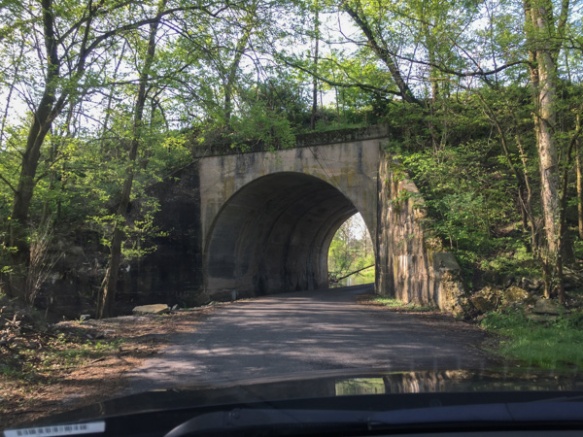 In this area the roads cross back and forth under the railroad which also follows the river. In fact a lot of the story of the canal is about the competition between people who thought the canal would serve as the best way to transport coal to the west and those who supported the railroad.
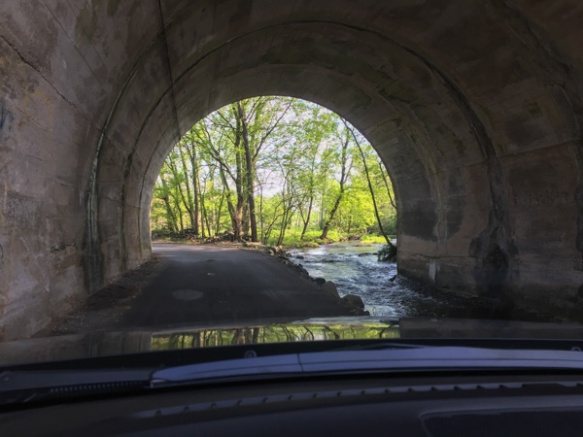 The railroad goes over the road here and the creek runs through the tunnel.
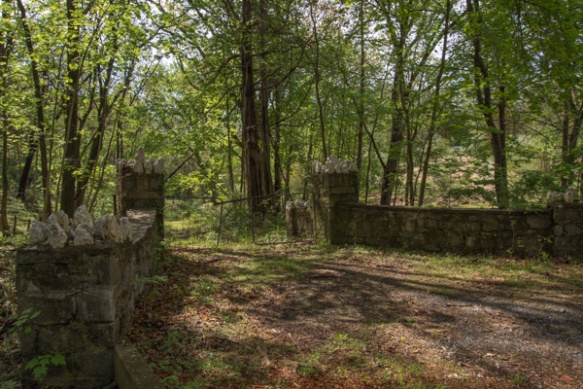 I followed my phone directions and found myself turning off the main road onto other narrow roads that wound through the woods.
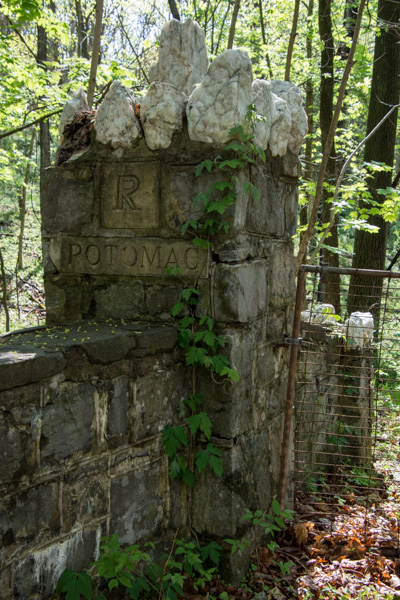 This is a detail of the stone fence in the previous photo…
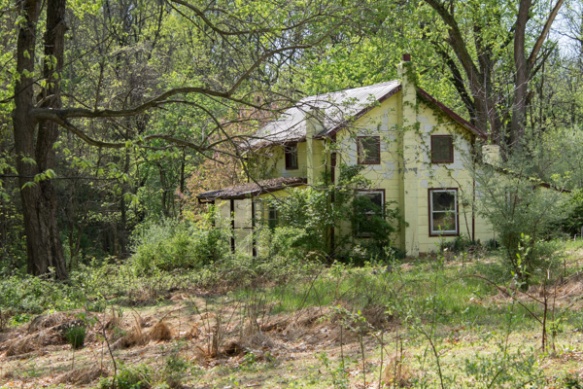 …and this is the abandoned house at the end of that driveway.
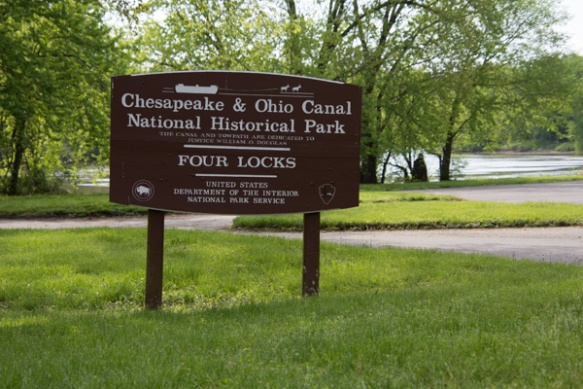 I found Four Locks, so named because the Potomac River makes a large loop here.
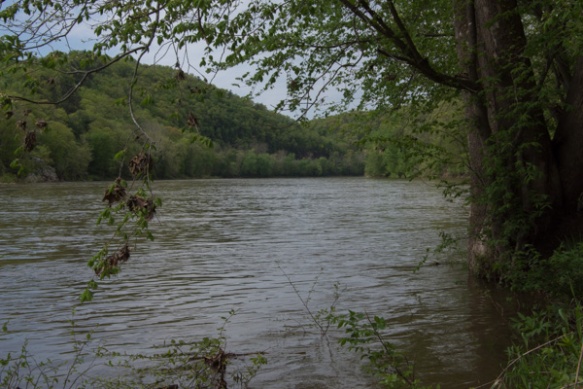 View of the Potomac River.
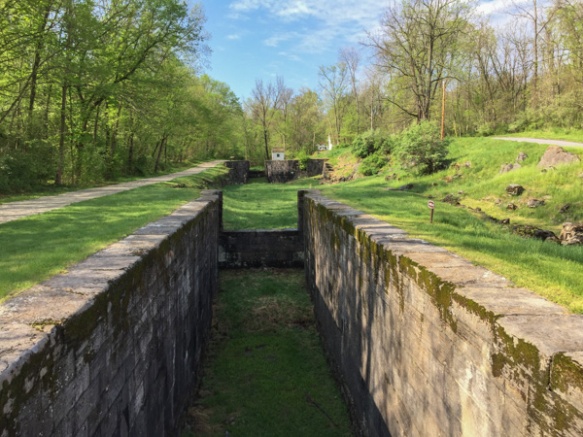 Rather than build a canal the length of the loop, the canal makes a short cut, necessitating four locks (#47-50) all within a half mile.
 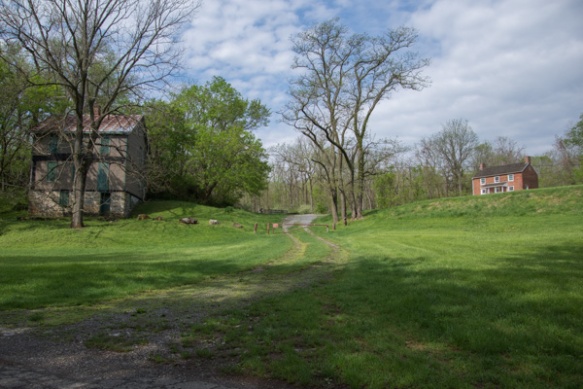 The locks were built in 1836-1838 and until the canal closed in 1924 there were two general stores, two warehouses, a dry dock, mule barn, post office, school, farms, and houses in this community.
 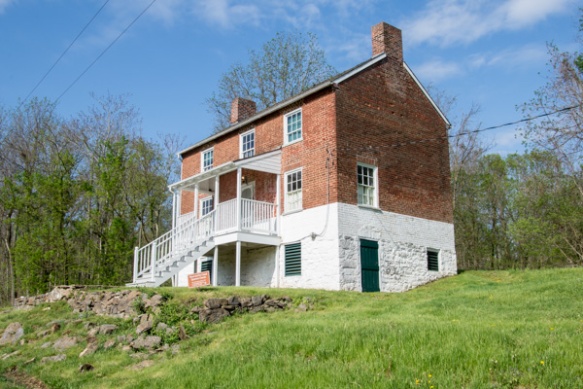 The lockhouse at this location is available to rent for overnight stays.
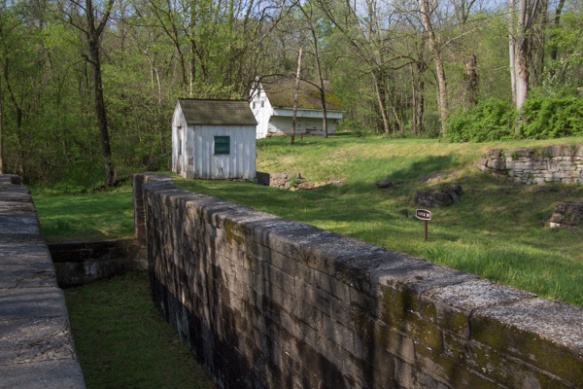 That is the mule barn in back. I read that there were 3000 mules working on the canals moving boats between the locks. I found it fascinating to imagine the effort that went into this endeavor–not only the construction but also moving boats up and down the canals. I hadn’t made it to the Visitor Center yet so didn’t yet have the full story.
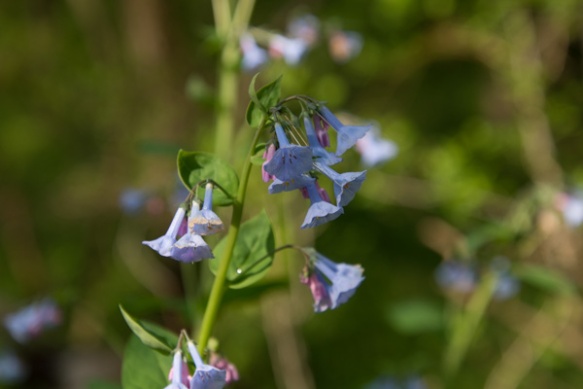 Virginia bluebells.
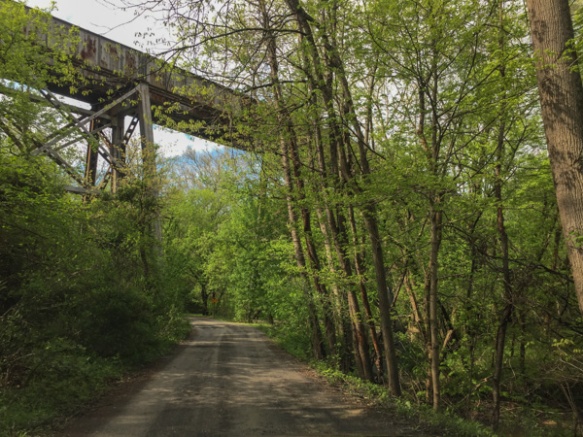 After walking around Four Locks I wound a few more backroads to find McCoys Ferry, a crossing on the Potomac. That is the railroad passing overhead. Then I got back to the freeway to head to Cumberland.
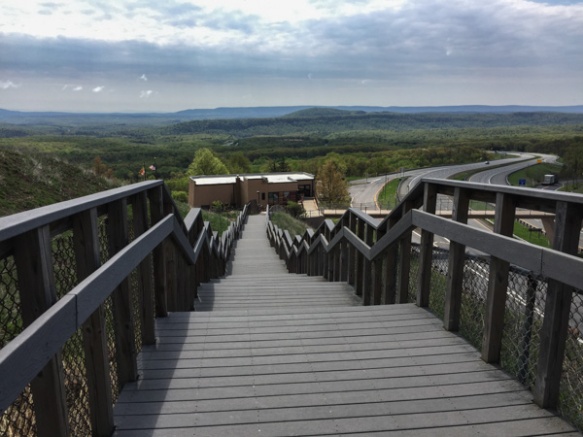 This is Sideling Hill Visitors Center, a rest stop along the highway with a great view over the pass and interesting geology in the road cut.
 Stacy’s face was split open to the bone. I called my vet and she said that if I wanted her to come it would be a couple of hours, but I could fix it myself. She told me what to do.
 I thought that the hardest part might be getting the old goat clippers to work. I found them in the tool box and after oiling they worked fine. That showed that the wound was longer than it appeared with hair over it.
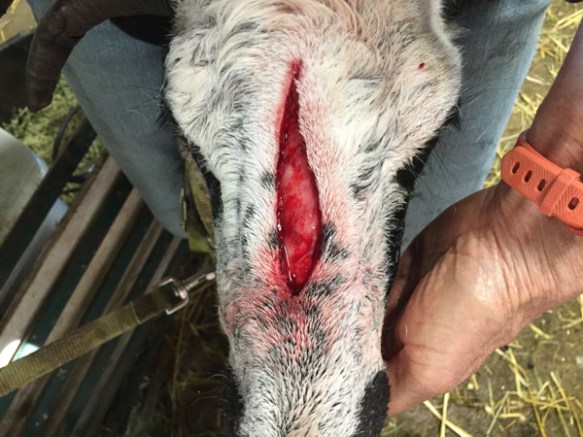 Then I scrubbed with betadyne.
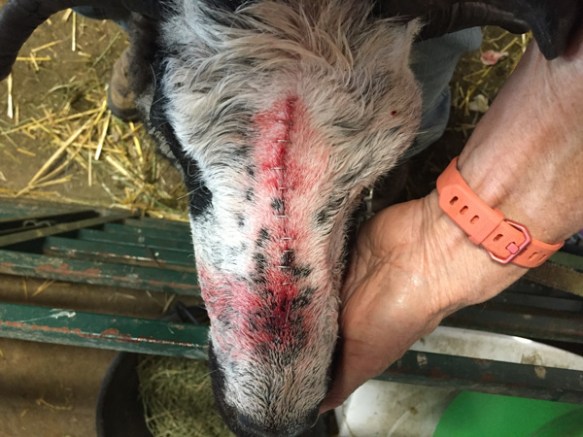 Fortunately I had bought the staple gun (meant for this purpose) a long time ago. I had forgotten about it until the vet suggested using staples. She barely flinched throughout this.
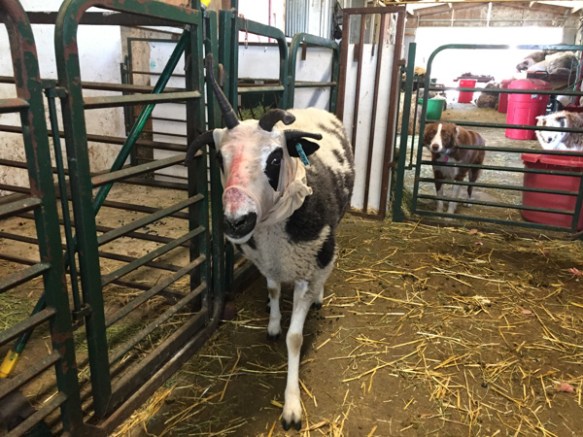 Nancy also suggested putting some kind of cover over this for a few days just to protect it. Since I haven’t worn pantyhose in more years than I can remember so it was lucky that there were some in the back of a drawer.
 The most stylish sheep are doing it!
 While I’m at the barn, here is a photo of the long-awaited work on the southwest corner where a lot of the wood is rotten.
 And speaking of veterinary issues, these are foxtails I pulled out of Rusty’s chest this morning. You can see on a couple of those how they had worked their way into the skin.
