Three days in a row with a blog post! I’m on a roll.
I didn’t write about my newest yarn because I wanted to have all the details. Here it is, although not on the website yet.
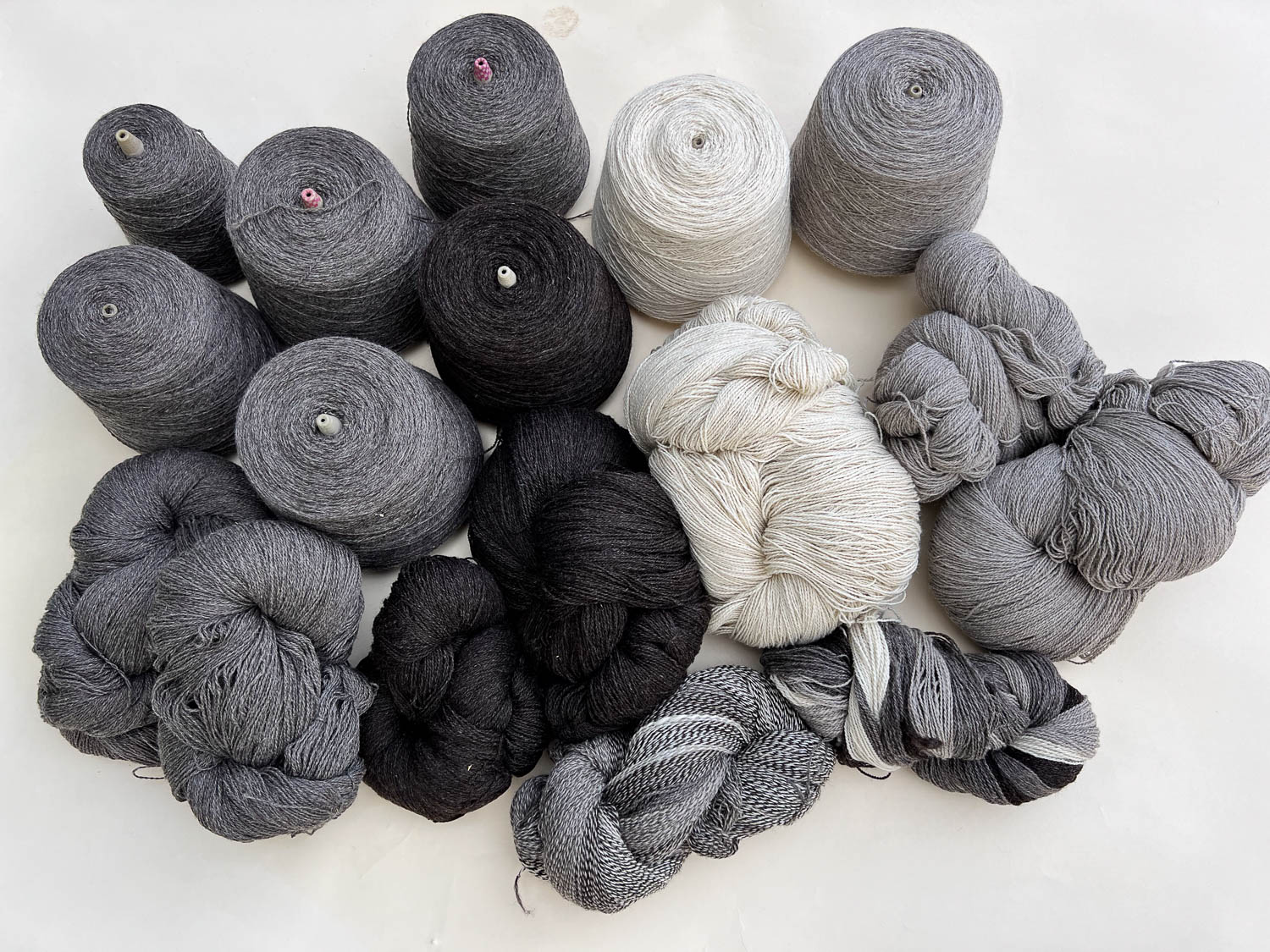
I shared this photo in a previous post. I just picked up the yarn from Valley Oak Mill a week or two ago. This is the last of the 2023 Jacob fiber.
The first thing I need to do before planning a weaving project and before listing the yarn for sale is evaluate the yarn. Measuring wraps/inch (WPI) is one step.
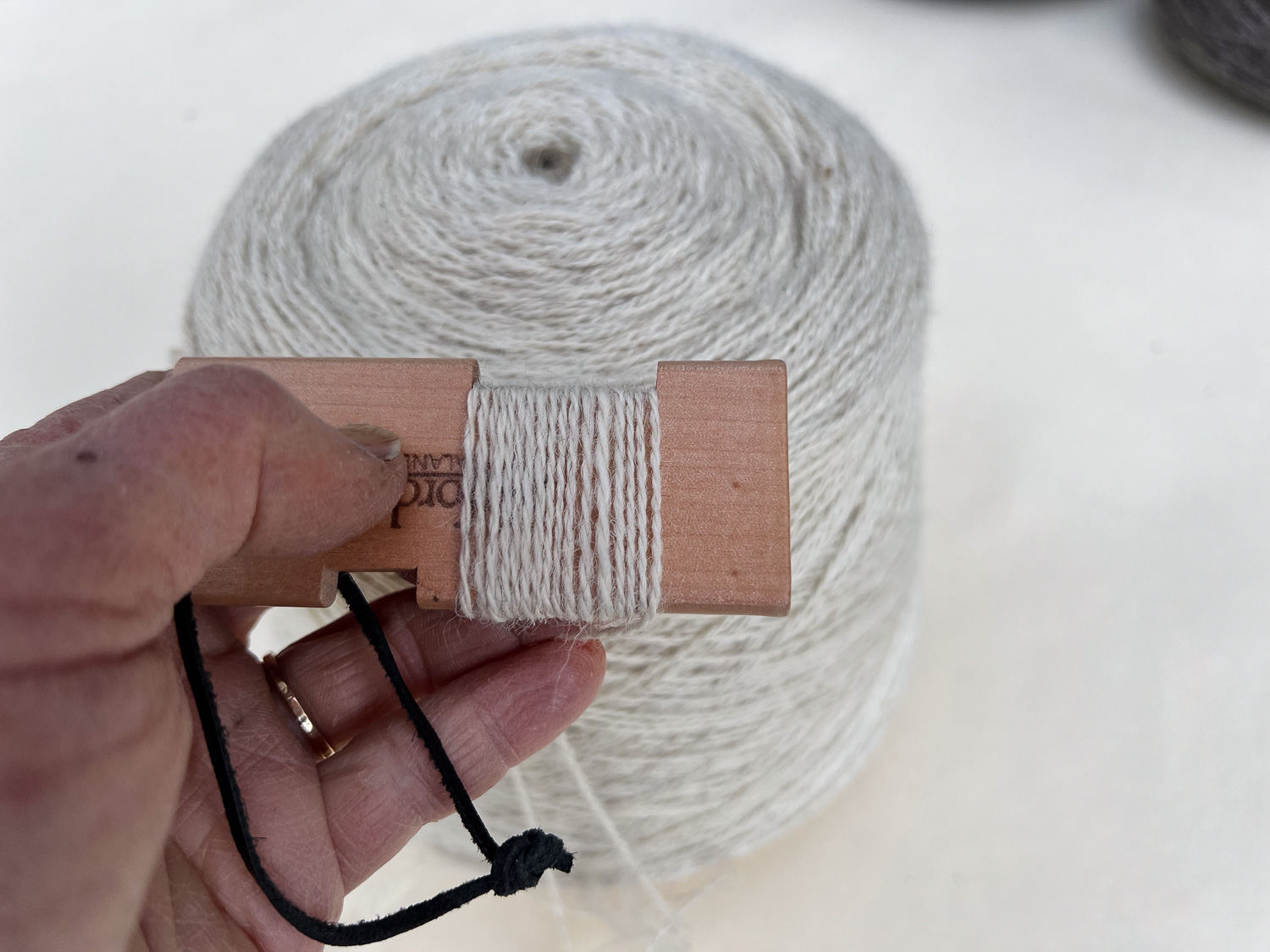
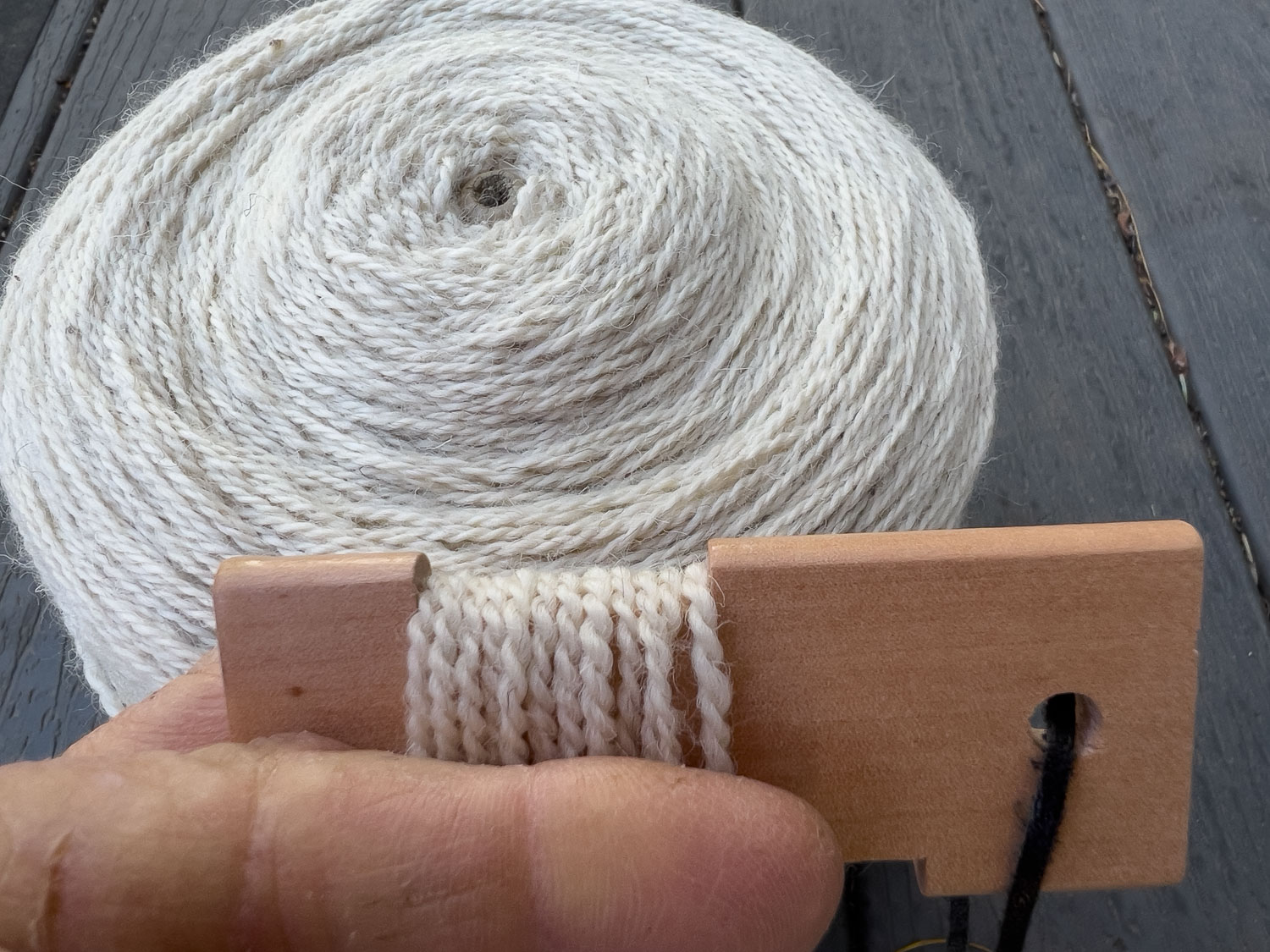
Look at what I finally figured out–how to put photos side-by-side. It only took 20 minutes of trial and error and I don’t know if I can do it again. Now if I could just figure out how to change the size of the spaces .
The point of this is to show the wpi measurements for the same yarn before and after wetting. The yarn on the left is wound straight from the cone. The sample yarn on the right shows the WPI after the yarn has “bloomed”. I soak the skeins in water for about five minutes and then spin them out and let them dry. It is important to plan a project based on what the yarn will look like when the knitted or woven or crocheted project is wet finished. In the case of all these yarns they measured 17 WPI when wound from the cone and 12 WPI after washing. That’s a big difference.
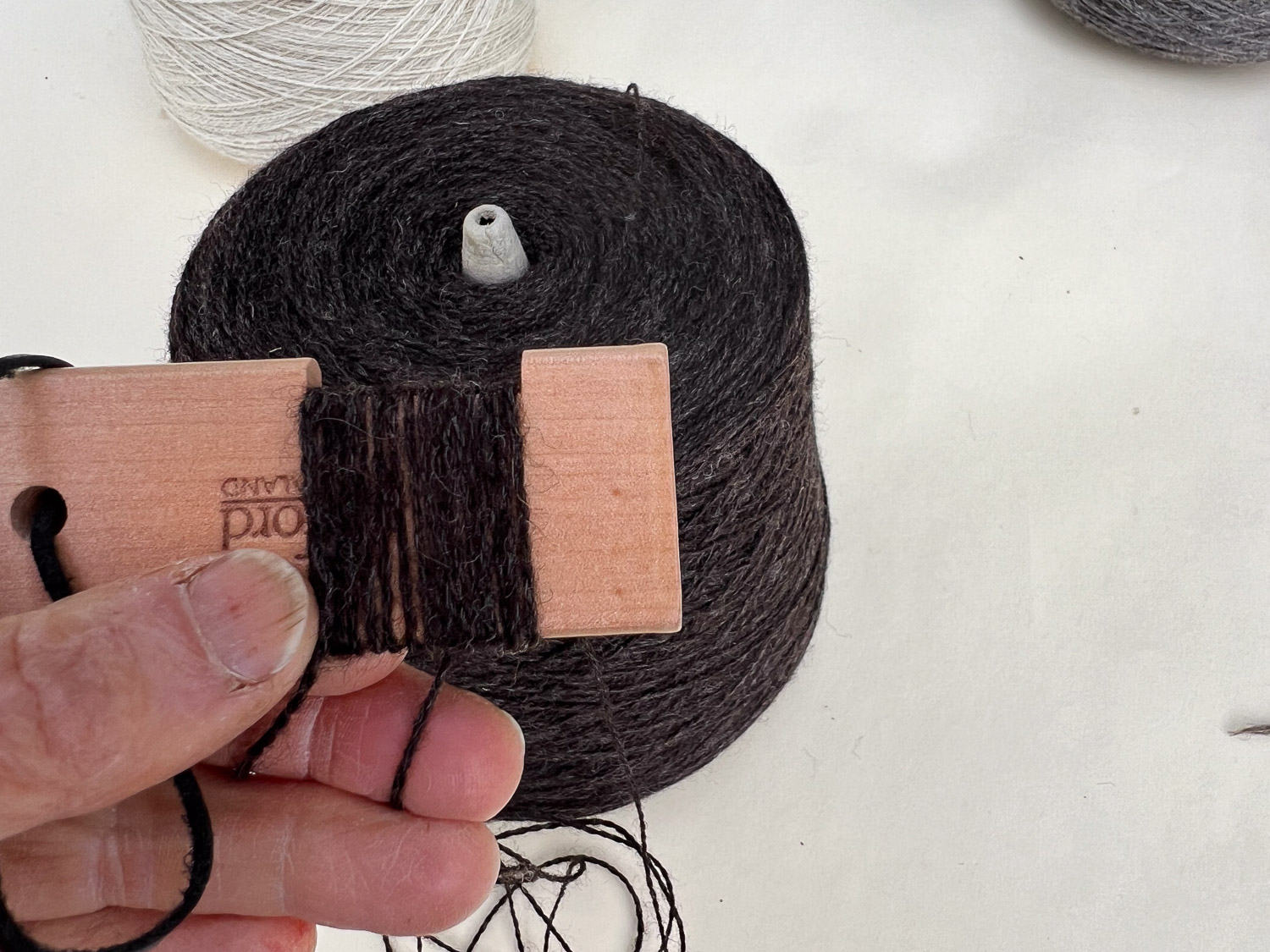
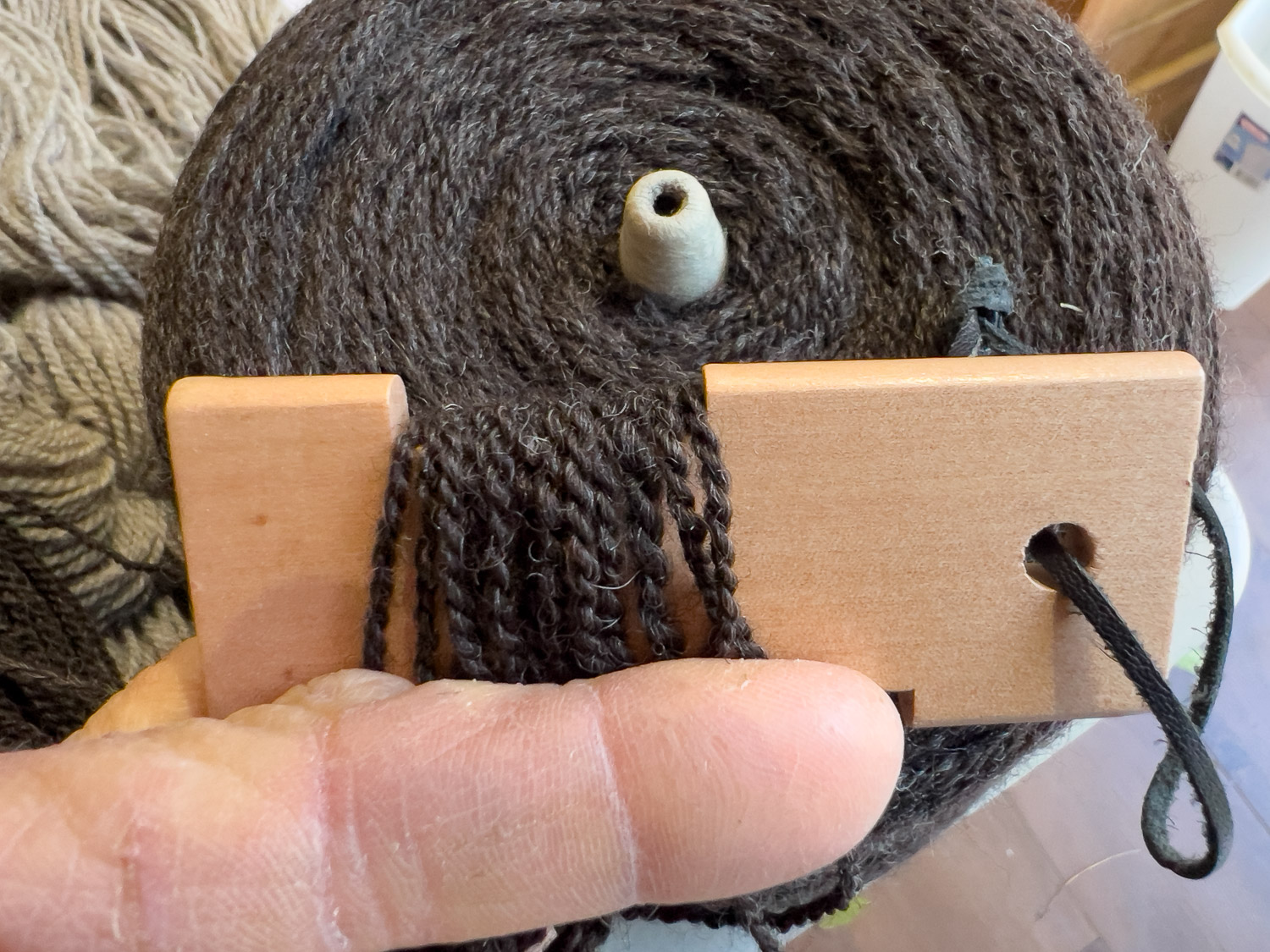
Here is how the black yarn looks.
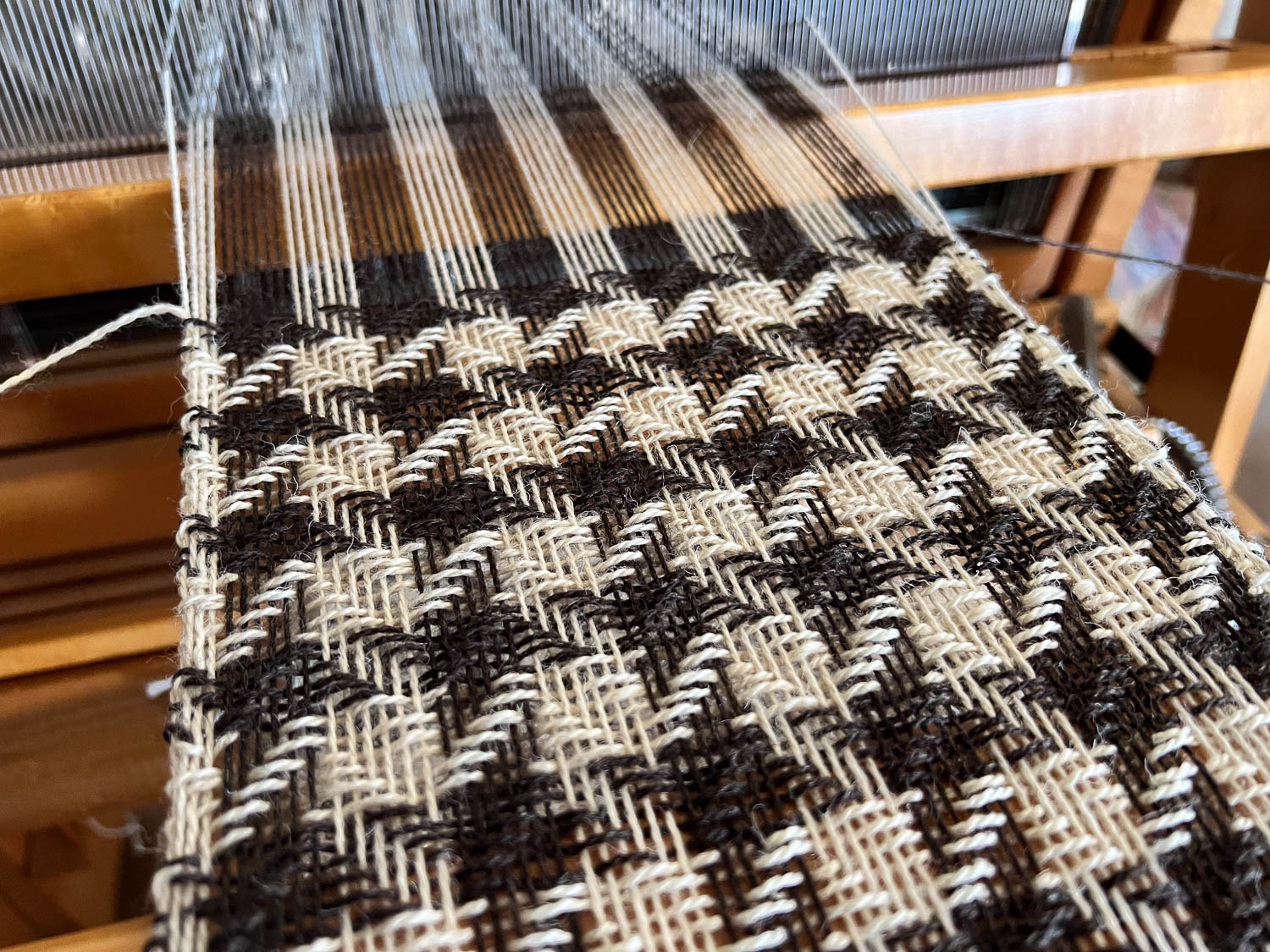
Here is this yarn on the loom. I sett it at 8 epi (ends per inch) based on the 12 WPI measurement. It looks very open but remember that the yarn is under tension on the loom and it has not been wet finished. It will bloom as in the photos above.
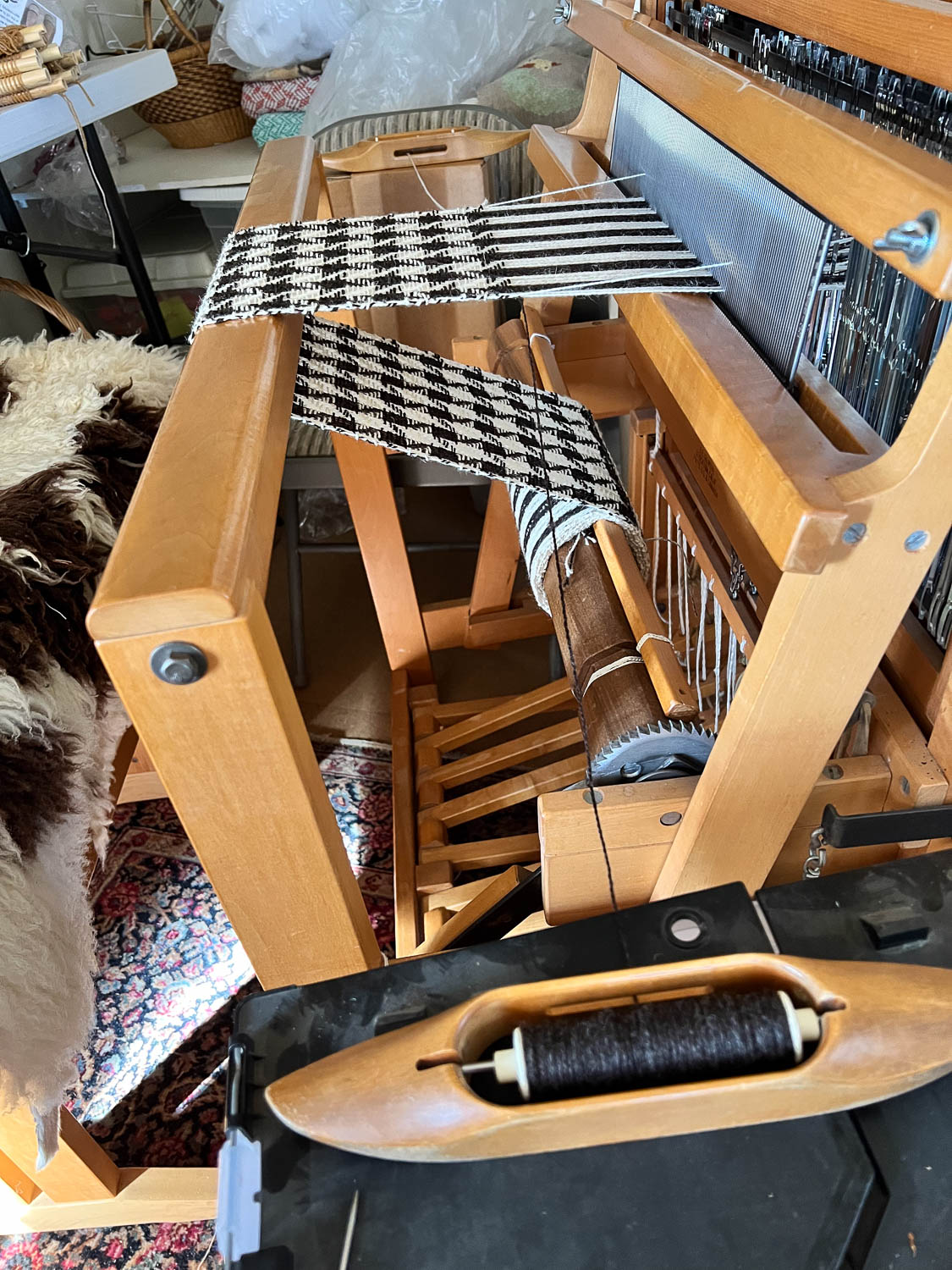
The stars appear due to alternating 6 dark threads and 6 light threads in warp and weft AND the weave structure. Without the two colors you wouldn’t see stars and without the weave structure (tie-up and treadling) you would see a plaid. There is a trick to weaving this without cutting the yarn every time you change color and keeping the selvedges neat. I put boxes at the right height at each side of the loom and rest the unused shuttle there where I can reach under the yarn when I catch the active shuttle for six picks.
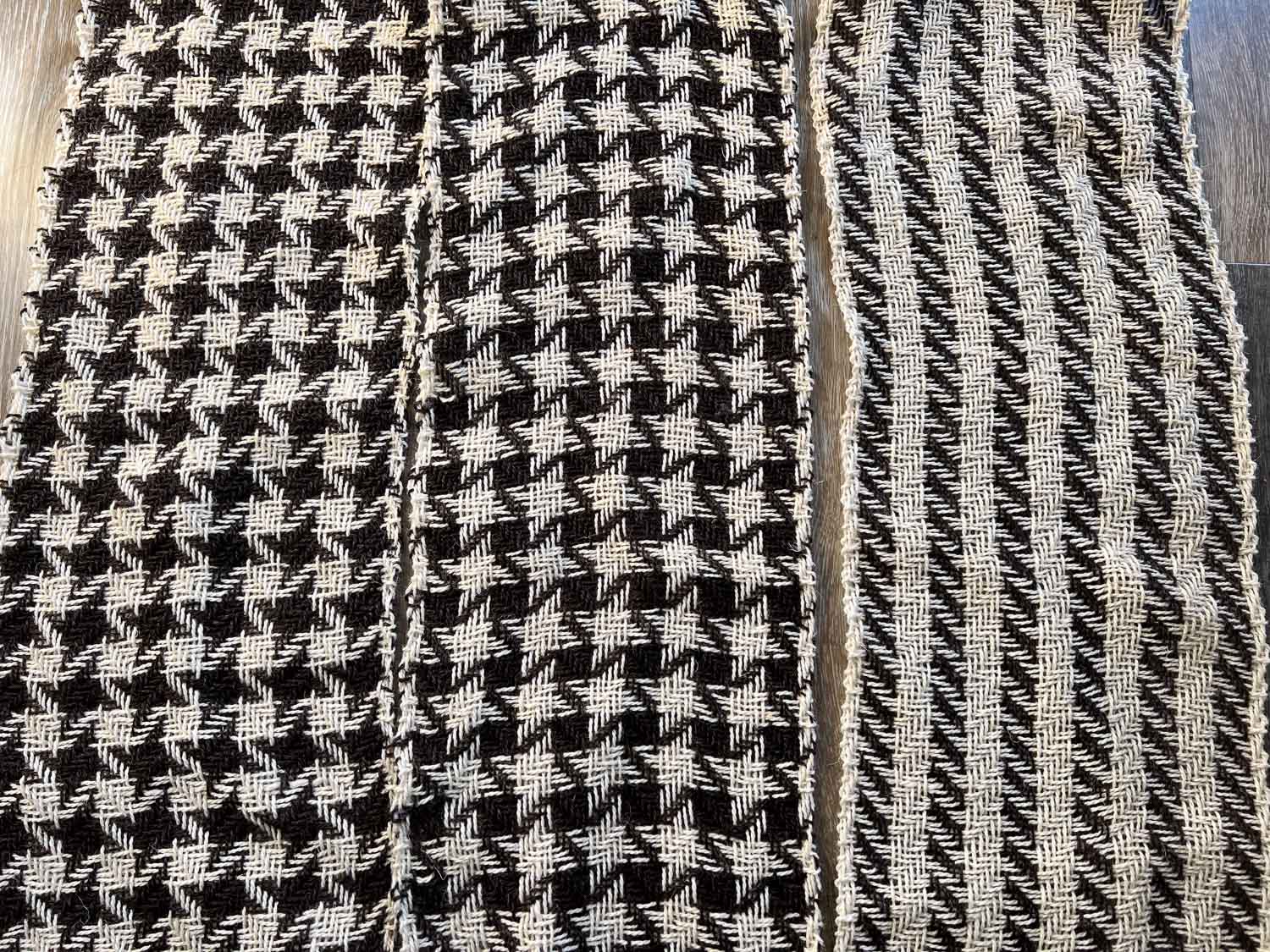
This is how the scarves look off the loom, not yet wet finished. The stars are black on one side of the scarf and white on the other.
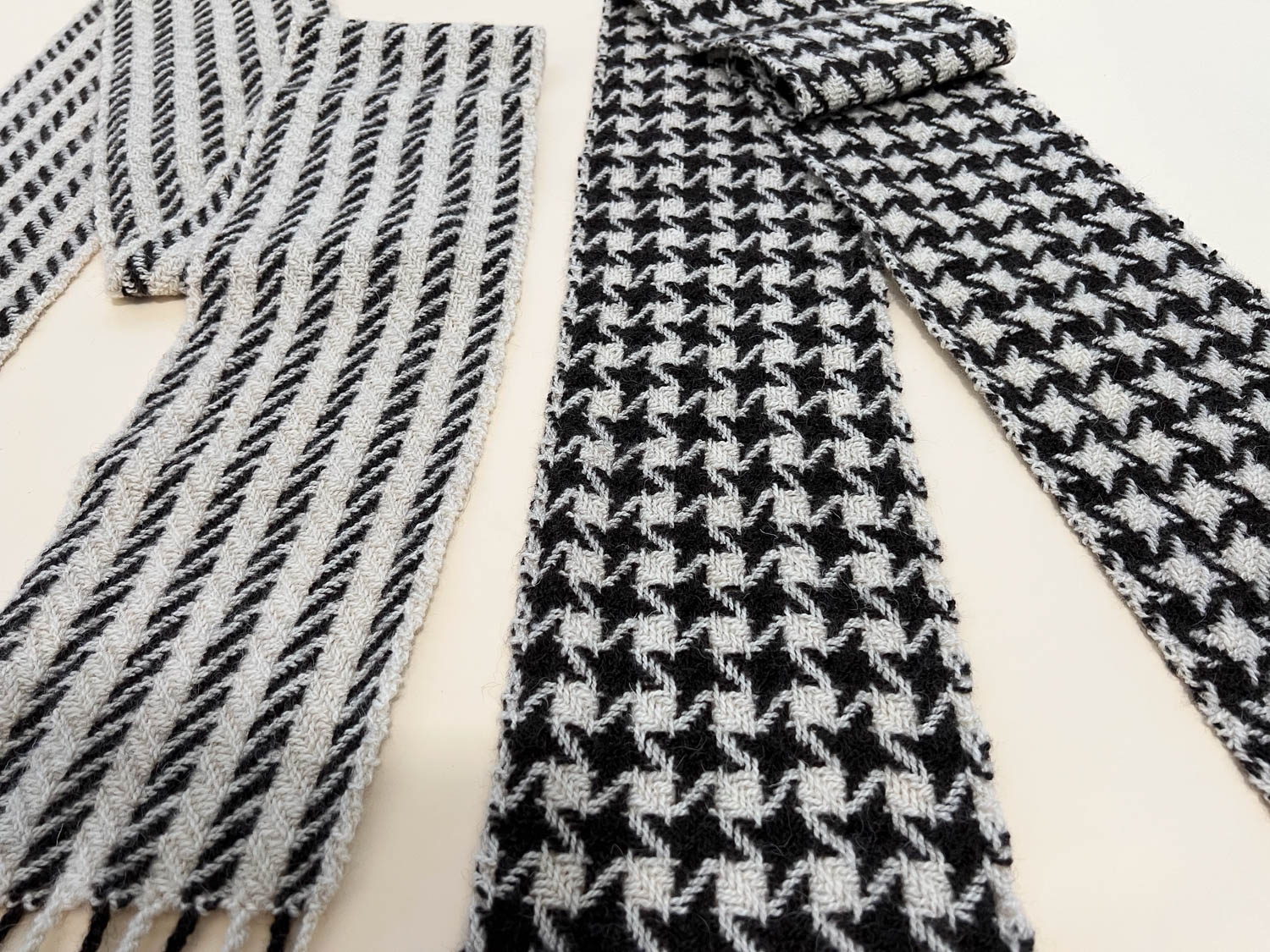
Here are the finished scarves. I have two of the stars scarves and one of the stripes. They may be sold this weekend but I can make more before Christmas. I wonder if I should try other colors. I could use the Timm Ranch naturally dyed yarn or Ashford yarn. I’d like to weave some in cotton as well. Too many ideas, too little time. If you’d like one let me know soon.
 This photo doesn’t do justice to the pile of stuff. Most of them are still out in the aisle. A couple of people stopped by and were amazed that I actually fit it all in. What you don’t notice in the photo because of the black drapes are the 16 gridwall panels that create the booth. Those get heavier every year.
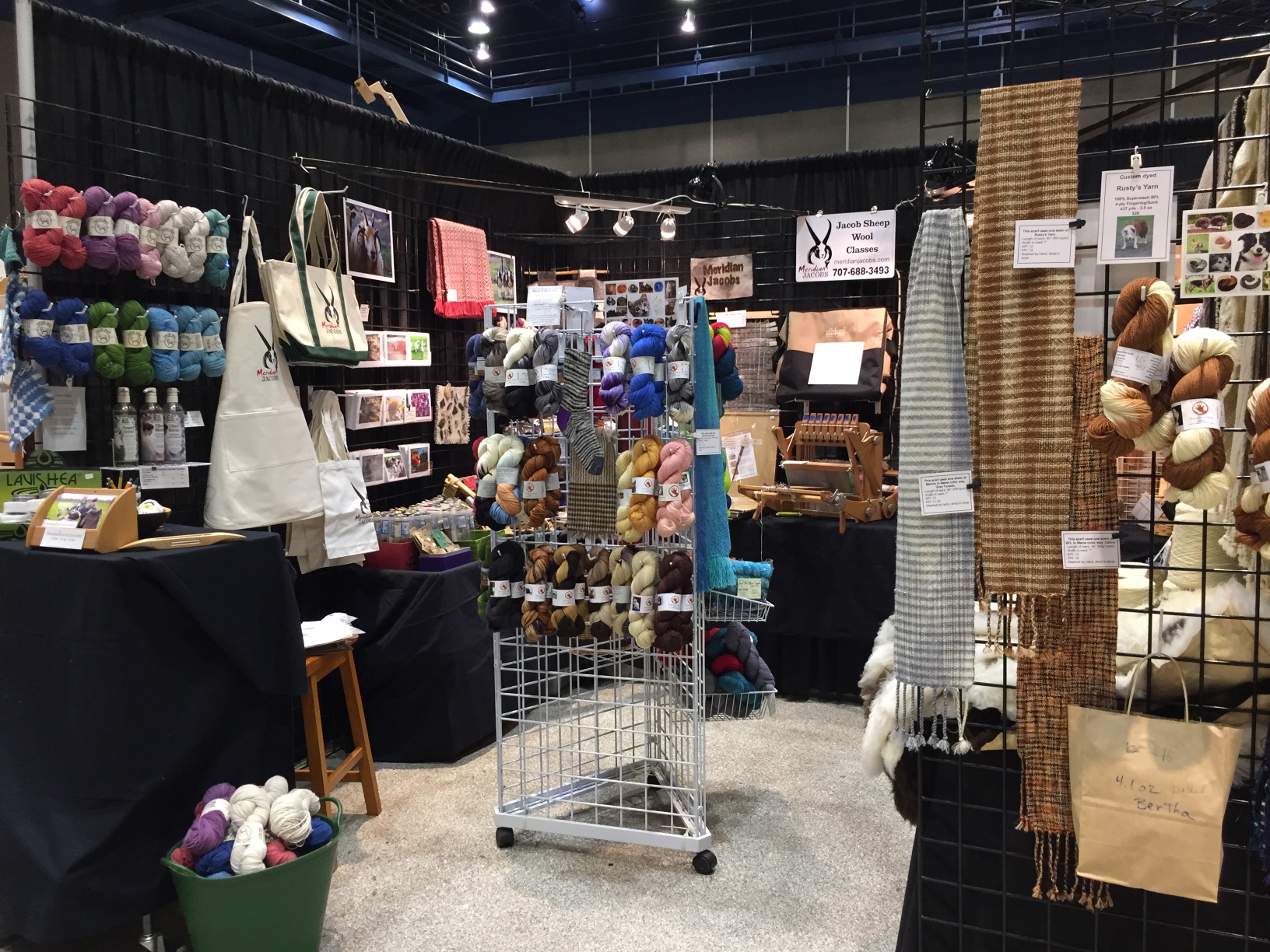 I got to Modesto about 4:30 p.m., worked until 8:40 on Thursday and then from about 9:30 to 1:30 today. The show opened at 2. Here is a tour of my booth:
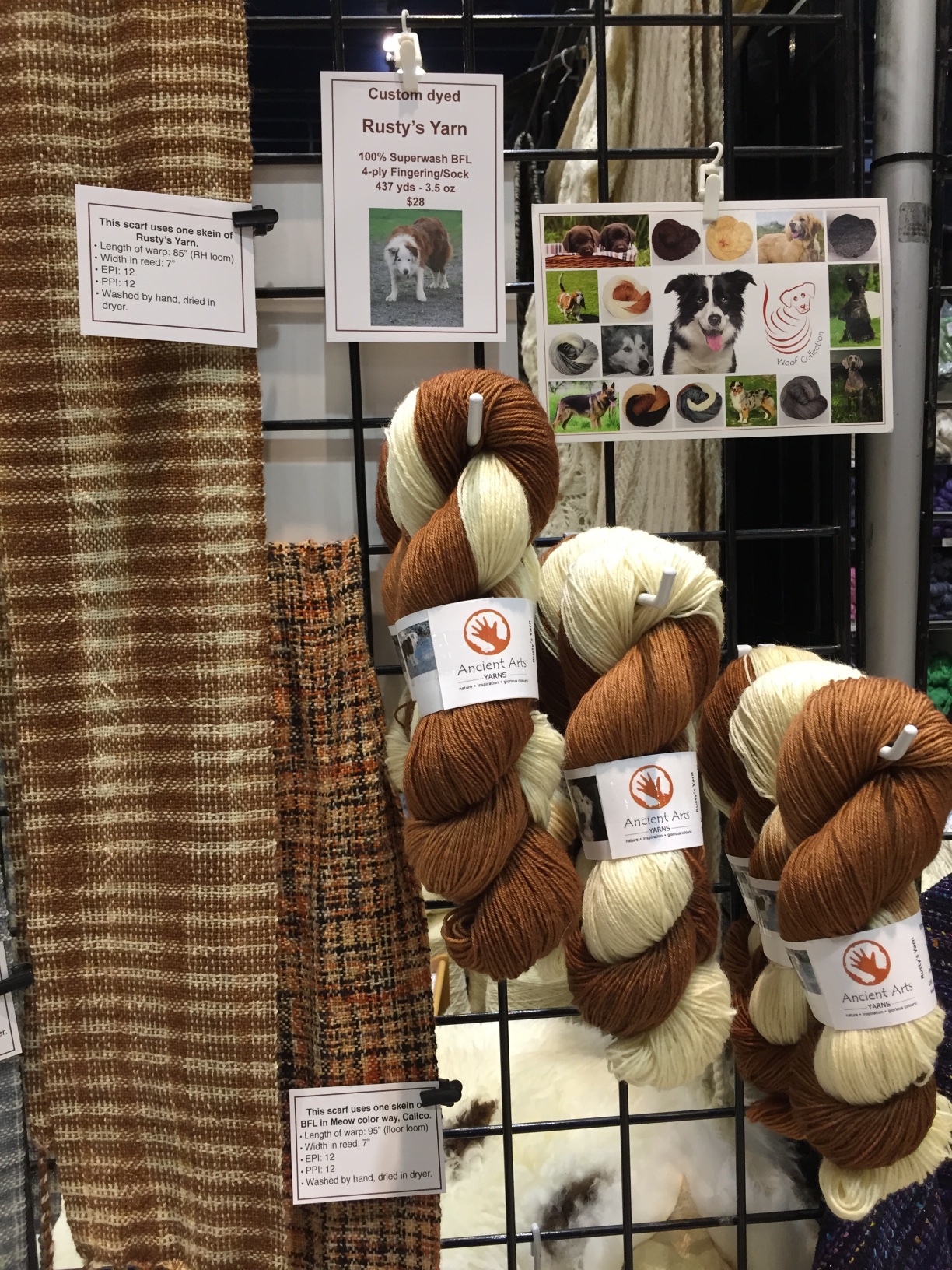 Rusty’s Yarn faces the aisle.
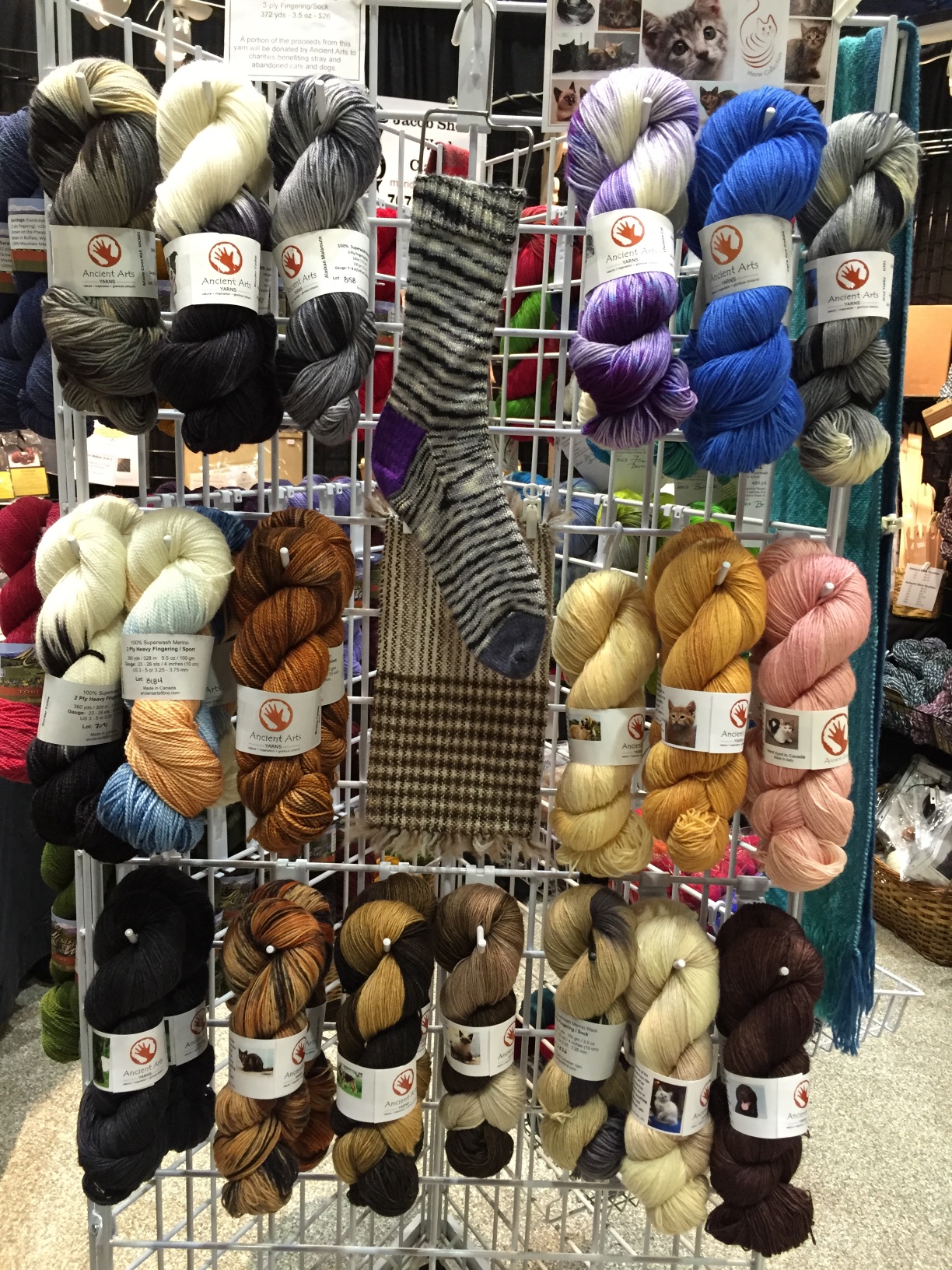 On the 3-grid tower in the middle I have the Meow and Woof yarns…
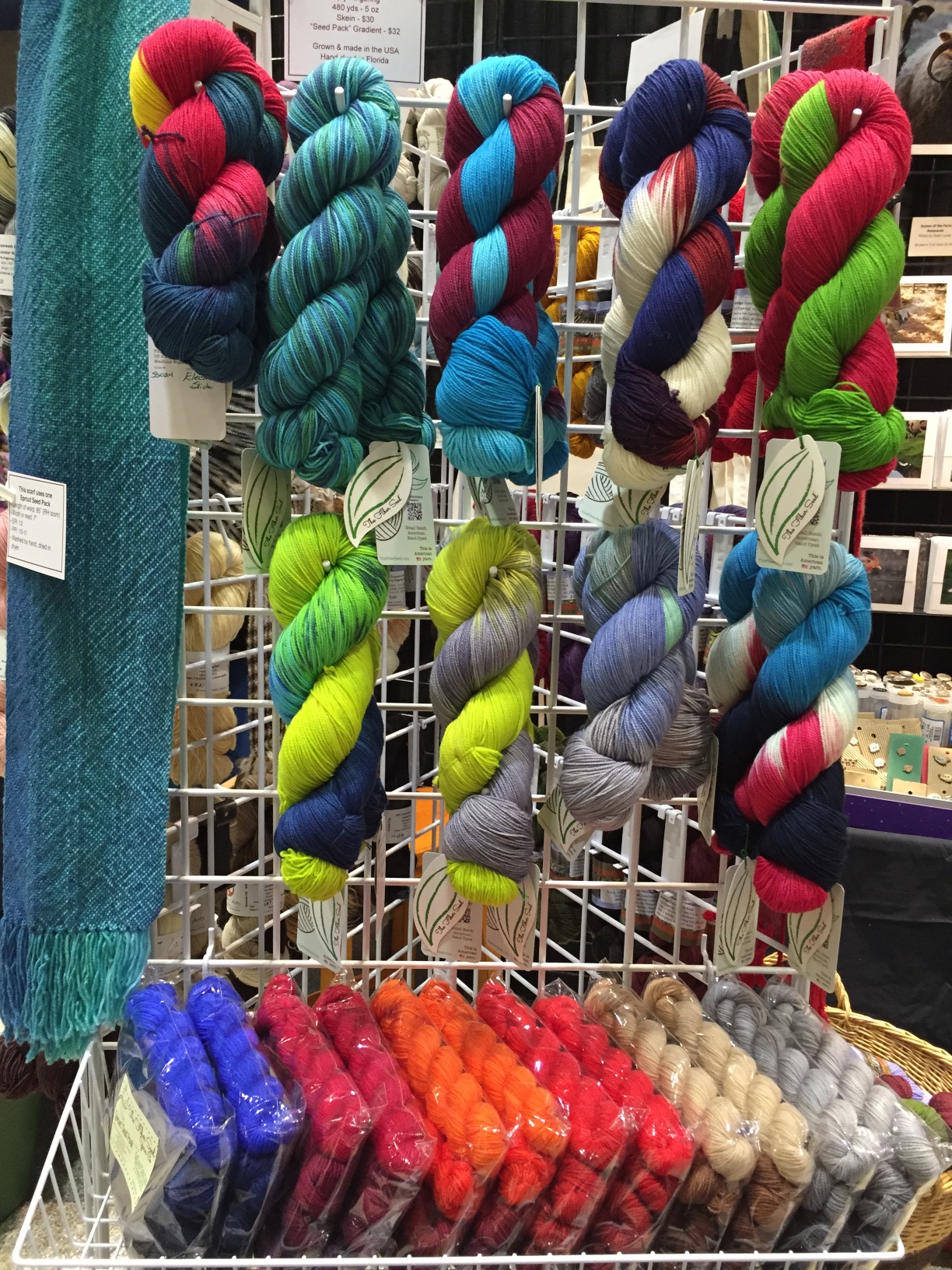 …Sprout yarns…
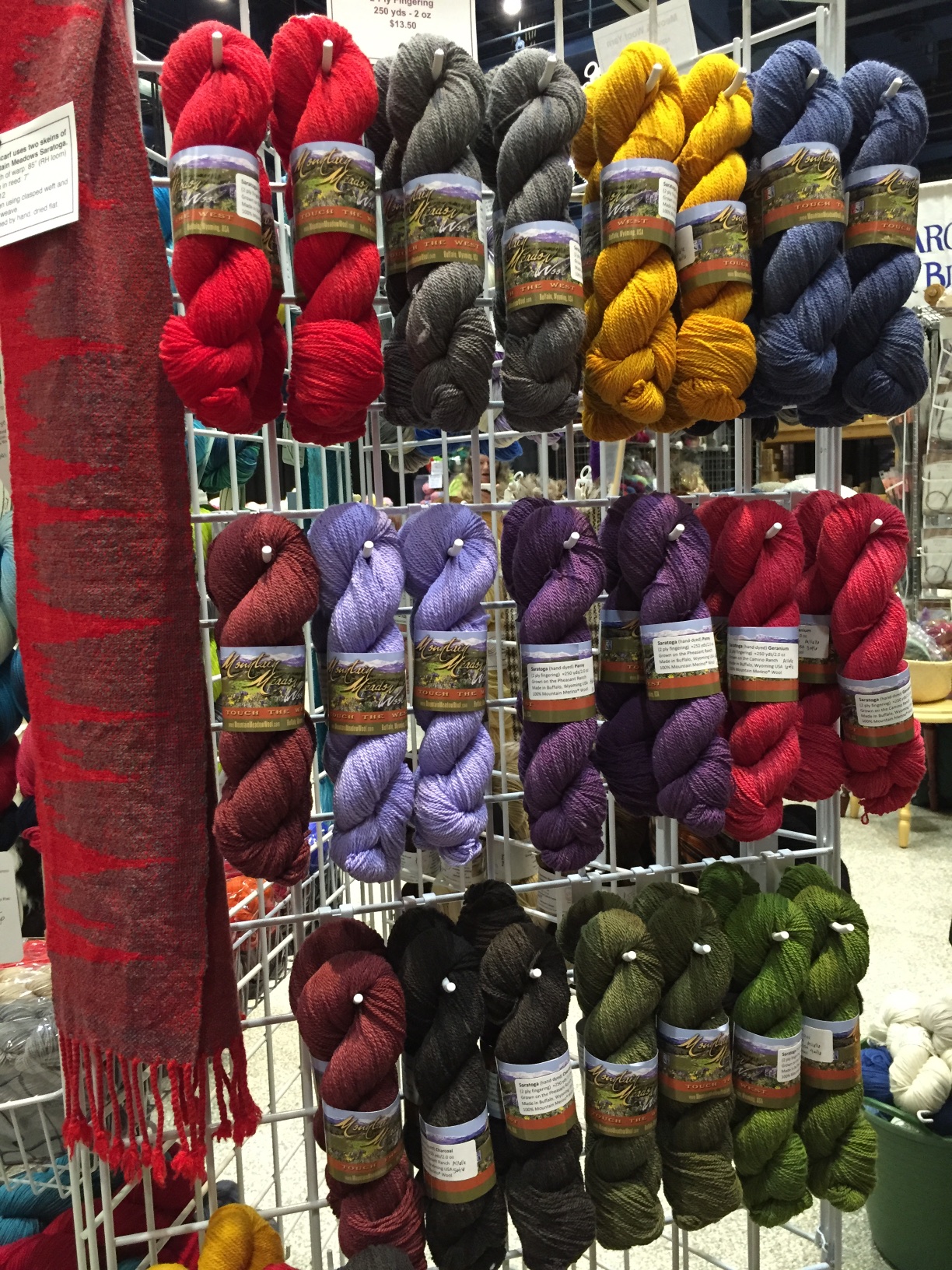 …and Mountain Meadows, all fingering weight yarns with sample scarves.
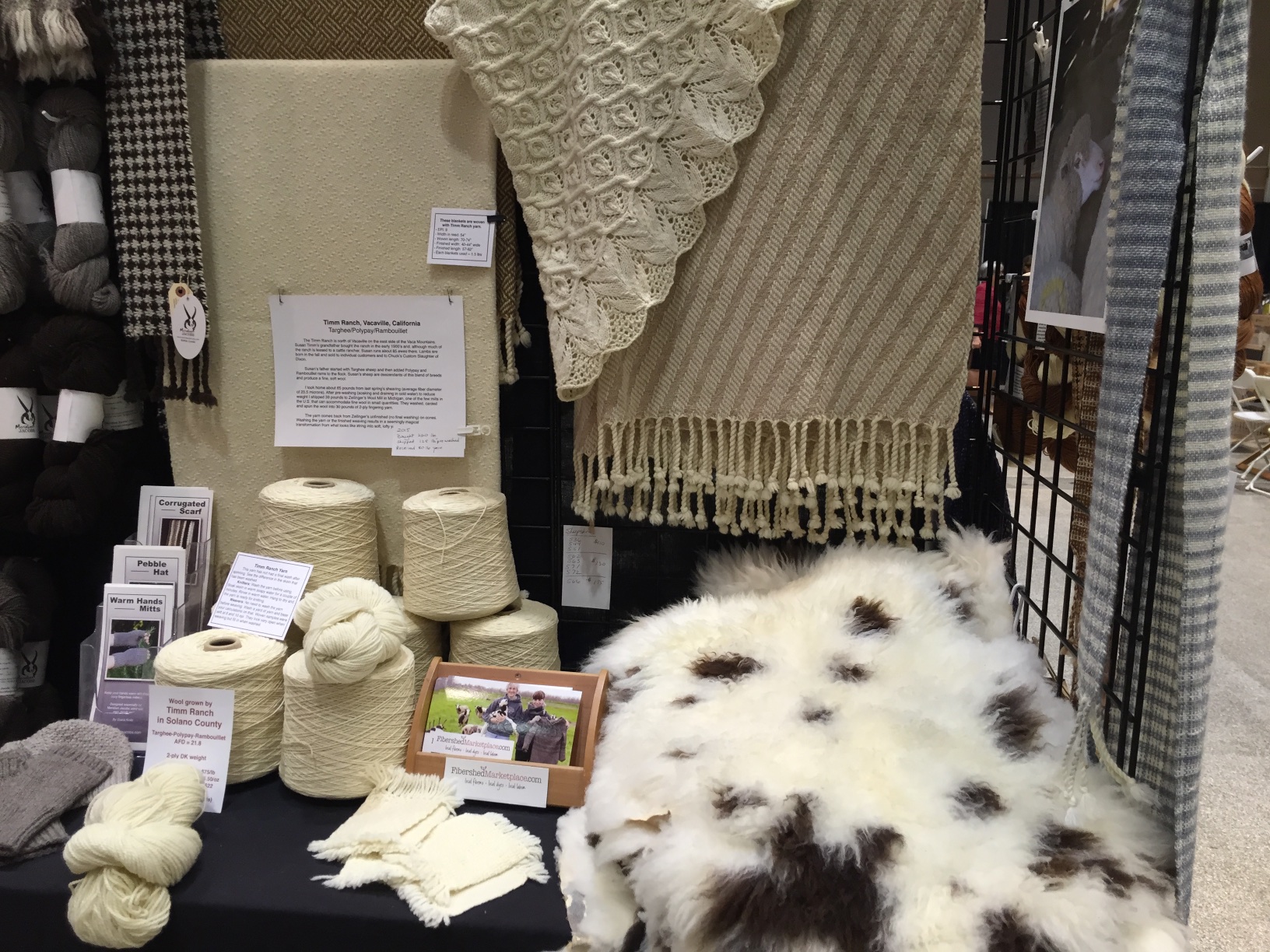 Around the inside of the booth is the Timm Ranch yarn with blankets I wove and Mary’s beautiful shawl. There are Jacob sheepskins too–only a few left.
 Moving to the left there is the Jacob yarn and Imperial Yarn Company’s “Anna”, a wool/cotton yarn that weaves up quickly (at 5 epi).
 Going around the back wall I have rigid heddle looms from Ashford and Schacht and the Ashford “Katie”, which is a wonderful very portable 8-shaft table loom.
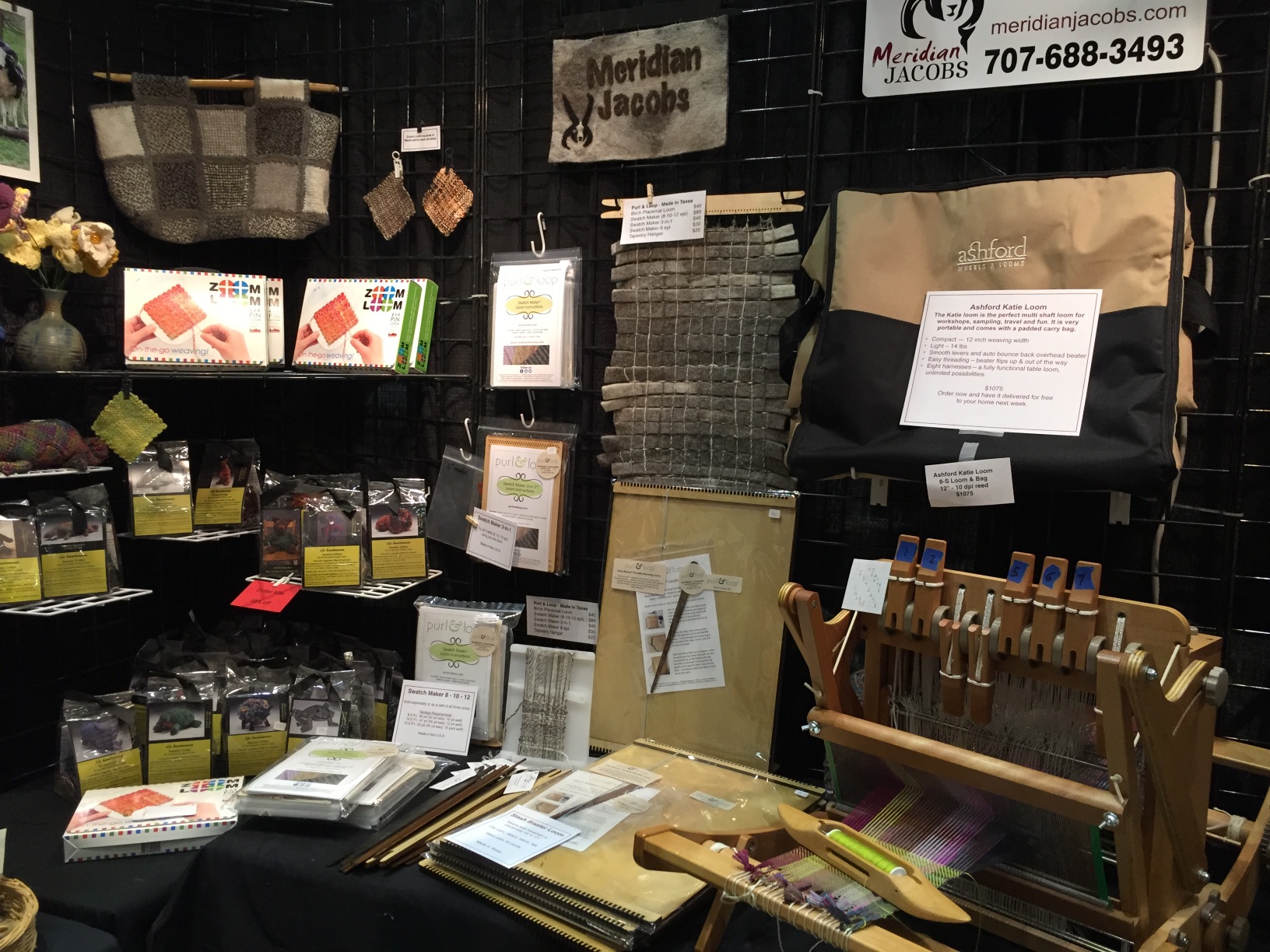 Purl & Loop Stash Blaster looms and Swatch Maker looms are brand new. Next to them are the Zoom looms with the critter kits that use squares made on the them.
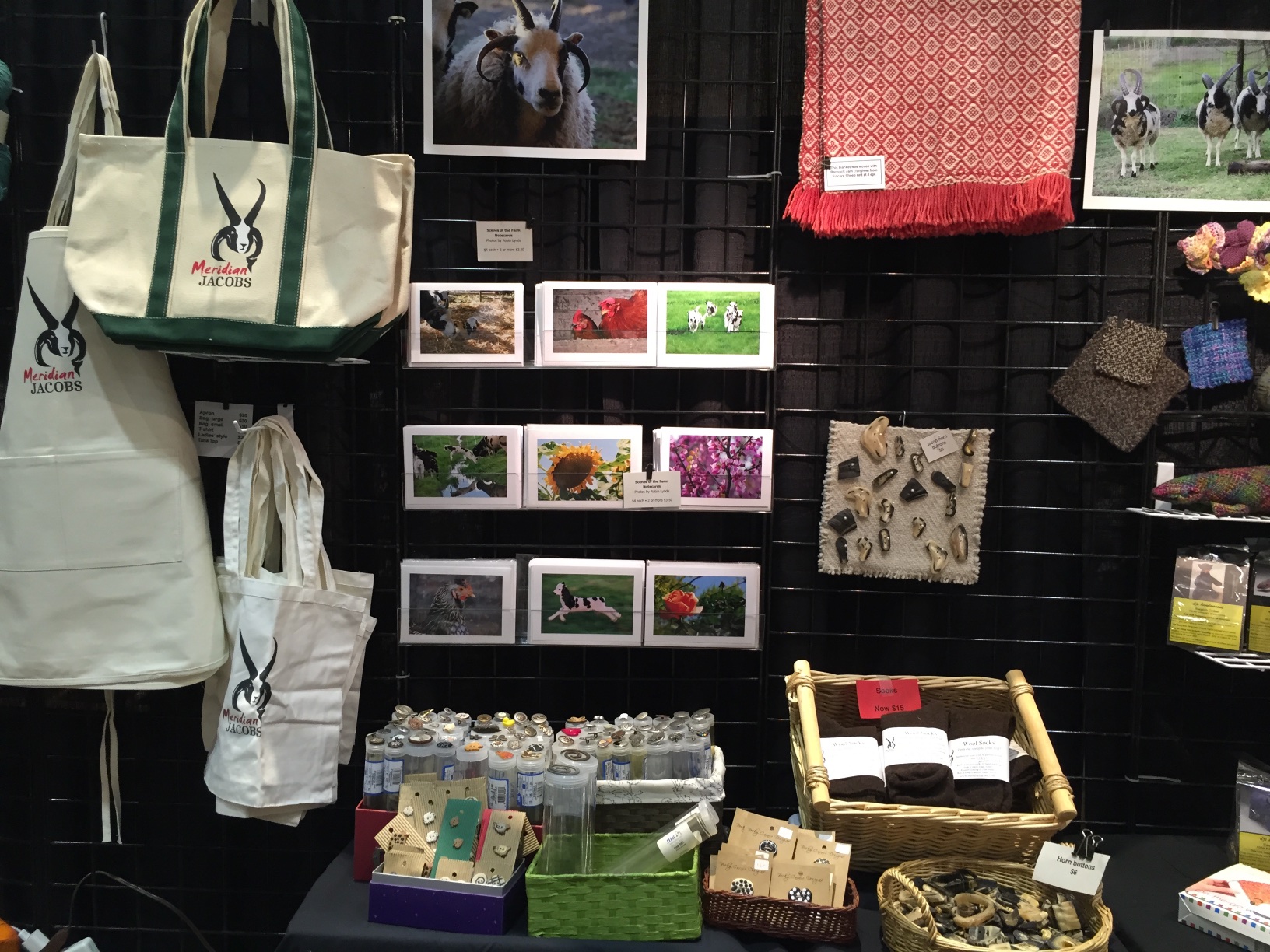 Coming around the corner I have photo notecards, buttons, and Meridian Jacobs bags and aprons.
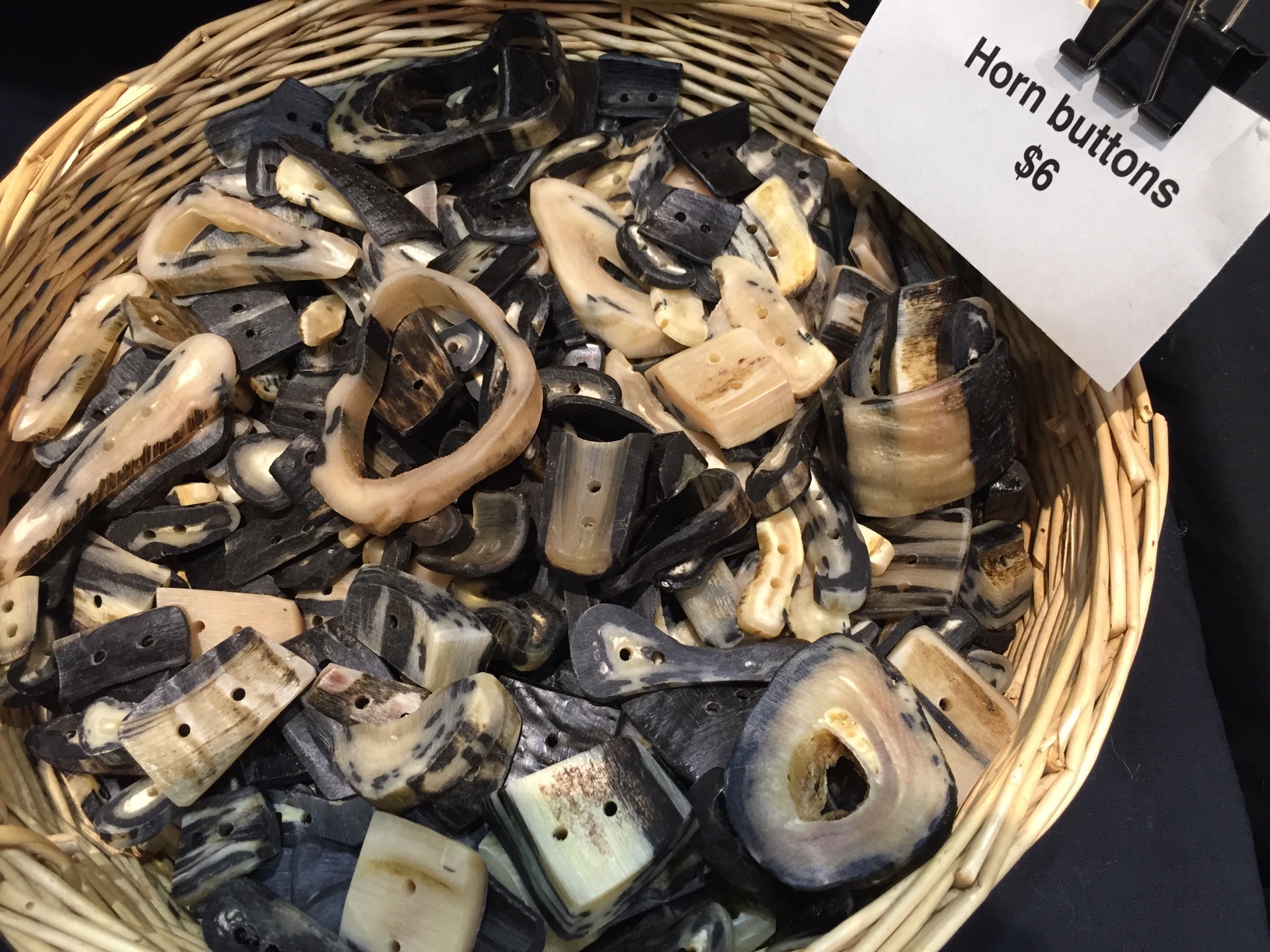 I have added to the horn buttons. My son helped finish off another batch.
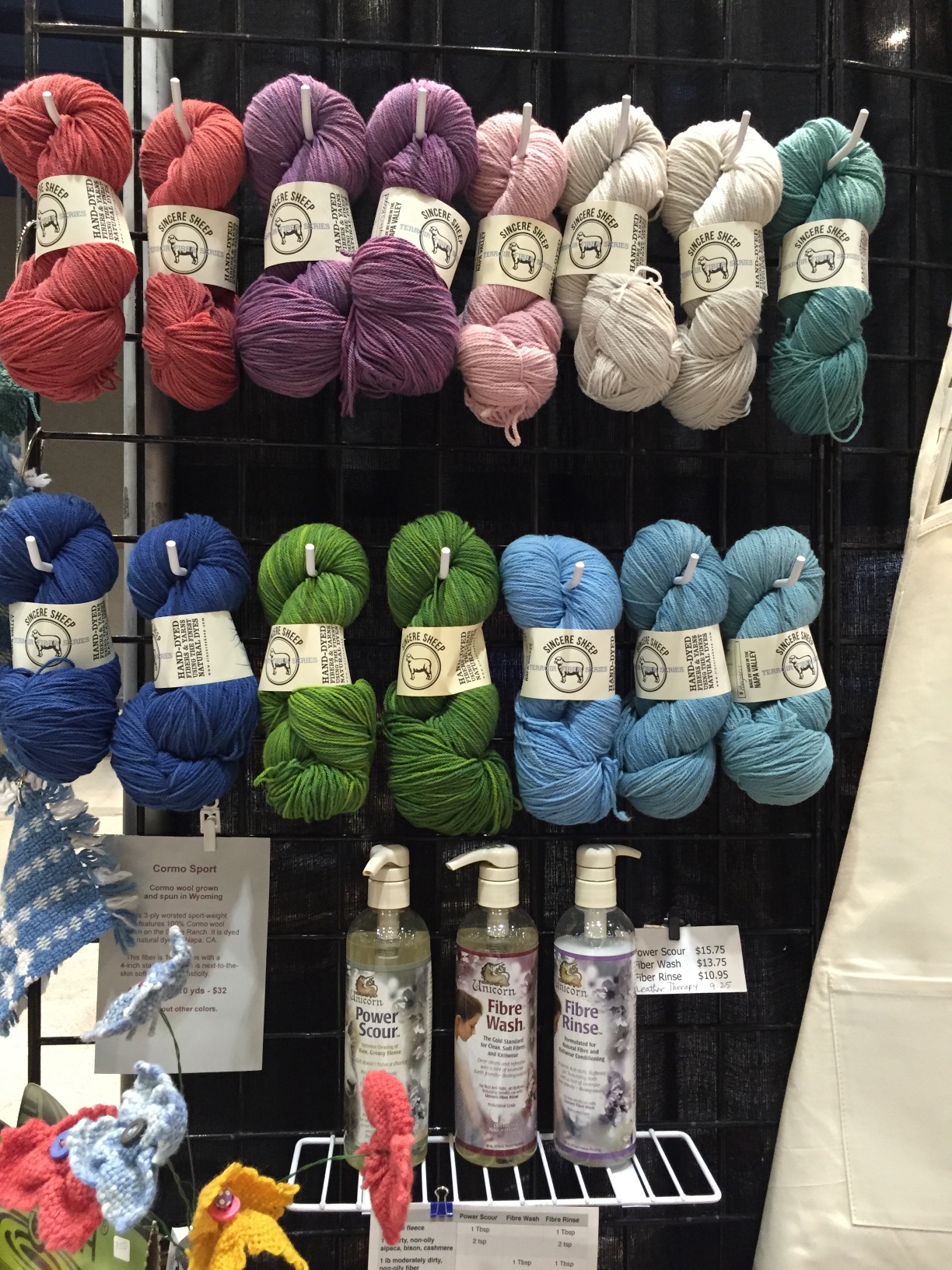 Last there is Cormo Sport yarn dyed by Sincere Sheep. You can see one of the samples that I wove. It is incredibly soft and spongy (not a good wool term, but is it better than squishy? I probably need a different adjective, but it’s late.) I brought Power Scour, etc with me but barely found room for a few bottles.
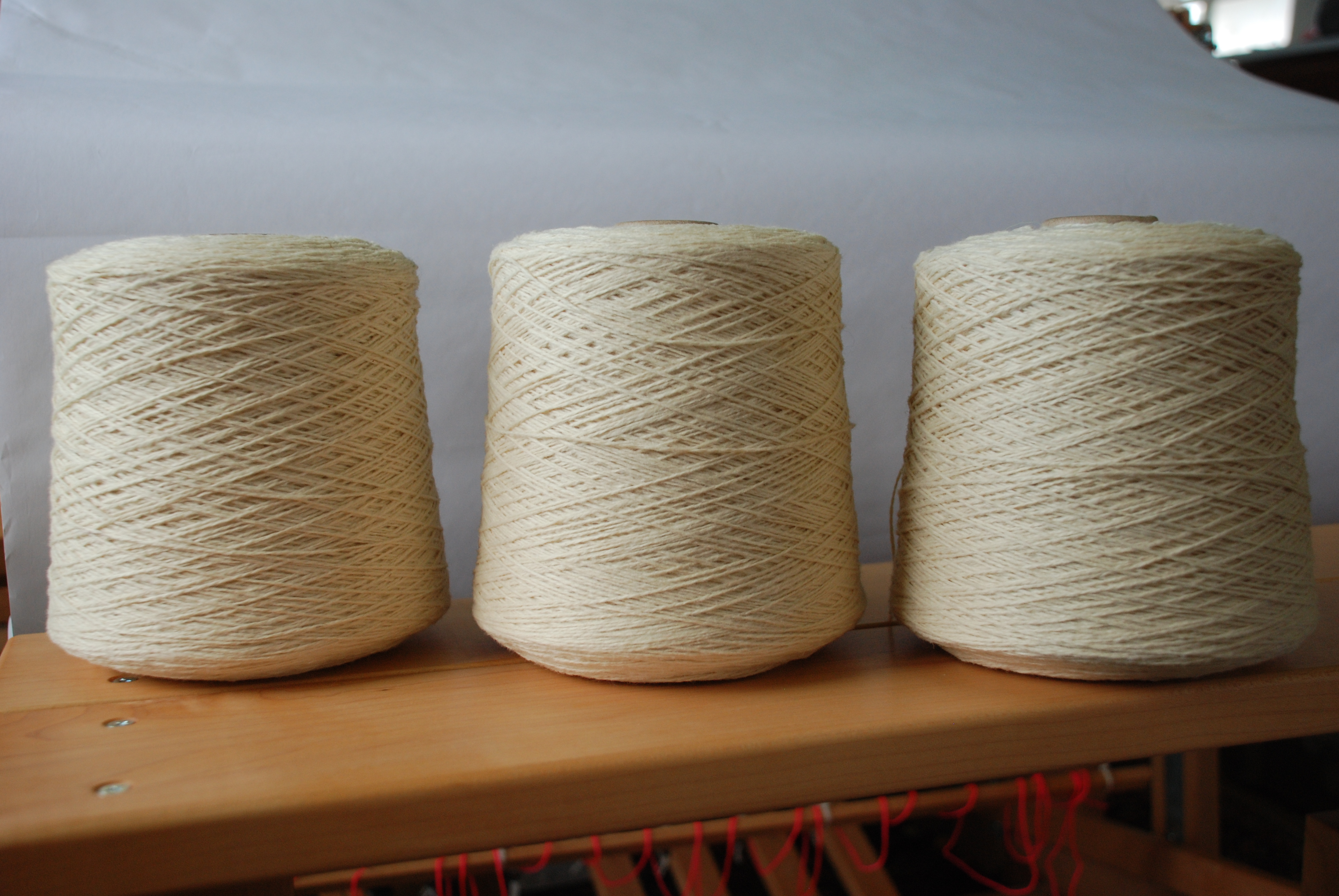 I hadn’t had a chance to do anything with it until recently. The first step was to gather some information.
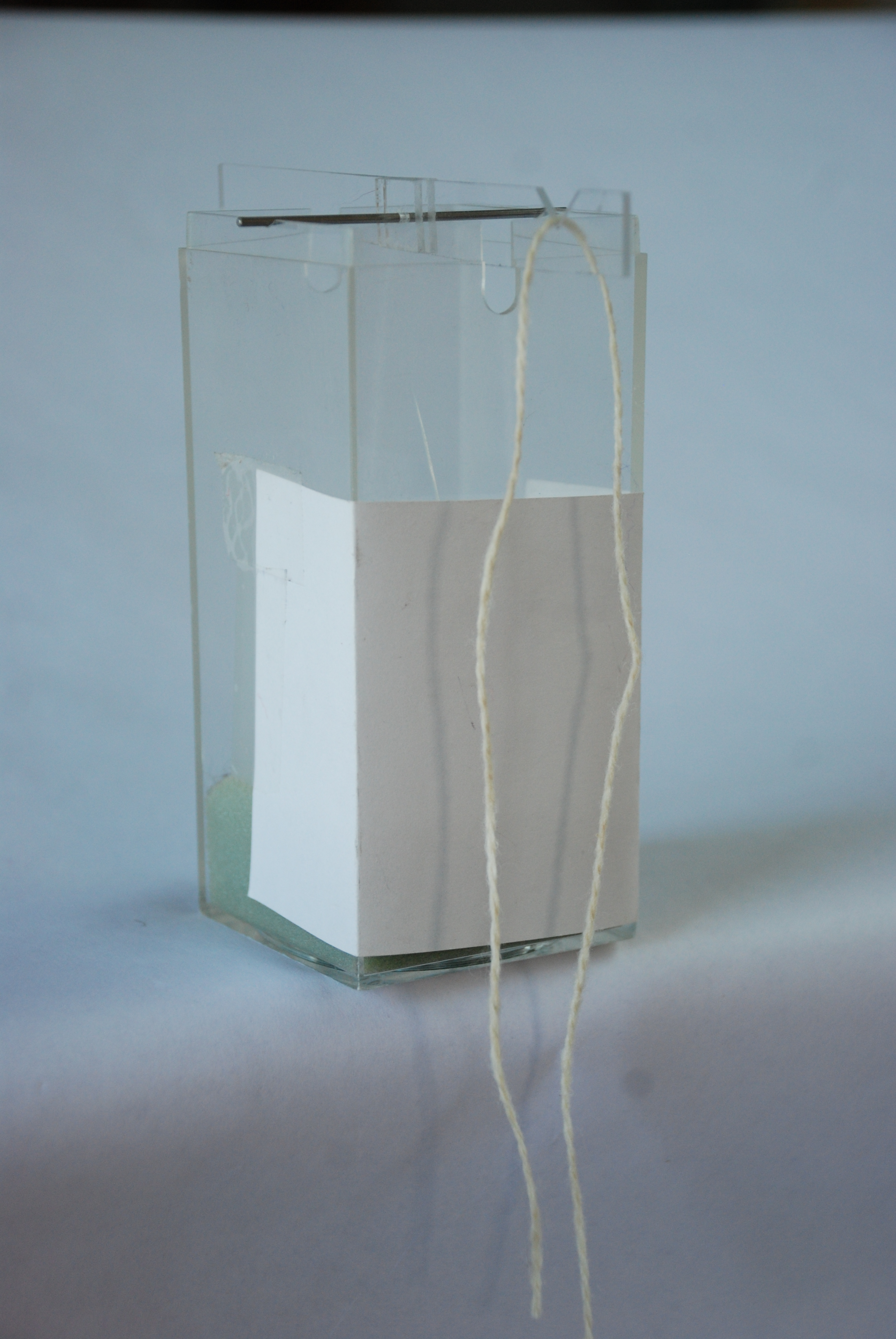 The McMorran yarn balance is one tool to do that. You trim the ends off a strand of yarn until the arm balances.
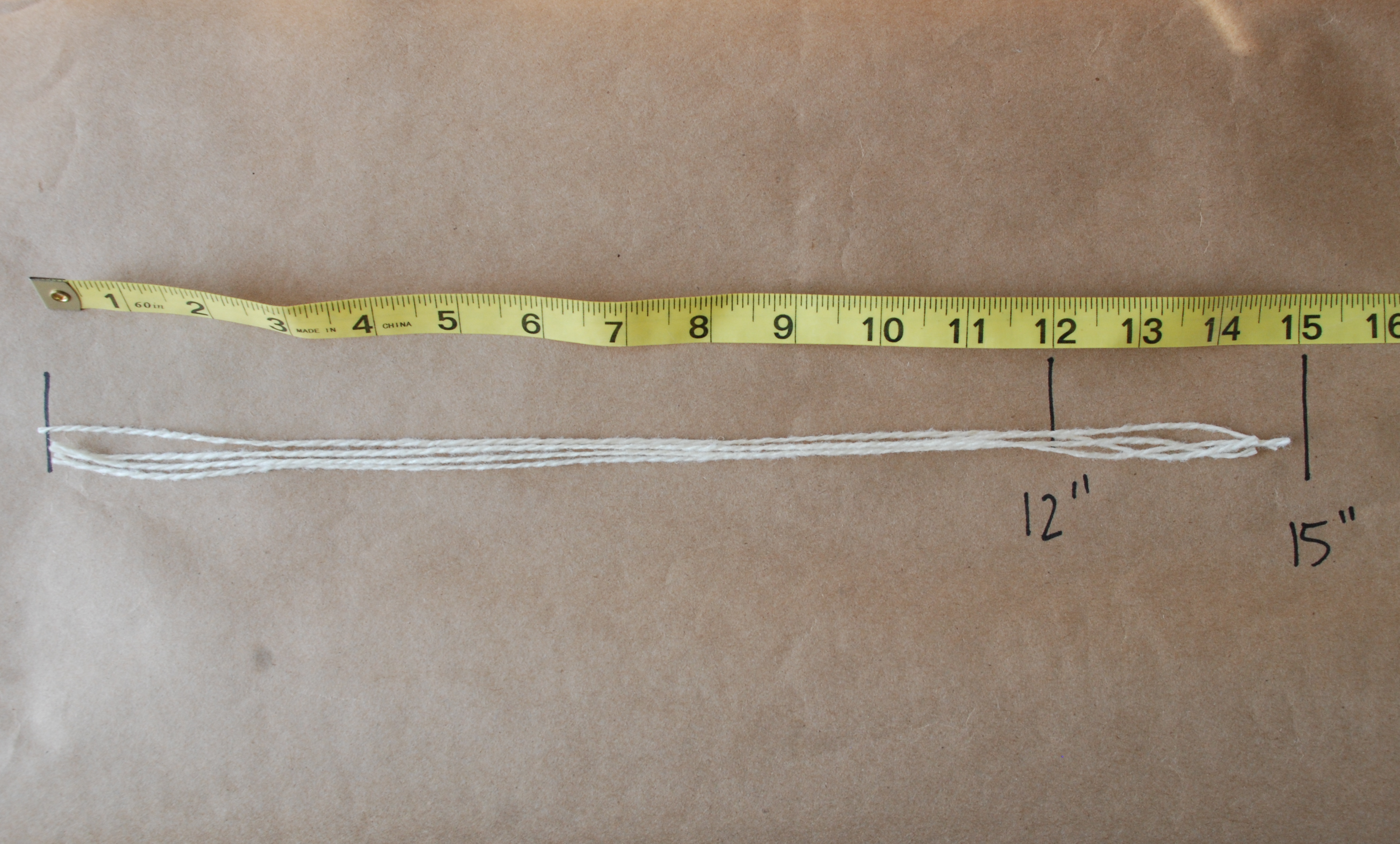 Then you measure that length of yarn and multiply by 100 to get ypp (yards/pound). I repeated that a few times to get an average–1500 ypp.
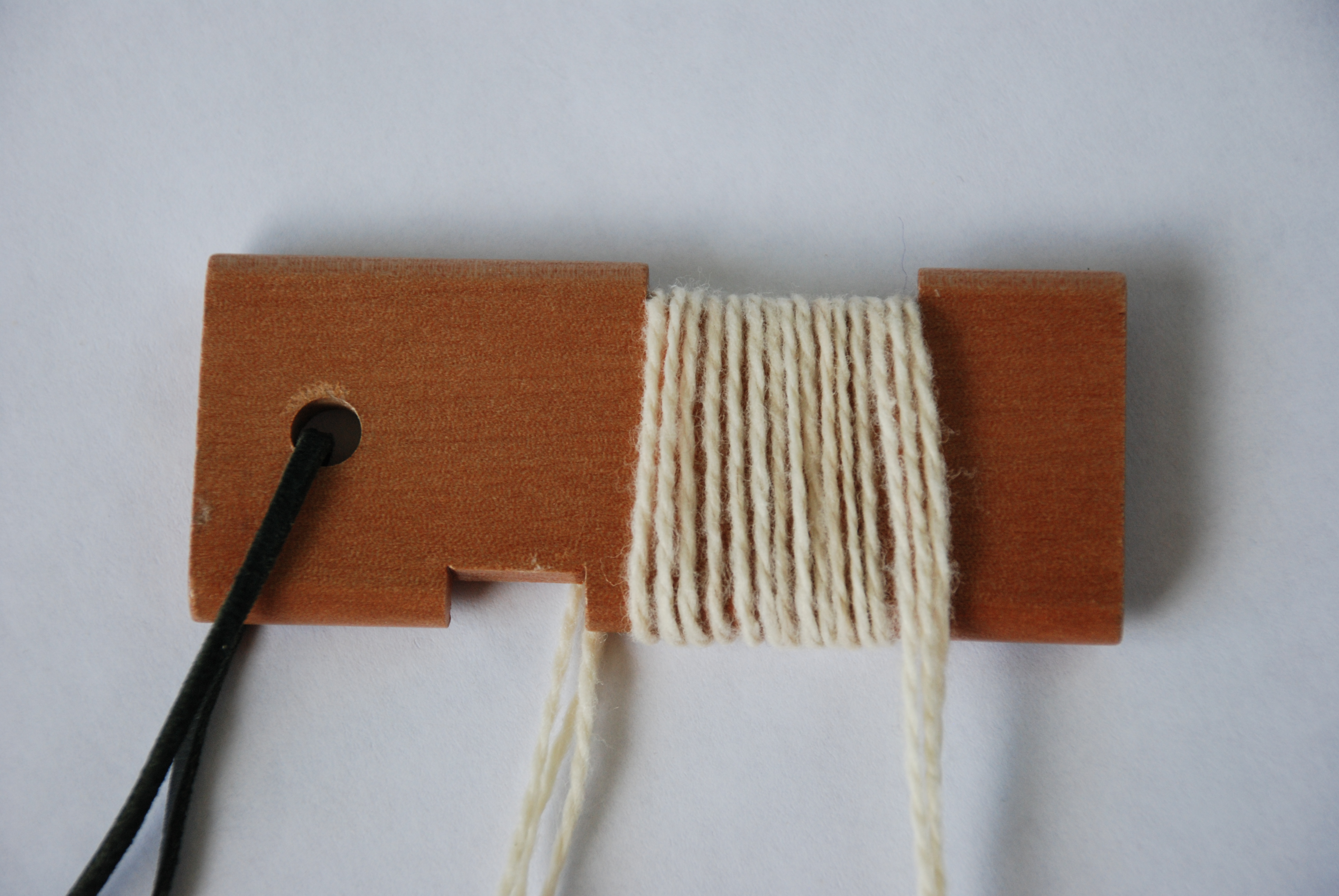 Another measurement is wpi (wraps/inch). This yarn measure 15 wpi. However, from past experience I know that this isn’t quite accurate. Most yarn is scoured (washed) and skeined before it is sold in yarn stores. That can have a dramatic effect on the yarn. The yarn that I got from the mill on cones has not been scoured yet, so it is not really “finished”.
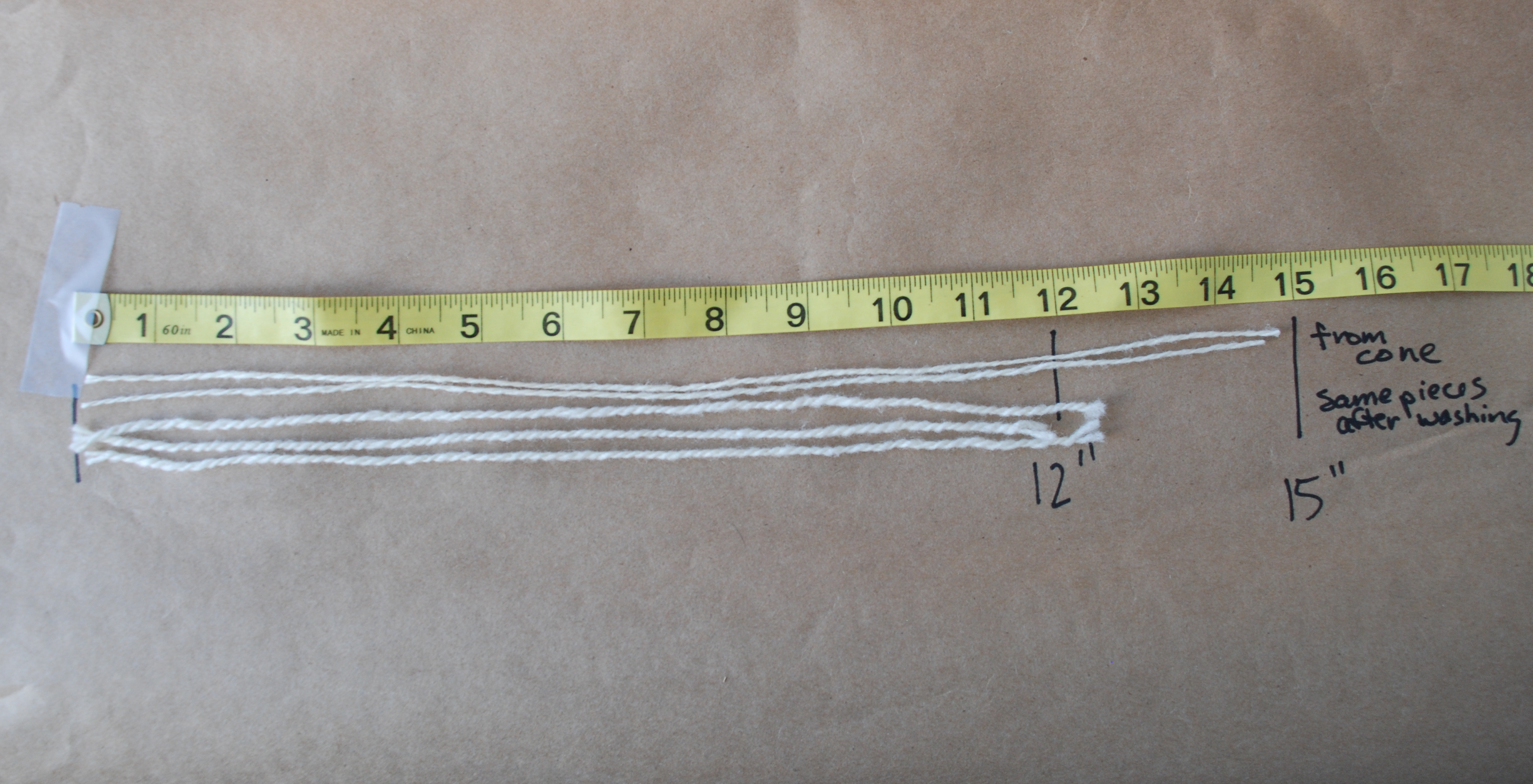 Look at the difference a soak in warm water makes. Now this yarn measure 1200 ypp (which is what the specs from the mill were)…
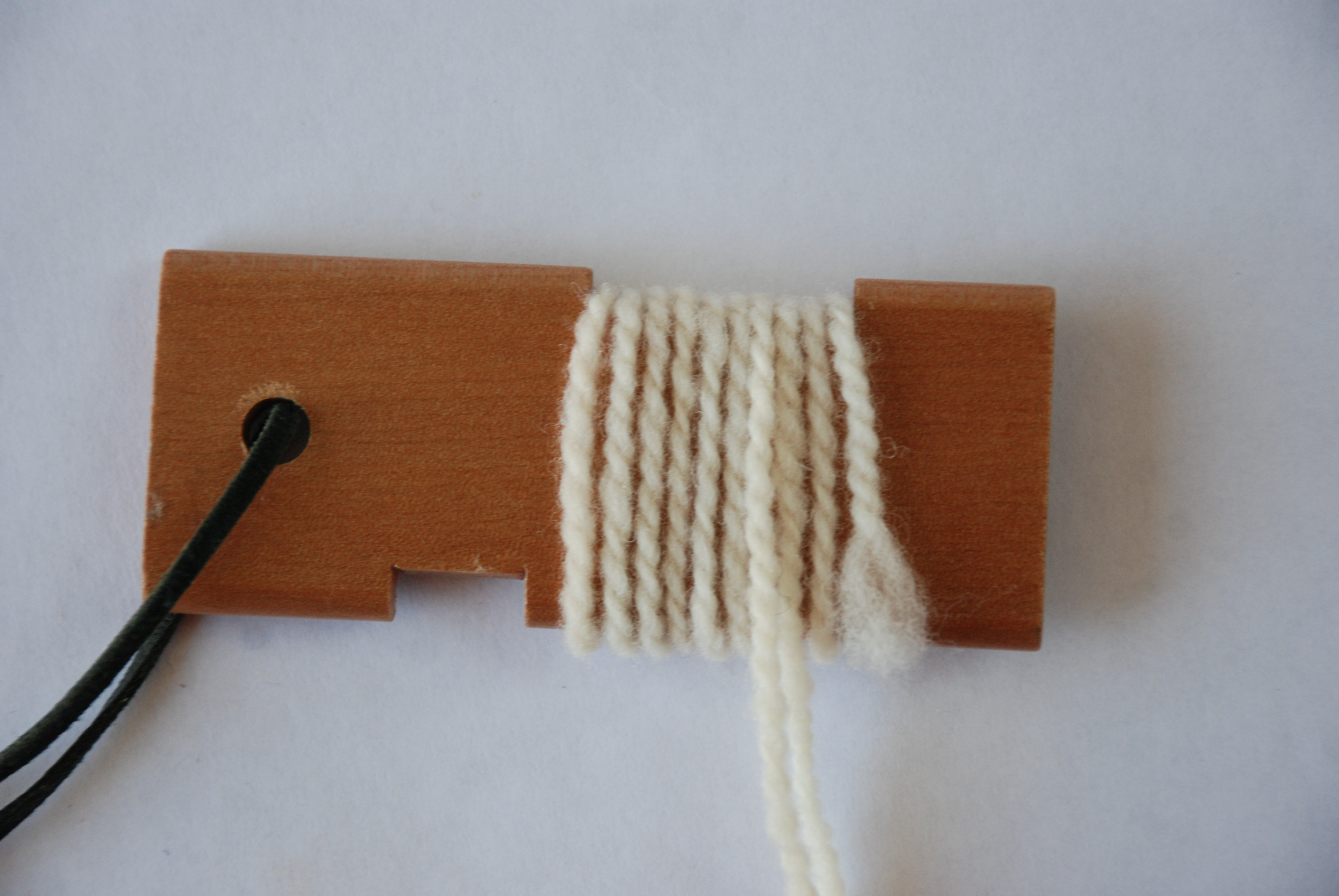 and it is 10 wpi. Based on those measurements I wove some samples.
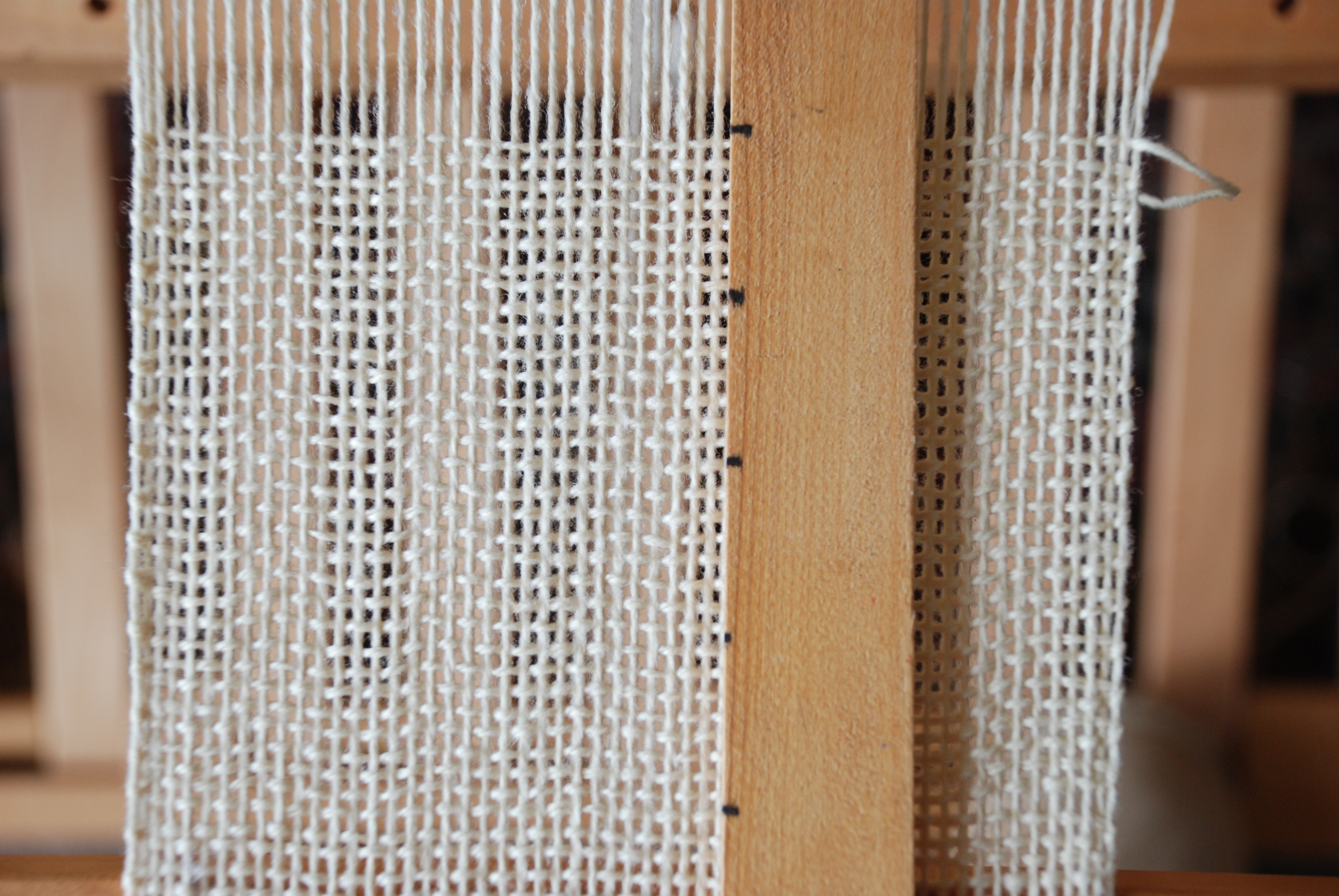 These samples look pretty open on the loom…
 …and I had to be careful to not beat the weft yarn down too much.
 This is how the samples look off the loom. The 8 epi samples are in the top row.
 And here is how they look after a quick wash. Dramatic difference from the loom to the finished fabric.
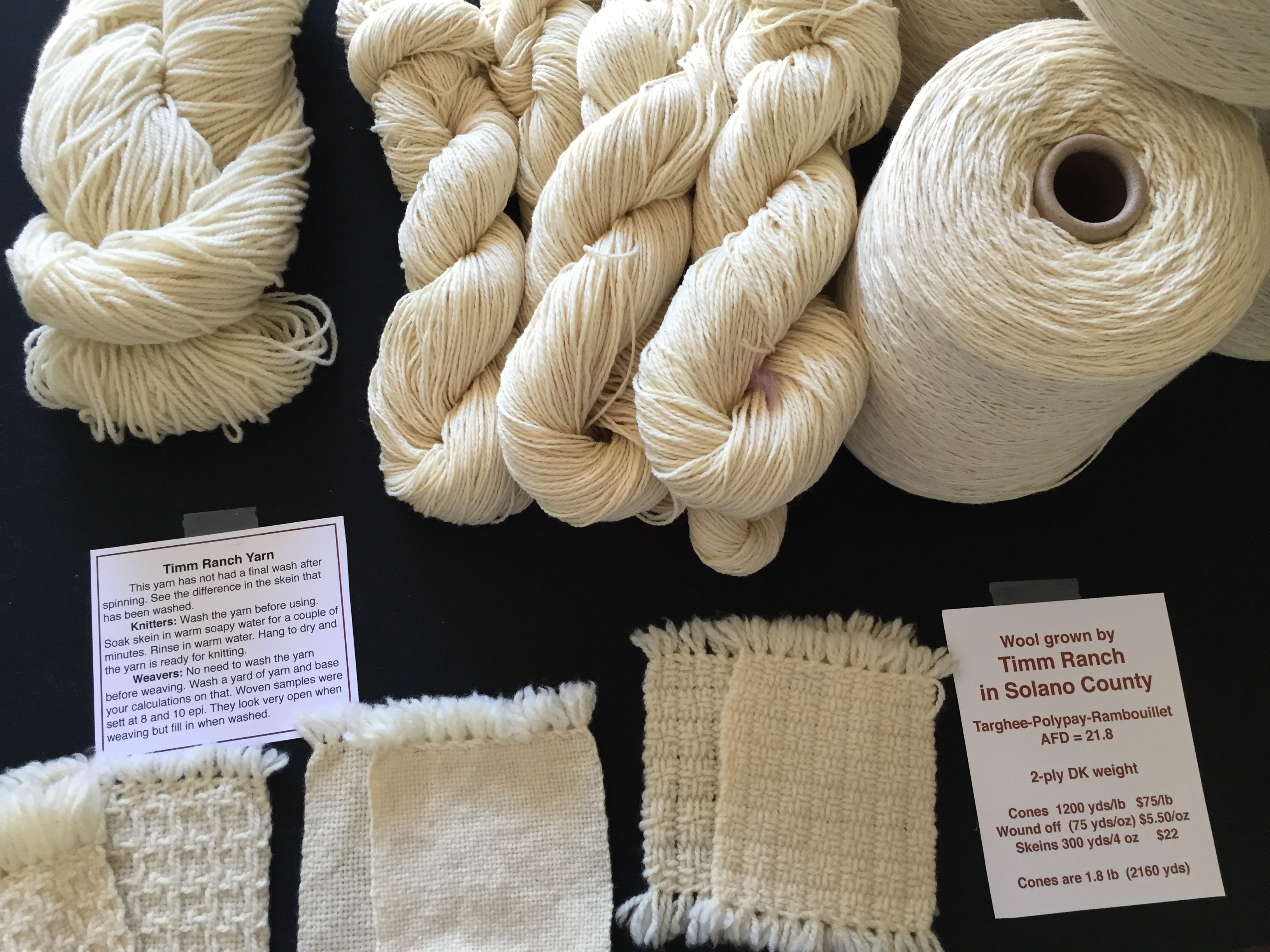 Here is how I had them displayed in the shop at the recent Shearing Day. The skein on the left has been washed. But these yarns aren’t just for weaving. My friend, Mary, bought some, washed it, and then used it for a Mystery Knit Along. Here is the shawl she knit.
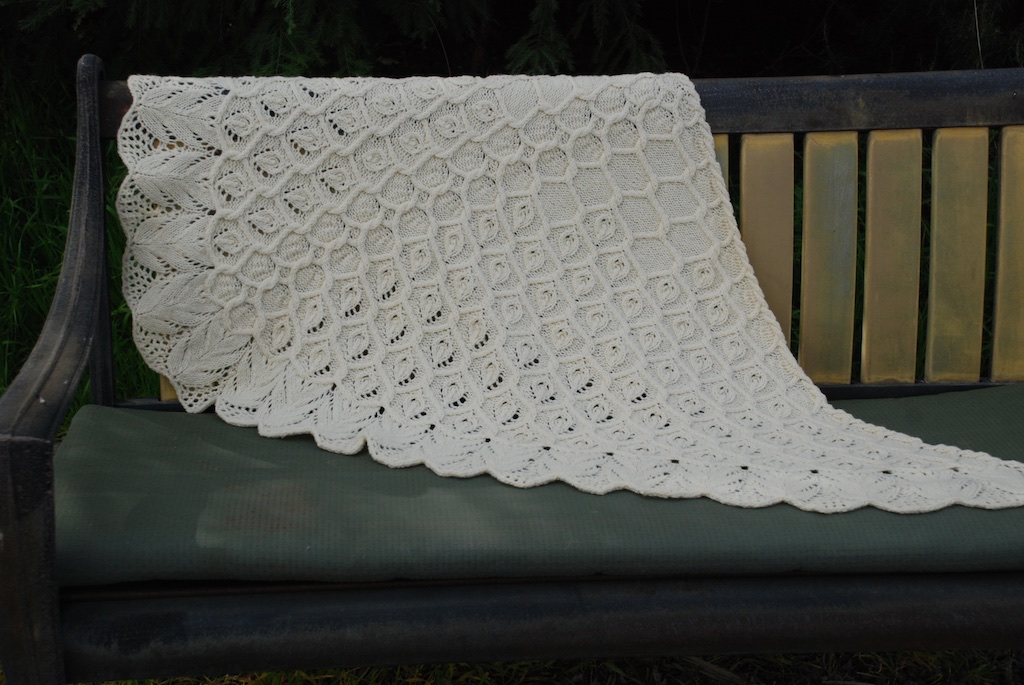 This was knit over a few weeks with a new direction given out each week.
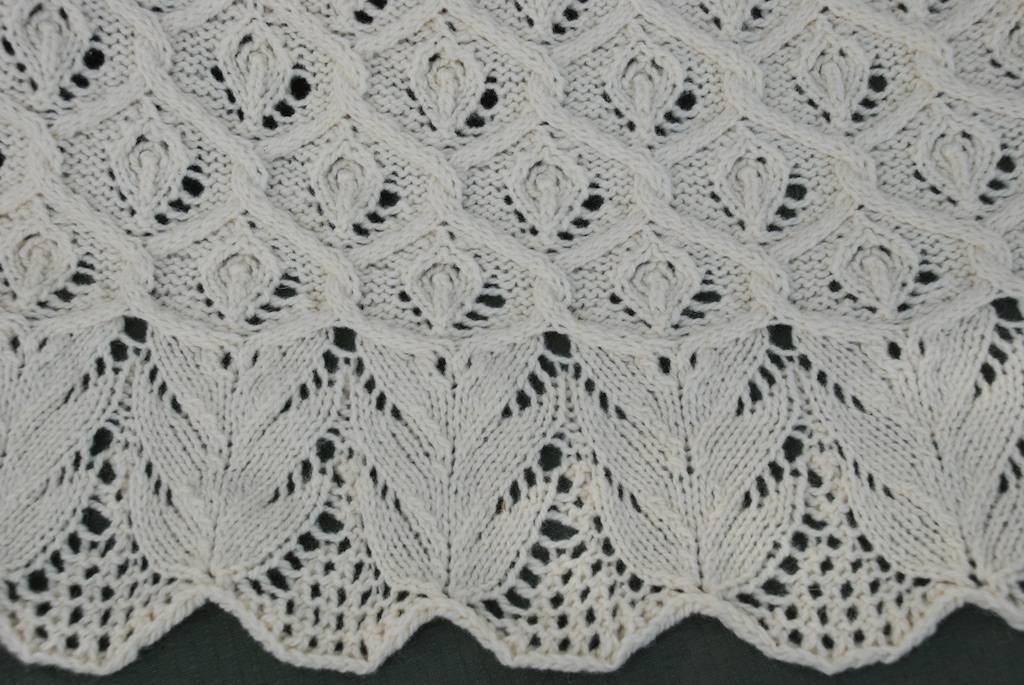 It is gorgeous in person and has a wonderful hand. I can’t wait to get some of this yarn on the loom and get to work with it.
 This is a selection of the BFL yarn in fingering weight. That’s a light weight yarn often used for knitting socks. You might wonder how purple and pink fit into cat and dog colors. The purple is called “cheshire cat”. I still didn’t understand how that fit until I googled “cheshire cat” and found that Disney’s version of the cheshire cat is indeed purple.
 What about this one? It’s called Kitten Nose Pink.
 It’s easy to see the calico here.
 These yarns are Merino fingering weight. They come in the same colorways. I bought a variety of each because I couldn’t get them all.
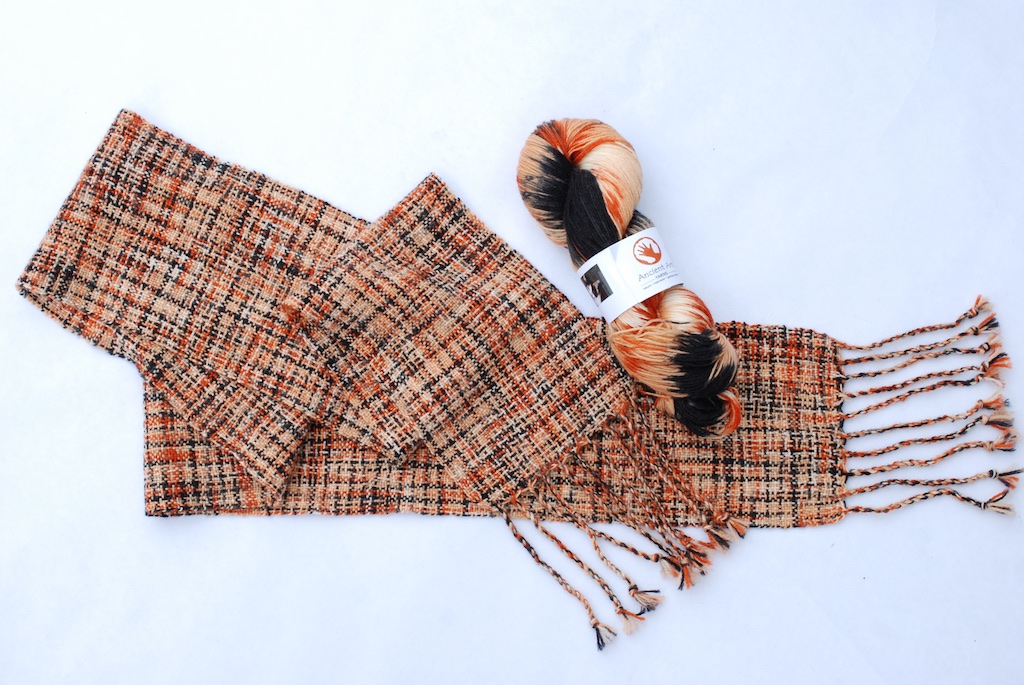 Here is my first project using one of the yarns. One skein will easily make a scarf.
 I also tried the Zoom Loom to see how they looked. The yarn is too thin to use singly, but doubled it’s great!
 Meridian Jacobs' Blog