Shearing at Timm Ranch 2024

If you do a search in either of the blog locations (WordPress that you’re reading now, or the one on my website that I don’t use much now) you can find Timm Ranch shearing posts from other years. I could probably substitute photos because the sheep look the same, the shearing location looks the same, our skirting set up looks the same, and some of the Farm Club members are the same–but not all of them. I just searched the WordPress blog and see 2015, 2016, 2017, and 2018. After that I think I started with my website blog. So here is a view of 2024.

The sheep are a blend of Rambouillet, Polypay, and Targhee. Once in awhile a new ram is brought in, but the Timm family mostly raises their own replacements so the blend of breeds has stayed the same.

This year they sheared about 120 ewes.

We set up two canopies and two skirting tables.

The shearing team started with one shearer but eventually there were two working.

As the fleeces came off the sheep we piled some of them nearby. We were slower than a professional crew would be, but that is because I want to be careful about what I send to one of our small local mills. I knew there would be plenty of wool so I can be picky with what I take. What we don’t take goes into the bale that the Timm Ranch will sell or to my neighbor, Charlene, to be made into Integrity’s Wool Pellets (formerly Gardener’s Gold).

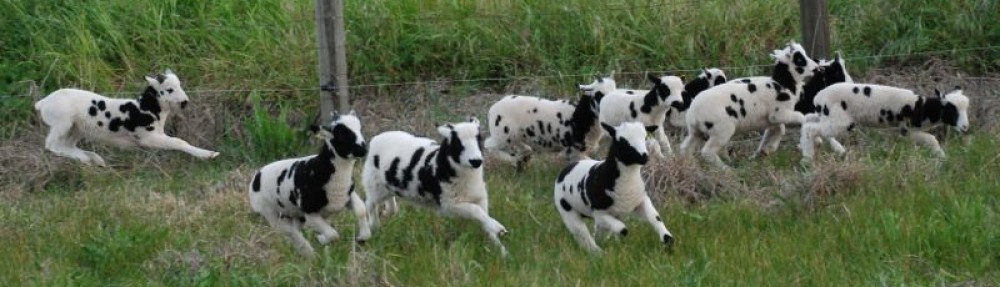
Three lambs got through the fence and wandered around while we were working. (Thanks to Sue G for the previous three photos.)

Another view of shearing.

Ewes after shearing.

We checked staple strength and length and skirted away manure and felted areas.

This is the 130 pounds that I kept. It will go to Mendocino Wool and Fiber for spinning. Yarn from 2022 is here and some of the TR yarn that I have dyed is here. Most of the blankets I weave use TR yarn for warp and sometimes for weft. The painted warp V-Shawls are all TR. You can see a variety of those pieces on this page.

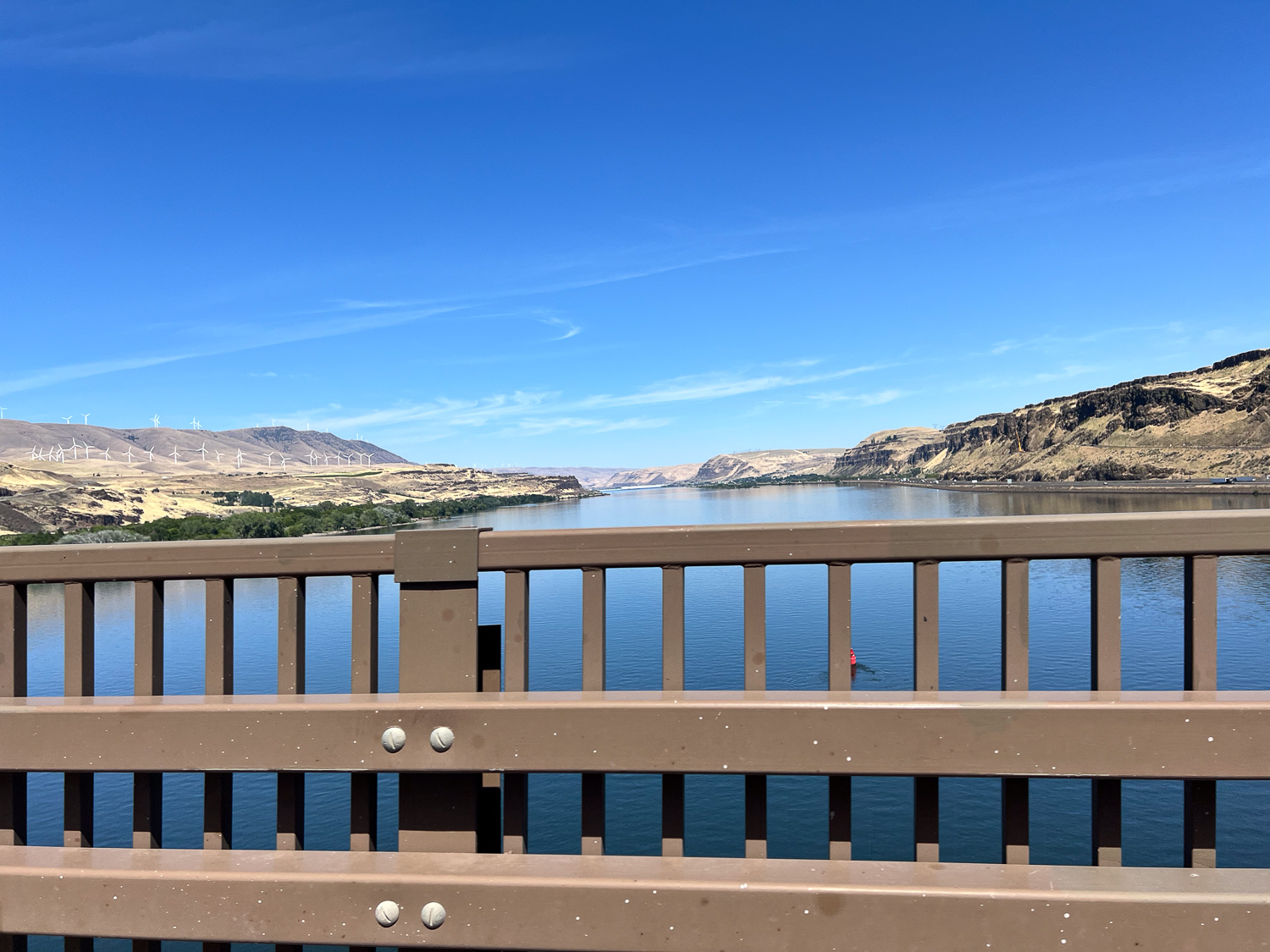
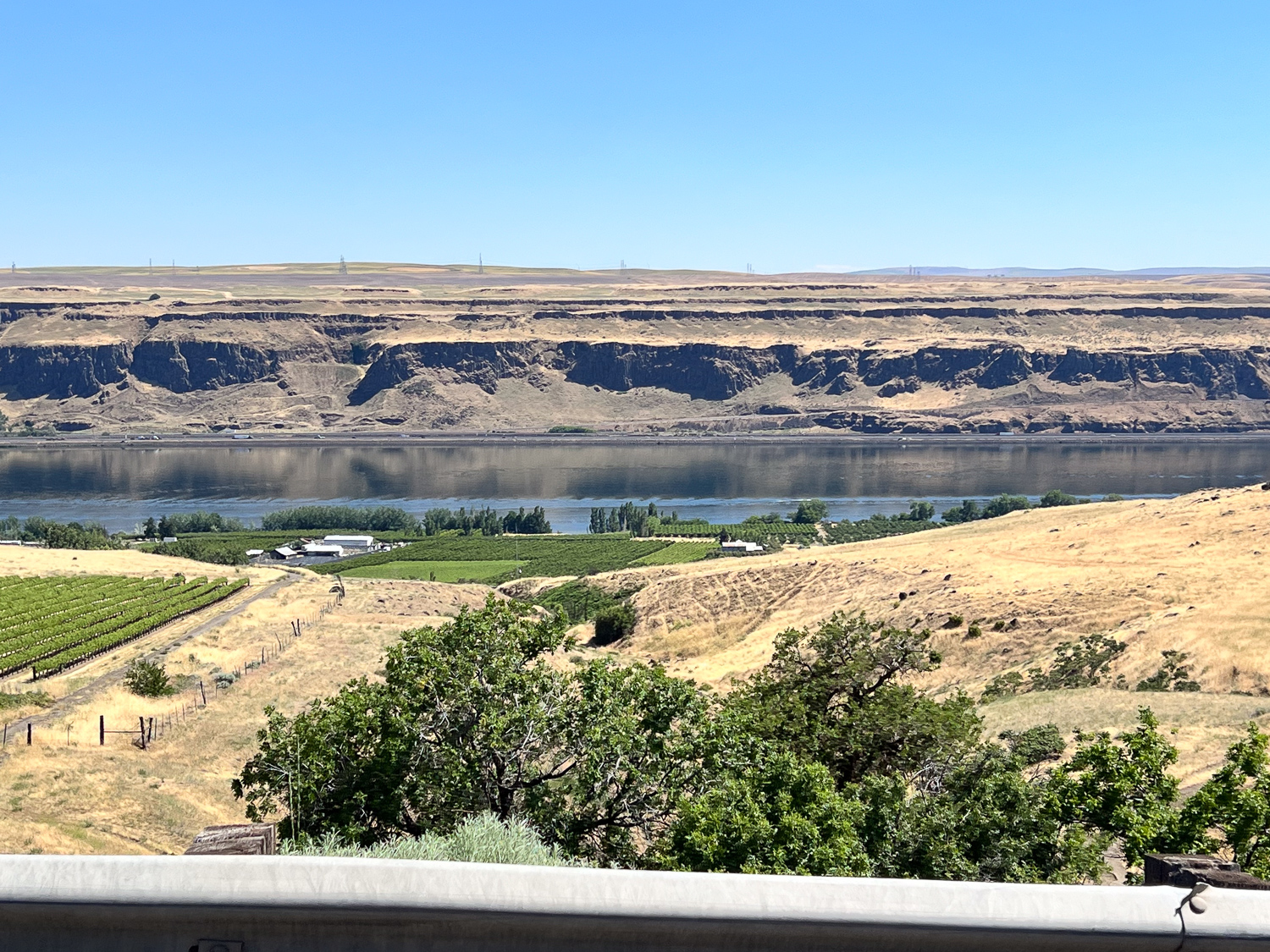
It was a beautiful day at Timm Ranch. Blue sky and green hills just starting to turn gold. Thanks to Farm Club for all their help!

Weave a V-Shawl (13 of them)

I taught a 2-1/2 day workshop this weekend for CNCH (Conference of Northern California Handweavers). It went very well, mainly because the attendees were all very enthusiastic and patient. That is a lot of people to have in a hands-on workshop when learning a brand new idea. I came home inspired and I hope they did too.

Here is a view of the classroom after I unloaded my trailer. I brought 6 looms for people to use as well as all the gadgets that go with them and the yarn for the projects.

I brought several shawls to as examples and we figured out a way to hang them, clothesline style.

This is how the classroom looked after I had all my things arranged. This was before 7 more looms showed up and we had to find room for warping boards.

I knew that we wouldn’t be able to hang warping frames on the walls and I suggested using metal grid wall to provide “walls”. The room got more and more cluttered looking as we set up work stations around warping boards and looms. It was already cluttered looking because of the dramatic design of the carpet and the stripy walls.

This is the classroom next door. There is still a distracting rug, but overall the classroom looked much more organized with the looms all arranged in rows like a desks in a classroom. These looms were brought to the show already warped, so they didn’t need to start with warping stations like we did.

Our classroom looked a little more chaotic, but there was a lot of work going on here. In this photo some people are still warping and others are threading their looms.

At this point everyone was weaving. It is hard to tell that there were 13 weavers in this room (some just out of the photo).

It was fun to see the variety of warp designs.

This photo shows one of the shawls partially through the Weave a V part. Warp threads are cut in pairs at the back of the loom and then those warp threads become weft, creating a plaid design.

On Saturday night teachers were asked to stay in their classrooms so that other attendees could wander through and see what was going on in each class. Some of the students stayed as well and were glad to demonstrate the technique (while making progress on their projects).

This seems to be a random photo. I left the hotel early on Saturday and Sunday mornings to take a brisk walk around the golf coarse.

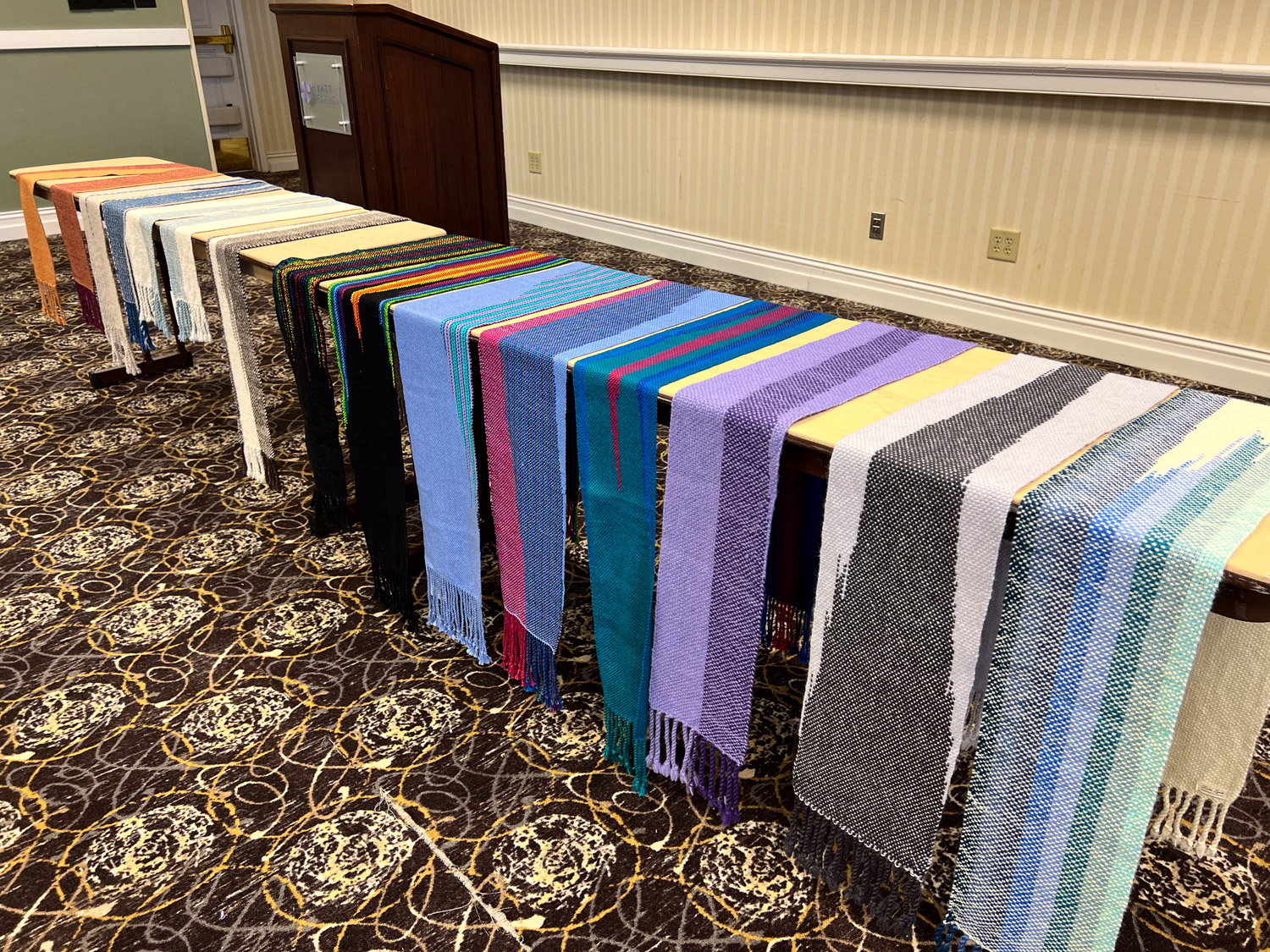
Sunday noon. Some of the students didn’t finish the shawls in class and will finish at home, but some did finish in time to open up the shawls and take photos. These shawls all need finishing touches–tie or twist fringe and wet finish. Then they will have an ore finished look. It is fun to see so many color ideas!

The unique design of the V-Shawl is evident when you see the backs!

Thanks to all these students for making this a great weekend!

Visiting Family in Texas – Part 4

The Eclipse in Texas post is here. That was on Monday. I was flying out on Wednesday, but in the meantime Dan and I had a day to find something to do. Kids were at school and Katie and Kurtis were at work. We drove to the town of Blanco to see what we could find.

We ended up at the Buggy Barn Museum where there are over 250 buggies, wagons, and carriages of all types. There is also a street with the Old West look and buildings that can be rented for photoshoots or gatherings.

We wandered around the Old West and explored the buildings.

We found a donkey (plastic) peering out of a stable.

Then we found the interconnected buildings that house the buggies. There are signs on some but not all. I don’t know what this wagon carried–something that needed to be confined to a cage.

Detail of the wheel on that buggy.

I can’t tell you all the different types, but there are a lot. Some of the buggies have signs that list movies or TV shows in which they have been used. Some have been restored for those shows. Others are replicas.

This is a view from an upstairs room that was also filled. There were several times I glimpsed a person driving or riding in a buggy and I had to look twice to realize it was a mannequin.

This person, however, was not a mannequin, but he dressed for the period. He was glad to see us and spent quite awhile telling us stories about some of what we were seeing.

Metal vultures overlooking the fence on the way out.

Back at the house I went on a walk. This is above the gate at Katie’s neighbor to the east.

This is across the road. That’s a bongo that we mostly saw under this tree. There are also zebras and springboks on the property.

One last photo of my new favorite flower. I find this one fascinating. It is called Antelope Horn for the look of the seedpods. No resemblance at this point. Maybe if I go back in the fall I’ll see some.

Visiting Family in Texas – Part 3

Part 2 of this Texas trip is here. This plan started way back last summer when Matt suggested that we all gather at Katie’s place in Texas for the total solar eclipse on April 8. She lives in the path of totality. It’s a good thing that Matt gave me plenty of warning. I bred the sheep a month earlier than normal so that I wouldn’t risk what happened in 2023–lambs due while we were on a planned family trip the first weekend of April. It worked, and all the 2024 lambs were born by March 7.

I didn’t go to Texas just for the eclipse. Since the family is there I spent a week with them.

Our friend, Roger, usually shares Thanksgiving and Christmas with us in California, but now that he has moved to Texas, he was a welcome addition to the Eclipse Day.

I have to attribute most of the photos to Kaleena. She did a much better job than I did with photos, especially of the actual eclipse.

We all tried out our eclipse glasses.

Then we waited.

The day was cloudy and overcast. We saw glimpses of the eclipse as the clouds came and went.

That made for some great photos by Kaleena. I evidently hadn’t paid attention to “how to photograph an eclipse”.

This was my contribution to Ellipse Day.

Visiting Family in Texas – Part 2

I’m slow at getting caught up with photos. I may never be caught up. Part 1 of this trip is here. On Sunday we drove to San Marcos for a glass-bottom boat tour at The Meadows Center managed by Texas State University.

This is the view from within the boat so I can share what the boats look like.

This is the view in the other direction showing out tour guide and the other people on the boat.

We are all sitting around a center channel with a glass bottom.

A view looking down into that channel.

A view of the bottom of Spring Lake. There are over 200 springs in the lake, bubbling up from the Edwards Aquifer. The water is at 72 degrees year round and the water from these springs becomes the San Marcos River. The guide pointed out what looked like current at the bottom of the lake in some areas and bubbles in others–those are the areas where water is rising from the springs.

After the tour we explored the Discovery Hall that is housed in the old building that used to be known as Aquarena Springs. For a fascinating glimpse into the history of the entertainment provided by the Aquamaids from the 1950’s through 90’s at this site see this link. Thanks to Kaleena for this great photo of Matt and Kasen sitting on the roof of the Hall.

We did a short walk on one of the trails around the Spring Lake Natural Area.

This sign explains that this area may be the oldest continuously inhabited spot in North America.

After that we drove into another part of the town and stopped along the San Marcos River where there is public access for swimming.

It was overcast, but warm enough for some of our group to want to get in the water.

Another great photo by Kaleena.

Back “home” we took another walk.

This is a close up view of a flower I identified in the last post…what was that? I just looked back. Pincushion Daisy. I took this photo because of the metallic green bee

Phlox roemeriana

I am experimenting with he ID ability of the phone (a feature I didn’t know about until Kaleena showed me). If I record something as a caption it shows up here. The common name is Goldeneye phlox.

Musicians seen along the road.

Pipevine Swallowtail
Antelope-Horns, Asclepias asperula

I shared these flowers in that other post also, but sharing new photos.

Antelope-Horns, Asclepias asperula

I am fascinated by this flower. It is so odd. And why that name?

The only photo that I am in–Kaleena took this one.

Next post will be Eclipse Day.

Visiting Family in Texas – Part 1

I shared one blog post in the first few days of my latest trip to Texas. That was all about flowers and I never got organized enough to do another. I’ve been back in California now for four days but for three of those days I had Covid. I’m still trying to catch up. I’ll be sharing some family photos here.

The day after I arrived Kirby had softball practice after school. She is the catcher for her team.

Kirby-softball practice
Kirby can certainly throw the ball better than I ever could.

At home with the bunny.

Outside with the goats. The original goats came from our place. Blog post here. Why is it that since the pandemic started our only road trips have always involved hauling animals around the country?

These are mostly outside cats who get to come in when it is particularly cold.

Two dogs are Josie and Alice.

On Saturday there was a softball game. Katie helped Kirby warm up while Kasen was off playing with friends.

Kirby as catcher.

Kirby at bat.

After the game we went to find a place where Kasen could work out the way he wanted to.

That’s doing pull-ups and running.

Kasen challenged Uncle Matt to a race. Matt gave him a head start.

More next time.

Springtime Walk in Texas

I’m in the Hill Country for a week. I walked up the road this morning and enjoyed seeing all the different wildflowers. I used my daughter’s wildflower books but still couldn’t identify them all. I think the ones included here are correct.

Antelope-Horns, Asclepias asperula

This one is fascinating. In the next photo it is in full bloom.

Antelope-Horns, Asclepias asperula
Gaillardia suavis

This one is called pincushion daisy. The photo in the book shows it with the ray flowers but it often has just the disk flowers as it does here.

Mimosa borealis

Pink mimosa. Do you know what you see when you search for pink mimosa on line? It mostly drinks, not flowers.

Cooperia pedunculata

Rain-lily.

Castilleja indivisa

Texas Paintbrush.

Winecup.

Bluebonnets. At home I’d call this flower a lupine, but there are many different species and the one is Lupinus texensis.

Maybe I’ll be able to identify more tomorrow.

Springtime Hike

On Monday we went on a hike with my brother and sister-in-law. I think it was actually a walk because the trail followed the edge of the lake fairly closely. Doesn’t a hike involved dramatic changes in elevation or at least some level of difficulty? Regardless, it was a beautiful day while the annual growth is still green and not all the trees have fully leafed out. (Is that a word?)

We drove to the north end of Lake Berryessa and stopped at the trail head.

My brother has been here several times and expects to find ospreys and eagles. We saw ospreys in the air on the way here and found another not long after starting on the trail.

This is a view of the landscape and the lake. There is an osprey in this photo also, but you have to look hard to see it.

Here is the osprey, right in the middle of that other photo. Notice there are two here. One is below the nest.

Another view across the lake. What a beautiful site for a ranch headquarters.

I have always taken more photos of plants than birds. Plants sit still longer and I can get closer.

Here is a magnificent oak tree.

The oak woodland landscape.

We noticed several trees with holes in the bark. Can you tell what is in the holes?

The holes are filled with acorns.

The acorn woodpecker is responsible for this. Wikipedia has this to say about this behavior: Acorns are stored in small holes drilled especially for this purpose in “granaries” or “storage trees”—usually snags, dead branches, utility poles, or wooden buildings. Storage holes—always in dead tissue such as bark or dead limbs—are used year after year, and granaries can consist of thousands of holes, each of which may be filled by an acorn in the autumn.

This turkey vulture wasn’t about to leave his meal, although three others did fly off as we walked by.

Can you spot the bird here?

This one is a bald eagle.

We walked about as far as La Pointe (on the map at the top) and turned around because we all had visitors coming for dinner. On the way back we saw the same osprey pair.

This is Dan, me, Kathy, and Dave thoroughly enjoying the day.

Lambing update

I just checked back to see when I wrote last. Wow! I’m so behind. It’s probably impossible to catch up with all the ideas I was going to share. Here’s an update about sheep and lambing season.

This is the lambing board where I record all the info as lambing progresses. This will stay up until the first lambs show up next year. The info shows date, ewe, lamb # (purple for ewes, blue for rams), and birth weight. The blue brackets are triplets.

Here is a summary:
Lambs born between January 25 and March 7, 2024
Single births: 3 = 3 live lambs
Twin births: 33 = 63 live lambs (3 died at birth)
Triplet births: 8 = 22 live lambs (2 died at birth)
Total live lambs = 88 ear tagged; 1 died at 1 day and 2 dead fetuses not counted.
44 ewe lambs / 42 ram lambs
Sires:
Horatio 36 lambs
Barrett 27 lambs
Typhoon 12 lambs
Blizzard 5 lambs
Peyton 5 lambs
Unknown 3 lambs
The Unknown are the first 3 lambs born, earlier than I expected, and due to the ram lambs getting into the pasture prior to breeding season. OOPS!

I also question if Blizzard is the sire of the five lambs born later than expected based on original breeding dates.

I made this chart to help work it out. If the lambs were born based on the original dates they would have ben born in mid-February. They are about 2 to 3 weeks later. A sheep heat cycle is 17 days and gestation is between 142-152 days (average 147 days or 21 weeks). Blizzard was with 3 ewes until Lambtown, October 6-8. If he bred them October 5 the due date would range from February 24 to March 5. I just looked back at last year’s Lambtown blog post and see that Queen Q and Quark were both at Lambtown also. They came back on October 8. IF they were bred October 8, 147 days would be March 3 (range February 27 to March 9). I’m pretty sure that April’s lambs are sired by Blizzard, but I’m still not sure about the others. I think they probably went in with Horatio when they came back here but I don’t remember. It would have been smart to leave them away from rams for another week or so. The lesson here: TAKE BETTER NOTES.

Thanks for “listening” while I try to work this out. Now, on to photos.

Lambs are getting big. This is Hailee, one of the few 2023 ewe lambs that I put with a ram. Her twins were born March 4, so they are only 3 weeks old. Really? It seems like that was so long ago now.

Here is a view of Hailee without lambs under her. I really like her horns!

We had a Farm Day on Sunday and several members showed up to help take notes about lambs. I hadn’t taken time to record number of horns, color, etc and needed to be able to update the website. We caught all the lambs and then inspected each one. It’s easy to tell the number of horns on the rams when they are young, but not always on the ewes. This photo makes mer think of a line at the grocery store. Farm Club members caught lambs and waited while we all checked them out and then I ear tagged with a colored tag.

They all get white ear tags for ID shortly after they are born. The colored tags are useful as back up if the original ones are pulled out and to help find a particular lamb. When I’m looking for a specific number I have to look at all 80+ lambs and it’s much easier to narrow it down by color. It also helps when I’m taking photos that usually I’ll be able to identify the lamb later by at least one ear tag. We color code them by sire.

Barrett’s lambs got green tags.

Ewe lambs are tagged with the white ID tag in the left ear and the colored tag in the right ear. Ram lambs are the opposite, so that’s another way to help find a lamb.

Horatio’s lambs have a purple sire tag.

We tagged Typhoon’s lambs with yellow. I did not assign colors to lambs that are potentially Blizzard’s or the ones with an unknown sire. Now you can find most of these lambs on the website. Ewe lambs. Ram lambs. I’m not finished taking photos. Most are for sale.

Pecan and ewe lambs born February 19.

Weave Like a Viking

Lambing is over as of two days ago. I will talk some more about lambs, but right now I want to share today’s class, Weave Like a Viking, taught by Farm Club member Siobhan…with a little about lambs.

Siobhan started figured out how to weave Vararfeldur, a pile weave using wool locks interspersed in plain weave or twill. Siobhan previously presented a class here in felting that results in a piece with a similar appearance at first glance, but is much different.

This is an example of the “sheepskin” from Create a Vegetarian Sheepskin.

These are the pieces of Vararfeldur that Siobhan brought to share. The pillow in the center is an example of the piece the students would weave today.

Siobhan started with a demonstration of the technique.

Six students brought rigid heddle or table looms already warped and ready to weave.

They weren’t expected to finish the weaving in this half day class but got well underway in the pile weaving.

The intent is to weave a pillow front with the wool locks and then finish the weaving in plain weave or twill to complete a pillow cover.

Half way through the weaving the class took a break to feed the bottle lambs.

We will offer this class again in May. You’ll be able to visit the lambs but by then none will need a bottle.