M birthday was last week and I spent the day with my son exploring some of the El Dorado National Forest.
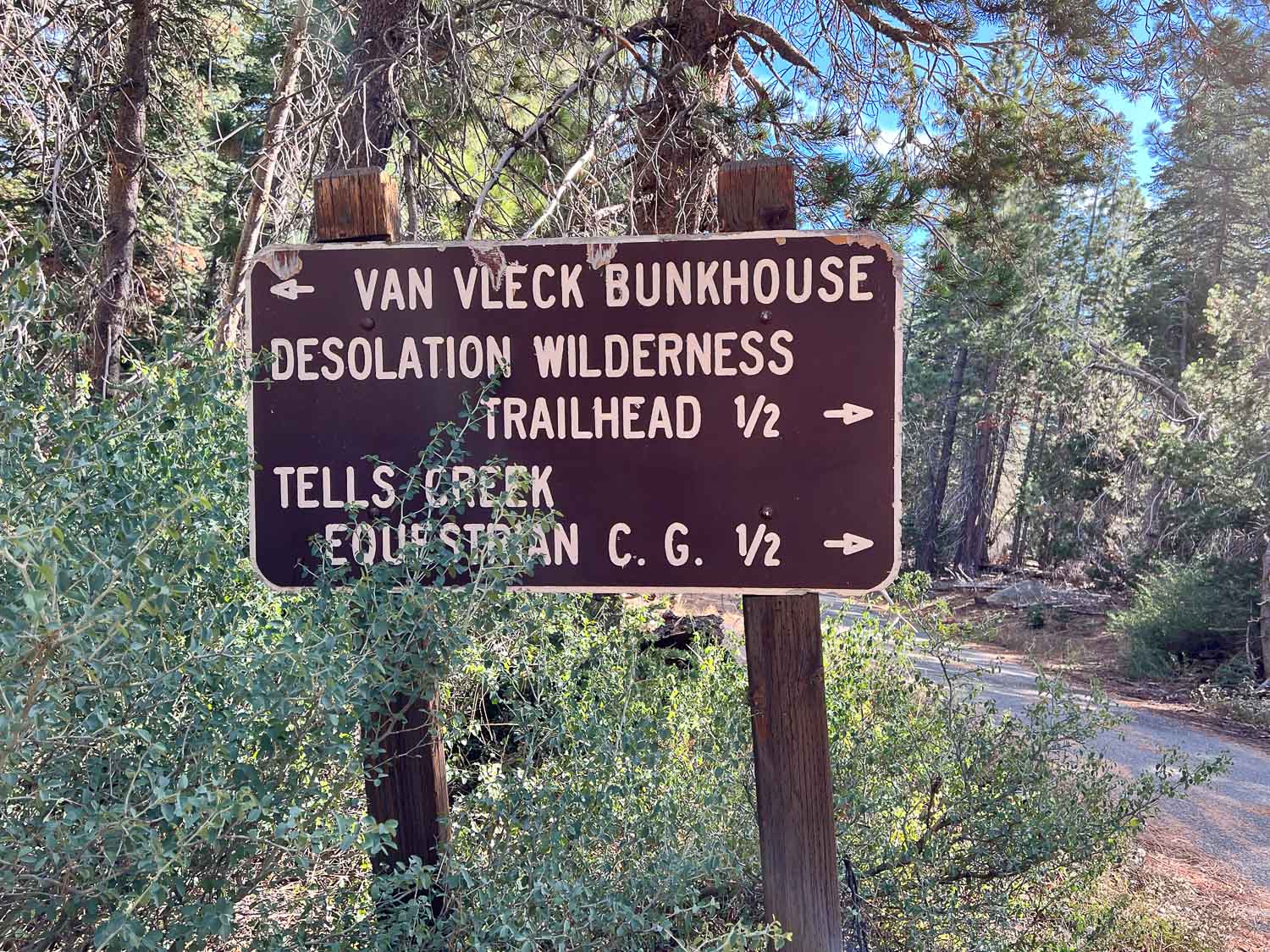
Matt drove and I wasn’t looking at a map so all I know is that we headed up Ice House Road and went beyond some of the other areas we have hiked in the past. The first stop was to look at the Van Vleck Bunkhouse, built in 1957, and now rented by recreational users from the Forest Service.
I had no idea that the Forest Service was in the vacation rental business. This might be a fun place to stay with a group of people. It sleeps six, has propane for cooking, but no electricity, and has running water during the summer.
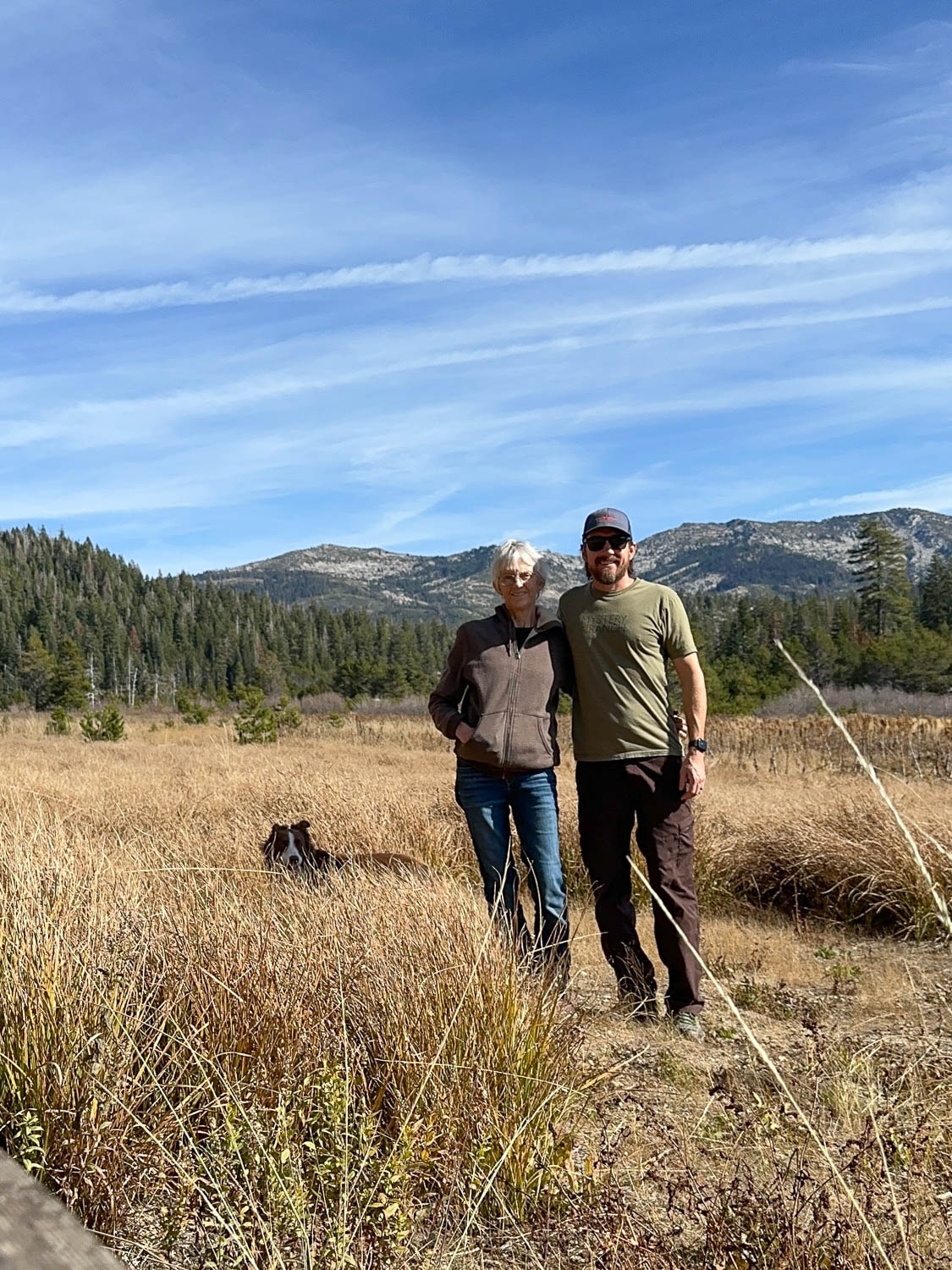
This is the meadow south of the bunkhouse with Desolation Wilderness in the background.
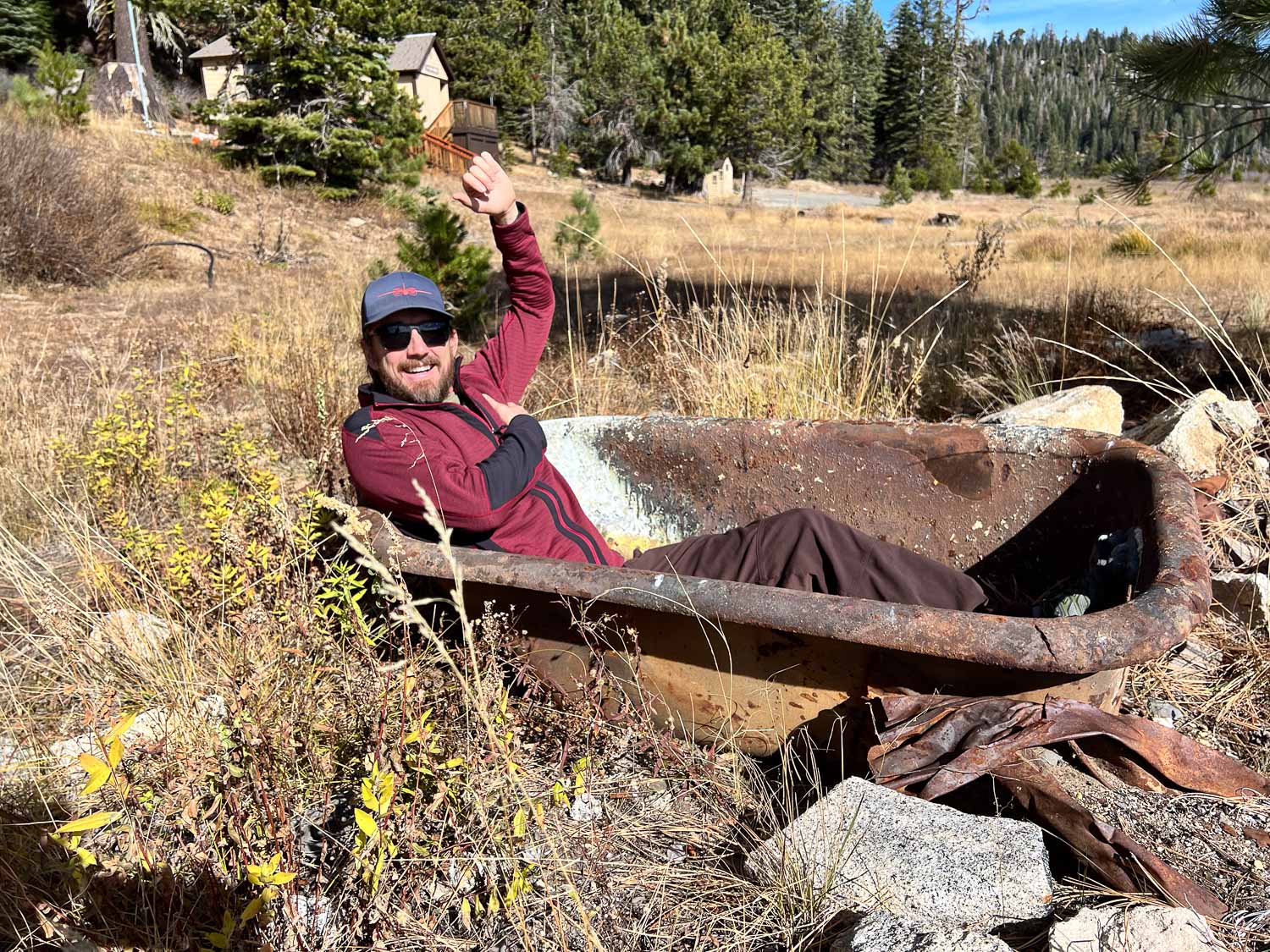
Matt didn’t care that there was no water. He tried out the bathtub at the edge of the meadow.
This is more of what was the meadow. Matt said that several years ago they did a prescribed burn here to maintain the meadow, but trees are encroaching again.
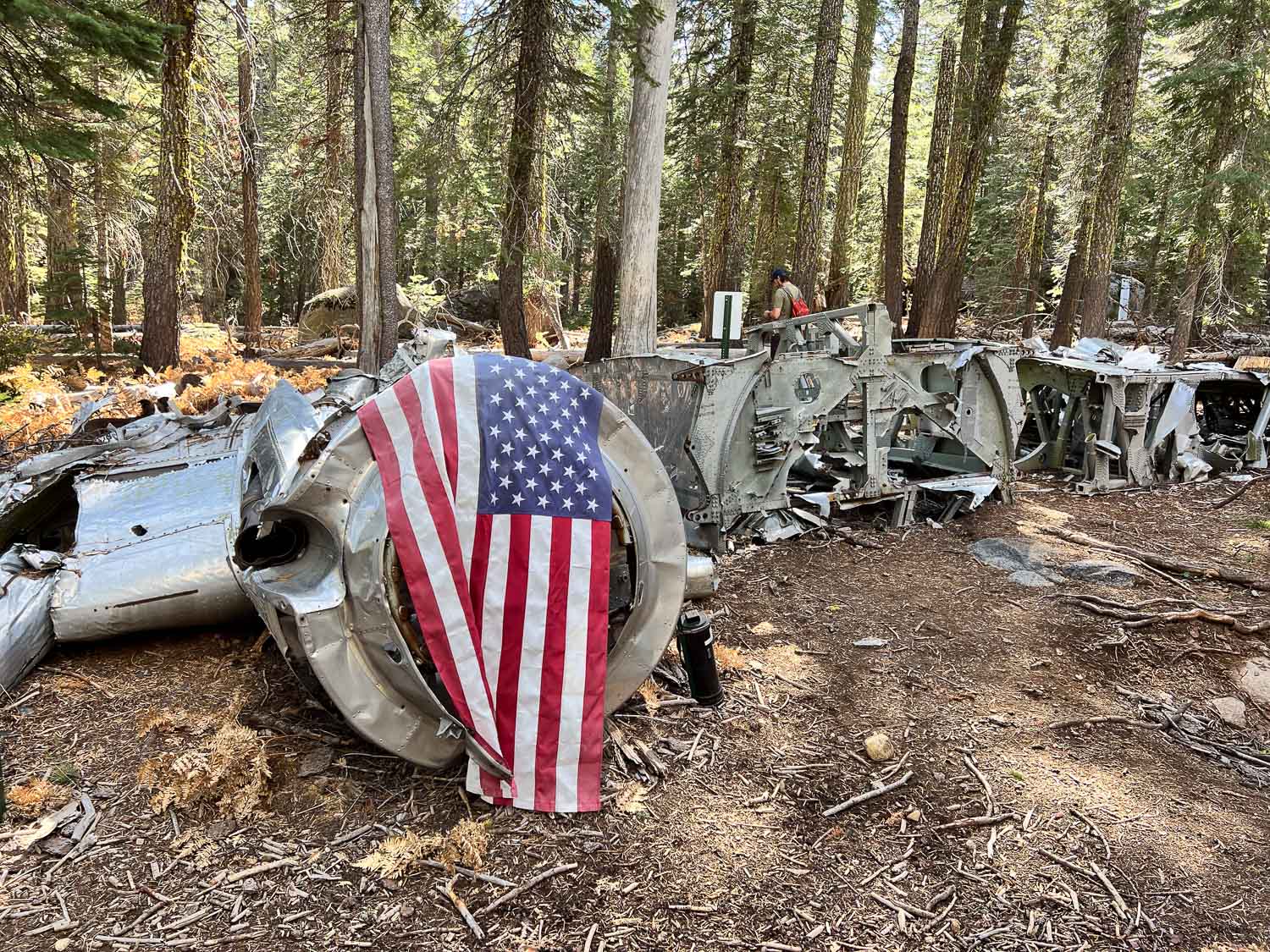
After leaving the meadow we drove further and then followed GPS coordinates to find the site of a plane crash in 1941. The info at that link tells of the air force pilot and crew that were flying a B-17, known as the Flying Fortress, from Salt Lake City to Sacramento. Due to weather and mechanical issues it went down on November 2, 1941. The pilot had ordered the passengers to put on parachutes. They all made it out but the pilot did not and two days later the crash site was discovered. We were here exactly 83 years later.
There is a trail of sorts to the site, but you’d still have to know where you’re going to find it.
The wing stretches off to the right. The other wing is at a different location.
This is what the remaining wing looks like.
Matt had the coordinates of other parts including the wing, and we walked farther to find the site, but didn’t see it before we turned back.
As we walked back down the trail I turned and could see the plane from an angle where I hadn’t noticed it before.
There were several downed trees in the area. I was surprised to see so many down with the roots pulled out of the ground. I suppose the severe storms last winter were to blame. The root structure of this one is massive.
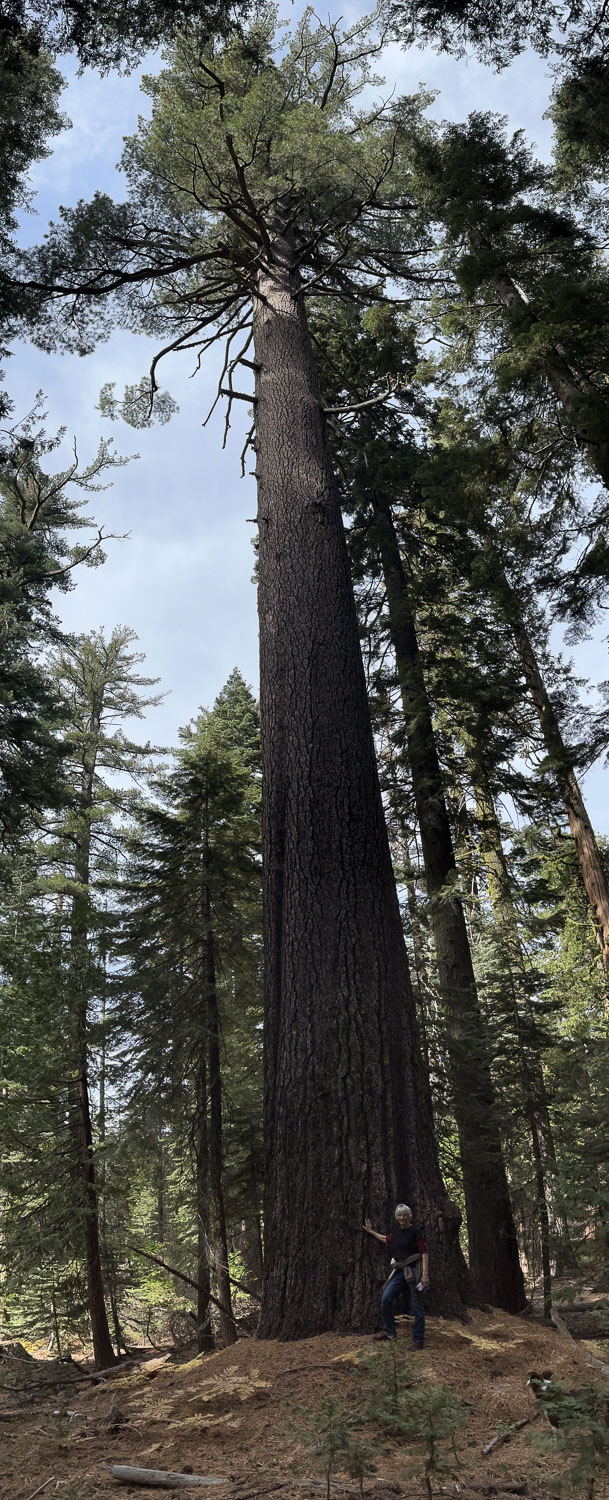
Check out the size of this tree.
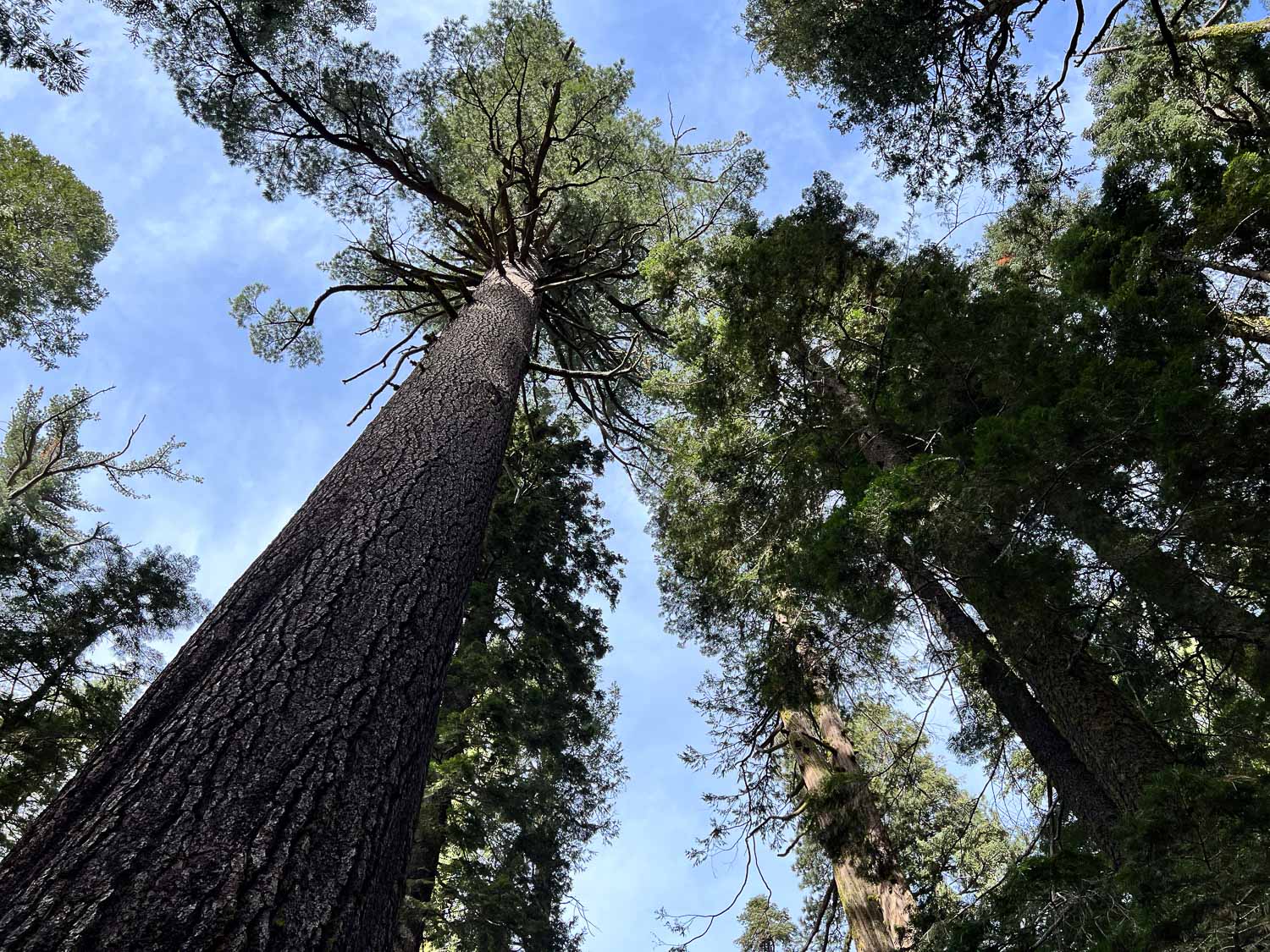
This was my view.
There were some big mushrooms too. You can’t tell from the photo but that one is bigger than my hand.
We drove back towards Matt’s house, but first turned up the road to Big Hill, the heliport where Matt used to work. This is the view of where we had been earlier with Desolation in the background.
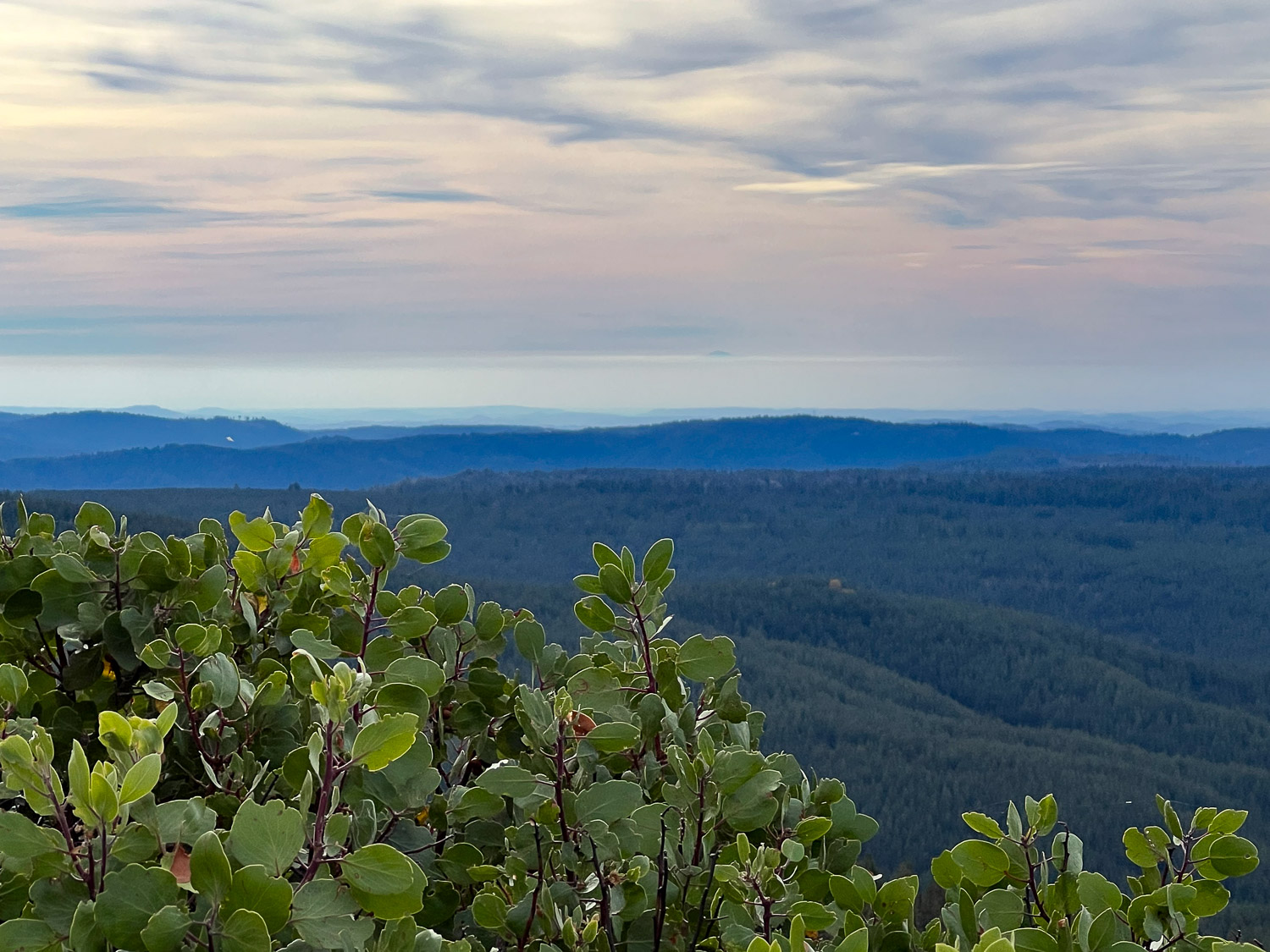
View to the west. I wish I could make an arrow on this photo. I’d point it to the mountain top that is Mt. Diablo, the mountain that I see due south when I walk Across the Road at my house. There is a strip of white above the mountains, below the blue-turning-pink part. Do you see a small dark bump just above that white strip, just to the right of center? That is the tip of Mt. Diablo. I think it’s interesting to see it from a totally different vantage point.
Between Lambtown in early October and Rhinebeck, New York two weeks ago I made a quick trip to Boise. My son got a ride here from Idaho to attend a wedding but then needed to get back home. I’d never had a chance to see the house he and Meryl bought over a year ago so this was a good chance, besides the opportunity to visit with them.
As I sorted through photos for this post I determined that this is a FAIL for photos of my family as it is mostly landscape and road trip type photos. That’s OK I guess, because even though I use this blog as my personal scrapbook, maybe I should be more reserved about sharing family photos. That’s my excuse, but it turns out that I didn’t take any, unless photos of dogs and cats count.
I was glad to let Chris drive. We had lots of conversation and I amused myself with a few landscape photos.
We drove to Boise on Tuesday. The next day we did two errands that were business related for me. We delivered salted sheepskins to the business that had tanned some for me a couple of years ago but then relocated. They are just starting up again and I we met in Boise to transfer the salted pelts from my car to her truck–a very convenient transfer for me. I look forward to getting these back. Then we drove to Lunatic Fringe at a location not far from Boise.
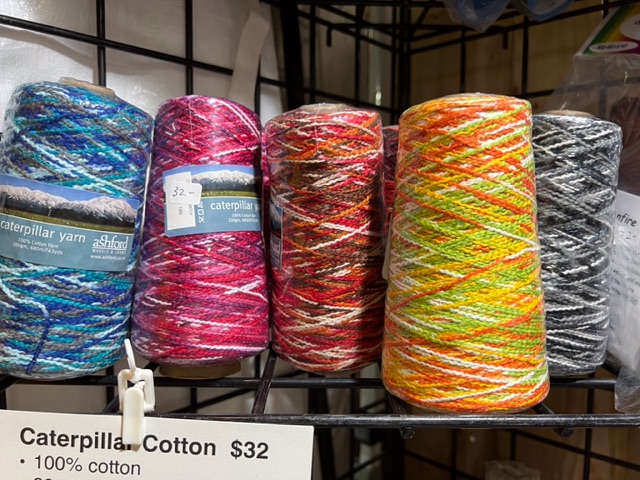
Lunatic Fringe is not open as a retail shop but I am one of their vendors and order cotton and hemp yarns and kits from them. It was fun to visit and be able to shop on-site instead of just on-line. Look at that selection!!
I was pleased to see this kit that they had just put together after I used their hemp in an article that was published in the most recent Little Looms magazine.
These are the bags I wove for the article.
This is the only photo I got of Chris and Meryl. At least they can’t accuse me of badgering them for family photos. We were walking on some trails in the hills north of Boise.
The view of the city from above.
I gave Chris and Meryl one of the cat baskets that I have been making. I think Luke is a little big for it, but I don’t expect these baskets to hold their shape once they are in use by the intended recipients.
This could be a scene from home but we don’t have any stoplights on our North Meridian.
On Thursday Chris and I went to the Idaho State Museum. It is an interesting museum and I’d go back to spend more time with some of the displays. We learned about parachuting beavers. (If you google beavers in Idaho you’ll find a few videos that explain what that’s about.)
I was amused to see this in the museum. My kids used to play a version although we didn’t have an Apple computer at the time.
Information about the number of sheep in Idaho and about women in Idaho ranching.
These are just a few many interesting displays at this museum. It would be easy to spend a few more hours there.
We drove downtown and parked so we could wander around the area.
Later we took the dogs for a ride and then a walk in natural area a friend told me about. That was an important part of my visit. I reconnected with a friend I had worked with in Utah around 1978. I last saw her when Chris was very young.
This prompted me to look back in the old photo albums to figure out when we had visited. I found this in the 1992 album. Those are my three kids in the middle, Matt, Katie, and Chris, and Joyce’s kids on the outside. Coincidentally they are named Dan and Katie, just to make things confusing. I hope to get to Boise again to visit Chris, 30 years older than in this photo, and Joyce too (maybe we’re only 15 years older?? I wish.)
I had to be home on Friday because there was a group of people coming on Saturday. So I took off Friday morning. I followed my phone’s directions to get out of Boise and for some reason ended up on the road to Elko instead of Winnemucca. That is the problem of not using real maps anymore. But it added only about an hour to the drive and I saw different country, although I don’t know where I took this photo.
This is probably Nevada. I think I got home at dark.
If you read the first post in this series you know that I started Day 1 with our first full day here. There was a travel day before that one, as is Day 6. So this would really be our seventh day away from home…just maintaining some level of accuracy.
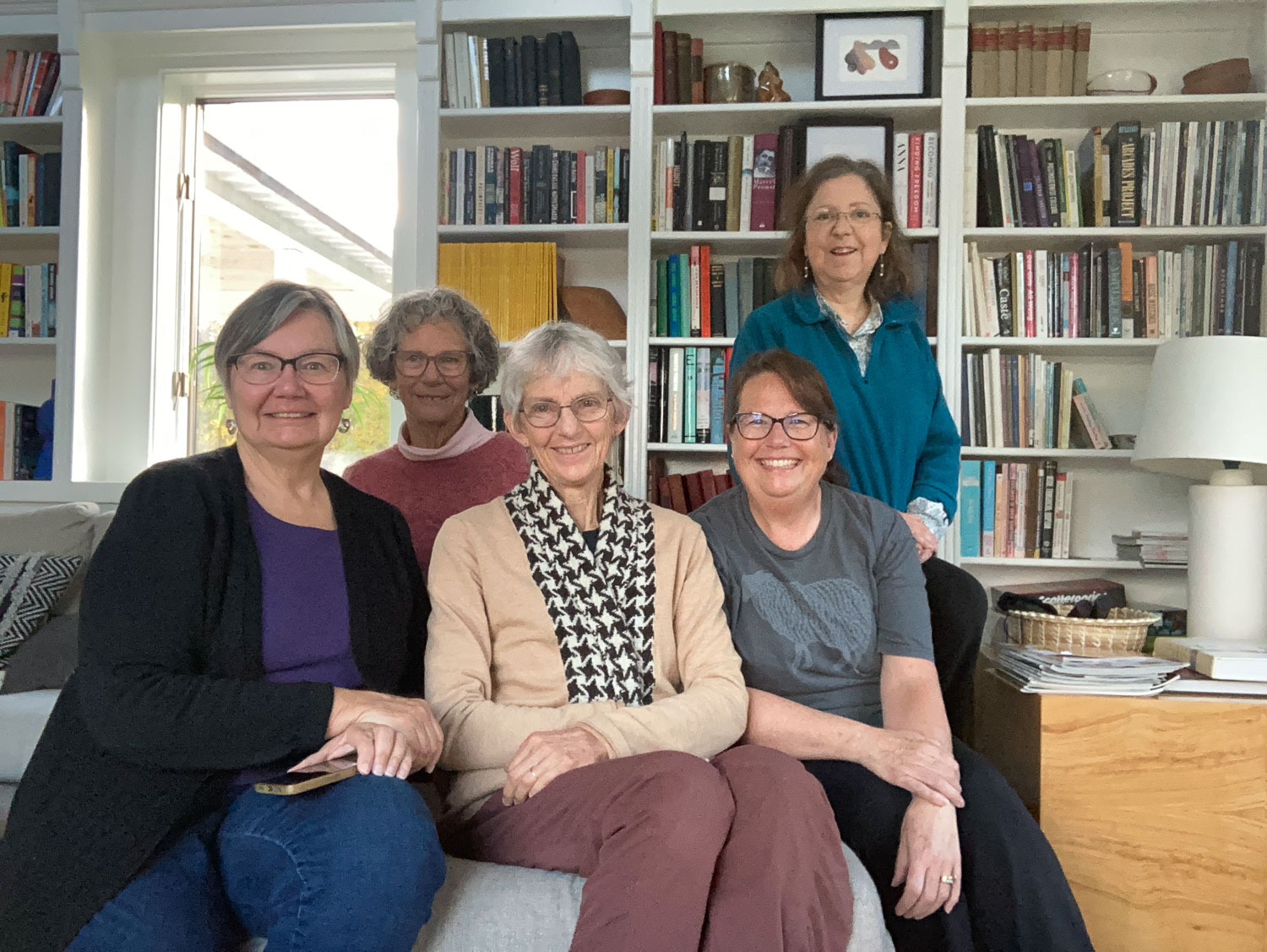
We took a group photo before we all left. The California contingent are the four of us on the left. Adrianne, on the right, stayed with us. We first met her in Maryland several years ago and have stayed in touch. She drove here from Ohio. Some of the best time on this trip was spent hanging out together in the living room and at the kitchen table.
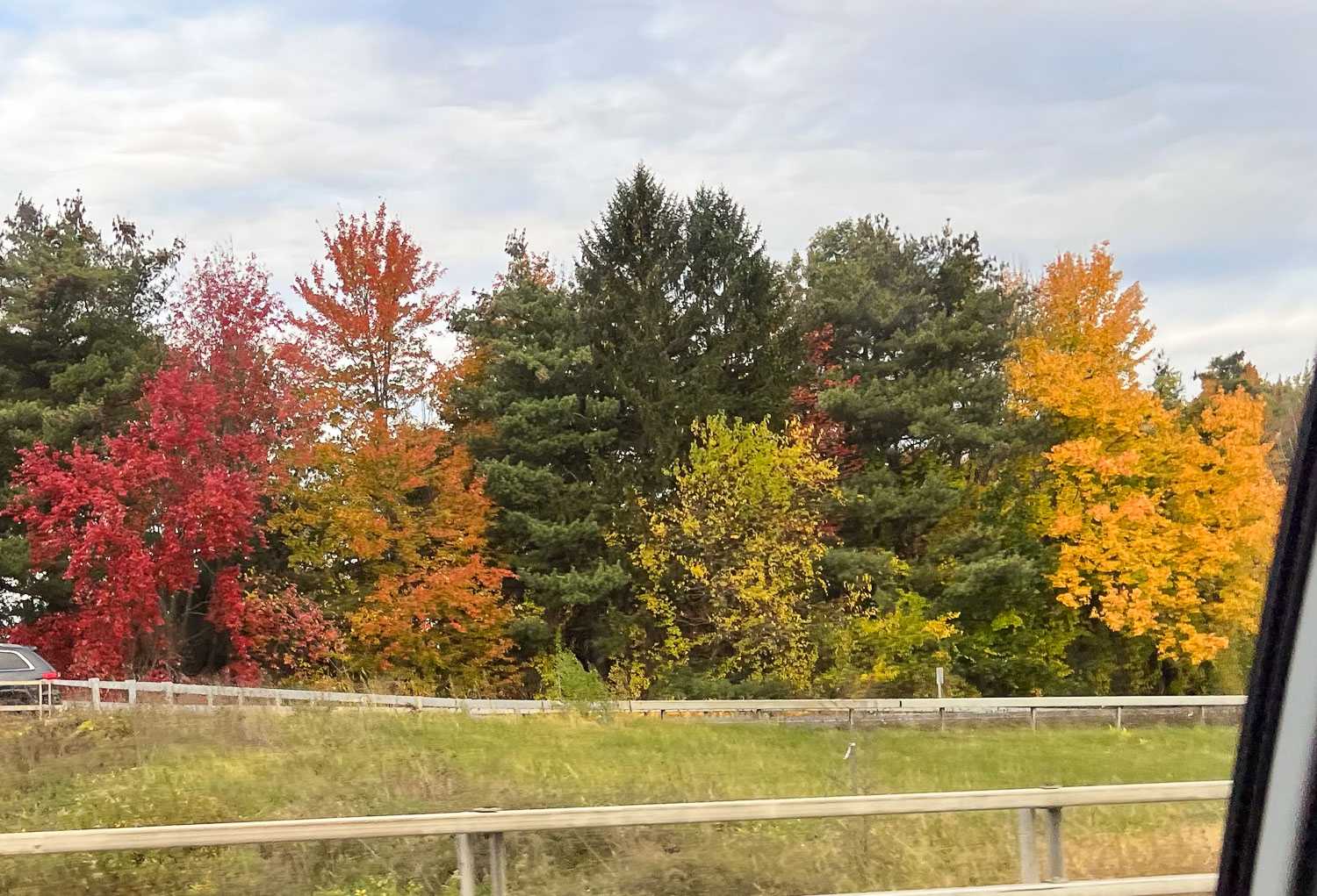
Fall color on the way to the airport.
Our travel days were easy and without incident. they were just long.
Somewhere over the mid-west.
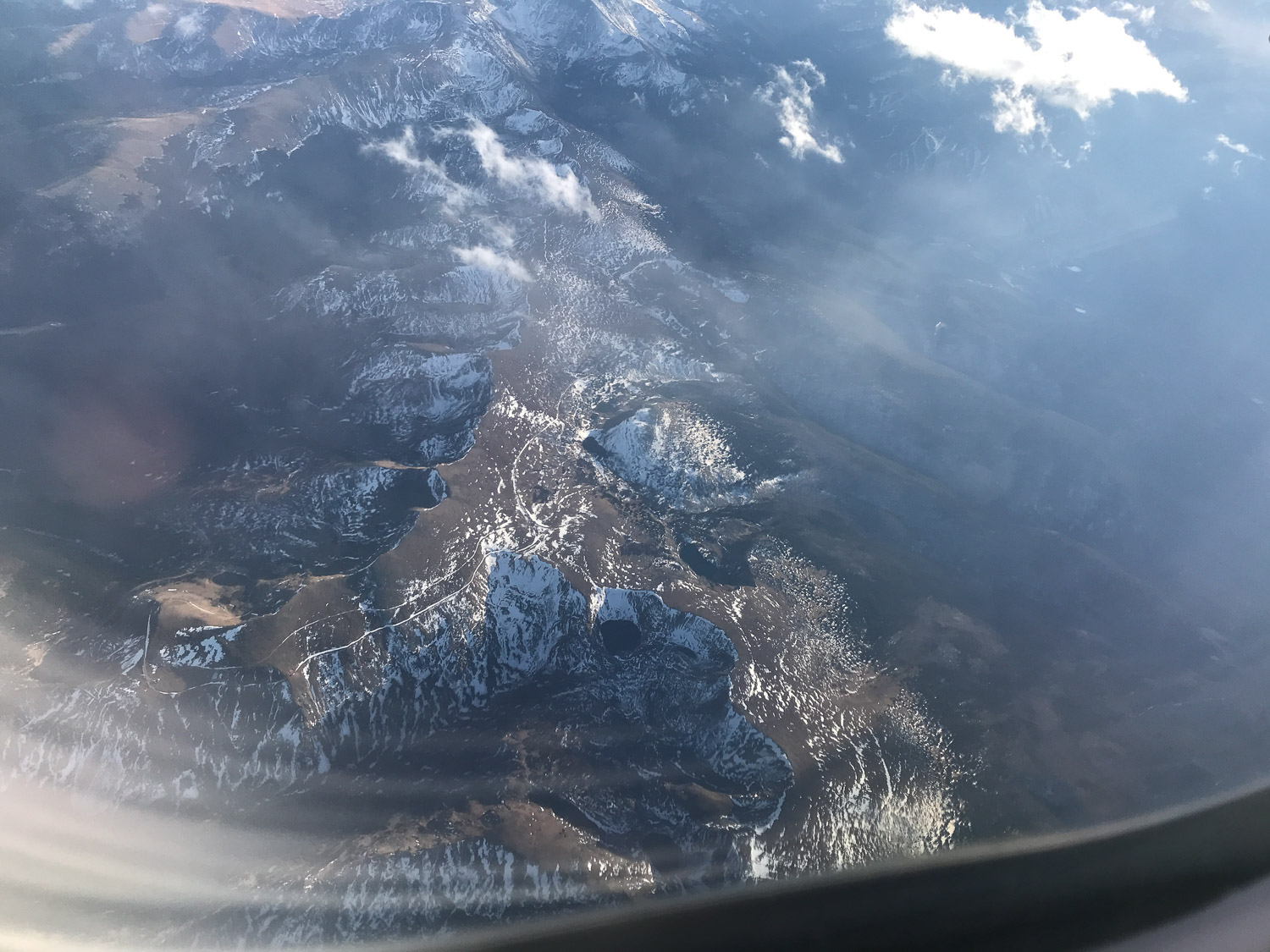
The Rockies.
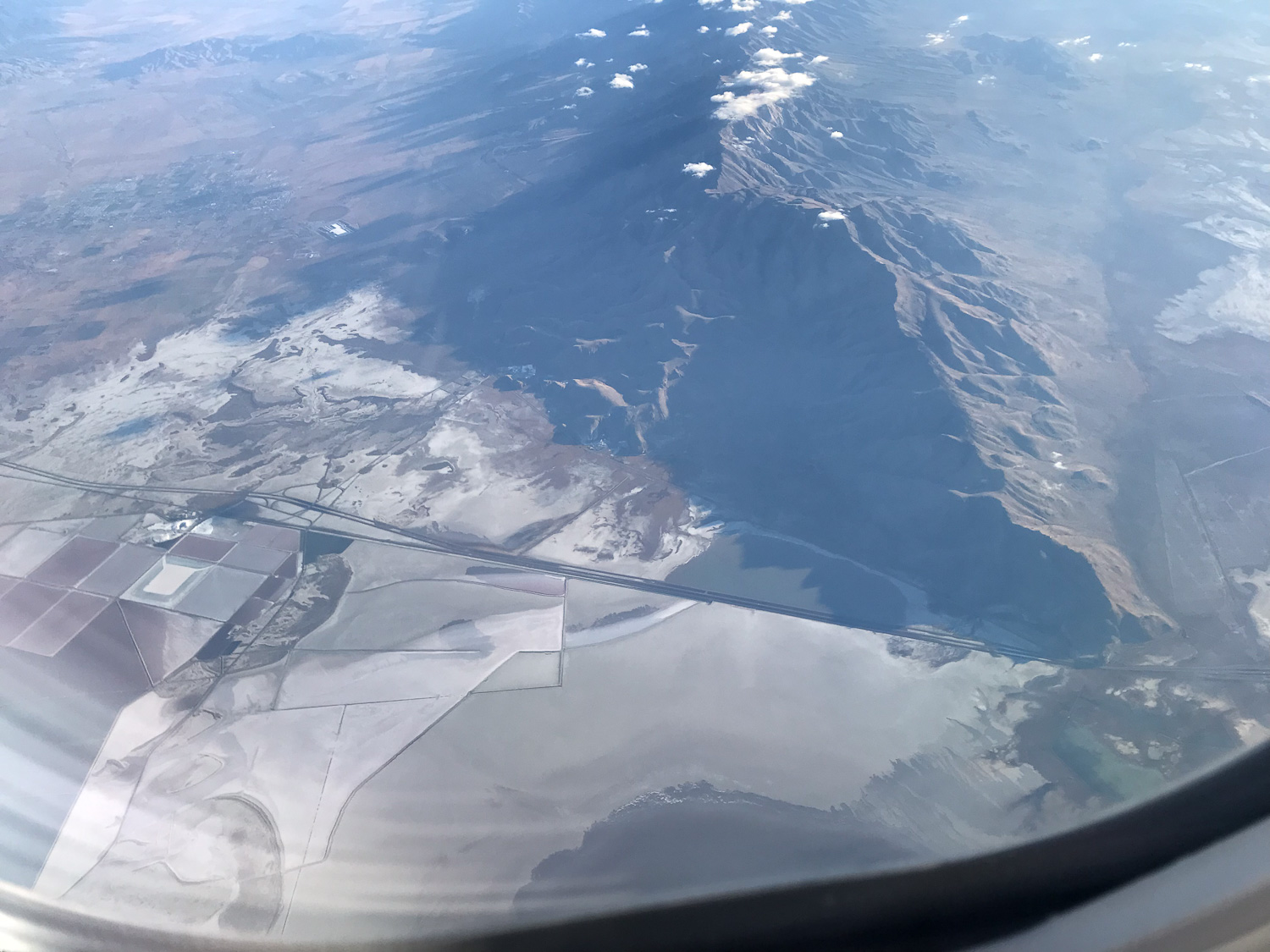
Over Salt Lake, but it’s mostly under the plane.
More of the salt flats. Some of you fly all the time and you are used to seeing this. I don’t see this often and I like getting this perspective
Lake Tahoe and the Sierras. That means we’re almost home.
When we see the fields of the Central Valley it means we are home. Aren’t those beautiful patterns?
Those hills just under the sunset are “my hills”. Our farm is in the valley just east of the lower hills.
This post is about Day 4 of our adventure, but Day 1 of the New York Sheep and Wool Festival. This was to be our last full day in New York and the second day of the festival. Even with spending all day Saturday at the festival I hadn’t seen it all.
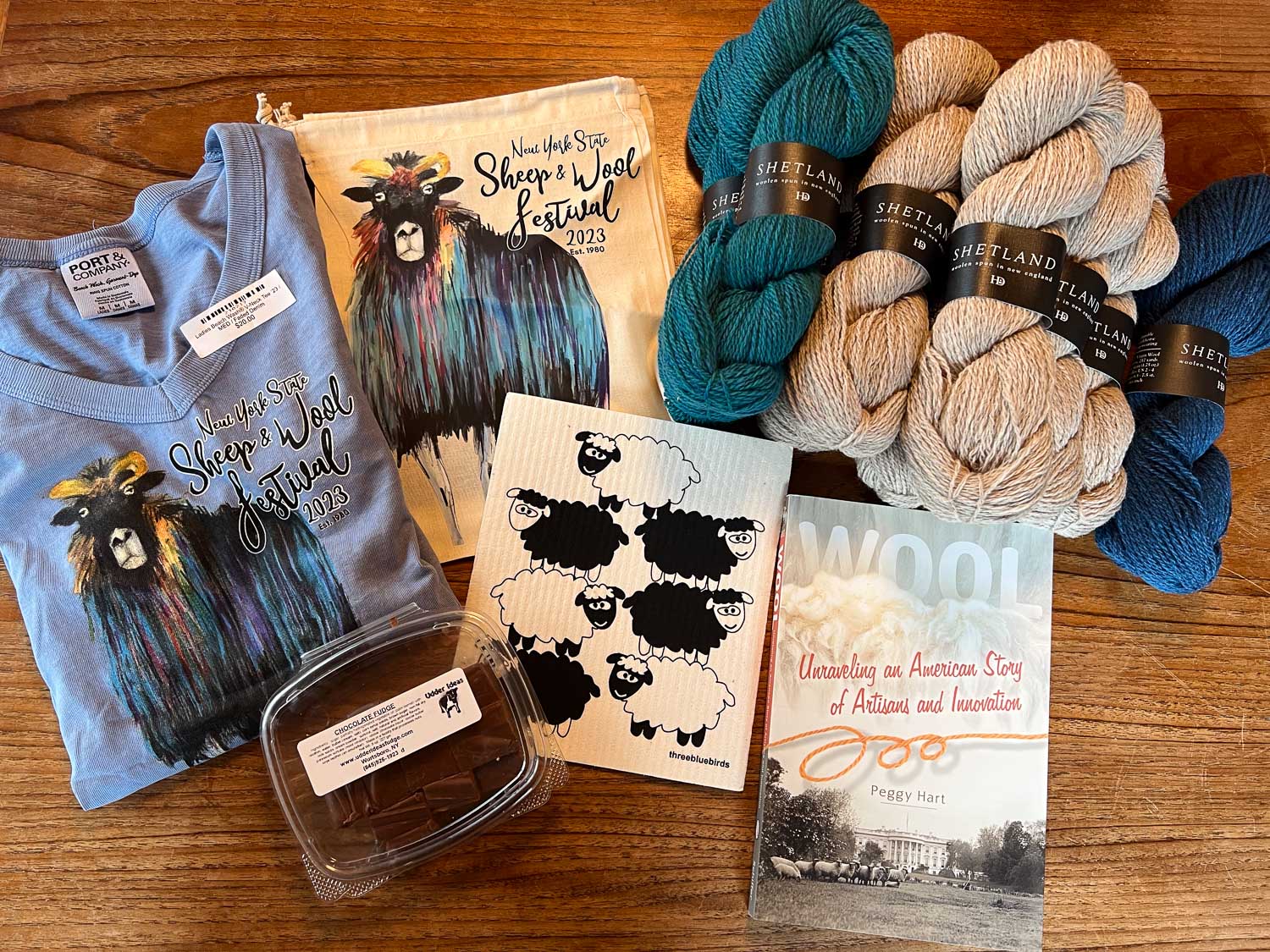
I got in line right away to buy a t-shirt and the person behind me had a companion with her wearing his own Rhinebeck Sweater, knit by his friend. The t-shirt line was relatively short when I got there, and fortunately there was one 2023 t-shirt left and it fit me.
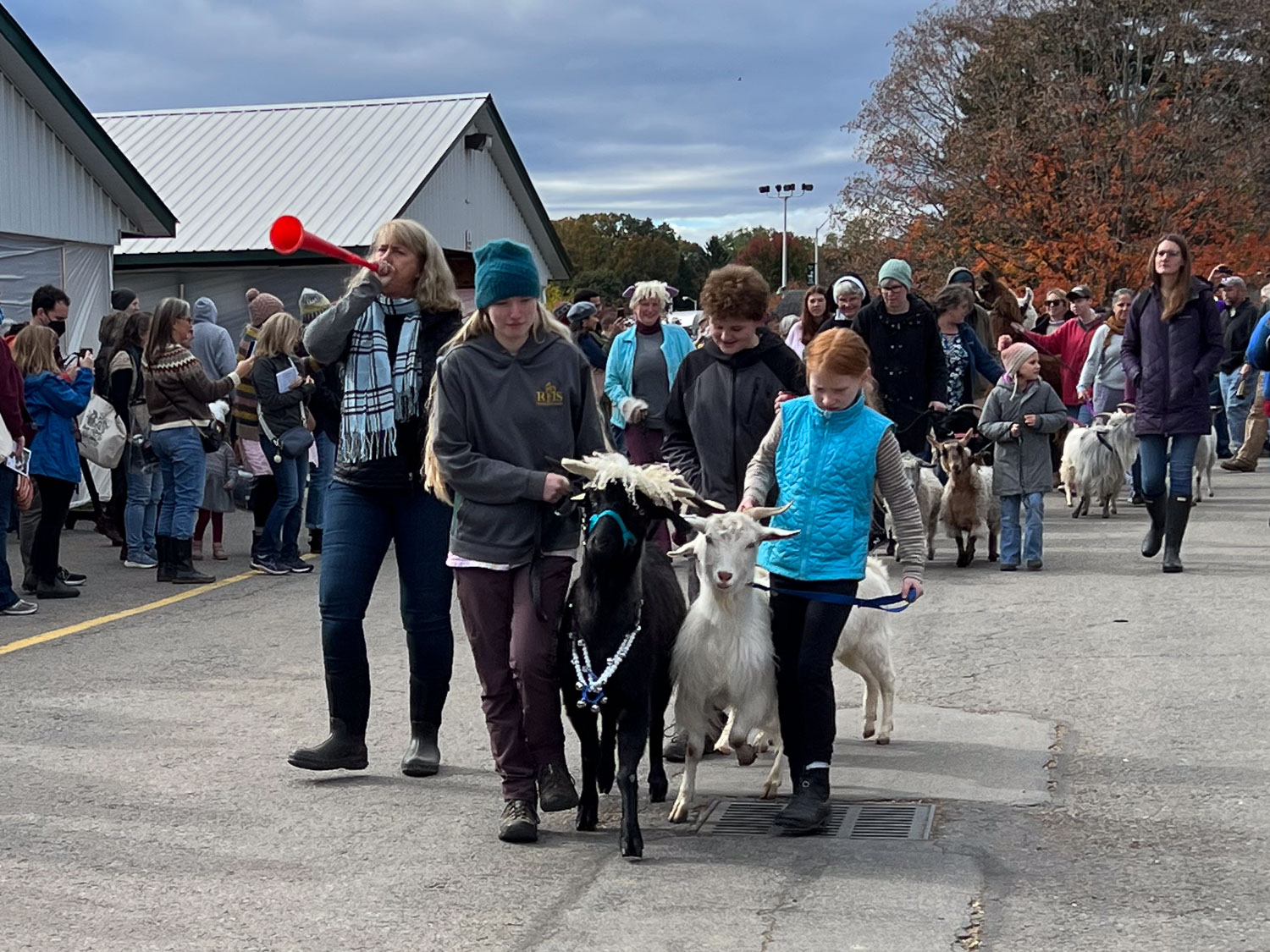
The camelid parade had turned into a goat parade on this day (with llamas in the back). They were announced by the trumpeter throughout the parade around the fairgrounds.
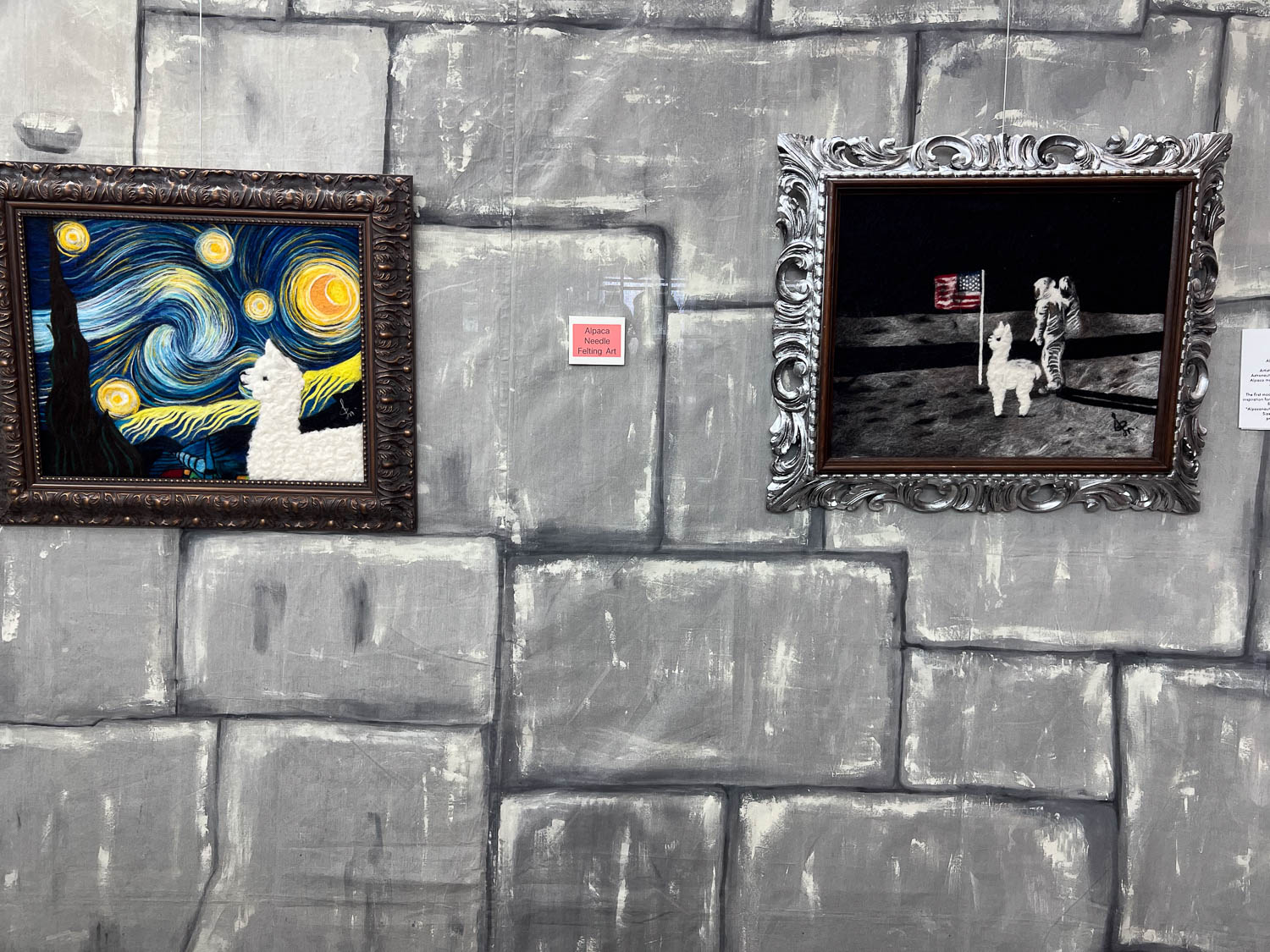
Back in the vendor halls there was no shortage of camelids, particularly alpacas. This booth had reproductions of several famous images and each included an alpaca.
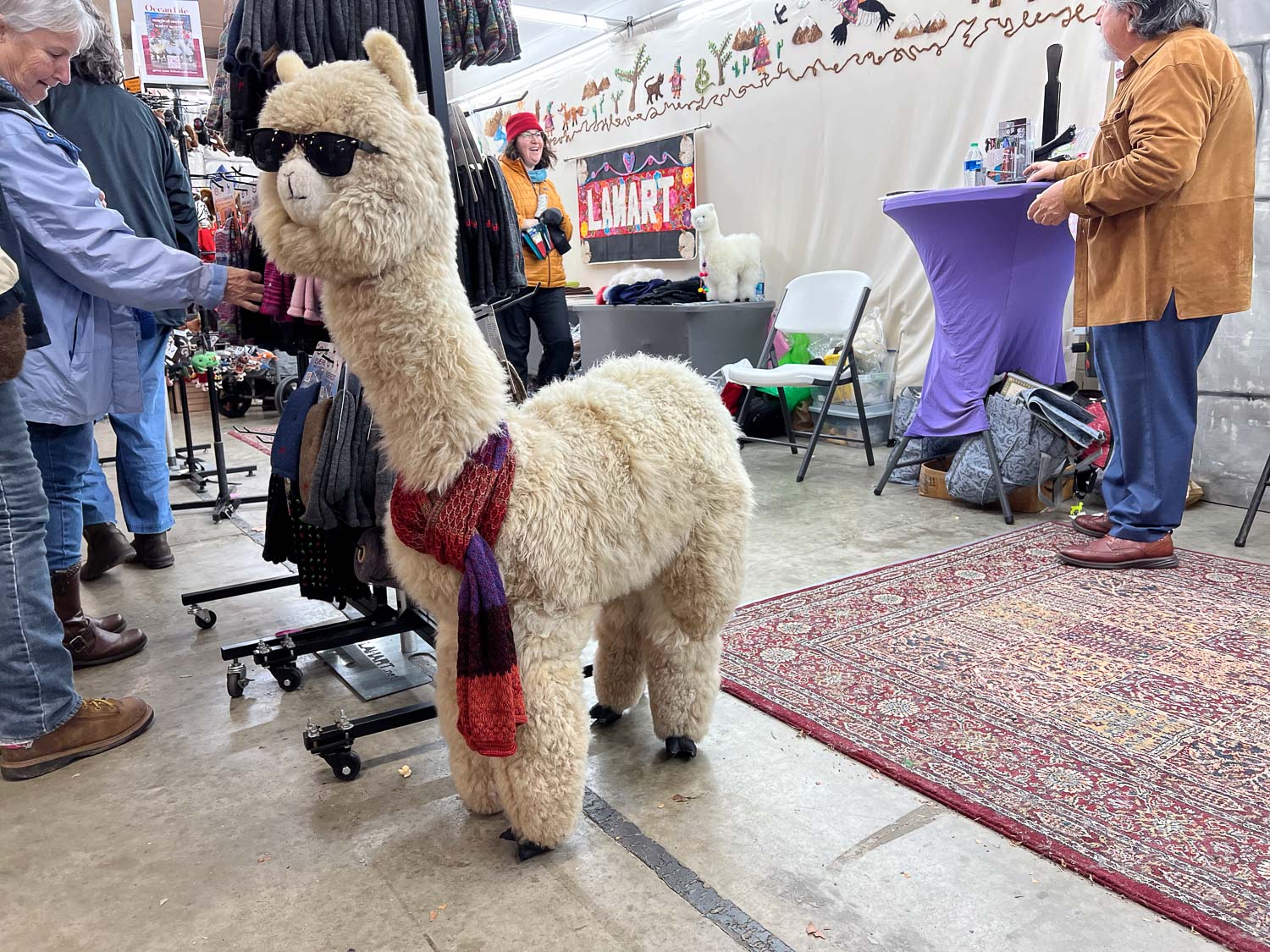
Here was a stylish alpaca.
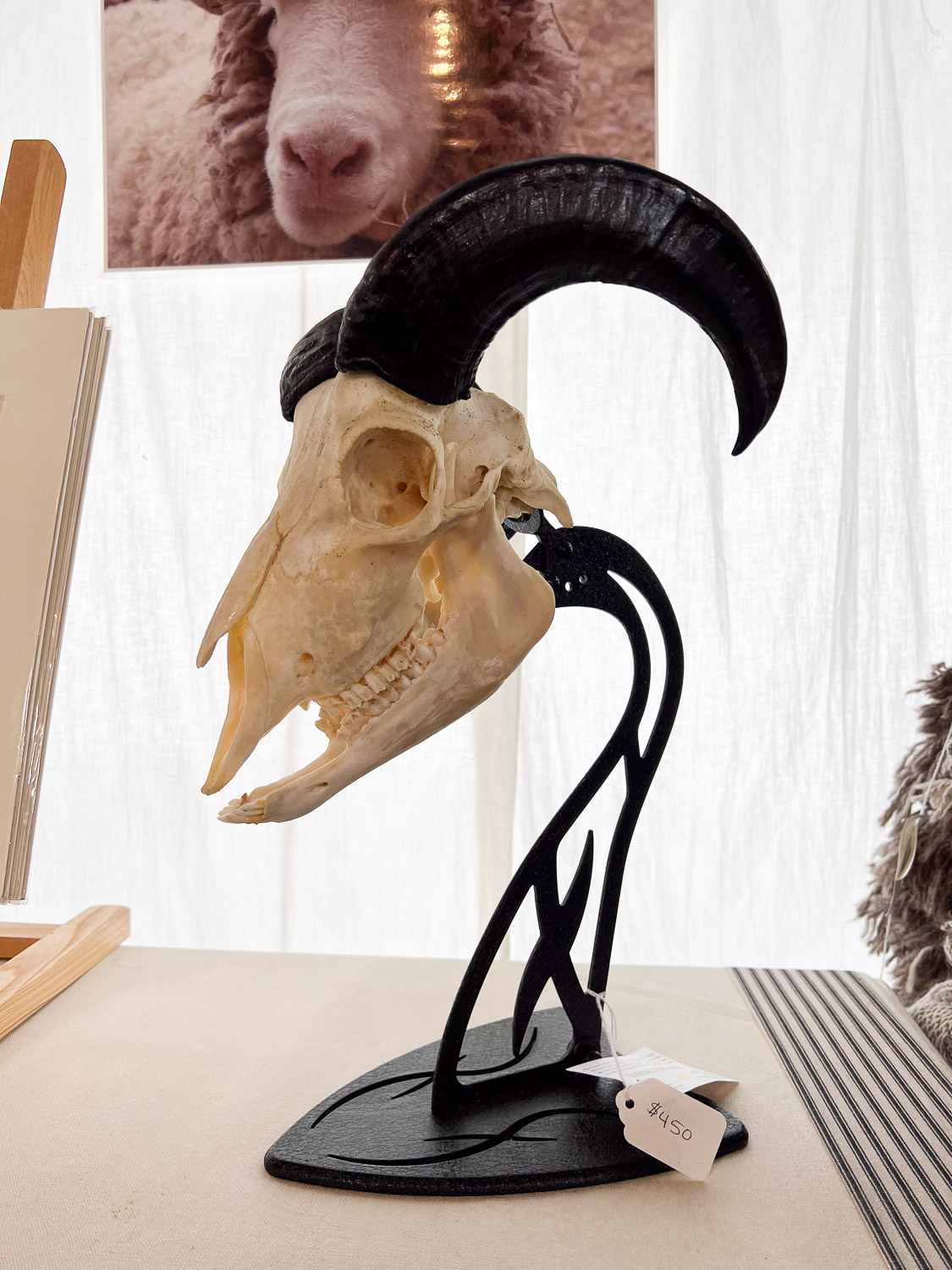
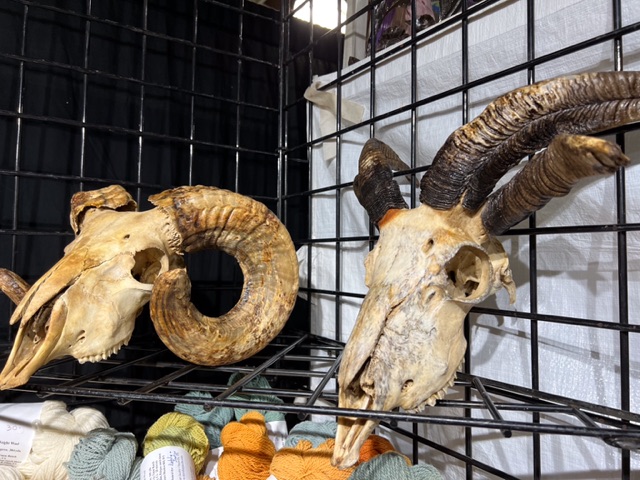
I had just sold four Jacob skulls at Lambtown, butfor a lot less than this one. However they weren’t nearly as clean, didn’t include the lower jawbone, and didn’t have a cool stand to hold them. You get what you pay for.
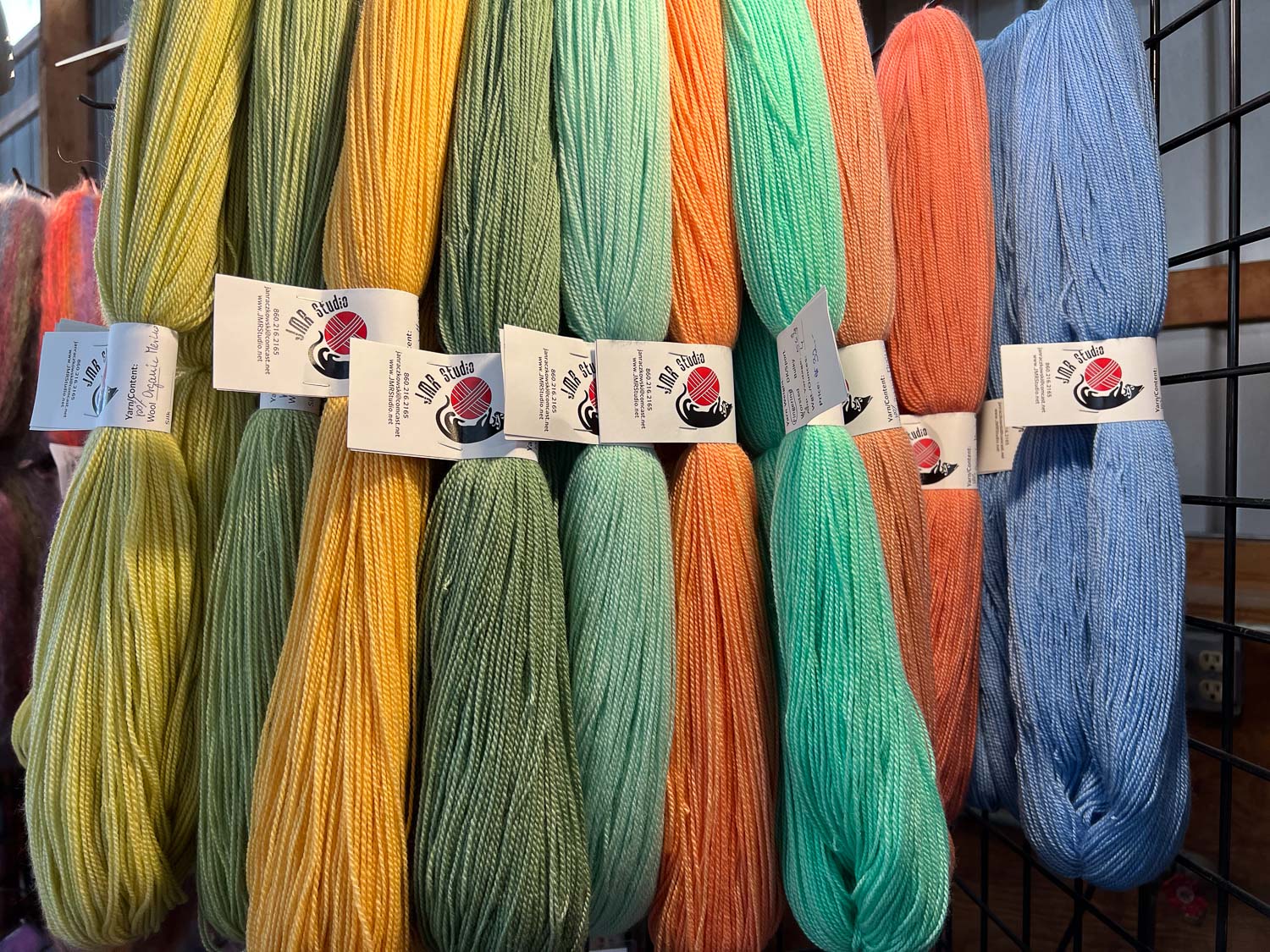
I considered these yarns to finish up the projects for my upcoming Handwoven article. As much as I liked them, I couldn’t see them in that project. That’s when I went back to the Harrisville Design yarn (yesterday’s post) and ended up with that yarn.
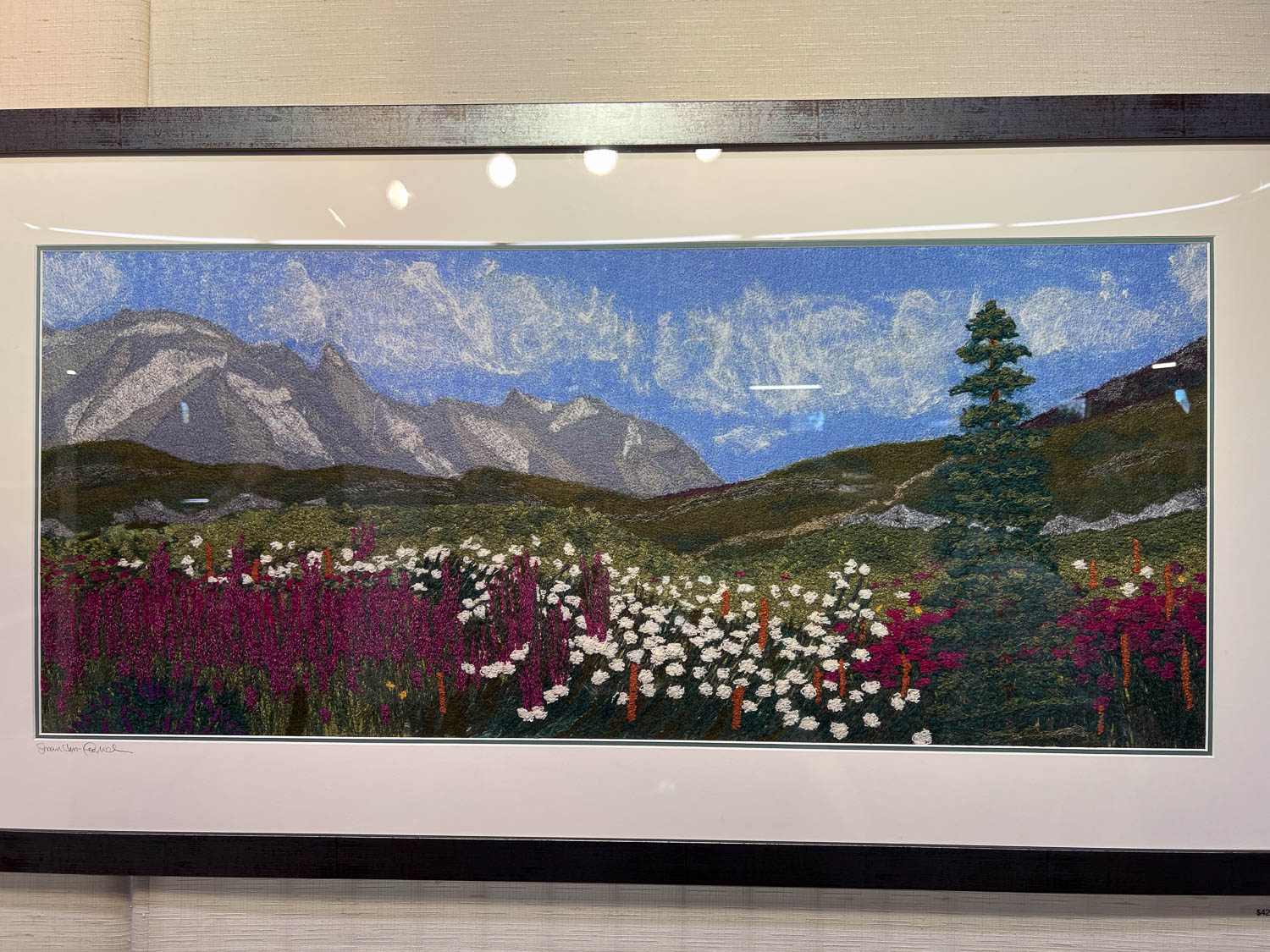
This booth had felted and needle-work embellished artwork.
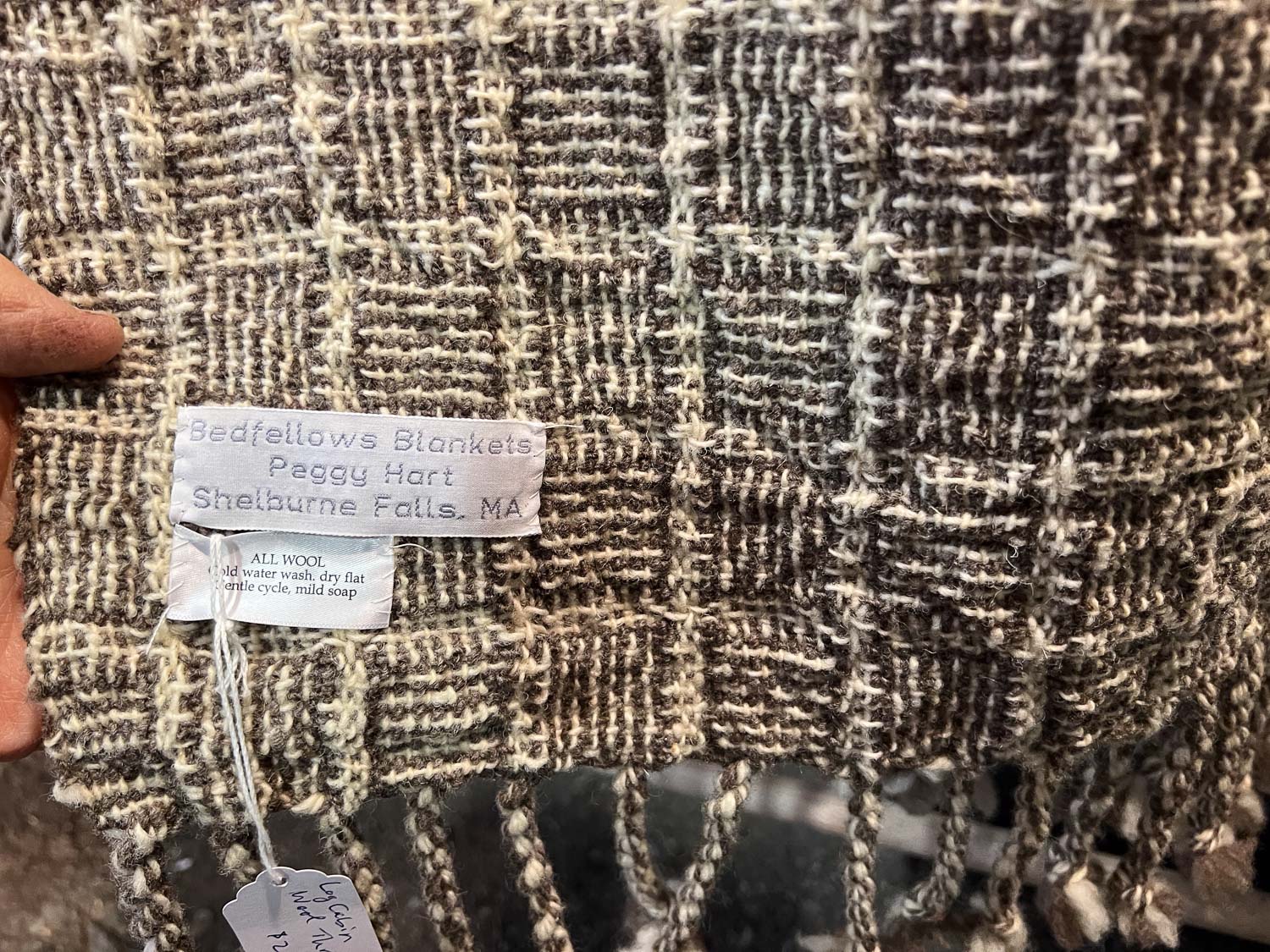
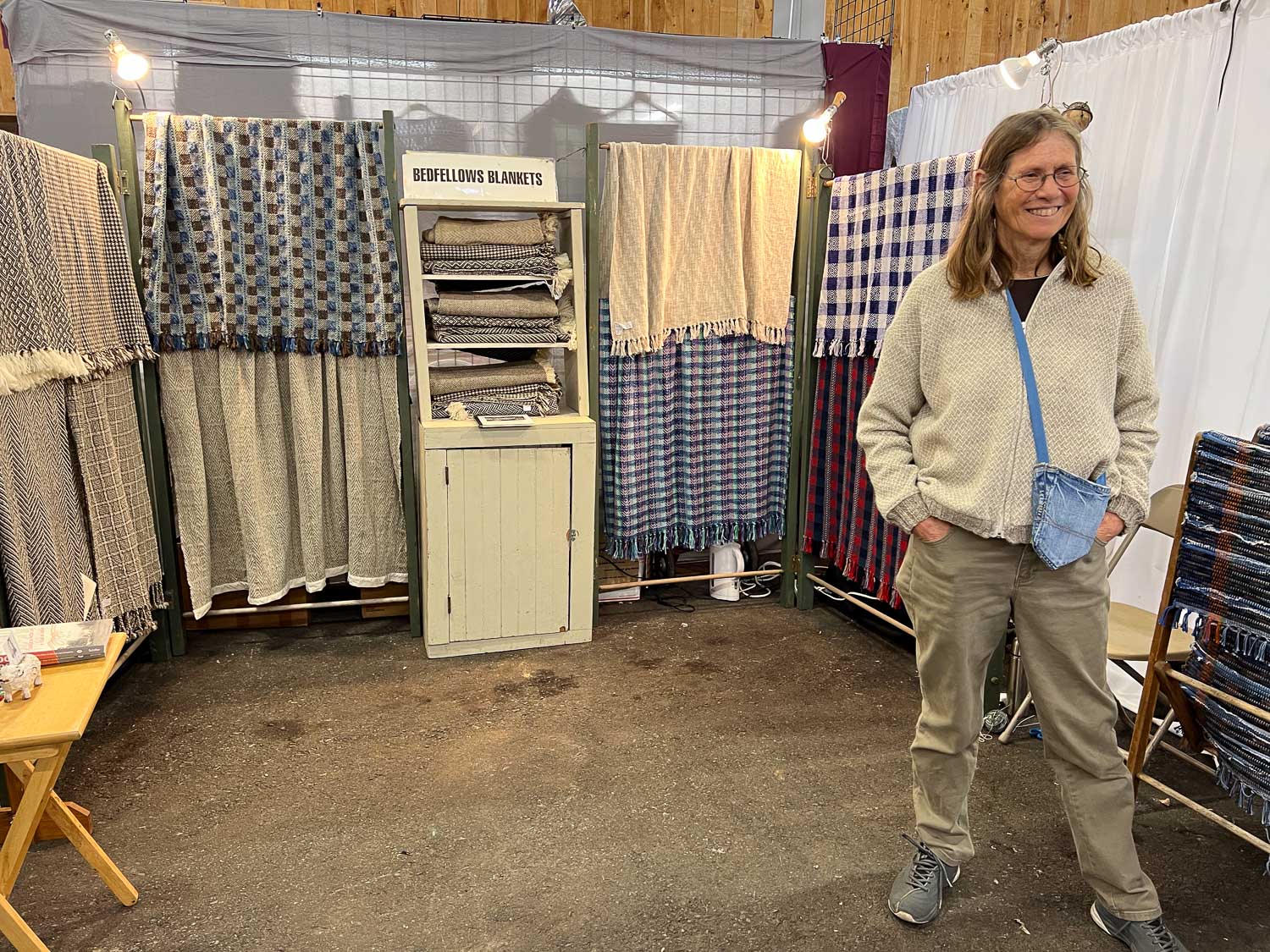
I had seen blankets in other booths that were woven using singles yarn and I noticed the same in this booth. I was thinking was about how different they look than what I weave. I think that each weaver has a style and these blankets looked like I had seen in other booths.
I talked to Peggy Hart, the weaver here, and she said that she had probably woven all those other blankets that I saw. She custom weaves for sheep owners who market their fiber and yarn, but don’t weave it themselves. I saw that she had also written a book about weaving and wool in America, and I bought a copy.
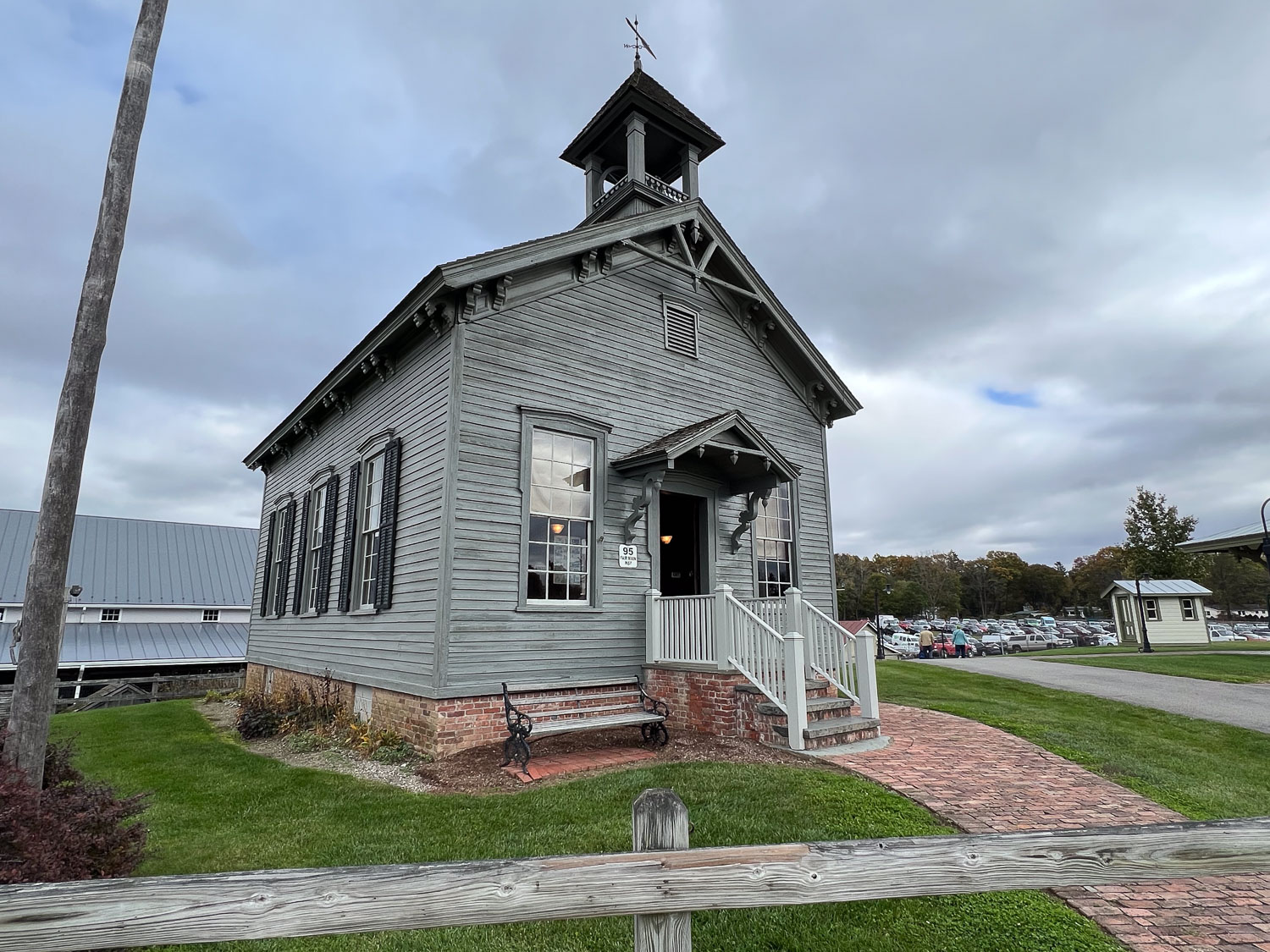
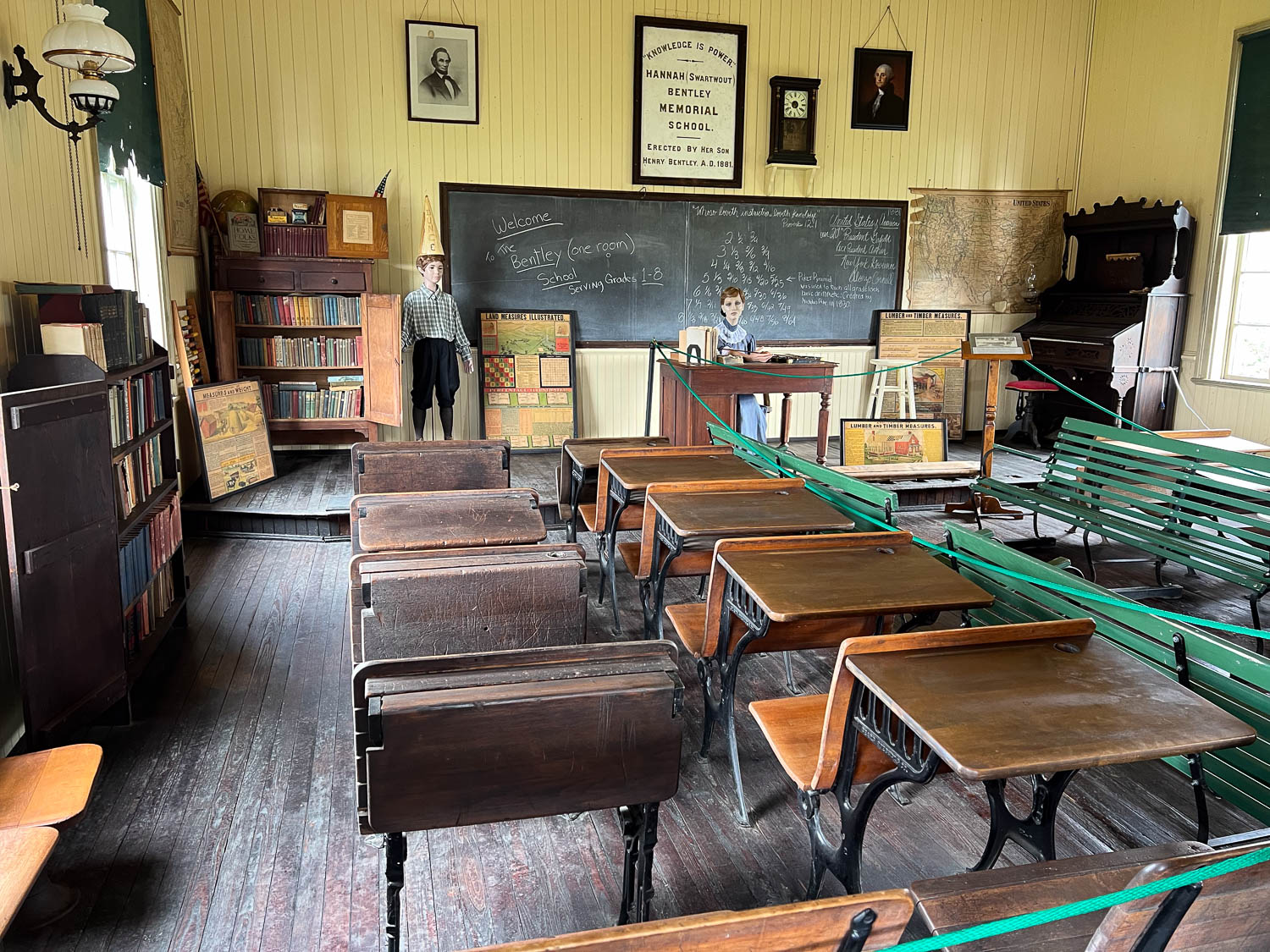
I had seen all the vendors and wandered over to some of the other buildings on the fairgrounds. This is the Bentley one-room schoolhouse, built in 1881, and relocated to the fairgrounds in 2003.
Many of the furnishings are original.
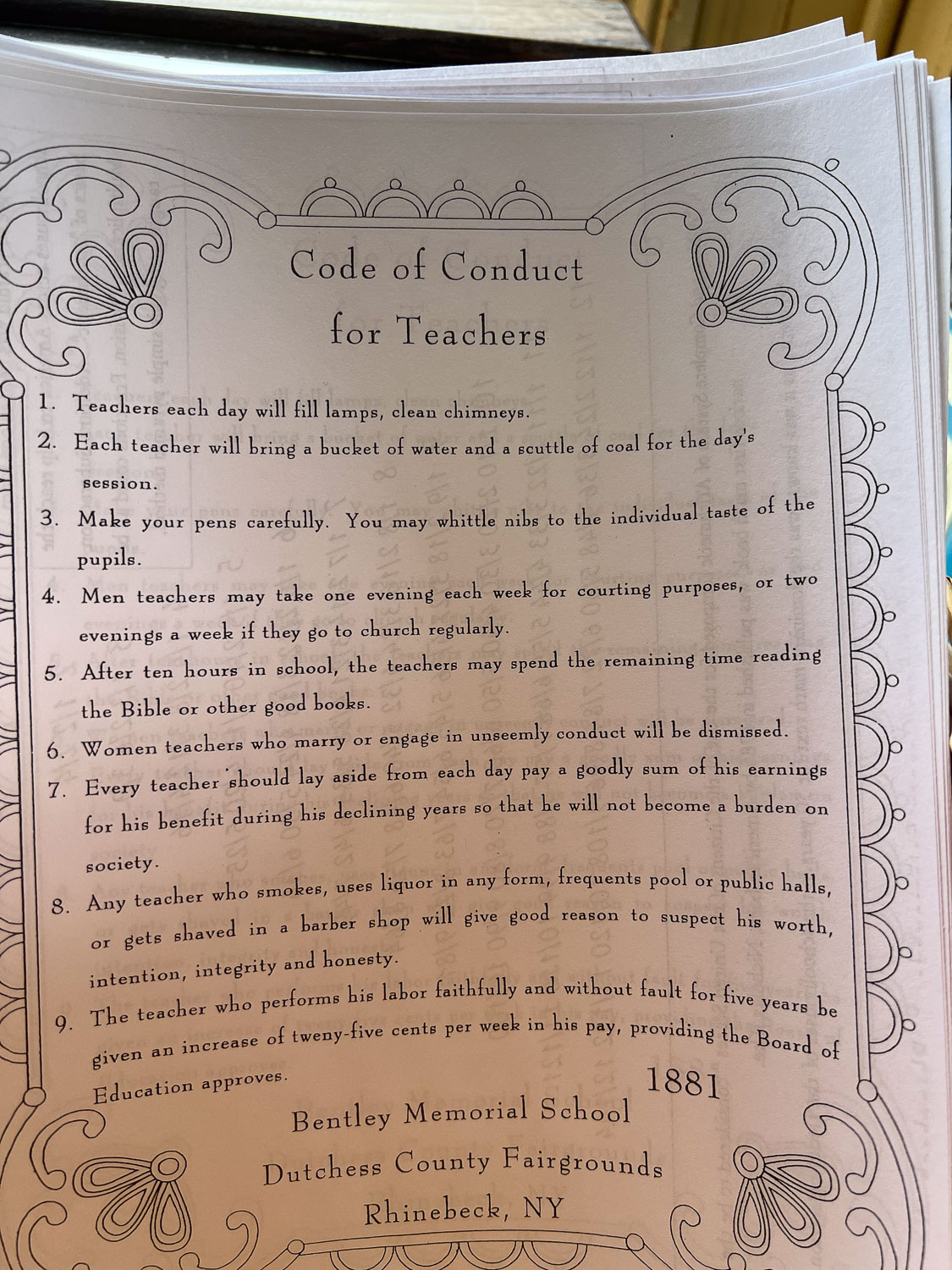
Teacher Code of Conduct.
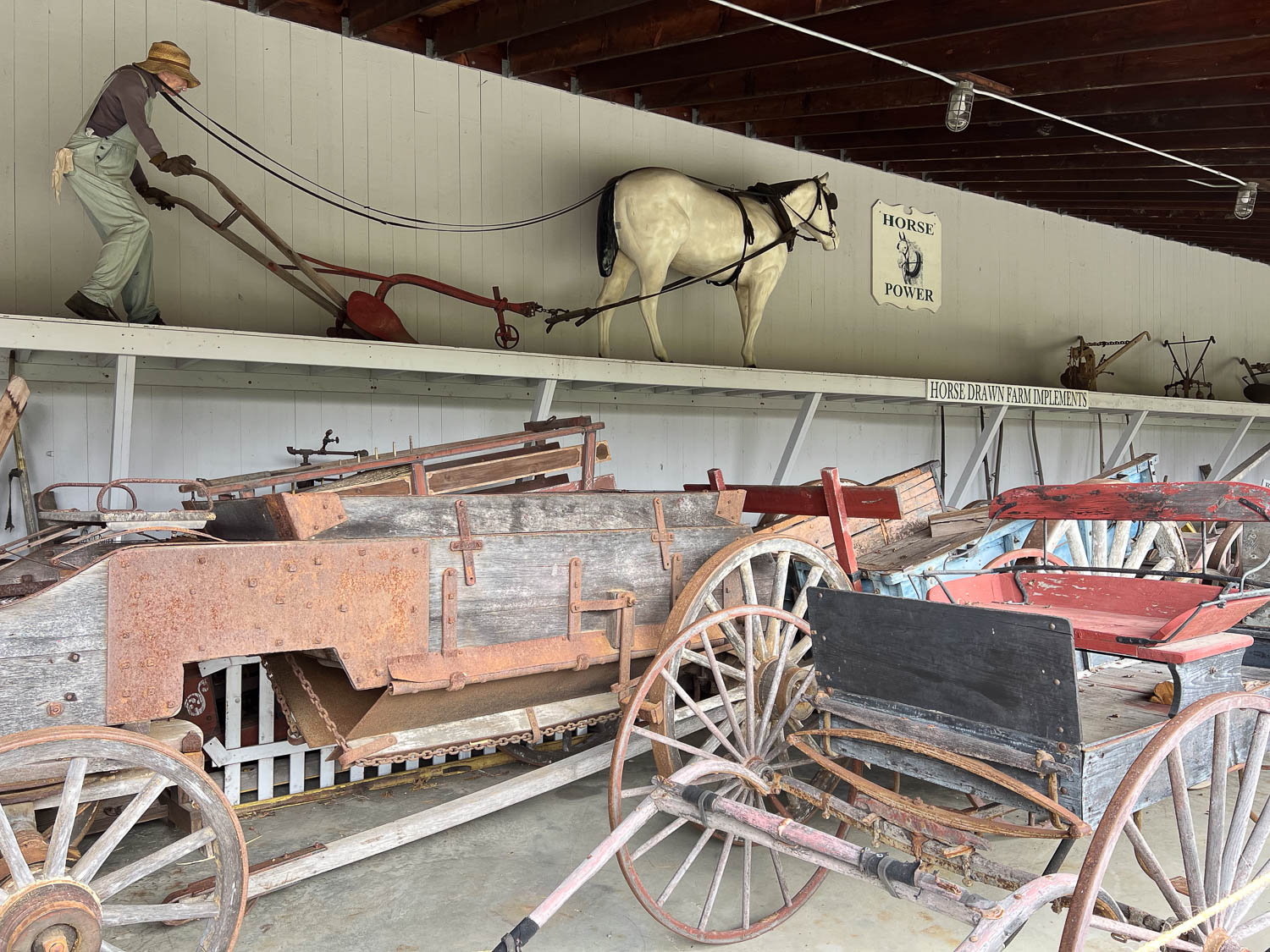
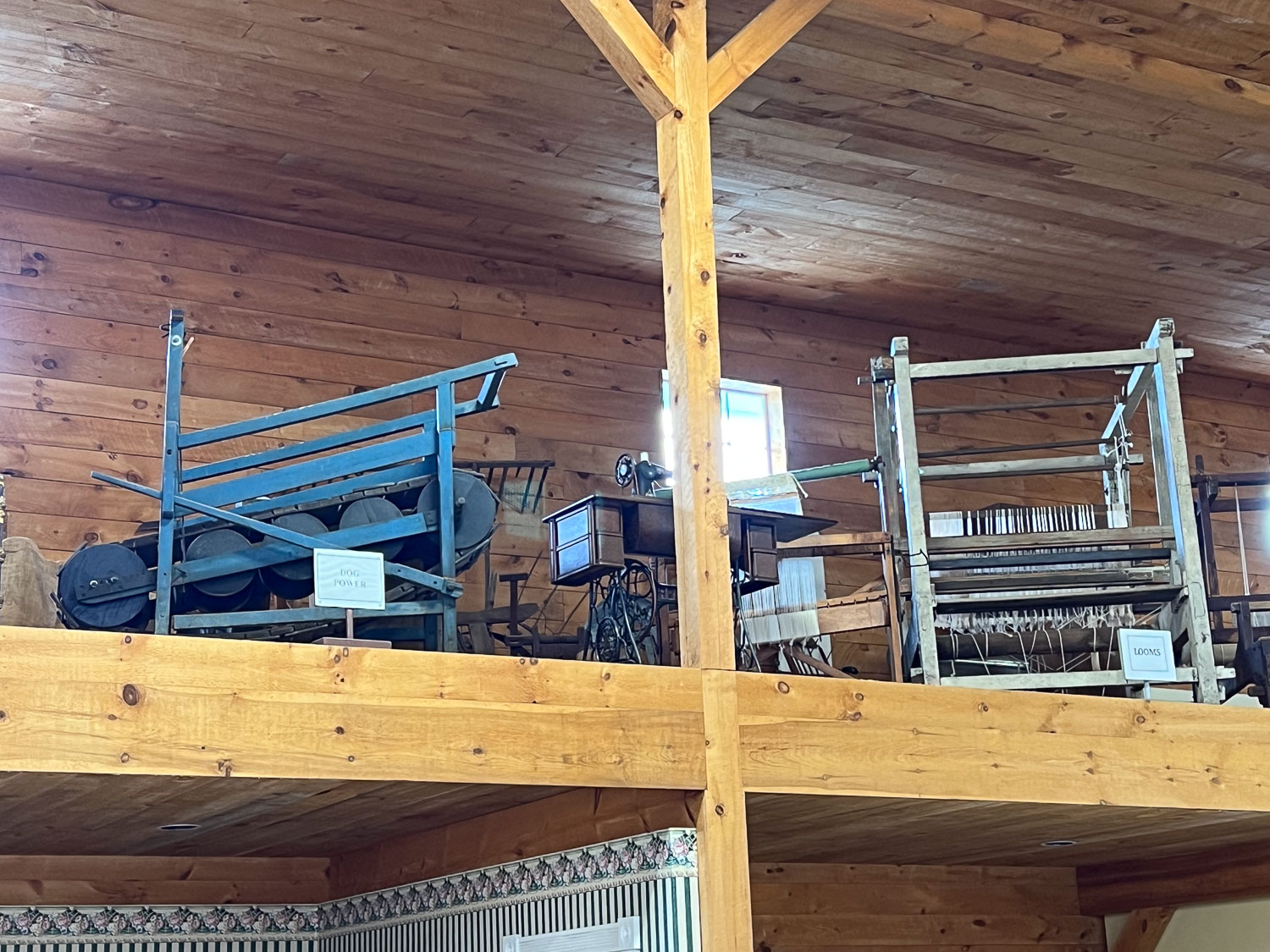
There is also a Century Museum, a large building filled with lots of displays of old equipment. There is a club that staffs this building during events at the fairgrounds and many were on hand to talk about their various areas of interest.
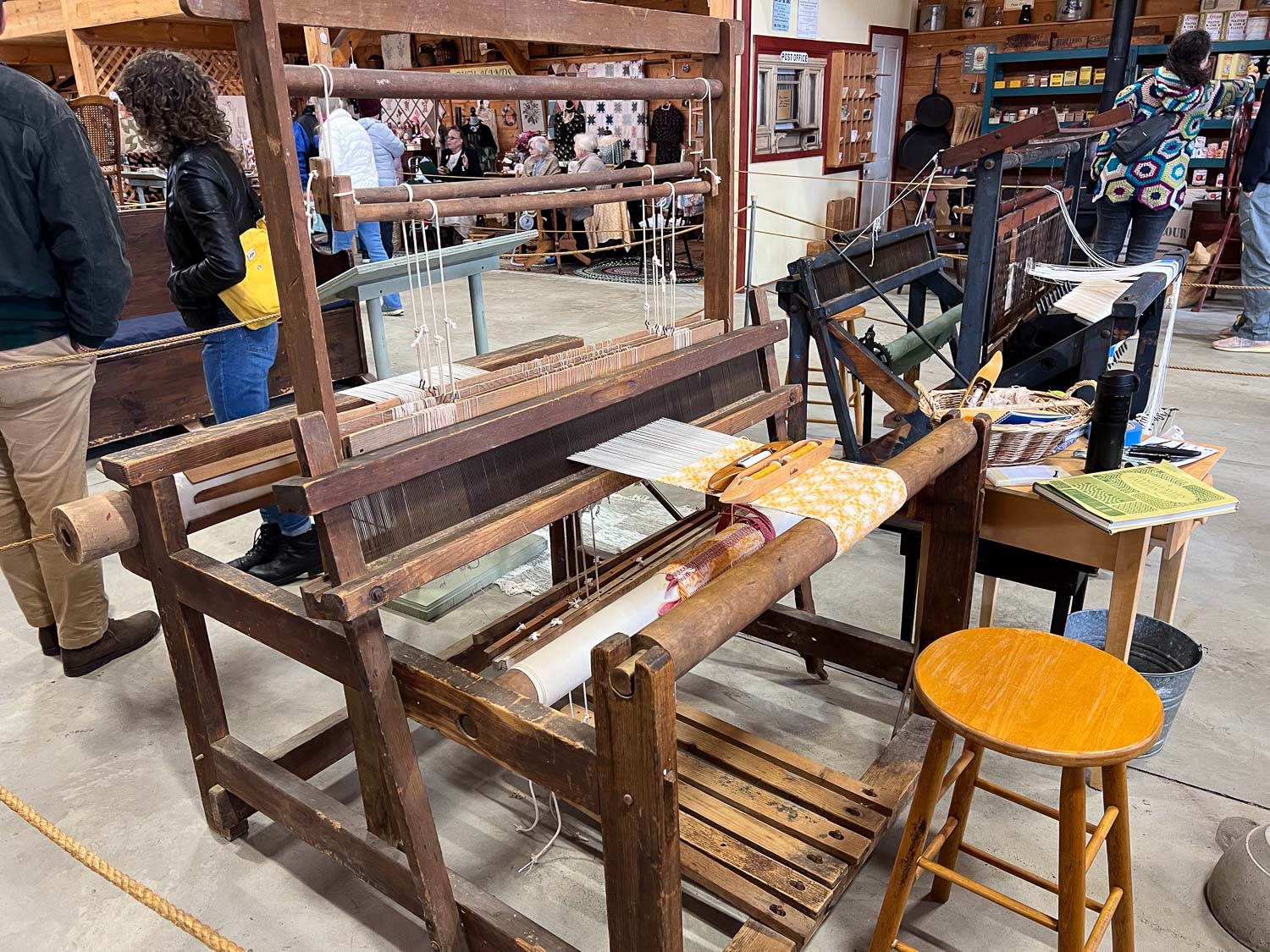
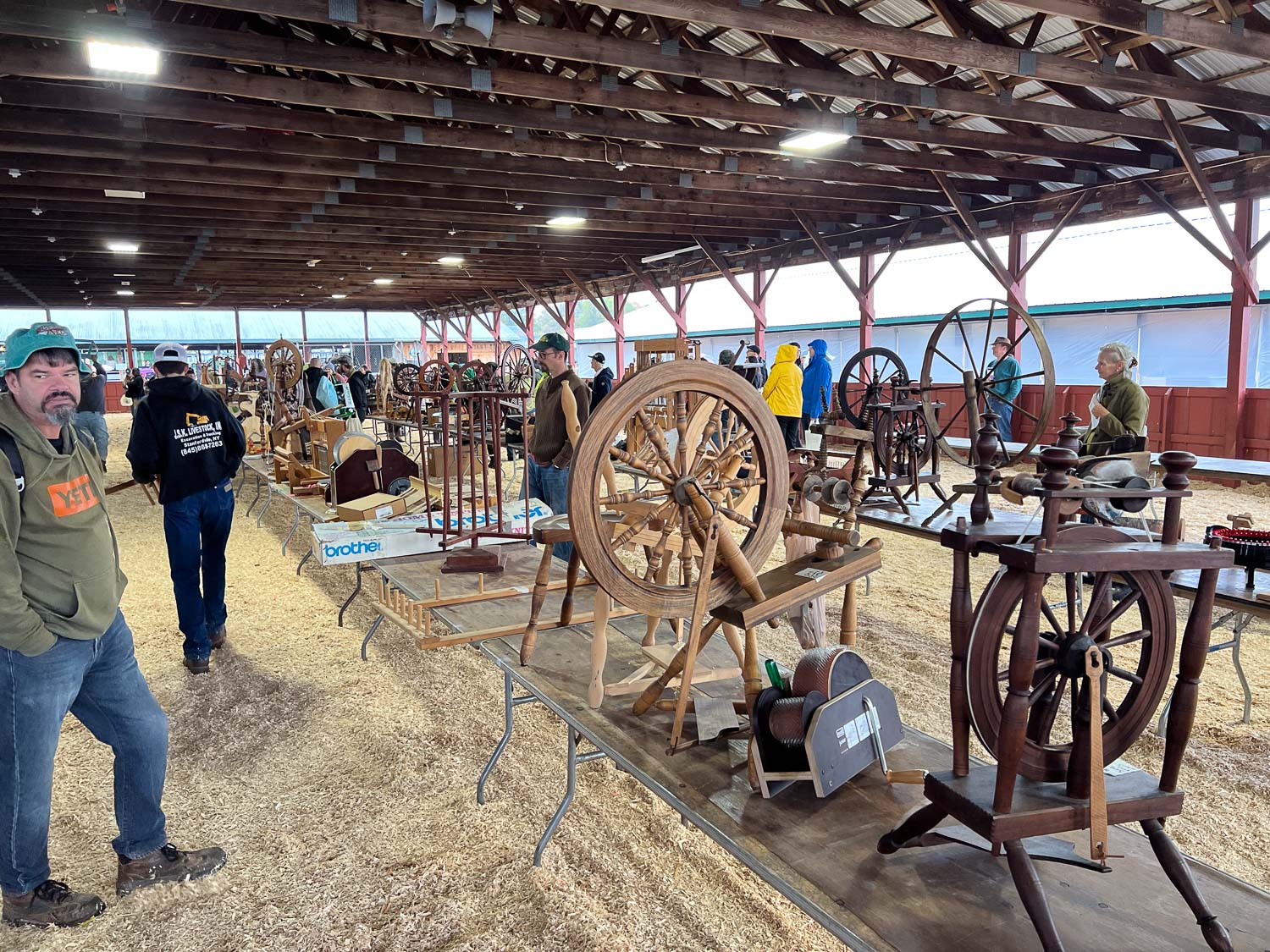
I talked to the weaver here about the action of the counter-balanced loom. I was amused to see a newer copy of the old Davison book that we all use.
The sign on that blue treadmill on the left says Dog Power. There was another with a huge stuffed dog in it. Notice several other looms and an old treadle sewing machine on this level.
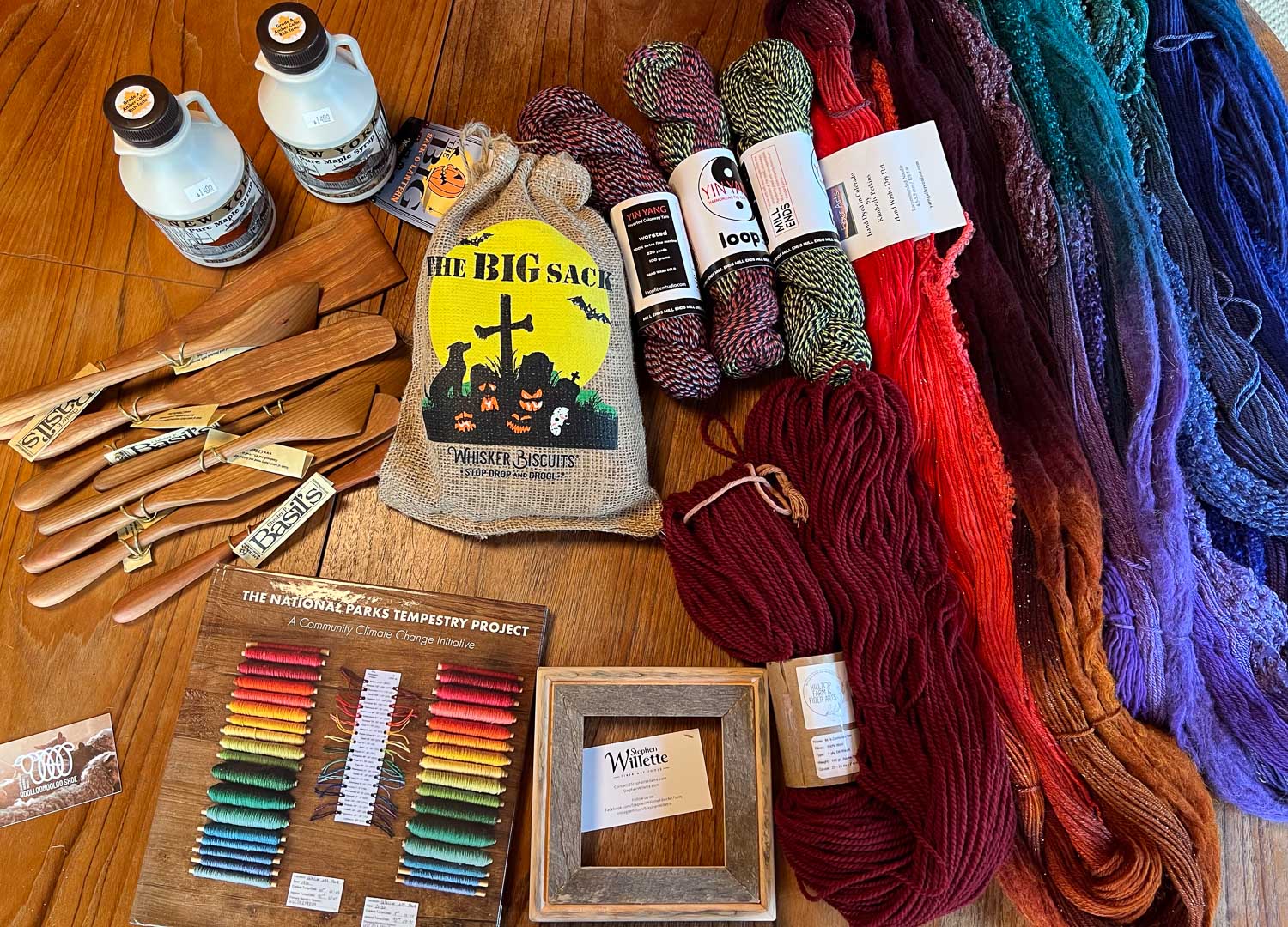
Back “home” we shared the day’s purchases.
One day left to this adventure, but it was a travel day.
I was thinking that I’d been back from our New York trip for a couple of weeks and I still haven’t finished my blog posts. I just checked the calendar and it’s been just over a week, so maybe I’m not that behind. The last post I wrote is here. Now it’s time for the main event. We made this trip to attend the event that everyone in the fiber world just refers to as Rhinebeck. The location is Rhinebeck but the event is the New York Sheep and Wool Festival. According to a 2022 source cited in Wikipedia the festival draws 30,000 visitors and has 300 vendors.
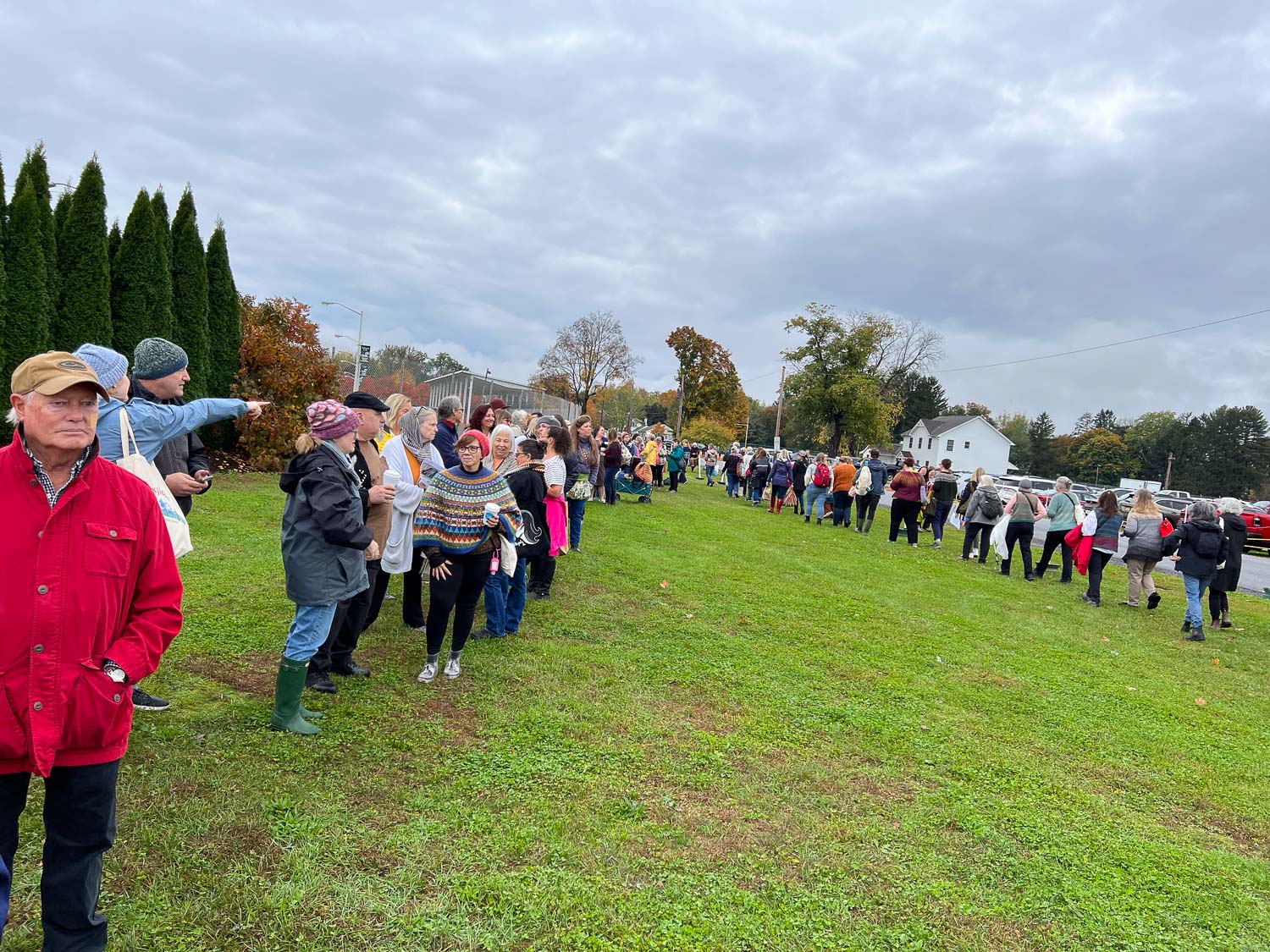
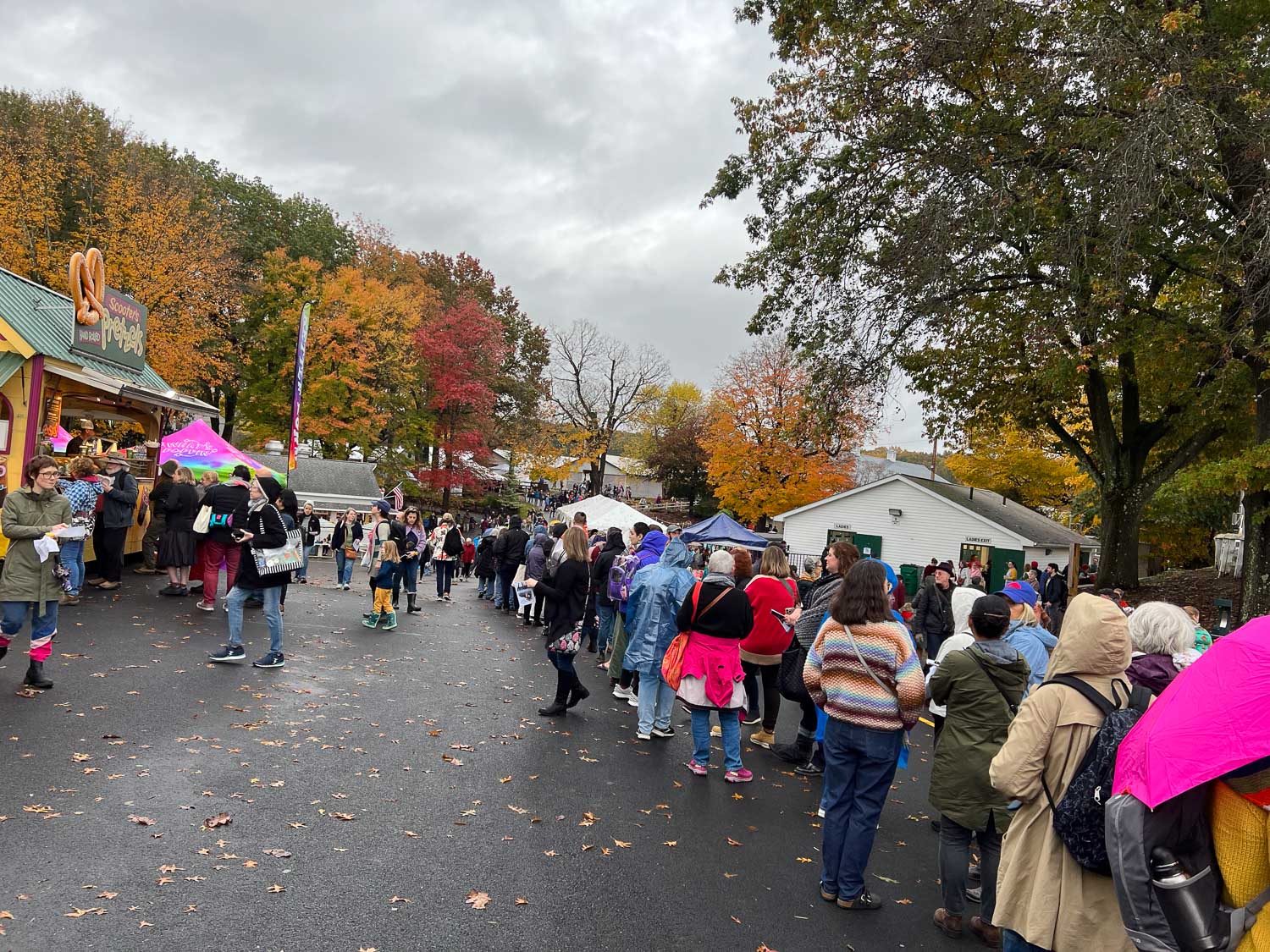
We had heard about the long lines of people and of traffic. Wanting to avoid lines we got there over an hour early. We thought we would wait in the car but people were lining up. We got in line near the front.
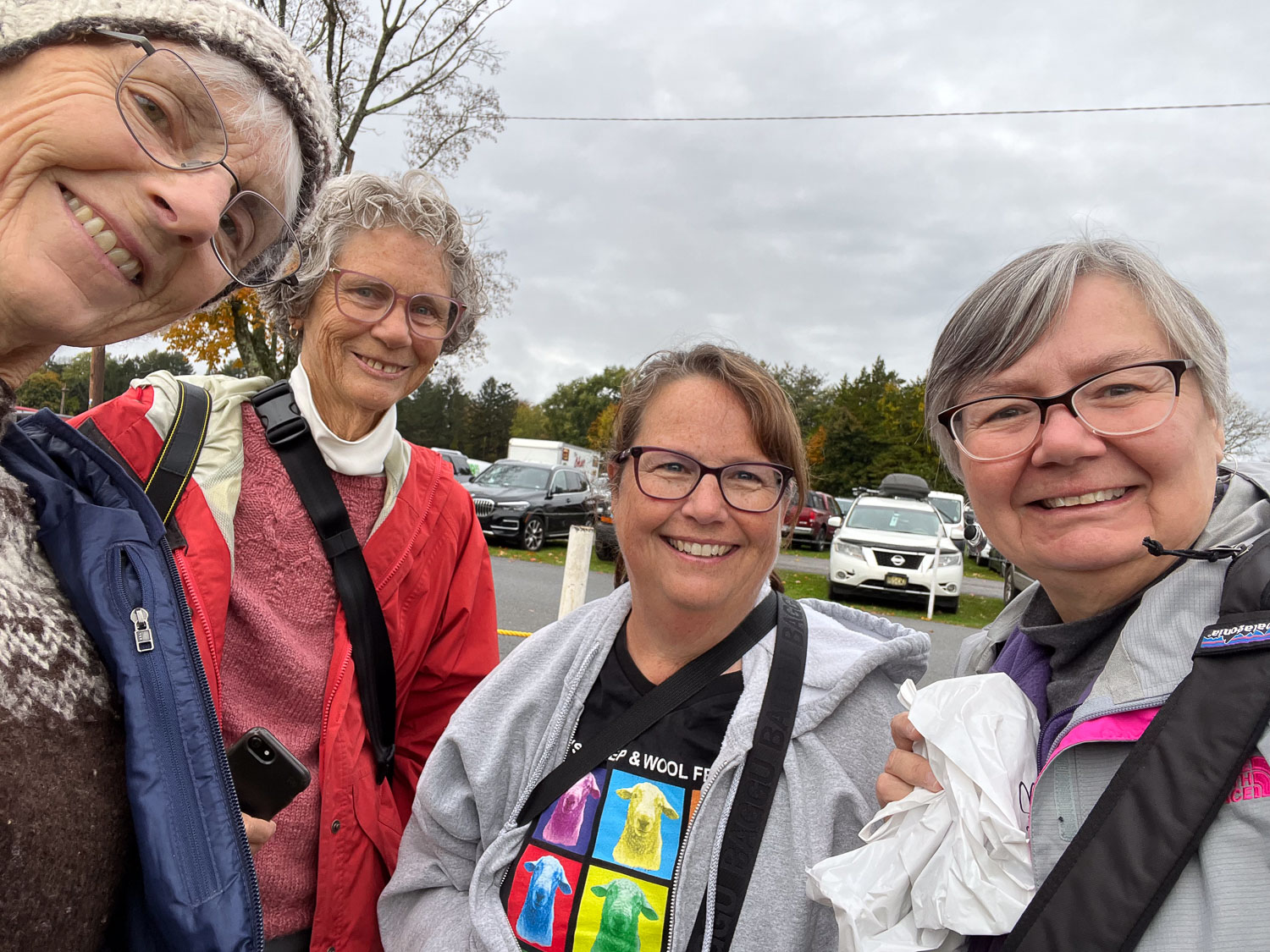
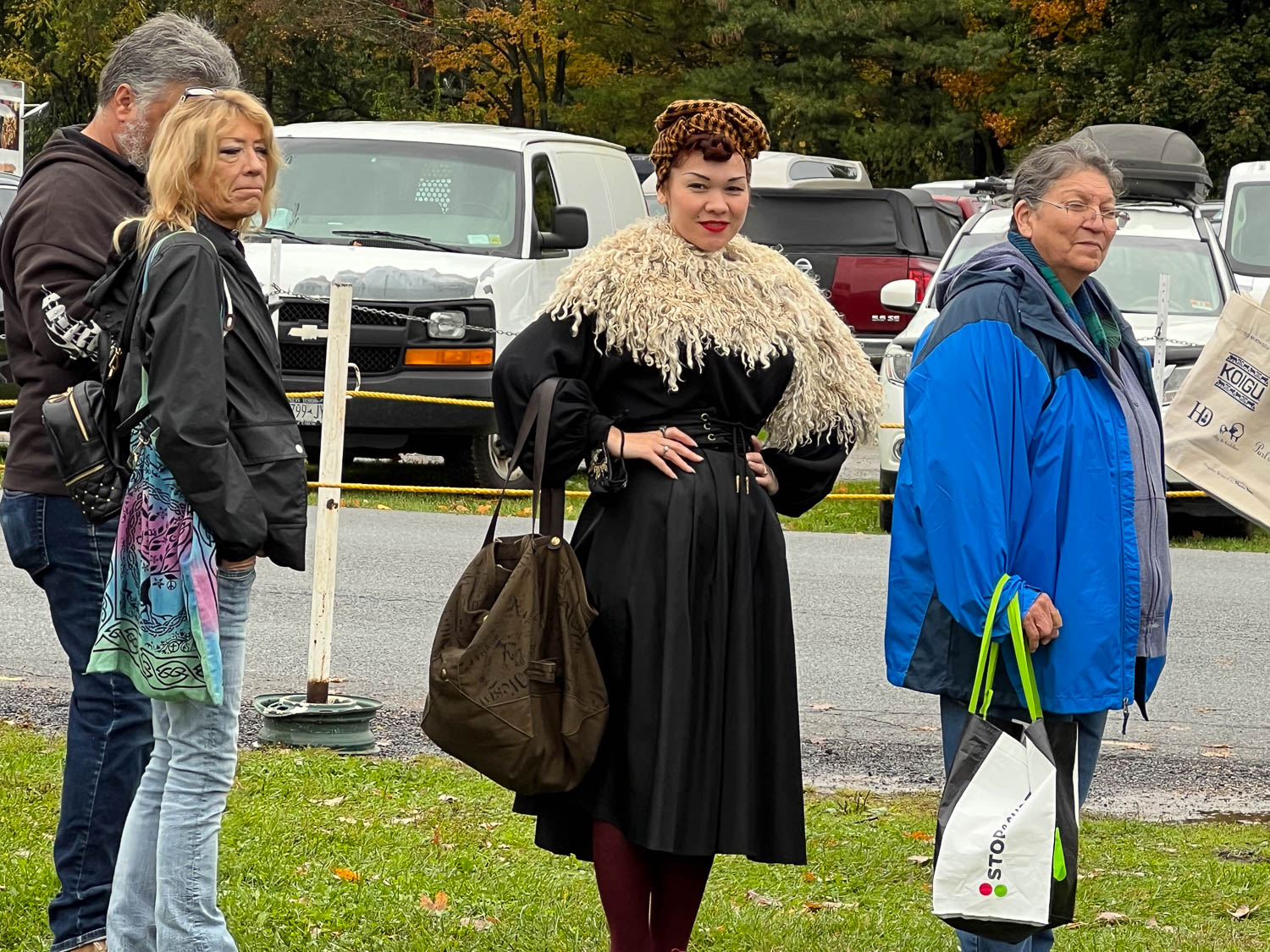
Here are the four of us. While in line we started talking to the people just behind us. They were three friends who meet here every year from various states. One has been to my shop as she used to live in Winters, just ten minutes away. It’s a small fiber world, even with 30,000 people in attendance.
Look who we saw in the line as it started to loop around. It’s Siobhan, one of our Farm Club members. It wasn’t a total surprise because we knew she’d be here and we had lunch with her the day before.
Things were pretty well organized at this gate. The security people came along the line to check tickets, stamp hands, and check bags. Then once the gates opened there was no more waiting.
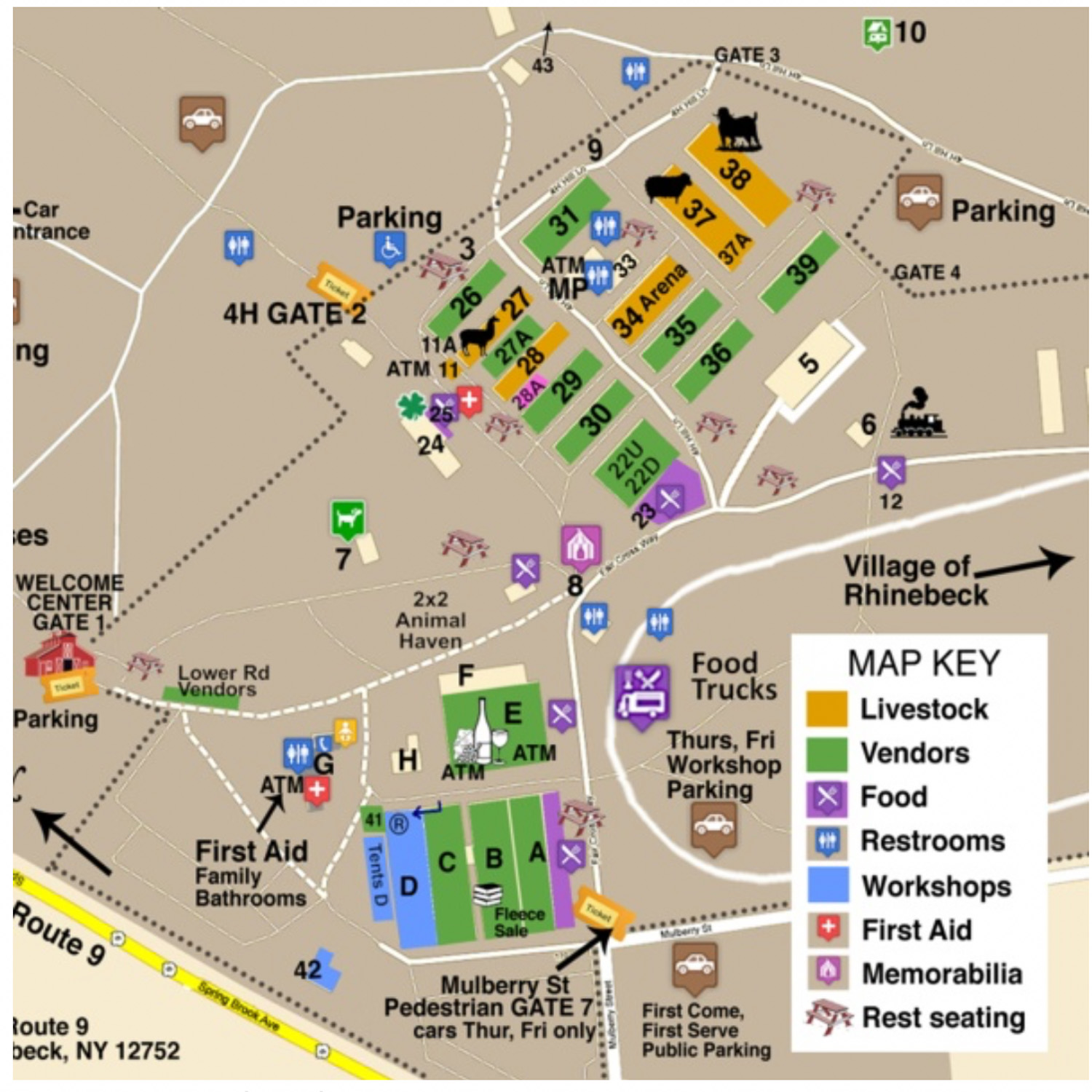
We entered at Gate 7 at the bottom of the map. The green blocks were full of vendors. There were a lot to see. In fact I was surprised that there wasn’t more livestock. I don’t know if there used to be, but you can see that a number of the barns are marked green indicating vendors. We first headed to Building E where Kathleen, Siobhan, and I had entered our woven pieces.
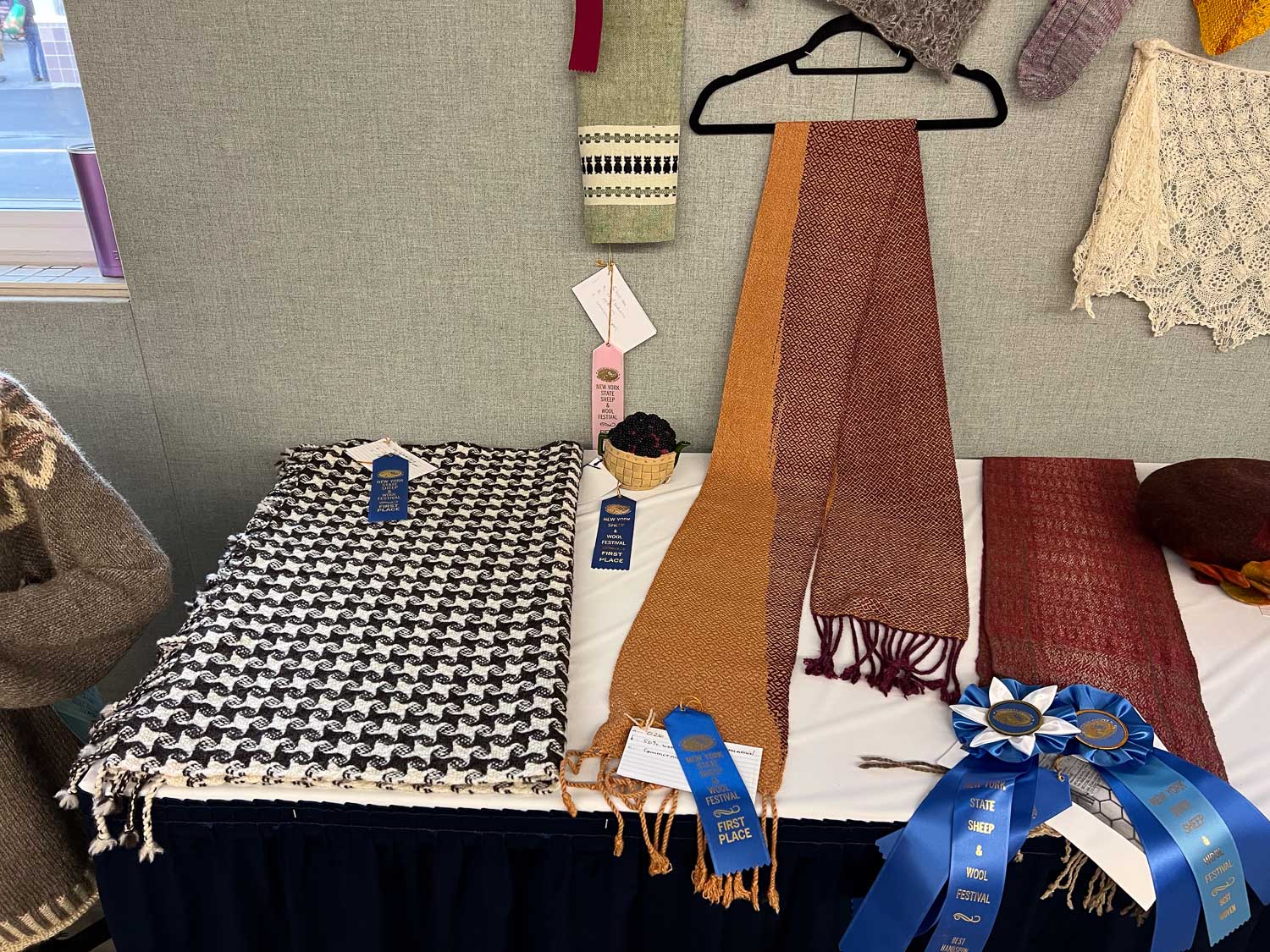
I entered six different classes and got first in four of them. My black and white pinwheel shawl was entered in a class that included all types of crafts but with the theme of Natural Color. The gold and red clasped warp scarf was entered in Handwoven, Small Item, Commercial yarn.
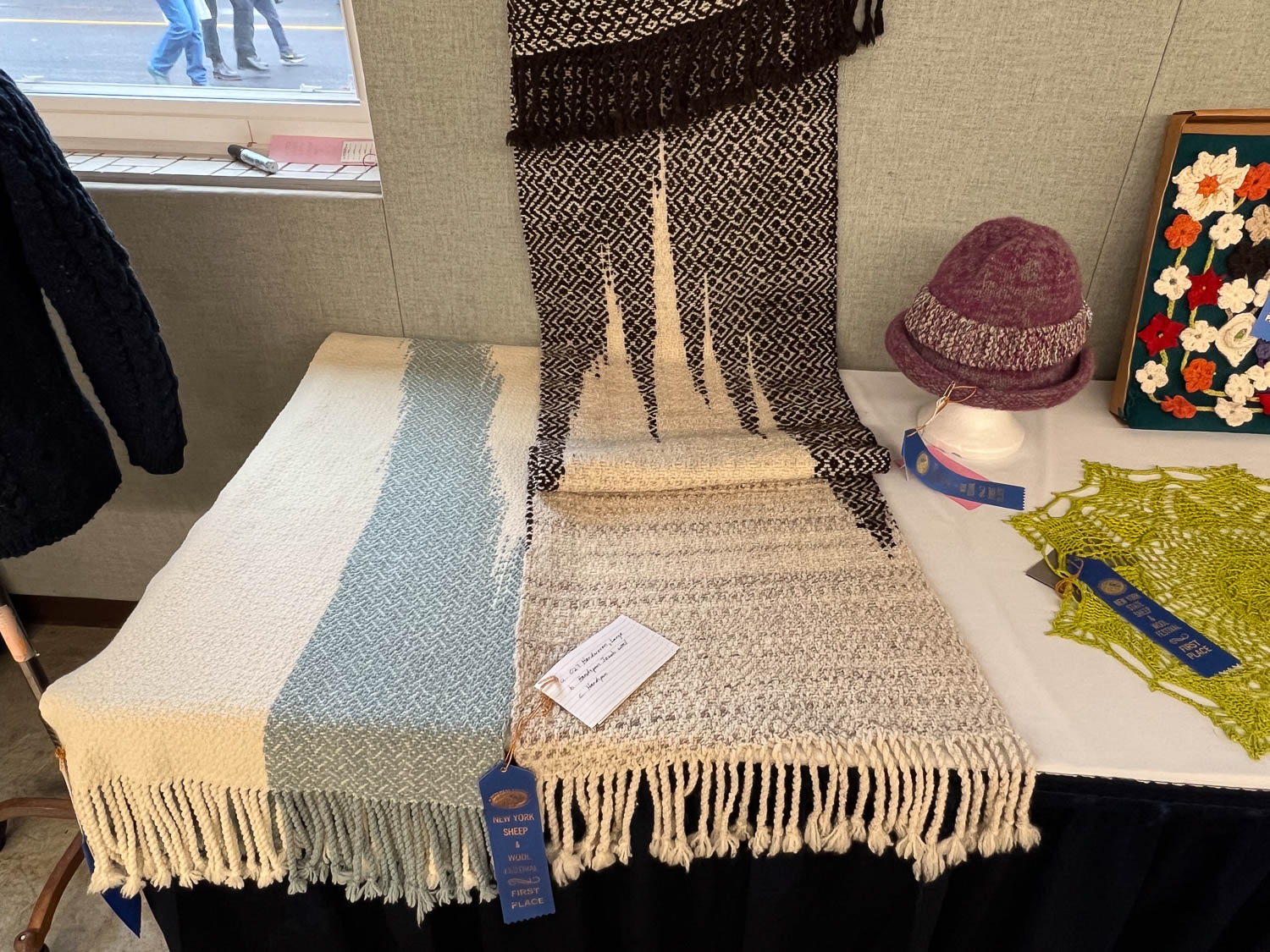
These two pieces are also clasped warp, because that is what I have been focused on lately, preparing an article for publication. The one on the left is locally grown wool, but commercially spun, that I dyed with indigo from the garden, and the one on the right is handspun yarn. So these pieces were entered in two different classes. I just sold the handspun one and the other is listed on the brand new Soil to Soil Market. This website is so new that there only two of us there right now, but it will eventually include Fibershed producers from all over the country.
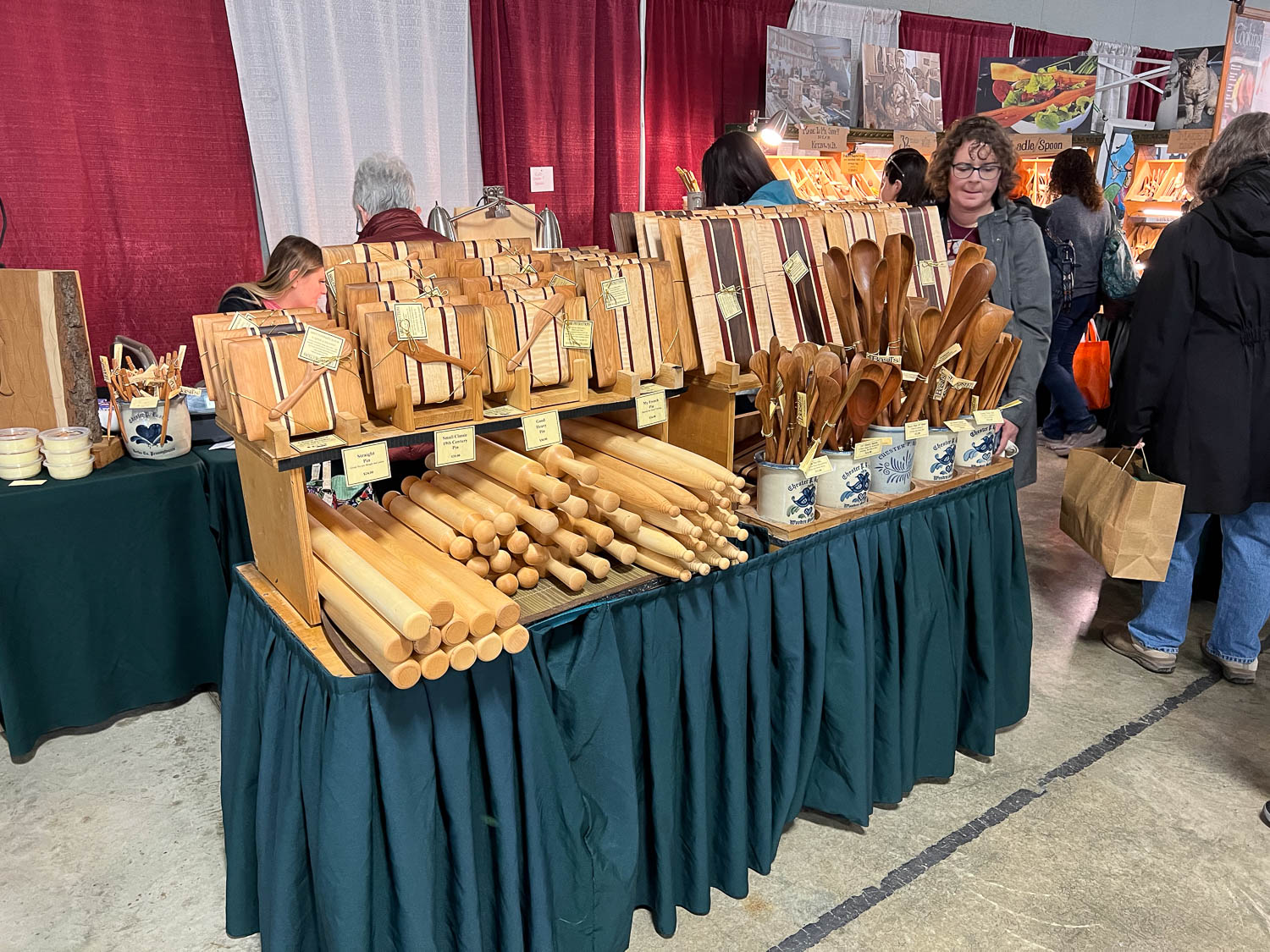
Building E not only housed the Fiber Arts competition, but had gourmet vendors. Mary wanted to start at the booth selling wooden utensils.
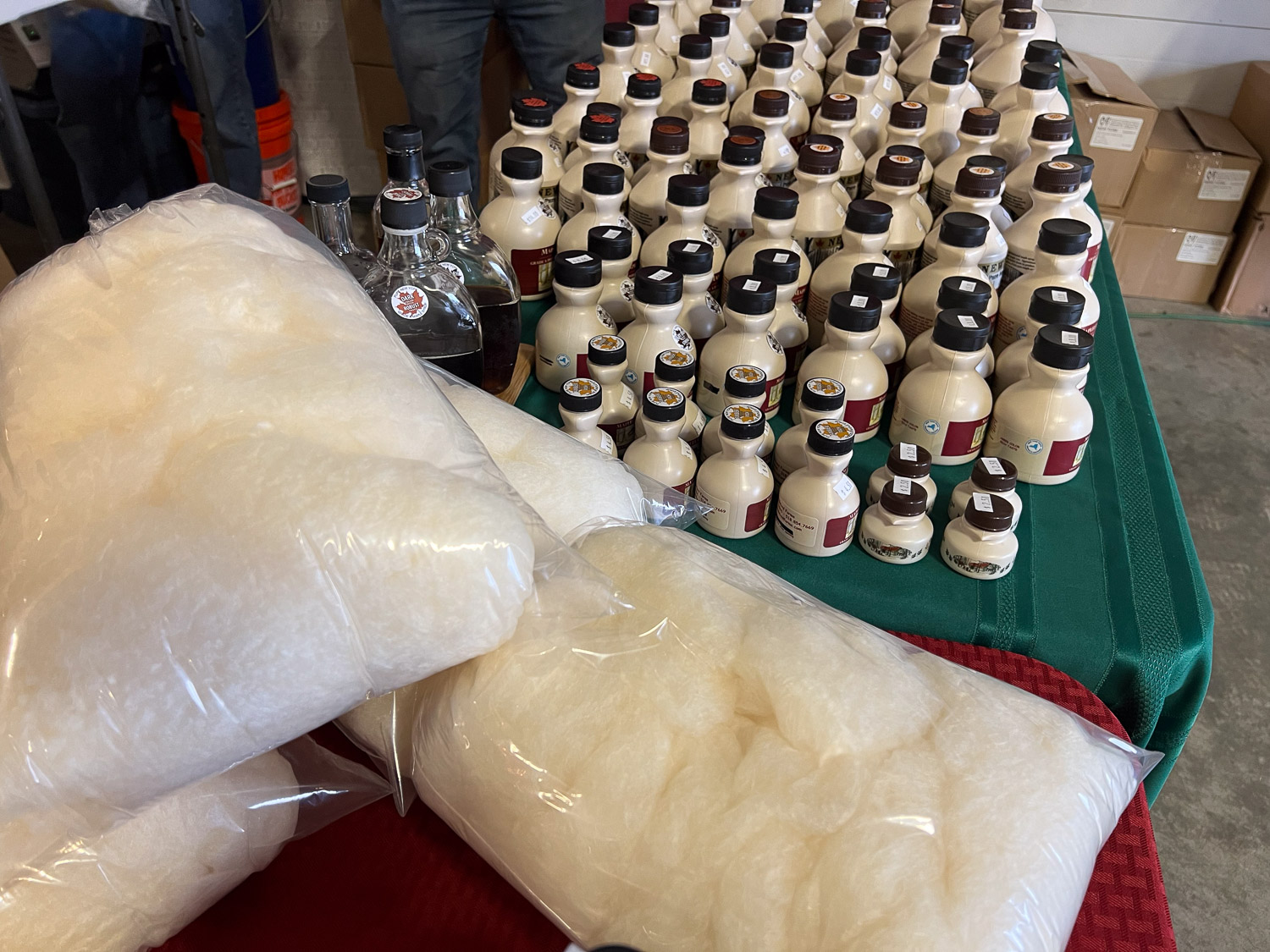
Next to him was a vendor with maple syrup and lots of other maple syrup products. So you think those bags are wool ready to spin? No. Maple sugar spun candy! It took me over an hour to move beyond these two vendors because I got talking to the maple syrup farmer and then a friend from Oregon showed up behind me and we chatted. There was a lot more to see and after I wandered through the other gourmet booths I went outside. I decided to be systematic so as to not miss anything. I was going to start at the far corner and work my way back, but I stalled out at some of these outside vendors.
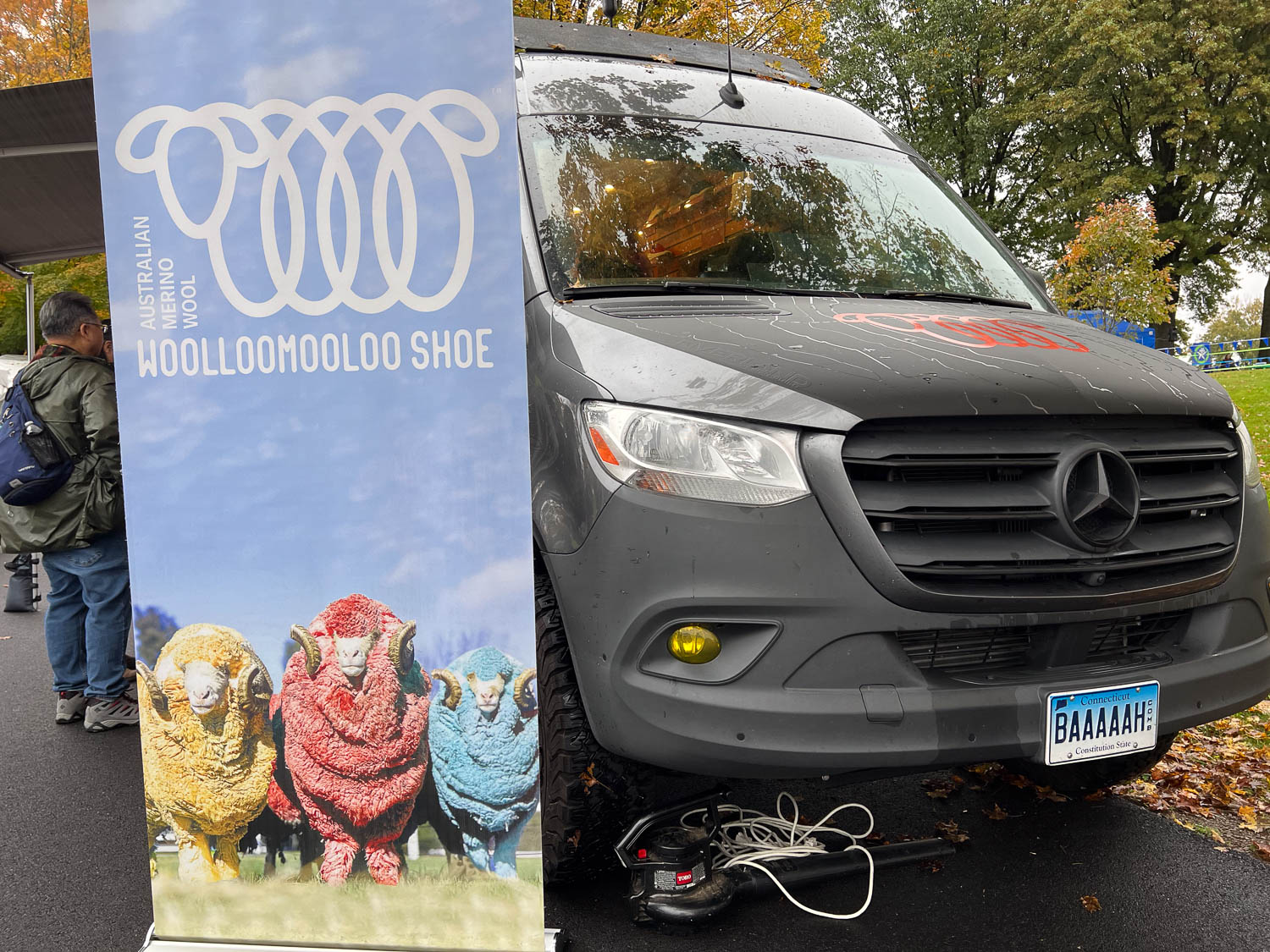
Notice the license plate of this van. They had a shoe shop set up. Shoes were in the van and there was a fitting area where you could try shoes of various styles and sizes outside the van.
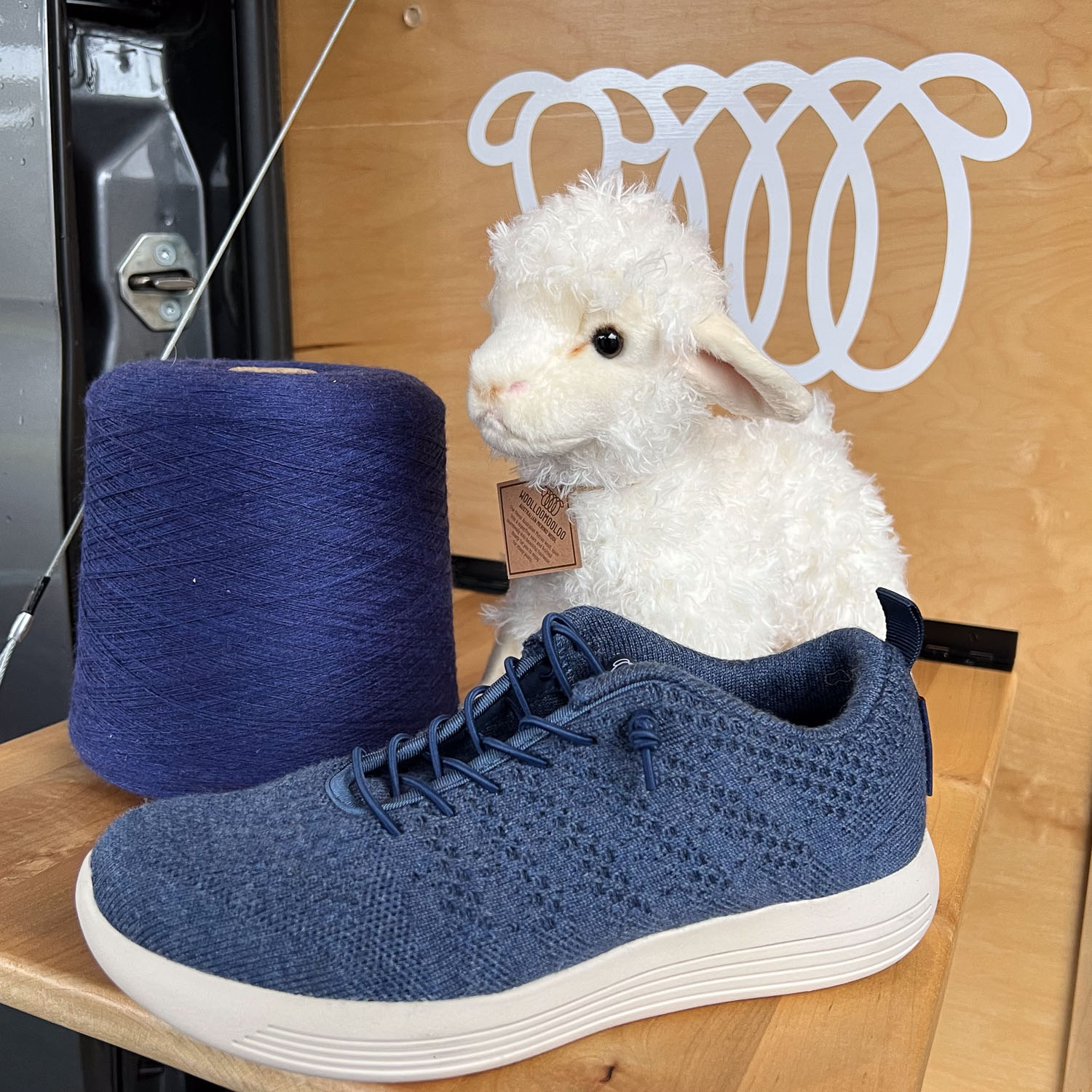
These are wool shoes and I bought a pair. They will be delivered soon.
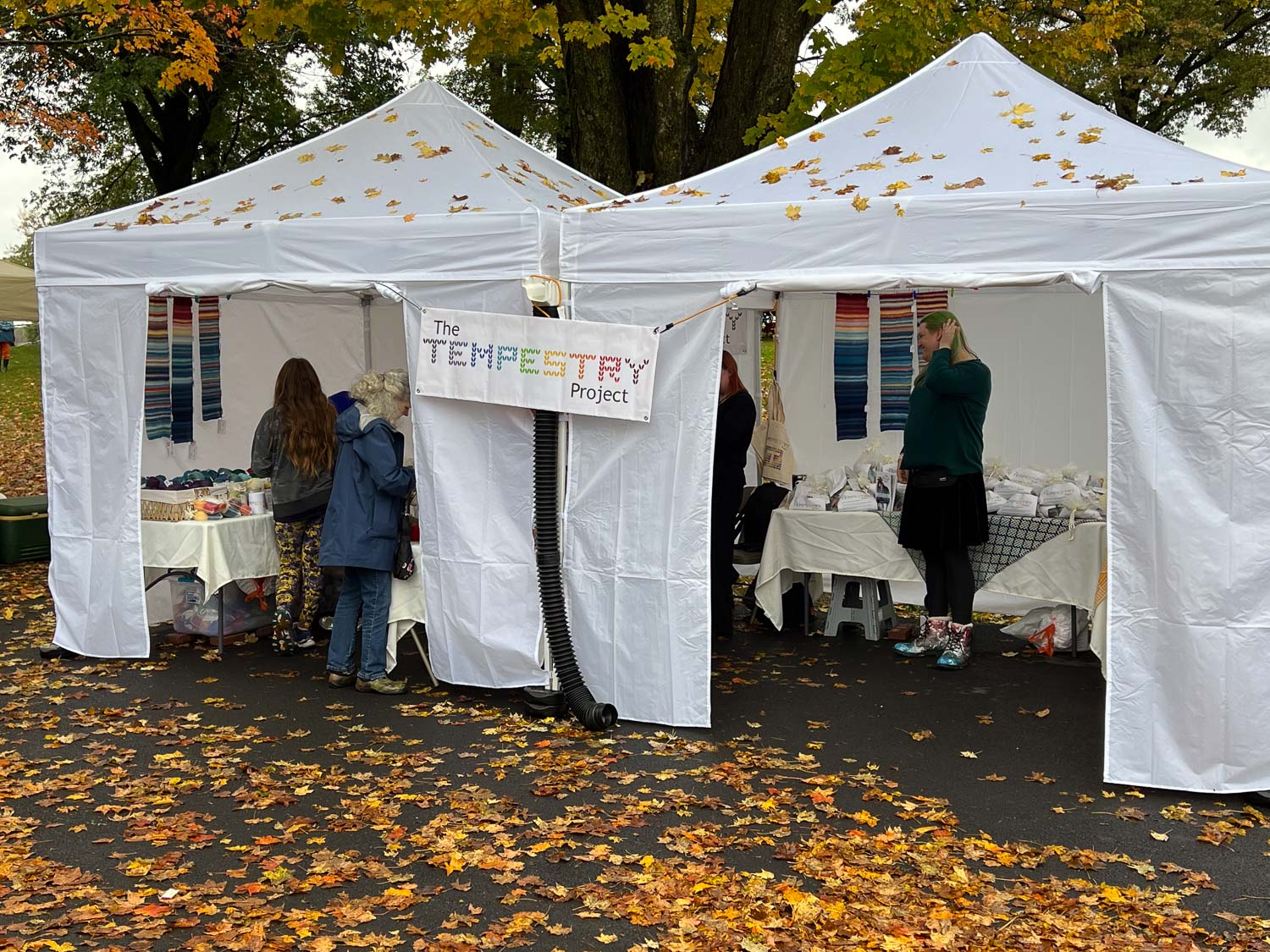
I got side-tracked here. The Tempestry project is focused on using fiber art to portray climate change by making “tempestries” to indicate high temperatures. This is partly how I got the idea of weaving my Year to Remember blankets. I found a book here that shows these pieces at National Parks all around the country, including one by my friend Lisa! So in the first two hours I had purchased items at four booths. Only about 250 booths to go!
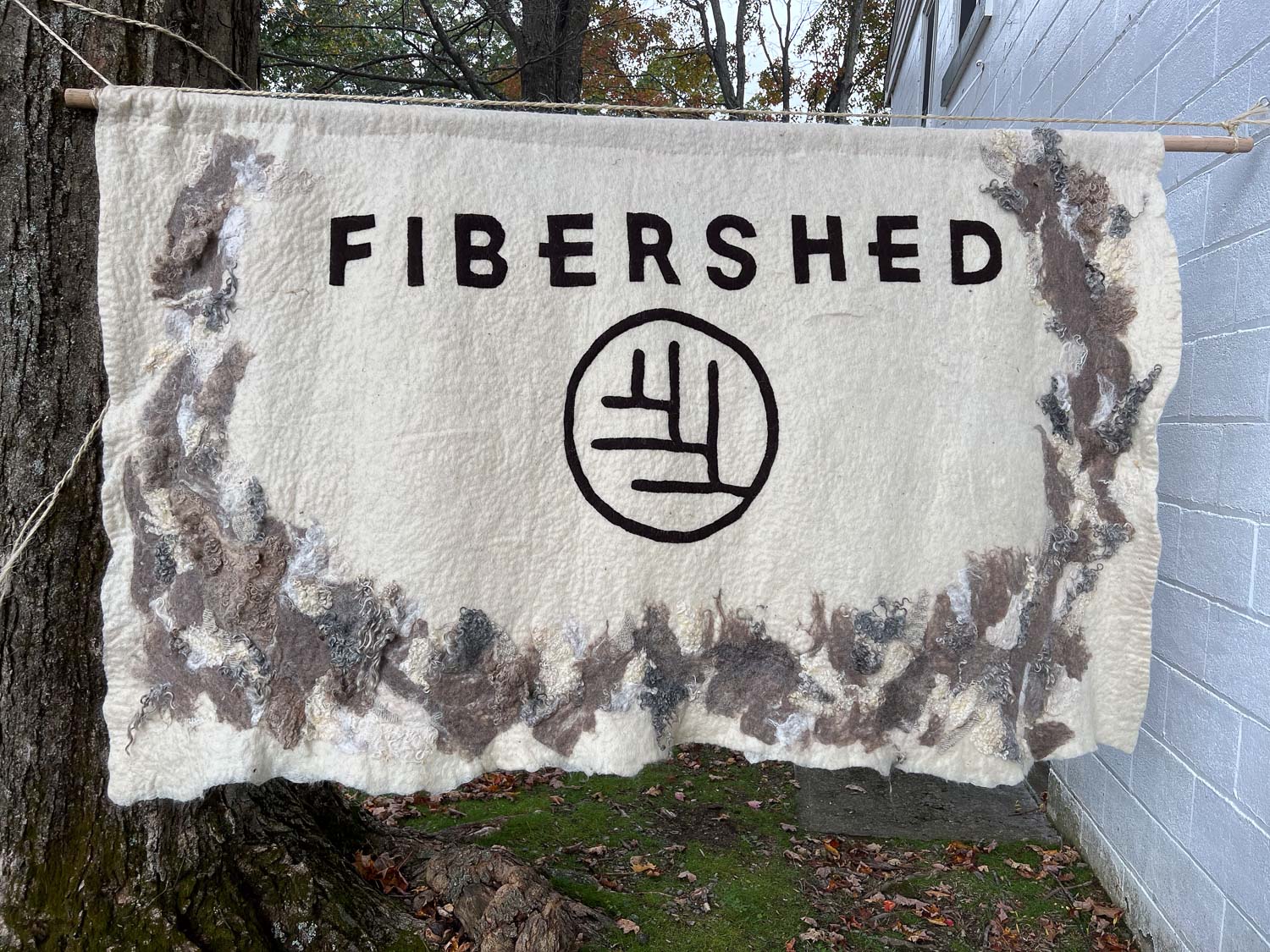
I found a Fibershed building. Our Northern California Fibershed was represented. I like to think of us as the Mothership. After all, this is where it started. There were also tables and displays from many east coast Fibersheds.
We had heard about lines, not just to get in, but to get popular items. That white tent in the middle of this photo is where the souvenir t-shirts and bags were and the line stretched even behind where I stood taking the photo. I didn’t try to get a t-shirt until the next day and almost all were sold out even early in the morning.
The used equipment auction was interesting. The auctioneer didn’t know what all the tools were, but the crowd helped him out.
I wandered through the barns.
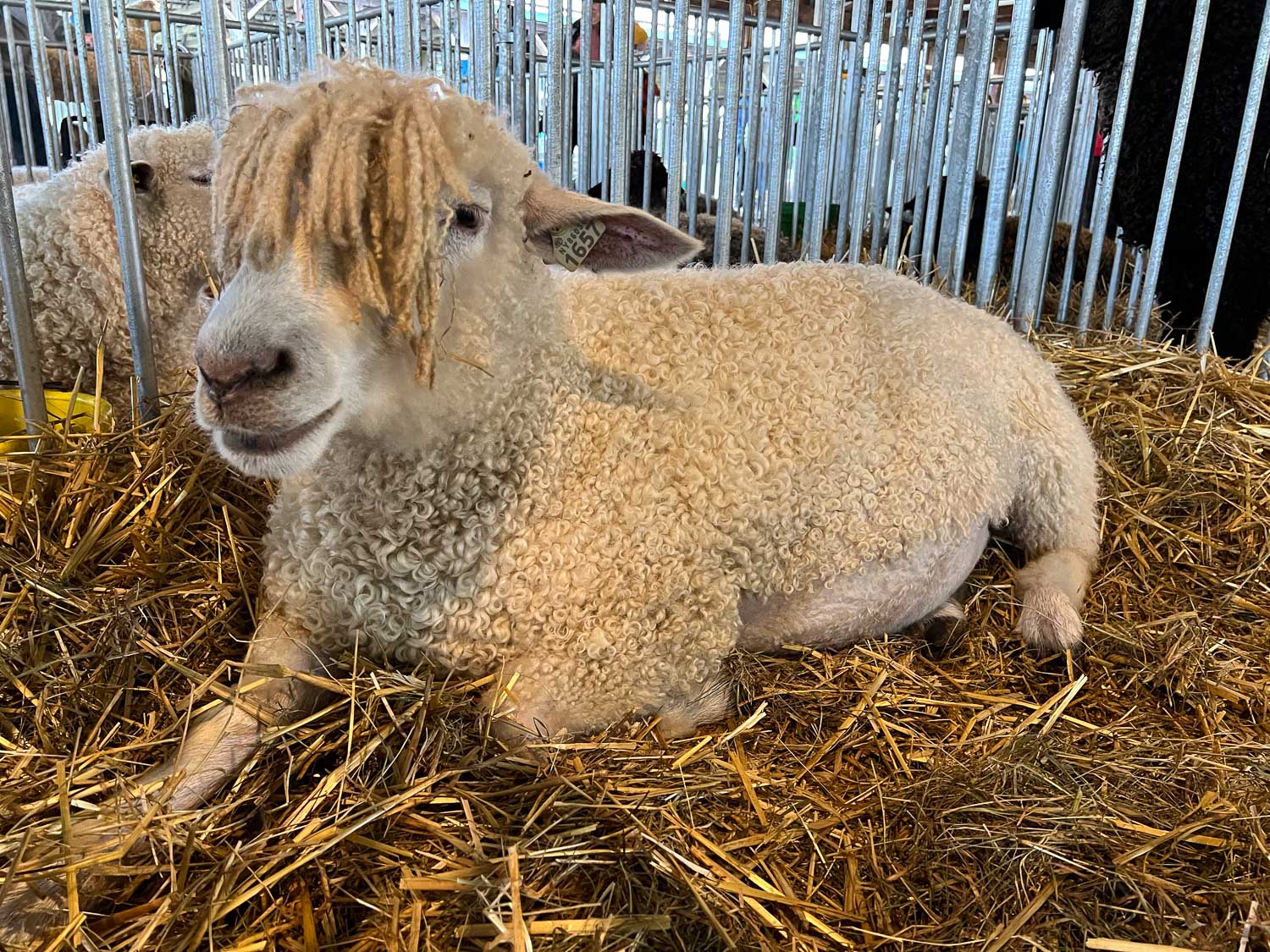
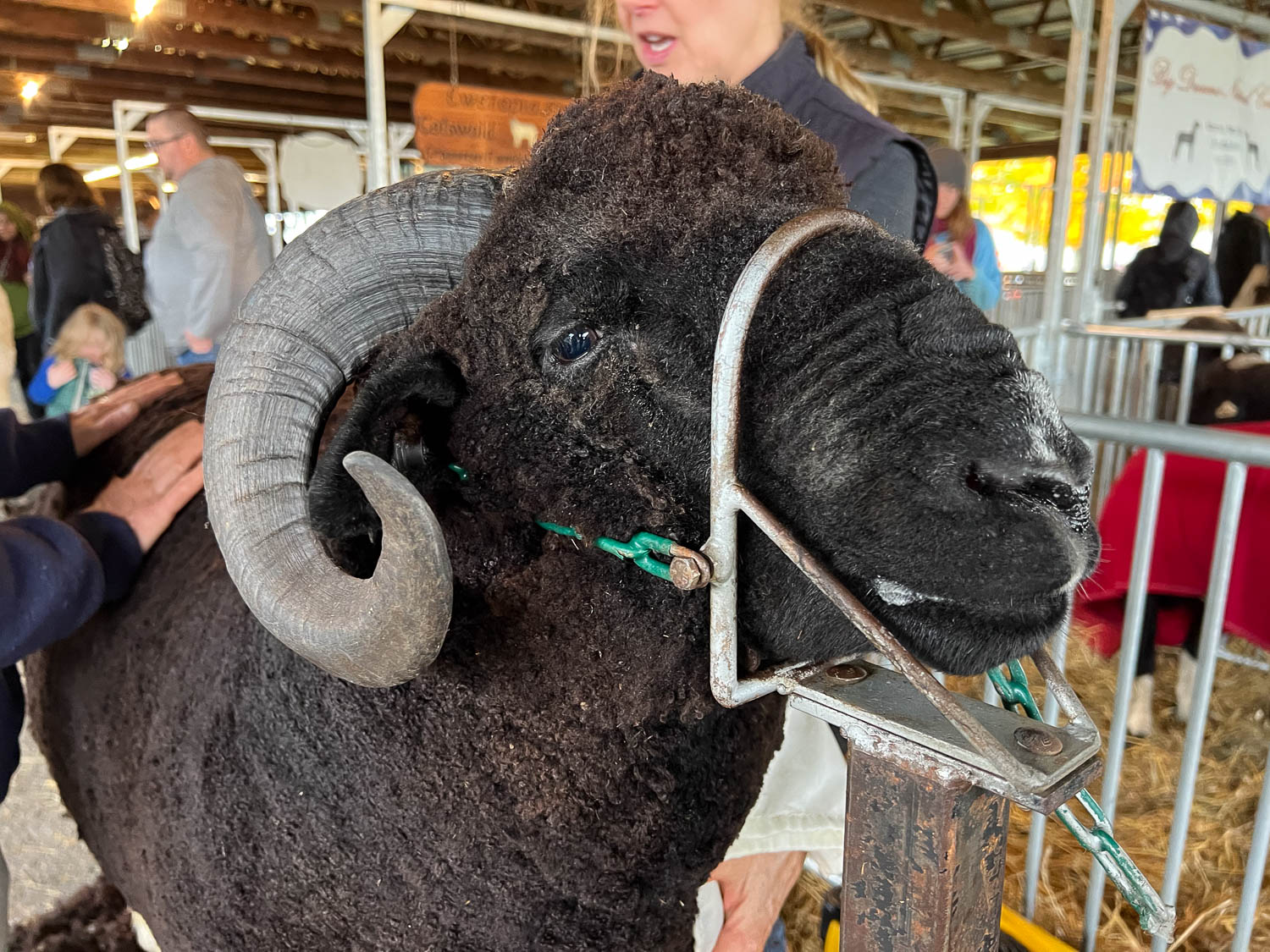
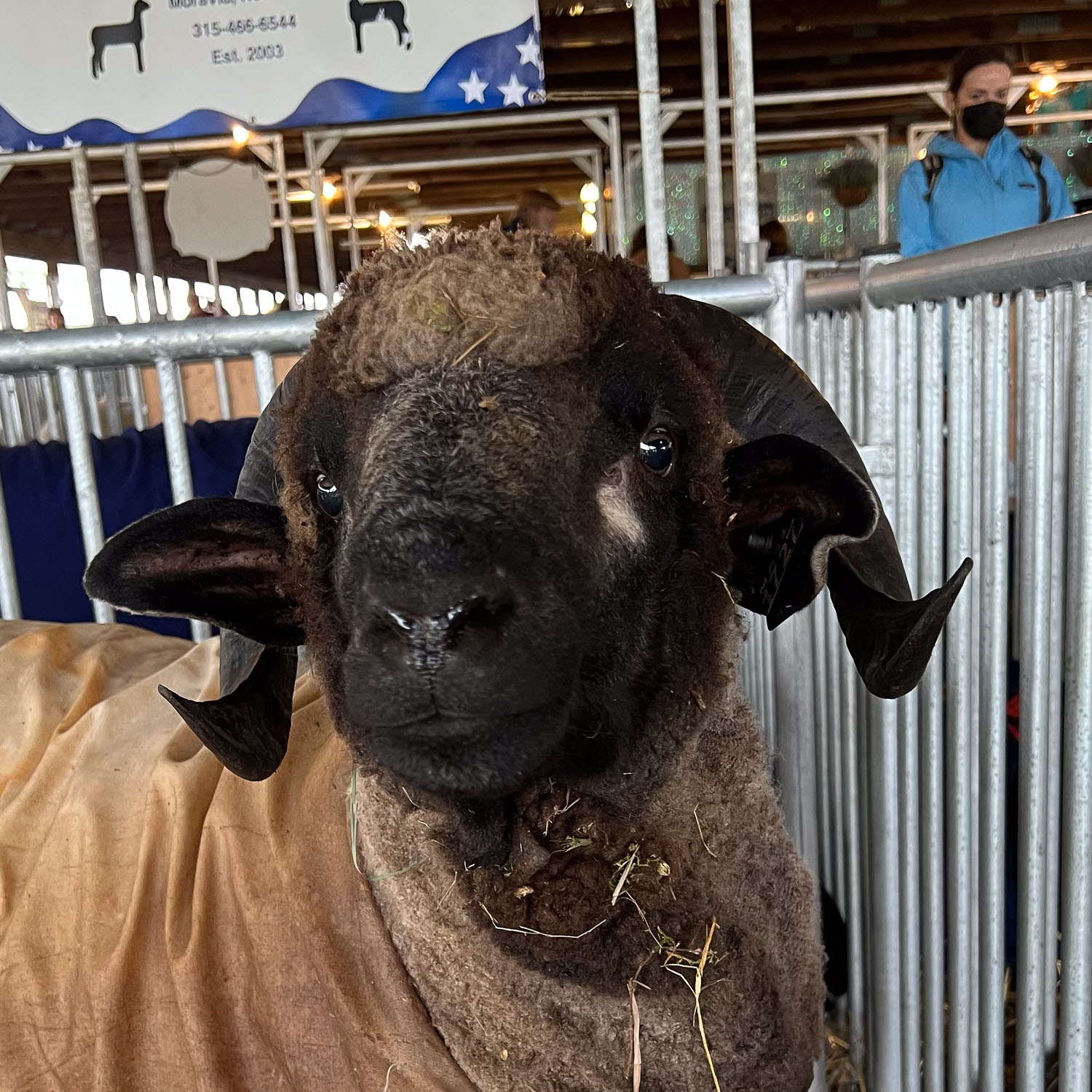
Sheep were being prepped for the show. I’m so glad that Jacob sheep are shown without all the fitting that goes on with many of the breeds.
I think this sheep and the one above showed in the Natural Colored Wool division.
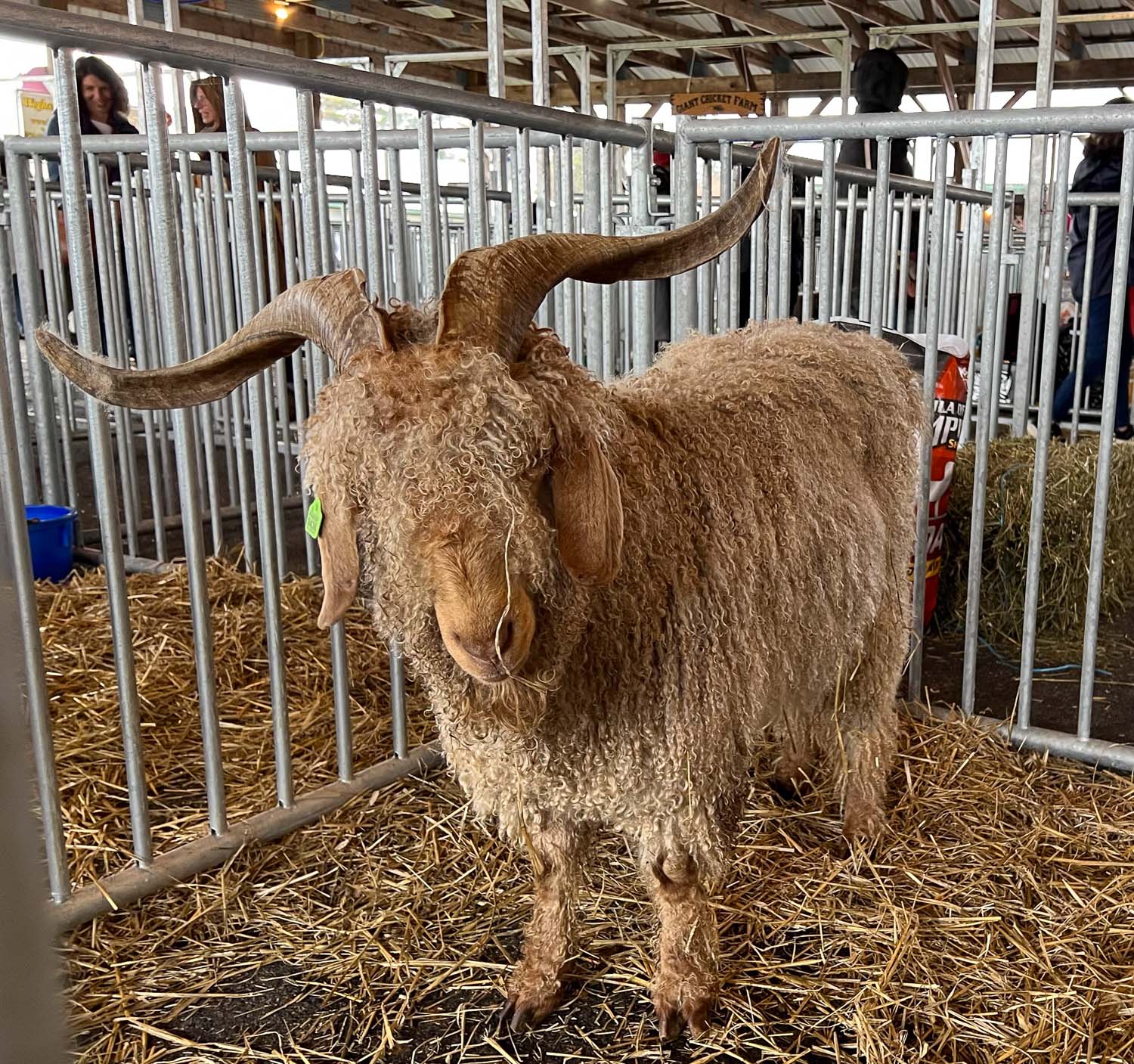
There were also some Angora goats at the show.
Now to wander the vendor halls. I have over 150 photos from these two days. I guess I won’t be able to share everything.
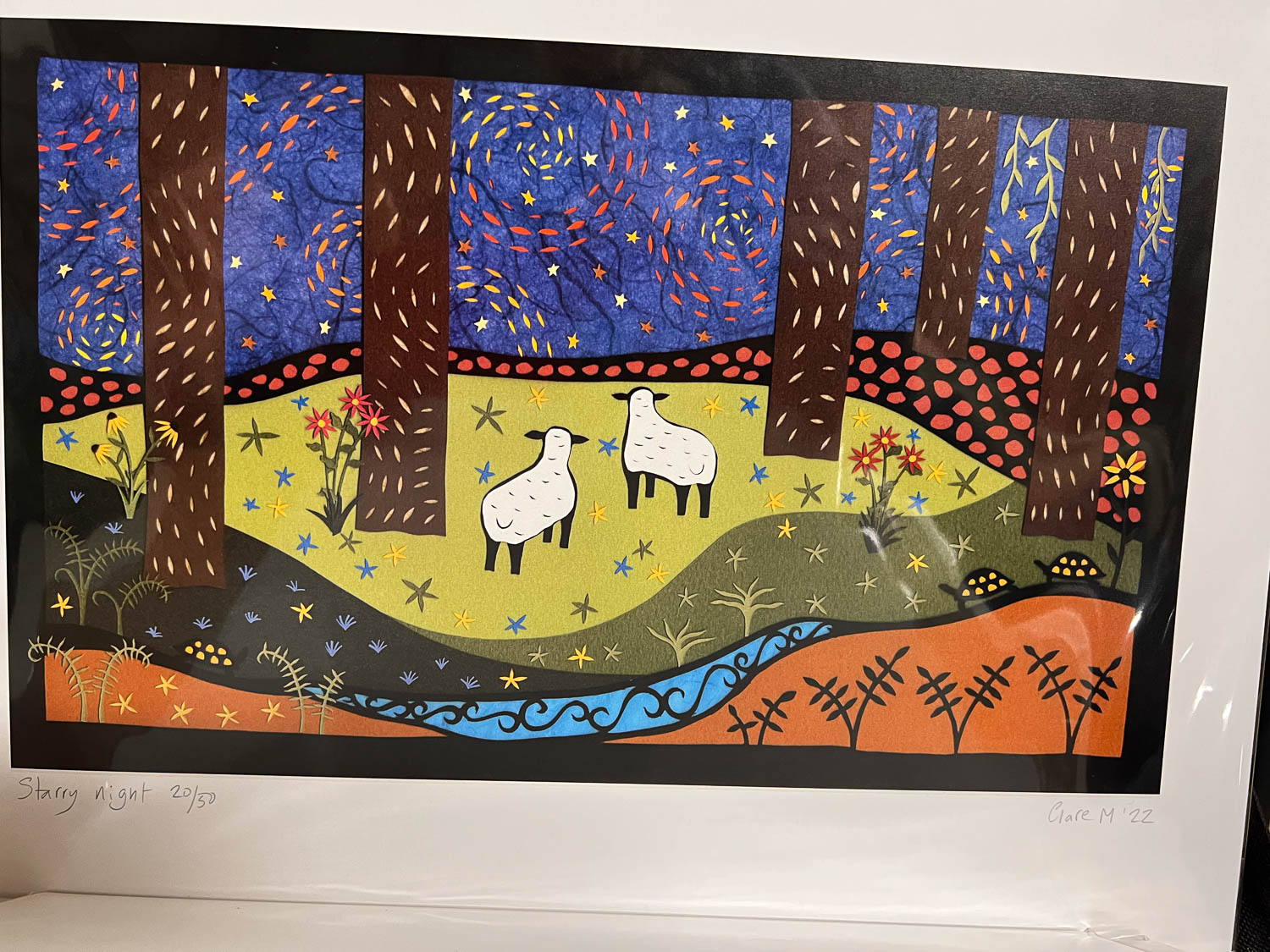
This is a print by Clare Margaret. She uses cut paper for her original artwork and then makes prints for the wall and cards. They are gorgeous.
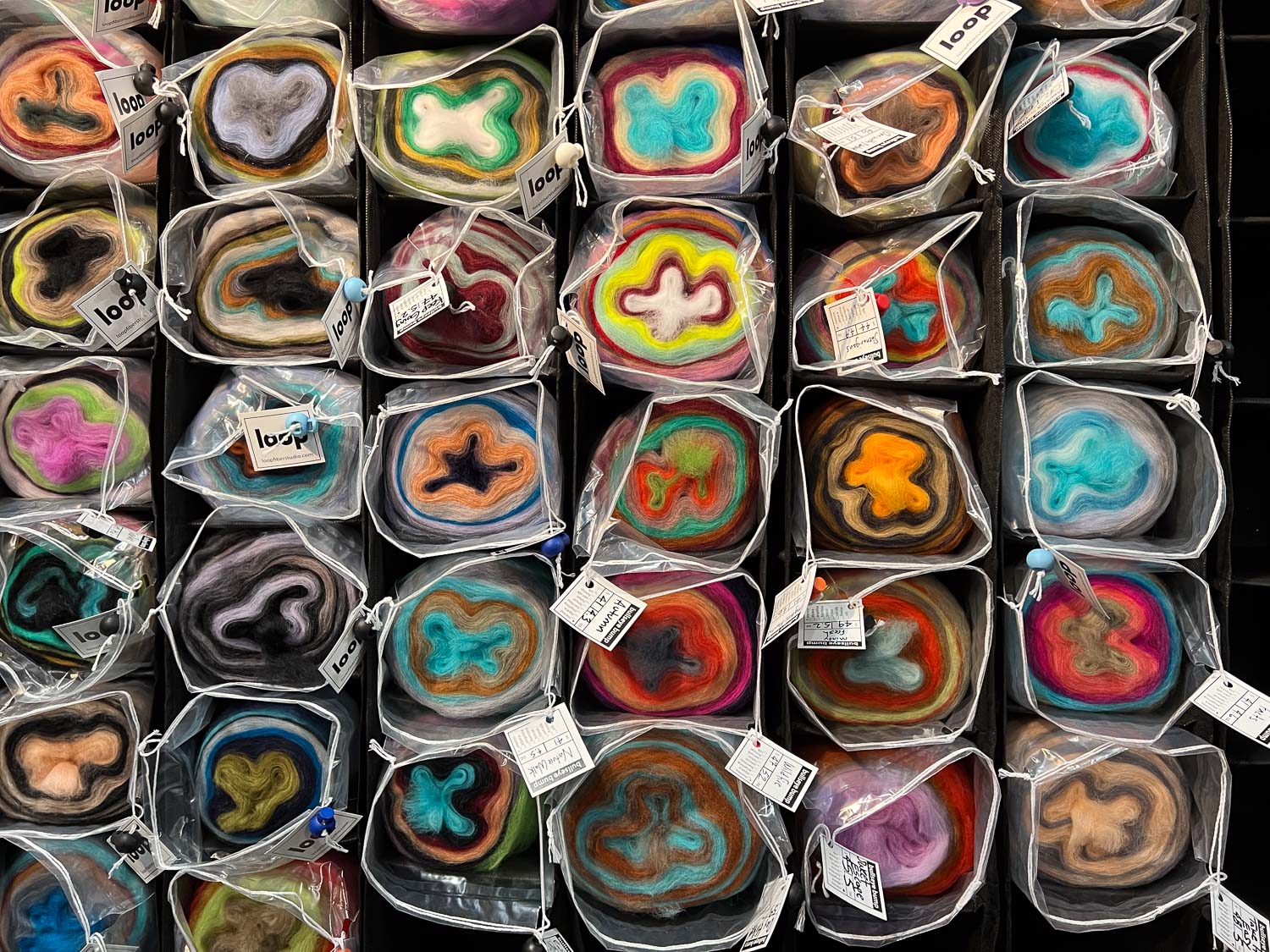
Fiber in fascinating colors and combinations.
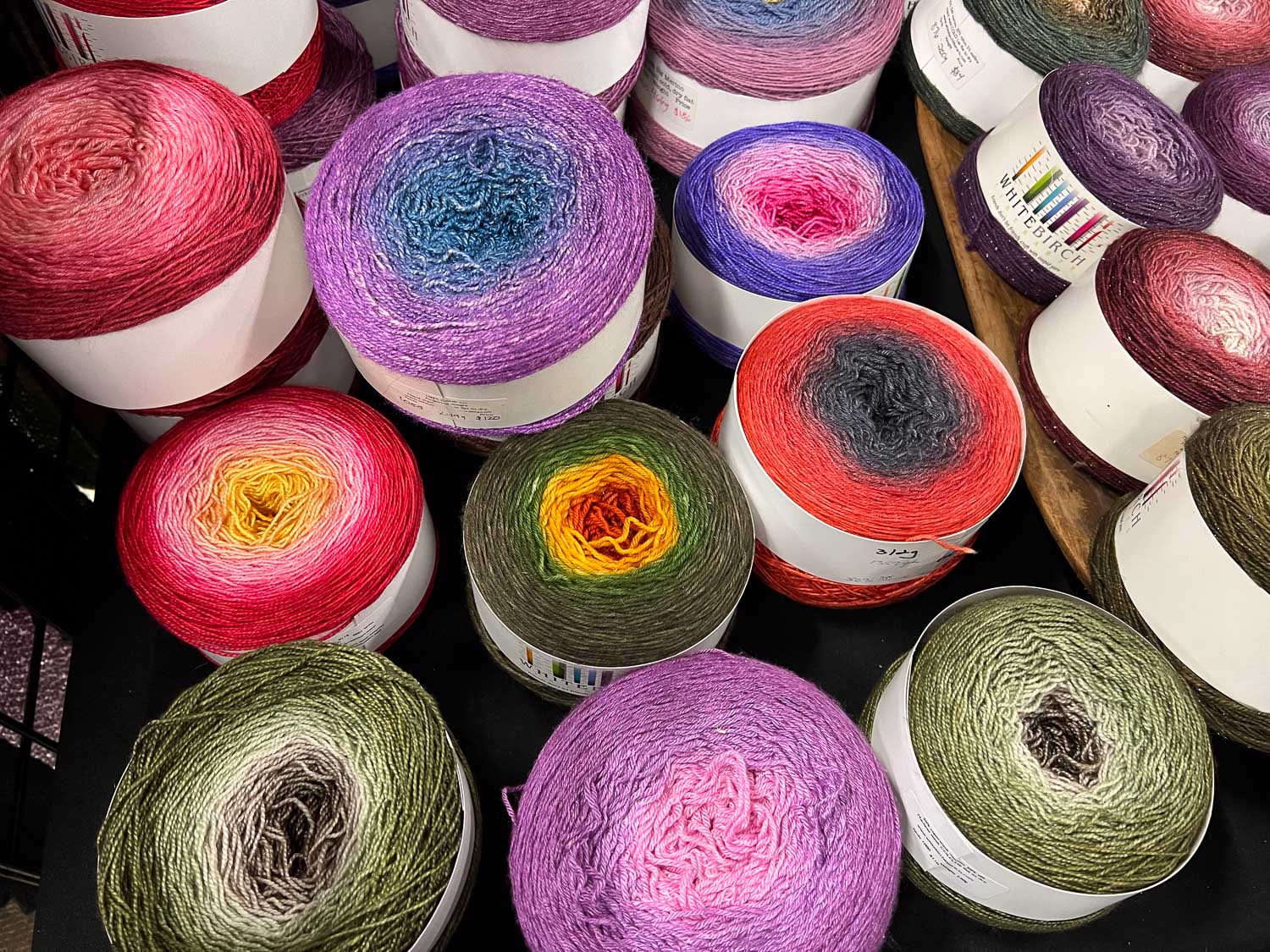
A similar idea but with yarn.
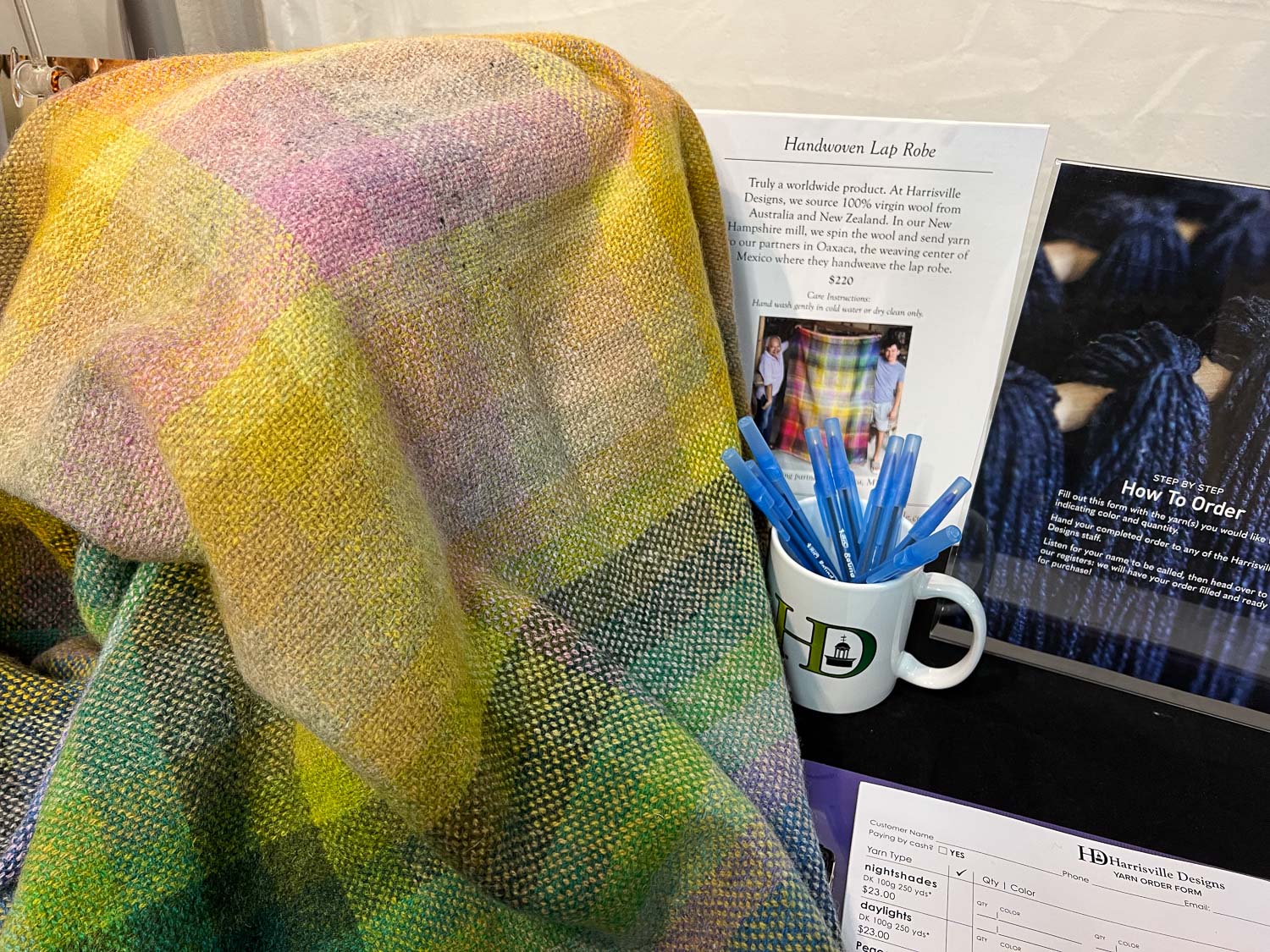
A blanket woven of Harrisville Designs Shetland yarn. I bought some of this and have woven a scarf. More to come later.
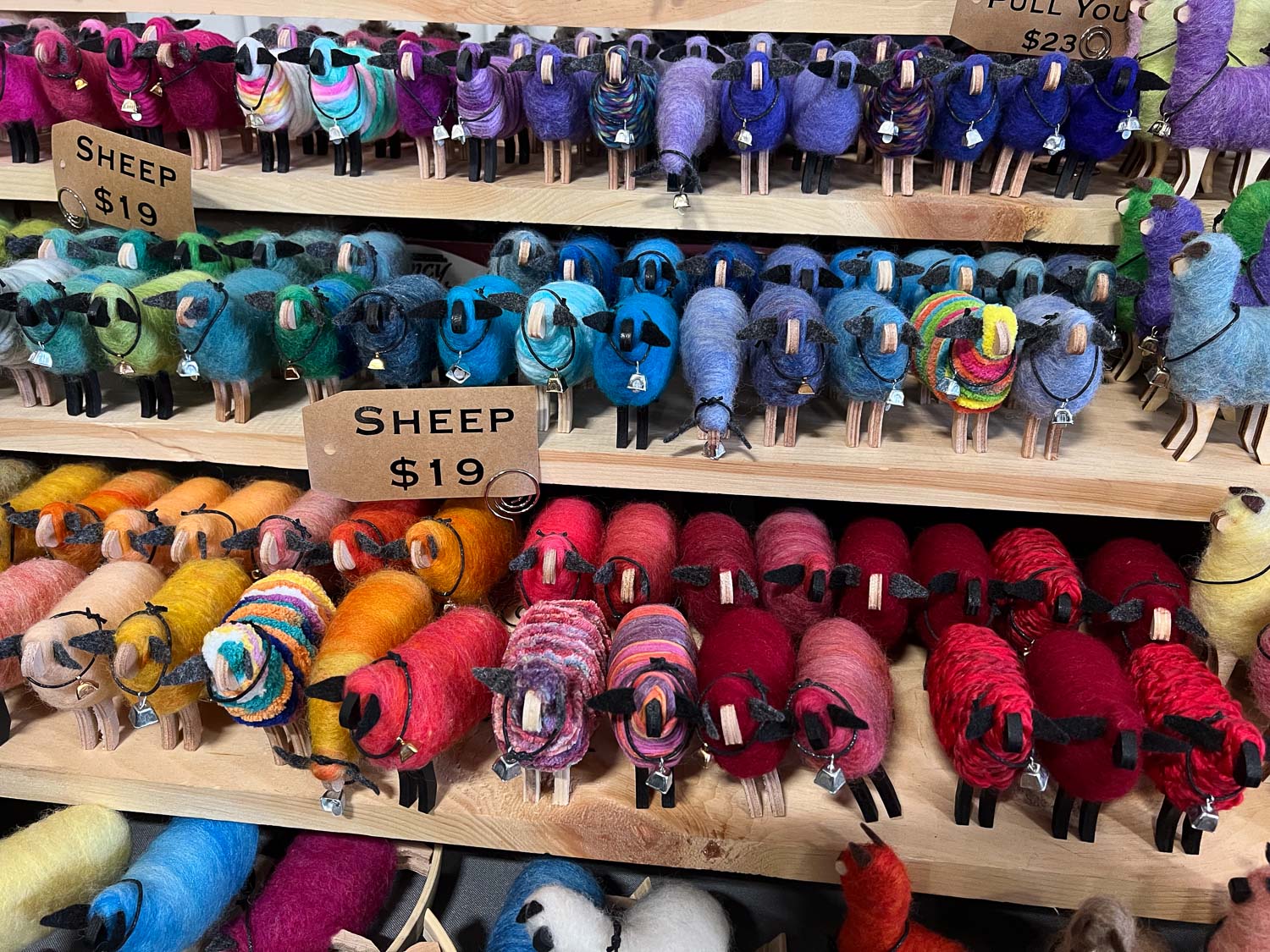
This booth sold the wooden pieces to make these yarn wrapped sheep and they also sold the sheep.
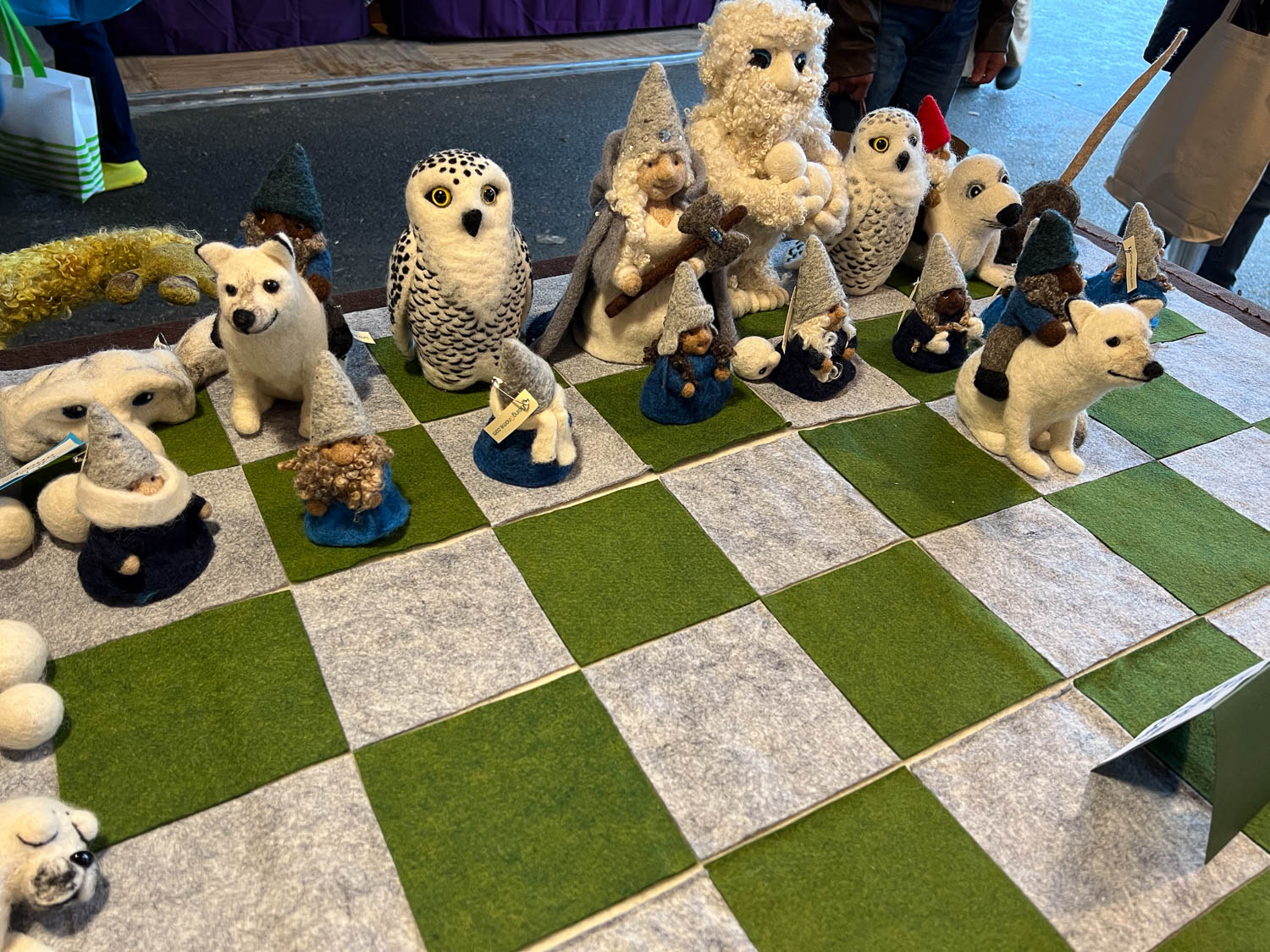
A chess set by a business called GoingGnome.com
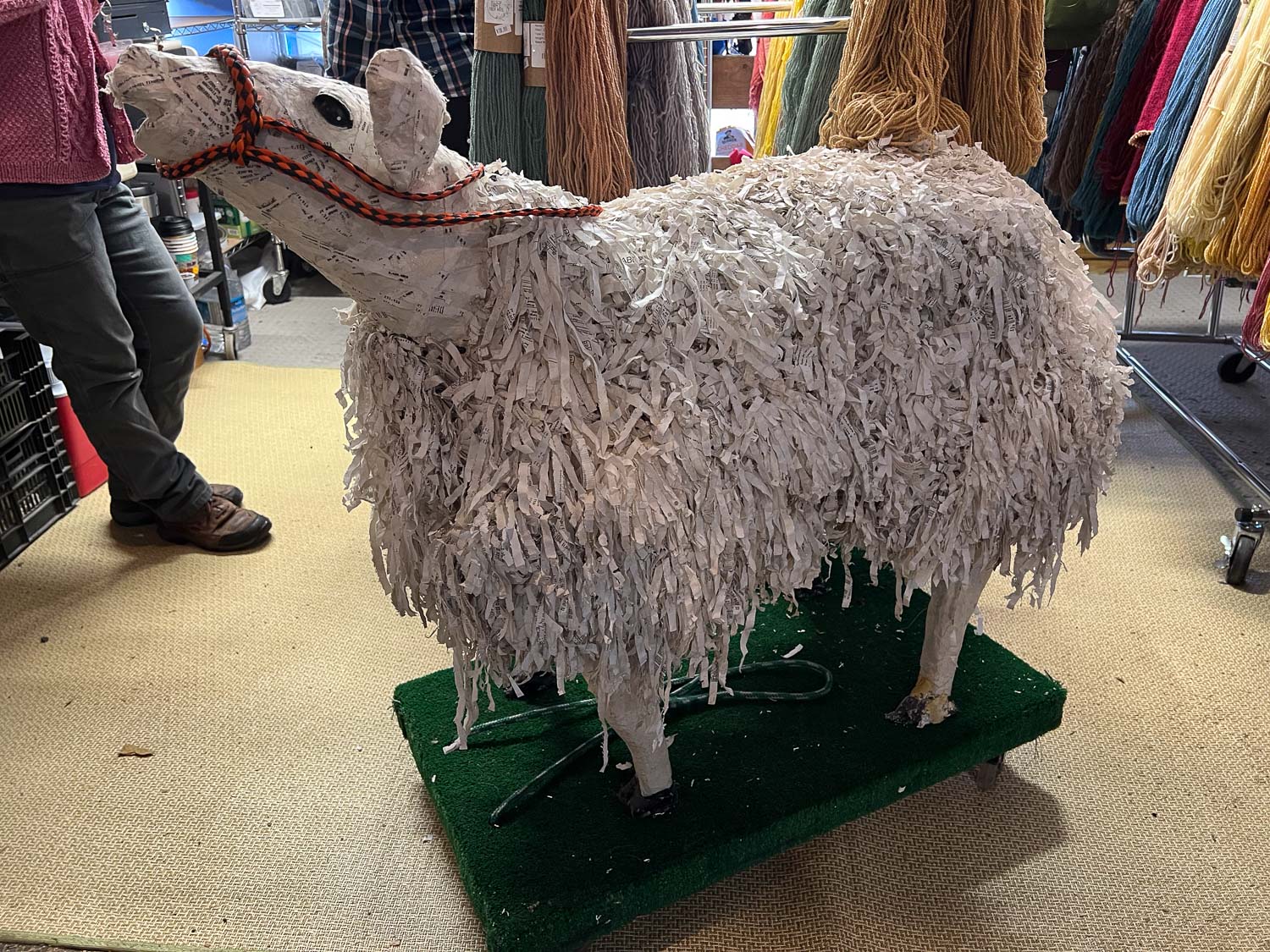
Hilltop Farm Fiber Arts had naturally dyed yarn, dried dye plants like I’m selling on my website and on the new Soil to Soil site, but with more variety. I liked this sheep at their booth.
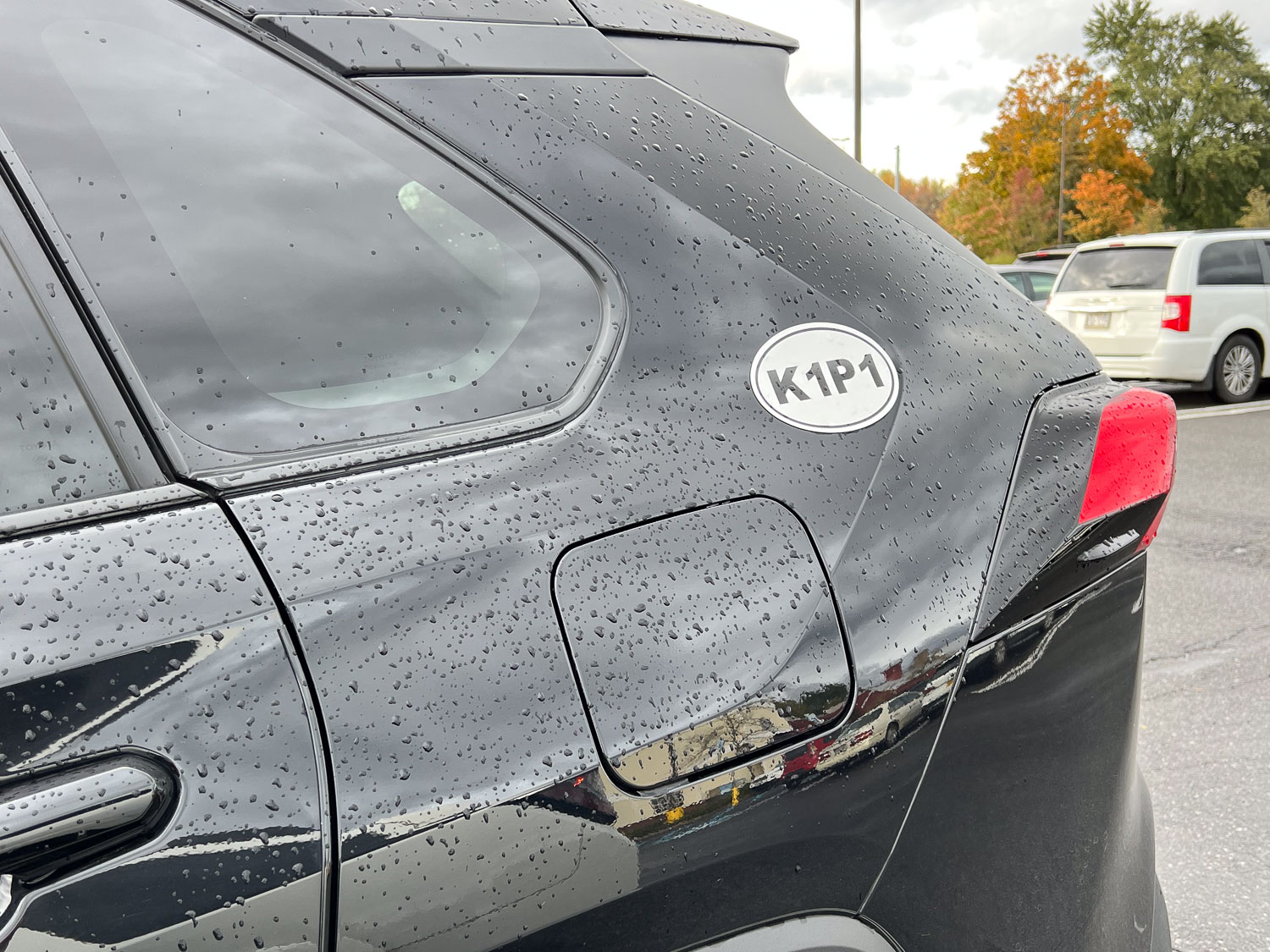
Seen at a grocery store on the way home that day. For you non-knitters, that stands for Knit 1, Purl 1, common language to fiber artists.
For not planning to buy anything I brought a lot home.
I talked about Day 2 here. Now that I’m numbering the days I see that I have it wrong. Day 1 was really a travel day. We left Sacramento on Tuesday at 11:45 and got to Albany well after dark. That’s why I didn’t count it. I’ll stick with the current numbering system that forgets the travel day.
Kathleen and I both entered handwoven items at the show and needed to deliver them on Friday. That was the first stop of the day.
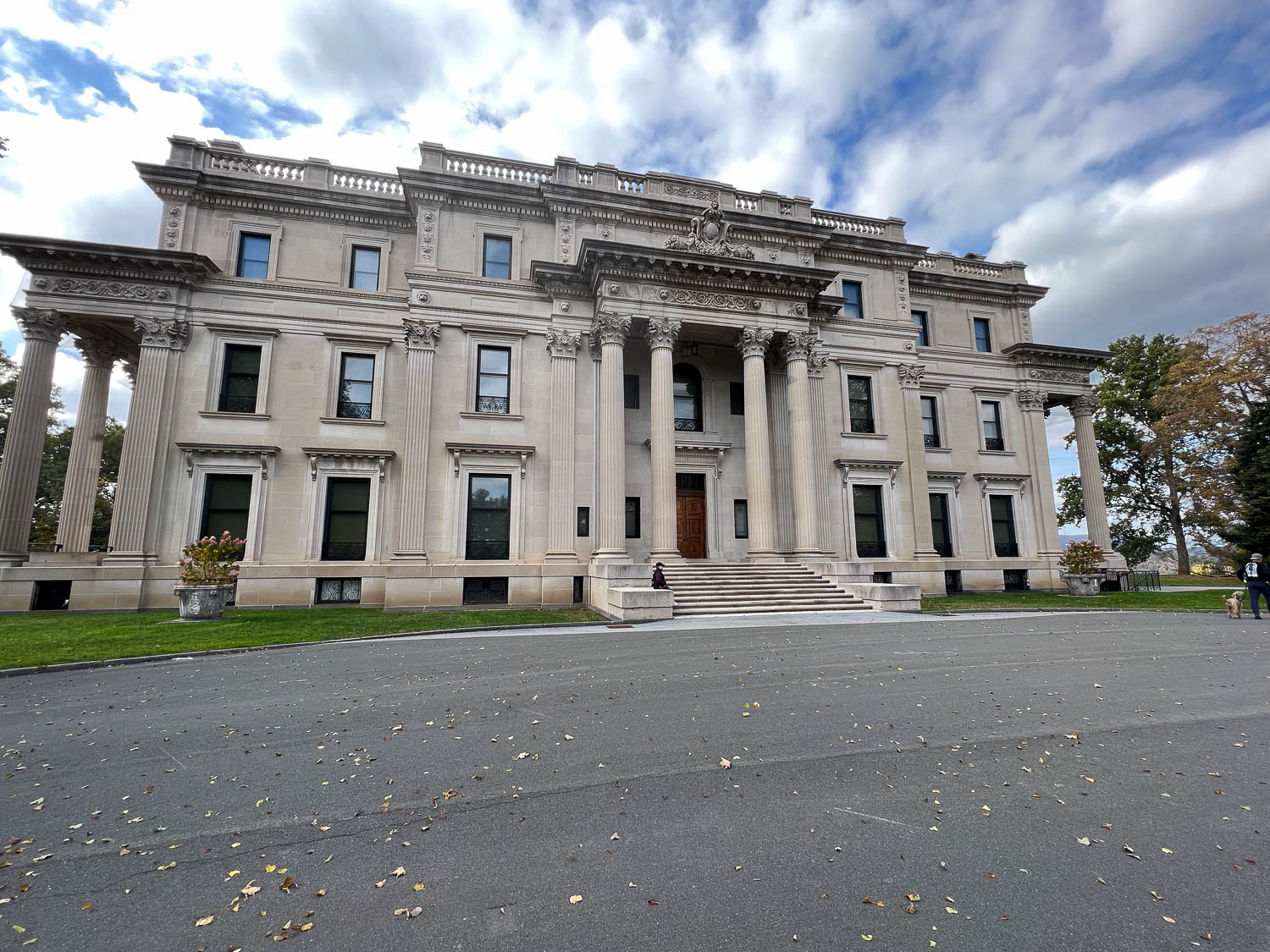
After delivering our items we drove back to Hyde Park so we could tour the Vanderbilt Mansion. This family tree starts with Cornelius, born in 1794. At age 16 he bought a sailing barge using $100 borrowed from his parents. He started his own shipping business and eventually was involved in railroads. In 1871 he opened the largest strain station in North America, which would eventually be called Grand Central Station. The bulk of Cornelius’ estate went to the firstborn son, William. Wlliam doubled the Vanderbilt fortune and each of his 8 children built extravagant mansions, shown on the chart above. The estate on the far right is the one I toured last summer in Asheville, North Carolina, known as “America’s Largest Home”. Notice on the family tree there are no heirs for Frederick’s home, third from right.
Frederick and his wife, Louise, had no children. They left the estate to Louise’s niece but she didn’t need it, having plenty of her own money and a mansion, after marrying into another rich family. She tried to sell the property but there were no buyers. Her neighbor, President Franklin D. Roosevelt, suggested that she donate the estate to the National Park Service, and the Vanderbilt Mansion National Historic Site opened in 1940.
The entrance hall was used for seating and conversation as well as having doorways into all the other first floor rooms. The green marble pilasters were imported from Italy. (From Wikipedia: “In classical architecture, a pilaster is an architectural element used to give the appearance of a supporting column and to articulate an extent of wall, with only an ornamental function.“) We were told that many of the home’s features and furniture were imported from Europe.
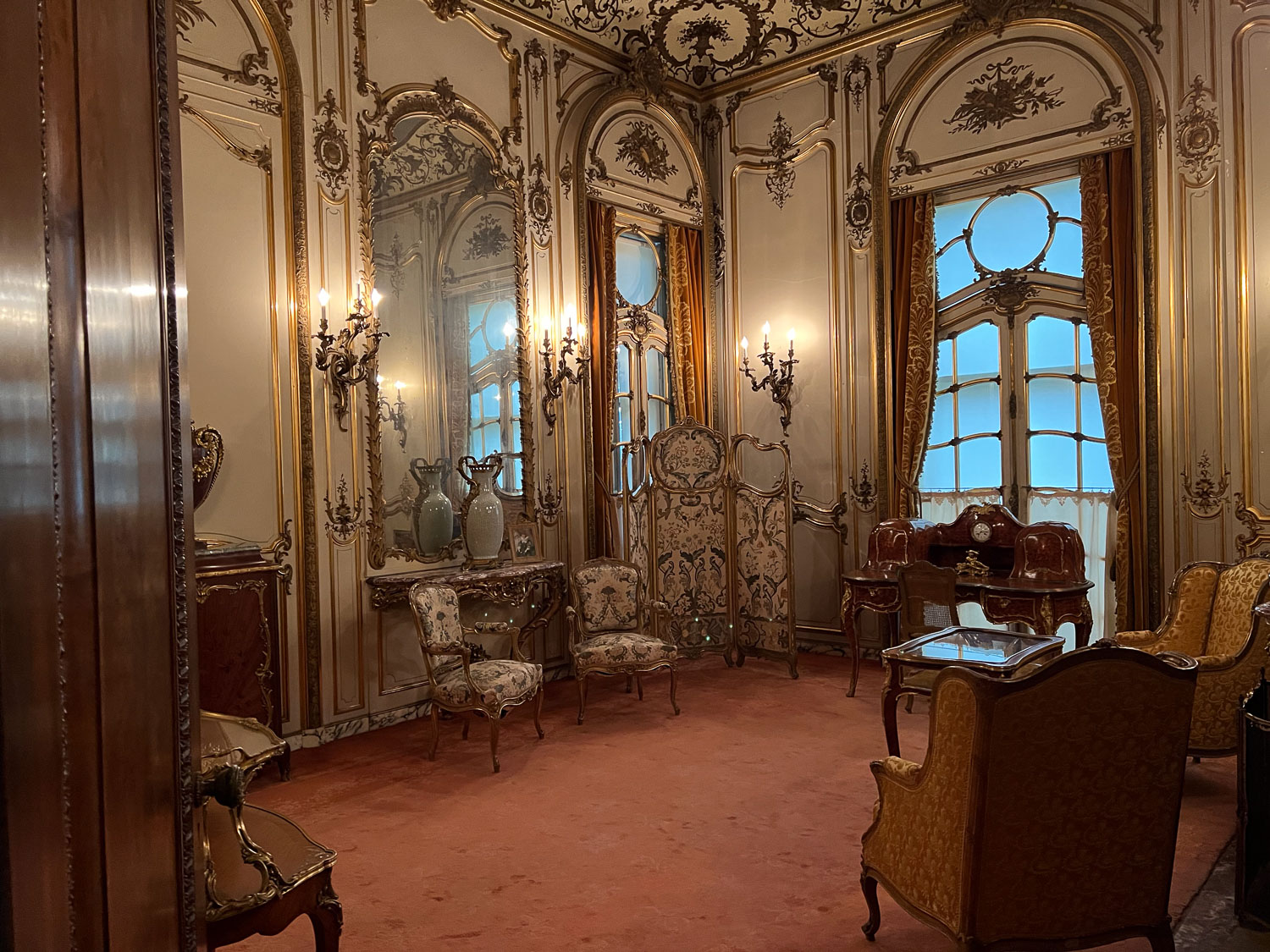
Reception Room. The National Historic Site website says: “Eighteenth-century-style French salons were a typical feature of Gilded Age mansions. Though infrequently occupied or used, they nonetheless were essential in the display of wealth and worldliness.“
I took this photo of the ceiling in one of the rooms. I think it was the Reception Room.
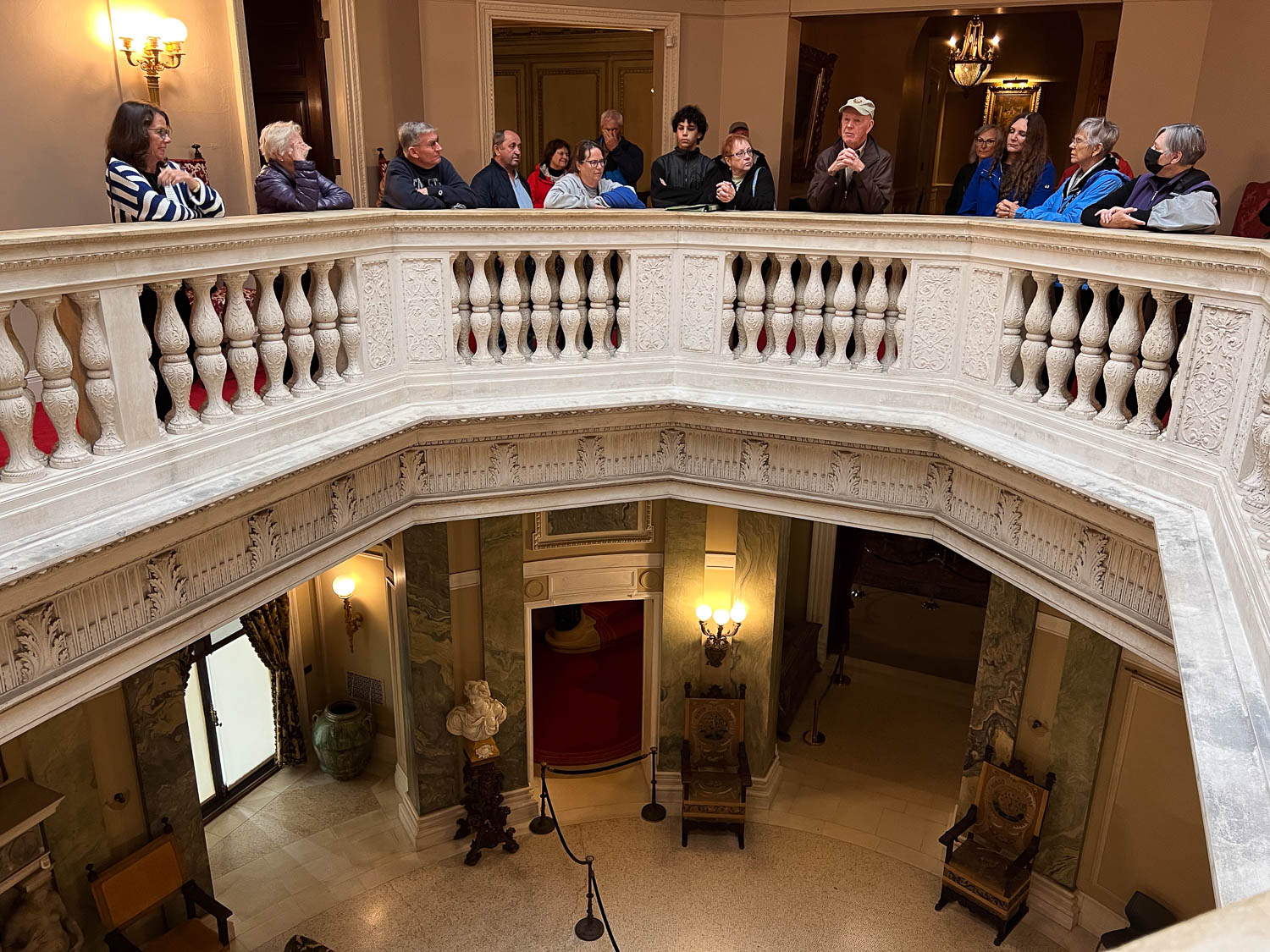
This is on the second floor where you can look down to the first …
…or up to the skylight.
Mrs. Vanderbilt’s bedroom modeled after those of 18th century French royalty. The railing around the bed was typical of royal bed chambers. I don’t remember if this was determined to be true, but the tour guide told us one theory that there may be observers when a Queen gives birth so there is no question about who is the true heir. I just found this on the National Historic Site website: “The railing around Mrs. Vanderbilt’s bed is an architectural convention borrowed from many European royal palaces. In the 17th and 18th centuries, it served both practical and symbolic purposes related to royal births and ceremonies that occured daily when the king or queen woke up. At Hyde Park, the railing serves no purpose other than to reference the architecture of Europe’s finest royal houses.”
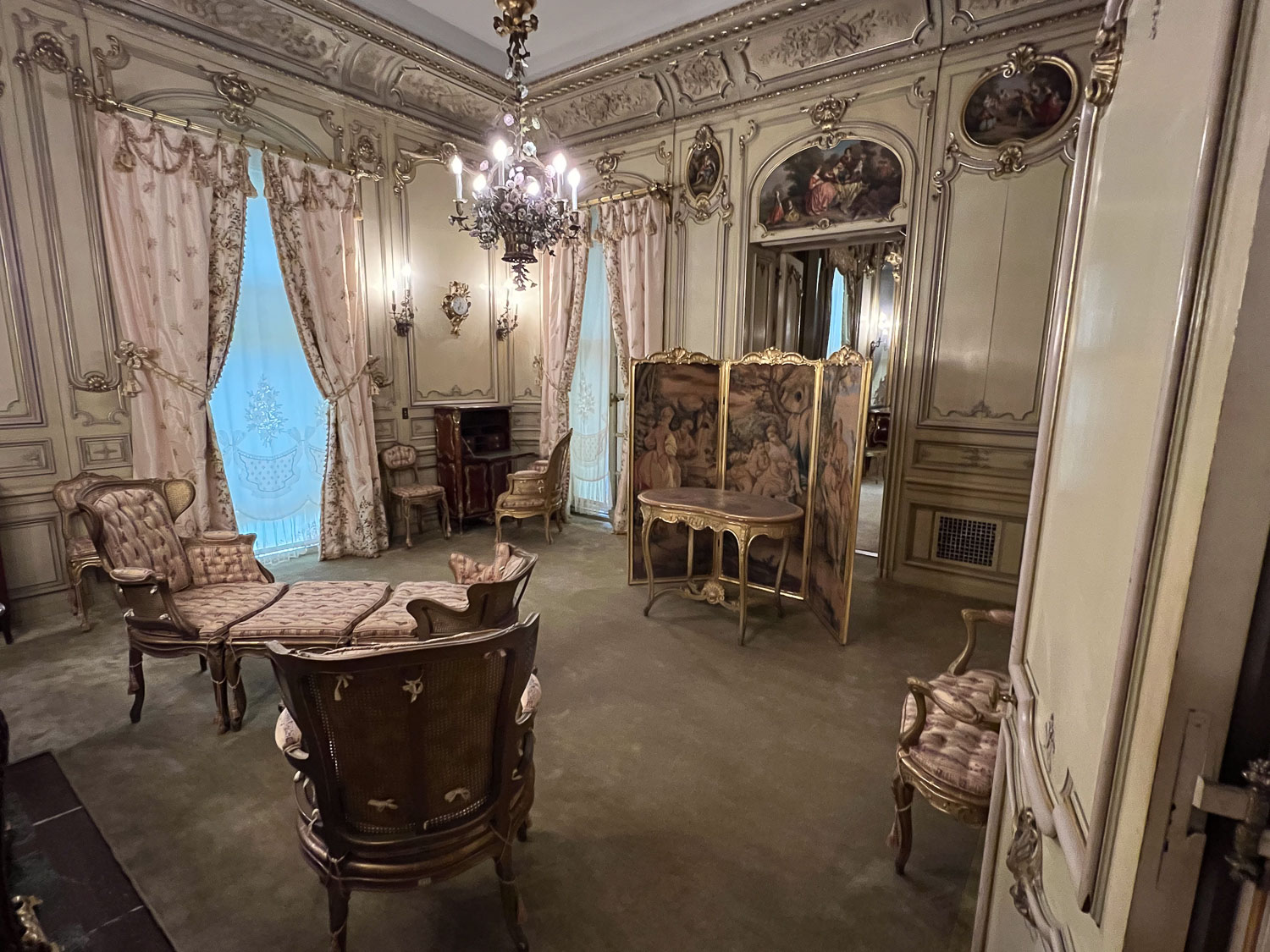
I don’t remember what this room is but looking at the map I think it is probably the Boudoir.
We took the stairway to the Servant’s Basement.
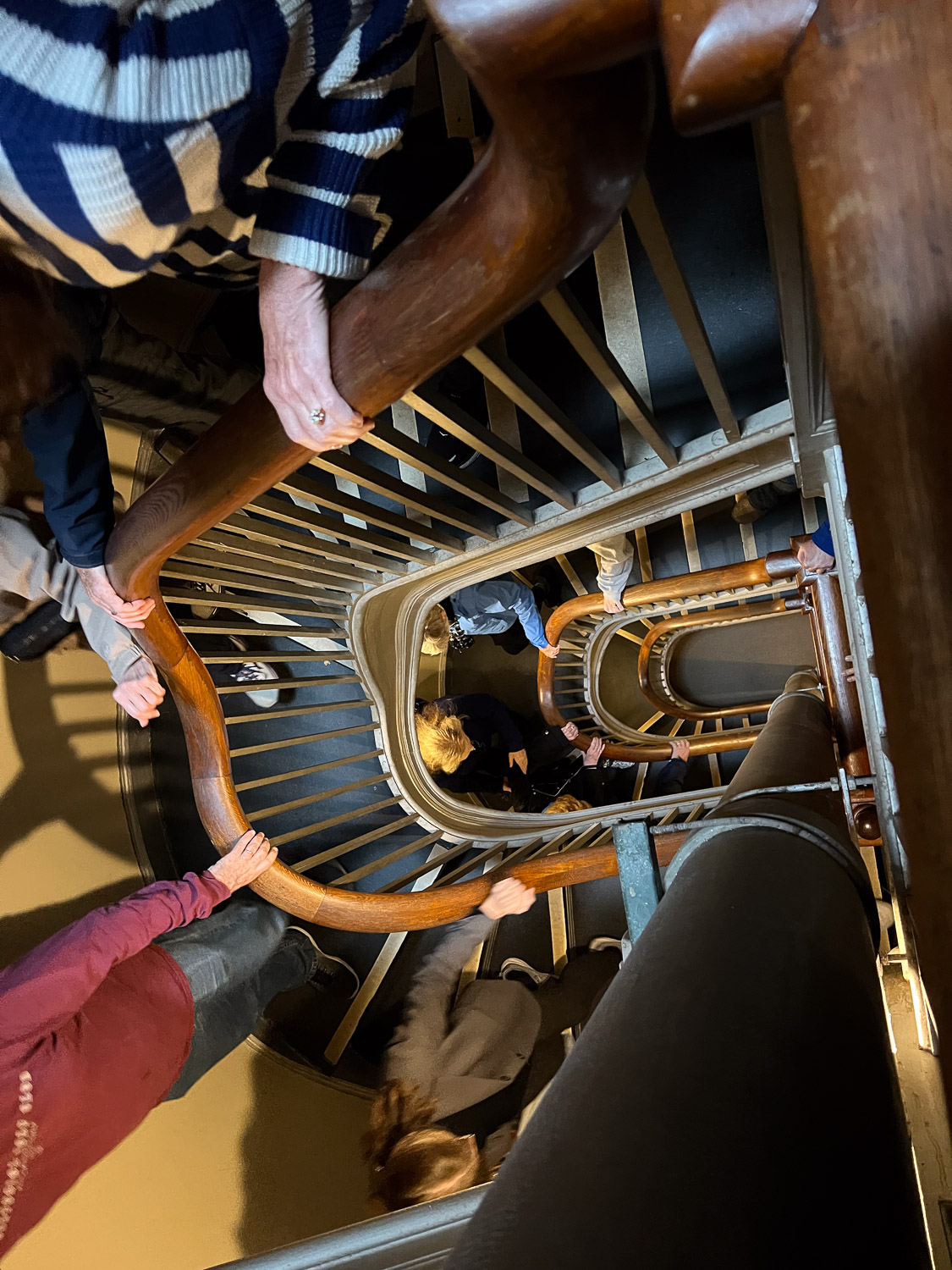
This is the view from below. There are four floors (including the basement), 54 rooms and 21 fireplaces. The third floor is closed to visitors and we were told that it is not as it originally was, being used to house Secret Service agents at some point in the history of Hyde Park. There is much more information to be found on the referenced website.
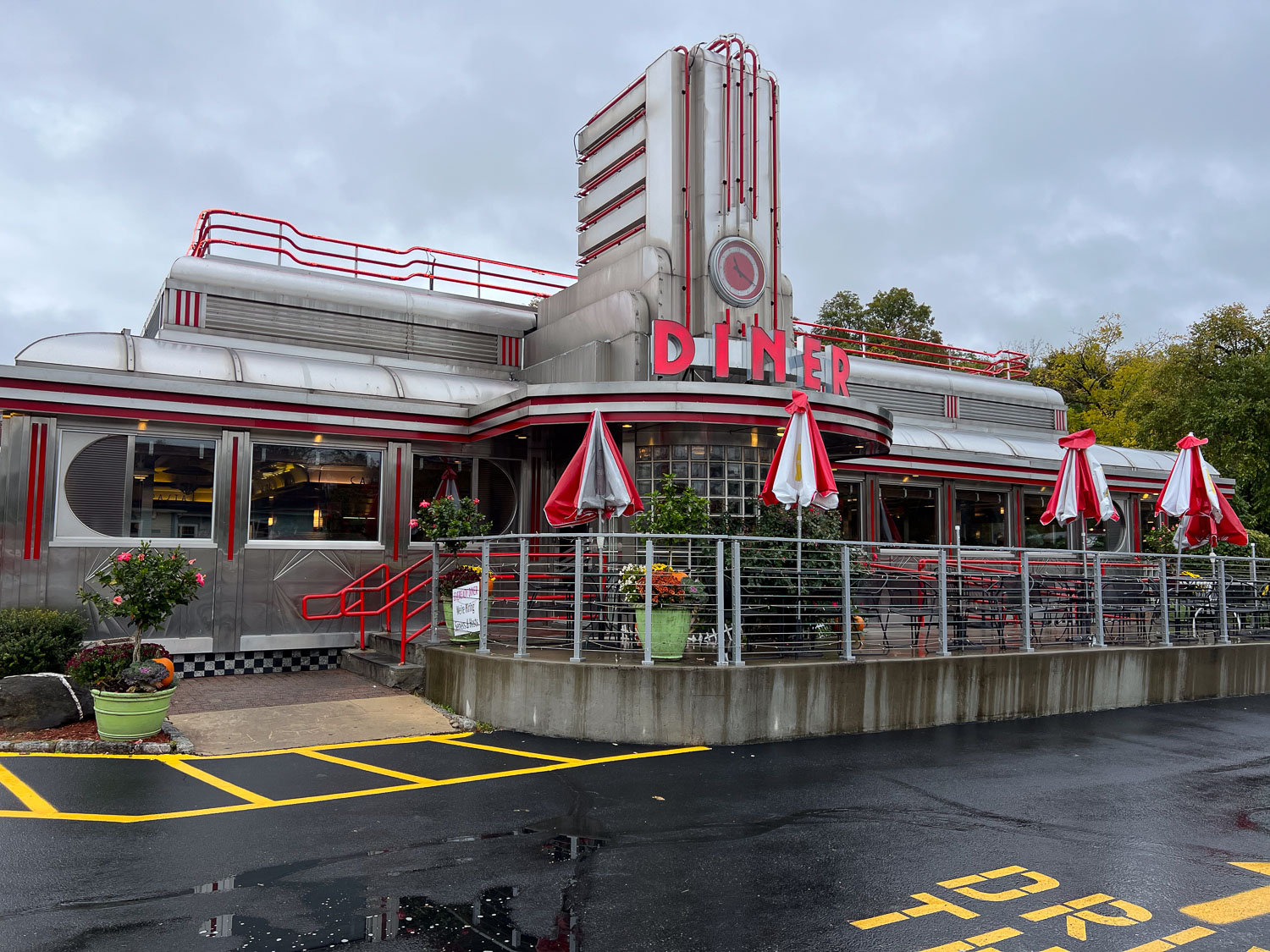
Change of scene… We stopped at the Eveready Diner in Hyde Park for lunch and met up with California friend, Siobhan, here. I didn’t drive during this whole trip and kept losing track of which town we were near. We stayed outside Tivoli, New York and drove to Rhinebeck, only 11 miles south. Hyde Park is only another 10 miles south of Rhinebeck. So we were back and forth on that same corridor for the whole trip.
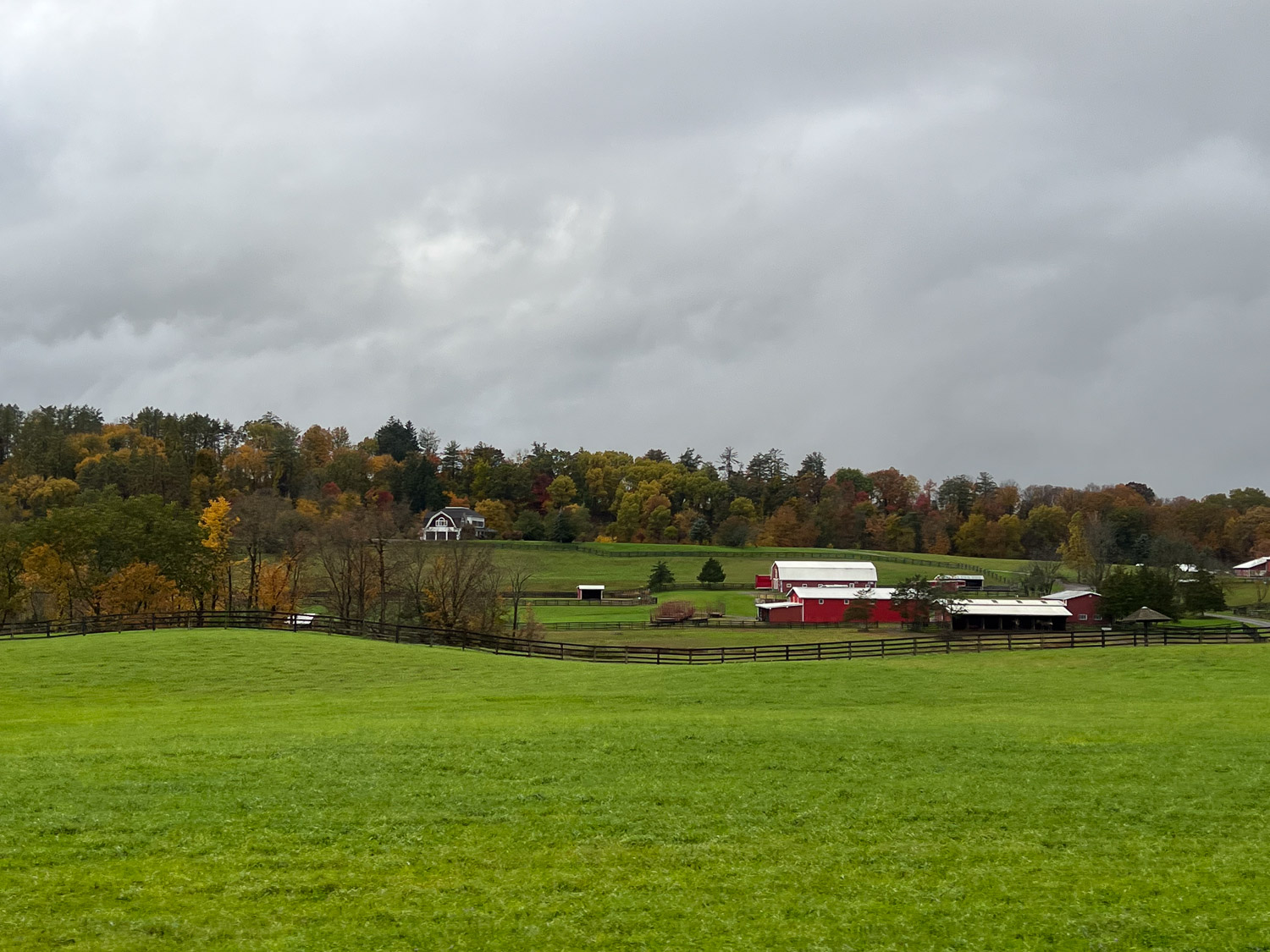
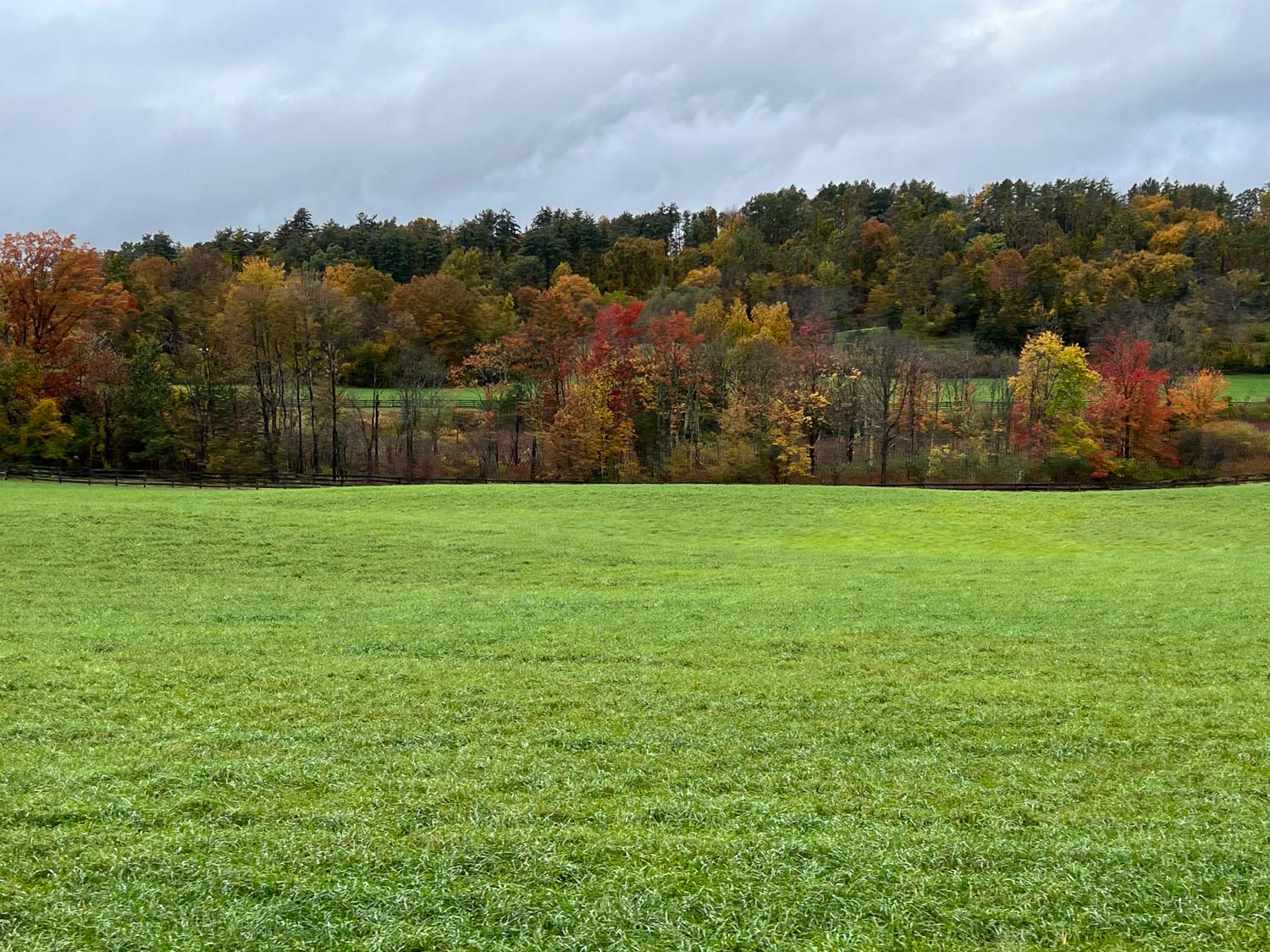
On the way home (to our AirB&B) we took a side road to see some of the countryside.
I thought that It would be great to come home all caught up with my blog posts. That didn’t happen–partly because it’s not as easy to work on the iPad as on my computer and partly because I spent time with my friends every evening and didn’t focus on other things.
On the second day in New York we drove to Hyde Park where there are three National Historic Sites we intended to visit. We started at this one.
We signed up for a tour of FDR’s house. This is the stable where we gathered.
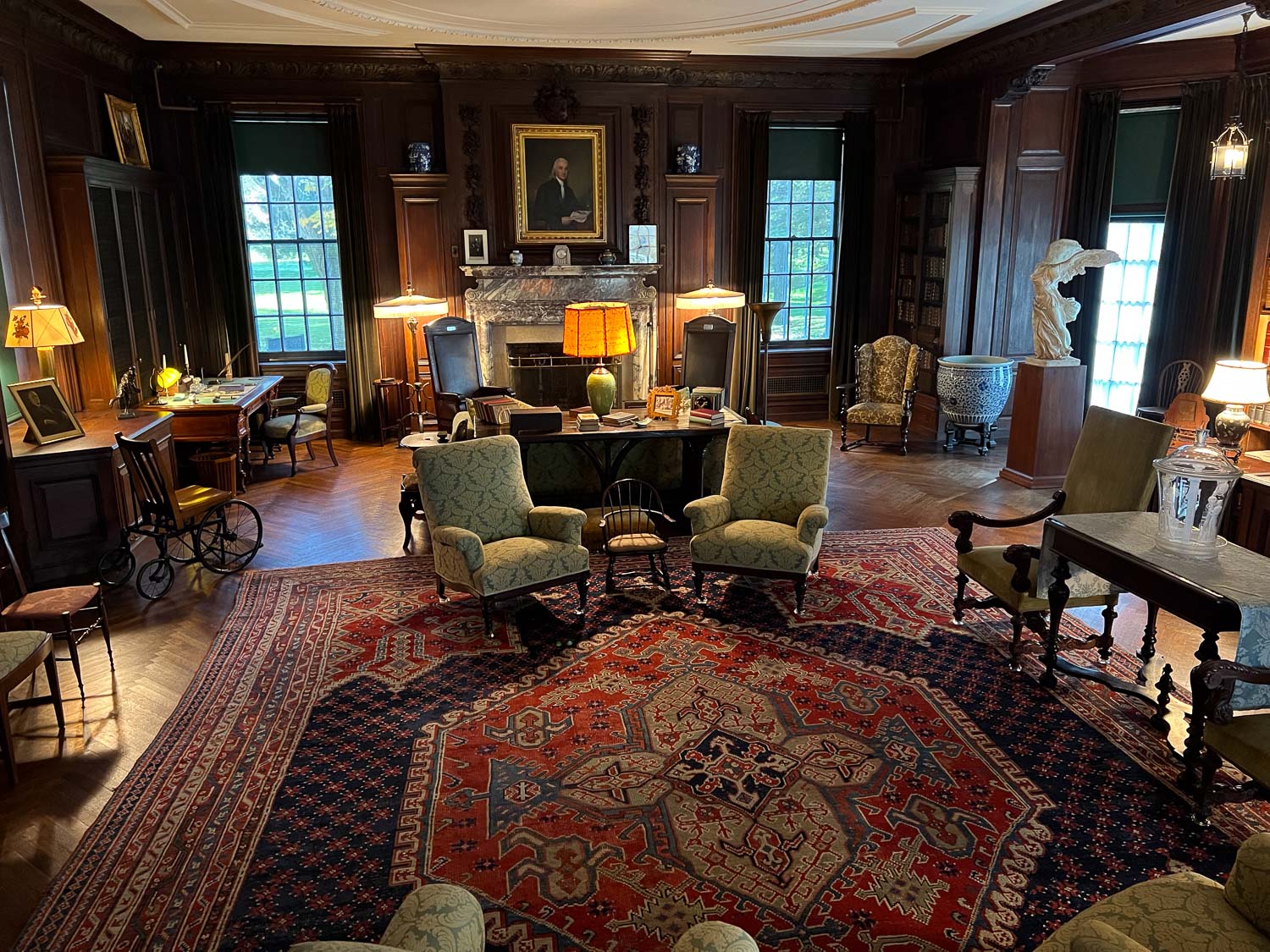
FDR was born in this house in 1882. After he was married and the family grew there were additions to the house There are also adaptations for wheelchair access since he was unable to walk unaided after contracting polio in 1921. I was surprised to learn the extent to which that fact was hidden from the public throughout his life.
There is a ramp to this room, but when Roosevelt was alive the ramp would be concealed once he was in the room and awaiting his guests.
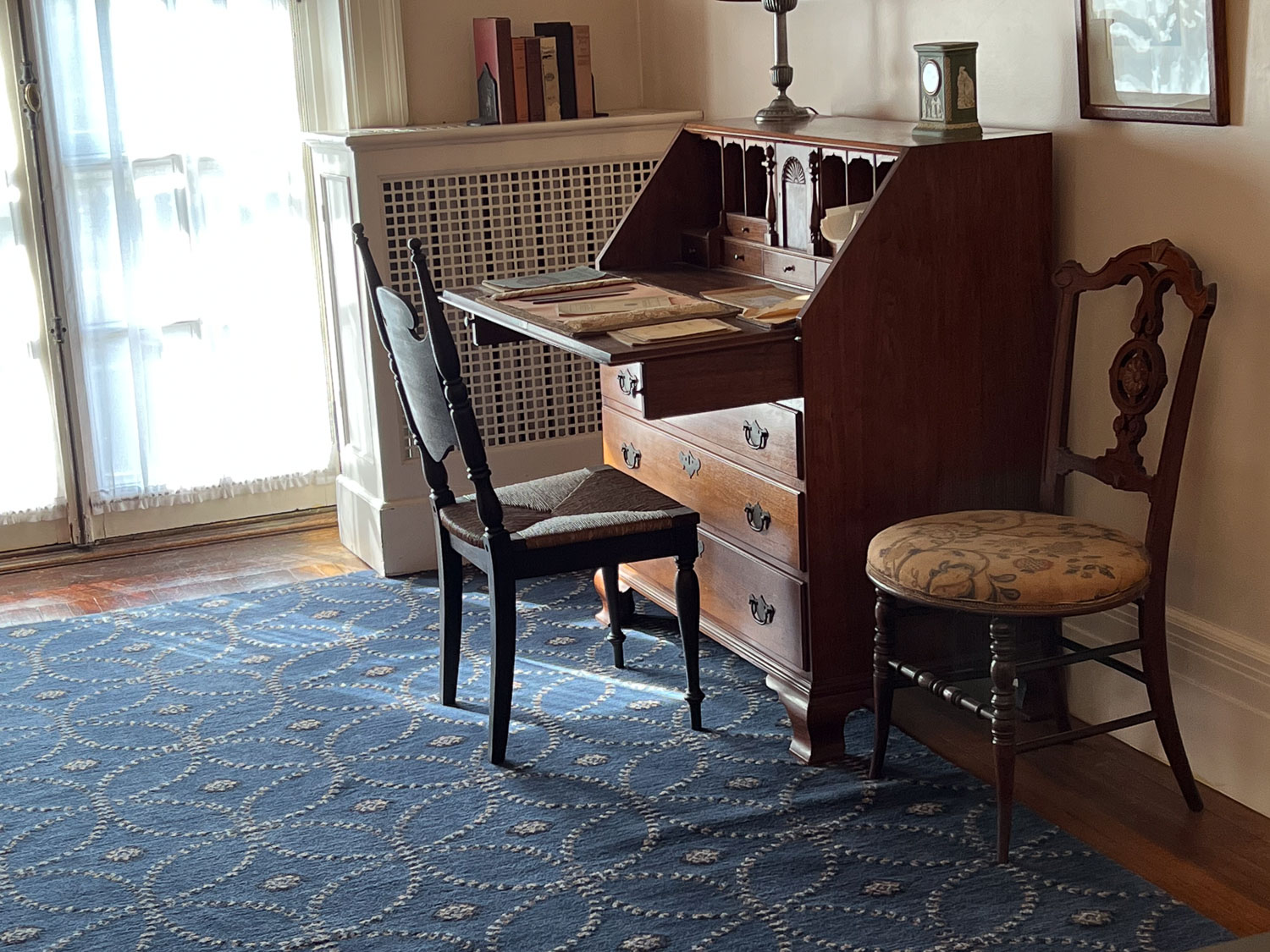
I took this photo because that desk is almost identical to the one that I used while I was a kid and through high school. It belonged to my grandmother who had lived in New York. I always liked the “secret” cubbyholes that were those fancy columns on either side of the door at the center of the upright part. My granddaughter has this desk now.
We had started at the FDR Presidential Library but had only a half hour before our tour of the house. There was so much to see here that we came back. I thought that a Presidential LIbrary would be full of books, but this is a museum. It is very well presented and there is an overwhelming amount of information here. This is the first Presidential Library and I assume that maybe others are modeled after this one. This one opened in 1941, and of course it would have been very different than what it is today.
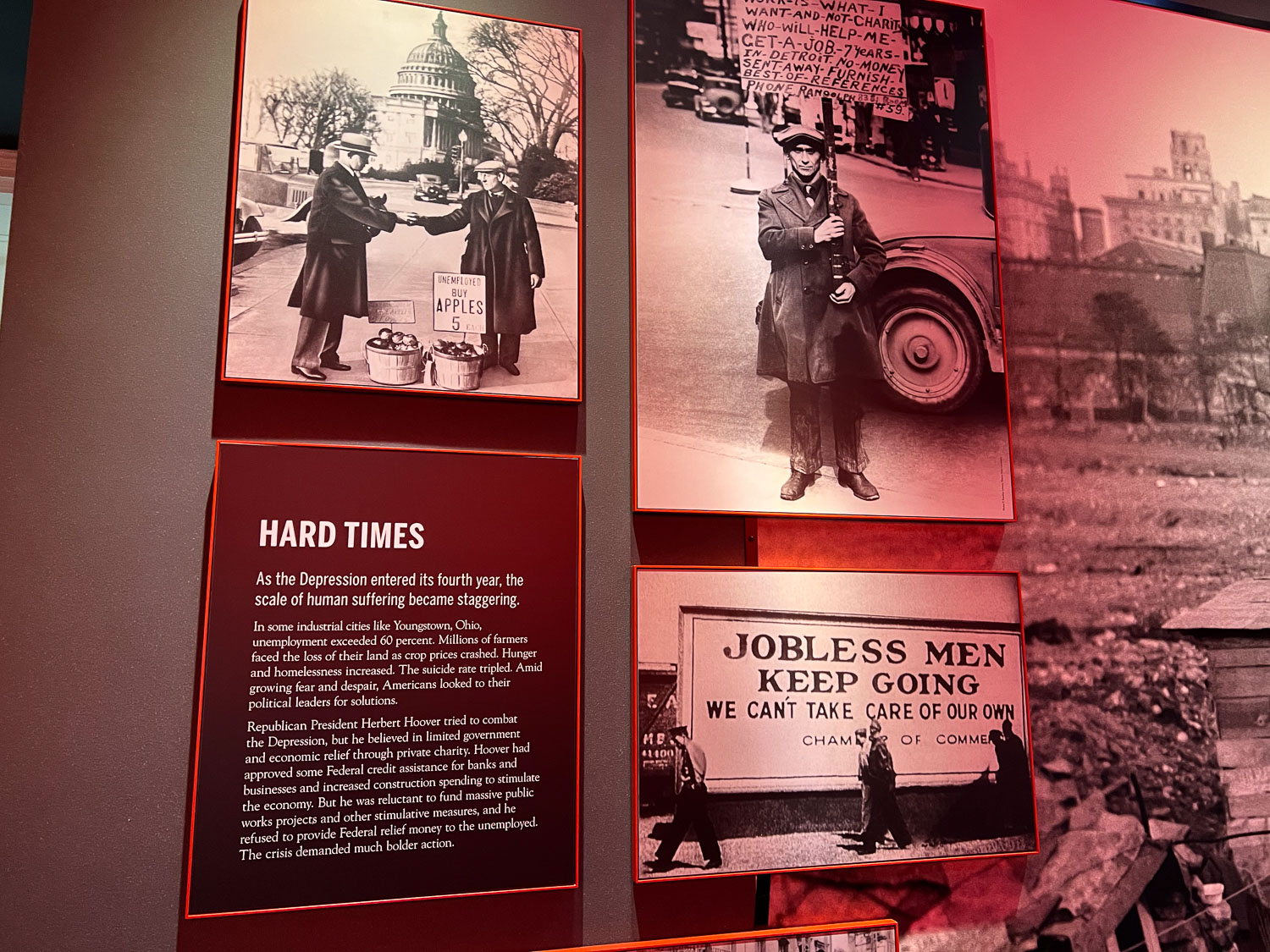
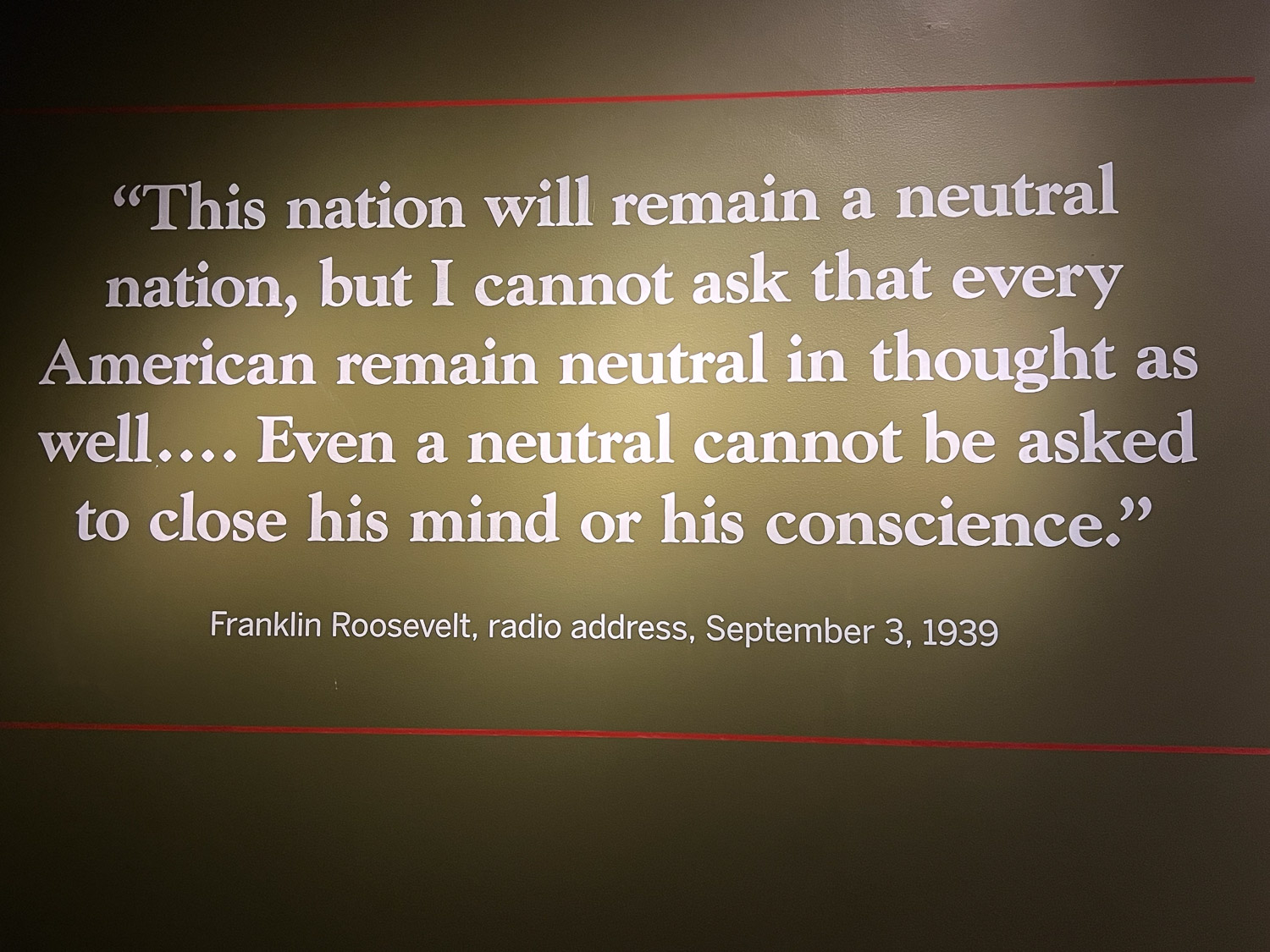
I knew the bare basics of this era but this exhibit pulls it all together in a very informative and organized way. The exhibits are all set up in order so that you move through Roosevelt’s story from before he became President to his death during his fourth term.
It starts with the Depression when Hoover was President.
When Roosevelt was elected he jumped right in and tackled the major problems facing the country.
I am of course familiar with all of these programs now because they are part of our way of life, but I have never thought about the time when they were developed.
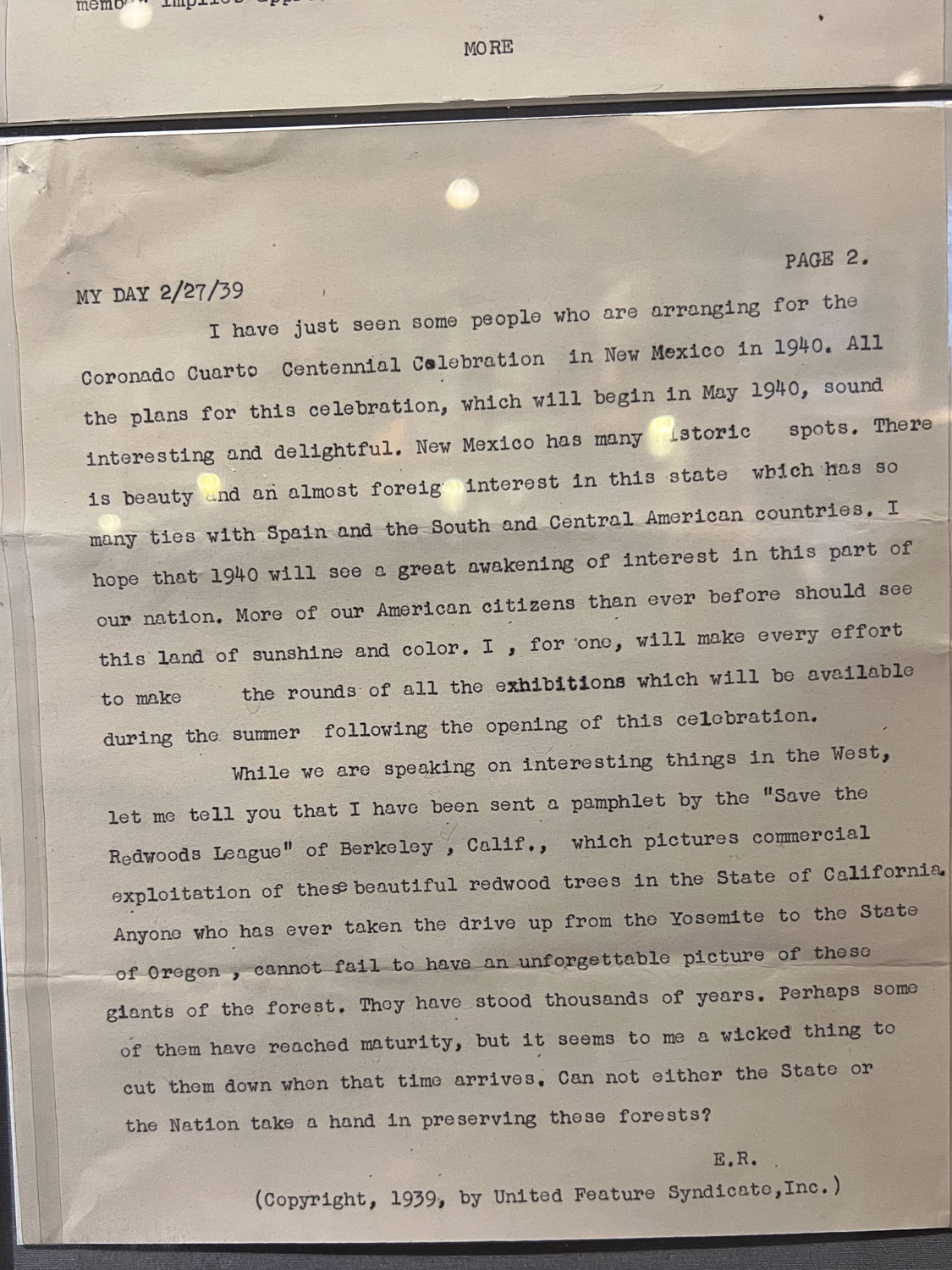
Eleanor is included in this museum as well. There is another National Historic Site at her home but we didn’t have time to go there. This letter is of interest to me because she recognized, way back in 1939, that California’s redwood forests were worthy of protection (second paragraph). There was a lot here about Eleanor’s influence and political activist. The FBI had quite a large file on her activities!
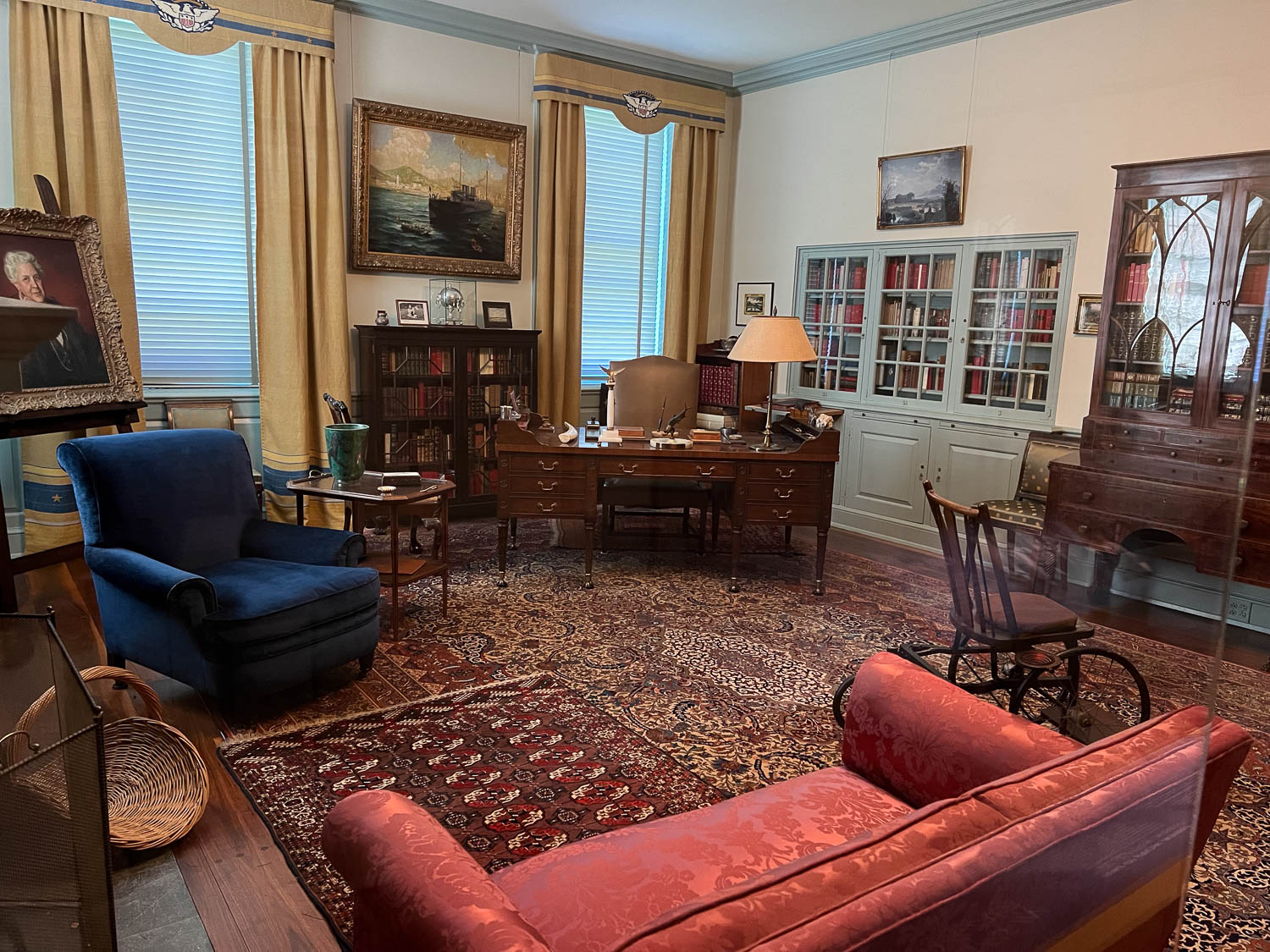
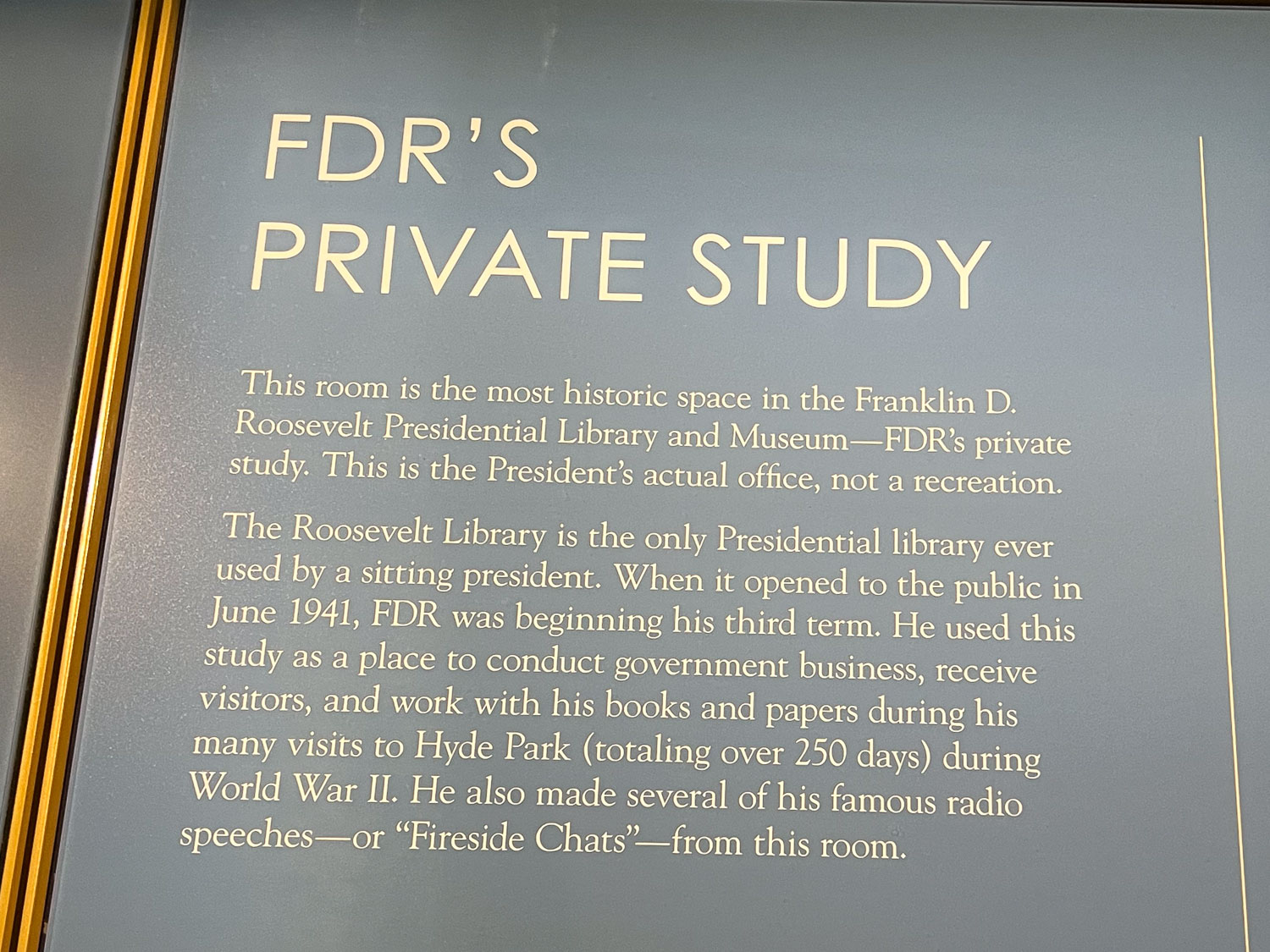
This is a working office used by Roosevelt during his presidency as is told in the photo below.
There was so much to see at this library that I could easily go back if I ever get to this part of the country again.
We drove to the Vanderbilt home only a few miles away. We would have had to wait a couple of hours for space in a tour so we decided to come back the next day.
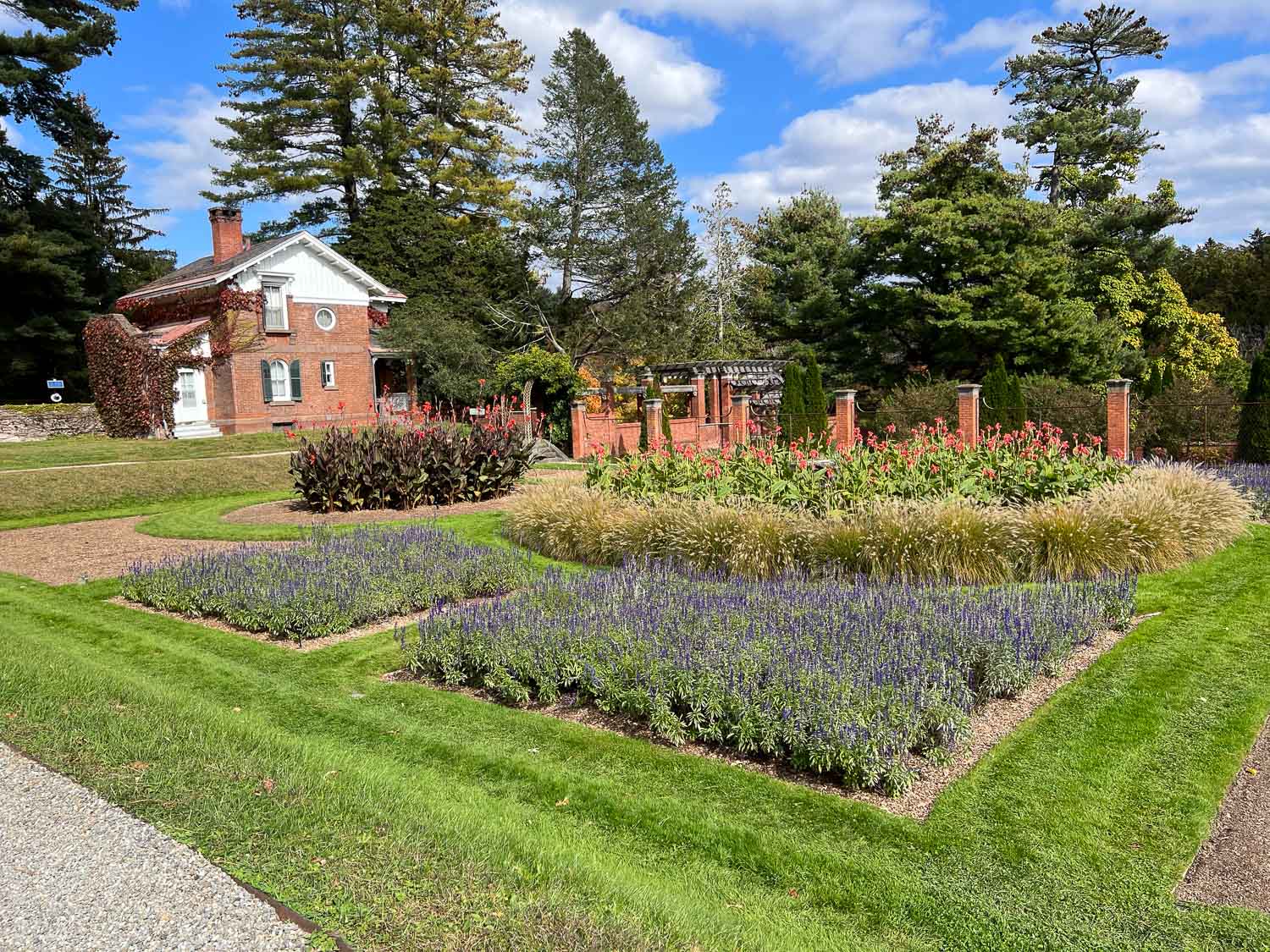
We wandered through the gardens before we left to go “home”.
I don’t have many photos of the AirB&B where we stayed. This is from the driveway.
I stayed in this bedroom.
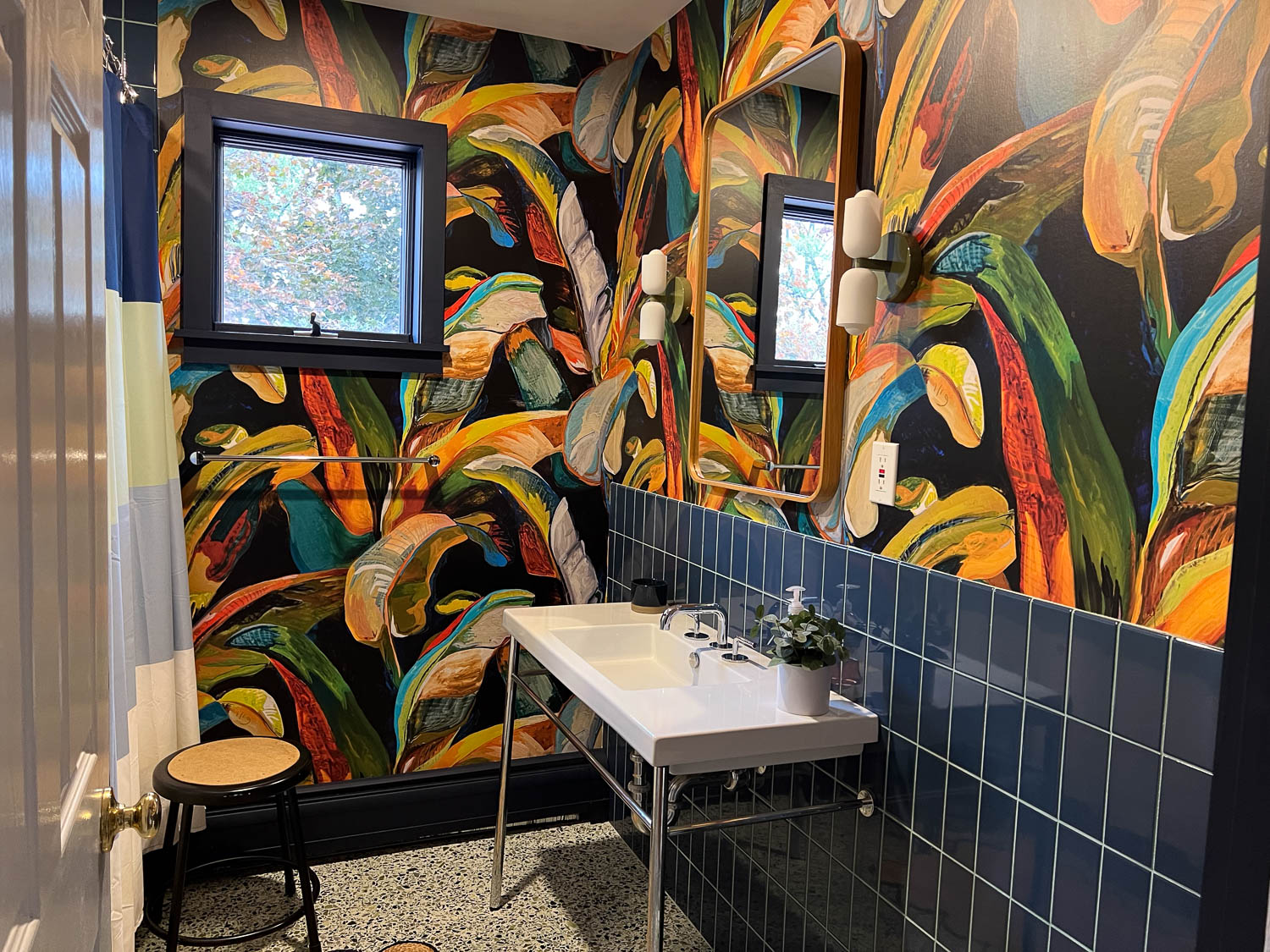
The bathroom that was shared by two bedrooms. The third upstairs bedroom had it’s own bathroom in a totally different style. We figured out with Google and other clues in the home that the owner is an architect with an office in Brooklyn.
This living room and the kitchen are where we spent most of the time. As much as we looked forward to exploring this part of the country and going to the fiber show, some of the most enjoyable time was spent sitting here and around the kitchen table.
For now I’m skipping over the time between Lambtown and the current adventure, but I may backtrack later.
Do you remember in 2019 when I had a major accident? This is the BlogPost about that. (I just reread that post and see all the typos—that was because my hand still wasn’t working very well and I didn’t catch all the mistakes.) In 2019 a group of friends and I had planned to go to the New York Sheep and Wool Festival in Rhinebeck, New York. Until I talked to these friends a couple of days ago I didn’t realize that the accident was only two days before our planned trip. My skull was repaired in February 2020 but that was just before the pandemic started. So now in 2023 we resurrected that trip we missed in 2019. It’s the same group minus one.
Landing in Chicago where we changed planes.
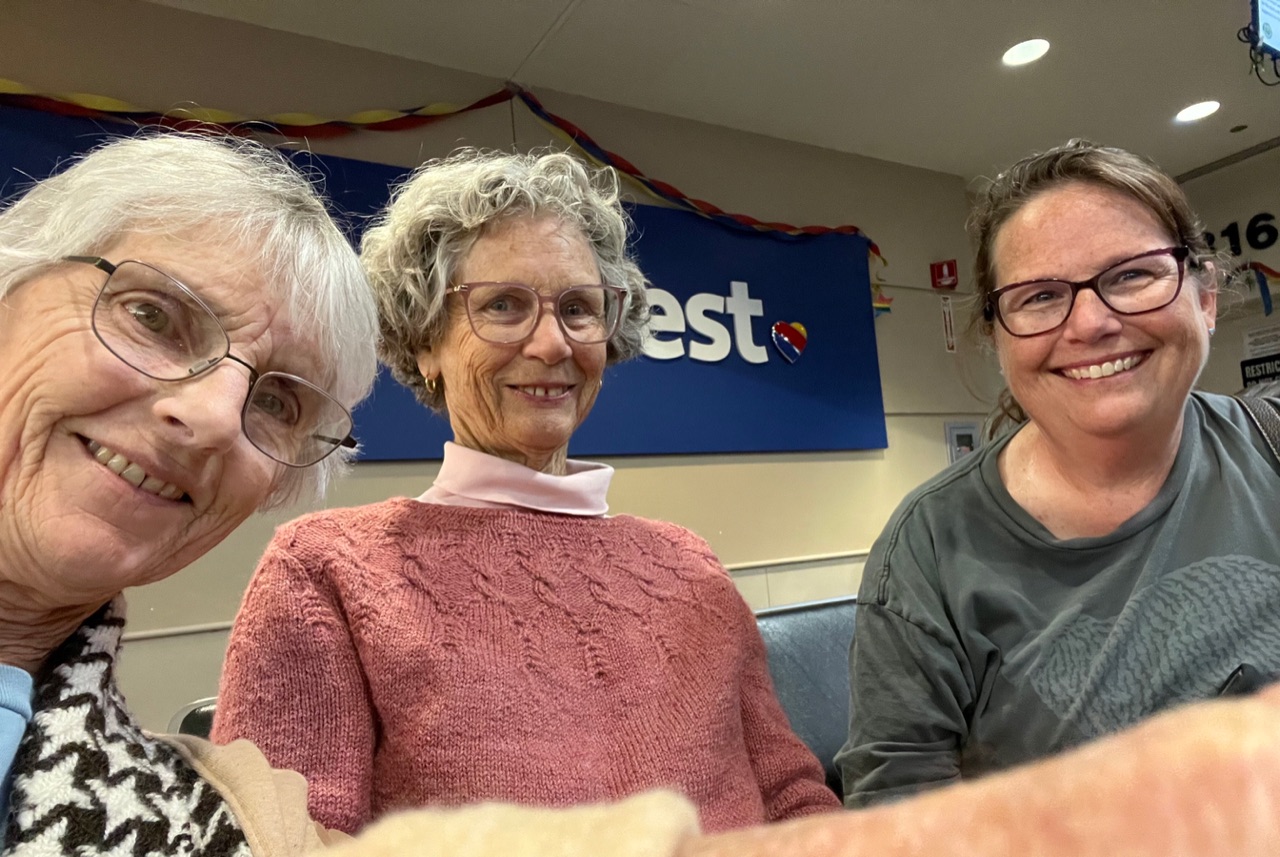
Kathleen and Mary and me in the airport waiting for the next flight. We were going to meet up with Chris who had already been exploring NY for a week with her husband and other friends.
We landed in Albany around 10 p.m., picked up a rental car, and found the nearby hotel we had booked. The next morning we had breakfast with Chris and got on the road. Kathleen wanted to find an apple cider donut and an apple farm was our first stop.
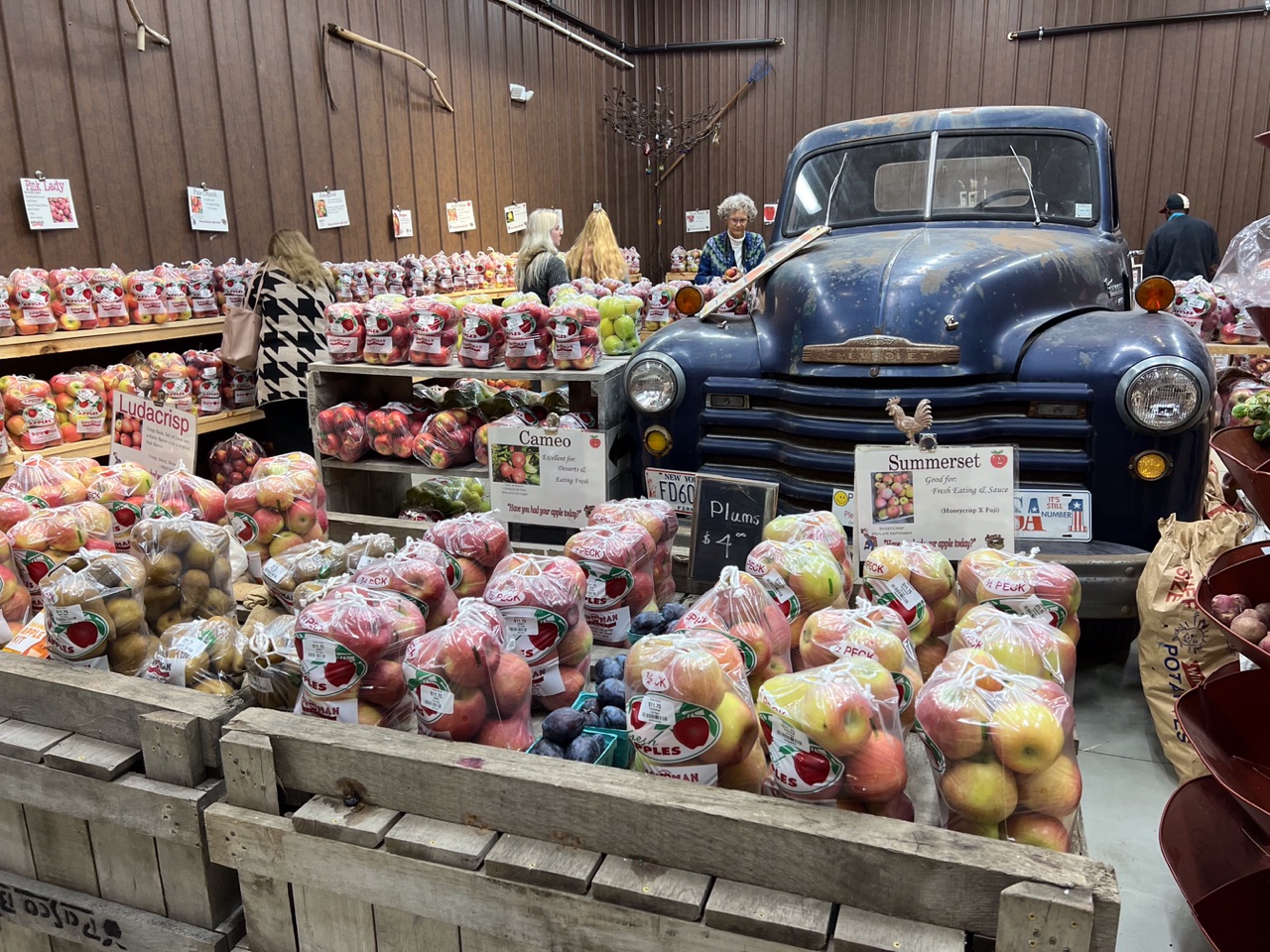
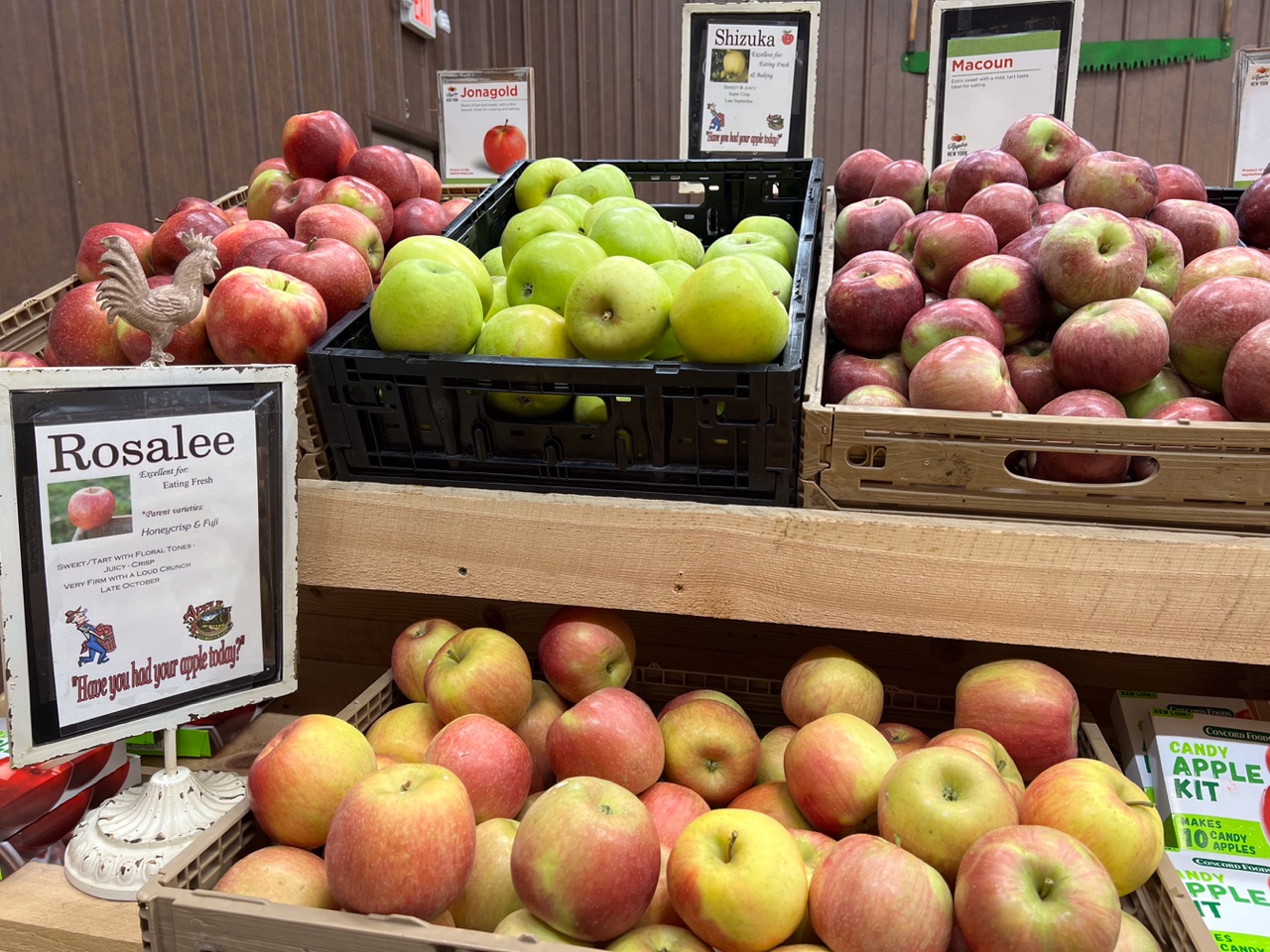
This farm was near Vischer Ferry and had you-pick apples as well as a fully stocked gift shop and bakery. There were apples of all varieties.
We each chose apples of different varieties. I like that this one says “Very firm with a loud crunch”.
How about this one that says “monster crunch, two-napkin juicy”?
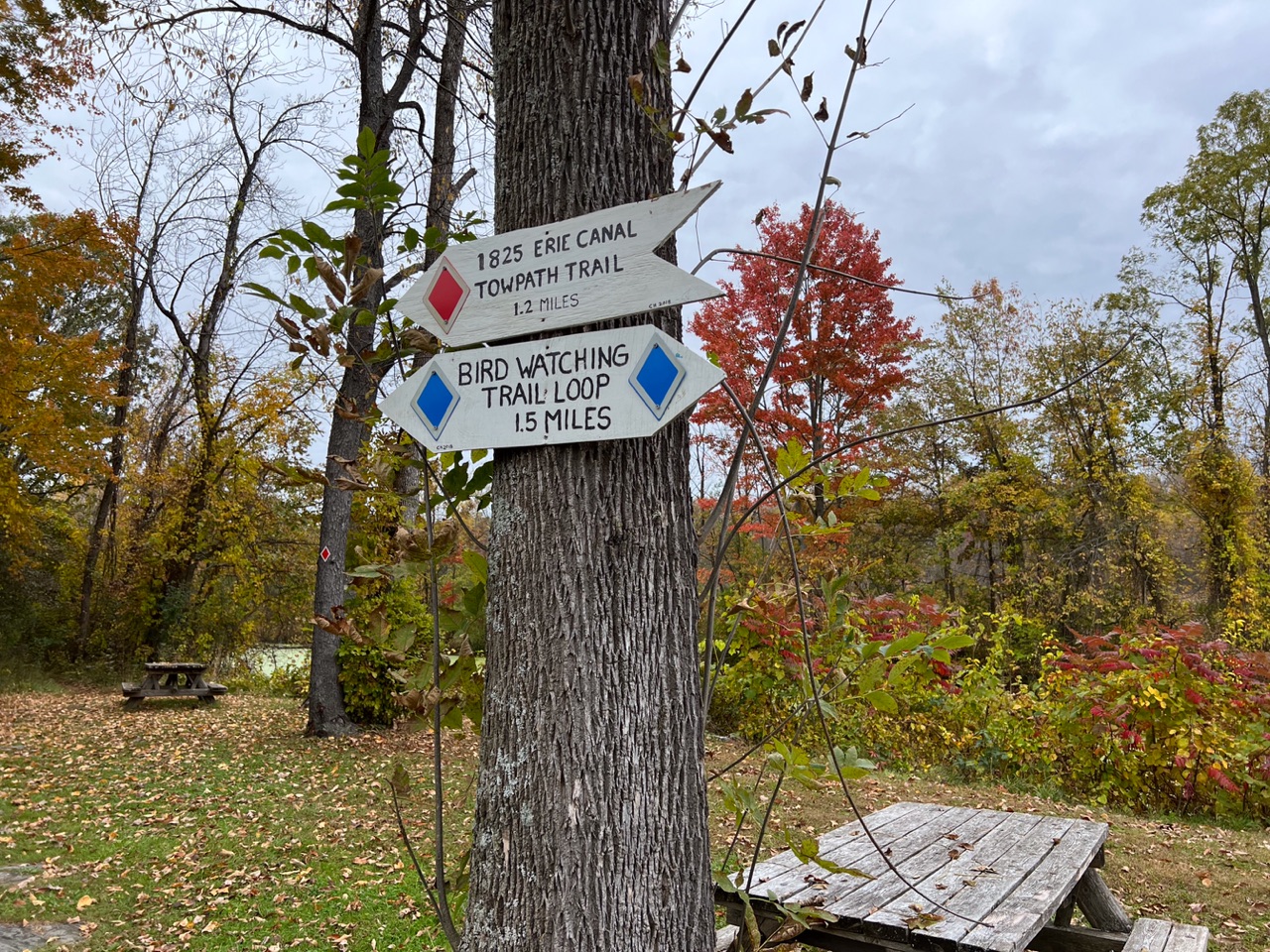
We continued on towards our AirBnB near the small town of Tivoli, but wanted to explore some of the country. We saw the Erie Canal on the map and decided to stop at the Erie Canalway Trail near Vischer Ferry Nature and Historic Preserve. According to signs the canal opened in 1825 to facilitate transportation between Buffalo and Albany and was enlarged in the 1840s. It was abandoned in 1917.
This is the canal today.
There was parking near this bridge which was originally over another part of the canal. It had been moved in 1917 to a private farm and in 1997 was brought to the canal where there had been a similar bridge.
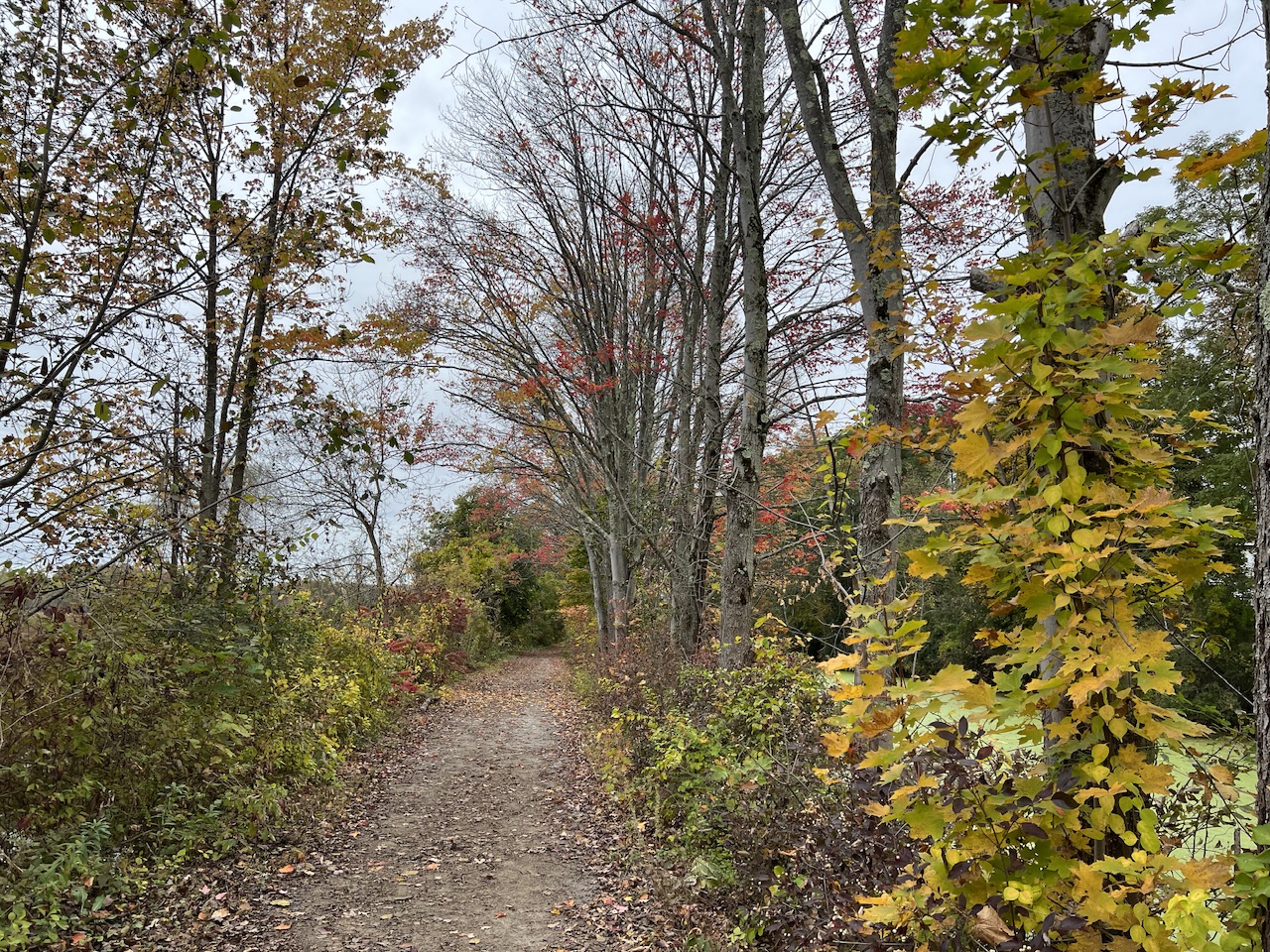
Kathleen and I chose to walk the trail for awhile.
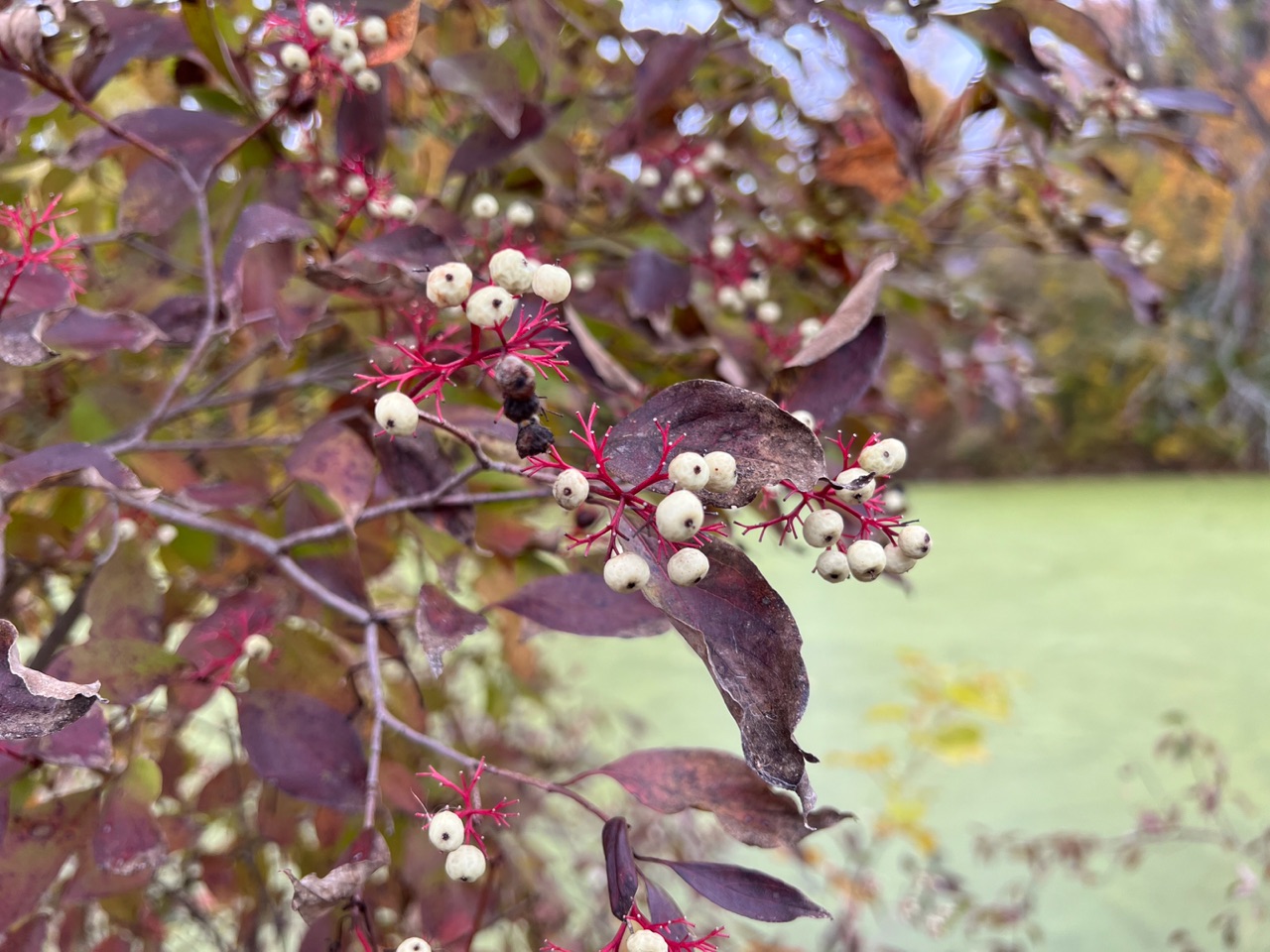
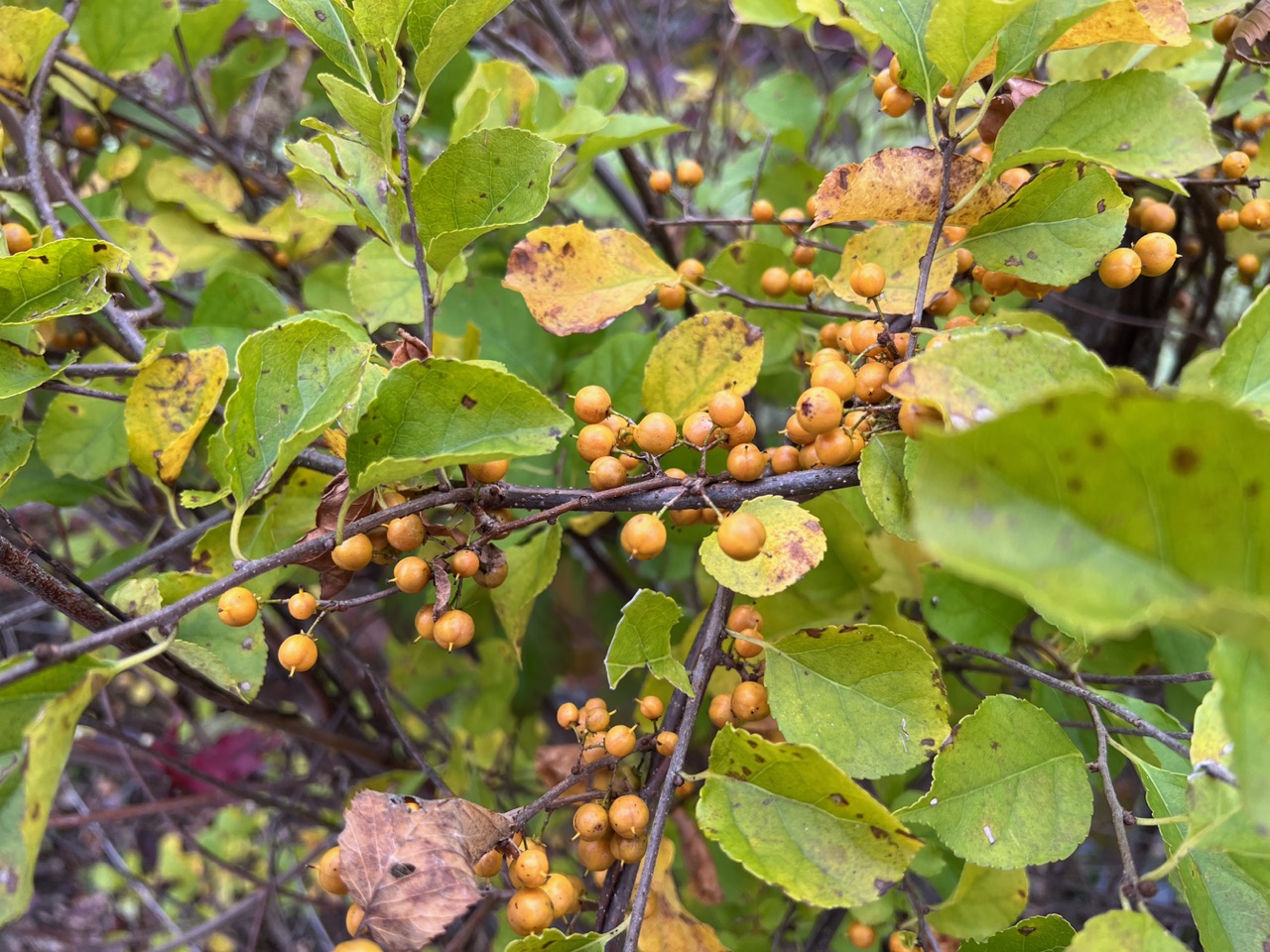
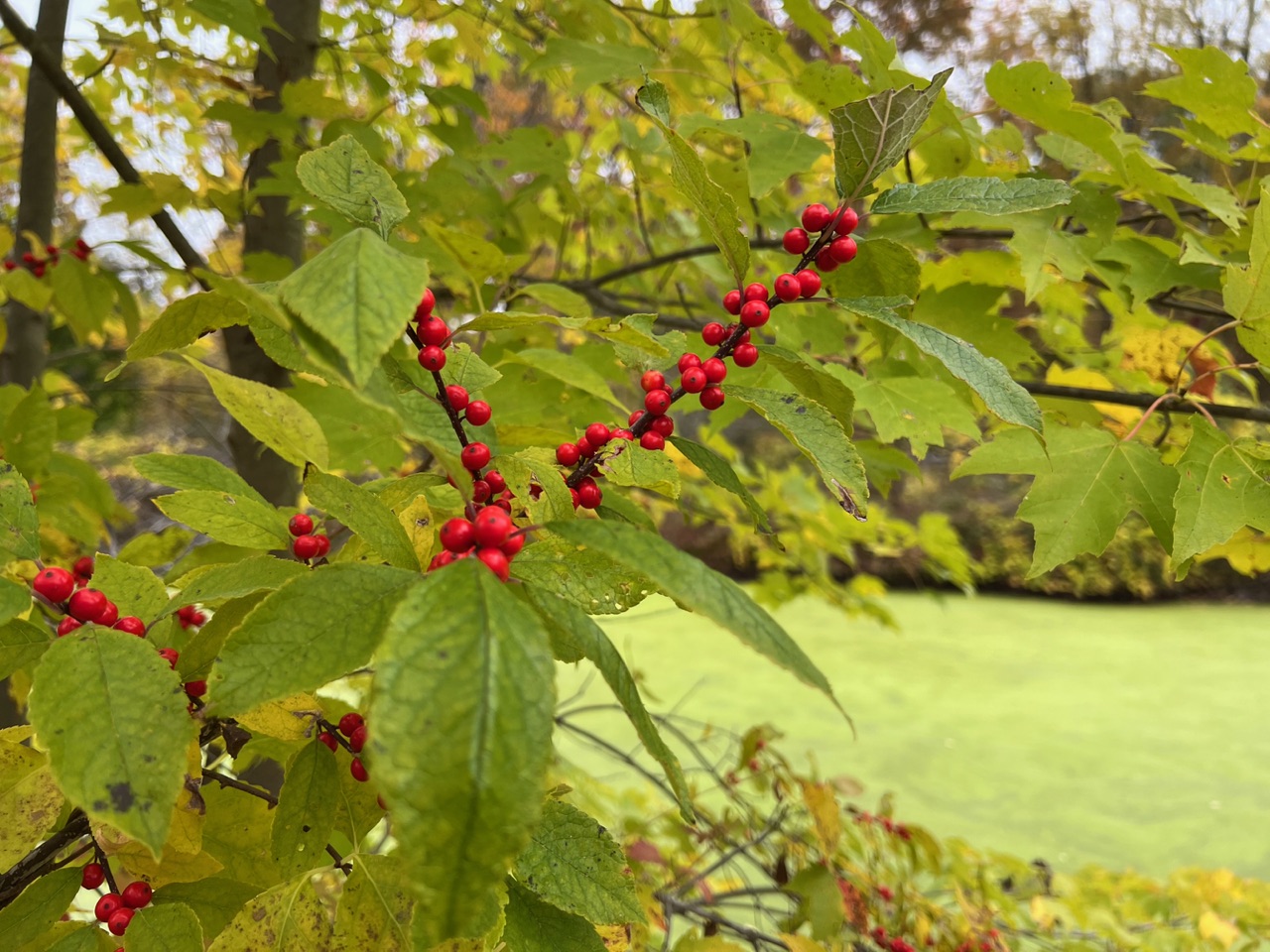
Kathleen was looking for birds while I kept getting sidetracked by all the plants that are different from what I’m used to. White berries on this one.
Yellow berries here.
Red berries here. I loaded this photo into a plant ID app on my phone and it was identified as winterberry holly.
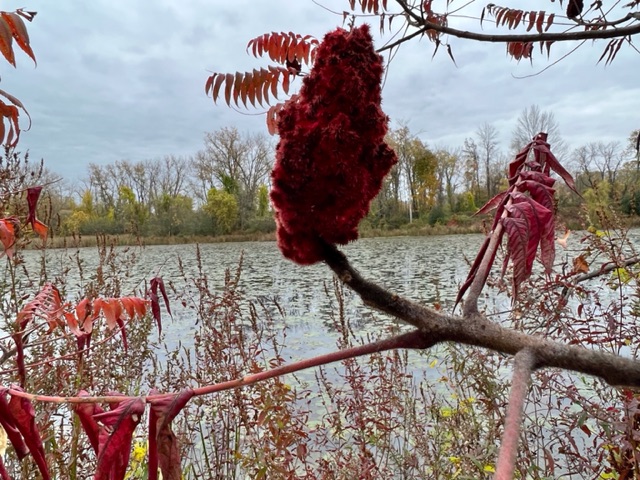
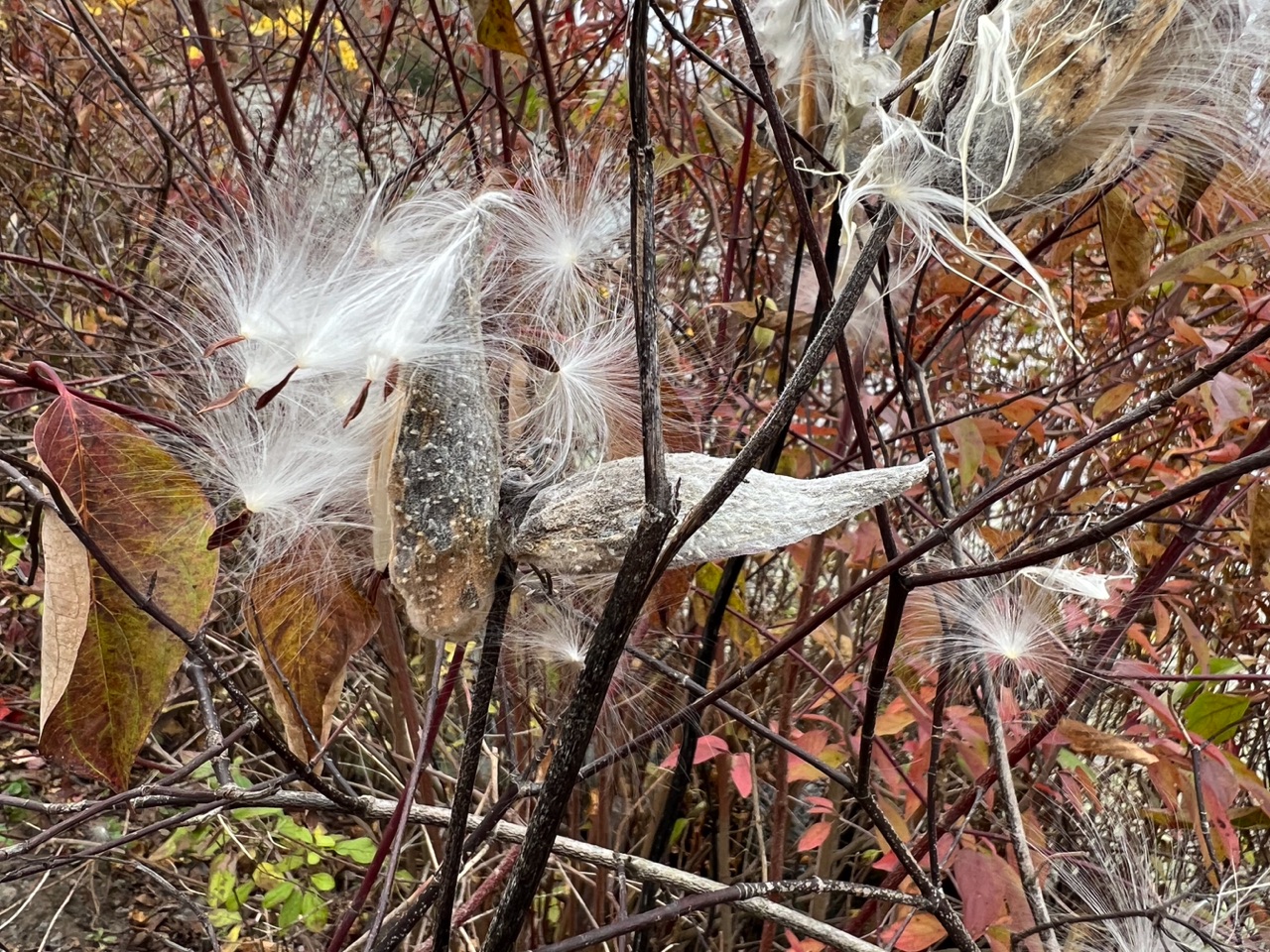
Berries are the fruit of the tree or bush and contain the seeds. We saw lots of other interesting mechanisms of seed dispersal, but I don’t have ID on any of these plants.
Another unknown.
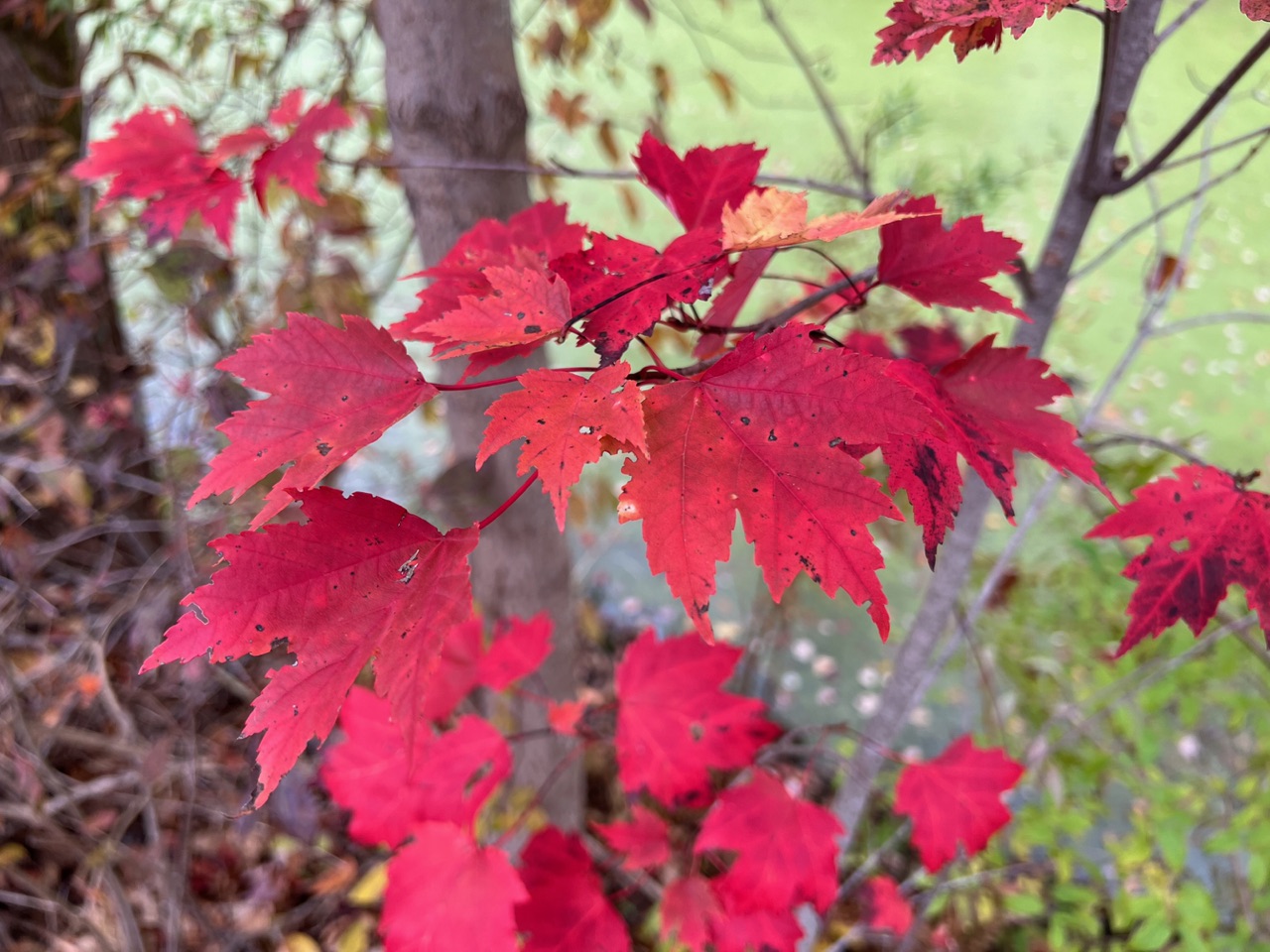
Gorgeous colors.
We could see the other side of the canal from the trail. I assume that this is the original rock wall. But I don’t really know enough about it.
It’s larger here—maybe part of an old bridge or where there was a lock??
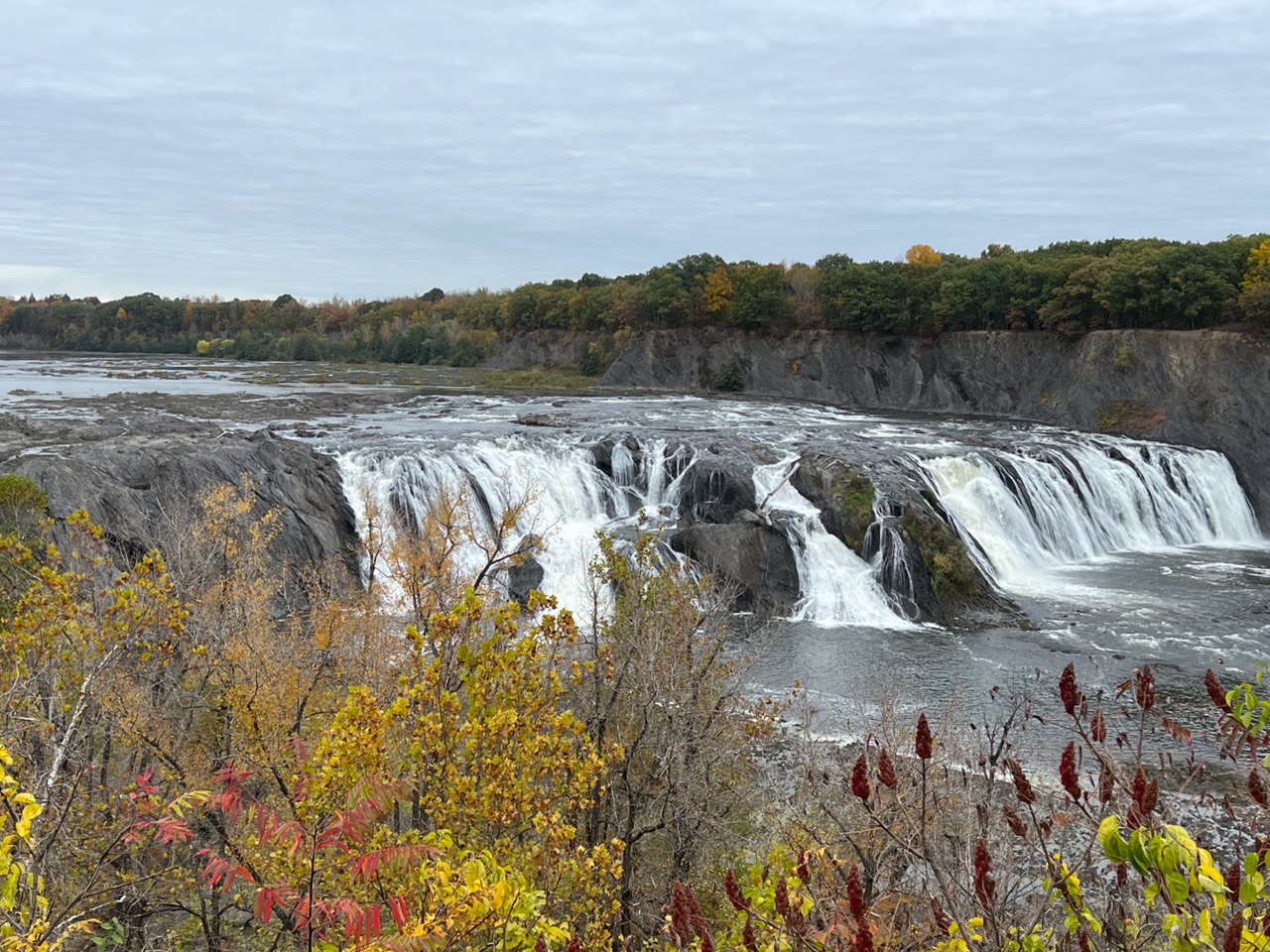
We drove on to explore Cohoes Falls on the Mohawk River.
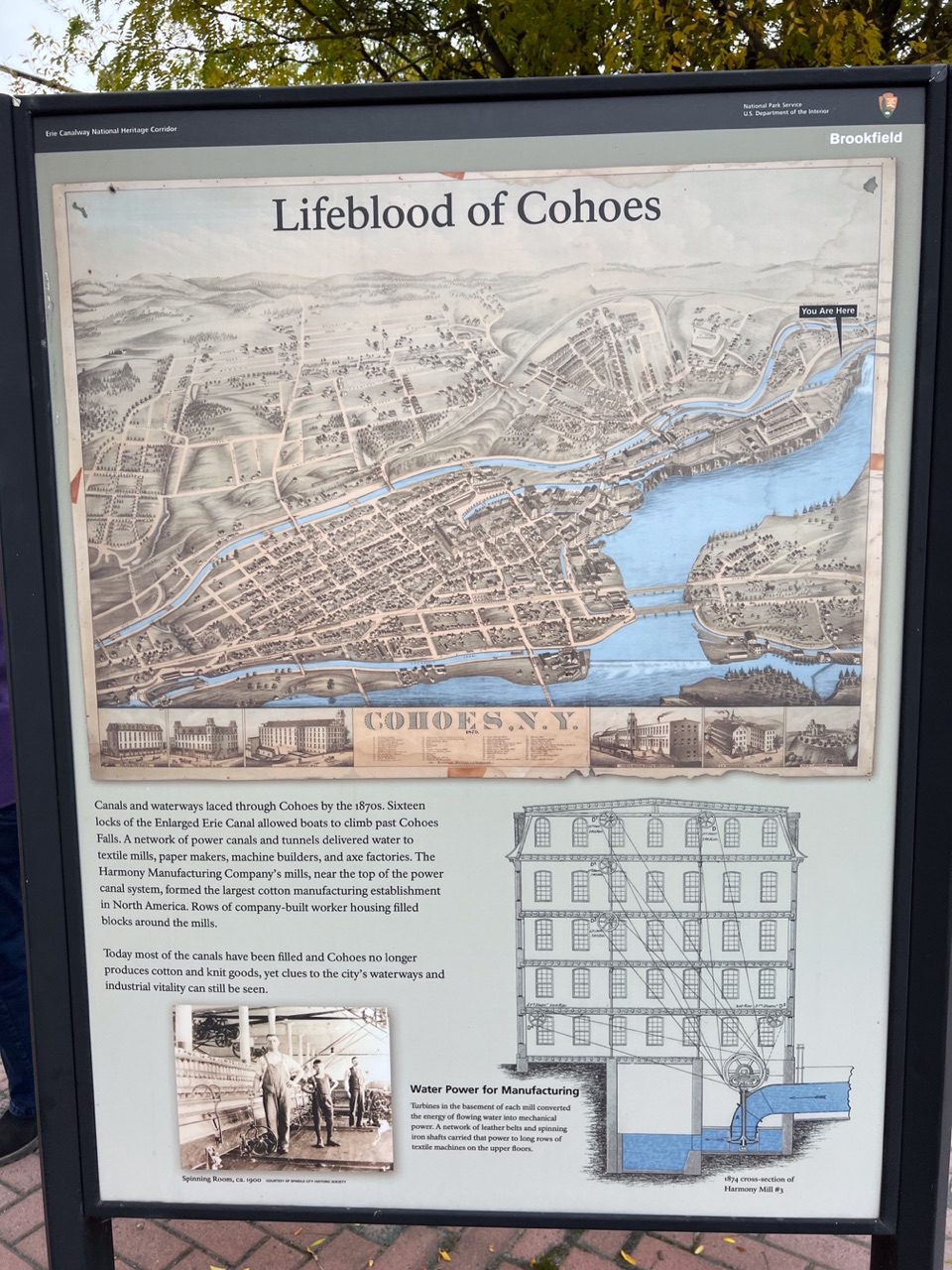
It was fascinating to see the original cotton mill buildings in the town and to read about how they were powered by the river water. Many of the old mill buildings are still here but have been converted into apartments.
Here is how it looks today.
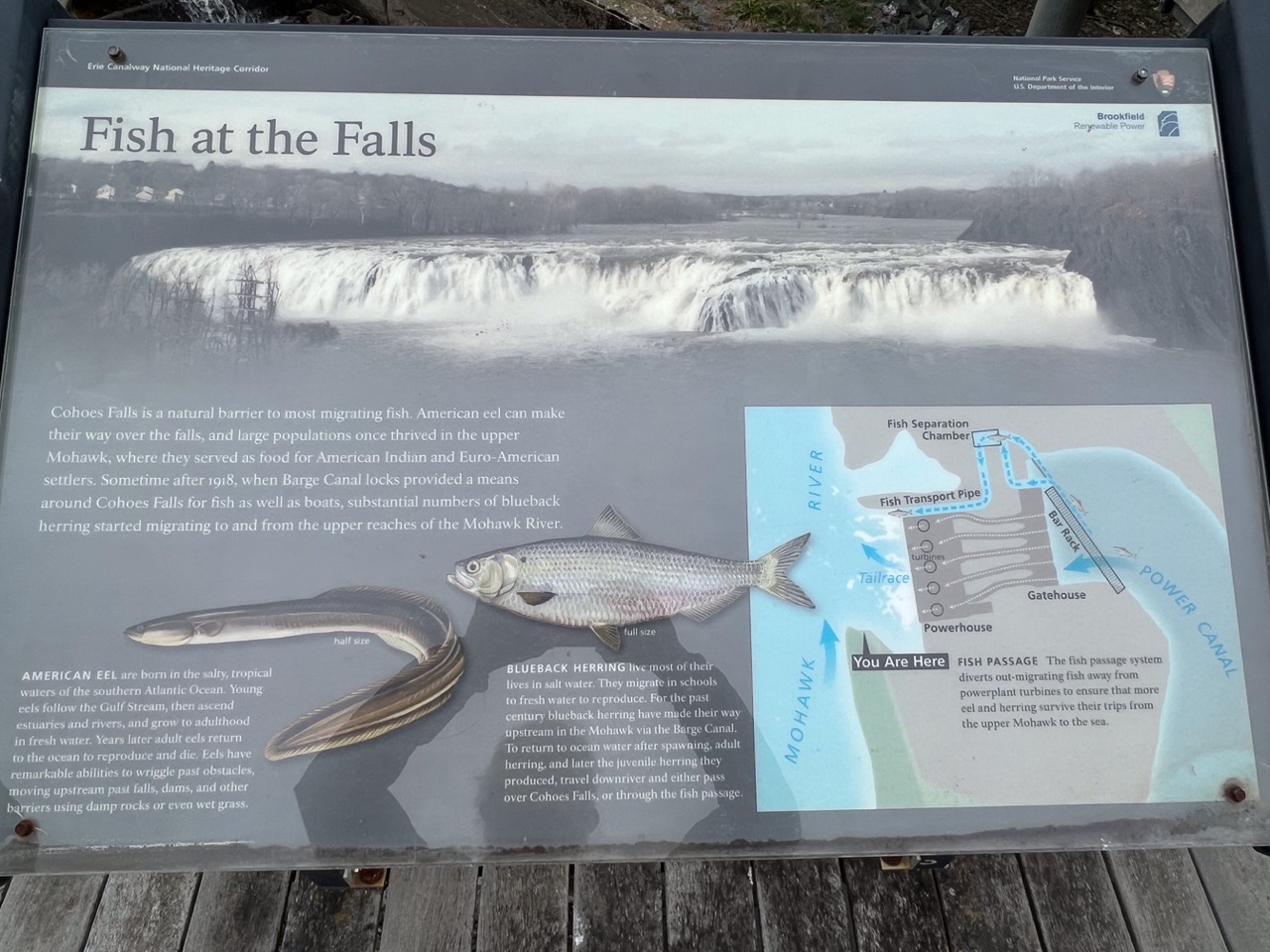
This is the outlet of the fish transport pipe as described in the sign below.
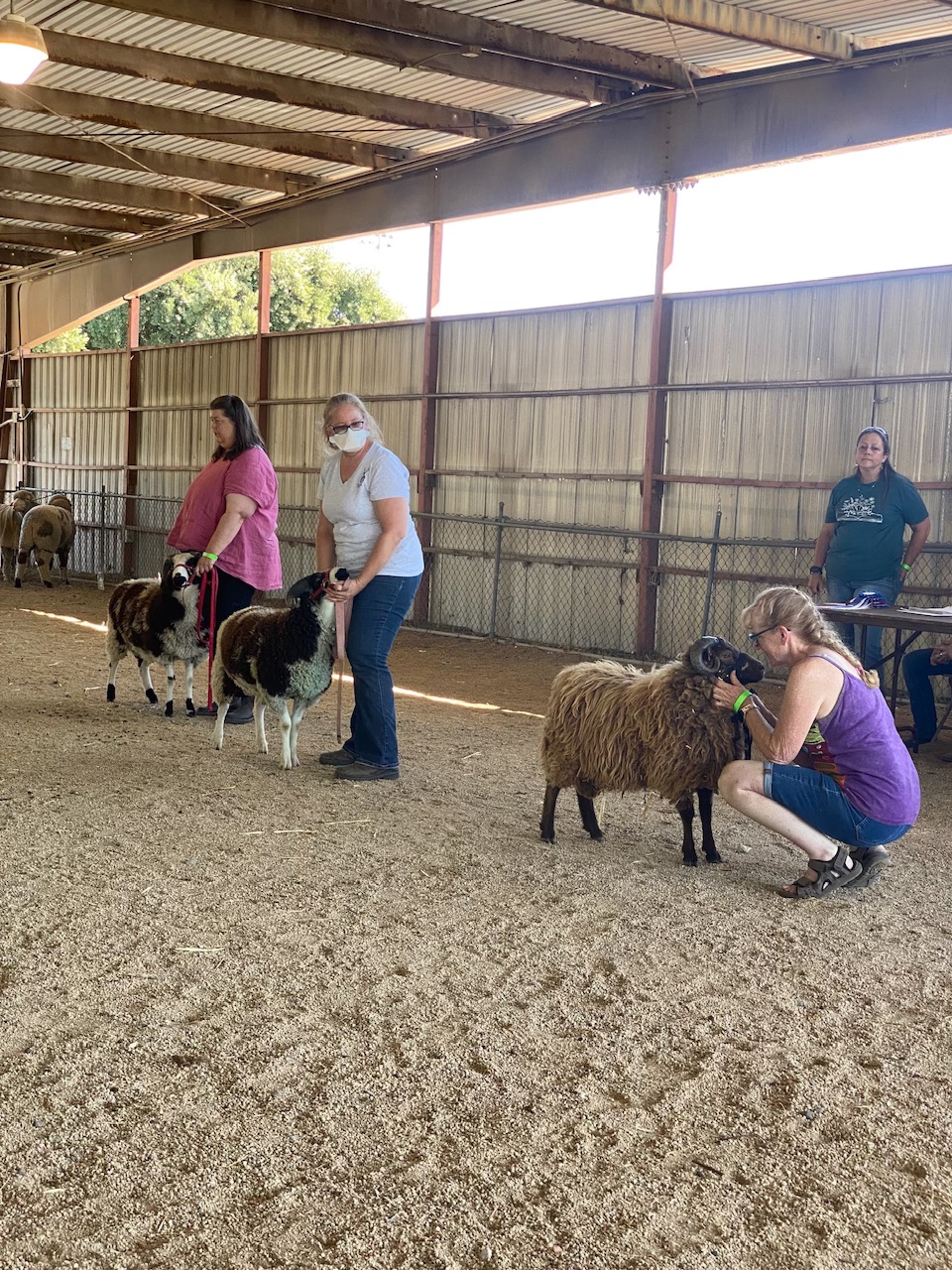
One of the Lambtown events is the sheep show. I live so close that I like to participate and I know that people like to see my sheep there. But I knew that I couldn’t be a vendor AND show sheep. I told the FarmClub that I would get sheep to Lambtown if they wanted to handle the show. They were willing.
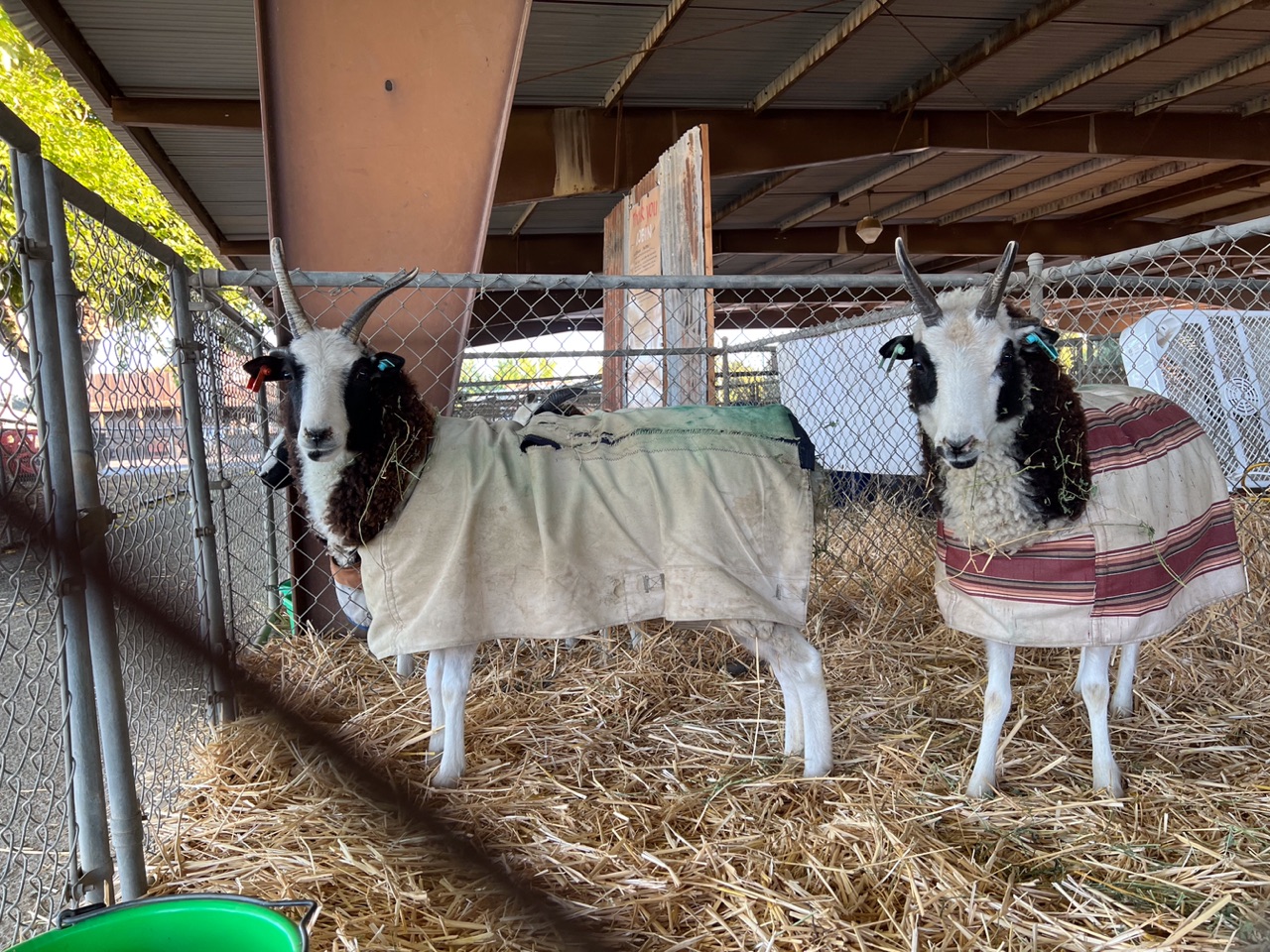
This was simpler than some other shows because there were no group classes and, as at many shows, you could only enter yearlings and lambs. I sold my yearling ram at Estes Park in June so we didn’t even have to worry about who would want to handle a ram. I entered two ram lambs, two ewe lambs, and two yearling ewes. It’s the yearling ewes in this photo. These are twins born in 2022.
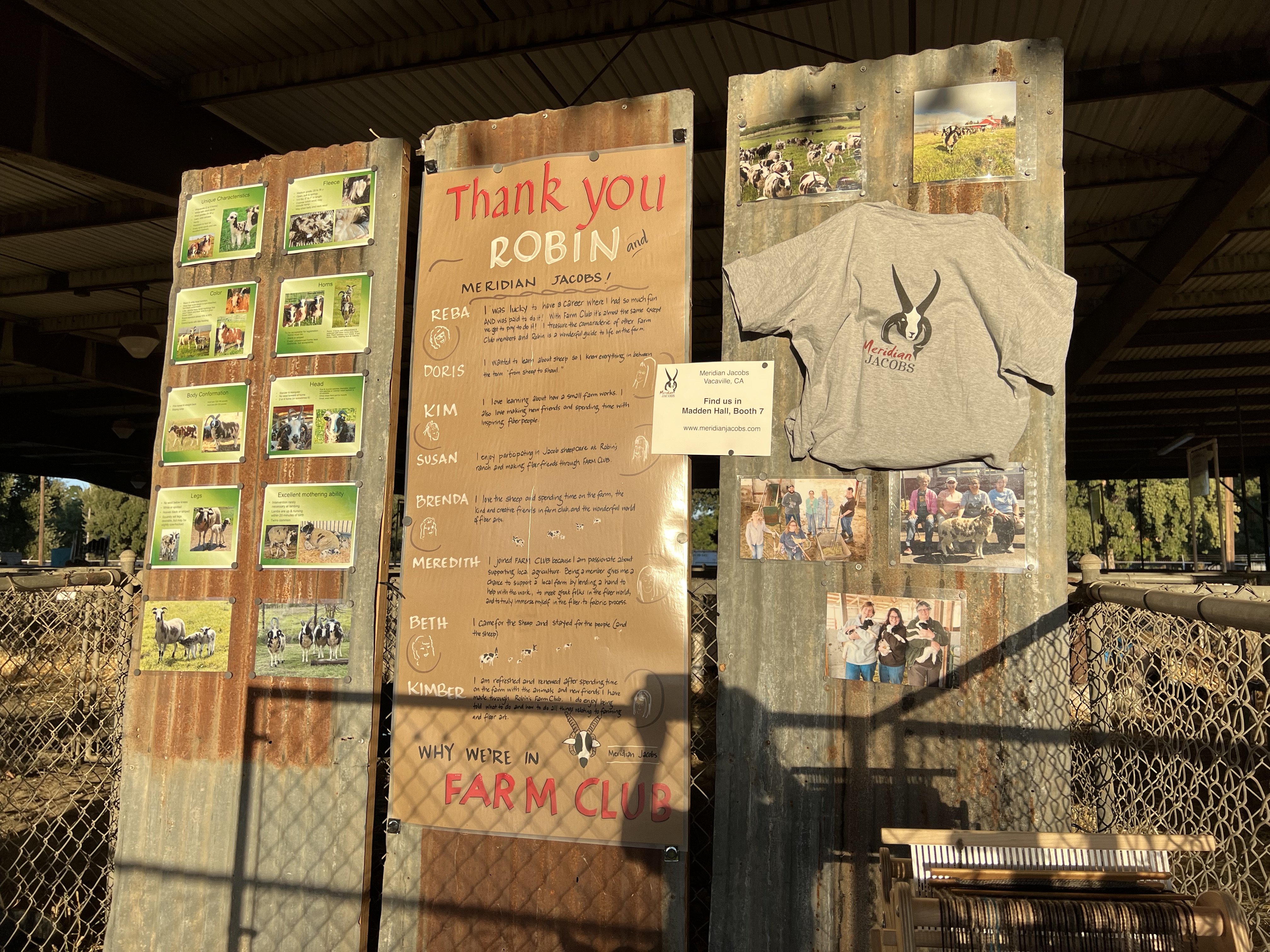
Farm Club members set up a display about Jacob sheep and Farm Club. All I had to do was bring a few of the panels that we use at State Fair and the box of photos and signs. I forgot that I’d be using the Meridian Jacobs sign in my vendor booth so Lisa used her t-shirt to indicate Meridian Jacobs. Clever!
I have to explain about that panel in the center. When you wind a warp on a loom you pack the layers of yarn with paper as you roll it on the beam. During one of the Sheep-to-Shawl competitions a few years ago FC member, Alison, thought that the paper used for rolling the warp could be made more interesting. As the shawl was woven, this message emerged from the back of the loom. Isn’t that a great idea?I thought it was worth laminating and using as a sign.
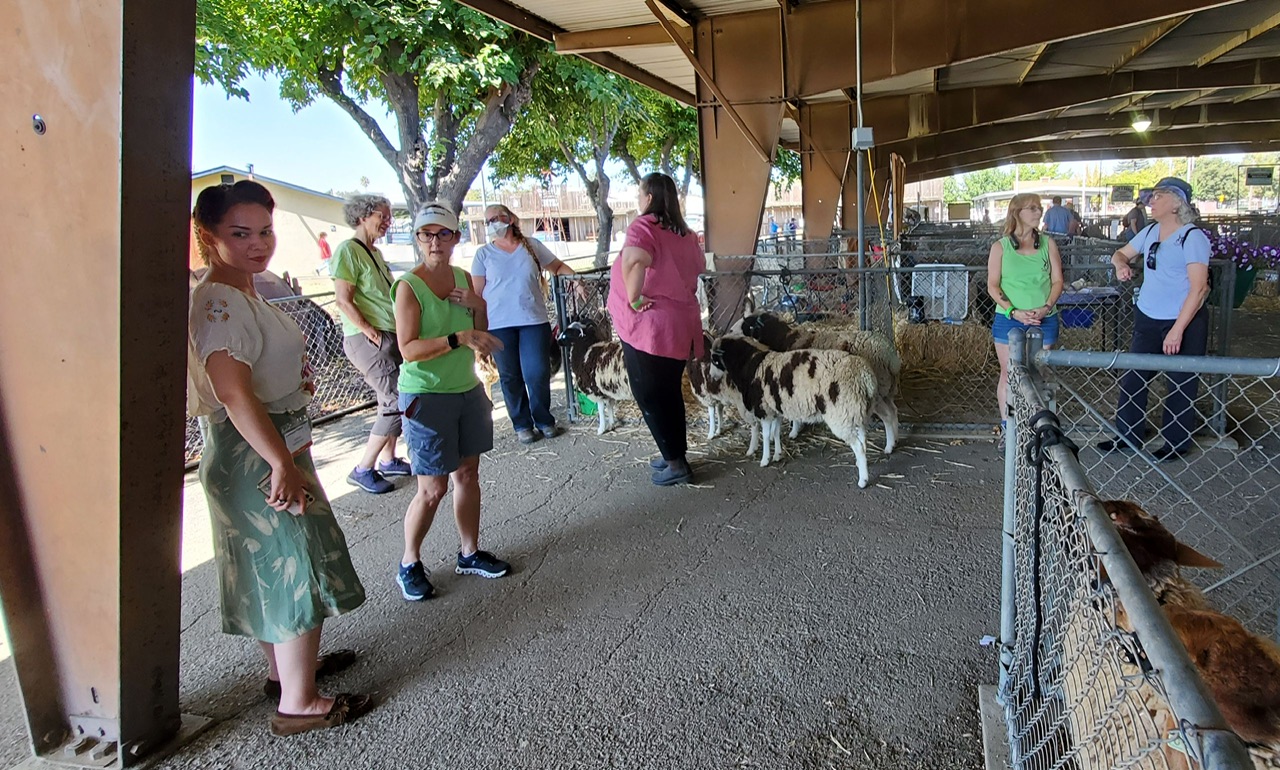
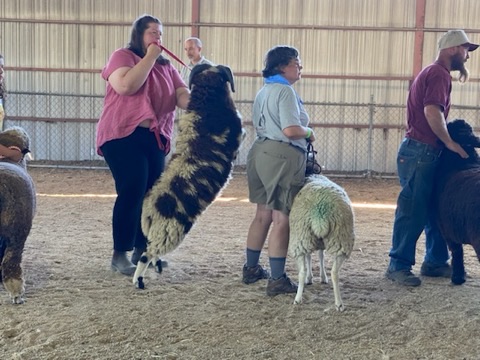
I did not get to see the sheep show, but many Farm Club members were there and some took the following photos.
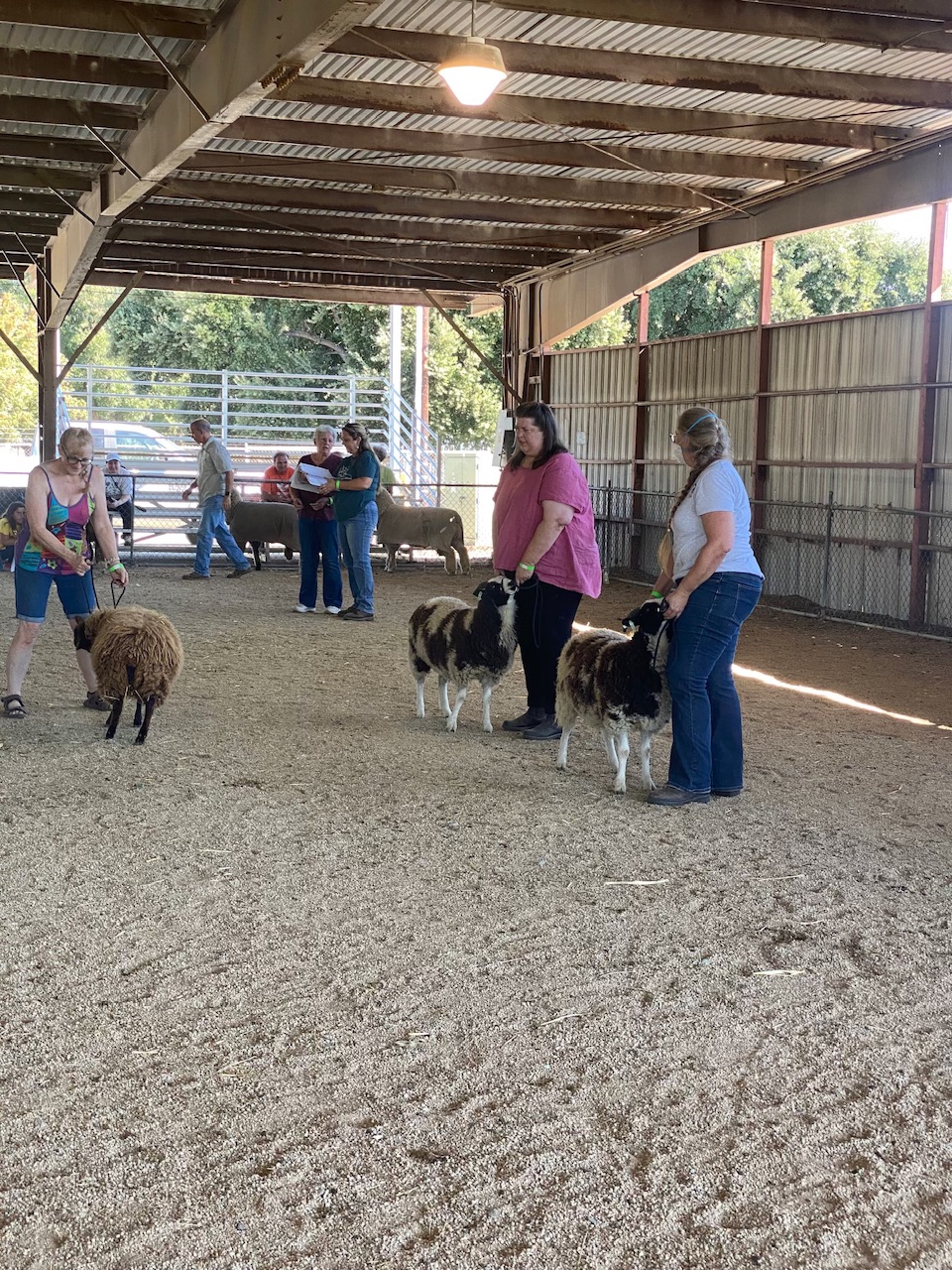
Beth and Marina did most of the showing. The competition was from a Shetland breeder. This is the ewe lamb class.
This is the ram lamb class. The green on the ram is because our breeding season had already started and this ram lamb was wearing a marking harness when he was with his group of ewes.
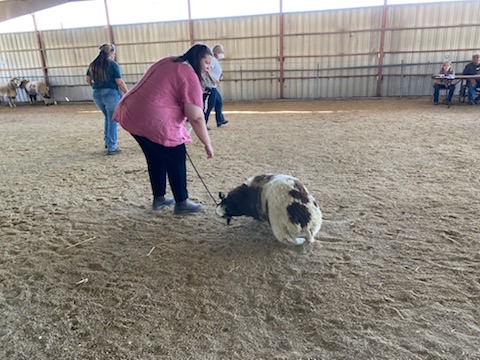
Beth ended up with a challenging sheep. This ewe decided to go on strike.
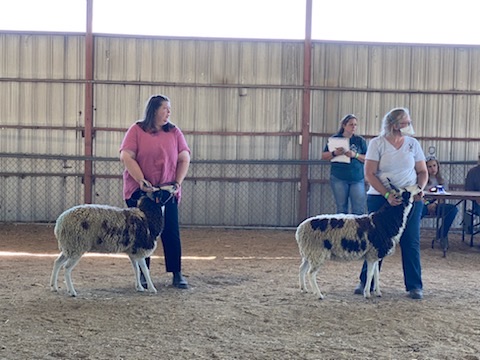
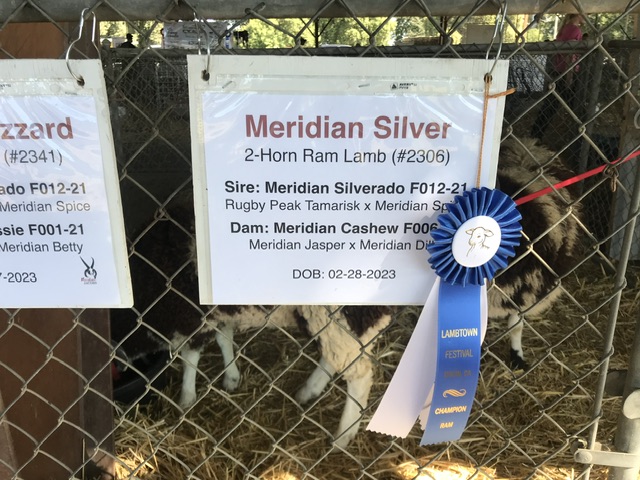
We ended up with Champion Ram and Champion Ewe of the Primitive Breeds division.
Deborah helped out when a third person was needed for the champion class. Once again Beth had a less cooperative sheep, but handled him well.
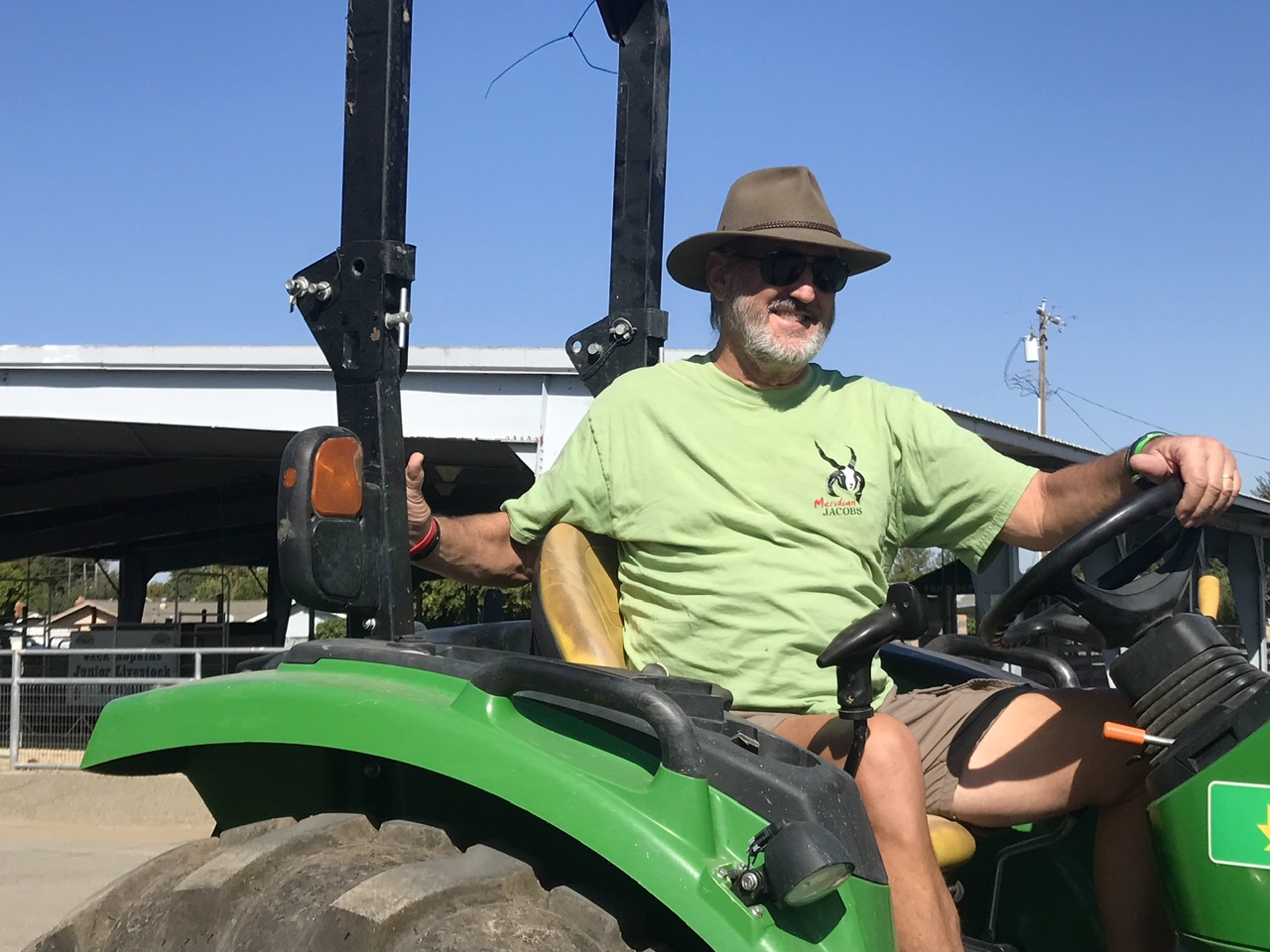
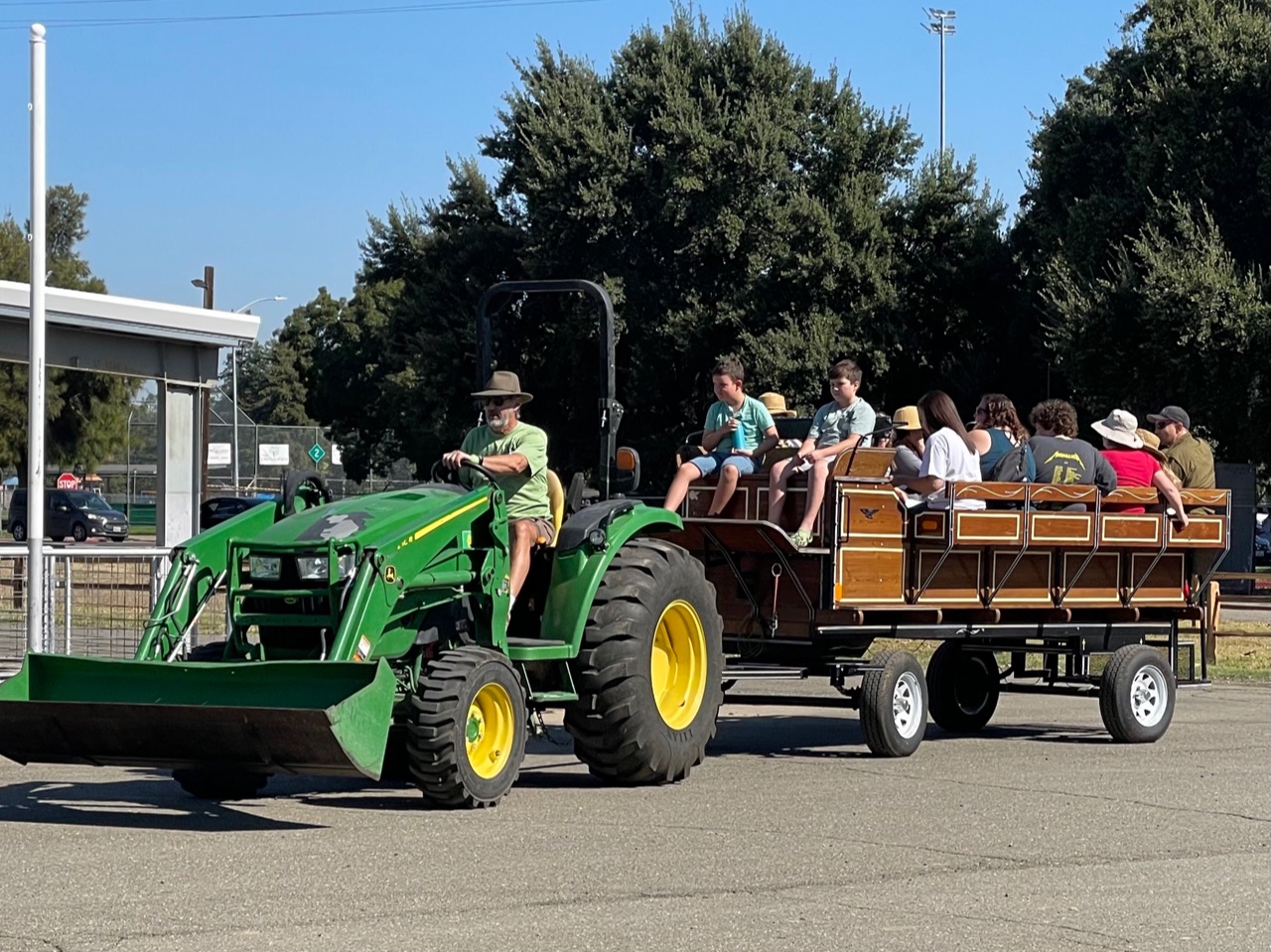
Dan spent all afternoon driving the tractor and wagon that transported people back and forth from the vendor halls to the livestock area.
This was very popular not only with adults that appreciated the rides, but with kids who liked to sit in the front. Dan took extra laps to give some of those kids more time sitting on the front bench.
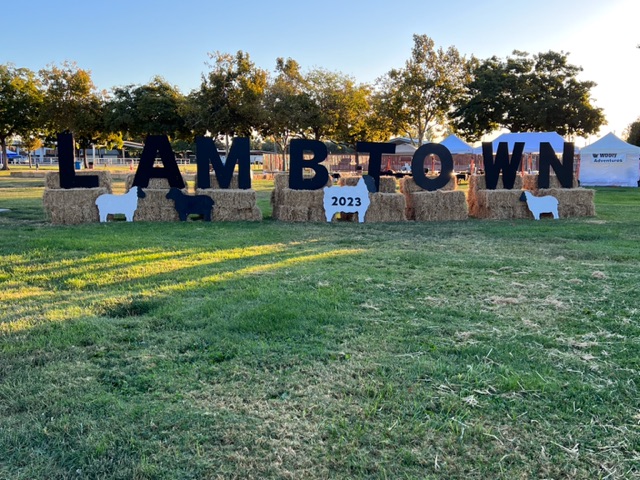
Lambtown 2023 was a big success for all of us. The crew that put the show on this year is to be commended for the time they spent on planning and organizing and the professionalism they brought to the event.
In the last post I wrote about the class I taught at Lambtown a couple of weeks ago. Now I want to share photos of my vendor booth and the sheep show.
I am still experimenting with posting from my iPad which isn’t as easy as from my computer. These photos are all entered as Medium size—that’s just a note to myself for when I review this later.
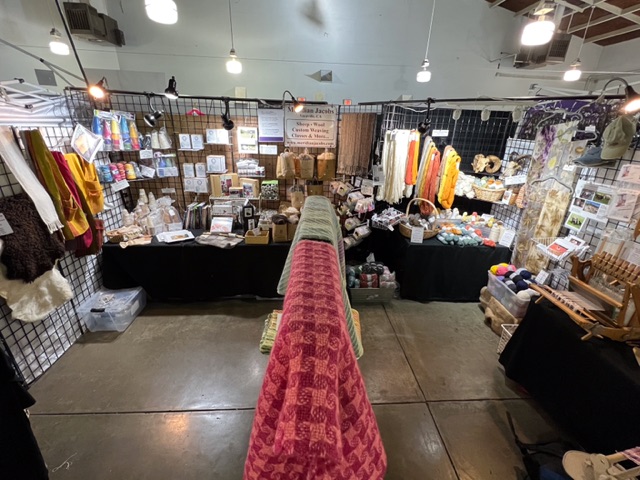
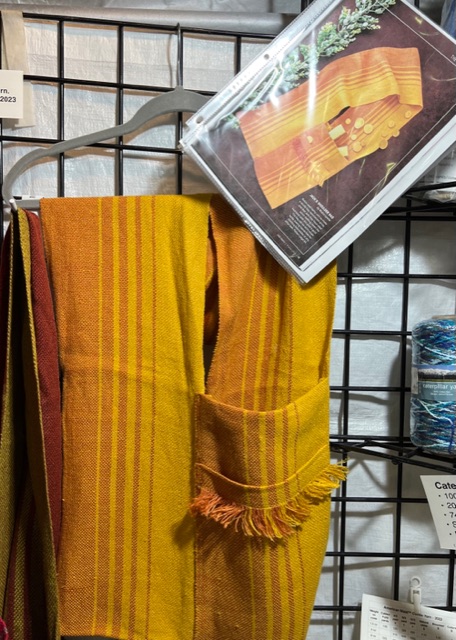
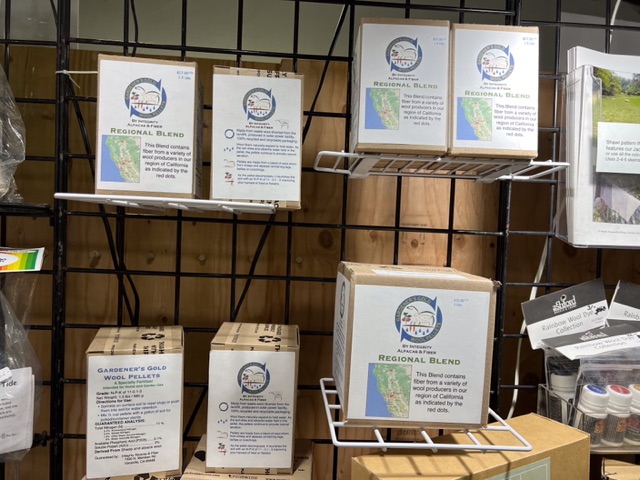
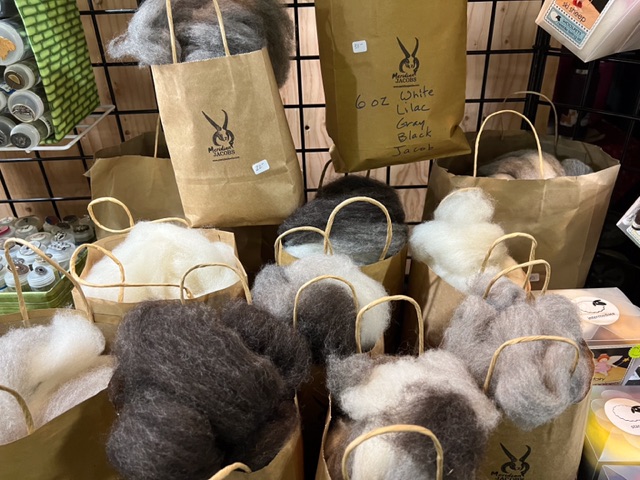
I ended up with a booth and a half space and now I’m spoiled. Will I ever want to go back to a single booth space? It’s hard to get a good feel for it from this photo. I used a rack in front to hold handwoven blankets. There wouldn’t not have been room in a single booth. There was plenty of room for people to wander in and really look at everything. There were so many people at Lambtown this year that I didn’t take this photo until after 4 on Saturday when I could finally step out of the booth. The following photos are some of the things I had in my booth.
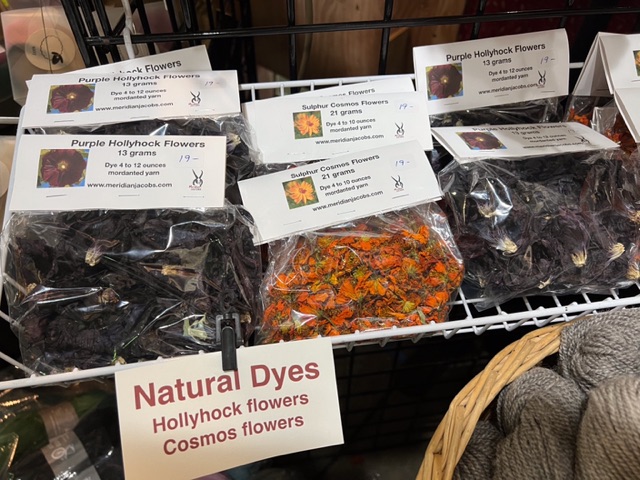
I spent a lot of time the last couple of weeks packaging the flowers I grew and used for my own dyeing this year.
I had forgotten I had these in my shop on the farm because there is always something in front of them.
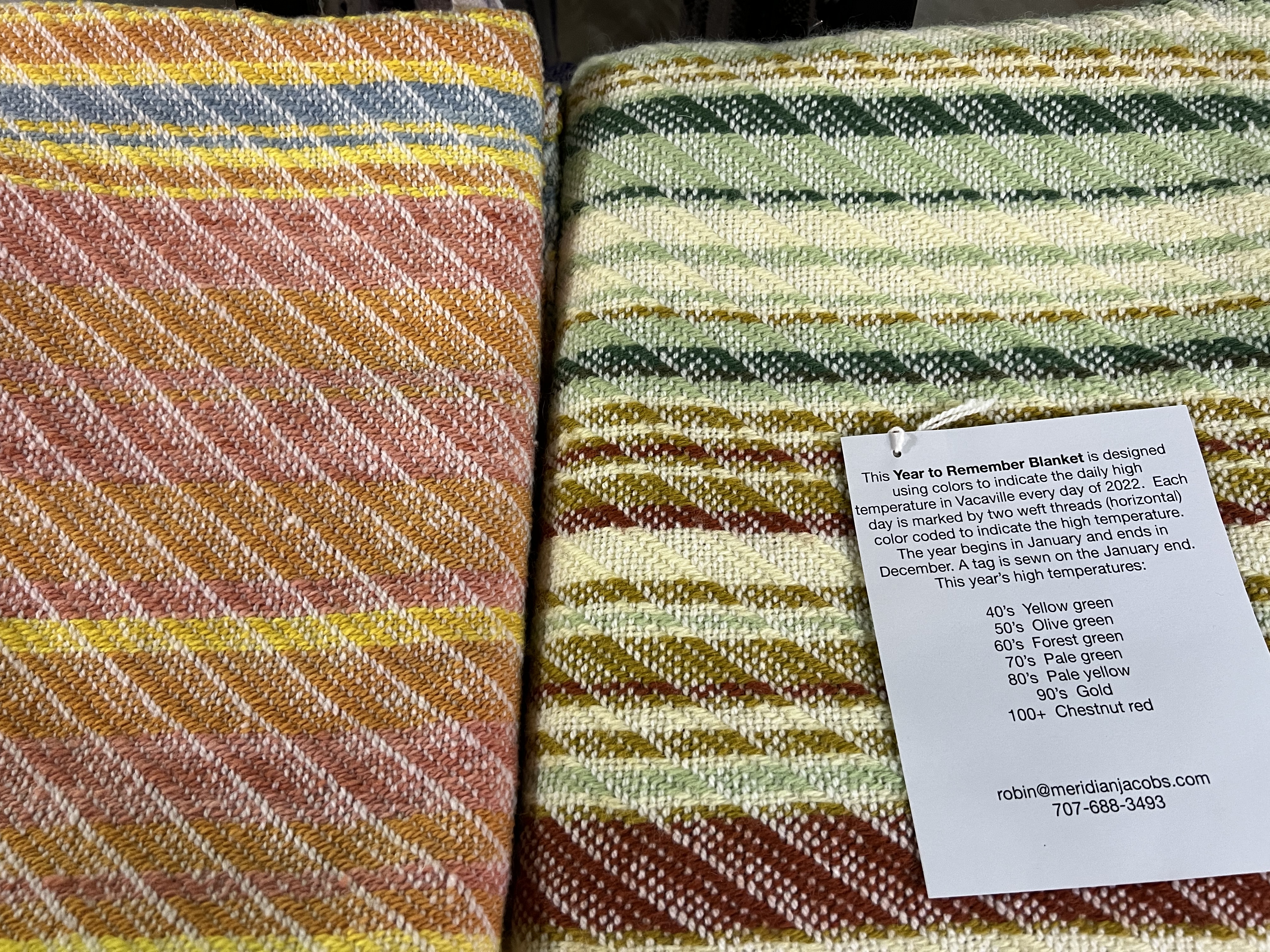
Year to Remember blankets, so called because I will custom weave these for people who want to commemorate a special year. These two use the same stripe pattern (although you can’t tell with them folded in this photo) but different colorways. The one on the left uses all naturally dyed yarns.
The hemp bag I made and wrote an article about for the most recent article of Little Looms.
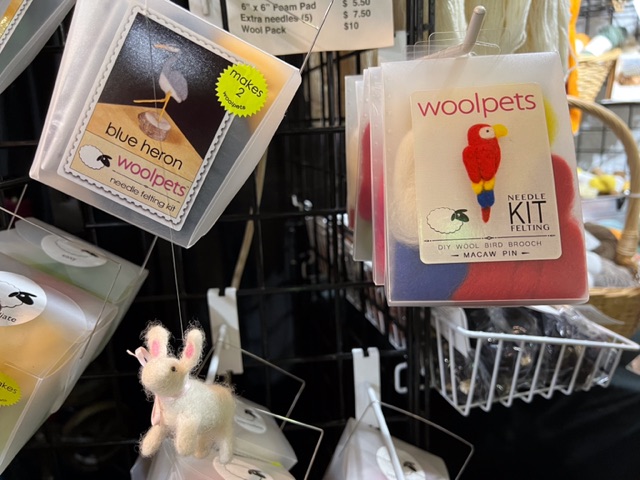
The newest product in the shop and online.
The 2023 wool I just got back from the mill. I haven’t had time to put this online yet.
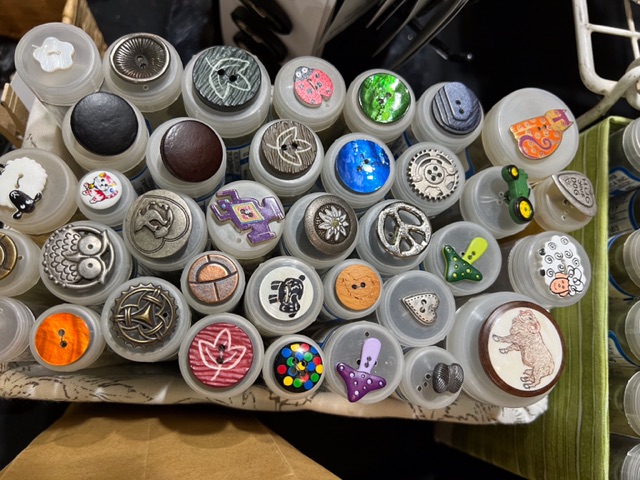
I have an odd variety of buttons in the shop and I brought these to Lambtown.
I brought four sheep skulls to Lambtown and sold them all. I have more at home I haven’t had time to finish.
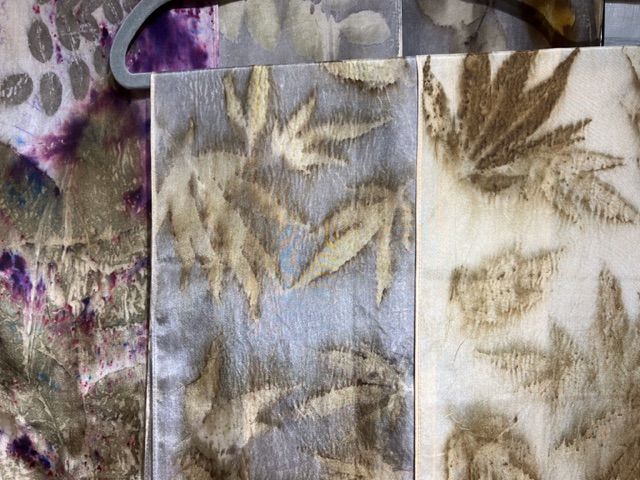
Some of the silk scarves I’ve printed recently.
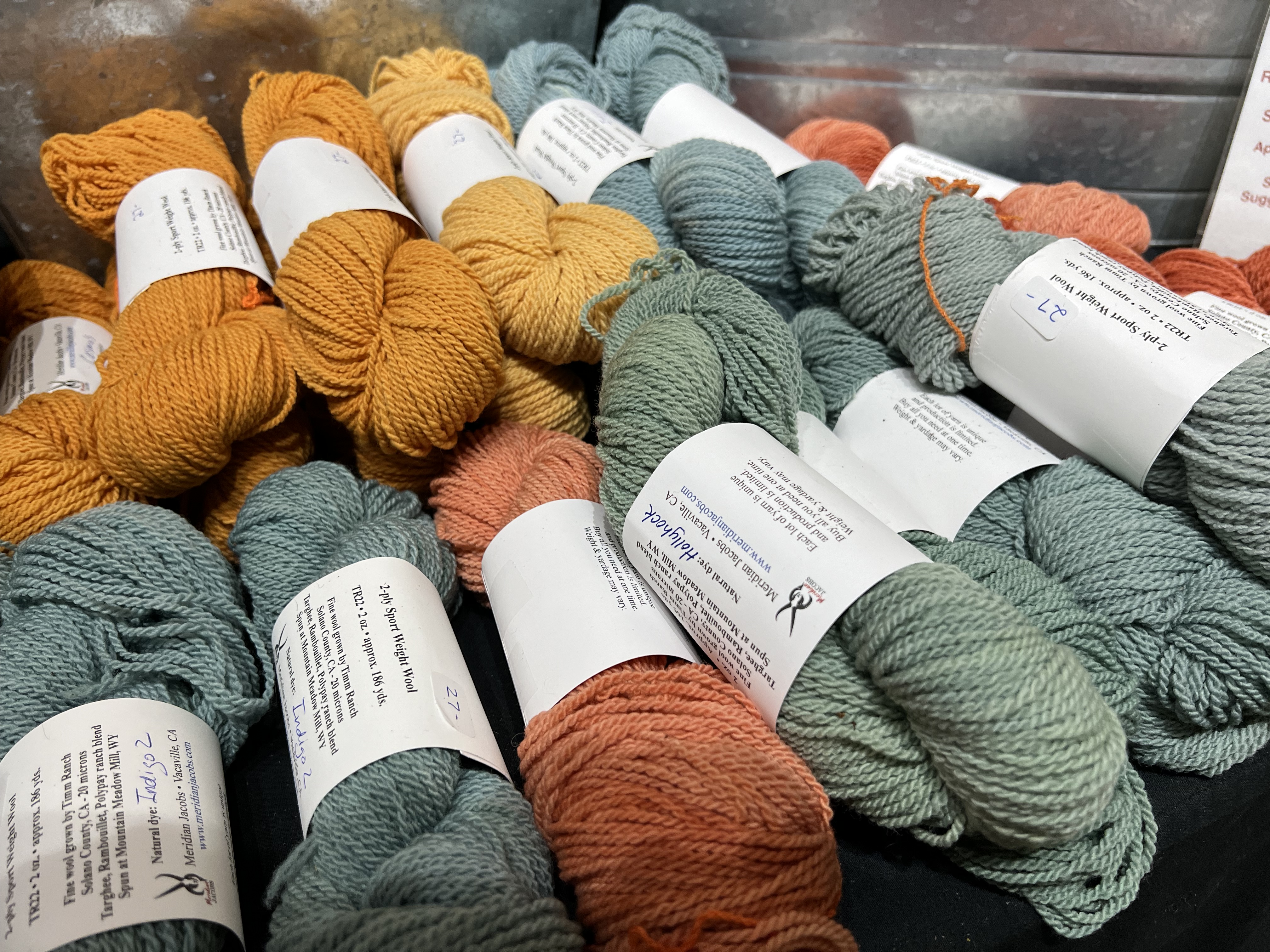
Timm Ranch yarn dyed with Indigo, hollyhock, madder, dahlia, and cosmos.
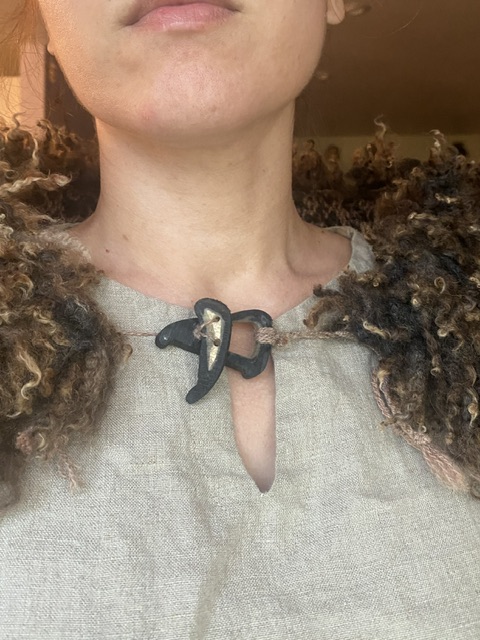
I had my own horn buttons with me and I love the way Siobhan used these two to create a closure for her woven piece.
That’s it for now. One more post for the sheep show.