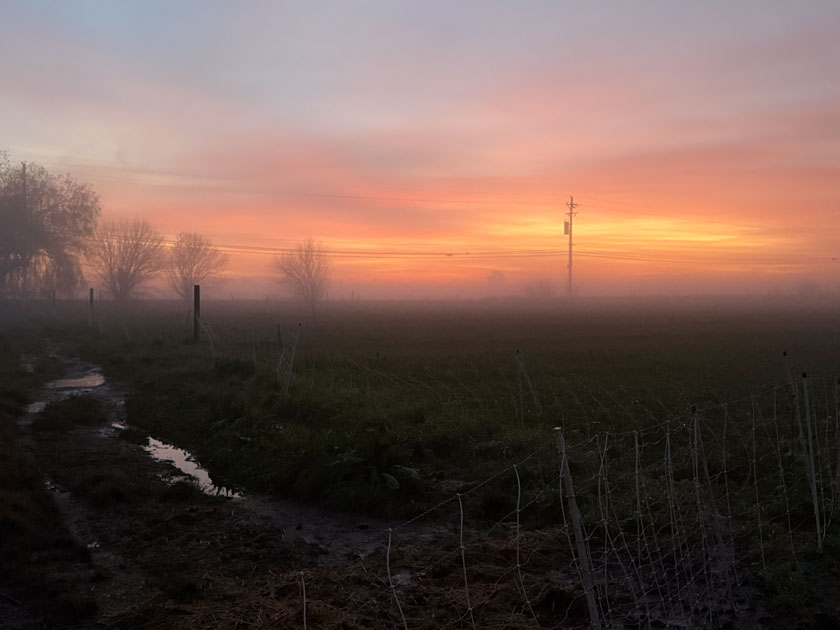
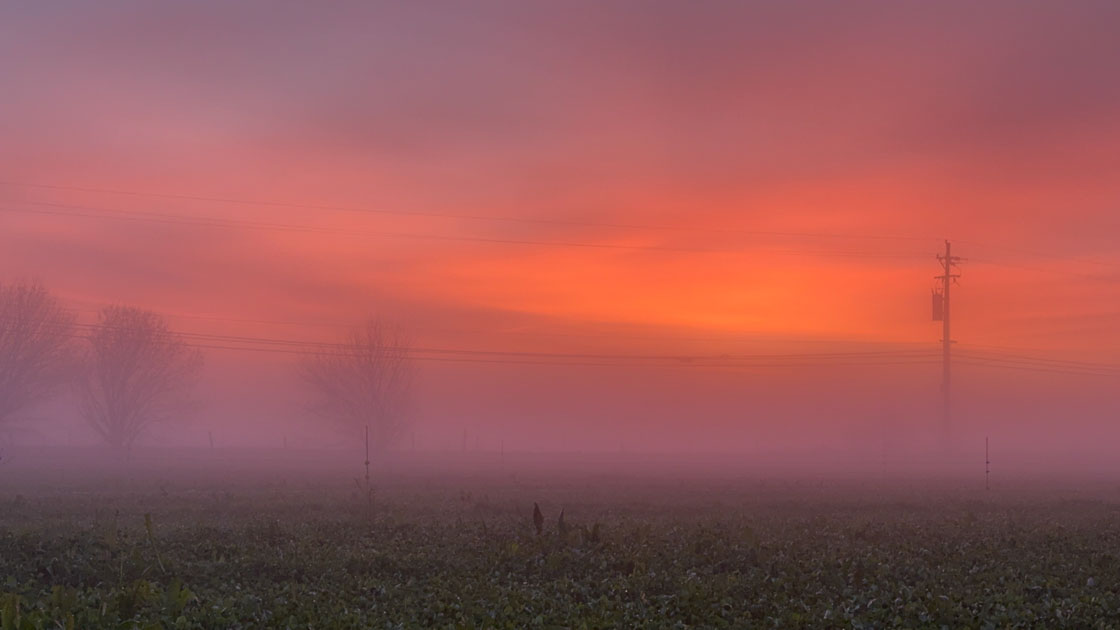
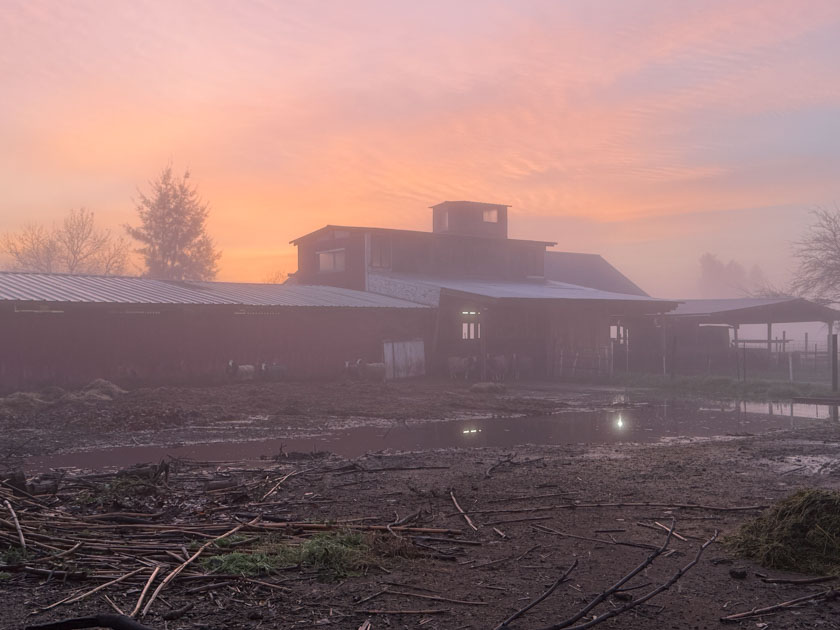
I was going to get away from a weather report, but this morning the sunrise behind the fog inspired me to take photos.
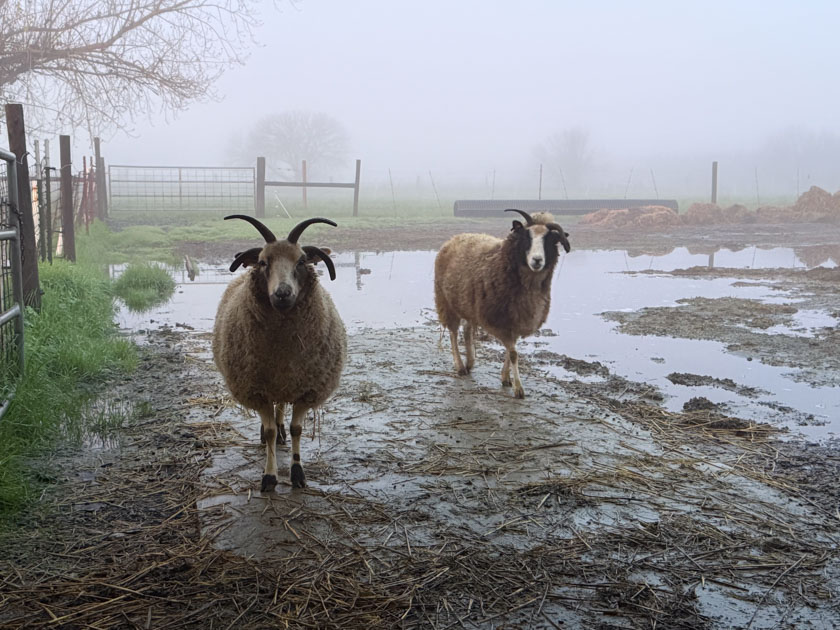
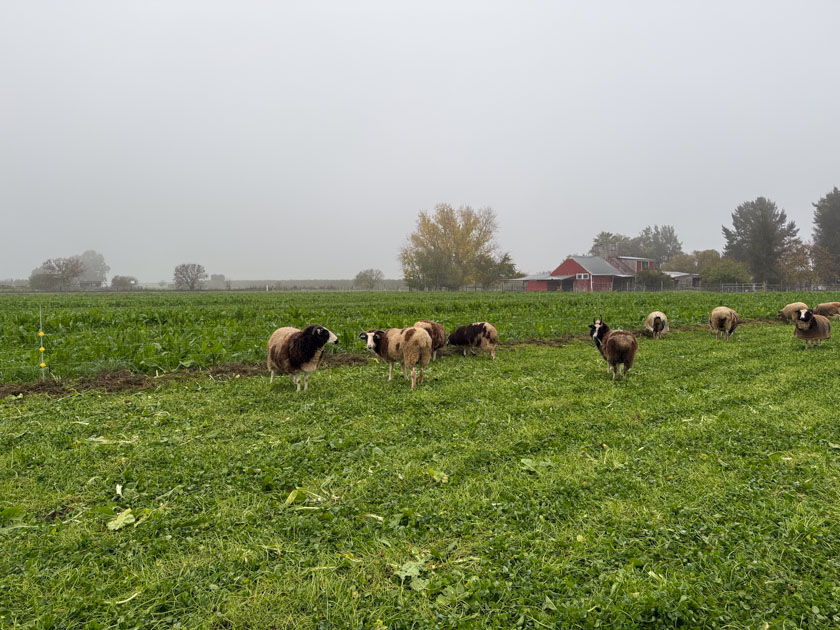
It was daylight as I finished cleaning the barn, but still foggy. Sheep are off the pasture now because it’s so wet, so they were waiting to be fed.
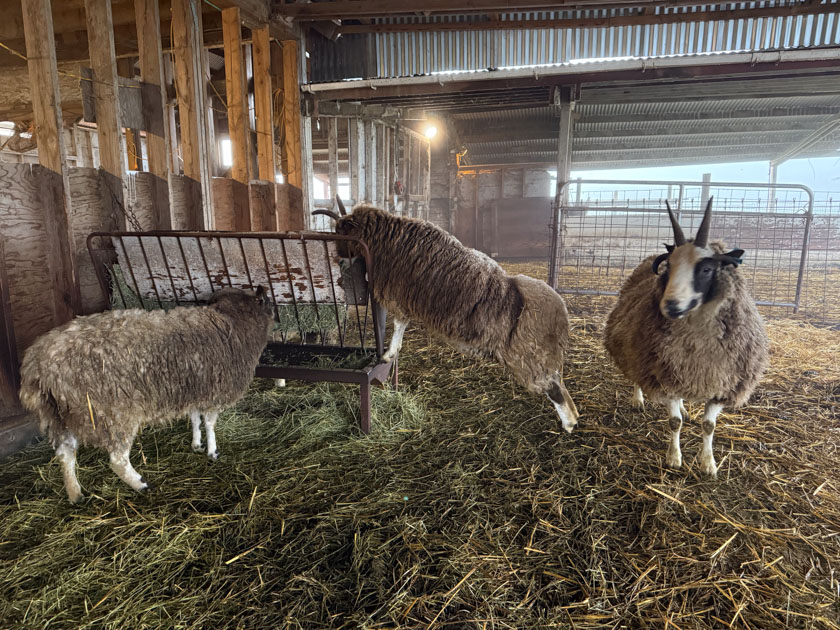
When you sit down for a meal at home do you always sit in the same place? Probably. These sheep are always at the back part of the barn because that is where they want to eat. And Zora always puts her feet up on the feeder to eat out of the top.
This is the barn from the back. There was a prompt on the phone to clean my lens. I think the phone objected to the fog.
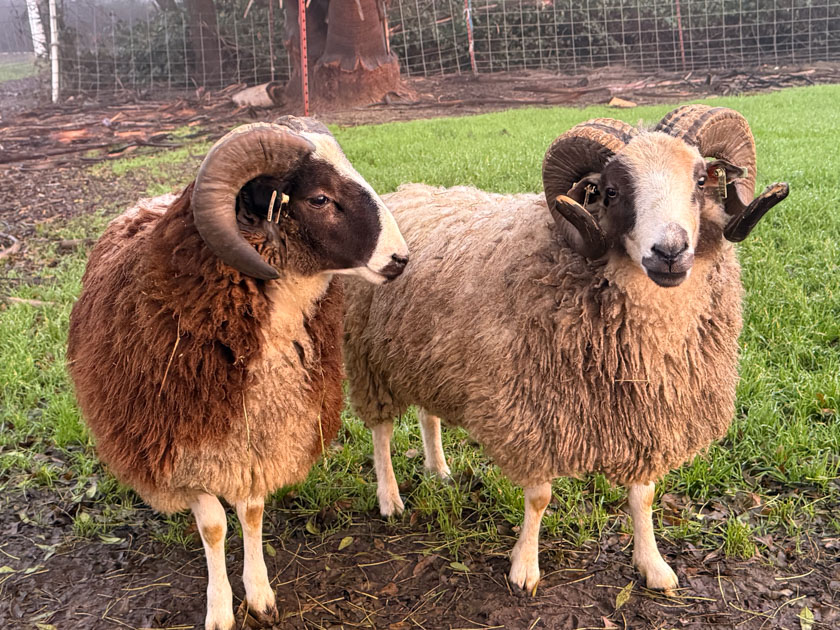
The ram pen is just behind where I was standing for that last shot. This is Starthist Hornblower, sire of many of the lambs to be born in February and March.
I was ready to write another Random Farm Photos blog post but then thought that maybe, since this is the last day of the year, there should be some sort of retrospective. Most of my blog posts this year have been about the sheep and the pasture, but I am also a weaver. I have neglected that.
I keep a notebook with all my weaving info. The warps are numbered. I looked for the first one of 2025 and couldn’t find a photo. I sorted my photos into date order and found 275 photos in the weaving collection. Yikes! That doesn’t mean I wove that many pieces–not even close. But they all are part of various stories, none of which I shared in my blog. Maybe forget the sheep for a while and focus on yarn?
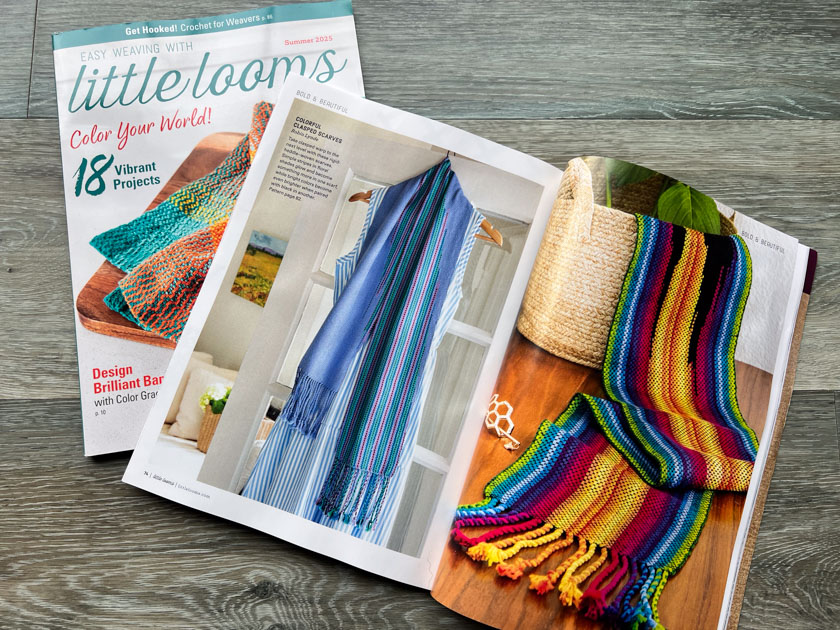
This is the issue of Little Looms, Summer 2025, with my clasped warp scarves in cotton. They were woven the previous year, but the magazine was published this year.
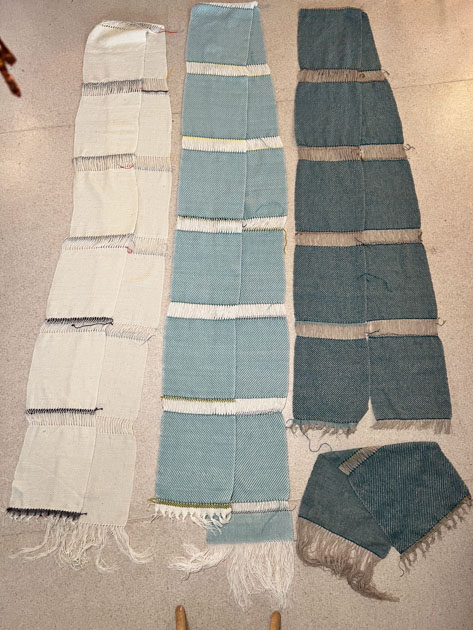
These are samples, all woven the same size in three different wool yarns. This is the photo after I took them off the loom but before any finishing. Wet finishing is the topic of an article in an upcoming issue of WEFT magazine. There were some surprises but you will have to wait for the magazine to be published to find out!
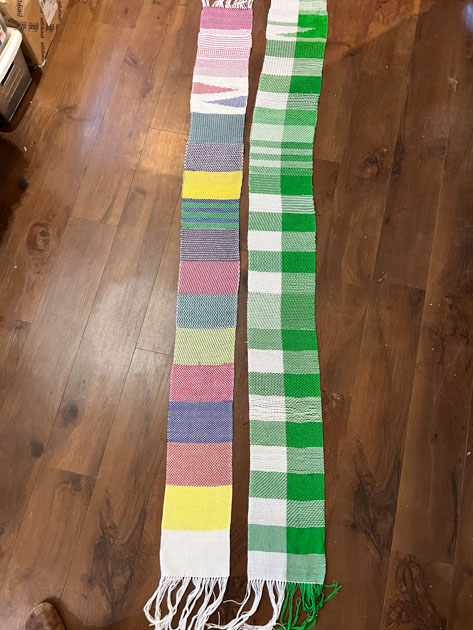
This is a workshop sampler for my Learn to Weave class. I taught this at the Conference of Northern California Handweavers (CNCH) in the spring and wanted new cotton samples. Students have the option of weaving wool or cotton in this class. You can’t tell from this view but every 6″ is a different treadling pattern. The green and white one gives four samples in one for each treadling by showing white on white, green on green, and the green/white blend.
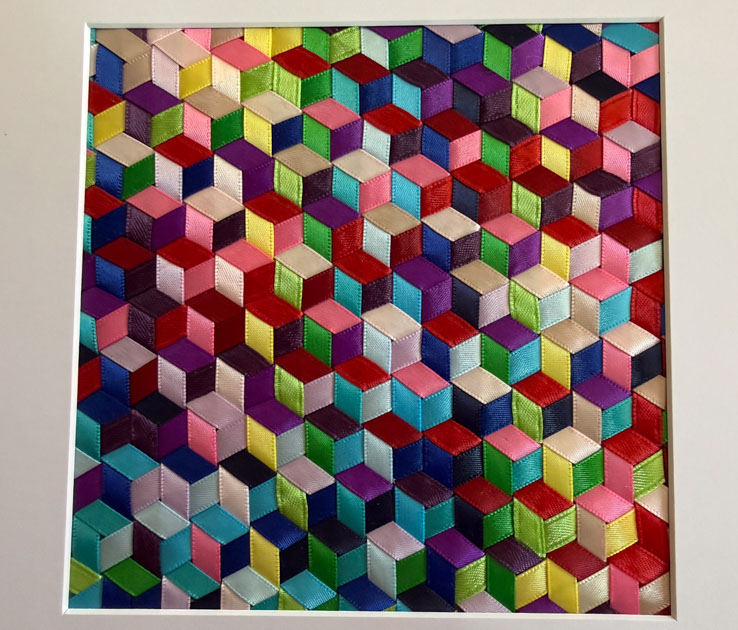
Another sampler. This one is to experiment with color-and-weave using six colors. There will be an article featuring a project based on this in the Summer 2026 Handwoven magazine.
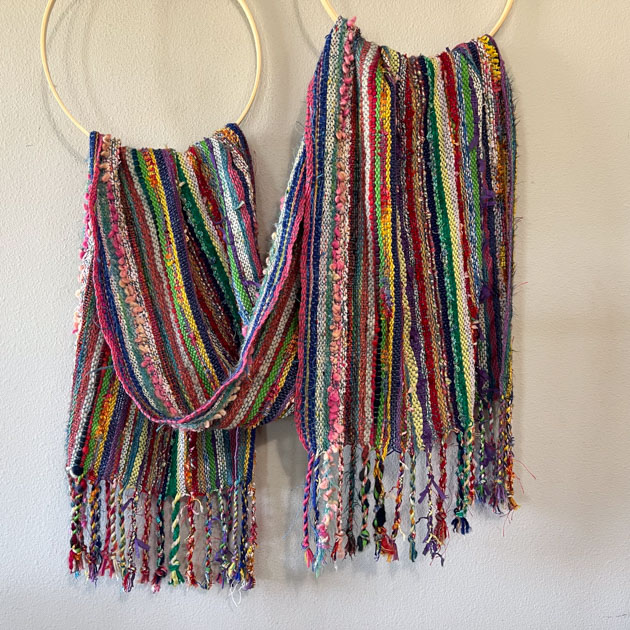
This is another scarf/shawl/wrap (which is it?) using Art Fiber Frenzy yarn. I have been intrigued by this yarn since I first discovered it a couple of years ago. I have also created a class to lead people through weaving a piece with so many fibers and textures.
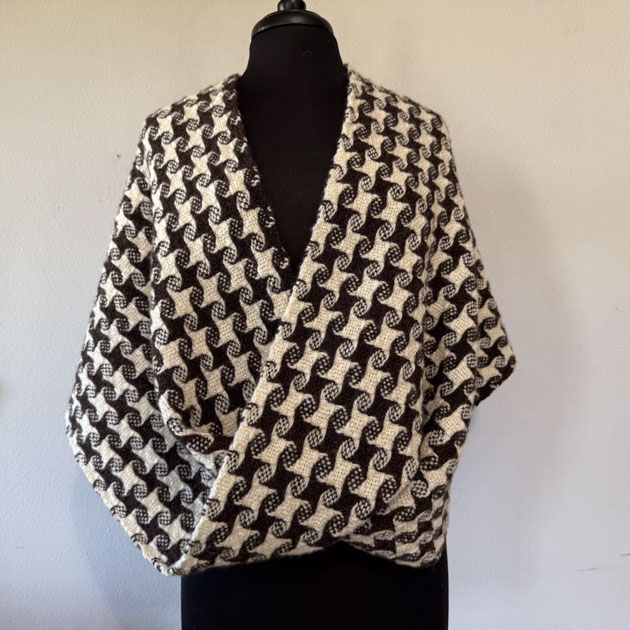
I didn’t neglect my favorite fiber–wool. I wove several blankets and shawls during the year. This is one in a more traditional color-and-weave pattern with only two colors. The yarn is, of course, black and white Jacob wool.
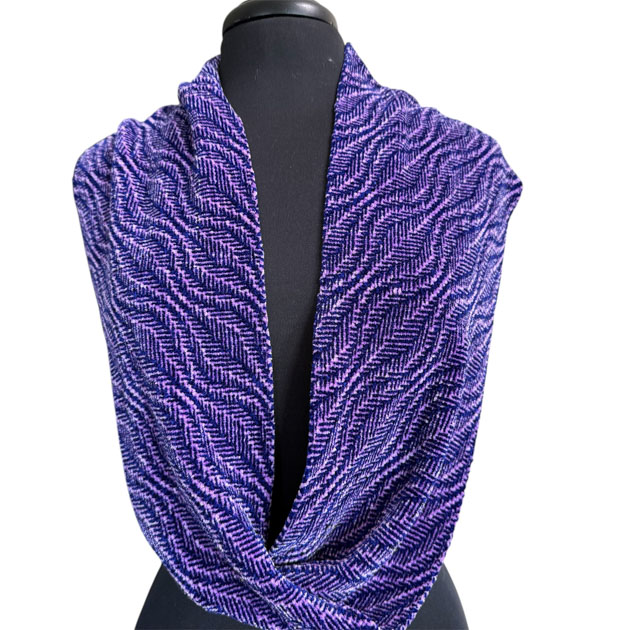
This is a chenille scarf in shadow weave. It has sold but there may be a similar one at the Artery–I’ve lost track.
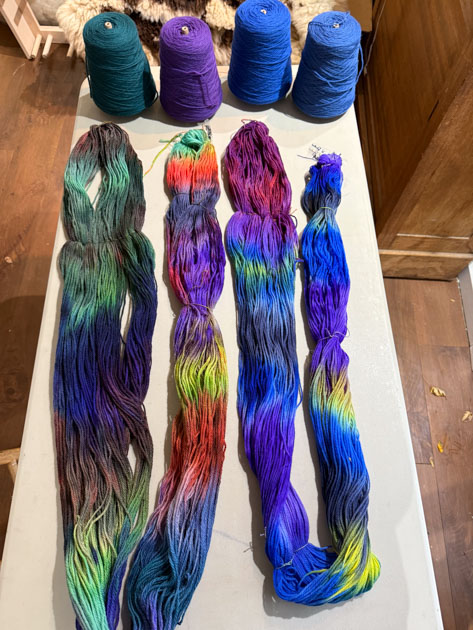
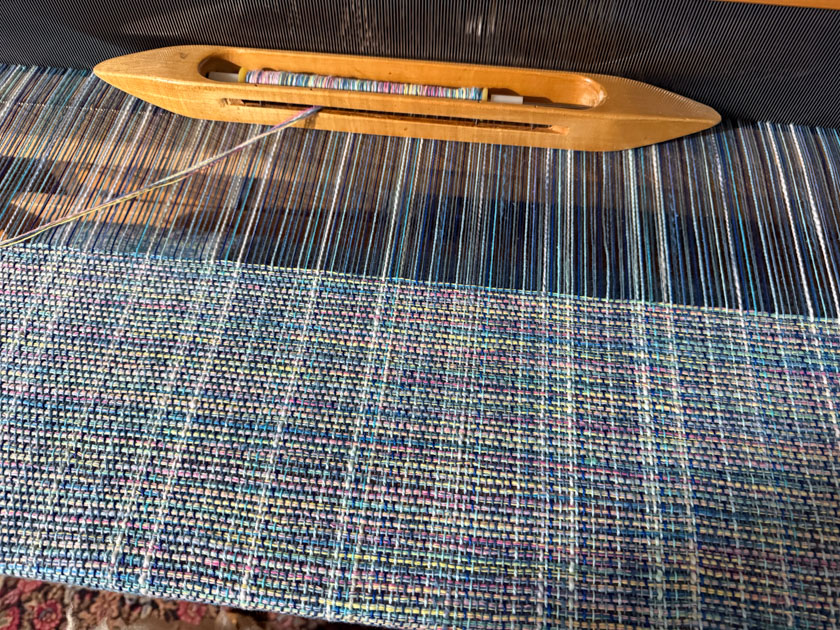
My new favorite wool (other than my Jacob and Timm Ranch yarns) is Brown Sheep Company Nature Spun. I’ll be introducing this for some of my classes this year. I wound some white v-shawl warps and space-dyed them. Then I needed to find weft colors.
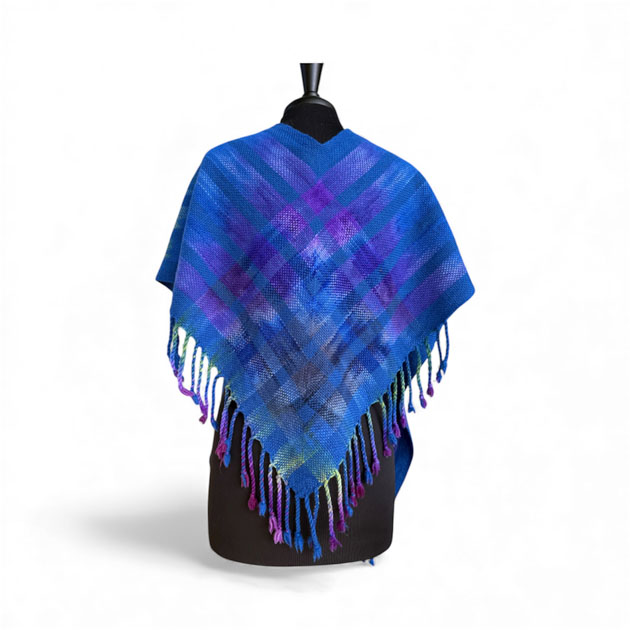
Here is how the one on the right turned out.
Oh boy! A crazy thing I got into was triaxial weaving. I wove some pieces 15 years ago and now have resurrected the idea. I spent way more hours on the four pieces I finished than maybe they warranted. But now I’m ready for more. Two will be in a January show at The Artery.
This is a v-shawl using the Nature Spun yarn. This one and the samples below are ideas for other articles I may propose and for pieces that I will sell.
Log cabin on the left is another color-and-weave pattern that looks much more complicated than it is.
If you read this blog regularly you know that I’ve been complaining about the fog, except for the beautiful sunny day we had two days ago. That didn’t last. It’s foggy again and it’s supposed to rain later. The “shop” where I have my bigger looms is not insulated and I don’t even try to heat it up with space heaters. I will put the heater on right next to me but It won’t have much impact on the surroundings. I am trying to finish the baby blankets that have been on this loom since October. That may be another blog post when I actually finish.
I worked on this loom yesterday and plan to finish today. First I need to put some more layers on.
Have I been too focused on weather? Fog, Fog, Fog, and then Rain. The sun was out today–all day! And it felt wonderful!
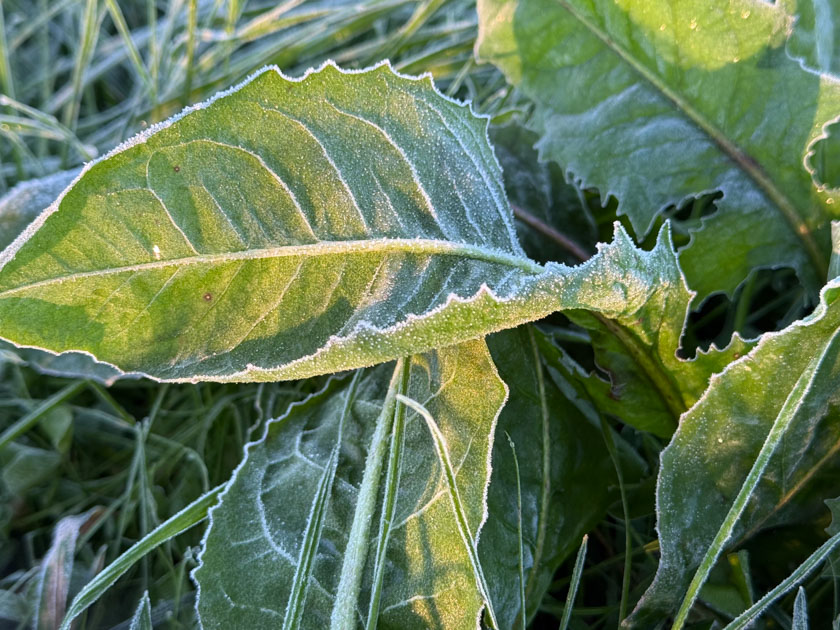
It was a chilly morning with frost. But it makes all the difference when the sun is out.
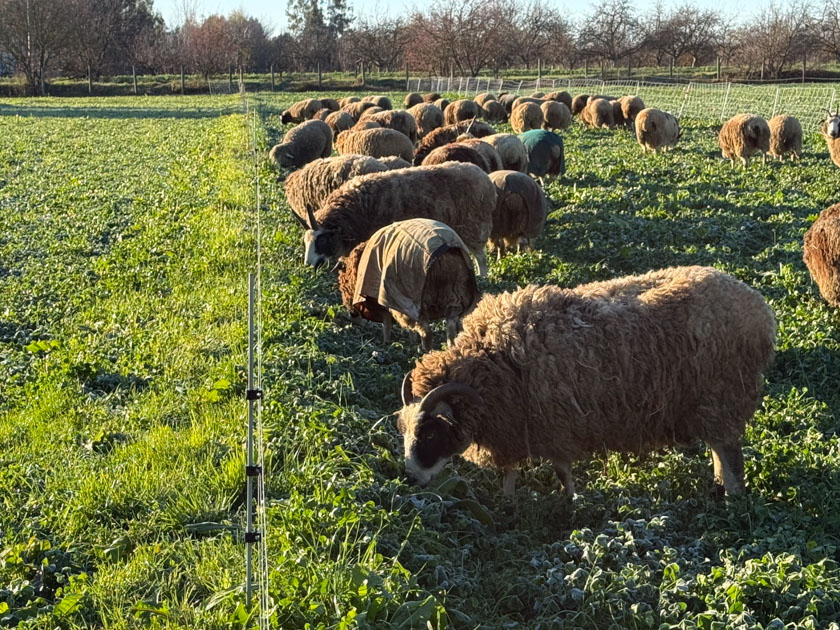
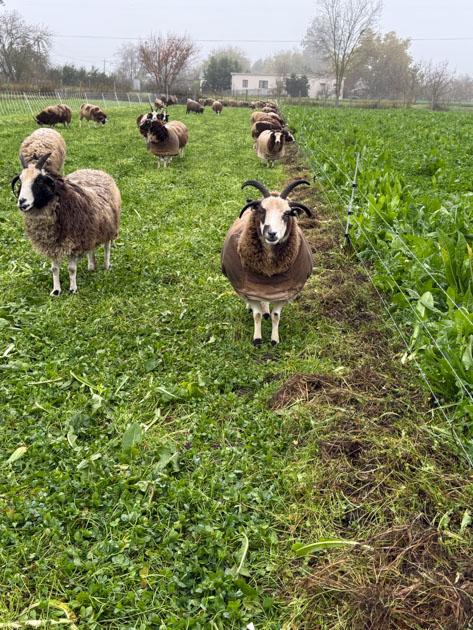
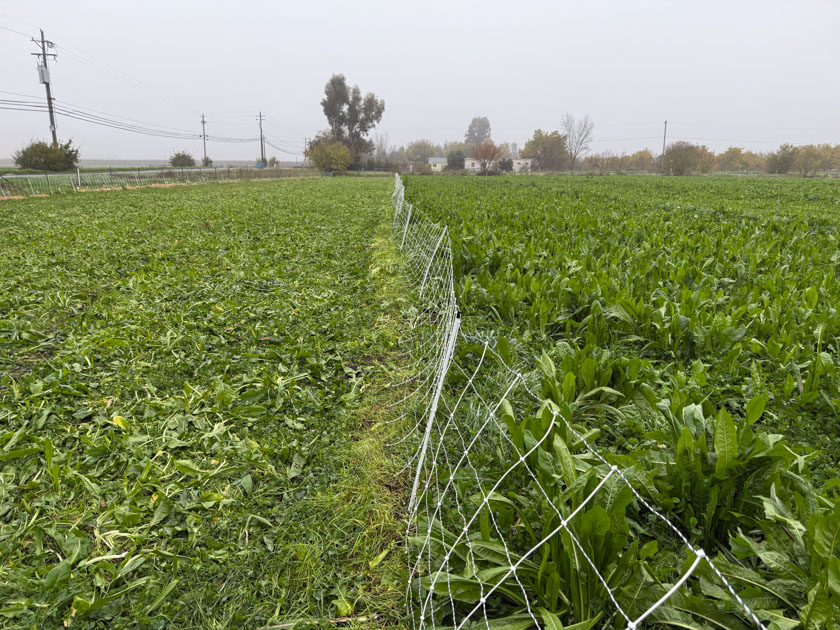
I moved the net fence (to the right in this photo) and let the sheep out to graze. In the last post I said that they were off the pasture while it was so wet, but today I thought that it had dried enough to minimize impact to the soil.
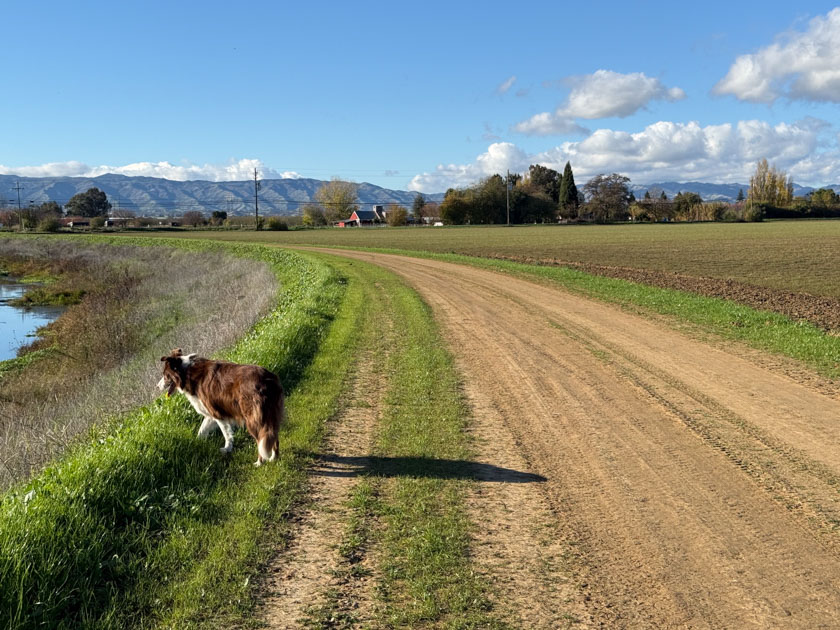
After chores and while I was still wearing all the layers I thought I’d take Ginny for a W-A-L-K (I have to spell it if she is near me) Across the Road. That’s Mt. Diablo in the distance (see the birthday hike post).
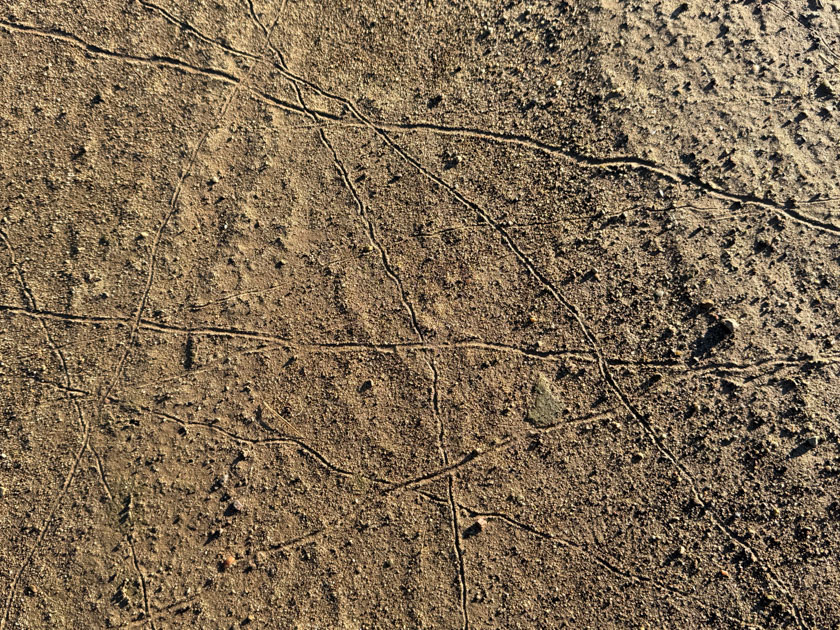
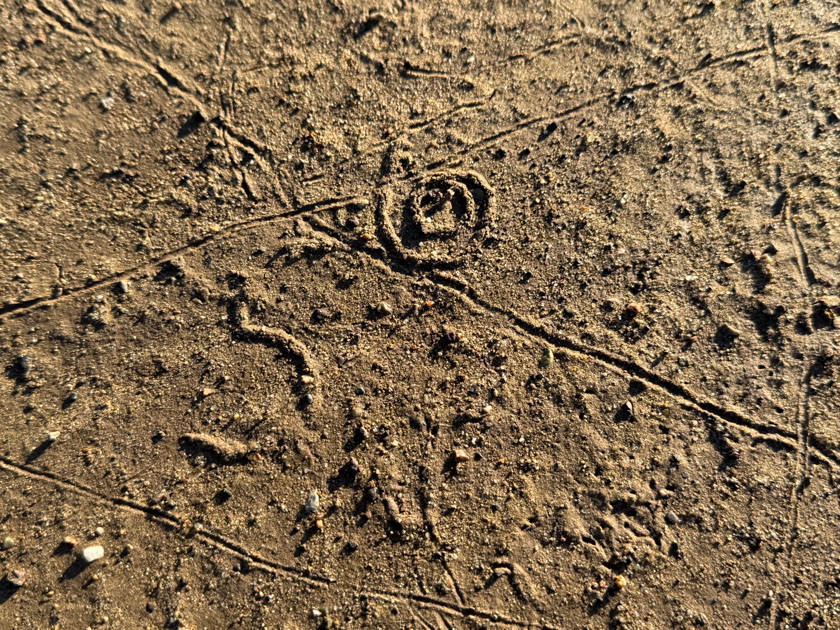
I’m always curious about what makes these patterns. Any suggestions?
Some of the patterns are from some kind of creature ON the soil. What about the others from a creature UNDER the soil?
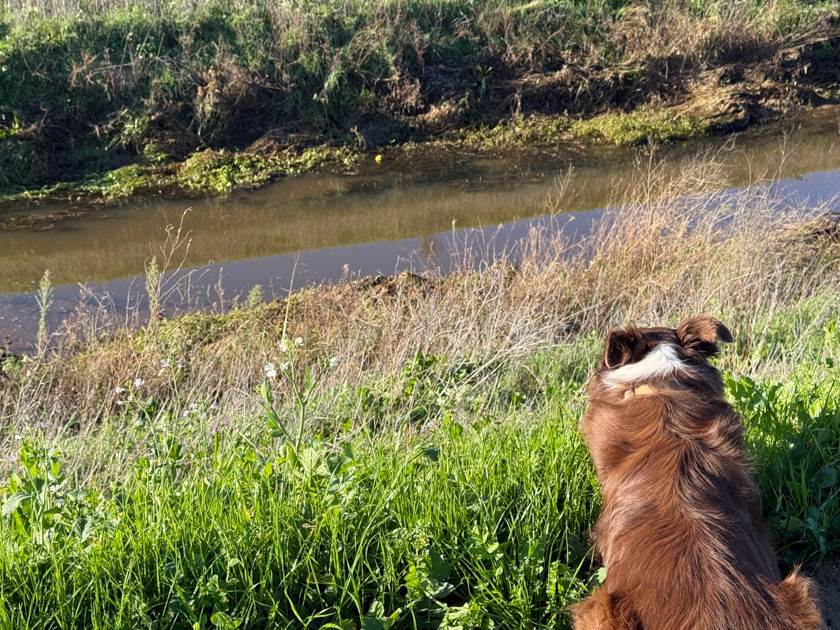
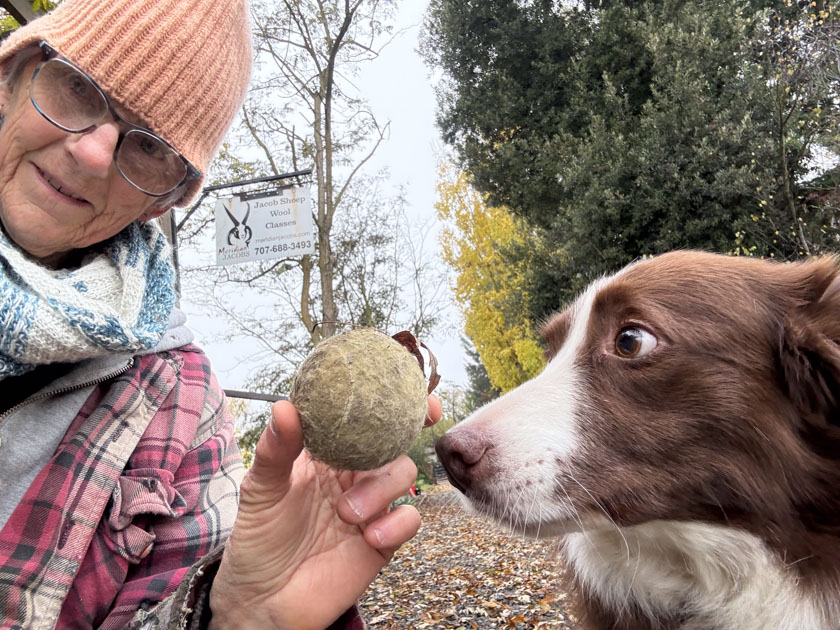
Towards the end of the walk Ginny saw something across the canal that looked familiar. I could see that it was an osage orange fruit, and not a tennis ball, but she was sure focused. I suggested that she go “get it”. Do you see the “ball” at the far side of the water, just about center in the photo?
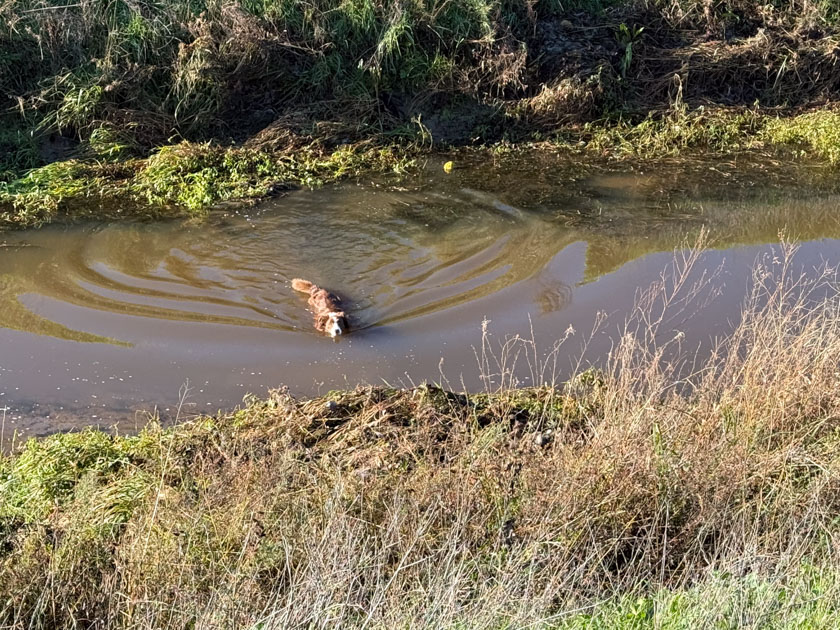
Ginny swam across the canal but was disappointed to find out that the yellow object was not a ball. That made me wonder about colors that dogs see. I didn’t think that they distinguish color. Here is what AI says: “Yes, dogs can see yellow, and it’s one of the primary colors they distinguish well, along with blue; they have dichromatic vision, meaning they see a spectrum dominated by blues and yellows, while reds and greens often appear as brownish or grayish shades. Their vision isn’t black and white, but it’s limited compared to humans, making yellow tennis balls stand out clearly against green grass for them.” Look at what you can learn when reading this blog.
Later in the morning, working in the sunny garden I spotted about 20 turkeys at the far end of the pasture. That’s the neighbor’s house in the background.
As part of our Pasture Renovation project last fall and into this year, supported by NRCS (Natural Resources Conservation Service) we installed two Soil Moisture sensors and a flowmeter. (If you want to start from the beginning to see photos of this project search in the blog for the topic, Pasture and Irrigation Renovation.) The goal of having these sensors is to aid in planning the timing of irrigation. However I find it interesting to see what is going on now with the rain.
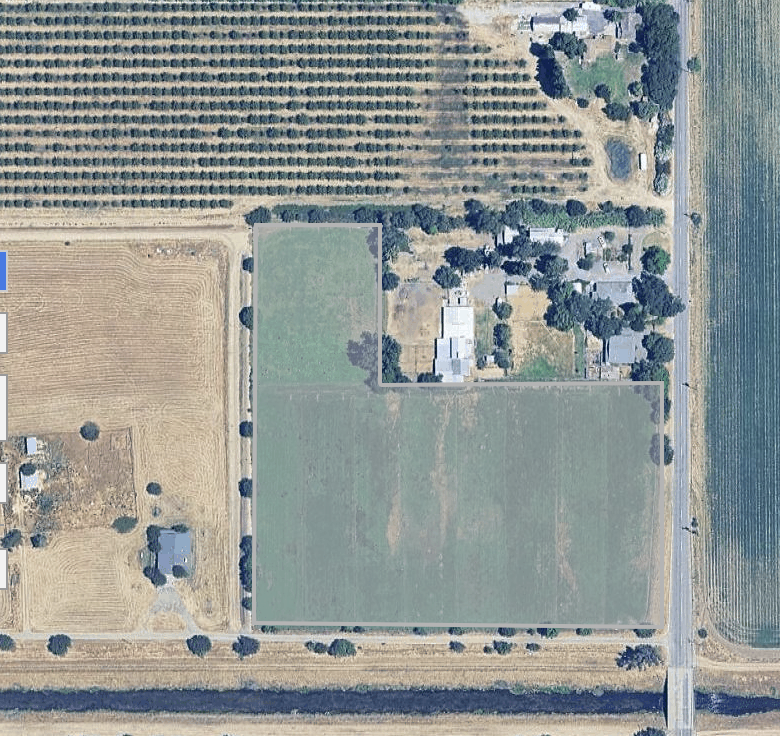
I took the photo below from the website we use to read the soil moisture info. I thought it would be interesting to see the aerial view of the farm. Our 10-acre farm is the green square in the center (plus buildings). There is an almond orchard north of us and alfalfa on the east. When I write about Across the Road that is what I’m talking about. There is a large canal on the south just past the driveway that leads to the neighbors on the west. This photo is from before we did the work in 2024 and still had an open ditch for irrigating. You can tell that we had eight fence lines in the south pasture. There are now nine interior fence lines running north-south, each 60′ apart. There are valves in the new irrigation pipeline every 30′, so when I graze I can either graze the 60′ wide strip or split that into two 30′ wide paddocks.
This photo provides a good visual for the post I wrote (and plan to do more) about sheep grazing Across the Road. The trucks in that post were parked just across the main road and between the trees just south of the house on our side of the road and the bushes on the other side just south of our tree.
Back to the purpose of this post, the soil moisture sensors.
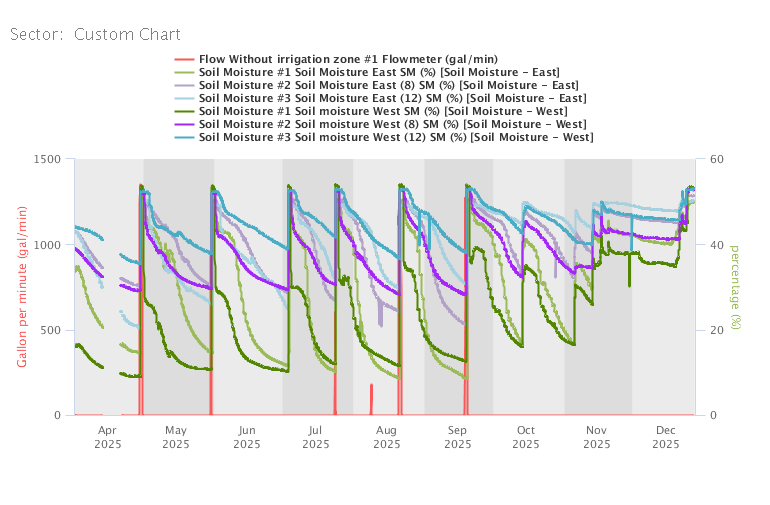
Let me explain what you’re seeing. The red line is the flow meter. It’s at zero except when we are irrigating. That shows the water coming into the pipeline from SID (Solano Irrigation District). It took some tweaking to get it right. The July reading stopped but we didn’t know why. By early August we had the solution. We needed a screen over the intake area so that weeds and branches didn’t physically impede the propellor going around in the pipeline.
About the other colors. There are two soil moisture sensors. Both are at the south end of the pasture. Now that I have added the aerial photo I can refer you to that–southwest corner and south edge about 2/3 of the way to the east. They are not right on the south fence line but about 20′ north of that.
Each sensor measure soil moisture at three depths–4″, 8″, and 12″. The goal is to know the moisture in the root zone of the pasture plants. Those depths are color coded: green is 4″, purple is 8″, and blue is 12″. When I look at the chart I have to orient myself to know that I’m not seeing the soil profile as it is if I am standing there. I think it as green for the plants and blue for the deepest water. Then it makes sense. The darker colors are the sensor on the west and the lighter colors are the east sensor. So you can see that when we irrigate or it rains all levels being measured are mostly saturated. The 4″ depth dries out most quickly while it takes longer for the other two to lose moisture, and during the summer they don’t lose nearly as much moisture as the ones closer to the surface.
November 13 and 14 it rained about 2″. The weather stayed foggy for weeks after that and into December. The soil moisture level remained high. I assume that is because #1- It was so foggy and damp, and #2 – plant demand slowed way down because of the cold and the season.
To be thorough I thought I’d show you most of the year. Early May shows our first irrigation. We were having the problem with the flowmeter but didn’t figure out the solution until August.
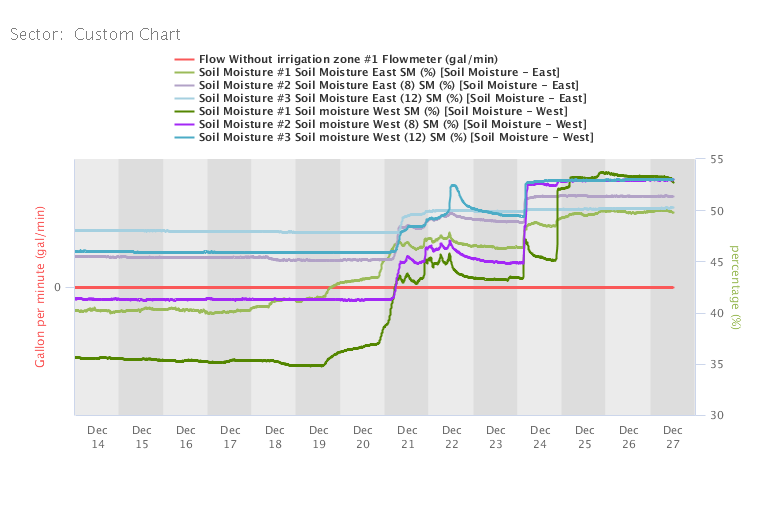
This view of the last two weeks makes it easier to see what’s going on. This explains why I have the sheep blocked off the pasture now. It is very wet, and I think it is better for the sheep and the pasture to have them off of it. It’s not that sheep can’t handle some rain, but, just like you don’t stomp around in your vegetable garden when you’re irrigating, we don’t want to impact the soil as 60 sheep (240 hooves) would.
Now I’ve convinced myself that I made the right decision to lock them in for now.
The shortest day of the year! Thank goodness we can look forward to sun again. I thought I’d share some photos of one of the things that most makes me think of summer.
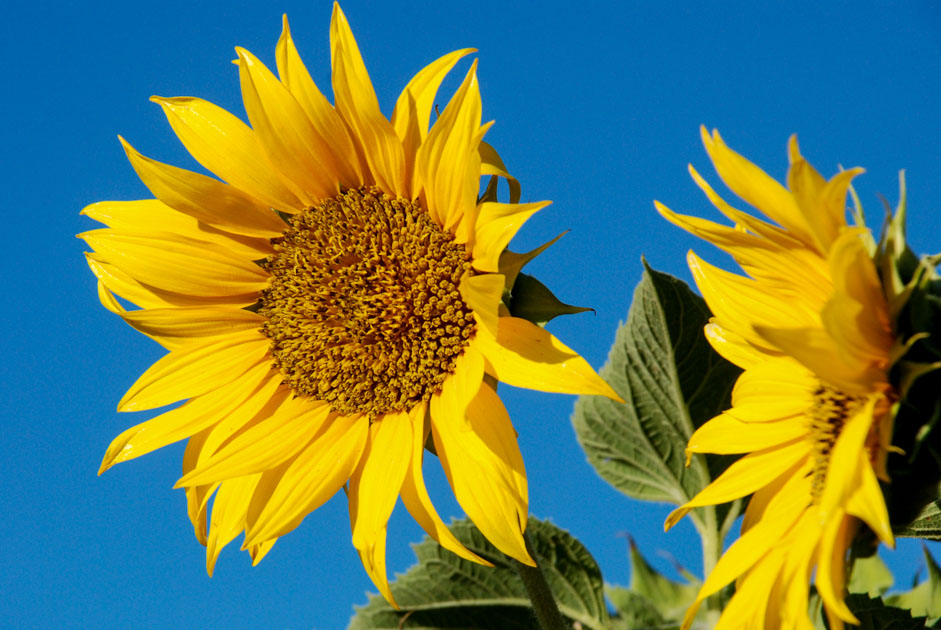
Sunflowers!
This is the view from Across the Road a few years when sunflowers were the crop. That’s our barn in the background.
Two sunflowers here at the farm that brighten up the foggy winter. On the left is a sunflower that is in the Weaving House (my studio/classroom). This is made by one of the Artery members who creates art from bicycle inner tubes! The one on the right is my birthday present made by Dan from horseshoes and metal scraps. You can’t tell from this photo but it is as tall as me and now marks my parking space near the garden!
The day began and ended very differently as far as weather. This is how I was dressed for morning chores, just has I have been for the last few weeks with the drizzly fog. The vets arrived at 9 and we got to work.
It’s worth it for me to be have confirmation of pregnancy, confirmation of due dates, and idea of how many lambs to expect. It’s not an exact science. I remember a couple of years ago when the prediction was two sets of triplets and there were eight! Some of it is about the timing of the ultrasound. Breeding season this year was from September 27 to November 11. We scheduled ultrasound day so that the timing would be right to confirm pregnancy for the sheep bred the latest. For those bred at the beginning of breeding season, the vets can certainly confirm pregnant or not, but may not be able to get an accurate count of the number of lambs because of the size of them at that point.
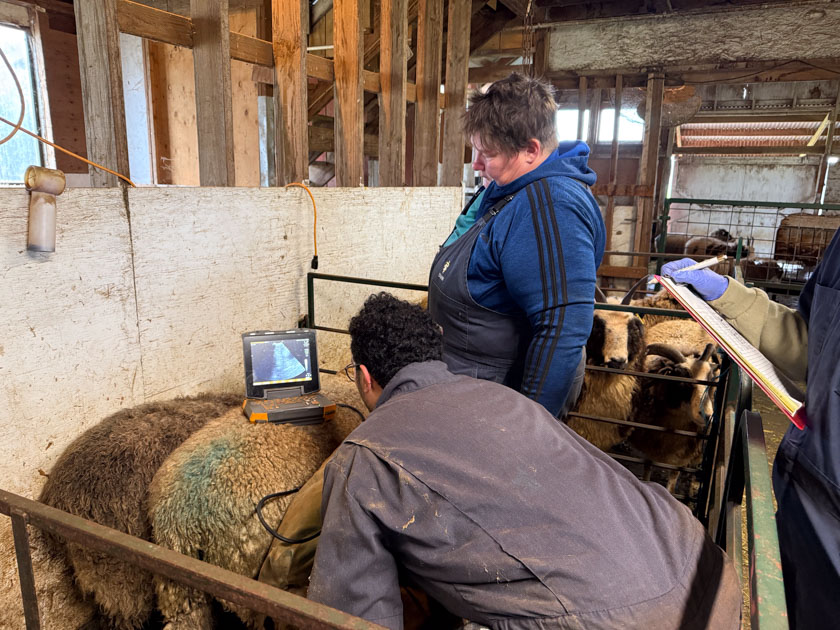
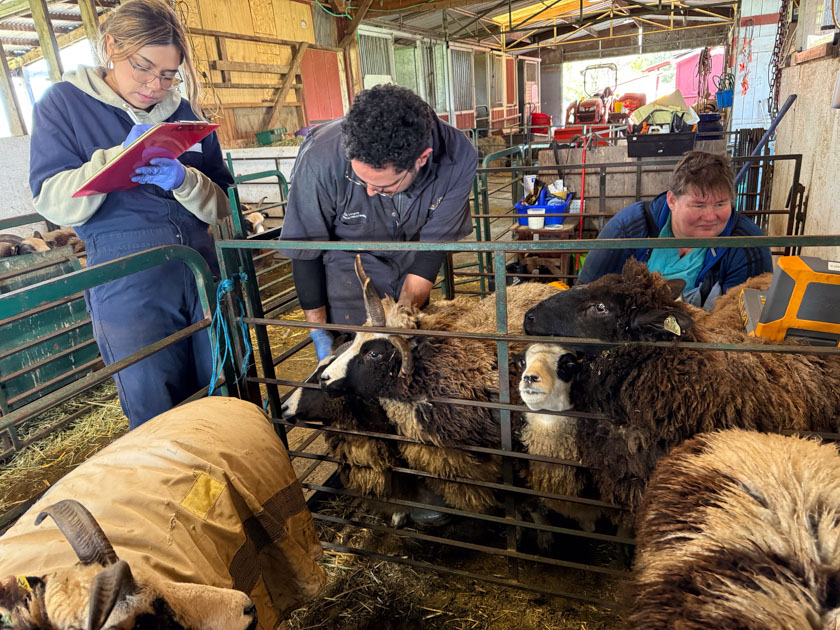
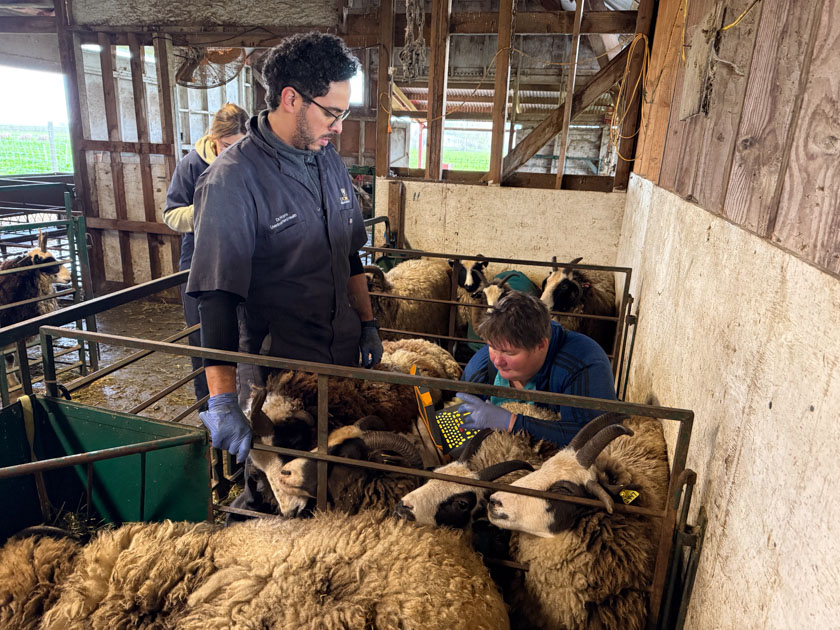
I gathered all the sheep in the barn and we put three or four in each lambing pen. When they are lined up four across it’s easier to keep them in one place, with the added advantage of a place to put the ultrasound unit.
One of the vets is a resident, having earned his DVM, but getting additional experience and training. So the visit probably took longer because he was getting help from Dr. Smith and then she also double checked some of the sheep.
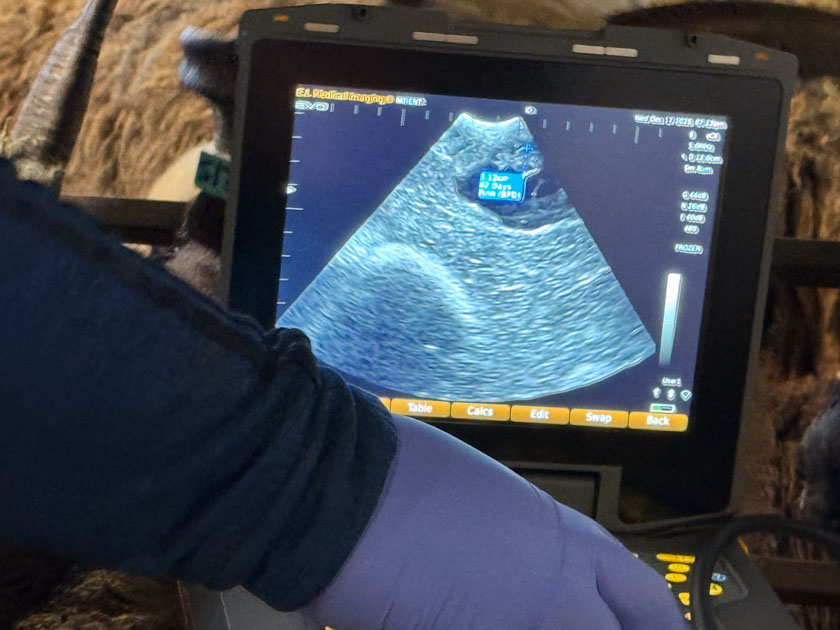
I took a few photos, but I sure can’t make out what is what. Whatever is important in this one is up in that top right part of the image.
It’s what is in the upper part of this image that is significant but I can’t tell you about this either…
…or this one…
…or this one.
The sun came out–this was significant since it had been 23 days or so since we’d seen it! After the vets had left and I cleaned the barn I had to get out for a walk. The sheep that were Across the Road were moved a couple of days ago, but that is another story when I can get to it.
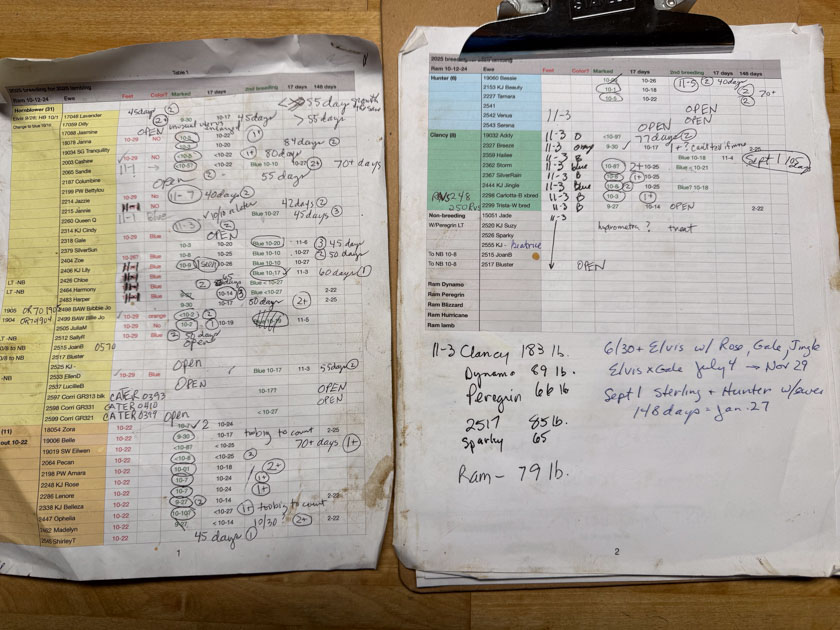
The vet tech wrote notes while they were working but this is how my spreadsheet looked when we were finished. Those people in Farm Club would recognize this as my breeding chart. Breeding groups are color coded on the left and dates are recorded as we go. (In case you’re getting a close-up look the dates on the left are hoof trimming, not breeding.) But all those circles and other notes are how I transcribed what the vets were saying. Fortunately I was able to take the vet tech’s notes and redo this spreadsheet, putting the rows into order of due date. That’s what we’ll refer to when breeding season starts.
One important item–when the rams got in with the ewes on September 1 at least one sheep was bred. The first due date is at the end of January while all the rest are due towards the end of February.
Dan saw a report that we have reached a record of 22 days of tule fog. Cold and drippy. I think I can handle cold (sort of) when it is balanced by a bit of sun. At least the green pasture and fluffy sheep look cheerful.
This is looking northwest to the hills. What hills? Fog instead.
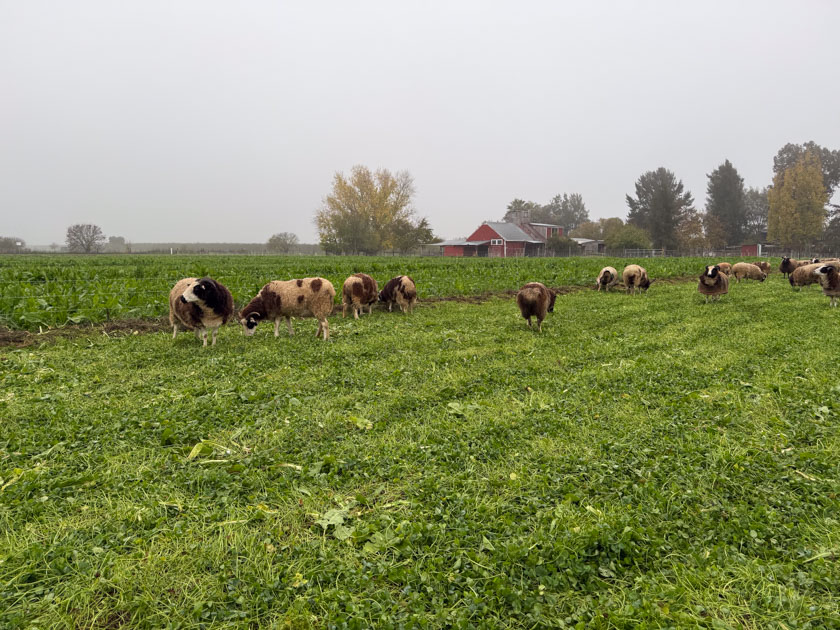
This is the second day grazing Paddock 17. There is still more feed out there, but I want to move them across the other paddocks.
It seems that two days is about right for each of these 30-foot strips. Notice in this photo and the previous one how well the sheep eat right to the edges. The fences are on the checks, the raised strips that channel the irrigation water down the pasture. I think they eat those closer because they aren’t trampled like the middle of the paddock.
This is another view of that paddock.
I moved the net fencing this morning and this is Paddock 16. .
Some of the chicory has red in the leaves and some does not.
We’re still in the gray gloom of drizzly fog, but we accomplished some outdoor tasks that make me feel as through I accomplished something.
These photos were taken on Wednesday, and on Monday I had moved the sheep from the northwest paddocks to the southeast along the road. This is Paddock 20-21 (numbers assigned to indicate the irrigation valves and checks). I had just fenced off the hedgerow we planted two weeks ago (blog post).
This that same fence but from the south. You might notice that it looks as though the fence is leaning the same direction but this is the opposite view. I have developed the habit of leaning my net fence away from the field the sheep will be in. It is rare that a sheep gets tangled in the net fence, but if that happens there is often a bad outcome. I think it is less likely for those upright horns to snag the fence and cause the sheep to panic if the fence is tipped slightly away when the sheep may be grazing close to the fence, as in a field with this much growth. (The previous photo shows how closely the sheep were grazing to the fence on the other side.) It’s also more likely when the charge on the fence is on the low end, and we need to do some troubleshooting on the connections in this field. So I always tip the fence.
Harmony, one of the ewes whose coat was changed recently (last post).
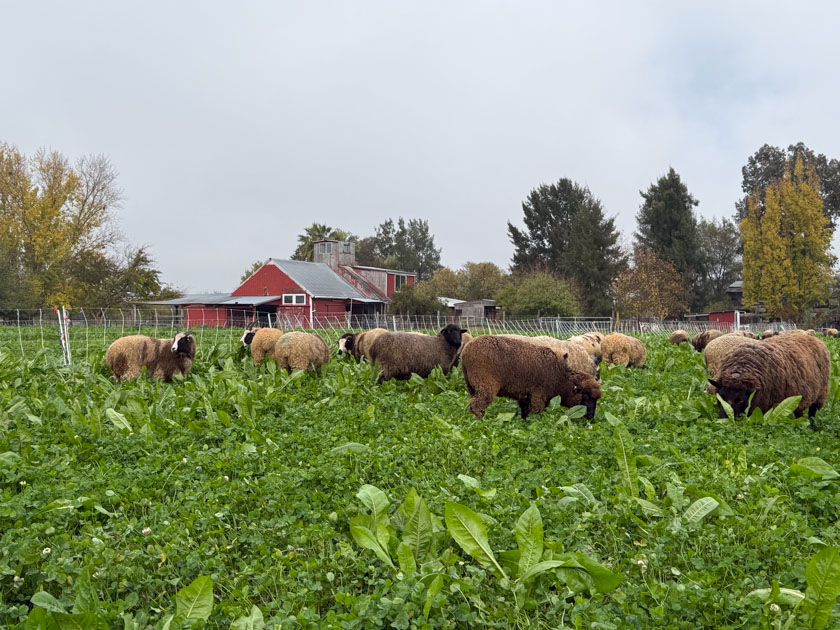
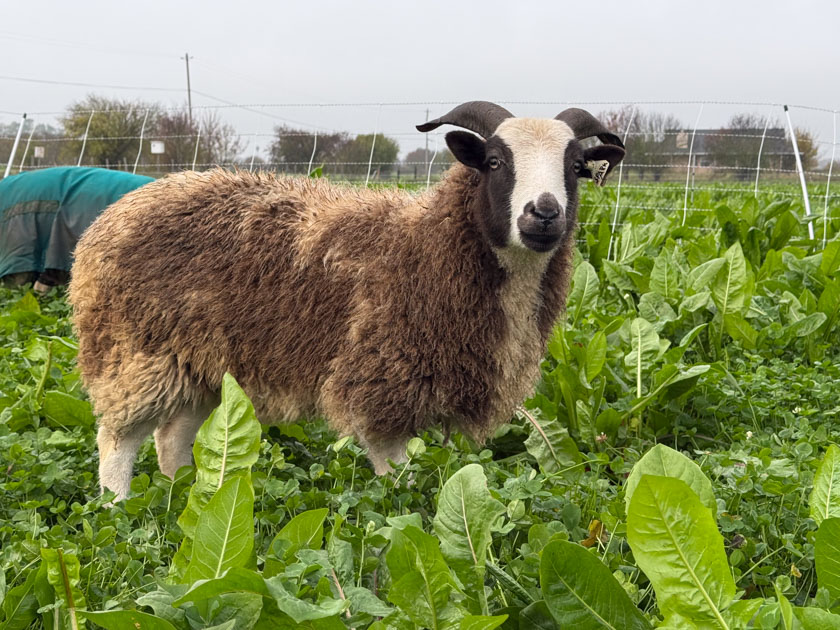
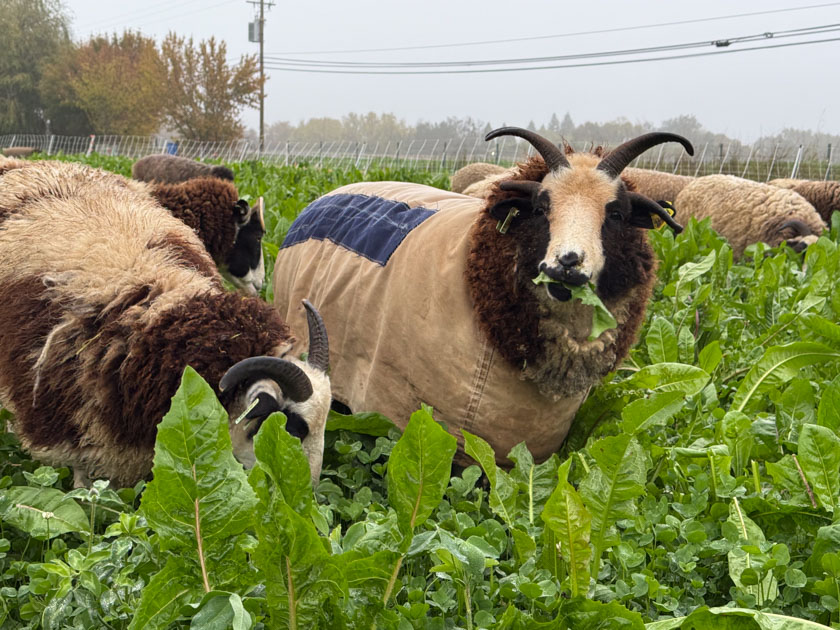
You all know Jade, the oldest sheep here, and a big pet. The plants you’re seeing are chicory and clover.
After morning chores I was looking for the wheelbarrow to use in the later project of working on the hedgerow. It was near the shop where I had been raking leaves, and I thought that, since it was here. I should rake up fallen lemons before I took the wheelbarrow away.
This tree has been here since we moved to this property in1999. I don’t know anything about growing citrus, but I think the tree may have been a combination of a few different citrus on a common rootstock. Maybe it’s always been just one variety, but I got confused with the different looks that seem to show up at other seasons. In any case, I was paying attention this month when we had loads of fruit on the ground. They sure looked like lemons, but were nothing I wanted to use. Lemons are not supposed to be sweet but I would describe these lemons as nasty. You can see a lot of fruit on the tree now, but it is not nearly ripe, and I know those are oranges. I just looked up lemon rootstock for orange trees and found this video about pruning out those rootstock suckers, which in this case had grown taller than the tree. I was right. The branches that had started as suckers but we hadn’t trimmed were taller than the tree. Do you see that empty spot on top and the one on the right? That is where branches had reached through the rest of the tree and were producing fruit. It was quite a job to cut those away as the branches had grown through other branches and they are very thorny. It took me a couple of hours to finish that job and by then it was about time for Raquel to come.
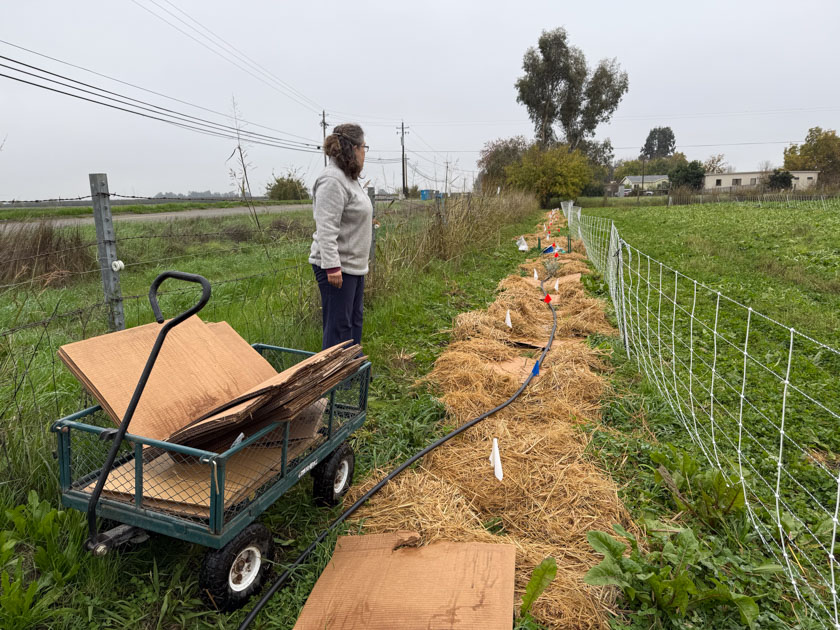
Raquel is a Farm Club member who went out of her way to help figure out how to order what was needed to install a drip system to irrigate our newly planted hedgerow. I had also picked up more cardboard from a friend so we could continue the mulching that we started. We rolled out 250′ of 3/4″ tubing and secured it with u-shaped wires.
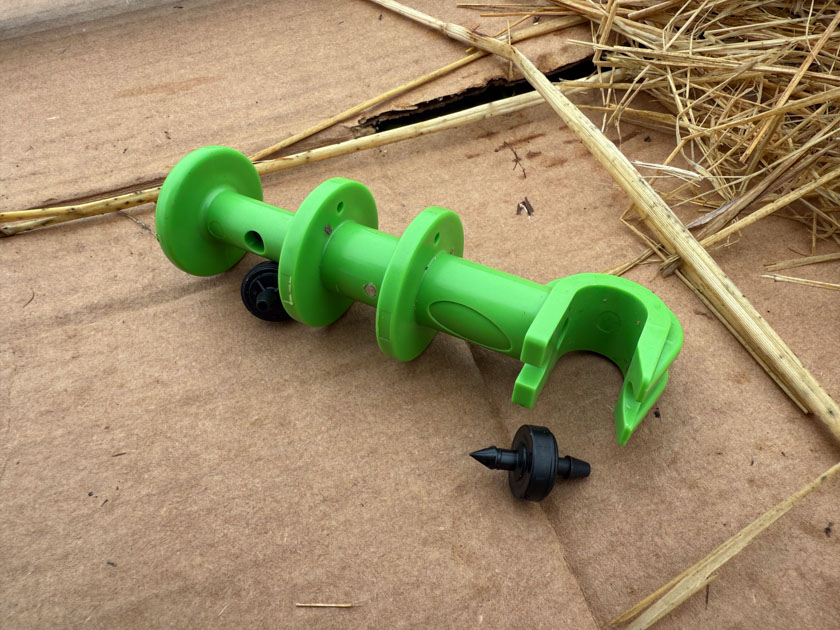
This is the tool that is used to poke holes at the appropriate places in the tube and then insert the emitters.
We had cardboard and straw mulch around the plants, but with the new cardboard we were able to cover space between the plants.
We finished the job…sort of. We used all the 250′ I had ordered. Someone (that would be me) had not measured correctly–a fact which I realized when I installed the new electric net fence for this strip. I thought we had a 250′ hedgerow, but it turns out I was 40′ short of fence. So we knew when we started on this yesterday we would run out of the main tube. We wanted to get as much done as we could though. I have ordered more tubing and all we have to do is connect it to this one and install more emitters and we’ll be good to go. It’s so damp and drizzly now that I don’t have to worry about more water on these plants right away.
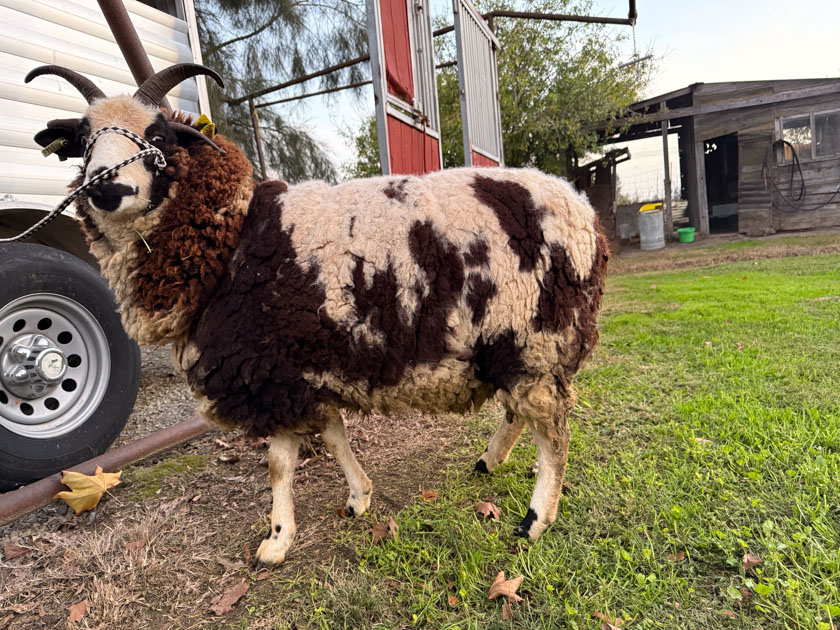
Every year I choose some sheep to coat–it’s usually those that are entered at a show. This year we took a trailer-full to Black Sheep Gathering (photos of the show). I coated most of those sheep because those who aren’t coated end up with straw buried in the fleeces. I kept coats on most of those afterwards so now there are nine sheep with coats.
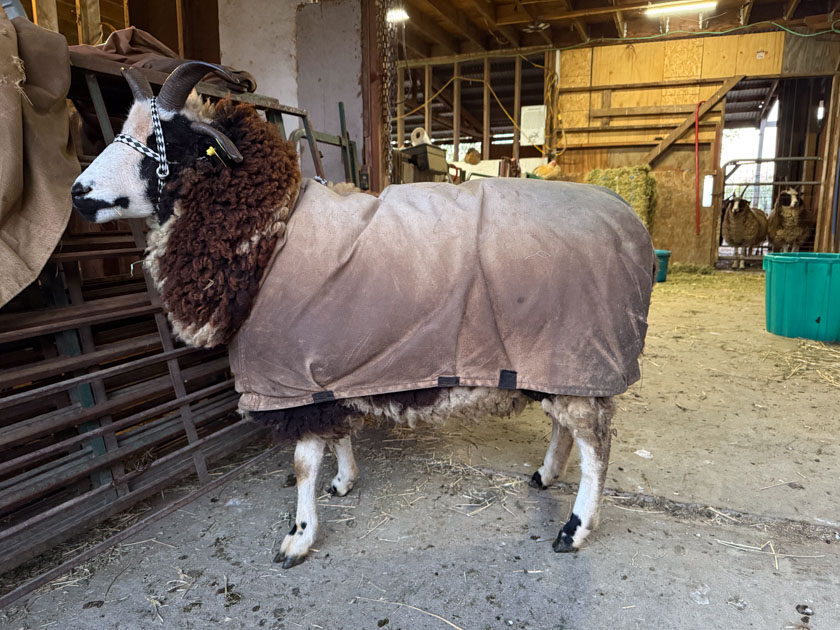
Why coat? 1. The fleeces are free of VM (vegetable matter) which could be stickers, seed heads, etc from the pasture, but our pasture doesn’t have any of those. Alfalfa is our most likely VM, and is great to spin a fleece that is completely free of that. 2. The colored wool isn’t sunbleached. Why don’t I like coats? 1. I would rather see the sheep in the field without coats. 2. Coats need changing as the wool grows, at least four times each year, and maybe more. 3. Coats need repair, especially when worn by horned sheep. 4. Coats can cause felting or other damage to fleece if they aren’t changed at the right time. 5. At this time of year with 6-1/2 weeks to go before shearing I’m running out of the larger sizes. I changed coats last week and took photos of some.
This is Lily wearing a coat that looks snug. I changed this one but didn’t get a photo.
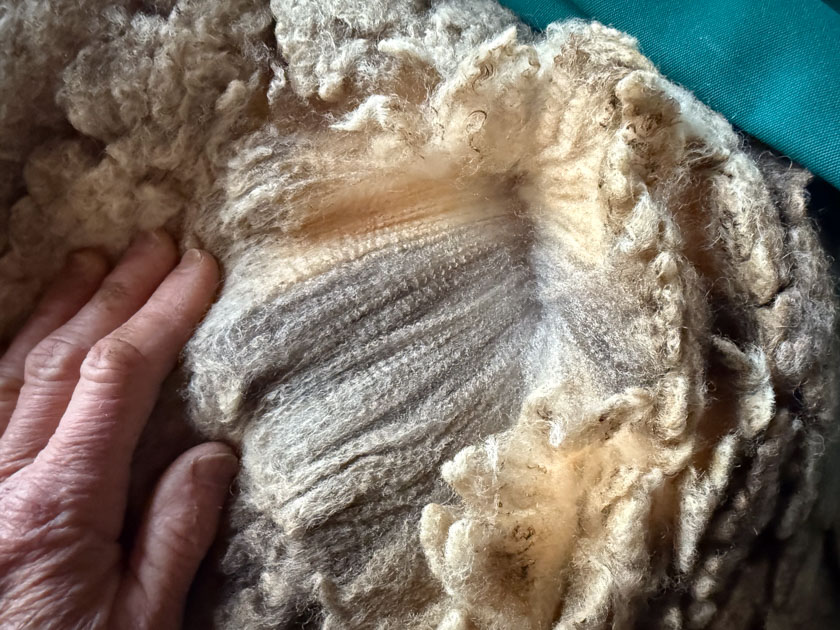
This is how Breeze looks with the coat removed. There is a bit of sun-bleaching because she didn’t wear the coat all year, but you can tell a difference from the neck wool that isn’t coated at all.
Breeze’s fleece.
Breeze with a larger coat.
I didn’t get a photo of Zoe, but here is one of her fleece. Gorgeous!
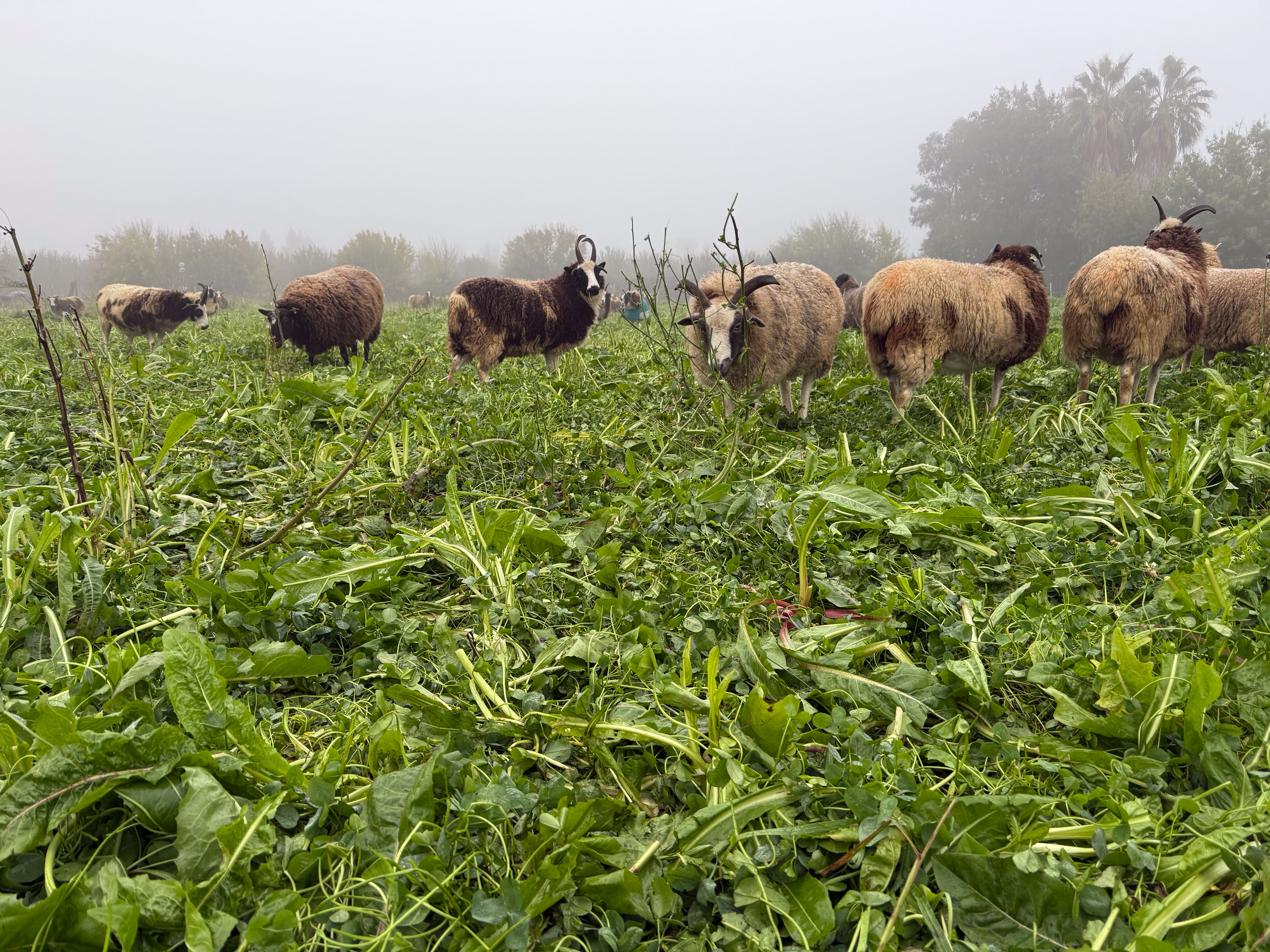
Checking the pasture this morning. The fog was so dense it seemed dark for longer this morning and I didn’t go out right away. The sheep had already been out eating.
This is Day 3 of grazing this paddock but it looks as though there is still plenty of forage.
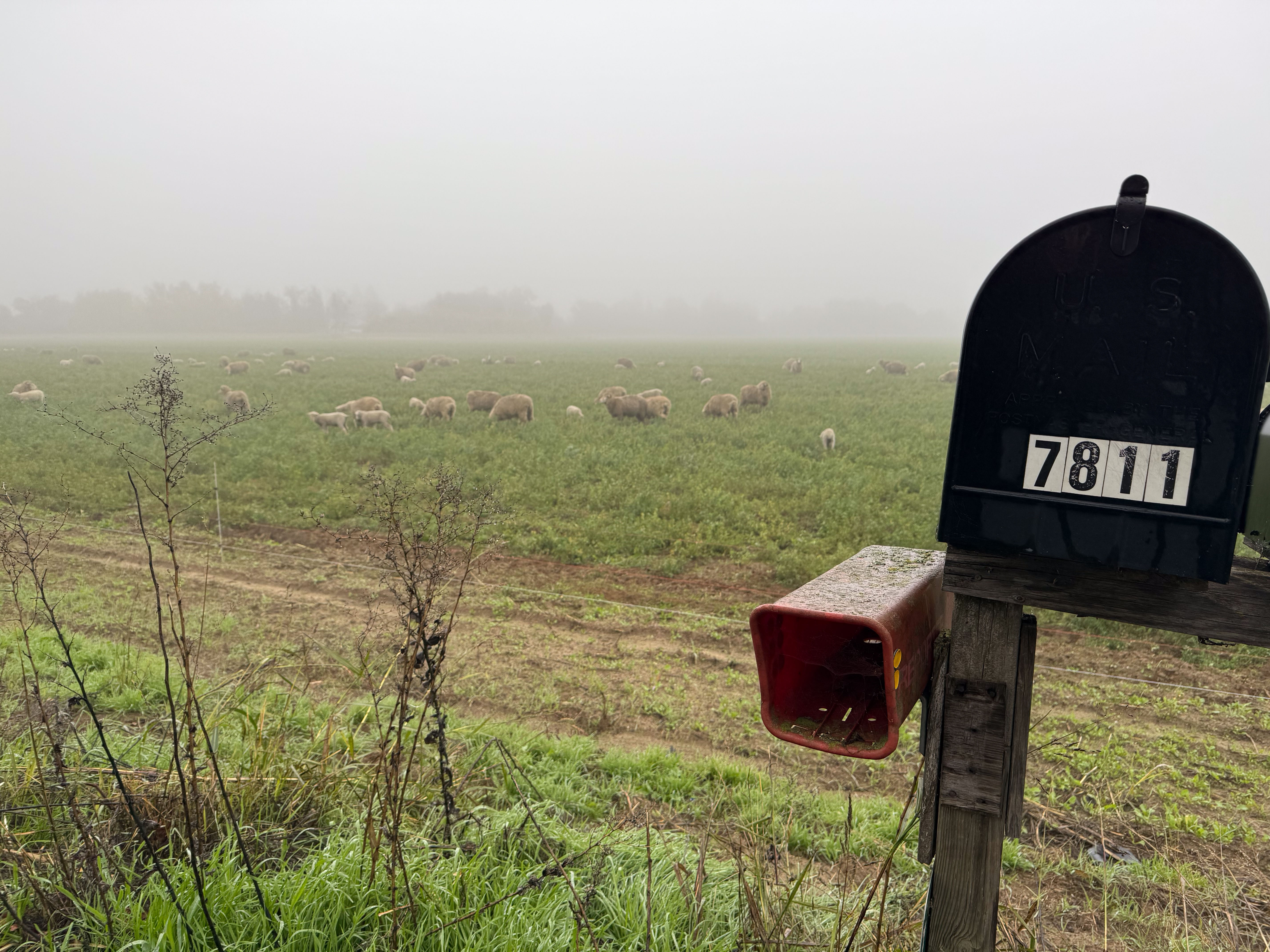
When I walked outside this morning I heard a lamb and I wondered if one of my ewes had an “oops” lamb from when the rams got out (or in with the ewes) but it still wasn’t the right timing. The sheep grazing Across the Road have now been moved to right across from our house.
There is one black lamb in this flock.
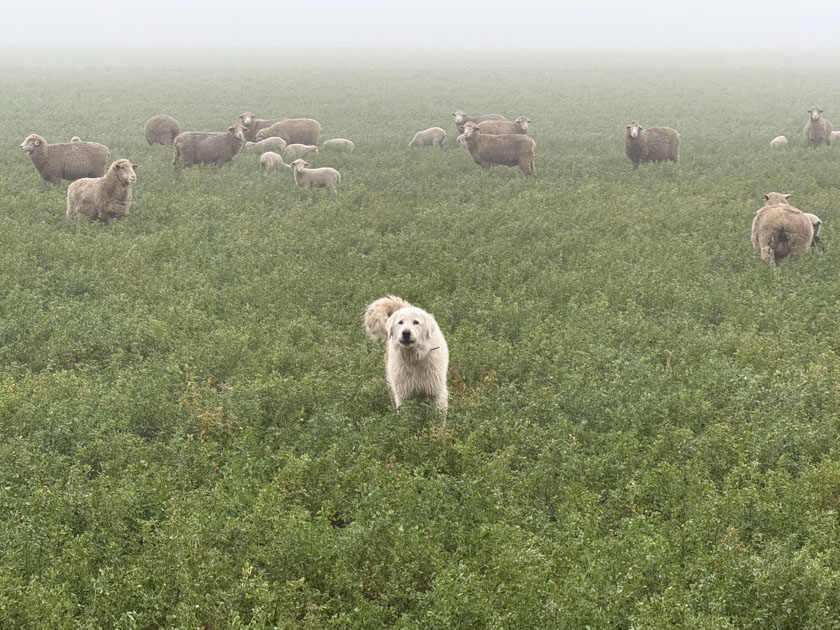
There are two guardian dogs and this one noticed me standing at the mailbox. He barked until I retreated.
Tanning is ongoing. Last night was the second session of the “hair-on” class. These will stay in the barrels for a week. They are tanning in mimosa.
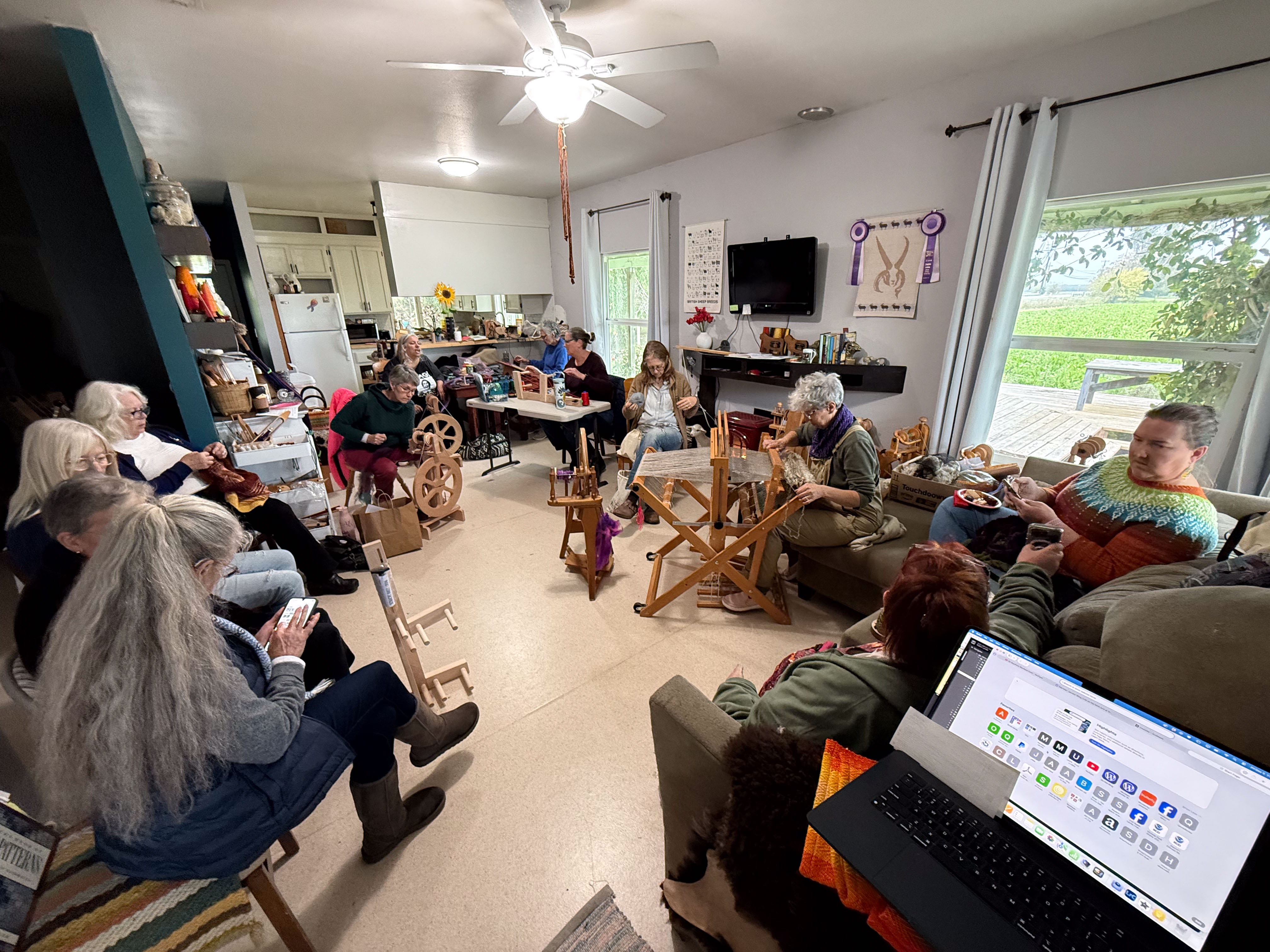
About a dozen people came for Spinners’ Day Out today. I think that today two people were spinning, one inkle weaving, one floor loom weaving, four knitting, one using a blending board, and everyone enjoying the conversation and great snacks.





























 Meridian Jacobs' Blog