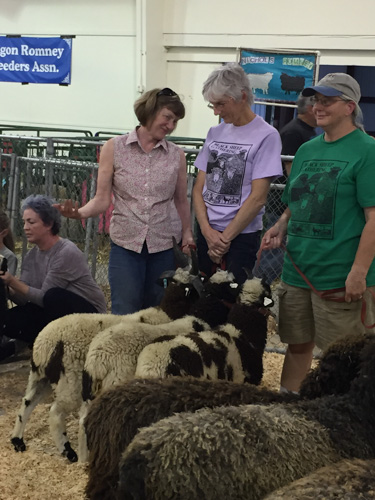
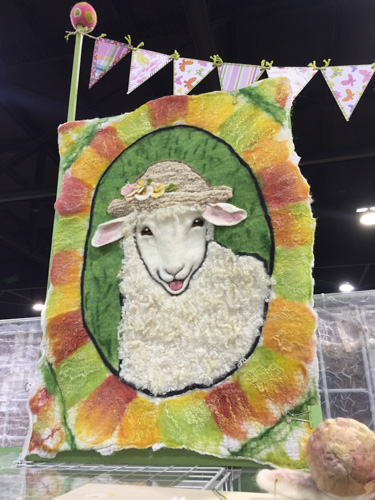
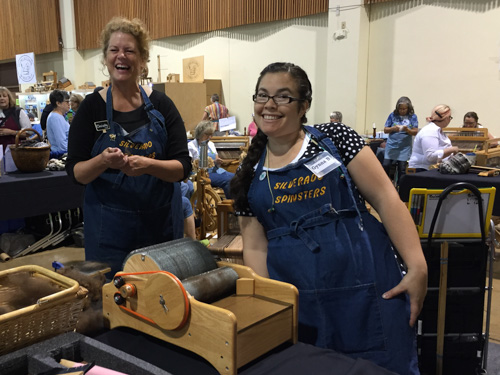
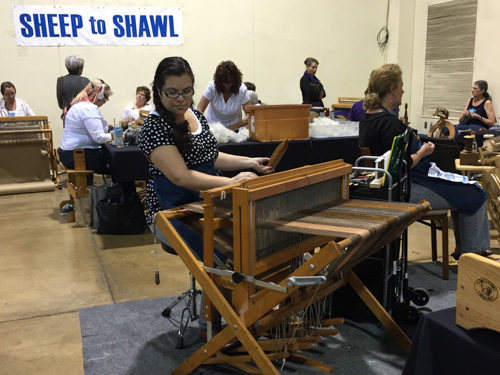
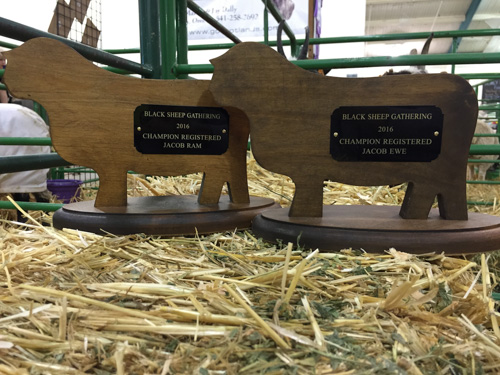
The Spinner’s Lead is one of the events I enjoy most at Black Sheep Gathering. It is a competition in which entrants show off their handspun or felted items and bring the animal that was the fiber source (or borrow a representative one from one of the animal exhibitors). There are two categories–one for Owner and one for Non-Owner.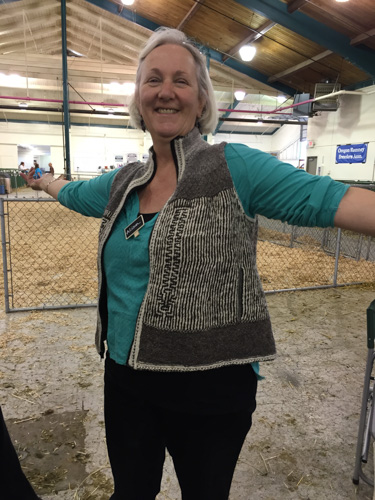
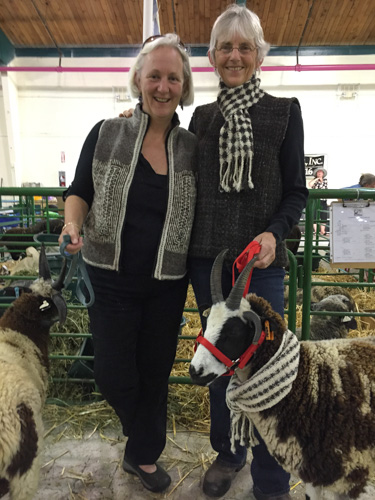
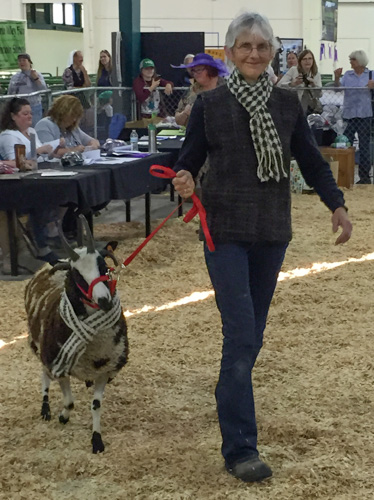
Alison and I both entered Jacob yarn vests. Alison’s vest is incredible. She started this project three or four years ago, spinning Jacob wool into 4-ply yarn. She knit the vest using twined knitting to create a fabric that is windproof but stretchy–a natural alternative to Polartech. At one point Alison had knit the vest almost to the top but was not happy with it and ripped it all the way back to the cast-on row! It features i-cord band, sewn in zipper, and pockets.
I started working on my vest about four weeks before BSG, inspired when I figured out that the fleece of the sheep I was entering, was still in the barn and was a beautiful one. After spinning the yarn the fabric took two days to warp and weave and another to turn into a vest. On Tuesday of the BSG week I wove scarves using white and the leftover black yarn. Weaving is so much faster than knitting!
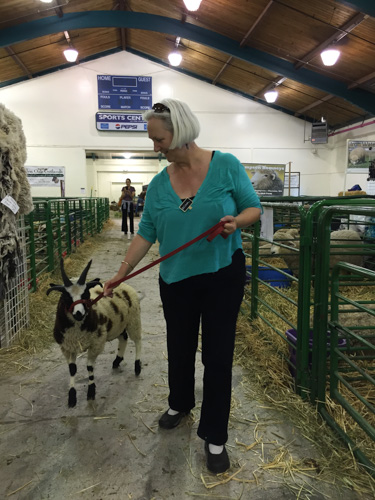
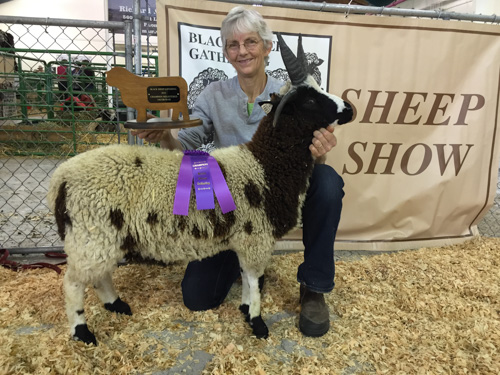
Honey was my selected sheep for the Spinners’ Lead because it was her fleece I used. I chose Marv for Alison because he seemed the best most compliant of the other sheep. She spent a little time practicing with him before the event.
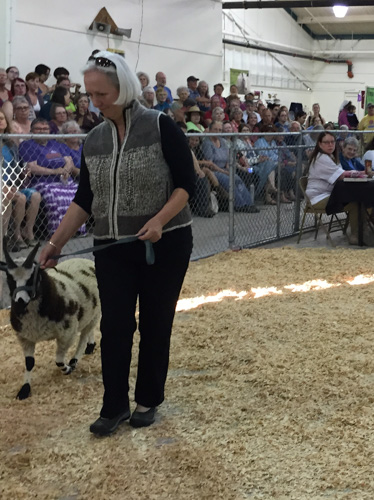
I handed my i-phone off to a friend who took most of these photos, and it’s not easy to get good photos standing at the outside of the show ring. (Thanks, Deb.)
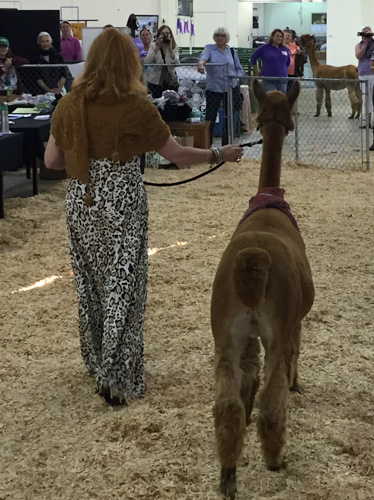
Alpaca shawl. Red hair, red shawl, red alpaca. (Honey did not like the alpaca when it showed up in the line near her.)
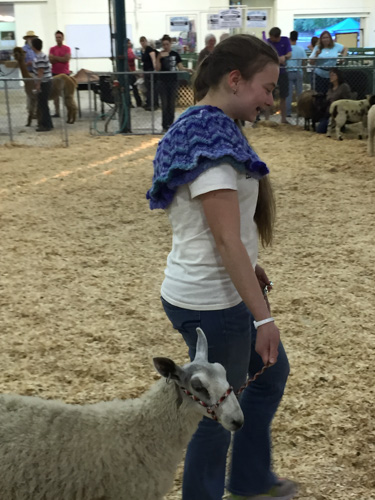
BFL sheep with her young owner. This one was the winner of the Owner category.
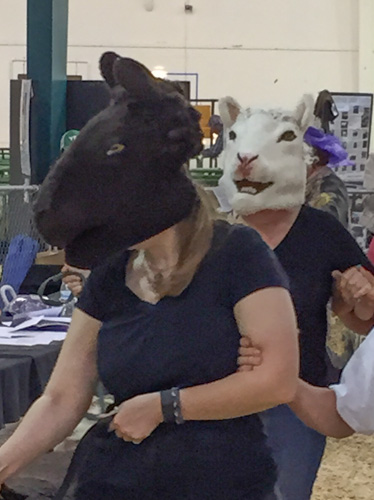
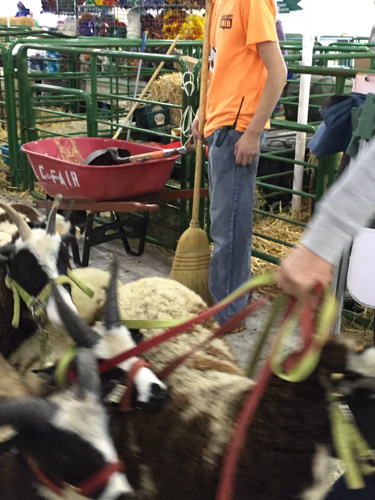
This was the most unusual entry this year–felted sheep masks. The wearers are leading sheep, but they needed to be guided as well.

Sweater knitted from natural colored fleece.
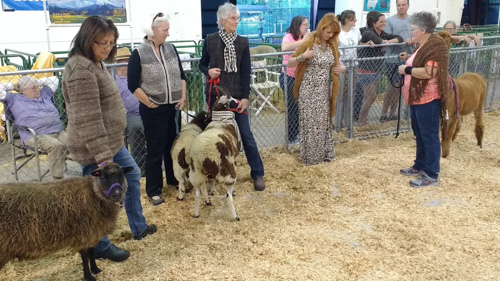
Waiting to hear the results. Alison won the non-owner category! It was well-deserved.

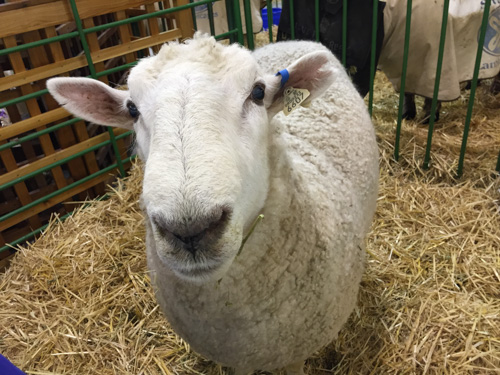


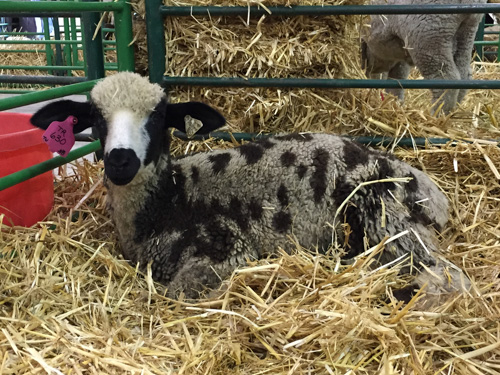











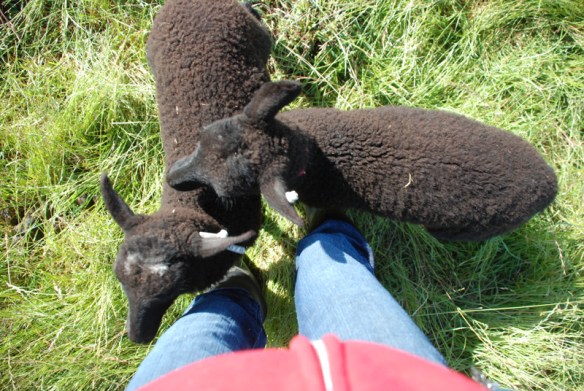
 I irrigated this weekend. The sheep were just moved off the paddock to the right and when it dries up enough they will go on the one to the left. Can you see the difference? It took only two days for them to eat that feed.
 One of their favorite plants is Birdsfoot Trefoil. It is a legume which means it is one of the plants that converts nitrogen in the air to a form that can be used by the plant. It is actually not the plant that does that but the bacteria that live in nodules on the roots of legumes.
 Clovers are also legumes. This is a variety of white clover.
 This morning I noticed just a few of these flowers. I can’t decide if this is a variant of the white clover or is a different species. The leaves are similar. I’ll have to do some more checking.
 Do you see how most of the other plants have been eaten and this one has not been touched? The sheep avoid plants that are toxic to them. This is Narrow-leaved Milkweed (Asclepias fascicularis). Not only is it a favored species for the monarch butterfly but according to a
  These are Narrow-leaved Milkweed flowers in various stages…
 …and a close-up.
 Field bindweed (Convolvulaceae arvensis), also known as morning glory. It is, according to a
  Soft Chess or Soft Brome, a non-native annual grass.
 Medusahead as it is drying out. Medusahead covers thousands of acres of California foothills. It is not normally found in irrigated pasture, but it is in the easternmost paddock here which sometimes does not irrigate well. I have reclaimed part of that paddock, but I continually fight this plant. I find patches of it in other areas of the pasture and, although this is not an effective control technique, I pull it up by the handfuls as I walk by, coming back to the barn with it stuffed in the pockets of my overalls. It is a nasty plant that is “…among the worst weeds: not only does medusahead compete for resources with more desirable species, but it changes ecosystem function to favor its own survival at the expense of the entire ecosystem…Because grazing animals selectively avoid this plant, and because medusahead thatch tends to suppress desirable forage species, infestations often develop into near-monotypic stands.” From the
  I have ID’d this one as Blunt Spikerush (Eleocharis obtusa), not a grass, but a sedge that is found on poorly drained soil and marshy areas. That’s my pasture…poorly drained soil. There is a lot of this sedge in the middle and south end of three or four of the paddocks. It looks like foot-tall grass, but that is why it is important to actually look at what is out there. This does not make good forage.
 A rather artsy shot of Buckhorn Plantain, found throughout California…
 …and a photo in which you will probably more easily recognize it.
 Meridian Jacobs' Blog