Friends and customers told me that I should start carrying sock yarns so last winter I chose a few special yarns. One is Sprout, a fingering weight superwash Merino yarn that is dyed and marketed by The Fiber Seed, the business name of a delightful couple who live in Florida.

This colorway is called Quicksilver and is dyed in one of several dye patterns they use.
Chris saw me photographing this and commented that I was going to weave something to match my cell phone.

Here is what it looks like after winding into a ball.
Too many people think that you can’t using “knitting yarns” for weaving and vice-versa. To me, yarn is yarn. This yarn is very stretchy and you need to plan for that from the start. I measured the warp on my warping frame under a light tension, also taking time to match up the color repeat. That way I have a warp where the colors don’t mix, but move from yellow to gray and repeat (which you will see in the finished piece). That may not work with every dye pattern or warp plan, but it worked perfectly for this one.

Notice how open this is. I sett the warp at 12 epi (ends per inch) and wove it with a very light beat. Beginning weavers often BEAT, instead of beat press the weft in. In this case that would completely cover up the warp and not make fabric appropriate for a scarf. This yarn is under tension and when it comes off the loom a lot of those spaces will fill in.
I could have chosen to weave this with a solid color to maximize the effect of the color movement in the warp, but one of my goals is to show what can be done using just one skein. The color repeat in the skein means that when using this yarn for weft the color changes after about every fourth weft pick. Notice also how the color changes over-ride the pattern of the weave structure. This is one of my favorite weave structures, but in this piece I used it for the drape and texture it would give the piece and not because you’d see the design it makes when I use solid yarns.

I knew this wool wouldn’t “full” because the yarn is superwash, but wet finishing will still change the look of the piece. I soaked it in water, agitating as if I was fulling it. I should have taken a photo but it was late at night. After that process the scarf looked pretty awful. The yarn reverted from being lofty and squishy to long and stringy. The fringe looked bad. I laid the scarf out to dry as I usually do and it was very disappointing. Then I remembered–Superwash! I put the scarf in the dryer with a big towel. That was the answer!
This scarf is lofty, bouncy, and very soft.
Here are the stats:
On the loom: 7.25″ x 81″ measured under tension
Off the loom: 6″ x 68″ (Remember, I told you it was stretchy!)
Wet after washing: 6.25″ x 72″ (and not looking very good)
After drying in dryer: 5.25″ x 58″ Perfect!

Another cool thing for you knitters is that each yarn comes with a QR code that links to a knitting pattern using the yarn.
I guess I need to get these yarns on my website, but there are so many color and dye pattern choices that will be difficult. I’ll work on it. In the meantime, if you are interested you can always ask me to send photos or come to the shop.
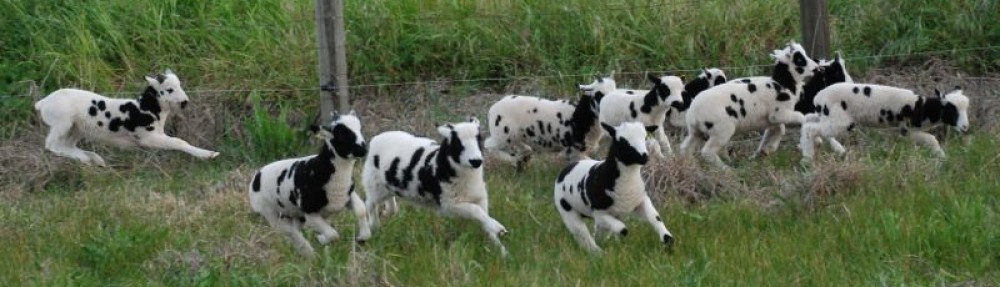

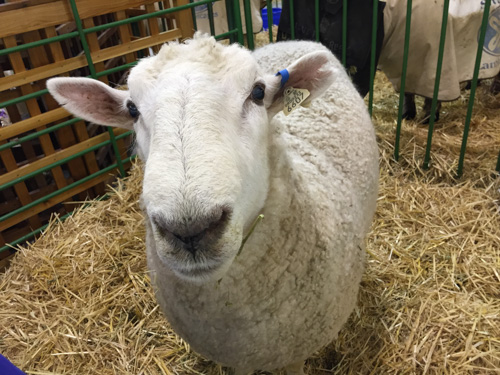


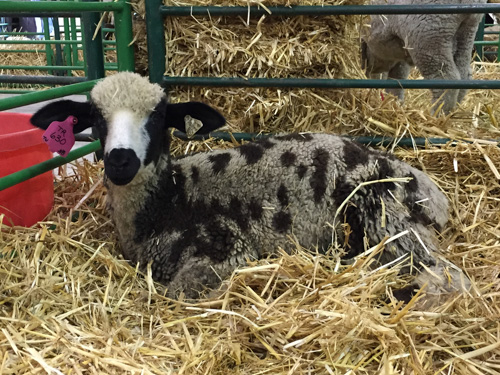

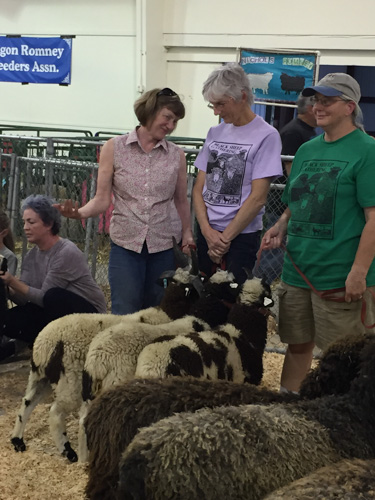










 I irrigated this weekend. The sheep were just moved off the paddock to the right and when it dries up enough they will go on the one to the left. Can you see the difference? It took only two days for them to eat that feed.
 One of their favorite plants is Birdsfoot Trefoil. It is a legume which means it is one of the plants that converts nitrogen in the air to a form that can be used by the plant. It is actually not the plant that does that but the bacteria that live in nodules on the roots of legumes.
 Clovers are also legumes. This is a variety of white clover.
 This morning I noticed just a few of these flowers. I can’t decide if this is a variant of the white clover or is a different species. The leaves are similar. I’ll have to do some more checking.
 Do you see how most of the other plants have been eaten and this one has not been touched? The sheep avoid plants that are toxic to them. This is Narrow-leaved Milkweed (Asclepias fascicularis). Not only is it a favored species for the monarch butterfly but according to a
  These are Narrow-leaved Milkweed flowers in various stages…
 …and a close-up.
 Field bindweed (Convolvulaceae arvensis), also known as morning glory. It is, according to a
  Soft Chess or Soft Brome, a non-native annual grass.
 Medusahead as it is drying out. Medusahead covers thousands of acres of California foothills. It is not normally found in irrigated pasture, but it is in the easternmost paddock here which sometimes does not irrigate well. I have reclaimed part of that paddock, but I continually fight this plant. I find patches of it in other areas of the pasture and, although this is not an effective control technique, I pull it up by the handfuls as I walk by, coming back to the barn with it stuffed in the pockets of my overalls. It is a nasty plant that is “…among the worst weeds: not only does medusahead compete for resources with more desirable species, but it changes ecosystem function to favor its own survival at the expense of the entire ecosystem…Because grazing animals selectively avoid this plant, and because medusahead thatch tends to suppress desirable forage species, infestations often develop into near-monotypic stands.” From the
  I have ID’d this one as Blunt Spikerush (Eleocharis obtusa), not a grass, but a sedge that is found on poorly drained soil and marshy areas. That’s my pasture…poorly drained soil. There is a lot of this sedge in the middle and south end of three or four of the paddocks. It looks like foot-tall grass, but that is why it is important to actually look at what is out there. This does not make good forage.
 A rather artsy shot of Buckhorn Plantain, found throughout California…
 …and a photo in which you will probably more easily recognize it.


 Dottie brought a car-load of supplies. She put indigo in a tea strainer and we watched the water turn color. We also noticed a metallic sheen on the water and weren’t sure what to do about that. We forged ahead…
 …sampling with cotton fabric that Dottie had brought with her. The metallic stuff showed up on the fabric but it seemed that we could wipe it off easily.
 So we went ahead with the dress. When dyeing with indigo you don’t want to stir up the dye bath because indigo dyeing relies on a chemical reaction as the fabric comes out of the dye and reacts with oxygen. If you introduce oxygen into the dye bath you lose some of the effectiveness of the indigo.
 When you bring something out of an indigo bath it is green at first.
 As it reacts it turns blue. Usually you rely on several dips to darken the color, but this one came out fairly dark the first time. However, we saw unevenly dyed areas where I had been too careful about lowering the dress into the bath and the dye didn’t get into the folds. There was also that metallic stuff in spots. I decided to hose the dress off (no pictures at this point) and see what it looked like. Not good. Very splotchy and not in a good way. So I tried again, this time stirring the dress in the pot with my hands. It was more important to get an even dye job than to save the dye bath for later.
 Here is the final product. But we weren’t done. There was another step and that was a surprise to me. First though the dress had to be completely dry, so that step was going to have to wait until later.
 No, one of us didn’t grow an extra hand. Dottie came with a friend who took some of these photos while we were working.


