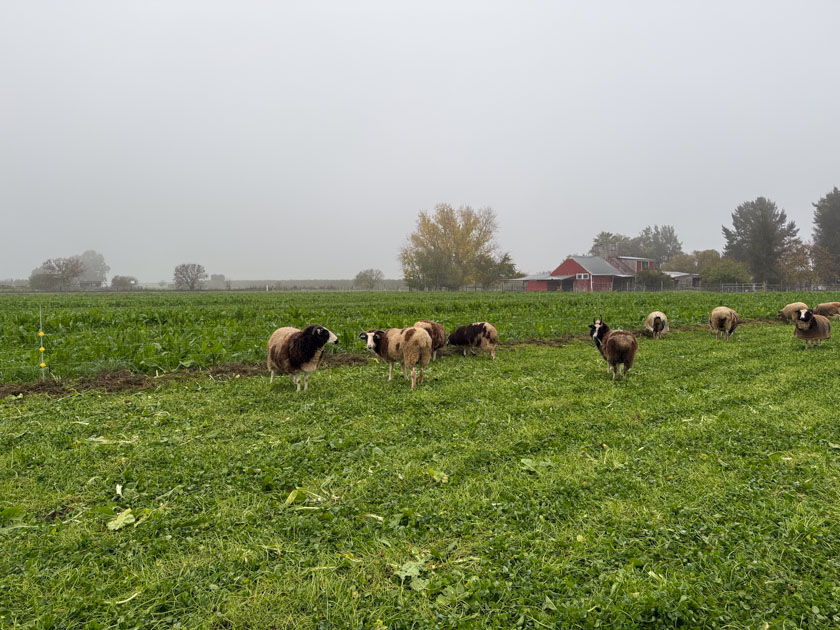
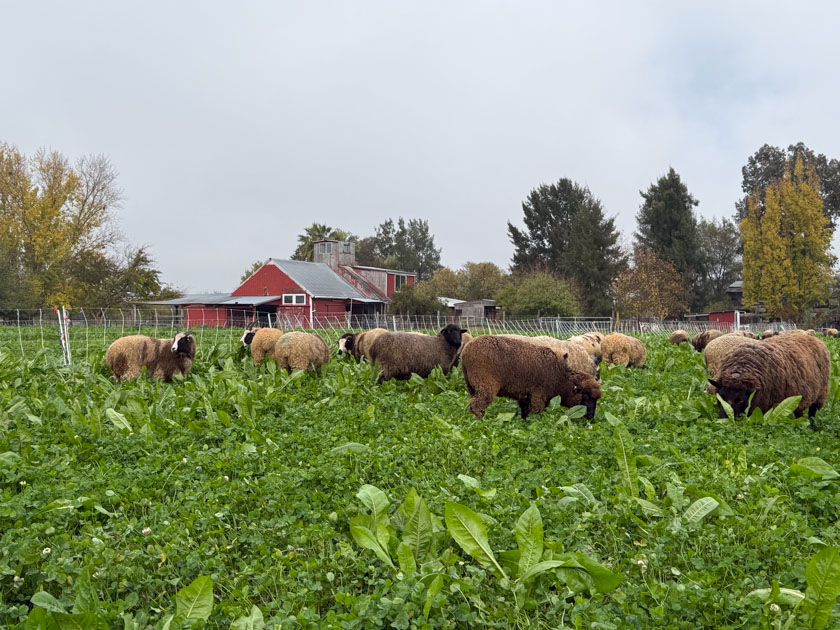
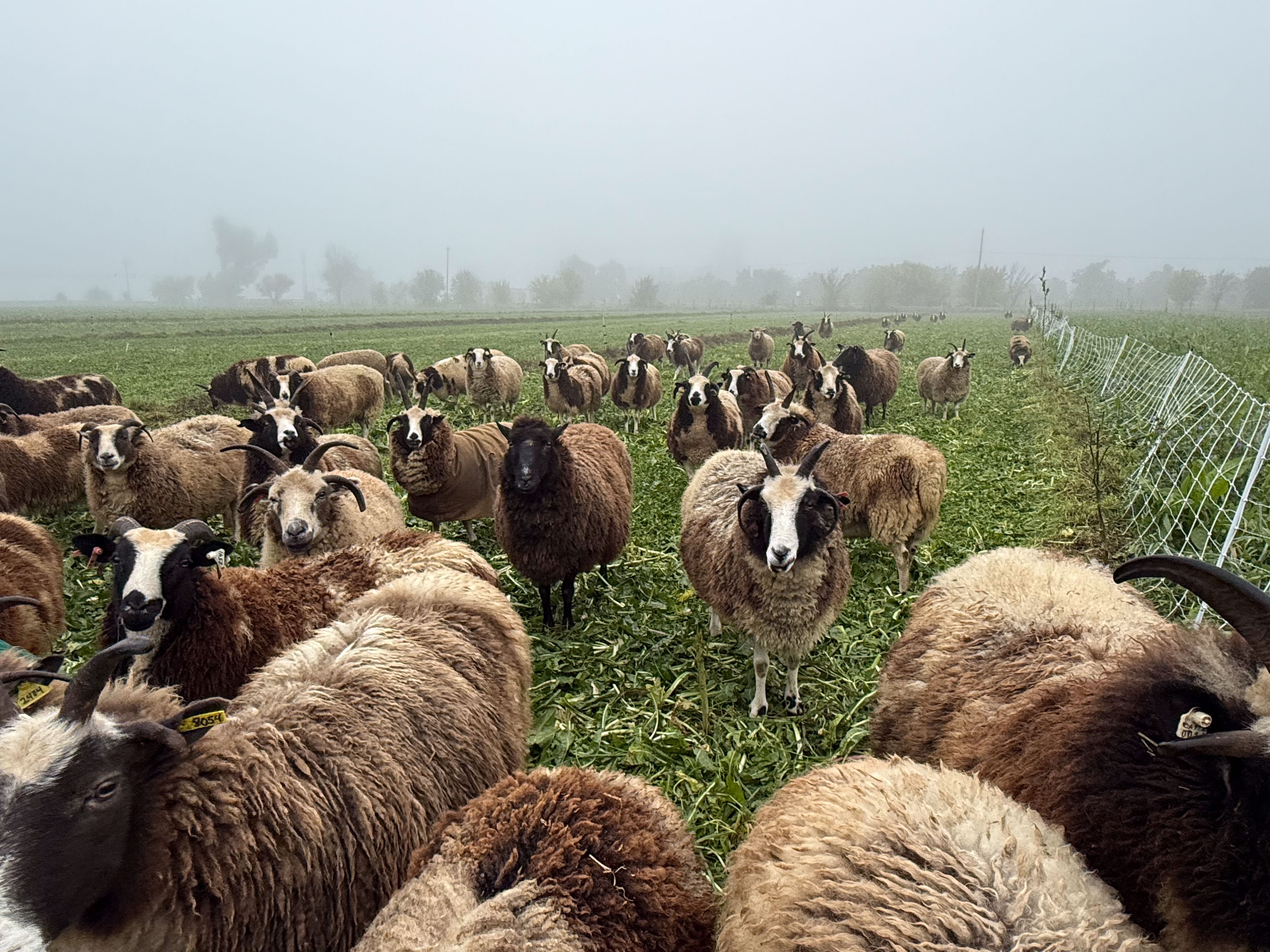
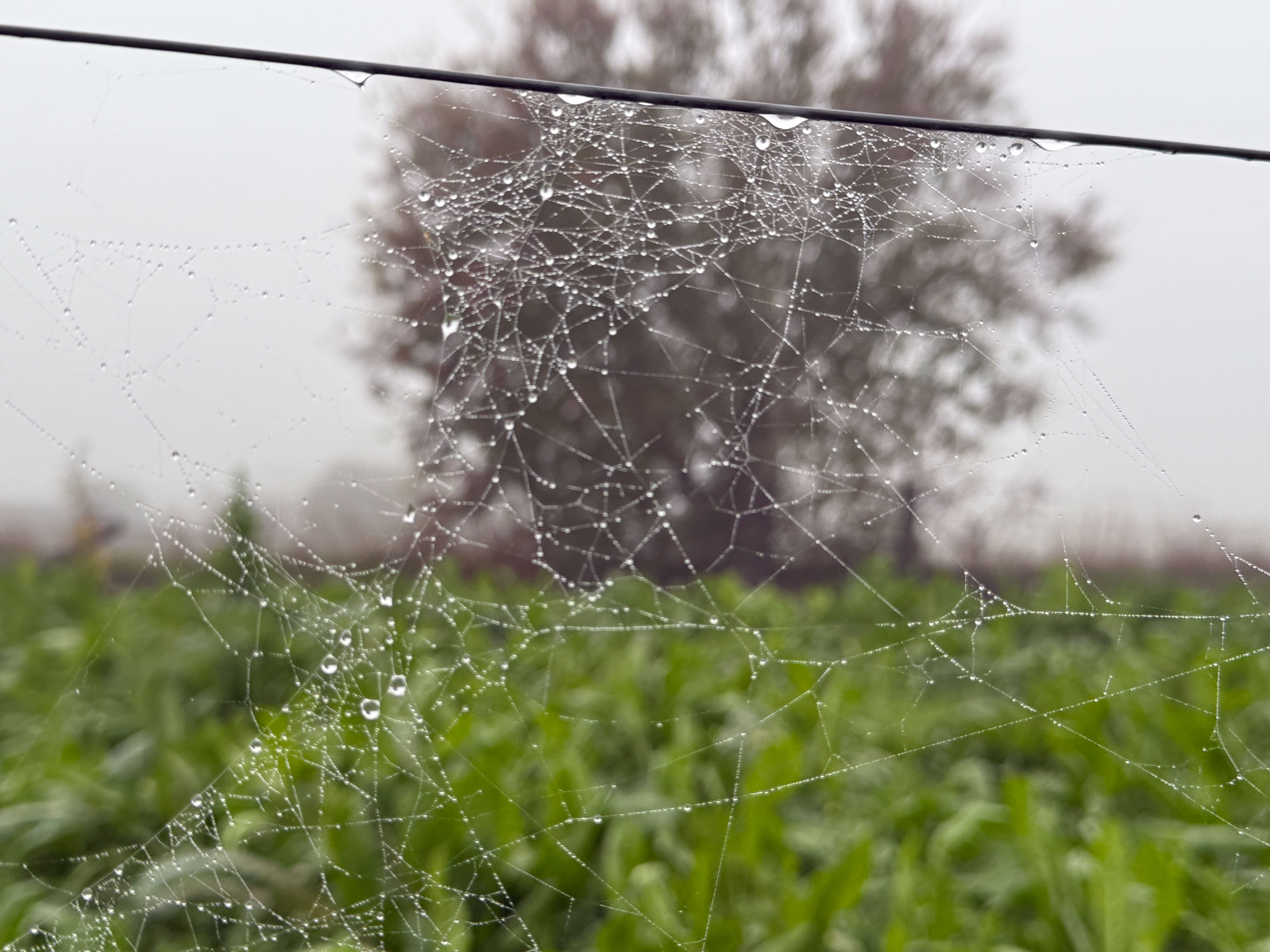
Dan saw a report that we have reached a record of 22 days of tule fog. Cold and drippy. I think I can handle cold (sort of) when it is balanced by a bit of sun. At least the green pasture and fluffy sheep look cheerful.
This is looking northwest to the hills. What hills? Fog instead.
This is the second day grazing Paddock 17. There is still more feed out there, but I want to move them across the other paddocks.
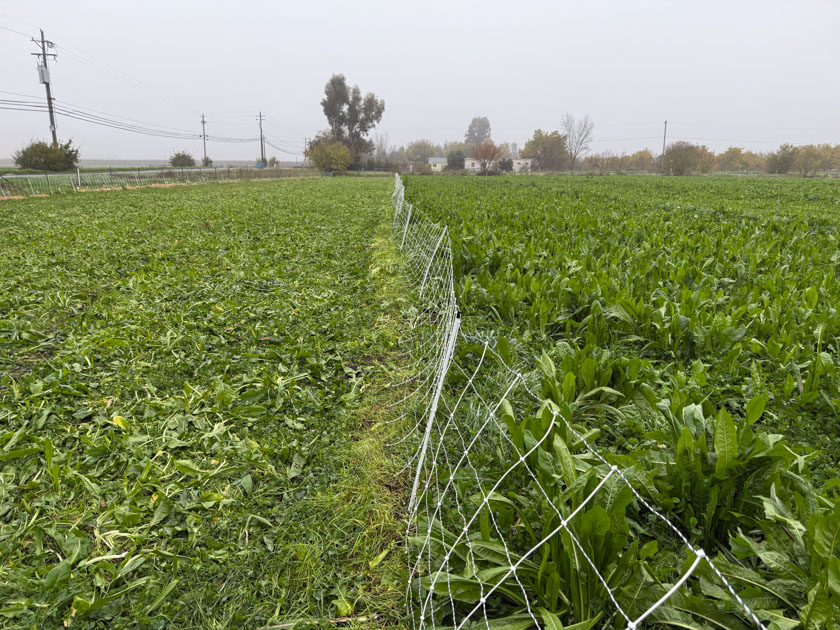
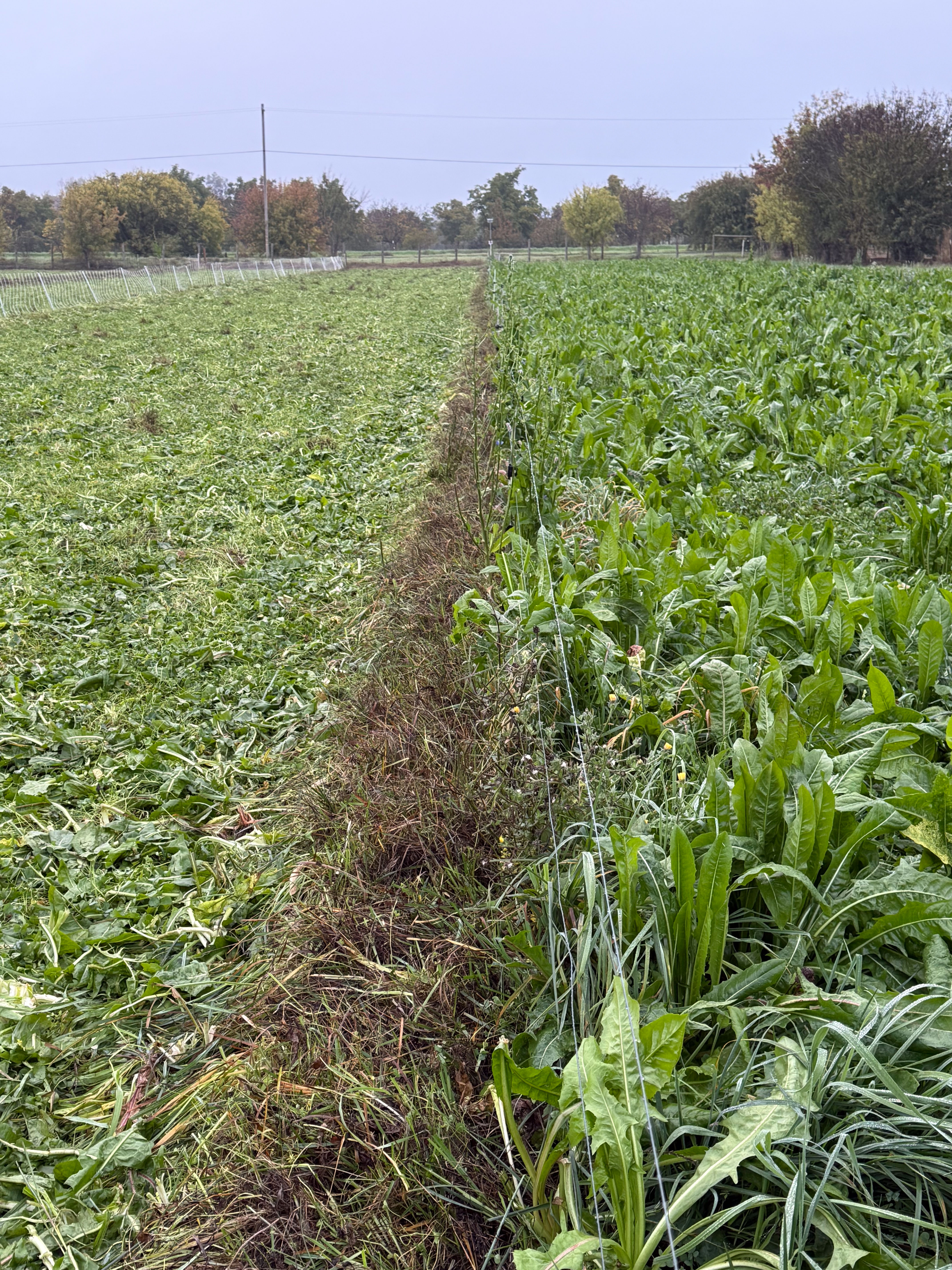
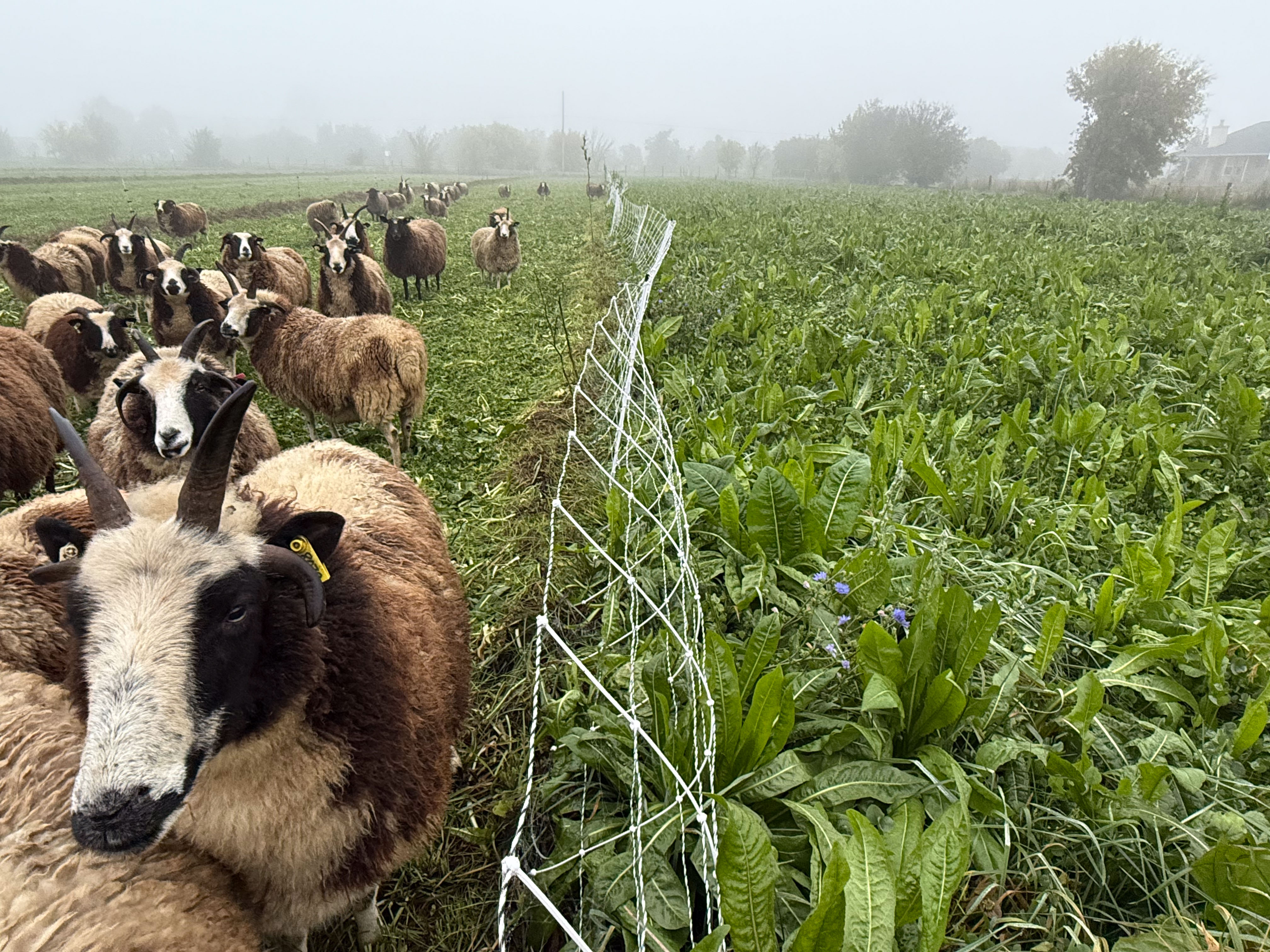
It seems that two days is about right for each of these 30-foot strips. Notice in this photo and the previous one how well the sheep eat right to the edges. The fences are on the checks, the raised strips that channel the irrigation water down the pasture. I think they eat those closer because they aren’t trampled like the middle of the paddock.
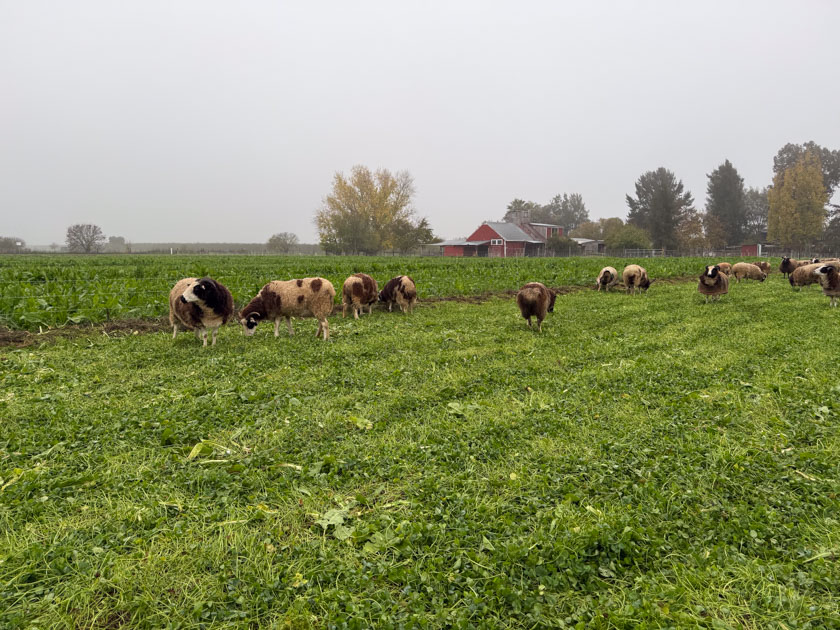
This is another view of that paddock.
I moved the net fencing this morning and this is Paddock 16. .
Some of the chicory has red in the leaves and some does not.
We’re still in the gray gloom of drizzly fog, but we accomplished some outdoor tasks that make me feel as through I accomplished something.
These photos were taken on Wednesday, and on Monday I had moved the sheep from the northwest paddocks to the southeast along the road. This is Paddock 20-21 (numbers assigned to indicate the irrigation valves and checks). I had just fenced off the hedgerow we planted two weeks ago (blog post).
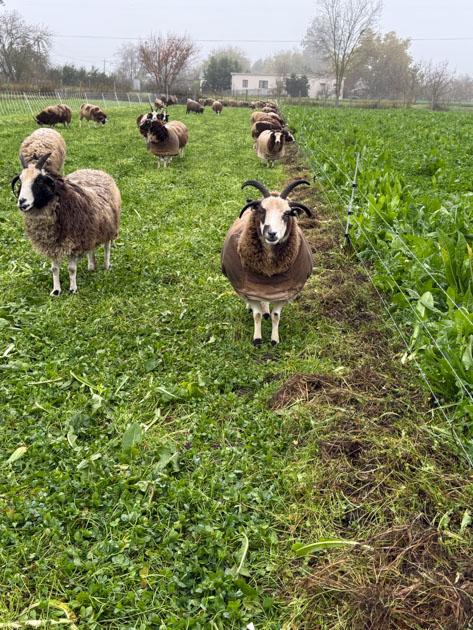
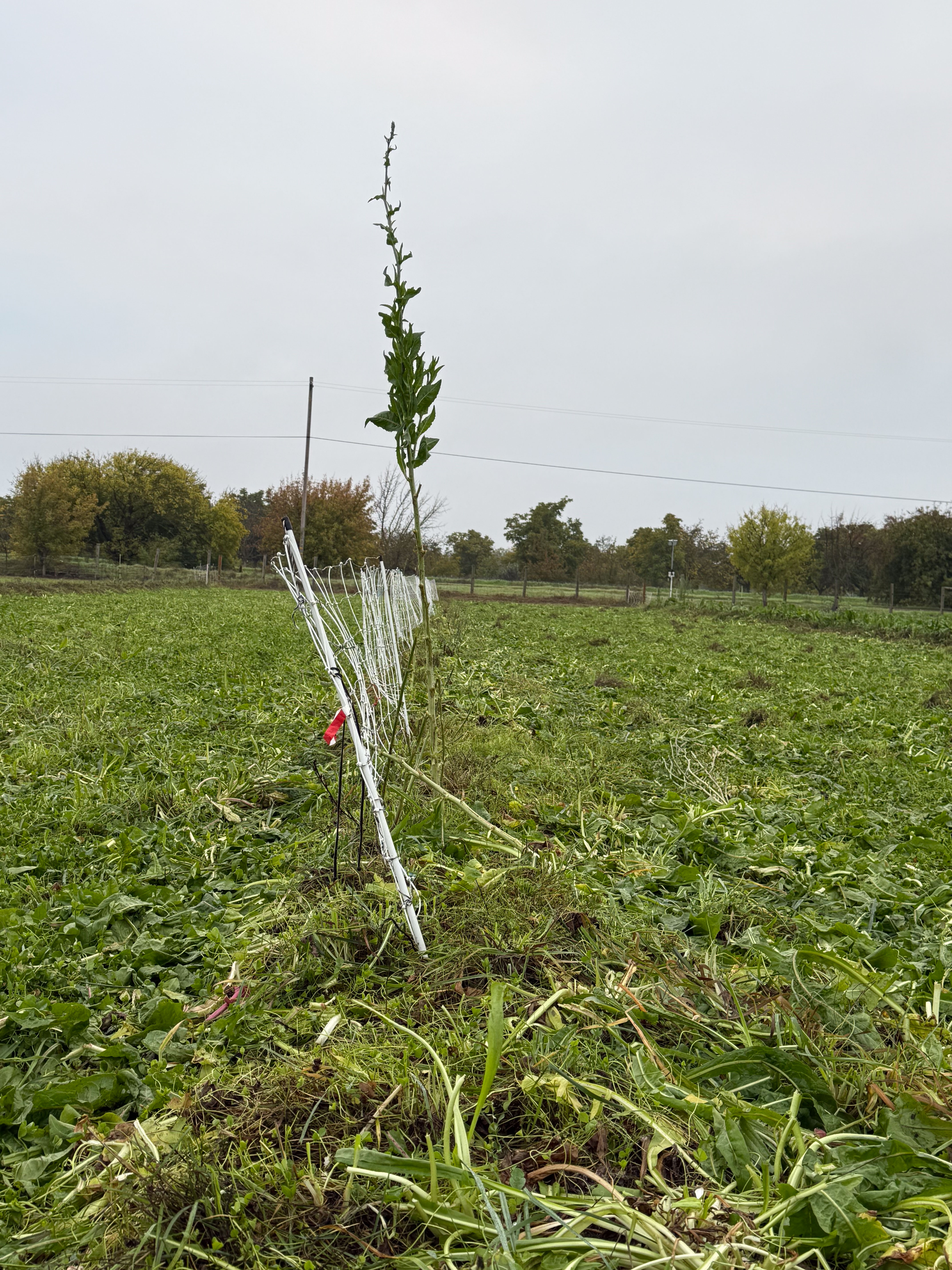
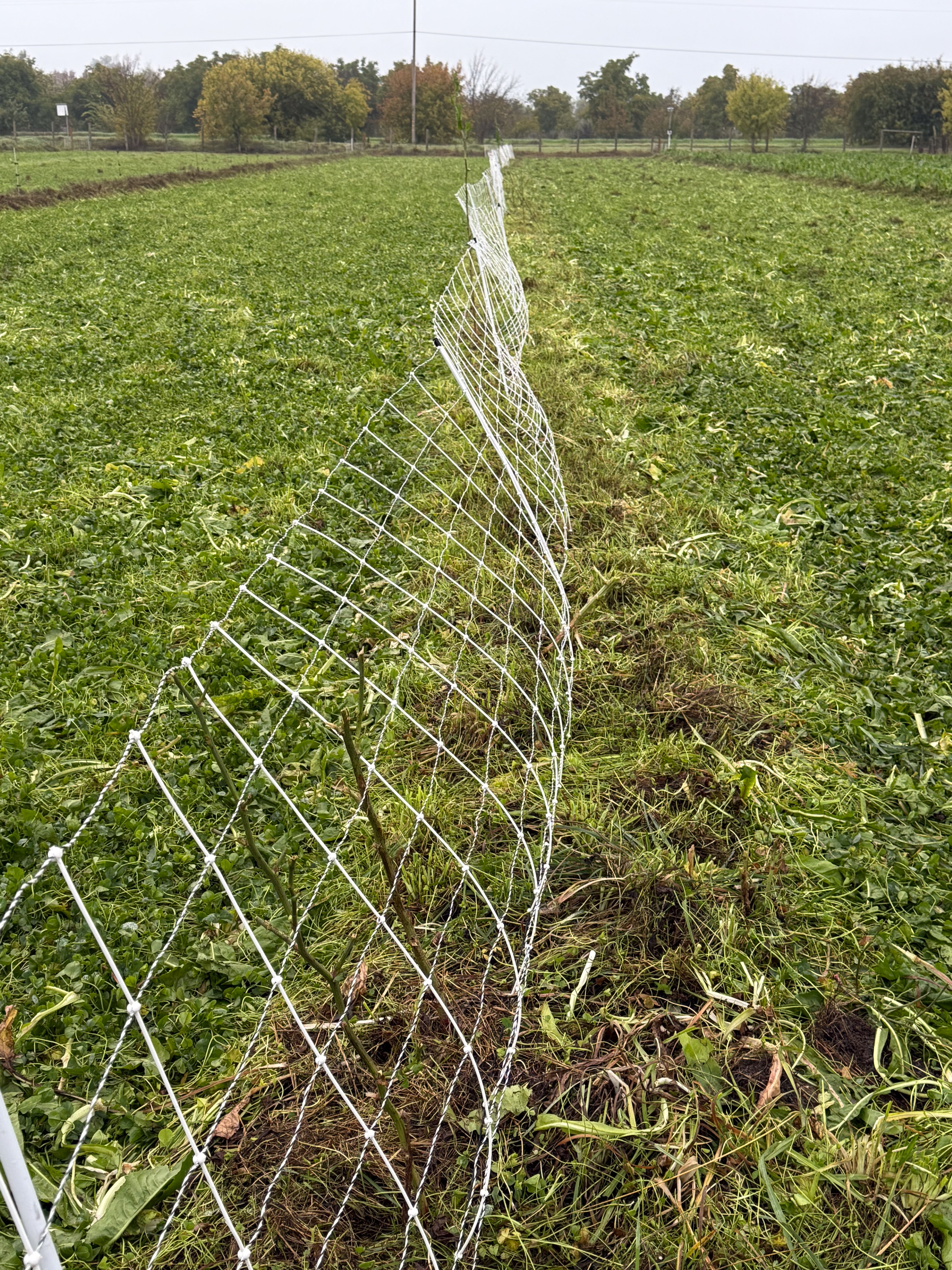
This that same fence but from the south. You might notice that it looks as though the fence is leaning the same direction but this is the opposite view. I have developed the habit of leaning my net fence away from the field the sheep will be in. It is rare that a sheep gets tangled in the net fence, but if that happens there is often a bad outcome. I think it is less likely for those upright horns to snag the fence and cause the sheep to panic if the fence is tipped slightly away when the sheep may be grazing close to the fence, as in a field with this much growth. (The previous photo shows how closely the sheep were grazing to the fence on the other side.) It’s also more likely when the charge on the fence is on the low end, and we need to do some troubleshooting on the connections in this field. So I always tip the fence.
Harmony, one of the ewes whose coat was changed recently (last post).
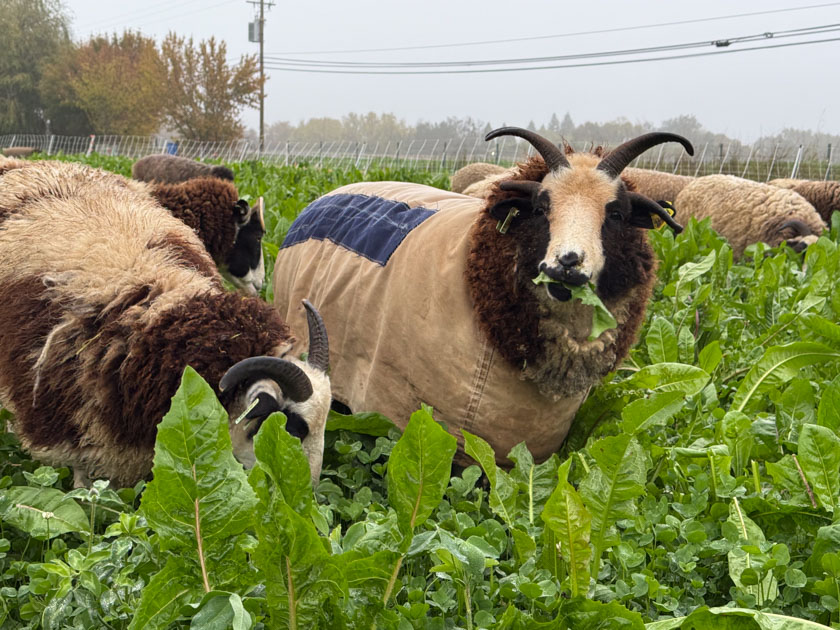
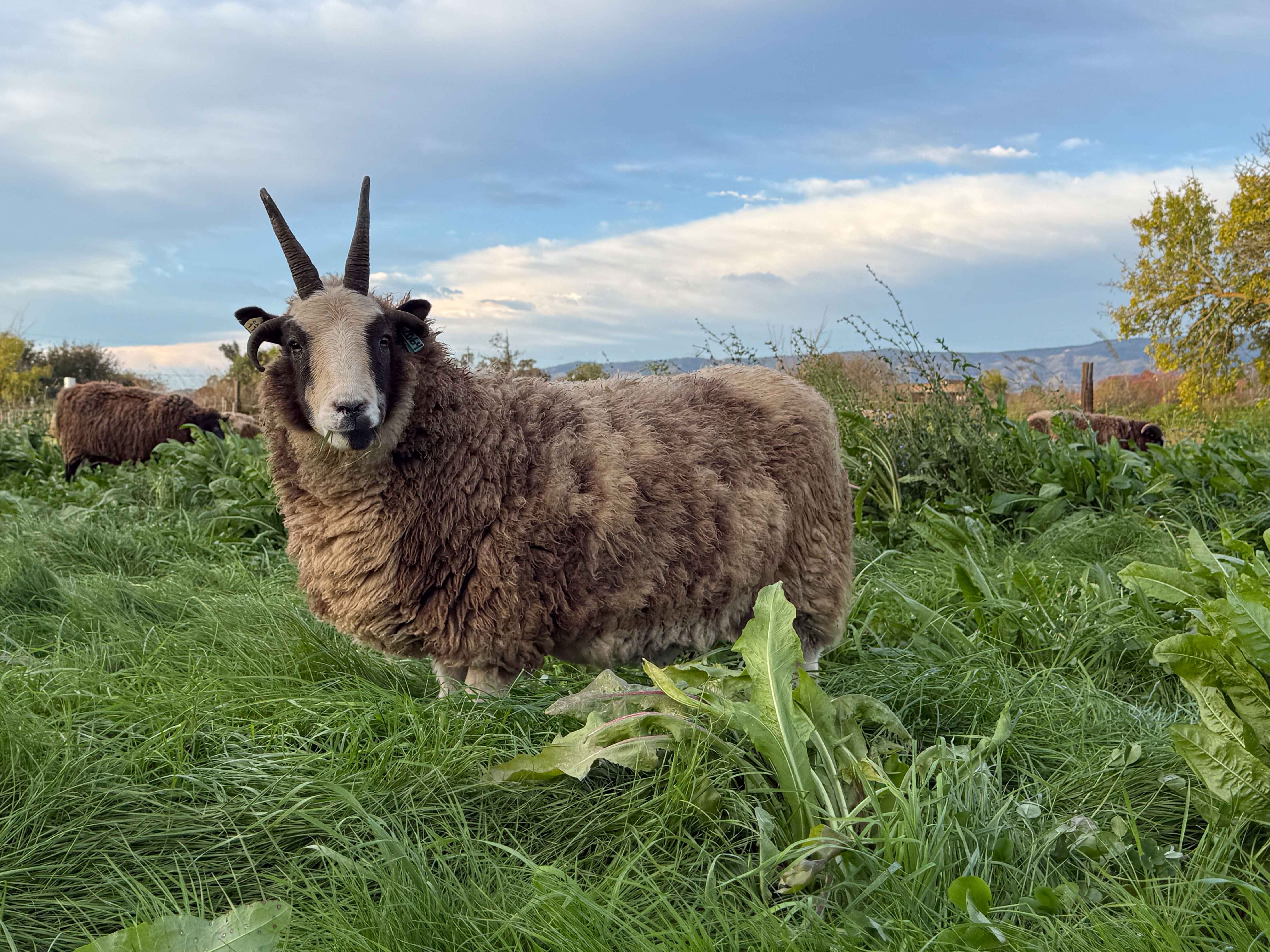
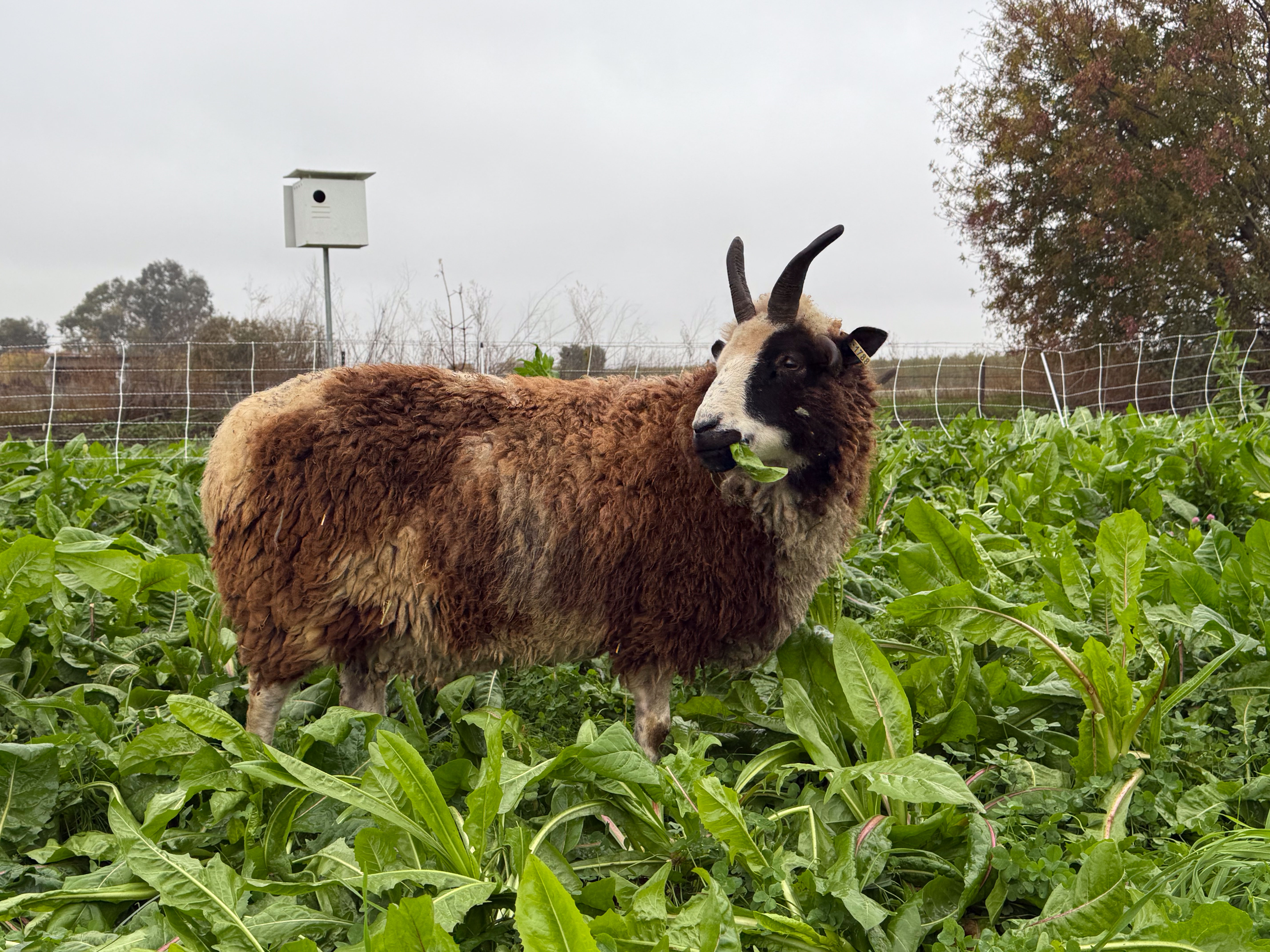
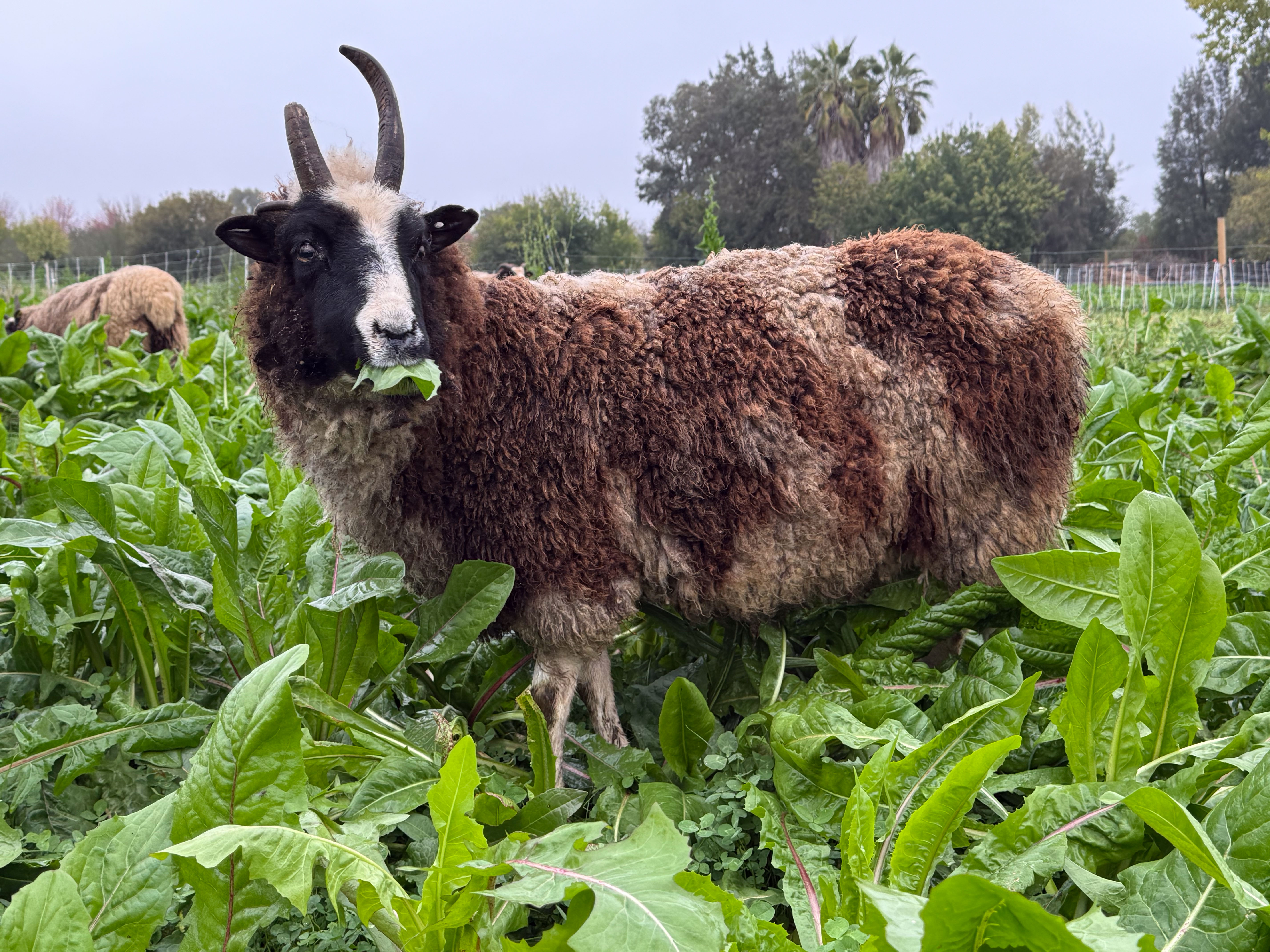
You all know Jade, the oldest sheep here, and a big pet. The plants you’re seeing are chicory and clover.
After morning chores I was looking for the wheelbarrow to use in the later project of working on the hedgerow. It was near the shop where I had been raking leaves, and I thought that, since it was here. I should rake up fallen lemons before I took the wheelbarrow away.
This tree has been here since we moved to this property in1999. I don’t know anything about growing citrus, but I think the tree may have been a combination of a few different citrus on a common rootstock. Maybe it’s always been just one variety, but I got confused with the different looks that seem to show up at other seasons. In any case, I was paying attention this month when we had loads of fruit on the ground. They sure looked like lemons, but were nothing I wanted to use. Lemons are not supposed to be sweet but I would describe these lemons as nasty. You can see a lot of fruit on the tree now, but it is not nearly ripe, and I know those are oranges. I just looked up lemon rootstock for orange trees and found this video about pruning out those rootstock suckers, which in this case had grown taller than the tree. I was right. The branches that had started as suckers but we hadn’t trimmed were taller than the tree. Do you see that empty spot on top and the one on the right? That is where branches had reached through the rest of the tree and were producing fruit. It was quite a job to cut those away as the branches had grown through other branches and they are very thorny. It took me a couple of hours to finish that job and by then it was about time for Raquel to come.
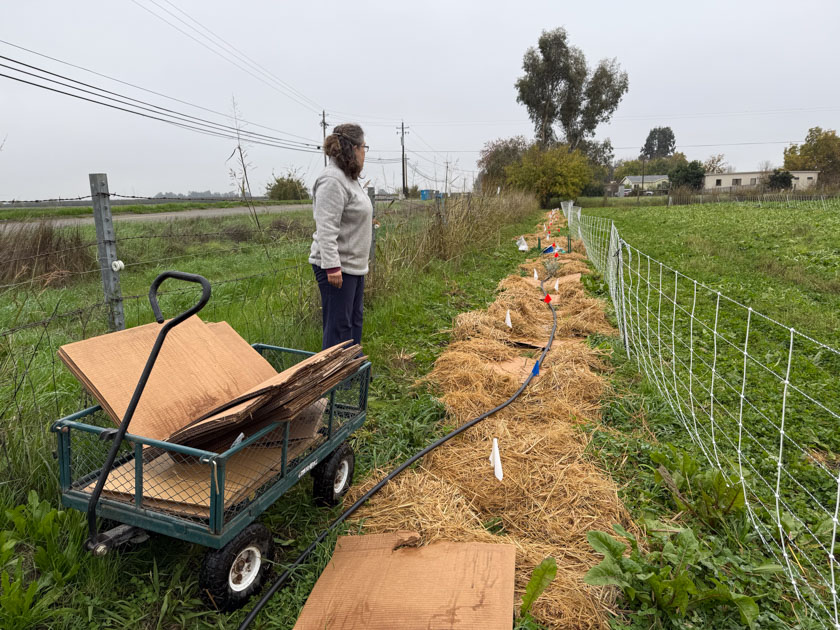
Raquel is a Farm Club member who went out of her way to help figure out how to order what was needed to install a drip system to irrigate our newly planted hedgerow. I had also picked up more cardboard from a friend so we could continue the mulching that we started. We rolled out 250′ of 3/4″ tubing and secured it with u-shaped wires.
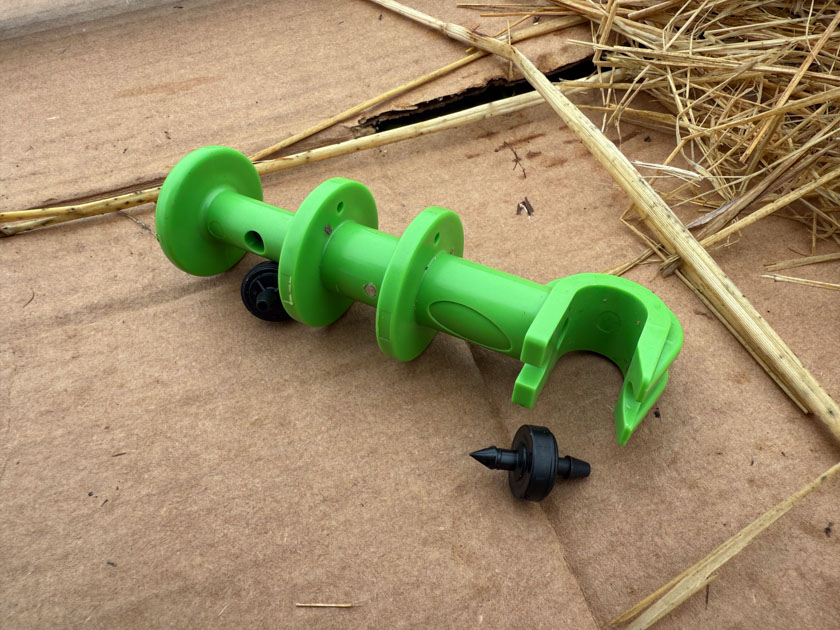
This is the tool that is used to poke holes at the appropriate places in the tube and then insert the emitters.
We had cardboard and straw mulch around the plants, but with the new cardboard we were able to cover space between the plants.
We finished the job…sort of. We used all the 250′ I had ordered. Someone (that would be me) had not measured correctly–a fact which I realized when I installed the new electric net fence for this strip. I thought we had a 250′ hedgerow, but it turns out I was 40′ short of fence. So we knew when we started on this yesterday we would run out of the main tube. We wanted to get as much done as we could though. I have ordered more tubing and all we have to do is connect it to this one and install more emitters and we’ll be good to go. It’s so damp and drizzly now that I don’t have to worry about more water on these plants right away.
The title is significant. I don’t know that we have ever grazed into December. There wasn’t enough feed and the ground was too soggy. Now we have lots of green feed and need to keep the sheep eating it. The downside is that the rain seems to have stopped and we will need more.
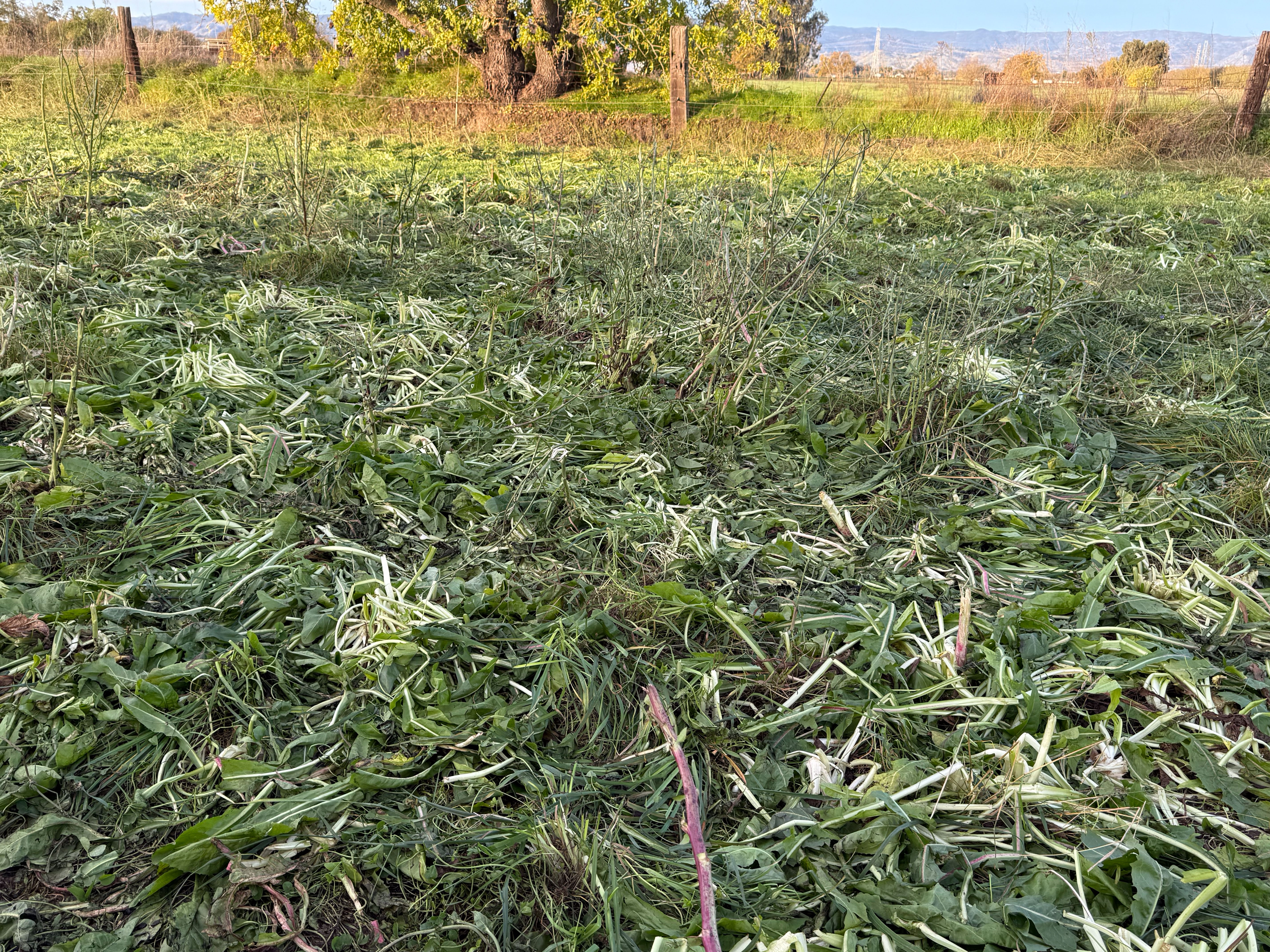
This is Paddock #1 (west property line) after two days of grazing.
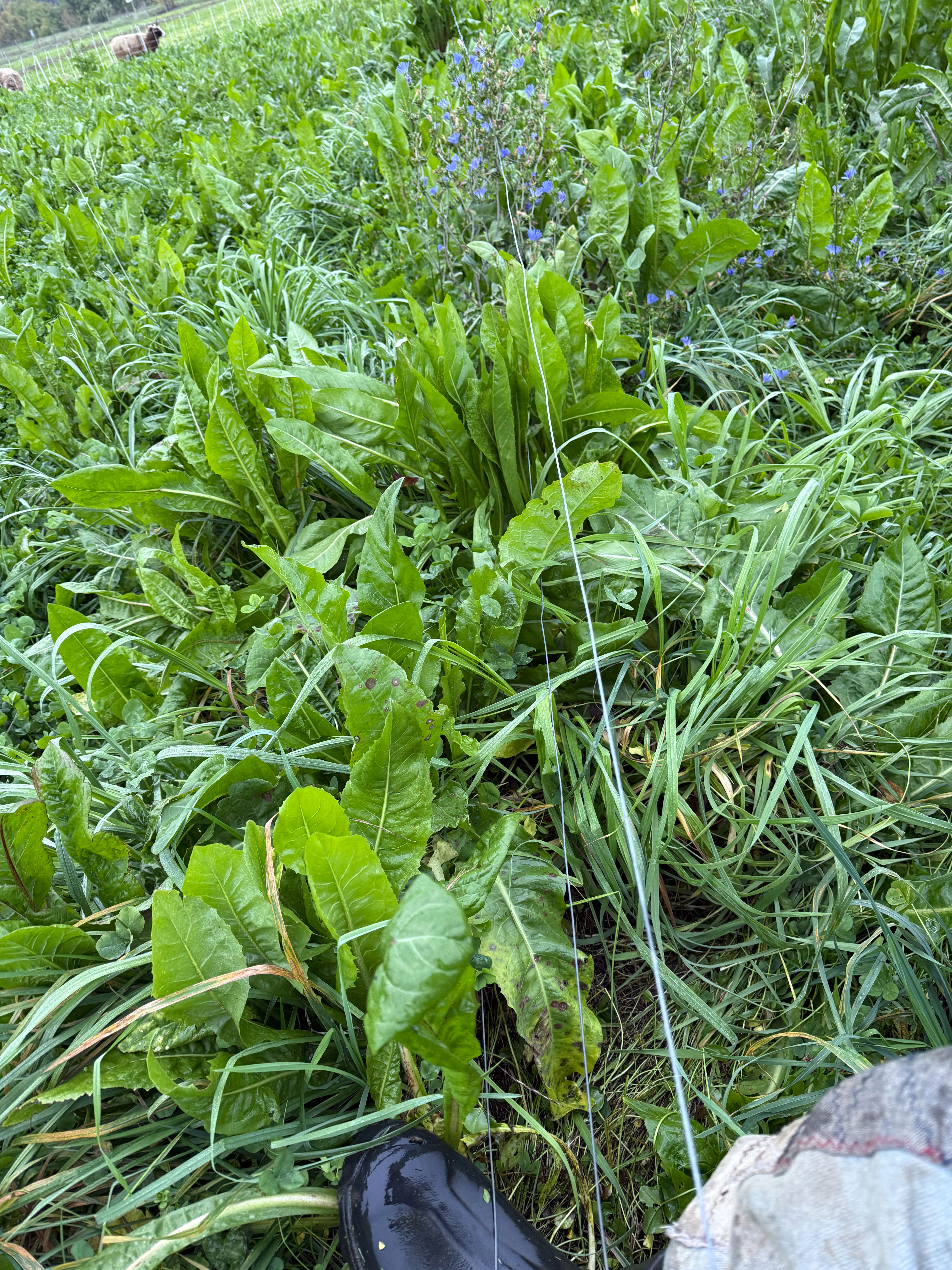
This is Paddock #1 North, just across that fence. Notice that my boot is under the bottom wire, but it’s pretty well buried in foliage. I walked along this stretch of fence to clear that bottom wire.
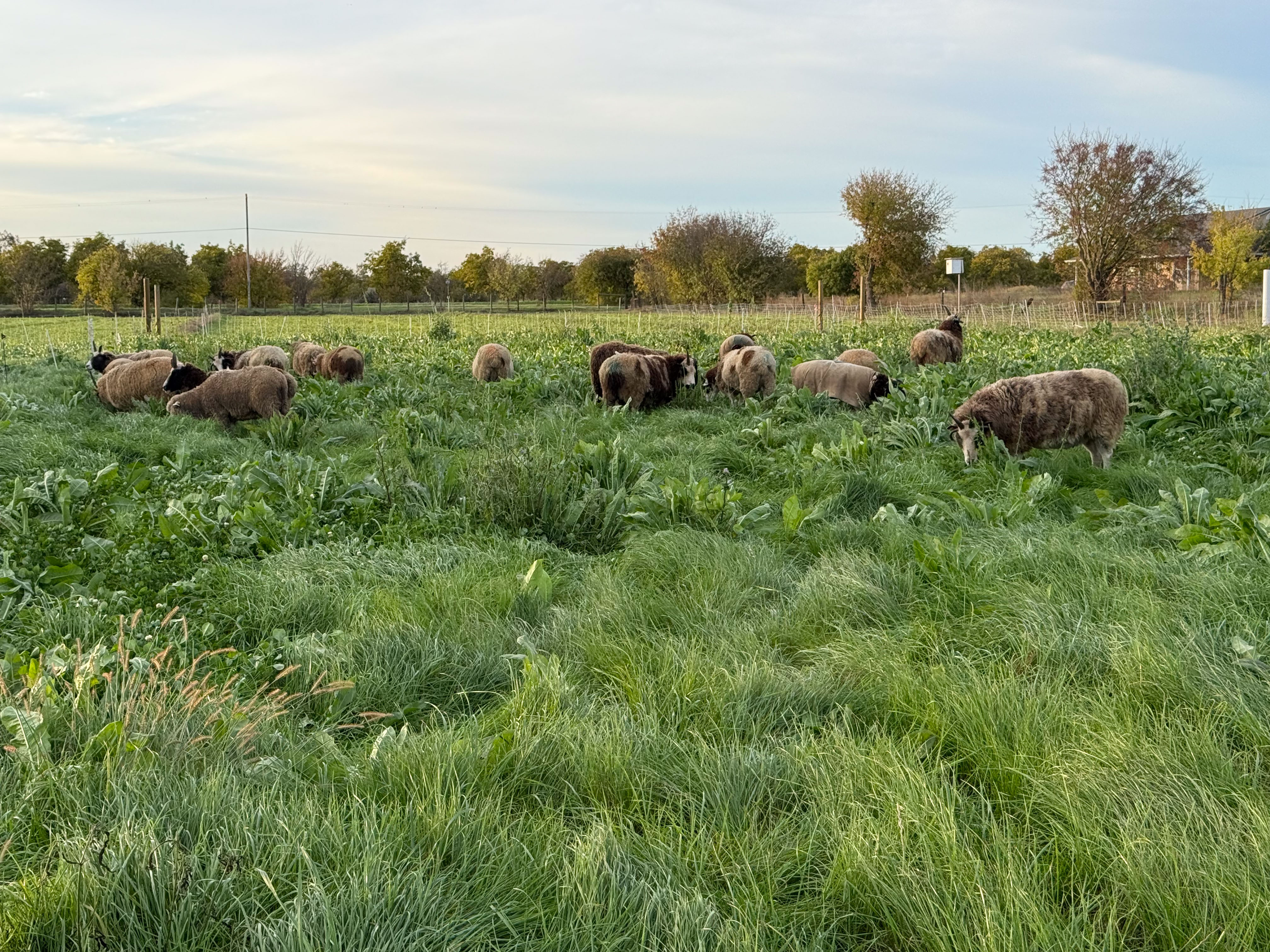
Happy sheep.
More happy sheep. The last time we grazed this paddock was three months ago on September 1.
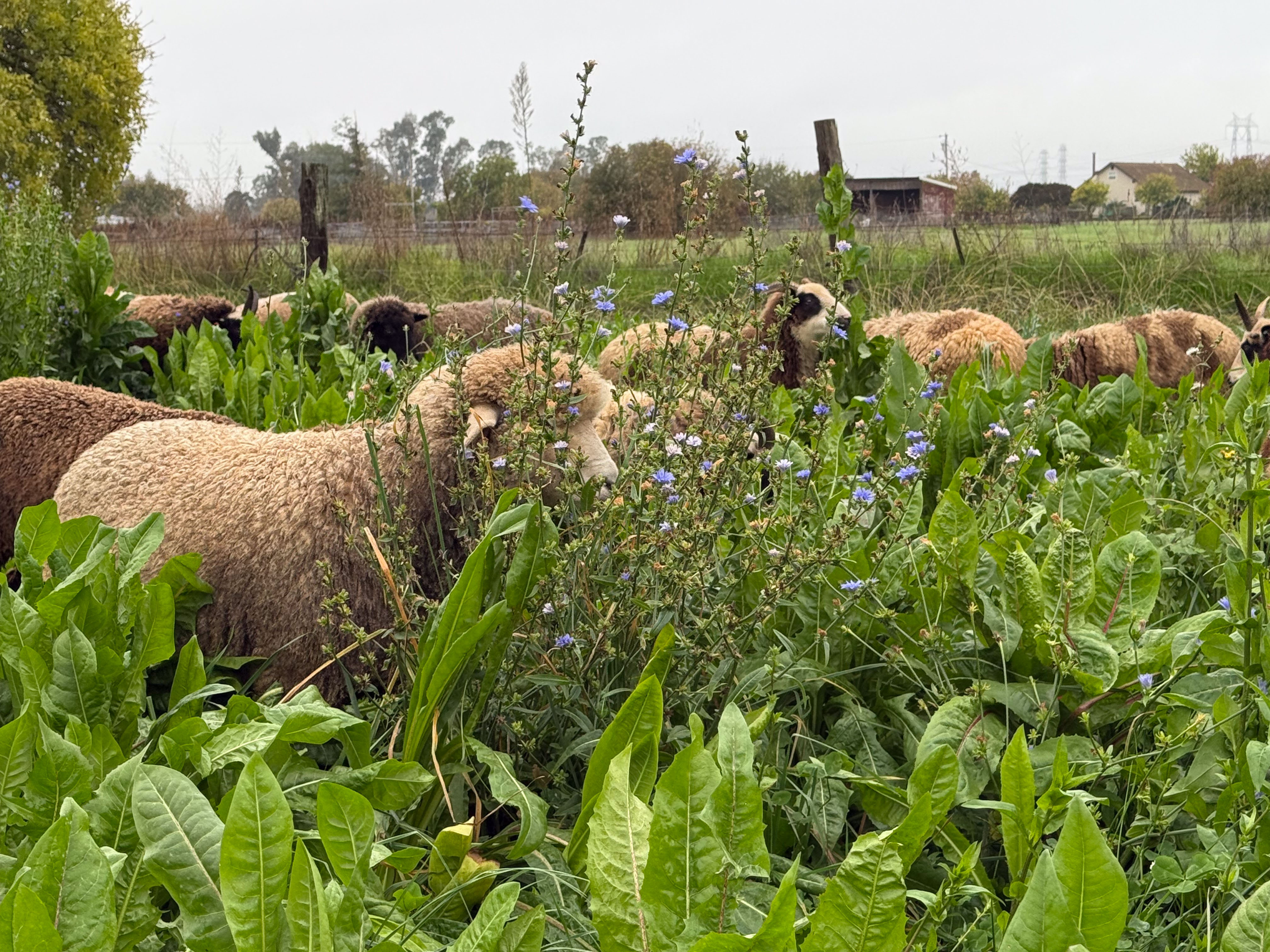
The big leafy plant is chicory and so is the one with blue flowers. It took me a long time to accept that they are the same plant.
After looking it up online I found: “Forage Chicory: Perennial broadleaf. Up to 18” (flower stalks up to 6′). Tap-rooted broadleaf perennial with bright blue flowers suited to well-drained moderately acidic soils. As annual or perennial forage: well-managed stands may persist 5 years or longer, but also valuable in annual stands for pasture or green chop. Very high digestibility and protein levels up to 50% higher than alfalfa. Digestibility is reduced if plants are allowed to bolt, but the flowers are very attractive! Research shows reduced parasite loads in animals fed or pastured on chicory. “
This photo is after grazing Paddock 1N for three days. A lot is trampled, but they were still eating out here this morning.
I opened the fence to let them into the next paddock. I have video and I just spent time on iMovie after not using it for a long time. Let’s see if I can share this on YouTube. Here is the link.
Back to regular blogging. More happy sheep.
This view is interesting to me because this is the area where ryegrass completely overwhelmed the clover last spring. This post is one of several I wrote about that situation. If you pursue the Grazing posts you’ll see the whole story. This is good feed here, but it is patchy, more so than in the rest of the paddocks.
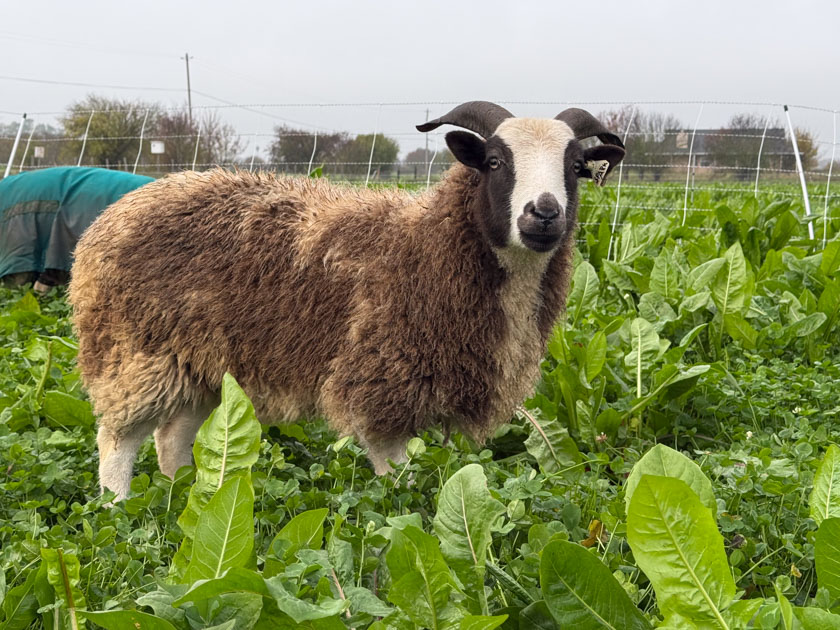
This ewe, Meridian Pecan, isn’t bothered by any of those details. She’s happy to have fresh green feed.
We’re almost to the last check in the south pasture. Well, we are at it but that is today and this blog post is about yesterday.
This is looking south and Paddock 2 on the right. That is the one the sheep were just grazing for two days, after grazing Paddock 3 (left) for two days. You can see how this looked two days ago here.
Anther view of that same fence line.
Moving west, this is the fenceline between #3 and #2. I had to move that net fence from the division between #3 and 4 to the division between #2 and 1.
The fence line between #’s 2 and 1, neither yet grazed
The sheep were out when I went to the barn yesterday morning. The paddocks are numbered from west to east, 1 to 21. Every other check has a permanent 3-wire fence, visible in this photo on the left. In the summer I grazed two at a time and 4 days seemed about right. After we got measurable rain I noticed significant trailing down the border check between the two paddocks they were grazing. The check is a raised strip running north to south that guides the water when we irrigate. I thought I’d better put a fence along that check so that they wouldn’t impact it as much. So that’s the way I’ve been grazing for the last few weeks. When Farm Club helped to measured net fences to make sure I had the correct fences where I needed them (blog post here) I had left 3 lengths of e-net that we measured to be the correct length for just this need. You can see the net fence on the right of this photo.
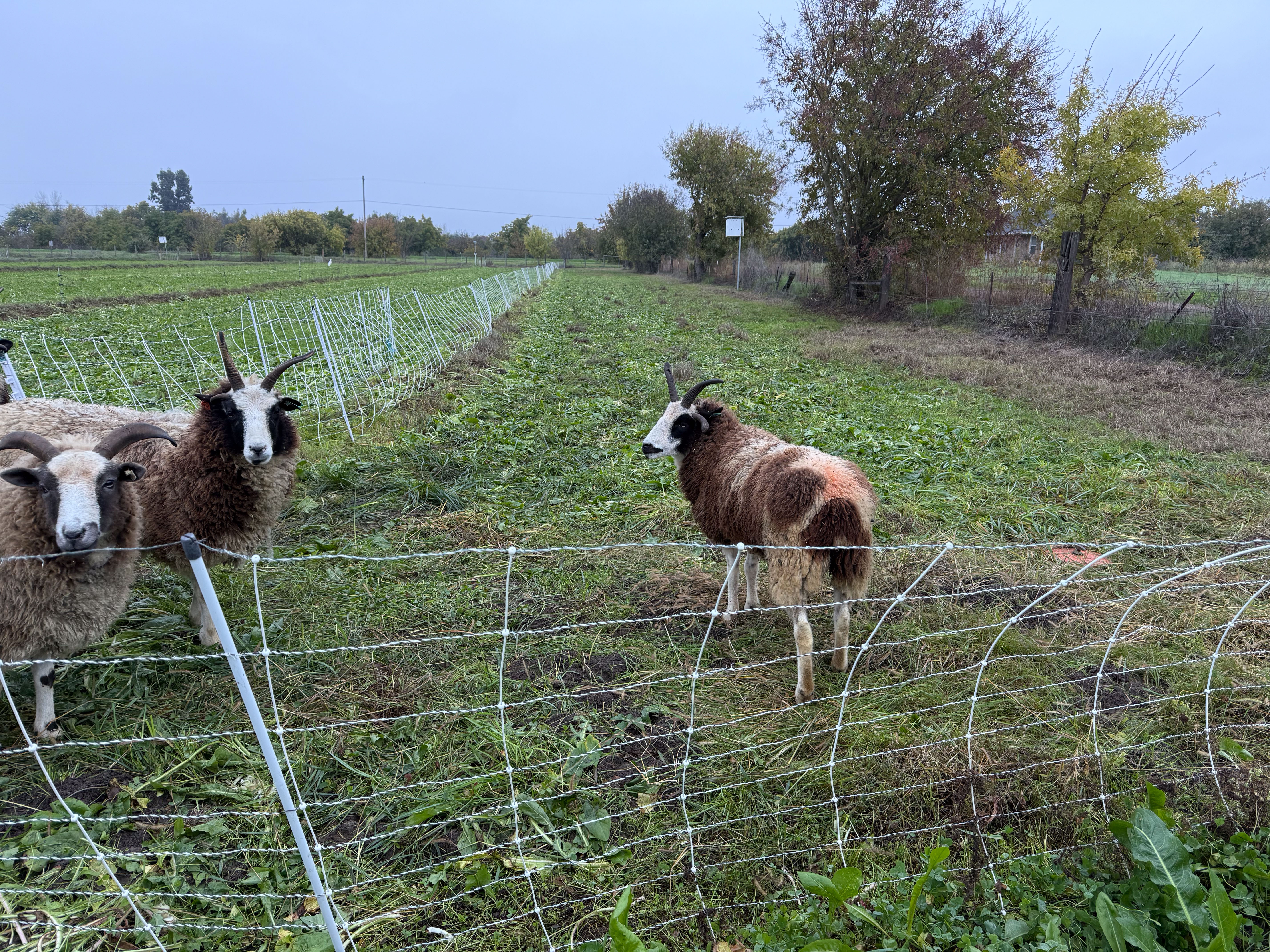
The sheep grazed this paddock (#4) for two days. This is the third morning and they need to move to #3. The fence is on the border check and you can see how they have grazed right up to it. The fence is purposely tipped away from the grazed paddock because I think the 4-horned sheep are less likely to get horns caught when they graze near the fence.
The sheep were anxious to get to fresh feed.
I was able to move the fence that was blocking access to the next paddock and they all came around the end.
This is the view before I reset the net fence. I find it interesting to see how the sheep ate the leaves as far as they could reach on the chicory. By the way, the leafy plant that looks like we’re growing a crop of lettuce or chard is chicory. That was one of the three forbs in the seed mix we planted last fall. It didn’t grow as much as the clover until later in the summer, but it is sure evident now.
Another view of the fence before I moved it, and more chicory stalks.
The sheep are happy on this new paddock. This is quite a contrast from the one grazed for only two days.
View to the north after re-setting most of the net fence.
I woke up at 5 and thought of things that need to be done. No point in staying in bed.
Rewrite minutes from Tuesday evening’s Artery Board meeting. ✓ Make one more 15′ length of e-net fence so I can switch sheep to another paddock. ✓ Walk across the road with Ginny. ✓ Do a fresh-leaf indigo dye bath to over dye the weld-dyed yellow yarn. ✓ Here are the photos to accompany that check list:
There are 3-wire electric fences every 60 feet in the south pasture. These are charged by attaching to a hot wire at the south border fence. I need to connect a 15′ net fence from that hot wire to these north-south fences. My goal was to have all electric net fences for blocking off the 60′ spaces and the 15′ connection fences in place and not have to move those lengths of fence every time I switch to a new paddock. I have finally accomplished that goal with this morning’s 15′ fence! (I think–maybe I need one more.)
Another accomplishment is to organize and label what’s left. There are three fences that will make up one long north-south fence if I decide to split the 60′ paddock in half lengthwise. The other two bags are leftover but still useable portions of net fence.
Time for a walk Across the Road. This is for Ginny’s mental benefit and for mine. If I go in the morning then all day I can remember that I got at least a little exercise.
This tractor was parked near the hayfield. That tire is taller than I am!
A view of the new paddock from the main road coming back from our walk.
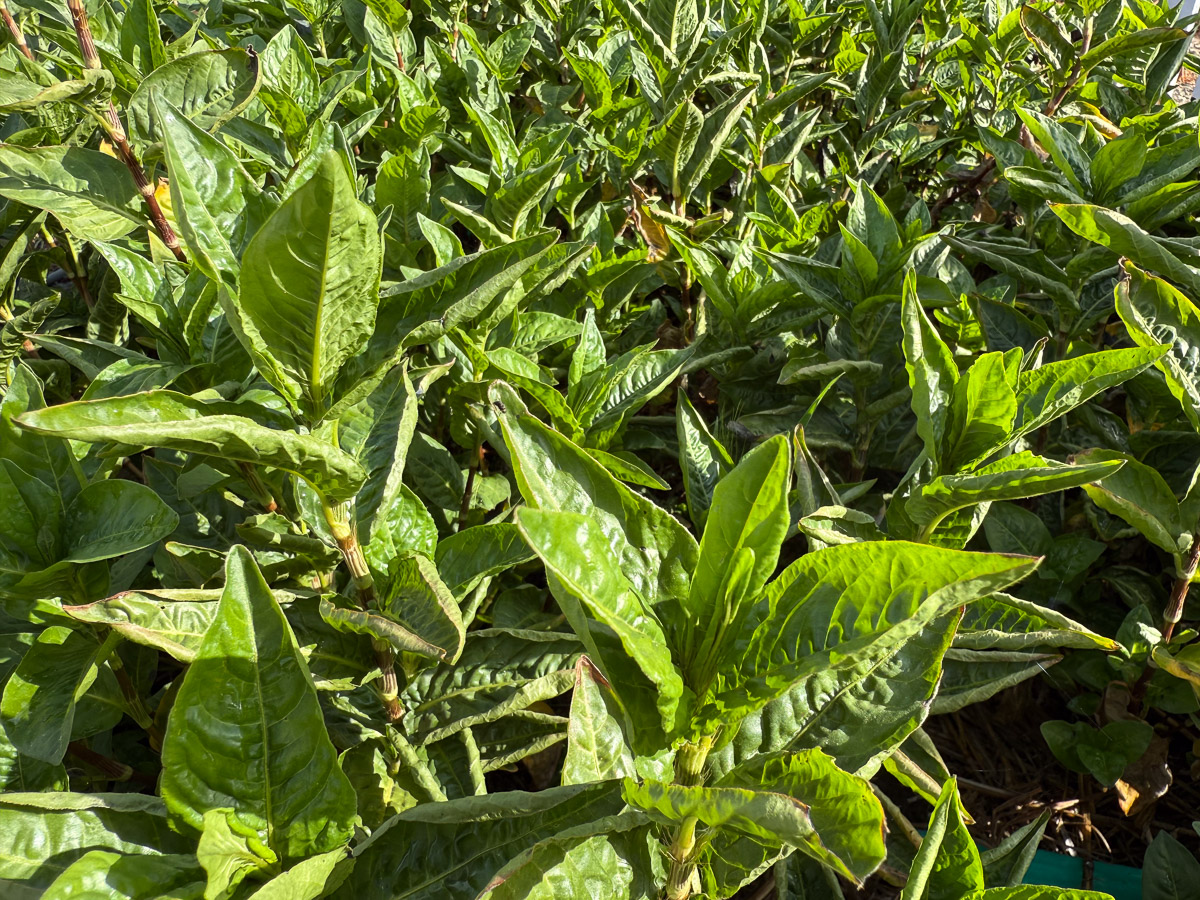
Indigo in the garden.
I harvested about a pound of leaves to overdye the yellow yarn I dyed with weld the day before. I dye with fresh leaves using ice water and a blender. After that dye bath was in place I could move on to something else.
What is the plan for the afternoon? Make more horn buttons ✓ Thread the hemp warp that is on one of the looms. ✓ Photograph all the unfinished pieces for yesterday’s blog post. ✓
I cut more buttons. The next step is to drill holes and then sand. I found some that already had holes but I had not sanded them. Those are in the three cups at the bottom. I keep track of buttons that will match by keeping all from one horn together through the process. I sanded all those that already had holes in them, but still need to drill the others.
While I was working in the barn on buttons we had a hay delivery. This is 88 bales that need to go in the barn.
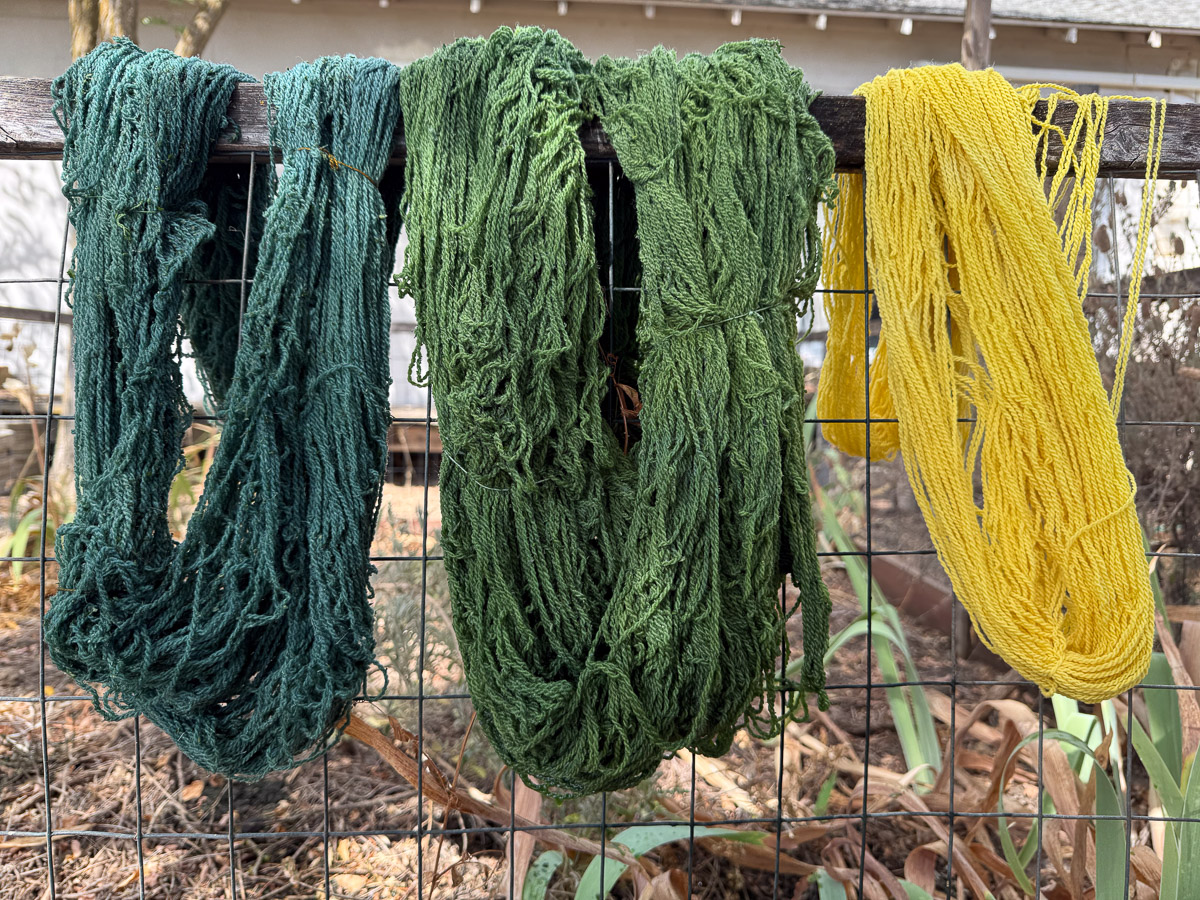
I took the indigo-dyed yarn out of the bucket and hung it up to drip. When I’m finished here I’ll cut apart the bundled skeins so they can dry better. The yellow one is what the green ones looked like before putting in the indigo. The blue yarn was white yarn in the same bucket.
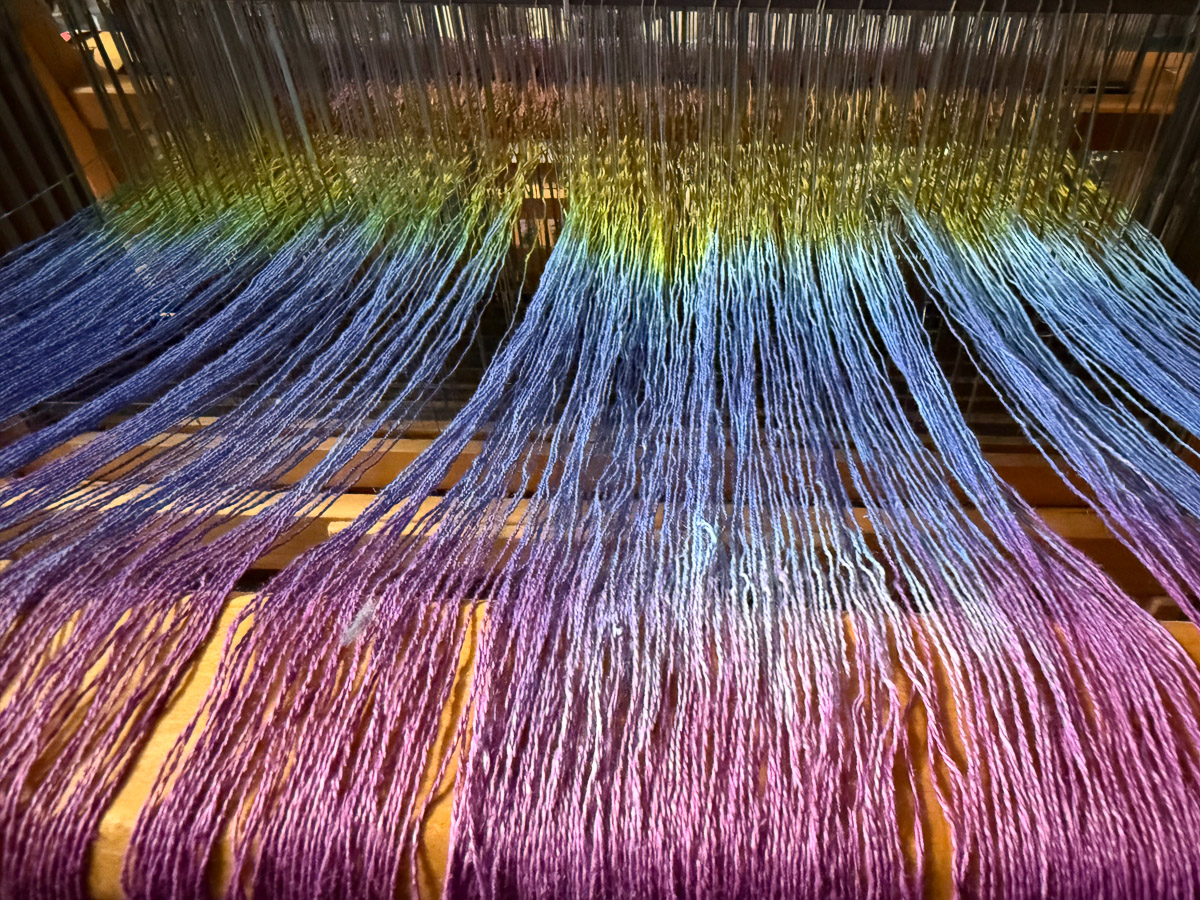
I went to one of the looms in the shop to thread my space-dyed hemp yarn and finished about chore time. Now it’s ready to weave. That is on today’s list, along with sanding those buttons.
When I wrote a newsletter yesterday I referred to the series of blog posts about the pasture that I wrote over the last year. You can find any of these by searching Pasture and Irrigation Renovation (14 posts) and Grazing and Irrigation (7 posts).
Tonight’s post will follow up on this Grazing and Irrigation post (#7) written in June about May grazing. The pasture looks much different now than it did then.
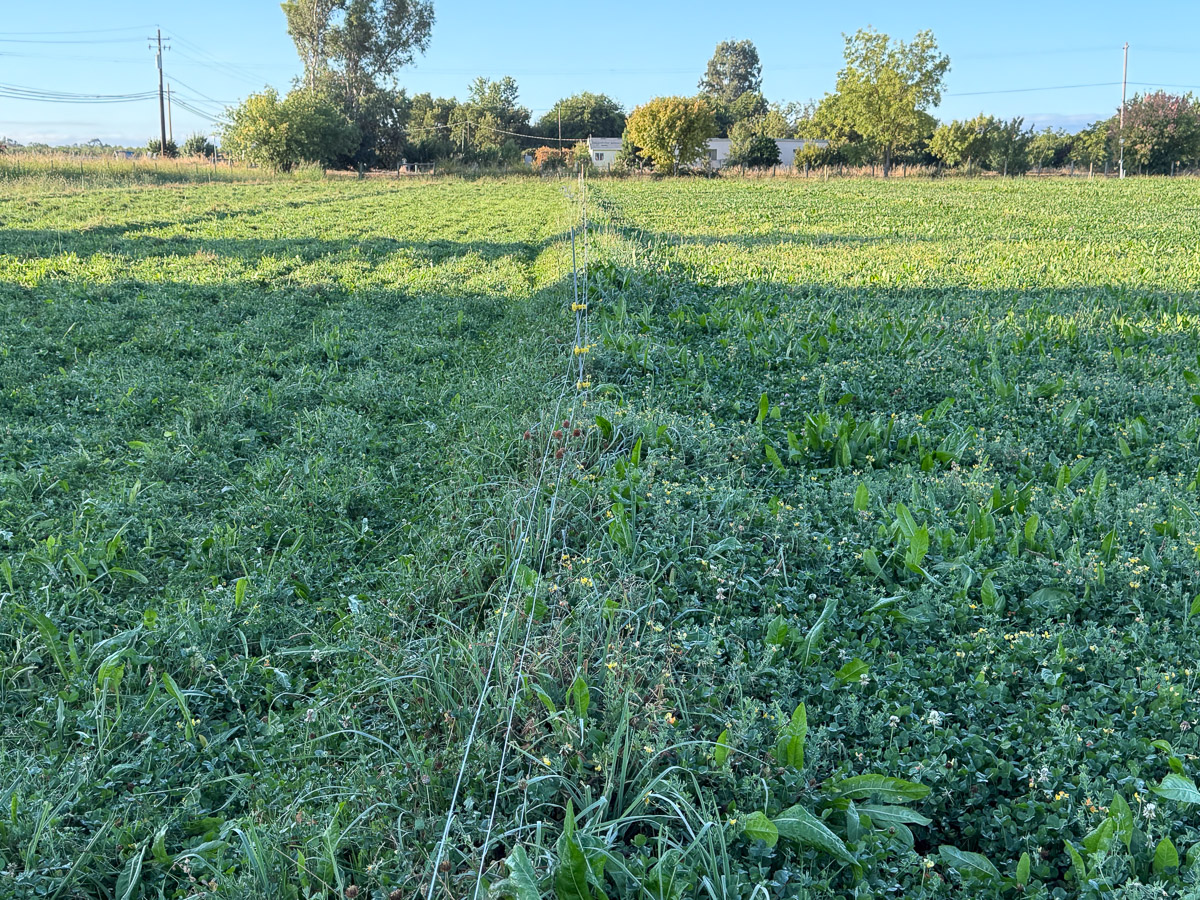
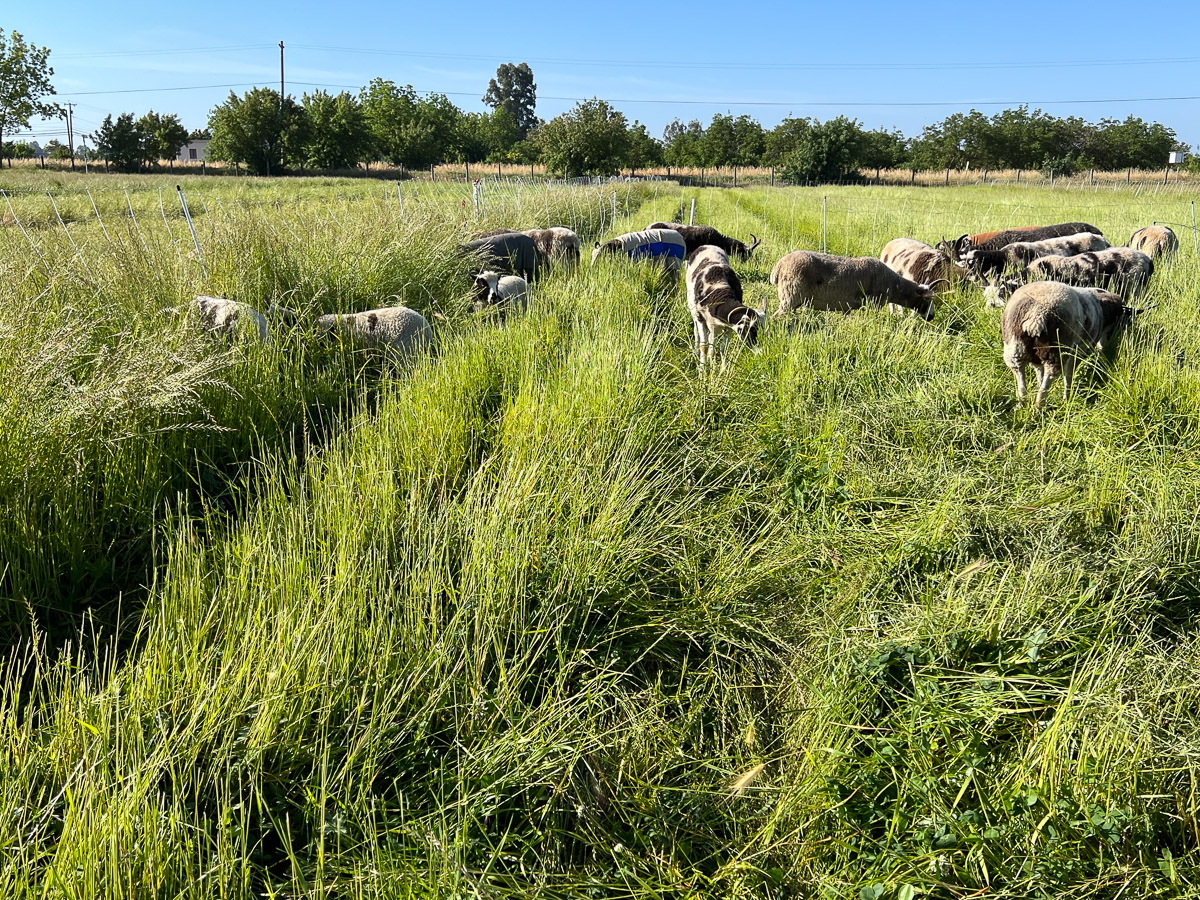
The ryegrass is gone and you see mostly clover.
Next most prominent is birdsfoot trefoil, and more recently the chicory has taken a foothold. Those are the three broadleaf plants that were in our seed mixture. All of the paddocks in the south pasture look like this now. Back in the spring we started topping the ryegrass with the mower before grazing and mowed again after grazing. This prevented the ryegrass from being flattened over the clover and becoming a mulch layer.
The smaller field on the north is different. We didn’t graze early enough and this is where the annual ryegrass had such a head start on the clover and overwhelmed it in places. I took this photo while irrigating two weeks ago. While the pasture was flooded, some of the ryegrass “mulch” floated and I was able to rake a lot of it into piles thinking that I’d be able to move it out with the tractor.
A few days later I realized that I didn’t want to wait until the field dried out enough to use the tractor. I was ready to graze again but the lane was still too muddy. I realized that I could use all that straw to cover up the mud. So I used the wheelbarrow.
I used at least a dozen big loads of ryegrass straw to fill in the lane.
This is Sparky in that north field. Hopefully over the course of winter these bare spots will fill in now the they aren’t covered with mulch.
I’ll start with a random photo. This is the newest animal here, if he/she (?) is still here. Every morning we feed the two Garage Cats in, well, the garage. For a couple of weeks we have seen a third cat off and on. It (haven’t identified gender yet) has started to come in while I’m still there if I don’t make any fast moves. We don’t know where it came from–a neighboring property or dumped. The local newspaper had an article this week about the overwhelming number of dogs and cats that are abandoned. So we’ll never know about this one. I put out a live trap a few days ago but one of the other cats went in for the food. We’re going to be gone for a week so this is not the time to catch this kitten anyway. I did not see it the last two days so I don’t know if it is gone or just being more cautious. I’ve name it Smudge.
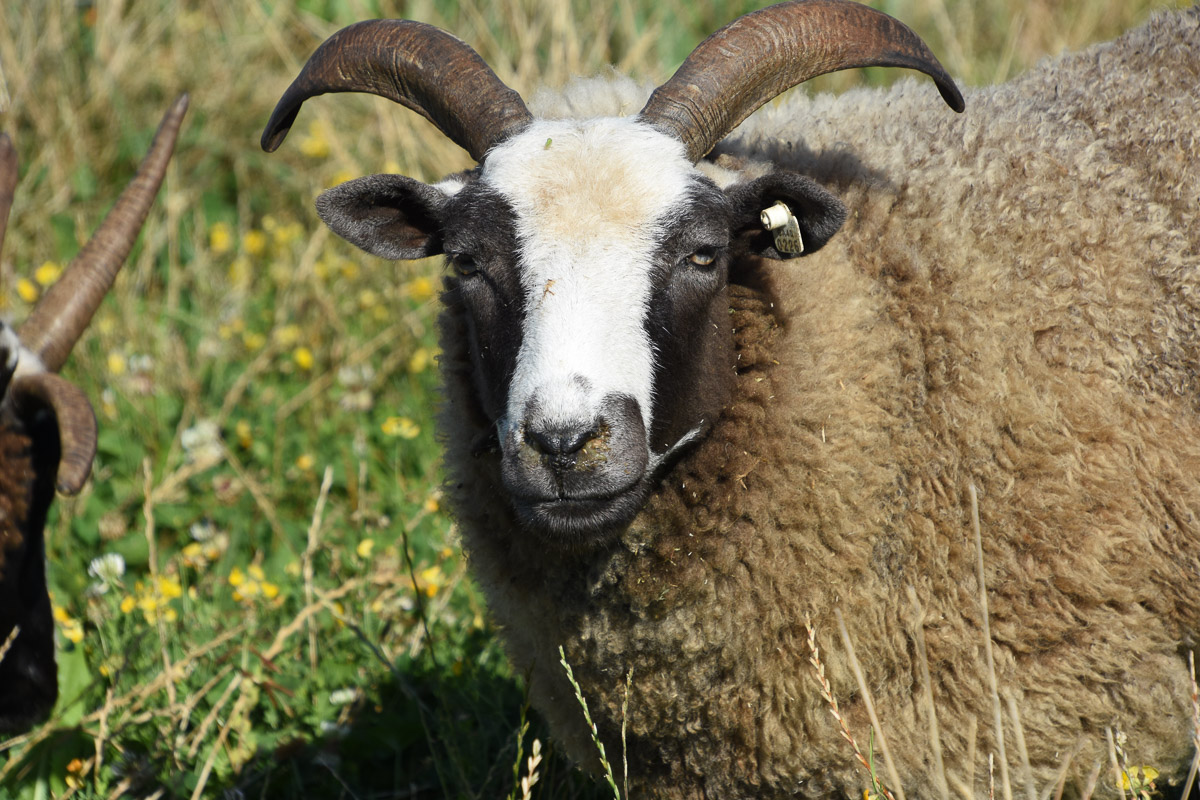
Back to sheep things. This is Patchwork Amara. You can glimpse the beautiful clover and trefoil in the background. This is what the sheep are grazing and that’s what this post is about.
Farm Club members came Saturday to help with a fencing project. We finally have all the permanent fencing back in the pasture. Dan has been working on that a bit at a time while trying to let his knee fully recover after knee replacement in April. Since last fall I have written a lot of blog posts about the pasture renovation and irrigation improvement. Grazing properly this spring was a challenge when I had to set up electric net fence for the whole paddock. Now we have 3-wire electric fence going north-south along every other check. That’s every 60 feet. Initially I was grazing each 30 foot width separately. Now it seems to work to graze the 60 foot width for four days. I think they are grazing it evenly enough.
I still need to use the electric net fence though. The posts for the permanent fencing are about 15 feet from the south perimeter fence so that we can drive a tractor there. We use net fences to block that 15 foot gap. That net fence is also important because it is how the charge is carried from the perimeter fence to the north-south paddock fence. In the past I have moved those fences from one end to the other as we moved the sheep. Wouldn’t it be nice to have enough of the 15′ fences to have them always in place and ready to go? I also wanted one fence to span the whole north-south distance in case I wanted to split those 60′ paddocks into two for grazing when we have fewer sheep out there. Another need is 60′ fences to block off the north end of those paddocks. That’s where Farm Club comes in.
I have been putting this off (not like I’m sitting around doing nothing) and thought that it would be a good task for Farm Club. Also if Farm Club members came to do it, I wouldn’t be able to procrastinate and move it to the “deal with it later” list.
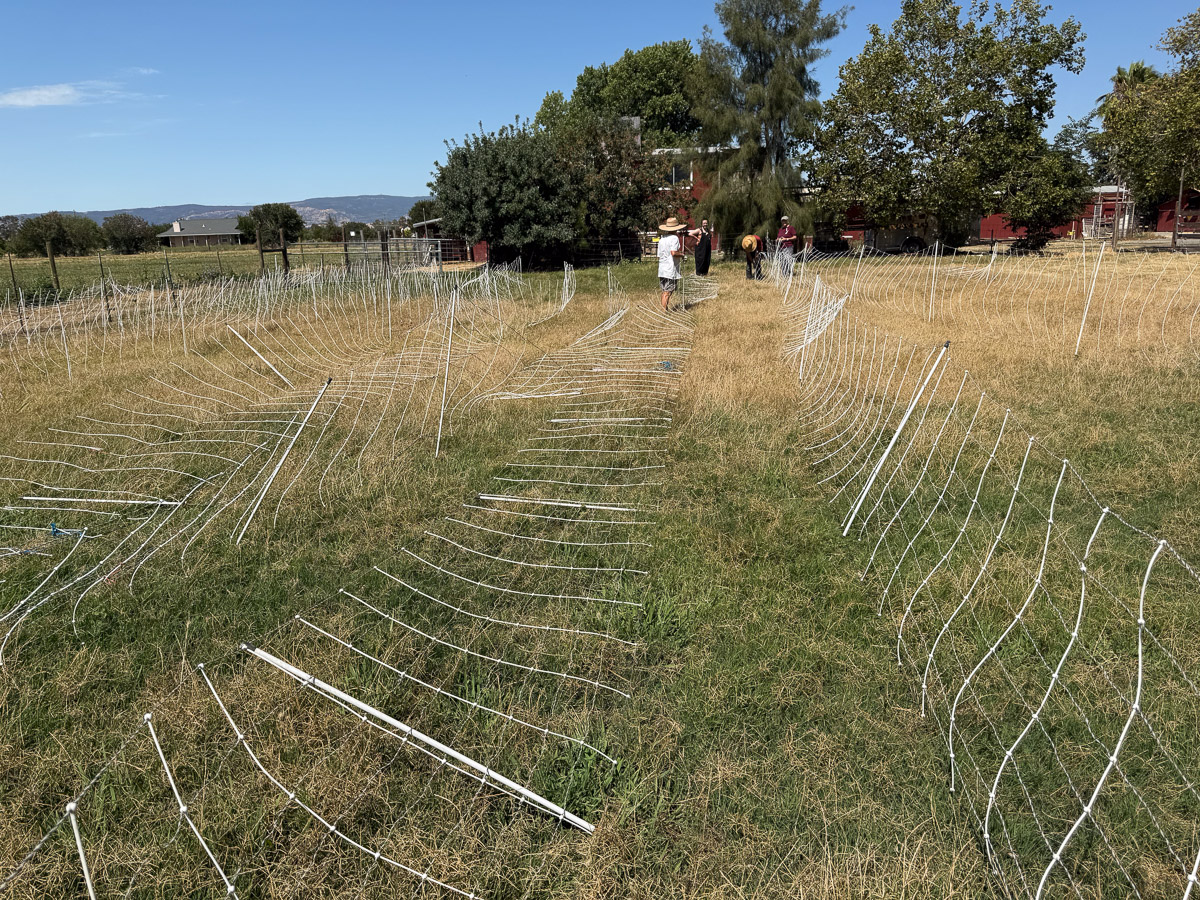
First we measured all the spaces in the pasture where I needed net fences. North-south lane fences need to be about 15 feet. The north-south fence to split the 60 foot paddock is 368 feet.
Then we gathered up all the fences that I’ve been using to create paddocks.We measured them and checked for damage.
We used bright red labels provided by Susan so that we could easily find the label. This is Rachel marking these.
Rachel made a list so we could match the needed fences with what was available. I found two 162 foot lengths and a 40+ foot length to use for the long fence I wanted. Then we started to cut the other fences and make sure the wires were attached at each end to carry the charge. I used to use 75+ foot fences to close the gaps in the old system. We could cut those into 60 and 15 foot fences or make multiple 15 foot fences, especially if there were bad spots to avoid. We did not finish the project, but made good headway. Now that all the fences are labeled we’ll have another Farm Day to finish the project. I have enough fences now so that the paddocks are set up for the week I’ll be gone and Farm Club members will be supervising.
Back to random photos.
Those are all mine. The green and blue shoes are wool and I like them best in the summer because they don’t get so hot.
Young pigeons. A couple of months ago I realized that a pigeon had made a shallow nest at the top of the stairs in the barn. I should have tossed it out then. Last year Dan spent days cleaning out years of accumulated pigeon droppings in the second story. He blocked off all the access points, but one pigeon figured out how to fly over the top of the door at the stairway. There were two eggs I think. I took a photo of the baby pigeons on June 30 and I think they were only a few days old. I’m surprised that they didn’t try to fly when I walked up here. They look like they are old enough. I wonder if they haven’t figured out how to fly through the gap where the mother pigeon enters this space.
And there are two more eggs. I don’t remember if I had seen four eggs and only two hatched, or if this is another generation. I have tossed these eggs. As soon as we get back from our upcoming trip I will move these pigeons out and clean this area. We don’t want to start another pigeon rookery.
I am in Michigan now (more on that in a future post), but having a chance to go through photos for planned blog posts. I took these photos last week when I switched the sheep to the last paddock on the west.
A view of the pasture with lots of clover. Most is white clover, but there is some strawberry clover as well. The dry grass is annual rye which has dried out. I have written extensively about the pasture project, seeding, and what is growing. If you’re interested search posts from November 2024 through spring 2025.
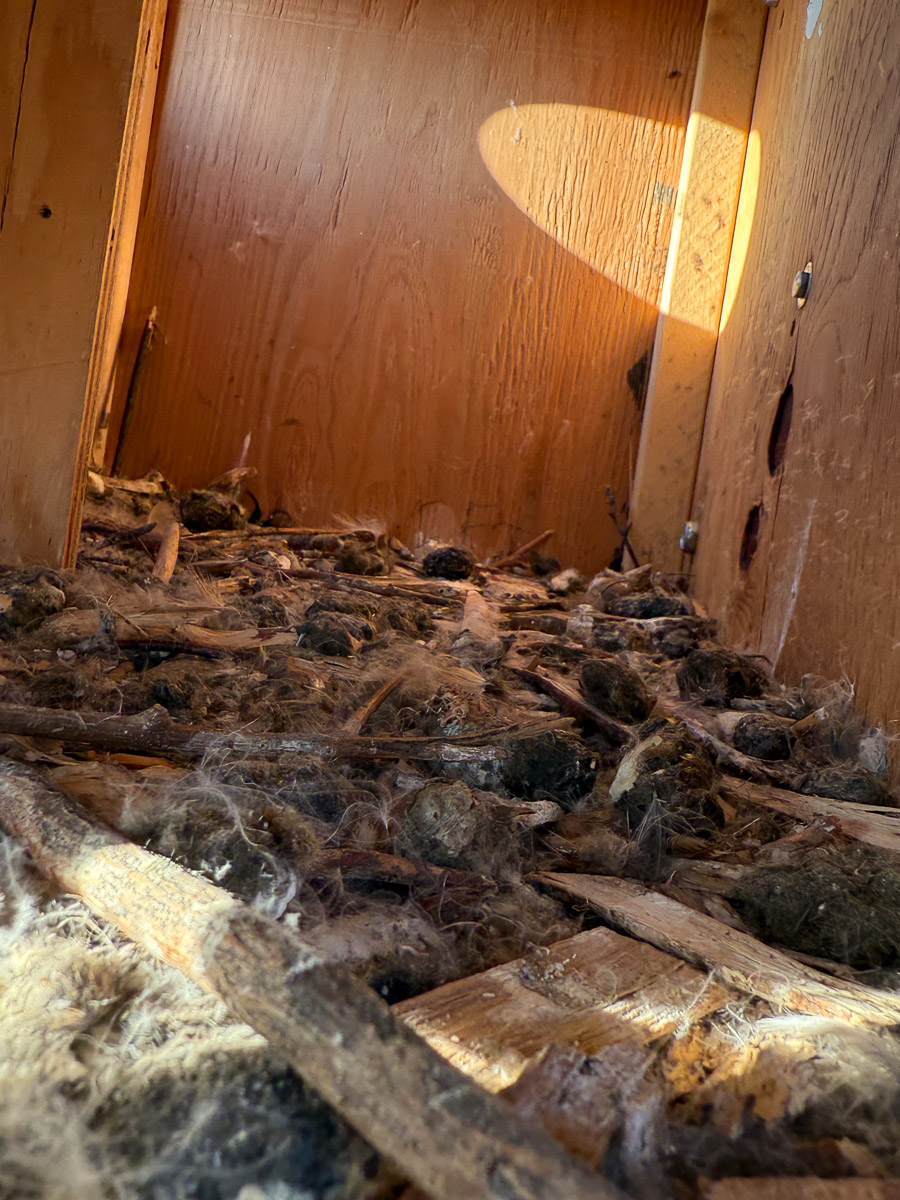
Part of the pasture project included two owl boxes. I can’t see inside them without a ladder. However, I can open the door on this one and hold my camera up high enough to take a photo of the inside. It’s obvious that it has been used, but I don’t know if it is used currently or not.
Chicory is one of the plants that was in our seed mix but I don’t see as much of it as I do the clover. After reading articles about native bees I think this is probably one of them.
There have been challenges on the north pasture. The annual ryegrass, which was not part of the seed mix, grew so quickly that it took over some areas. There is clover growing, but a lot was shaded out by the ryegrass that was trampled as the sheep were turned out.
These are patches that I lifted up to show how tall the grass is. It has effectively mulched parts of the field. Dan recently mowed this area to try and break up this thick grass. We’ll try hand seeding some of these areas before irrigating next week.
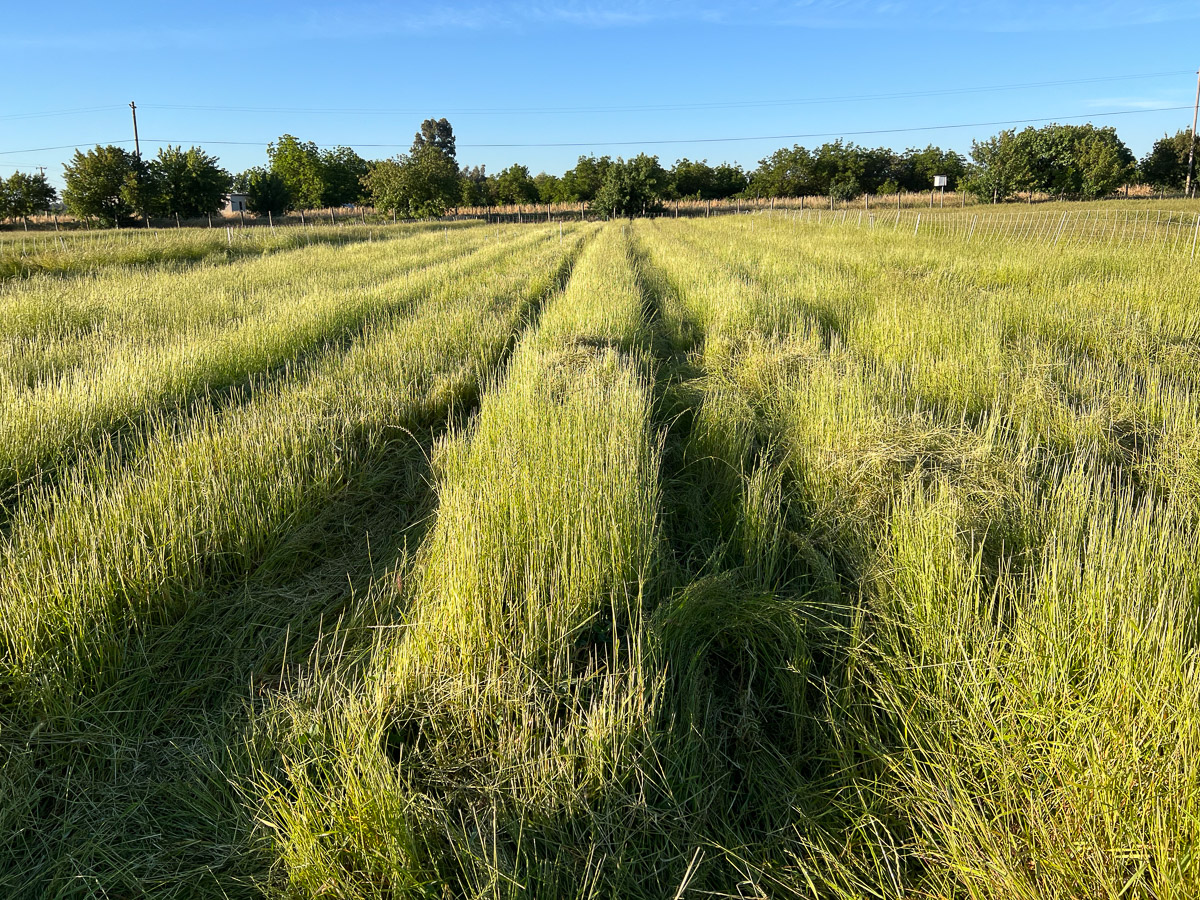
Back to the south pasture. You can still see the dry ryegrass, but it was mowed or grazed before it got as tall as that in the north pasture. There is plenty of clover thriving under it.
I wrote posts a couple of weeks ago to create a photo diary of our grazing progress as we started grazing the new pasture. As usual I got behind. It’s crazy now to try and document this the way I had intended. Instead I’ll start with this week and see where I go with this.
This is yesterday’s photo. I have numbered all the checks from west to east so I can keep track of what I’ve been doing. They are 30′ wide. We started grazing this spring with the paddocks in the north field. This is the previous post about that before I went on to the first irrigation. When we switched from grazing the north paddocks to the south ones we started with fencing two checks at a time and the idea was to split into smaller areas with cross fencing.
I have to say here that the main challenge here is that we have no permanent fences yet. When this project began (see the first post in October) we had to remove all the interior fences. Dan had knee replacement surgery in April and he wasn’t able to get those fences up before we needed to start grazing that month. I am using electronet fence and that means piecing together lengths of net and moving it as I move the sheep across the field.
This shows the length of fence as I have moved it from one check to another before setting it up.
There is plenty of clover and trefoil, but in some of the areas it has been overshadowed by the annual ryegrass. That is another challenge. Annual rye was NOT part of the seed mix. There were three perennial grasses in the mix, but the ryegrass that was already in the soil took over. Fortunately it is a good feed, but it grew so quickly that it has been a real challenge to manage. This paddock is one that Dan topped with the mower several weeks ago and the clover is more visible here.
So far it seems that I can graze the sheep on each 30′ strip for two days. I could probably add another day but I want to move them across the field to try and keep up with that ryegrass. We also want to make sure that the clover and trefoil get well established before grazing them heavily. It is time consuming to move that length of fence from one check to another every two days, so this last time I moved only one of the fences to the west. There is no fence down the center of this photo. I moved the fence that was on that check to the next check to the west. So the right half of the photo is where the fresh feed is. The sheep can tell where there is fresh feed, and they spent the next two days mostly on that half. They are also able to eat more of the ryegrass that is still on the check once the fence is removed. If this method works then I’ll move one fence every two or three days.
This photo is from a month ago when we moved them to the south field and set the north-south fences up to include two checks. We added east-west fences to have them eat each part more throughly. However, we have no drinking water source out there now so they have to have to be given access to the barn.
You can see how overwhelming the ryegrass is. There is clover there but it is hidden. When the grass is this tall the sheep trample it more than eat is and it has the effect of mulching the field. That is not what we want to encourage the clover and trefoil to grow.
When Dan topped the ryegrass the sheep could move through it more easily and it allowed the other plants to have light.
This view shows how they were able to graze the mowed part.
It’s great to have all this feed now, but I wish that I had more sheep right now to use all that feed.
































 Meridian Jacobs' Blog