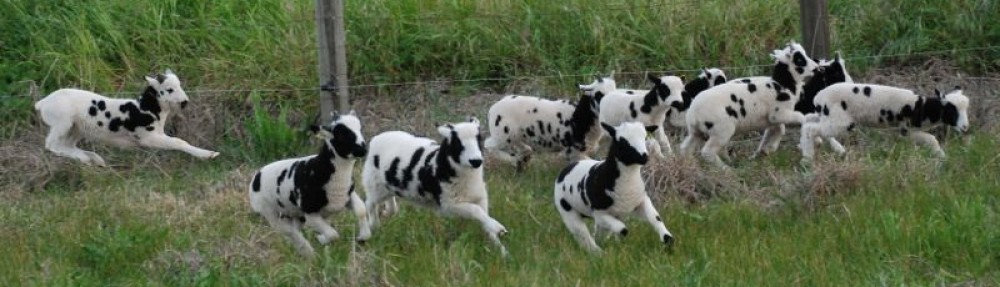
Are we getting tired of lambing posts? It only happens this time of year.
 Do you remember this lamb from a couple of posts back? Trista had a 10+ pound lamb and then almost two hours later a 5 pound lamb. She didn’t want the little one and I struggled to get it to nurse. I ended up milking Trista and tube feeding the lamb colostrum. I left the lamb with Trista but she became increasingly less happy to have it around and more hostile.
The lamb wouldn’t suck on a bottle and I was getting very frustrated. It’s one thing to have to feed a lamb every four hours, but then when it doesn’t suck it’s maddening. You get the nipple in the mouth, the tongue hangs out the side and the precious colostrum goes everywhere. (This brings back frustration of trying to get Brown Swiss calves on a bottle. The Milking Shorthorns were fine, the Brown Swiss were not.)
A solution presented itself the next day.
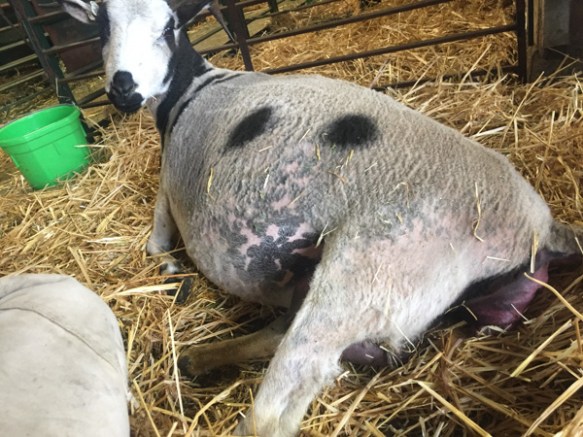
 I saw this in the barn. This lamb was standing hunched up like a lamb does when it doesn’t feel good. This view from the top down shows how large it’s belly is and it was tight as a drum. From previous experience I suspected intestinal atresia, a malformation of the digestive tract where the intestine is not complete. The lamb eats normally at first and then there is no where for the milk to go and this lamb was already over 24 hours old–it didn’t have long to live and was in great discomfort.
When a lamb dies if you put the fresh skin on an orphan lamb sometimes you can trick the mother into thinking that it is her baby. I went to the house for my new knife (purchased for when I need to necropsy or skin something and the sharpest thing in the house has been a pocket knife). By the time I came back to the barn the lamb was dead. In addition the lamb had stopped nursing so the ewe was at risk of mastitis as her udder filled, even though there was a remaining twin. One side had started to fill more and become uncomfortable. That starts a vicious cycle where the ewe won’t let the lamb nurse and that side of the udder gets worse and worse. This is a photo of milk from Trista, the orphan’s mom. I got over two cups of milk from the ewe with the baby who died.
The trick was going to be to get this lamb who had never nursed on her mom to nurse on this mom.
 I made a little lamb jacket out of the skin by cutting a neck hole and leg holes. It’s kind of hard to tell if you don’t know that’s what you’re looking at.
 The new lamb was smaller than the one that died so this jacket was a little large. The mom wasn’t convinced at first that it was her baby, but she didn’t outright reject it. The lamb had eaten (been tube fed) just two hours before so it wasn’t hungry. But later that night it was hungry. It was on it’s feet and when I held the ewe still it nursed!
 The next day the jacket was beginning to smell. The idea is that at first the mom smells her baby and eventually gets used to the new lamb smell. So our transition was original lamb smell mingled with new lamb smell, new lamb smell mingled with dead smell, all new lamb smell. I had cut a portion of the skin off to get more of the new lamb smell and because I wanted the lamb to be able to adjust to the cold when the second skin came off. But this skin jacket was so big that at that point it got tangled up and I took it off.
I kept the ewe and the lambs in a pen for several days so that I could watch. The ewe slept with her lamb and not the new one. She would stomp when the lamb tried to nurse but if I went in the pen she resigned herself to it (almost rolling her eyes) and stood there.
 We have success. I haven’t had to hold the ewe for a few days while they have been in a group pen. They will go out tomorrow and I’ll keep an eye on them. But I think the baby has a new mama.
 This is Cayenne…
 …and this is Serrano. Yearling rams trying to figure out who is boss. I think most of the blood came from a fifth horn that was behind Serrano’s lower horn–that horn is gone now. I’m not sure who won. Neither of them seemed to be feeling very good for a day or two.


 The
 Estelle and lambs.
 Ht Lips and her triplets plus an extra.

 Back in the barn lambing has continued at quite a clip. This is Fandango and her BFL-cross lamb.
 Vixen’s twins.
 There are plenty of lambs to cuddle.


 Here is the lambing count a week ago.
 My bike set up on a trainer in the house. The only use it is getting right now is as a sock drying rack right.

 This is the first lamb born way back on February 22.
 Wednesday was quite a day with five sets of twins born. There was a Fibershed Ag Coop Board meeting at noon, but the representative photo for that would just be Stephany and me on the phone for two hours. But the main event was not lambing or the meeting. Ben Hostetler of Mountain Meadow Wool came to speak to a gathering of Fibershed producers and other interested people and talk about value-added processing and how to figure out cost effectiveness, etc.
 We also looked at fleeces and discussed skirting and cleanliness of fleeces to be sent to the mill. Oh, and do you see that stack of alfalfa in the background of the first photo of Ben and the group? I had made a call to say DO NOT bring hay on Wednesday because there would be a lot of people and a storm is coming. The hay showed up on Wednesday and Dan got about half of it in the barn before people arrived for Ben’s talk.
 I ended up pulling twins and all was OK although in hindsight I’m sure that this ewe did not need intervention, just more time. In the meantime while I was dealing with that ewe Trista popped out another lamb. This was almost two hours after the first and it was such a tiny thing that I’m not sure she even noticed. She did not want that lamb–that’s the small one in the photo under the heat lamp. By this time it was almost 6:00 and the rain was starting. A few of the people at the talk had stayed around to help. Dan and Ben brought the rest of the hay in under cover. I dealt with the cold, rejected lamb. I ended up tube feeding it colostrum because we could not get it up to suck even when we held Trista still. Ben and Dan helped with chores while Stephany went in to clean up the kitchen and order pizza and pasta to be delivered. That was really the best way to end the day because by then I didn’t want to go out anyway. More about that lamb in a later post.
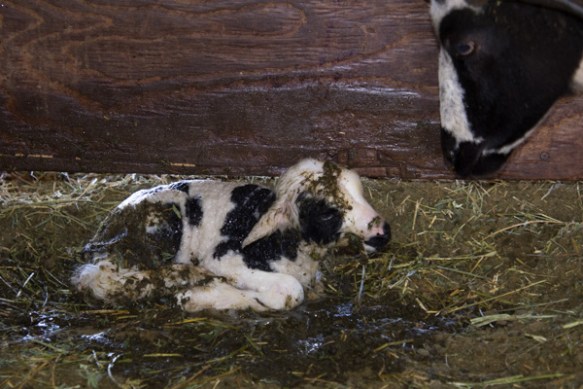 Skipping ahead to the next day. Petra was the only ewe to lamb on Thursday.
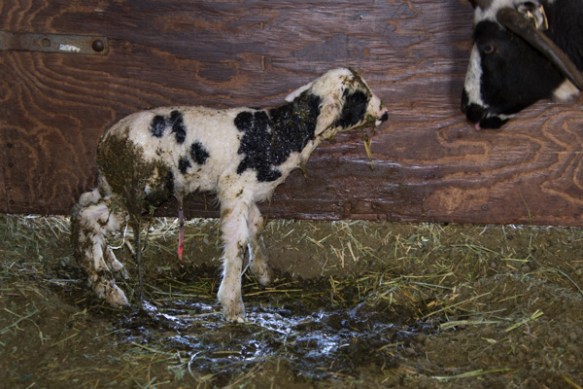
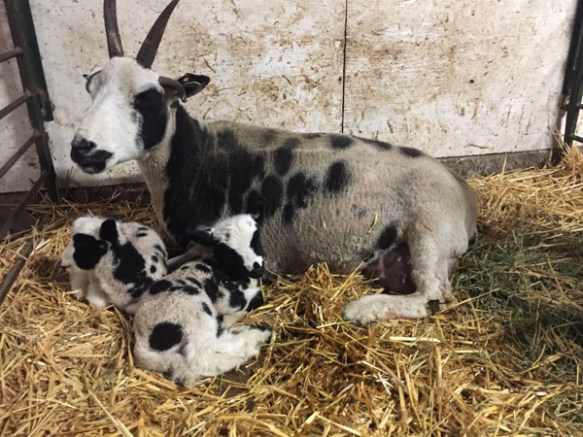 Isadora is one of the ewes who had lambed on Wednesday. By the next day I was worried about mastitis. She has a lumpy uneven udder from previous mastitis and it seemed to get hard again. I spent some time massaging and using warm compresses (easy with hot water in a disposable diaper). She didn’t developed mastitis so I think it was just the normal engorgement coupled with the hard, scarred areas from before that I was feeling.
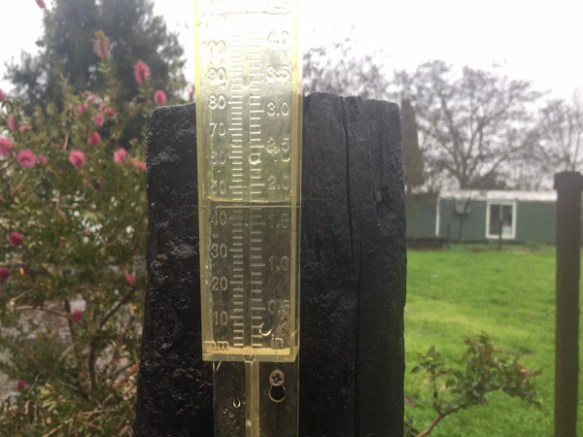 Wednesday night through Thursday we had 1.8″ of rain after almost no rain in all of February.
 That’s all it takes for our place to look like this.
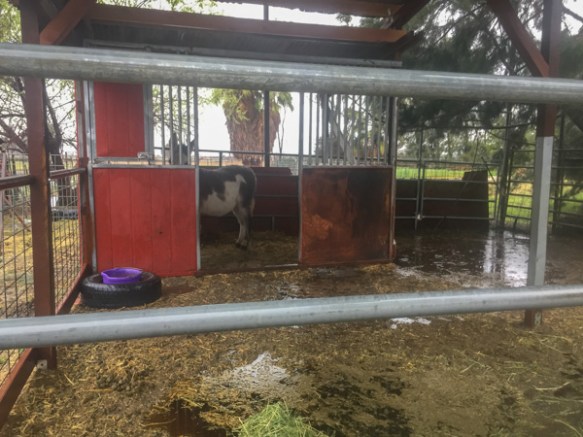

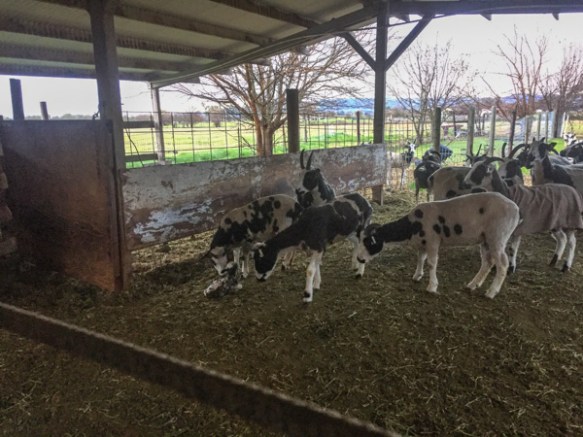 So I looked over the barn wall where I spy on the ewes and saw this. Yearlings aren’t always sure about what to do with a lamb and need a little time to let their instinct kick in. It is important that a young ewe has a chance to figure out that the lamb is hers and that she really does want it. You don’t want to interrupt that bonding time. However she can also be bullied or distracted by other ewes who are curious or close to lambing and will start to mother the lamb themselves.
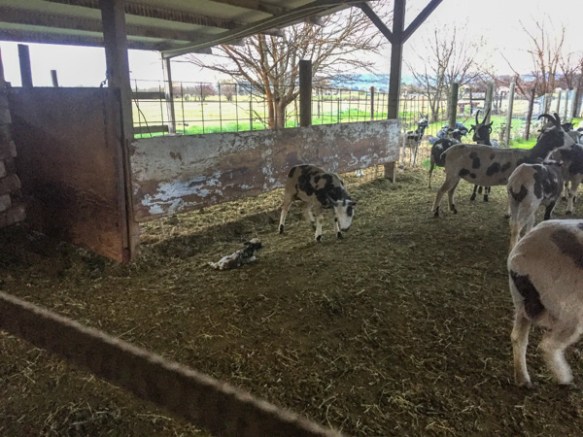 I walked around the gate briefly to push the other ewes away and then backed off so that Dilly would approach her lamb again.
 I gave her some time and then slowly picked up the lamb and got her to follow it into the barn.
 This lamb was only 4.6 pounds. The other Jacob lambs are more often 7 to 8 pounds or even more.
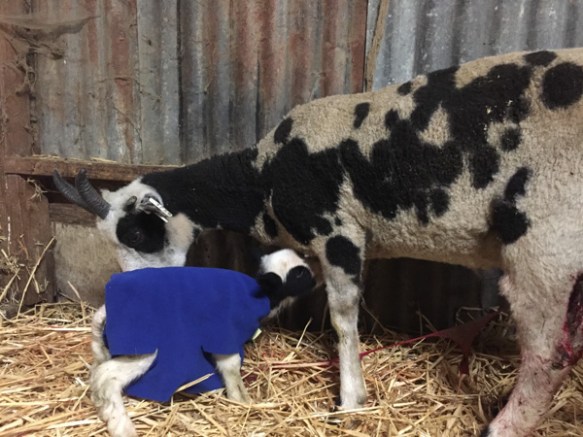 It was stormy and cold so I put this little lamb coat on it for the night. However the coat was too big and got wet. By morning I took it off.
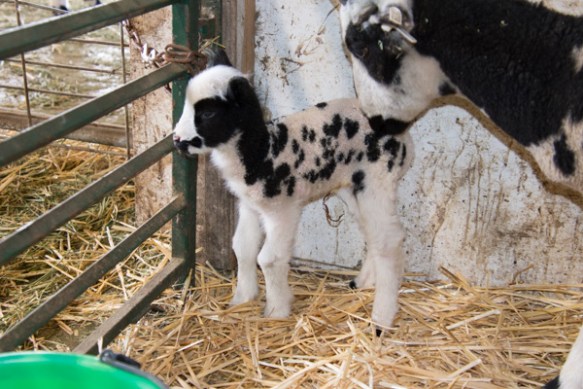 Dilly’s lamb at 2 days old.
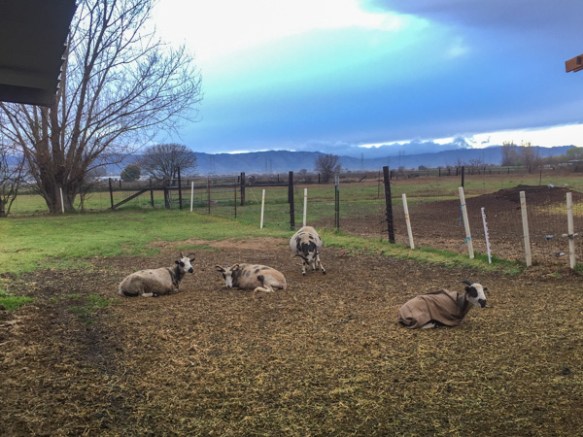 That is her pawing and looking restless during morning chores.
 When she looked more as though she were in active labor I brought her into the barn. That was about 10:15.
 At about noon the sac was visible.
 This view, taken about 2:00 shows how, as labor progresses, the sides are sunken in front of the hips. I had been waiting for Sheena to have her lambs before I went to town, but I finally decided to make a quick trip. When I came back at 3:00 she was lying down and pushing but I saw only the nose, which at that point looked somewhat swollen. When I felt for the lamb position, the feet were at about a 2:00 position instead of below the head and out in front. I pushed the lamb back so that I could make sure that the feet matched up to the right lamb, brought them around to the 6:00 position and then pulled the lamb easily.
 As soon as the lamb was out Sheena went to work.
 The sac for the next lamb showed within a few minutes.
 Lamb #1 was on his feet within 8 minutes.
 You can see this ram lamb’s horn buds.
 Sheena barely noticed as she pushed out the second lamb about 15 minutes later.
 Lamb #1 is mostly white.
 Lamb #2 has a lot of color and has lilac markings. Catalyst is the sire.
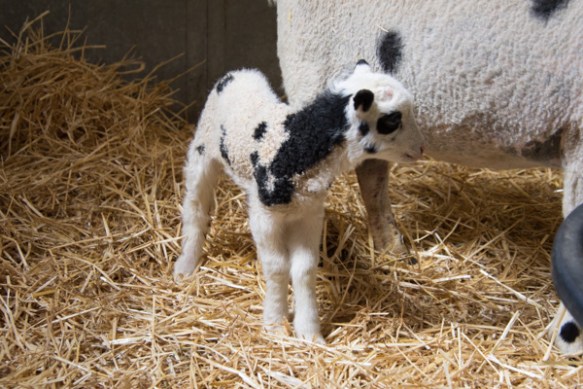 This is the first lamb two days later.
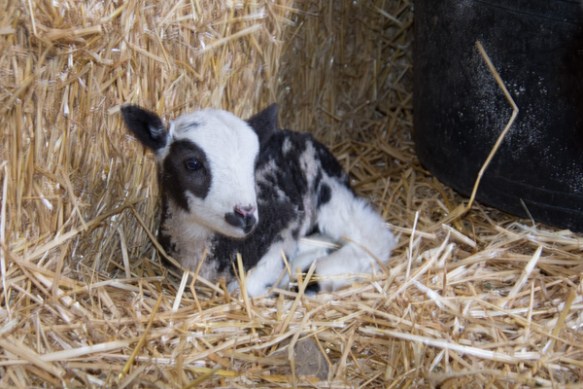 Here is the second lamb.
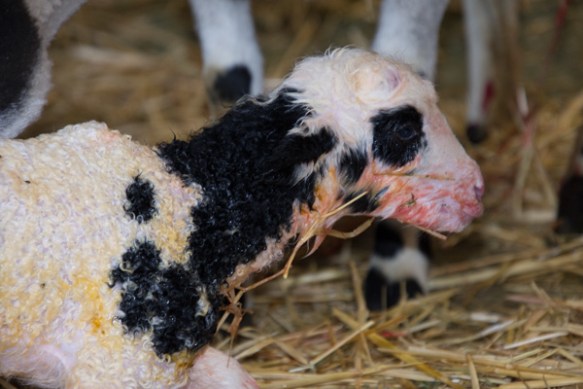
 Lamb #1. These aren’t usually a pretty side when just born. Slime, dirt, blood.
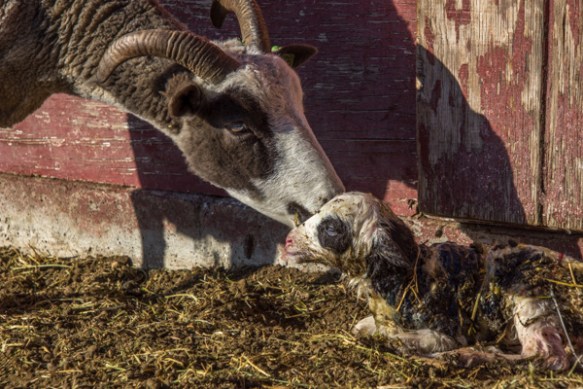 Jacob ewes are usually very good mothers and the lambs are vigorous. Shelby was cleaning up her baby…
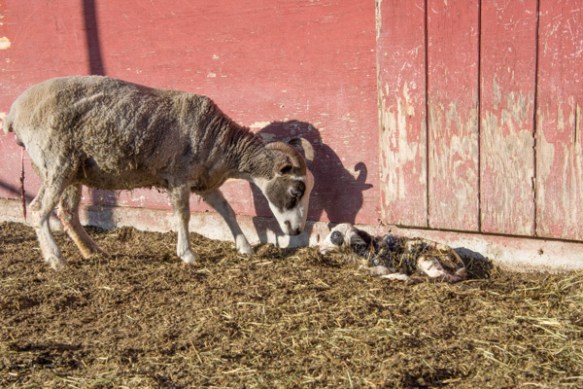 …even while pawing the ground and having contractions for the second.
 I got them inside the barn and the lamb got to its feet and started looking for milk.
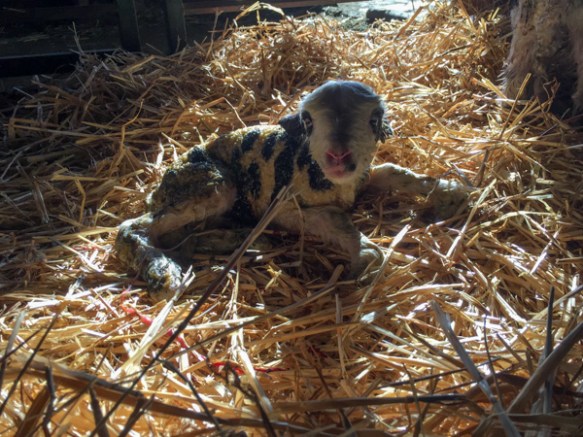 Lamb #2.
 The first lamb is nursing while Shelby cleans the second.
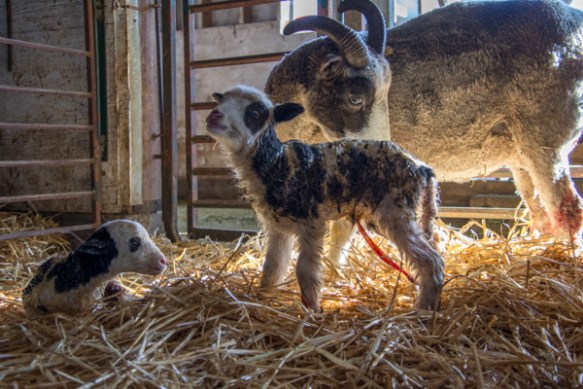 I love the look of this one. These are both lilac ewe lambs sired by Catalyst.
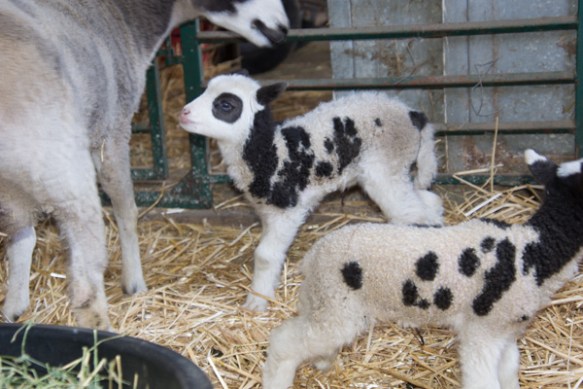 Here they are three days later.
 These lambs are listed on my
 Our fabulous shearer is John Sanchez. We started with the rams. This is Peyton, the new BFL. His fleece sold right away.
 Next was the 2 year old lilac ram, Catalyst.
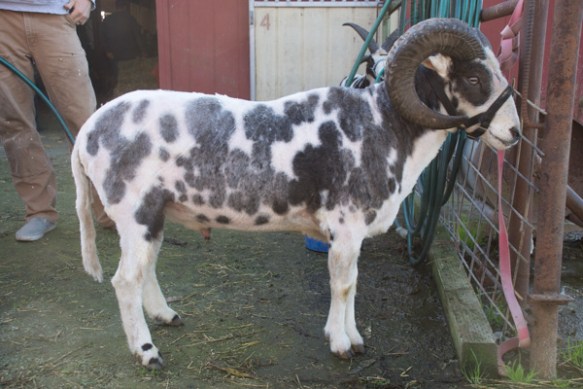 Here he is afterwards and…
 …here is his fleece.
 A staple of Catalyst’s fleece.
 Catalyst’s son, Cayenne, after shearing. You can see what he looked like before shearing near the end of
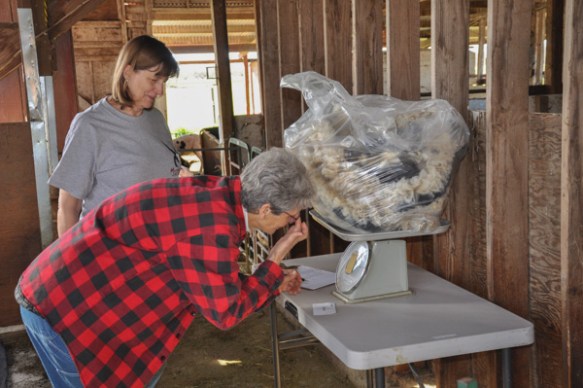 One of the shearing day jobs is weighing and recording fleeces. Kathleen and Lisa did that job.
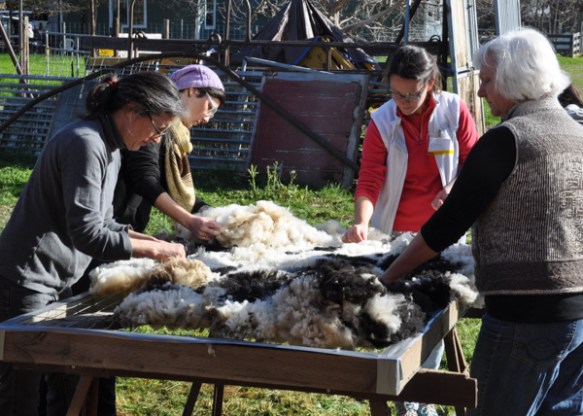 We had two skirting tables set up this year. Farm Club members skirted their fleeces and helped others skirt and sort.
 I set up the GoPro for some shearing video. That will be coming later.
 Roy and Gina worked in the sheep pen.
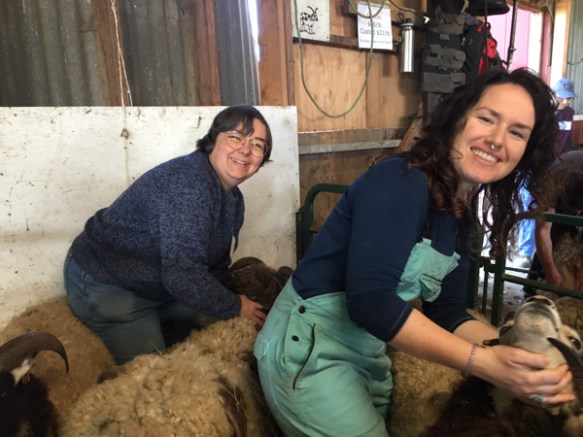 So did Deborah and Shelby. They all made sure that John never ran out of sheep.
 Kathleen, Lisa, and Dona. Dona is our “official” Farm Club photographer because I’m always too busy to take photos on our Farm Days. She took some of the photos here.
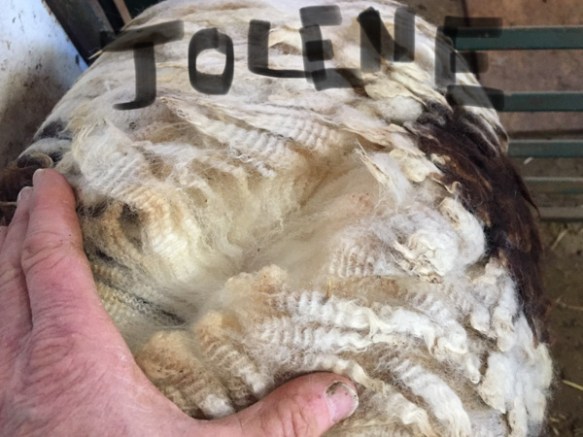 This is what a fleece looks like when you take the coat off the sheep.
 Here is that same fleece after shearing.
 Locks from Jolene’s fleece.
 Another beautiful fleece on the table.
 Doris made Jacob sheep cookies for us.

 Hot Lips.
 Janis
 Some of the sheep are coated. This is Honey.
 Sylvia.
 Stacy
 Shelby and her daughter, Lavendar.
 Almost 1-year old rams, Cayenne and…
 …Serrano.
 I not only found a plastic tub to keep the dust and cobwebs and rats away but I wrote the names on the tops of the bottles so that I don’t have to pull each of them out every time I’m looking for something. This is so simple, but it makes me inordinately pleased–why didn’t I think of it before?
 While I was cleaning inside the barn Dan was working outside. We had finally had some rain so felt more comfortable burning the brush pile.
 By the way we burned this on Thursday. This doesn’t look like much but it was a pretty not fire. Even though it looked like it was out on Monday there were still hot spots and smoke.
 That burn pile is right next to the ram pen. Here are the five of them. The 4-horned rams are Serrano and his dad, Buster. The lilac 2-horns are Cayenne and his sire, Catalyst. That’s Gotham in front.
 In the meantime, Dan is working on the west side of the barn. This has been a multi-year project but I think it may get finished this year.
 Let’s put the GoPro on a sheep. Jade is the obvious choice, being the best pet sheep.
 The first thing she did was run into the barn. When one sheep runs, they all do.
 At that point I needed a scoop of grain to entice her.
 I had used the headgear that is meant for wearing the camera, but it was meant for a human head and didn’t wrap around the horns very well. I found the brace I use for my elbow and that seemed to secure it better.
 I’ve looked at the footage. It’s not as exciting as we might hope for. Maybe if she wore the GoPro all day (and there was enough battery life to do that…and then we condense it all into a minute) it would be interesting. But it’s not like she’s going to be skydiving or snorkeling. For this trial run she pretty much just looked at the barn, the pasture, and me.
 I will still do something with the video but it probably won’t be winning any film festivals.

 This is Serrano and his dad, Buster.
 One of these days, Serrano may come out the boss.
 But not yet.


 Buster is still boss.
 This is Gotham sleeping on a foggy morning. When the rams lie with their heads propped up by their horns they do look dead.

