As I’ve said before Breeding Season is a Season, overlapping the traditional seasons of summer and fall. If defining a Season influences how you live your life, Breeding Season definitely qualifies. It doesn’t take long before I’m ready for it to be over. It’s easier when all the ewes are in one place, the rams are somewhere else, and I don’t have to feed groups differently and watch my back when I’m with the ewes.

We have 4 breeding groups, a non-breeding group (the oldest sheep, Jade, and six ewe lambs), two young rams with potential for breeding (too young and/or small this year), and two older rams who are sold but still here. The breeding group with the most ewes is on the main pasture. Hornblower has about 30 ewes with him. Doesn’t that pasture look great?

Elvis has eleven ewes and is on the pasture to the north. When I moved the Hornblower group to the next paddock of the south pasture I needed to separate the two groups with more than a single net fence, especially since I’m having some issues with the power to the north one. So I set up two fences and was able to power the north one from the south one.

Those pasture photos were taken October 10. On the 13th it rained. We had 1.6″ the first day and .5″ the second day. A significant rainfall usually marks the end of grazing. It is late in the year and the pasture is depleted or dormant. Also, the land is flat and the water doesn’t drain well. This year is different because the pasture has been renovated and there is a much better stand (mostly clover, trefoil, and chicory). We are not sure how long we’ll be able to graze but it seemed appropriate to continue as long as I moved the sheep to a fresh paddock.

Five days ago I moved Hornblower’s group to the paddock closest to the road.
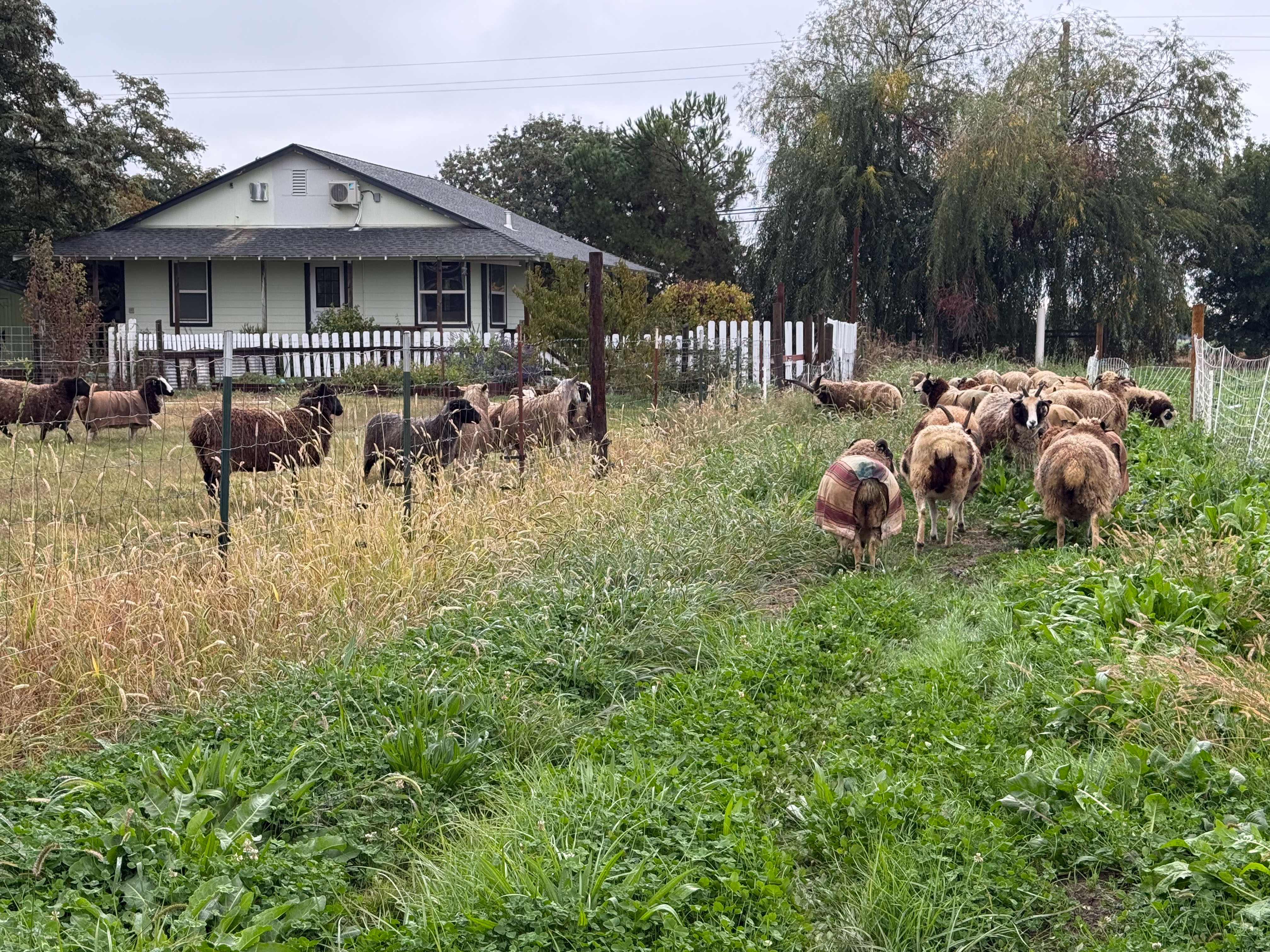
The lane is adjacent to Clancy’s group. However there is hot wire on both sides of the net fence and there doesn’t seem to be any problem with either ram trying to get through.
You may notice some blue marks on the ewes. Those are more noticeable than the orange marks on several, The rams wear marking harnesses so we have a better idea of when to expect lambs. I hadn’t noticed as many marks lately.

Is this why? The rams went in with ewes three weeks ago on September 27. I substituted the orange markers from Clancy and Hornblower with blue markers a week ago. You can see the difference in a new one and the used ones.

Clancy’s group is in the field between the barn and the shop–not one of the renovated pastures. Notice two blue marks. The ewe in the background marked blue was the first one Clancy marked with orange on September 27.

So we now know that she was not pregnant after that breeding. If all the ewes in this group are re-marked that would indicate a problem with the ram. Hopefully that is not the case. The other ewe marked blue in the photo above this one had not been marked before. I’ll keep watching to make sure that more of the oranges aren’t also marked blue in the next week.
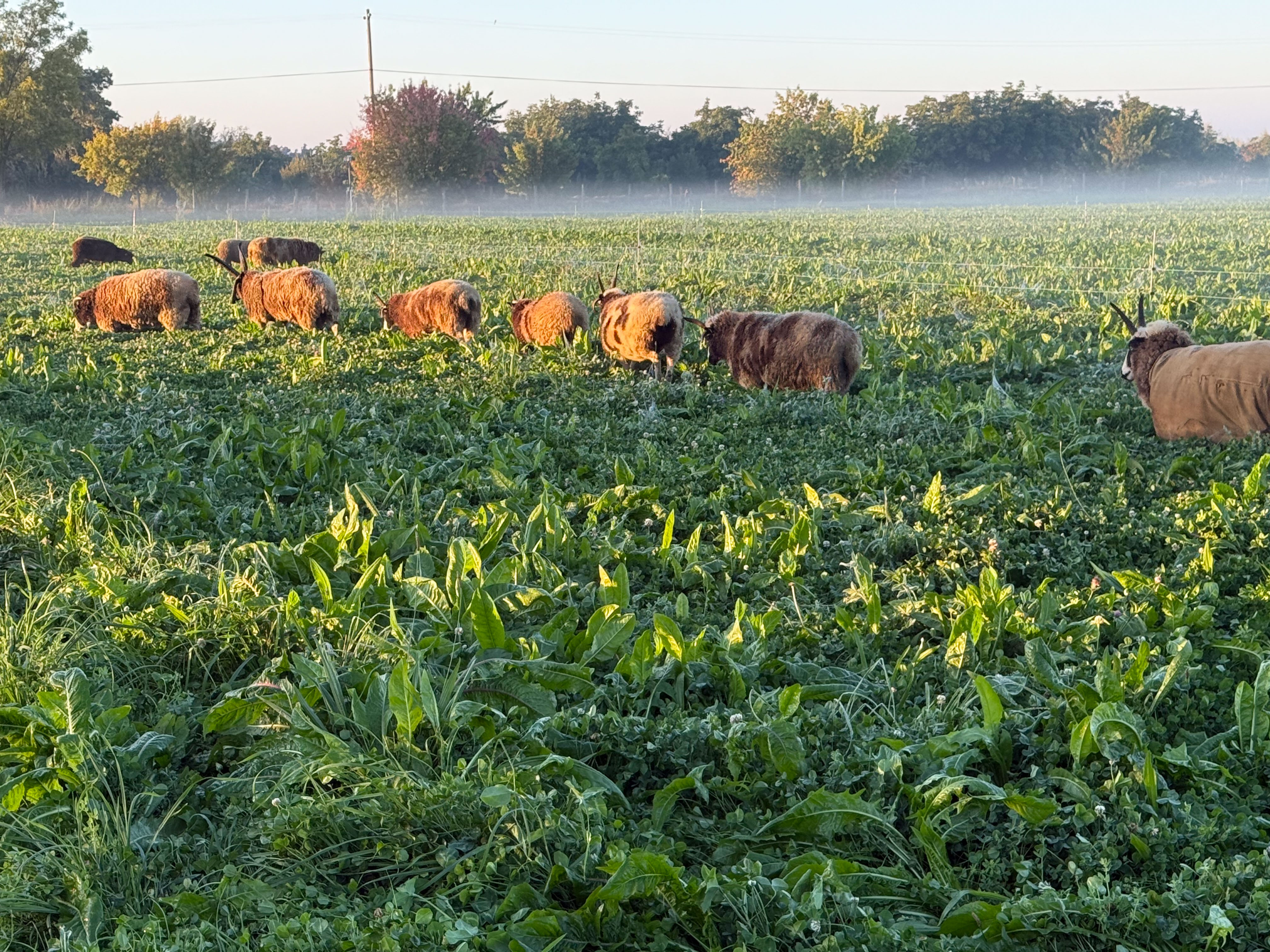
This morning’s move to fresh pasture.
 Meridian Jacobs' Blog