More Pasture Plants

This is a continuation of What’s in the Pasture. I have a lot more plants to go.DSC_0113

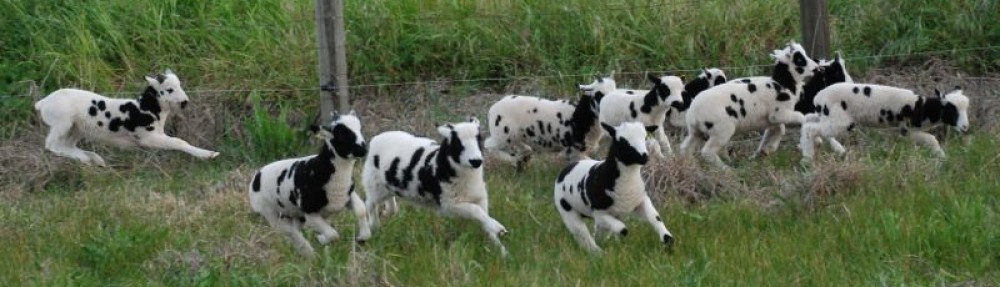
I changed the fence to move the sheep from the south half of the Horse Pasture (no horses for a long time) to the north half. They came running.DSC_0117

They were ready for fresh feed…DSC_0119

…because this is what they left behind. I have moved the net fence a few inches off the fresh pasture. You can see what it looked like on the other side of the fence.

Orchardgrass-m

I think this is orchardgrass, but I’m not 100% sure.

Orchardgrass ligule

When you identify grasses it helps to look at more than just the seed head. This photo shows the ligule which this publication from the Wisconsin Cooperative Extension (which also has a good diagram of grass parts) describes for orchardgrass as “prominent; cuts or splits on whitish margin”.  Yeah, I can see that. This one from UCD is also a good resource.

Curly dock

Lately I have left my 40 mm lens on the camera and get a kick of of looking closely at things that I see better on my computer than through my glasses.This one is Curly Dock.

Curly dock-2

Here is the not-so-interesting photo of it.

Spiny cocklebur

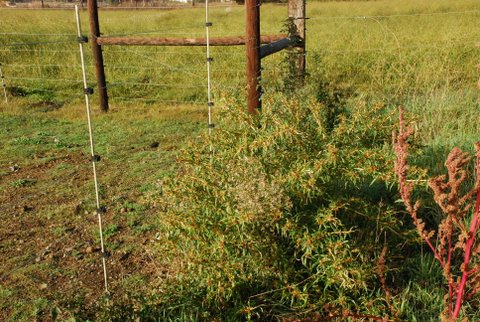
I have made good progress at getting rid of Spiny Cocklebur, but it will never all be gone. I continue to chop any of these that I see. Obviously I haven’t dealt with these along the corral fence but need to take a shovel instead of a camera when I walk out here. Spiny cocklebur-close2

You can see why it is undesirable and the reason it thrives even where everything else has been eaten. Besides the thorns the flowers develop into nasty burs that stick in fleece and hurt fingers.

blackberry

Speaking of thorns and eating, I’ll deal with the thorns when the eating is this good. And I won’t complain that the bushes are completely covering the electric fence.  I had my first ripe blackberry this morning.

Dallisgrass revisited

I have  posted several times about dallisgrass in the pasture. It features in this post a few years ago, this this post about burning it, this post in August 2011 and this post in August 2012. Please ignore the fact that I have spelled it differently in several of this posts. It is dallisgrass and here is a definition: “a tall tufted tropical South American perennial grass (Paspalum dilatatum) introduced as a pasture and forage grass in the southern United States”.

This came up in an e-mail conversation last night. Why don’t I shear before breeding season to avoid the blue and red and green markings on the wool?

Good question and that is a discussion for another post. I was thinking about pros and cons of shearing before breeding–sometime in September. I was explaining that the dallisgrass grows so tall and develops seed heads in the late summer. At some point in the cycle the seed heads are very sticky and the sheep (and Rusty…

…and my pants) are covered with sticky goo that catches dirt and the seeds that come off of the grass. After a few weeks the sticky part goes away and then fall rains clean the sheep. I thought I’d look this up to see why the seed heads are so sticky. I was surprised to learn that the goo is actually the result of a fungus that is common on dallis grass and is toxic to cattle. Who would have thought? That doesn’t change anything, but I find it interesting. So this morning I wanted to see for myself.

This dallisgrass looks “clean”.

This one is infected.

The dry grass here is dallisgrass.

See how tall and thick it is? Some of the leaves are still green, but they are so coarse that the sheep will choose to eat the dallisgrass only after they have eaten all the grass and clover that they prefer.

A few sheep photos. This is Sierra.

This is Aurelia, the ewe I got from Kreutzer Farms  in Nebraska.

Onyx, the Jacob x BFL cross. Notice the ewe in the top right corner of the photo that is almost invisible in the tall grass.

And while I’m talking about fungus in the pasture, what about this one?

 It is huge.

Pasture Maintenance

Nothing very exciting in this post.  But I spent all day Sunday in the pasture  after thinking the job at hand would take only a couple of hours.  I find that I am always writing blog posts in my head so here it is.

I started by mowing the paddock that the sheep had just been grazing. Now that I have my mower (never meant for this heavy duty work, but so far still working) I have been working on the dallisgrass that gets ahead of the sheep this time of year. In the past I have tried burning, trampling, weed eating (photos and past efforts in this post and this post and this post), but I think this mower will be the answer. It is at the south end of my pasture(right side of the photo) that the dallisgrass gets so thick and tall. The idea is to mow right after grazing and then everything has an equal change of regrowth, and the dallisgrass will be in a more palatable stage and the sheep will keep up with the growth.

In this photo the paddock that I just mowed is to the right. The sheep grazed the one on the left a few days before. I mowed that one that last time they grazed it and that made a big difference. I shouldn’t have to mow after each grazing–maybe once or twice per season I think. Notice the fence-line. That is a 3-wire electric fence and this was the other thing I wanted to deal with on this day. I have been putting off cleaning up the fence-line with the weed eater, but when you can’t even see the wire, it’s time. I have already used the weed-eater in the area where you can see the wire. This dallisgrass is tough. I have the heavy duty string on the weed-eater and it still gets used up quickly.  Slow-going. It took me about 3 hours to finish this fence-line.

Speaking of problem plants, here is another. This is what the medusahead looks like when it’s dry. There are plenty of posts about my battle with this noxious weed also. This is along the perimeter fence.

And lets not forget devils-claw. This one isn’t so bad because I don’t have much of it and it is easy to chop out the big plants. It doesn’t invade the irrigated pasture, but is along the edges where it is dry.

What is the problem with devils-claw? See the fruit? See those curved, pointed ends? When the fruit dries it splits in two and those curved points get caught in wool. I’ll show you other photos sometime. This is seed dispersal in action.

Moving on to other plant problems. This is the small blackberry bush on the west fence. On this morning I actually had breakfast here because the berries are ripe, but in general the blackberry bushes become a problem when they cover the electric fence as they do on my west fenceline. (Note wheelbarrow full of devils-claw.)

I started irrigating Sunday evening. Here is a spot that I hoped to get water to this time. The last few times I irrigated the water didn’t get here.

This is the pathetic state of the trefoil that didn’t get water.

Here is what it looks like where it was irrigated.

And here is a view of a paddock that has had plenty of water, has a manageable amount of dallisgrass,and hasn’t been grazed for a few weeks.

This is  self-portrait of the irrigator.

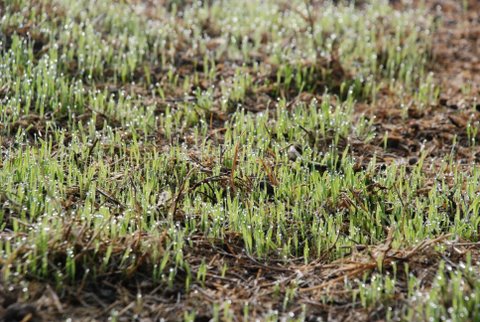
What season is this?

It was a beautiful day today in our part of  California. After a little morning fog the sun was out and it was warm. The ground is wet and there is new grass in the areas where it has been dry all summer. That means fall, but it felt like spring.

There were even a few new flowers.

It really is fall however and there are noxious weeds to show for it. I am vigilant about keeping the worst of these weeds out of my pastures,  but there is one area that is not regularly grazed and I wasn’t paying attention.

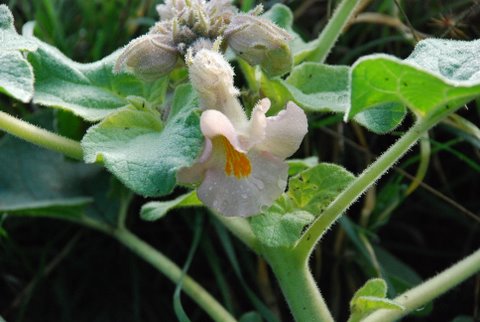
Pretty flower, but appropriate for a Halloween post, this is Devil’s Claw.

Here is the green seed pod.

This is what the seed pod looks like as it dries out. Those two pointed tips are very sharp. When they get stuck in wool you can’t get them out.

Fortunately this plant is very easy to get rid of. The stems aren’t tough and one chop with the shovel will take care of it. These are in the burn pile now.

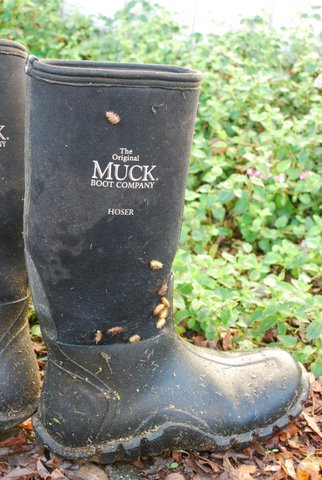
I have done pretty well at getting rid of most of this spiny cocklebur, but missed the plants in this area. Why is it bad? Take a look at a close-up.

Not only is it spiny, but those burs stick to wool like velcro as well as having an extra sharp point on the end. In the summer I hoe all the small cockleburs that i see. Even though I chopped and will burn all of these plants today they left hundreds of cockleburs (seeds) behind on the ground.

Here is a lesson in seed dispersal.