Why Coated Fleeces Cost More …

…and should probably be priced even higher.

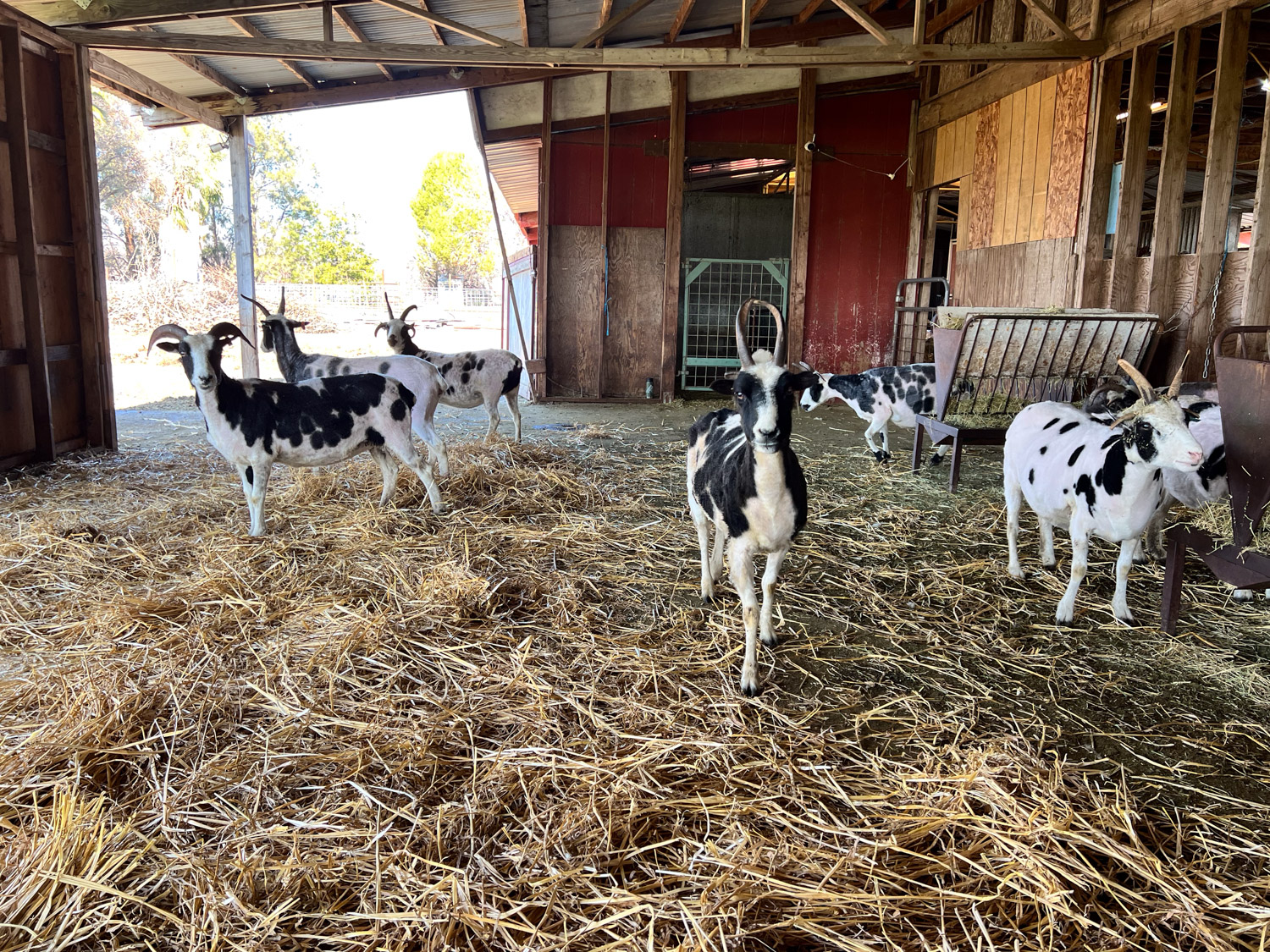
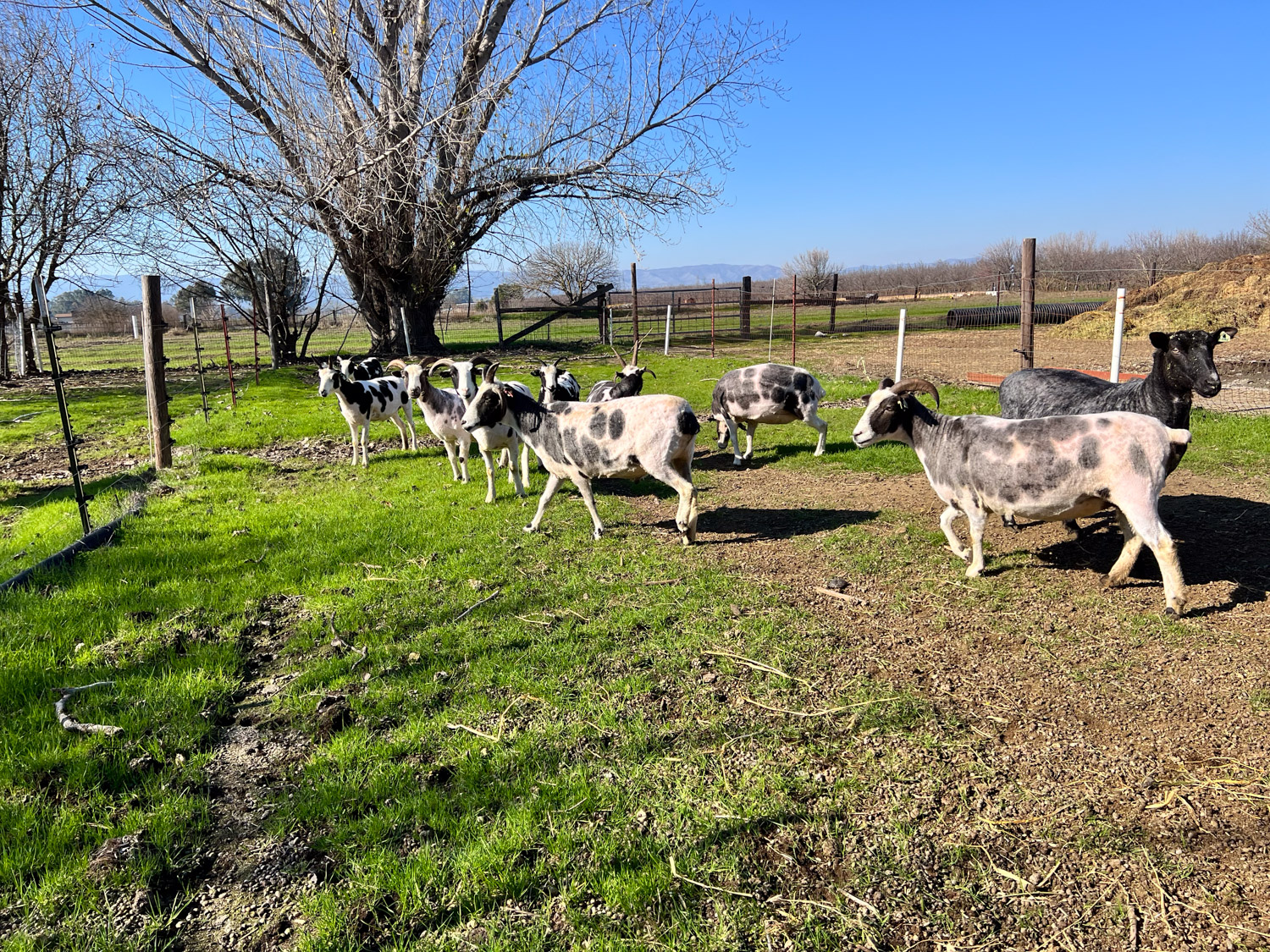
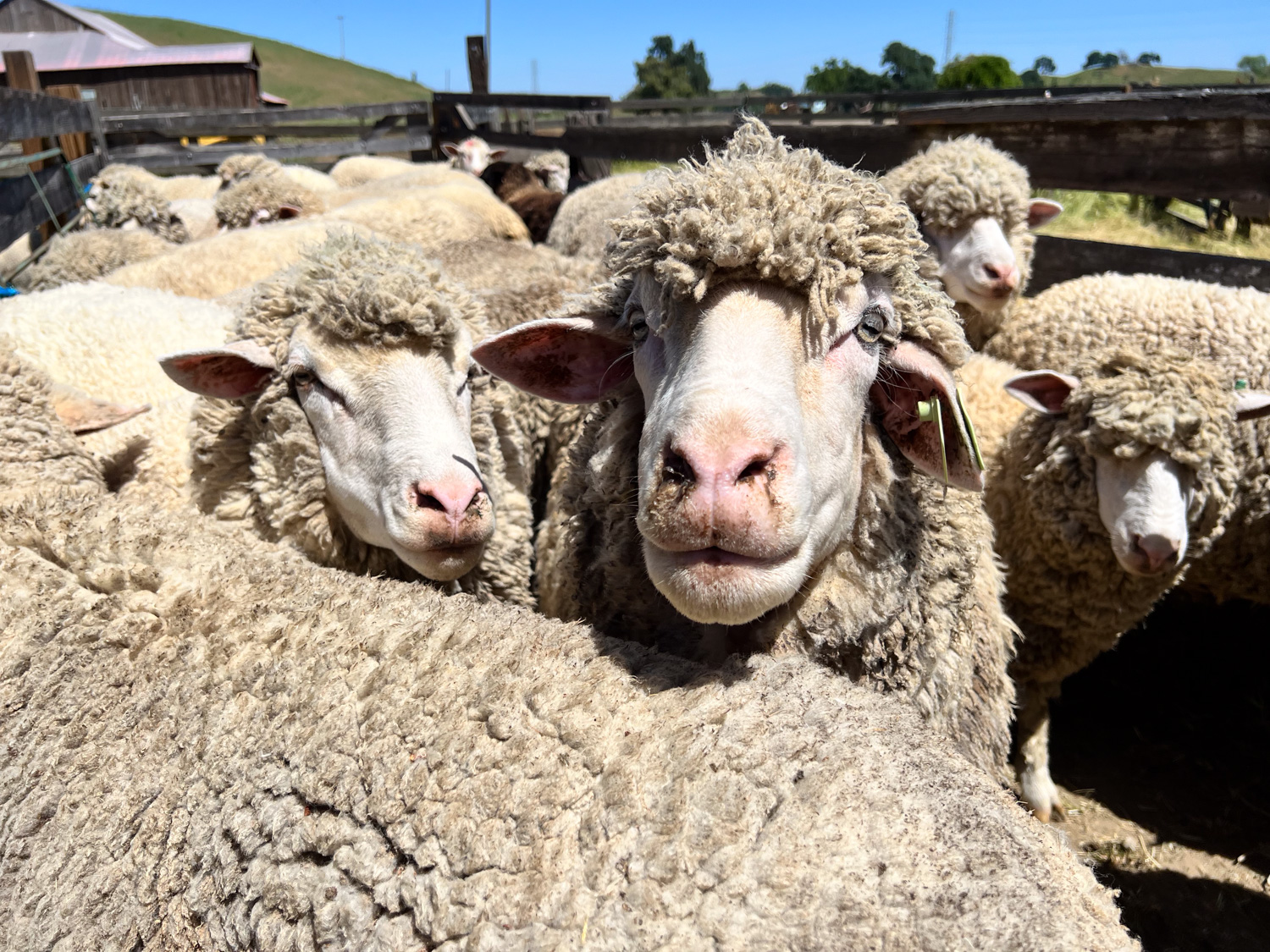
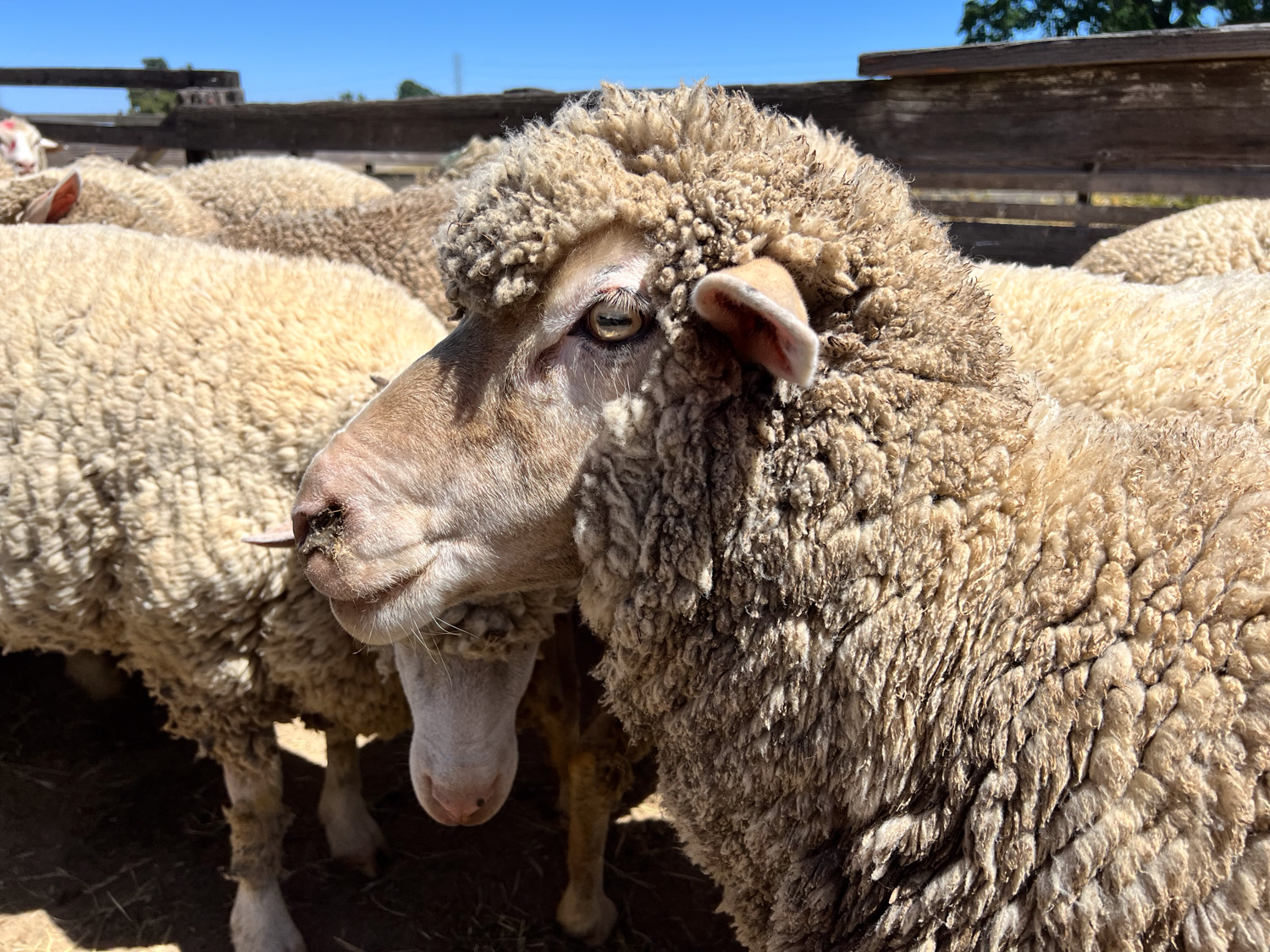
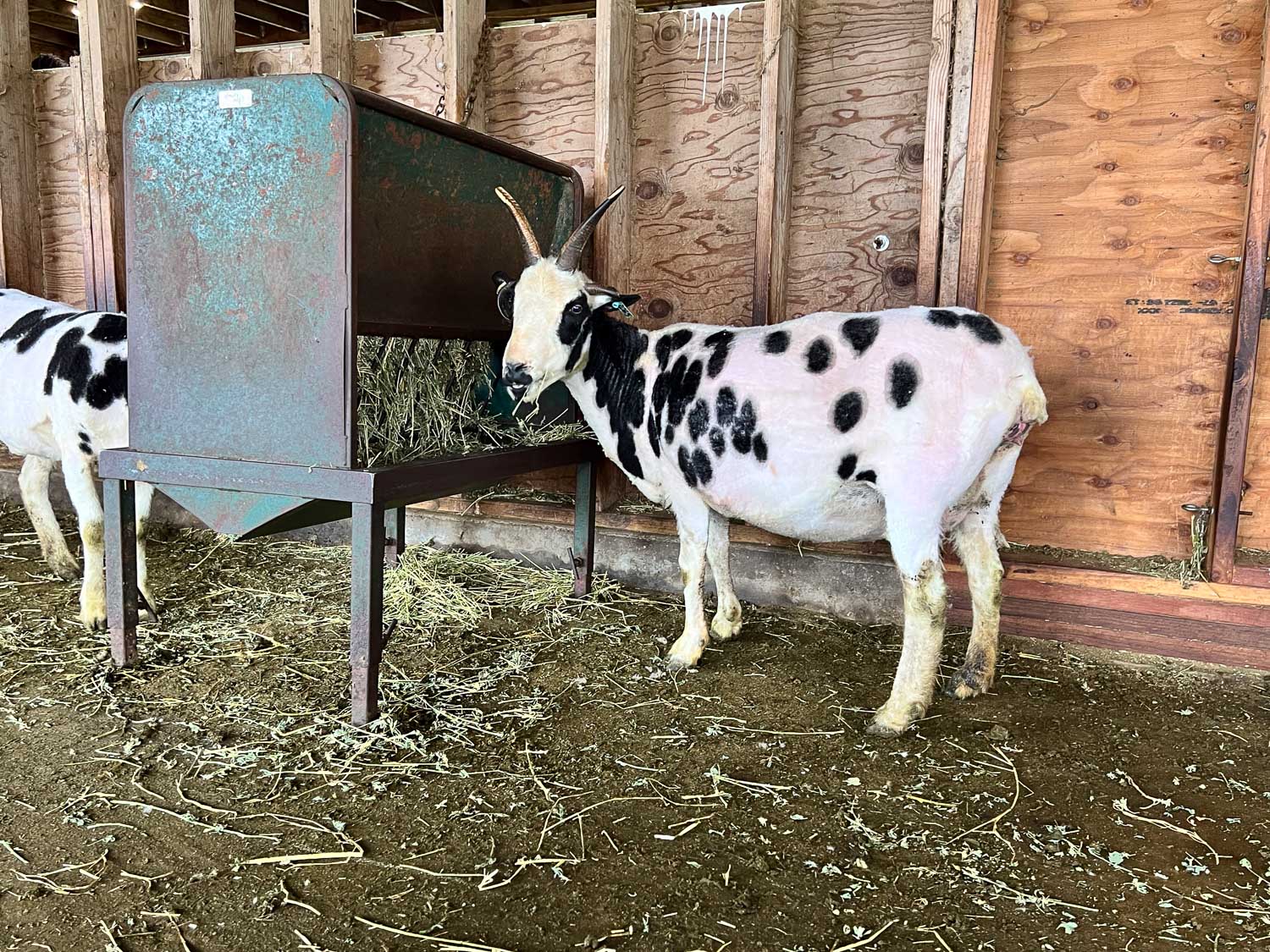
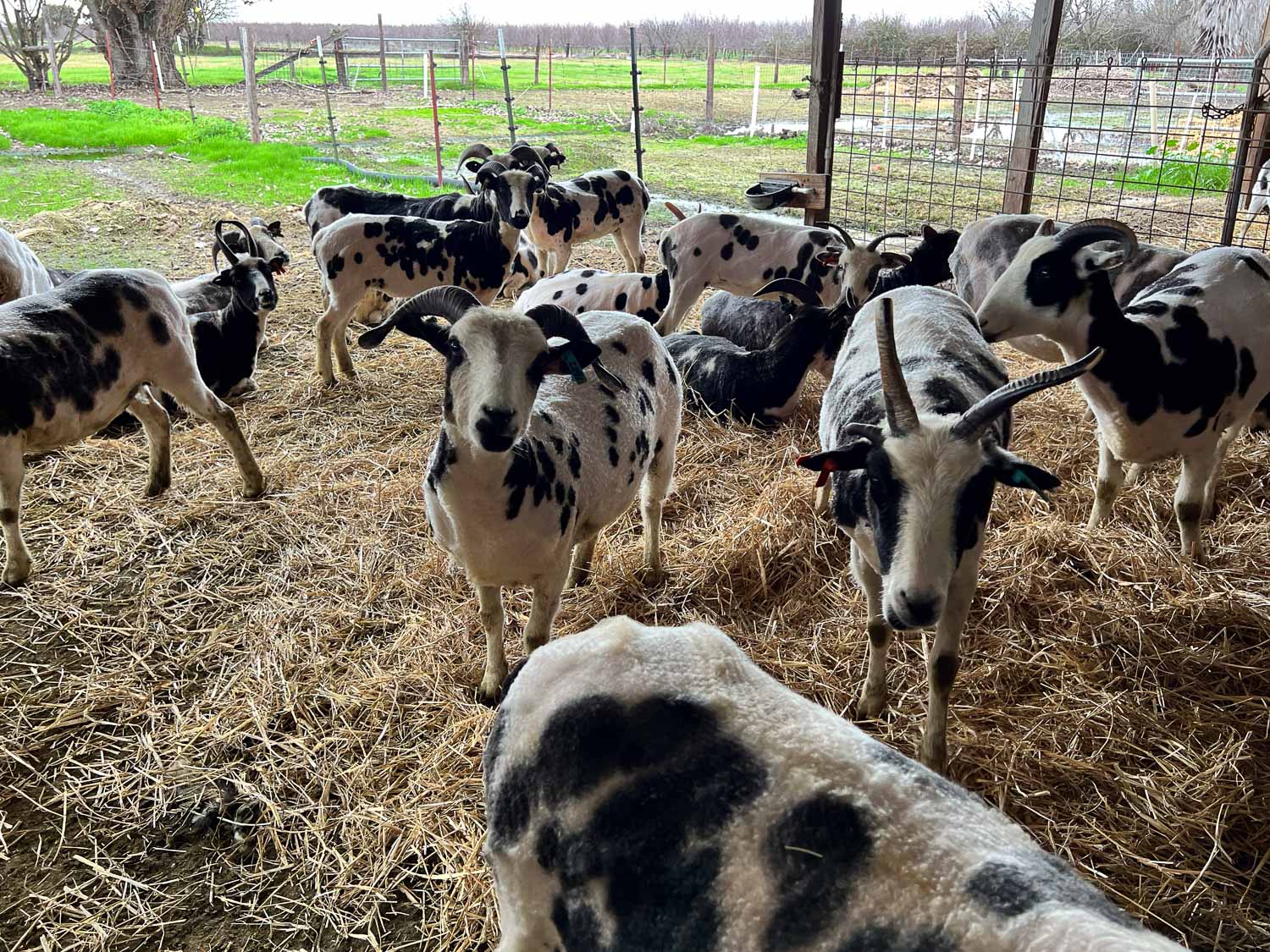
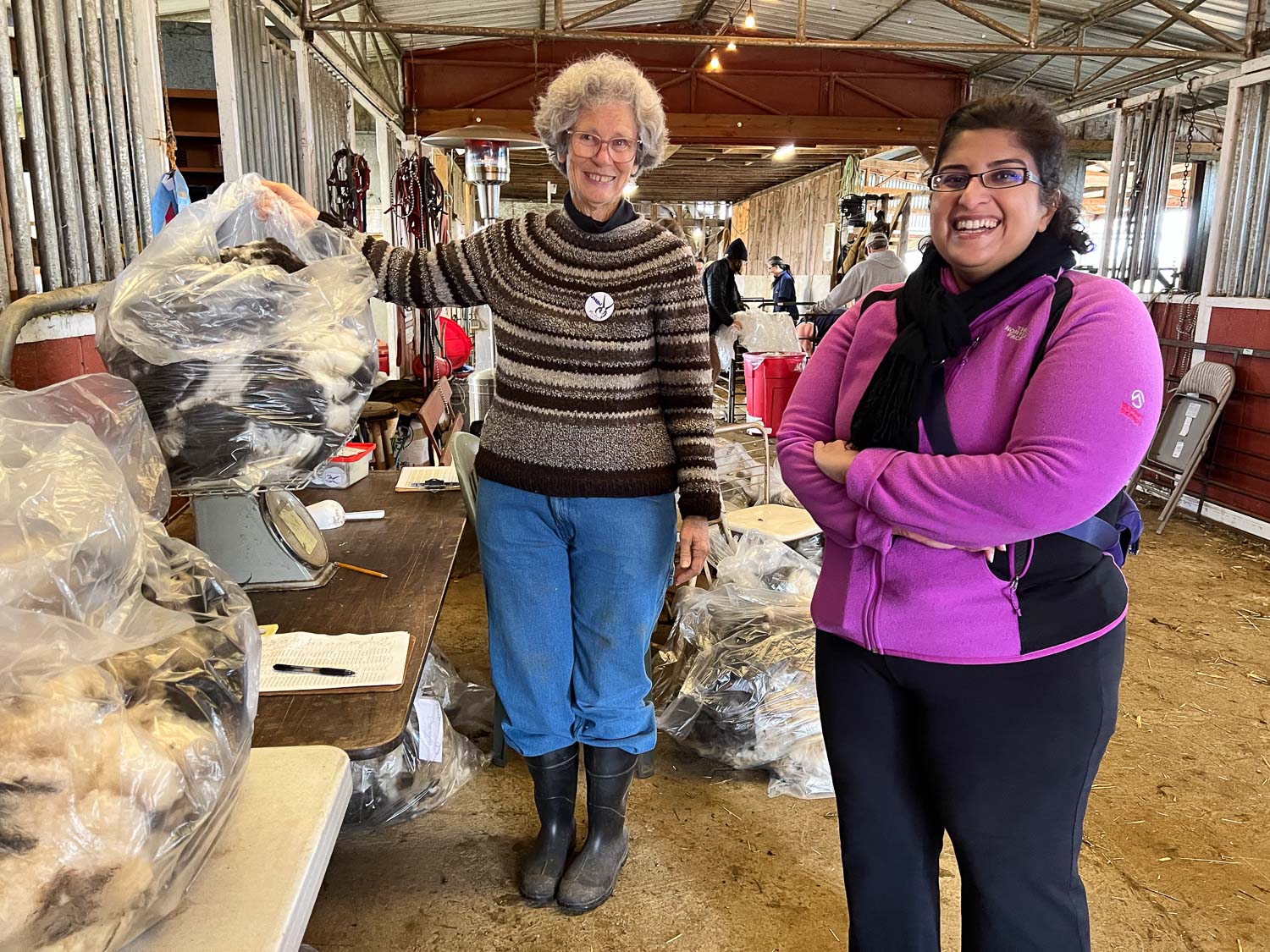
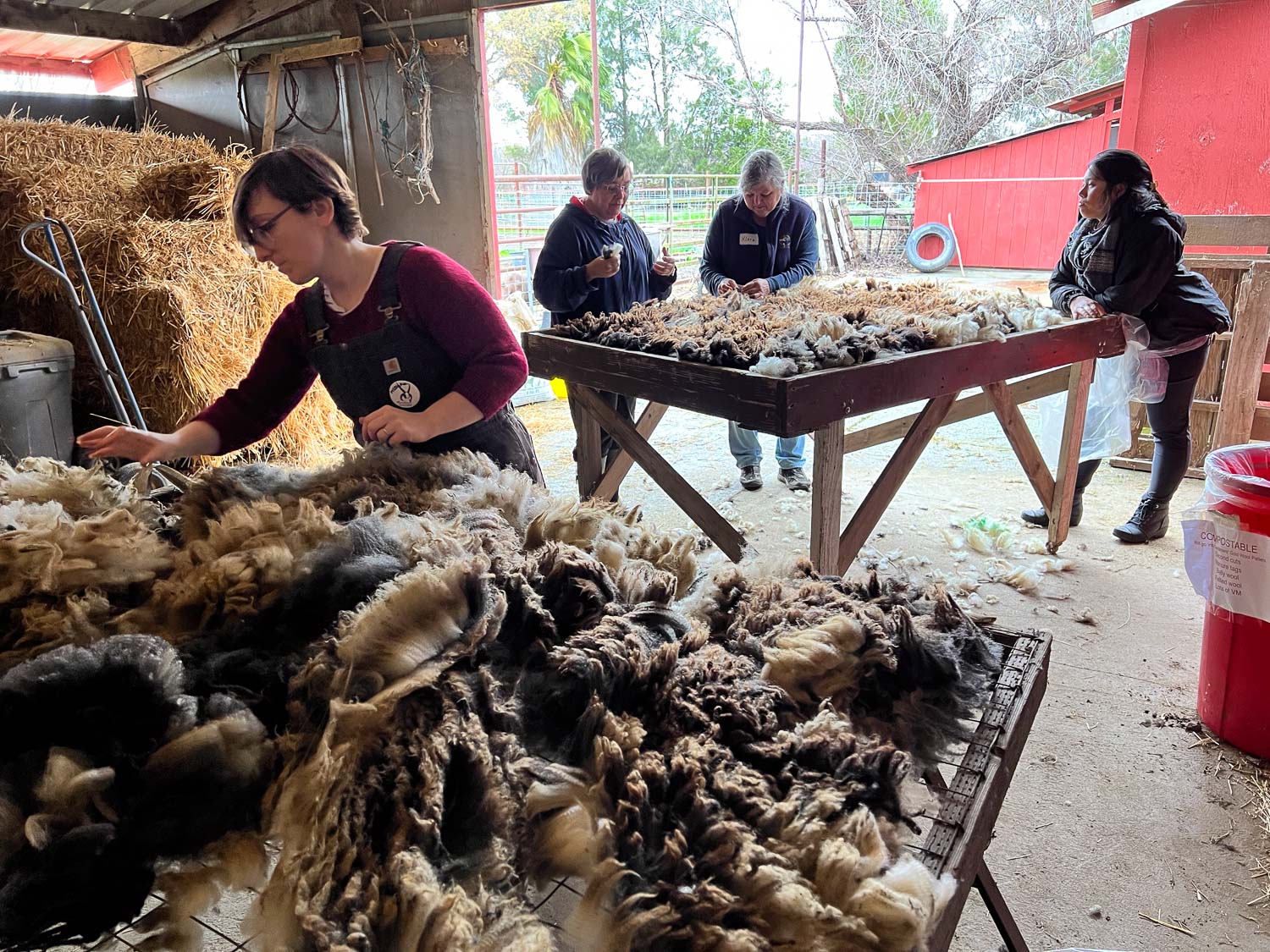
Every year I choose some sheep to coat–it’s usually those that are entered at a show. This year we took a trailer-full to Black Sheep Gathering (photos of the show). I coated most of those sheep because those who aren’t coated end up with straw buried in the fleeces. I kept coats on most of those afterwards so now there are nine sheep with coats.

Why coat?
1. The fleeces are free of VM (vegetable matter) which could be stickers, seed heads, etc from the pasture, but our pasture doesn’t have any of those. Alfalfa is our most likely VM, and is great to spin a fleece that is completely free of that.
2. The colored wool isn’t sunbleached.
Why don’t I like coats?
1. I would rather see the sheep in the field without coats.
2. Coats need changing as the wool grows, at least four times each year, and maybe more.
3. Coats need repair, especially when worn by horned sheep.
4. Coats can cause felting or other damage to fleece if they aren’t changed at the right time.
5. At this time of year with 6-1/2 weeks to go before shearing I’m running out of the larger sizes.
I changed coats last week and took photos of some.

This is Lily wearing a coat that looks snug. I changed this one but didn’t get a photo.

This is how Breeze looks with the coat removed. There is a bit of sun-bleaching because she didn’t wear the coat all year, but you can tell a difference from the neck wool that isn’t coated at all.

Breeze’s fleece.

Breeze with a larger coat.
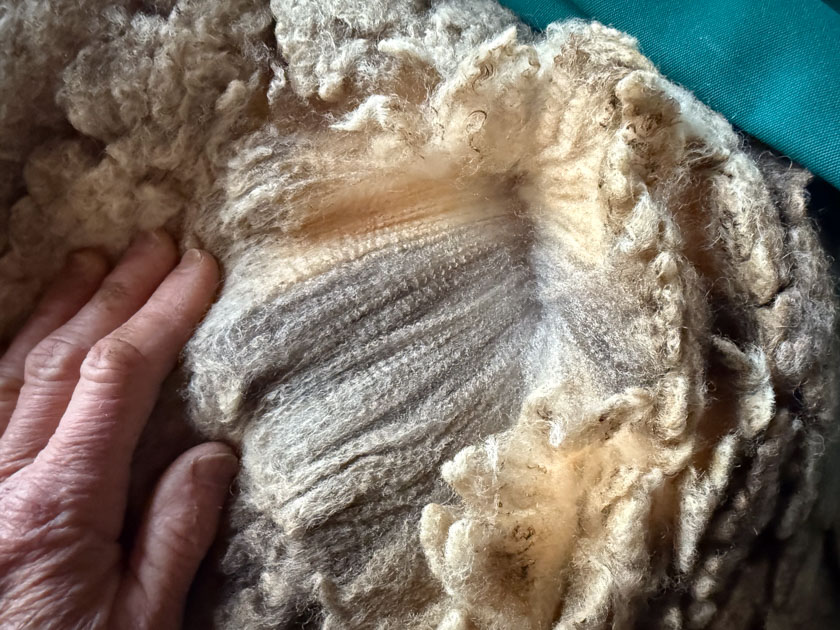
I didn’t get a photo of Zoe, but here is one of her fleece. Gorgeous!
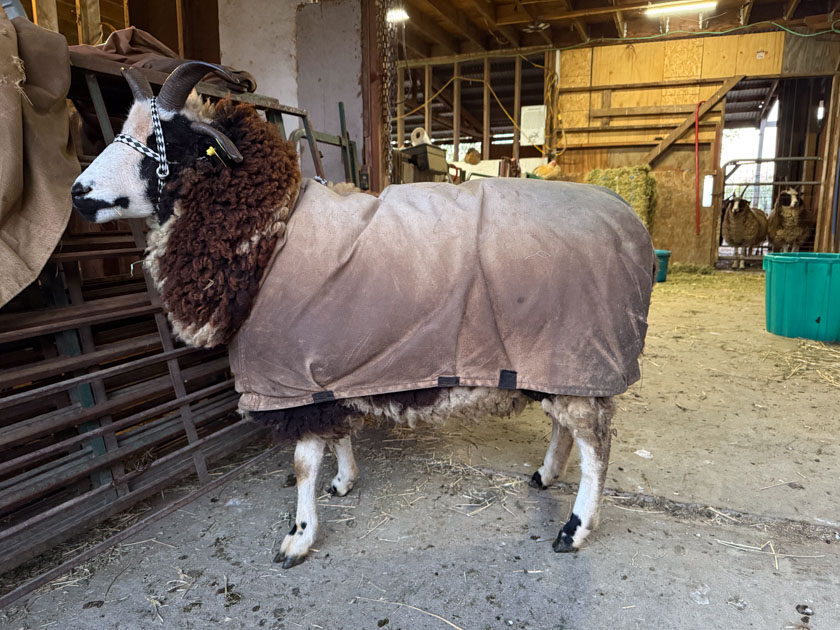
Harmony with a coat that looks too snug.
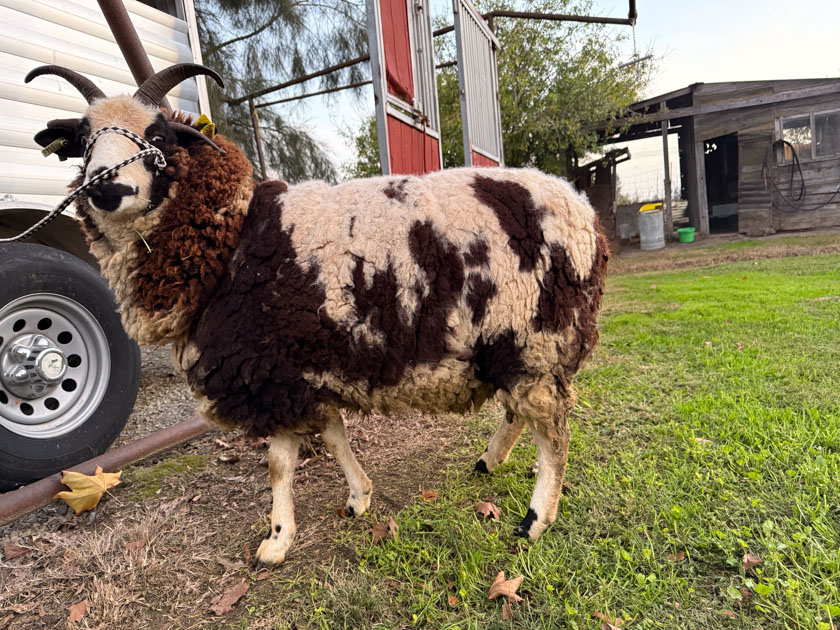
This is what’s under the coat.

Harmony’e fleece.

Harmony’s new coat.

Weaving to Finish

I should catch my blog up on the weaving side of life. I am always trying to squeeze weaving into the day. There are a lot of ongoing projects and many that are off the loom but not finished. There is a saying “It’s not finished until it’s wet finished.” Wet finishing is an important part of the process, but there are often other steps between taking the piece off the loom and wet finishing. Here’s a round-up of all the projects that are waiting around to be finished.

Three handwoven wool blankets folded. These need to be finished.

These three wool blankets have been off the loom awhile. The one in the middle is ready for wet finishing. So is the one on the right…or maybe not. I am going to sew a hem. I have to decide if I’ll finish the hem before or after wet finishing this time. I usually do it after. The blanket on the left has a warp error the whole length of the blanket that needs to be fixed. I didn’t see that until the blanket was cut off the loom.

Four handwoven purple chenille scarves that need to have fringe twisted.

These chenille scarves have been off the loom a long time. They need fringes twisted before washing.

Handwoven cotton shawls in bright gold, orange, and yellow. These are folded and the fringe isn't twisted yet.

Two cotton shawls that need twisted fringe and then washing.

Three black and white handwoven shawls folded. Shawls are woven with a pinwheel design.

Jacob shawls woven in black and white pinwheels. I think that the pinwheels will square up with wet finishing. They are a bit elongated now. I have twisted the fringe on one of these but need to do that on the upper left. Bottom left doesn’t have fringe and the ends will be sewn together. to create a mobs wrap.

Handwoven cotton shawls woven with space dyed warp.

These are just off the loom. I wove the piece on the right first. I dyed the warp last week. This piece has twisted fringe and needs to be washed. I’ll wait until the fringe is finished on the other and run them through the washing machine together. These were on the same warp. The scarf on the right was sett at 10 epi, the sett that I usually use for this Ashford “caterpillar cotton” . Weft is 3/2 cotton. The scarf on the left is sett at 15 epi and weft will be 5/2 cotton.

Now for projects that are on the loom:

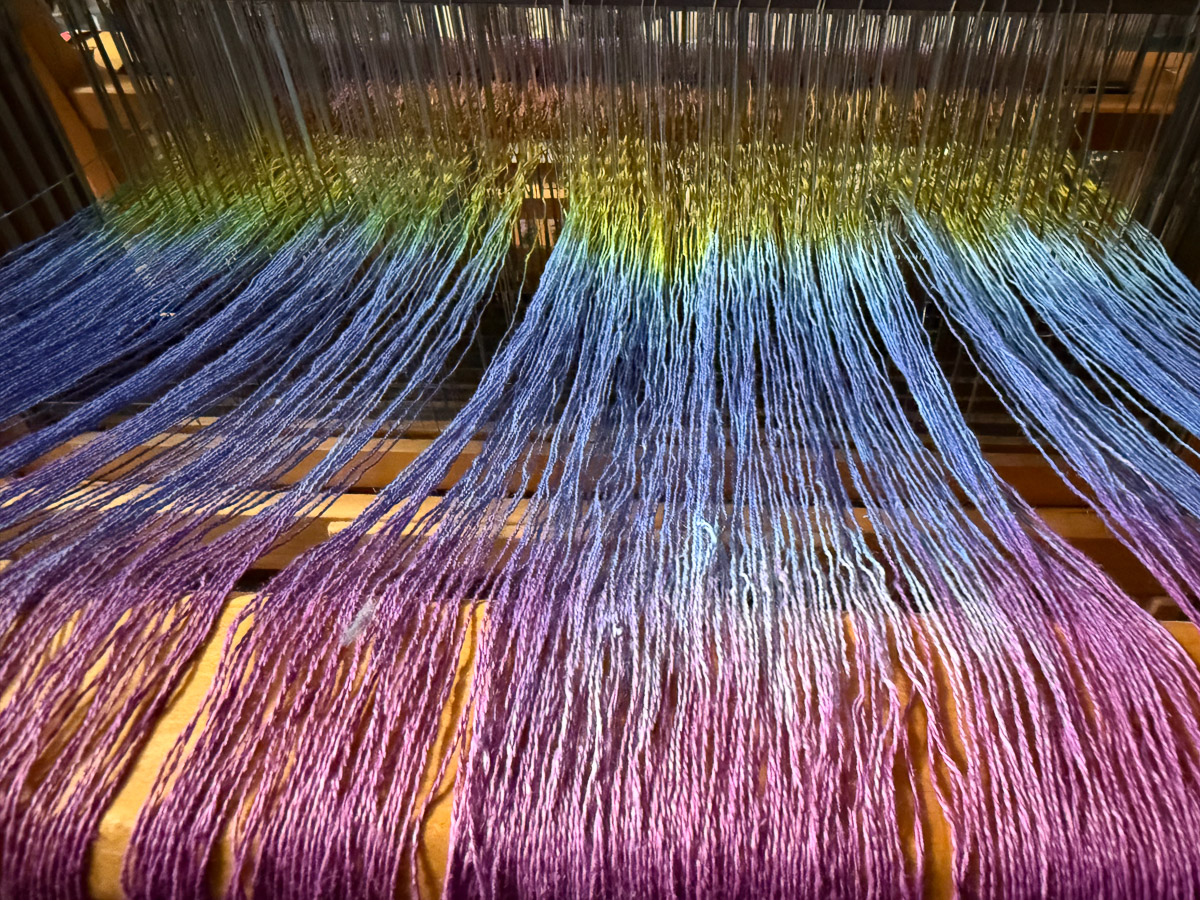
I dyed this yarn last week, along with the warp above. This one is hemp and will be dishtowels. I had to fix a threading error today and will have this ready to weaving tomorrow.

Baby blankets underway.

Wool blankets underway. I really want to finish these blankets this week.

A warp ofj mixed yarns, sourced from Art Fiber Frenzy.

Now I’m getting too tired to do more.

Computer Time and Cycles

This was a catch-up day at the computer. I’m still not caught up, but accomplished a few things. Did you know there is a Meridian Jacobs YouTube channel?

I spent some time today editing videos.There is probably a way to embed them here, but I don’t know how. I’ll include links. Two are from shearing day. Shearing Jacob Rams and Shearing Two Jacob Ewes. The third is one I’ve been meaning to put together for quite awhile. I show how I Using A Warping Wheel to warp my big loom. This is a specialized piece of equipment that is hard to explain even to other weavers.

To make this post a little more interesting, here are some photos that relate to the videos.

This is one of the ewes that was shorn in the video. It’s not always possible to keep hay out of he wool!

This is Eli, one of the rams in the shearing video.

Here is the warp I was winding in the Warping Wheel video. These are the blankets just cut off the loom.

These six blankets are some from the previous photo after wet finishing. The yarn in the blue blankets is dyed with indigo I grew and the brown yarn is dyed with walnut hulls.

There is are cycles to farming. The sheep are shorn and starting to grow new wool. The ewes are pregnant and lambing season will start soon. These blankets are woven using wool I get from Timm Ranch and have spun into yarn. Timm Ranch shearing will be in March and I’ll skirt fleeces and buy wool for the 2025 yarn. I am still waiting on the 2024 Timm Ranch yarn. Due to unforeseen circumstances I will be combining the 2024 and 2025 wool for the next batch of yarn.

The dye garden has its own cycle. I won’t be ready to dye blue yarn until the indigo plants get big enough…and they aren’t even planted yet for this year. Fortunately I have some dried cosmos and hollyhock flowers that I can use, but that’s only if I have enough yarn left from previous years. The cycles don’t always overlap the way you want them too.

Shearing Day 2025 – Part 2

Shearing Day was a week ago. Here is the first post.

As we loaded Trish’s sheep into the trailer John kept shearing, starting with my rams…

…and then moving on to ewes.

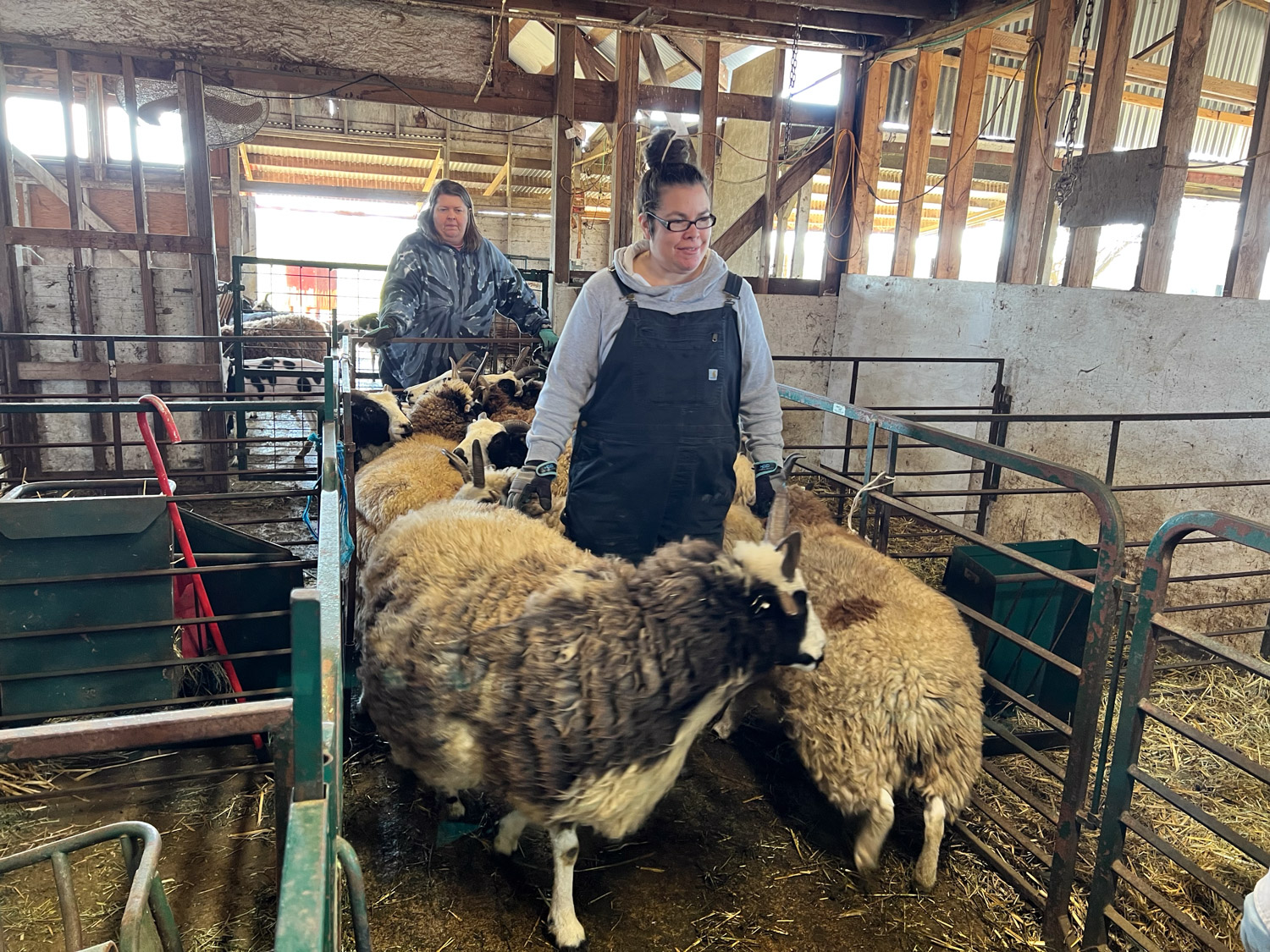
Farm Club members kept the sheep coming so that John didn’t have to wait.

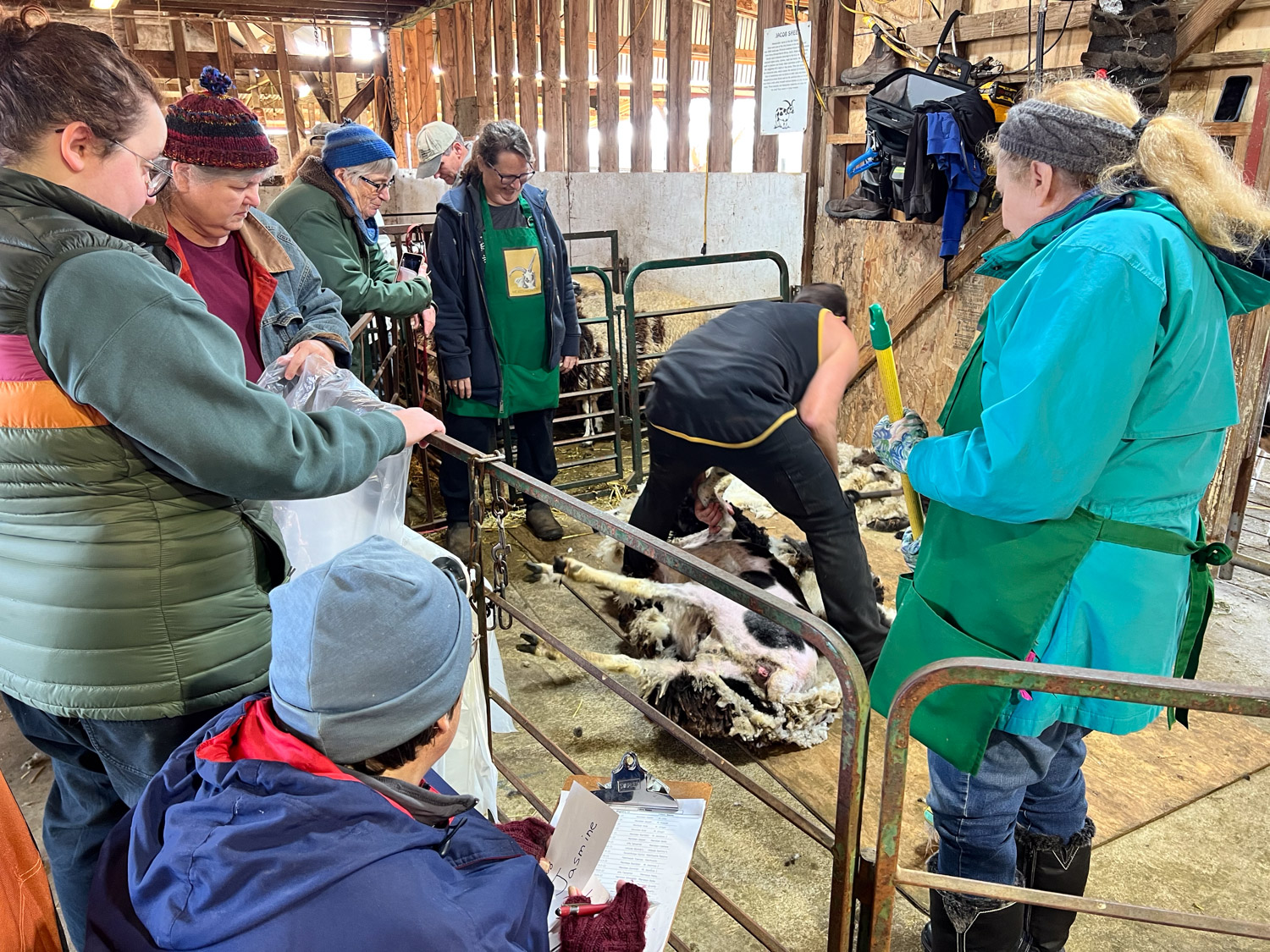
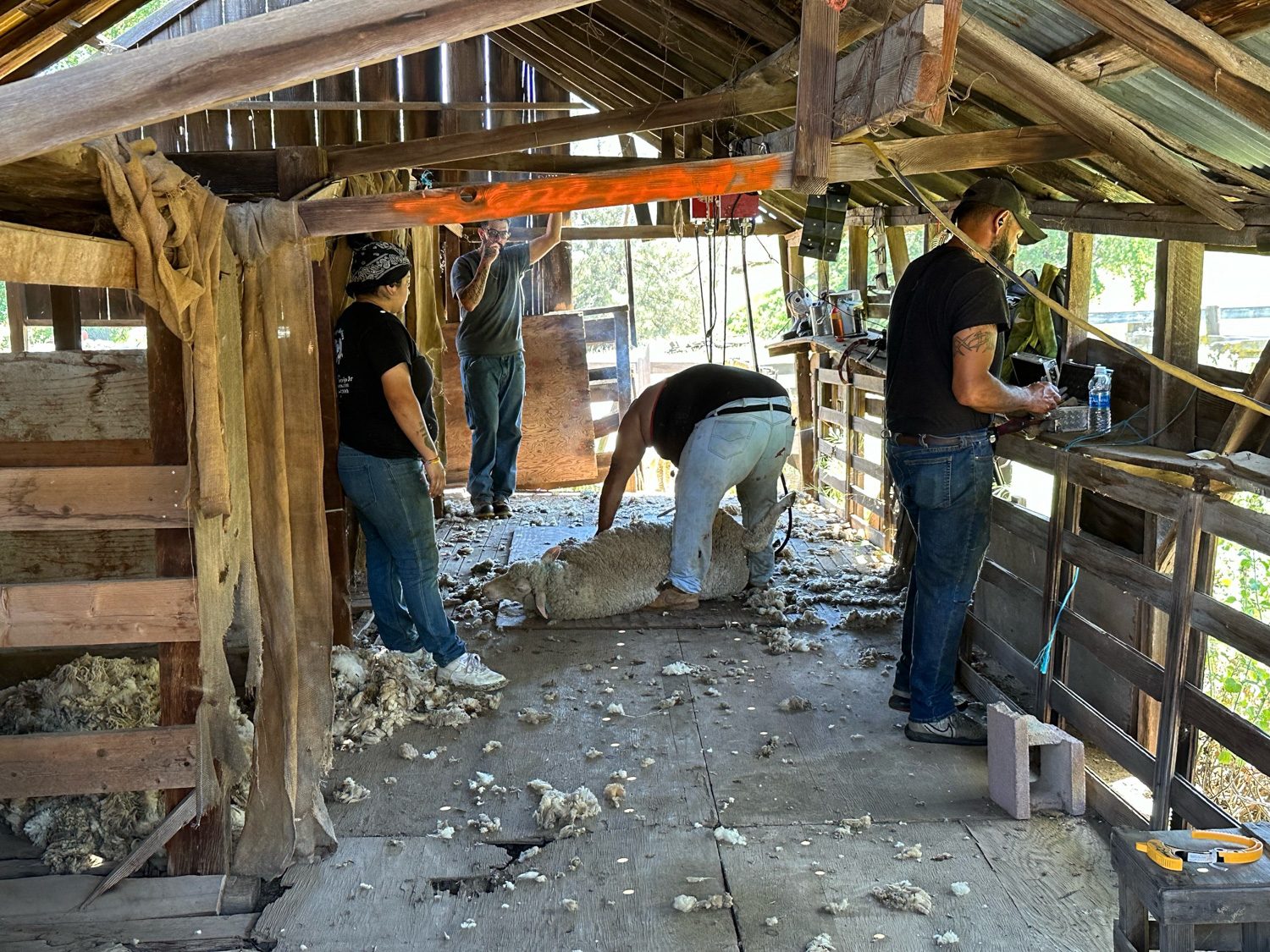
Farm Club members covered all the jobs. They moved sheep, bagged fleece, checked the ciipboard, swept between sheep and let sheep out as they finished. I have videos of shearing but haven’t had time to post them yet. Because I recorded 4 or 5 videos I can say that John shears a sheep in just over 2 minutes. It is amazing to watch.

We bedded the barn with straw knowing that would help with the cold at night.

The shorn sheep enjoyed the sun during the day.

Farm Club member, Kathleen, took over her annual job of weighing fleeces.

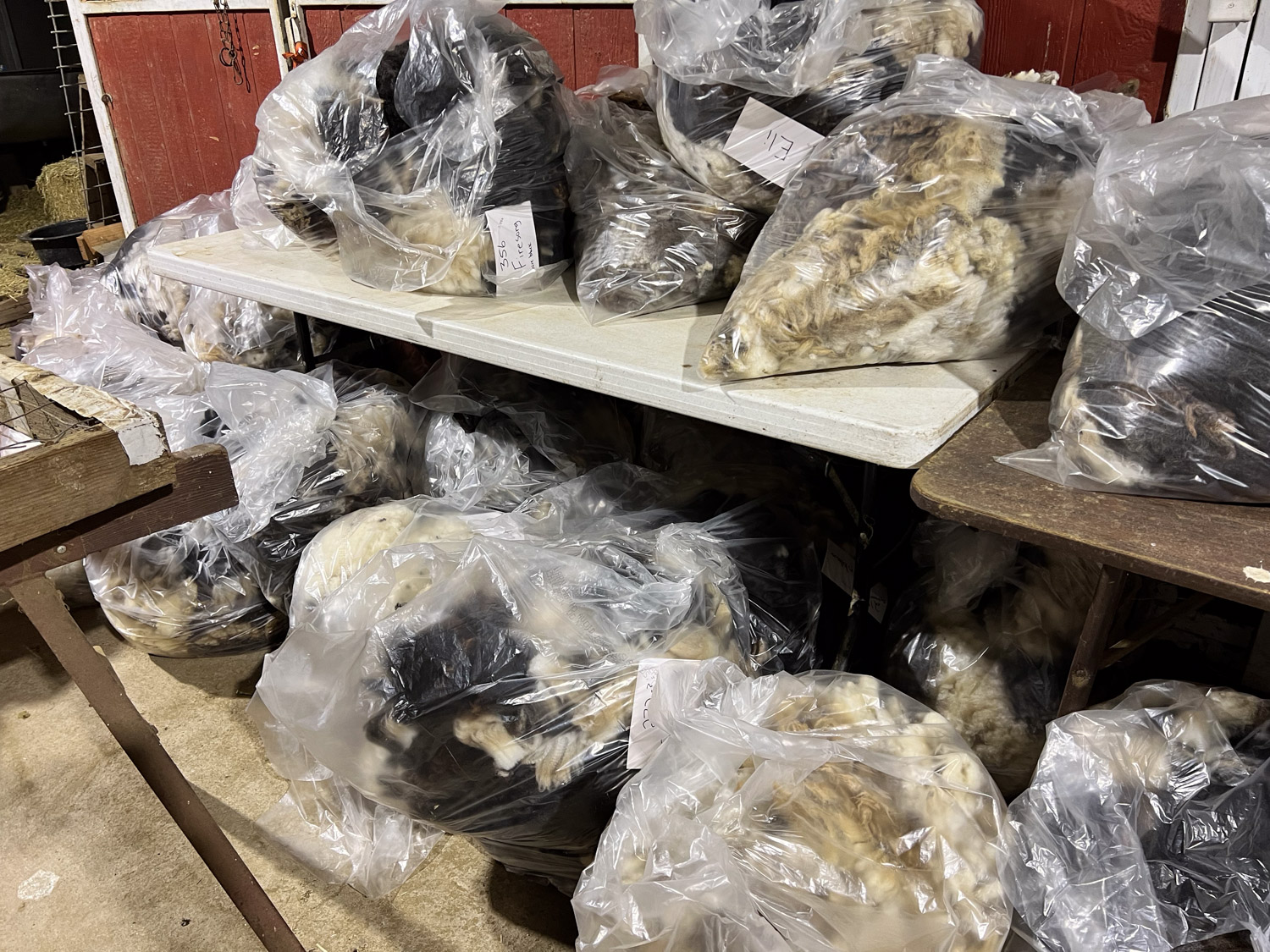
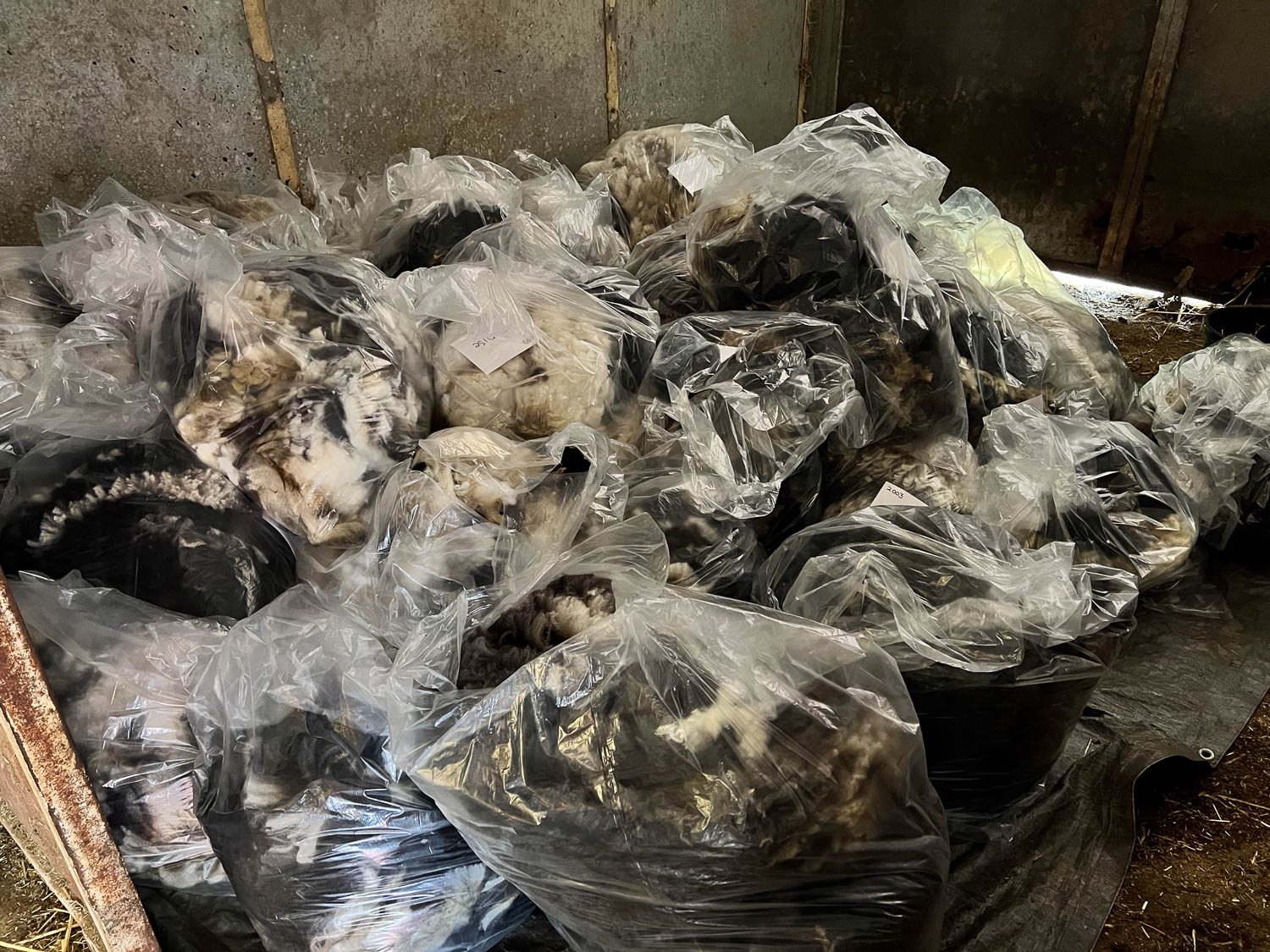
This is just some of the fleeces, bagged and labeled with sheep name and weight.

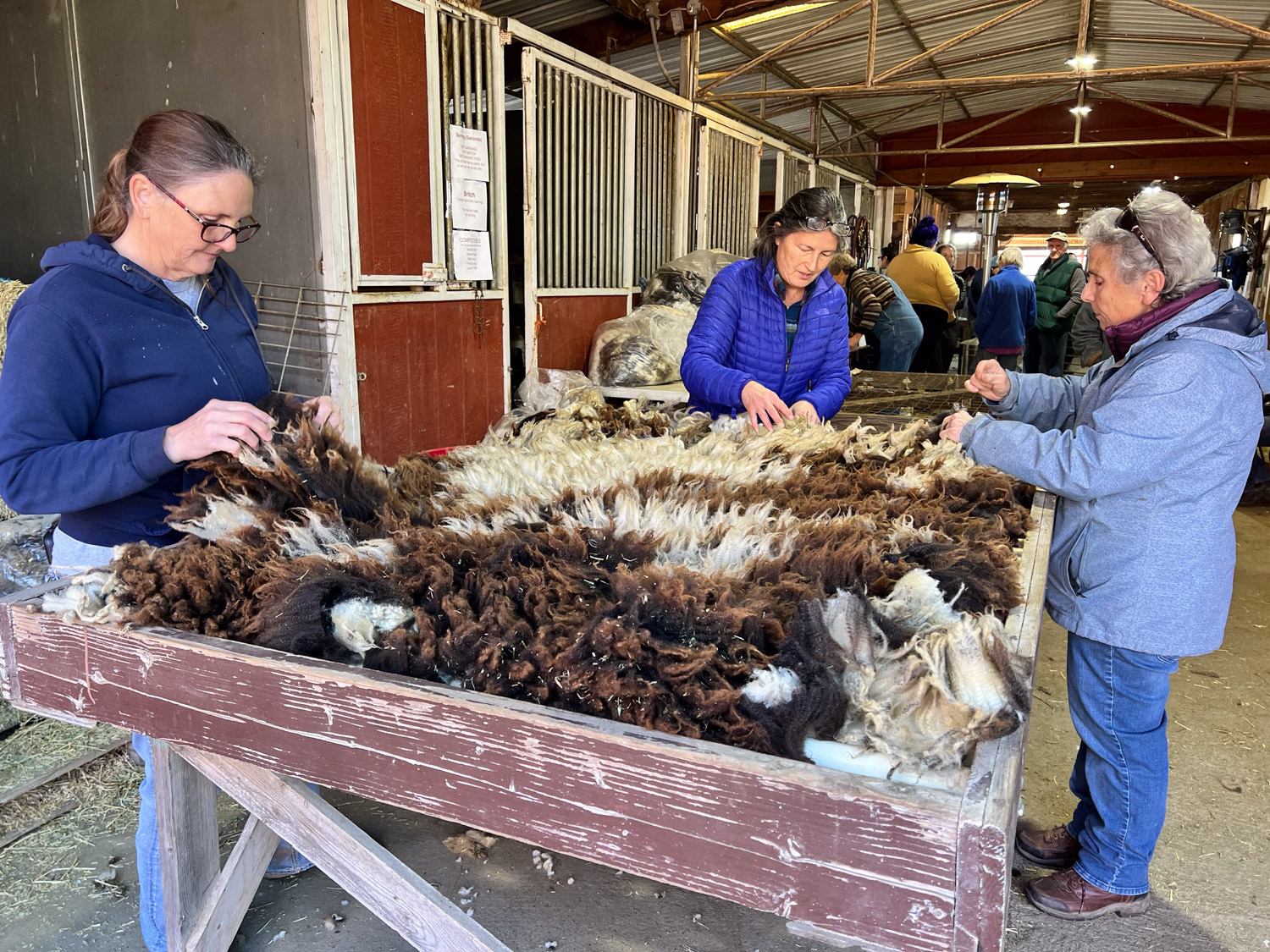
Farm Club members and other friends who purchased fleeces were able to skirt fleeces the selected.

This is our youngest Farm Club associate, son of a member. He wanted a job and spent most of the morning cleaning the barn with the help of Dad.

Shearing Day can be tiring. This is Oakley, John’s dog, in a pile of belly wool.

After shearing was over I called on three Farm Club members, who are now tagged as the Tech Team, to figure out why I couldn’t get the barn cameras to work after we made a big switch to a new internet service. I hadn’t been able to get them set up again. Farm Club members have links to those cameras. Success!

Shearing stats: We sheared 64 ewes, 12 rams, and a wether. That’s important to know because shearers charge more for rams. I guess it’s a good thing that they don’t charge more for horns. (Joke) Of those sheep 47 ewes, 9 rams, and the wether are mine. We didn’t shear 2 ewes who will be the subject of another blog post. Fleece weights range from 2.5 to 6 pounds. That’s typical for Jacob sheep.

I need to start skirting and sorting fleeces so I can get some on the website for sale and others to the mill for processing.

Lambtown 2024 – Part 1

Lambtown is our local fiber festival–only 15 minutes from my farm. After a very different beginning many years ago (but that would be another story) it is now a full-fledged fiber show complete with sheep, sheepdogs, contests, classes, vendors, demonstrations, and other activities. It is the first weekend of October, but starts on Thursday with classes. If I am going to teach it has to be on Thursday because I set up a vendor booth on Friday and am in the booth both Saturday and Sunday. This makes for a busy week. I knew I had to have the trailer packed up on Wednesday.

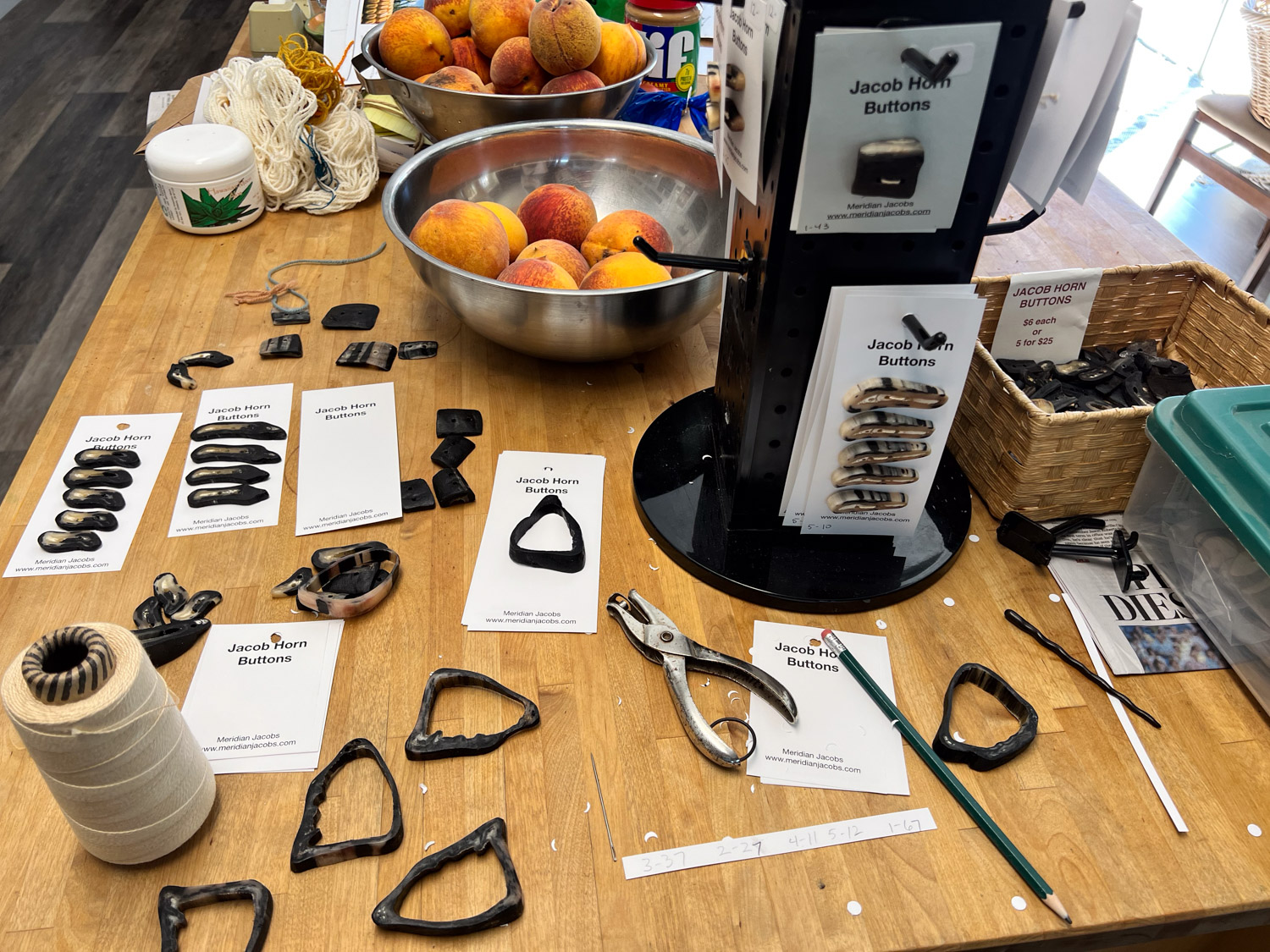
The kitchen island one of the evenings that week. I described making these buttons here. After making them I still have to put them on cards, especially for selling online later.

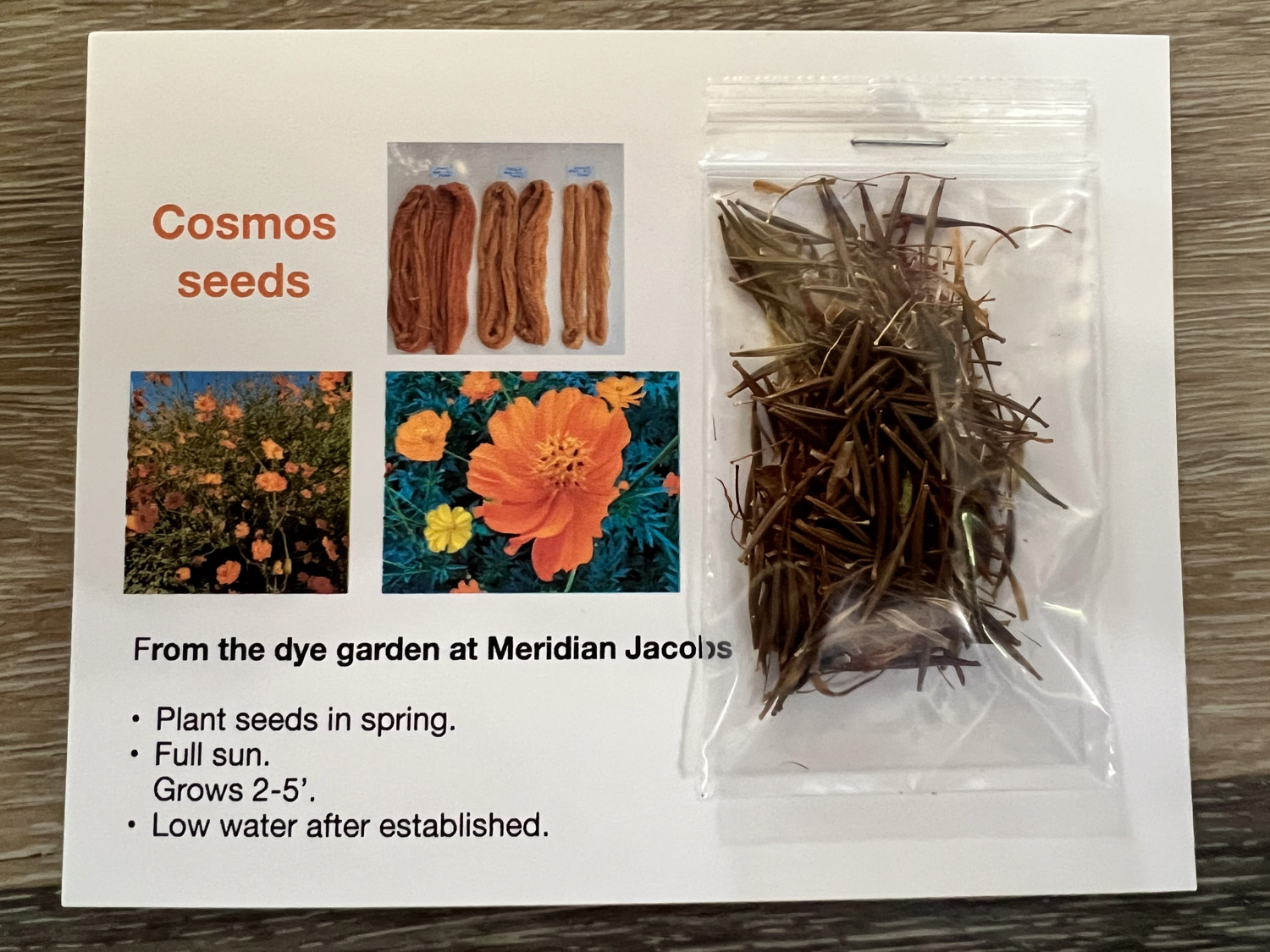
A friend thought that I should sell cosmos seeds to grow flowers for dyeing and printing, so I worked on that too.

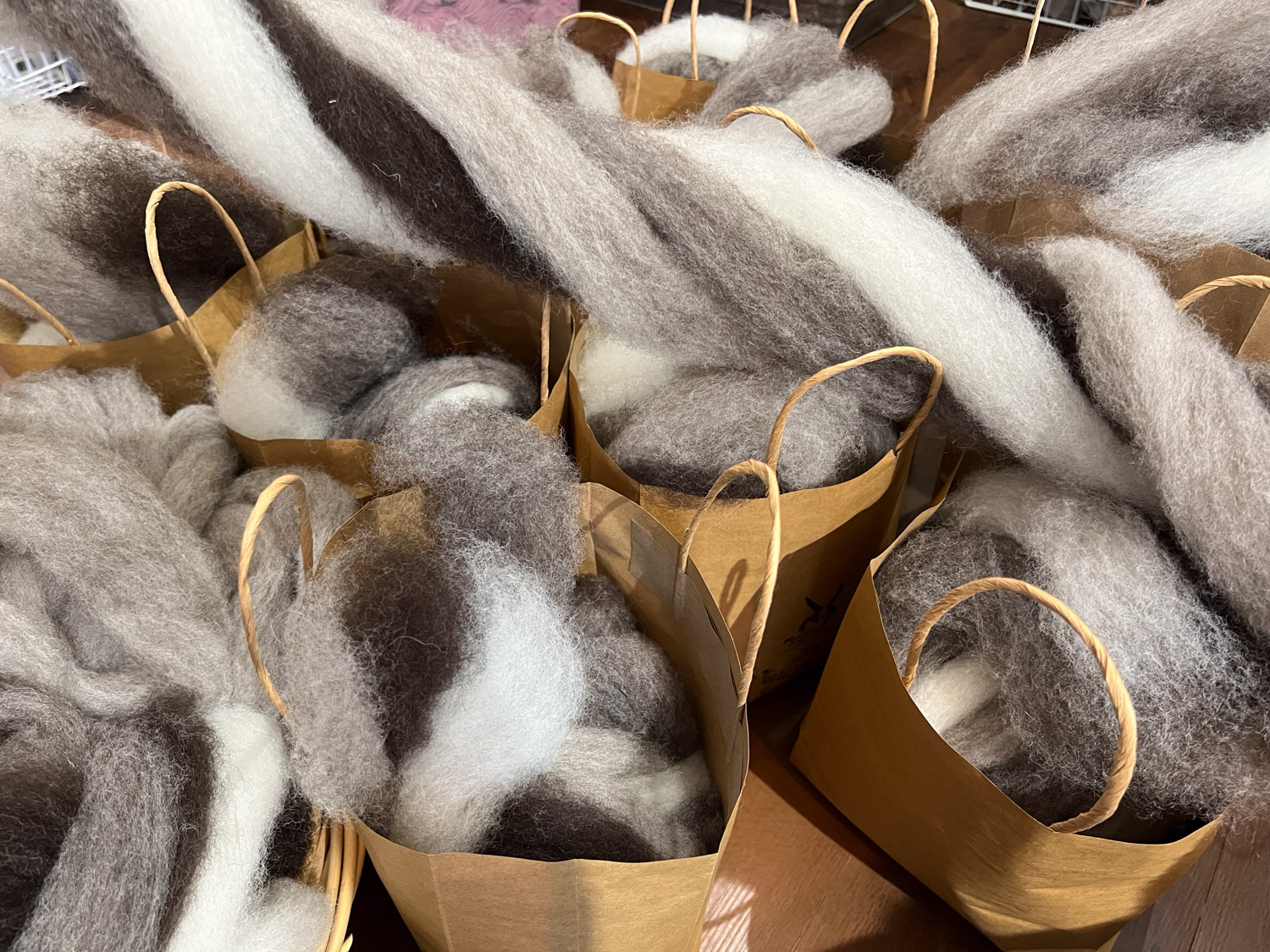
I picked up the 2024 Jacob fiber from the mill on Tuesday and needed to weigh it. Some were single color bags and others are a mix of all four colors.

A few of the shop while I was still trying to decide what to pack up for the show.

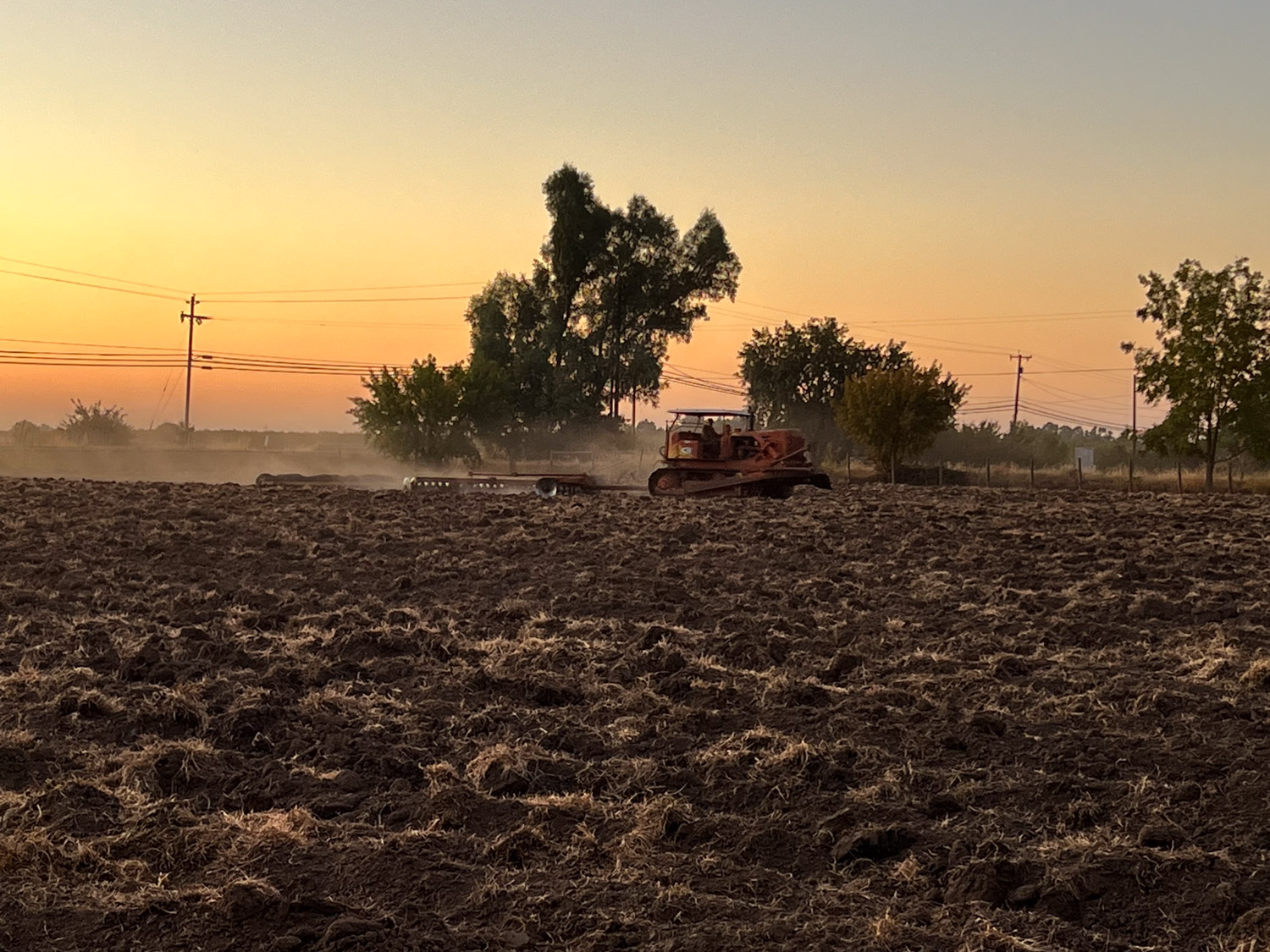
Thursday morning, Brett was at work discing the pasture. That project was described here. We haven’t moved beyond the last discing. Hopefully leveling will happen soon.

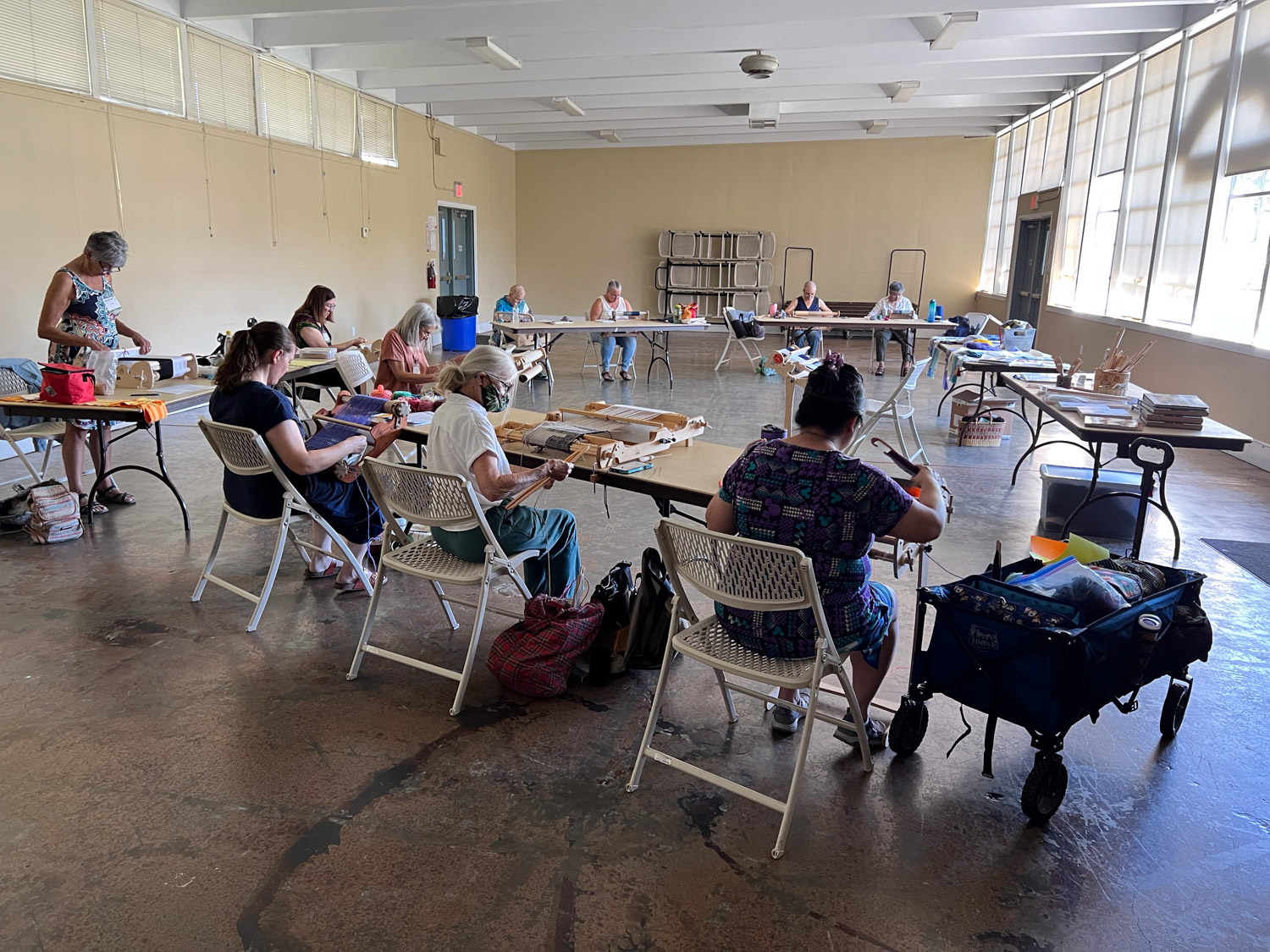
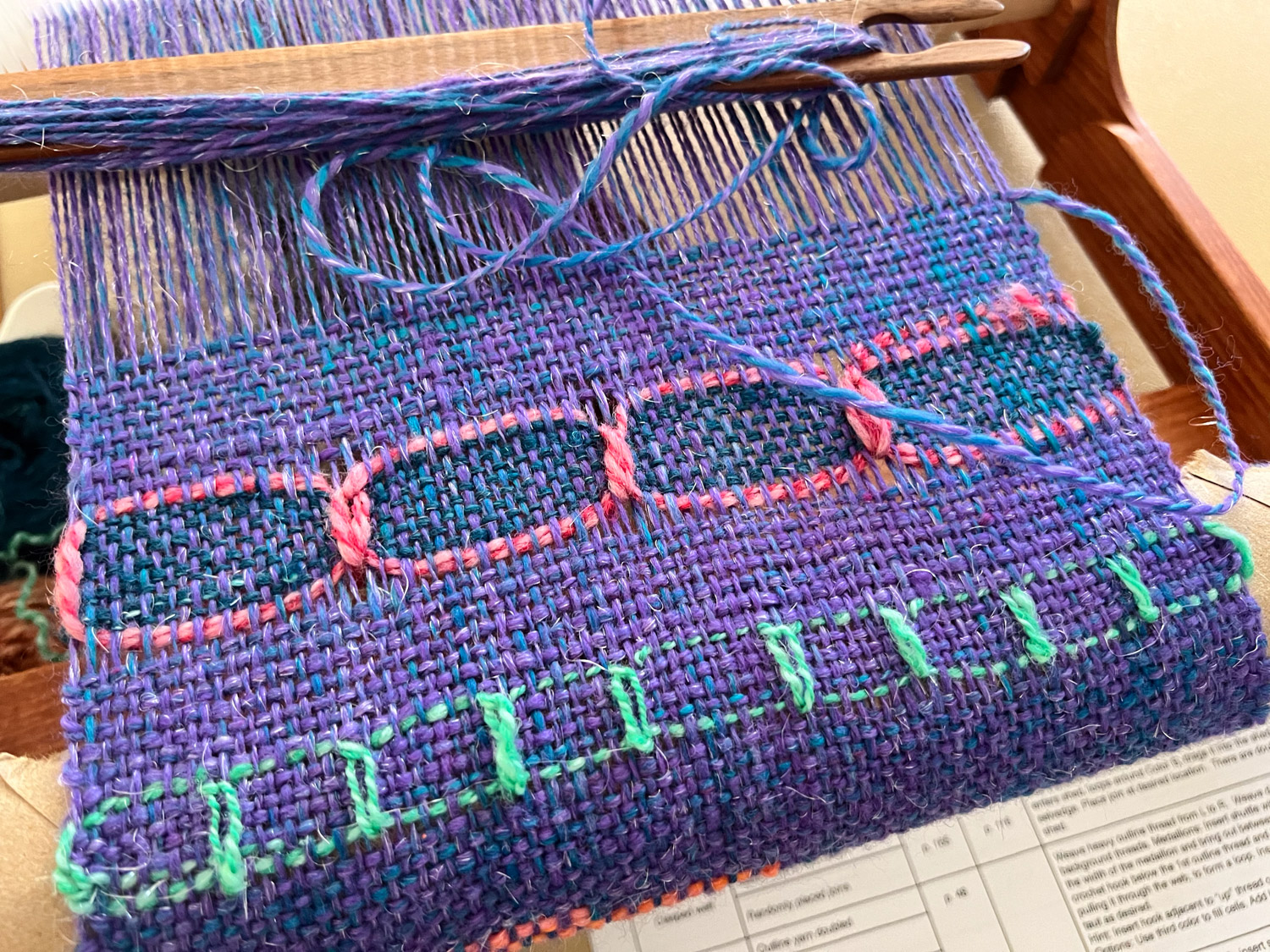
Thursday there were ten students in my “Let’s Get Fancy” class where I showed hand-manipulated techniques for design in weaving.

Danish Medallions.

Brook’s Bouquet, Leno, and Loops.

Friday was a full day as we harvested lambs first. A friend brought her lambs here for one of my customers and I salted the hides. We finished around 11 and went to the fairgrounds by noon.

Here is what the booth looked like by the time I went home.

The other half of the booth. It still needed tweaking, but it was mostly done, thanks to a couple of friends who spent the afternoon helping. We still needed to get the sheep here for the sheep exhibit so I went home to load sheep.

Dan and I drove back with sheep and Farm Club members met to figure out how to best set up a display.

Stay tuned for Part 2.

Black Sheep Gathering 2024

I’m already on my next adventure, but need to catch up with the last one. After the quick trip to Idaho I decided against going to Black Sheep Gathering in Oregon the following weekend. I had not planned to take sheep this year and had not entered wool, fiber arts, etc. But half way through the week I changed my mind. Without entering any shows I didn’t have to be gone as many days, so I left Friday morning. I will admit that two hours into the drive I thought about turning around and coming home because I had so much to do at home before the next event (where I am now). However I had told a friend in Oregon that I’d visit along the way, so I kept going.

Here is where I stayed the three nights I was there. As I set up my tent I realized that I think I’ve had this tent and my sleeping bag since my college days or shortly after.

I took very few photos in the barn, but here is one–a Valais Blacknose. There was a new Jacob breeder there and I helped her show. Because she was the only person with Jacob sheep she had to show in the All Other Breeds class, as I did last year. Maybe I’ll enter again next year and we’ll have a Jacob show.

I took a few photos in the exhibit and vendor hall. These are the main award winners in the Fiber Arts Show.

I spent a lot of time with a few vendors and tried to make time to see the rest.

I met this vendor last year at this event. She lives in Sacramento and I encouraged her to sell at Lambtown last fall. Her booth was next to mine. Even though I specialize in locally grown wool, including my own, I was intrigued by her yarns, many of which are not natural fibers and are certainly not local. But they sure are fun! The larger skeins are all lengths of yarns that are tied together. I had bought a few of these crazy mixed fiber skeins and brought the scarf I had just finished to show how I had used the yarns. I plan to create a class using this idea.

I spent time with one other vendor, business name of Shuttle Creek. Annie is a weaver and was working on a loom in her booth, She sells her mostly cotton garments at local shows I think. I just looked at the website and there are some gorgeous items there but blog and Facebook activity seem to stop in 2021 and I was thinking that she said she doesn’t do much online. Anyway, after talking to her a long time she pulled this piece off a hangar and put on me. I bought it and that’s what wore all day at the weaving event where I’m teaching (next post). I need a button that “no, I didn’t weave it”.

I spent part of the day at the vendor hall, helped the other Jacob breeder show sheep, visited with friends (most of whom are from California), and watched Spinners’ Lead. I packed up fairly early on Sunday and started home.

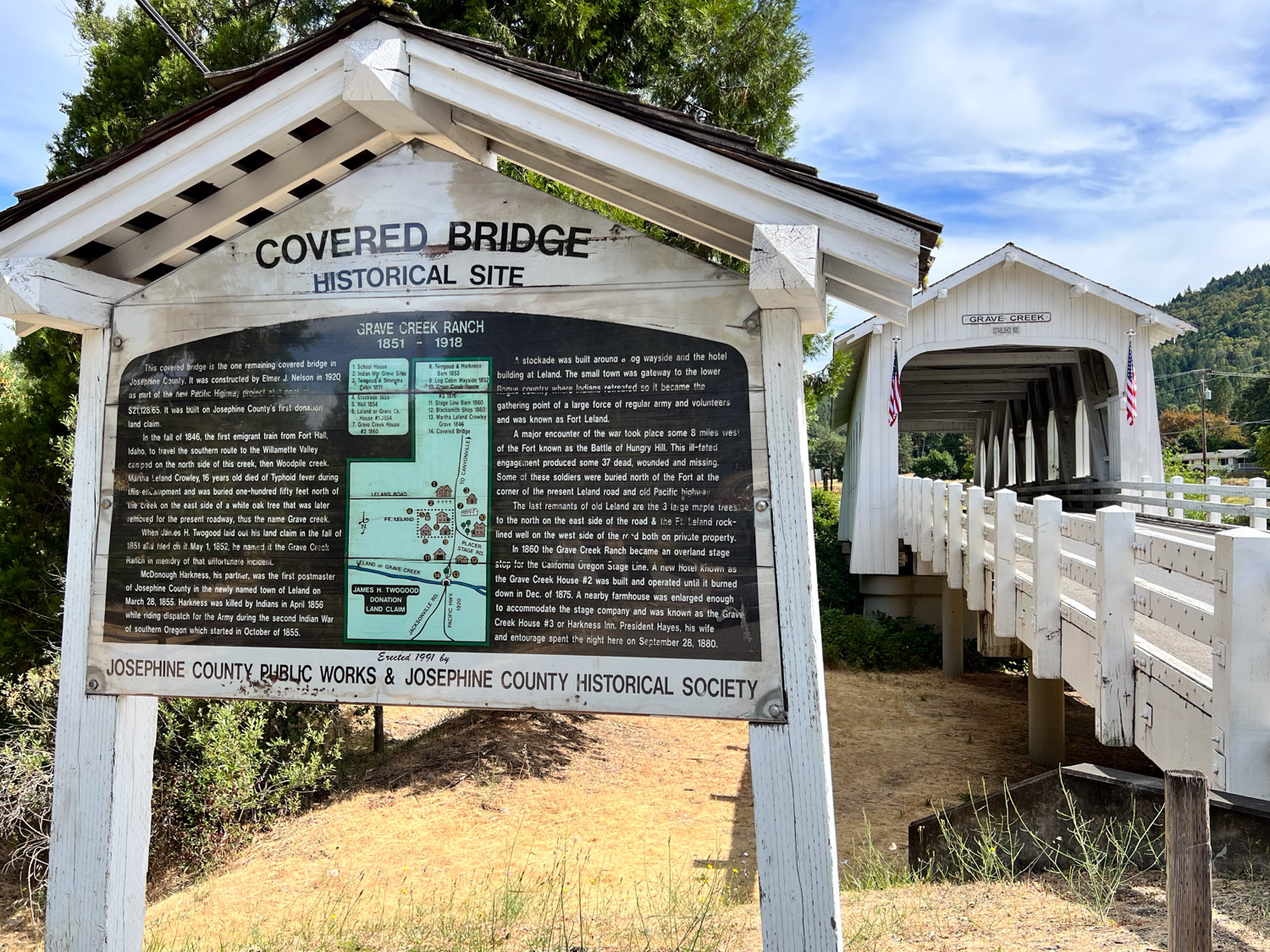
I’ve seen the sign for the covered bridge every time I’ve driven to Oregon but I’ve never stopped. It’s not far from the highway and an interesting site. There is a museum nearby but it wasn’t open on Sunday morning. The bridge was built in 1920 and the sign talks about the history of the area when white settlers came there in the 1840’s and 50’s.

I always at this site in California.

This means I’m almost home. (Sort of.)

Shearing at Timm Ranch 2024

If you do a search in either of the blog locations (WordPress that you’re reading now, or the one on my website that I don’t use much now) you can find Timm Ranch shearing posts from other years. I could probably substitute photos because the sheep look the same, the shearing location looks the same, our skirting set up looks the same, and some of the Farm Club members are the same–but not all of them. I just searched the WordPress blog and see 2015, 2016, 2017, and 2018. After that I think I started with my website blog. So here is a view of 2024.

The sheep are a blend of Rambouillet, Polypay, and Targhee. Once in awhile a new ram is brought in, but the Timm family mostly raises their own replacements so the blend of breeds has stayed the same.

This year they sheared about 120 ewes.

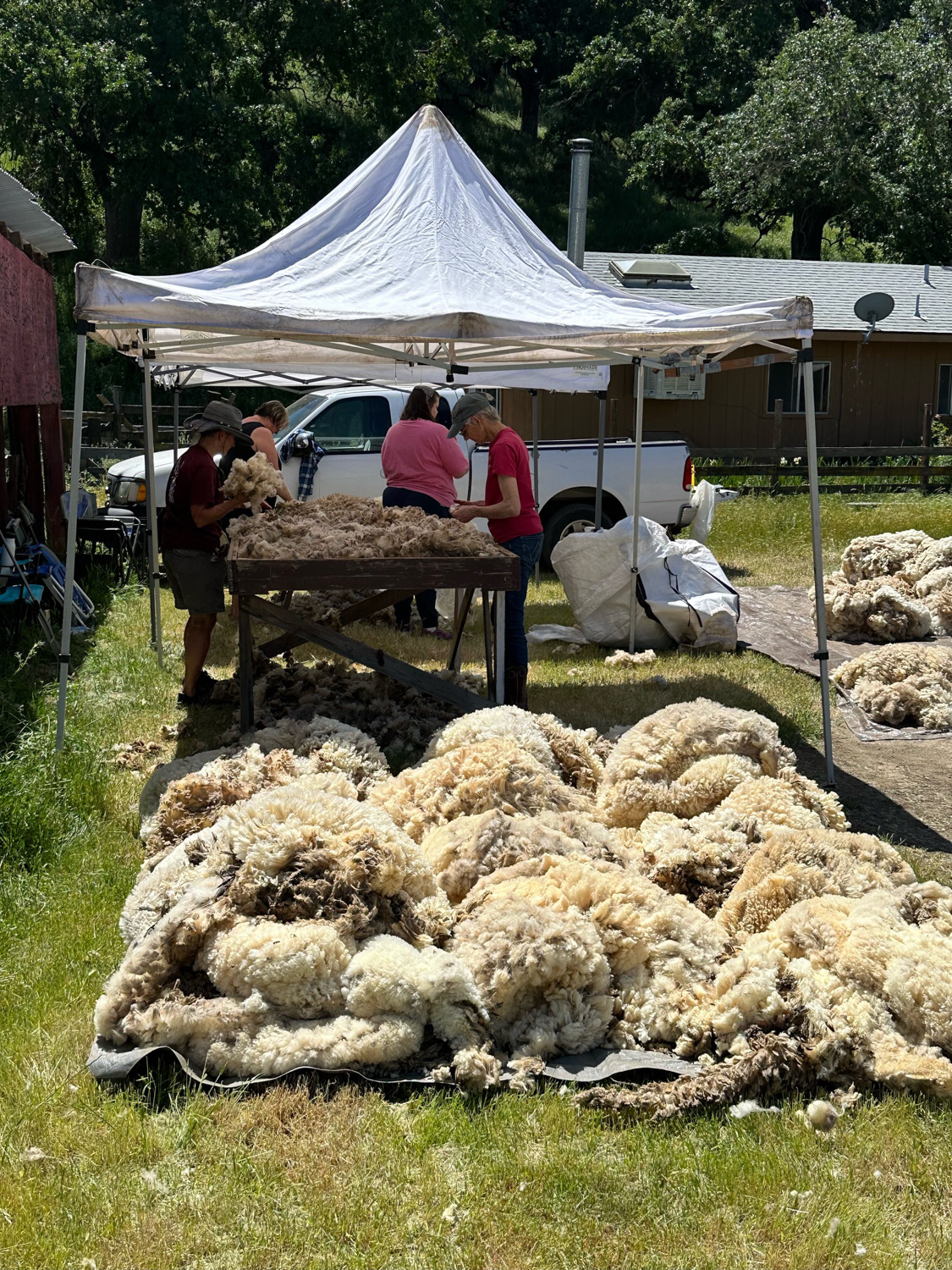
We set up two canopies and two skirting tables.

The shearing team started with one shearer but eventually there were two working.

As the fleeces came off the sheep we piled some of them nearby. We were slower than a professional crew would be, but that is because I want to be careful about what I send to one of our small local mills. I knew there would be plenty of wool so I can be picky with what I take. What we don’t take goes into the bale that the Timm Ranch will sell or to my neighbor, Charlene, to be made into Integrity’s Wool Pellets (formerly Gardener’s Gold).

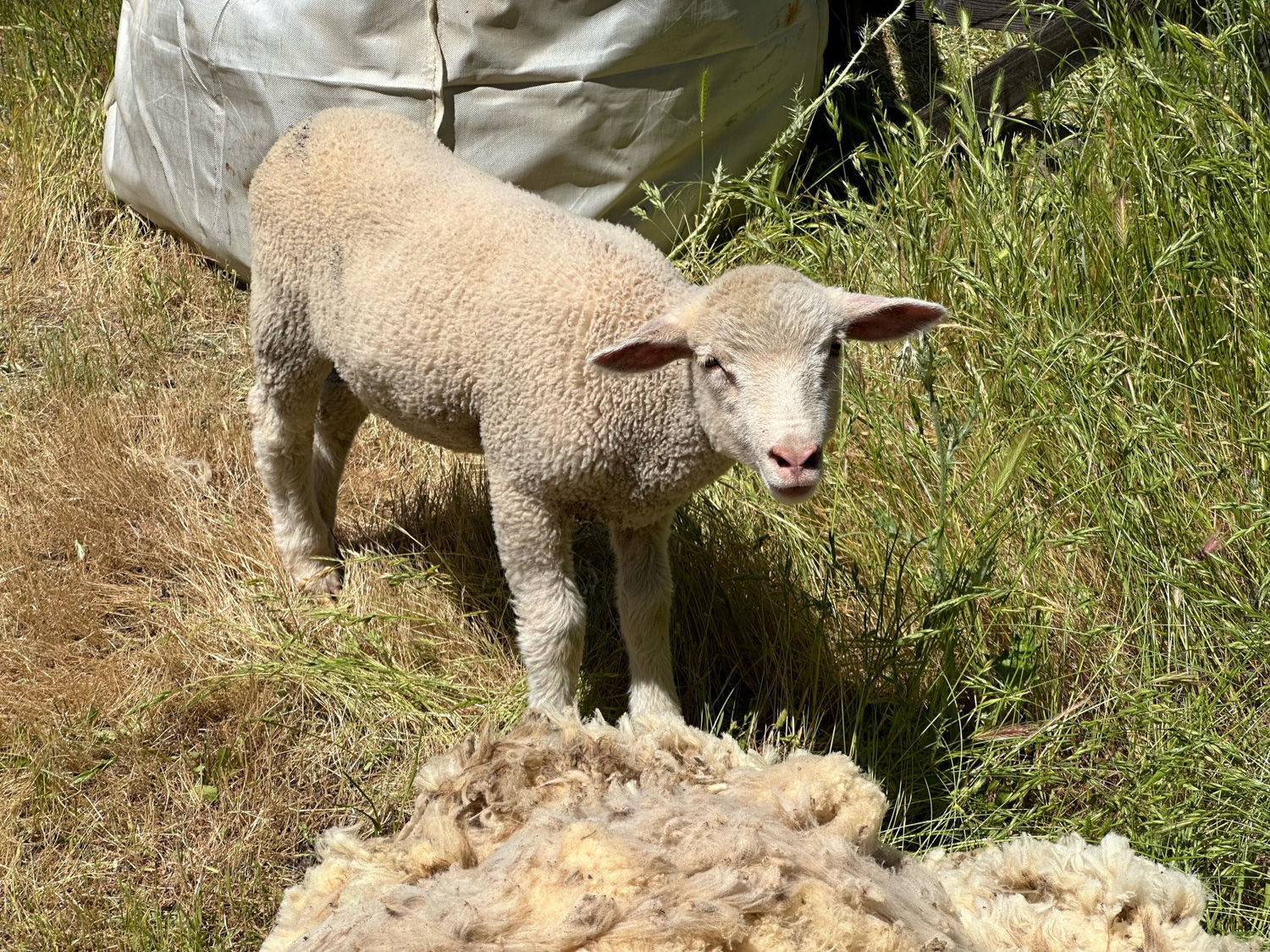
Three lambs got through the fence and wandered around while we were working. (Thanks to Sue G for the previous three photos.)

Another view of shearing.

Ewes after shearing.

We checked staple strength and length and skirted away manure and felted areas.

This is the 130 pounds that I kept. It will go to Mendocino Wool and Fiber for spinning. Yarn from 2022 is here and some of the TR yarn that I have dyed is here. Most of the blankets I weave use TR yarn for warp and sometimes for weft. The painted warp V-Shawls are all TR. You can see a variety of those pieces on this page.

It was a beautiful day at Timm Ranch. Blue sky and green hills just starting to turn gold. Thanks to Farm Club for all their help!

Weaving in 2023 – 1

I saw a blog post the other day in which the writer had recorded everything she wove within that year. That gave me this idea. I’m taking photos and keeping notes all the time. I may as well use them. I won’t try to fit the whole year into one post however. Maybe I’ll post weaving, then I’ll post lambs, then weaving, then lambs. How’s that?

My warps are all numbered so I can find the info in my binder. This one is 1299 from January 2023, blankets on the AVL loom. My notebook shows that I wove 11 blankets on this warp, some of which were Year to Remember blankets. These three use temperature data from 2022 so the stripes are all the same, but the colors are very different. I weave custom Year to Remember blankets and use a sparkly yarn to distinguish the special date. I think I have enough warp still on the loom for one more of these this winter, so contact me if you want to know more.

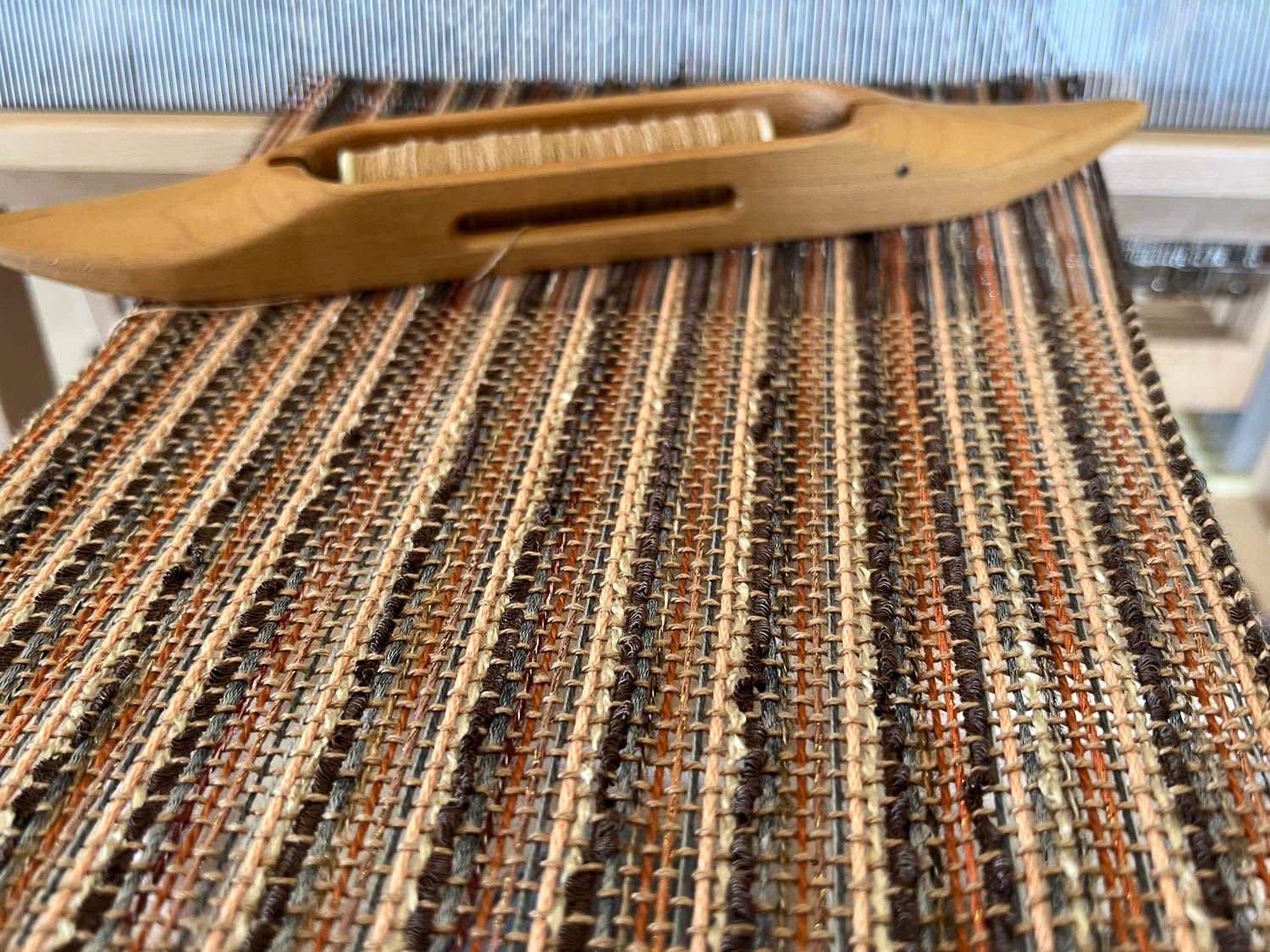
This is 1301 a scarf using all these crazy yarns. I teach a class in weaving a scarf using a mixed warp wound with a paddle, “Mix it Up”. I haven’t taught that class in awhile and I probably need to change it from a 1-day class to maybe 1-1/2 days. I don’t know if people want to pay for an extra day, but I always forget that it takes longer in a class setting than I take if I’m just warping and weaving my own scarf.

Two more mixed warps on the loom. The one on the right is a shawl, now at the Artery I think. I wove 5 or 6 of these in different colors.

In February I demonstrated weaving at the Sacramento Weavers Open House. I missed it this year because lambs were coming earlier than the previous year. I wove a chenille warp on Saturday and a wool warp on Sunday.

This is the warp after I took it off the loom.

Warp 1317 was a handspun Jacob wool scarf. Two Farm Club members spun yarn from wool that was accumulated from years of samples sent in when registering rams. Each ram application requires a few locks of wool. We have been digitizing the papers and that means those baggies of wool are discarded. I decided to do a project like this and then donate the scarf to the Jacob Sheep Breeders raffle. I wove two scarves using wool two different people had spun.

Clasped Warp is a technique that I wrote about for Little Looms a few years ago. It has been used with rigid heddle looms to design warps that change color midway through the length. I decided to do the same thing on a floor loom, adding the woven in pattern to the elements of interest. This is a shawl woven on a 4-shaft loom using handspun yarn. I will have an article coming out in the next Handwoven on this technique.

I wove fabric for 4 bags to use in an article that was published in Little Looms last year. These are hemp and woven on a rigid heddle loom. The bag uses a length of fabric that is 8″ wide and 4 yards long. Folding it strategically gives a shoulder bag with and inside and outside pocket.

This was part of that last blanket warp. It used up odds and ends of the Ashford DK yarn that I use for the Year to Remember blankets. The shape isn’t exactly right because that warp is designed to weave throws that end up about 45-50″ wide. I wove random stripes and sewed two together for a bed-sized blanket. I should have woven them longer and then they’d fit the bed correctly, but I didn’t have a plan at the time.

More to come if I’m going to finish out the year.

Shearing Day 2024 – More Photos

I shared the first batch of photos from Shearing Day last night. Here are more.

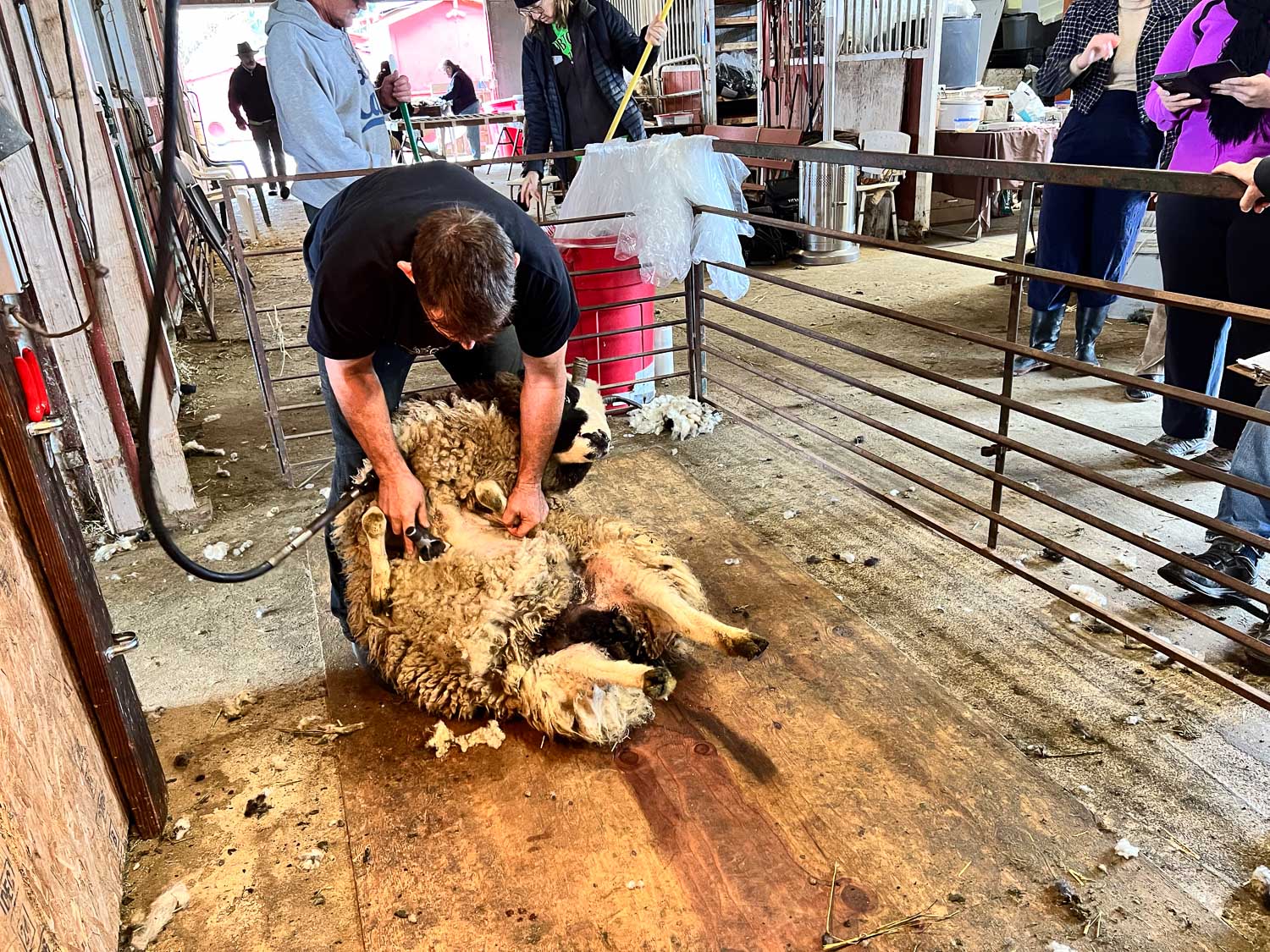
John has been shearing for us for years. He is an excellent shearer and a nice person.

I recorded some of the sheep being shorn which I’ll share when I have time. When I record I can pay attention to time. Some of them are right at 2 minutes or maybe even a little faster.

There is no blood. The sheep are in good shape and the fleeces look great! What more can you ask for?

Farm Club members kept up with getting the sheep to John. I got outside and started to take photos of the sheep after shearing. This ewe is Sandie.

They sure look clean now! That won’t last.

Kathleen weighed all the fleeces.

We had two skirting tables available so that fleeces could be skirted before purchase.

This is just a portion of the fleeces that I need to skirt and put out for sale. Give me a little time to get to that. The sooner the better though.

Distraction…there was a lamb born tonight! Surprise! I guess the next post will be about lambing.

Farm Day – One Week Until Shearing

I scheduled a Farm Day today to take care of some chores prior to shearing next week. The ewes were ready to be vaccinated to provide the highest level of antibodies in the colostrum. I wanted to clip fleece samples from the yearlings (their second fleeces) to send in for micron testing. We also made sure that the ear tags were clean enough to read and that the tags would match the cards that go with each fleece.

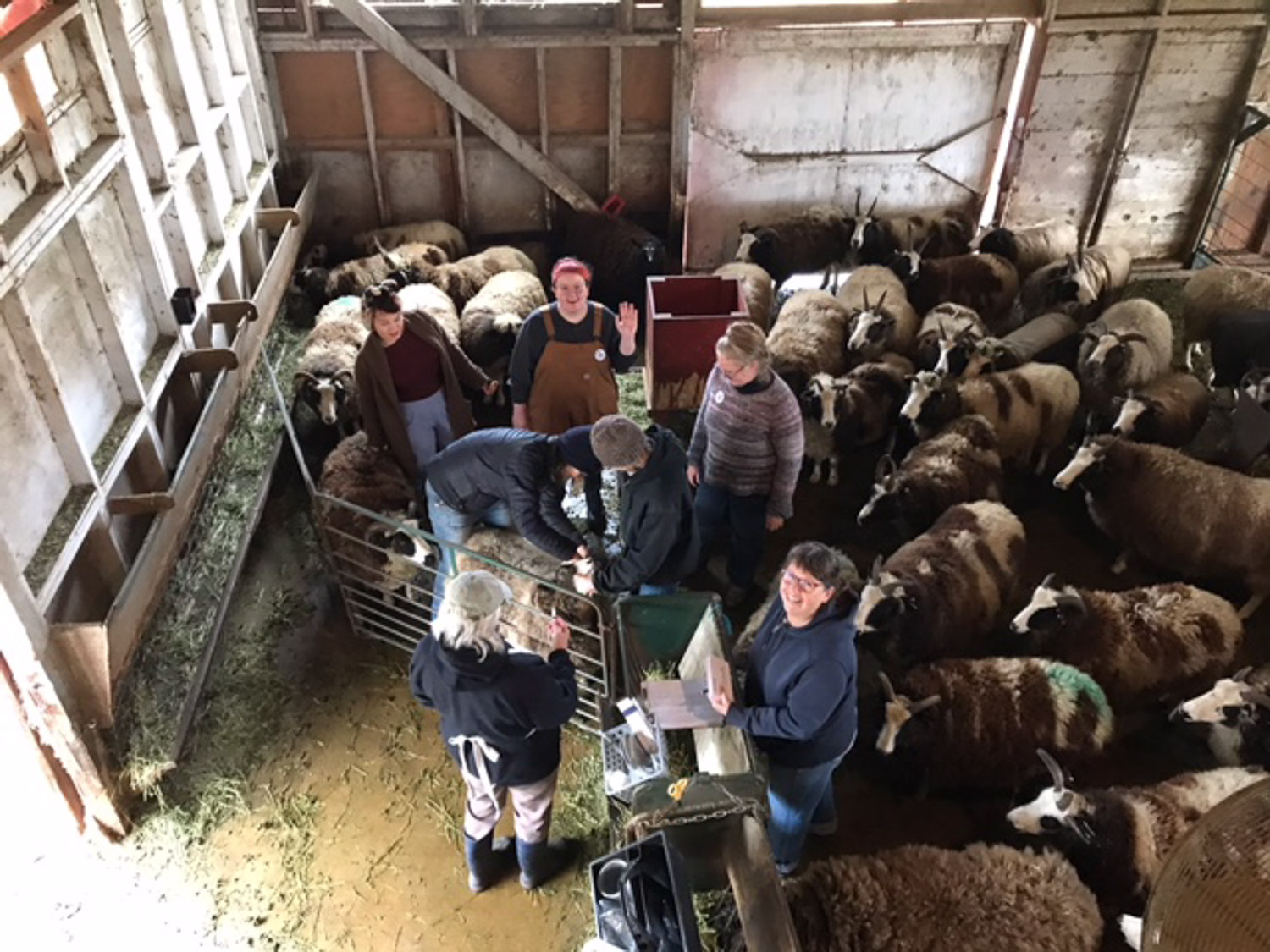
Some long-time Farm Club members were there as well as some people who are new to Farm Club. It all went very smoothly and it took only a couple of hours to work through all the sheep and take time to take a closer look at some of those fleeces.

Farm Club members get a chance to reserve a fleece at this Fleece Preview Farm Day.

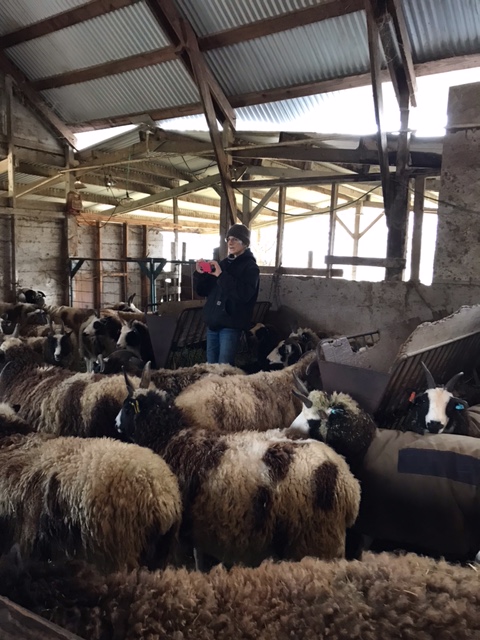
Deborah took the photos from above and this is me remembering to take at least a few photos. Often we get so busy that I overlook that.

While most of us were in with the sheep Susan, Chris, and Nikki volunteered to clean behind the barn. That’s always a big chore. When they finished here they moved to the ram pen and cleaned the ram barn.

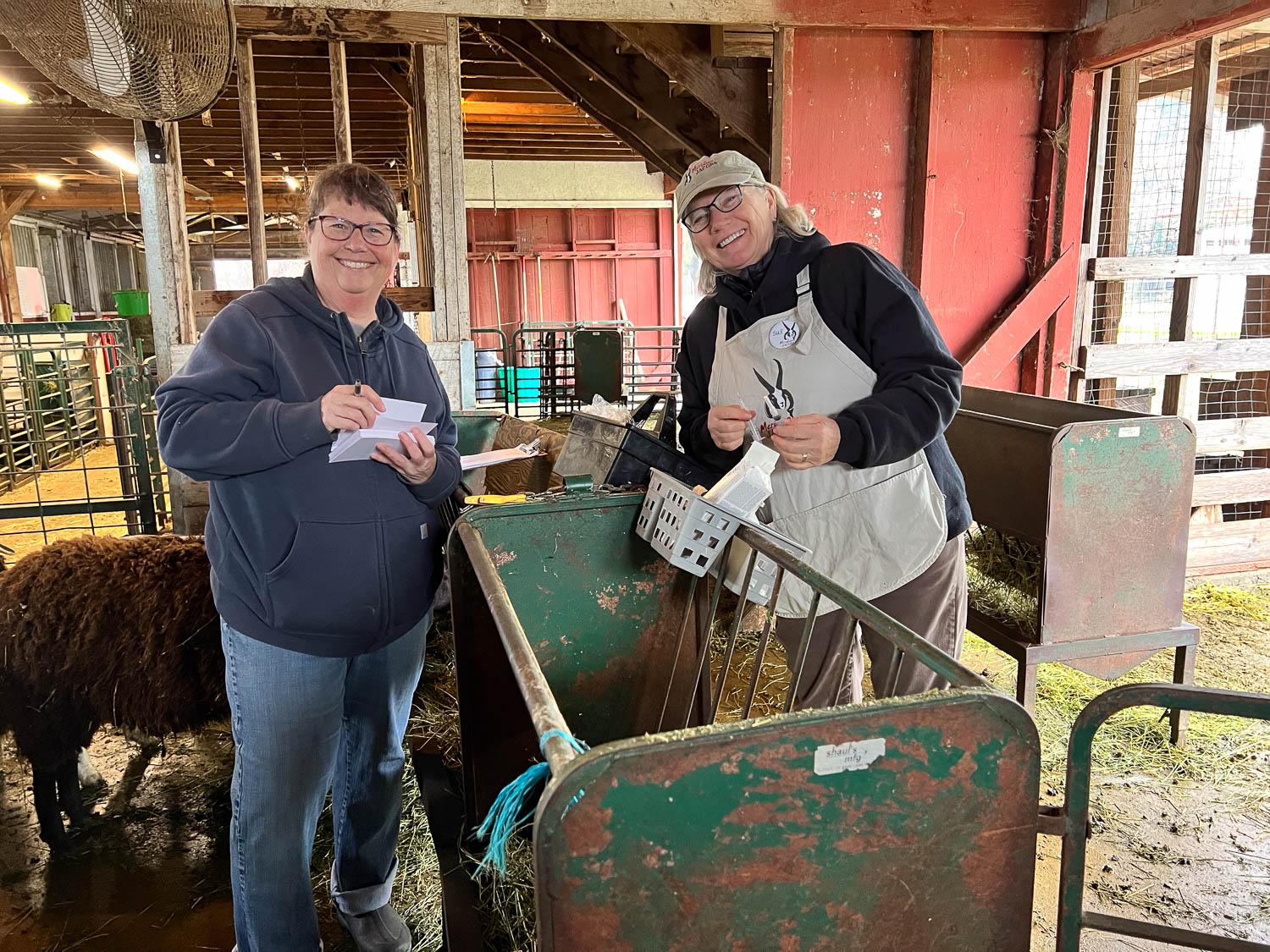
Mary checked off the list on the clip board and made sure the cards matched the ear tags. Susan drew up vaccine into syringes.

Marina and Katy caught sheep, marked faces, and cleaned ear tags.

Rachel and Siobhan also helped catch and mark sheep.

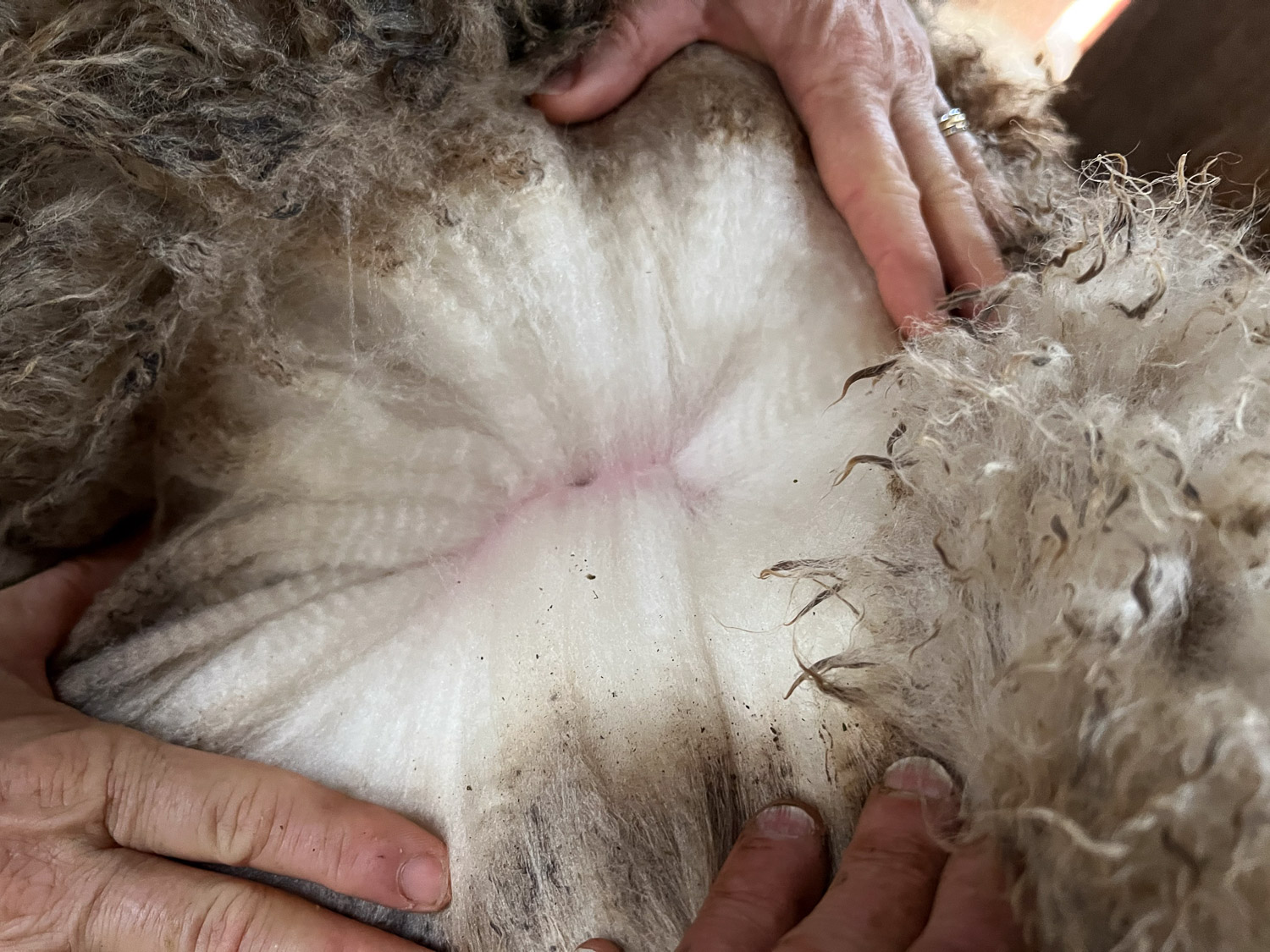
The photos below are what it is all about. I had been thinking that the sheep are looking a bit bedraggled, but when I got hands-on those fleeces I changed my mind. They are looking good.

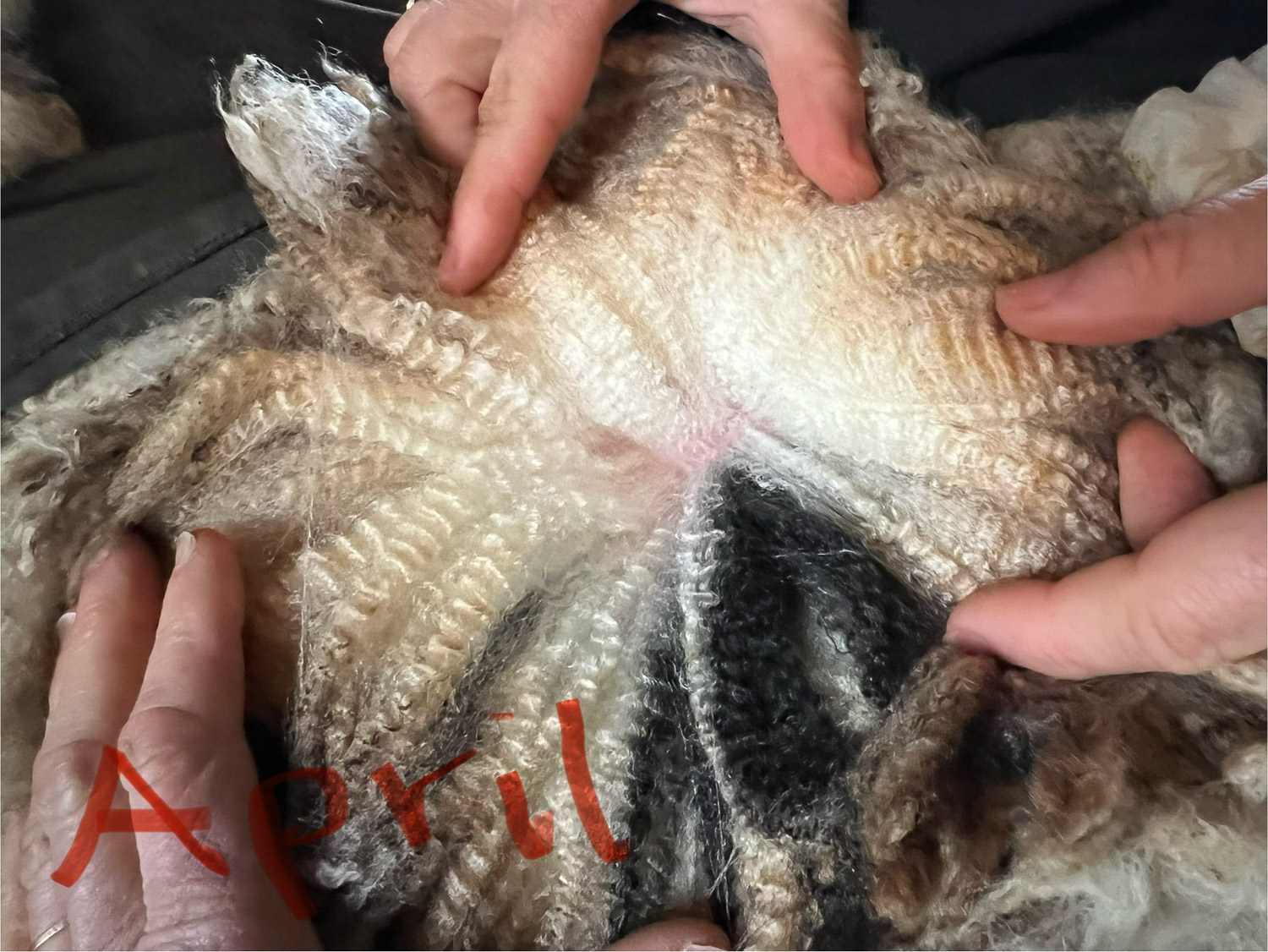
April is a yearling ewe, almost 2 year old.

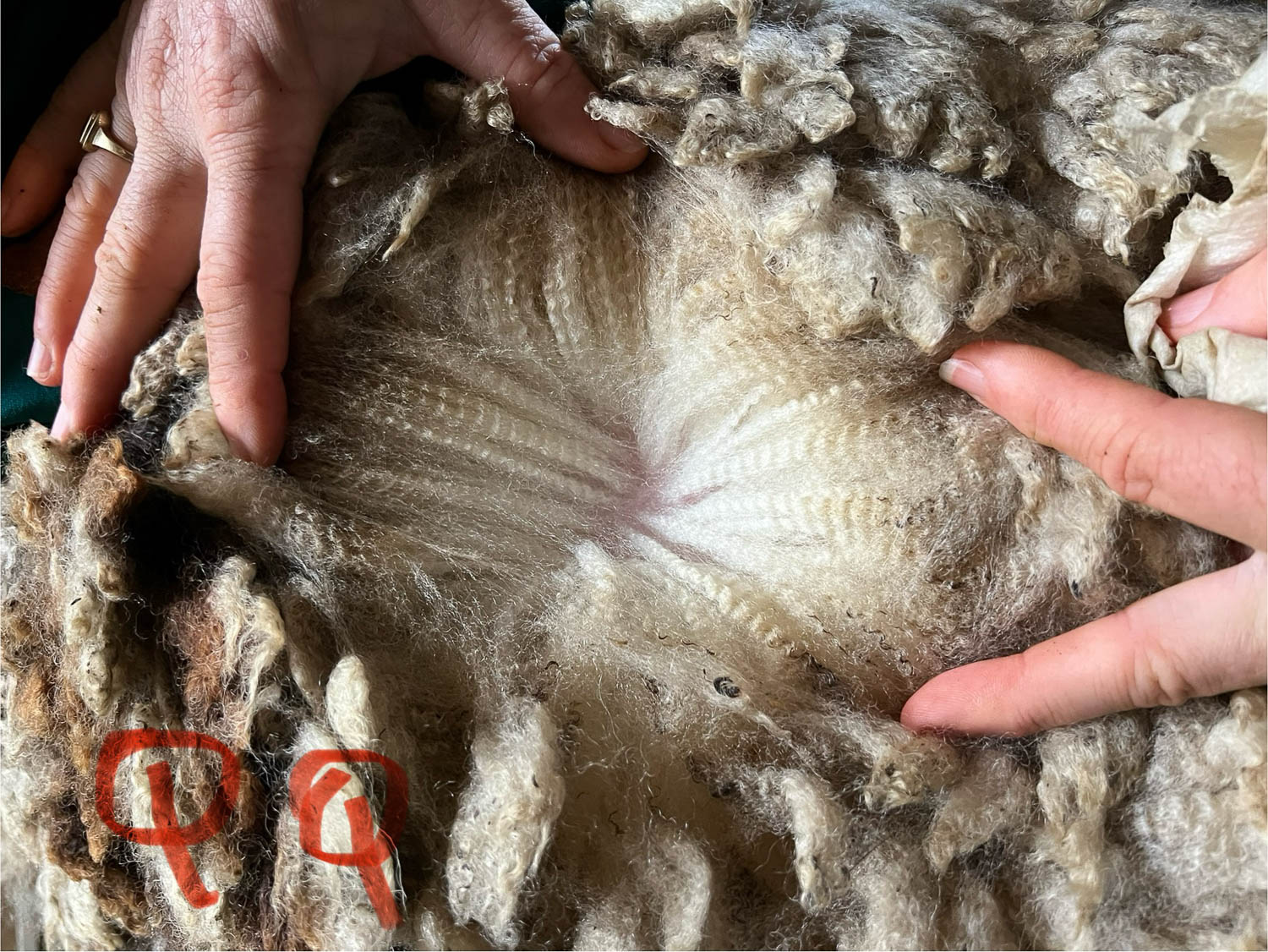
Queen Q is the same age. The photos below are an on-the-hoof look at the fleeces of the four rams I have here.

Meridian Blizzard (Meridian Silverado x Meridian Bessie), 10 month old ram.

Meridian Typhoon (Meridian Turbo x Meridian Rocha)

Fair Adventure Horatio, 3 year old ram, from Colorado.

Hillside Gabby’s Barrett, 3 year old ram, from Michigan.

Shearing Day is Sunday, January 21.* We’ll be shearing about 70 sheep. Fleeces are available on shearing day and for a month or two afterwards as I skirt them and post them on-line. If you live in the area you can come here to choose a fleece. Contact me.

*I just fixed this. A friend pointed out that I wrote June 21. Yikes!