Random Farm Photos

These photos may seem to be unrelated, but that’s how my life is right now…or maybe all the time. Farm Club members were here on Saturday to help set up breeding groups. Too busy to get photos then. Sunday I demonstrated weaving at an alpaca farm for their open house for National Alpaca Farm Day (remembering at 6 the evening before that I needed to get a loom warped for that). Today I worked on lots of odds and ends, mostly working towards being ready for Lambtown this weekend. So this is odds and ends.

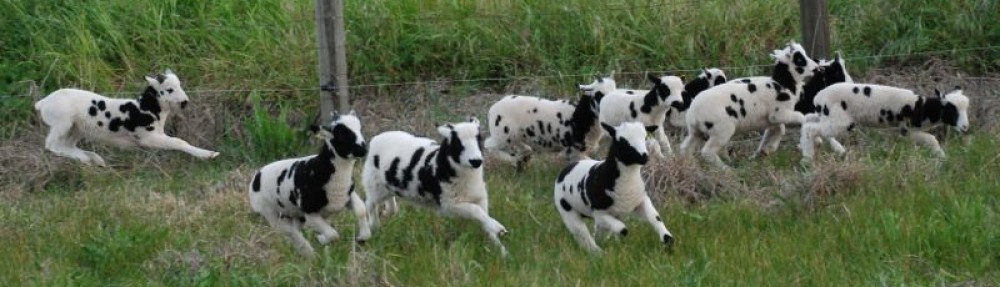
Clancy got to work right away on Saturday. (For the record, he is a BFL registered as Liongate Aylan, but I started calling him Clancy because I couldn’t remember that name. Clancy stuck.)
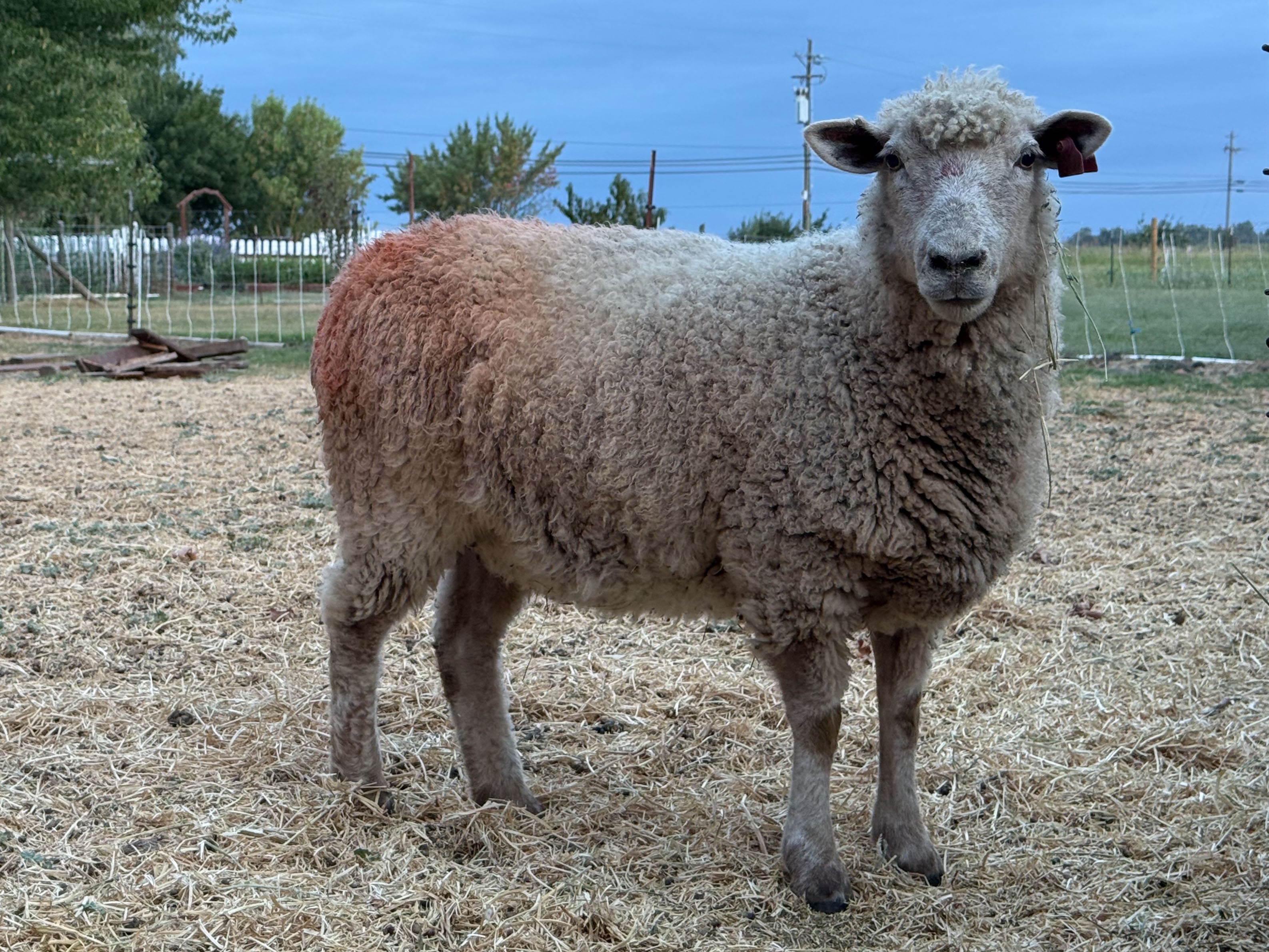
This is one of the ewes I picked up in Napa last week. That’s a story for another blog post when I have time. She is with Clancy’s group.
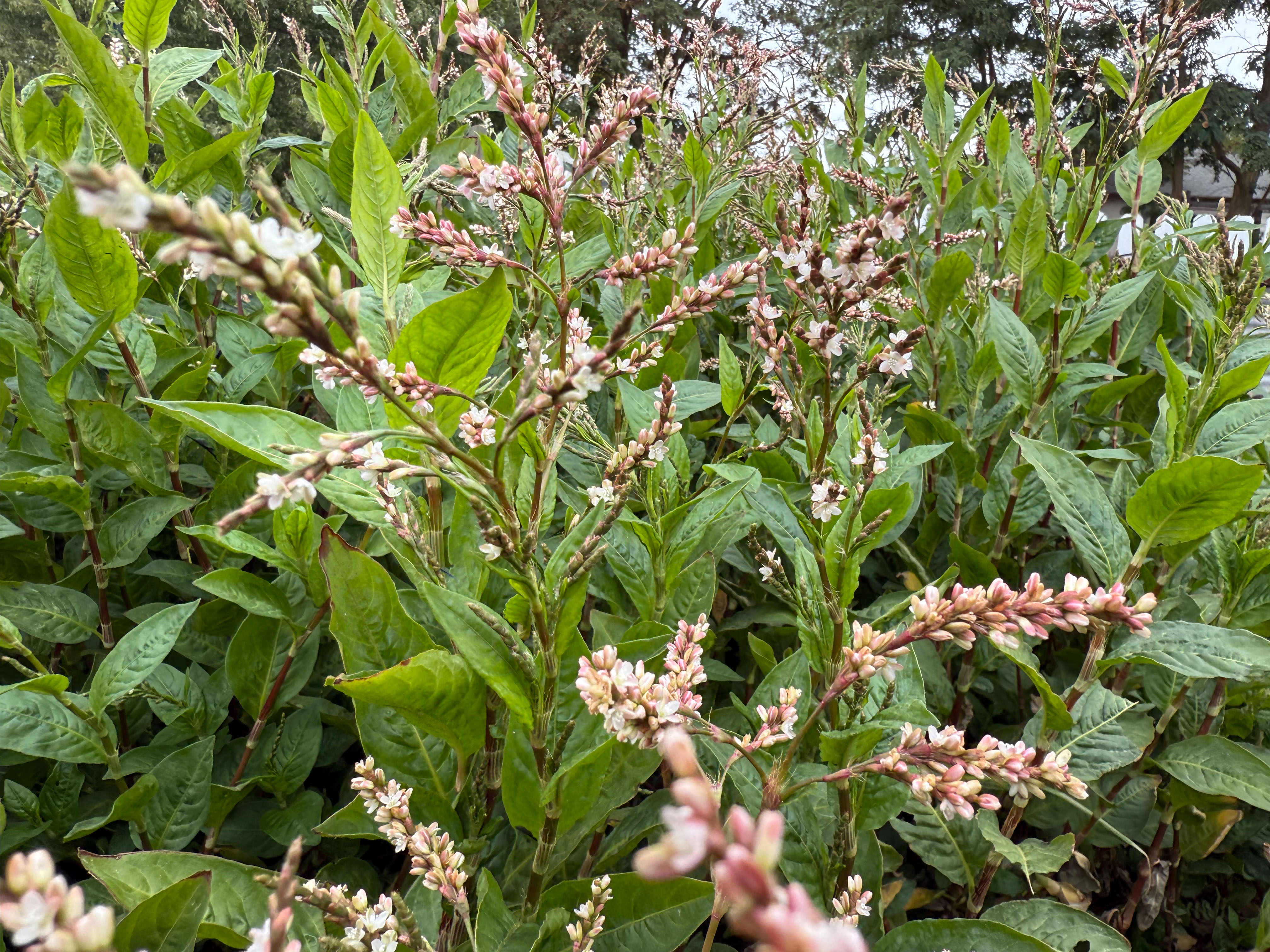
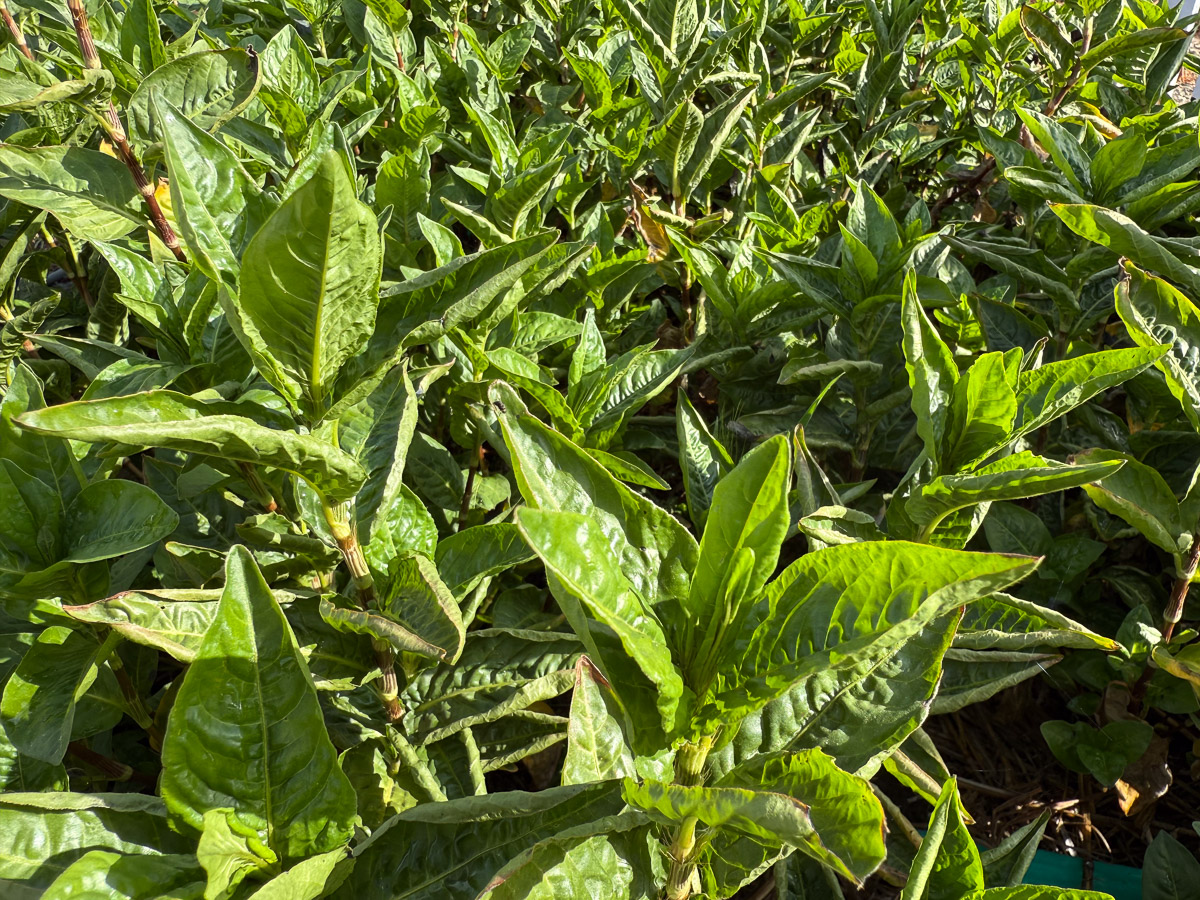
Indigo is flowering. I spent so much time trying to keep the indigo thriving during the summer that I want to make sure I use more of it for dying before it’s too late.

This is today’s fresh leaf indigo dyepot. That yarn will be blue when it is out of the pot and dry.

I made buttons over the last few weeks but hadn’t finished them yet. I use lacquer in a satin finish. I could only find semi-gloss locally and had to order what I wanted. There are also two skulls that I cleaned as well as I could and wanted to apply lacquer to the horns.

I load the buttons onto wires that I can dip in the can of lacquer and then spread them to drip and dry. This is one way to get some use out of styrofoam packing material.
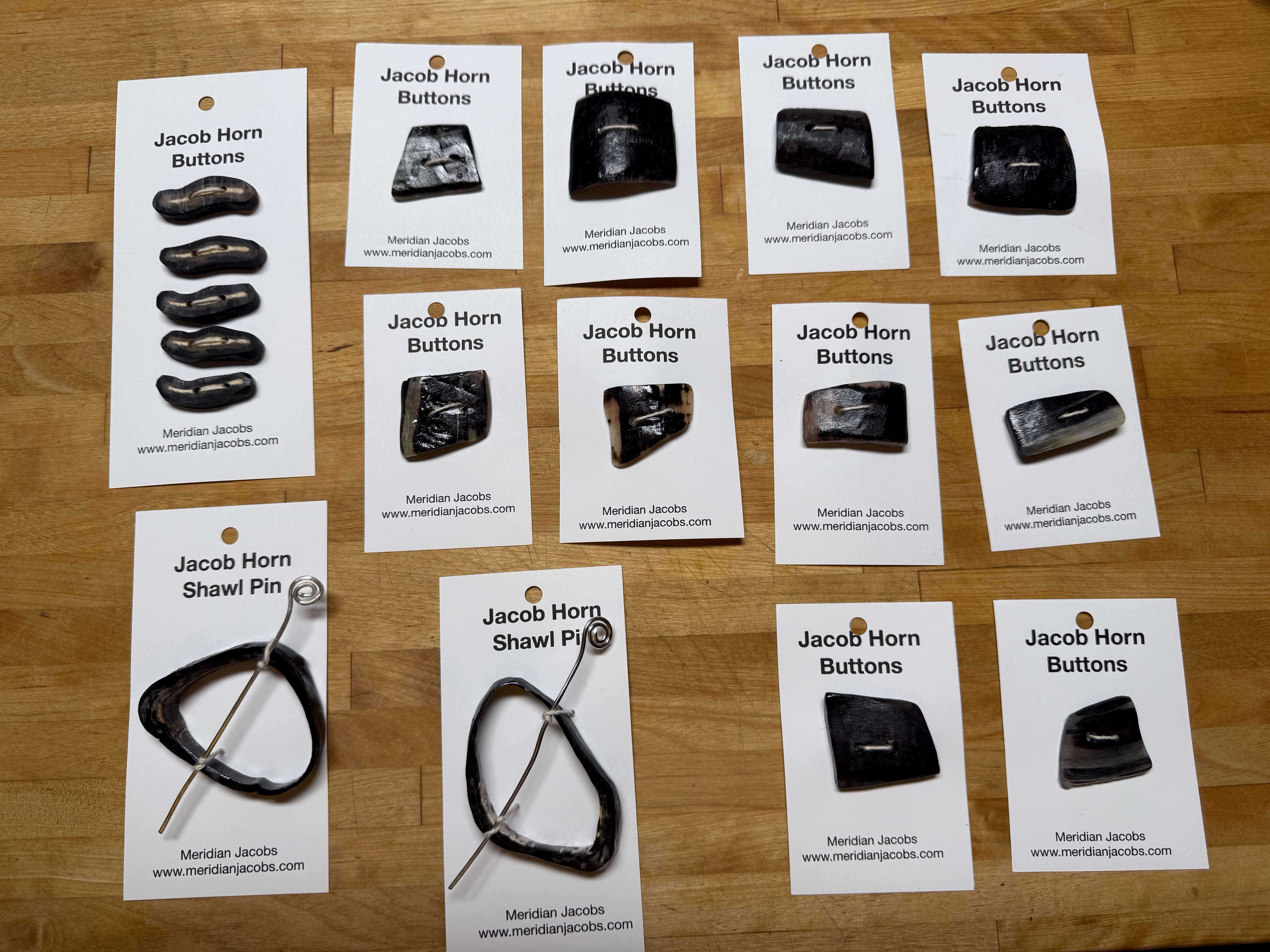
These are buttons and shawl pins that I finished a couple of weeks ago. When I couldn’t find the satin lacquer I used semi-gloss and also polyurethane. I think I like the satin finish best, but I’ll find out at Lambtown if it even makes any difference.
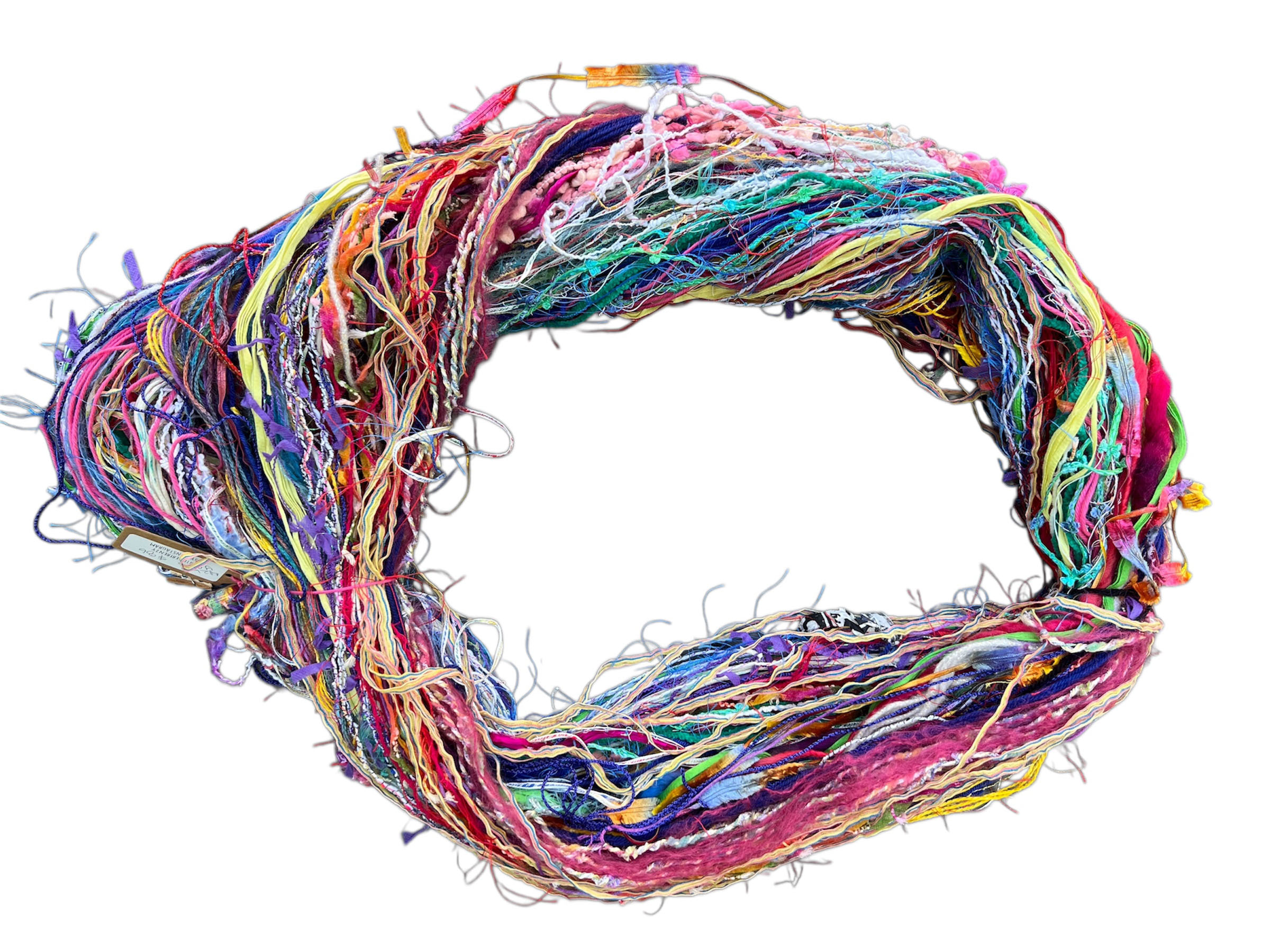
I spent a lot of time this week using a new app that will completely remove the background from photos.

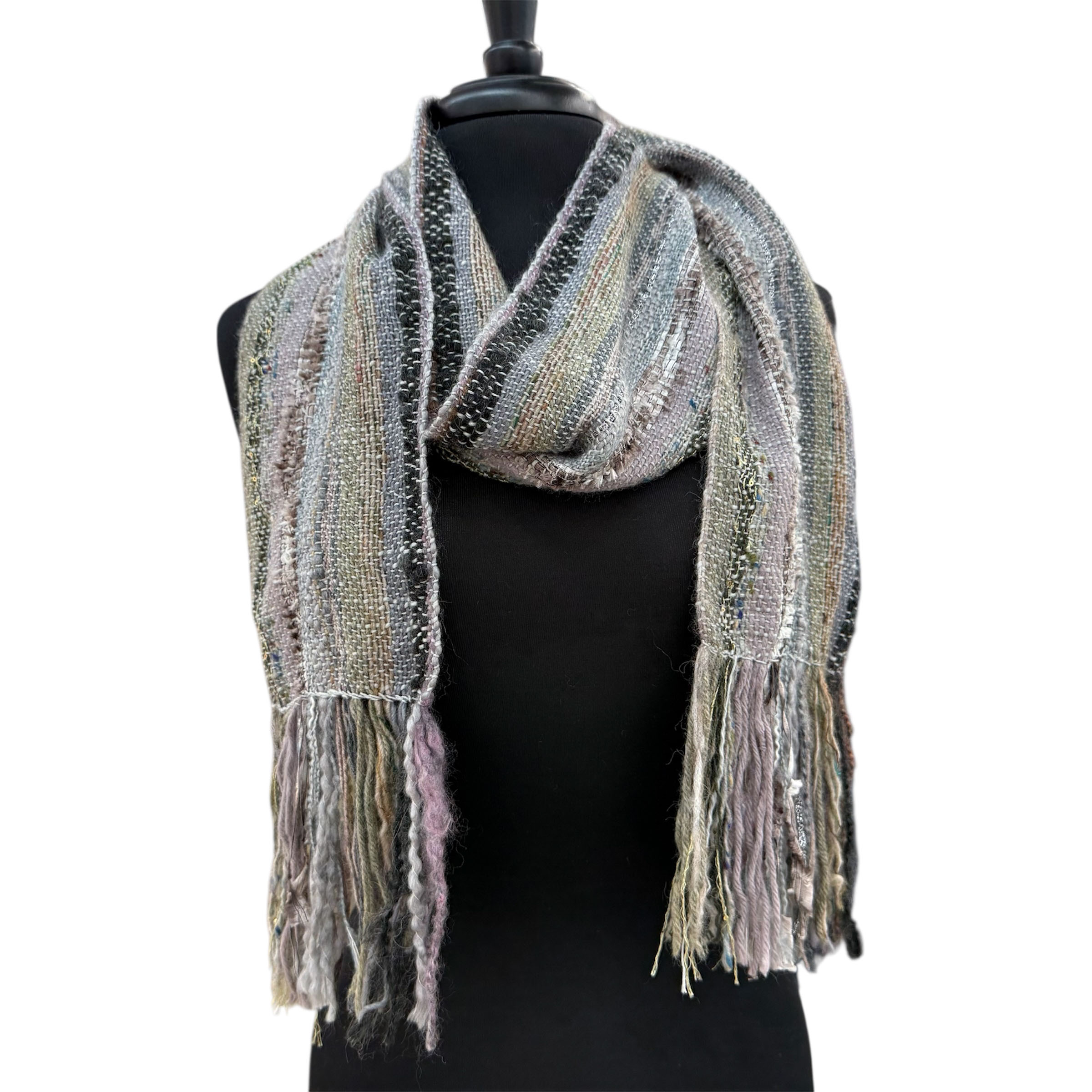
This is another example. I wanted these photos for the new weaving class on my website.
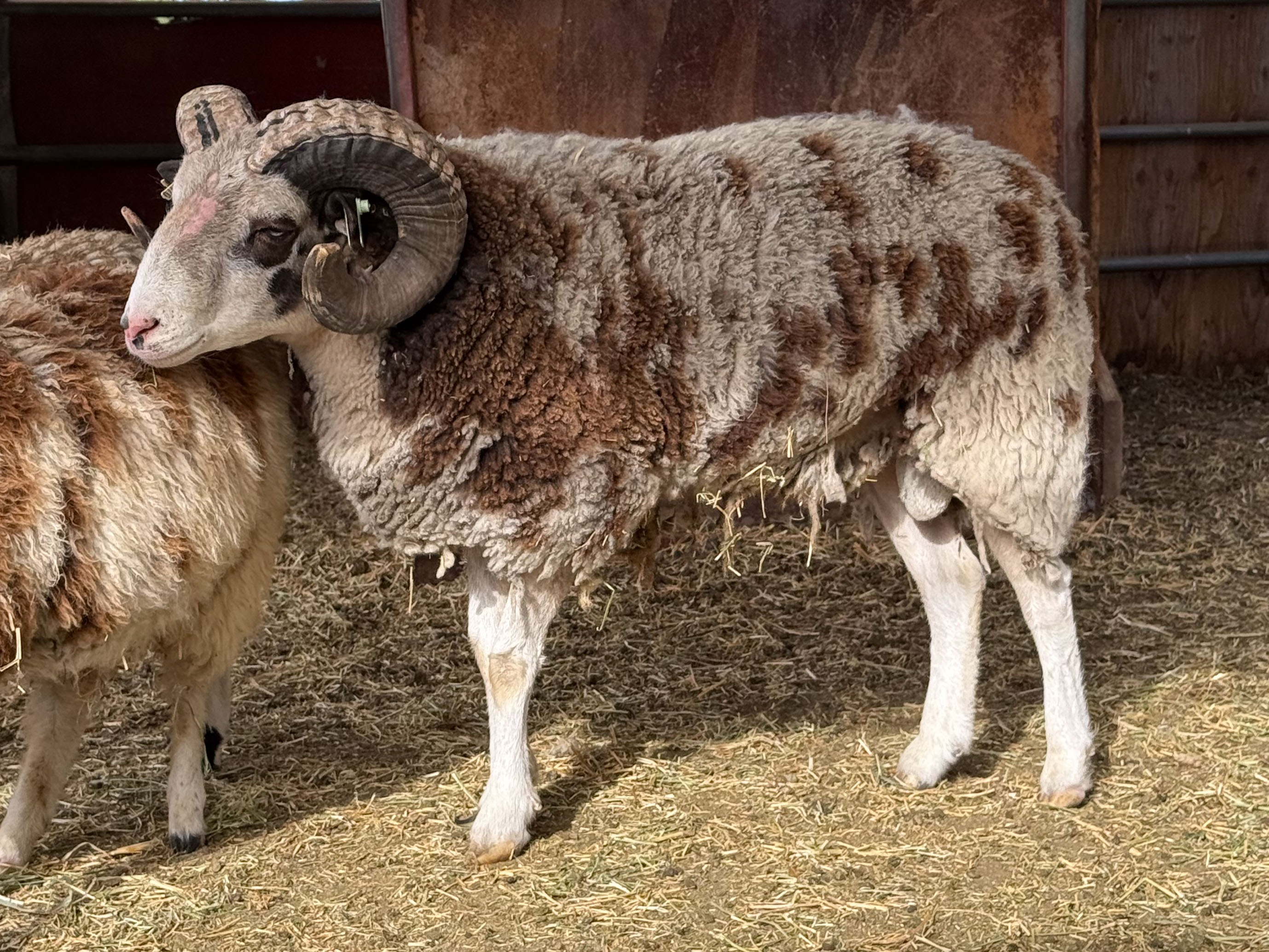
One more sheep thing. I have two registered adult rams that I need to sell. There are four rams out with ewes now and these are extra this year. This one is Hurricane. Rams are on the website here.

Time to move onto getting my newsletter out.

Wild and Crazy Weaving Debut

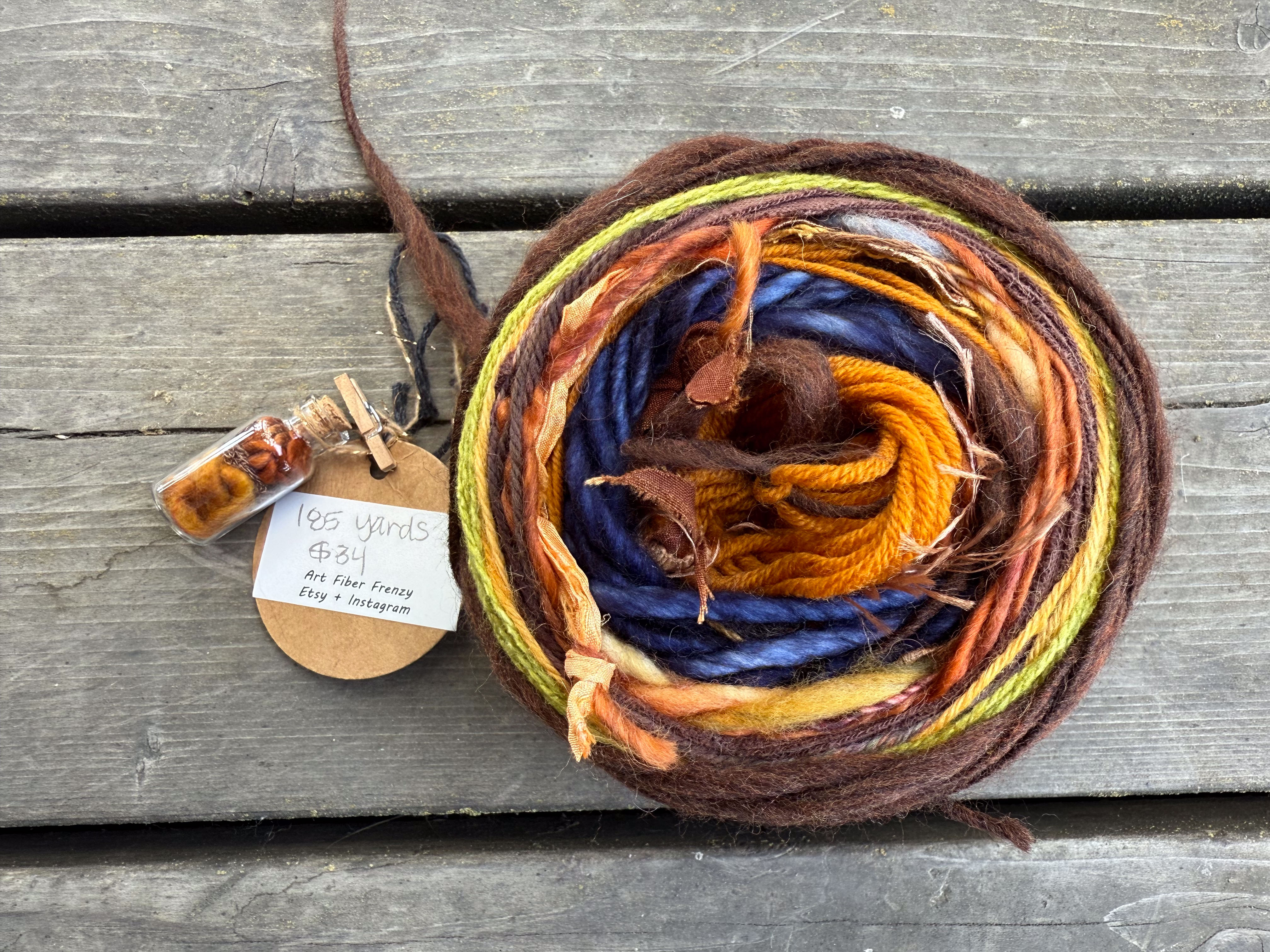
I just listed the Wild and Crazy Weaving class on my website. I’ve been thinking about this awhile, but finally got it done just in time to advertise it at Lambtown coming up October 4-5. I met the creator of Art Fiber Frenzy yarns a couple of years ago at Black Sheep Gathering in Oregon. It turns out that she lives in Sacramento, not far from me, and she will be at Lambtown again this year.

When you closely at this yarn you will see that the random lengths of yarn are tied together. I don’t think the intent was to use this for warp, but that is all that I see. I have figured out the method to turn this into a warp.

The first step is to wind a ball.

This is a step where you don’t want to be sloppy. It was manageable, but not as fun to work with this yarn after my ball turned into many connected balls.

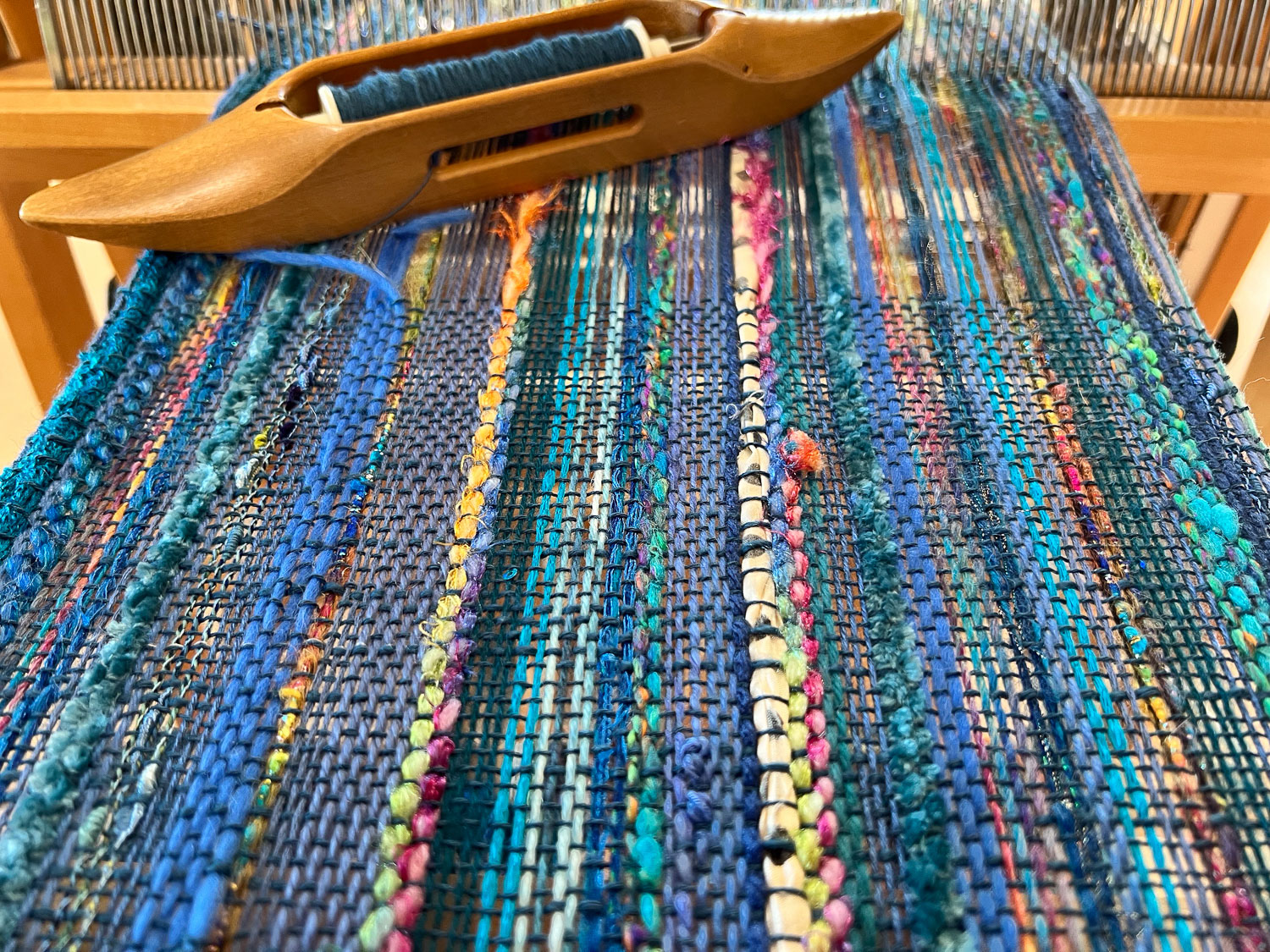
It’s the step of winding warp for which I have developed the best way to deal with the yarn–not just the knots, but all the yarns of different character.

And there is the consideration of sett and weft yarn.

Purchase a skein of yarn from Art Fiber Frenzy and sign up for my class to learn how to weave with it. I have listed one class to teach about a month after Lambtown but plan to teach other sessions of this next year.

Yesterday On the Farm – Keeping Busy

I woke up at 5 and thought of things that need to be done. No point in staying in bed.

Rewrite minutes from Tuesday evening’s Artery Board meeting. ✓
Make one more 15′ length of e-net fence so I can switch sheep to another paddock. ✓
Walk across the road with Ginny. ✓
Do a fresh-leaf indigo dye bath to over dye the weld-dyed yellow yarn. ✓
Here are the photos to accompany that check list:

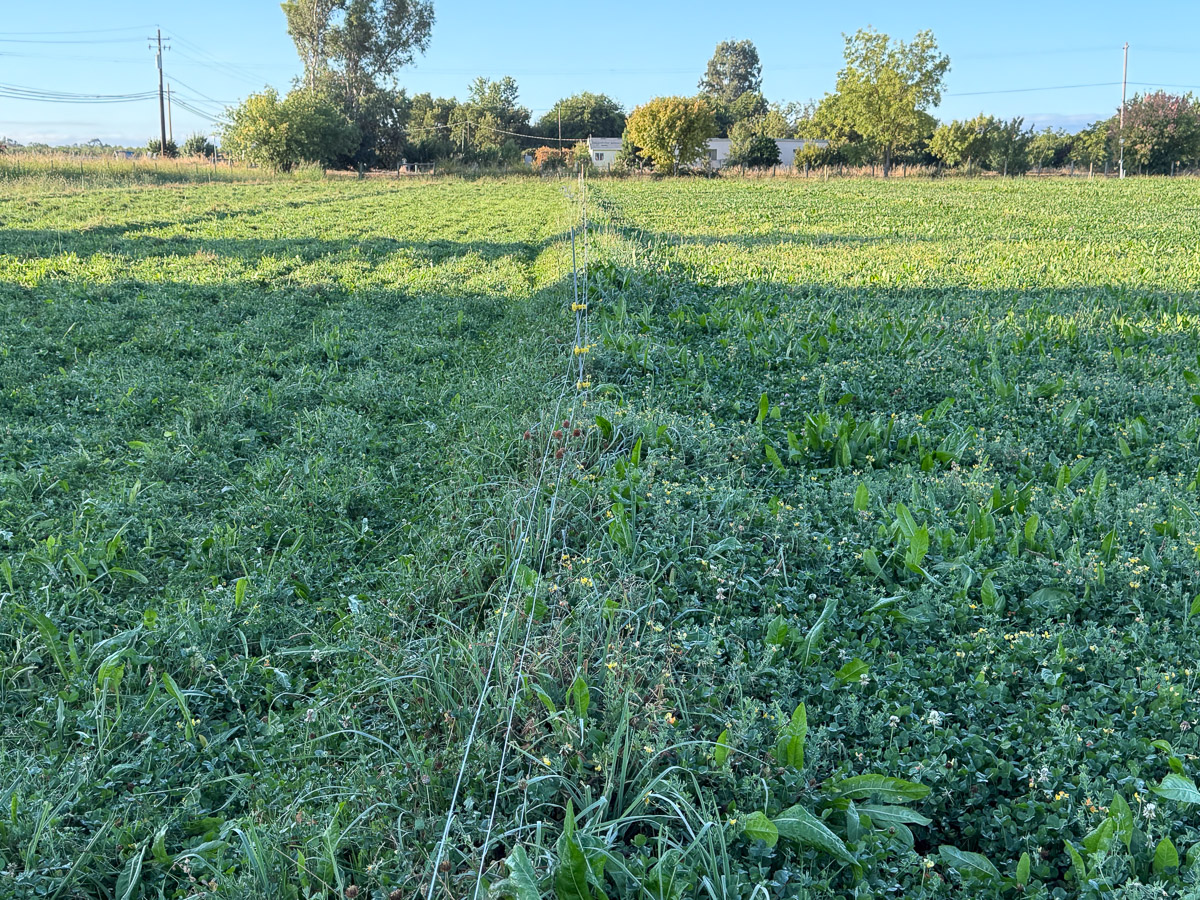
Green pasture with fence down middle. One side has been grazed and one side as not.

There are 3-wire electric fences every 60 feet in the south pasture. These are charged by attaching to a hot wire at the south border fence. I need to connect a 15′ net fence from that hot wire to these north-south fences. My goal was to have all electric net fences for blocking off the 60′ spaces and the 15′ connection fences in place and not have to move those lengths of fence every time I switch to a new paddock. I have finally accomplished that goal with this morning’s 15′ fence! (I think–maybe I need one more.)

Another accomplishment is to organize and label what’s left. There are three fences that will make up one long north-south fence if I decide to split the 60′ paddock in half lengthwise. The other two bags are leftover but still useable portions of net fence.

Border collie standing on dirt road along a canal with water. Cloudy sky in background.

Time for a walk Across the Road. This is for Ginny’s mental benefit and for mine. If I go in the morning then all day I can remember that I got at least a little exercise.

Selfie of Robin standing next to a tractor tire that is taller than she is. Cab of the tractor is visible.

This tractor was parked near the hayfield. That tire is taller than I am!

Sheep grazing green pasture with blue sky and red barn behind.

A view of the new paddock from the main road coming back from our walk.

Green indigo leaves.

Indigo in the garden.

Harvested indigo leaves in white tub with yellow yarn on top.

I harvested about a pound of leaves to overdye the yellow yarn I dyed with weld the day before. I dye with fresh leaves using ice water and a blender. After that dye bath was in place I could move on to something else.

What is the plan for the afternoon?
Make more horn buttons ✓
Thread the hemp warp that is on one of the looms. ✓
Photograph all the unfinished pieces for yesterday’s blog post. ✓

Handmade horn buttons on tray. Squares are in one corner and rounder horns are matched in cups.

I cut more buttons. The next step is to drill holes and then sand. I found some that already had holes but I had not sanded them. Those are in the three cups at the bottom. I keep track of buttons that will match by keeping all from one horn together through the process. I sanded all those that already had holes in them, but still need to drill the others.

Stack of 88 bales of alfalfa next to red shed.

While I was working in the barn on buttons we had a hay delivery. This is 88 bales that need to go in the barn.

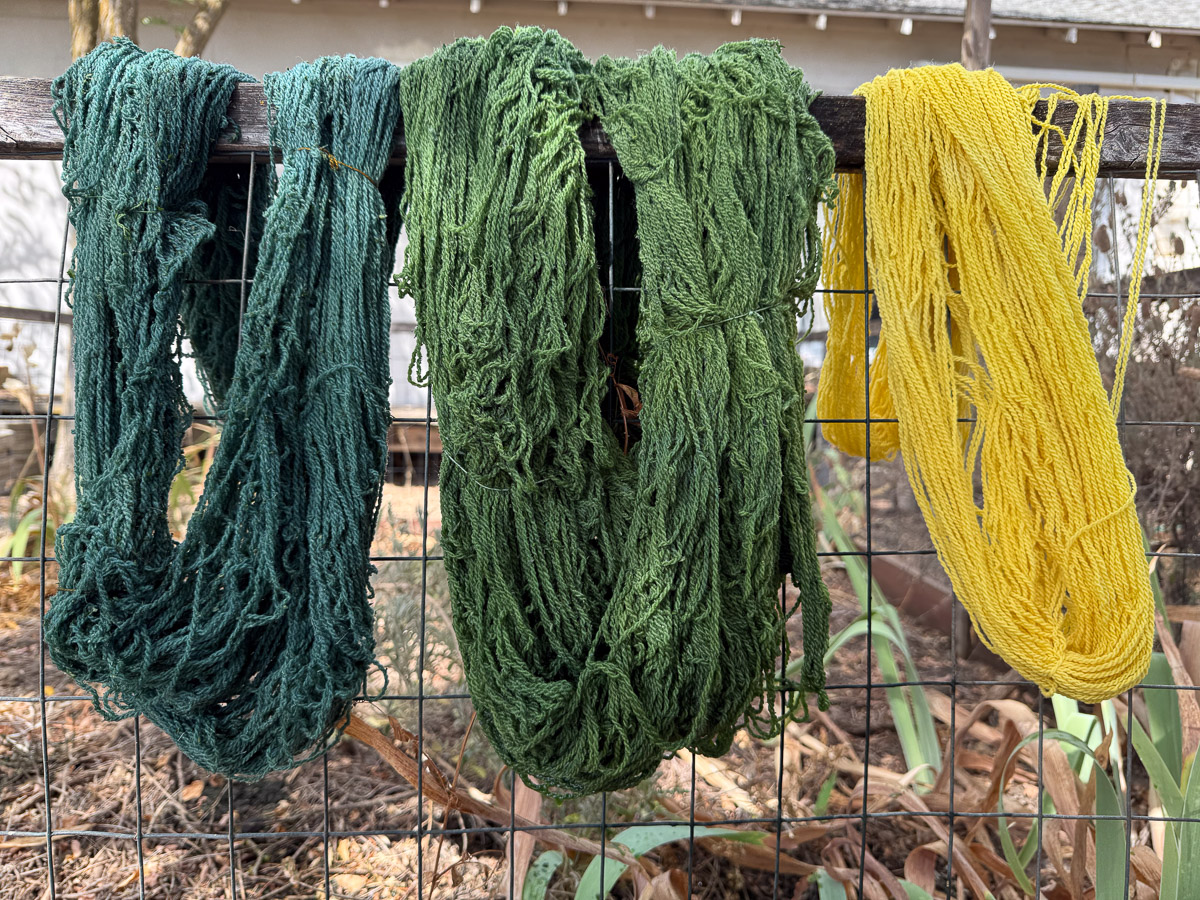
Dyed yarn (blue, green, yellow) hanging to dry on fence.

I took the indigo-dyed yarn out of the bucket and hung it up to drip. When I’m finished here I’ll cut apart the bundled skeins so they can dry better. The yellow one is what the green ones looked like before putting in the indigo. The blue yarn was white yarn in the same bucket.

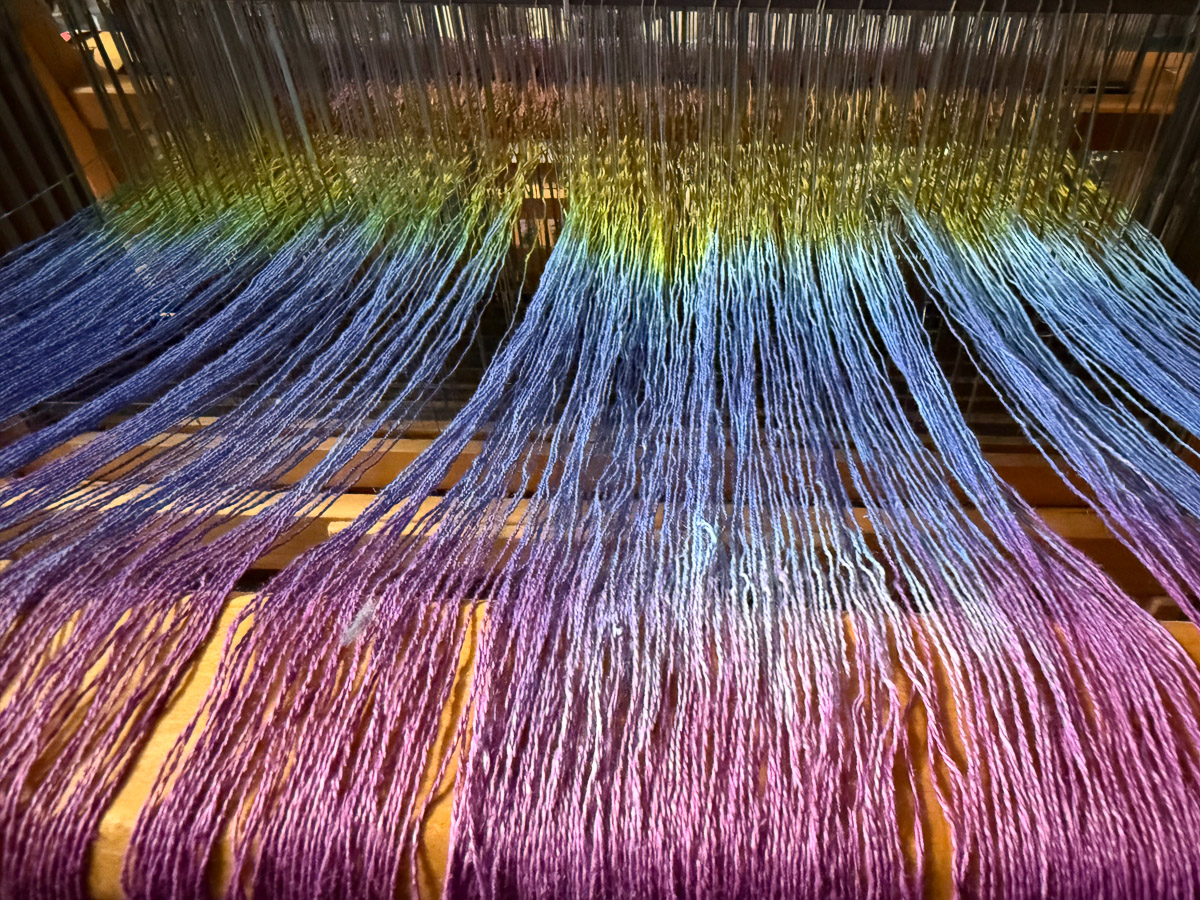
Space-dyed pink, blue, and yellow yarn  on loom.

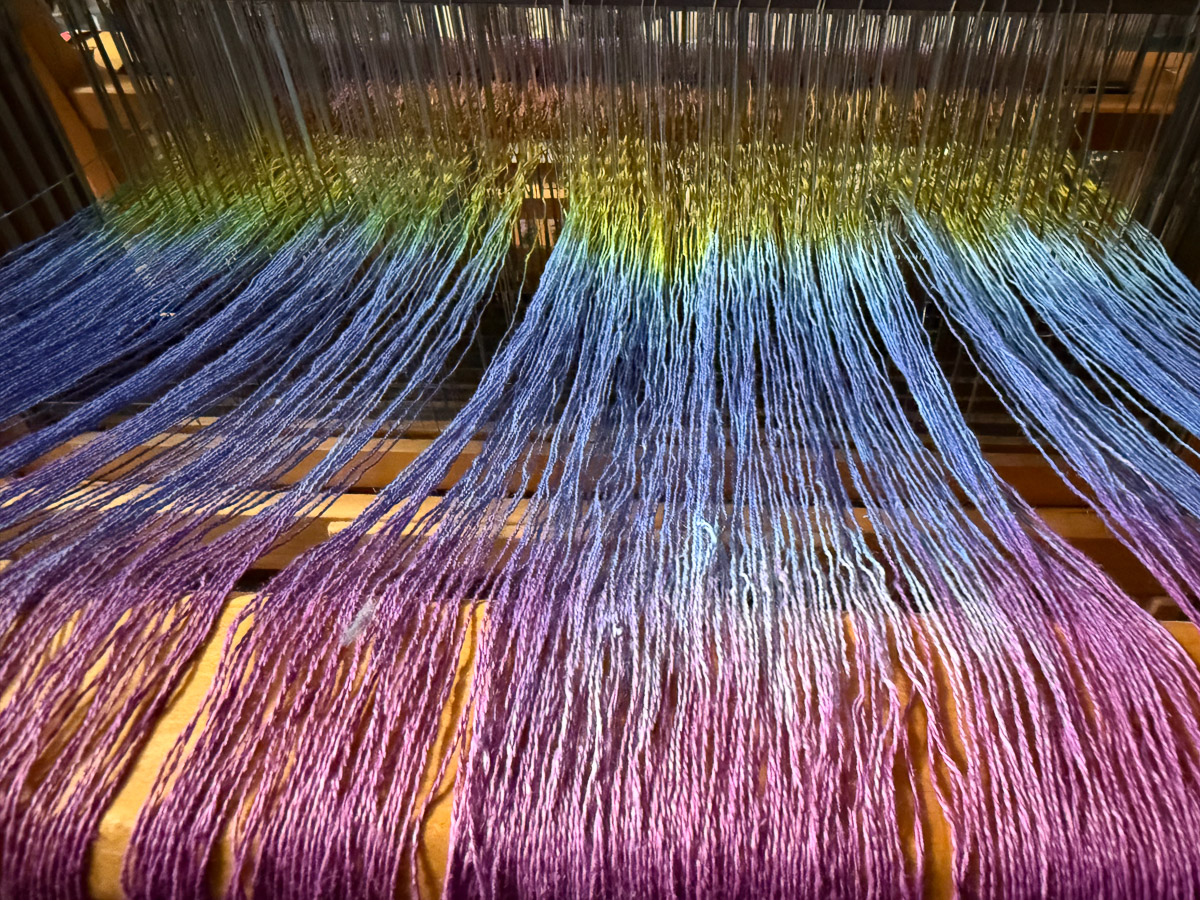
I went to one of the looms in the shop to thread my space-dyed hemp yarn and finished about chore time. Now it’s ready to weave. That is on today’s list, along with sanding those buttons.

Weaving to Finish

I should catch my blog up on the weaving side of life. I am always trying to squeeze weaving into the day. There are a lot of ongoing projects and many that are off the loom but not finished. There is a saying “It’s not finished until it’s wet finished.” Wet finishing is an important part of the process, but there are often other steps between taking the piece off the loom and wet finishing. Here’s a round-up of all the projects that are waiting around to be finished.

Three handwoven wool blankets folded. These need to be finished.

These three wool blankets have been off the loom awhile. The one in the middle is ready for wet finishing. So is the one on the right…or maybe not. I am going to sew a hem. I have to decide if I’ll finish the hem before or after wet finishing this time. I usually do it after. The blanket on the left has a warp error the whole length of the blanket that needs to be fixed. I didn’t see that until the blanket was cut off the loom.

Four handwoven purple chenille scarves that need to have fringe twisted.

These chenille scarves have been off the loom a long time. They need fringes twisted before washing.

Handwoven cotton shawls in bright gold, orange, and yellow. These are folded and the fringe isn't twisted yet.

Two cotton shawls that need twisted fringe and then washing.

Three black and white handwoven shawls folded. Shawls are woven with a pinwheel design.

Jacob shawls woven in black and white pinwheels. I think that the pinwheels will square up with wet finishing. They are a bit elongated now. I have twisted the fringe on one of these but need to do that on the upper left. Bottom left doesn’t have fringe and the ends will be sewn together. to create a mobs wrap.

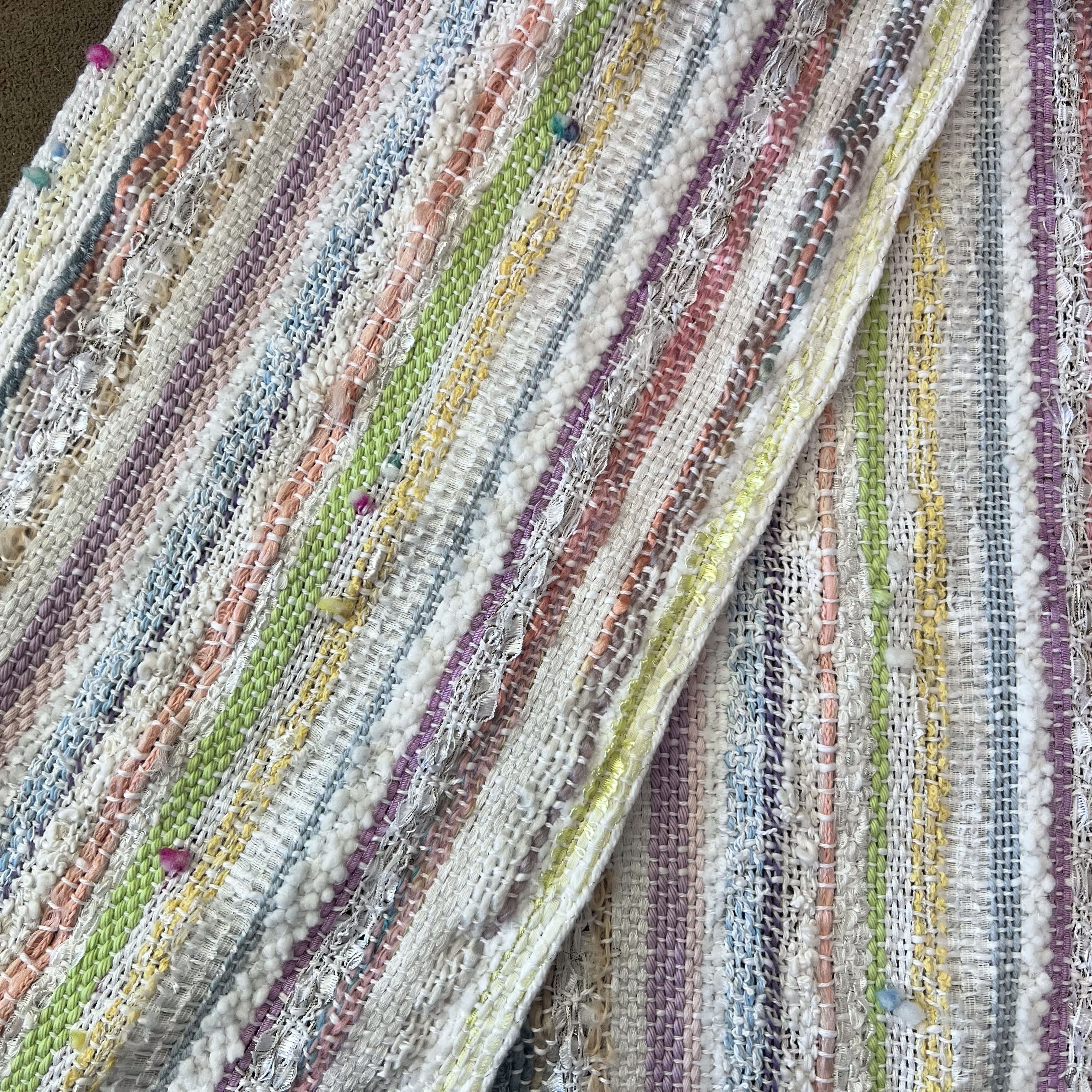
Handwoven cotton shawls woven with space dyed warp.

These are just off the loom. I wove the piece on the right first. I dyed the warp last week. This piece has twisted fringe and needs to be washed. I’ll wait until the fringe is finished on the other and run them through the washing machine together. These were on the same warp. The scarf on the right was sett at 10 epi, the sett that I usually use for this Ashford “caterpillar cotton” . Weft is 3/2 cotton. The scarf on the left is sett at 15 epi and weft will be 5/2 cotton.

Now for projects that are on the loom:

I dyed this yarn last week, along with the warp above. This one is hemp and will be dishtowels. I had to fix a threading error today and will have this ready to weaving tomorrow.

Baby blankets underway.

Wool blankets underway. I really want to finish these blankets this week.

A warp ofj mixed yarns, sourced from Art Fiber Frenzy.

Now I’m getting too tired to do more.

Grazing and Irrigation 8 – September

When I wrote a newsletter yesterday I referred to the series of blog posts about the pasture that I wrote over the last year. You can find any of these by searching Pasture and Irrigation Renovation (14 posts) and Grazing and Irrigation (7 posts).

Tonight’s post will follow up on this Grazing and Irrigation post (#7) written in June about May grazing. The pasture looks much different now than it did then.

Four horned Jacob ewe with grass all over her horns in a clover pasture.

The ryegrass is gone and you see mostly clover.

Jacob sheep grazing clover pasture.

Next most prominent is birdsfoot trefoil, and more recently the chicory has taken a foothold. Those are the three broadleaf plants that were in our seed mixture. All of the paddocks in the south pasture look like this now. Back in the spring we started topping the ryegrass with the mower before grazing and mowed again after grazing. This prevented the ryegrass from being flattened over the clover and becoming a mulch layer.

Pasture being irrigated. This area has a lot of dry grass and mounds of grass piled up.

The smaller field on the north is different. We didn’t graze early enough and this is where the annual ryegrass had such a head start on the clover and overwhelmed it in places. I took this photo while irrigating two weeks ago. While the pasture was flooded, some of the ryegrass “mulch” floated and I was able to rake a lot of it into piles thinking that I’d be able to move it out with the tractor.

Wheelbarrow piles high with old wet straw.

A few days later I realized that I didn’t want to wait until the field dried out enough to use the tractor. I was ready to graze again but the lane was still too muddy. I realized that I could use all that straw to cover up the mud. So I used the wheelbarrow.

Lane bordered by white net fence and green pasture. Lane is filled with old straw.

I used at least a dozen big loads of ryegrass straw to fill in the lane.

Two horn Jacob ewe lamb with mouthful of green leaves in a pasture.

This is Sparky in that north field. Hopefully over the course of winter these bare spots will fill in now the they aren’t covered with mulch.

Road Trip 2025 – Day 7 – Heading Home

We were gone from July 29 to August 4 and I wrote the first blog post about it August 8. I am finally finishing the trip today, September 2, and soon will get back to sheep and weaving posts…hopefully.

Highway stretching out towards desert hills. Blue sky above.

We spent Sunday night at a motel in Green River, Utah. I don’t remember when we got on the road, but this photo was at 8:50 a.m. At this point I don’t remember much about any of the photos I took, but it’s one way I keep myself entertained while being a passenger. Most of these photos were taken in Utah.

Red Rock cliffs with blue sky.

Trinidad is over 1200 miles from Vacaville and we didn’t always take the most direct route. That’s a lot of time in the car. Dan likes the driving part so I am happy to be a passenger. I had taken a dozen magazines and books and a couple of fiber projects to keep myself occupied. I barely looked at any of them. What’s the point of a “road trip” if you don’t experience the road? This scenery is beautiful..

Red rock scenery along highway in Utah.

,,,and vast.

Red rock cliffs along highway in Utah.

We didn’t make many stops so most of these are “drive-by” photos.

Highway in Utah with cement silos along the road.
Sign that says Pony Express National Historic Trail.

We did stop here because this marker was a short distance off the highway. The story of the Pony Express is fascinating but it was only a fragment of our history. The third photo of this blog series back on Day 1 shows one of the stations that were located about every ten miles. That’s a huge undertaking when I think of our drive of over 1200 miles that followed some of the Pony Express route. From the Pony Express National Historic Trail site: “It is hard to believe that young men once rode horses to carry mail from Missouri to California in the unprecedented time of only 10 days. This relay system along the Pony Express National Historic Trail in eight states was the most direct and practical means of east-west communications before the telegraph.”

Utah Salt Flat with salt company.

Driving across the salt flats of Utah.

Utah Salt Flats with mountains in the distance and blue sky.
Highway overpass with art work of cattle and words Battle Mountain.

It seems that this was the last photo I took during the drive. This is 4:30 p.m. Unlike last year’s road trip, we didn’t have vehicle or traffic issues through the whole trip until we got near home. Just west of Sacramento the Causeway (I-80) was narrowing to one west-bound lane for the never ending highway work. We drove in the driveway about 11 p.m.

Map of the western U.S. with green and red marker showing routes from California to Colorado.

The green line is the 2024 road trip and pink is this year.