Unknown's avatar

About Robin

Owner of Meridian Jacobs, farm and fiber shop. I raise Jacob sheep, teach fiber arts classes, weave handwovens for sale, and manage the store.

Still weaving

I haven’t written about weaving lately, but I’m still working at the loom. I have orders from 3 regular customers for 9 baby blankets. I just finished a warp with 10 blankets.

Last week I finished an order for wool throws. This customer had her yarn spun at Yolo Wool Mill and wanted 5 different blankets. Sometimes it is necessary to add a lot of spinning oil to the wool during processing. The yarn isn’t very appealing in that state, but woven blankets aren’t truly finished until they are ‘wet finished’. In wet finishing  the  oil is removed and the blanket is fulled. Take a look at the before and after photos of these blankets.

I calculated a sett of 5.5 epi. I used a 6-dent reed and left every 12th dent open. After I started weaving I worried that you would see that empty space in all 5 blankets and that would distract from the woven pattern. I didn’t need to worry.  In the photo below you can sort of see that line, but when you see the blanket you focus on the diagonal twill and don’t even notice the vertical line.

Above is the before and after of another twill blanket.

Plain weave. Before fulling is above and after fulling is below.

This is one of my favorite weave structures. I was concerned about the finishing of this blanket. The yarn that I got from the mill was on cones and in skeins. The skeined yarn was so much oilier than the coned yarn  it almost seemed to be a different batch. You can see the difference in the photo. In fact, there was so much tacky grease that I had to pull a length of yarn out of the shuttle with every pass or my end-feed shuttle would go flying off the loom (guess that’s because I have a fly-shuttle loom!) because the yarn wouldn’t feed out properly. I was relieved after I washed the blanket that there was no difference in the fulling of the two yarns.

Nostalgia at Feather Falls

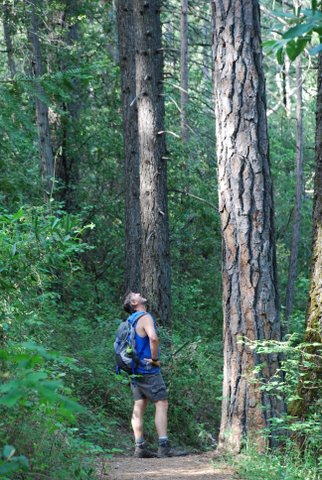
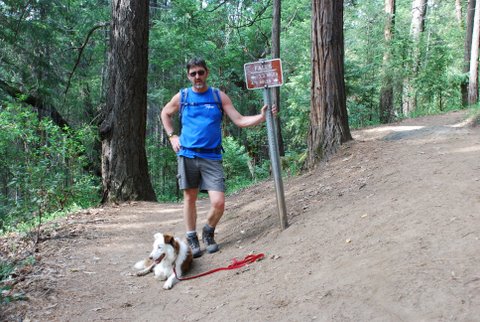
Last weekend my husband and I chose the absolute best day to go hiking in the Sierra foothills. Flowers were blooming in abundance, everything was green, and the weather was perfect. I hadn’t been to Feather Falls in years–not since we carried one (or was it two?) of the kids on the trail. (And now the youngest is 19.)

I have a lot of photos on my Facebook page, but here are a few of them.

There is a lot of poison oak along the trail. We could avoid it, but Rusty didn’t seem to care. I knew that i’d need to give him a bath when we got home.

I wish I remembered all my wild flowers, but I enjoy them even if I don’t remember all their names.

This delicate looking flower is a Ceanothus–Deer Brush or California lilac and the flowers cover bushes that are 6-8 feet high.

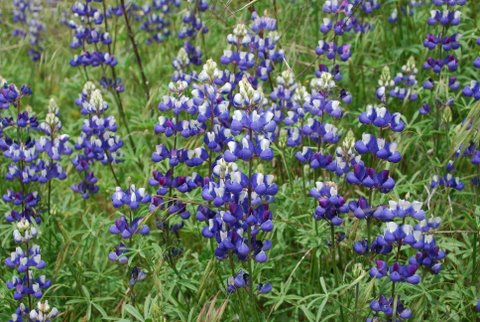
There were so many lupines that in places you could smell the sweet scent along the trail.

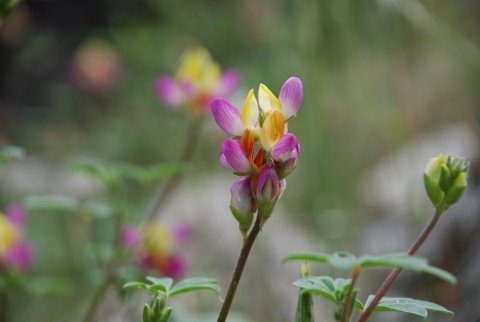
This is another kind of lupine that was closer to the falls.

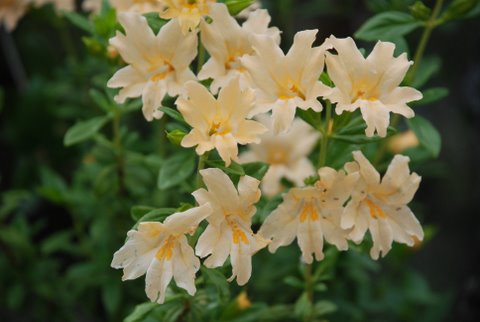
Sticky monkey flower.

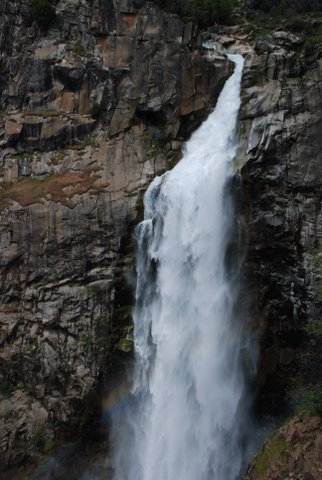
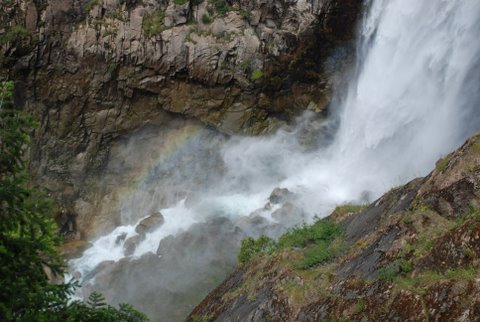
Feather Falls. The photo doesn’t do it justice–600 feet of plunging water.

Sorting lambs

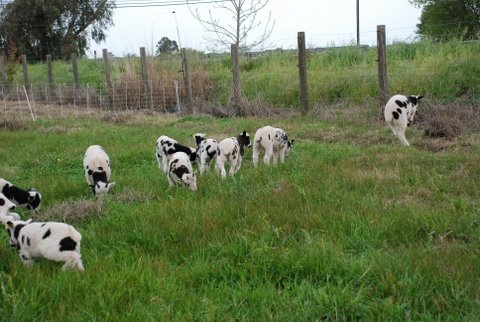
Today was the day to start evaluating lambs. I need to choose lambs for shows, for sale, and the ones that I want to keep. When they are all together and mixed up with the ewes I have a hard time comparing them. Two friends came over today to help with sorting and to find out the criteria I use to select lambs for sale or show.

Rusty and Mobi hoped that they would get to help also.

First we separated the ewe and ram lambs. Then we separated the 2 horn and 4 horn ewes. I sorted out some that I have decided to keep and some that will not be registered because they are too light. We narrowed the field down to lambs that I will offer for sale and/or will show. I need to figure out which lambs to take to Black Sheep Gathering in June, the Solano Co. Fair in June, and the CA State Fair in July.

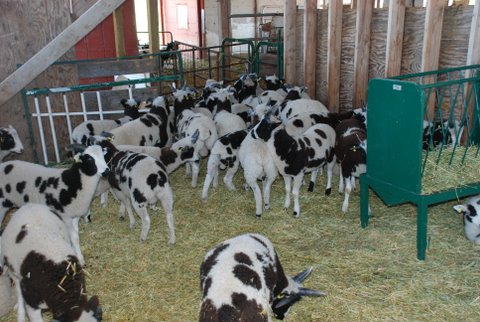
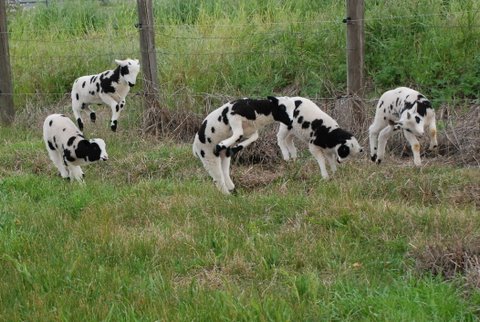
This is the group of 4-horn ewe lambs that  are available for sale or show.

This is the group of ram lambs before we started sorting them.

The ewe lambs were glad to head back to the pasture.

How I have spent 22 Mother’s Days

The Dixon May Fair is the longest-running fair in California. It is always Mother’s Day weekend. My oldest son started showing dairy cattle in 1988 and I’ve had kids at the fair ever since.  The kids can show as FFA members for one year after they finish  high school so this was my youngest son’s last show. He was at the fair from Tuesday through Sunday and left Sunday night for his job on a hotshot crew north of Redding.

Chris has shown dairy goats each year since he started in 4-H.  He sold some of his goats last summer when he left for the fire-fighting job, but had two two-year old milkers at the fair this year. Chris is showing Devan and a friend showed Denise.

This was a very small show, but Devan won Champion…

…and Best Doe in Show. Chris showed her dam at the CA State Fair two years ago and won Champion Toggenburg.

On Sunday Chris competed in Supreme Showmanship, in which the showmanship winners of each species compete.

Each participant shows sheep,

beef cattle, dairy cattle, meat goats, dairy goats, and swine. Chris won second place in this event. And then it was over. Chris rushed home to leave for the job. I went back to the fair to get the goats when they were released. That’s it! Not as big an adjustment as last year when Chris left home for the job for the first time, but now my years of 4-H & FFA Mom is over.

But I’m still a mom. Here is the Mother’s Day present that Chris gave me!!!!

Irrigation time again

I live on the western edge of the Central Valley in CA.  We get winter rain and it’s dry all summer. The only way that things stay green here is through irrigation. One reason that we wanted this property was because it was part of the Solano Irrigation District and we could get irrigation water without having an ag well.

When I order water the water tender opens a valve at the west end of this ditch (left in the photo). This is not on our property, but the water flows down this ditch and then onto our property by opening the valve at this end.

The water flows through a pipe that goes under the fence and the water comes up in this standpipe and out the hole into the ditch in the pasture.

This view is still looking west. The water is starting to flow from the standpipe down the ditch at the north end of the property. The ditch turns south and gets the water to the rest of the pasture. The ditch is supposed to have high enough sides that the water is contained and only flows out where I dig a cut-out that lets the water into the pasture. The idea is to open a few areas at a time and be able to fill those cut-outs in as you open more. Ideally the pasture would have just the right amount of slope so that the water would flow evenly. Easier said than done. One problem with our place is that we don’t have the equipment to re-ditch the property. I’m using the same ditch that we had dug (by a neighbor with a tractor and ditcher) when we first started here. I see the alfalfa farmers re-ditch every time they irrigate and I’m jealous. I’ve looked into a pipeline system in which there wouldn’t be a ditch, but a buried pipe with valves that could be open and shut to control the irrigation. Unfortunatly the cost is completely unrealistic for my business. So I keep plugging away with the shovel and hoping for the best.

That is a mowed alfalfa field on the north (top of the photo) and our property is the green field. The standpipe is in the northwest corner of the property and the ditch in one of the photos above is along the north fenceline. You can see the water flowing down the ditch going south and that part of the pasture is already flooded. The sheep have to be in the corrals and barn when I’m irrigating. (So I have to feed them hay for several days every 3-4 weeks. I usually have the water on for 36 hours, but it takes several days for the field to drain enough to turn the sheep back out.)

That ditch that takes the water south dead-ends on this ditch that runs east-west and carries water to the other 5 acres. This view shows the south west corner of the property.

Here is the south east corner. I strip graze this 5 acre pasture. The strips run north-south and are separated by a 3-wire electric fence. You can make out the strips in this photo. See that black thing towards the top? That’s a portable water trough that I plug into the water pipeline that we installed a couple of years ago. The water trough is on one of the fencelines. I have just finished grazing the strips on either side of the water trough. The next two strips are more lush. They are ready to be grazed next. Notice the very pale green in the strip above the water trough? This strip is hard to irrigate and for several years I couldn’t get much water on it. That light green color is medusahead–a very unpalatable grass. Ideally I think burning it would be good, but I don’t think I can do that. We just bought a better heavy-duty weed-eater and I think I’m going to try to stay on top of the medusahead by using the weed-eater. I hope that I can make an impact on it this year. It renders that strip of the pasture unuseable. I noticed tonight that my irrigation water was getting there. I hope that if I can keep the medushead at bay then something else will start growing there.

New Baby Blankets

I haven’t written much about weaving lately, but I’m getting a few things done. I have woven some baby blankets using SuperLamb. That’s the washable Merino wool  by Jaggerspun that i am selling in the shop. It will be great for baby blankets–very soft and the added advantage of being machine washed and dried.

Here are some of the blankets still on the loom.

And here they are off the loom. These blankets are at The Artery right now.

Fashion photos with sheep

A few weeks ago I was contacted by Jenne Giles of Harlequin Feltworks in San Francisco who asked if she could do a photo-shoot at the farm. It sounded like fun so we set it up and yesterday was the day. The photographer of the day was Allison Harrell She and her crew arrived mid-morning along with suitcases of props and lots of lighting equipment. Here  are some highlights.

I showed everyone the farm and Allison took some time to figure out locations for the various scenes.

First location was a stack of alfalfa. The model here is Kara, wearing one of Jenne’s striking felt creations.

Kara is joined by Emily and one of my lambs.
Next location with new outfits. Emily and Kara were joined by a ewe and a goat in some of the photos.
Make-up artist & hair stylist, Elizabeth, found a new role as she negotiated with Amaryllis to be part of the day’s activities.

A little grain works wonders.

Amaryllis cooperated quite well for most of this portion of the shooting.

Location 4 was the pasture.

Paulette invited her self to be part of this scene.

Doris and her triplets posed quite well also, although I didn’t tell them that this wasn’t all  about them.

The last location at our place was the chicken house.

Rusty worked all day to make sure that everything was in control.

It was very interesting to see what goes on “behind the scene” of something like this. My shop was tuned into the dressing room. Jenne’s dresses and scarves were stunning. She uses Merino wool for her felt and the pieces are lightweight and soft. Accessories included everything from dozens of pairs of colored tights to frilly rubber swimcaps. Allison had her laptop with her so that she could show Elizabeth the look that she wanted with the make-up and hair. (Anyone who knows me will understand when I was surprised to hear that it would take about an hour or more to accomplish the make-up and hair part. I’m lucky if I remember to comb my hair when I get to my car–which is where I keep my comb.)  While the models were getting ready and changing in between locations Allison was busy getting the lighting just right and setting the scene.

I thoroughly  enjoyed this day and meeting all of these delightful women.  To see more of my photos you can find Meridian Jacobs on Facebook (become a fan while you’re at it) and also be sure to look at Jenne’s blog. The “real” photos (Allison’s) will be coming later.

Thanks for a fun day, ladies!

Tay Sachs and Sheep?

Friday was an interesting day. Veterinarians I know had agreed to help with the project of testing my flock for the gene for lysosomal storage disease. I’ll back track and explain briefly.  A gene for lysosomal storage disease has been identified in Jacob sheep. Carriers are unaffected but if two carriers produce an affected lamb it will develop symptoms of the disease and eventually die. There is interest among some breeders in identifying carriers so that they can either avoid the problem (don’t breed carrier to carrier) or remove the problem (cull carrier sheep). But there is more to it than protecting our flocks. Researchers at Texas A&M and New York University Medical Center found that this disease identified in Jacob sheep is the same as the lysosomal storage disease in children, known as Tay Sachs. So there is interest in maintaining a carrier flock of sheep for use in studying human medicine. One of the members of the Tay Sachs Gene Therapy Consortium stated:

“The goal of identi­fying and eliminating Tay-Sachs in Jacob sheep in order to conserve the breed is a noble goal. But we who are working on a human gene therapy cure are very happy that you did not succeed and kept the car­riers for the last decade. These sheep are genetically significant.”

This article it will give more background.

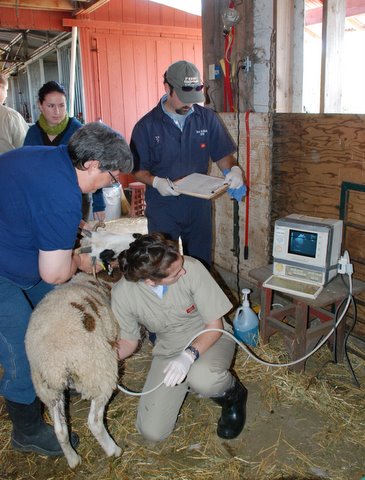
First up was to do ultrasounds on the sheep and one goat that will be part of the UC Davis VMTH Livestock Nursery at the CA State Fair.  I have provided sheep for the nursery for the last couple of years and because we’re breeding out of season we like to check and make sure they are really pregnant.  I’m pleased to announce that Stephanie, the Toggenburg goat, and 3 ewes are pregnant and will be at the fair in July.

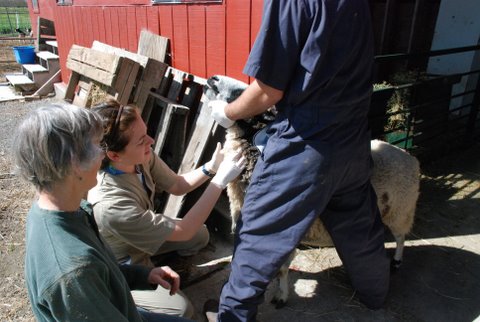
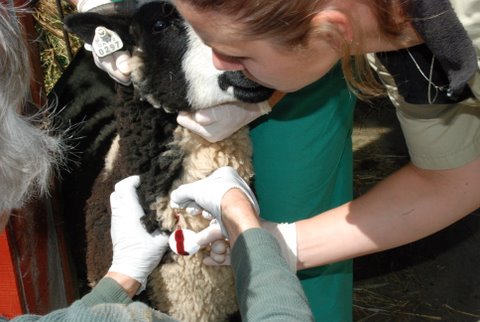
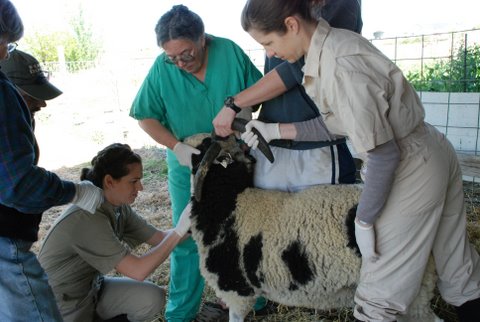
A protocol was developed to enable sheep producers to gather blood samples from their flocks themselves. The DNA test can be done with a few drops of blood on a filter paper. It was recommended to use a special lancet and take the blood from the ear. The Farm Club members and I worked on that a few weeks ago but it turns out that we didn’t have the right supplies and it was a struggle. While I was waiting forthe correct supplies I talked to my veterinarian friend who suggested obtaining the blood from the jugular vein as you would for any other blood test. It’s easier on the sheep (minimal pain) and easier on the person (if you know what you’re doing).   In this photo I’m getting a lesson on how to do this.

I’m pleased to say that after a few missed attempts I was able to get four in a row. Then I figured that I at least knew how to do it and I went back to helping move sheep. We had a “clean” person who labeled and handled the samples, 2 people drawing blood and the rest of us caught and held sheep so we could work through the whole flock quickly. Oh, one of the Farm Club members was the photographer and took all these photos. Thanks,  Shelby.

It was a little more difficult getting blood from the rams. This is Tioga.

My son, Chris,  helped move sheep.

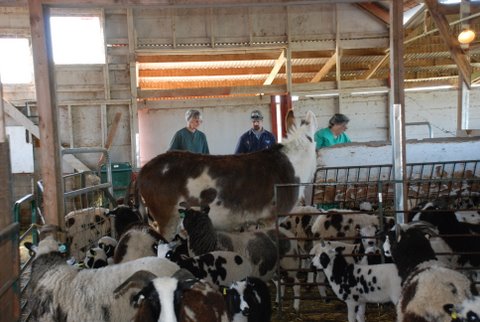
As much as I love my donkey sometimes she makes things more difficult. She is standing right in the gate where the sheep are supposed to go.

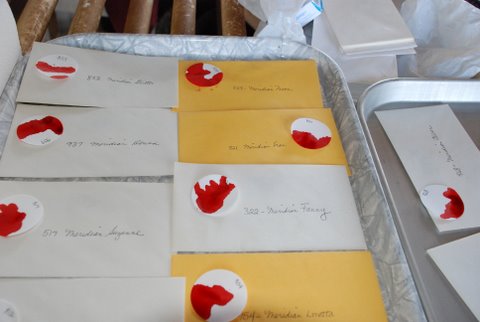
These are some of the samples that will be sent to NY for testing.

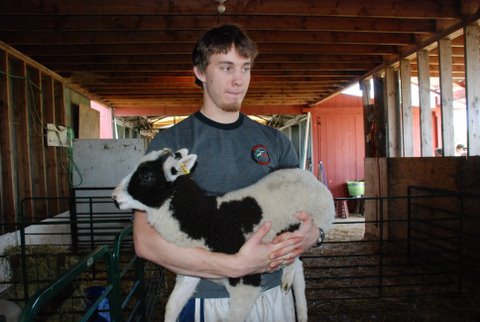
This is Sid, a wether who will go home with Jackie when he’s old enough.

Thanks to the veterinarians who helped with this project and to the Jackie, Shelby, and Kathy of the Farm Club.