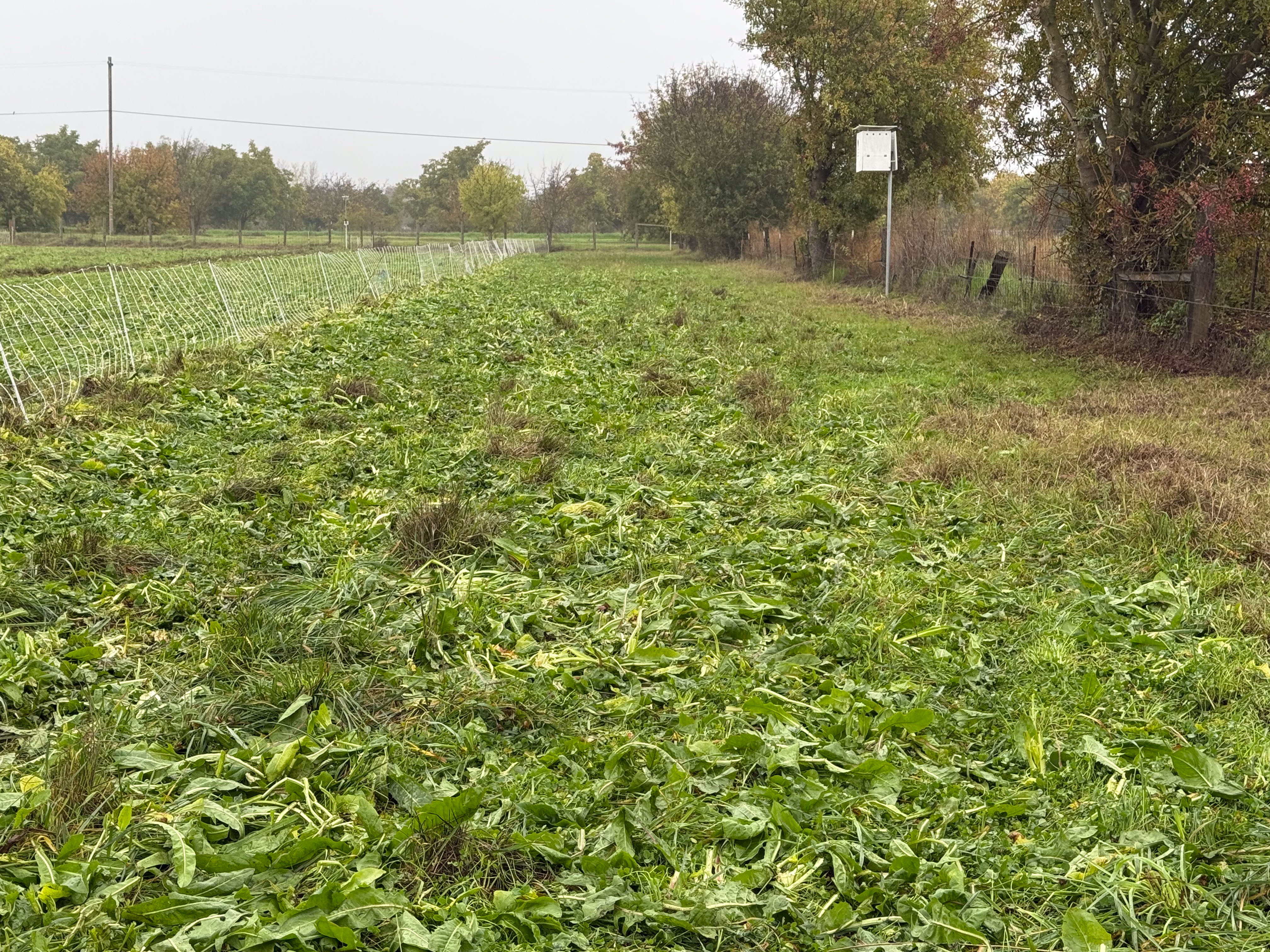
Paddock 1 after the first day of grazing. These are yesterday’s photos and this morning the sheep were moved to Paddock 1-N. That is the one just north of this one.
This is 1-N before I moved the fence.
Did you notice the owl box in the first photo? I can’t look in but I can just reach the latch, open the door, and snap a photo with my phone. It’s obvious that it has been used, but I don’t know if the owls have raised babies or not.
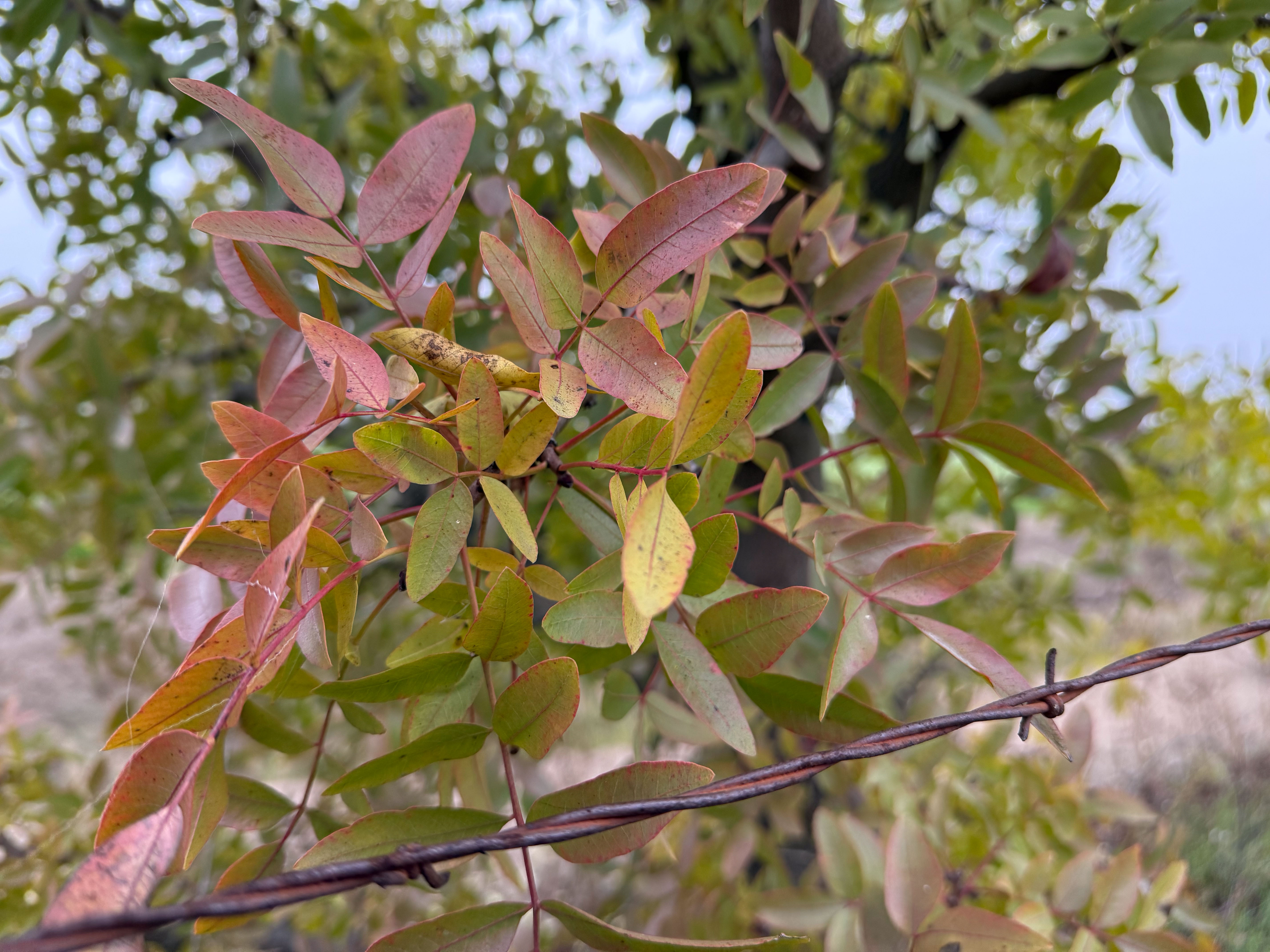
Leaves at the edge of the pasture.
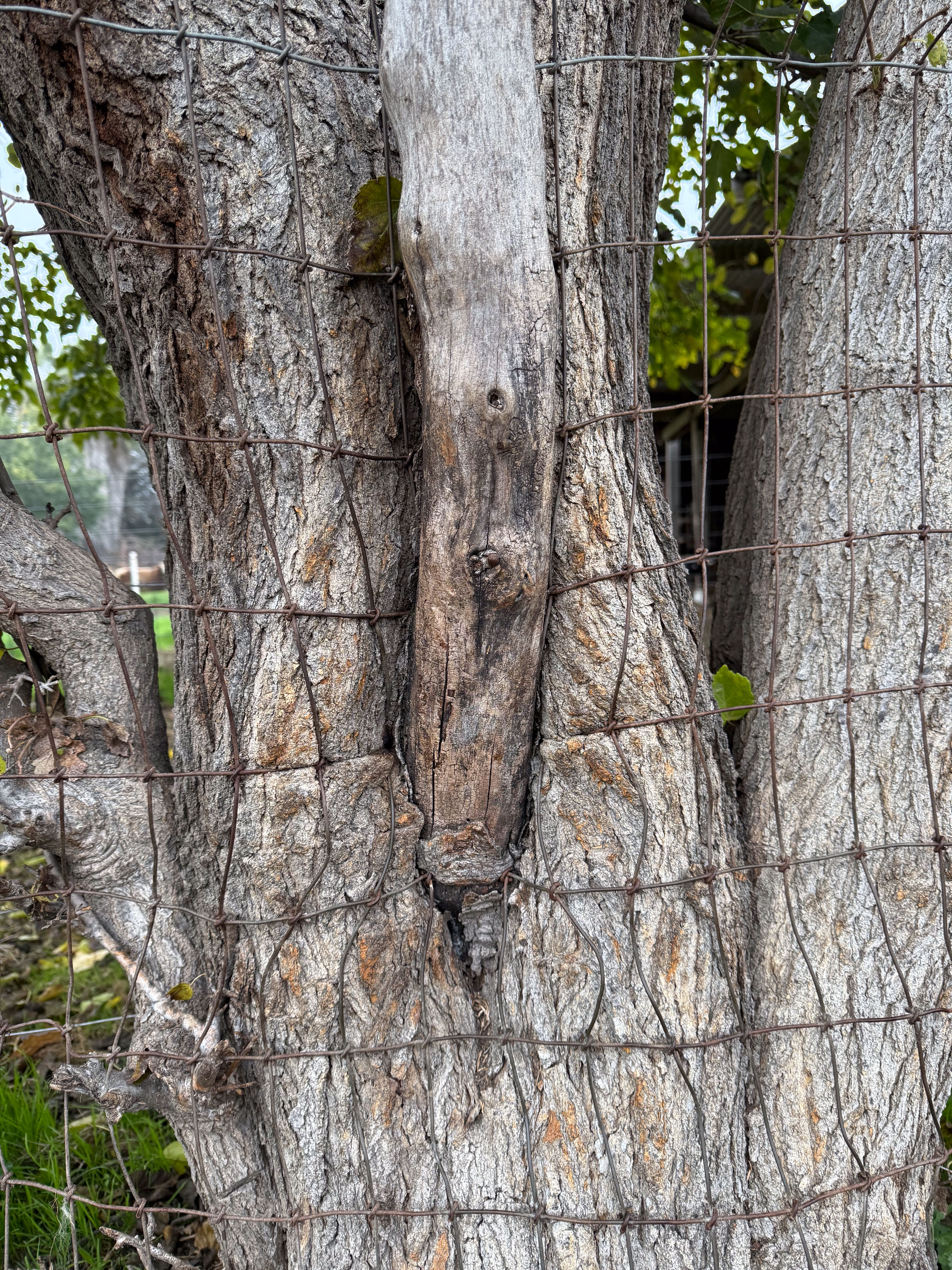
The tenacity of trees to grow however they can.
A view of some of the sheep Across the Road. They are grazing the alfalfa and being moved strip by strip.
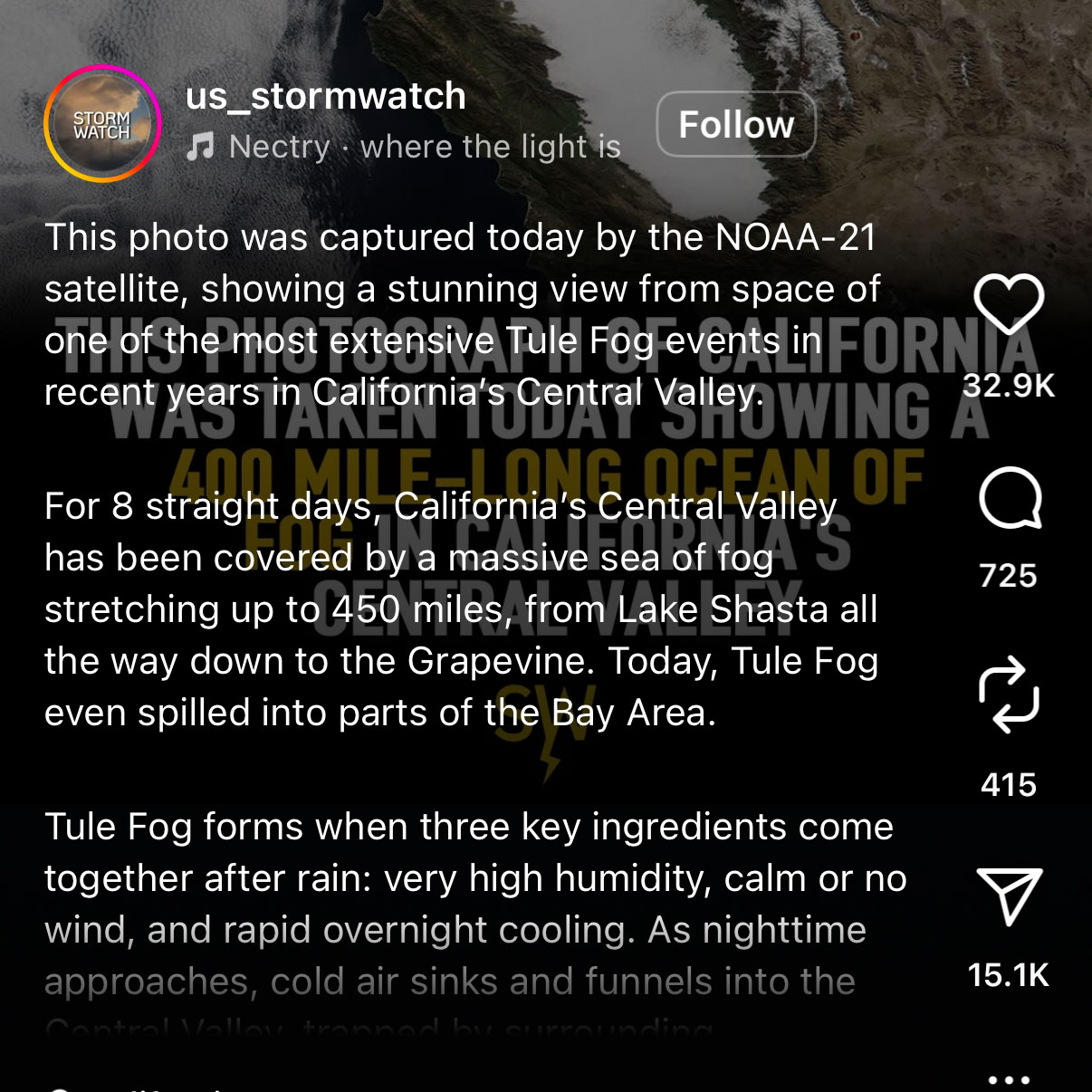
A screenshot from Instagram show yesterday shows our weather.
Our farm is at the edge of the Central Valley, sort of where that arrow points. To put this in perspective, realize that the white band on the right is the Sierra’s (not much snow yet). The left side is the Pacific Ocean and where the fog narrows and goes to the left–that’s going between the hills and ends up over the SF Bay.
Read the details above. To those of you who live where it is really cold it probably sounds like I am whining. Is cold different when you can see sun part of the day? Or sit in a sunny window? There was not even a glimpse of sun the last couple of days.
So let’s add some color!
Cosmos from the summer dye garden.
Sunflowers growing Across the Road a few years ago.
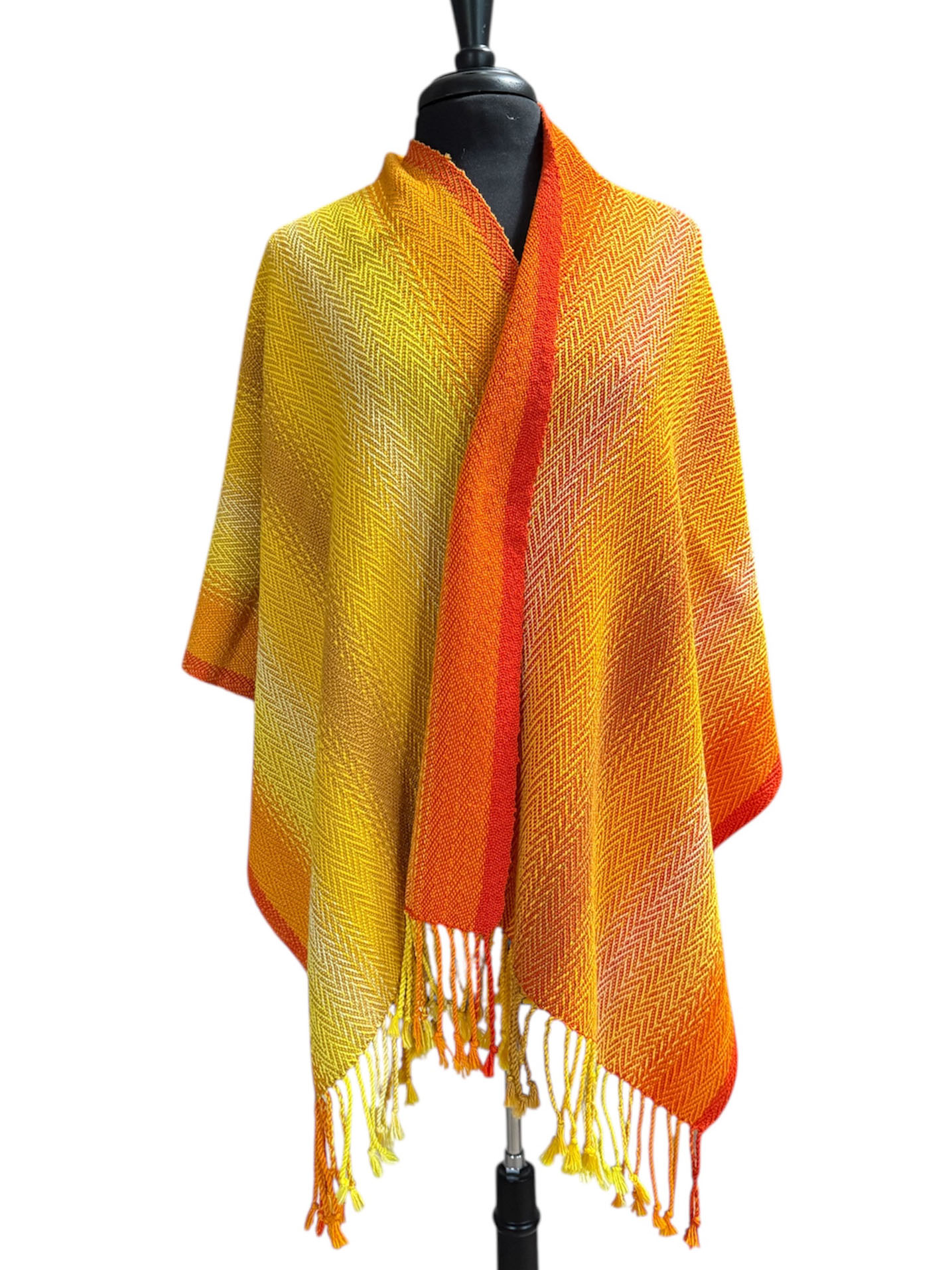
My interpretation of the garden woven in a cotton shawl.
We’re almost to the last check in the south pasture. Well, we are at it but that is today and this blog post is about yesterday.
This is looking south and Paddock 2 on the right. That is the one the sheep were just grazing for two days, after grazing Paddock 3 (left) for two days. You can see how this looked two days ago here.
Anther view of that same fence line.
Moving west, this is the fenceline between #3 and #2. I had to move that net fence from the division between #3 and 4 to the division between #2 and 1.
The fence line between #’s 2 and 1, neither yet grazed
This morning I shared photos of our grazing set-up now that it’s one year after the big project began. I just looked back through my blog and found this post when we seeded. That was November 19, just hours before we had a lot of rain. A lot has happened in a year. This winter it feels like a whole new experience because prior to this project I would not have been grazing in late November and would be waiting for spring.
Yesterday about noon I walked out to check the fence. Some of the sheep were on their way in.
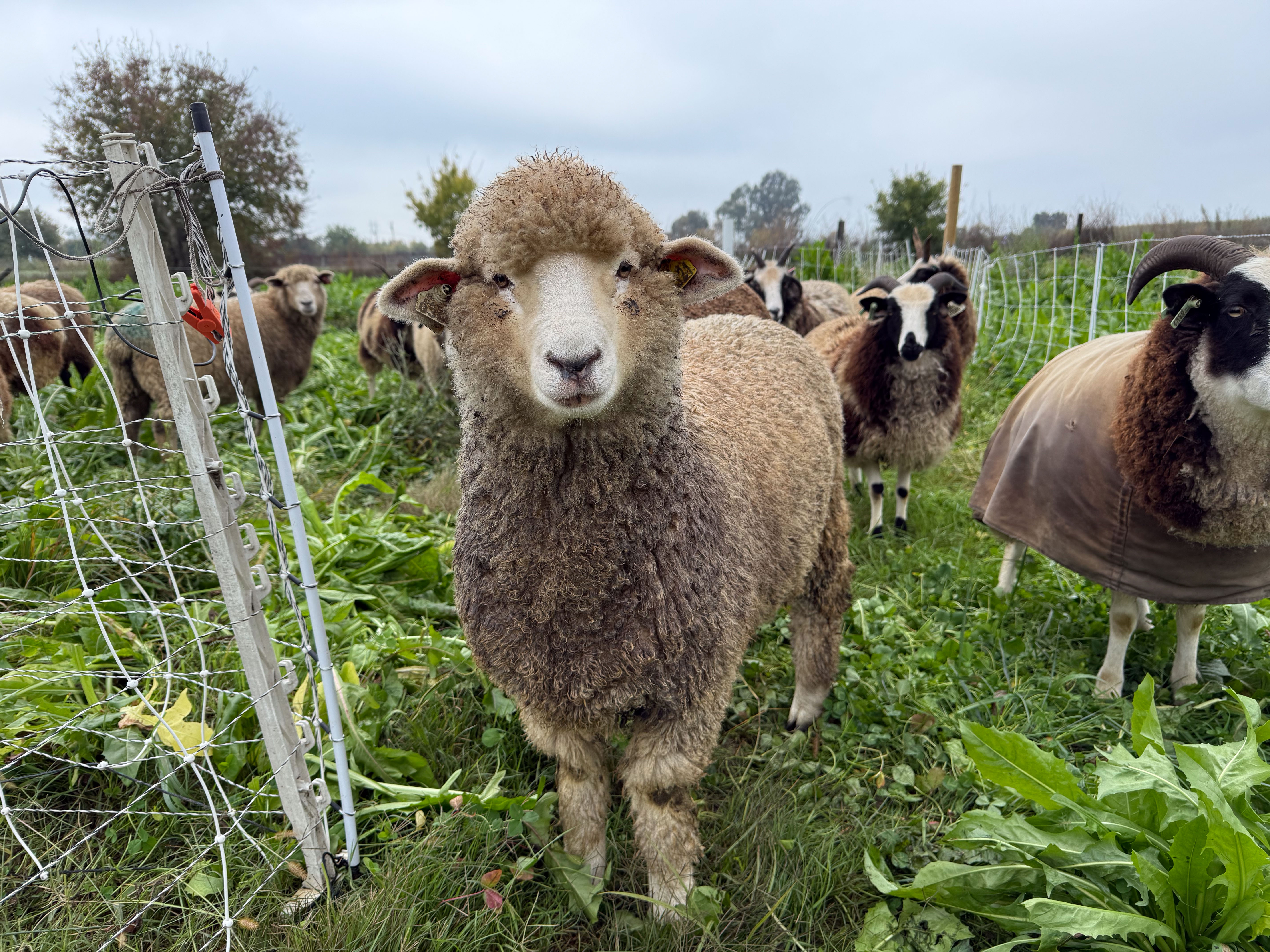
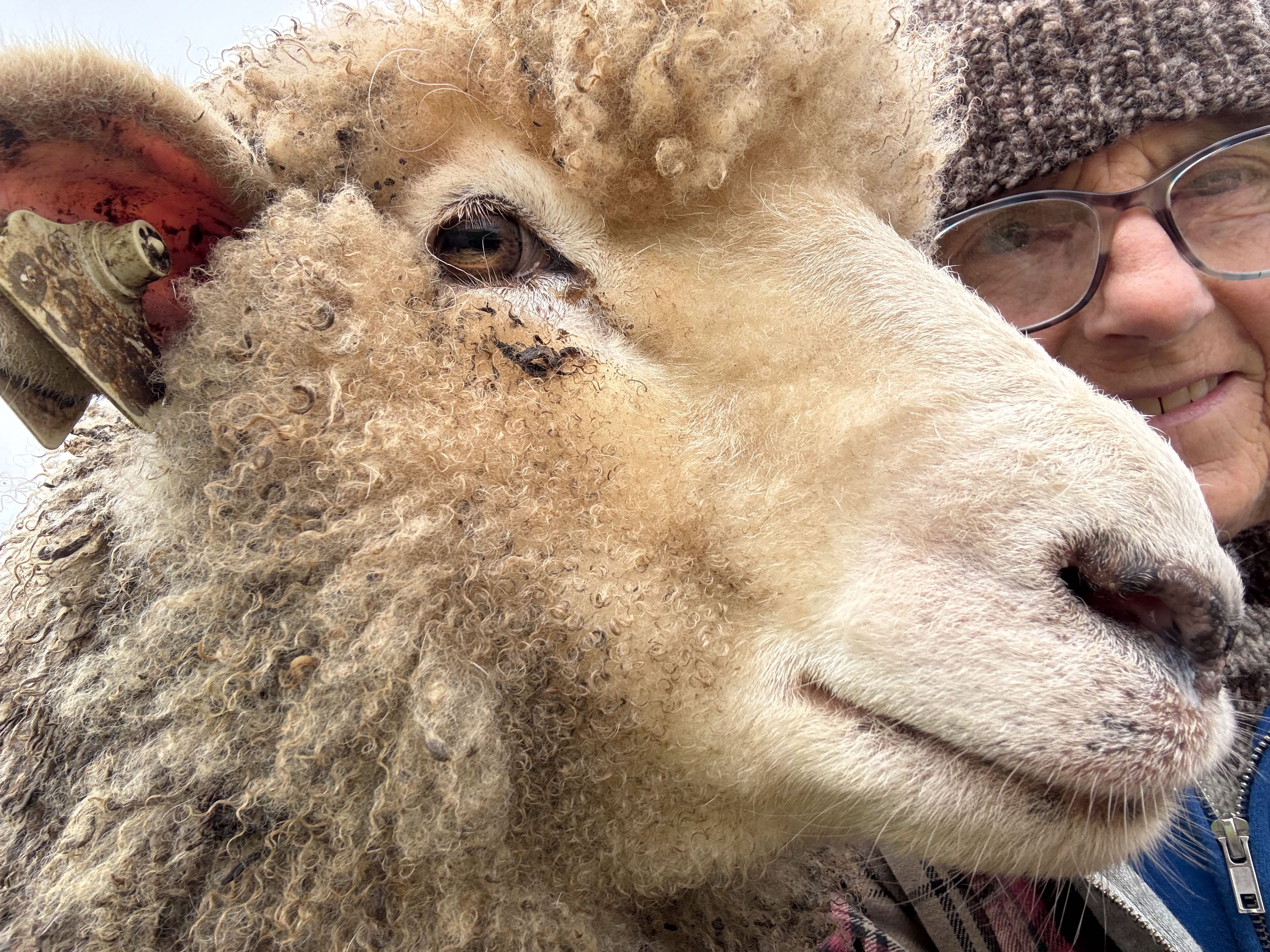
This is the corner of the new paddock I’d just set up. I think I mentioned something in previous posts about acquiring five new sheep. This is one of the three Corriedales, so far named Corri 1, Corri 2, and Corri 3. Yeah, not very creative. This is Corri 3…
…and she is one of my best friends.
Sparky is another.
I have been taking photos of individual sheep to update the pages on the website. I have updated this page with the current ewes, but haven’t included all the new photos yet. The ewe in this photo is Ophelia, a yearling.
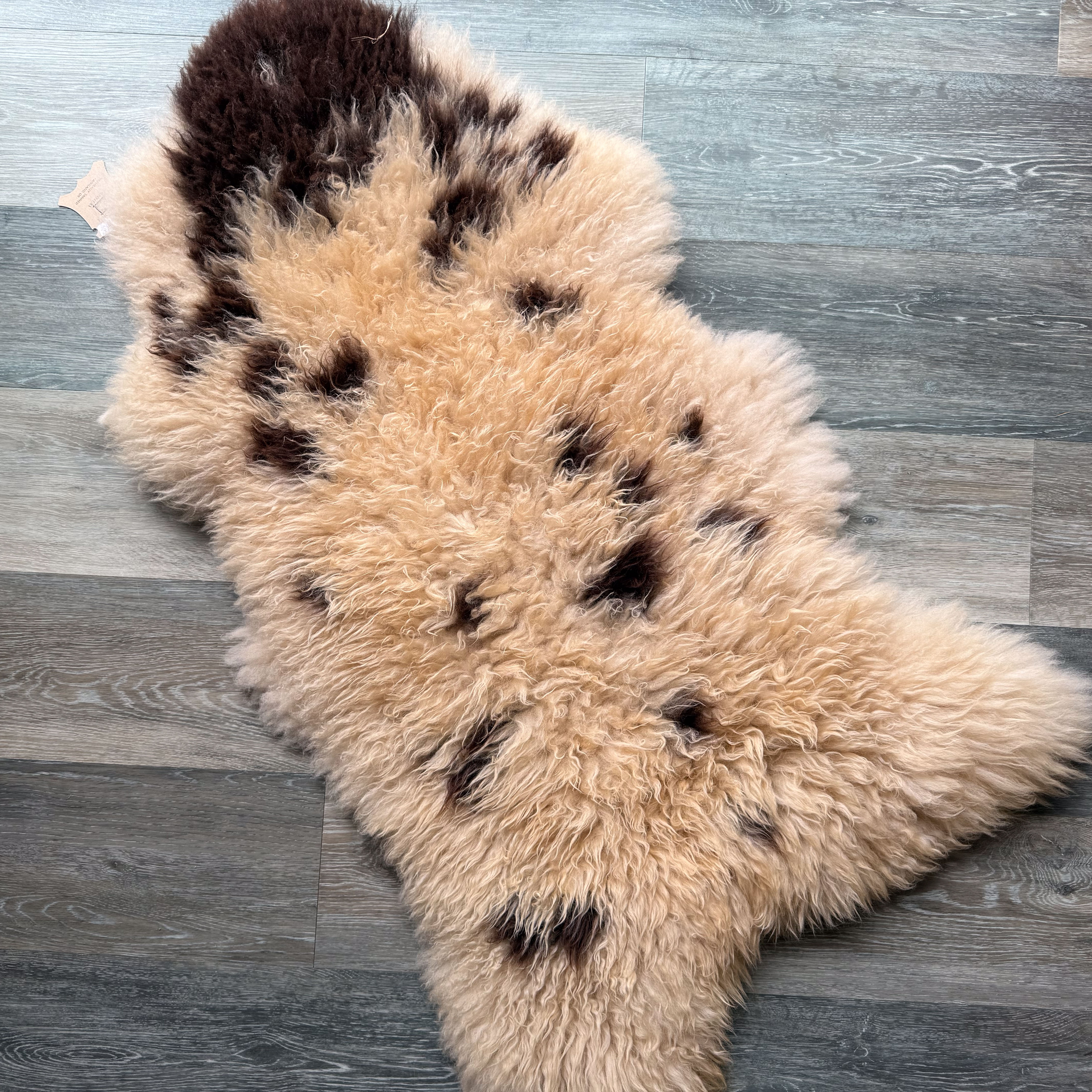
I also took photos of new lambskins yesterday. I stopped in the middle of writing this to list them here.
The hedgerow project wasn’t completely finished yesterday. I found more cardboard and cut it up for the remaining 19 plants and added more straw. We hadn’t got them all watered yesterday so I brought out a wagon to haul more water at one time.
I finished just as the sun went down.
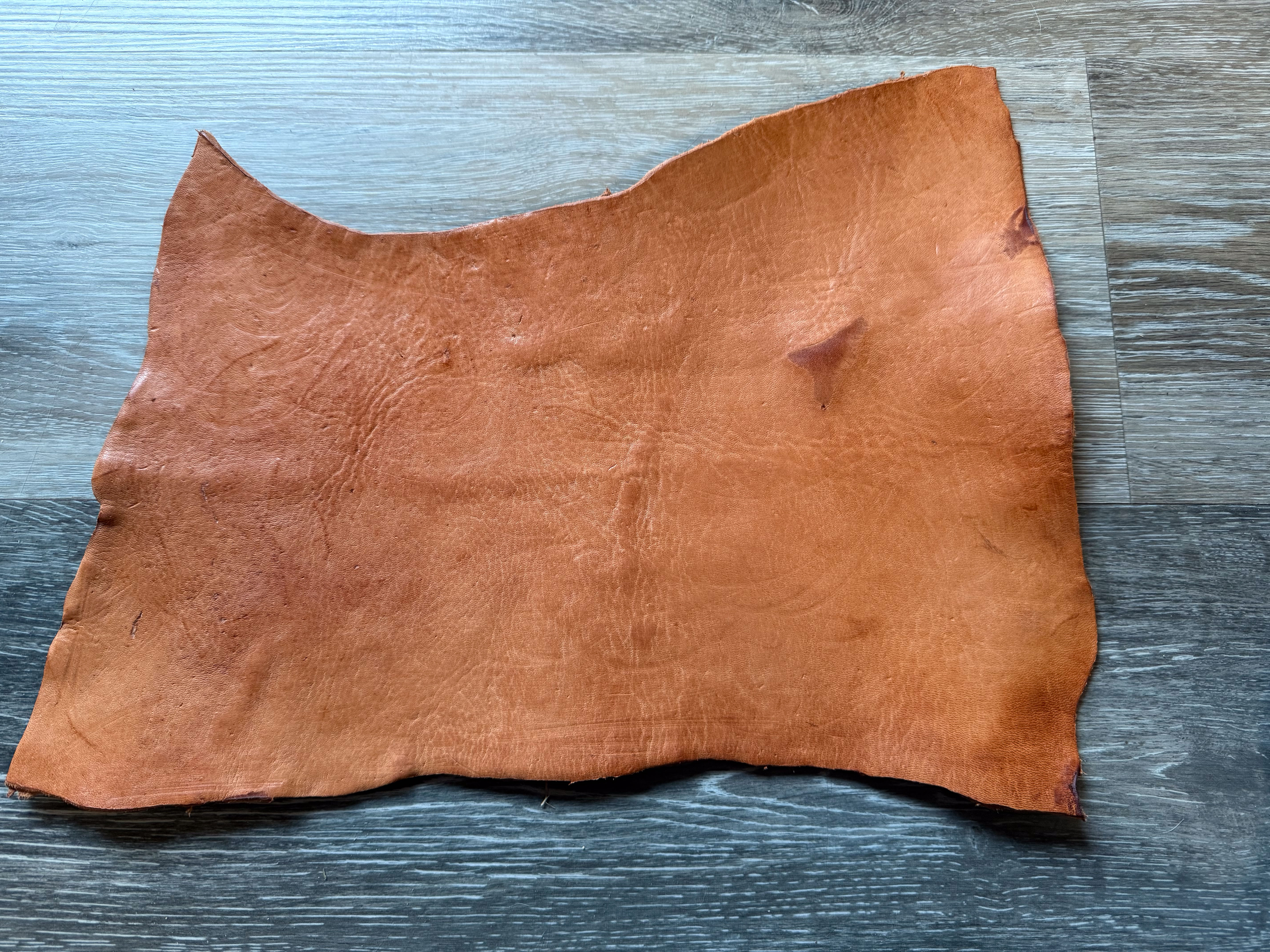
In the evening I jumped on Zoom for my final Basics of Bark Tan class presented by Traditional Tanners where I have had the latest sheepskins tanned. This is leather I made from deerskin! I highly recommend this class. It is very well presented and a lot of fun!
The sheep were out when I went to the barn yesterday morning. The paddocks are numbered from west to east, 1 to 21. Every other check has a permanent 3-wire fence, visible in this photo on the left. In the summer I grazed two at a time and 4 days seemed about right. After we got measurable rain I noticed significant trailing down the border check between the two paddocks they were grazing. The check is a raised strip running north to south that guides the water when we irrigate. I thought I’d better put a fence along that check so that they wouldn’t impact it as much. So that’s the way I’ve been grazing for the last few weeks. When Farm Club helped to measured net fences to make sure I had the correct fences where I needed them (blog post here) I had left 3 lengths of e-net that we measured to be the correct length for just this need. You can see the net fence on the right of this photo.
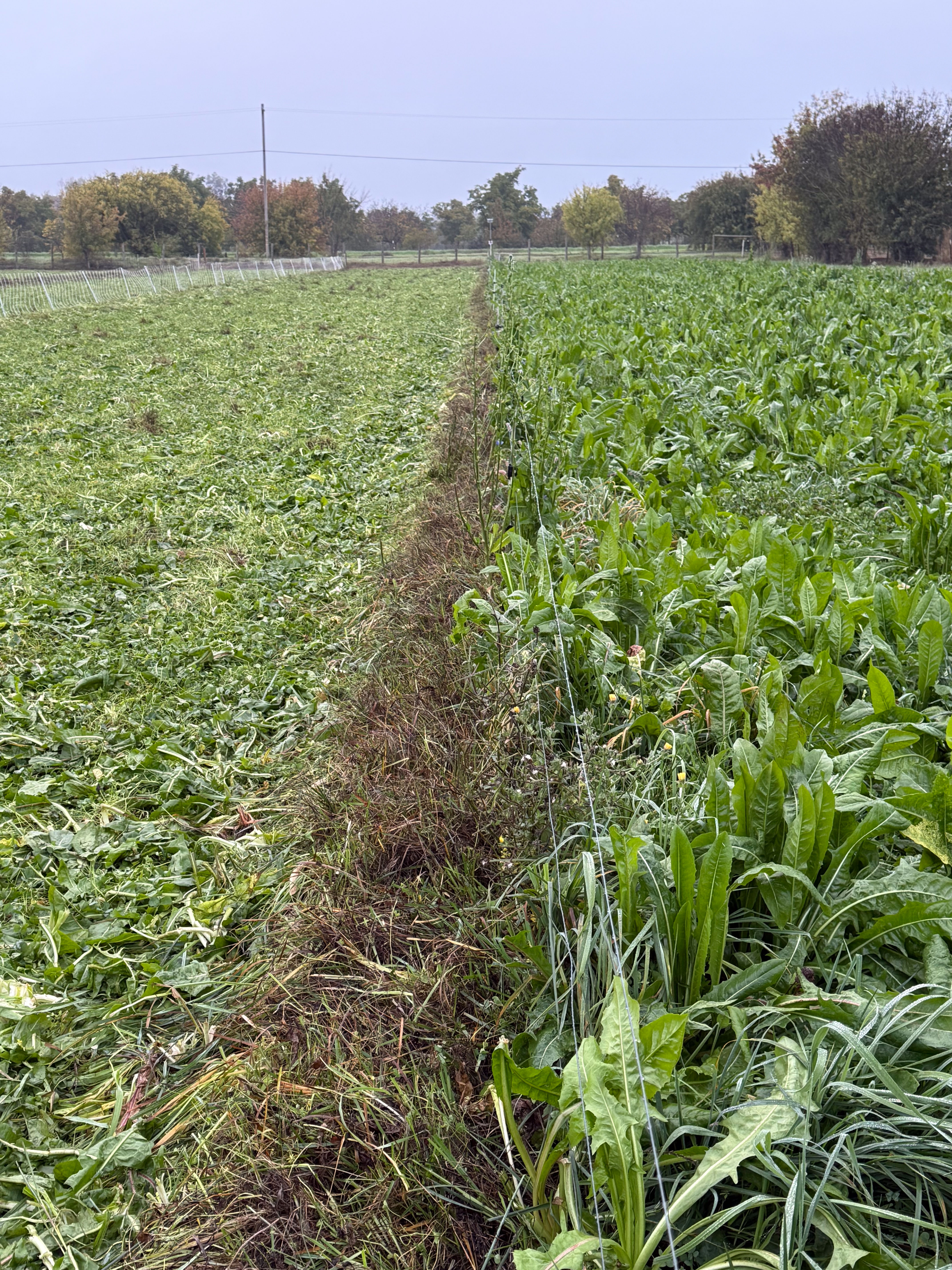
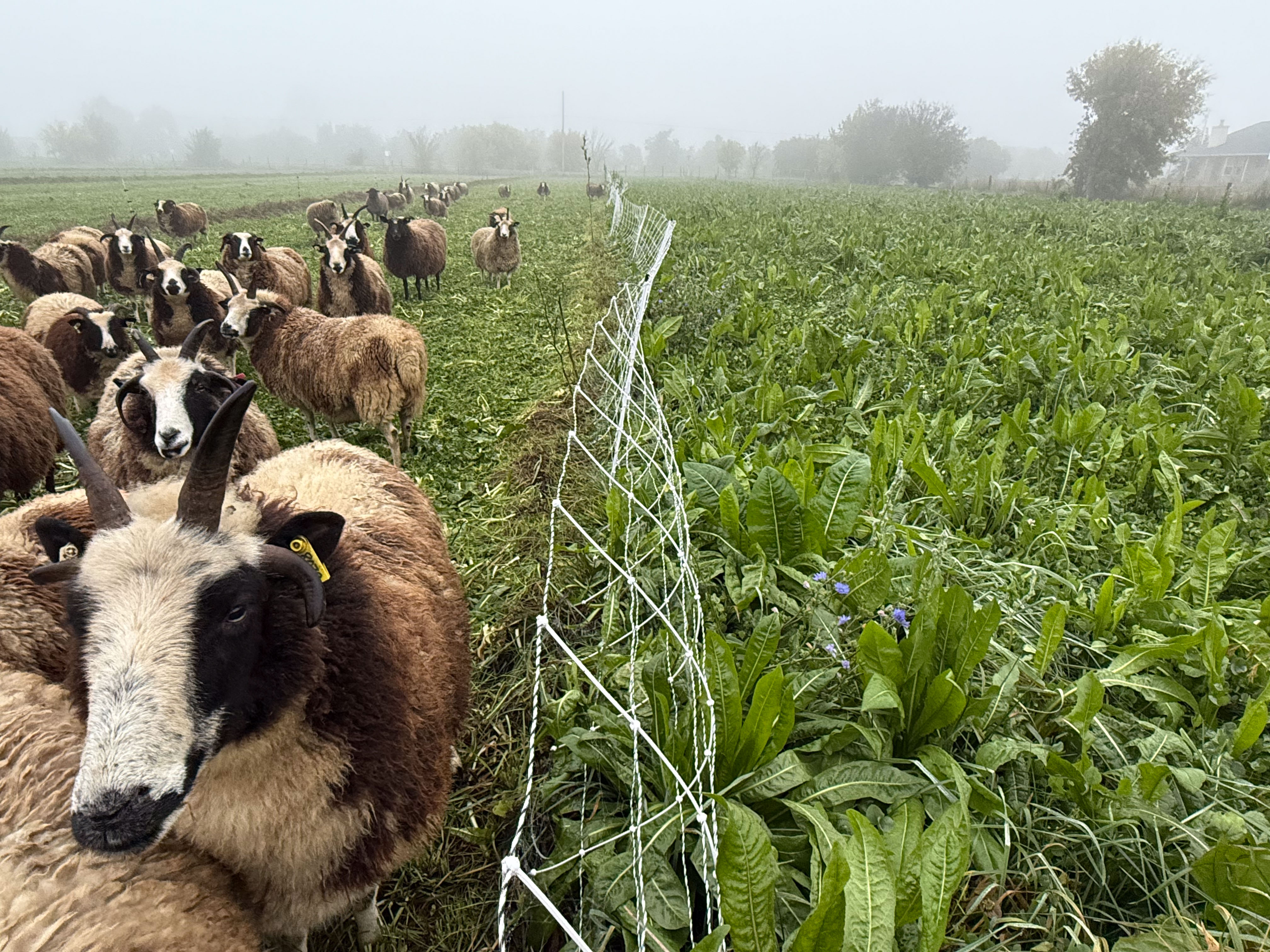
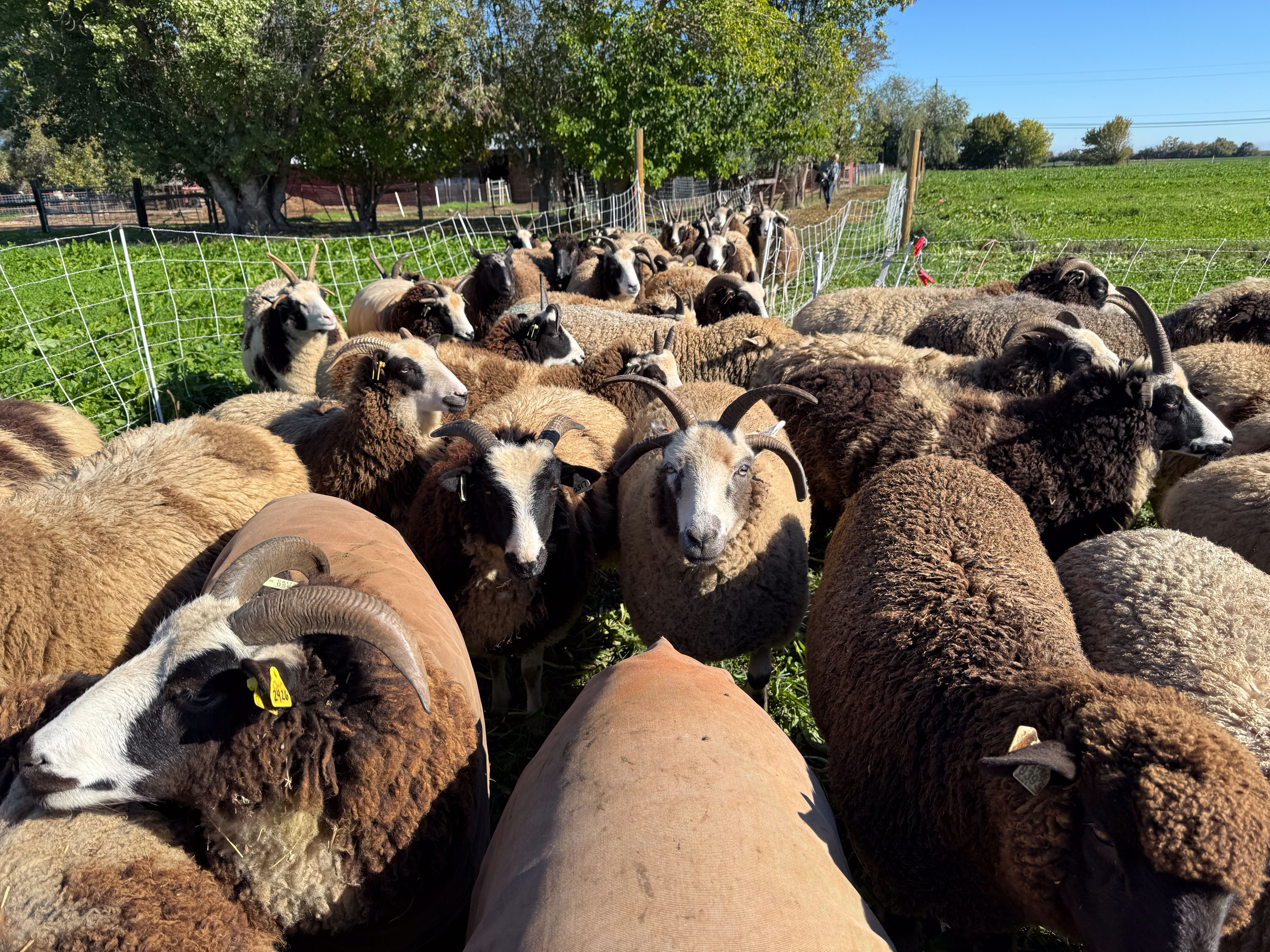
The sheep grazed this paddock (#4) for two days. This is the third morning and they need to move to #3. The fence is on the border check and you can see how they have grazed right up to it. The fence is purposely tipped away from the grazed paddock because I think the 4-horned sheep are less likely to get horns caught when they graze near the fence.
The sheep were anxious to get to fresh feed.
I was able to move the fence that was blocking access to the next paddock and they all came around the end.
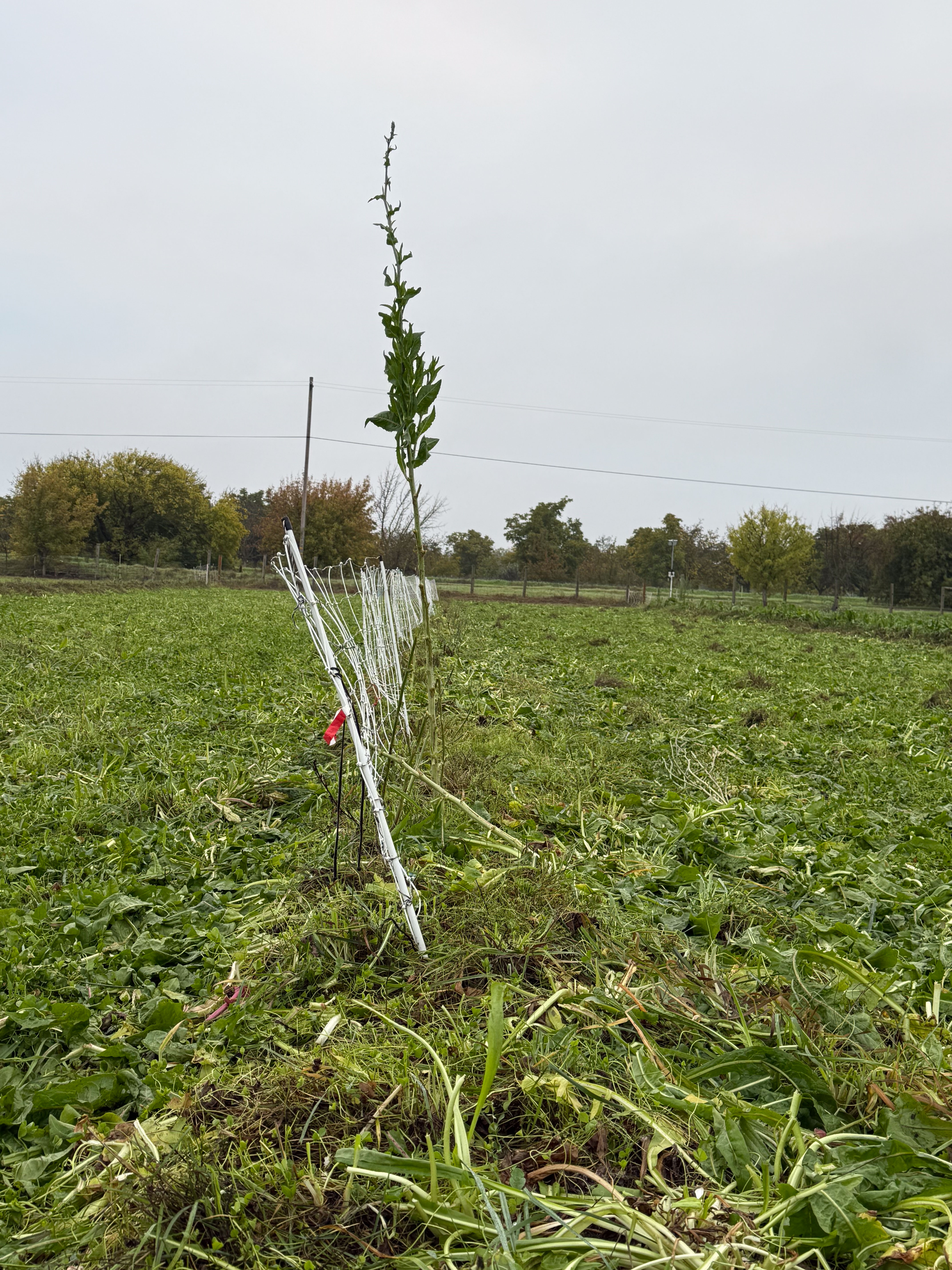
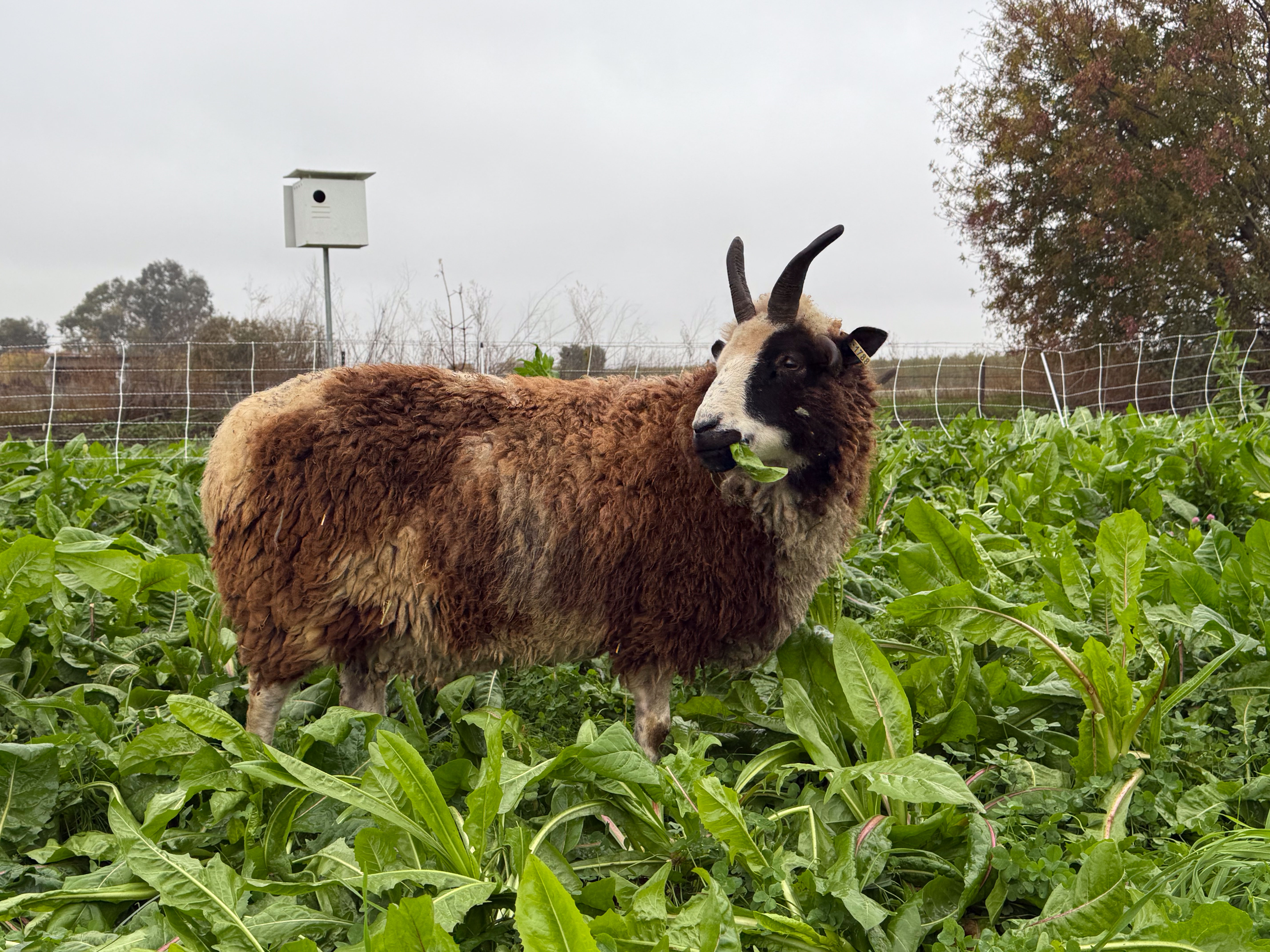
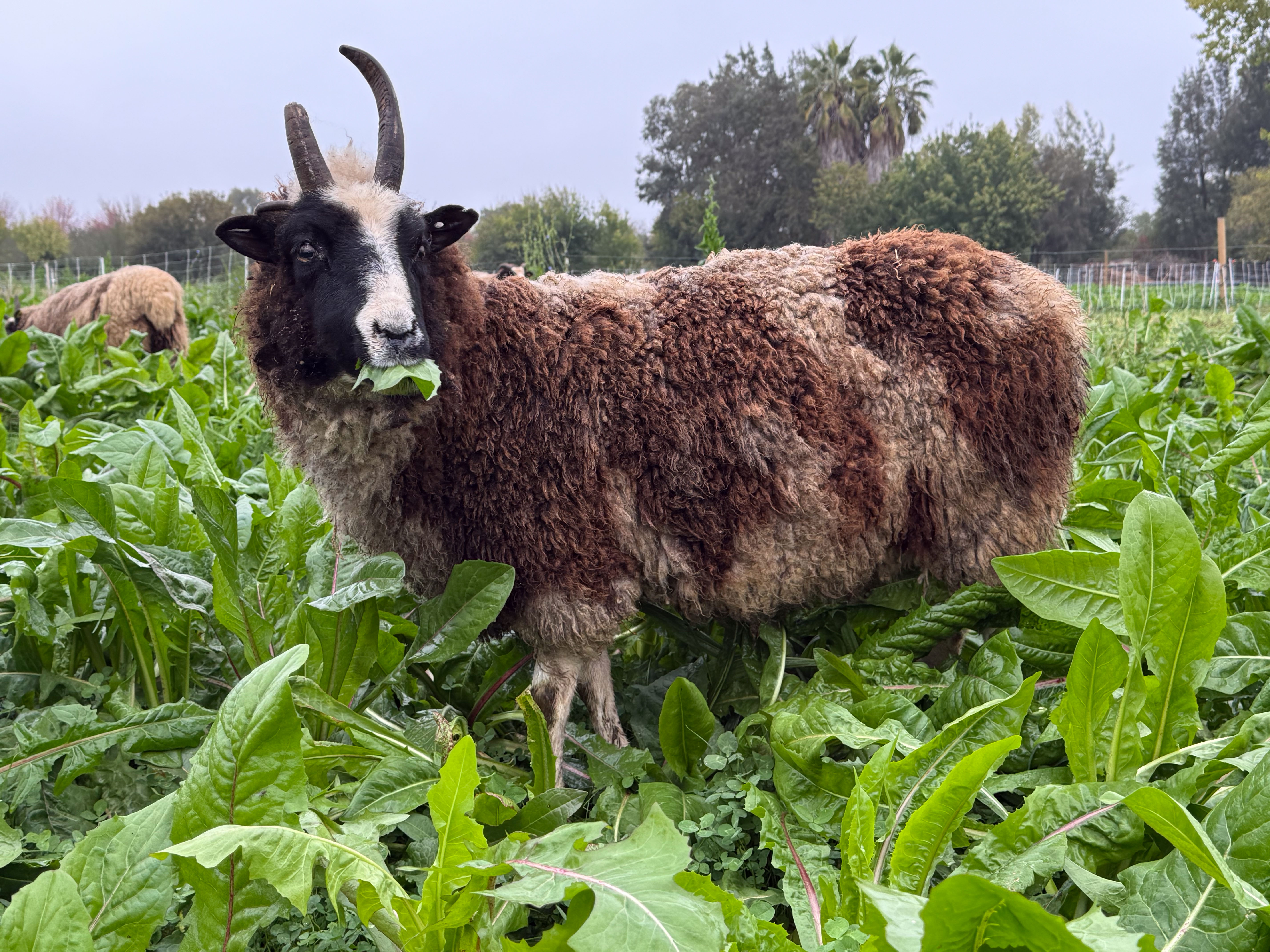
This is the view before I reset the net fence. I find it interesting to see how the sheep ate the leaves as far as they could reach on the chicory. By the way, the leafy plant that looks like we’re growing a crop of lettuce or chard is chicory. That was one of the three forbs in the seed mix we planted last fall. It didn’t grow as much as the clover until later in the summer, but it is sure evident now.
Another view of the fence before I moved it, and more chicory stalks.
The sheep are happy on this new paddock. This is quite a contrast from the one grazed for only two days.
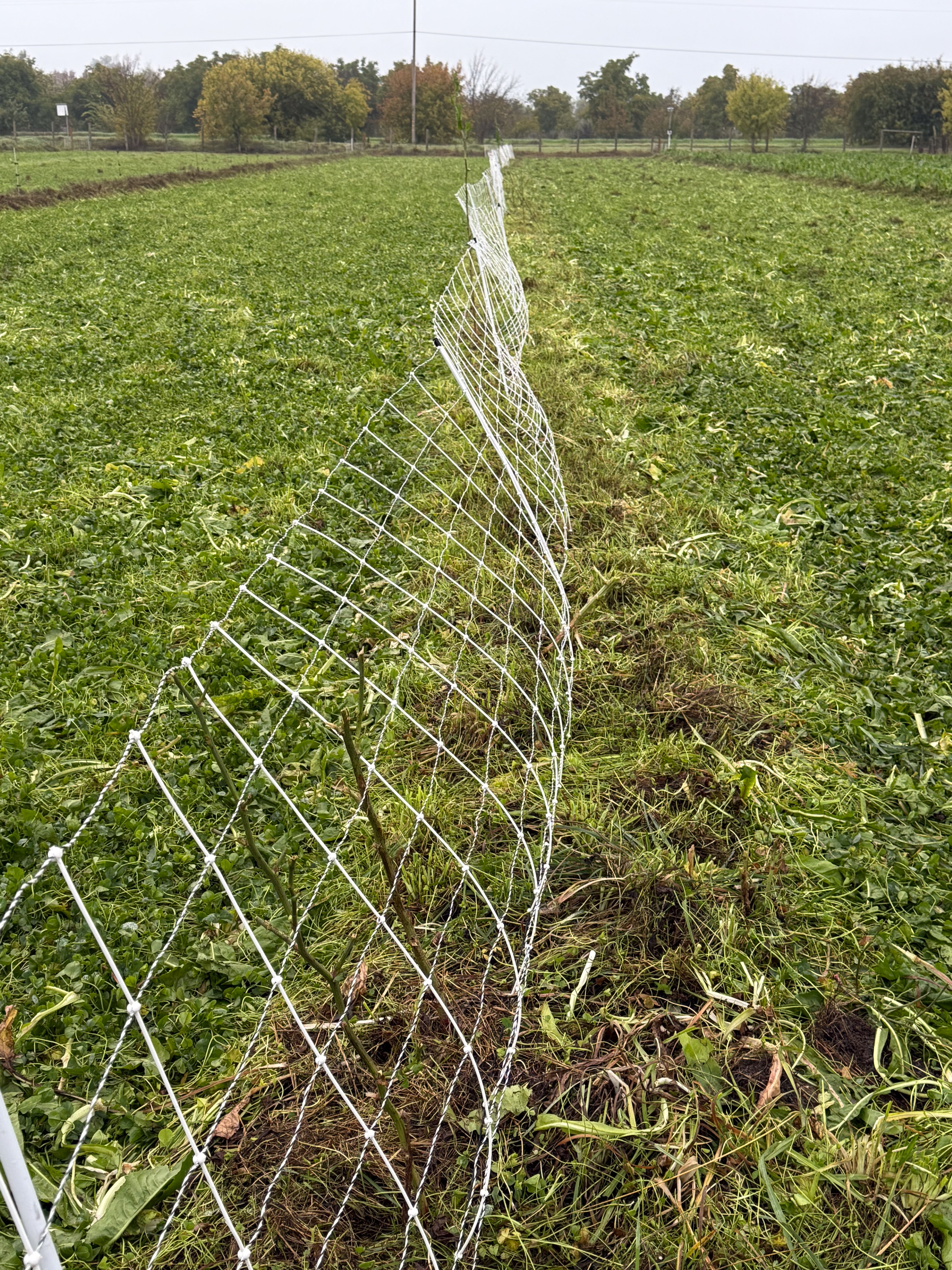
View to the north after re-setting most of the net fence.
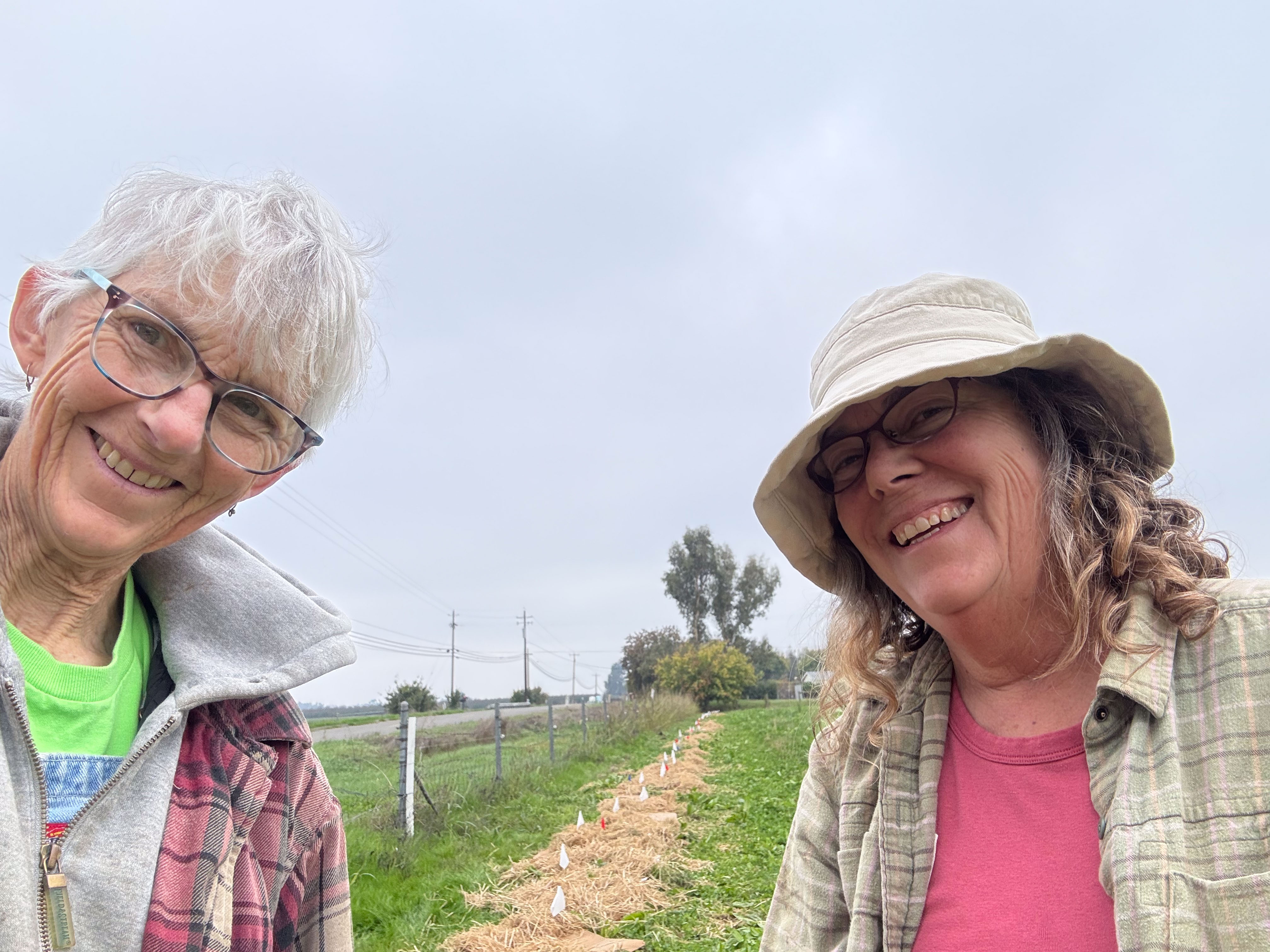
I introduced our hedgerow project in the previous post. That was Friday. Today, Sunday, one of the Farm Club members who had helped on Friday had offered to come back to help with the project. Even though the ground is moist from recent rains, the new plants would benefit from water right after planting. Also, we needed to add a cardboard layer to the mulch. Cardboard, covered by straw or other material would provide more of a light barrier which will help prevent or at least slow weed growth.
Raquel brought a barrel that she uses to catch rain water. There is a spigot on the bottom to fill containers. She thought it would be a good idea to fill this so that if more people came to help we wouldn’t all be waiting to fill buckets at one hose. It turned out to be just the two of us but her barrel idea was still helpful. We brought a hose from the other side of the fence to fill the barrel and could then work from that. Raquel’s idea was to use gallon milk jugs so they could be tipped over at each plant and direct the water to the base, while we were also working on the cardboard part.
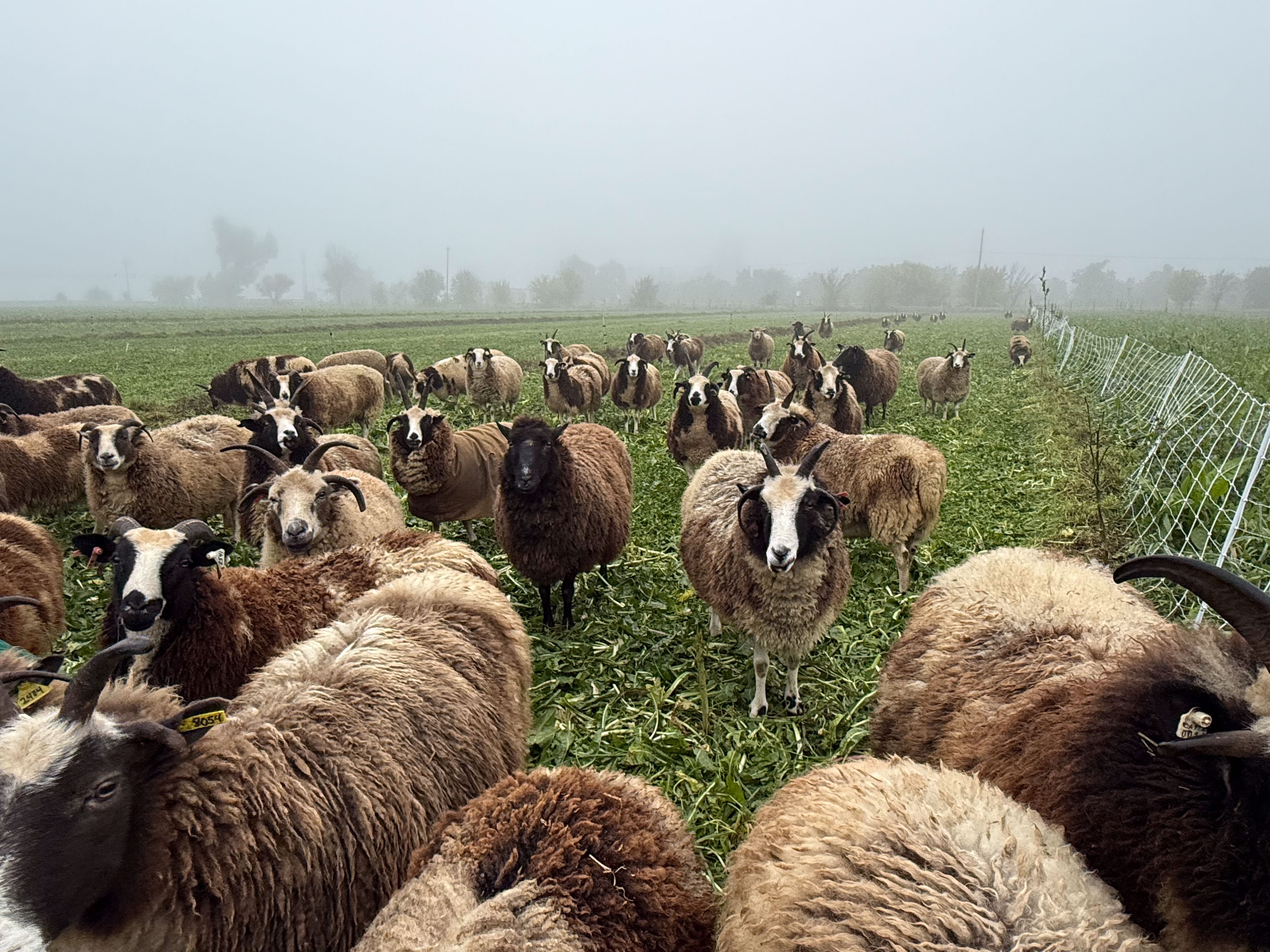
This morning started out super foggy. This is a view of the paddock that I opened for the sheep yesterday. They have eaten or trampled most but will have one more day here.
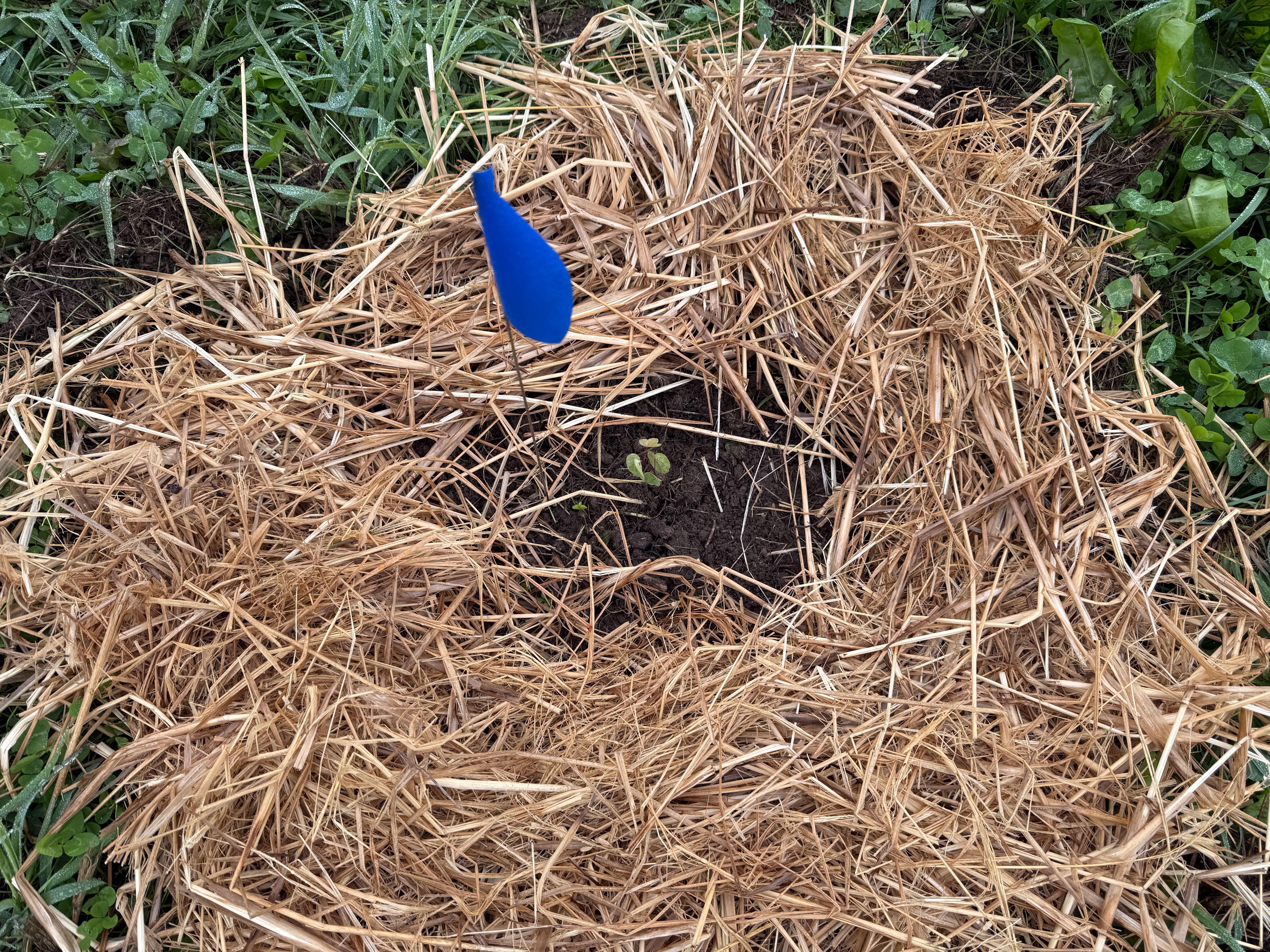
This is one of smallest plants we put in Friday. It is a Western Redbud, which is not a small plant when it has grown up, but right now it’s only a couple of inches.
This is another redbud, marked with the blue flag, yarrow, and deer grass.
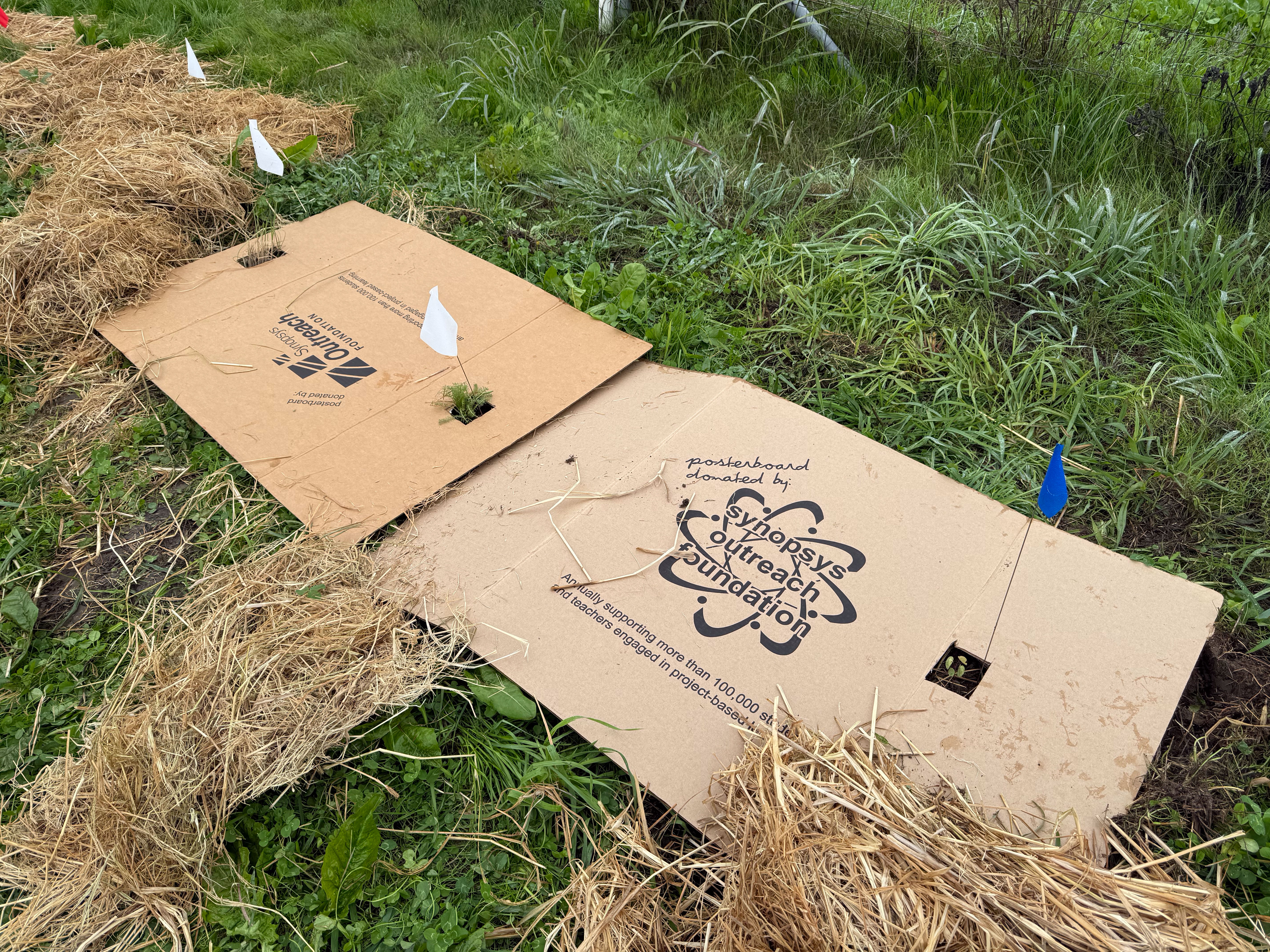
Some of the cardboard was cut in strips and positioned in a triangle around individual plants. These three were close enough that I cut holes in two larger pieces to provide the first layer of mulch. We had put straw around all the plants on Friday, but today we moved that to add the cardboard.
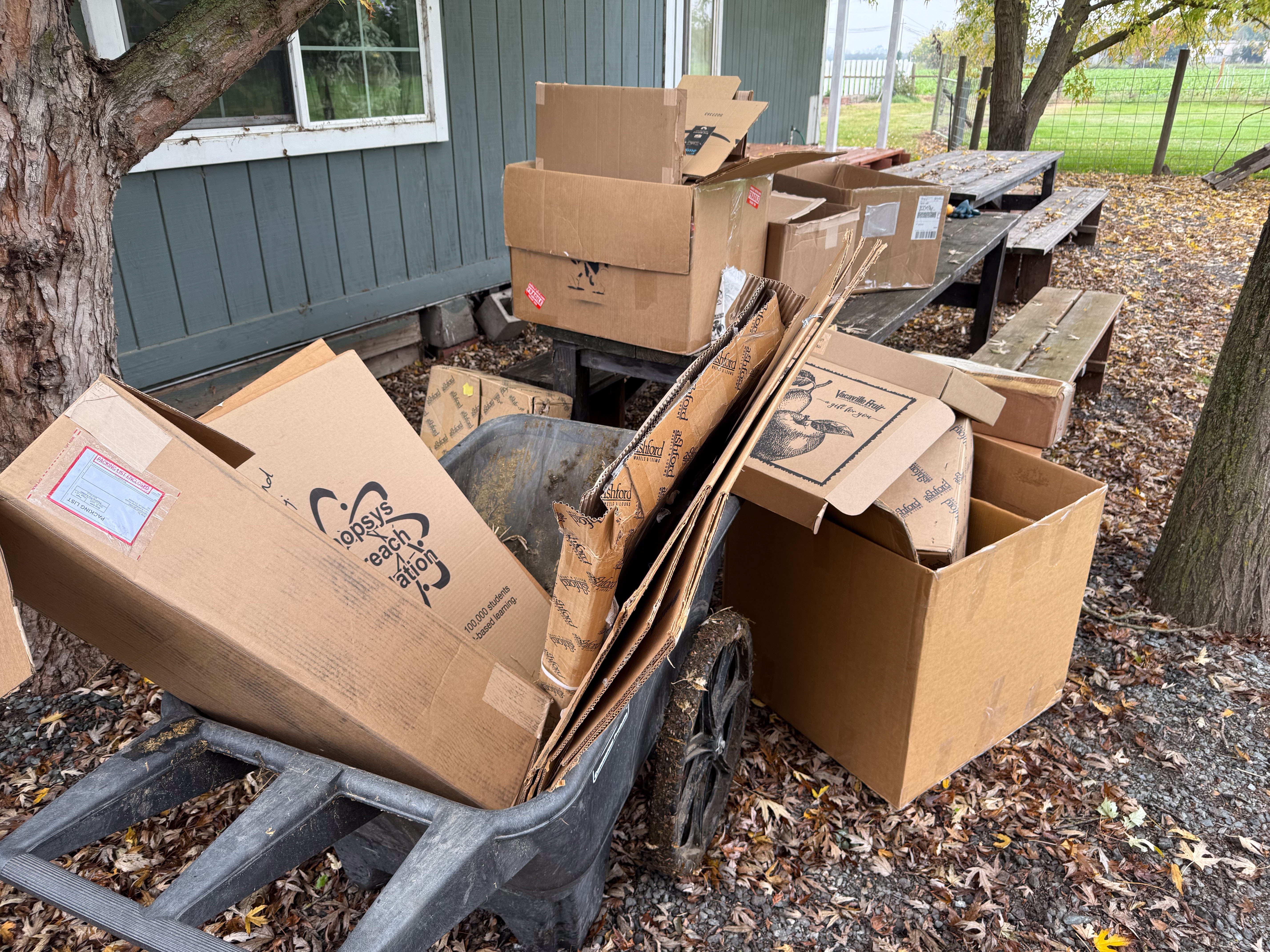
Where did we find enough cardboard? I thought that I might have to buy some. There was a box of science fair boards left over from Dan’s years teaching seventh grade science. And there are a lot of boxes I have saved because you never know when you’ll need a box! I do use a lot of boxes for shipping wool, etc, but I don’t think I’ll need any of these larger boxes or odd shaped ones for the rest of the year. Raquel and I cut them apart and stripped off all the tape and plastic labels.
We used the cardboard strips around the plants or cut holes in larger pieces. That blue barrel is what we filled with water from the hose near the house.
Raquel made trips with jugs of water. We let them drip while we continued with cardboard.
Almost finished!
We covered all the cardboard with more straw. The project is still not finished. You can’t tell from the photo but there are 19 plants without cardboard and about that many that didn’t get water today. That will be tomorrow’s project for me.
Our pasture and irrigation project that began last fall included a plan for a hedgerow. This project was included in a block grant from CDFA administered by Fibershed. So when the time came to implement the hedgerow plan, people from Fibershed volunteered their time to help make it happen, along with the RCD (Resource Conservation District) representatives.
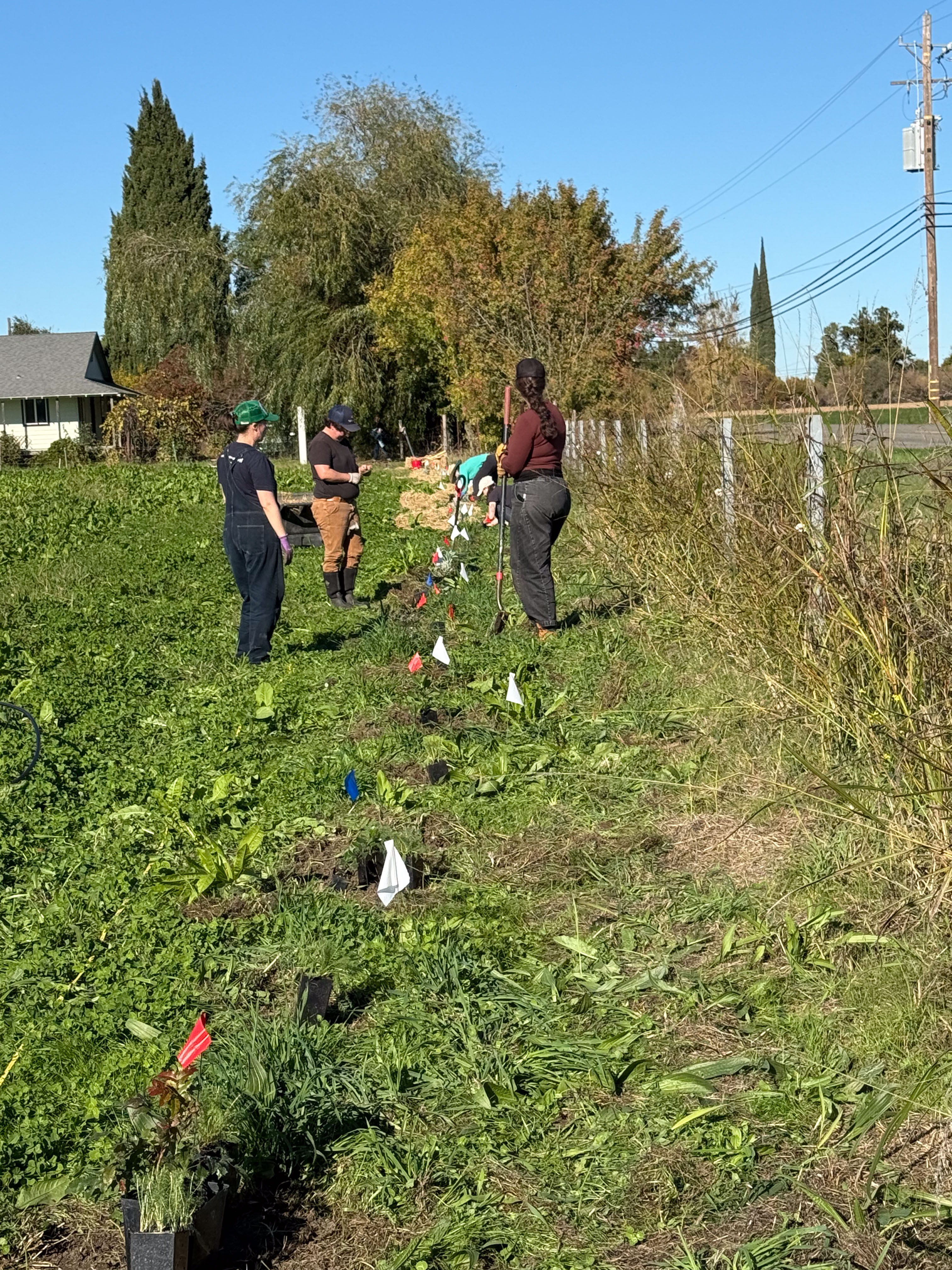
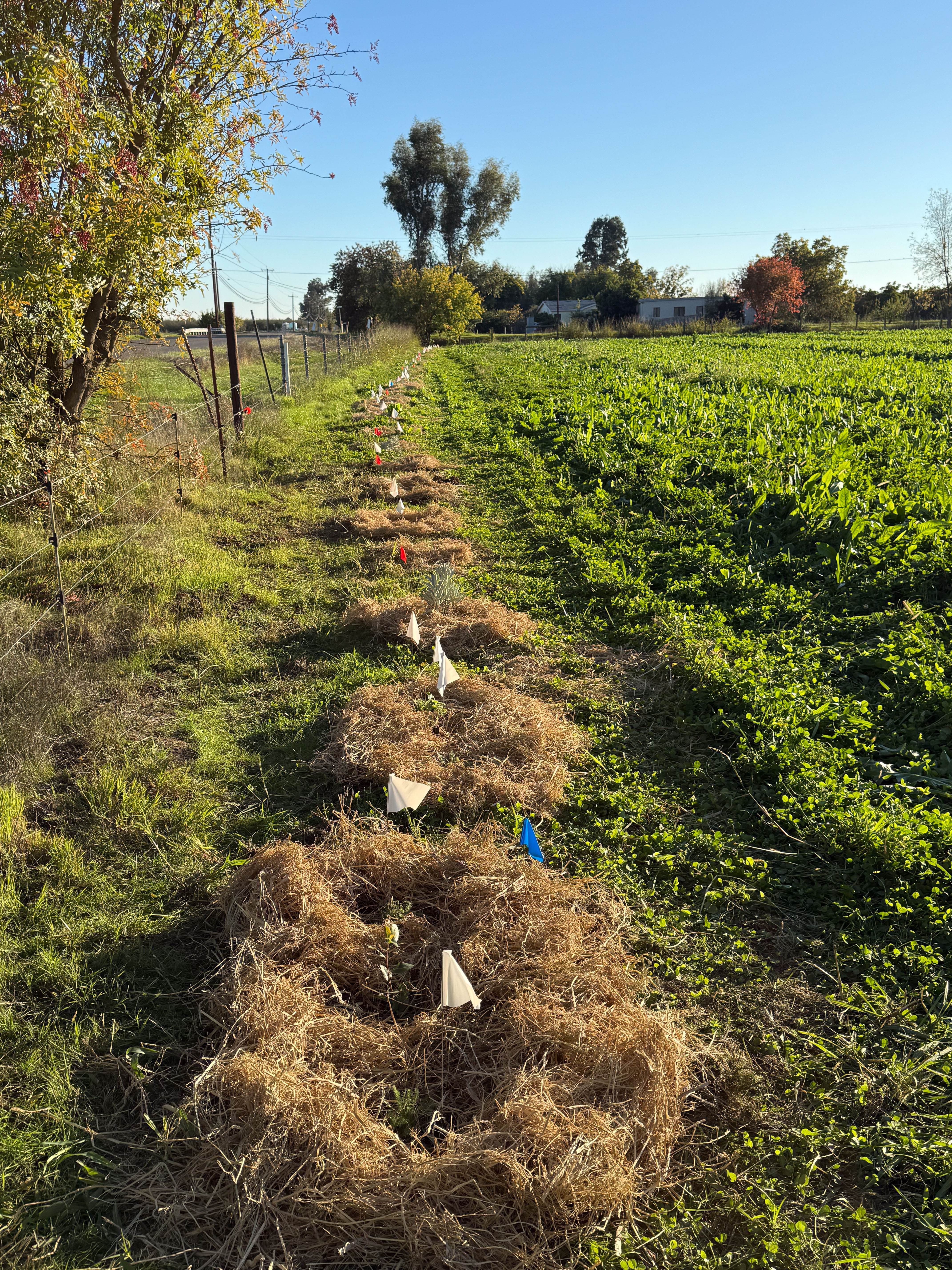
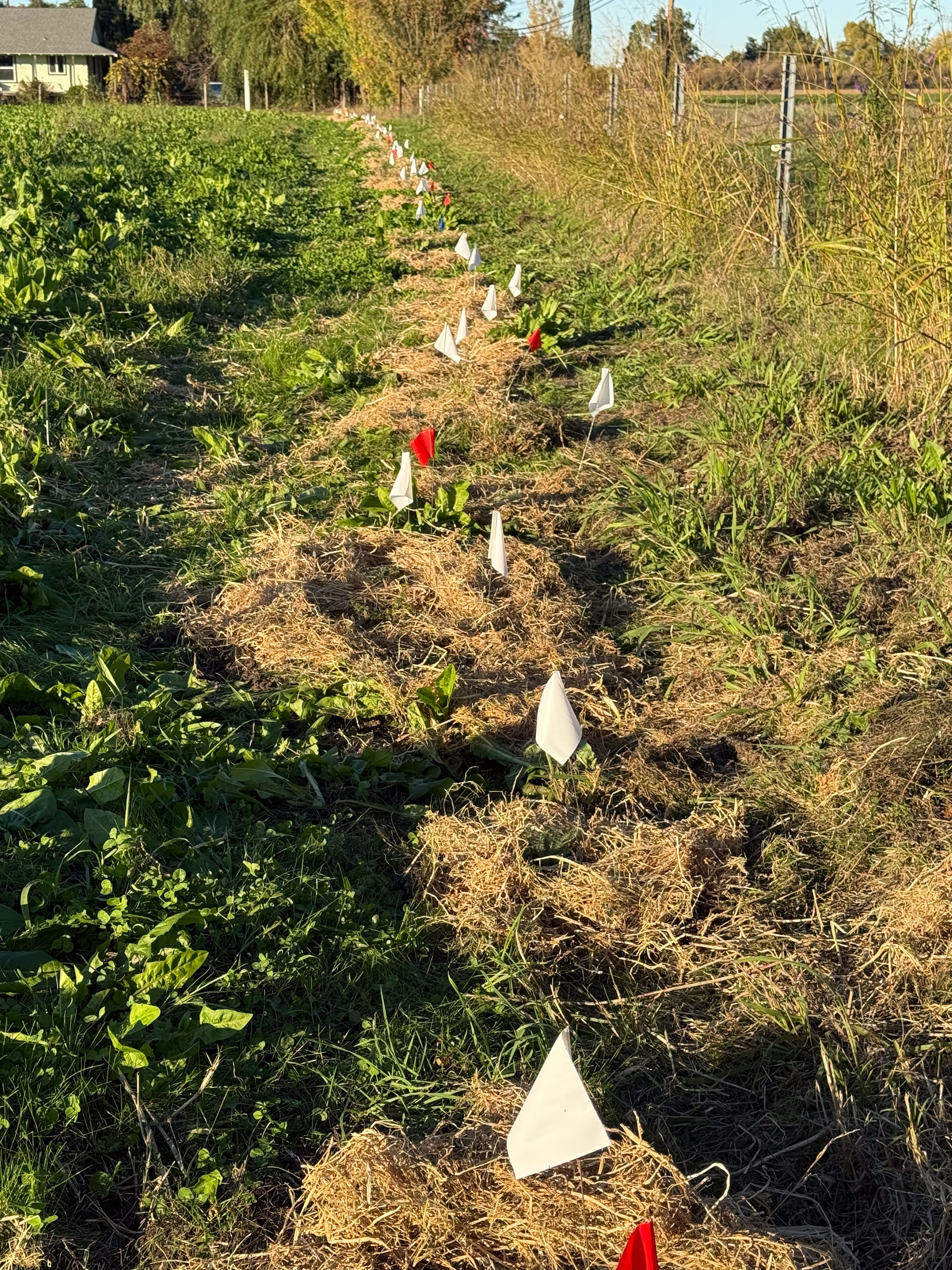
The hedgerow was to be planted inside the east fence of the pasture. RCD experts had come the day before with most of the plants. We placed them approximately where we thought they should be planted and marked them with flags. Some are small and if we hadn’t flagged them it would have been like an Easter egg hunt to find them all.
After a foggy start to Thursday we had warned everyone to wear rubber boots. Friday was sunny and dry! The first task was to clear space where each plant was to go in the ground. The biggest impediment to getting a good start will be the amount of competition and shading from all the other vigorously growing plants. Even a plant we like (clover for example) will be considered undesirable in the root zone of the new plants. I remember from somewhere, “A weed is a plant out of place.”
This was quite an undertaking. We planted 80 California natives in the 250′ row.
The plants include three to five each of Coyote Bush, Oregon Grape, CA Lilac, Western Redbud, Golden Current, Deergrass, St. Catherine’s Lace, Toyon, White Sage, CA Fuchsia,and 50 Yarrow.
The pasture has been growing well, the soil looks healthy, and everywhere you dig there are earthworms. We have had recent rain so it’s moist, but we will have to make sure that we irrigate these new plants. That’s a project for a couple of days later.
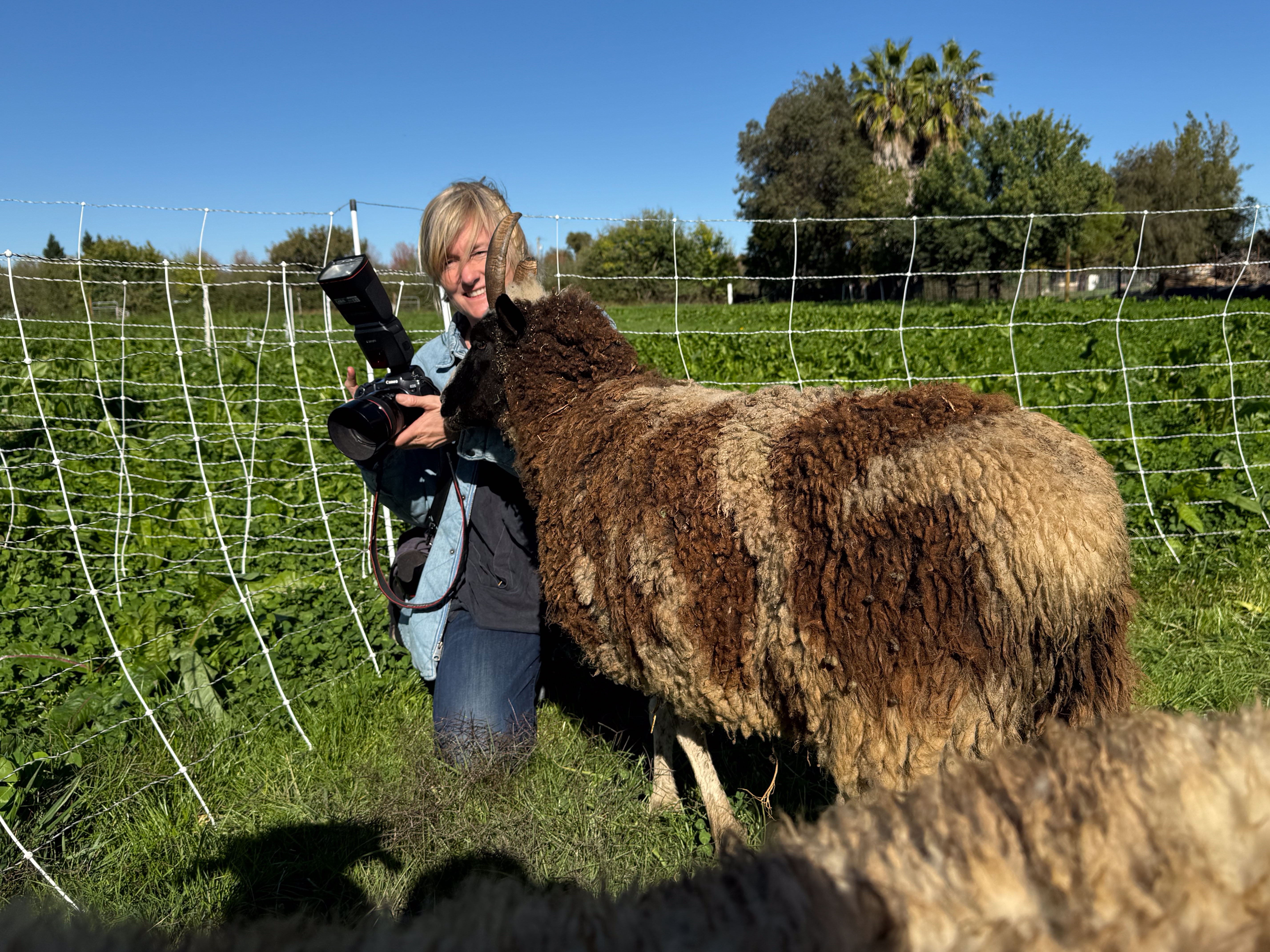
The photographer who has been with Fibershed since the beginning, Paige Green, and I wandered out to visit the sheep and take photos.
Jade provided Paige with the perfect cover for getting photos of sheep that might otherwise be wary of an unfamiliar person.
Back to the hedgerow. View to the south when we were finished.
View to the north. Each plant was surrounded by rice straw to provide mulch with the intent to prevent weed growth. There is more to that story…to be continued in the next post.
A few days ago I heard sheep making a lot of noise and saw that they were all going from the pasture to the barn. It seemed like more baaing than usual. Then I realized that I wasn’t hearing my sheep.
These trucks were parked just down the road but where I couldn’t see them from the house because of the trees.
Notice that the two noses poking through the holes are different!
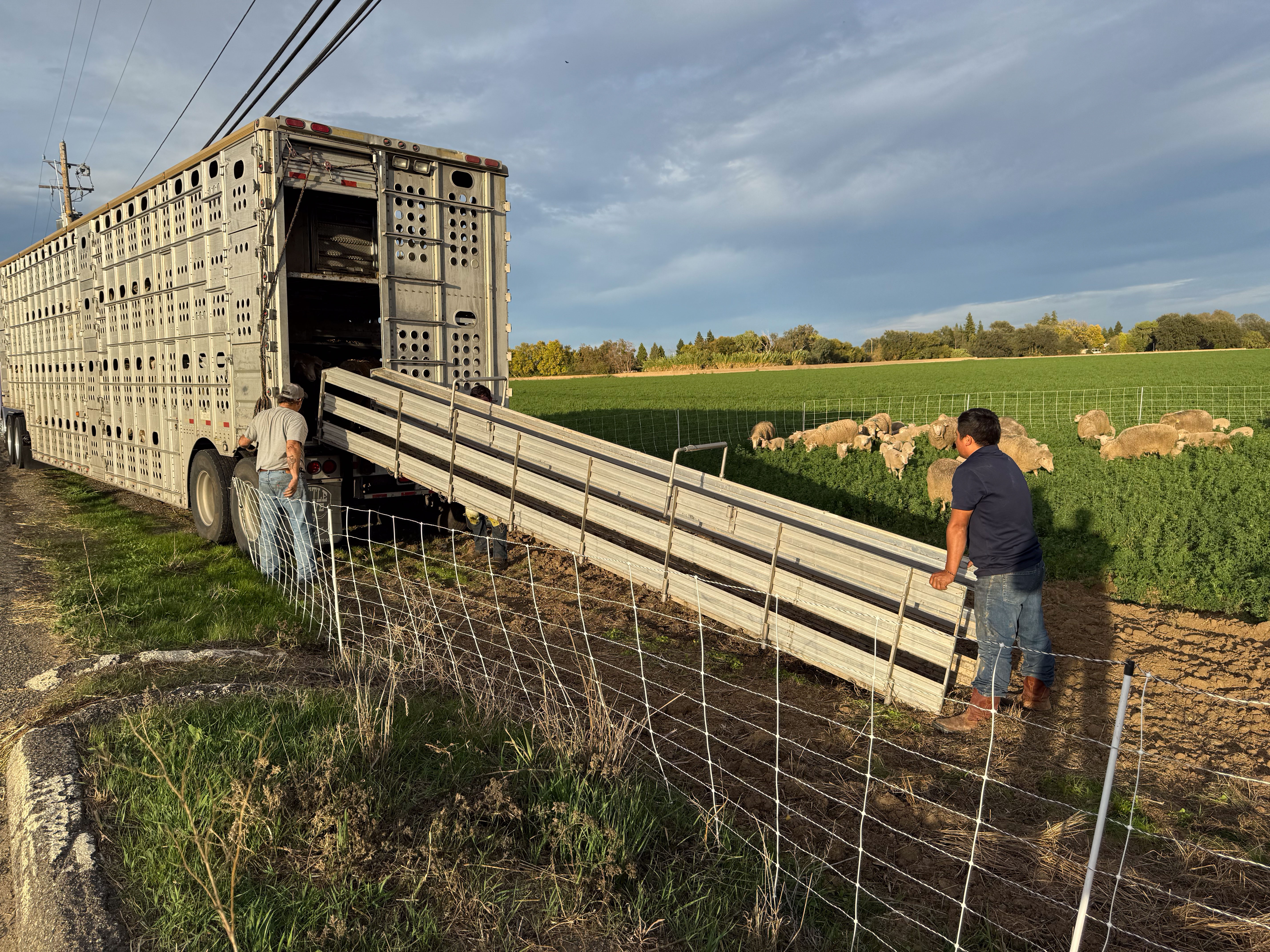
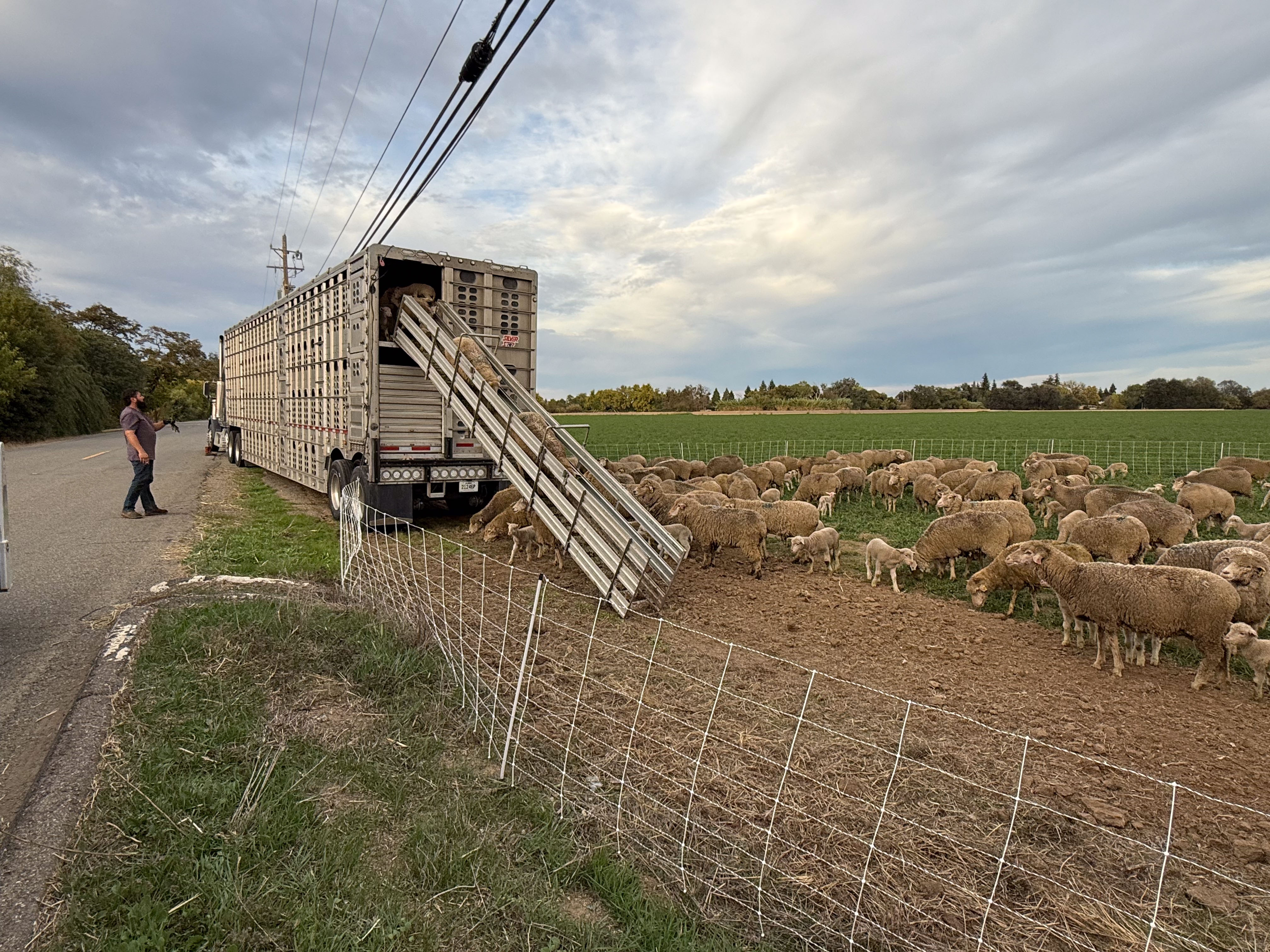
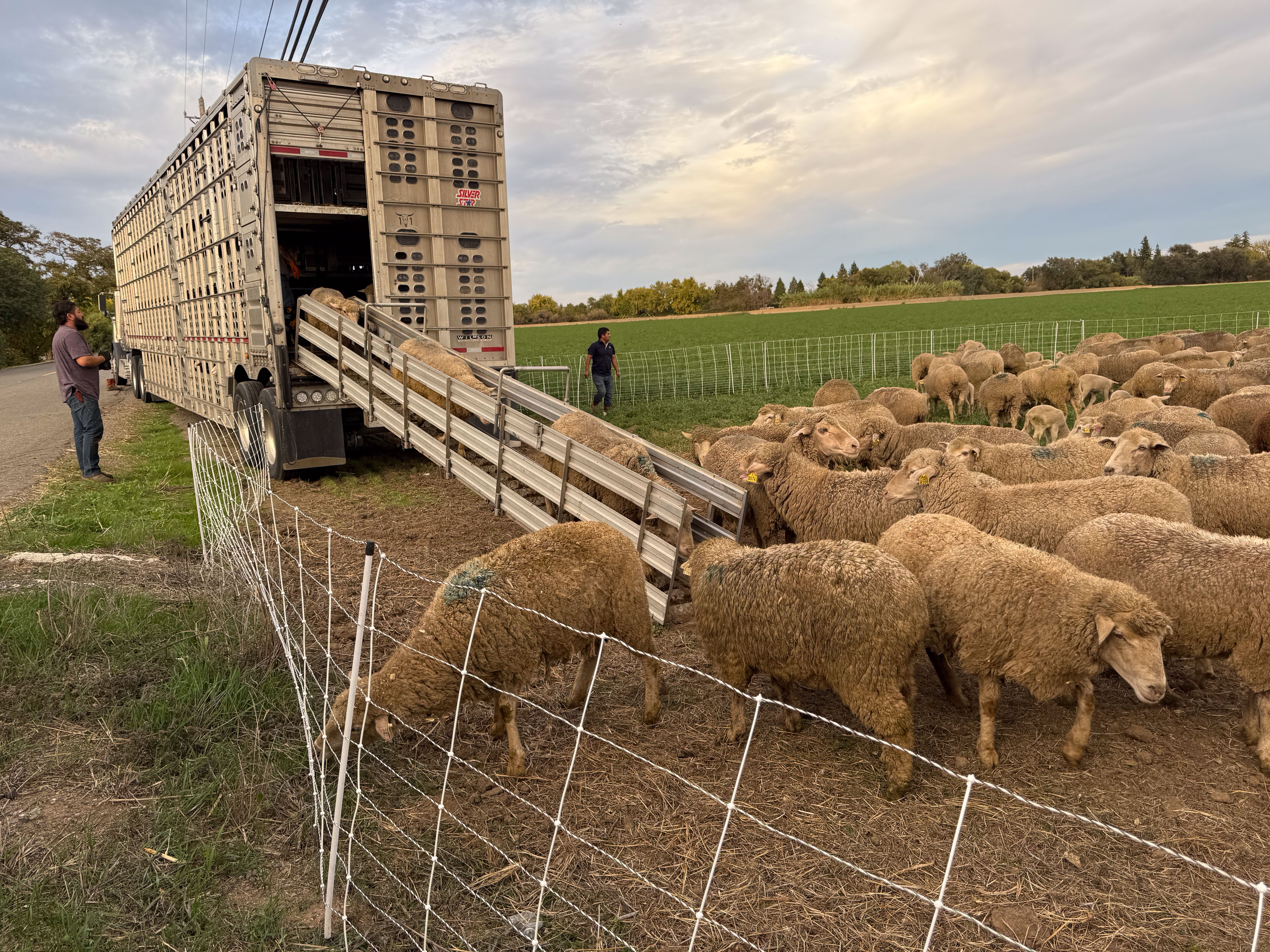
These trailers have four levels and all were full of ewes and lambs.
They move the ramp once because two levels can unload to one position of the ramp.
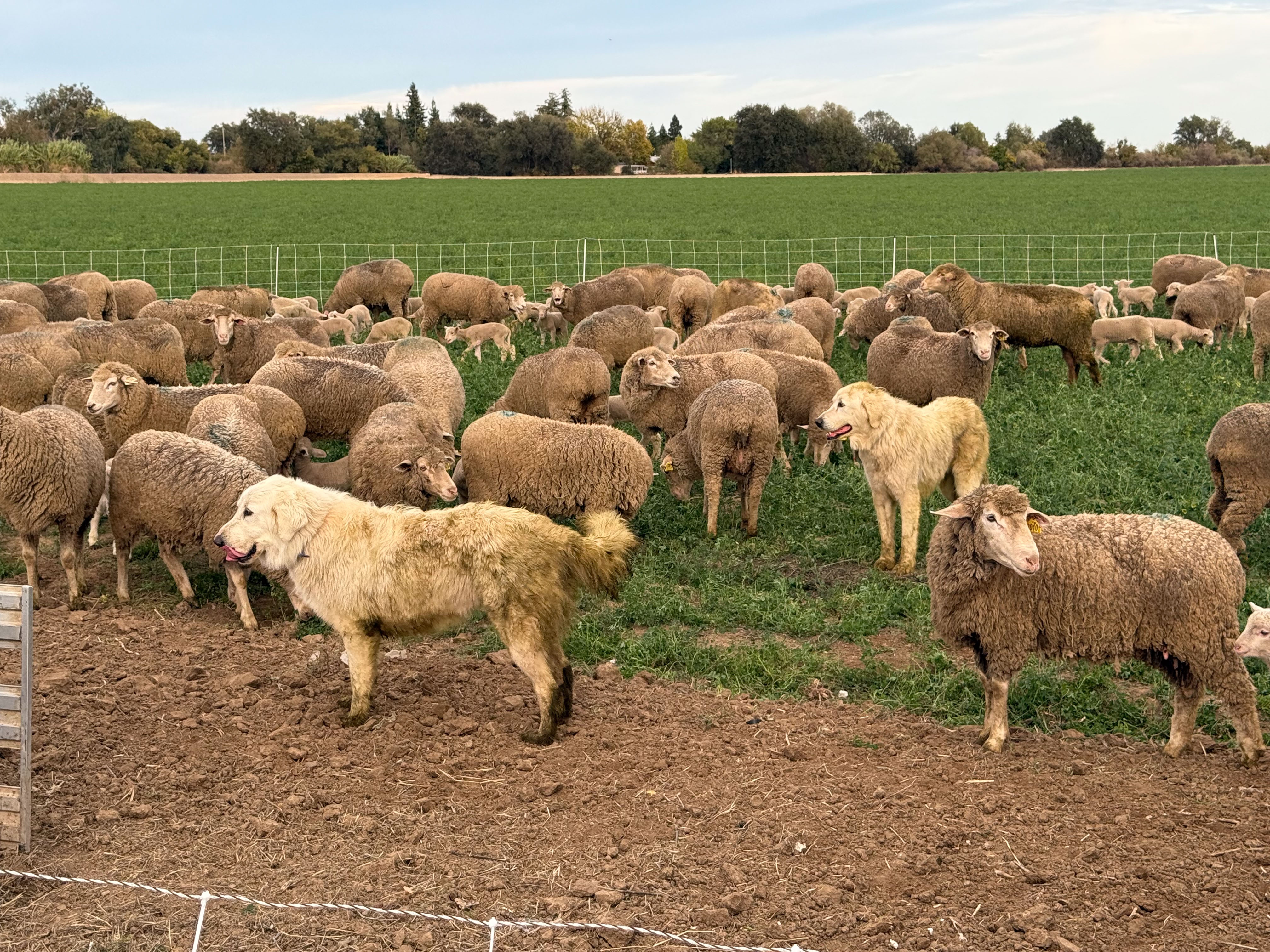
Two guardian dogs were with the sheep.
I was surprised at how young some of the lambs were. It shouldn’t have been a surprise. It’s just that I have no experience with this kind of operation. Our sheep have it easy with barn access and personal attention all the time.
It was quite noisy with lambs and ewes looking for each other.
The second truck pulled up to unload.
Each driver was responsible for unloading his truck. They switched to rubber boots so they could climb in with the sheep if necessary and keep their other footwear clean. I didn’t see any other fences so I wasn’t sure how they were going to deal with this many sheep.
I have seen other alfalfa fields where they graze sheep but this is a first for “our” field–the one Across the Road that I know well. I talked to the truck drivers a bit. I think they said they had about 450 sheep to unload. I thought they said that was the number of ewes but maybe it included lambs. I wasn’t sure what they were going to do for the night because I didn’t see any other fences.
There were a lot of sheep crowded into this fenced area. It turns out that this was just a holding area while the trucks were being unloaded. This was late in the day and rain was coming in that night.
The fence was opened and two men with one 4-wheeler and 3 Border Collies moved the sheep to the east. Fencing was already set up somewhere else and a herder would stay in an RV near the sheep.
It rained that night and it was too muddy to walk across the road the next day and I was busy all day anyway. The following day I wanted to see where the sheep were. I walked half of my normal route but didn’t want to get close enough to alert the guardian dogs and cause a problem. It’s complicated to bring sheep to graze areas that aren’t set up for it. Fencing is supplied by the grazers–you can’t see the electric net fence in this photo. And they have to have a water source–that’s the white tank.
I’ll probably walk over there today and find out if they are in the same location.
I always see Mt. Diablo when I walk Across the Road (unless there is too much haze or fog). I feel a sort of weird connection to it because of the road we live on, which prompted the name of our farm, Meridian Jacobs. I wanted to DO something on my birthday and fortunately the weather was perfect for a hike. We picked up my brother on the way and arrived at Mt. Diablo State Park a little after 8 a.m.
Wikipedia says: “The Mount Diablo Meridian, established in 1851, is a principal meridian extending north and south from its initial point atop Mount Diablo in California.”
I took a lot of photos but I have to narrow it down for a blog post. There are probably more in this post than there should be. It’s hard to portray the true essence of the hike in my photos.
I wanted to get to the summit. Not long after we started we spoke to someone who said the direction we were headed was very steep and suggested a different route.
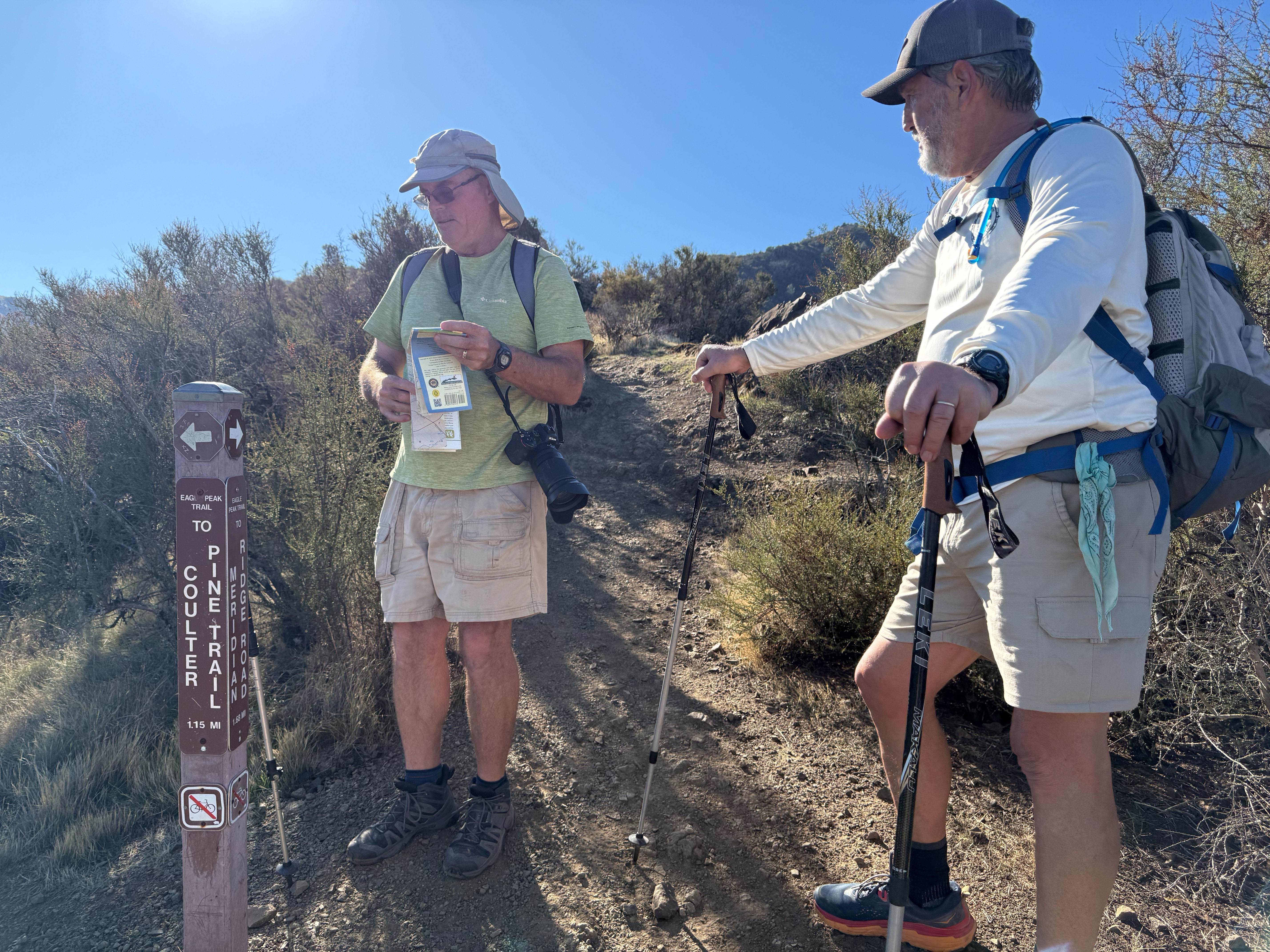
We had a map that showed all the trails and decided to start on a different one than what we’d planned.
Double checking the location.
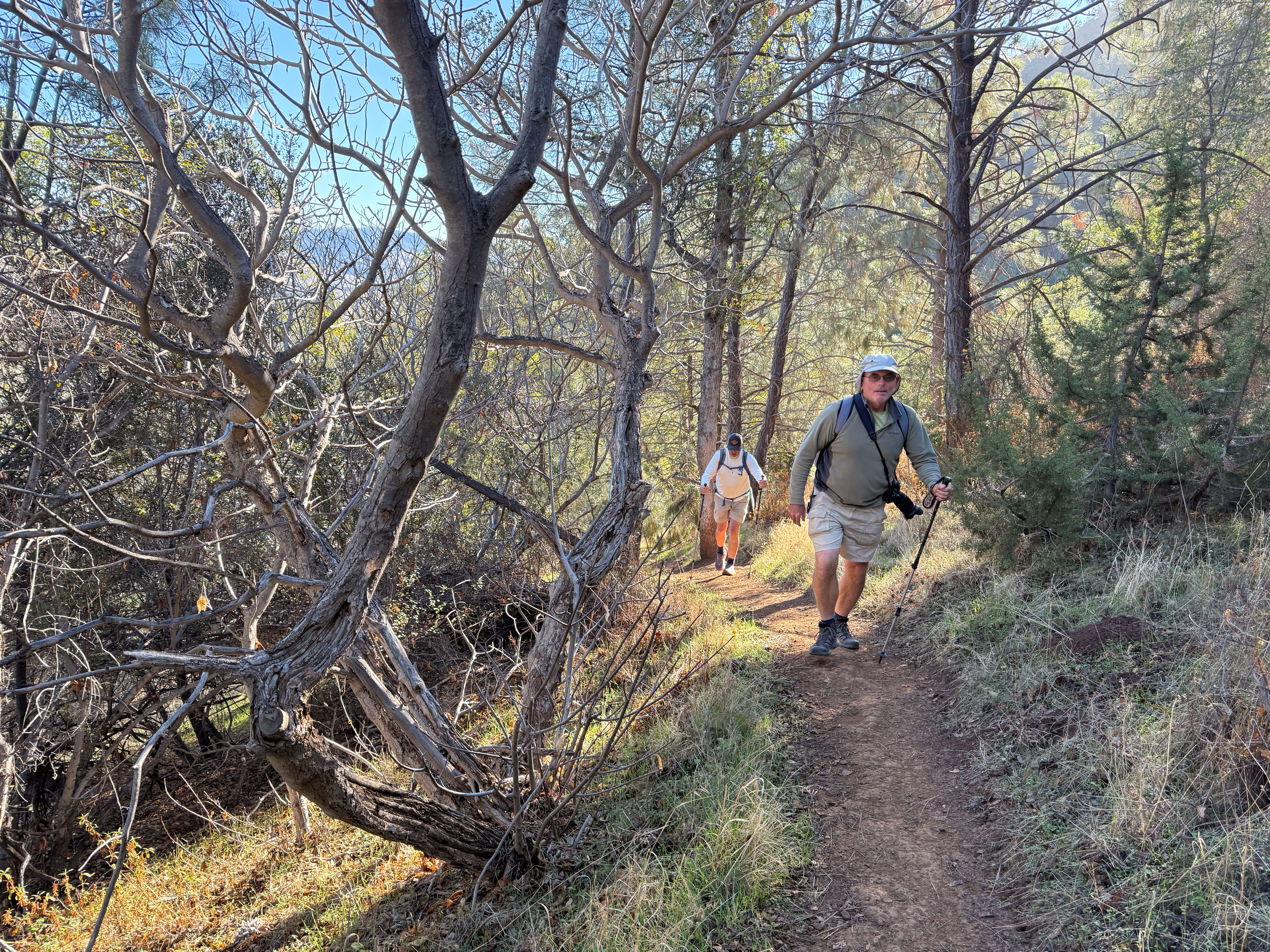
We’re still smiling!
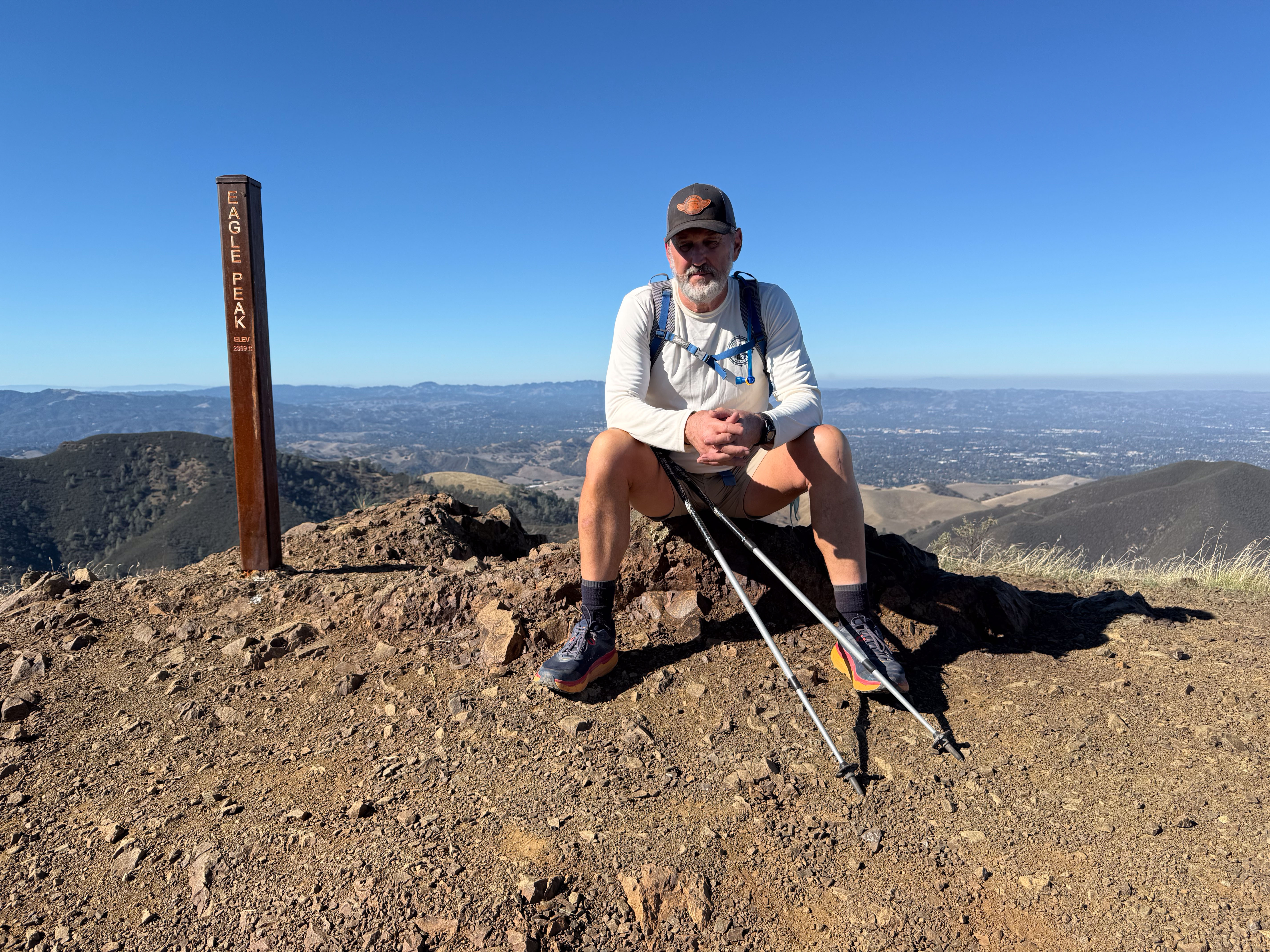
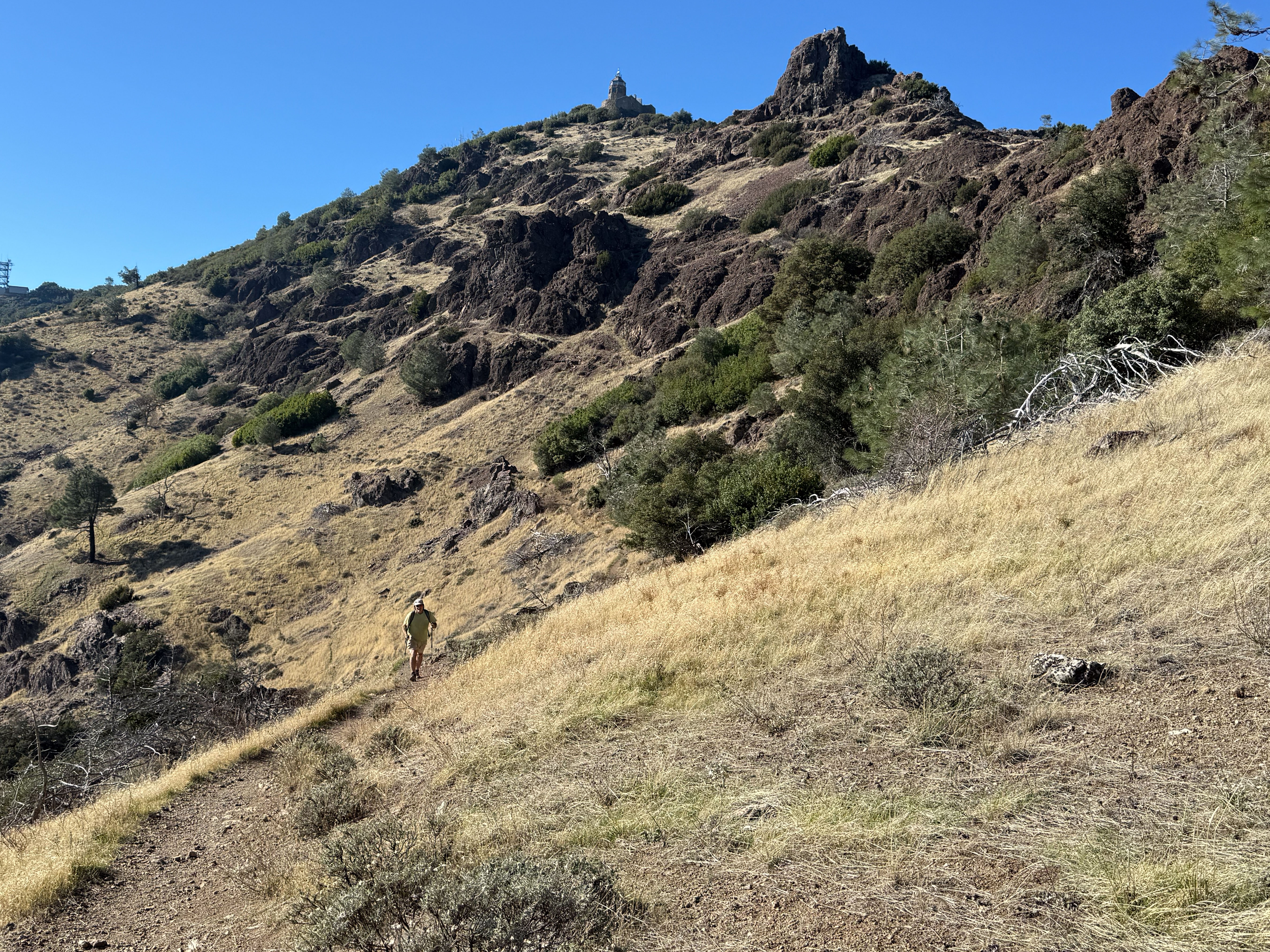
One of several peaks on the way to our goal. The sign say elevation 2369. I thought about adding a 1 in front of the 2. That’s sort of how it felt since we live in the flatland and lately all the walking has been flat. This was about 10:30.
I took this photo around noon. That point on the mountain is our goal and Dave thought that we should get there by 1 p.m. to make sure we had plenty of time to get back before dark.
This is where that arrow points.
Pipestem Clematis
Not many flowers yet, but things are greening up and showing promise of a beautiful spring. We did see a lot of this vine that I recognize from other oak-woodland hikes.
There was a point where we had a choice to take a one-mile “short-cut” to the top (steep, we were warned by someone coming down) or another two miles with ups and downs. We split up here. Dan took a different route that Dave and I would follow later back down the mountain. Dave and I went to the top.
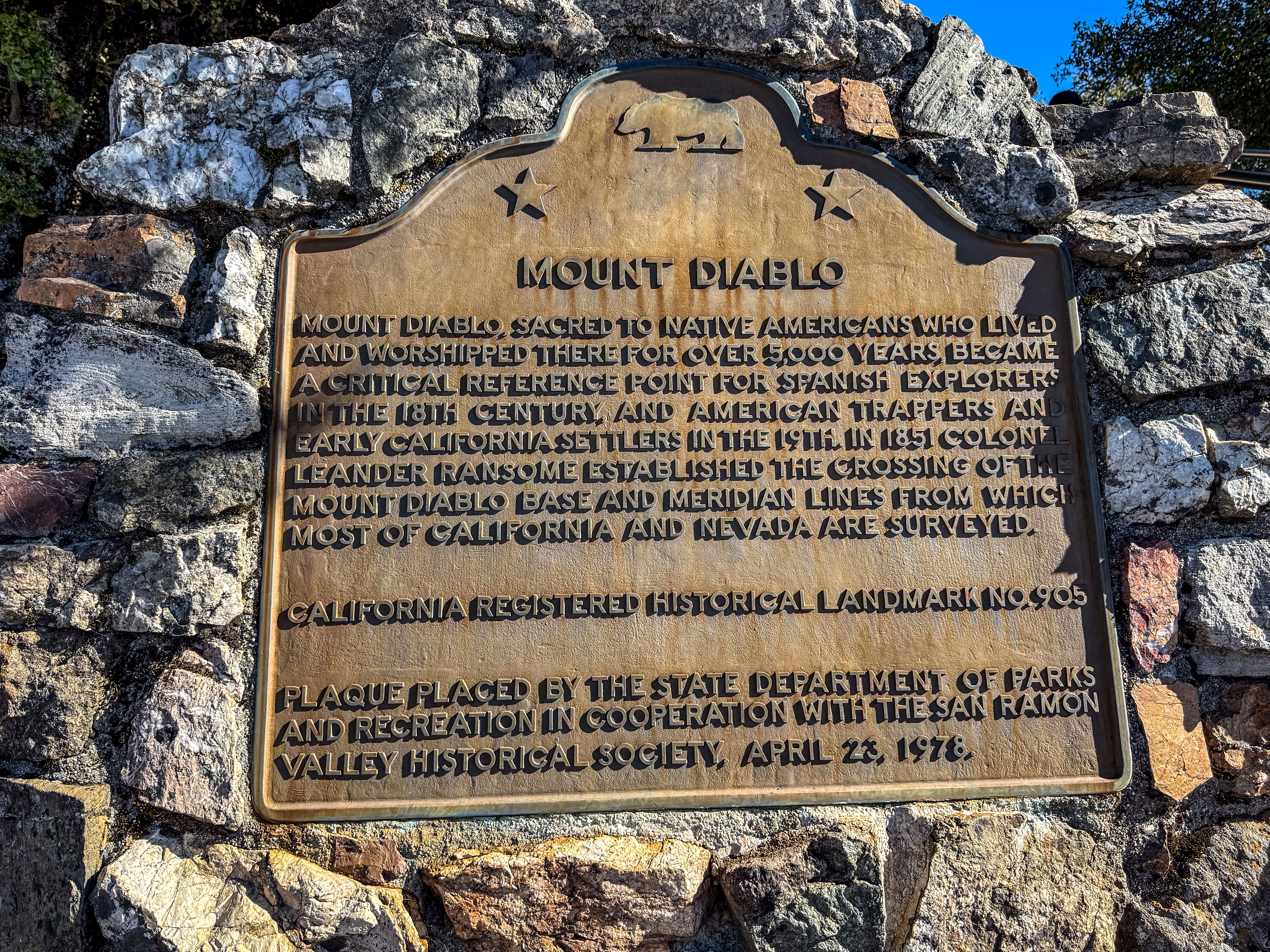
Since you may not be able to read the sign I’ll repeat it here: “Mount Diablo, sacred to Native Americans who lived and worshipped there for over 5000 years, became a critical reference point for Spanish explorers in the 18th century, and American trappers and early California settlers in the 19th. In 1851 Colonel Leander Ransome established the crossing of the Mount Diablo base and meridian lines from which most of California and Nevada are surveyed.”
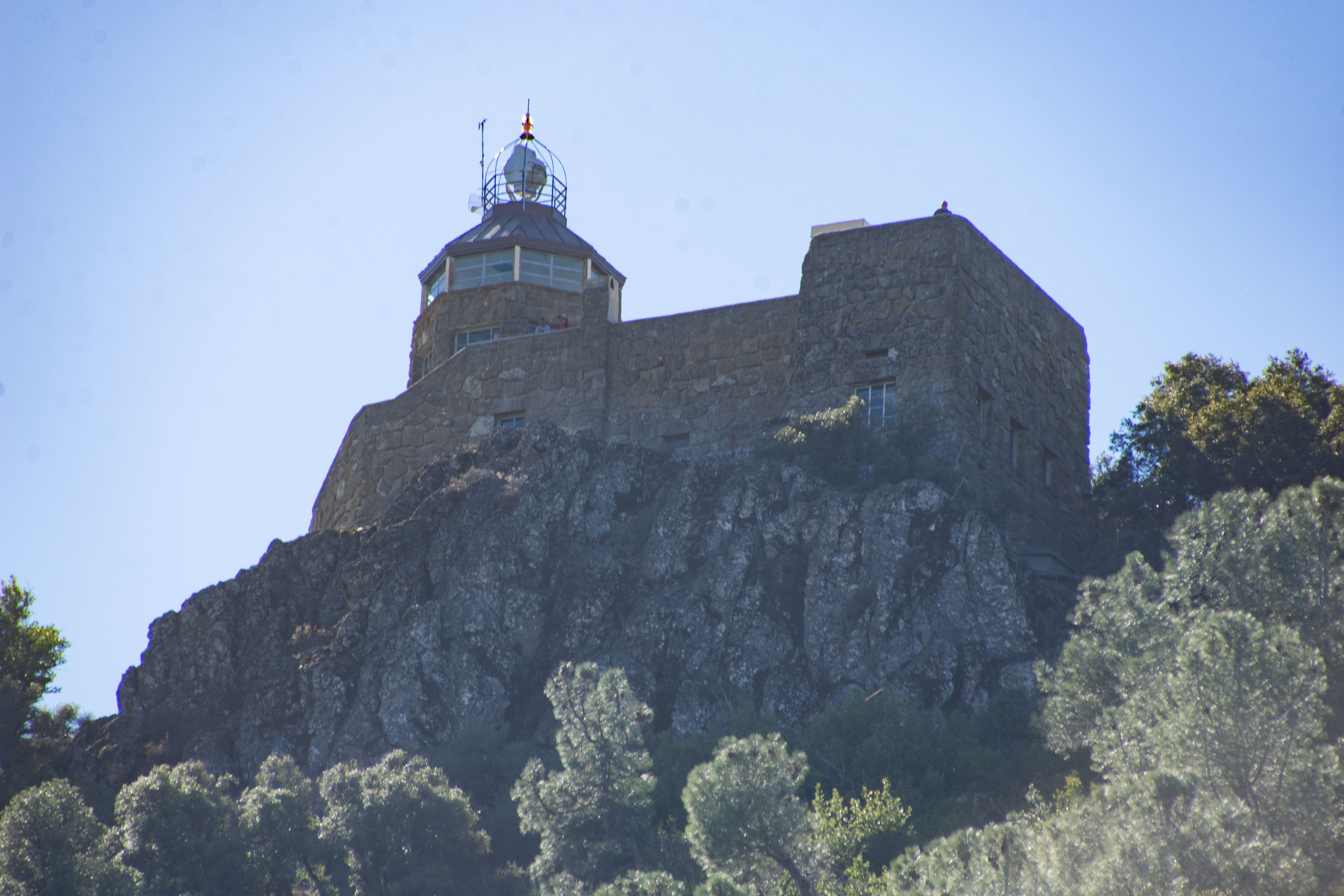
In the days before electronic navigation the light on top of the rotunda (once on a 75-foot tower) served as a crucial route-finding aid. It was turned off after the attack on Pearl Harbor amid fears that it could guide the enemy to an attack on the mainland. It is now dark except when it is lit on December 7 as a memorial to those who died at Pearl Harbor.
This is inside the rotunda.
View north-northwest.
View to the north. If I can see this mountain from where I live it seems as though I should be able to see my house from the mountain. I guess not. It’s out there somewhere. You can make out the windmills that are south east of our farm and we think what you can barely see left of center under the horizon is Travis AFB.
This is the view of the rotunda on our way down the mountain.
View to the east.
We saw a little bit of fall color. I took few photos on the hike back down. It was the most challenging part of the day. We followed a dirt road that is used to access communication towers on another mountain top. Downhill and a road. Sounds easy, right? It was so steep in parts that if I hadn’t had a walking stick to brace against I would have been slipping the whole time on those parts. Even with the stick it seemed treacherous. I hadn’t thought to bring walking sticks, but Dan and Dave had. On the way down Dan had left one of his with me. Once I started hiking this road I realized that his trip would have been extra challenging with his new knee joint and using only one stick.
We got back to the car before dark.
I had turned on my Map My Walk app before starting (blue dot). Somehow it turned off not long after we started and only started up again when we were sitting on the top eating lunch. So these stats are only half of the hike. We think our hike was 13 to14 miles. A good day.
I went to the barn this morning planning to move the fence and open up the next paddock. It seemed a dramatic scene.
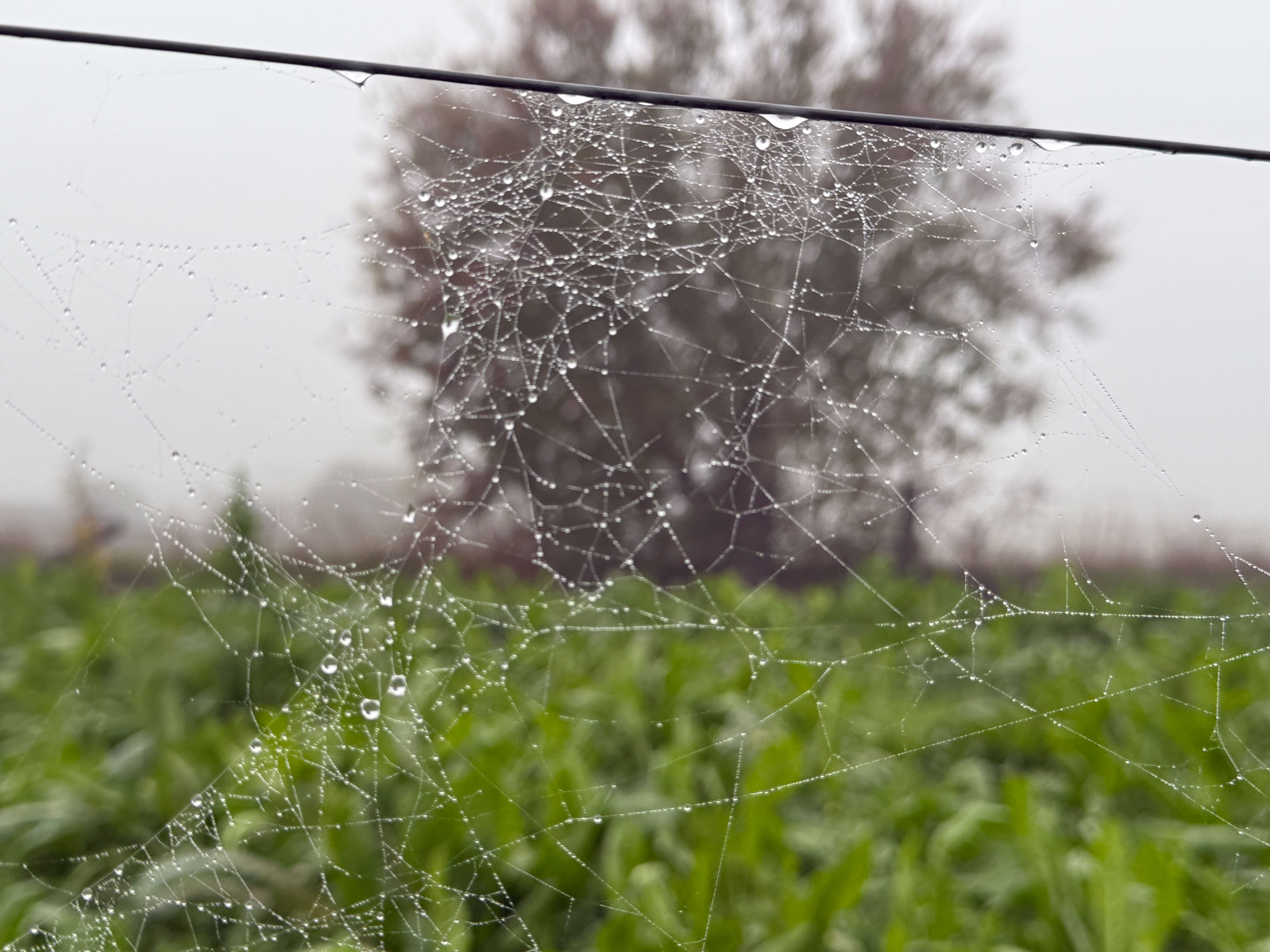
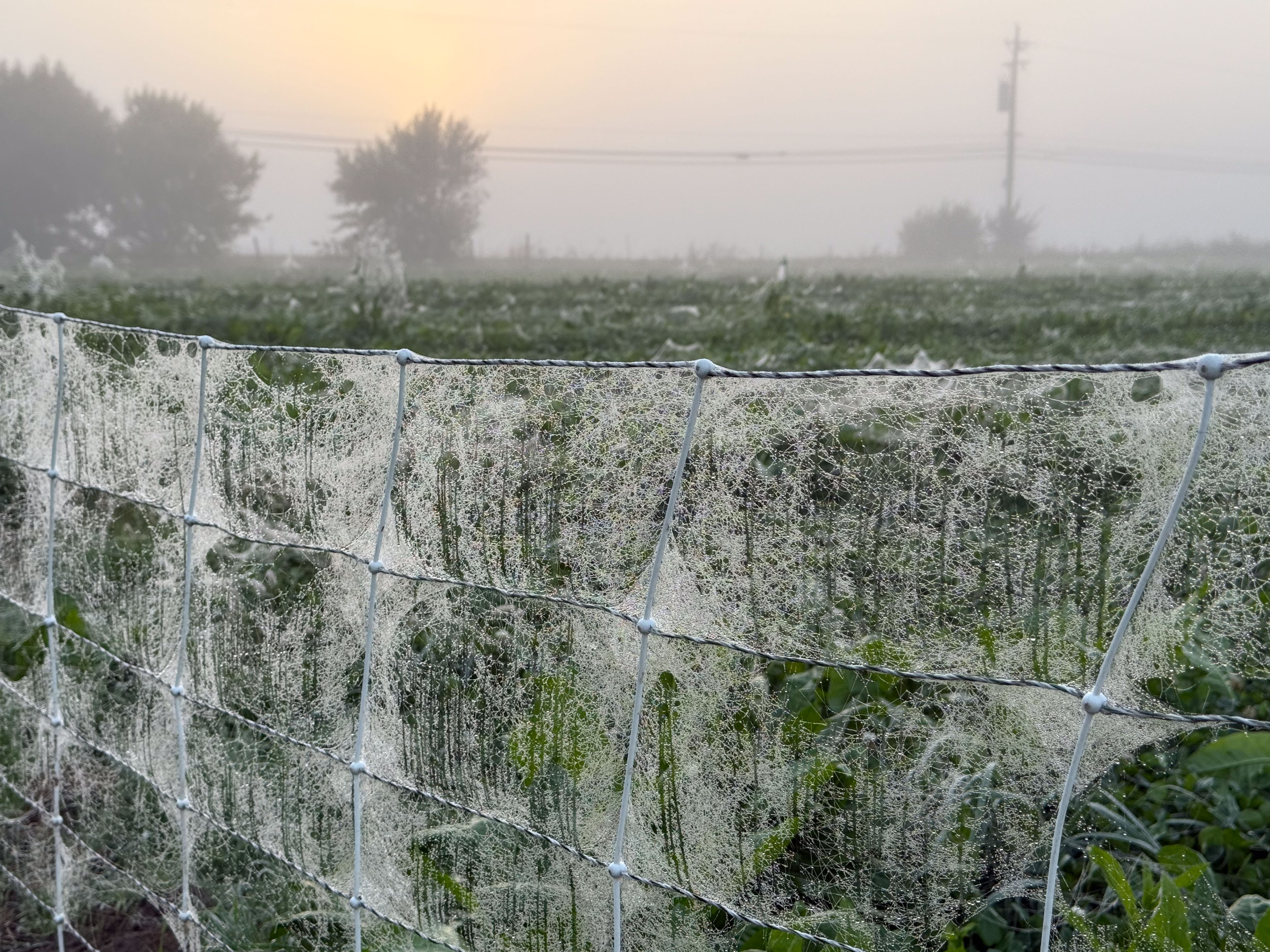
It was foggy, but was most obvious was the dew on the spiderwebs.
The spiderwebs seemed to be everywhere, especially obvious on the net fence.
The dew makes the webs much ore obvious.
This is only dew, no webs.
Later in the day the fog burned off and the dew was gone.
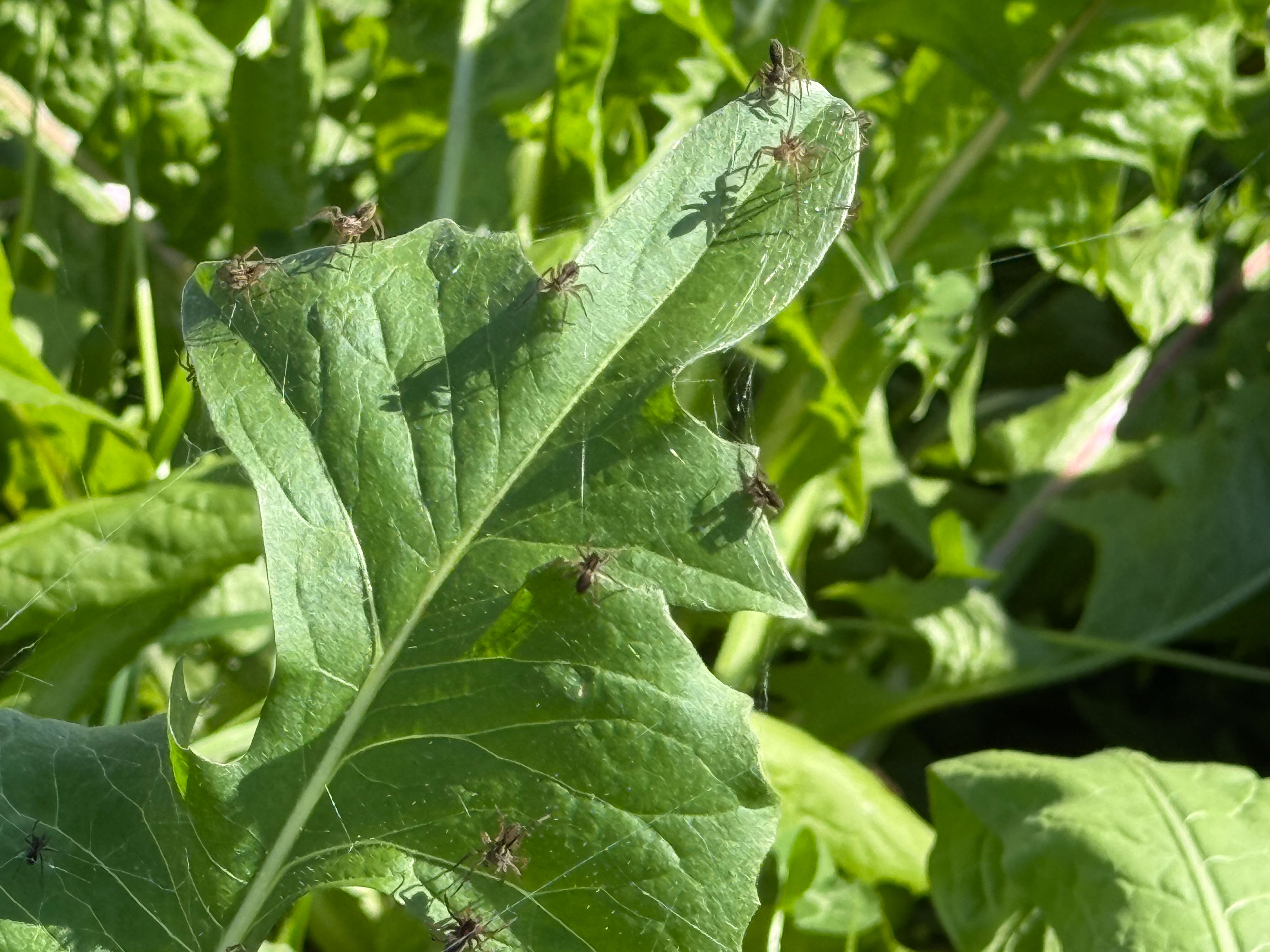
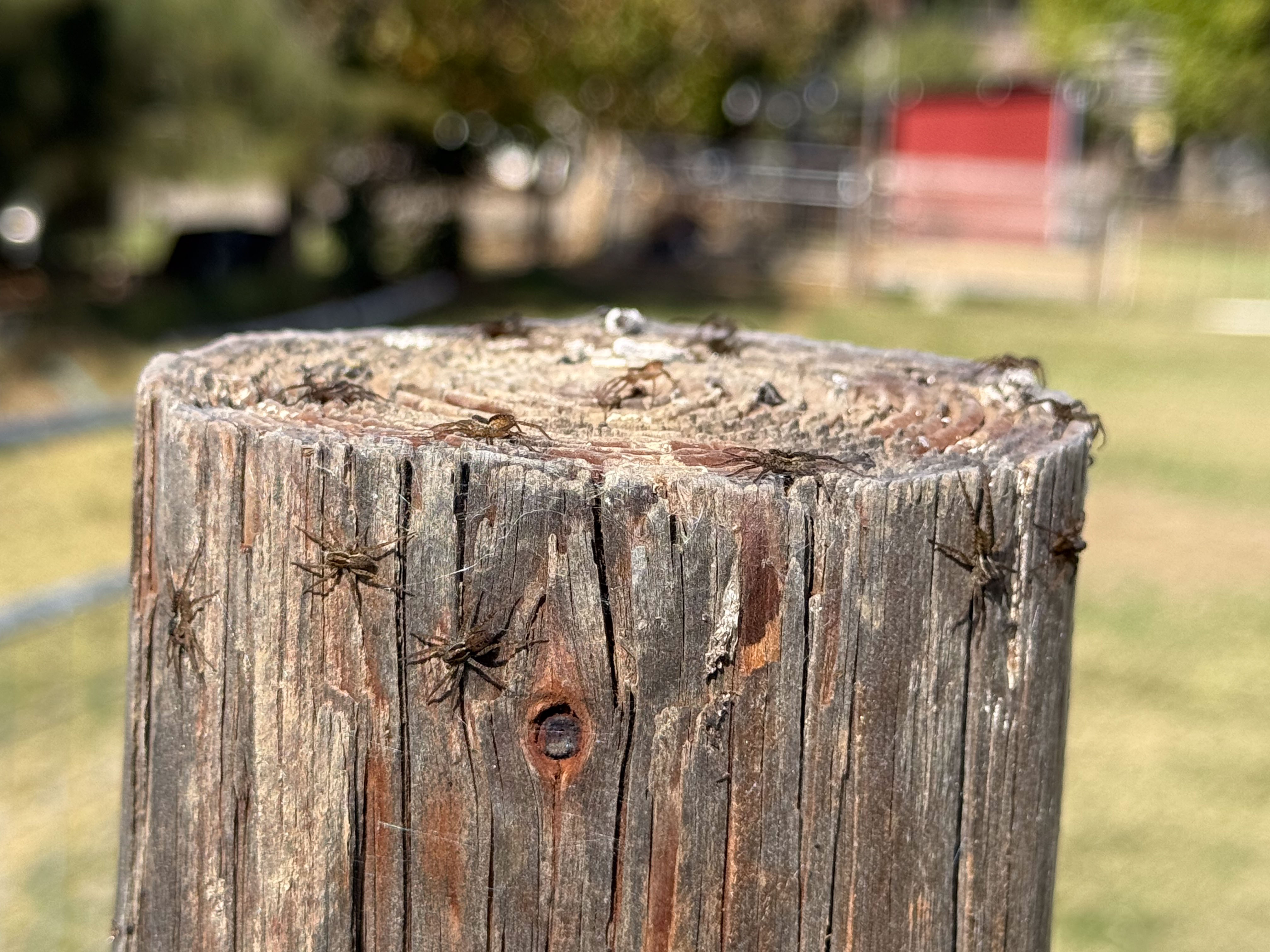
Here are the spiders that are responsible for what looks like webs. However they are not the typical web.
If you look up “spiders ballooning” you’ll find out that baby spiders will produce a strand or two of silk and be carried away by the wind. The net fence and the pasture plants easily catch those silk strands. So I don’t know how far those spiders have dispersed. Didi they start out here or elsewhere?










































 Meridian Jacobs' Blog