Unknown's avatar

About Robin

Owner of Meridian Jacobs, farm and fiber shop. I raise Jacob sheep, teach fiber arts classes, weave handwovens for sale, and manage the store.

Sheep photos

Lambing won’t start for 4 weeks but there are some ewes that look as though they shouldn’t wait that long, especially when you realize that 70% of total fetal growth occurs during the last third of pregnancy.

Sparkle was bred as soon as I put her with the ram. She is due February 18, a month away.
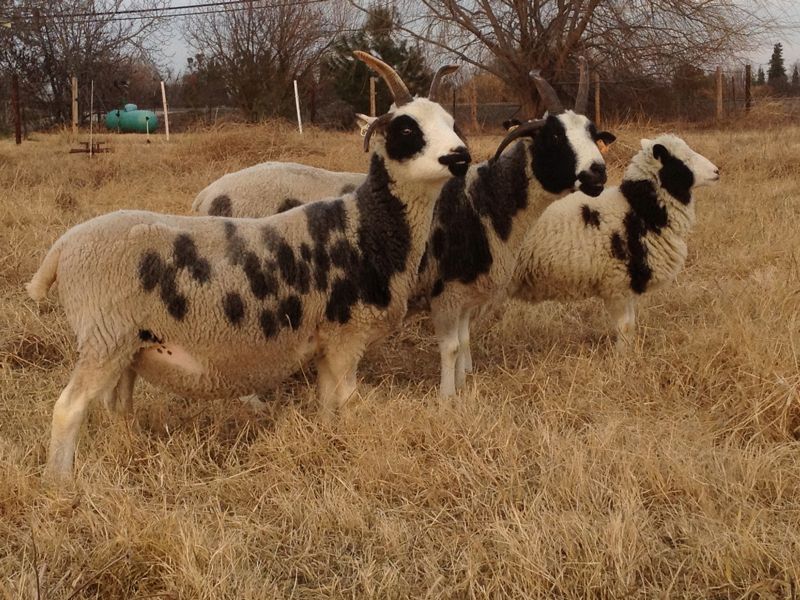
I don’t have a breeding date for Summer, but she is obviously pregnant.

I’ll be surprised if she doesn’t have triplets.

Jimmy is out there with the ewes and he is a very luck sheep. Most males that do not make the cut as breeding rams end up in the freezer. When he was a young lamb, I thought Jimmy had breeding potential. In fact I had a buyer for him. She was very disappointed when, after taking a closer look at him at about 3 1/2 months of age, I would not sell him for breeding. I was knew that his lower horn on the left would be a problem, but what was not obvious until I looked more closely was the freckling.
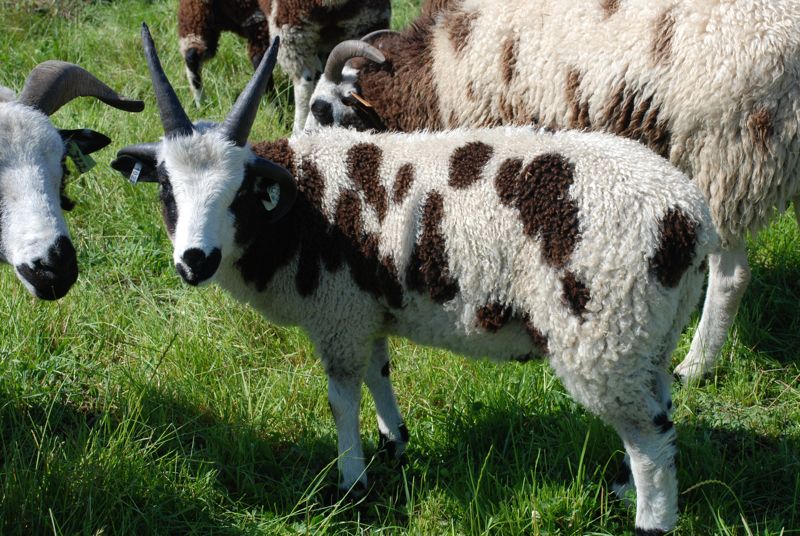
In this photo you can’t see the freckling, but when I parted the fleece I could see it. Freckling in a young lamb is a disqualifying trait for Jacob sheep registration. It increases with age and it is almost as if a spotted sheep turns into an overall gray sheep. Jimmy has a beautiful fleece (although not appropriate for a breeding ram) so I decided to keep him as a wether. The horn issue was dealt with when he was castrated because, without testosterone, the horn growth slows drastically.

Why keep a wether? When you have to separate a ram for whatever reason, he needs a buddy to keep him company. Sheep do not do well by themselves. The other wether I have right now is Jerry (nice fleece, but too much black for a breeding ram)…

…and he is Faulkner’s permanent buddy.

Wanted: Winter Storm

Wow! Look at that grass!

This photo was taken a few years ago in early February.
Here is another that shows the edge of the pasture.
This is the same field as in the first photo and the larger pasture is in the background. Why the difference? No rain.

The Central Valley of California has a Mediterranean climate–hot, dry summers and cool, wet winters. We count on the winter rains (and snow in the mountains), starting some time in October or November and continuing through April or May (and last year, into June) to fill reservoirs, replenish aquifers, and to grow grass. Normally the annual grasses start growing when it rains in the fall and when it gets warmer in the spring the grass growth takes off and we get the kind of growth as seen in that first photo. The annual grasses dry out in the spring, but can still provide feed through the summer when properly managed. The cycle starts over with the next fall rains.

I have irrigated pasture. I usually have the best of two worlds. I take advantage of that lush spring growth of annual plants…

Grazing annual ryegrass as some of the other annuals are drying out.

…but I start irrigated in May or June. Through the summer, when livestock on dry land eat dry feed, my sheep eat perennial forages that include clovers and birdsfoot trefoil.

Birdsfoot trefoil

Clover

The  perennial plants drastically slow their growth in the winter but rely on winter rain to grow strong root systems and be ready to support new growth in the summer. Look at the next photo taken two weeks ago.

Annual grasses that germinated after the good rain in November have since died. Some plants are still trying valiantly to hang on but there is virtually no growth. The dry grass in this photo is the remnants of the late summer growth of less desirable yellow foxtail and bermudagrass.

This photo is behind the barn. That clump of grass in the foreground is under the place where any moisture (fog, dew) drips off the roof. Had there been normal rainfall the whole place would look like that.

Let’s hope we see the rain that has been promised for this week so we can look forward to this scene soon.


New Buttons

I made new buttons this week. This is a multi-step process and after each step I know that I have not priced my buttons too high. If I were to show all the steps the first photo would be the head of a sheep (butchered for meat). Then there would be the photo of cutting the horns off the dead head. (Lately this step has been done by the person who butchers sheep, but I used to have to do that myself.) The next step is letting the horns sit in a bucket of water for a week or so. The hotter the weather the better, because the slimy parts that are between the bony core and the outside horn get rotten and smelly and then I can pull the outer horn off. Then I’m left with this:

I use a band saw to cut the horns into button shapes. That was a huge improvement over the table saw. I could easily cut a finger off with the band saw but it is probably not as likely as with the table saw. These are pieces that are ready for the next step:

I still need to drill holes and sand these buttons. Then I finish each button with polyurethane.

Rounded buttons.

Squarish buttons.

Shawl pins (without the pin part).

These are for sale on my website

A special gift from a special friend

What did I do to deserve such good friends? Look at my Christmas present from Jackie.

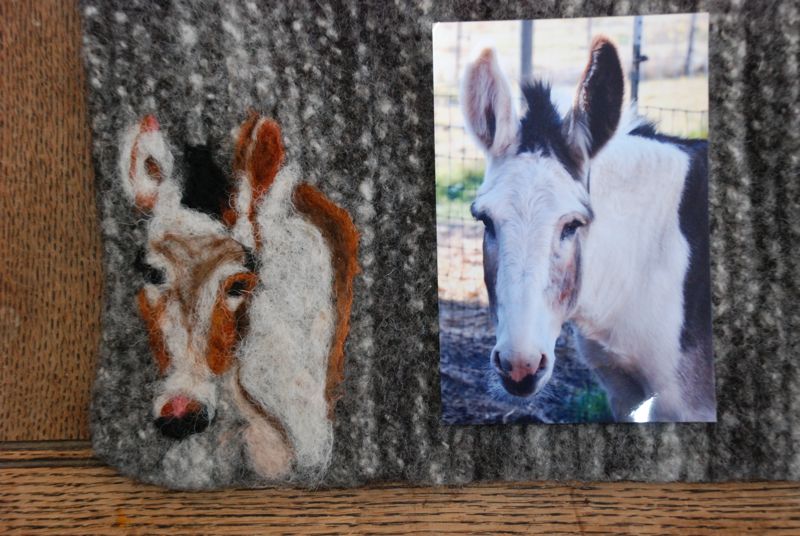
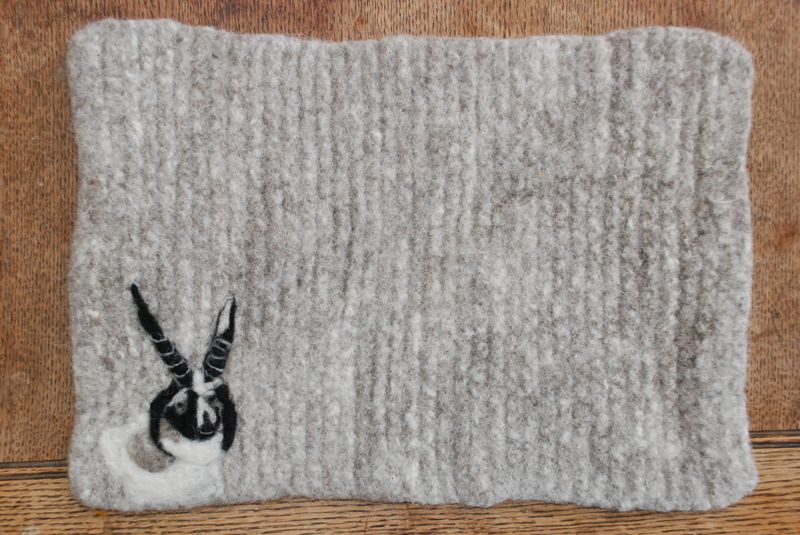
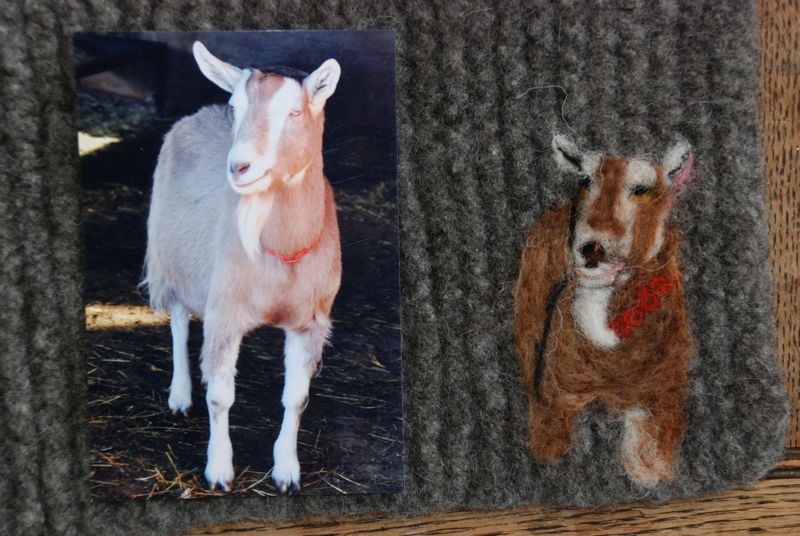
These are four placemats. Jackie bought fiber from me, then spun it, knit it, felted it, and then needlefelted the designs. (Is that little red hen in the corner Jackie’s self-portrait?)

Here are close-ups:

Amaryllis

Hudson is the lilac ram so he is on a mat of lilac wool.

This is the bantum chicken that hangs out in the barn.

Stephanie

Thanks so much, Jackie. This is an amazing gift.


Let there be light…of the right color

One of the things on my Christmas list was a light reflector for helping with photography. This is a big round disc with changeable covers to give reflect light in different ways. After figuring out how to get better product photos by using manual settings on my camera, I was still limited by being able to direct light in the best way.  I still have a lot to learn, but this is a start.

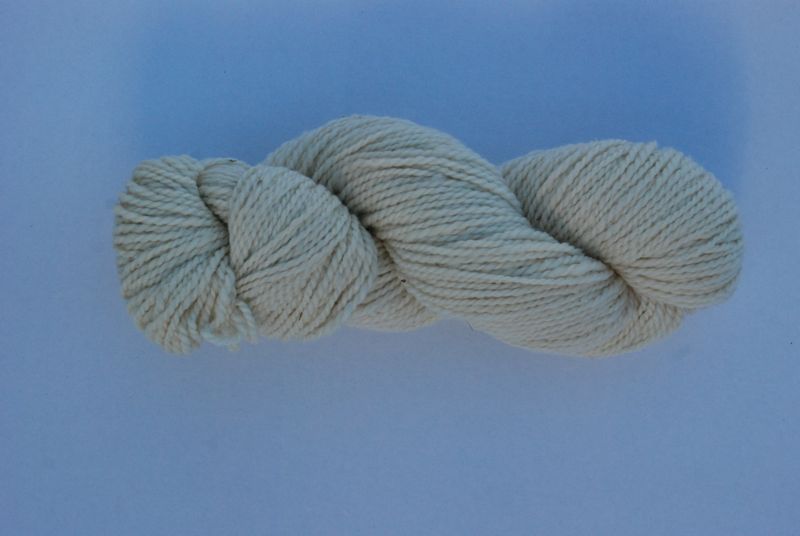
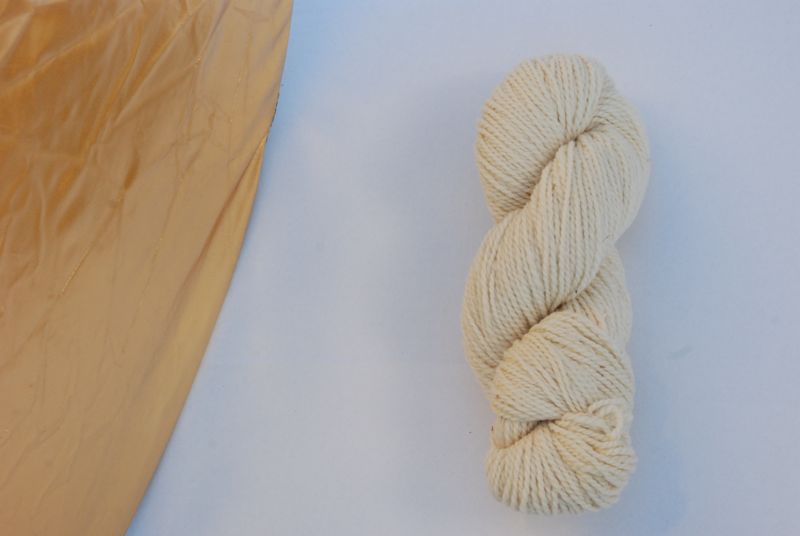
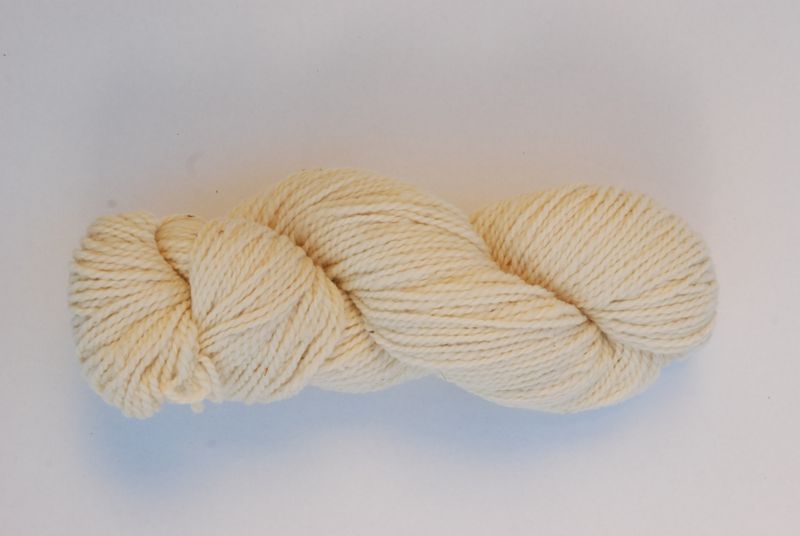
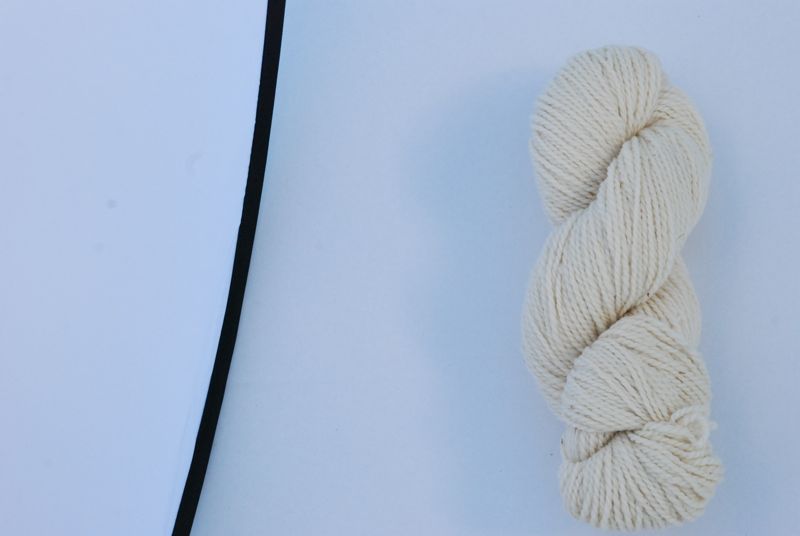
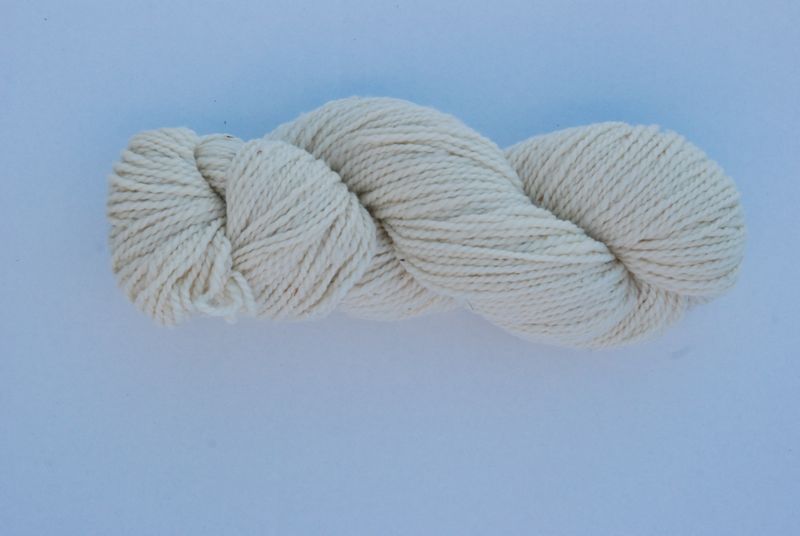
These photos are of  a beautiful Targhee yarn that I just got back from the mill.

The photo above was taken using my camera on automatic. Yuck.

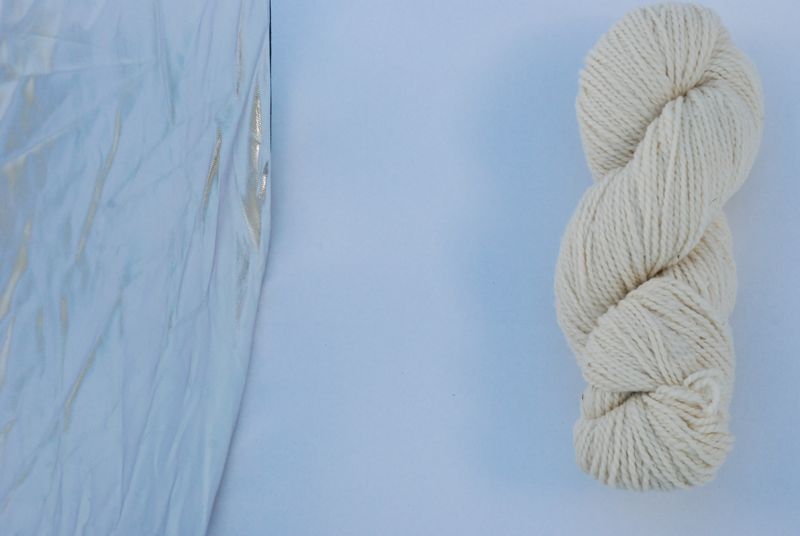
The yarn is in the same place but I have the gold cover on the disc. I also changed the camera to using manual settings for aperture and shutter speed, but I kept those the same for all the following photos.

This is the photo using the gold. It’s a pretty photo, but probably doesn’t show the true color of the yarn.

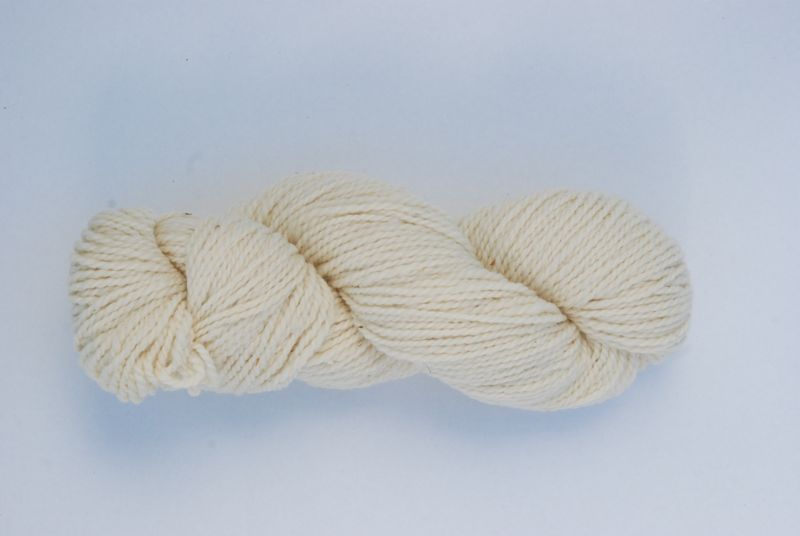
This is the cover that is not reflective, but diffuses light as it shines through.

Here is the yarn using that diffuse light. Not bad.

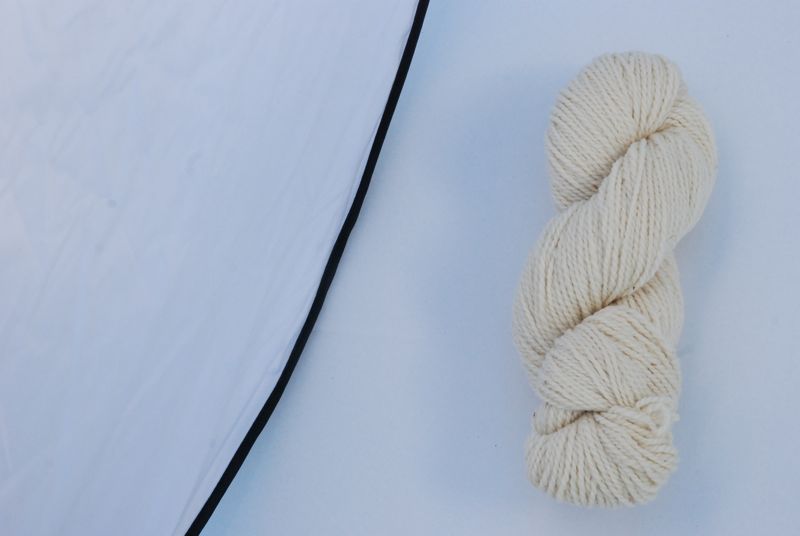
Here is a white reflective cover…

and the yarn. The yarn looks ok but there is more of a blue background.

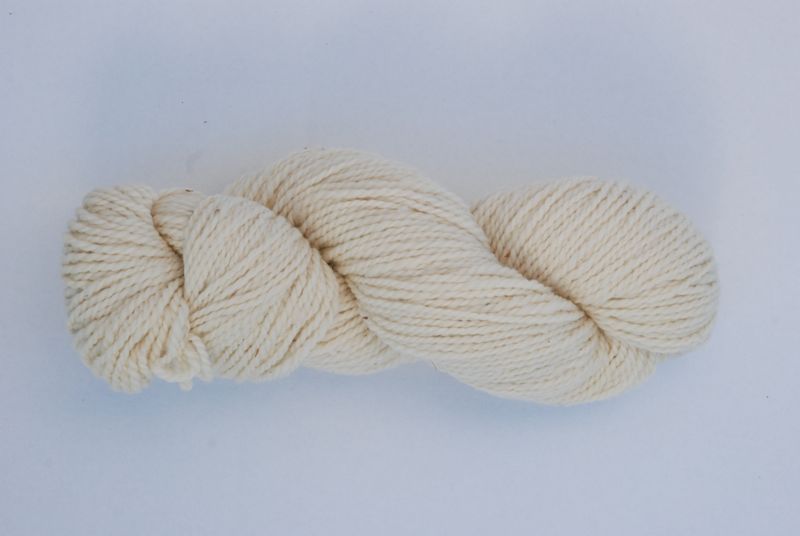
How about the silver reflective cover?

This is the photo using the silver cover.

There are other variables of course–especially how my computer monitor displays the color and how your monitor displays the color. Those may be two different things.

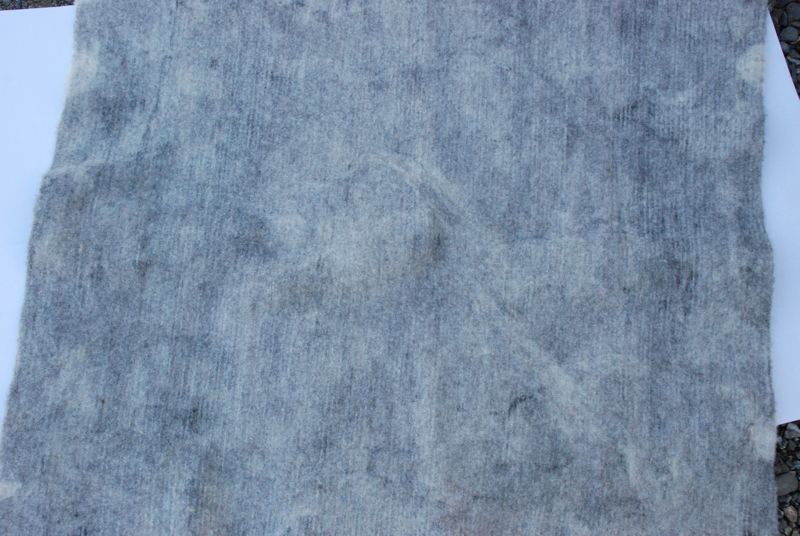
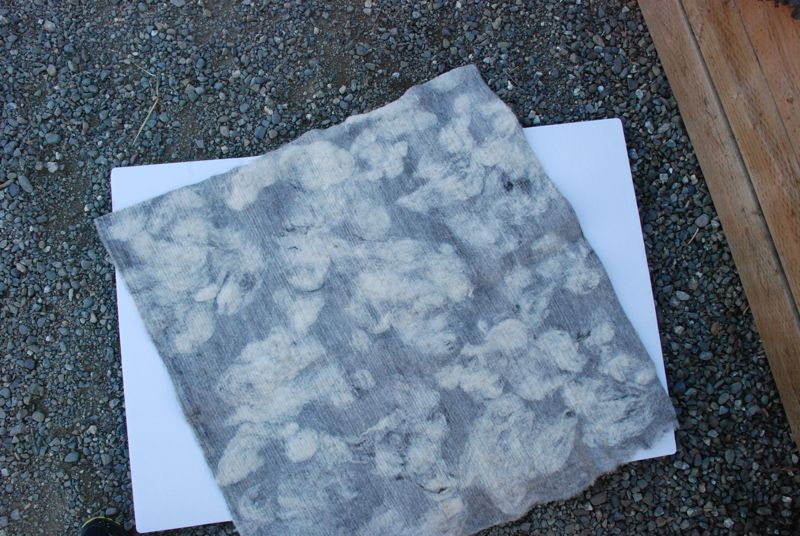
And while I’m at it, here is a photo of felt that I got back from the mill last month. This is incredibly soft.

Look at the back side of that felt. Isn’t that cool?  I think this will inspire something interesting.

Weaving in Blue

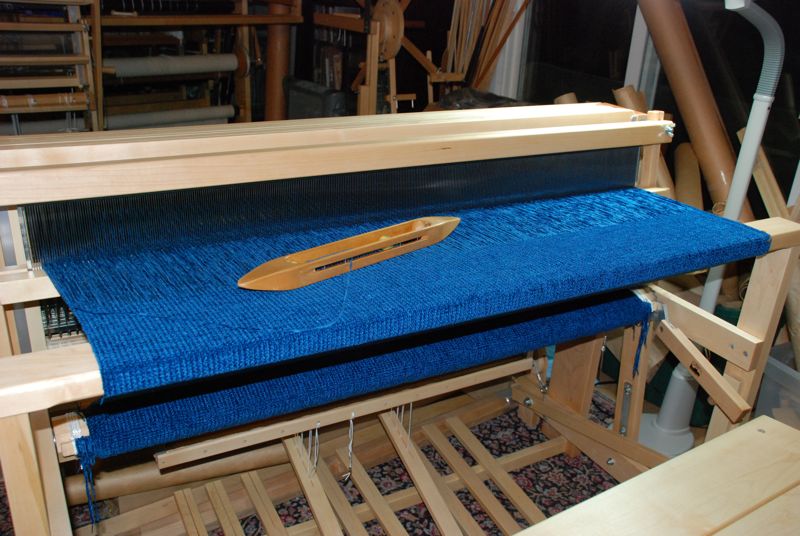
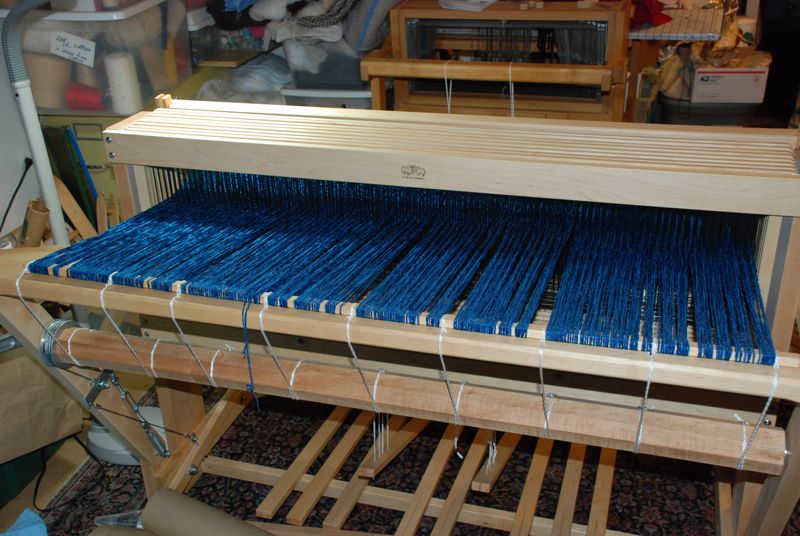
I got a new loom! It wasn’t from Santa. I realized that if I was going to try to sell Schacht looms I’d better have some examples here. I have the smaller looms, but not a large floor loom. So the week before Christmas my loom came. It’s an 8-shaft, 46″ loom and I ordered a double back beam and sectional beam. Wow! What should the first project  be? Fortunately I didn’t have time to worry about the appropriate first project. I had an order to weave a chenille throw and I’d been putting it off. The deadline was Christmas.

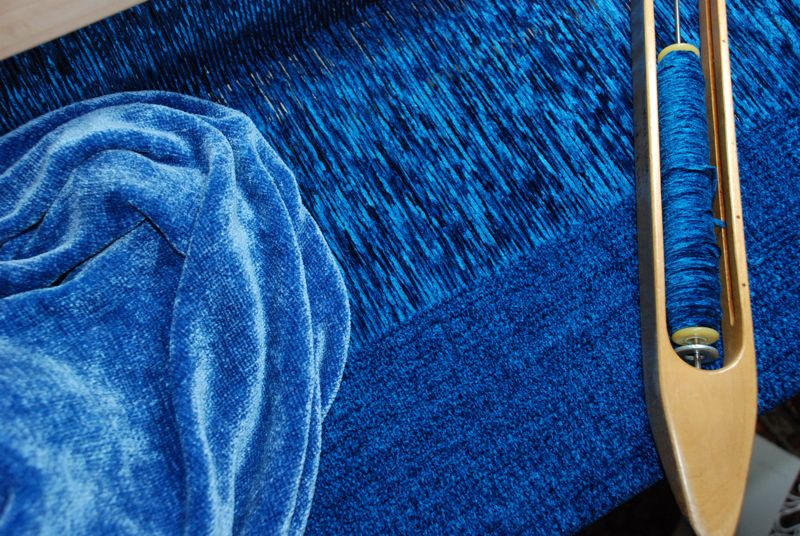
Here is the first warp on my new loom. I think that a 46″ wide chenille throw is a worthy project for the occasion.

Back view of the loom (before adding the extra beam or even the rest of the treadle tie-ups.

The piece on the left is the original throw that I was to duplicate. The loom was a joy to weave on, even with a 46″ wide warp. I am thrilled and can’t wait to wind the next warp.

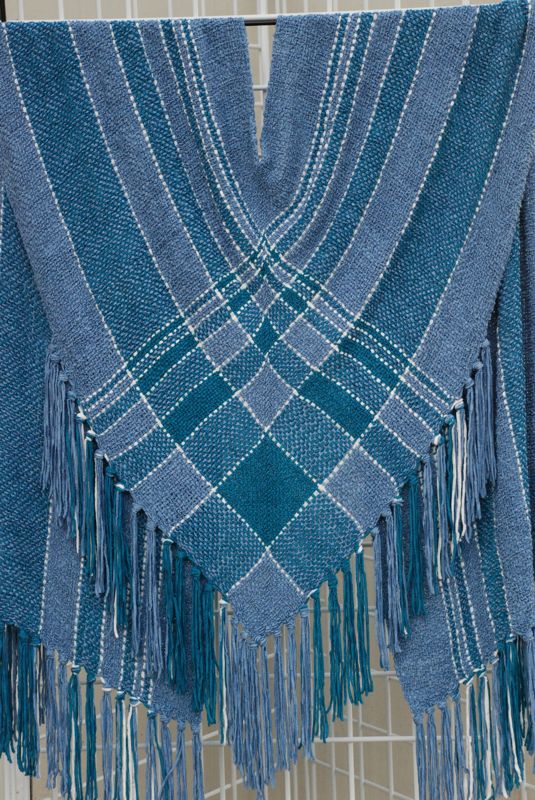
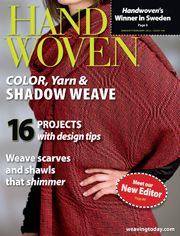
In the meantime I had a deadline for a piece to (hopefully) be used in the next issue of Handwoven.

This was finished  yesterday and mailed today. Its a v-shawl out of yarn called Bambu Lace.

About a month ago I got an e-mail asking for favorite sheep photos so that they could be used for the 2012 Jacob Sheep Breeders calendar. This year’s calendar is very different from previous calendars. JSBA member, Julie, who happens to live nearby, offered to create artwork from the photos to use for the calendar. Julie is a wonderful artist and the calendar is a special treat, complete with Jacob yarn binding. As a special surprise, each of us whose photos were used were given the original artwork.

This is Fanny, my oldest ewe. I absolutely love it. Thank you so much, Julie!

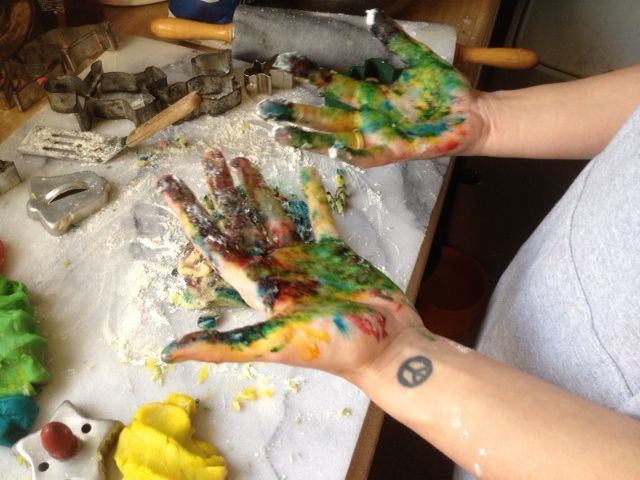
Tie-Dye Meets Christmas Cookies

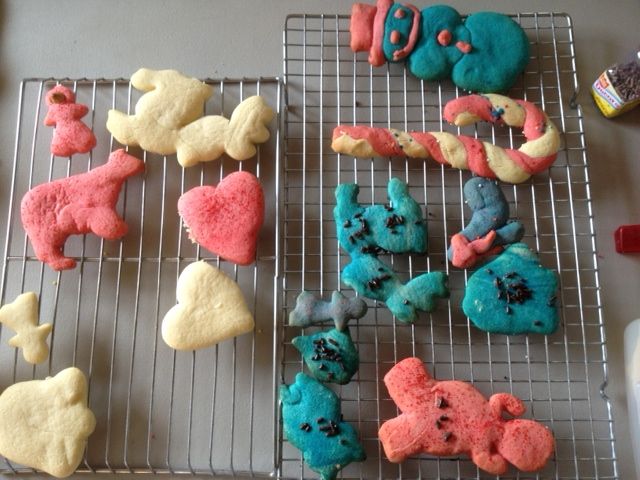
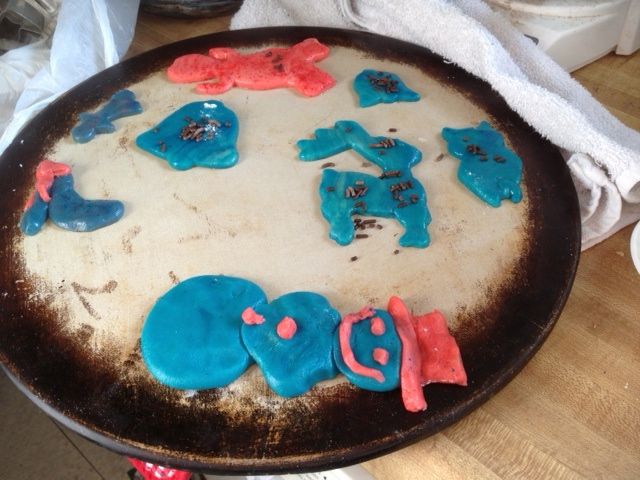
Chris and Meryl wanted to make Christmas cookies. They discovered that it didn’t work with chocolate chip cookie dough (although that didn’t stop us from eating the cookies). Next batch was using a more traditional recipe.

The original idea was to frost the cookies later, but then I got out the food coloring and sprinkles.

Each successive batch was more interesting (creative).

I had to leave before this batch was finished. What fun to have grown up kids in the house!

A Foggy Morning

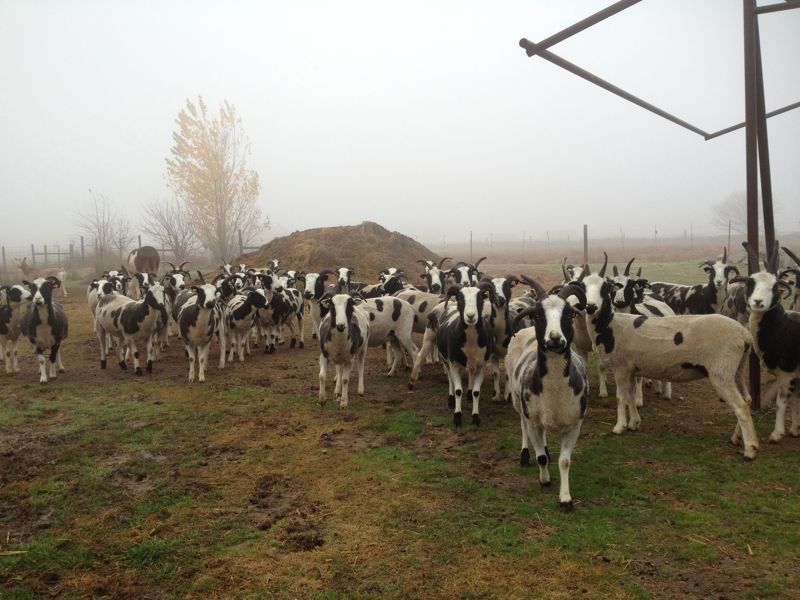
It’s been foggy in the Sacramento Valley, but this last few days we have been just west of the fog. It was here this morning but is burning off.

The sheep greeted me as I went out this morning.

See the 3 sheep in the middle of this photo? Paulette is the farthest right of those three. We did preg checks on her and the other 2 sheep who are the ewes I breed in February to lamb at State Fair in July. When we brought her in I thought that she had quite a belly for an open ewe. She’s pregnant with triplets. No State Fair for her this year. Faulkner had got through the fence a couple of months ago and although I gave her an injectable form of the “morning-after” pill I guess it didn’t work. So those are three little BFL/Jacob lambs she’s carrying.

Why is Amaryllis standing here when everyone else is in the pasture? Those of you that know the flock will probably guess.

Because that’s where Stephanie is.

Here are the rams. In the foreground left to right: Ruby Peak Linden, Meridian Clapton (lambs)

Center: Meridian Fogerty (lamb)

Background front to back: Mud Ranch’s Hudson, Sweetgrass Clint, Puddleduck Sullivan (lamb).

This is Faulkner and his Jacob buddy, Jerry.

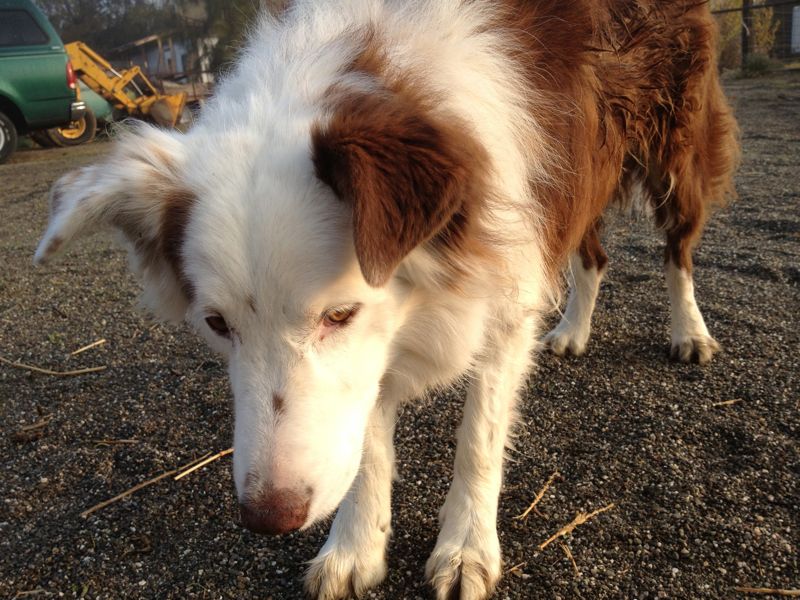
And, of course, Rusty is out here with me–staring at shadows.