Digging Ditches (& on my pasture soapbox)and a new fun discovery

We’re finally getting rain like in the old days…that is, before the several drought years. One thing that is different in the last few years is that the news media now has days of coverage Before The Storm. It’s good to have warning of hurricanes, floods, etc, but sometimes I think that there is a little overkill on the Before reporting. There must be other news…oh wait, I guess if it is the political climate instead of the atmospheric climate  maybe I’d rather hear about the weather after all.

I was gone Friday night (that’s for another blog post). Heavy rain had been predicted  rain through the whole weekend. The scene below is not abnormal for a regular (non-drought) winter here. We don’t handle winter well at our facility.fullsizerenderThe first thing you’ll notice in this photo is the pink line. That’s my new discovery–that I can draw on my photos!!! Yippee! More fun with photos! I’ll try not to overdo it once I’m done with this post. The pink outlines the waterlogged wet area behind the barn, around the Mt. Meridian (the compost/manure pile). The arrow indicates how that water eventually has to drain IF it can flow away. Or it eventually evaporates or soaks into the ground. That is a slow process with our clay soil that is already waterlogged.

fullsizerender-4

This photo is taken from the same location as the last but at the fence that borders the ditch (irrigation in the summer, run-off in the winter). It’s hard for me to tell if the water level around the manure pile is lower or higher than the level in the ditch right now. At times when I’m irrigating the irrigation water flows backward into the barn area because it flows through gopher or ground squirrel holes. I don’t want to dig a ditch if it’s going to drain the ditch water back towards the barn area. So I started digging. The water was flowing the right direction.img_5959

Here is where I cut through to the ditch. You can see the water flowing into the ditch although the levels aren’t that much different.

fullsizerender-2

The water has to flow east in the ditch and then south. It leaves the property near that tree by going under the driveway to the south and into the canal.

fullsizerender-5

Even in the summer I have a hard time getting the ditch to drain quickly. I walked to the ditch going south. You can see where the water has to go. There is much less water here than in the east-west ditch. This one is much smaller and full of grass. I started digging out dallisgrass clumps. I walked the whole ditch back and forth looking for the next problem spot–where the grass seemed to be hindering the water flow. I didn’t by any means dig the whole thing bigger and deeper but I think I made some difference in the flow.

fullsizerender-6

This is taken when standing in the corner near that tree and looking west. The arrow indicates the tail-water ditch where water flows after irrigating. The pastures are saturated and some water is flowing there now, but notice the overgrown dallisgrass.

While I’m almost on my dallisgrass soapbox I’ll point out the green parts of these last two photos. This is a Mediterranean climate and that means that we have winter rains and dry summers. When it rains in the fall the grass and forbs start to grow. This growth is dependent on temperature and light. When it warms up in the spring the grass takes off and grows like crazy. By May or June things dry out and grass sets seed and it dries out. So…in the spring I count on that annual growth for feeding sheep. I count on the clovers and trefoil (which I have because I irrigate) to sustain us through the summer. Dallisgrass is a perennial grass that grows in the summer and eventually gets out of control and too coarse and fast growing for the sheep to keep up with. The last few years I have mowed after grazing to keep it manageable. These photos show why that is important. The green parts in the photo above shows green growth in the paddocks I mowed. Where it is brown is the overgrown dallisgrass where hardly anything grows. Same with the photo  below. The roadsides are covered with green grass and forbs but the overgrown dallisgrass that wasn’t eaten or mowed blocks everything. That means less feed.

Back to the issue at hand, which is water and ditches.fullsizerender-7

This photo shows where the water leaves the property, flowing under the driveway to the south and into the canal.
img_5969

After doing what I could in that ditch I walked back to where I had started digging near the barn. Water was still flowing.

img_5971

So I went into Faulkner’s pen and started digging north towards the manure pile and barn. Here is a closeup of some of my ditch from the other direction. The fence is at the top of this photo. You can see how the water is flowing UNDER the surface through rodent hoels.

fullsizerender-8

My ditch isn’t nearly big enough to drain everything, but it’s better than nothing. At least it feels like progress.

There will be another blog post later about my fantastic Friday/Saturday AWAY from the farm. Maybe fewer marked up photos too. Right now I am going to Higby’s to get new rubber boots because mine are too old and water is seeping through at the ankles.

The Flock

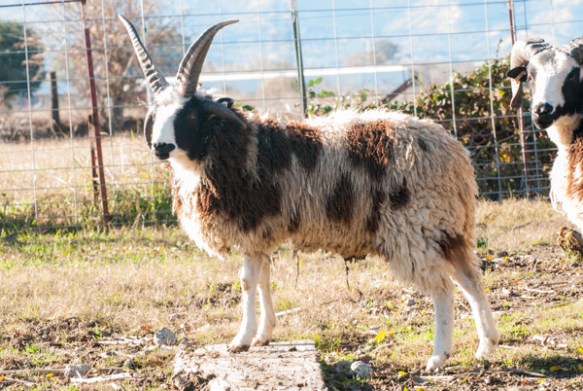
Every year I put together a Flock List for the Farm Club members. This includes photos and a little information about each sheep (and dog and other characters) on the farm. I like to get current photos of each sheep and I’ll share a few here. Shearing Day is in just a month so they are in almost full fleece. I’ll have to get before and after shots of them as well. 11047-zoey-3

Zoey.

11086-alexandria-2

Alexandria.

12018-sonata

Sonata.

13044-ears

Ears.

13068-cascade

Cascade.

14013-jean-2

Jean.

15031-15053

Two almost 2-year-olds, Honey and Zinnia.

16015-marilla-13007

Marilla, a 2016 lamb, and her mother, Marilyn.

sheenashelby

This photo was taking during the summer of two of the sheep I bought from flocks in Oregon. That is Kenleigh’s Sheena on the left and Shadow Mountain Shelby on the right. I found this photo while I was looking for another. It is a good example showing a lilac ewe (right) and a black and white ewe.

dsc_4747

Most sheep eyes.

blue-eyes

Some of the lilac sheep have striking blue eyes

Christmas in Texas

This is the first time I haven’t been home, where ever home has been, for Christmas except for maybe one or two years when I lived in Arizona. I took these photos on my walk this morning, Christmas Eve day, along the 2 miles road from the highway to my daughter’s house.

img_5472

img_5473

img_5478

img_5479

img_5480

This is the reason that I’m here:

dsc_5153Kasen Allen, born 4 days ago.img_5530Big sister, Kirby, in her new Christmas PJ’s, hanging stockings on the tree (in lieu of a fireplace)…img_5533…and leaving pie and milk for Santa and a carrot for Rudolph.
Merry Christmas from Texas!

Sheep

Every year at this time I create a Cast of Characters for the Farm Club members. So I took sheep photos today. Here are some of them:

dsc_4683

I started before chore time in the morning and had to chase all the sheep out of the barn. They weren’t too happy about missing breakfast.

dsc_4686

And they don’t like the deep mud so they all stayed on the cement that Dan poured behind the barn this summer.

dsc_4688

This is Janis.

12098-foxglove

Mud Ranch’s Foxglove. She is a lilac ewe.

15073-alice-2

Alice.

16043-virginia-2

One of the 2016 lambs, Virginia.

16062-cindy

Another lamb, Cindy.

bronagh

This is Windy Acres Bronagh, another lilac ewe.

buster-2

Bide a wee Buster, and March ram lamb.

dsc_4837

Ears.

dsc_4908

While I was taking photos, my DIL was throwing the ball for the puppies, Sawyer and Finn..

dsc_4916

Ginny ended up with their ball.


Orchard Trails

It’s dry enough now to ride my bike Across the Road. I take Ginny to try and wear her out a bit. Yesterday I took a different route and decided to veer off the road that borders a walnut orchard. I don’t know why I haven’t done that before–veering off the road. Maybe because at other times of the year it’s muddy or weedy (including puncture vine, also known as goats’ head that puncture tires and dog feet) or being harvested. Or because I’m not the sort of person that goes off the trail.

Maybe it’s that I am not a big fan of orchards in this area. Almond orchards seem to be taking over the valley and the landscapes that I love are hidden once the orchard has been in a couple of years.

img_5201

Anyway, it was beautiful view from within the orchard.

img_5199

Peaceful.

img_5200

Colorful.

img_5197

Orderly.

img_5206

img_5211

However, I still love the broad landscape that is outside the orchard. This is one of the few black walnut trees remaining around the fields.

img_5217

The mountains are almost obscured by the young almond orchard  that is across the big canal but at least I can still see the sunset.

Marathon Finishers

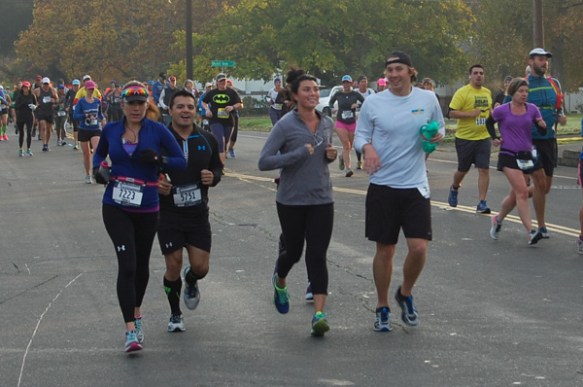
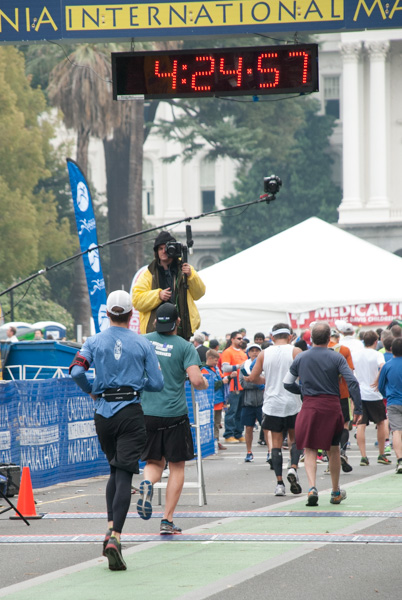
The morning was crisp and cold at 4:30 a.m. when Dan drove Chris & Meryl and friends Ish and Daizsha to the start of the California International Marathon in Folsom. I stayed home to take care of animals but showed up for the finish at the capitol in Sacramento. dsc_0339

Dan caught all three looking cheerful at Mile 5.

dsc_0345

He and Daizsha found them again at Mile 17.

dsc_0353

They had separated by this time. Meryl points out that the Sacramento Marathon is NOT flat, even though everyone says it is.

dsc_0363

There is Meryl at Mile 26. Only 2/10 mile to go.

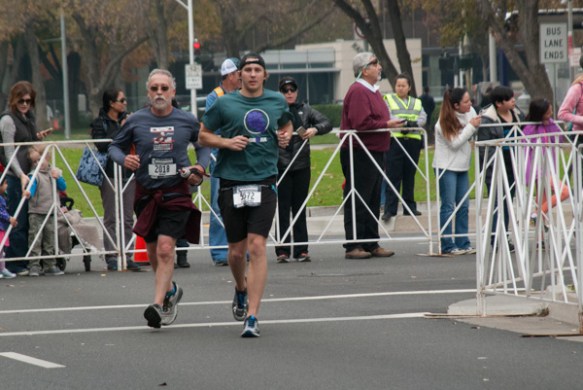
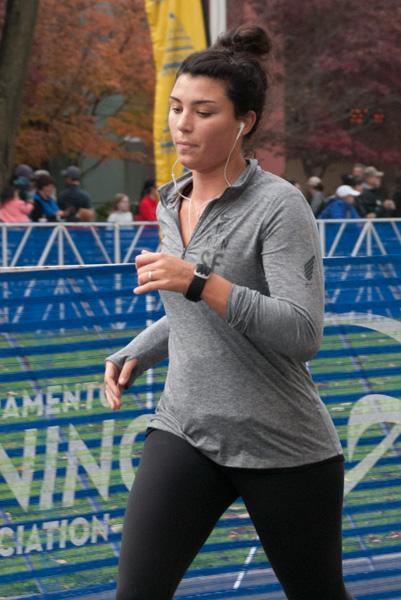
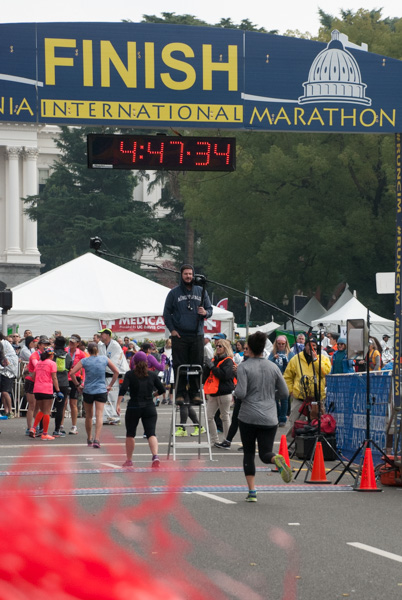
I got to the finish about an hour before our first runner came in. I don’t know anyone in this collection of photos but they caught my eye.  These were all taken as the runners turn the last corner and head to the finish line which was behind me. Top left to right and then down: A “guide” running with a visually impaired runner, a pacer (the clock said 3:23 as he crossed the line–amazing), the women’s finish line with the 3:28 pacer crossing the line, two guides with another visually impaired runner, women’s finish line at 3:35 (Boston marathon qualifying time), a dad who brought his young son across the finish line with him, a flag runner, a flag wearer, runner promoting the Sacramento soccer team.

I started to worry that maybe I’d missed Chris because I was at times distracted by the very impressive police horses. (Dan failed similarly at his pit crew duties at one event when he was distracted by airplanes overhead.)

dsc_4532

But there he was, running a very respectable pace considering that he had done little training for this one.

dsc_4537

This was Chris’ seventh marathon…

dsc_4543

…two of which were at the end of Ironman triathlons.

dsc_4544

Spectators can follow their athletes (on the other side of the fence)…dsc_4546

…to waiting family and friends.

dsc_4550

We worked our way through the throngs of people to the women’s finish  chute in time to catch Meryl…

dsc_4556

…finishing her first marathon.

dsc_4566

Ish was close behind her but on the men’s side so I missed his finish. This was his first marathon also.dsc_4569
dsc_4596

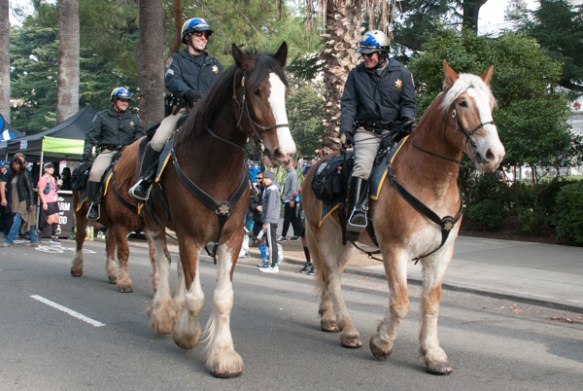
Walking back to the cars we were passed by the magnificent police horses. I didn’t realize that they were using draft horses for police work. Can you tell how large that bay horse is from the stirrup position of the rider. I can always be distracted by horses!

dsc_4608

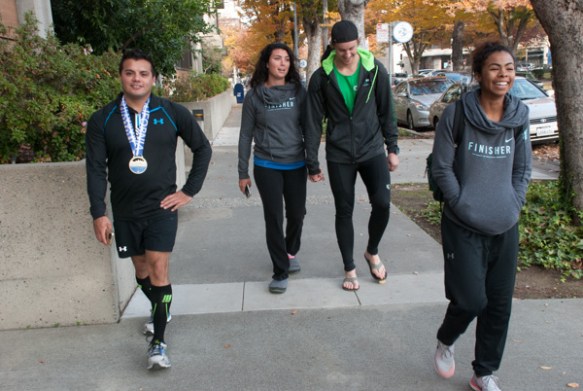
Four BFF’s heading back to the car and looking forward to In & Out burgers.

dsc_4609

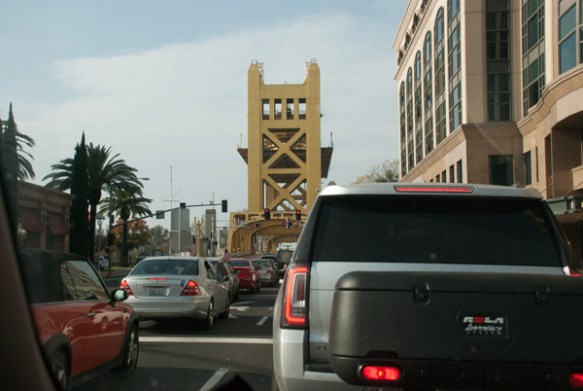
Dan and I were in our car and were stopped on the way out of Sacramento by the drawbridge. I’ve never seen this one in the up position with the whole roadway up in the air!

I guess that would be one reason that the marathon isn’t routed over the bridge.

Spinners’ Day Out

What an inspiring day this was! We had a full house here for Spinners’ Day Out. It was cold and windy outside and somehow we all fit in the shop. Then people started pulling things out of their bags! What talent! That inspired this blog post.

janis-baby-hat

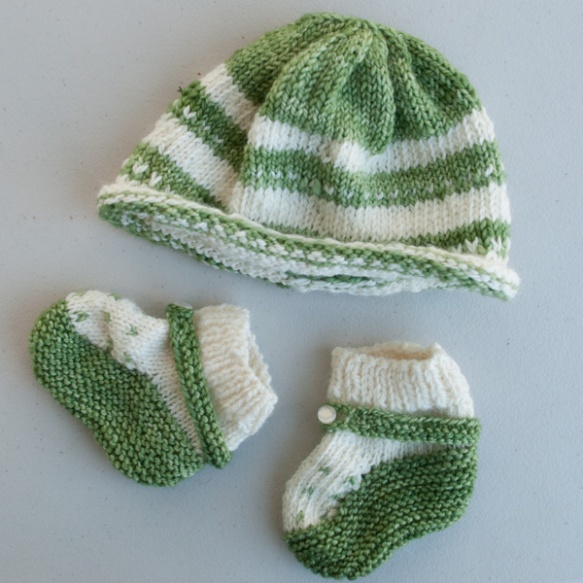
Janis knit this baby hat and booties for my soon-to-be-born grandson. This is yarn she spun during our Spinzilla week. She said that this pattern was one passed down from her grandmother and the booties actually stay on babies’ feet.

donas-scarf

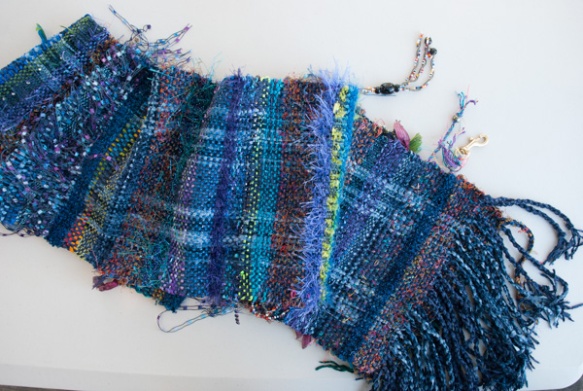
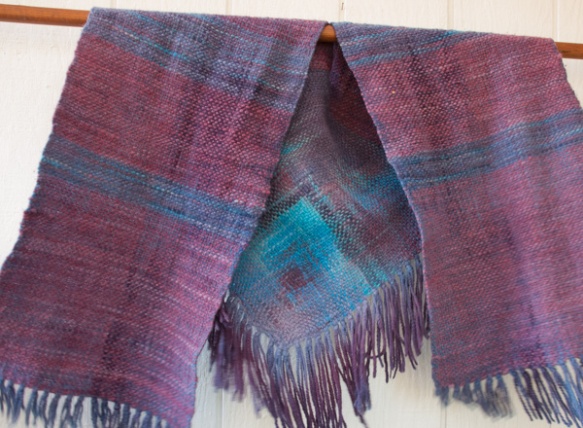
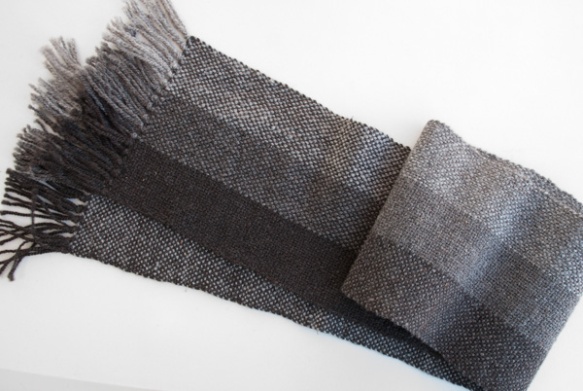
Dona wove this scarf on the rigid heddle loom. It is full of wild yarn including a designer leash that I made a long time ago (note clip on the side) and a beaded necklace.alisons-scarves

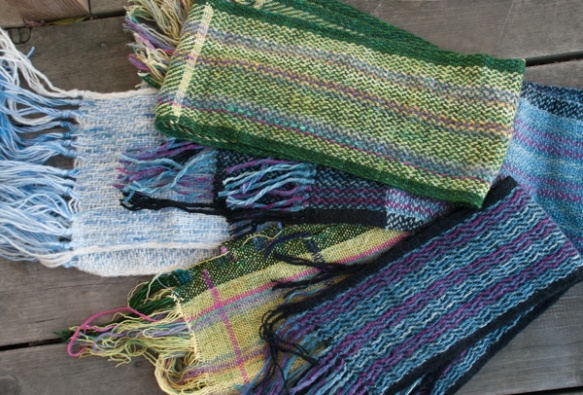
Alison has been going wild on her loom, exploring weave structure and color. She has woven all these scarves in the last week or two…

alisons-v-shawl

…in addition to this v-shawl that she wove in a class here. (By the way, photos were a bit challenging today as there was a strong north wind. Can you tell from the movement of this shawl?)

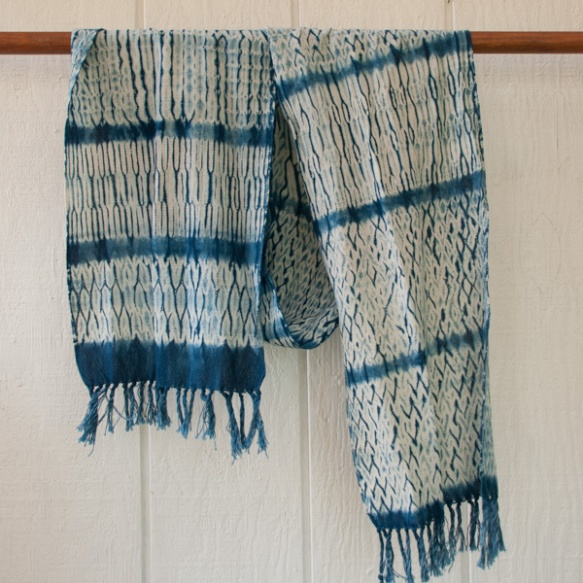
gails-shibori

Gail wove and dyed this beautiful shibori scarf.

mushroom-dye

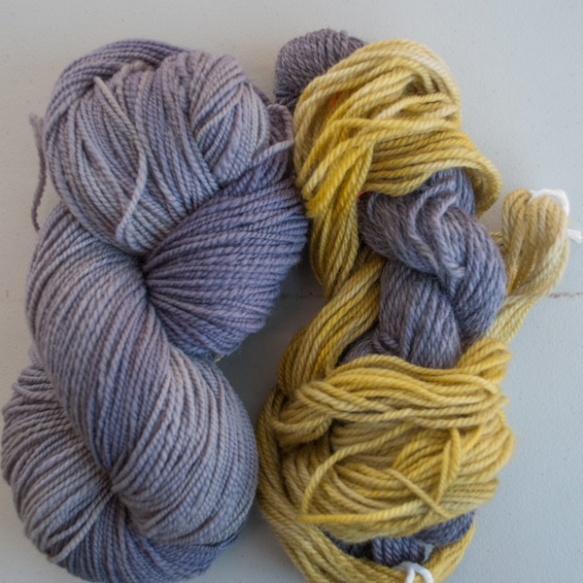
Lisa showed us her mushroom dyed yarn…

gilmore-scarf

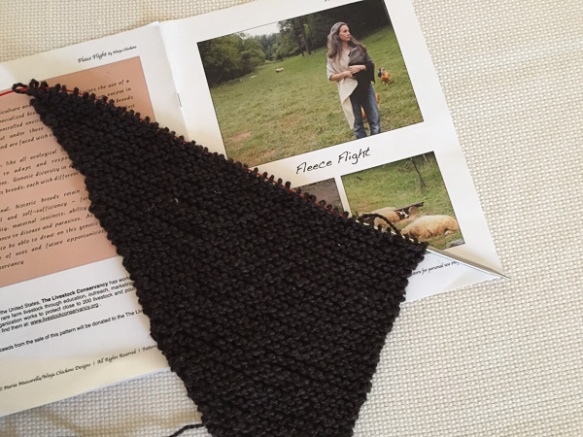
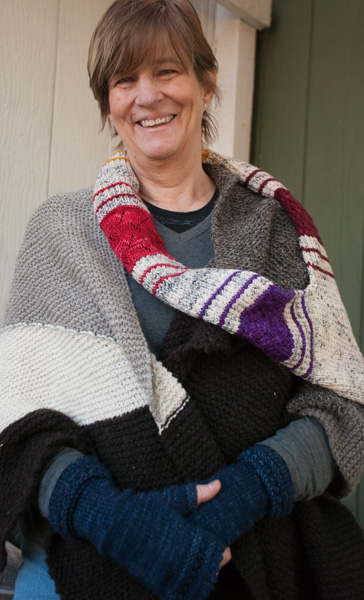
…and modeled Mary’s knit cowl, as well as her own Fleece Flight shawl knitted with Jacob yarn for our ongoing KAL in Ravelry.

maggies-scarf

Mary’s daughter, Maggie wove this Jacob scarf on the rigid heddle loom as her first-ever weaving project. Look at those edges!

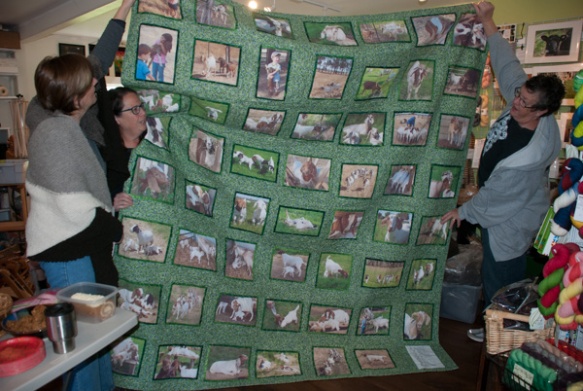
donas-goat-quilt

Dona brought her quilt that had pictures of all the goats that she used to have.

dsc_4467

This is the back of the quilt–very cute fabric!

dsc_4469

I just finished three black walnut-dyed shawls.

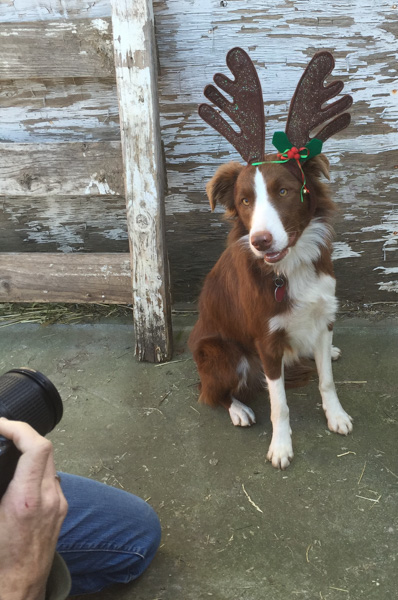
Later in the day a few of us decided it was time for the annual “dress the animals in Santa hats” but that will be for another blog post.

ginny

This is a preview.

Shearing at Other Farms

A few weeks ago two of my friends did their fall shearing. Since I didn’t have to do any work I just visited and took photos.

dsc_4081

I don’t know which is which but this is one of Jackie’s Herdwick sheep, either Heddy or Hazel.

dsc_4083

I do know this ewe because she lived here for many years. This is Diamond who is now almost 17 years old.

dsc_4084

Lucy is Diamond’s granddaughter. She is almost 10. dsc_4102

Camelids are not my favorite animals but they can be photogenic. Jackie’s llama is named Peridot…

dsc_4109

…and her alpaca is Evangeline.

dsc_4114

Jackie’s flock after shearing. Jackie shears twice a year because many of her sheep are long-wools and benefit from twice/year shearing. The Jacob sheep will be shorn in the spring.

The next shearing location was Colleen’s place. dsc_4130

This is Colleen’s older ram, Razor,…

dsc_4133

…and her younger ram, Thor.

dsc_0243

When doing anything with the rams at Colleen’s farm you have to deal with the Goose. (Thanks, Dona for this photo.) The Goose is bonded with and protective of Razor (as if he needs protecting) but has a sincere dislike of Thor. Thor usually has to live separately to keep the goose from continually harassing him.

DSC_4145-2.jpg

Razor is about as big as John, the shearer, and probably weighs more.

dsc_4156

Velvet, the cat, enjoying the sun and the smell of lanolin.

dsc_4164

Colleen raises Romeldale and CVM sheep that have very fine wool…

dsc_4163

…and the unique “badger” face pattern.

dsc_4165

dsc_4207

After shearing we enjoyed surprise birthday cupcakes (mine–yes, I chose to spend my birthday watching sheep shearing) at Colleen’s outdoor table. Velvet joined us.


Dryer Ball Experiment

Turn massive amounts of fluffy wool into something smaller. That is my goal as I try to organize the workshop end of my shop so that I can get to my looms. I think there is a principle of physics in here somewhere.

dryer-balls-25

I have been making dryer balls to sell but it has been hit or miss. Sometimes they turn out great and other times they are not so good. What makes a good dryer ball? Firm instead of squishy. A sphere instead of strips of felted wool connected in random places. The success of a dryer ball has to do with the type of wool (breed of sheep) and the fiber preparation (carded or not). As I use up odds and ends of fiber I’m never sure if the end result will be worth the time and use of fiber so I decided to do some testing.

dryer-ball-test-before-2

This is the “before” showing 17 different wool types and/or preparations from wool that I drum carded wool to commercial top to pre-felted wool and breeds including Merino, Jacob, and Suffolk. I included a different color of yarn with fibers that I might need help to identify after felting.

dryer-ball-test-4

This photo shows the “after” in the same order as the “before” photo. The least successful here were the “white prefelt”and the Suffolk. You might not be able to tell from the photo, but they did not felt hard at all. The Merino/alpaca felted well, but the alpaca fibers poke out giving a hairy appearance. Some of the other balls have more “hairiness” depending on the amount of coarse fibers in the mix of wool.

dryer-ball-test-3

Another view of the same balls.

dryer-balls

This is the latest batch of balls that just need to be matched up and labeled. The white balls are mostly Merino and the gray balls are Jacob wool.

dryer-balls-15

You can purchase my dryer balls at the Artery, at my shop, or on the website.