A Birthday Hike – Mt. Diablo

I always see Mt. Diablo when I walk Across the Road (unless there is too much haze or fog). I feel a sort of weird connection to it because of the road we live on, which prompted the name of our farm, Meridian Jacobs. I wanted to DO something on my birthday and fortunately the weather was perfect for a hike. We picked up my brother on the way and arrived at Mt. Diablo State Park a little after 8 a.m.

Wikipedia says: “The Mount Diablo Meridian, established in 1851, is a principal meridian extending north and south from its initial point atop Mount Diablo in California.”

I took a lot of photos but I have to narrow it down for a blog post. There are probably more in this post than there should be. It’s hard to portray the true essence of the hike in my photos.

Sign at Mt. Diablo State Park with mileage to various points.

I wanted to get to the summit. Not long after we started we spoke to someone who said the direction we were headed was very steep and suggested a different route.
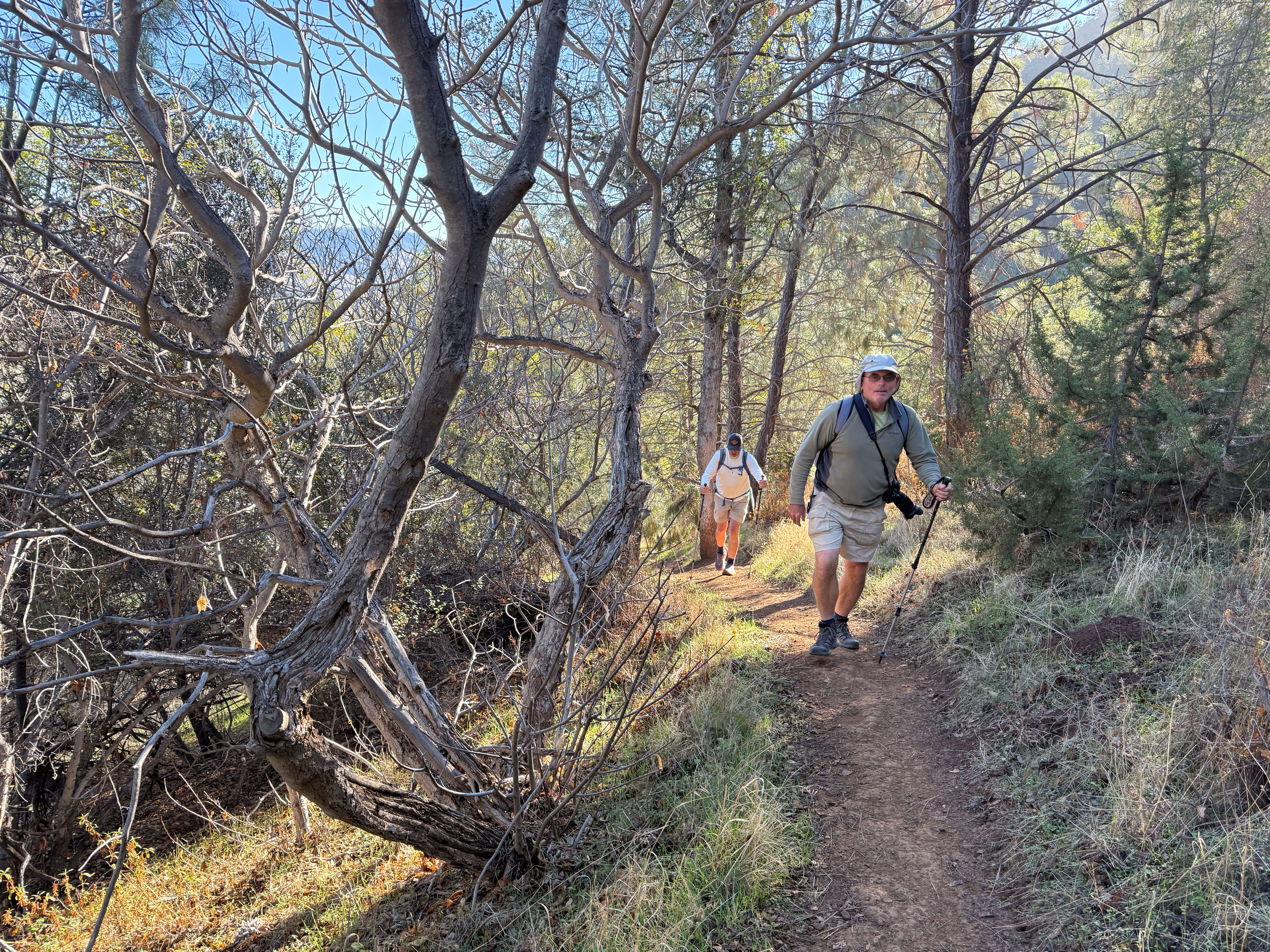
Two people hiking a trail through oak woodland.

We had a map that showed all the trails and decided to start on a different one than what we’d planned.
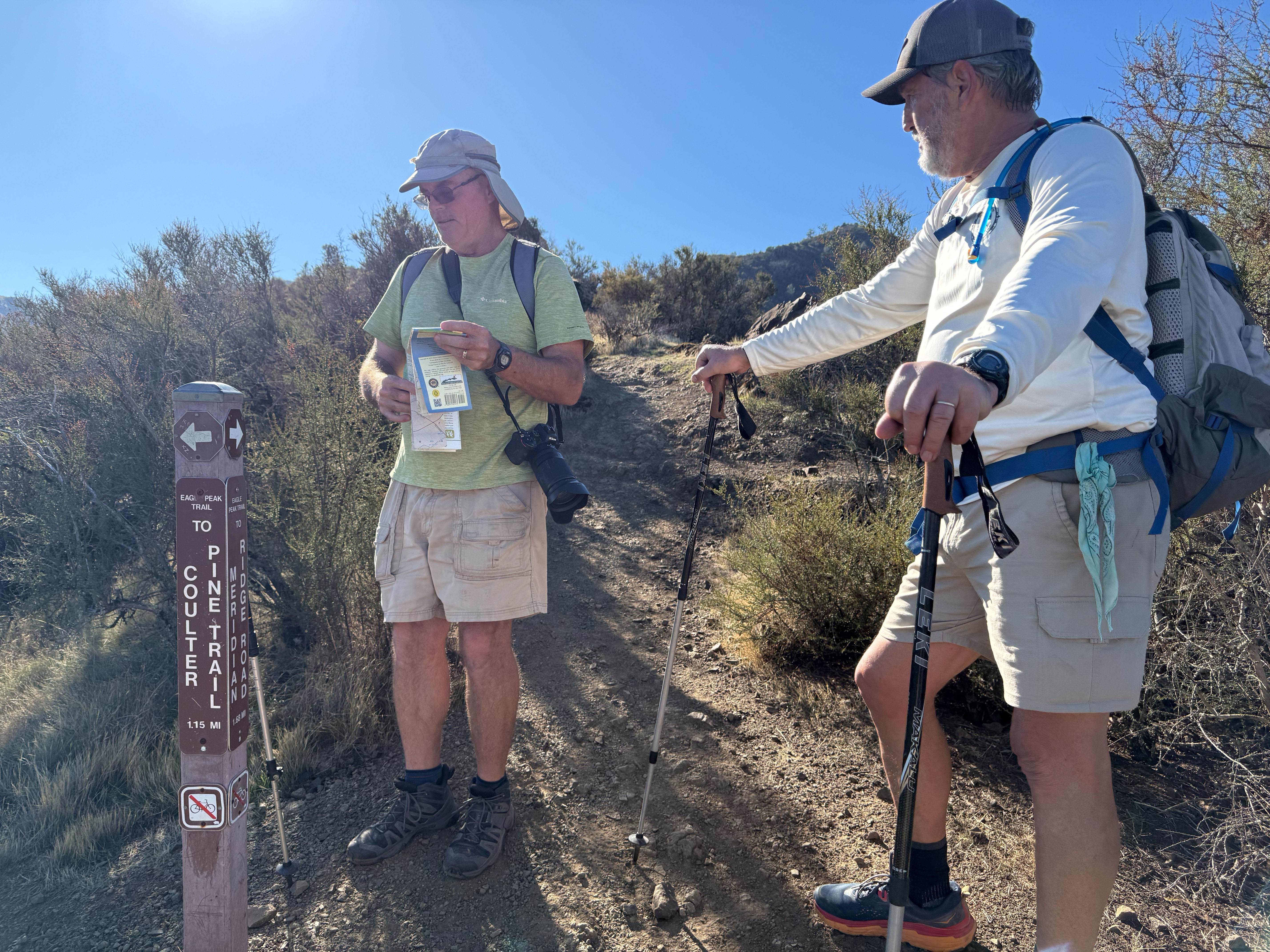
Two hikers looking at a sign post and a map.

Double checking the location.

Two hikers pointing to the map.

We’re still smiling!

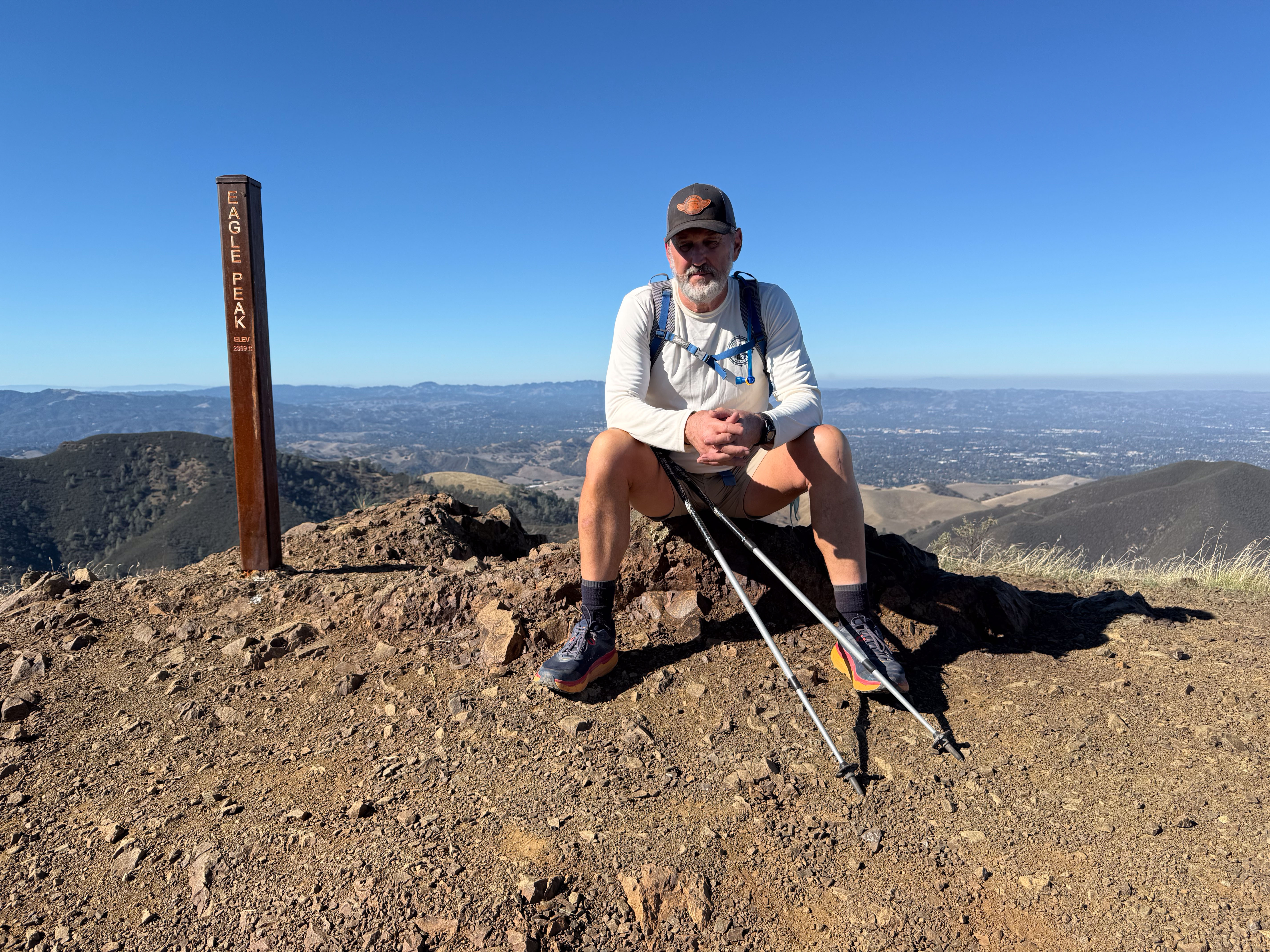
Hiker sitting on a ridge top near a sign for Eagle Peak.

One of several peaks on the way to our goal. The sign say elevation 2369. I thought about adding a 1 in front of the 2. That’s sort of how it felt since we live in the flatland and lately all the walking has been flat. This was about 10:30.

Distant view across wooded hills with an arrow pointing to a building at the crest of the mountain.

I took this photo around noon. That point on the mountain is our goal and Dave thought that we should get there by 1 p.m. to make sure we had plenty of time to get back before dark.
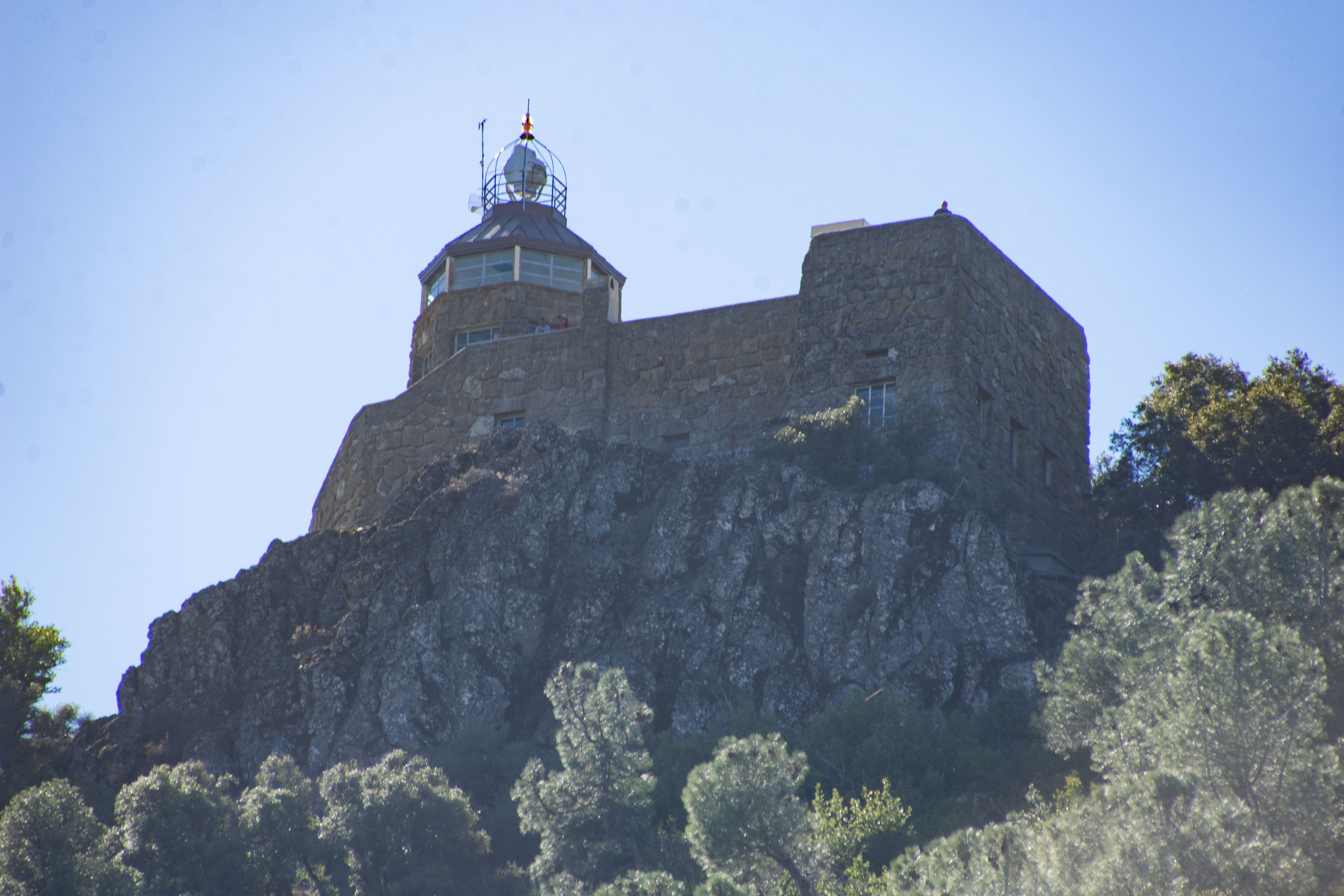
Structure at the top of Mt. Diablo. Concrete building looks like a castle.

This is where that arrow points.

Pipestem Clematis

Not many flowers yet, but things are greening up and showing promise of a beautiful spring. We did see a lot of this vine that I recognize from other oak-woodland hikes.

There was a point where we had a choice to take a one-mile “short-cut” to the top (steep, we were warned by someone coming down) or another two miles with ups and downs. We split up here. Dan took a different route that Dave and I would follow later back down the mountain. Dave and I went to the top.
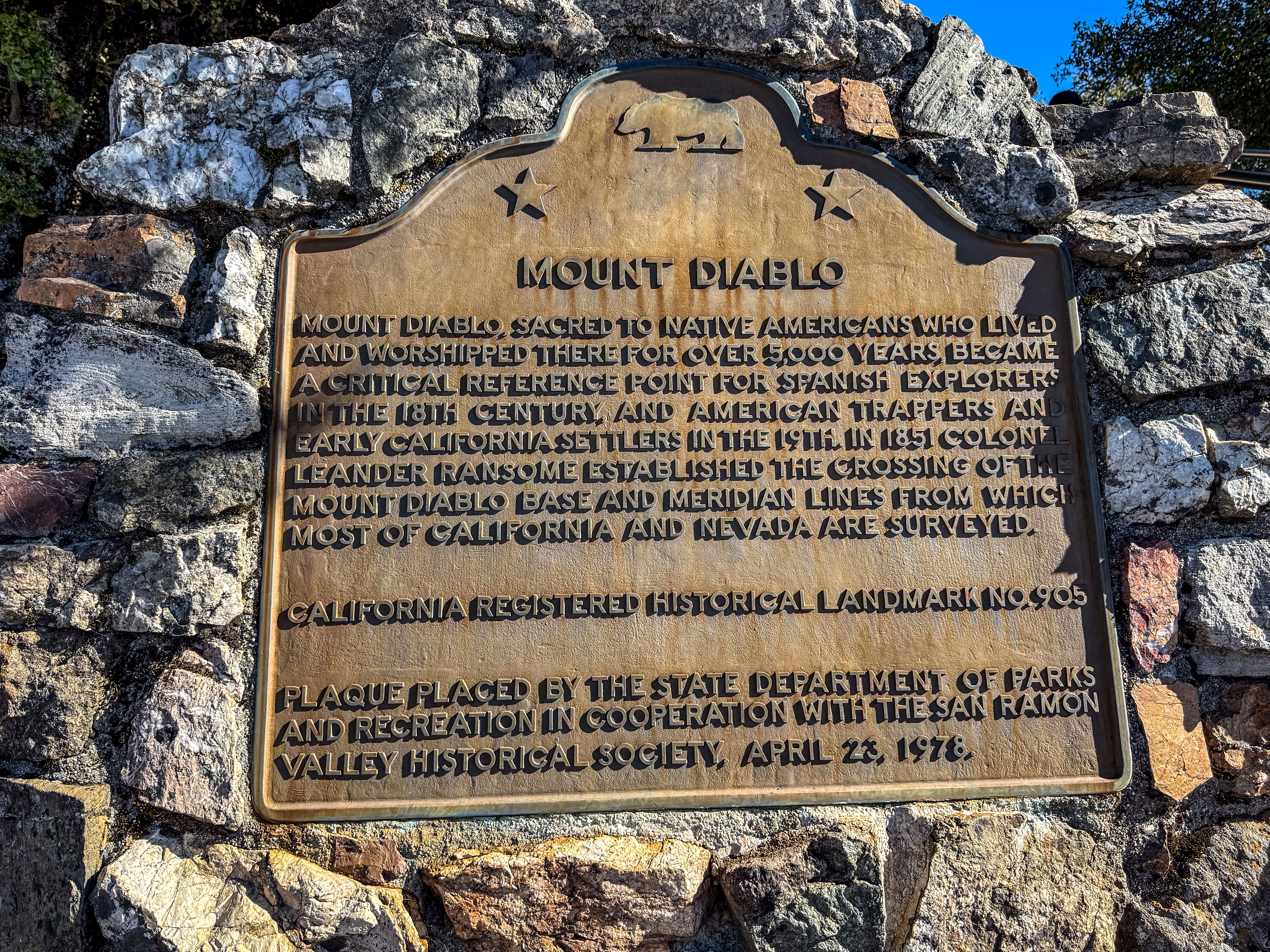
Since you may not be able to read the sign I’ll repeat it here: “Mount Diablo, sacred to Native Americans who lived and worshipped there for over 5000 years, became a critical reference point for Spanish explorers in the 18th century, and American trappers and early California settlers in the 19th. In 1851 Colonel Leander Ransome established the crossing of the Mount Diablo base and meridian lines from which most of California and Nevada are surveyed.”

In the days before electronic navigation the light on top of the rotunda (once on a 75-foot tower) served as a crucial route-finding aid. It was turned off after the attack on Pearl Harbor amid fears that it could guide the enemy to an attack on the mainland. It is now dark except when it is lit on December 7 as a memorial to those who died at Pearl Harbor.

This is inside the rotunda.

View north-northwest.

View to the north. If I can see this mountain from where I live it seems as though I should be able to see my house from the mountain. I guess not. It’s out there somewhere. You can make out the windmills that are south east of our farm and we think what you can barely see left of center under the horizon is Travis AFB.
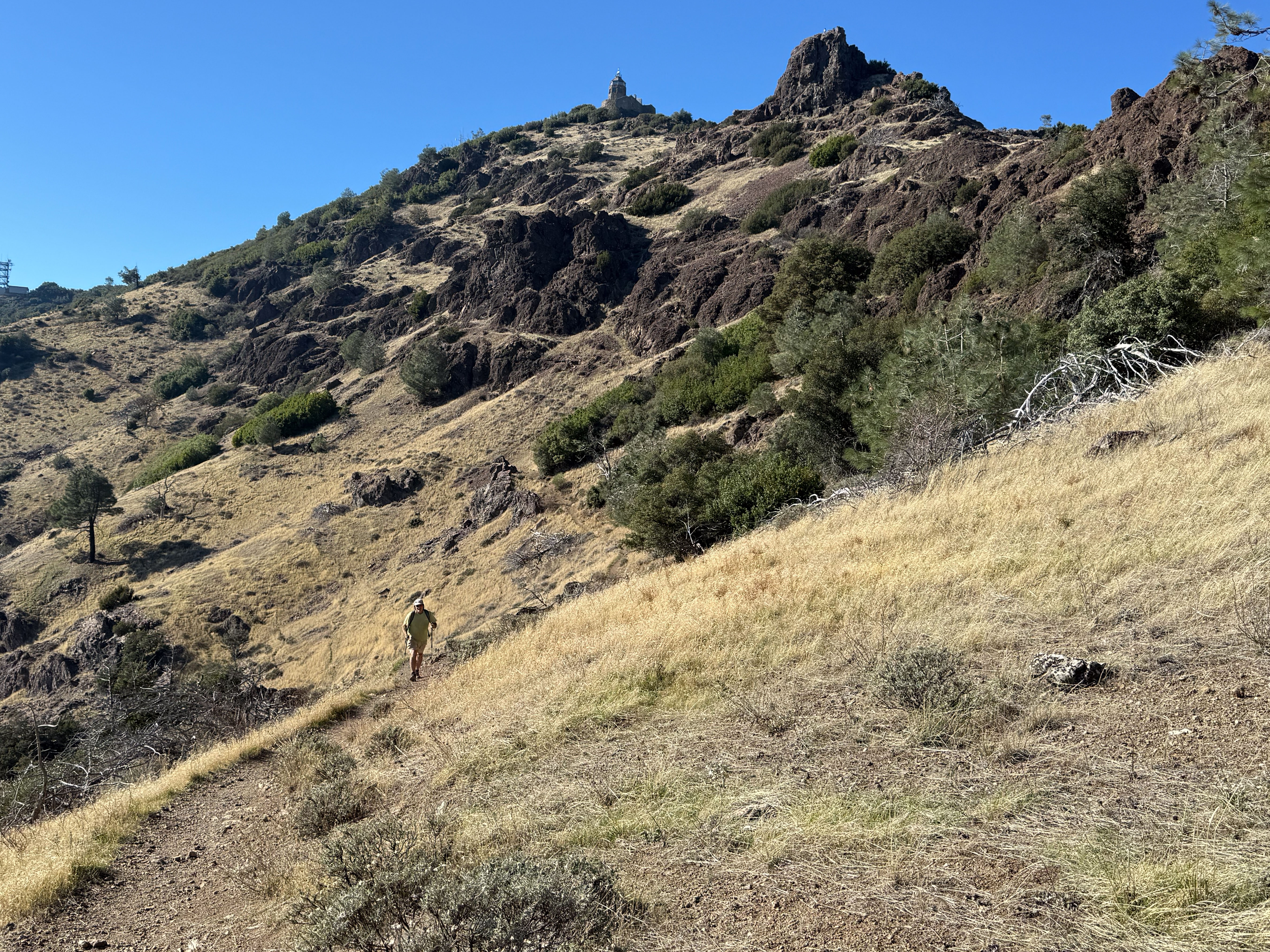
This is the view of the rotunda on our way down the mountain.

View to the east.

We saw a little bit of fall color. I took few photos on the hike back down. It was the most challenging part of the day. We followed a dirt road that is used to access communication towers on another mountain top. Downhill and a road. Sounds easy, right? It was so steep in parts that if I hadn’t had a walking stick to brace against I would have been slipping the whole time on those parts. Even with the stick it seemed treacherous. I hadn’t thought to bring walking sticks, but Dan and Dave had. On the way down Dan had left one of his with me. Once I started hiking this road I realized that his trip would have been extra challenging with his new knee joint and using only one stick.

We got back to the car before dark.

I had turned on my Map My Walk app before starting (blue dot). Somehow it turned off not long after we started and only started up again when we were sitting on the top eating lunch. So these stats are only half of the hike. We think our hike was 13 to14 miles. A good day.

Road Trip 2025 – Day 6 – Colorado

We were on the way home after the stop inTrinidad Friday and Saturday. We spent Saturday night with Dan’s brother and SIL in Colorado Springs.
Two men and a woman standing in front of a seascape painting.

We had brunch with Dan’s sister, also in Colorado Springs. This is Dan and his two Colorado based siblings, Rob and Sally.

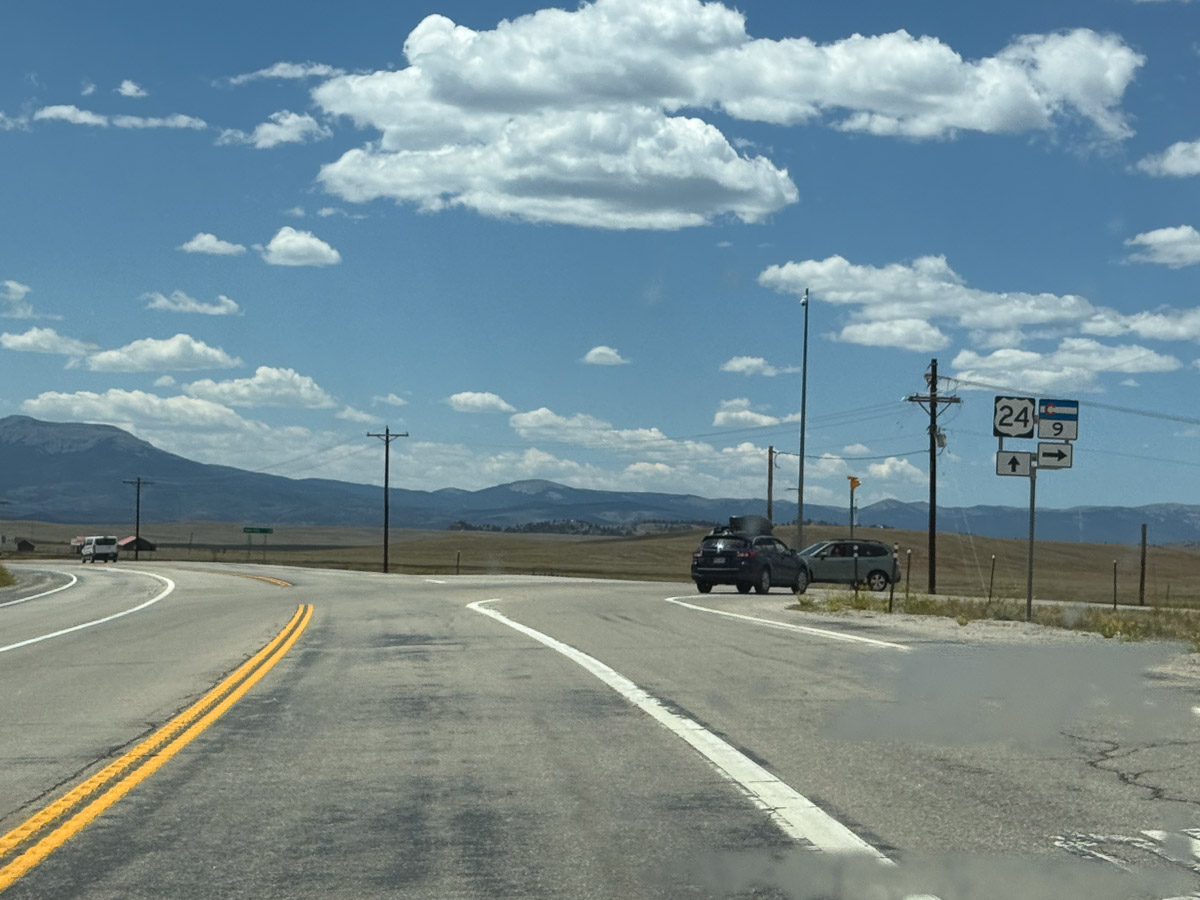
View of the highway where a road turns right. Clouds in a blue sky.

We headed west and planned to turn north to go through Leadville. We had thought about this on last year’s trip, but this intersection (or was it the next?) was blocked due to a fatal accident and we made a big detour. No such problem this time.

Sign about bighorn sheep horns with the title Sheep Shapes.

Somewhere along the road we stopped at this sign. I am interested that bighorn sheep horns are classified based on where the tip of the horn is in relation to the ear and the eye. I wonder if that could apply to Jacob sheep.

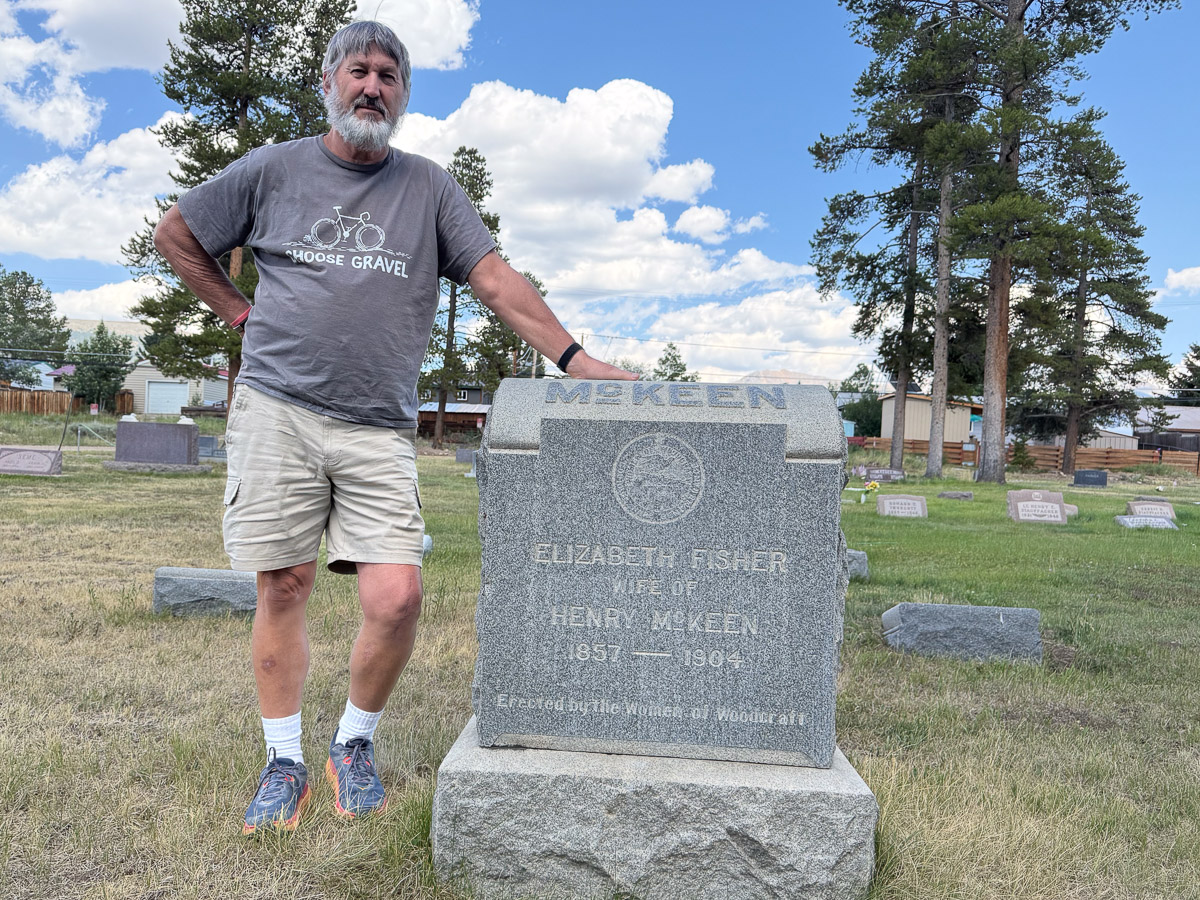
Dan standing next to a gravestone that says McKeen.

When we got to Leadville we stopped at the cemetery to look up Dan’s relatives. This is the headstone for Dan’s great grandparents on his dad’s side.

There was a detour driving into Leadville due to an event and we decided to see what was going on. It was the Boom Days Pack Burro Race!

Text about the Leadville Pack Burro Race.

I have decided that I missed out on an activity that I could have really enjoyed had I been able to start years ago. If you’re going to go on a long run why not take a burro? I would have loved to do this.

Burro at the end of a pack burro race with man in yellow shirt.

We got here as the last few competitors were finishing the course. This burro and his handler, in his late 70s according to the announcer, finished the 15 mile course. Remember, Leadville is at an elevation of over 10,000′.

Burro at the end of the Pack Burro Race with handler in blue hoodie.

This mammoth donkey and his handler finished the 22 mile course. I looked up the rules. Burros must carry the pack saddle with some basic equipment–a pick, shovel, and gold pan. The rules state that the burro must be on a 15′ lead and “the runner may lead, drive, push, pull, or carry the burro…may not ride the burro…”

Head view of burro with green halter and handler with blue sweatshirt.

This burro seemed to enjoy being petted after the race.

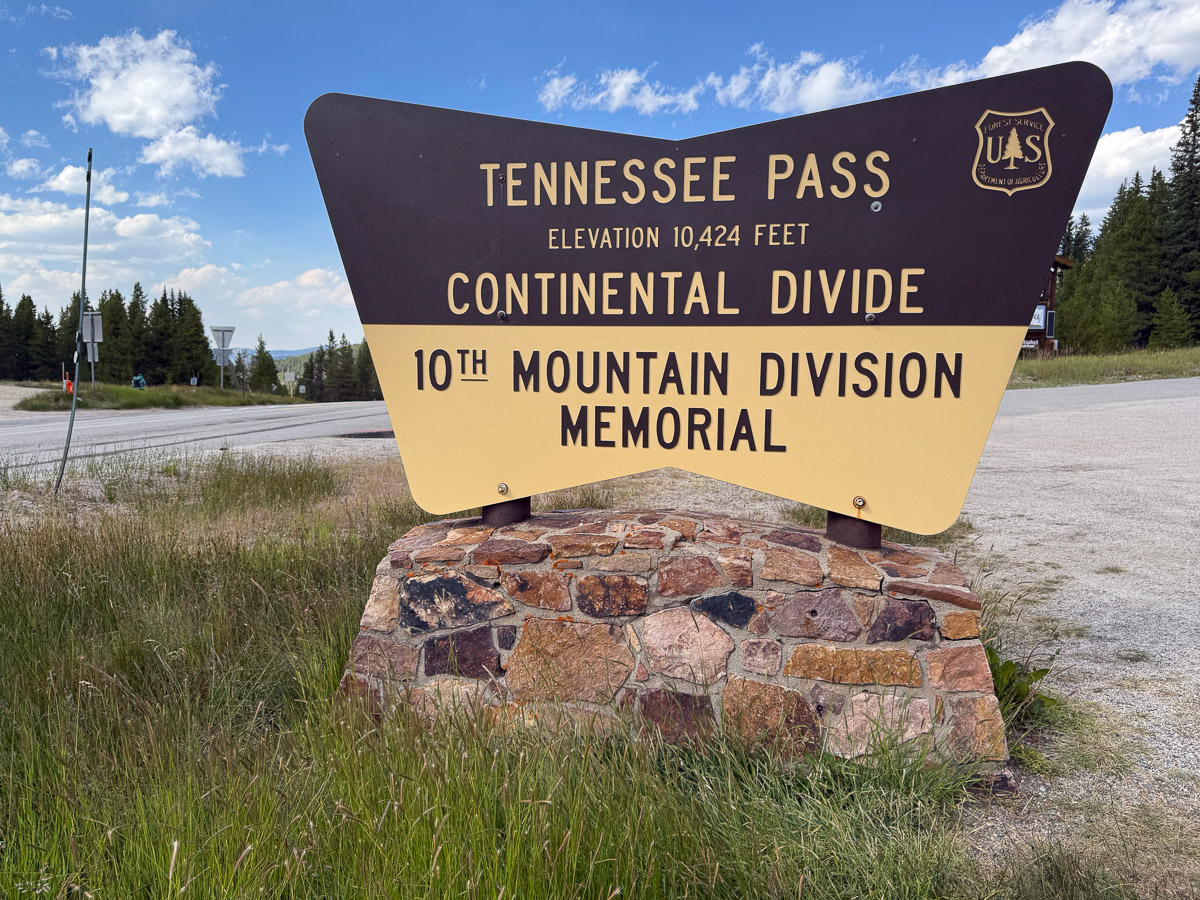
Sign that says Tennessee Pass on the Continental Divide.

We continued west on Hwy. 24 and stopped at the points of interest.

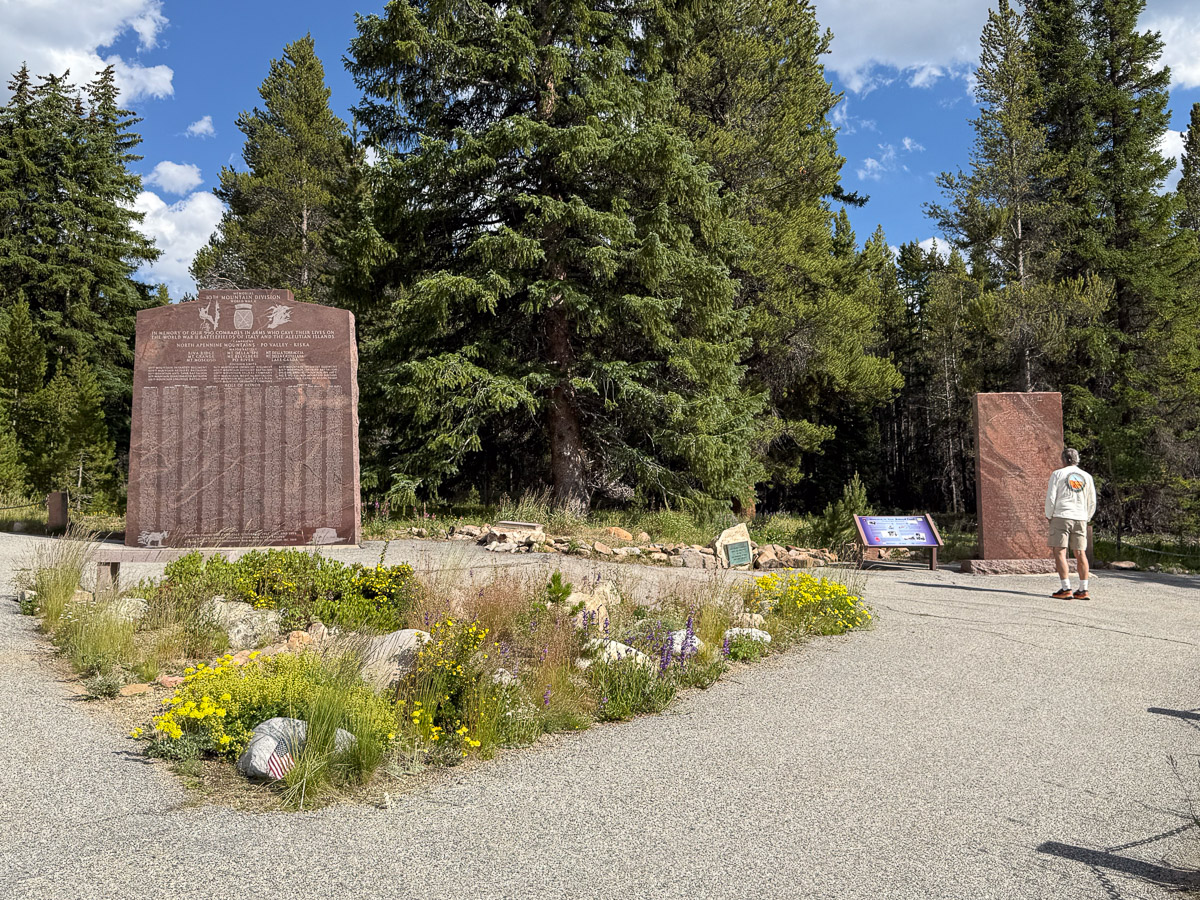
The story of the 10th Mountain Division and their impact in WW2 is fascinating. It is also interesting that well known ski resorts in Vail and Aspen were started by veterans of this regiment and many were also involved in manufacturing of ski equipment and clothing, trail development, and developing skiing for the disabled.

Large granite pillars that make uptime 10th Mountain Division Memorial.

The memorial for the 10th Mountain Division.

Sign for Camp Hale National Monument on the Continental Divide. Mountains and trees in the background.

Camp Hale is 7 miles beyond the Memorial site. I’d like to return to explore the trails of this National Monument .

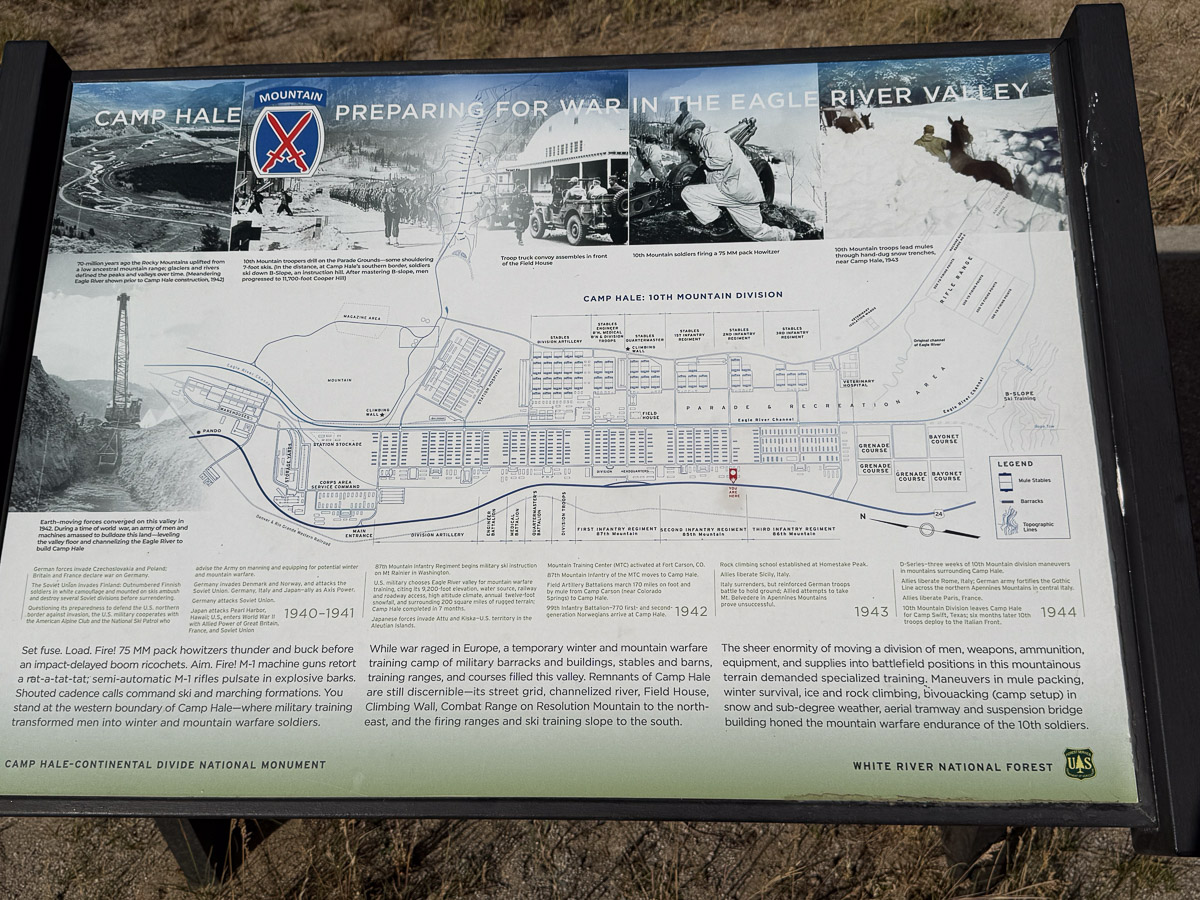
Sign about Camp Hale that shows the footprint of all the buildings that used to be there.

There were several signs to explain and point out the remnants of Camp Hale. It is hard to imagine 15000 soldiers and 5000 pack mules and horses in this valley. We read the signs and pondered the impact of this Camp. Then it was time to move on.

Highway winding through mountains on either side.

We drove through some beautiful scenery, eventually making it to Green River, Utah where we spent the night.

November Adventure – Joshua Tree NP on Day 2

I’m interrupting the Pasture and Irrigation Renovation posts (#9 of that series) of the last few weeks because we had an adventure before the project was completed.

Two Road and Recreation Atlas books on my lap. One says Arizona and one says California.

Chris was to compete in the Tempe (AZ) Ironman on Sunday. Dan had gone to Idaho for a visit and to pick up Chris’ bicycle so he wouldn’t have to ship it. We left November 14 (Thursday) with the plan to camp part way and get to Tempe mid-day on Friday.
Sign that says Entering Joshua Tree National Park with blue sky behind.

I took this photo when leaving the park on Friday, because by the time we got to Joshua Tree NP it was dark and I did not take a photo at the west entrance. I did not take any photos that evening. We set up the tent and ate bagels and cheese for dinner. This trip was not intended to be a real camping trip. We just needed a place to stay on the way to Arizona and it seemed that it would be fun to have short National Park experience. When we got there we realized that we hadn’t even brought any water, other than the water bottles we’d already emptied. I have learned that I am not a winter camper. The last (and maybe only other) time I have camped in the winter was at Big Bend National Park in 2017. I know that because I just looked for the blog post and found it. I have the same sentiment now that I did then–you get to a campsite in the dark and it’s not bedtime but you have to get in a sleeping bag to be warm.

Brown tent in campsite with rocks behind. Sunrise glowing in the background.

I think we got in sleeping bags about 6 p.m. I read awhile and eventually fell asleep. I woke up at midnight and the wind was howling and the rain fly was slapping the tent. Dan told me the next day that he wondered if he left the tent in the middle of the night if it would blow away with me in it! I read until I finished a book about 3 a.m. and then slept. I woke up early and thought I’d be better off moving than lying in the sleeping bag for longer. I thought I might find some sun since it was starting to come up.

I found a marked trail not too far from the campground.

I didn’t see any bighorns, but I liked the sign.

Dawn in the desert.

Bird nest surrounded by cactus spines.

This seems like a prickly place for a bird nest, but maybe it’s protected that way.

Remnants of adobe house. It's just parts of walls standing now.

We were staying at the Ryan campground, named for the Ryan family who settled this area in 1896. It’s hard to imagine that 60 people lived here and worked in at the ranch and mine until 1908. This is one of the buildings built of adobe bricks. There are other remnants of the ranch as well.

Desert landscape with mountain in the background.

You can see this structure centered the right of this photo. Those two large rock features are part of the campground and our tent was behind the one on the right.

Old windmill blades on the desert sand with dry grass in the middle. Mountains with sunlight in the distance.

Part of a toppled windmill. At this time the sun had reached the hills across the valley but there was not sun where I was.

Trail through desert with sunrise behind the hills.

I continued my walk until sun appeared over the hill and from behind clouds and I could stand in a sunny spot for awhile.

Tent and picnic table with ice chest and food box.

The tent was still in the shade when I got back. Dan had emerged, but maybe you can tell that he was cold. We didn’t linger there, but packed up and headed for Arizona. We did spend some time in the park, stopping to read signs and take in the sights.

Landscape with rocky points in the foreground and the Coachella Valley below.

This is a view over the Coachella Valley with Santa Rosa Mountains in the background and the San Andreas fault at the eastern edge of the valley.

Cholla cactus in the foreground, hills and blue sky in the background.

We stopped at the “Cholla Garden”, a location along the road filled with cholla cactus.

Close up of cholla cactus, spiny with remnants of yellow flowers.
Dan walking on trail with cholla cactus filling the landscape.

This is a fascinating landscape, and I’m glad it’s preserved by the National Park system.

Sign explaining differenced in Mojave and Colorado deserts.

Another sign tells that Joshua Trees live only in the Mojave Desert and that is in the northern section of the Park. The Mojave and Colorado Deserts overlap in the park and the vegetation in each is different.

Convergence 2024 in Kansas – Day 1

When I Google “convergence” I find “an annual convention for fans of Science Fiction and Fantasy”, “a global network for blended finance”, and more, If you’re a weaver you probably know of Convergence as a gathering held every other year by the Handweavers Guild of America. This year it’s in Wichita, Kansas. It was a year ago that I applied to teach here and two of my proposed classes were accepted. I ended up teaching only one because too few people signed up for the other.

I flew to Wichita on Wednesday.

The conference is at the Hyatt Regency and the adjoining Convention Center. I spent the afternoon setting up my classroom for the next day’s workshop. Then I explored the nearby area.

Screenshot

I took a screenshot of the app I have on the phone to record workouts–although I don’t call this a workout. It’s a walk. There are paved paths along each side of the Arkansas River with plenty to see on both sides.

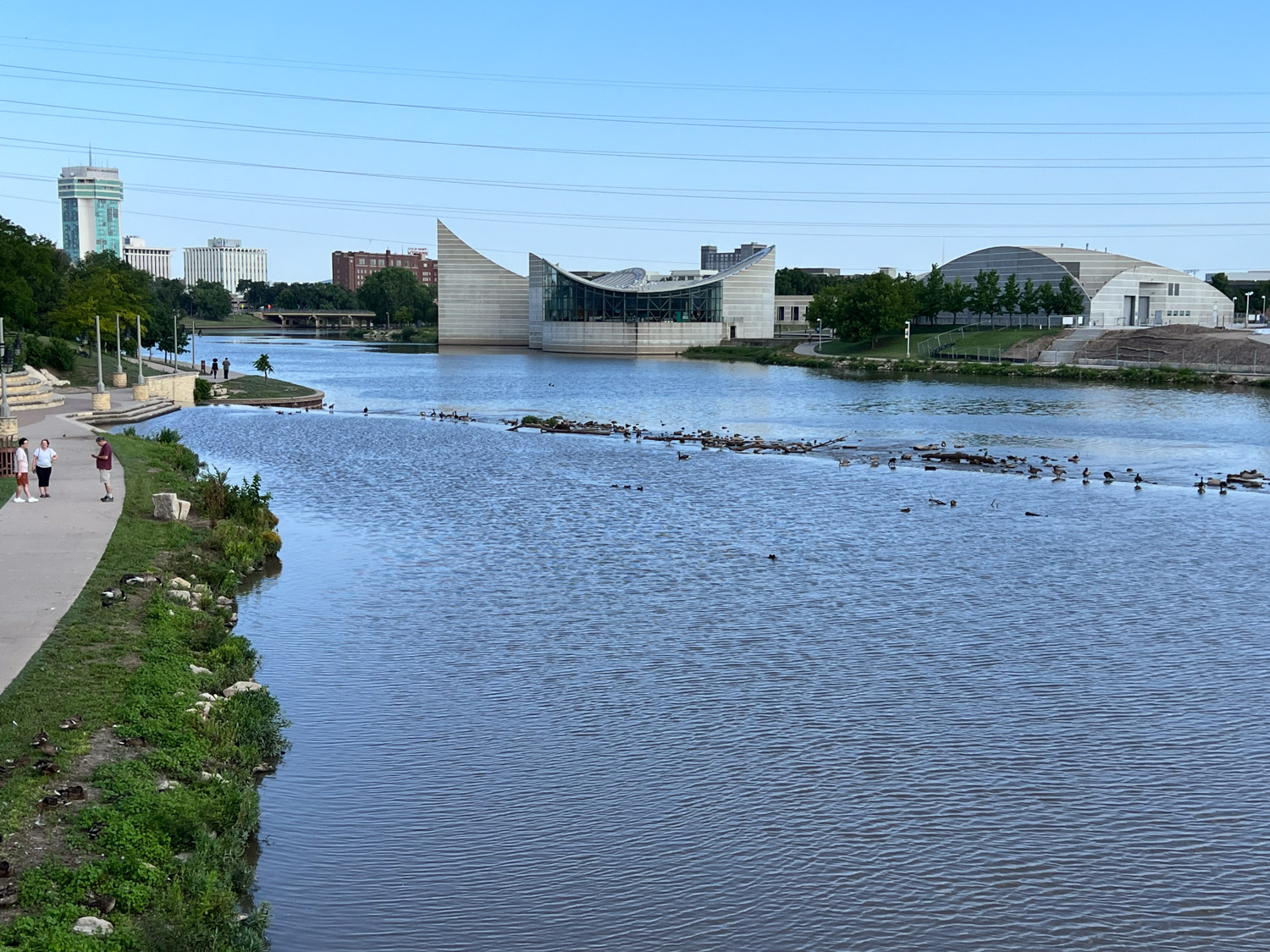
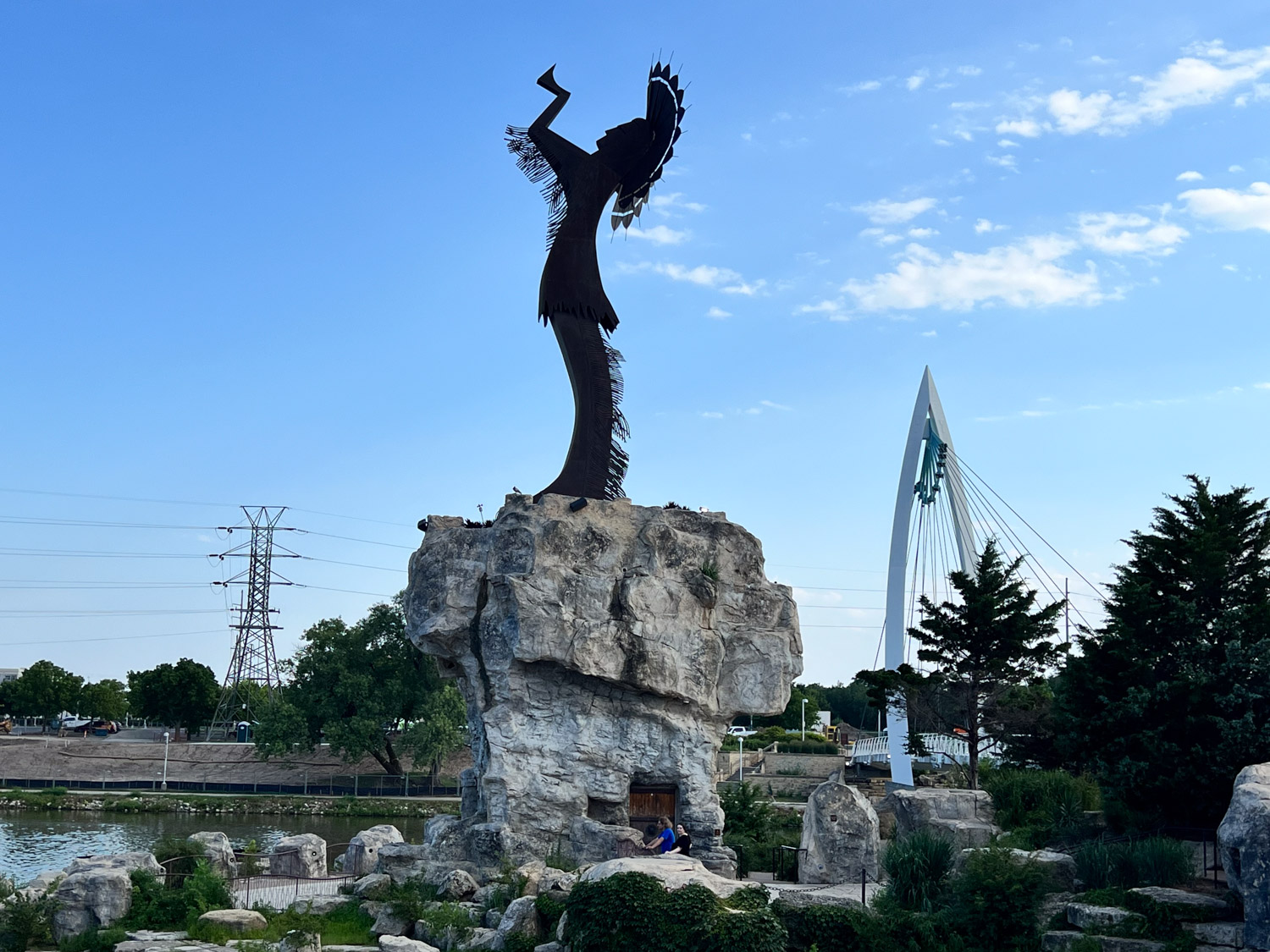
This unusual building is the Exploration Place. In the distance you can see a pedestrian bridge and the 44-foot tall Keeper of the Plains statue that rises on a rock promontory. It is at the confluence of the Arkansas and the Little Arkansas Rivers, as seen on the map above.

This monument is just off the path and is one of many in the adjoining Veterans Memorial Park

Exploration Place seen from the north.

Keeper of the Plains. The statue was erected in 1974 and was raised on a 30-foot promontory in 2006 so that it could be seen from farther away. In the adjoining plaza there are displays that describe the local tribes that used to inhabit the area. There is also a ring of fire pits that are lit nightly for 15 minutes.

As I walked back on the other side of the river I had another view of the Exploration Place. Right now the website advertises two nights of Superhero Sleepover (“Bam, Pow, Snooze”). This looks like a great place to visit with kids…probably adults too. I took this photo partly for my own kids who I think would be interested in or amused by the helicopter, the giant open mouth and the green object on the left. You probably can’t tell in the photo here but I could see from where I stood that it says Fart Chair. The building is large and I’m sure holds a full day’s worth of interesting activities.

This is a view of the Hyatt from the bridge where I crossed back over the river. Home for the next four days.