Who’ll Stop the Rain?

Can you tell that I just watched a Creedence Clearwater Revival documentary (and I’m of an age to have that phrase pop into my mind)? Did you know that the CCR members got together in junior high?

But I digress. This was to be a post that follows up on the Pasture and Irrigation Renovation posts because it’s about the pasture….and rain. After NO rain in January the first few days of February were wet. We had almost 5″, with close to 2″ in one day. That doesn’t sound like a lot to people in many parts of the country but it’s a lot for our flat property. That is 1/5 of our annual 24″ in five days.

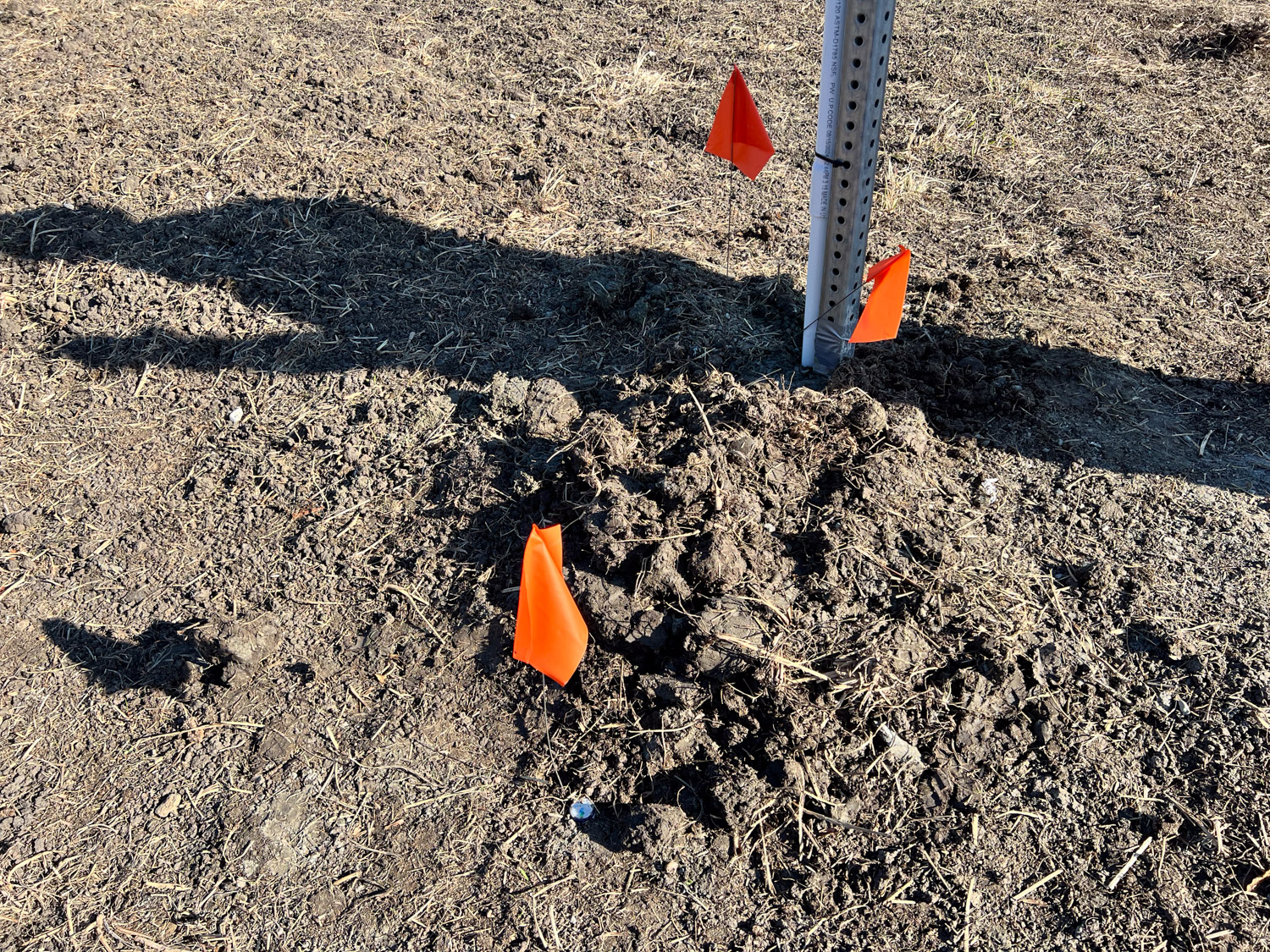
This was before the last inch of rain fell. There was a break in the rain and I walked to the south end of the property. That post with the orange flags holds one of the soil moisture sensor I mentioned in the last post.

This is the other sensor. We are not happy about the lines in the field that have become ditches. We needed to disc and seed the fields before the heavy rain in November, which was finished hours before that storm (blog post). However the irrigation pipeline work was not completely finished. That involved more traffic back and forth in the field and we have truck tracks to deal with.
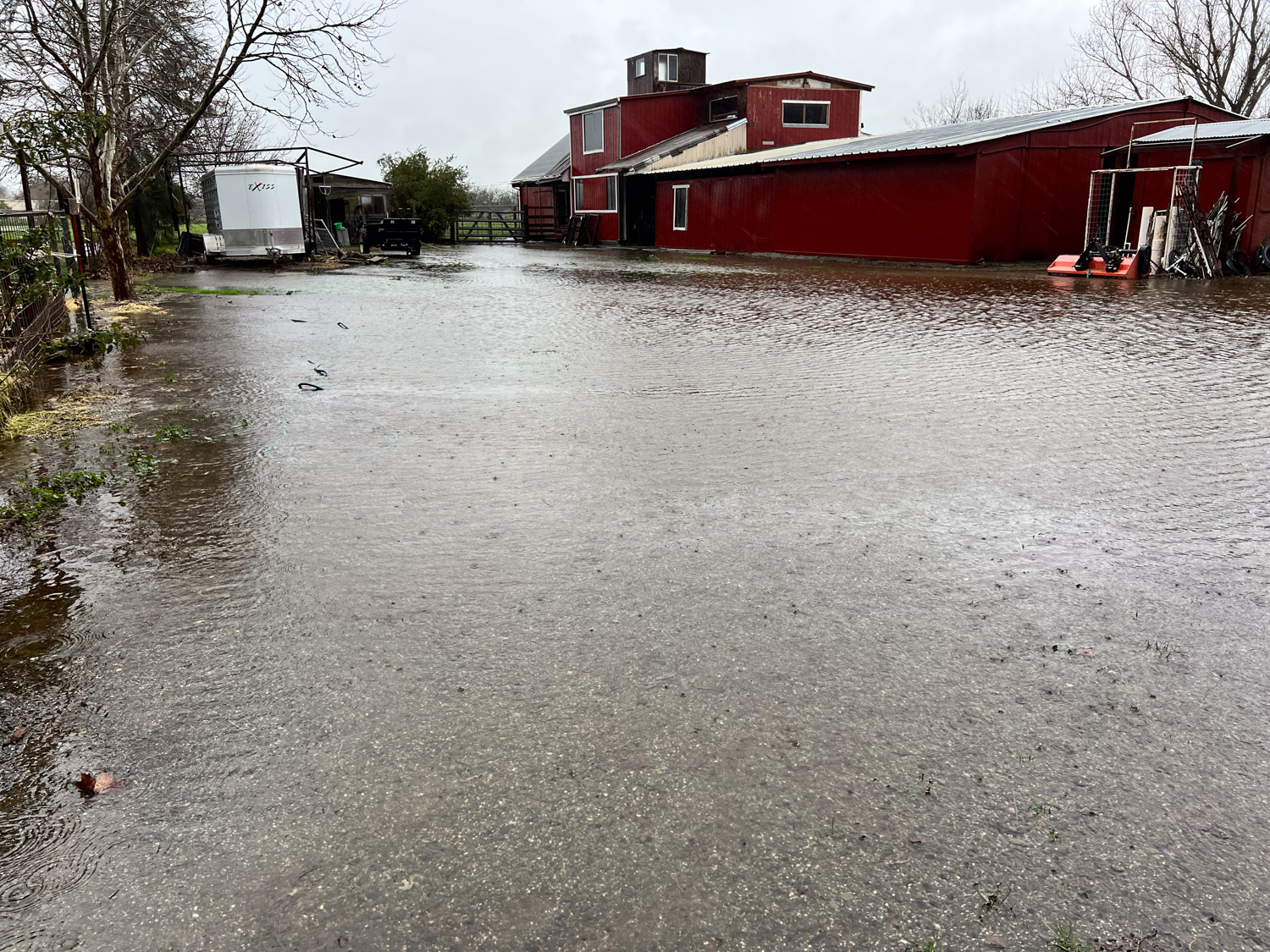
Back to the barn. For those of you who have been here, you know that this is where we walk to the barn from the house. It doesn’t take much rain (well, 2″ on top of 3″ the previous days) to look like this. Thankfully our barn stays dry inside…so far.
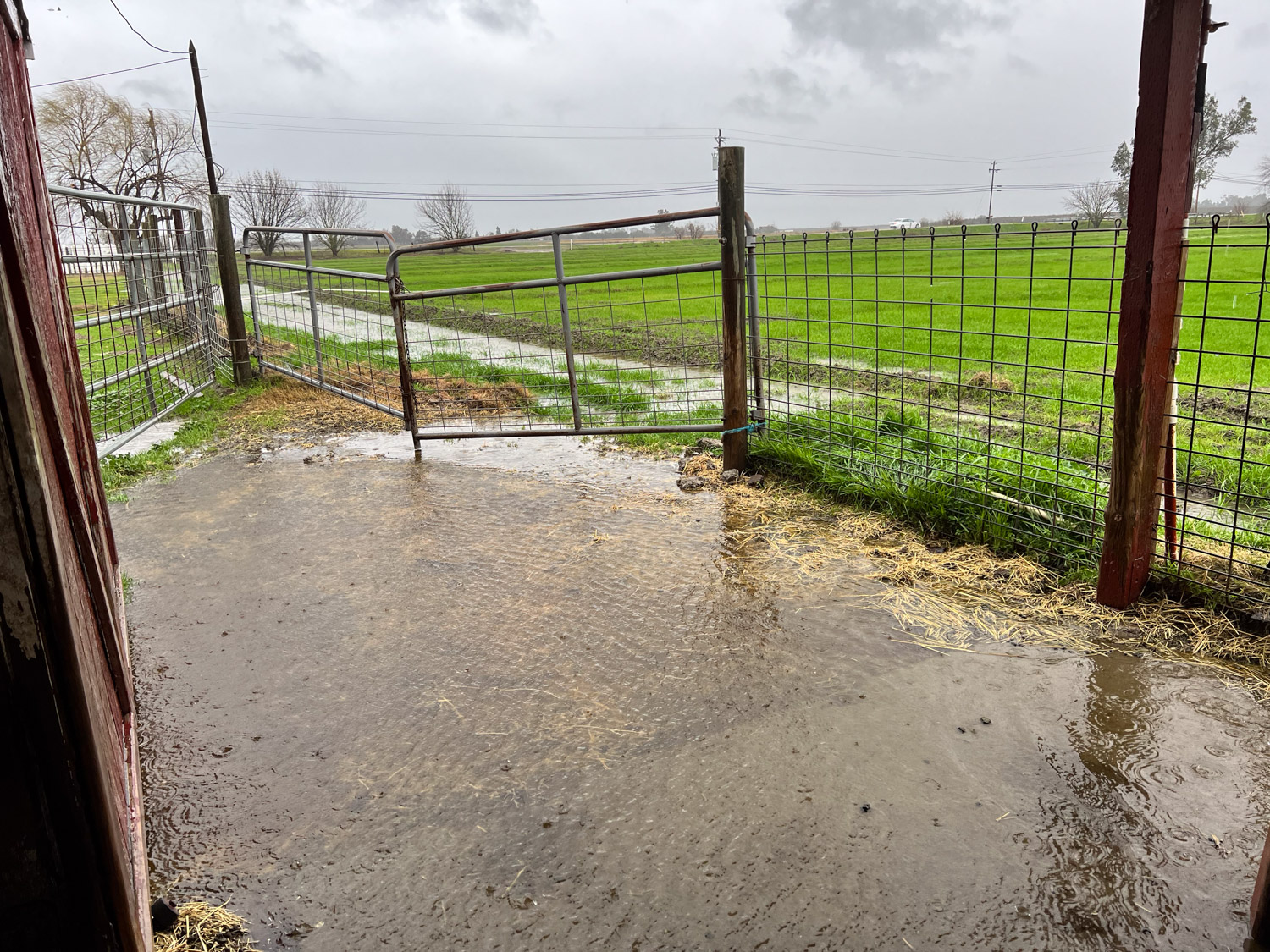
Looking south from the barn door. Normally I’d be digging a ditch to drain the water from here to the irrigation ditch. But we don’t have an irrigation ditch anymore. We have a pipeline which will hopefully make life so much easier and more efficient in the summer.
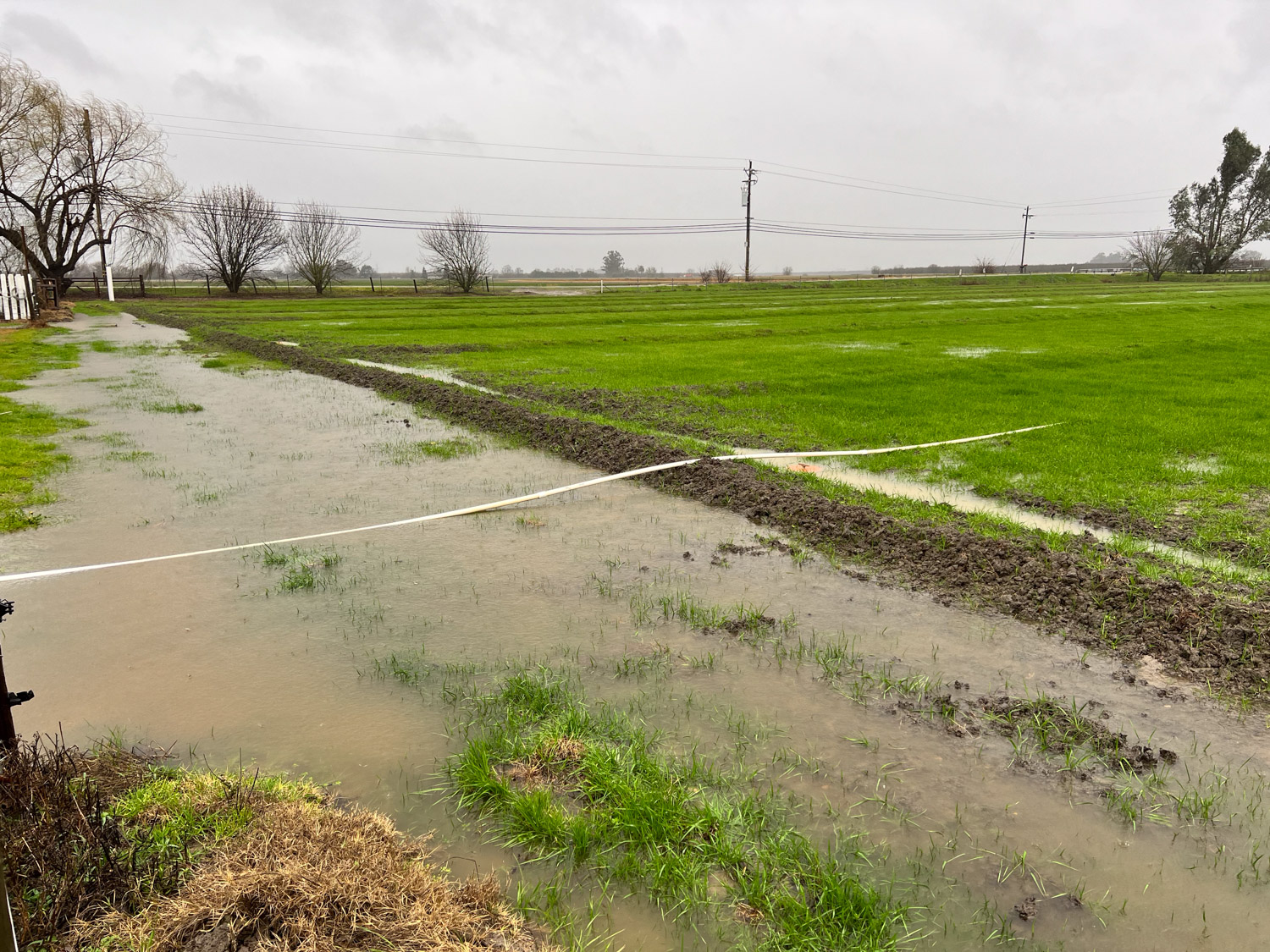
What looks like a ditch in the foreground is where the old ditch was. Now there is a buried pipeline on the other side of that row of dirt. All of this is still settling so we don’t know what it will look like eventually. The water drains off our property from the southeast corner (near the tree in the top right corner of the photo). Dan set up a pump to take the water from the near the barn through an old pipe and over that row of dirt into the field. It seemed to work OK.
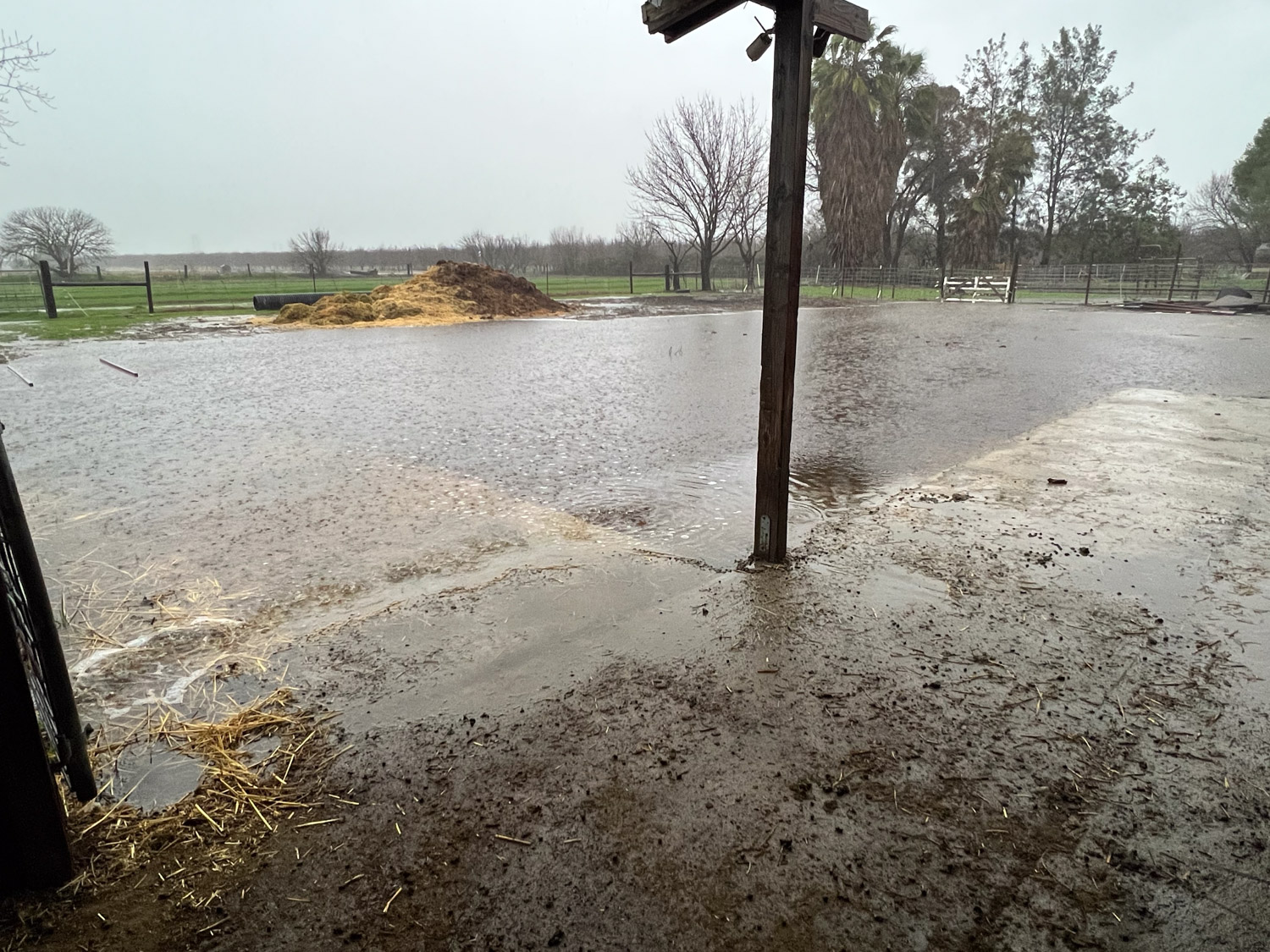
This is the view behind the barn.
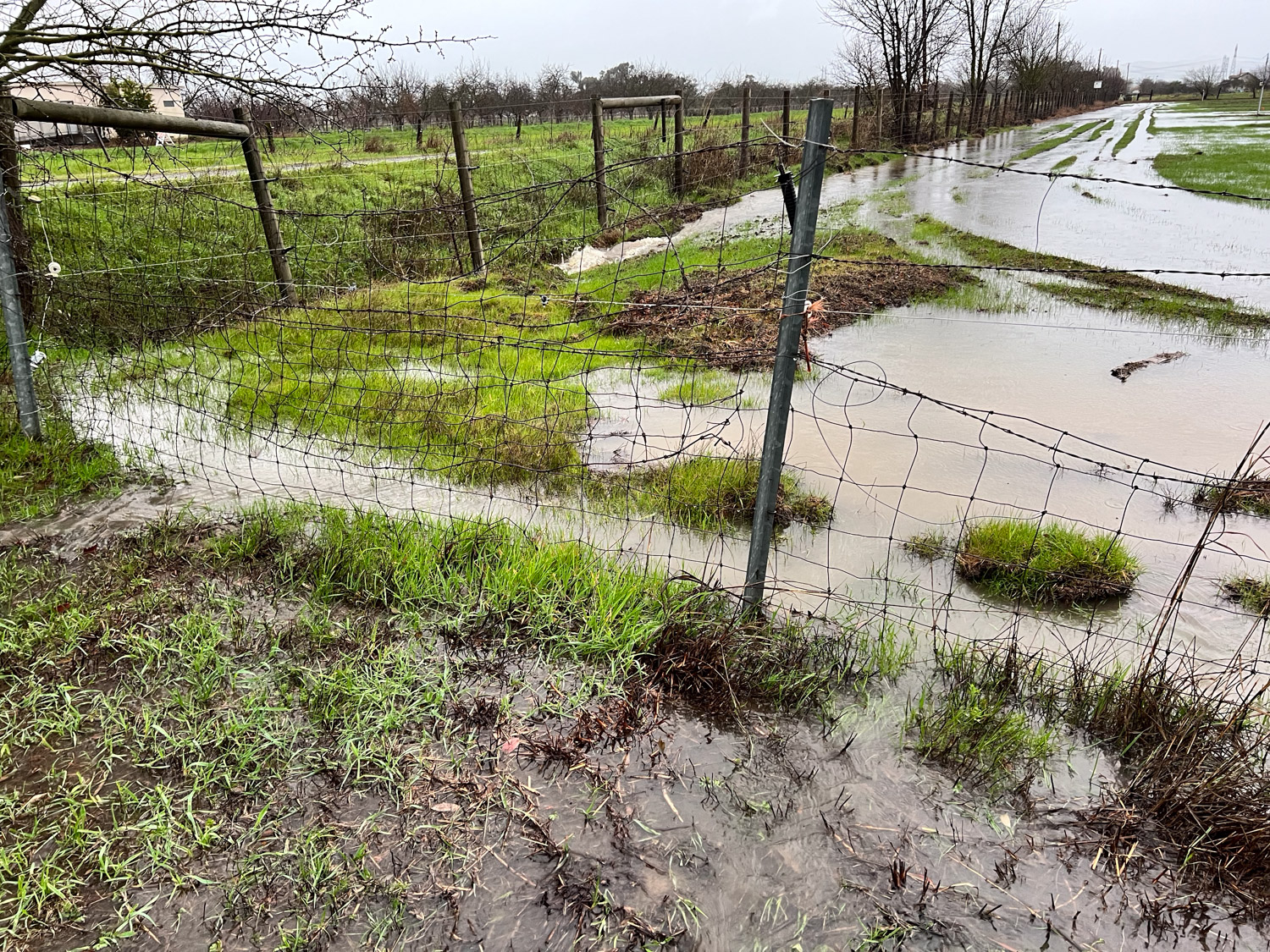
Later in the afternoon I walked back to the southeast corner and brought a shovel. Like I’m going to drain this with a shovel. There is a ditch that is between the fence and the road with a culvert that takes water into the canal, and water was starting to flow under the fence here. The problem to deal with eventually is that the water flowing along the south fence line erodes the soil there as it goes under that fence into another culvert, and eventually those posts will go.
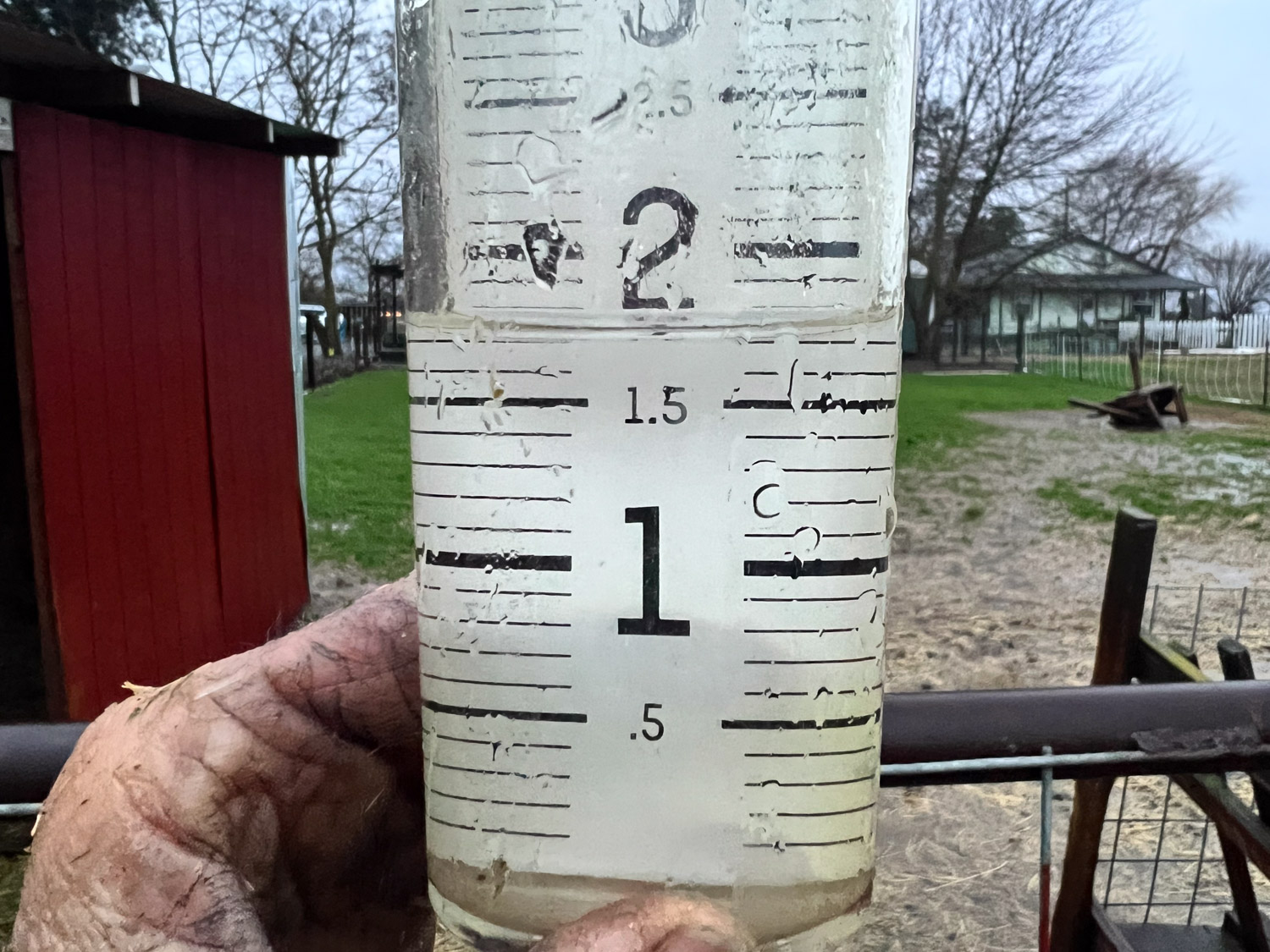
Wednesday’s total.

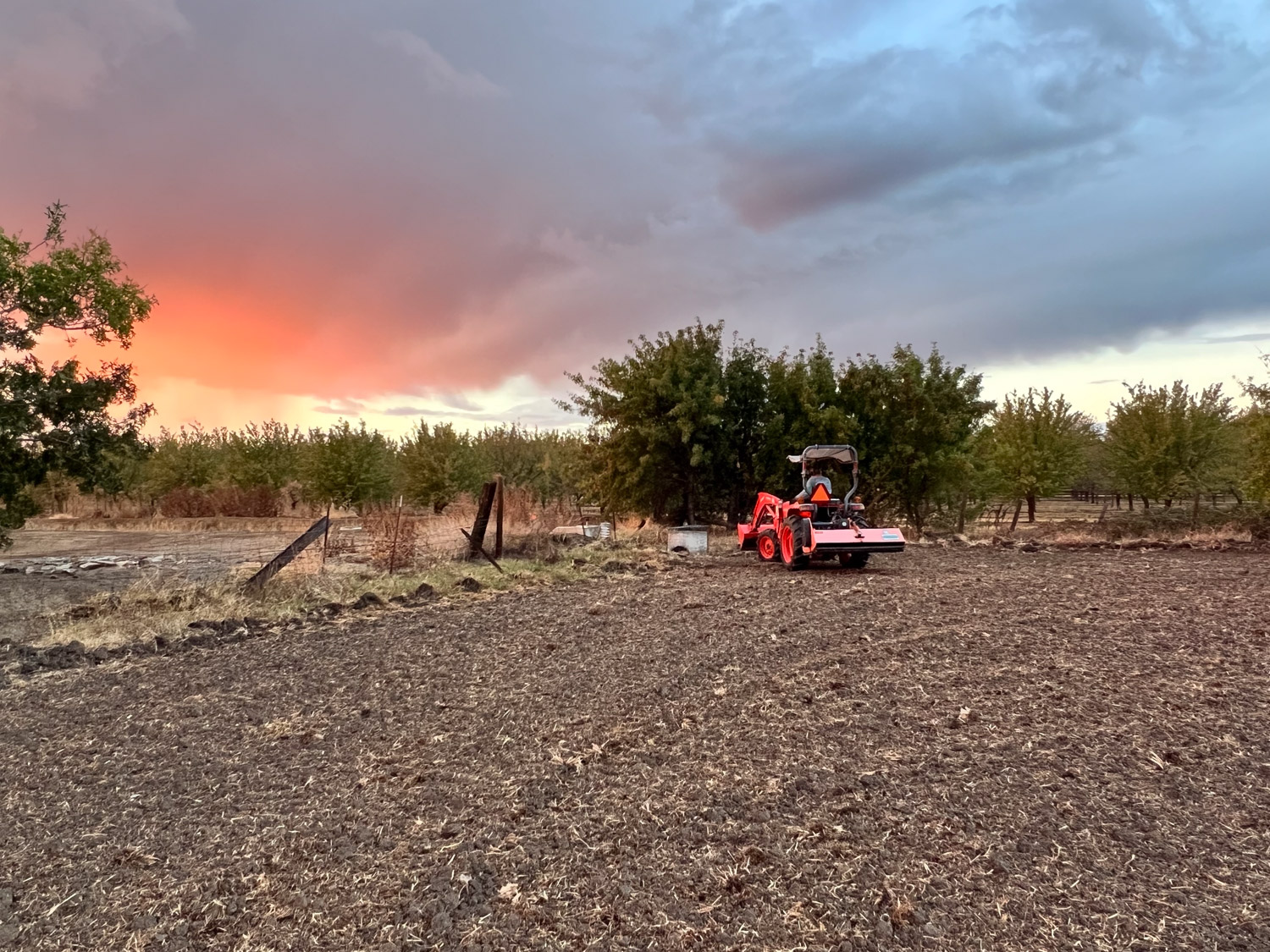
Yesterday was dry and sunny. Today it started raining again and that’s why the title of this post came to me.

Pasture and Irrigation Renovation – Part 14

The last time I wrote about this project was over six weeks ago in December.

About two weeks ago one of the NRCS representatives came to check on the progress of the pasture seeding. Not a great photo, but he is putting down a grid to aid in evaluating plant growth.

This is what it looks like and I should have asked more about it. I didn’t see him mark where he put it or count plants. We were talking about generalities in the pasture, but now I’m going to ask. Did you know that my degree from UC Davis is in Range and Wildlands Science? So I recognize this for what it is–a tool for analysis of plant germination and growth–but we didn’t talk about it.

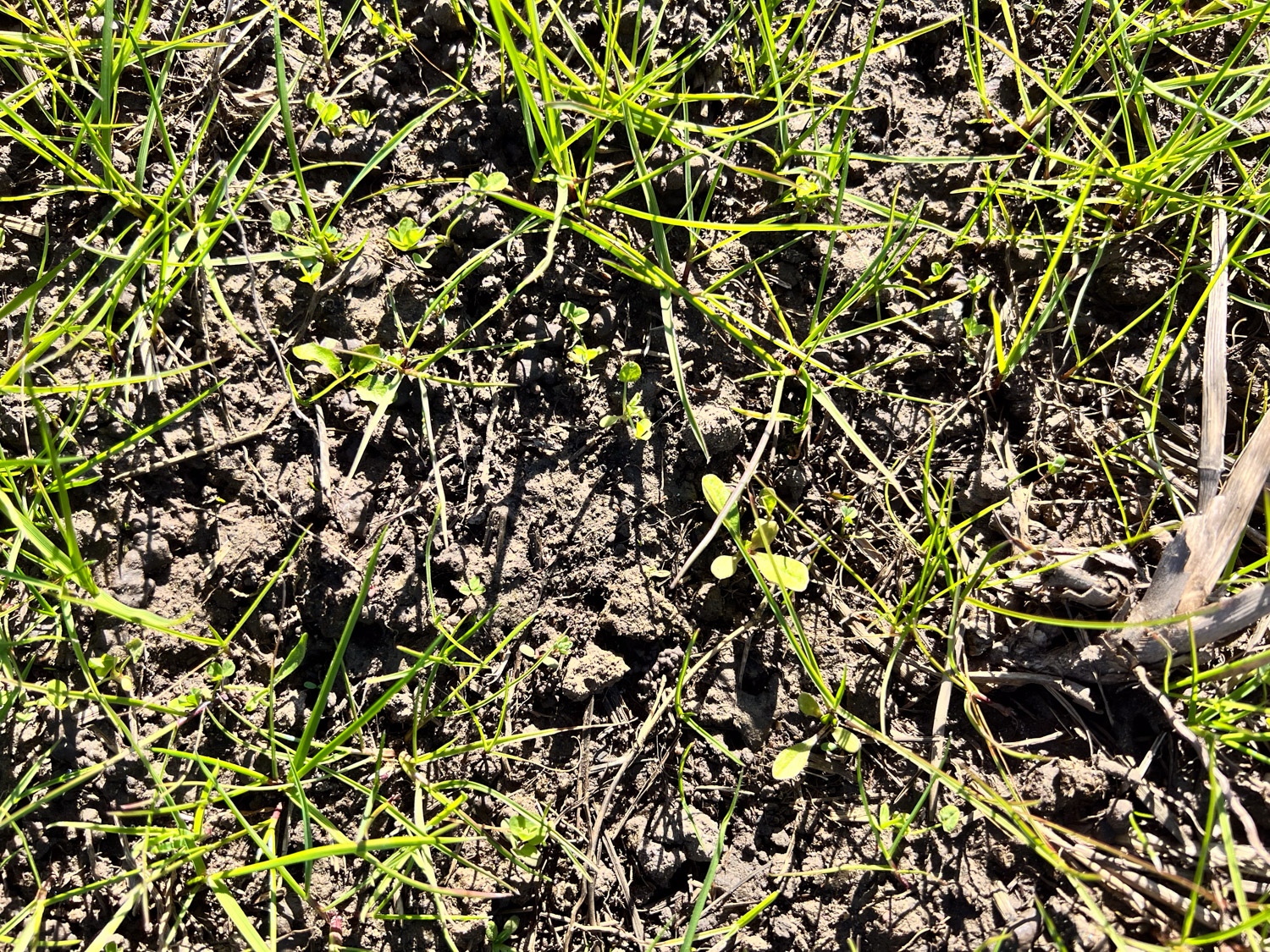
Do you see how hard it is to evaluate growth when you look across the field and not straight down? Compare the first photo to the next two. In the second photo close up photo it shows grasses and forbs. There were three of each in the seed mix. We identified clover and chicory, but I don’t see trefoil yet. I can’t identify the grasses.

This is the field west of the barn. The grass growth is thicker here, at least in that small area.

This is a photo taken from the same spot as the last one, but looking north. This is the check where there was traffic from the people working on the irrigation system. We’re thinking that it probably needs discing again.

Last week we met with a representative from the company that makes the soil moisture sensors that were installed. He showed us how to see the info generated by the two sensors and we talked about how we’ll use that. They are sensors are at the south end of the field, one near the west edge and one in the center, still in line-of-sight with the sensor in the northwest corner.

The flag in the foreground marks where the sensor is at this station.

This is what it looks like inside the box.

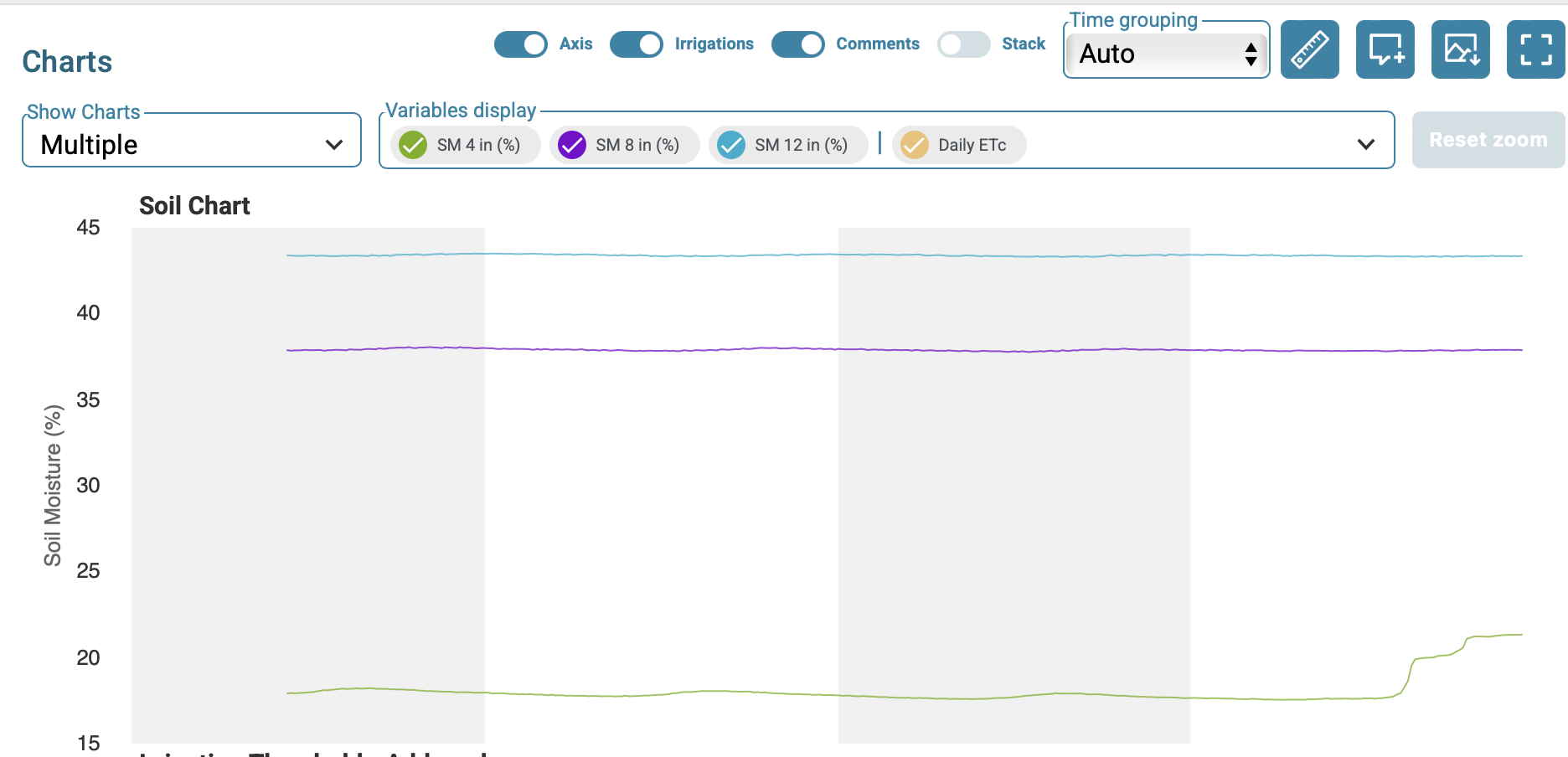
We haven’t had rain for a month and there have been north winds that make things dry out even more. We were getting worried about this new pasture. Those little seedlings need moisture in their root zone to stay alive. This is a screenshot of what the sensor shows for one station. The gray and white columns each indicate a day. The horizontal green line is 4″ depth, purple is 8″, and blue is 12″. You can tell that today’s 1/4″ rain just started to soak in.

Here is what the other sensor shows. The scale on the left axis is different. This 4″ level had more moisture to begin with than the other two. We will be learning how to use this info. There is a lot more available. I just copied this portion for now. This will sure be interesting to follow.

Who is Going to Lamb and When? Ultrasounds

For the last few years I’ve asked the UC Davis vets to come here and do ultrasounds. It is certainly useful to know ahead of time the ewes that are not pregnant and, hopefully, the number of lambs to expect from those that are.

I told the Dr. Smith the dates the ewes were with rams and December 20 was chosen as the optimal time for ultrasounds. (Never mind that a few ewes went in with the new ram, Eli, right at Thanksgiving. This ultrasound date was scheduled before Eli came here. It won’t be hard when the time comes to know if those few ewes will lamb.

I purposely did not breed as many ewes this year because of the limited space with our pasture being off limits for most, if not all, of the next grazing season. If you read this blog regularly then you know about the Pasture and Irrigation Renovation going on. Look back over the last few months for those blog posts.

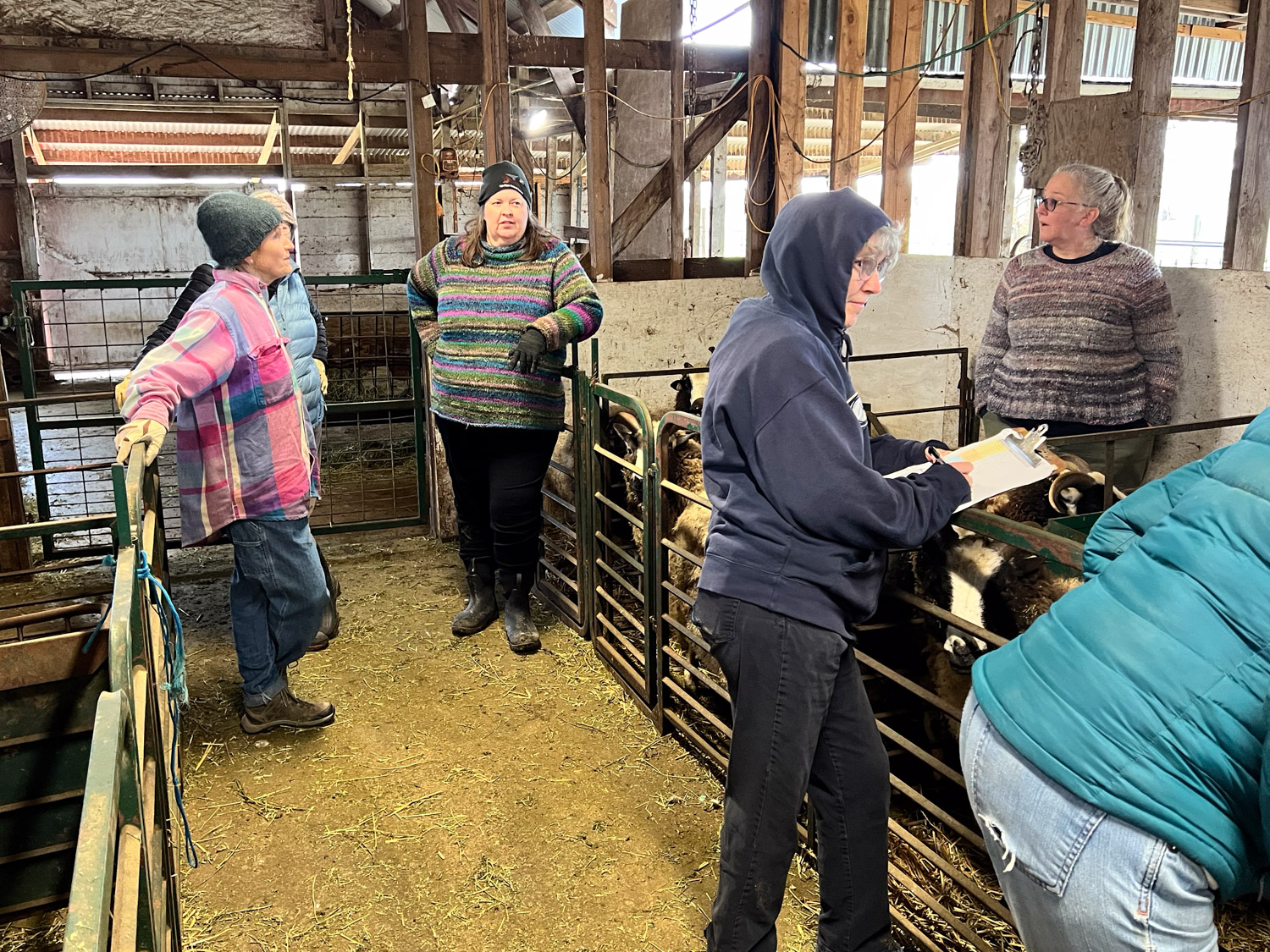
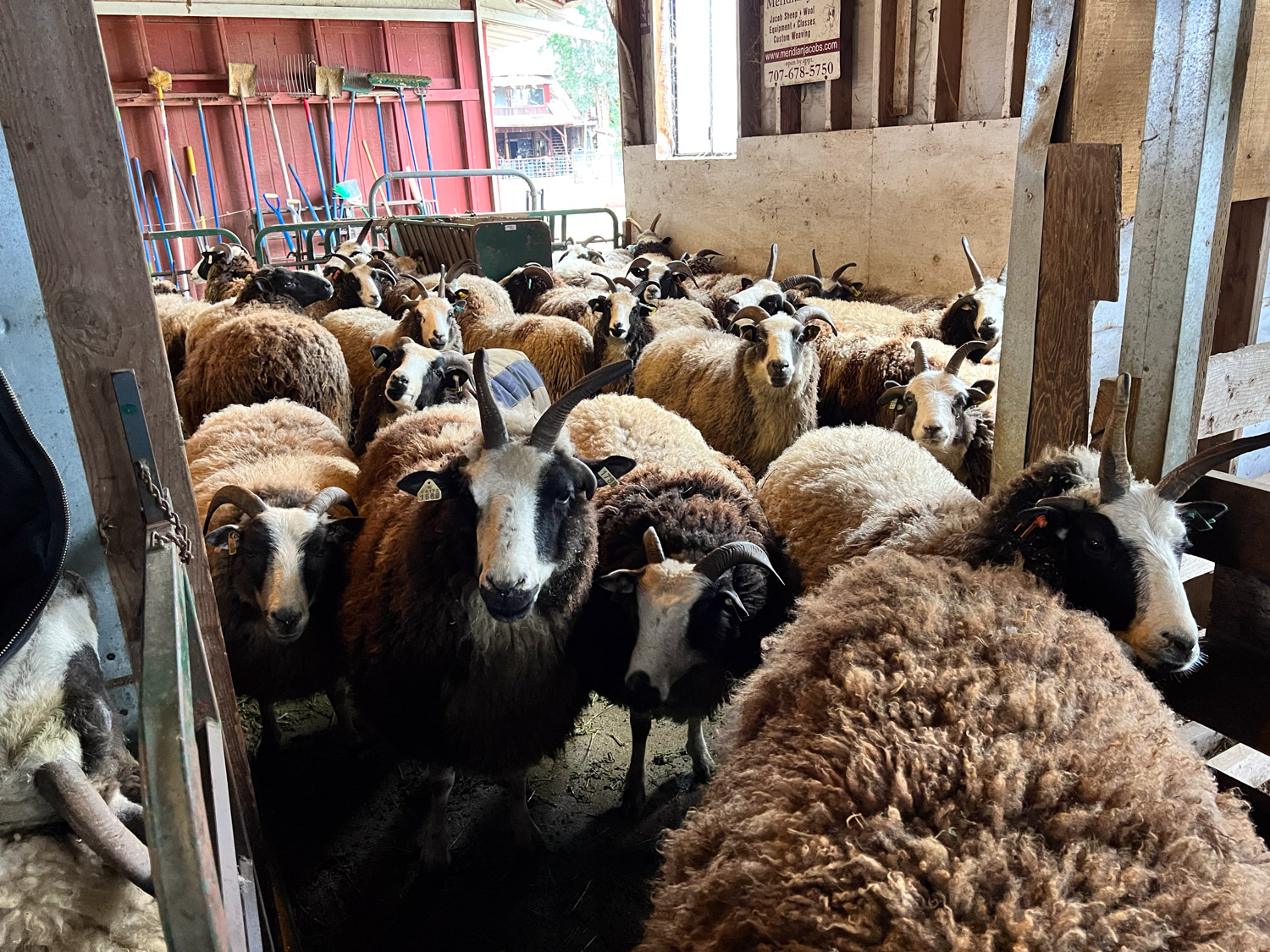
Farm Club members came and, since I was otherwise preoccupied with an overlapping visit by my son and DIL and Matt’s offer to help me with some loom/computer issues, they did all the work of getting the sheep organized and in pens, ready for the vets.

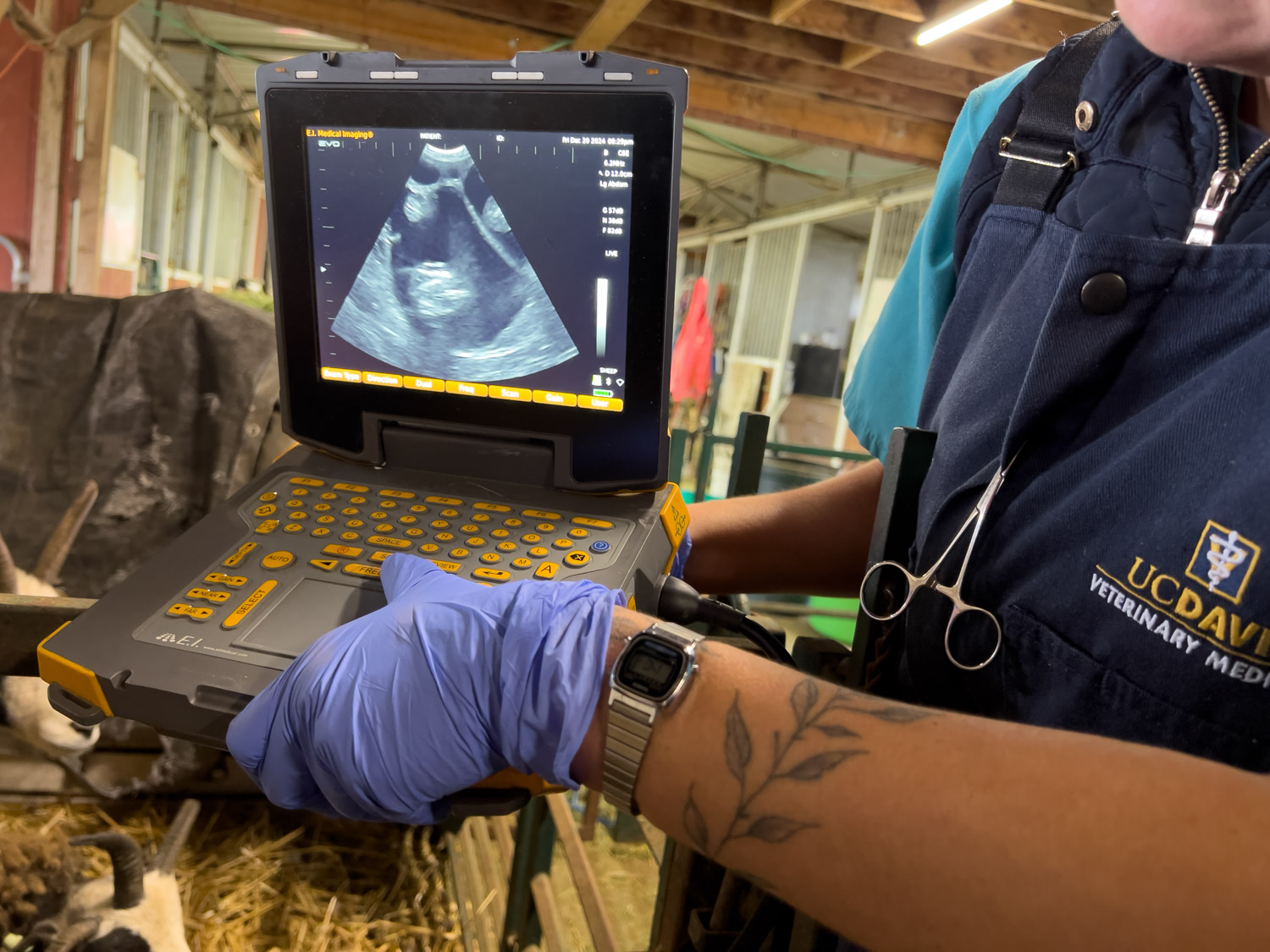
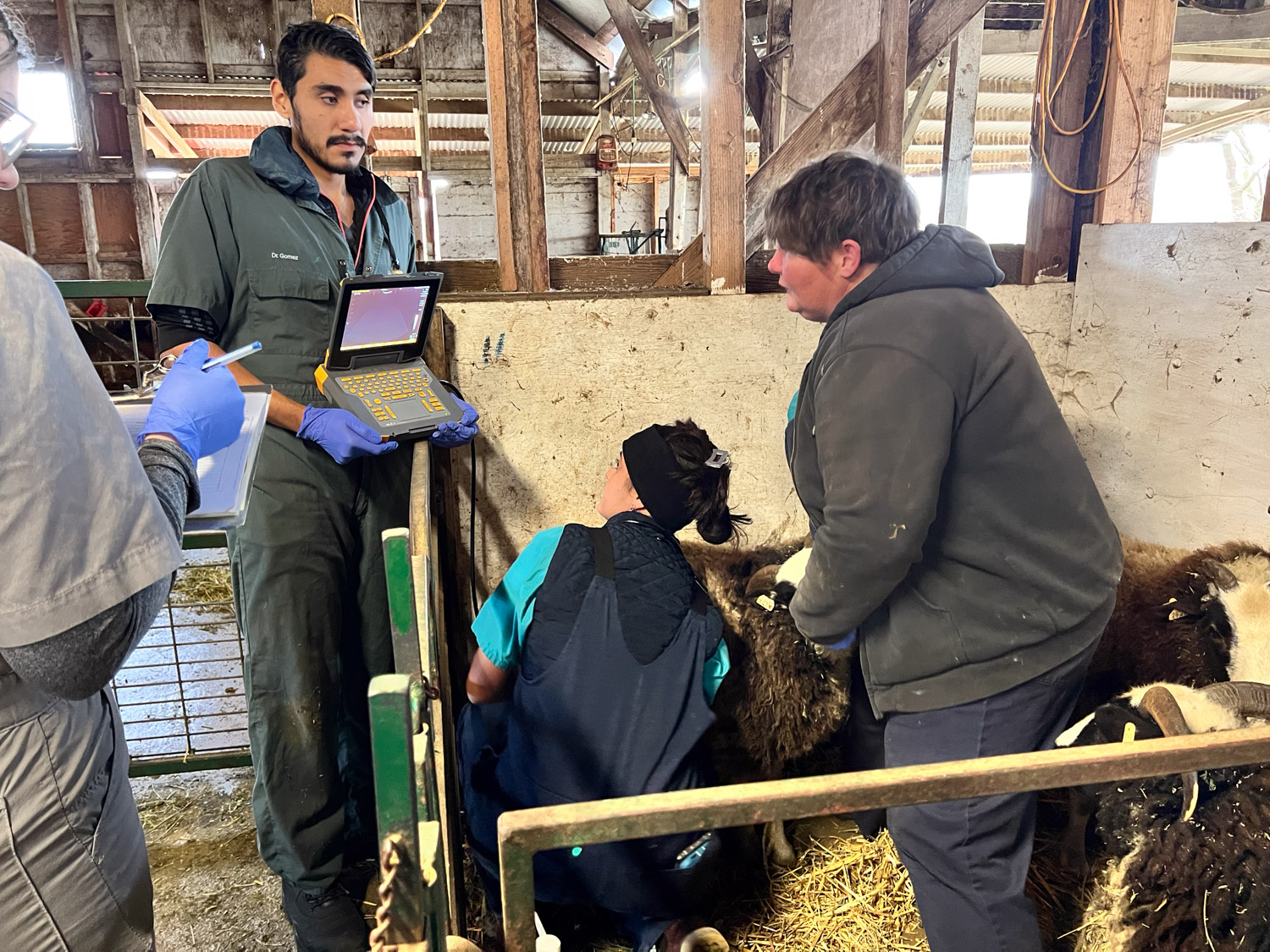
There were four from UC Davis. I lose track of the titles, but I think one person was an intern and/or student and maybe a couple were in residency. They took turns doing the scans and reading the results, with Dr. Smith overseeing it all.

Don’t ask me what we’re seeing. I’m good when I see a ribcage go by as they move the probe around, but I have a hard time with the rest of it unless it’s pointed out. They judge size of the lamb’s head and, therefore, its gestational age. Amount of fluid and relative position of the lambs are other factors they consider.

The next group of ewes waiting.

Trading places in scanning.

Meanwhile, one reason Matt came was to climb the weeping willow and cut a couple of large branches that had broken during the summer. FIY, he is using safety gear to prevent falling in case of slips.

It’s amazing how quickly this tree has grown. Matt cut the problem branches, but then cleaned out a lot more where it overhangs the pasture and the fence.

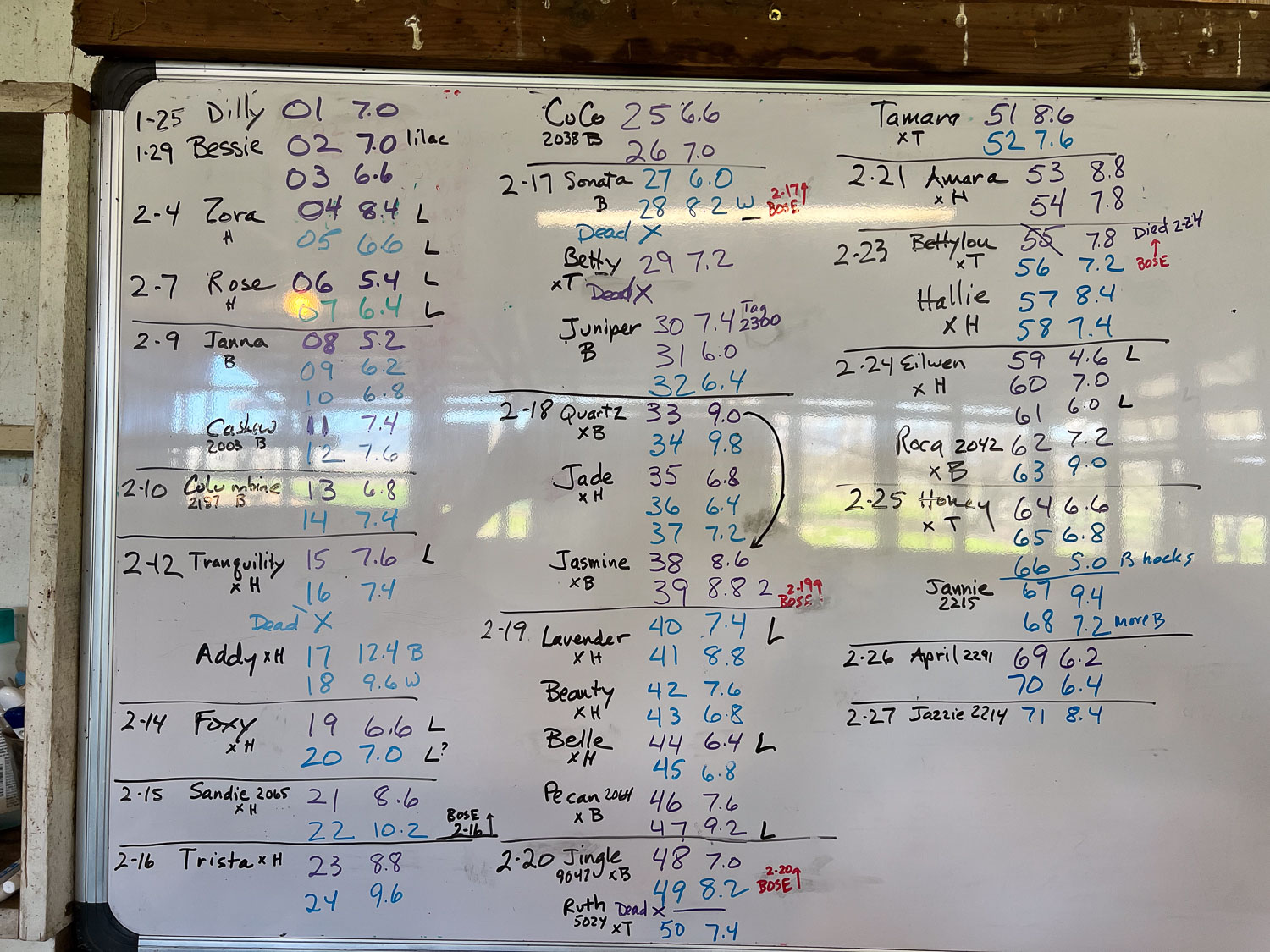
Back at the barn they are still scanning, but we could used last year’s lambing list on the white board (to be erased at the beginning of the next lambing) to pick out which ewes had triplets last year.

Here are the stats:
Fetuses counted: 51
Sets of triplets: 2
Sets of twins: 17
Singles: 5
Sets of 2+ (twins, but not ruling out a 3rd): 3
Ewes pregnant: 27
Ewes open who were with a ram: 3
Ewes maybe pregnant, bred late by Eli: 4
Ewes not with.a ram: 7
Ewe lambs not bred: 8

Stay tuned for March 9, the first due date based on when I put rams in with ewes.

Pasture and irrigation Renovation – Part 6

The last post ended with land leveling on October 18. Pipe and other supplies had been delivered October 16 but we had to wait for Brett’s work to be finished before starting anything else. The next two parts of this project were to install the irrigation system (Hunter from the irrigation company) and to create borders and seed the pasture (Michael with the field equipment). Initially we thought the pipeline work would be next and we would finish with the rest of the field work. Michael talked to Hunter about the best order of operation here. We were getting worried about weather. It was important to get this work done before there was too much rain that would stall the work. Also both of them have other much bigger jobs that they are trying to finish while the weather holds. I left it to them to work out the best way to accomplish this. Hunter and Michael went to school about the same time, along with my son, Chris. (In fact, Hunter and Chris were on the same rugby team for a season, and Michael’s mom and I carpooled at times to get the kids to school.)

Michael brought a tractor over on October 24. He and Dan and I had walked the field and determined that part of the field could use another discing. That is where the concrete had been. When leveling, that area seemed to have been scraped but left a surface that wasn’t as good for creating the borders and seeding.

Michael had one of his employees disc that portion of the field to help loosen it up.

The next day Dan and I picked up more chunks of concrete that had surfaced. Over the last couple of weeks we had picked up a lot of this that was scattered throughout the field.

Before Hunter could do the first part of the irrigation work Dan had to remove the fence in the northwest corner of the property.

This is the view from the field to the northwest.

The view from outside the field looking to the east. This is part of the SID (Solano Irrigation District) system. There is a metal gate at the bottom of that concrete structure that lets the water into our ditch which is now all filled in and leveled. It will be replace with a pipeline. Dan removed the fence and old posts and other debris from this corner.

To be continued.

Pasture and Irrigation Renovation – Part 2

A few weeks ago I wrote Part 1 of Pasture and Irrigation Renovation. I ended that post with the sheep coming in from the pasture for the last time and a lot of heavy equipment in their place. A lot went on for a couple of weeks and then there was a lull. I have to go back and find the photos I took at each step.

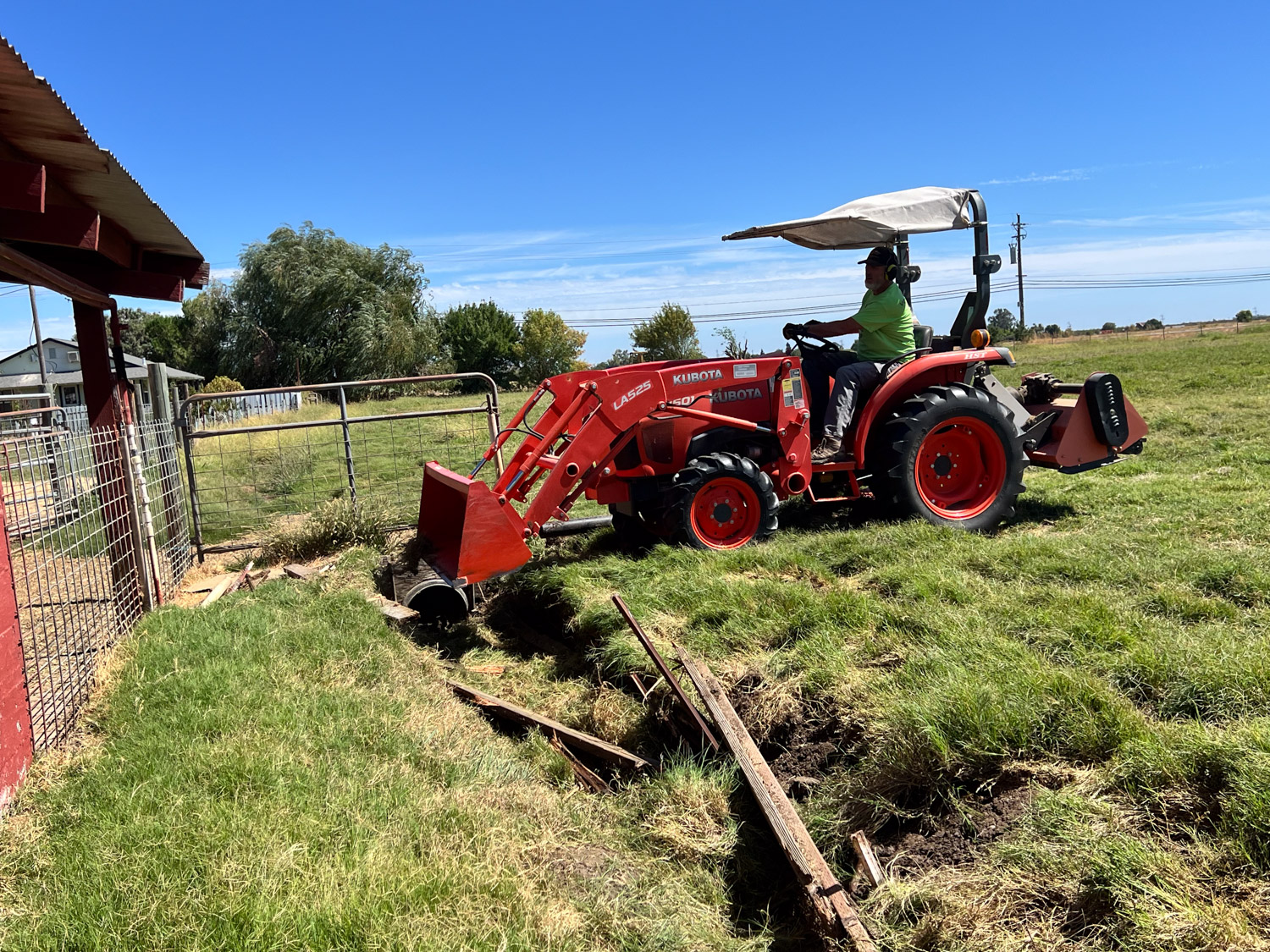
There was still more work for us (Dan) to do. Here he is removing the wood and stakes we had used to make the ditch more functional near the barn and taking out the culvert.

Before work began we were asked to hold a meeting with the contractors where we could all listen to a representative of the tribal people who used to live in the area. He showed photos of the cultural items that one might find when soil is disturbed and talked about procedures if something was found.

The first job was to remove the old cement foundation that ran north to south over 3/4 of our property. We suspect it was the floor of an old barn–I don’t know what else it would have been. That would have been a big barn and maybe someday I’ll be able to talk to a local history buff who knows what this was. It doesn’t really matter–it’s just that we have always had to work around it. Part of it was broken apart to put the original irrigation ditch through and, even though grass will grow on top in the winter, it dries out in summer and the desirable pasture plants don’t grow there. NRCS calls this job “obstruction removal”.

Brett is the contractor with the heavy equipment. He first scraped the layer of dirt and grass off the top of the cement. Most of the concrete was only 2″ to 3″ inches thick and a lot of it broke into smaller crumbly pieces . The borders were a lot larger however.

Brett used the excavator to scoop up chunks of broken concrete.

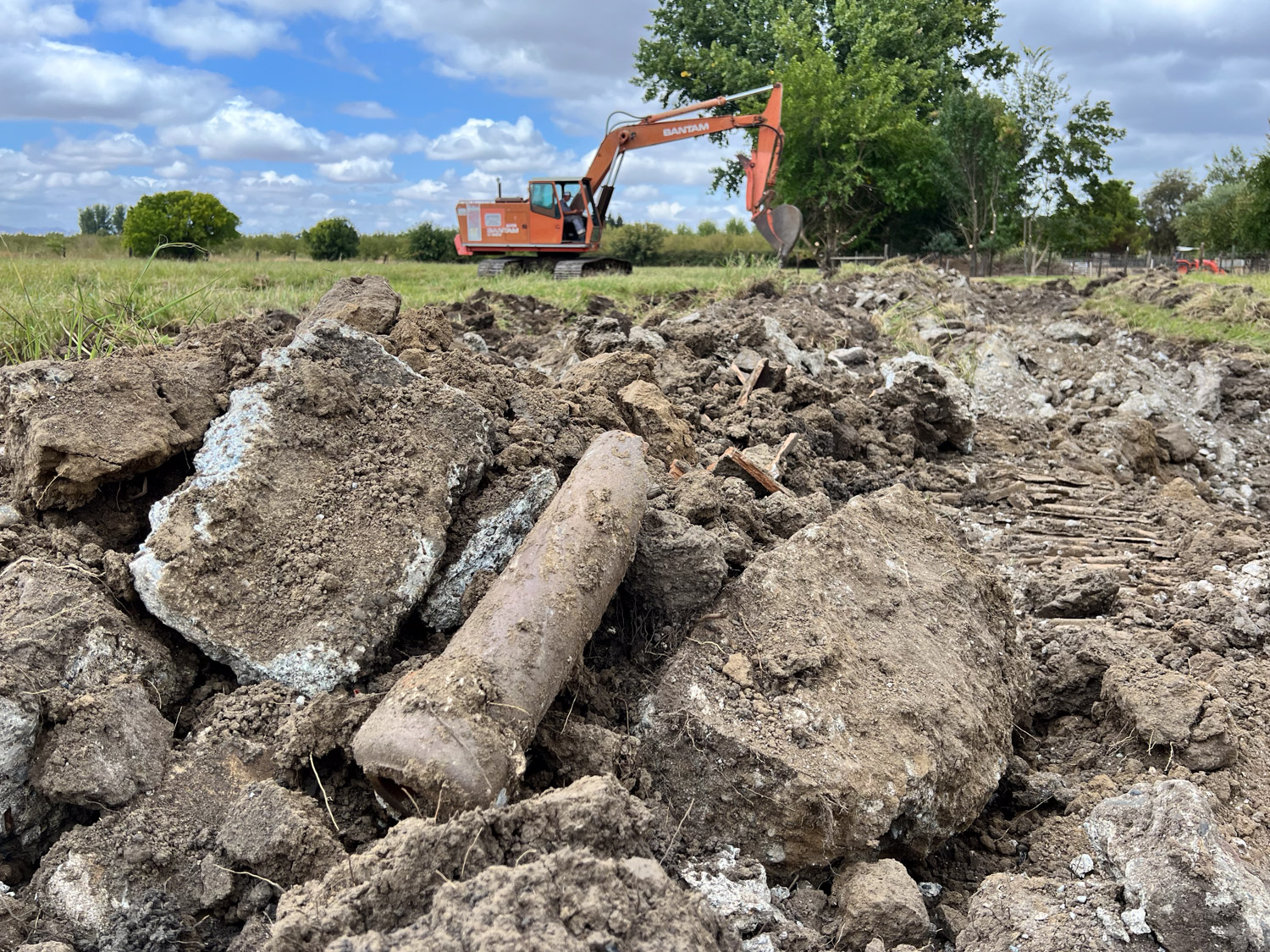
We found that a clay pipe ran the length of the concrete.

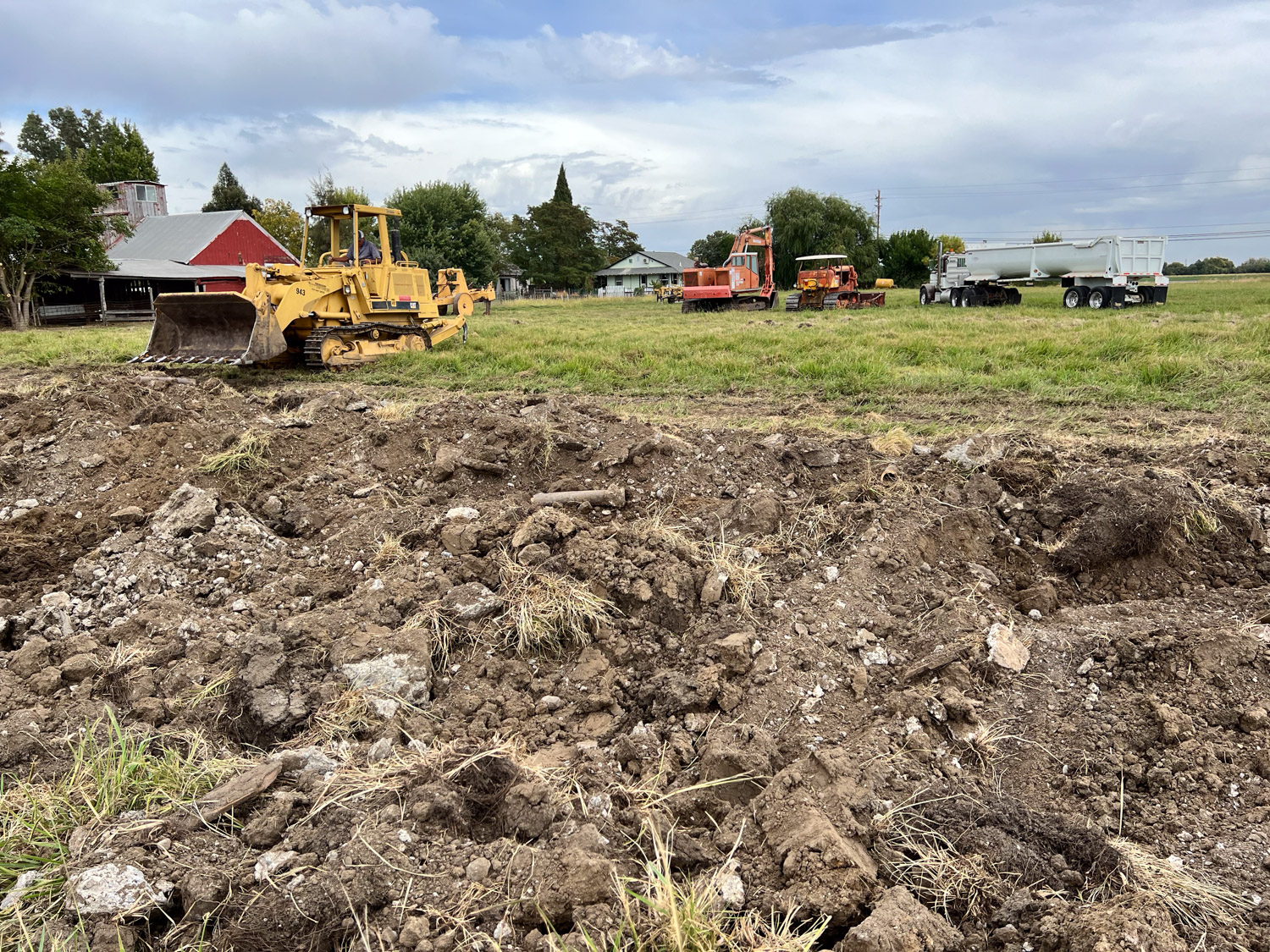
Brett used the teeth on the track loader to rake through the dirt and find the concrete chunks.

The chunks were loaded into a truck for removal to a place where they’d get broken up even more for use in road bed material.

Eventually the pile of dirt that was scraped off the top was incorporated back into the area where it had been.

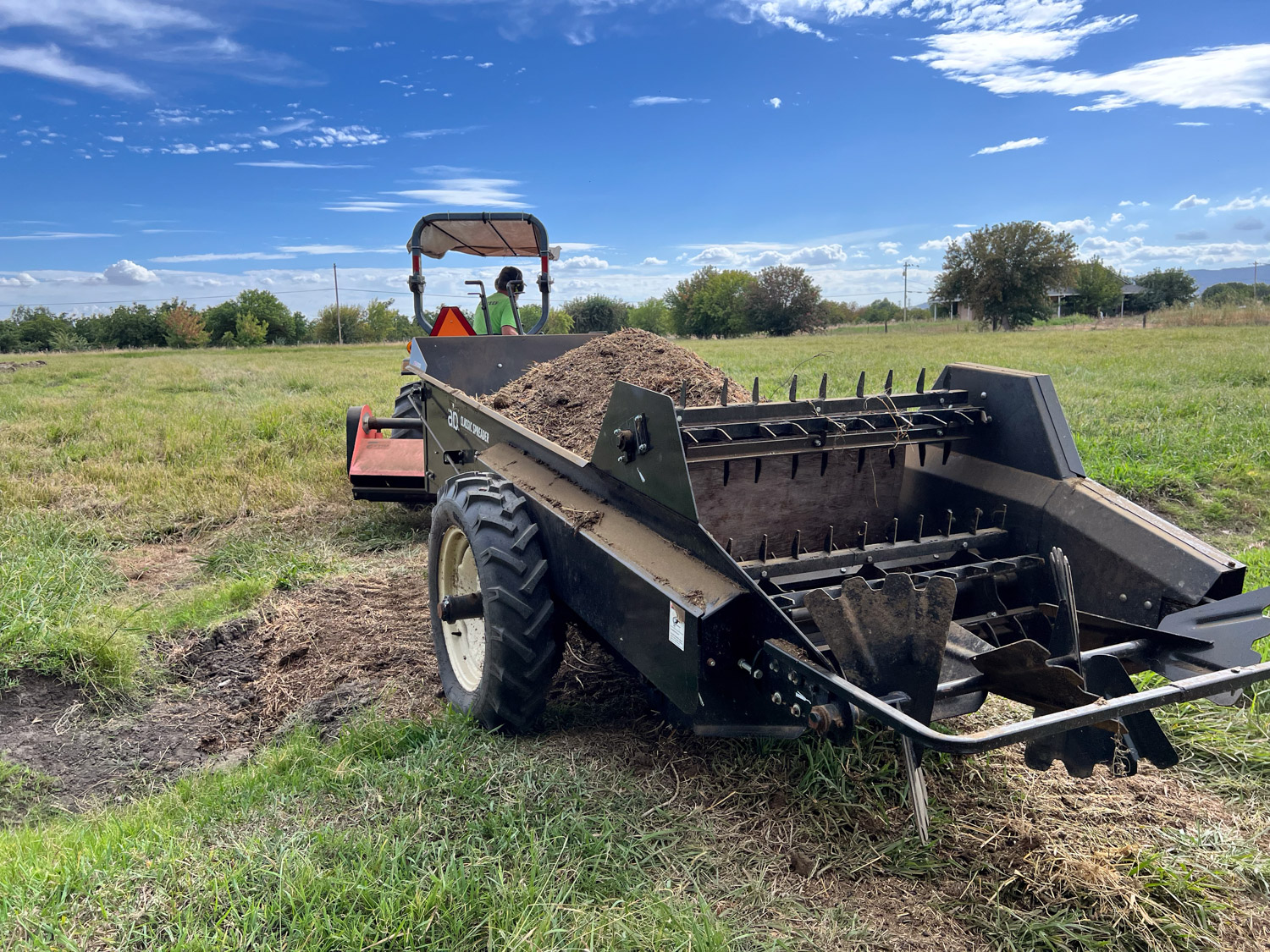
Manure spreader driving into green field.

While Brett was working on this part, Dan spread the rest of the composted manure pile.

Manure spreader working in green field under cloudy blue sky.

This part of the job took about three days using all this equipment.

Triple Trouble

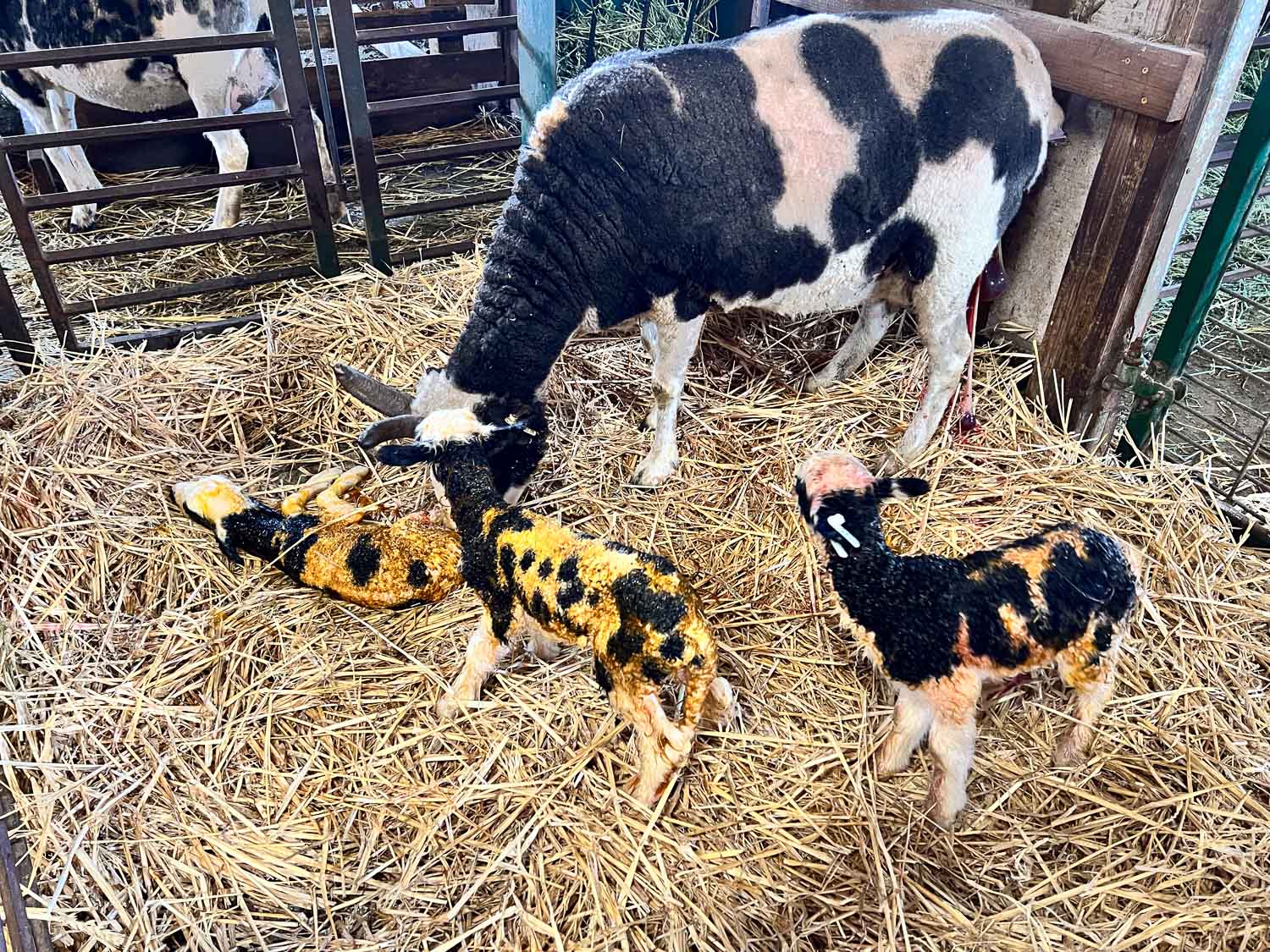
I wrote last time about Seeing Triple and all the triplets that have been born. Eilwen was the last one in that post, but early the next morning Honey had her lambs–more triplets.

When I went to the barn I saw the moon setting in the west…

…and the sun rising in the east.

Here is what I saw in the barn. I had put Honey in the night before because she was desperately trying to claim the lambs of the ewe that had just lambed when I was at the barn around midnight. Now she had her own brood. This is the sixth set of triplets. That’s too many, especially for this ewe who had mastitis last year. I thought it had been resolved enough for her to have lambs again. I was wrong.

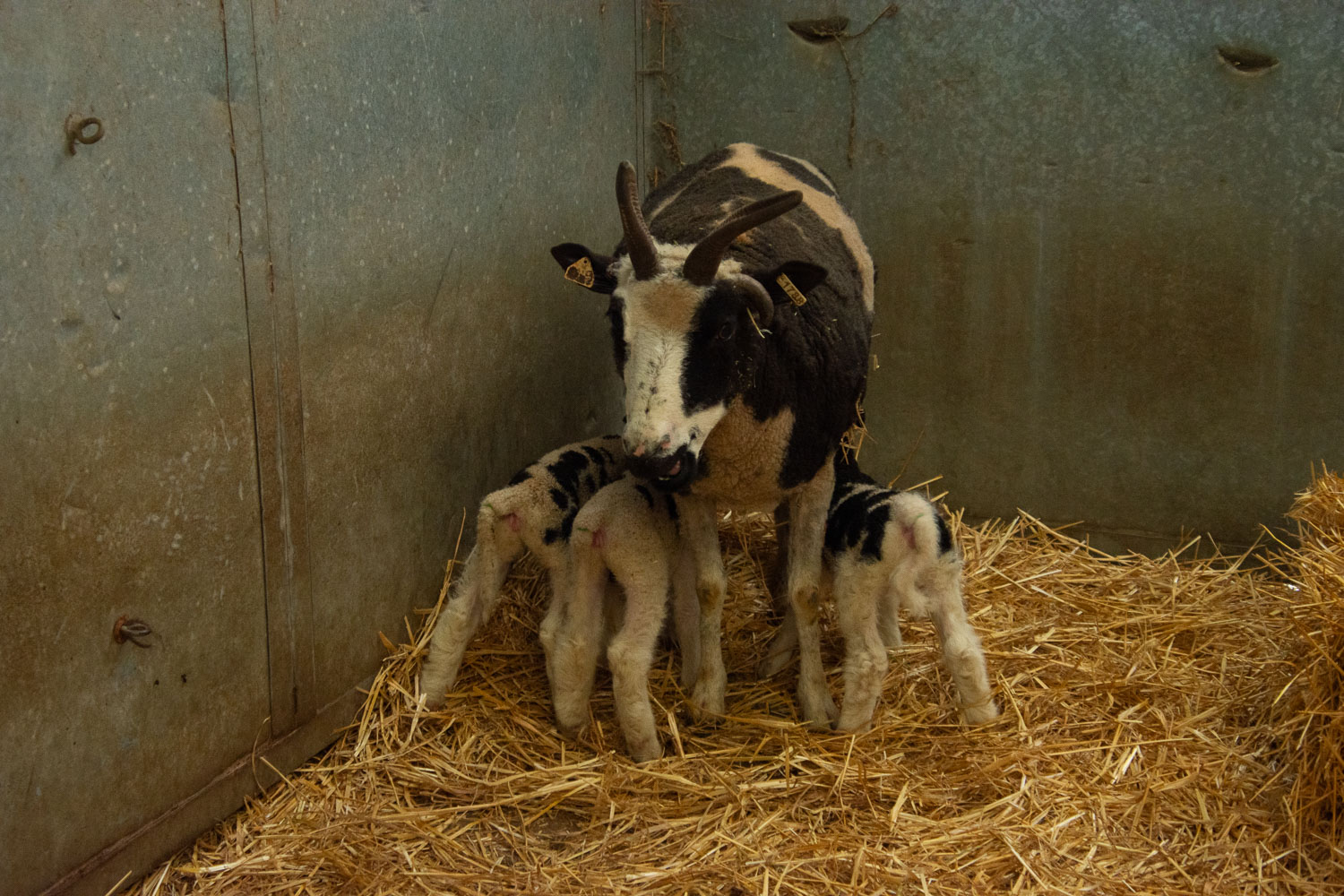
The lambs had figured out that they were getting milk from only one side. A ewe can nurse a single lamb one one side, and maybe twins, but it’s asking way too much to raise triplets that way. Its important for the lambs to get colostrum during the first day, so I made sure that they all took turns nursing through the day, but I started to supplement that night.

Jannie lambed later that day with twins.

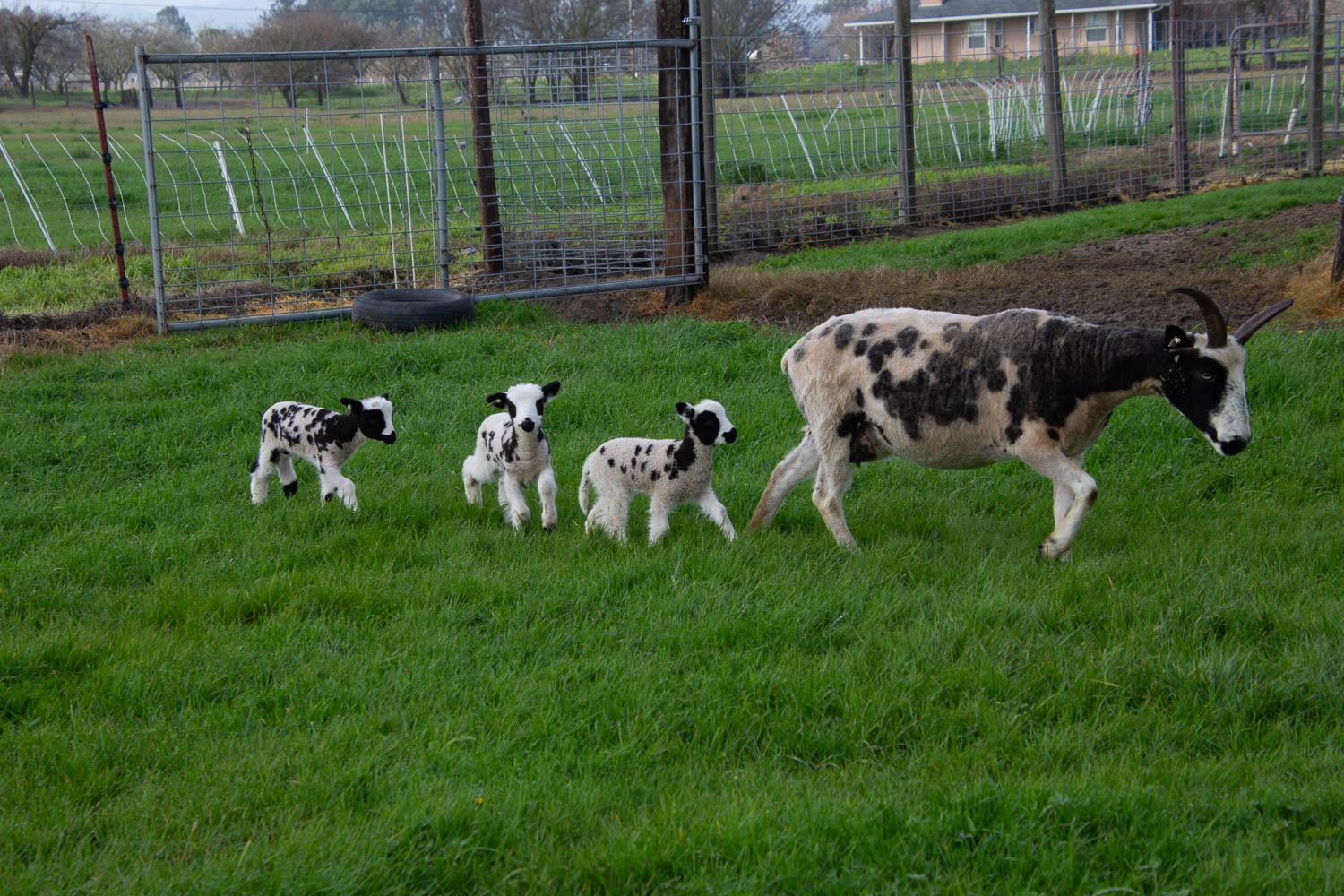
This is Coco with 10-day old twins. Yesterday I found Coco less responsive than normal. She is not one of the tame sheep and she wouldn’t get up when I wanted her to move. The lambs were trying to nurse while she was lying down. I discussed symptoms with one of the vets at the VMTH (UCDavis Vet Hospital).

No fever and, in fact, lower than normal body temperature, her behavior, and the yellow cast to the sclera led her to think copper toxicity. I have dealt with copper toxicity in the past but not for several years.

I took Coco to the VMTH as soon as I could. This story does not have a happy ending, but this is real life. Coco was euthanized. I know she looks like a normal sheep in this photo, but believe me, her body was shutting down. There is a lot more I could tell you about this — details about copper toxicity in sheep, decisions one has to make about animals whether they are considered livestock or pets, and more. That is what Farm Club is all about. Farm Club members get the behind-the-scenes stories in much more detail than works (or is appropriate for) a blog post. They have had daily updates from the beginning of lambing and have been invited out here to participate as well.

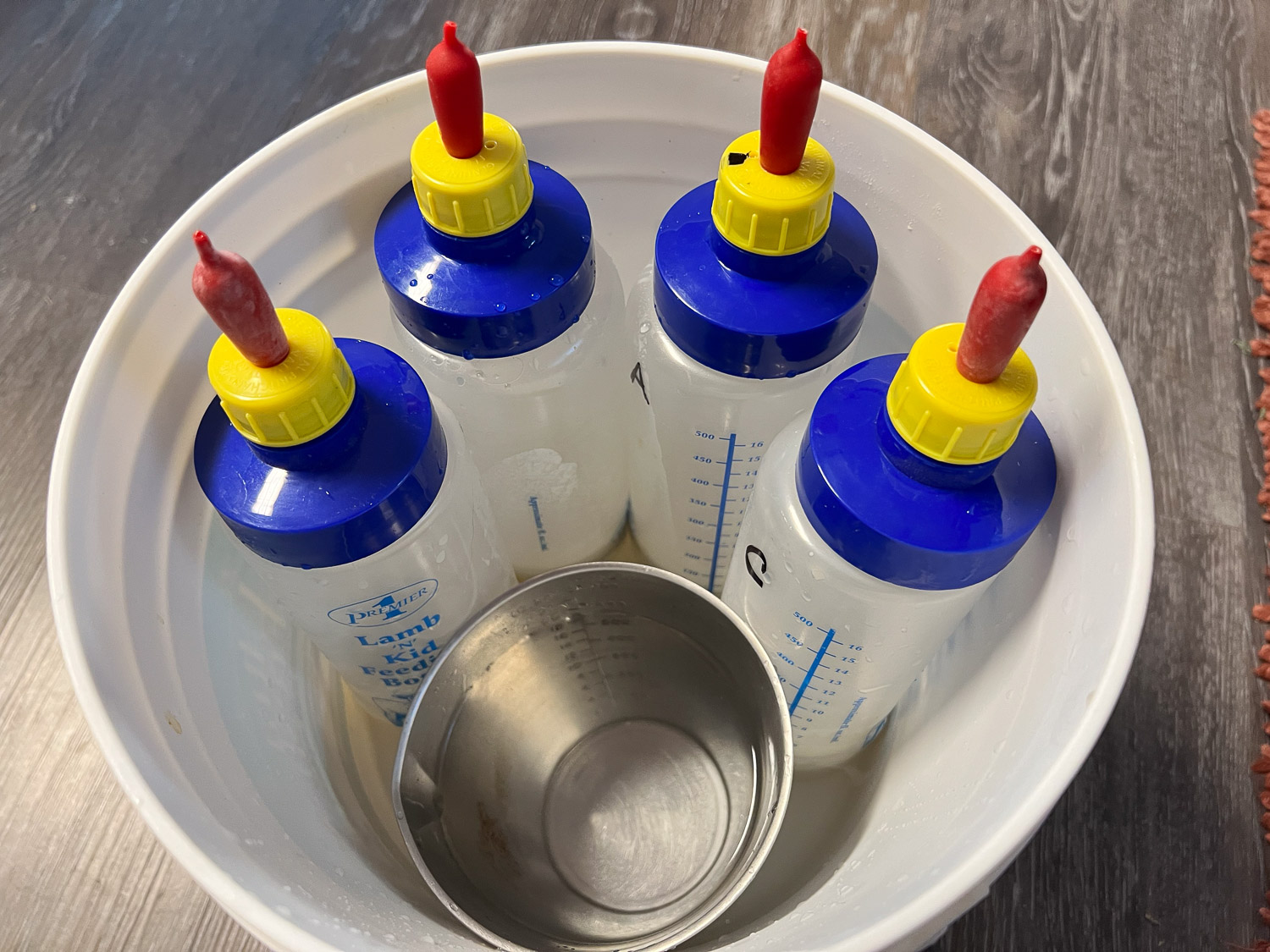
This was the bucket I took to the barn this morning. Two bottles for Coco’s lambs and two bottles for Honey’s lambs. As of the noon feeding I added a fifth bottle. I’ll be feeding four times/day for a couple of weeks I think.

Those are Coco’s lambs on the right. I took two of Honey’s lambs out of her pen this morning. The fact that she didn’t care means she doesn’t feel well. I left one with her but will supplement him.

On the positive side, Jazzie lambed this morning.

The lambing board so far.

Seeing Triple

Janna had the first set of triplets this year. That was February 9.

Next was Sonata on February 17. Unfortunately the third one died after birth. I thought she was finished with lambs after two. When I came back the third was there with membranes on its face. It may have been that Sonata didn’t even know she’d had another lamb while she was dealing with the first two.

Later that same day Juniper had triplets.

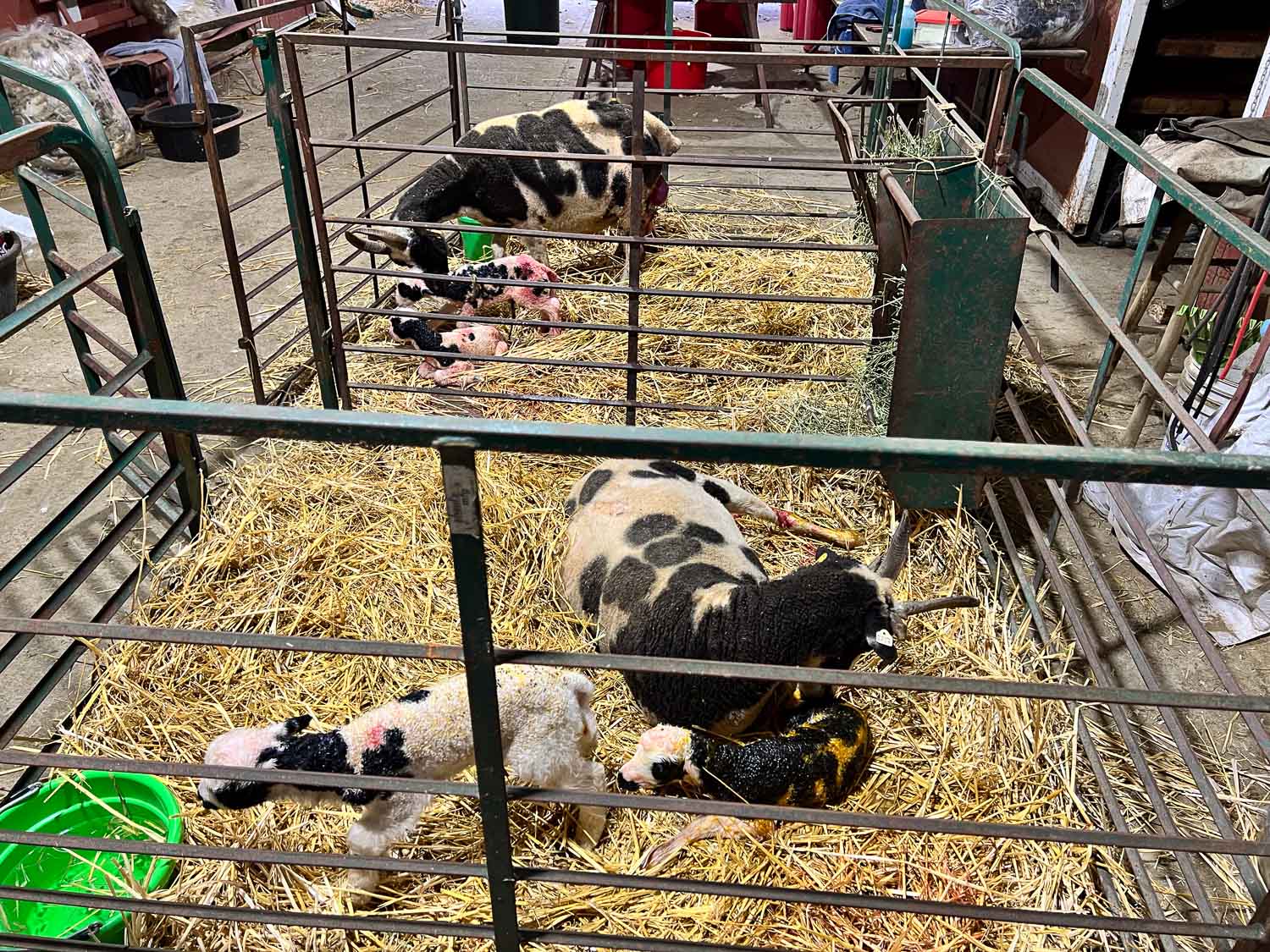
The following day, February 18, Jade had triplets. By this point lambing was intense. These pens were “overflow” in the alley of the barn. I think that Jade had been in labor since the morning–or at least the early stages–with no progress. In the meantime Quartz, Jade’s daughter in the pen next to her, lambed with her first. I decided to palpate Jade and find out what as going on. I found back legs with one bent at the hock. That lamb was blocking the progress of the others. I pulled that lamb and then a second. I found a third, but couldn’t quite figure out the right orientation and it was in pretty far. I left her alone to see if she would deliver that lamb on her own. Eventually I reached back in and pulled it. That was a difficult pull and I wasn’t sure if I had injured the lamb. It sure took a long time to get going. It eventually came around and now you can tell any difference in it although that night I wasn’t very hopeful. I milked colostrum from the three recent ewes and tube fed the lamb, feeding it three times by the end of the night.

Quartz was having her second lamb, but before she delivered I checked her udder as I always do. One half was hard and I sort of remembered a mastitis issue. There is scar tissue in the udder and the teat is not functional. A ewe could raise two lambs on one side of the udder but it is certainly not ideal. I was also worried about her developing a fresh case of mastitis.

Jasmine was lambing at the same time and the ultrasound had indicated a single lamb.I made the decision to give her one of Quartz’s lambs. The Quartz lamb was already up and had nursed, but was still under an hour old. I made sure that she was “slimed” by the lamb Jasmine had just delivered so that they both smelled the same and needed cleaning. It worked and Jasmine had no problem thinking that both were hers.

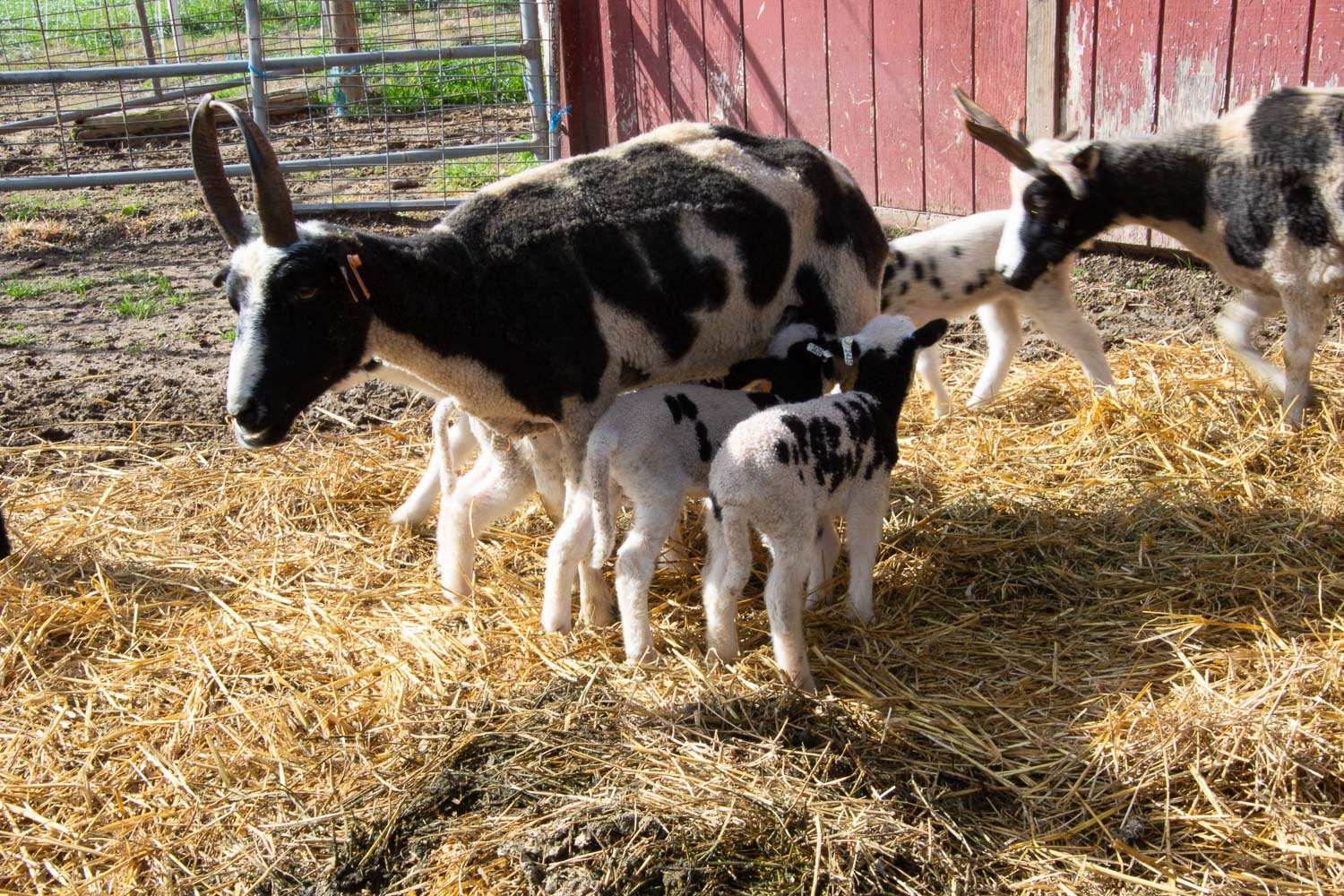
Then Jasmine lay down and had a second lamb, or is it a third? In any case, Jasmine is now nursing three lambs.

Jasmine in a stall with her brood a few days later.

Tonight there were more triplets. Eilwen had the first out in the drylot. I had suspected triplets because she was so huge, even though the ultrasound had shown two. This lamb was only 4.6 pounds compared to the average of about 7. That was the first confirmation that I was correct.

Lamb #2.

And a third.

Jade’s lambs look much nicer when all cleaned off.

Today on the Farm – February 21

I know it will make me crazy to go back and do other photos out of order, but I’m ready now for today. So I’ll do it this way and include a couple from yesterday as well. Maybe I’ll get to others later because there are stories.

Yesterday Dan decided to take out part of the tree that we think used to stand straight. Ever since that super strong wind last week this tree has looked like it’s tipping more and we’ve known that part of it looks dead. If it went down it could not only take a person with it but it would lift up the corner of the fence. It’s easier to cut down a tree than to replace the fence.

This is one of Trista’s twins born five days ago. The first time he nursed he did it while lying down. Maybe he has decided that is just the way you do things. It works when the sheep has a low hanging udder.

I was in the barn a good part of the day yesterday. I skirted fleeces in between watching ewes lamb. I’ll try to get time to post these.

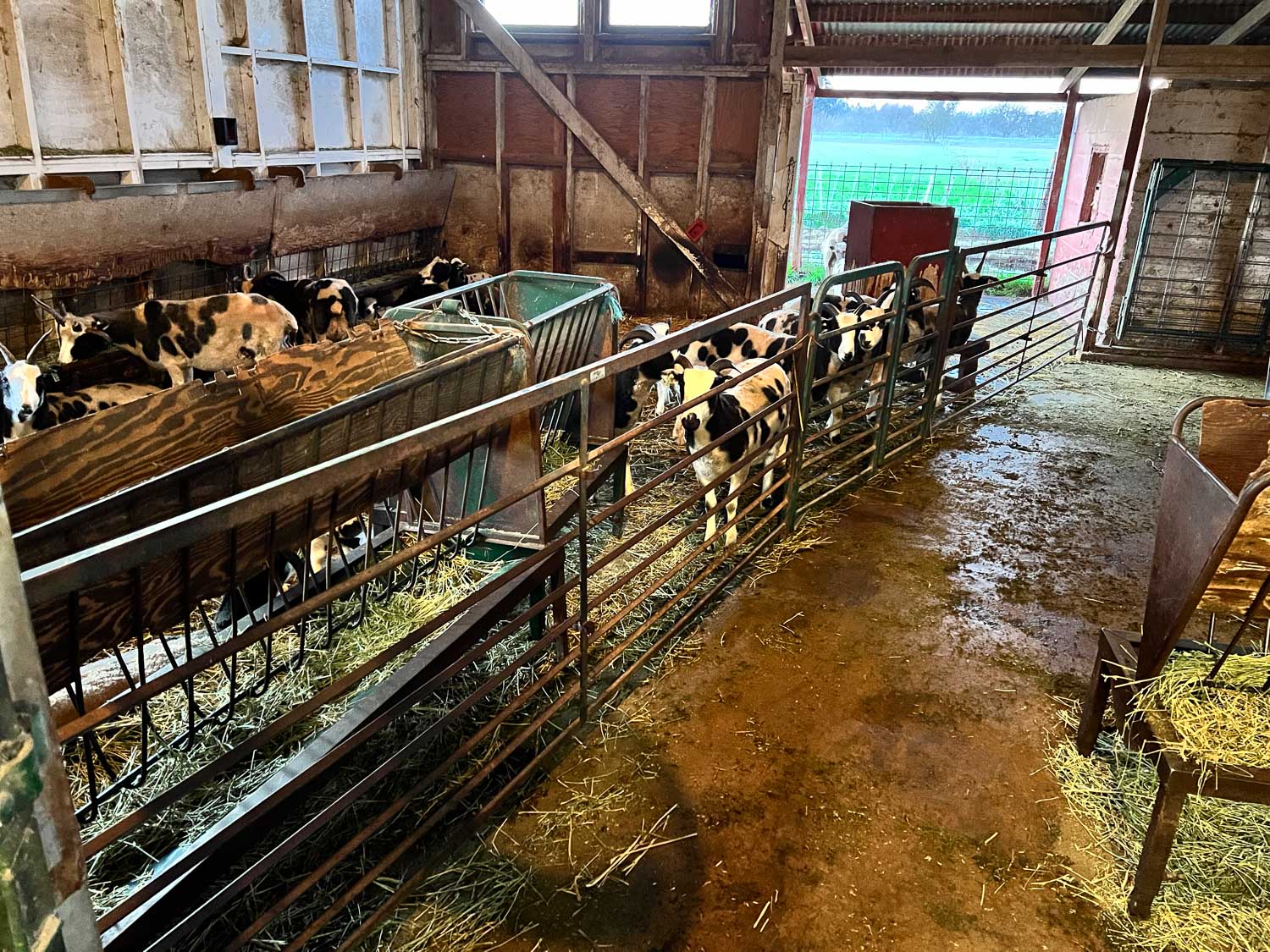
This morning I knew it was time to rearrange the furniture. As the ewes lamb and I move more ewe/lamb groups out of pens they go on one side. The pregnant ewes stay on the other. It’s the only way I can keep track of who’s next and who may be in labor. There were way too many sheep on one side. It’s mud on the outside of the barn and the pasture has standing water. Until we get some dry days and some more growth they won’t go out there.

Now the ewes and lambs have a much larger space in the barn and outside to the west.

The pregnant ewes (not in this photo) have the space to the left.

In the barn. I ran out of feeders that hang on the panels so Tamara has to share her meal as bedding.

The hens looked like they were dying, but I knew that they were just happy to spread out in the sun.

I moved Amara in last night thinking that she might lamb during the night. Today was the day.

I went to the house for breakfast and to get supplies so that I could work from the barn. I had to prepare for a Zoom meeting for which I didn’t have time last night. This is one of my favorite cups. I bought it at Black Sheep Gathering last year.

My new office set up.

My view from the office.

The result. The second was one of those that may have been just fine if I wasn’t there, but I don’t know. There have been plenty of lambs born with no one around and they are up and nursing when I find them. But so far there have been two that I found dead and had the membranes over the face, one of which was still half in the ewe. This one was born while the ewe was standing and paying attention to the first. It slipped out and landed with the body flopped over the head and fluid all around. I straightened it out and it came to life. I don’t know if it would have before the ewe discovered she had a second.

That’s the day so far. We have 54 lambs and I think I counted 19 ewes to go.

Watching and Waiting

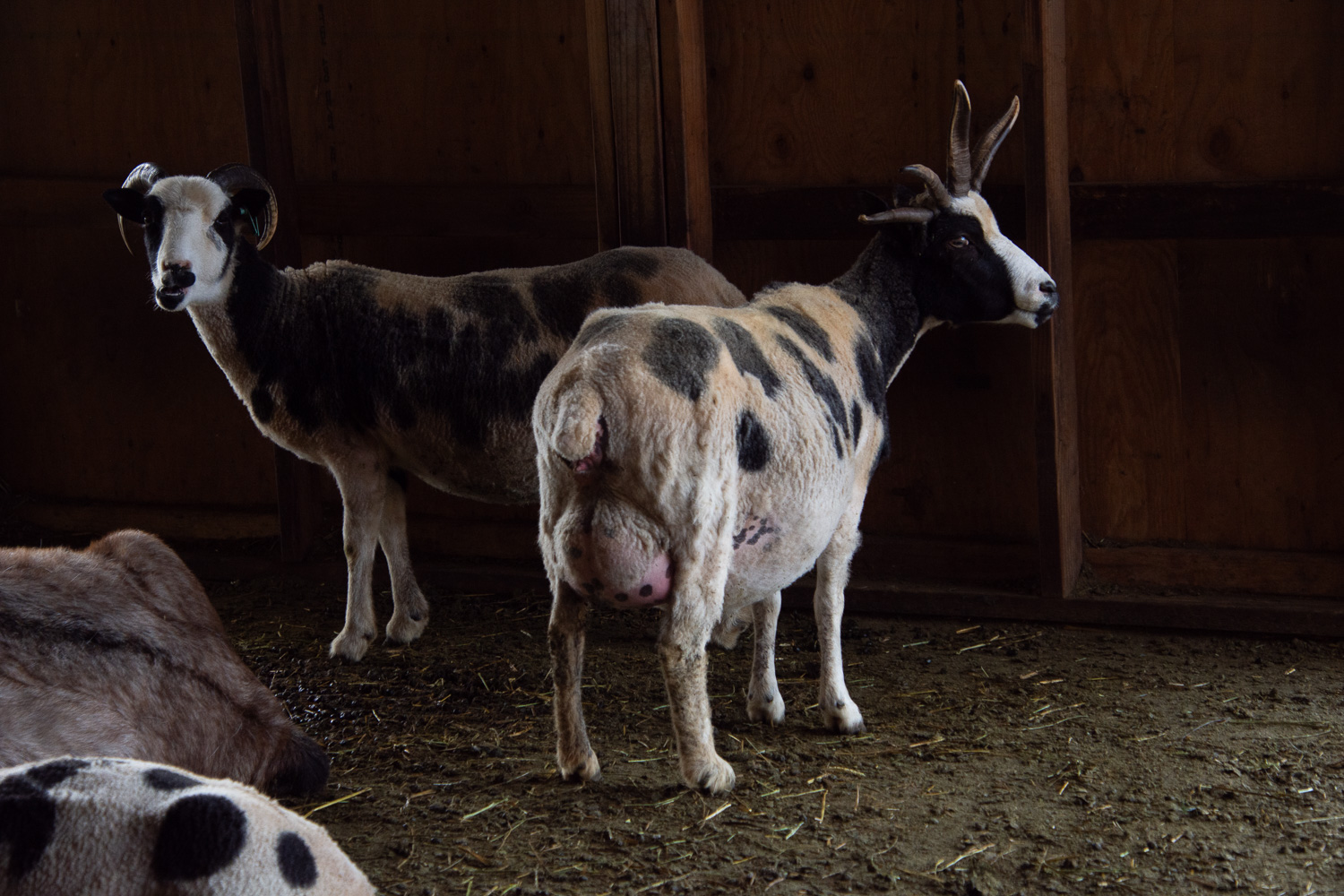
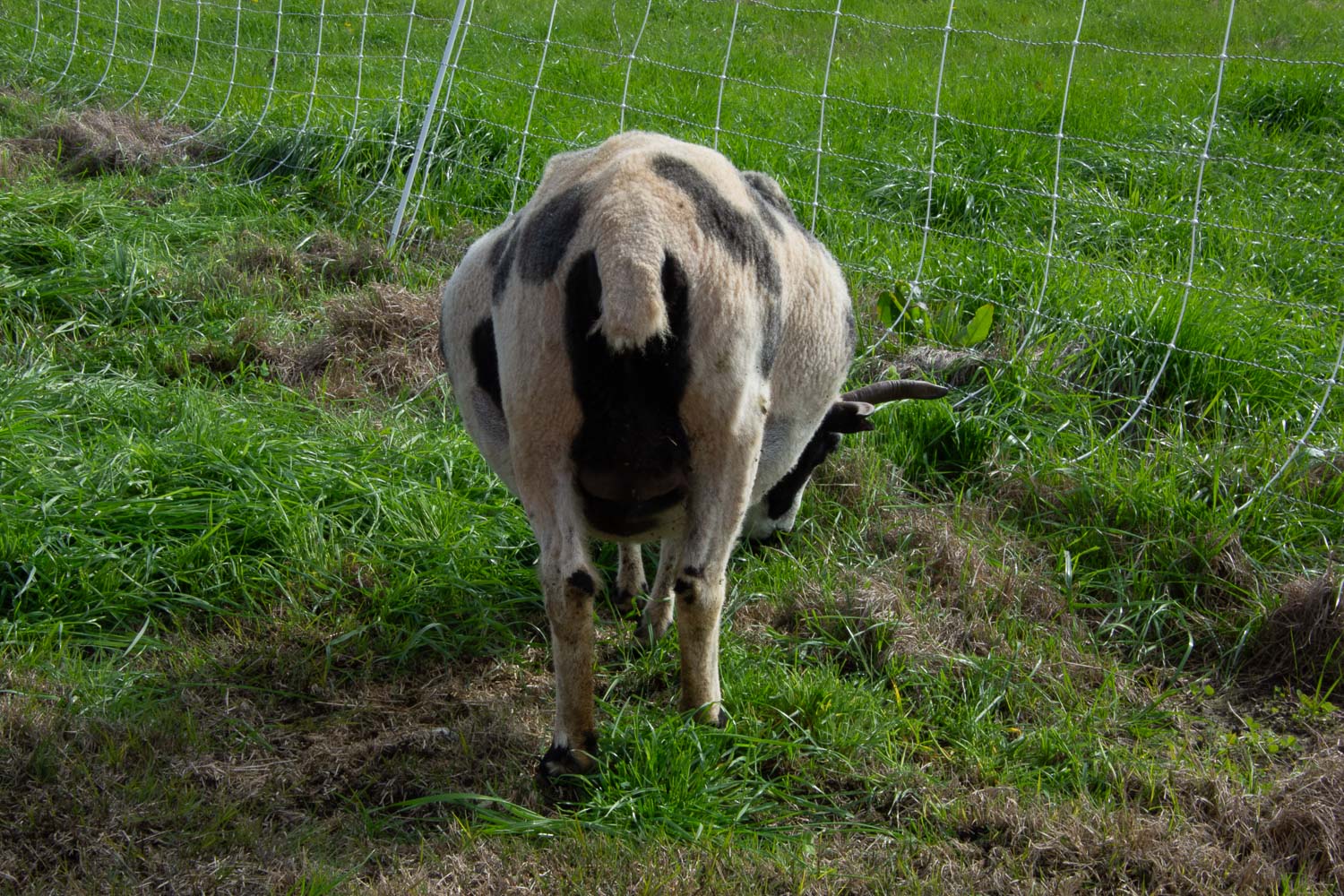
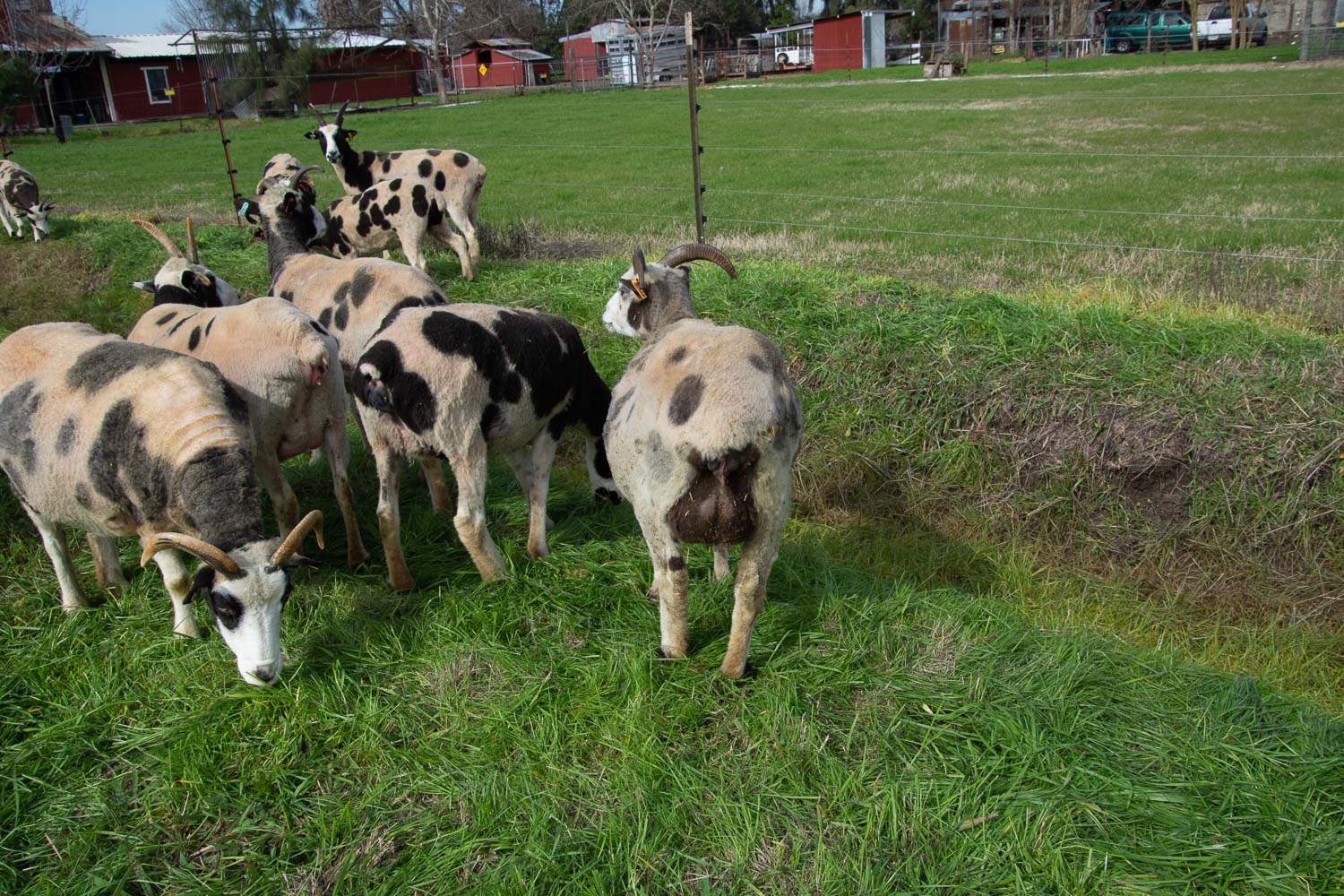
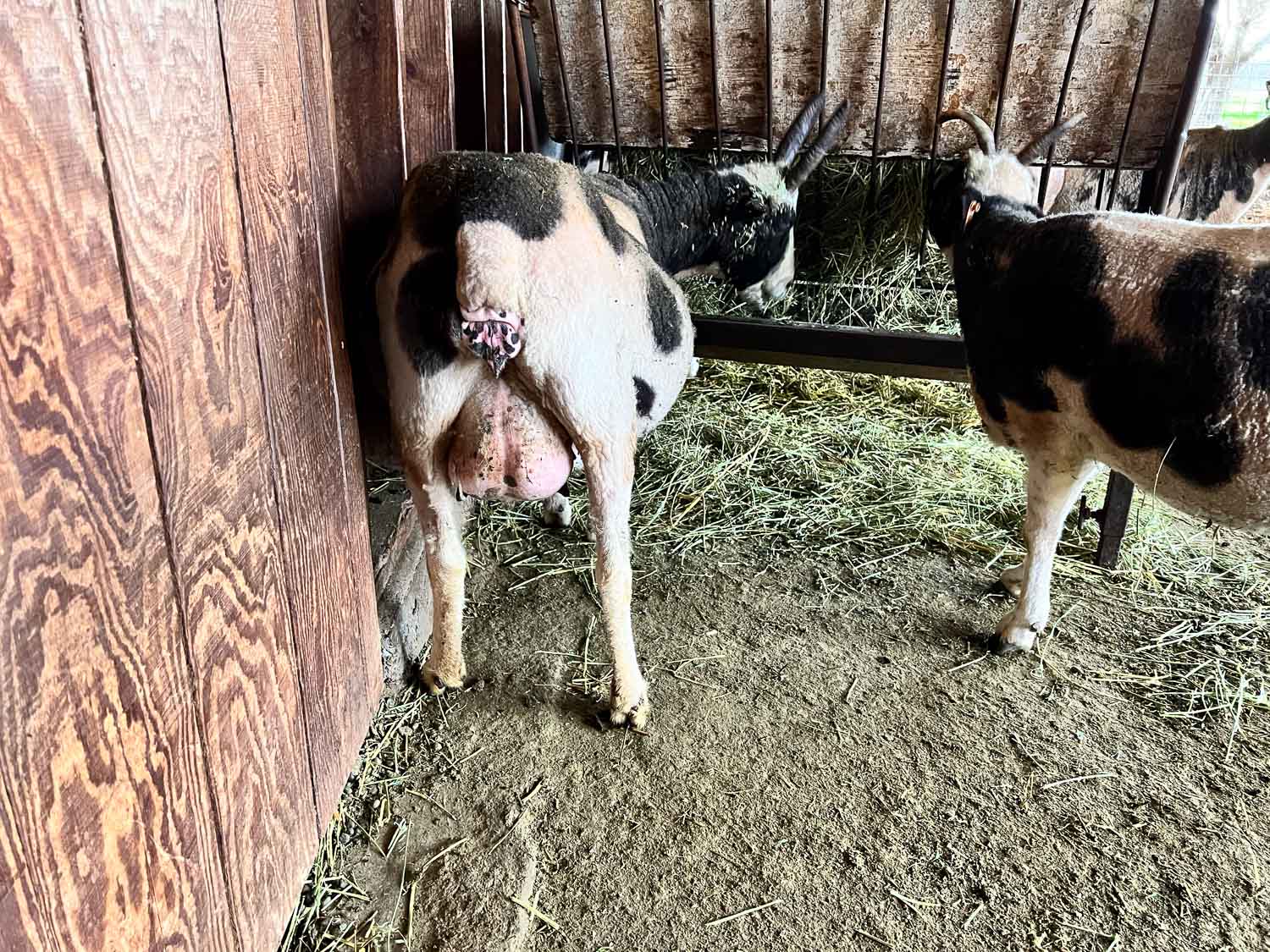
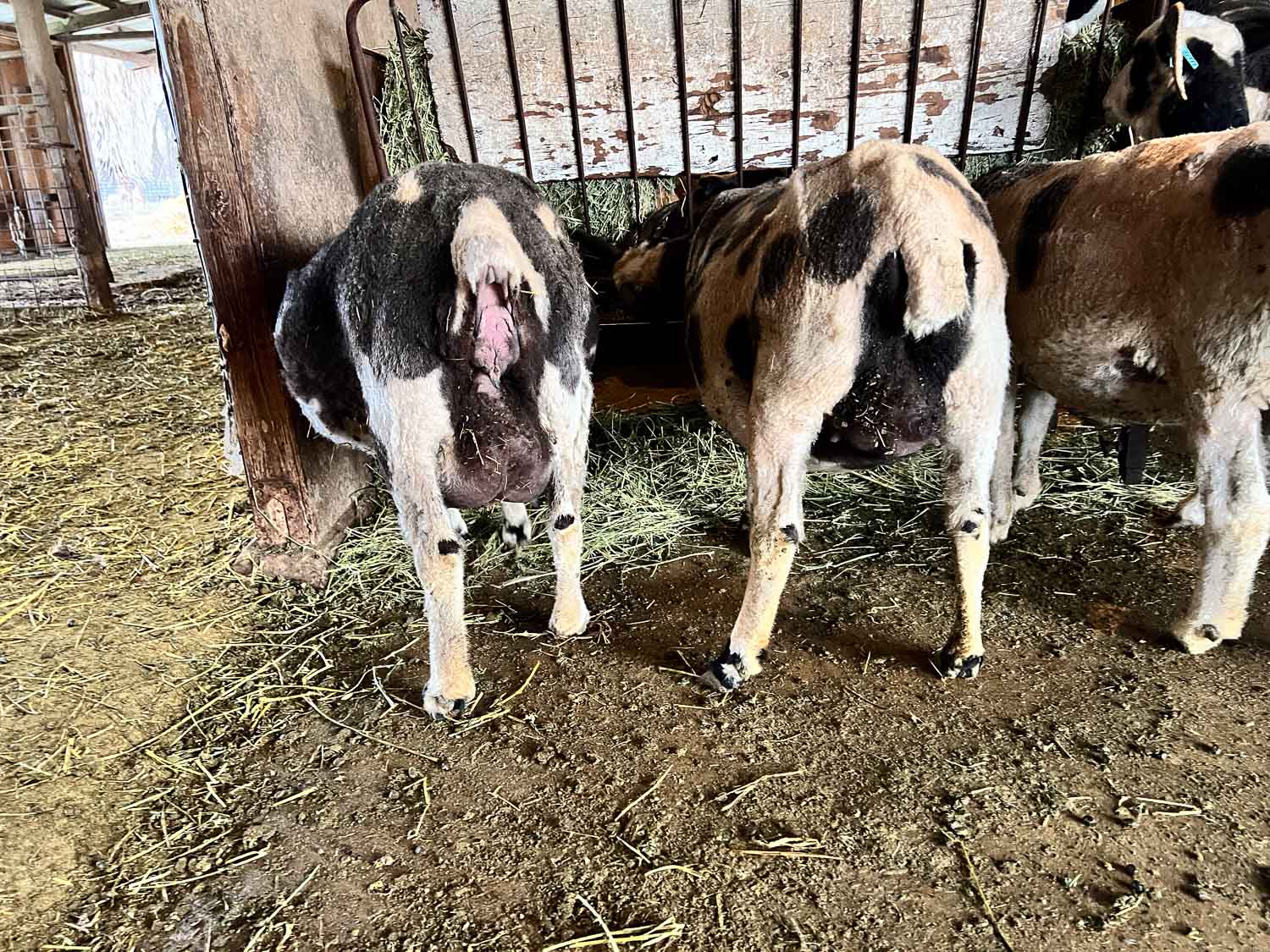
This is probably the kind of photo you expect to see when people are sharing pictures of sheep. But it’s the other end that I’m watching to try and figure out who is next to lamb. The ewe facing me is Sandie due 2/15 (tomorrow). I took lots of photos earlier to bring back the Lambing Game for Farm Club. That’s where I share photos of sheep (mostly rear ends) and Farm Club members can choose the next to lamb. There may be a prize or the prize may just be bragging rights. But I kept taking photos and either not being able to positively identify the sheep from the wrong end, or that sheep lambed before I had a chance to post photos.

Tranquility was one of those I was going to post. She lambed the morning after I took this photo.

Addy was also on the list. She lambed late in the afternoon after I took this photo, the same day as Tranquility.

I think this is Eilwen because the spots match the last photo here.

The ewe on the right is Foxy who lambed this morning. The photo was taken three days before.

Jade is in the middle. Everyone who has been here knows Jade. She is due 2/16.

At 12 years, Sonata is the oldest ewe here, due on 2/16.

Trista and Eilwen. Trista is due 2/17. Eilwen is due 2/27.

If I have time I may take a new set of photos tomorrow. They should all be taken at the same time to make this game fair.

Shearing Day…for One Sheep

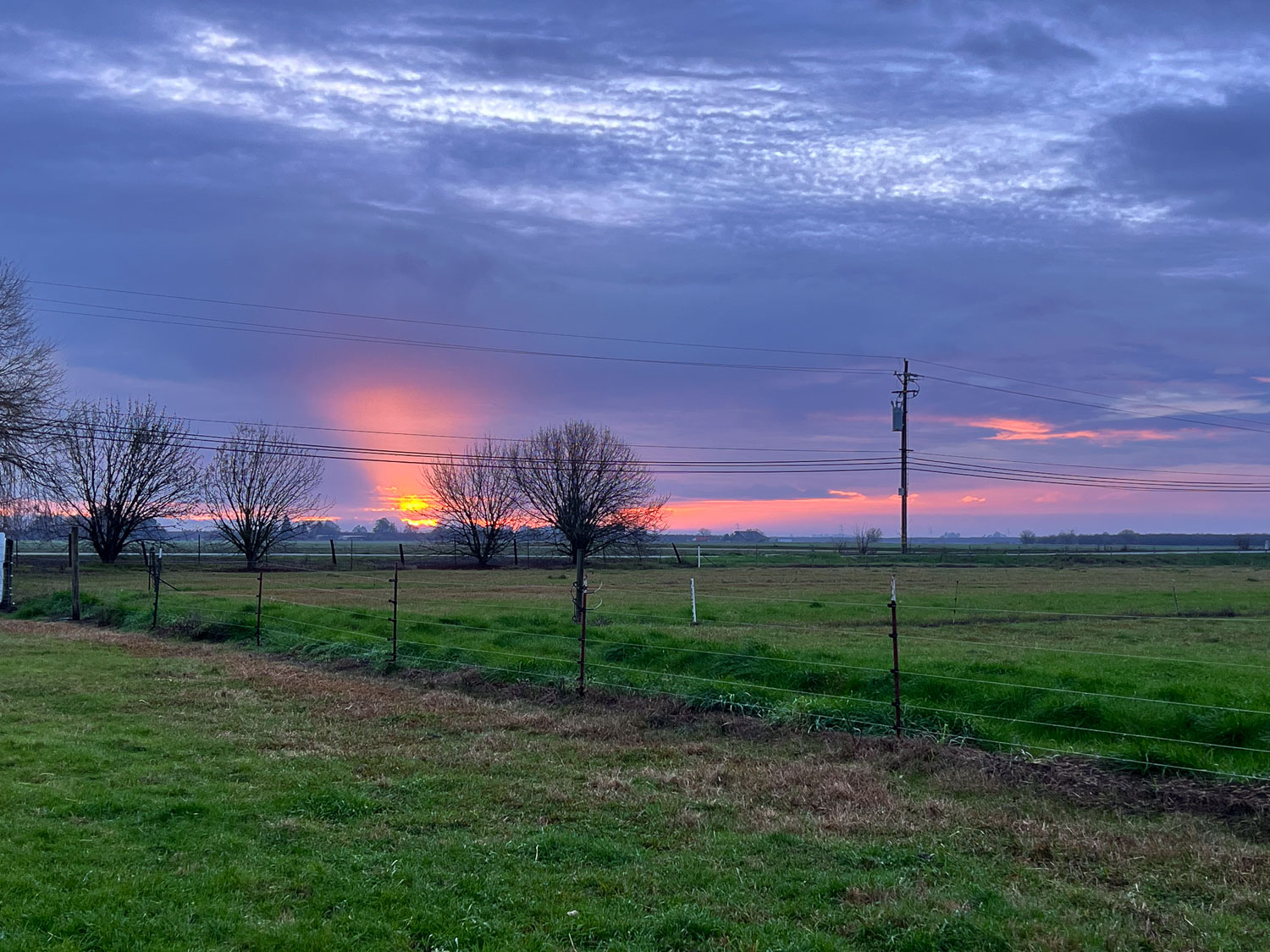
Sunrise with gray clouds above green grass.

Shearing Day was scheduled for January 21, but this was the day before. I was up before sunrise again (necessary if you want to get enough done in the day in the winter) and it’s nice when there is color to go with it.

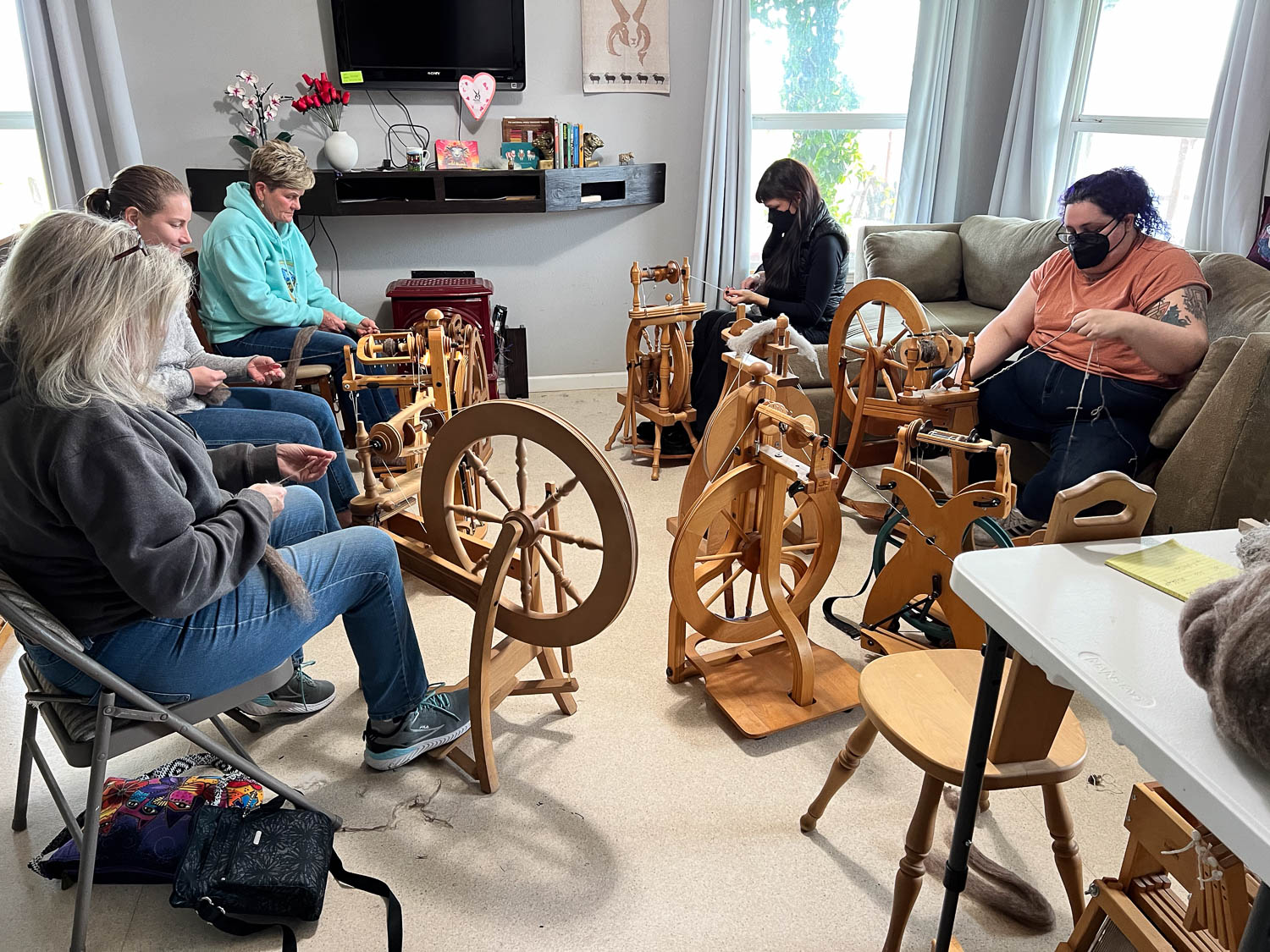
Five women sitting in a circle, each spinning on a different type of spinning wheel.

I had a spinning class scheduled for the morning. Five people from five different cities came to learn about spinning. Most had a little bit of experience or at least an introduction to spinning so we started right in after I explained the different wheels and some basic terminology. They all had a chance to ply their yarns by the time we finished a little after noon.

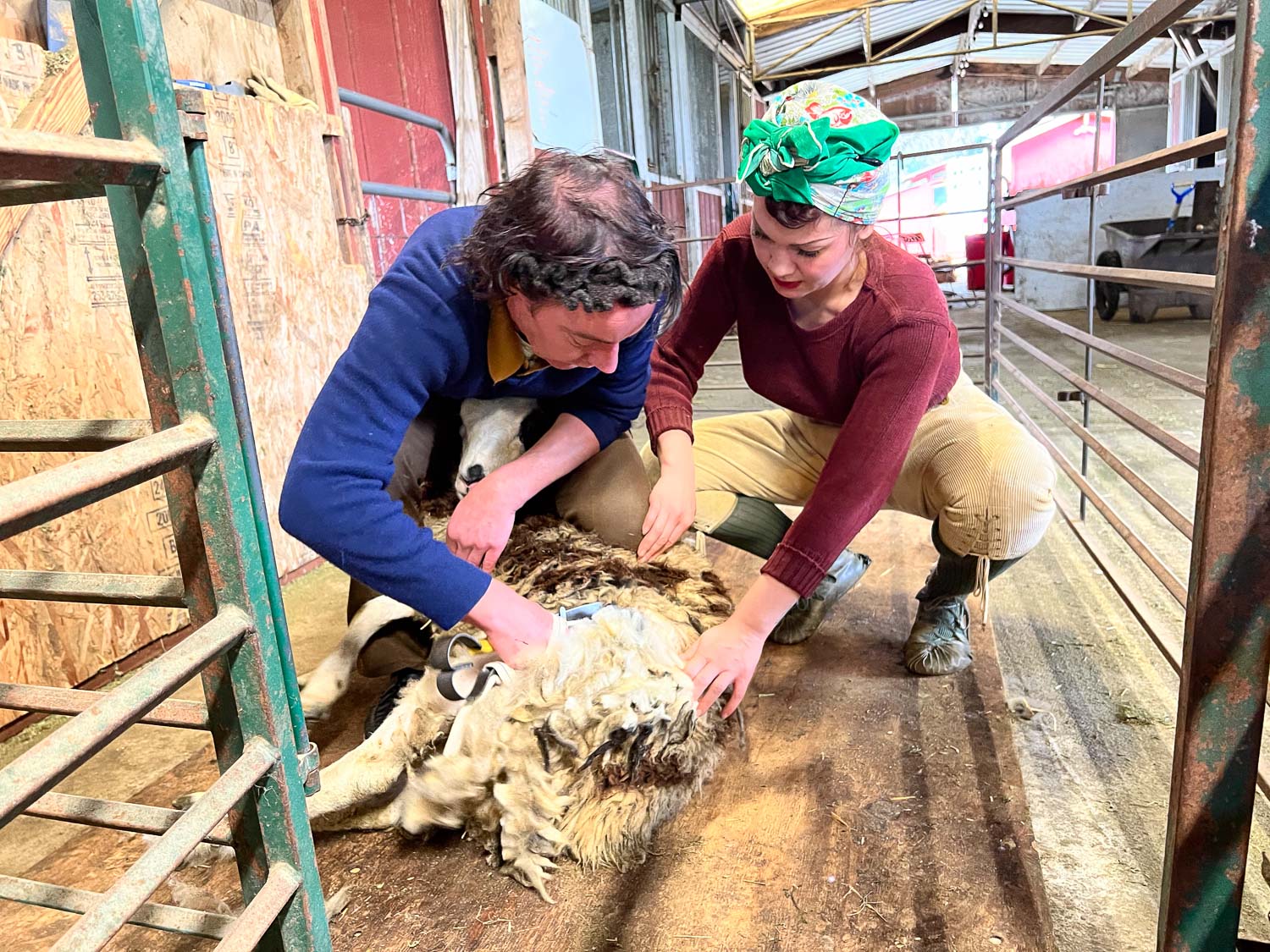
Just as we were finishing Siobhan and Ivar got here. Siobhan is a Farm Club member who has been here often, either teaching a class or to farm sit, besides our regular Farm Days. She and her husband spent a few weeks in England on a belated honeymoon last year. While there they took a lesson on blade shearing and bought hand shears. Siobhan asked if she could shear a sheep for her Farm Club fleece for this year. I said “sure”.

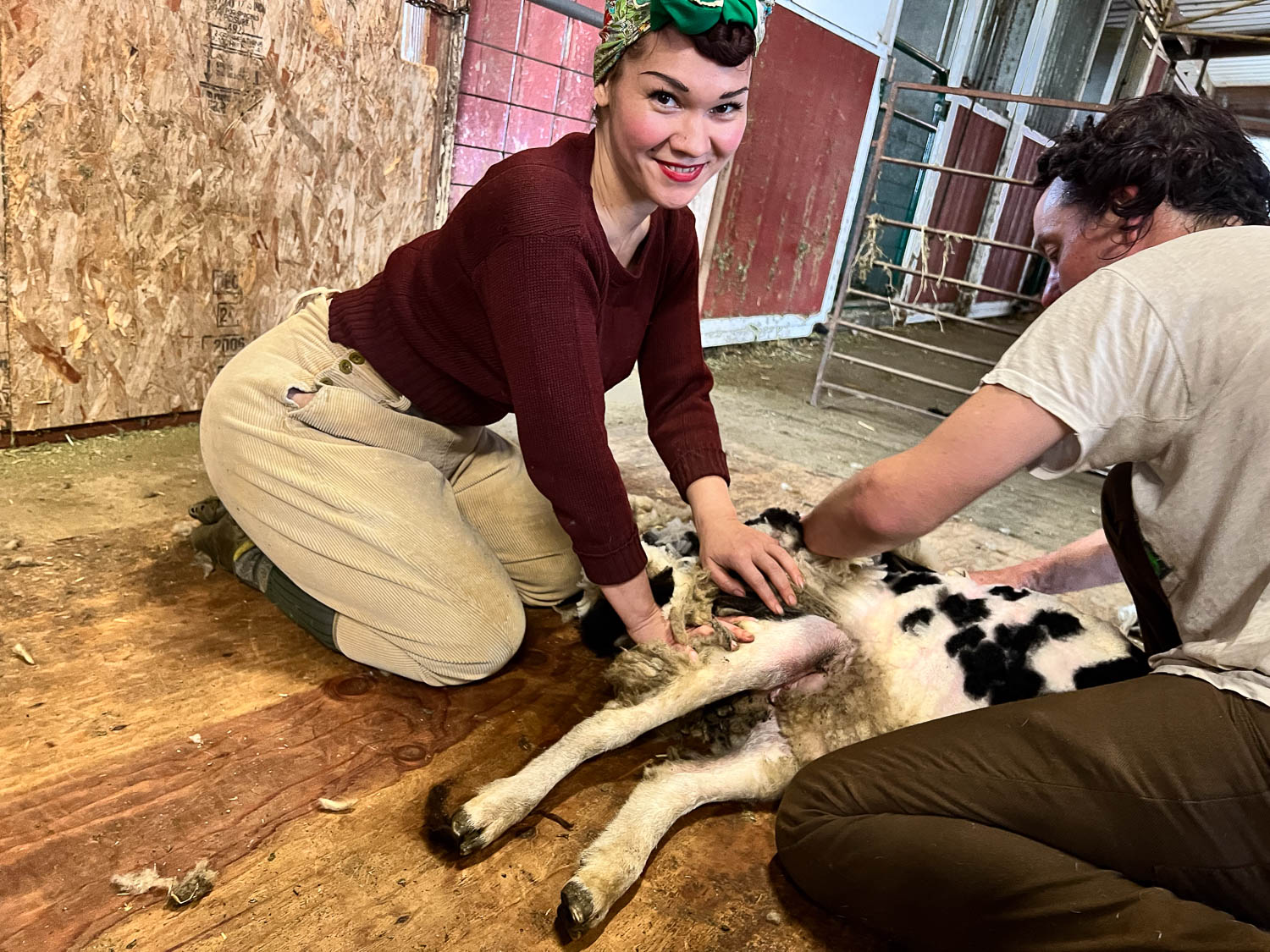
She chose Harry, the offspring of one of our pet sheep, Hazel, who died last year). I had wethered Harry because he had become such a pet to Siobhan and my granddaughter, Kirby. Ivar did the actual shearing while Siobhan helped with sheep control.

I can’t believe that I didn’t get photos between the start and the finish. I was doing some other barn clean up but also helping with a bit of sheep management. In fact I took this photo while Ivar was finishing his last strokes from the front of the sheep where I had one hand (or maybe my knee at this point) on Harry’s head. Siobhan however has a great time-lapse video of the whole process.

I’ll bet it felt like longer to Ivar, but when I looked at the time on my photos I saw that between the first and last photo there was about 55 minutes. I’d say that’s pretty good for your first sheep and doing it with handshears…and the sheep has horns, which only adds to the difficulty.

The fleece looks good too and I can’t wait to see what Siobhan does with it. Great job, Ivar and Siobhan!

The next day we sheared 77 sheep, but John uses electric shears! Stay tuned for another post.