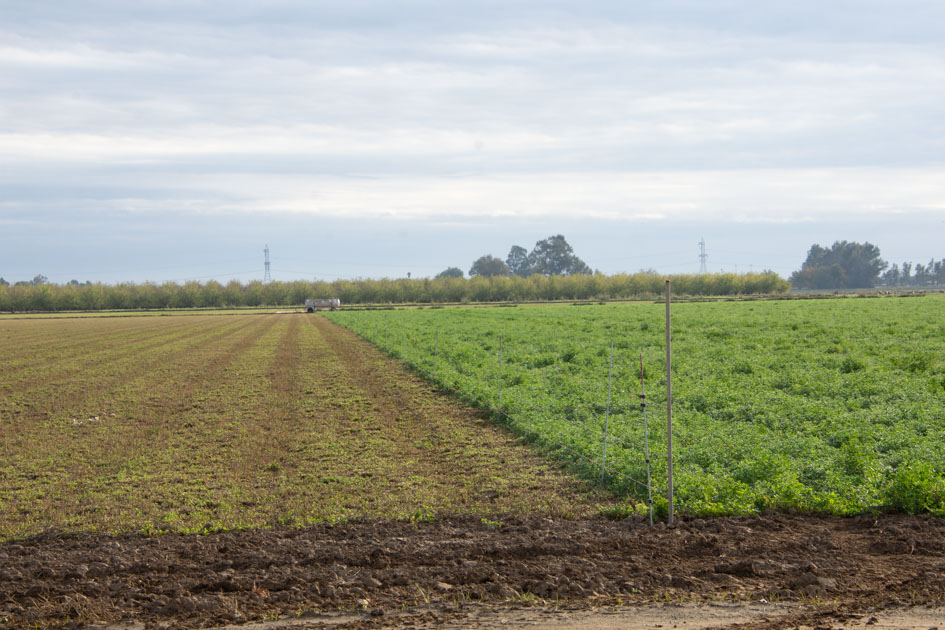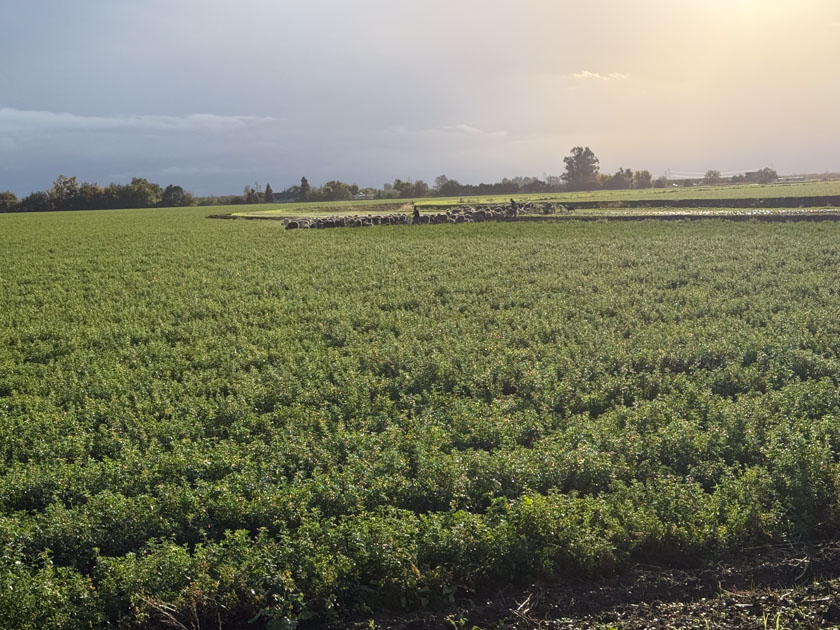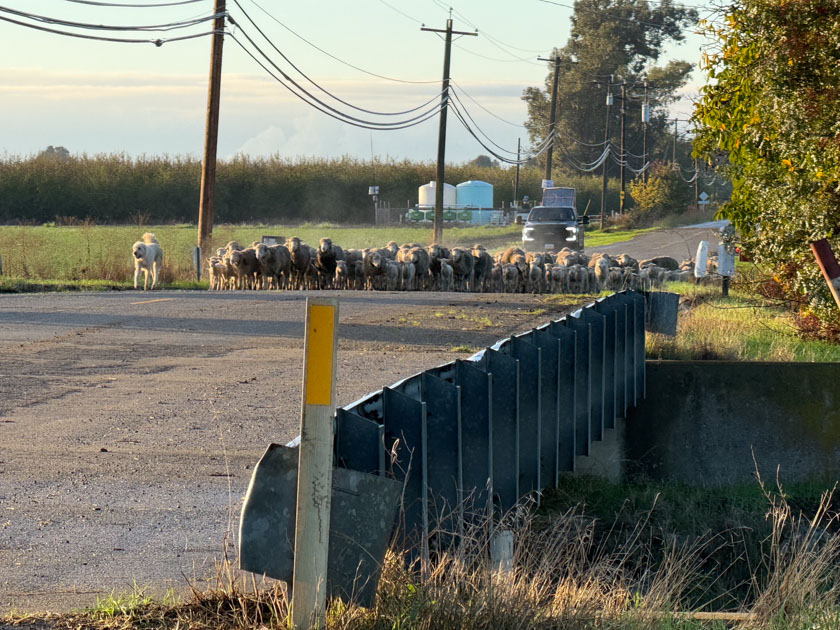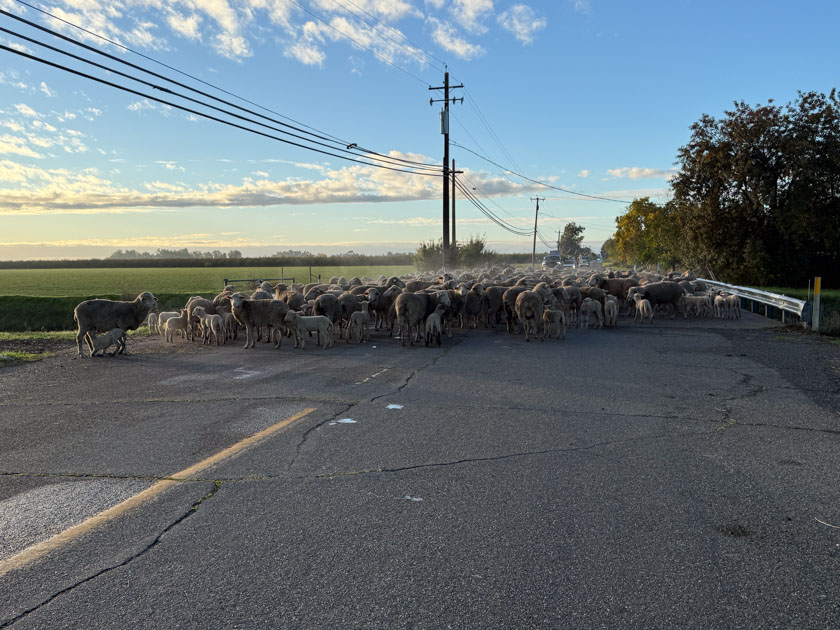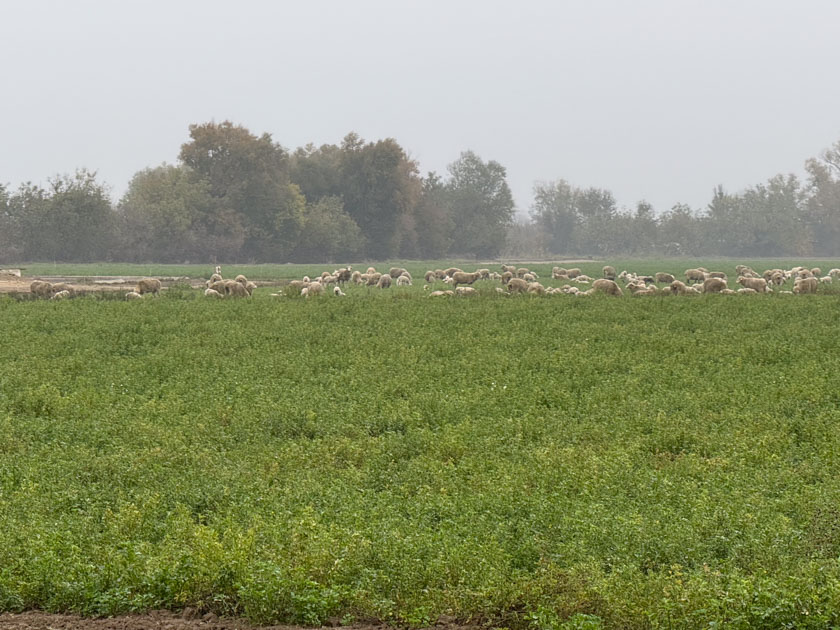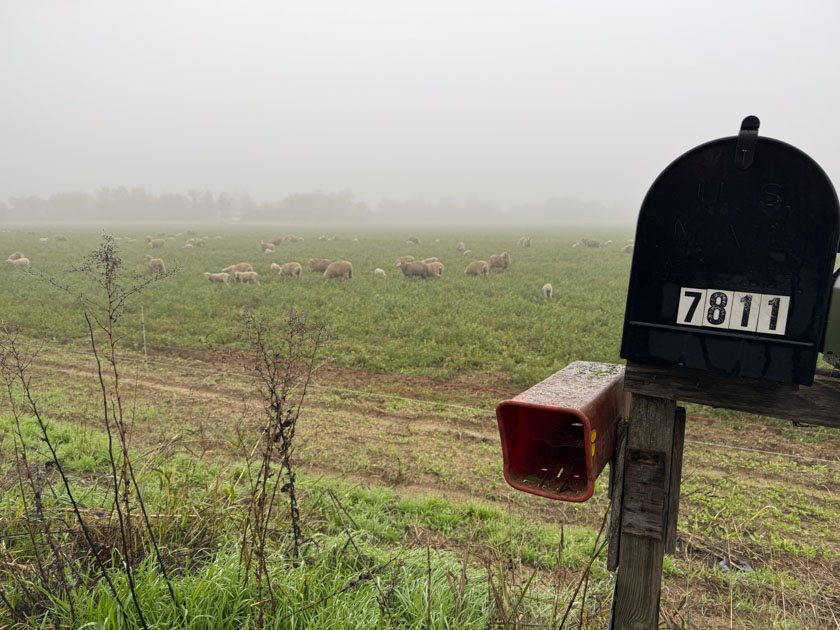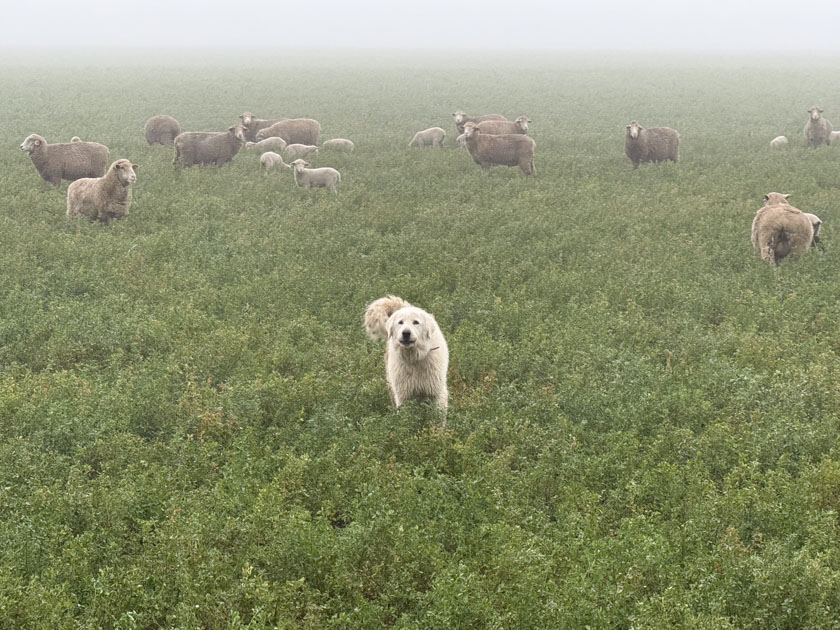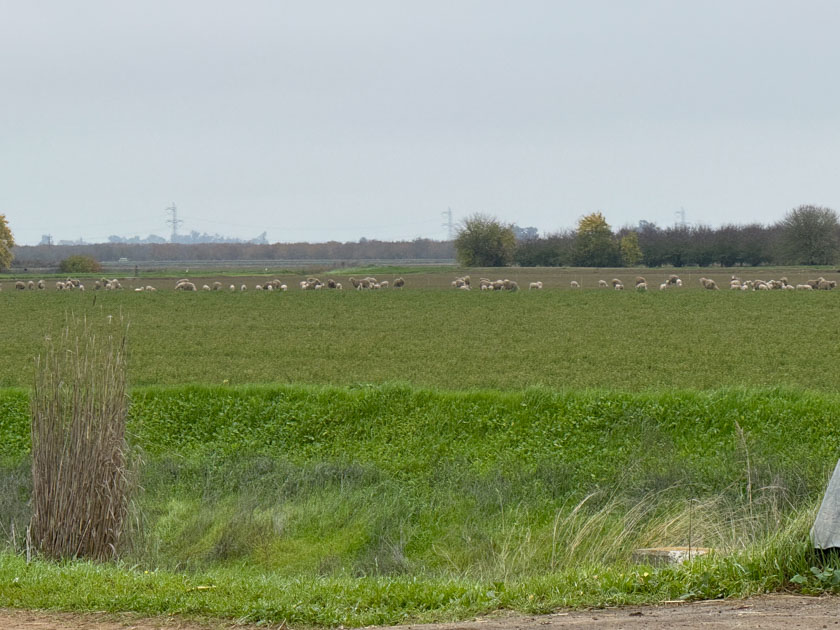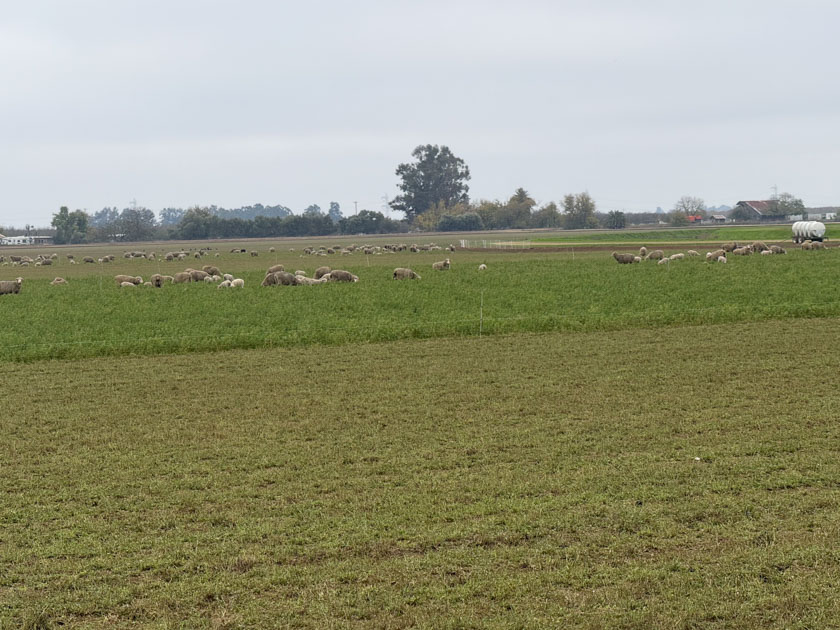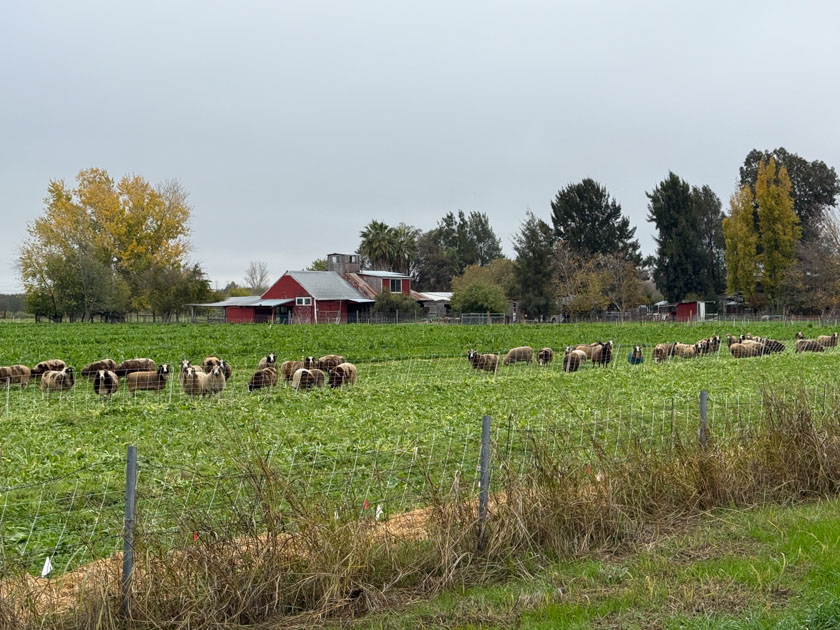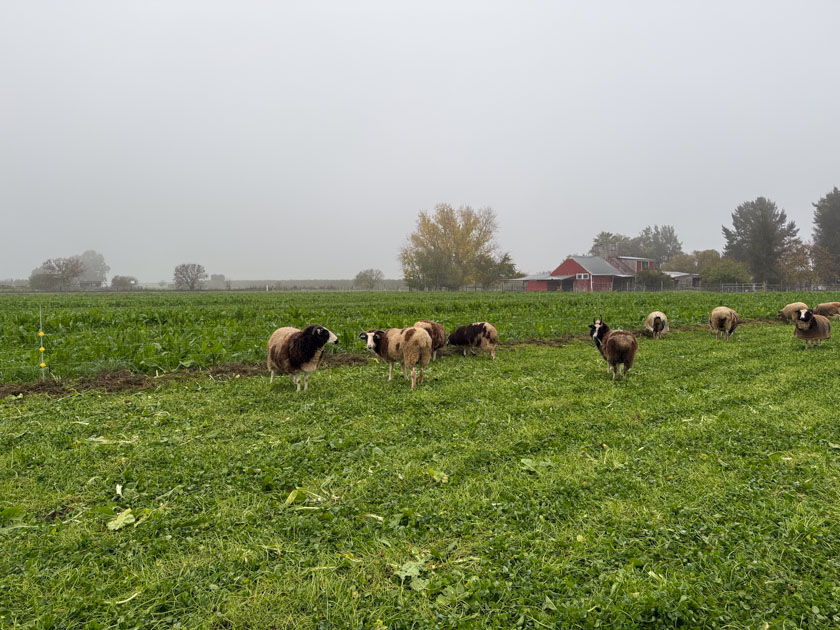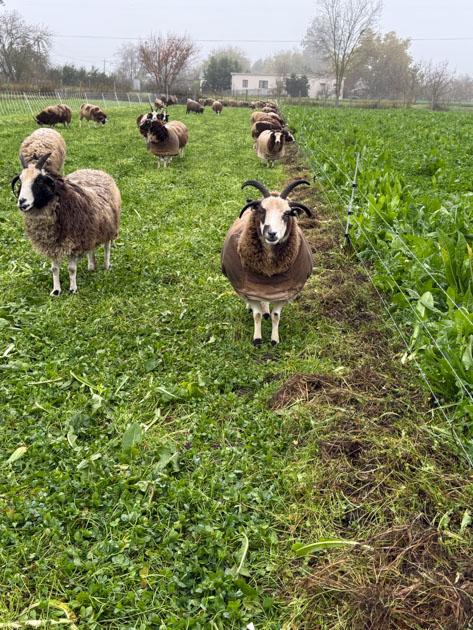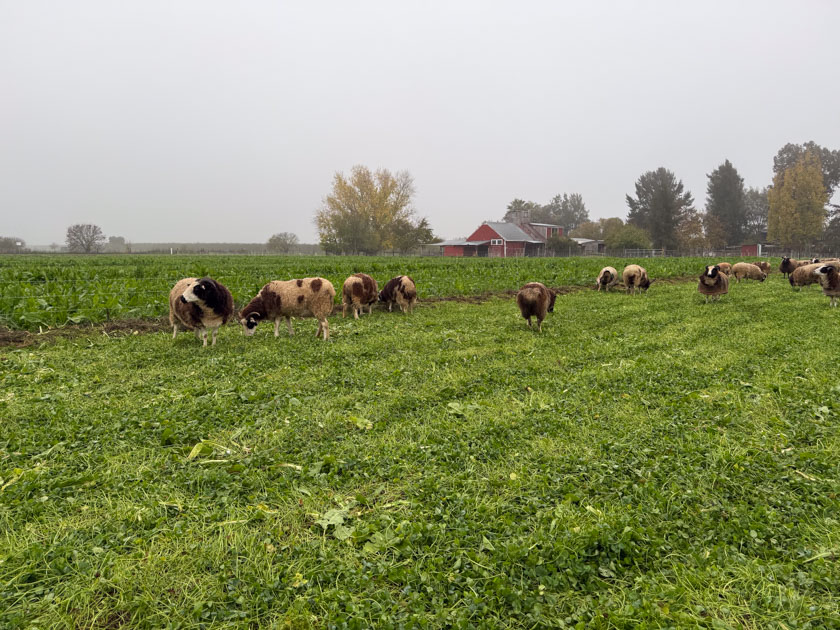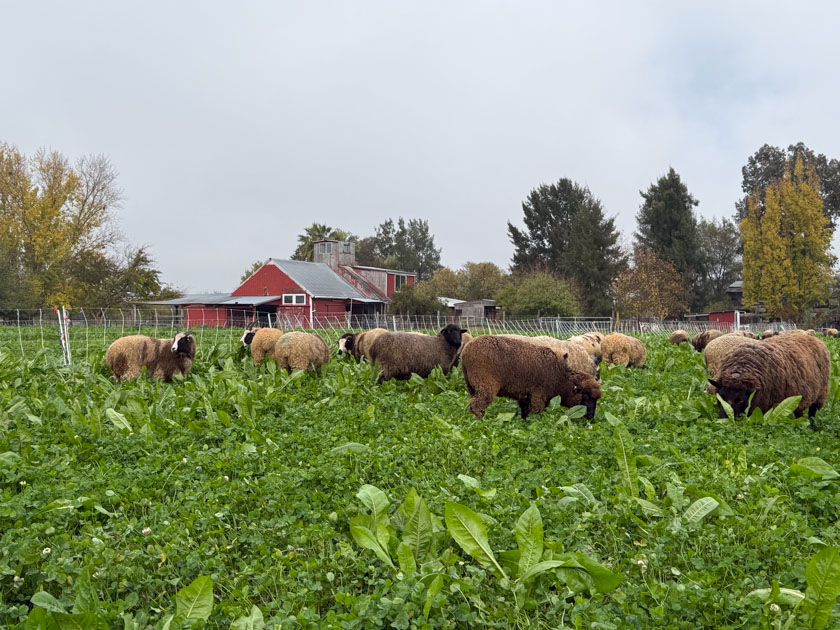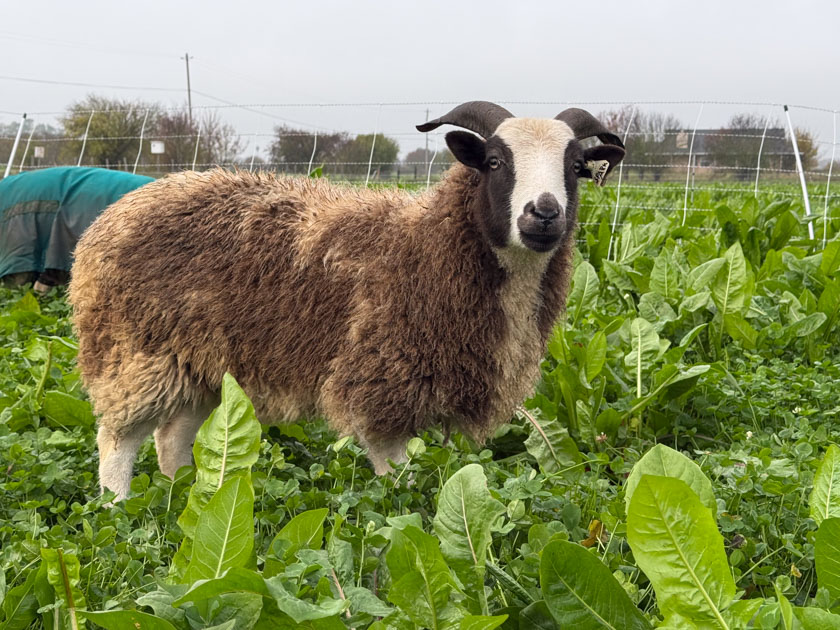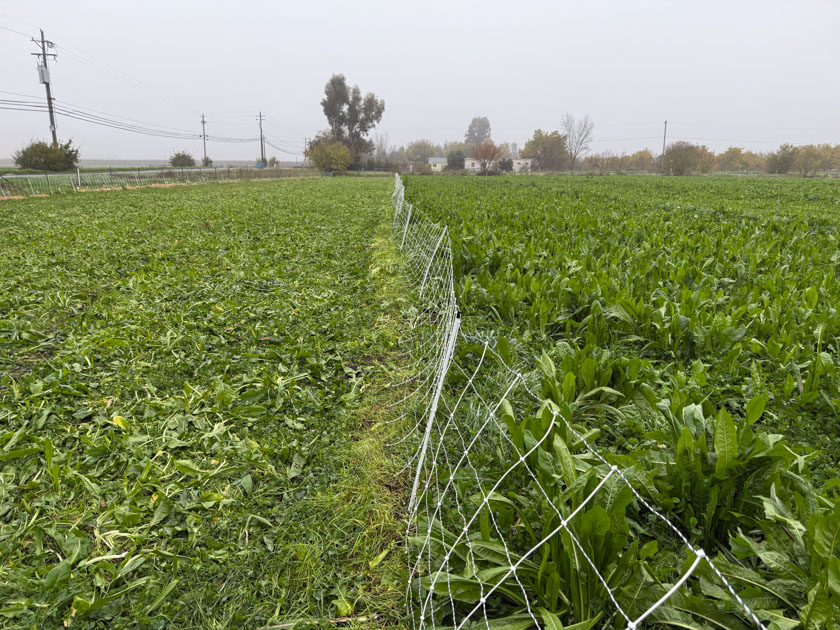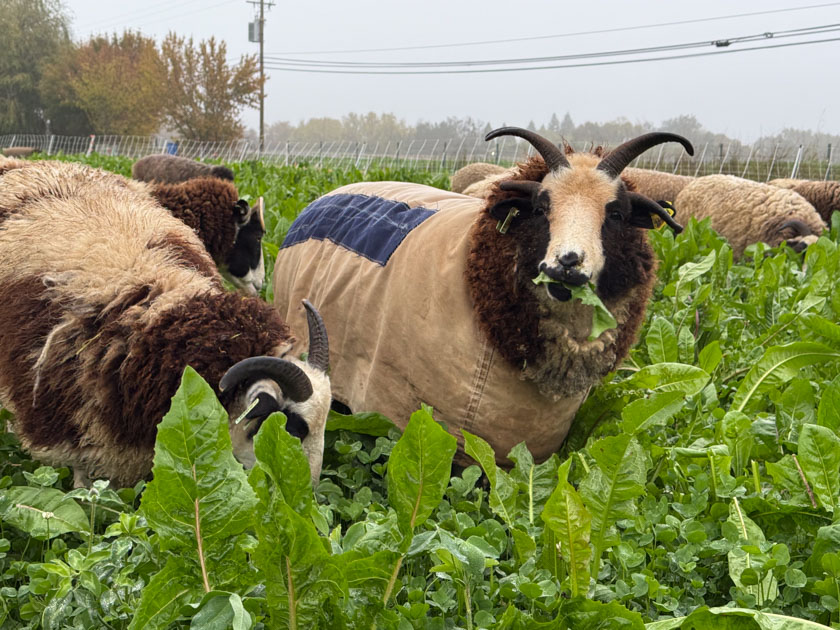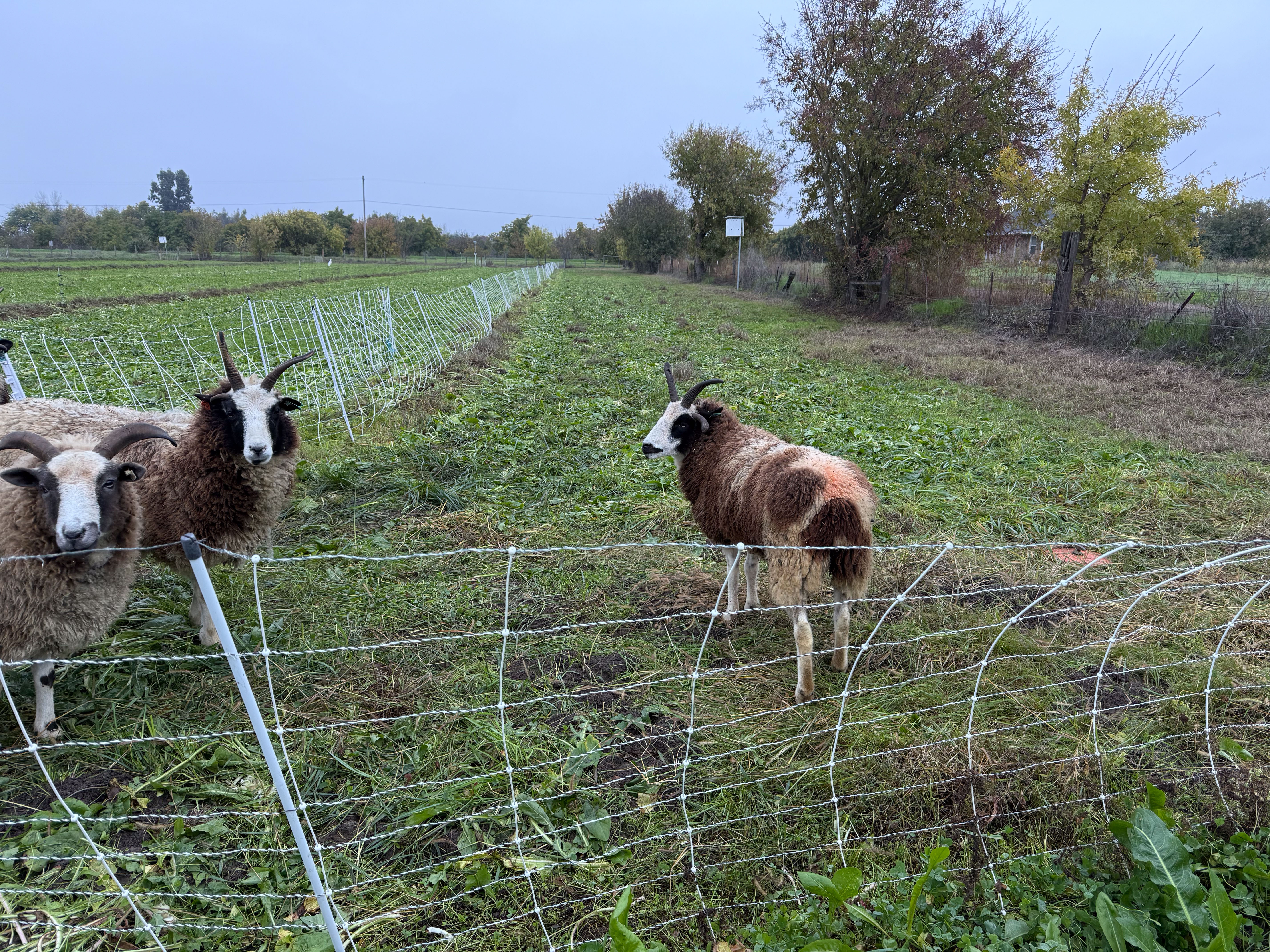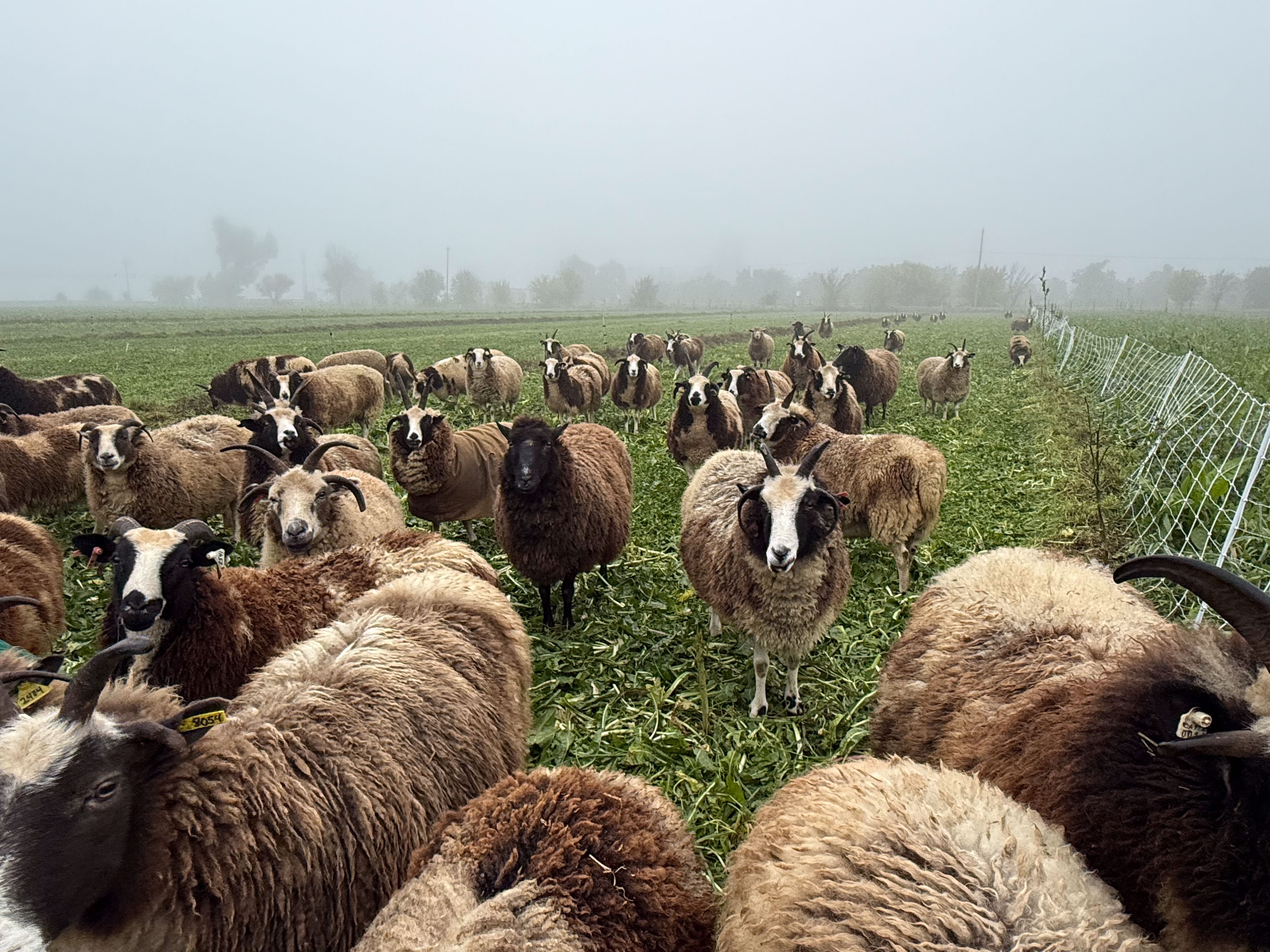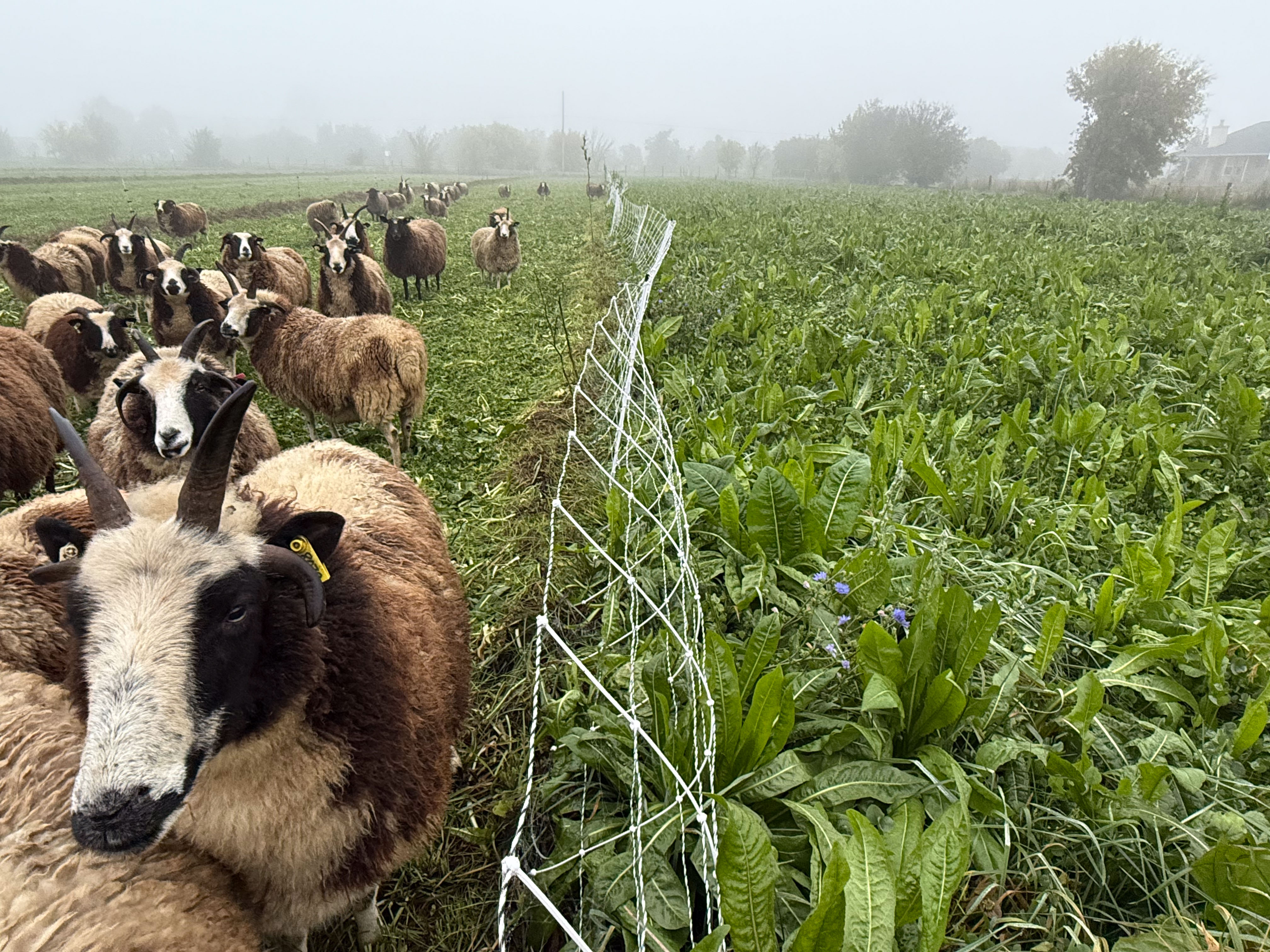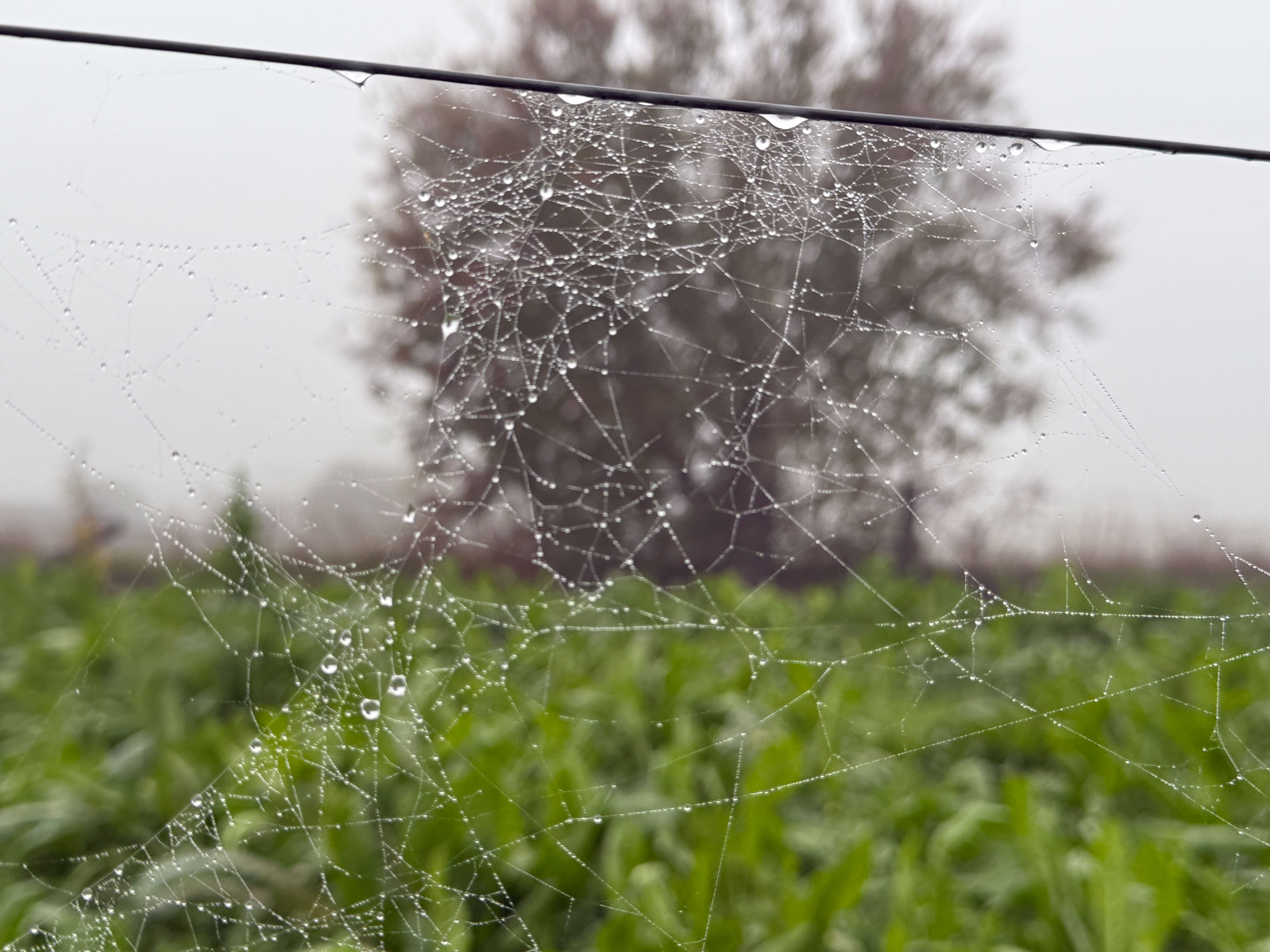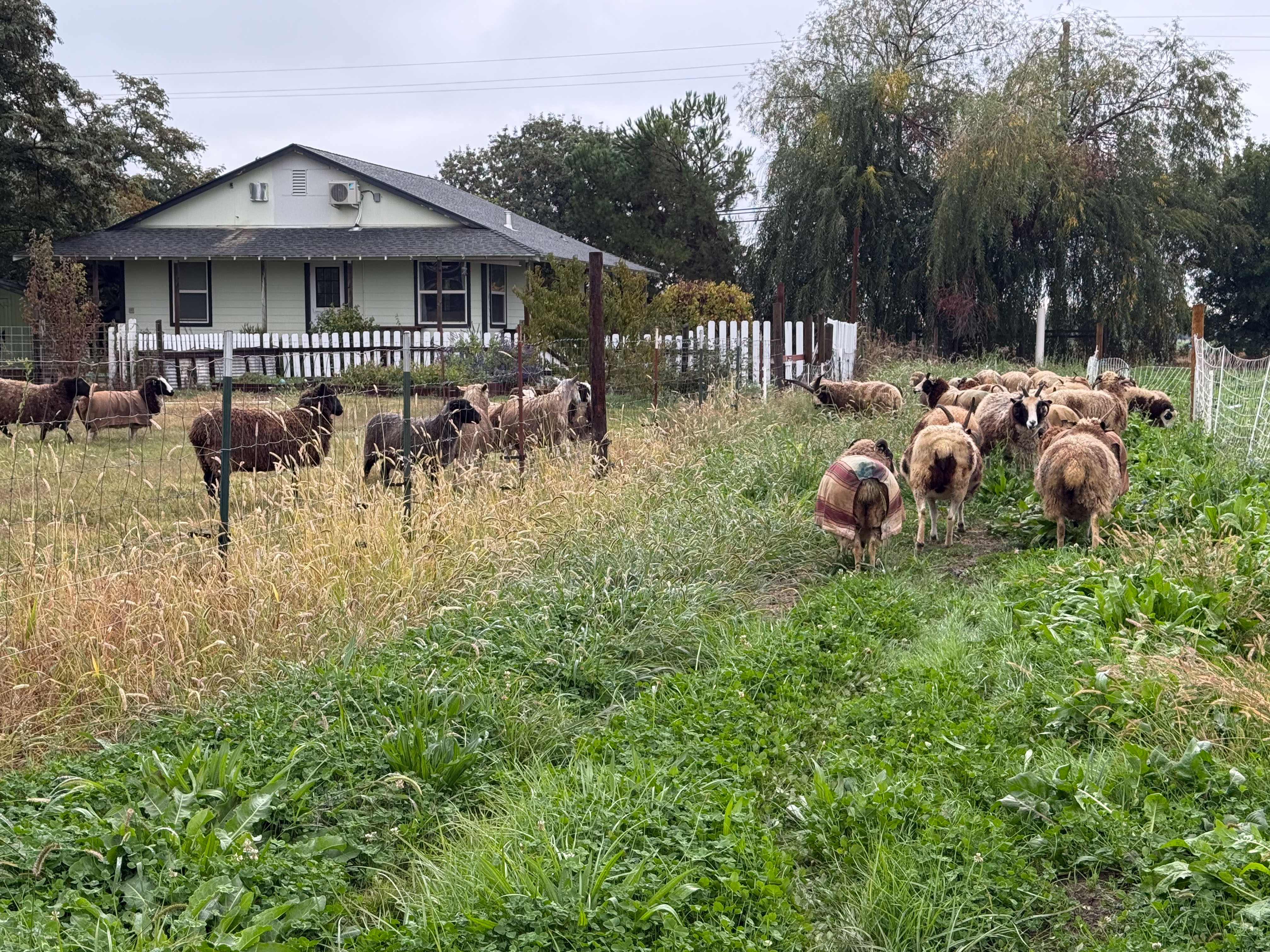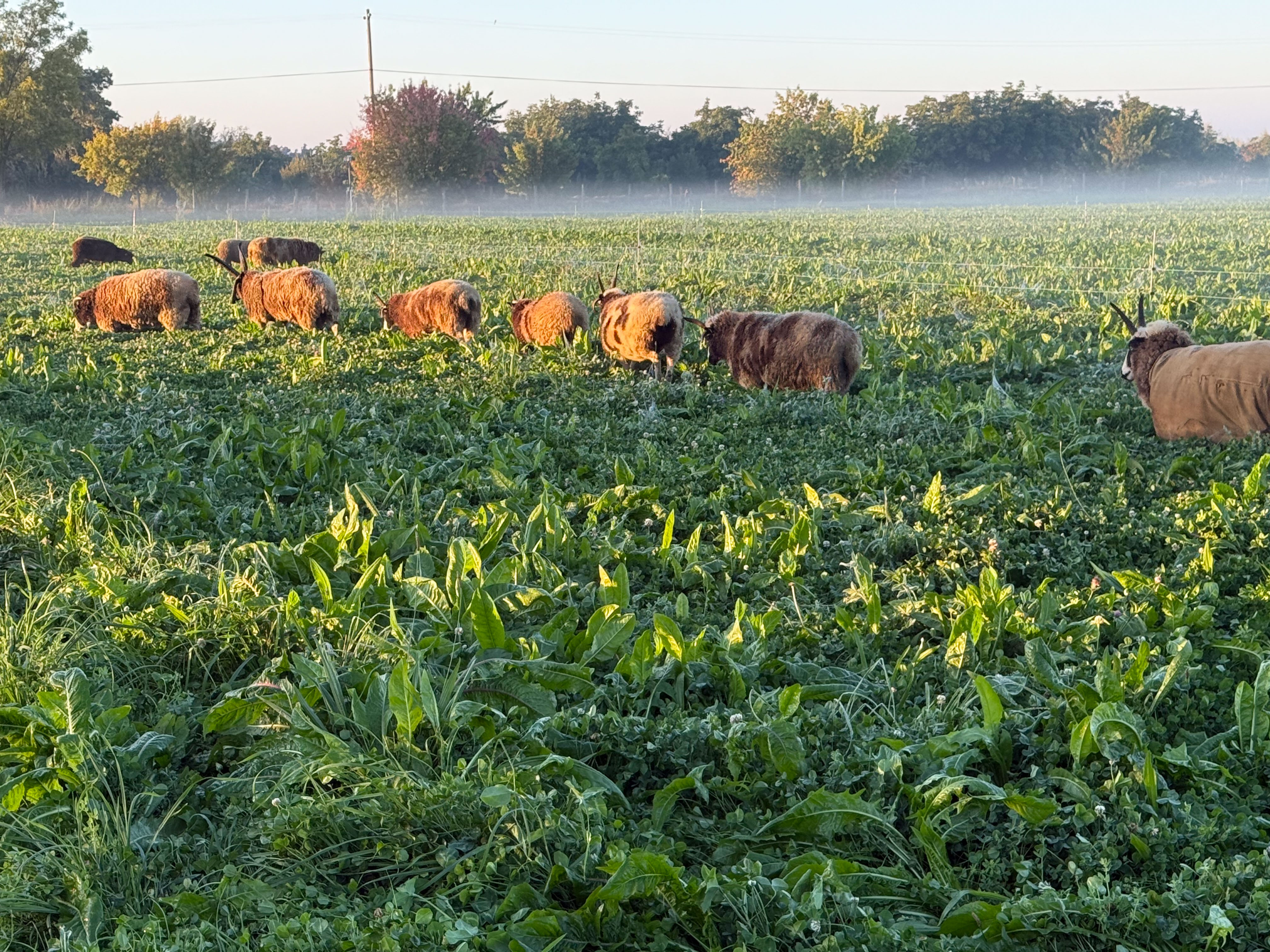
Dan saw a report that we have reached a record of 22 days of tule fog. Cold and drippy. I think I can handle cold (sort of) when it is balanced by a bit of sun. At least the green pasture and fluffy sheep look cheerful.
This is looking northwest to the hills. What hills? Fog instead.
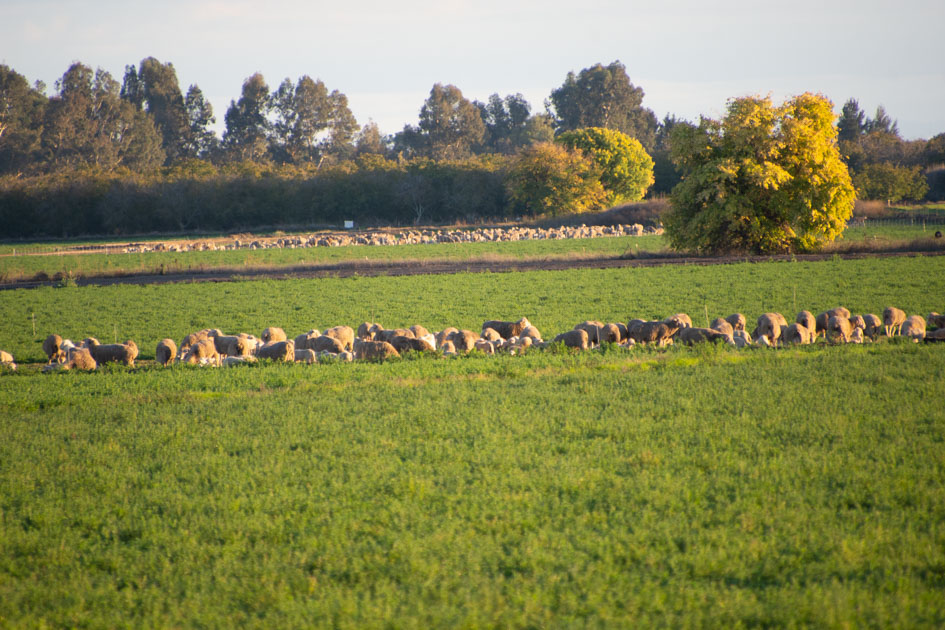
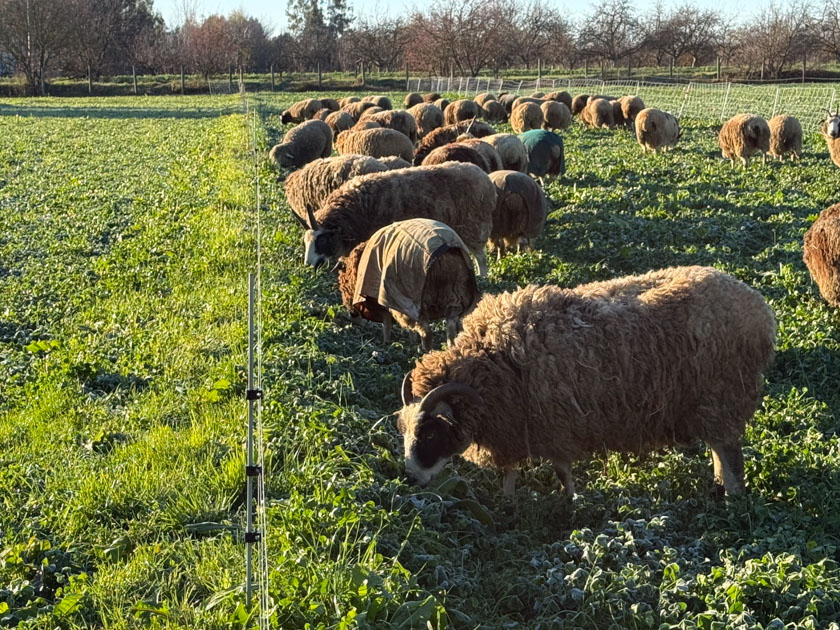
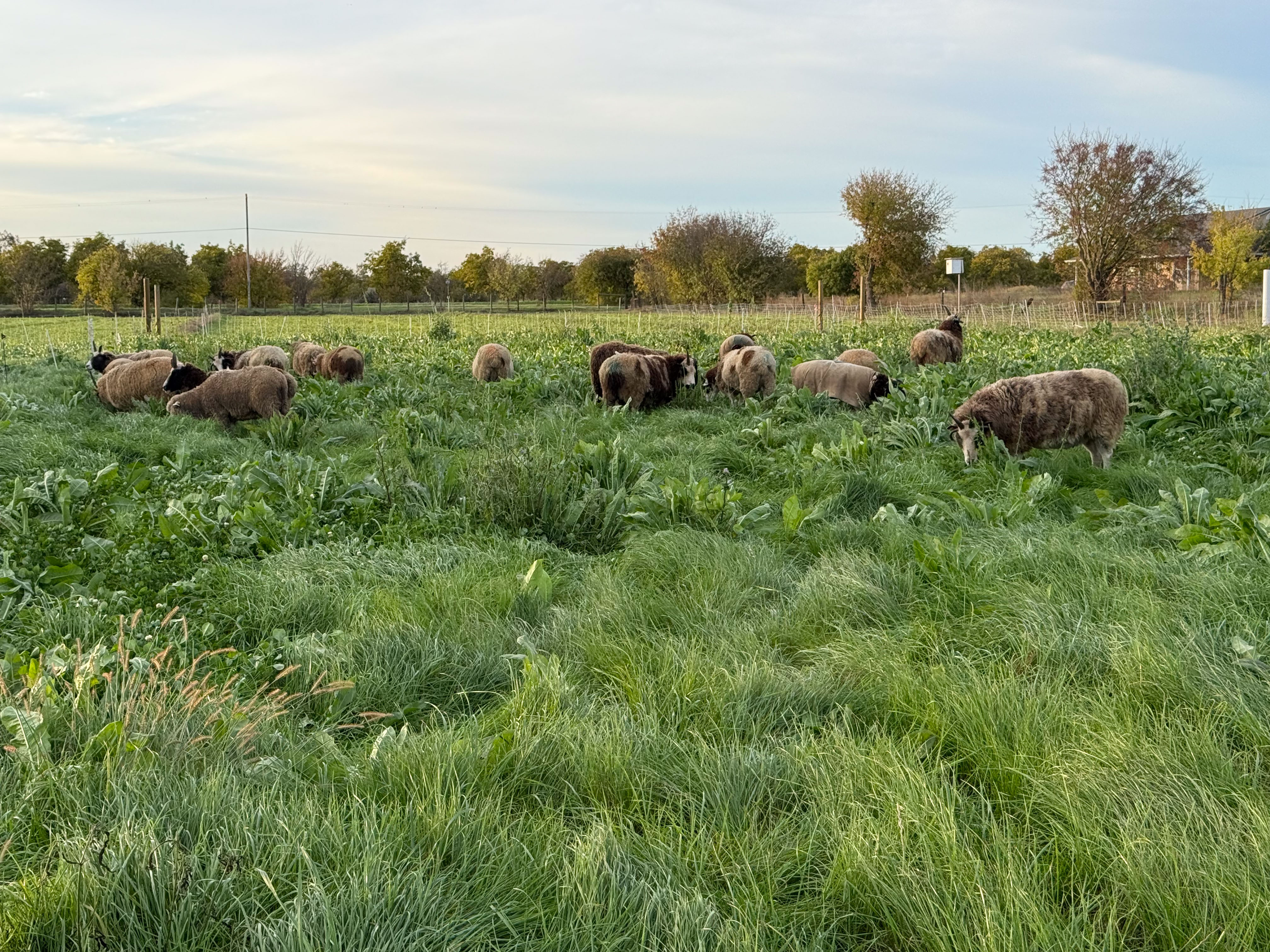
This is the second day grazing Paddock 17. There is still more feed out there, but I want to move them across the other paddocks.
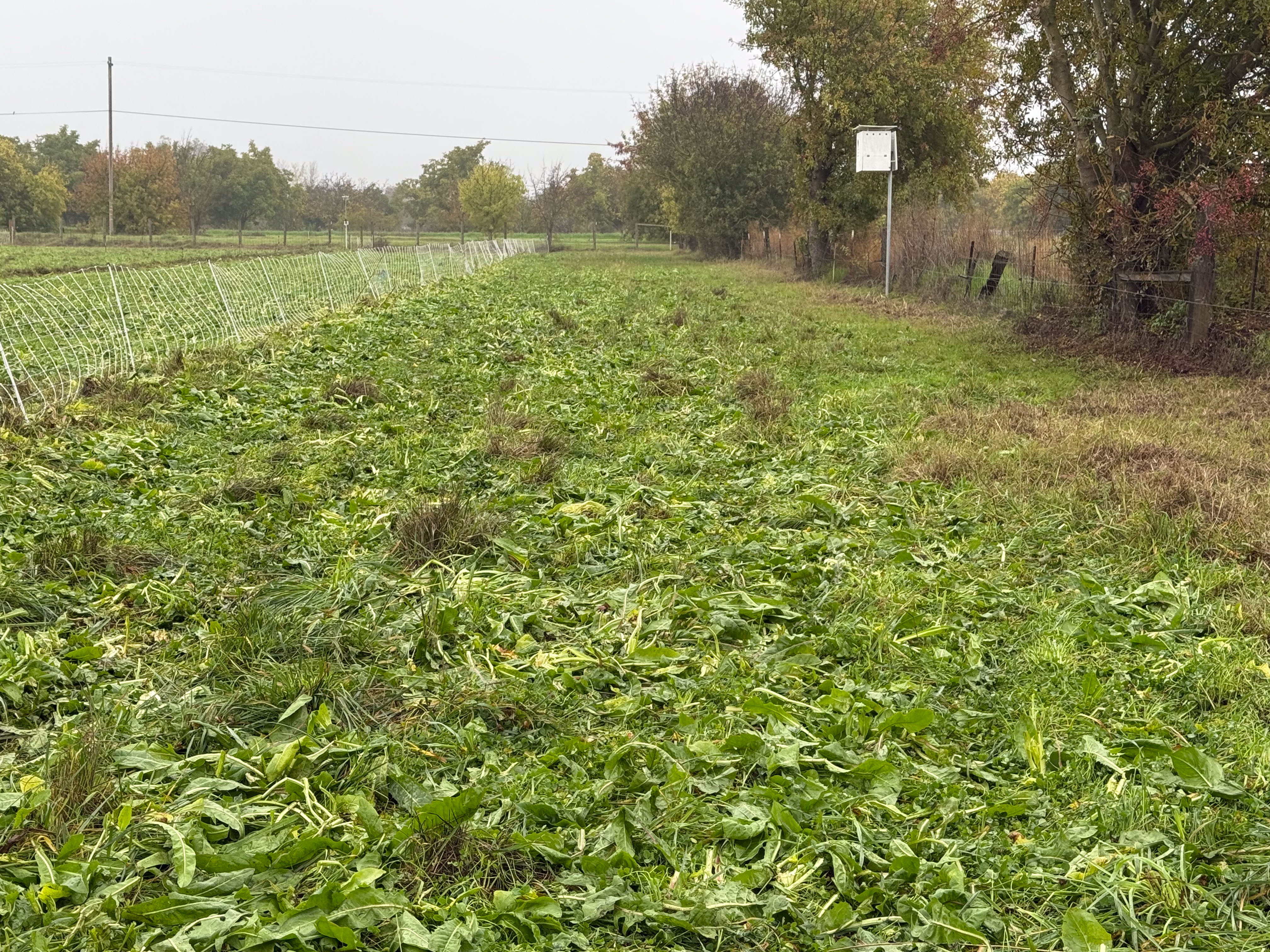
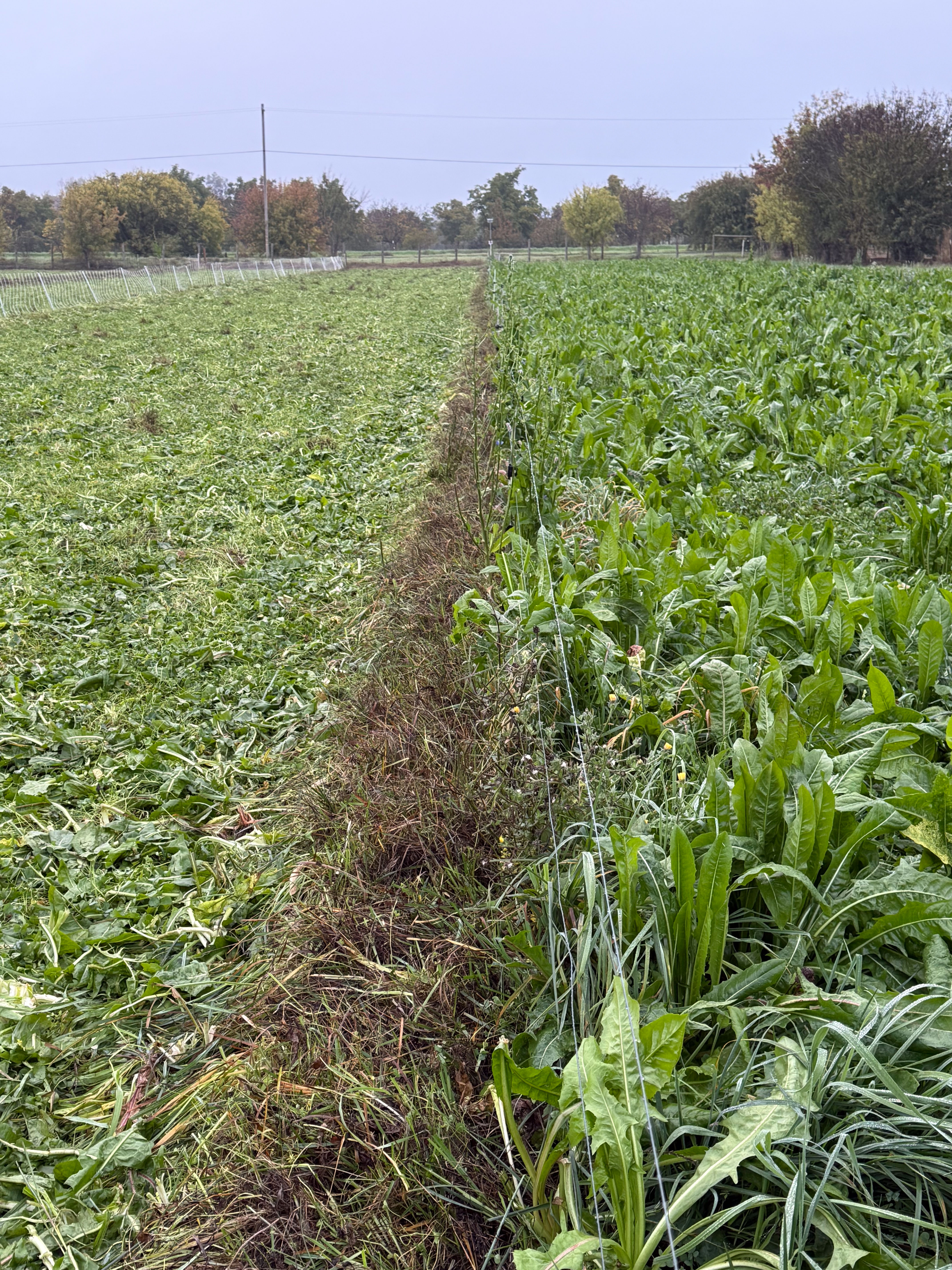
It seems that two days is about right for each of these 30-foot strips. Notice in this photo and the previous one how well the sheep eat right to the edges. The fences are on the checks, the raised strips that channel the irrigation water down the pasture. I think they eat those closer because they aren’t trampled like the middle of the paddock.
This is another view of that paddock.
I moved the net fencing this morning and this is Paddock 16. .
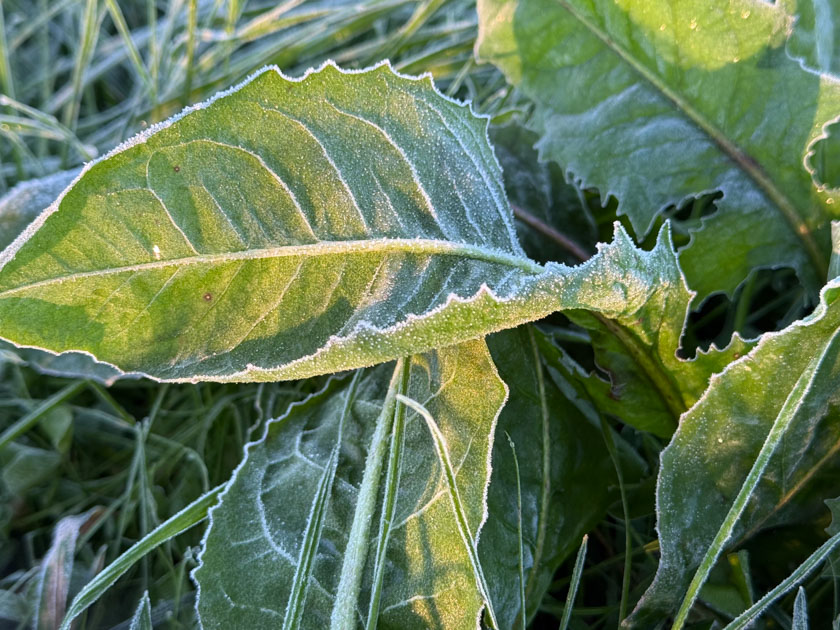
Some of the chicory has red in the leaves and some does not.
We’re still in the gray gloom of drizzly fog, but we accomplished some outdoor tasks that make me feel as through I accomplished something.
These photos were taken on Wednesday, and on Monday I had moved the sheep from the northwest paddocks to the southeast along the road. This is Paddock 20-21 (numbers assigned to indicate the irrigation valves and checks). I had just fenced off the hedgerow we planted two weeks ago (blog post).
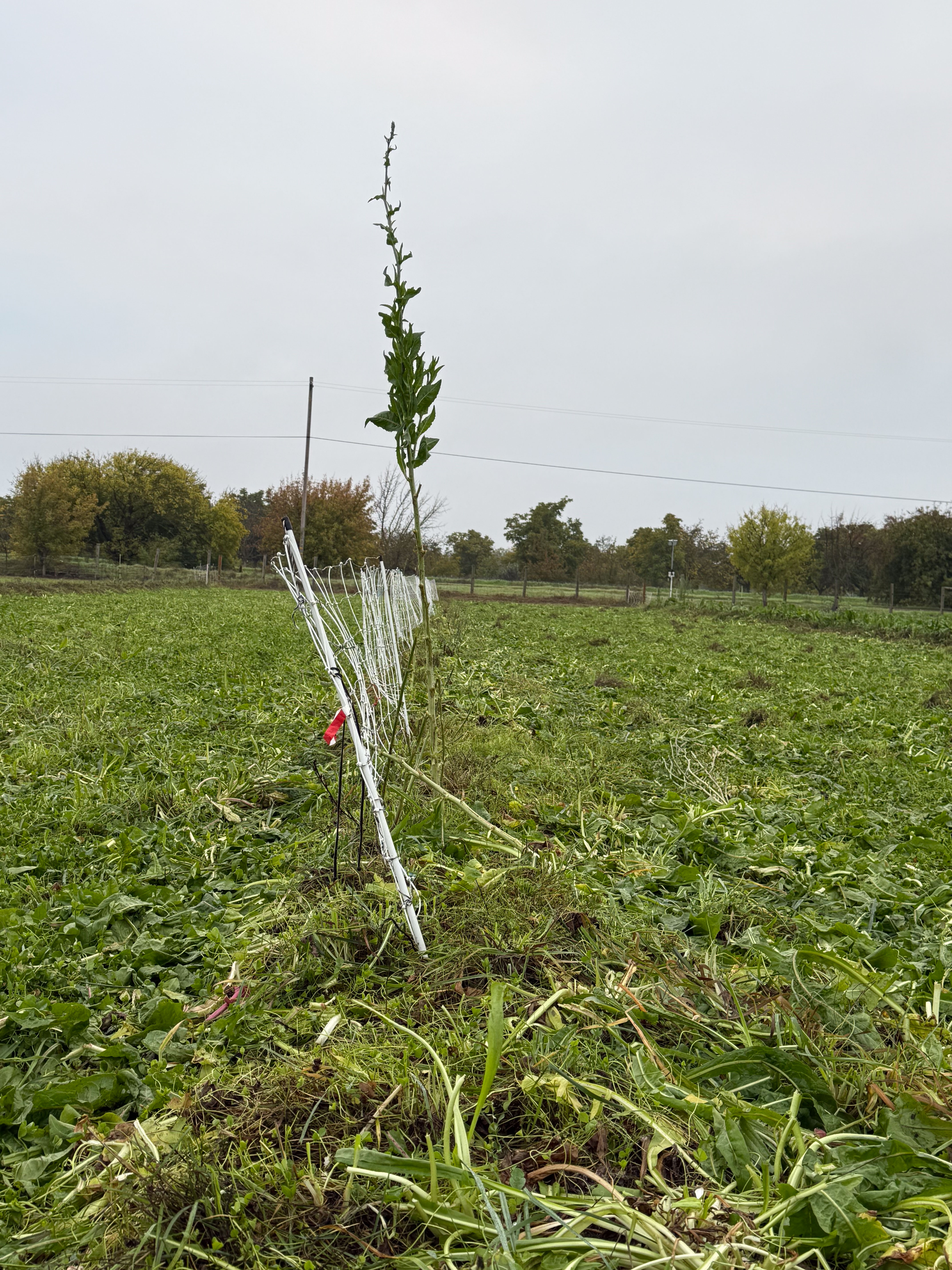
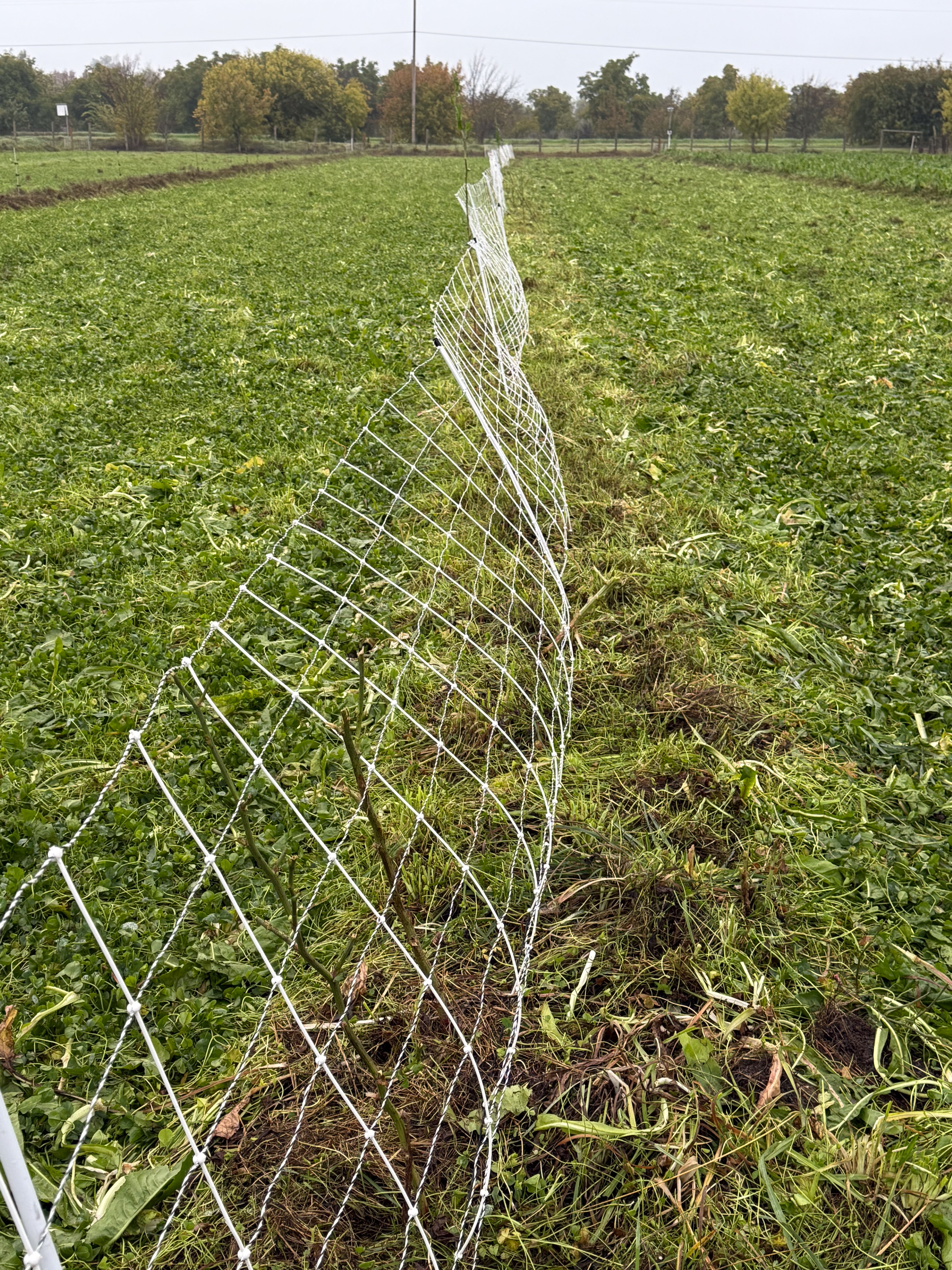
This that same fence but from the south. You might notice that it looks as though the fence is leaning the same direction but this is the opposite view. I have developed the habit of leaning my net fence away from the field the sheep will be in. It is rare that a sheep gets tangled in the net fence, but if that happens there is often a bad outcome. I think it is less likely for those upright horns to snag the fence and cause the sheep to panic if the fence is tipped slightly away when the sheep may be grazing close to the fence, as in a field with this much growth. (The previous photo shows how closely the sheep were grazing to the fence on the other side.) It’s also more likely when the charge on the fence is on the low end, and we need to do some troubleshooting on the connections in this field. So I always tip the fence.
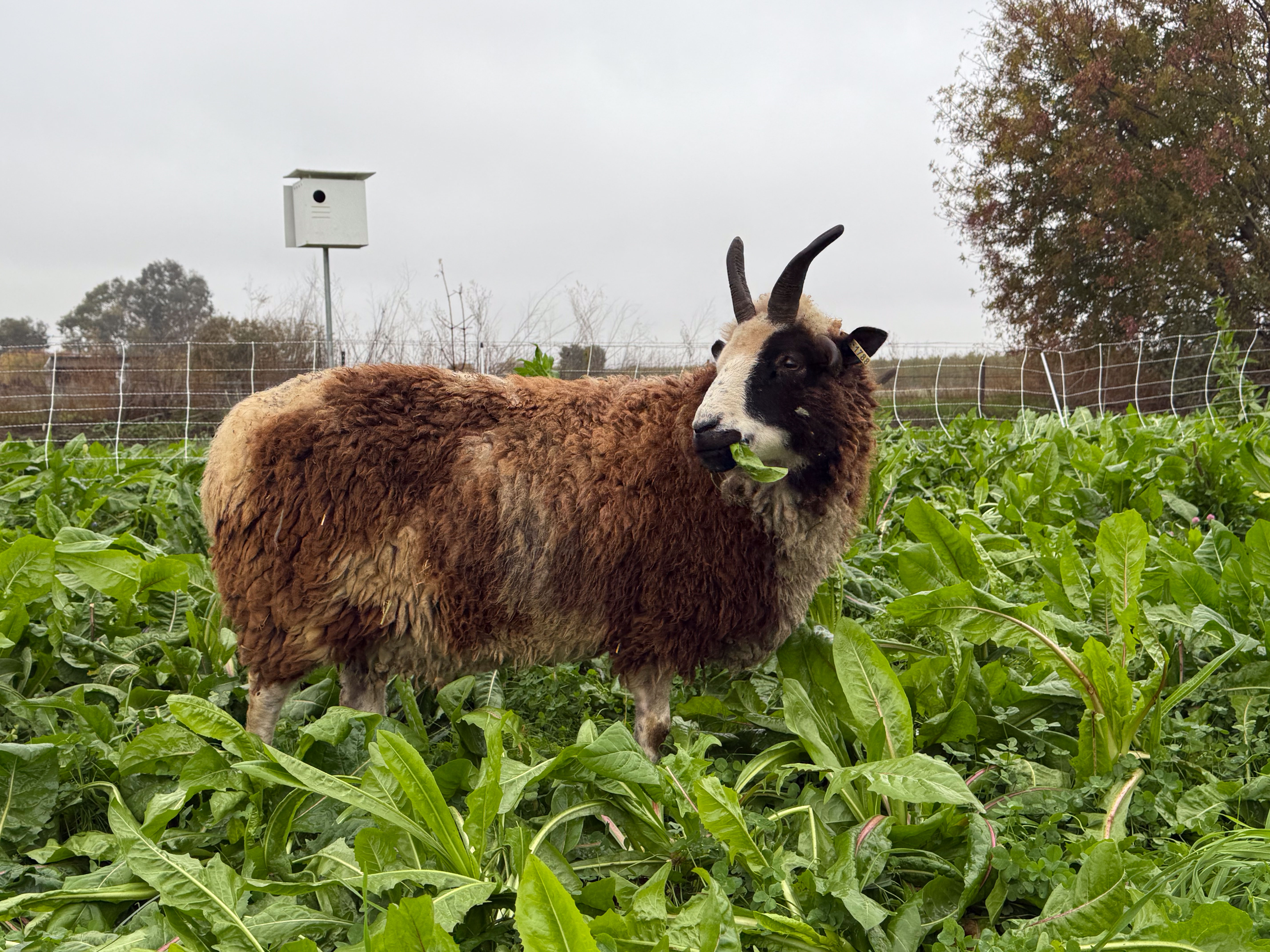
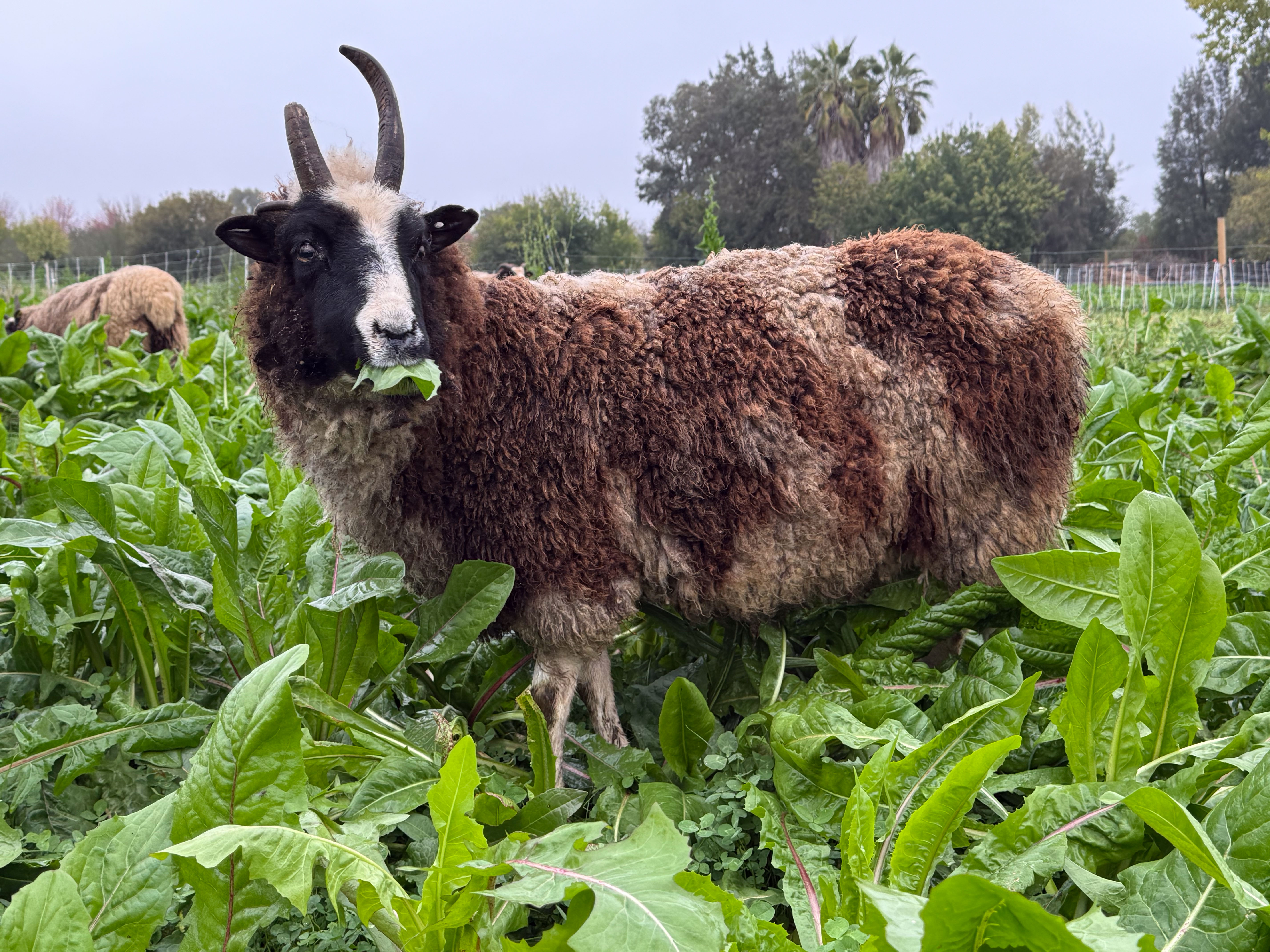
Harmony, one of the ewes whose coat was changed recently (last post).
You all know Jade, the oldest sheep here, and a big pet. The plants you’re seeing are chicory and clover.
After morning chores I was looking for the wheelbarrow to use in the later project of working on the hedgerow. It was near the shop where I had been raking leaves, and I thought that, since it was here. I should rake up fallen lemons before I took the wheelbarrow away.
This tree has been here since we moved to this property in1999. I don’t know anything about growing citrus, but I think the tree may have been a combination of a few different citrus on a common rootstock. Maybe it’s always been just one variety, but I got confused with the different looks that seem to show up at other seasons. In any case, I was paying attention this month when we had loads of fruit on the ground. They sure looked like lemons, but were nothing I wanted to use. Lemons are not supposed to be sweet but I would describe these lemons as nasty. You can see a lot of fruit on the tree now, but it is not nearly ripe, and I know those are oranges. I just looked up lemon rootstock for orange trees and found this video about pruning out those rootstock suckers, which in this case had grown taller than the tree. I was right. The branches that had started as suckers but we hadn’t trimmed were taller than the tree. Do you see that empty spot on top and the one on the right? That is where branches had reached through the rest of the tree and were producing fruit. It was quite a job to cut those away as the branches had grown through other branches and they are very thorny. It took me a couple of hours to finish that job and by then it was about time for Raquel to come.
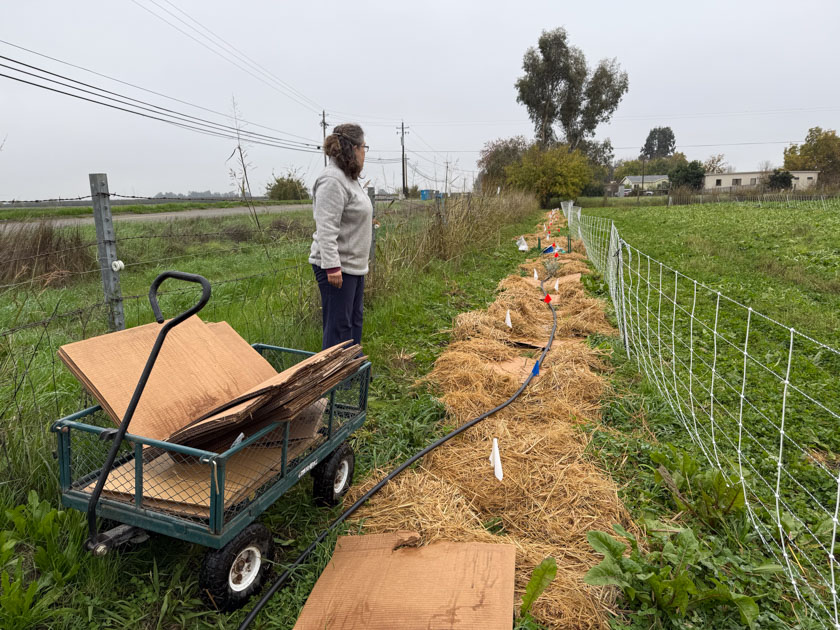
Raquel is a Farm Club member who went out of her way to help figure out how to order what was needed to install a drip system to irrigate our newly planted hedgerow. I had also picked up more cardboard from a friend so we could continue the mulching that we started. We rolled out 250′ of 3/4″ tubing and secured it with u-shaped wires.
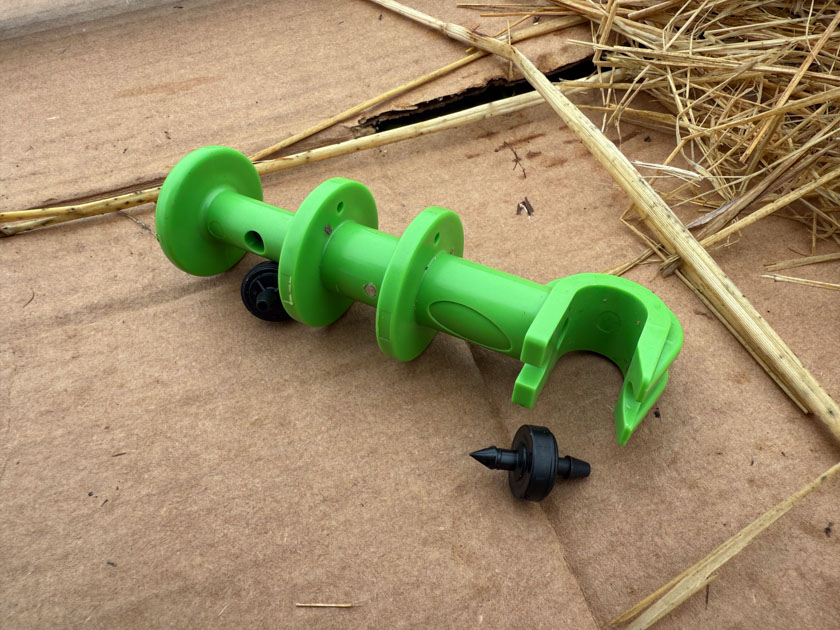
This is the tool that is used to poke holes at the appropriate places in the tube and then insert the emitters.
We had cardboard and straw mulch around the plants, but with the new cardboard we were able to cover space between the plants.
We finished the job…sort of. We used all the 250′ I had ordered. Someone (that would be me) had not measured correctly–a fact which I realized when I installed the new electric net fence for this strip. I thought we had a 250′ hedgerow, but it turns out I was 40′ short of fence. So we knew when we started on this yesterday we would run out of the main tube. We wanted to get as much done as we could though. I have ordered more tubing and all we have to do is connect it to this one and install more emitters and we’ll be good to go. It’s so damp and drizzly now that I don’t have to worry about more water on these plants right away.
The title is significant. I don’t know that we have ever grazed into December. There wasn’t enough feed and the ground was too soggy. Now we have lots of green feed and need to keep the sheep eating it. The downside is that the rain seems to have stopped and we will need more.
This is Paddock #1 (west property line) after two days of grazing.
This is Paddock #1 North, just across that fence. Notice that my boot is under the bottom wire, but it’s pretty well buried in foliage. I walked along this stretch of fence to clear that bottom wire.
Happy sheep.
More happy sheep. The last time we grazed this paddock was three months ago on September 1.
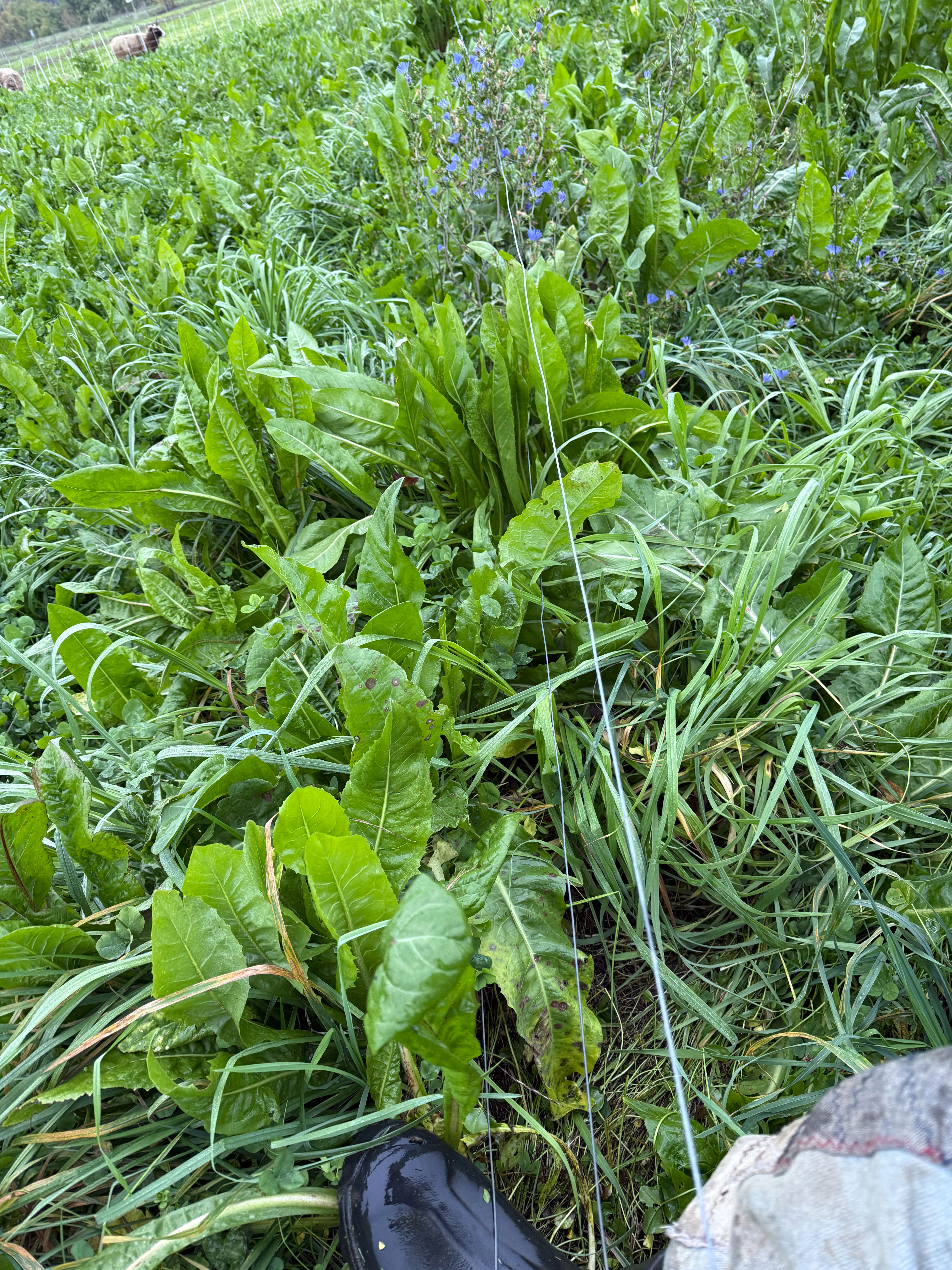
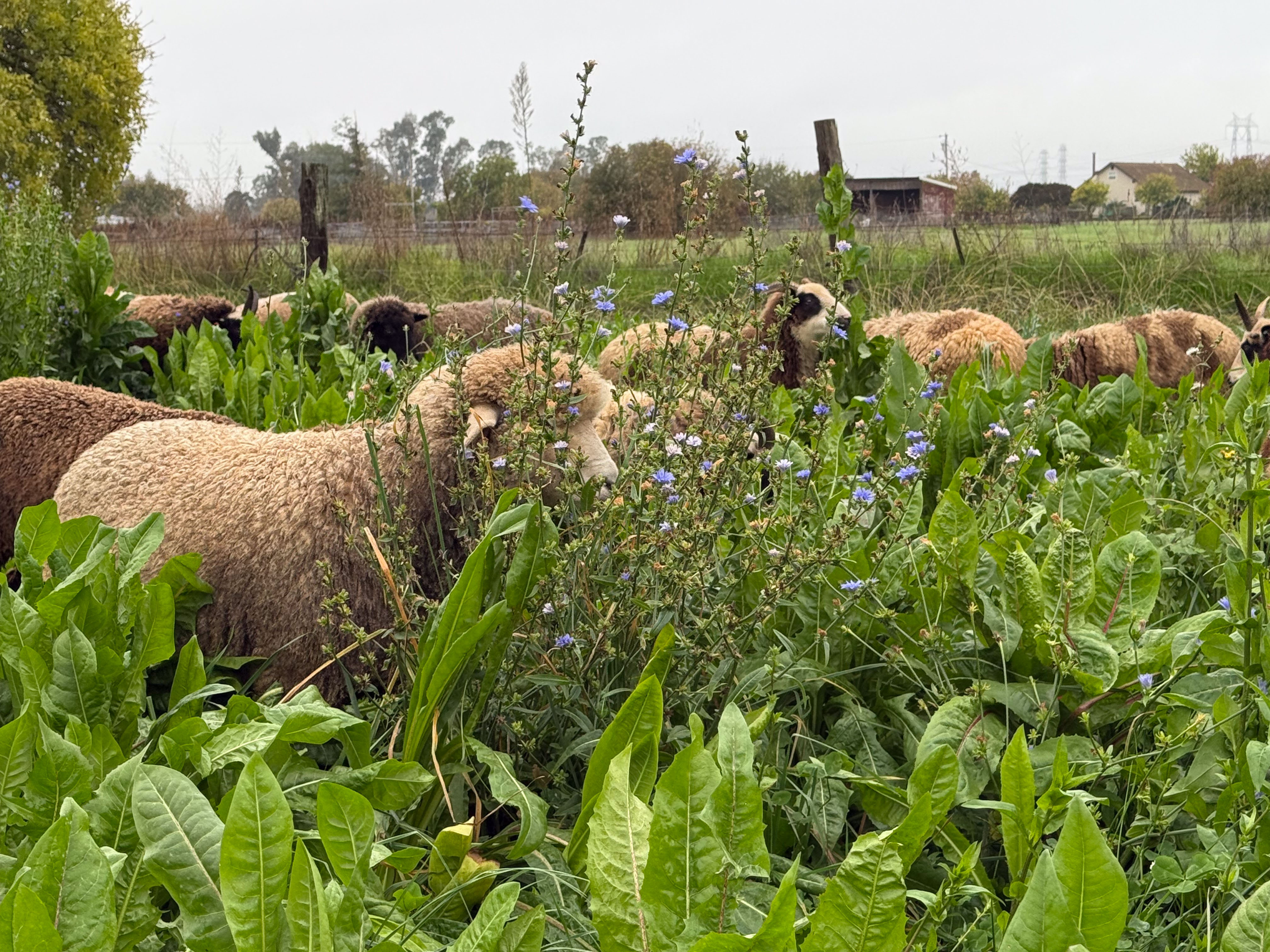
The big leafy plant is chicory and so is the one with blue flowers. It took me a long time to accept that they are the same plant.
After looking it up online I found: “Forage Chicory: Perennial broadleaf. Up to 18” (flower stalks up to 6′). Tap-rooted broadleaf perennial with bright blue flowers suited to well-drained moderately acidic soils. As annual or perennial forage: well-managed stands may persist 5 years or longer, but also valuable in annual stands for pasture or green chop. Very high digestibility and protein levels up to 50% higher than alfalfa. Digestibility is reduced if plants are allowed to bolt, but the flowers are very attractive! Research shows reduced parasite loads in animals fed or pastured on chicory. “
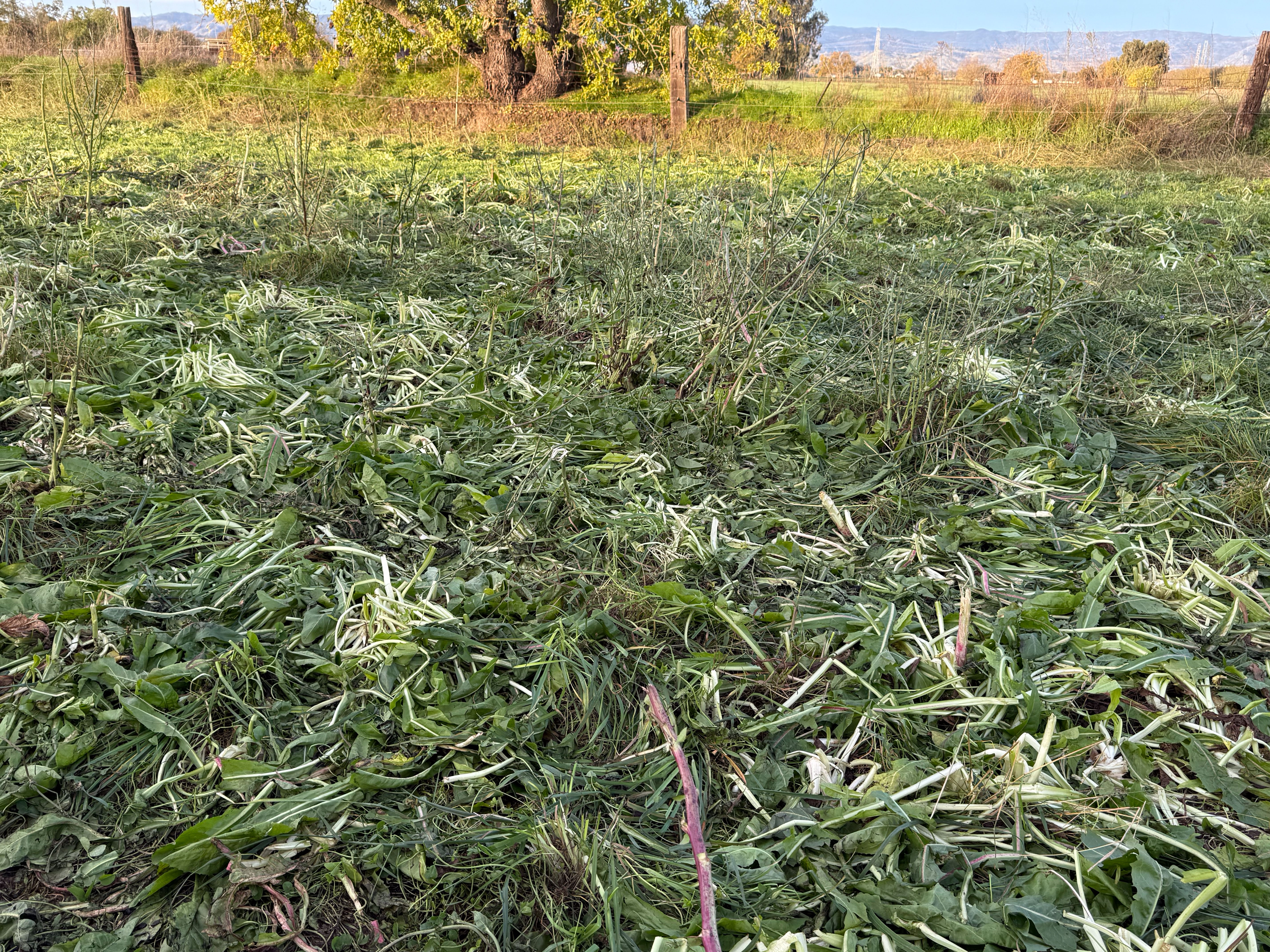
This photo is after grazing Paddock 1N for three days. A lot is trampled, but they were still eating out here this morning.
I opened the fence to let them into the next paddock. I have video and I just spent time on iMovie after not using it for a long time. Let’s see if I can share this on YouTube. Here is the link.
Back to regular blogging. More happy sheep.
This view is interesting to me because this is the area where ryegrass completely overwhelmed the clover last spring. This post is one of several I wrote about that situation. If you pursue the Grazing posts you’ll see the whole story. This is good feed here, but it is patchy, more so than in the rest of the paddocks.
This ewe, Meridian Pecan, isn’t bothered by any of those details. She’s happy to have fresh green feed.
Paddock 1 after the first day of grazing. These are yesterday’s photos and this morning the sheep were moved to Paddock 1-N. That is the one just north of this one.
This is 1-N before I moved the fence.
Did you notice the owl box in the first photo? I can’t look in but I can just reach the latch, open the door, and snap a photo with my phone. It’s obvious that it has been used, but I don’t know if the owls have raised babies or not.
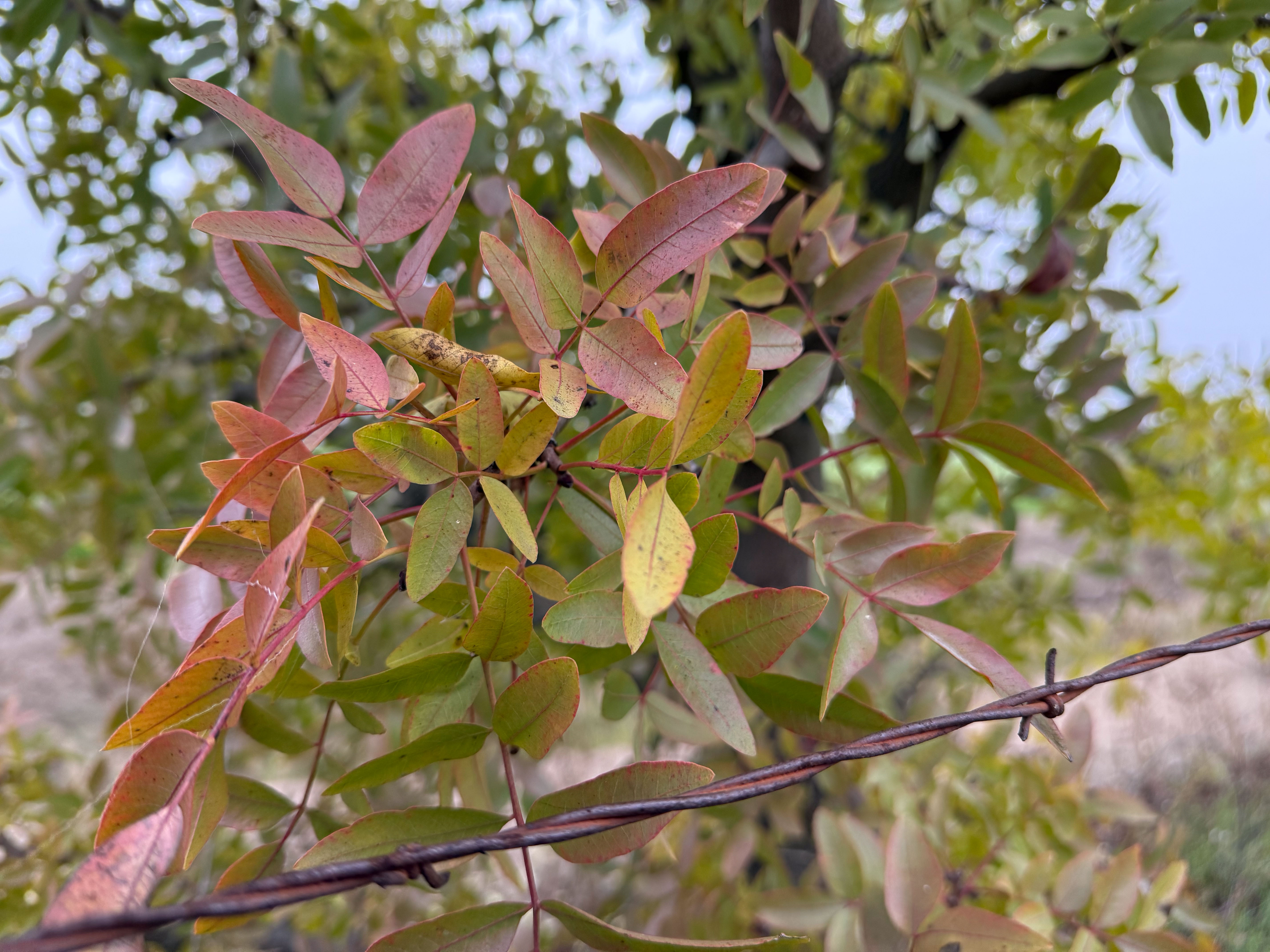
Leaves at the edge of the pasture.
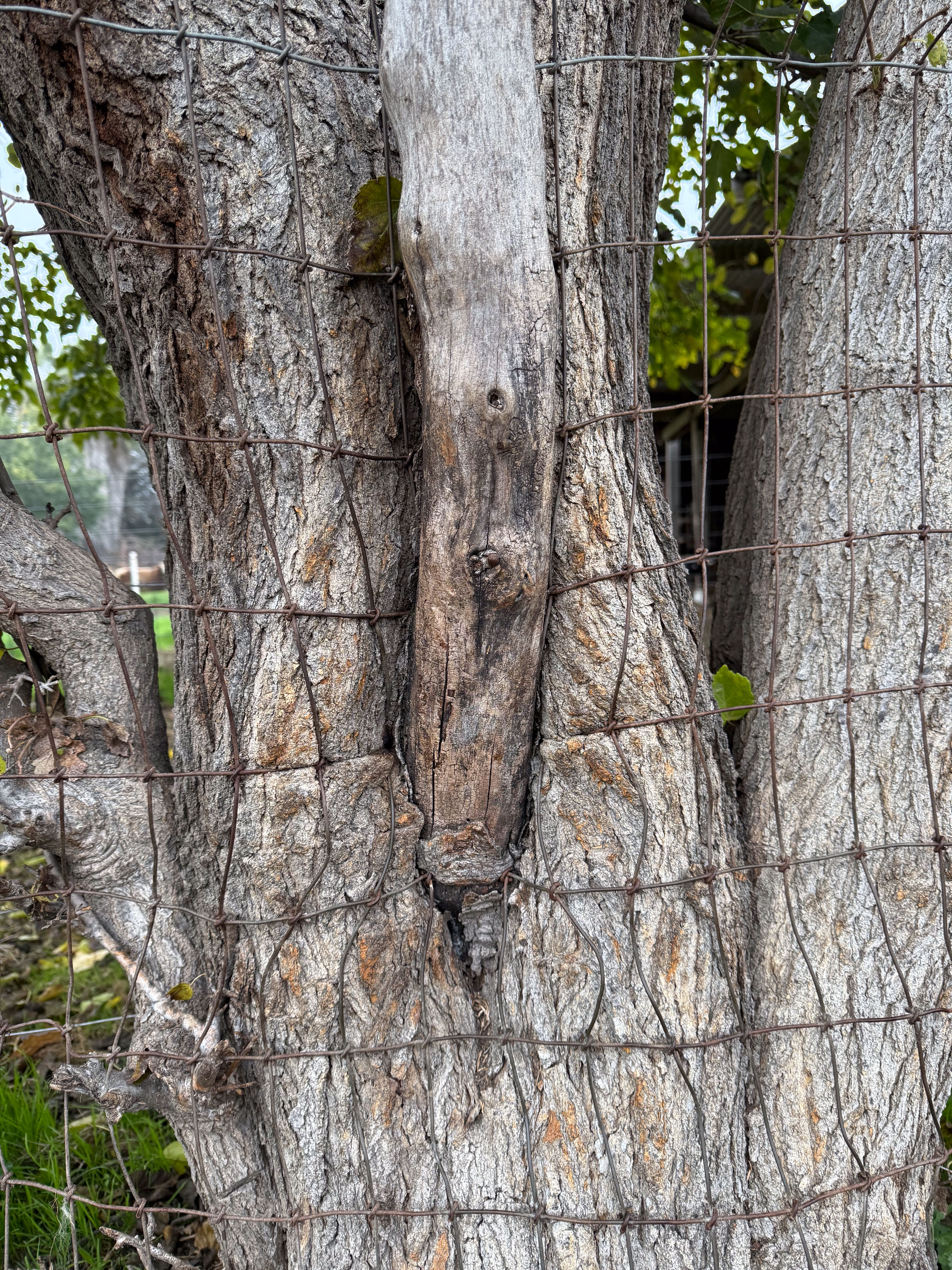
The tenacity of trees to grow however they can.
A view of some of the sheep Across the Road. They are grazing the alfalfa and being moved strip by strip.
We’re almost to the last check in the south pasture. Well, we are at it but that is today and this blog post is about yesterday.
This is looking south and Paddock 2 on the right. That is the one the sheep were just grazing for two days, after grazing Paddock 3 (left) for two days. You can see how this looked two days ago here.
Anther view of that same fence line.
Moving west, this is the fenceline between #3 and #2. I had to move that net fence from the division between #3 and 4 to the division between #2 and 1.
The fence line between #’s 2 and 1, neither yet grazed
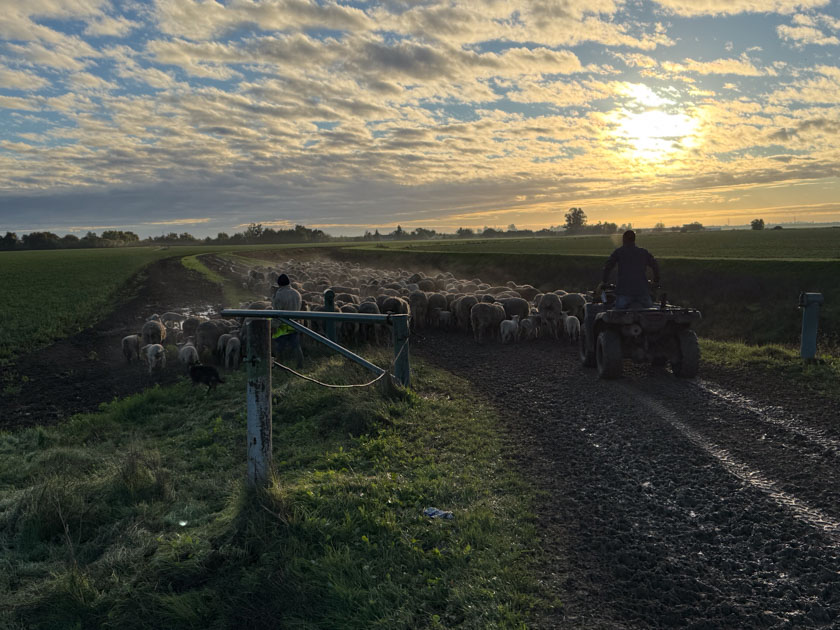
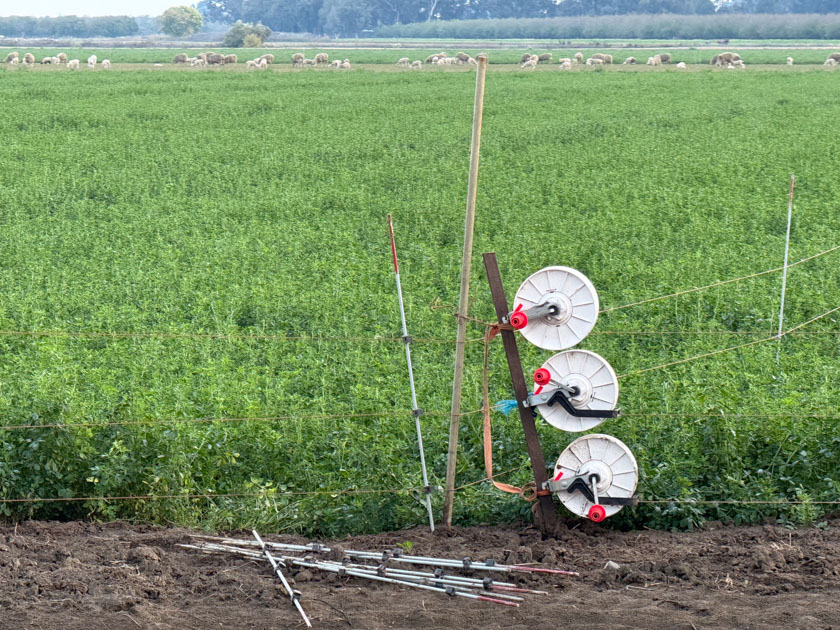
The sheep were out when I went to the barn yesterday morning. The paddocks are numbered from west to east, 1 to 21. Every other check has a permanent 3-wire fence, visible in this photo on the left. In the summer I grazed two at a time and 4 days seemed about right. After we got measurable rain I noticed significant trailing down the border check between the two paddocks they were grazing. The check is a raised strip running north to south that guides the water when we irrigate. I thought I’d better put a fence along that check so that they wouldn’t impact it as much. So that’s the way I’ve been grazing for the last few weeks. When Farm Club helped to measured net fences to make sure I had the correct fences where I needed them (blog post here) I had left 3 lengths of e-net that we measured to be the correct length for just this need. You can see the net fence on the right of this photo.
The sheep grazed this paddock (#4) for two days. This is the third morning and they need to move to #3. The fence is on the border check and you can see how they have grazed right up to it. The fence is purposely tipped away from the grazed paddock because I think the 4-horned sheep are less likely to get horns caught when they graze near the fence.
The sheep were anxious to get to fresh feed.
I was able to move the fence that was blocking access to the next paddock and they all came around the end.
This is the view before I reset the net fence. I find it interesting to see how the sheep ate the leaves as far as they could reach on the chicory. By the way, the leafy plant that looks like we’re growing a crop of lettuce or chard is chicory. That was one of the three forbs in the seed mix we planted last fall. It didn’t grow as much as the clover until later in the summer, but it is sure evident now.
Another view of the fence before I moved it, and more chicory stalks.
The sheep are happy on this new paddock. This is quite a contrast from the one grazed for only two days.
View to the north after re-setting most of the net fence.
As I’ve said before Breeding Season is a Season, overlapping the traditional seasons of summer and fall. If defining a Season influences how you live your life, Breeding Season definitely qualifies. It doesn’t take long before I’m ready for it to be over. It’s easier when all the ewes are in one place, the rams are somewhere else, and I don’t have to feed groups differently and watch my back when I’m with the ewes.
We have 4 breeding groups, a non-breeding group (the oldest sheep, Jade, and six ewe lambs), two young rams with potential for breeding (too young and/or small this year), and two older rams who are sold but still here. The breeding group with the most ewes is on the main pasture. Hornblower has about 30 ewes with him. Doesn’t that pasture look great?
Elvis has eleven ewes and is on the pasture to the north. When I moved the Hornblower group to the next paddock of the south pasture I needed to separate the two groups with more than a single net fence, especially since I’m having some issues with the power to the north one. So I set up two fences and was able to power the north one from the south one.
Those pasture photos were taken October 10. On the 13th it rained. We had 1.6″ the first day and .5″ the second day. A significant rainfall usually marks the end of grazing. It is late in the year and the pasture is depleted or dormant. Also, the land is flat and the water doesn’t drain well. This year is different because the pasture has been renovated and there is a much better stand (mostly clover, trefoil, and chicory). We are not sure how long we’ll be able to graze but it seemed appropriate to continue as long as I moved the sheep to a fresh paddock.
Five days ago I moved Hornblower’s group to the paddock closest to the road.
The lane is adjacent to Clancy’s group. However there is hot wire on both sides of the net fence and there doesn’t seem to be any problem with either ram trying to get through.
You may notice some blue marks on the ewes. Those are more noticeable than the orange marks on several, The rams wear marking harnesses so we have a better idea of when to expect lambs. I hadn’t noticed as many marks lately.
Is this why? The rams went in with ewes three weeks ago on September 27. I substituted the orange markers from Clancy and Hornblower with blue markers a week ago. You can see the difference in a new one and the used ones.
Clancy’s group is in the field between the barn and the shop–not one of the renovated pastures. Notice two blue marks. The ewe in the background marked blue was the first one Clancy marked with orange on September 27.
So we now know that she was not pregnant after that breeding. If all the ewes in this group are re-marked that would indicate a problem with the ram. Hopefully that is not the case. The other ewe marked blue in the photo above this one had not been marked before. I’ll keep watching to make sure that more of the oranges aren’t also marked blue in the next week.
When I wrote a newsletter yesterday I referred to the series of blog posts about the pasture that I wrote over the last year. You can find any of these by searching Pasture and Irrigation Renovation (14 posts) and Grazing and Irrigation (7 posts).
Tonight’s post will follow up on this Grazing and Irrigation post (#7) written in June about May grazing. The pasture looks much different now than it did then.
The ryegrass is gone and you see mostly clover.
Next most prominent is birdsfoot trefoil, and more recently the chicory has taken a foothold. Those are the three broadleaf plants that were in our seed mixture. All of the paddocks in the south pasture look like this now. Back in the spring we started topping the ryegrass with the mower before grazing and mowed again after grazing. This prevented the ryegrass from being flattened over the clover and becoming a mulch layer.
The smaller field on the north is different. We didn’t graze early enough and this is where the annual ryegrass had such a head start on the clover and overwhelmed it in places. I took this photo while irrigating two weeks ago. While the pasture was flooded, some of the ryegrass “mulch” floated and I was able to rake a lot of it into piles thinking that I’d be able to move it out with the tractor.
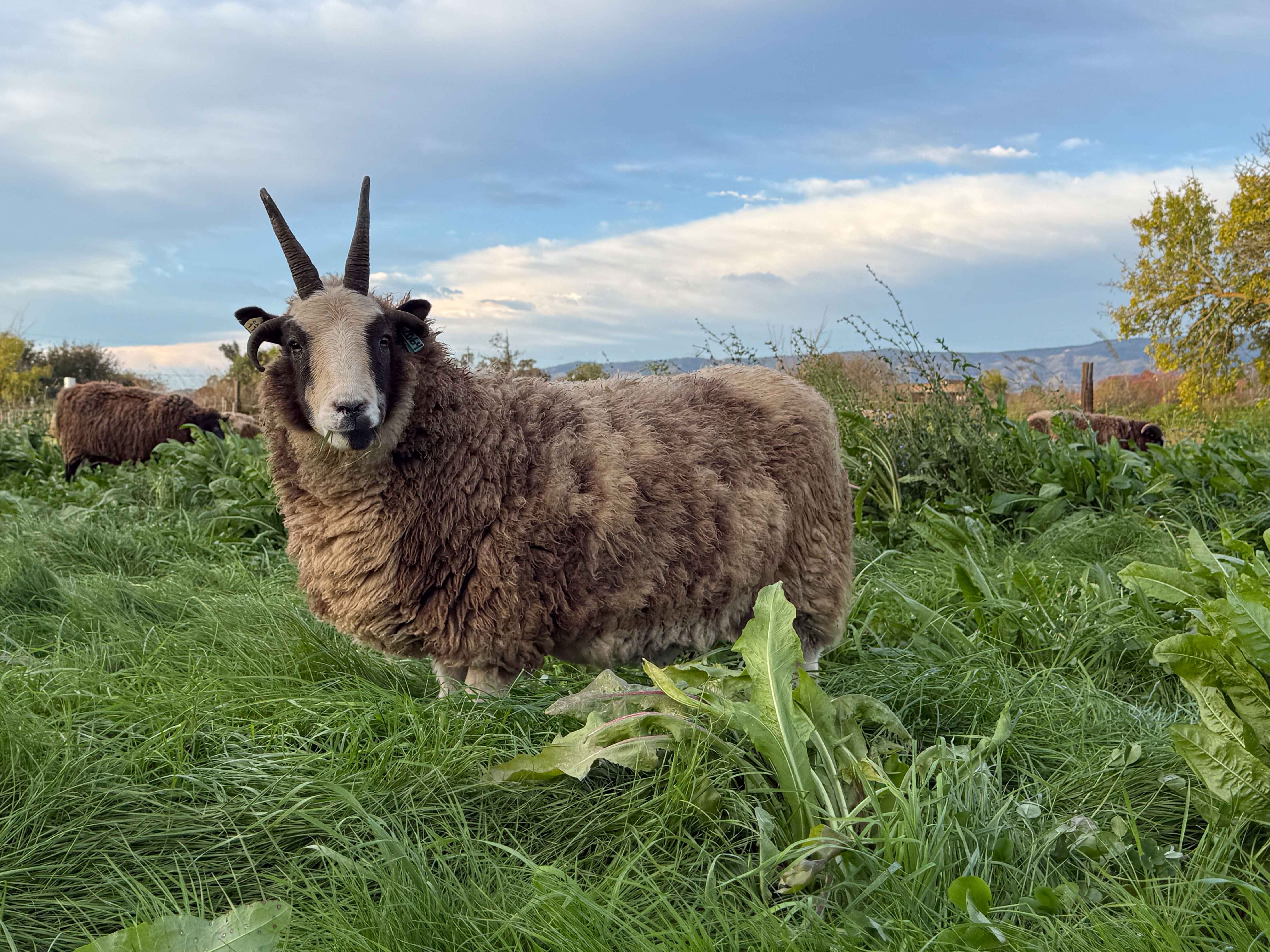
A few days later I realized that I didn’t want to wait until the field dried out enough to use the tractor. I was ready to graze again but the lane was still too muddy. I realized that I could use all that straw to cover up the mud. So I used the wheelbarrow.
I used at least a dozen big loads of ryegrass straw to fill in the lane.
This is Sparky in that north field. Hopefully over the course of winter these bare spots will fill in now the they aren’t covered with mulch.
I am in Michigan now (more on that in a future post), but having a chance to go through photos for planned blog posts. I took these photos last week when I switched the sheep to the last paddock on the west.
A view of the pasture with lots of clover. Most is white clover, but there is some strawberry clover as well. The dry grass is annual rye which has dried out. I have written extensively about the pasture project, seeding, and what is growing. If you’re interested search posts from November 2024 through spring 2025.
Part of the pasture project included two owl boxes. I can’t see inside them without a ladder. However, I can open the door on this one and hold my camera up high enough to take a photo of the inside. It’s obvious that it has been used, but I don’t know if it is used currently or not.
Chicory is one of the plants that was in our seed mix but I don’t see as much of it as I do the clover. After reading articles about native bees I think this is probably one of them.
There have been challenges on the north pasture. The annual ryegrass, which was not part of the seed mix, grew so quickly that it took over some areas. There is clover growing, but a lot was shaded out by the ryegrass that was trampled as the sheep were turned out.
These are patches that I lifted up to show how tall the grass is. It has effectively mulched parts of the field. Dan recently mowed this area to try and break up this thick grass. We’ll try hand seeding some of these areas before irrigating next week.
Back to the south pasture. You can still see the dry ryegrass, but it was mowed or grazed before it got as tall as that in the north pasture. There is plenty of clover thriving under it.
The previous post showed how this looked when the sheep went in. The growth of the annual rye was so fast at this time of year that we needed to move them through fairly quickly.
Here is another view of that same area (left) before removing the fence to graze the next section.
The sheep trail out from the barn to access that field.
It was a challenge to set up fence and graze this with the grass so tall. Thanks to my brother for coming to help set this up.
This was the last day before I had to be gone for four days. Dave came every day while I was gone to get the sheep out on new pasture.