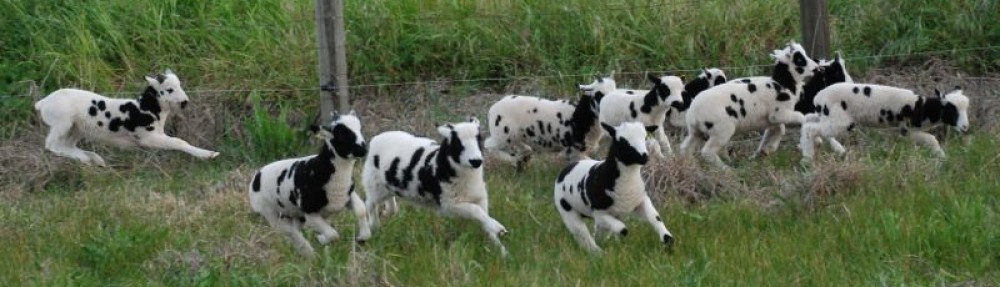
I keep talking about seasons and everyone has their seasons that are important in their lives. Lambing Season for me may be Tax Season for someone else. Some of these seasons overlap. Last year Fly Season began to overlap with Lambing Season. It’s not fun to see lambs born and have flies everywhere. (I could comment on Global Warming here…). Fortunately Fly Season has held off. It is now Irrigation Season.
I live on the western edge of the Central Valley. We are supposed to have wet winters and dry summers. Here are some facts gleaned from the USGS website.
“The Central Valley, also known as the Great Valley of California, covers about 20,000 square miles and is one of the more notable structural depressions in the world…
Approximately 75% of the irrigated land in California and 17% of the Nation’s irrigated land is in the Central Valley.
Using fewer than 1% of U.S. farmland, the Central Valley supplies 8% of U.S. agricultural output (by value) and produces 1/4 of the Nation’s food, including 40% of the Nation’s fruits, nuts, and other table foods.”
Irrigation is the only way that we have green plants in the summer and fall. So Irrigation Season is important, but irrigating isn’t as simple or as easy as just turning on a faucet. Here was my irrigation prep this week. This was taken from standing in the northwest corner of the property and looking west. When SID (Solano Irrigation District) opens the right gate the water comes down that canal, through a gate in the cement structure at the bottom of the photo and…
 …comes up through this standpipe. It goes out that hole on the left and…
 into this ditch. At the end of the ditch it turns south and goes into the other part of the pasture. Later in the year this ditch will require weed-wacking for the whole length to allow the water to flow. This time I didn’t need to do that.
 This part of the ditch has old pipes that take the water under the burm. I can find two of the three that used to be functional.
 The first job is to dig out around both ends of these.
 As I walk through the pasture I find thistles that need to be chopped.
 The rest of the pasture doesn’t have those pipes, but instead has cut-outs or places where the burm is cut away to allow the water to flow from the ditch into the pasture. I didn’t get photos of those. This photo is a cut-out (under the fence) that I had to fill in because it was where we had cut through the burm to allow water flow INTO the ditch in the winter to help drain the rainwater that was all around the barn.
  Here is the place at the northeast corner of the pasture where I have to put a tarp to keep the water backed up in the ditch. After this point the ditch turns south and drains at the southeast corner of the property.
 I can never remember what size tarp to get. I bought 2 sizes and took this photo to remind myself that this one is just fine.
 The idea is to set the tarp so that the edges are buried in dirt and those boards behind will keep the water from pushing the tarp down flat. I did this twice.
  The first time the dirt that holds the tarp down on the bottom was too high. That means when I released the tarp at the end of irrigating there would still be a dam. I have a hard enough time getting the ditch to empty that I don’t need to impede it more.
 This is a second tarp that I set just around the corner in the ditch that goes south. I shouldn’t have to do this, but due to gopher holes, tree roots, and maybe my lack of irrigator skills it seems that one is never enough. Two tarps hold the water back better. Or at least one is a back-up for the other.
 While I was working in the pasture I saw that a couple of lambs had their heads through the electric net fence and didn’t seem to care. That prompted a search for the problem with the electric fence. I found a broken wire at the south end. I got new wire and fixed it but then found several more places where I had joined new wire to old. The more times you do that the less conductivity there is. So I took out a long stretch of the old pieced-together wire and replaced it. Low and behold, my tester showed higher strength than it has in years!
 One thing leads to another. While I was at that end of the pasture I was bothered again by the old dallisgrass that effectively mulches my pasture. It’s one thing to mulch a garden to keep weeds from growing, but mulching a pasture is counter-productive. If you search dallisgrass in this blog you’ll find many attempts to deal with this. This time I was simply knocking it off the electric wire that is about a foot and a half up on inside this fenceline. It broke and pulled away so easily at this time (this is last year’s dry grass) that I started pulling it away by the armfuls. I didn’t have any tools or even gloves, but threw mounds of it over the fence–hey, I’ll mulch the outside of the fence and maybe keep the growth down there. That felt somewhat productive although it may not be useful at all. But at least I could see a difference in the before and after.
More about irrigation in Part 2.

 This was growing inside that pile.
 Even if the rams don’t get to go to the city, some of them are having fun. It’s time to breed my ewes that will lamb at the State Fair. This is Foley and Isadora yesterday. Today it was Crosby and Clover.


 The sheep don’t mind me working while they graze.


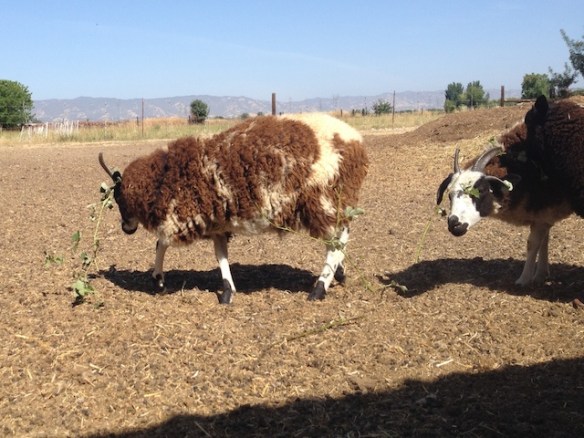 However I’m not happy that the branches get stuck in their wool.

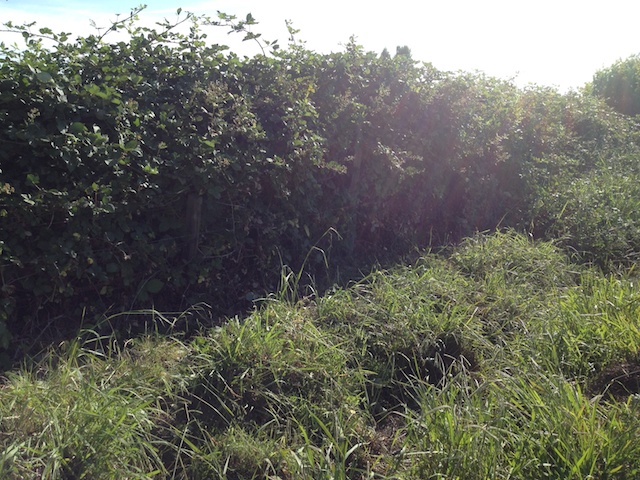

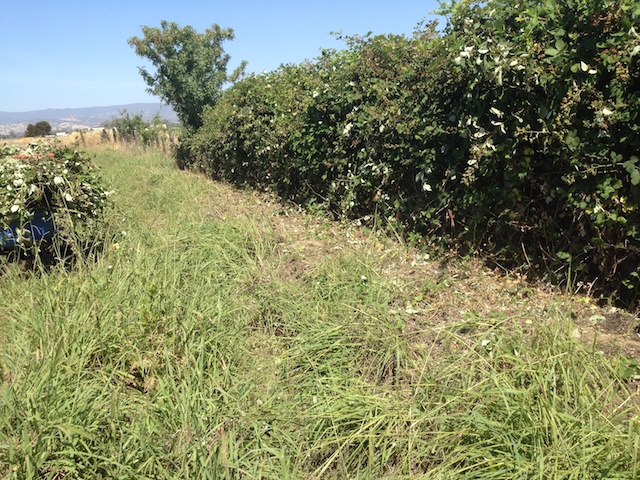
 There are plenty of these still on what is left and they will be easier to get to. With my luck though they will all ripen just about the time that I go to Texas for the birth of my granddaughter.

 This photo shows that they are making progress. Now I can actually see a ditch and the sheep can get through it to the side with the blackberries.


 Meridian Jacobs' Blog